
European Digital Innovation Hubs Network Driving
PM
Published · 9 slides · 0 views

1 / 1
Description
European Digital Innovation Hubs Network Driving the EUs digital transformation 12 EDIH 12 SoE Liechtenstein 10 Sectors EDIHs in Liechtenstein Funded under Digital Europe Programme 2 Members Serves a diverse array of sectors,
Related Topics
Share
Embed code
Download this presentation From Below
"European Digital Innovation Hubs Network Driving" is the property of its rightful owner. Permission is granted to download and print the materials on this website for personal, non-commercial use only, and to display it on your personal computer provided you do not modify the materials and that you retain all copyright notices contained in the materials. By downloading content from our website, you accept the terms of this agreement.
Presentation Transcript
01
European Digital Innovation Hubs Network
Driving the EU’s digital transformation<br>
02
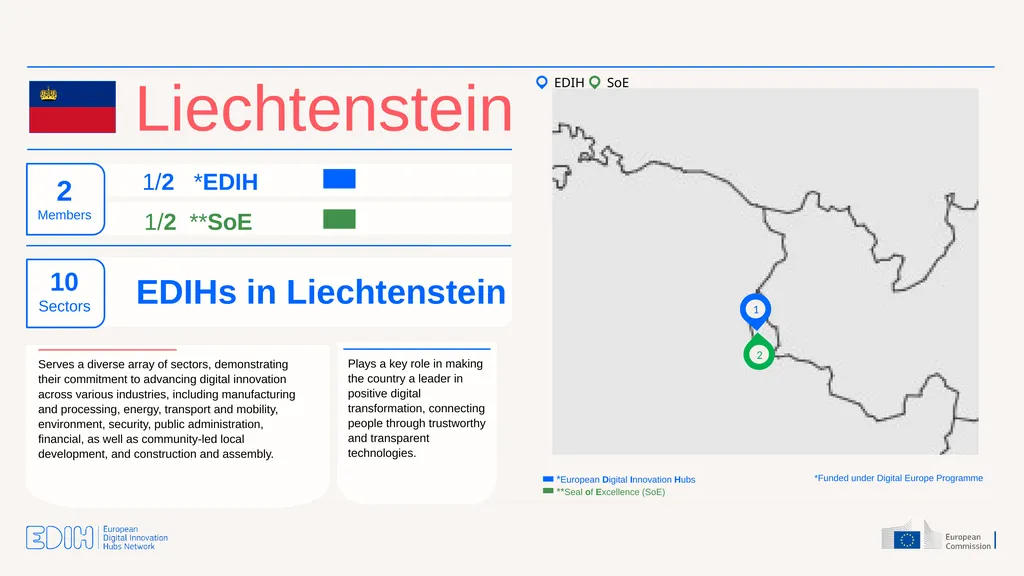
1/2 *EDIH 1/2 **SoE Liechtenstein 10
Sectors EDIHs in Liechtenstein *Funded under Digital Europe Programme 2
Members Serves a diverse array of sectors, demonstrating their commitment to advancing digital innovation across various industries, including manufacturing and processing, energy, transport and mobility, environment, security, public administration, financial, as well as community-led local development, and construction and assembly. Plays a key role in making the country a leader in positive digital transformation, connecting people through trustworthy and transparent technologies.<br>
03
digihub.li Network overview: 2 members – 1 EDIH<br>
04
EDIH Digital Trust Network overview: 2 members – 1 SoE<br>
05
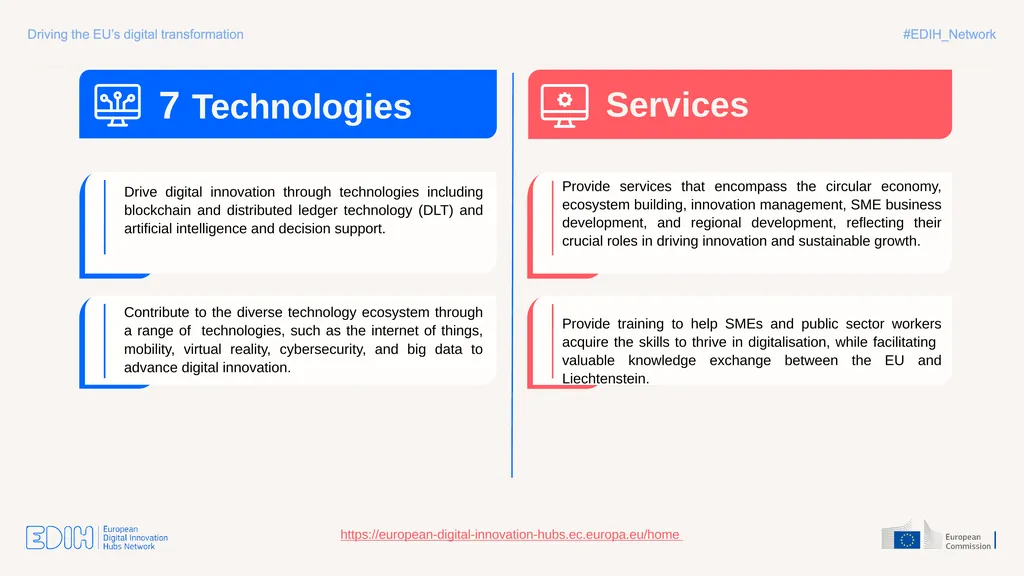
Services Drive digital innovation through technologies including blockchain and distributed ledger technology (DLT) and artificial intelligence and decision support. Provide services that encompass the circular economy, ecosystem building, innovation management, SME business development, and regional development, reflecting their crucial roles in driving innovation and sustainable growth. 7 Technologies https://european-digital-innovation-hubs.ec.europa.eu/home Contribute to the diverse technology ecosystem through a range of technologies, such as the internet of things, mobility, virtual reality, cybersecurity, and big data to advance digital innovation. Provide training to help SMEs and public sector workers acquire the skills to thrive in digitalisation, while facilitating valuable knowledge exchange between the EU and Liechtenstein.<br>
06
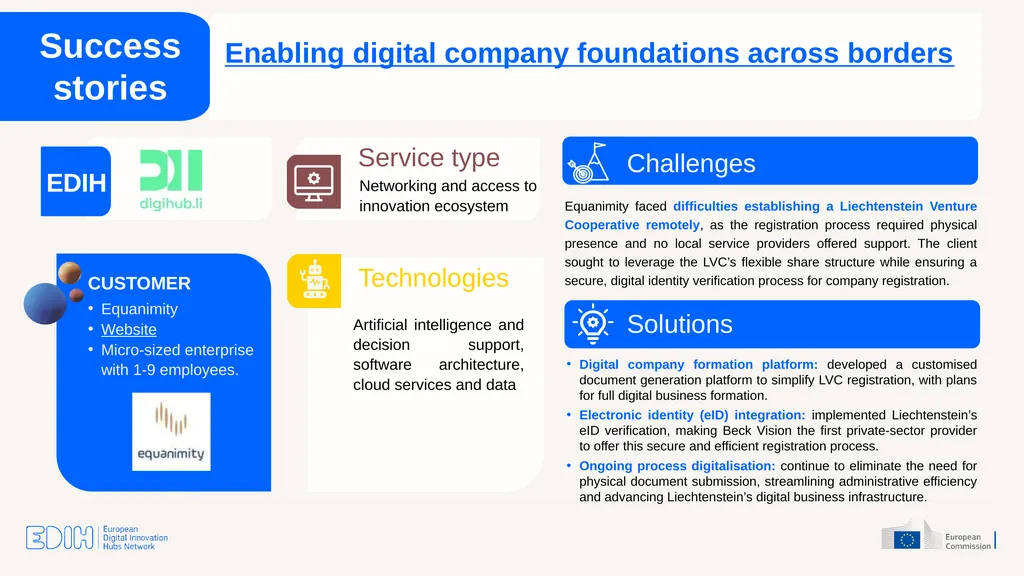
EDIH CUSTOMER
Equanimity
Website
Micro-sized enterprise with 1-9 employees. Equanimity faced difficulties establishing a Liechtenstein Venture Cooperative remotely, as the registration process required physical presence and no local service providers offered support. The client sought to leverage the LVC’s flexible share structure while ensuring a secure, digital identity verification process for company registration. Networking and access to innovation ecosystem Artificial intelligence and decision support, software architecture, cloud services and data Technologies Challenges Service type Digital company formation platform: developed a customised document generation platform to simplify LVC registration, with plans for full digital business formation.
Electronic identity (eID) integration: implemented Liechtenstein’s eID verification, making Beck Vision the first private-sector provider to offer this secure and efficient registration process.
Ongoing process digitalisation: continue to eliminate the need for physical document submission, streamlining administrative efficiency and advancing Liechtenstein’s digital business infrastructure. Solutions Success stories Enabling digital company foundations across borders<br>
07
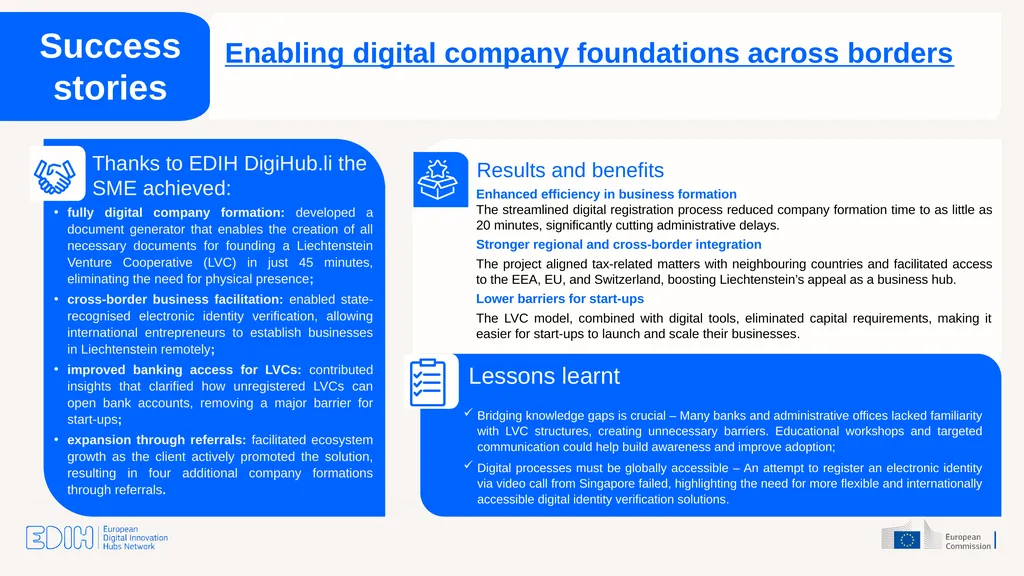
Results and benefits Enhanced efficiency in business formation
The streamlined digital registration process reduced company formation time to as little as 20 minutes, significantly cutting administrative delays.
Stronger regional and cross-border integration
The project aligned tax-related matters with neighbouring countries and facilitated access to the EEA, EU, and Switzerland, boosting Liechtenstein’s appeal as a business hub.
Lower barriers for start-ups
The LVC model, combined with digital tools, eliminated capital requirements, making it easier for start-ups to launch and scale their businesses. Thanks to EDIH DigiHub.li the SME achieved:: fully digital company formation: developed a document generator that enables the creation of all necessary documents for founding a Liechtenstein Venture Cooperative (LVC) in just 45 minutes, eliminating the need for physical presence;
cross-border business facilitation: enabled state-recognised electronic identity verification, allowing international entrepreneurs to establish businesses in Liechtenstein remotely;
improved banking access for LVCs: contributed insights that clarified how unregistered LVCs can open bank accounts, removing a major barrier for start-ups;
expansion through referrals: facilitated ecosystem growth as the client actively promoted the solution, resulting in four additional company formations through referrals. Lessons learnt Bridging knowledge gaps is crucial – Many banks and administrative offices lacked familiarity with LVC structures, creating unnecessary barriers. Educational workshops and targeted communication could help build awareness and improve adoption;
Digital processes must be globally accessible – An attempt to register an electronic identity via video call from Singapore failed, highlighting the need for more flexible and internationally accessible digital identity verification solutions. Success stories Enabling digital company foundations across borders<br>
08
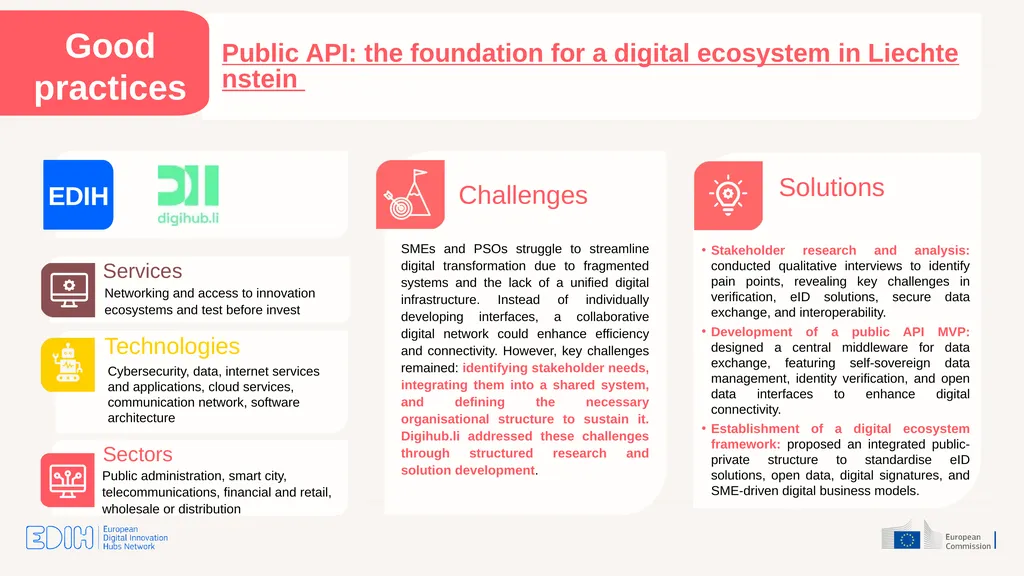
Networking and access to innovation ecosystems and test before invest Services EDIH Challenges SMEs and PSOs struggle to streamline digital transformation due to fragmented systems and the lack of a unified digital infrastructure. Instead of individually developing interfaces, a collaborative digital network could enhance efficiency and connectivity. However, key challenges remained: identifying stakeholder needs, integrating them into a shared system, and defining the necessary organisational structure to sustain it. Digihub.li addressed these challenges through structured research and solution development. Technologies Cybersecurity, data, internet services and applications, cloud services, communication network, software architecture Public administration, smart city, telecommunications, financial and retail, wholesale or distribution Sectors Solutions Stakeholder research and analysis: conducted qualitative interviews to identify pain points, revealing key challenges in verification, eID solutions, secure data exchange, and interoperability.
Development of a public API MVP: designed a central middleware for data exchange, featuring self-sovereign data management, identity verification, and open data interfaces to enhance digital connectivity.
Establishment of a digital ecosystem framework: proposed an integrated public-private structure to standardise eID solutions, open data, digital signatures, and SME-driven digital business models. Good practices Public API: the foundation for a digital ecosystem in Liechtenstein<br>
09
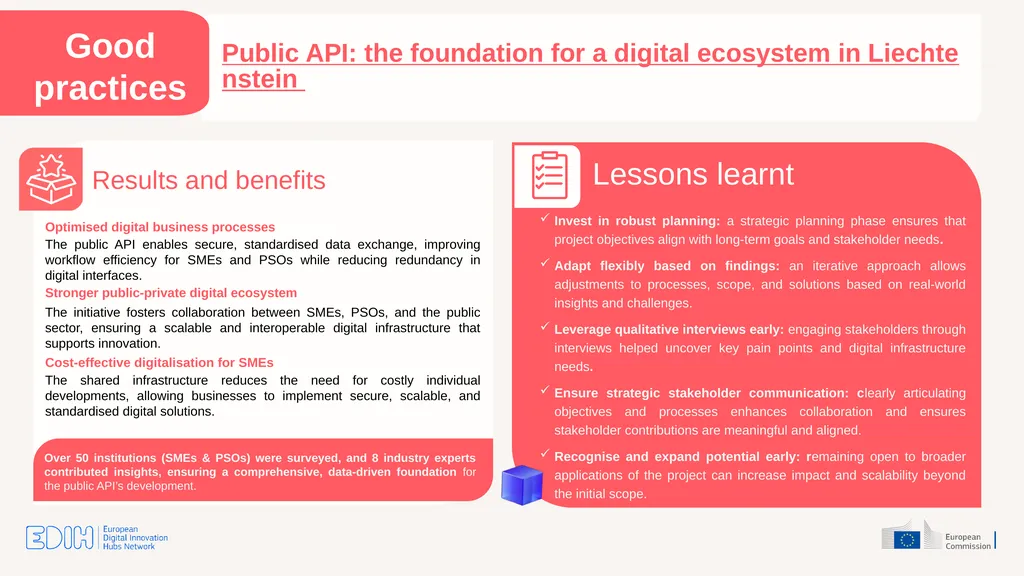
Results and benefits Lessons learnt Optimised digital business processes
The public API enables secure, standardised data exchange, improving workflow efficiency for SMEs and PSOs while reducing redundancy in digital interfaces.
Stronger public-private digital ecosystem
The initiative fosters collaboration between SMEs, PSOs, and the public sector, ensuring a scalable and interoperable digital infrastructure that supports innovation.
Cost-effective digitalisation for SMEs
The shared infrastructure reduces the need for costly individual developments, allowing businesses to implement secure, scalable, and standardised digital solutions. Good practices Invest in robust planning: a strategic planning phase ensures that project objectives align with long-term goals and stakeholder needs.
Adapt flexibly based on findings: an iterative approach allows adjustments to processes, scope, and solutions based on real-world insights and challenges.
Leverage qualitative interviews early: engaging stakeholders through interviews helped uncover key pain points and digital infrastructure needs.
Ensure strategic stakeholder communication: clearly articulating objectives and processes enhances collaboration and ensures stakeholder contributions are meaningful and aligned.
Recognise and expand potential early: remaining open to broader applications of the project can increase impact and scalability beyond the initial scope. Over 50 institutions (SMEs & PSOs) were surveyed, and 8 industry experts contributed insights, ensuring a comprehensive, data-driven foundation for the public API’s development. Public API: the foundation for a digital ecosystem in Liechtenstein<br>