Evacuation Equipment Key Trainer Course Before we begin Housekeeping Emergency exits, fire alarms, assembly points and facilities Health and Safety Medical conditions, recent operations Ok to walk backwards downstairs Any other concerns
"Evacuation Equipment Key Trainer Course Before we" is the property of its rightful owner. Permission is granted to
download and print the materials on this website for personal, non-commercial use only, and to display it
on your personal computer provided you do not modify the materials and that you retain all copyright
notices contained in the materials. By downloading content from our website, you accept the terms of this
agreement.
Presentation Transcript
01
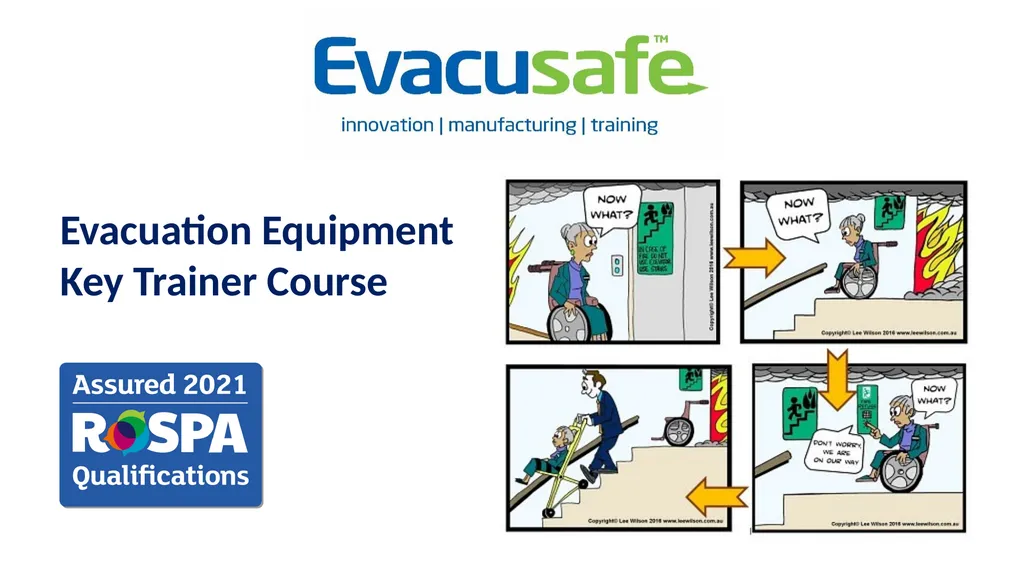
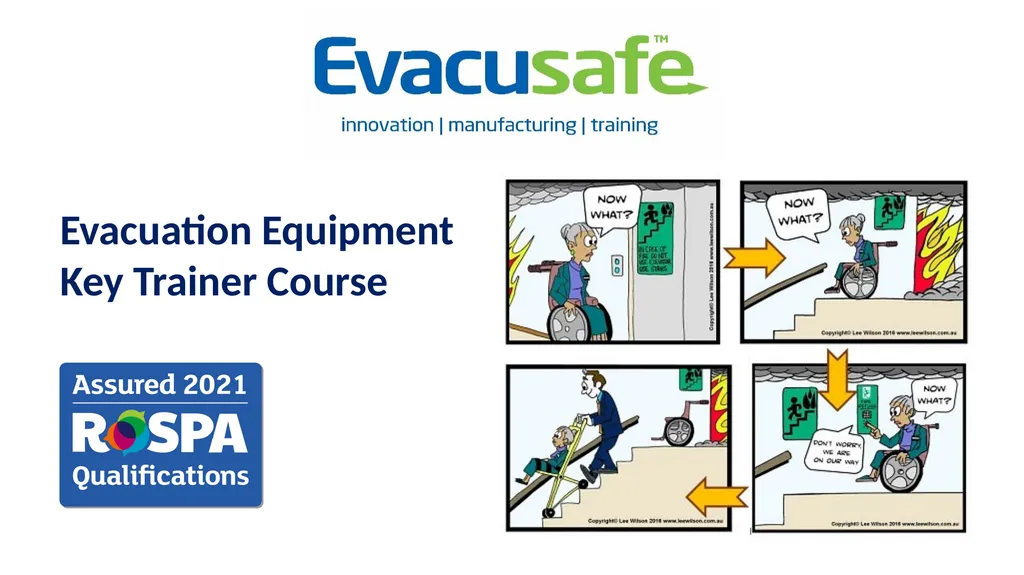
Evacuation Equipment Key Trainer Course<br>
02
Before we begin Housekeeping
Emergency exits, fire alarms, assembly points and facilities
Health and Safety
Medical conditions, recent operations
Ok to walk backwards downstairs
Any other concerns about completing the course
Notes and handouts
Questions
Refreshments
Mobiles<br>
03
Course agenda Course timings
Presentation
Current UK legislation
Those who may need assistance
Possible reasons to evacuate
Where to locate your equipment
Do’s and Don’ts
Demonstration of equipment
Practical sessions
Setting up the equipment
On to the stairs (operator and buddy)<br>
04
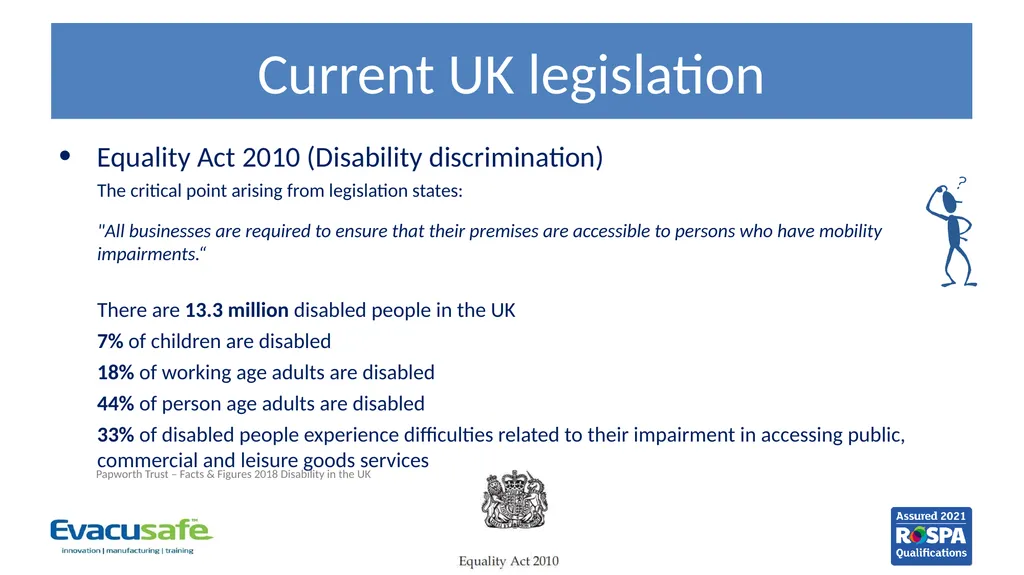
Current UK legislation Equality Act 2010 (Disability discrimination)
The critical point arising from legislation states:
"All businesses are required to ensure that their premises are accessible to persons who have mobility impairments.“
There are 13.3 million disabled people in the UK
7% of children are disabled
18% of working age adults are disabled
44% of person age adults are disabled
33% of disabled people experience difficulties related to their impairment in accessing public, commercial and leisure goods services Papworth Trust – Facts & Figures 2018 Disability in the UK<br>
05
Current UK legislation Equality Act 2010
Employers will be required to make certain reasonable adjustments to the workplace, where arrangements of physical features of the premises are likely to place a mobility impaired person at a substantial disadvantage, compared with an able bodied person.
When an employer or service provider does not make the provisions for evacuation of mobility impaired persons from its premises, this may be viewed as discrimination<br>
06
Current UK legislation The Regulatory Reform (Fire Safety) Order 2005
Biggest single reform of fire safety legislation in over 30 years
Amended or replaced 118 pieces of legislation
The Order places firm responsibility on the Responsible Person and outlines all the measures that must be taken, to ensure the safety of all the people the Responsible Person is directly or indirectly responsible for<br>
07
Current UK legislation The Order requires the Responsible Person to:
Carry out a Fire Risk Assessment
Produce a Fire Policy
Develop procedures (for example fire evacuation)
Provide staff training
Carry out fire drills
Consult with their employees on fire safety matters
Ensure the provision and maintenance of clear means of escape, signs & notices, emergency lighting, fire detection & alarms and fire extinguishers
Note: This is no-longer the responsibility of the Fire Service<br>
08
UK legislation summary Provision has to be made for any mobility impaired person within an organisation in relation to the two pieces of legislation:
Equality Act 2010
Adjustments to the workplace where physical features of the premises are likely to place a mobility impaired person at a disadvantage.
The Regulatory Reform (Fire Safety) Order 2005
Employers or organisations take responsibility for ensuring that all people, including disabled people, can leave the building they control safely in the event of a fire.<br>
09
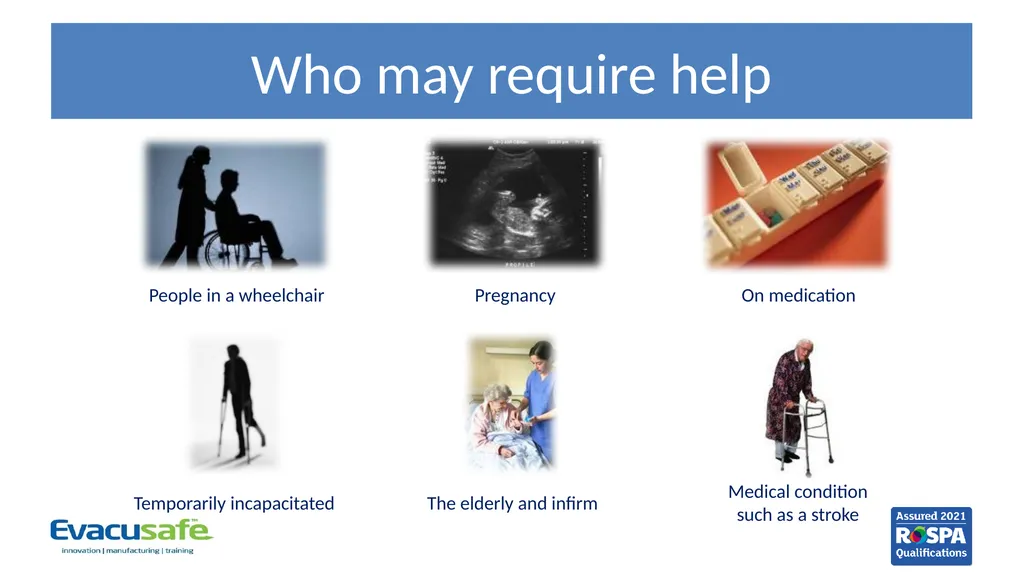
Who may require help<br>
10
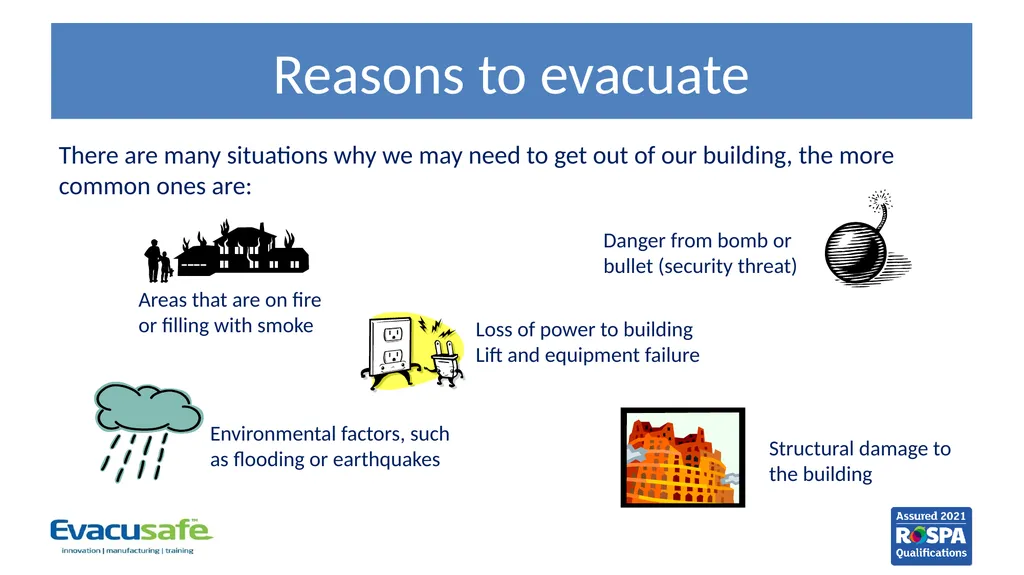
Reasons to evacuate There are many situations why we may need to get out of our building, the more common ones are:<br>
11
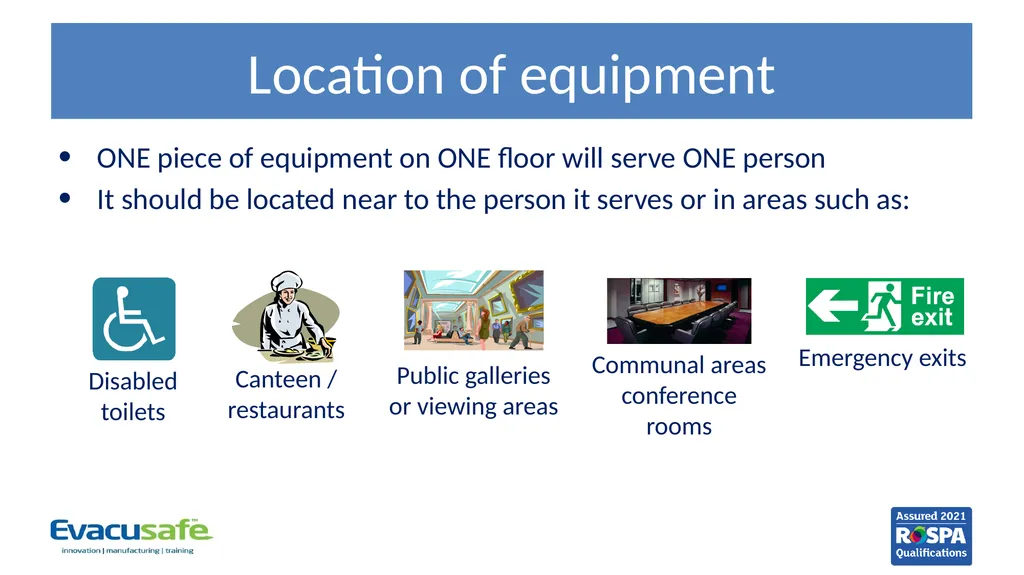
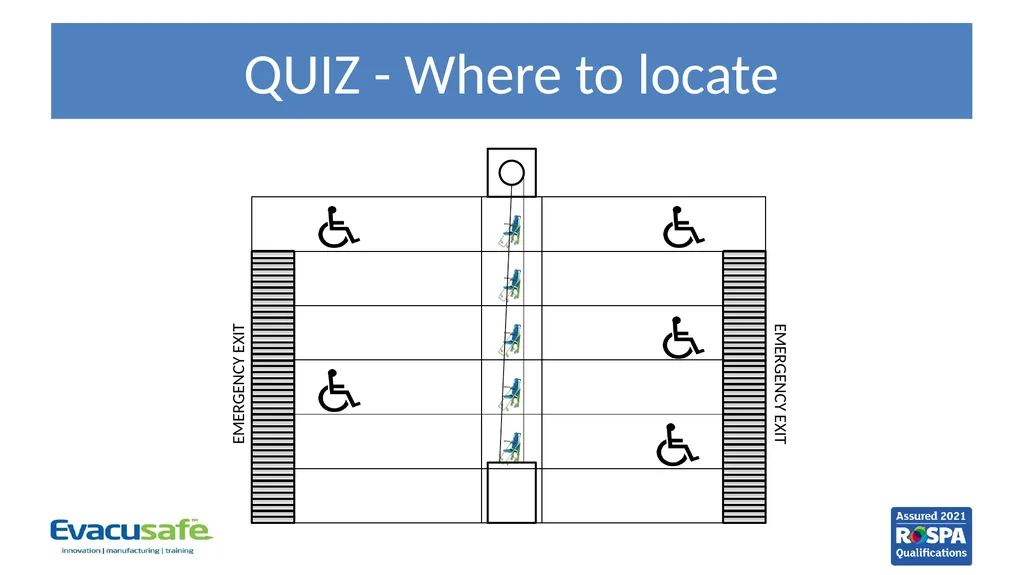
Location of equipment ONE piece of equipment on ONE floor will serve ONE person
It should be located near to the person it serves or in areas such as:<br>
12
QUIZ - Where to locate Emergency exit Emergency exit<br>
13
Means of escape The forced evacuation of a building in an emergency is a foreseeable event
Because it is foreseeable, procedures need to be put into place to ensure the smooth evacuation of everyone to a place of safety
You need to ensure that everyone in your premises can get out quickly and safely in the event of an emergency
Emergency routes and exits should lead as directly as possible away from the workplace to a safe area.<br>
14
Reducing the risk Emergency plans and procedures are vital and so are the people involved
To help reduce the risk of injury, ensure staff are trained to deal with emergencies such as fire and that they receive the appropriate training and information
Try to avoid placing to many duties on those who have more than one responsibility in an emergency<br>
15
Additional points to consider For you to be aware of during an emergency
Knowing where all of the emergency exits are within your building
Are they clear of any obstructions?
Where the assembly point is located?
Is the route to it easy to traverse with the evacuation equipment?
If there are other roles or responsibilities of the equipment operator during the emergency?
Who is able to operate the evacuation equipment?<br>
16
Do’s and don’ts Do
Be aware of any special requirements people have and be sensitive to their needs
Perform evacuation drills in which everyone evacuates the building and the equipment is deployed
Include your evacuation equipment in your regular checks and servicing of your fire safety equipment
Check your emergency exits are NOT blocked or obstructed (inside and out)<br>
17
Do’s and don’ts cont. Do
To maximise the space available on the stairs, keep to the inside of the stairway if possible when using an evacuation chair and the outside If using a sliding device (mattress, sheet etc.)
If using an evacuation chair, carry out the evacuation with a buddy
Leave at the tail end of the evacuation if possible, this will allow any problems ahead to be identified
Remain with the individual after evacuation
Where possible, make provision for them to transfer into their own equipment once at a place of safety<br>
18
Do’s and don’ts cont. Don’t
Use the equipment unless you have received appropriate training and instruction.
Horse or fool around with the equipment
Use the equipment for any other reason
Adjust any of your equipment’s settings or features other than those on the maintenance checklist<br>
19
Discussion points After the training, here are some points to think about
Do you have any Personal Emergency Evacuation Plans (PEEP) in place? You will require information of how to transfer people into the equipment
You might also consider a Generic (or General) Emergency Evacuation Plan (GEEP) for situations that are foreseeable but for persons unknown until required.
Where is the evacuation equipment located? Is this the best place?
Is everyone aware of the nearest fire exits?
Do we have sufficient numbers of evacuation equipment to cover the premises?
How to cascade training to new members of staff and refresh existing?
Regular checks of your evacuation equipment should be carried out. If you have any issues with the equipment, inform the site contact or person responsible for it immediately.<br>
20
Finished Thank you for your attention
On to the practical sessions<br>