Evaluating Large Language Models on Computer Science Education Using University Exam Questions Edan Gabay, Yael Maoz, Jonathan Stahl, Naama Maoz, Abdo Amer, Orr Eilat, Adi Haviv, Hanoch Levy, Michal Kleinbort, Amir Rubinstein Tel Aviv
"Evaluating Large Language Models on Computer" is the property of its rightful owner. Permission is granted to
download and print the materials on this website for personal, non-commercial use only, and to display it
on your personal computer provided you do not modify the materials and that you retain all copyright
notices contained in the materials. By downloading content from our website, you accept the terms of this
agreement.
Presentation Transcript
01
Evaluating Large Language Models on Computer Science Education Using University Exam Questions Edan Gabay, Yael Maoz, Jonathan Stahl, Naama Maoz, Abdo Amer, Orr Eilat, Adi Haviv, Hanoch Levy, Michal Kleinbort, Amir Rubinstein
Tel Aviv University<br>
02
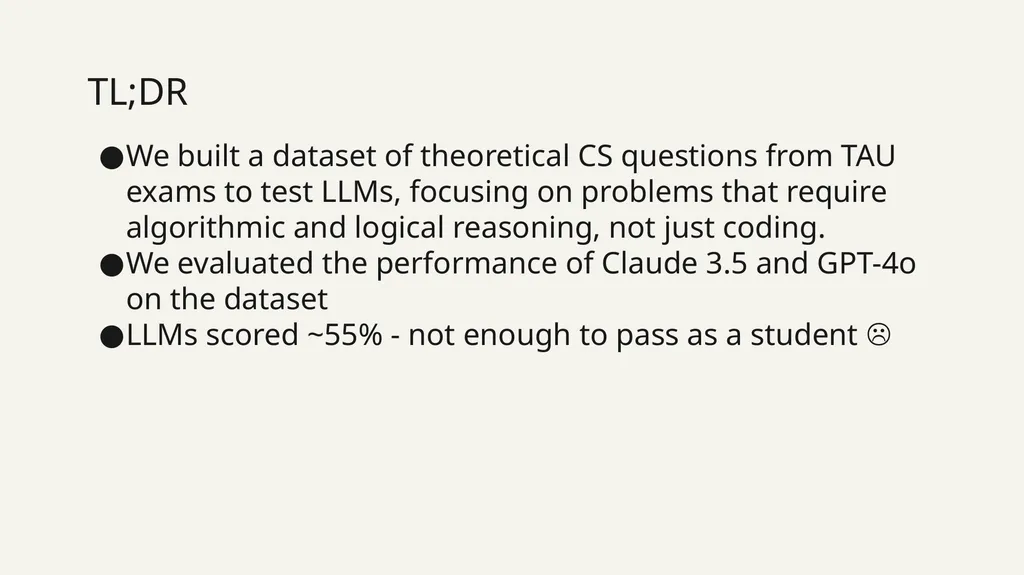
TL;DR We built a dataset of theoretical CS questions from TAU exams to test LLMs, focusing on problems that require algorithmic and logical reasoning, not just coding.
We evaluated the performance of Claude 3.5 and GPT-4o on the dataset
LLMs scored ~55% - not enough to pass as a student <br>
03
About the team This work was carried out by a team of undergrad students as part of a workshop in the Computer Science B.Sc. Program at TAU.
Supervised and lead by a teaching assistant pursuing her Ph.D. and three faculty members from the Computer Science Department Edan Gabay, Yael Maoz, Jonathan Stahl, Naama Maoz, Abdo Amer, Orr Eilat, Adi Haviv, Hanoch Levy, Michal Kleinbort, Amir Rubinstein
Tel Aviv University<br>
04
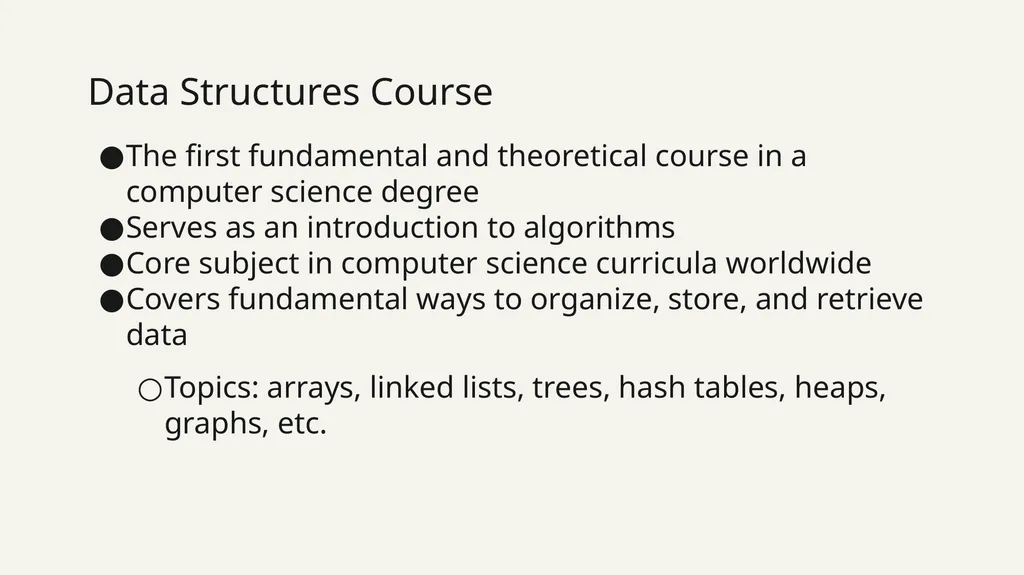
Data Structures Course The first fundamental and theoretical course in a computer science degree
Serves as an introduction to algorithms
Core subject in computer science curricula worldwide
Covers fundamental ways to organize, store, and retrieve data
Topics: arrays, linked lists, trees, hash tables, heaps, graphs, etc.<br>
05
Why Evaluate LLMs on This Course? They are widely used by students for homework and studying, both for coding and theoretical subjects
LLMs have been widely evaluated and demonstrated impressive capabilities in general knowledge and programming tasks
LLMs have barely been evaluated on complex algorithmic concepts and theoretical computer science questions<br>
06
Our LLM Benchmark Dataset A dataset of questions to be used to evaluate LLMs on university-level, theoretical questions about Data Structures curriculum.<br>
07
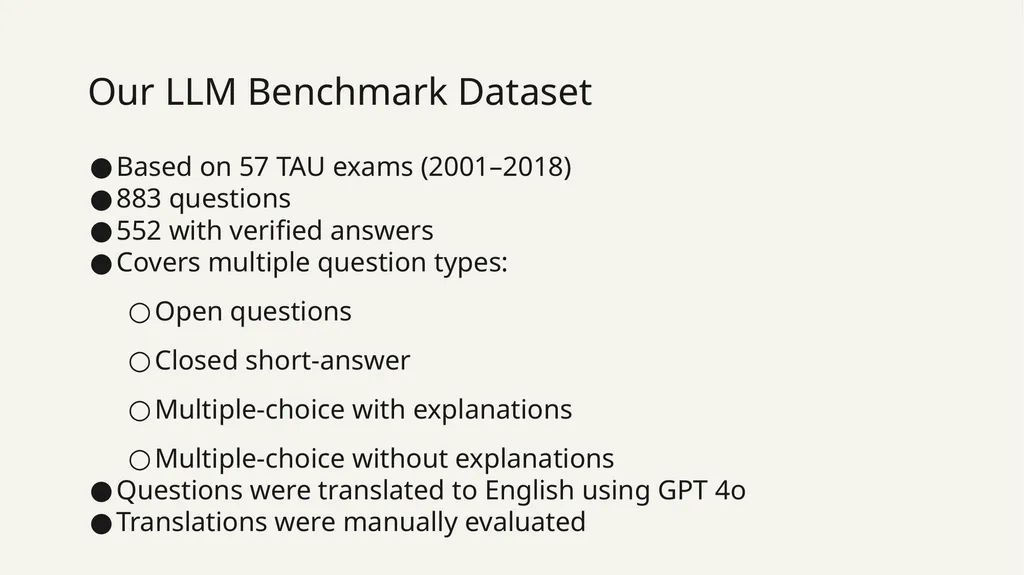
Our LLM Benchmark Dataset Based on 57 TAU exams (2001–2018)
883 questions
552 with verified answers
Covers multiple question types:
Open questions
Closed short-answer
Multiple-choice with explanations
Multiple-choice without explanations
Questions were translated to English using GPT 4o
Translations were manually evaluated<br>
08
Our LLM Benchmark Dataset Questions were translated to English using GPT 4o
Translations were manually evaluated<br>
09
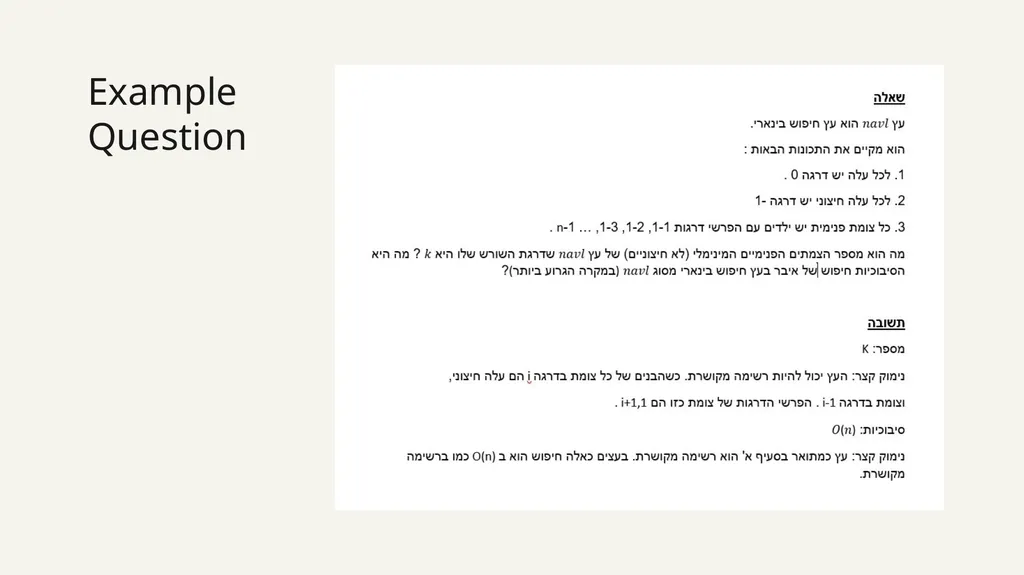
Example Question<br>
10
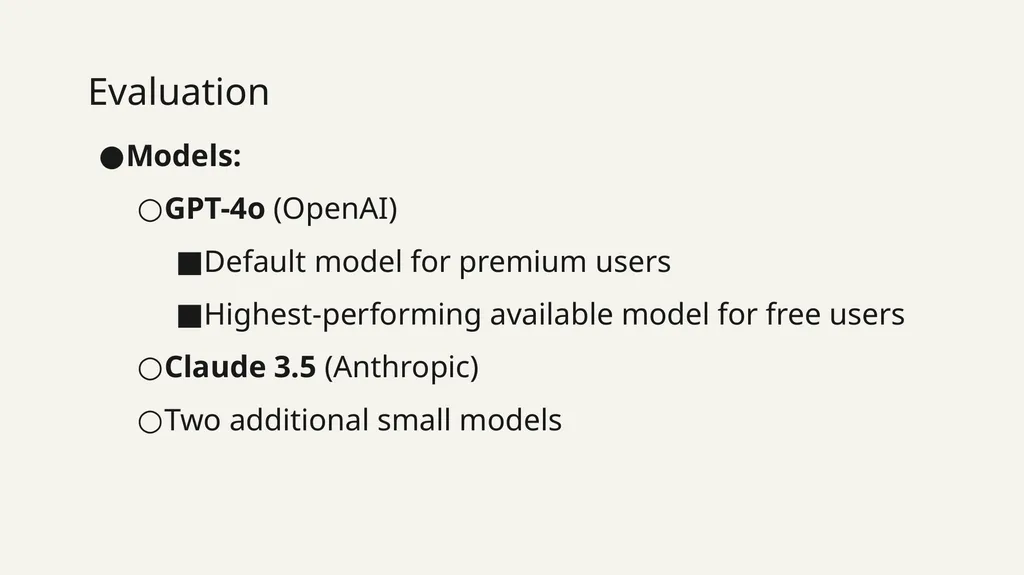
Evaluation Models:
GPT-4o (OpenAI)
Default model for premium users
Highest-performing available model for free users
Claude 3.5 (Anthropic)
Two additional small models<br>
11
Evaluation Questions:
200 questions
Closed short-answer & Multiple-choice
Multiple topics: Various data structures, algorithms and analysis methods<br>
12
Evaluation Questions:
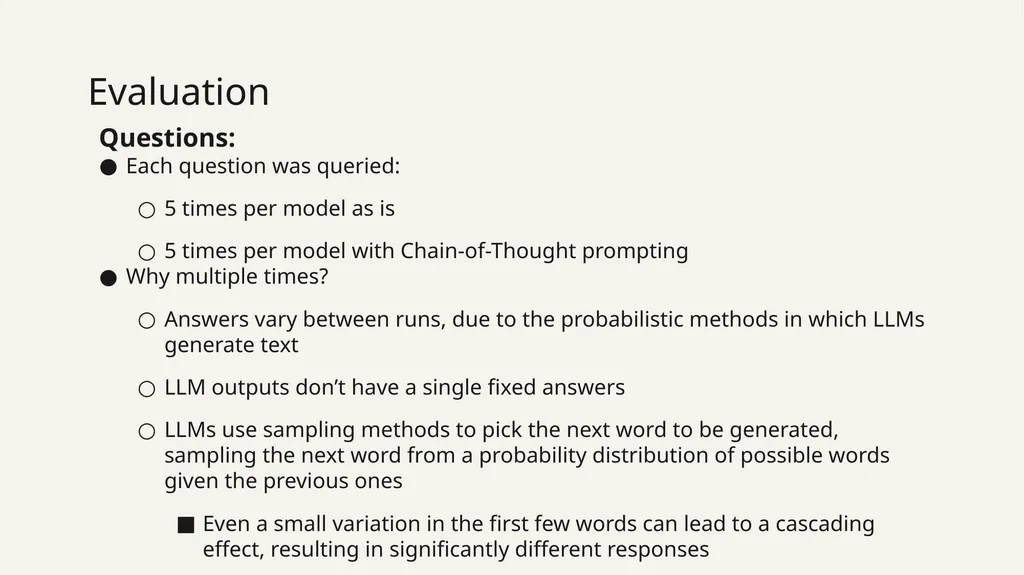
Each question was queried:
5 times per model as is
5 times per model with Chain-of-Thought prompting
Why multiple times?
Answers vary between runs, due to the probabilistic methods in which LLMs generate text
LLM outputs don’t have a single fixed answers
LLMs use sampling methods to pick the next word to be generated, sampling the next word from a probability distribution of possible words given the previous ones
Even a small variation in the first few words can lead to a cascading effect, resulting in significantly different responses<br>
13
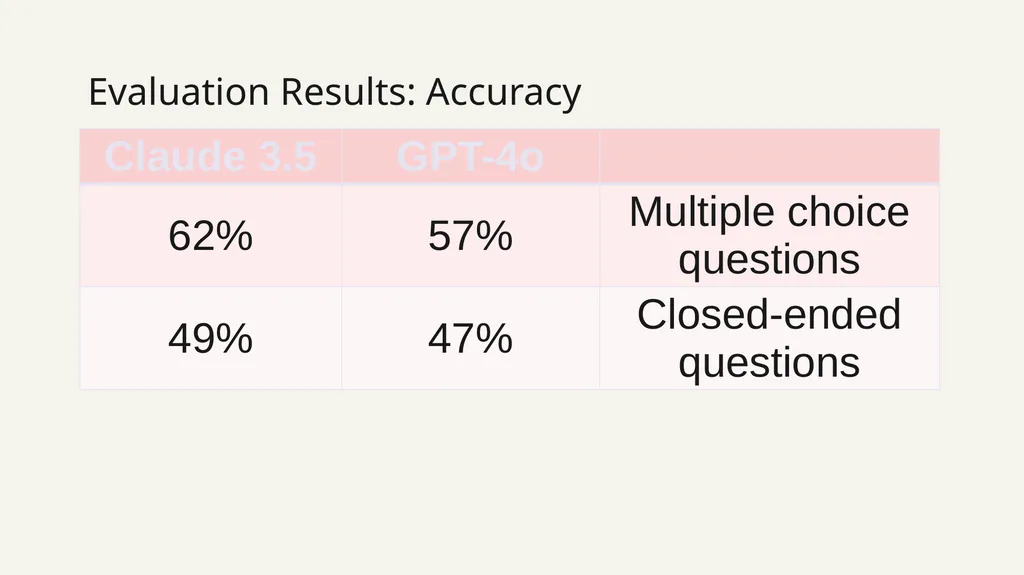
Evaluation Results: Accuracy<br>
14
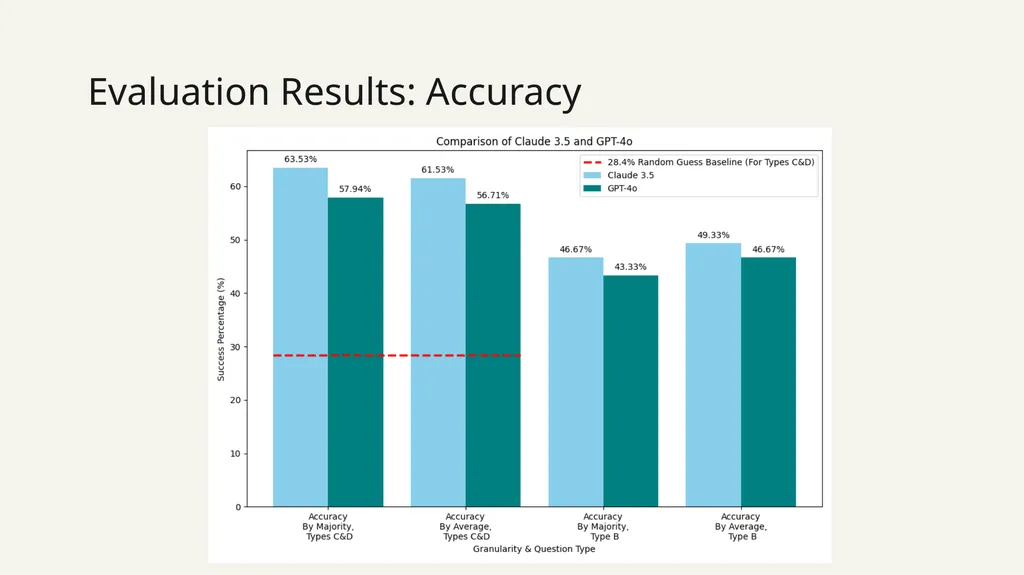
Evaluation Results: Accuracy<br>
15
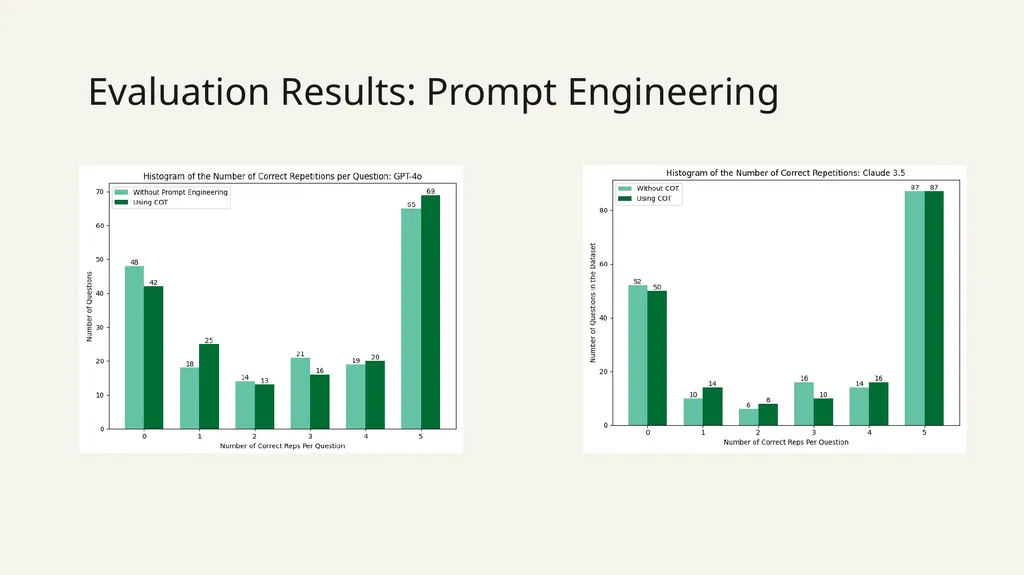
Evaluation Results: Prompt Engineering Chain-of-Thought (CoT) prompting: instructs model to reason step-by-step
No consistent improvement from CoT
Possible reason: models already perform implicit reasoning<br>
16
Evaluation Results: Prompt Engineering<br>
17
Key Insights Both models are well above random guessing, but there is still much room for improvement Need to test new reasoning-type models by OpenAI and Anthropic<br>
18
Educational Implications & future work Benchmark for future research:
Our dataset offers a consistent benchmark to evaluate newer LLMs with improved reasoning abilities in theoretical CS.
Potential educational tools (pending improvement):
With significantly improved accuracy, LLMs could support automatic grading, generation of new questions, and serve as personal teaching assistants in CS theory.
Current limitations:
Today’s models still fall short in this domain, especially in logical rigor, making these applications premature but promising.<br>
19
Summary We built a benchmark from real TAU exams to test LLMs
Claude and GPT-4o achieve 46–49% overall accuracy
Prompt engineering (CoT) not very effective here<br>