EVALUATION, GRADING AND FABRICATION OF DRESSED CARCASSES INCLUDING POULTRY Dr. R. K. Jaiswal Asstt. Prof.-cum-Jr. Scientist Dept. of Livestock Products Technology Bihar Veterinary College Bihar Animal Sciences University Patna-800014
"EVALUATION, GRADING AND FABRICATION OF DRESSED" is the property of its rightful owner. Permission is granted to
download and print the materials on this website for personal, non-commercial use only, and to display it
on your personal computer provided you do not modify the materials and that you retain all copyright
notices contained in the materials. By downloading content from our website, you accept the terms of this
agreement.
Presentation Transcript
01
EVALUATION, GRADING AND FABRICATION OF DRESSED CARCASSES INCLUDING POULTRY Dr. R. K. Jaiswal
Asstt. Prof.-cum-Jr. Scientist
Dept. of Livestock Products Technology
Bihar Veterinary College
Bihar Animal Sciences University
Patna-800014 (Bihar)<br>
02
Evaluation Grading and evaluation play important role in marketing and merchandizing of carcass.
Carcass evaluation is a broader term which gives idea about carcass yield, meat processing character, palatability and overall quality of meat.
Extension of grading that identifies carcass composition and value differences with greater precision than grades alone.<br>
03
Carcass evaluation procedures Dressing Percent or Carcass Yield
Dressing percent is calculated by dividing the chilled carcass weight by the live weight and multiplying by 100.<br>
04
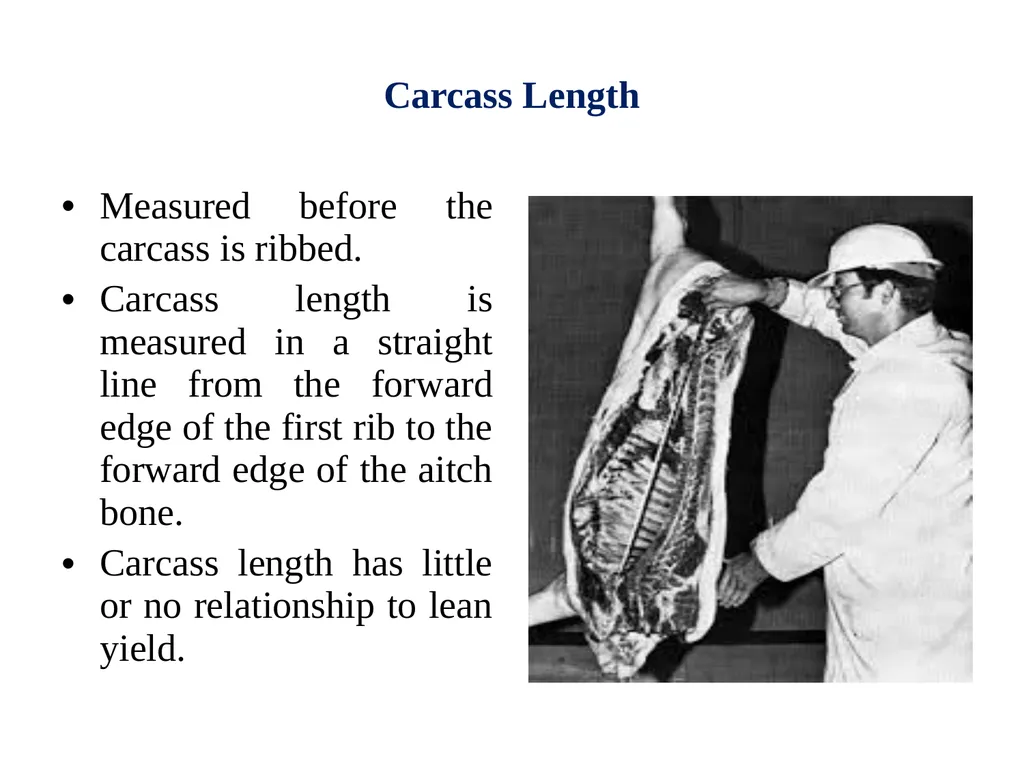
Carcass Length Measured before the carcass is ribbed.
Carcass length is measured in a straight line from the forward edge of the first rib to the forward edge of the aitch bone.
Carcass length has little or no relationship to lean yield.<br>
05
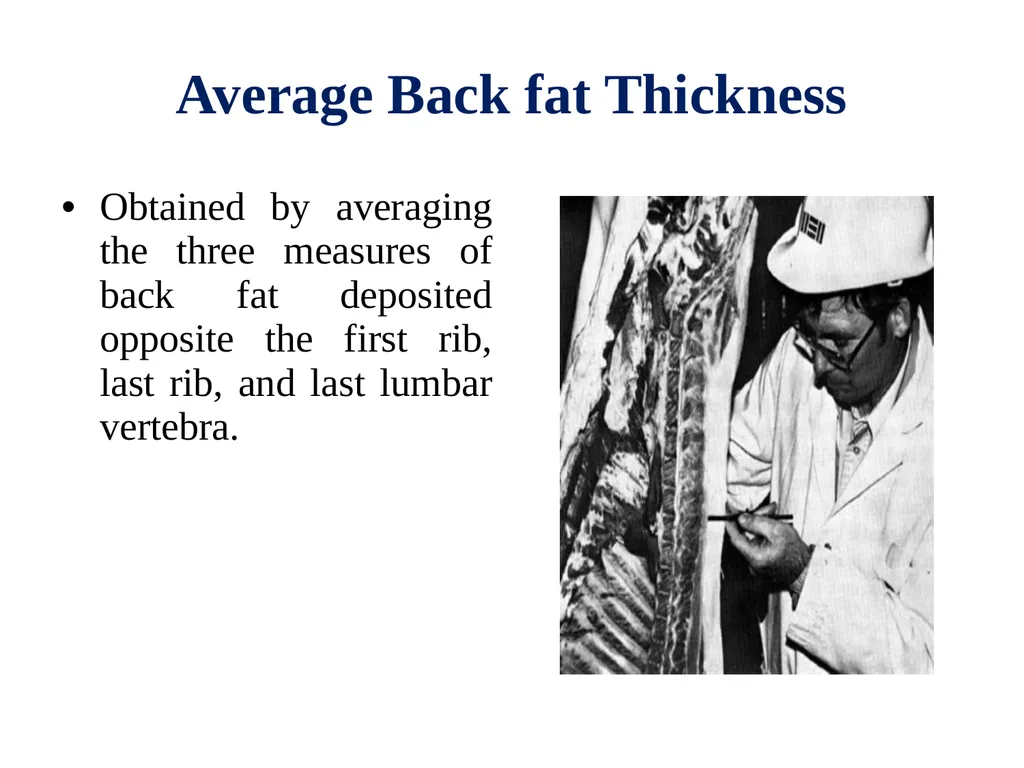
Average Back fat Thickness Obtained by averaging the three measures of back fat deposited opposite the first rib, last rib, and last lumbar vertebra.<br>
06
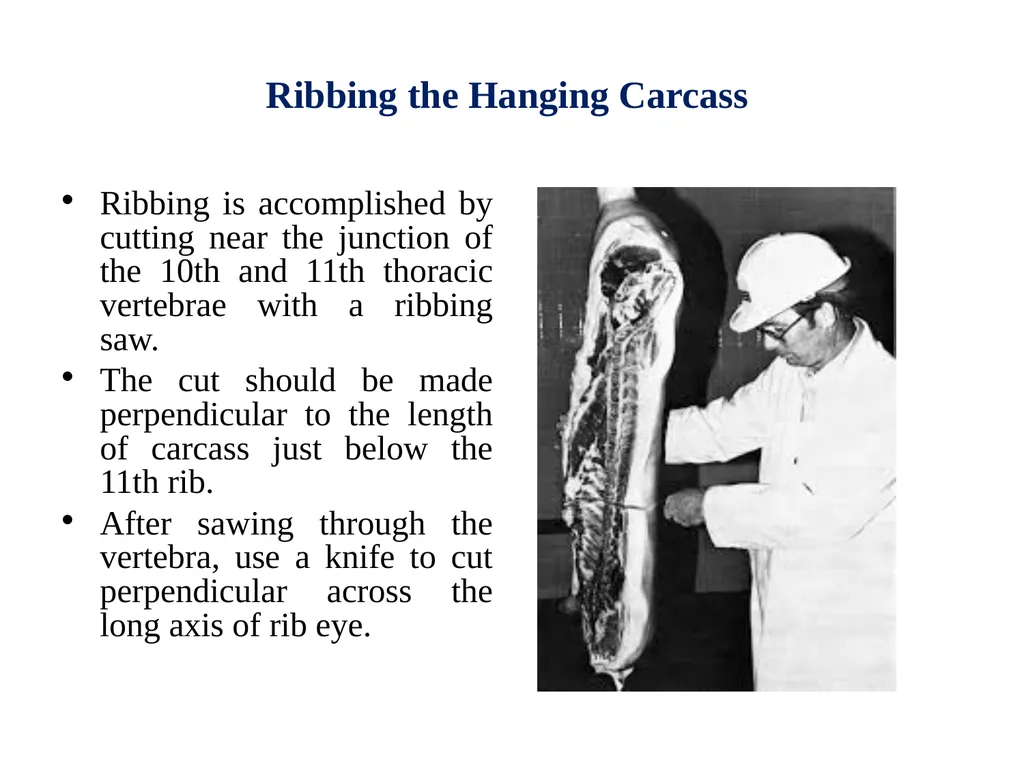
Ribbing the Hanging Carcass Ribbing is accomplished by cutting near the junction of the 10th and 11th thoracic vertebrae with a ribbing saw.
The cut should be made perpendicular to the length of carcass just below the 11th rib.
After sawing through the vertebra, use a knife to cut perpendicular across the long axis of rib eye.<br>
07
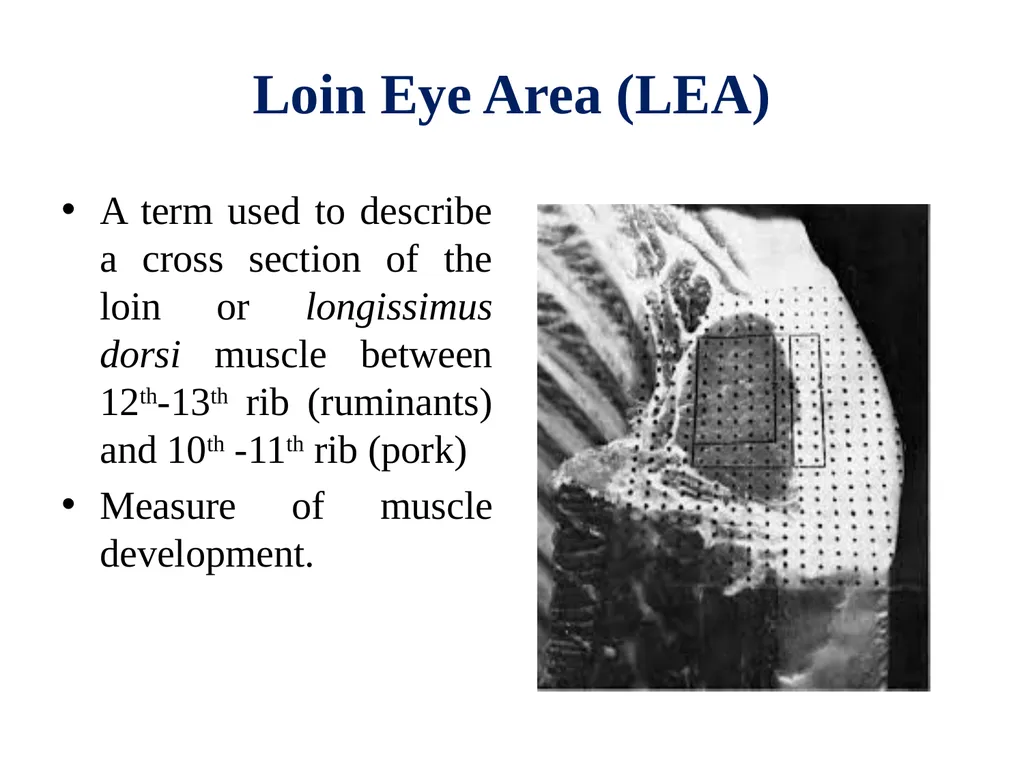
Loin Eye Area (LEA) A term used to describe a cross section of the loin or longissimus dorsi muscle between 12th-13th rib (ruminants) and 10th -11th rib (pork)
Measure of muscle development.<br>
08
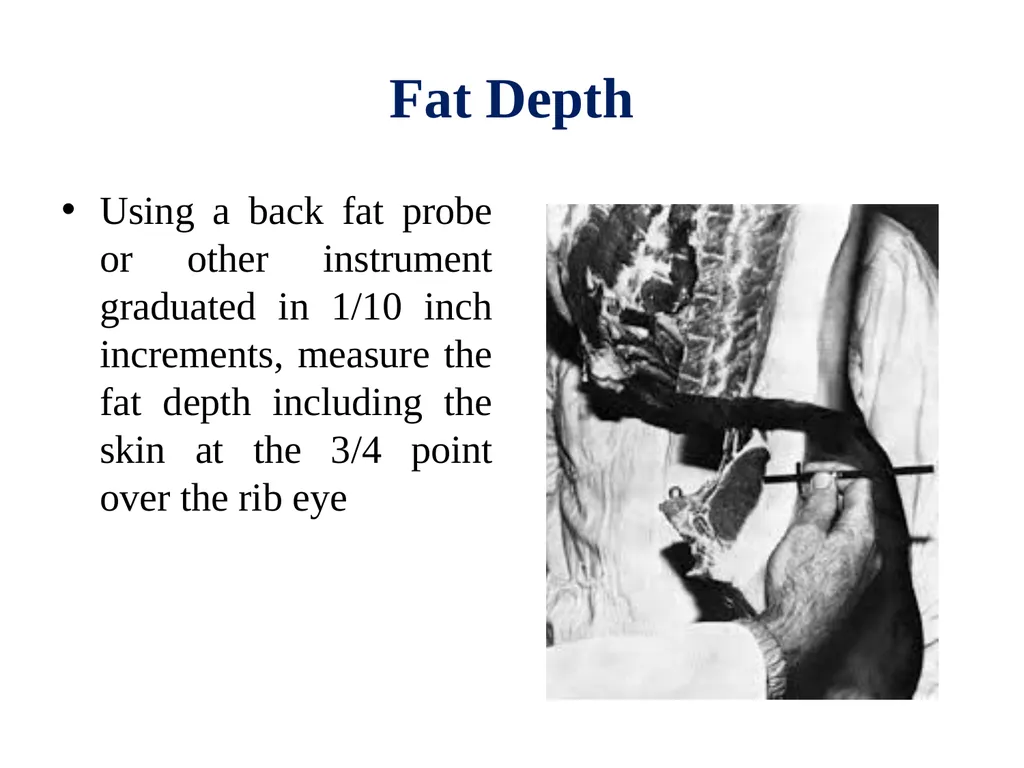
Fat Depth Using a back fat probe or other instrument graduated in 1/10 inch increments, measure the fat depth including the skin at the 3/4 point over the rib eye<br>
09
Grading On the evaluation of dressed carcass, carcasses are divided into different grades.
It is defined as process of segregating meat and meat products on the basis of palatability, yield or other economically important traits into standardized group with minimum common characteristics.
There are generally two types of grades:
1)Quality grade (palatability and acceptability)
2)Quantity grade (Yield grade)<br>
10
Importance of grading Producer can certify animal and carcasses for class, quality and condition through authorized agencies .
Producer recognise the quality he produced and paves ways for better planning to improve breeding programme and to produce high-grade animals and carcasses.
Producer select the required types according to the needs of the market and consumer.
Processor adopt or decide methods and procedures for disposing animals and carcasses.<br>
11
Consumers purchase assured quality of meat and gives satisfaction over the money spent on purchasing the meat.
Consumer utilise meat most efficiently by preparing it in the manner for which it is best suited.<br>
12
Factors used to establish grades In general the grade of an animal is determined on the basis of three grades factors.
1. Conformation - Morphology of animal
2. Quality - Meat
3. Finish - Fatness of animal<br>
13
Conformation It is the build, shape and outline (contour) of animal and its different primal cuts (wholesale cuts).
It is largely due to shape and size of the bones and muscles and the fat covering.
It is attributable to breeding, and care of the animal.<br>
14
Quality It is the character of the muscle or the lean meat (without bone) of the animal and of the intermuscular (Seam fat) and intramuscular fat (marbling) contained in the meat.
It refers to firmness of the texture, freedom from coarseness to a certain extent.
External evidence of quality is found in the refinement of head, hide, hair, bone.
It is important as it is related to eating desirability i.e., tenderness palatability, colour, juiciness, odour, water holding capacity, etc.<br>
15
Finish It refers to one quantity, amount, colour and distribution of fat.
This includes:
External: Subcutaneous fat
Intramuscular fat: Marbling
Intermuscular fat: Seam fat<br>
16
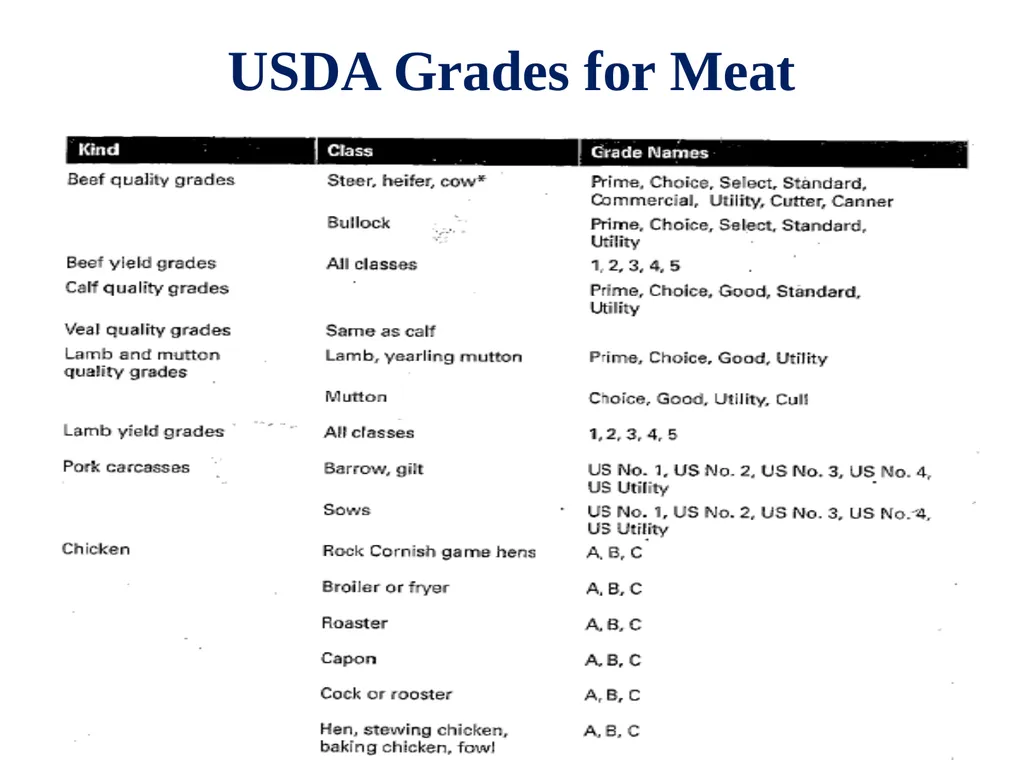
USDA Grades for Meat<br>
17
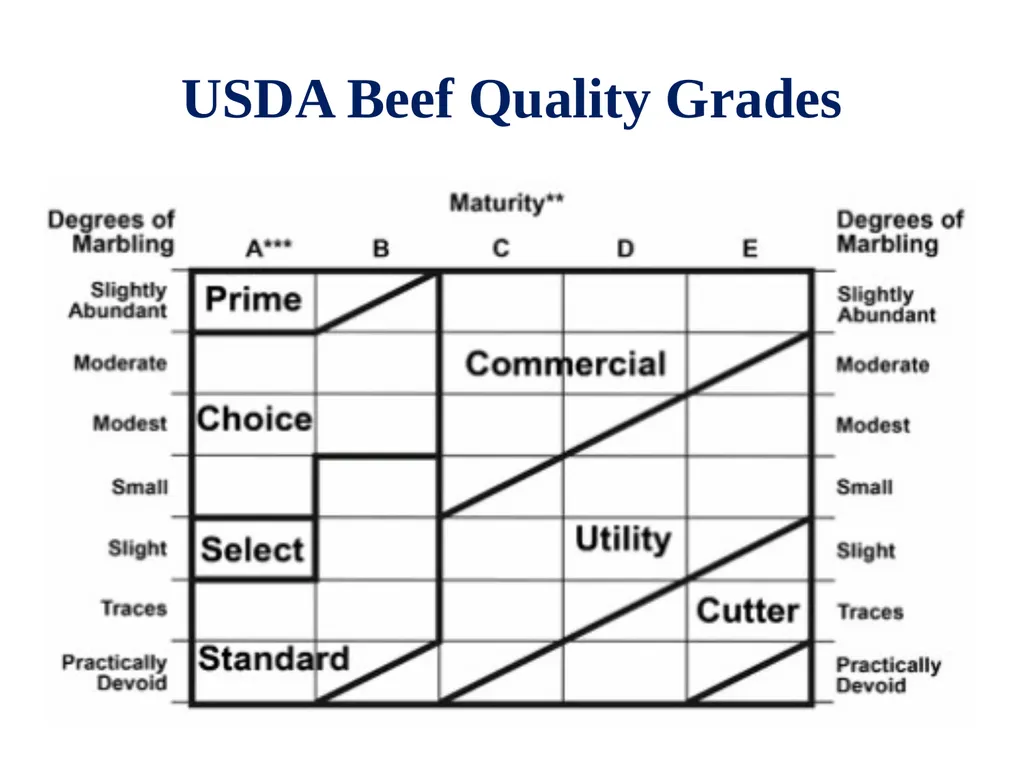
USDA Beef Quality Grades<br>
18
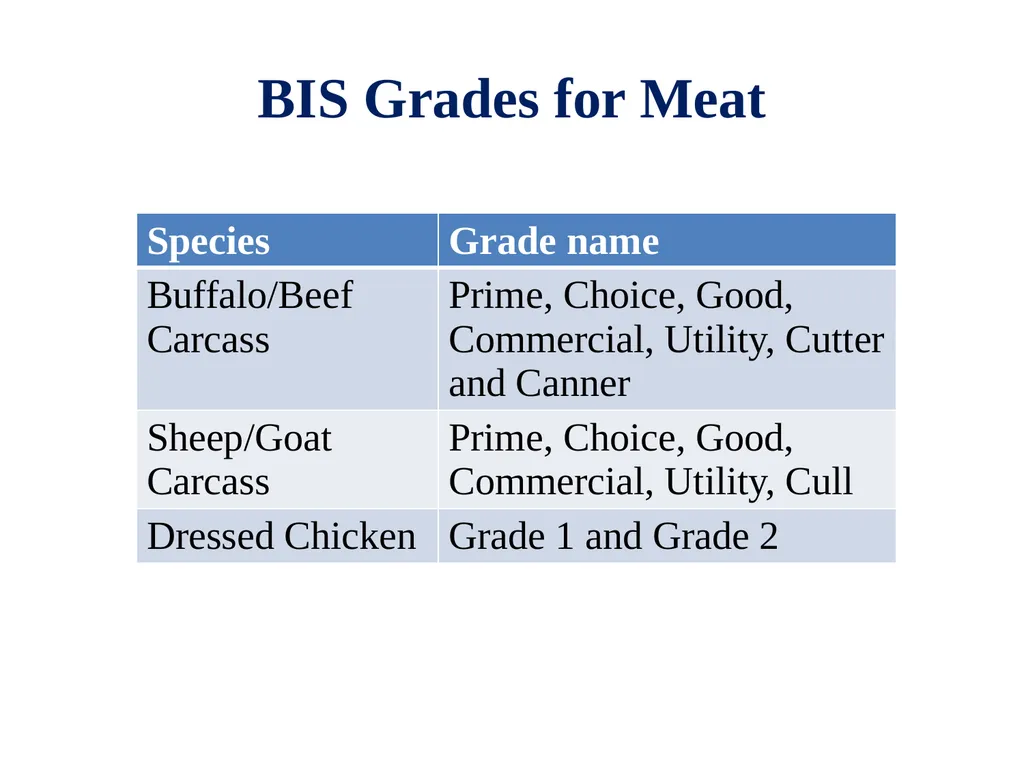
BIS Grades for Meat According to BIS:IS 2537, six grades for beef and buffalo carcasses based on conformation, finish and quality.
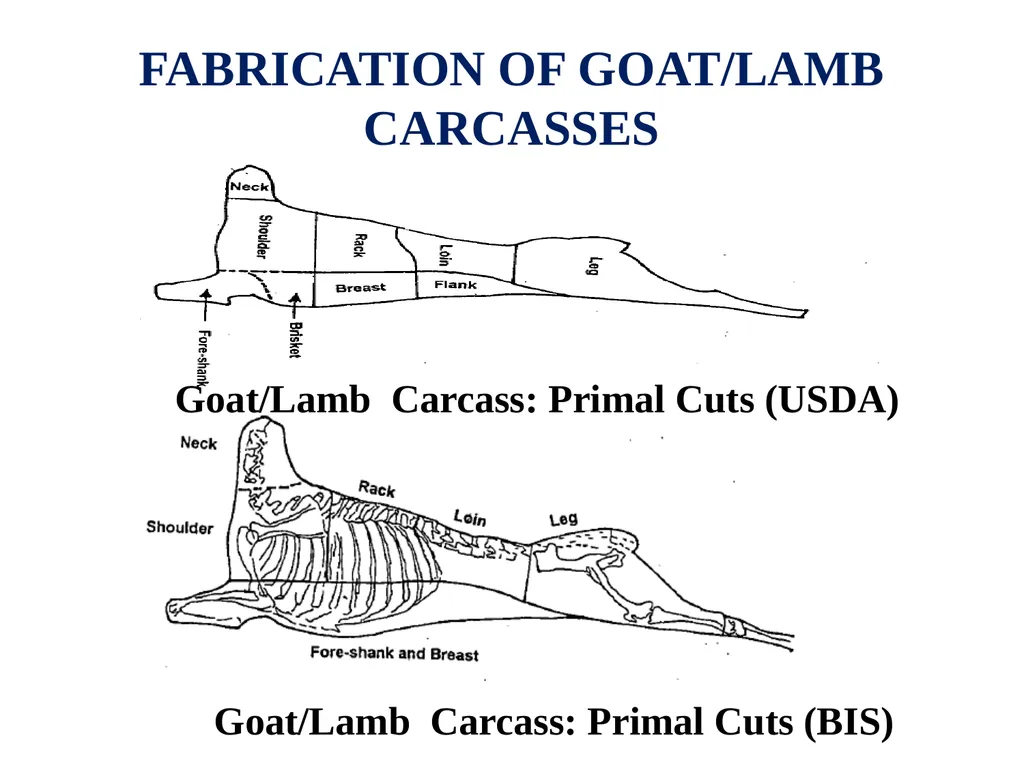
According to BIS, IS 2536: 1995, sheep and goat carcasses are divided into the main classes based largely upon age. They are
Lamb (12 months or below)
Yearling mutton (12 to 20 months)
Mature mutton (above 20 months)
The above three classes are divided into six grades based on conformation, finish and quality of the carcasses or cuts.
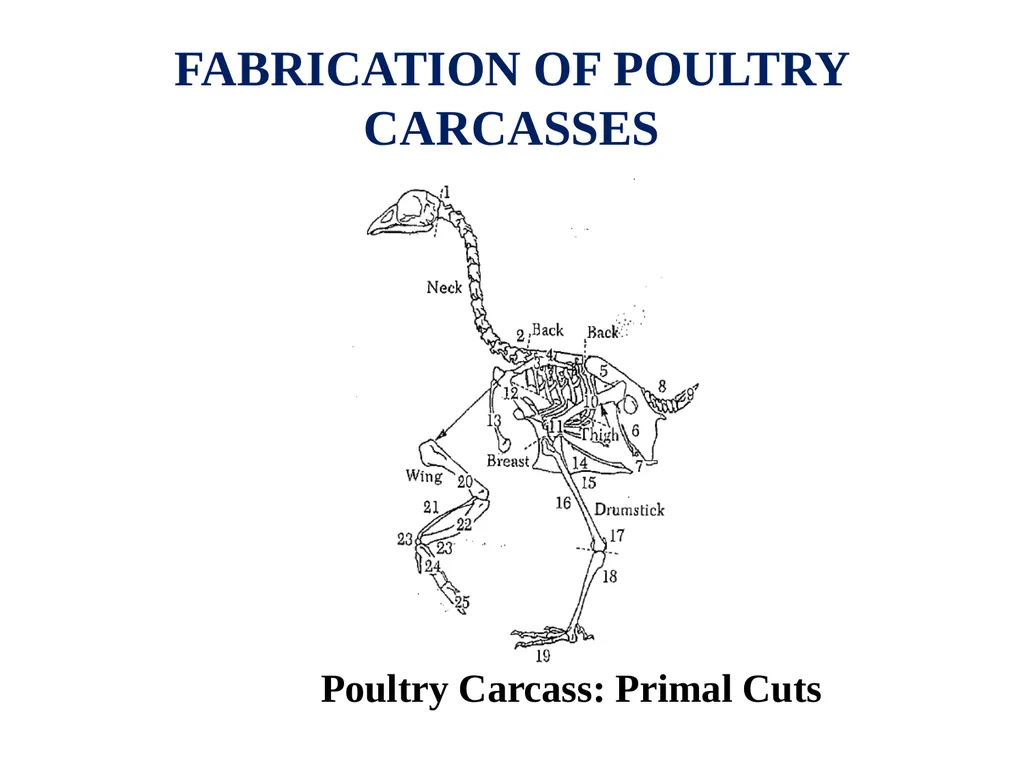
Dressed chickens are graded on the basis of conformation, degree of fleshing, bruises, cuts and other quality attributes.<br>
19
BIS Grades for Meat<br>
20
FABRICATION OF CARCASSES OF FOOD ANIMALS The term meat cutting may aptly be defined as the art, skill or craft of separation of carcass wholesale primal cuts into different portions as to suit various needs in the meat trade and to facilitate easy handling by the butchers.
The process of dividing of chilled carcass into various commercial parts is referred to as the cutting operation or fabrication of carcasses of food animals.<br>
21
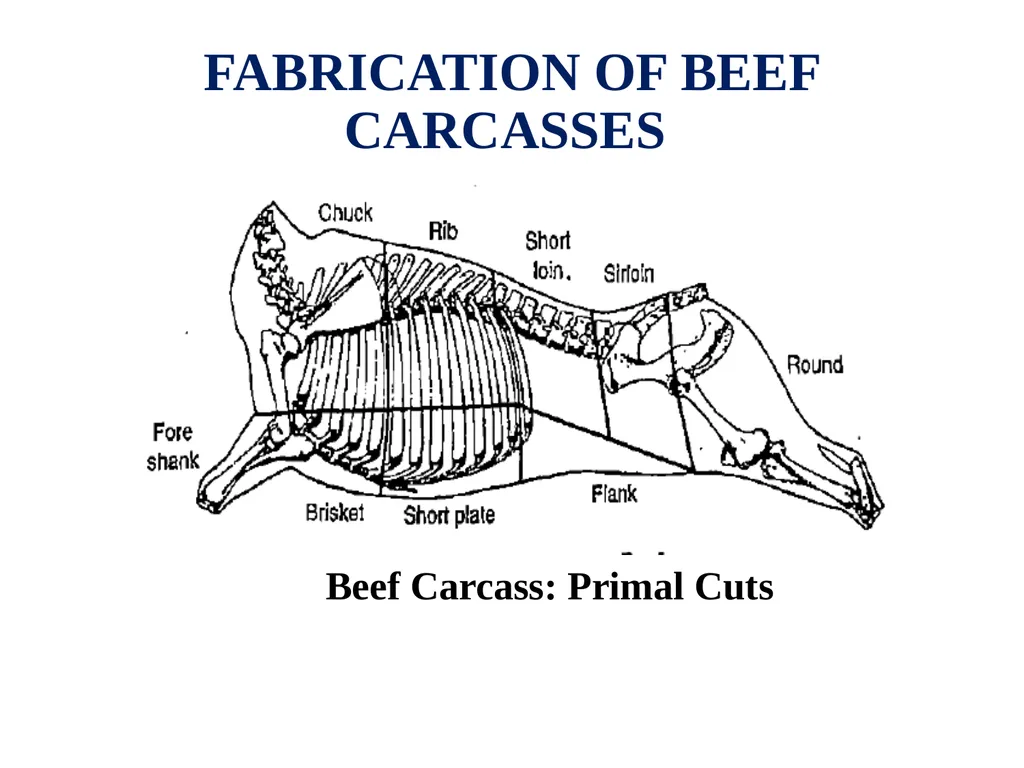
FABRICATION OF BEEF CARCASSES Beef Carcass: Primal Cuts<br>
22
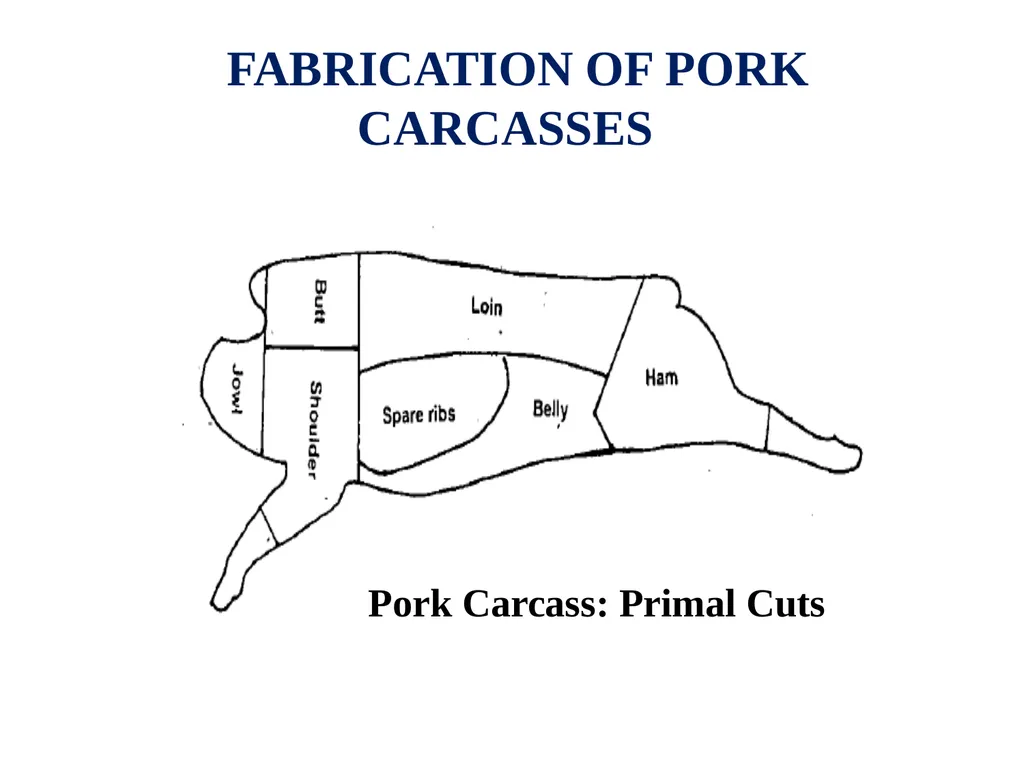
FABRICATION OF PORK CARCASSES Pork Carcass: Primal Cuts<br>