
Evaluation support study on Geographical

Description: Evaluation support study on Geographical Indications and Traditional Specialities Guaranteed protected in the EU Final report December 2020 European Commission - DG AGRI Introduction - objectives Study conducted from December 2019 to
Related Topics
Download Presentation
"Evaluation support study on Geographical" is the property of its rightful owner. Permission is granted to download and print the materials on this website for personal, non-commercial use only, and to display it on your personal computer provided you do not modify the materials and that you retain all copyright notices contained in the materials. By downloading content from our website, you accept the terms of this agreement.
Presentation Transcript
slide1. Evaluation support study on Geographical Indications and Traditional Specialities Guaranteed protected in the EU
Final report – December 2020 European Commission - DG AGRI<br>
slide2. Introduction - objectives Study conducted from December 2019 to December 2020
Objectives:
provide an evaluation on the EU quality policy on GIs and TSGs protected in the EU,
provide answers to 16 evaluation study questions (ESQs) on 5 themes: effectiveness, efficiency, relevance, coherence and EU added value.<br>
slide3. Introduction – coverage Geographical coverage: EU 28
Period covered: 30 May 2008 to 2020
GIs and TSGs covered (data on the 01/01/2020):
3 286 GIs and TSG registered by MS (3 224 GIs and 62 TSGs)
32 GIs registered by third countries through direct application
Sectoral coverage: agricultural products, foodstuffs, spirit drinks, wines and aromatised wine products.
Regulatory coverage:
Spirit drinks: Regulation (EC) No 110/2008 until 7 June 2019 and Regulation (EU) 2019/787 Since 8 June 2019,
Agricultural products and foodstuffs: Regulation (EU) No 1151/2012
Wines: Regulation (EU) No 1308/2013,
Aromatised wine products: Regulation (EU) No 251/2014.<br>
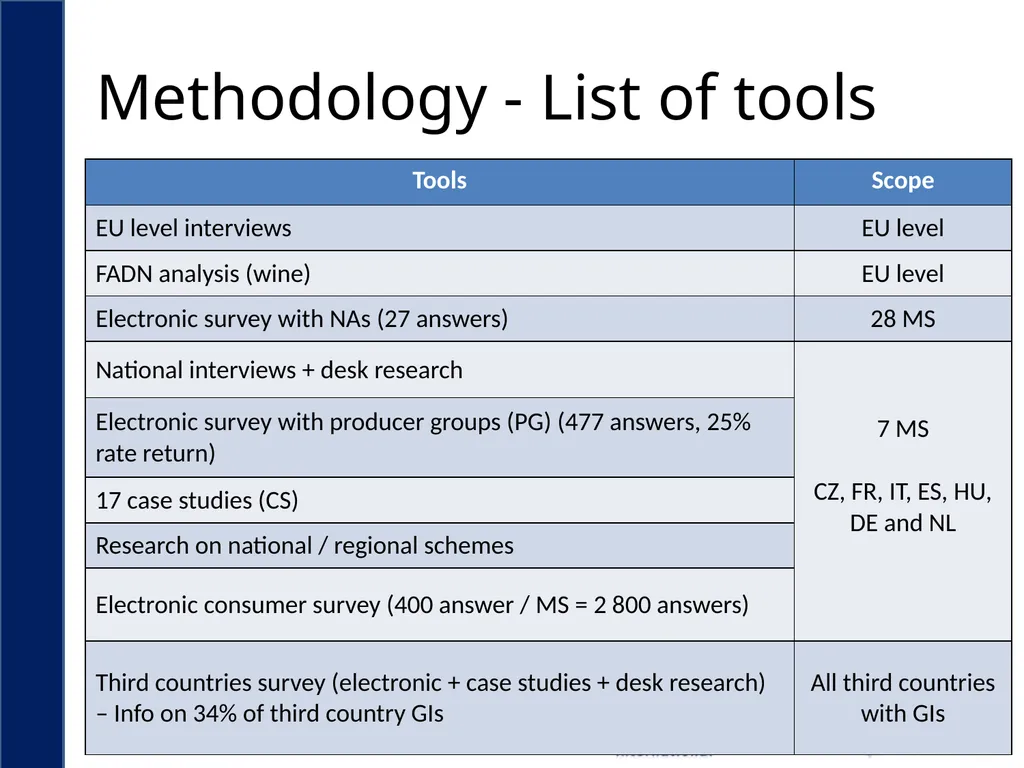
slide4. Methodology - List of tools<br>
slide5. Main conclusions by theme<br>
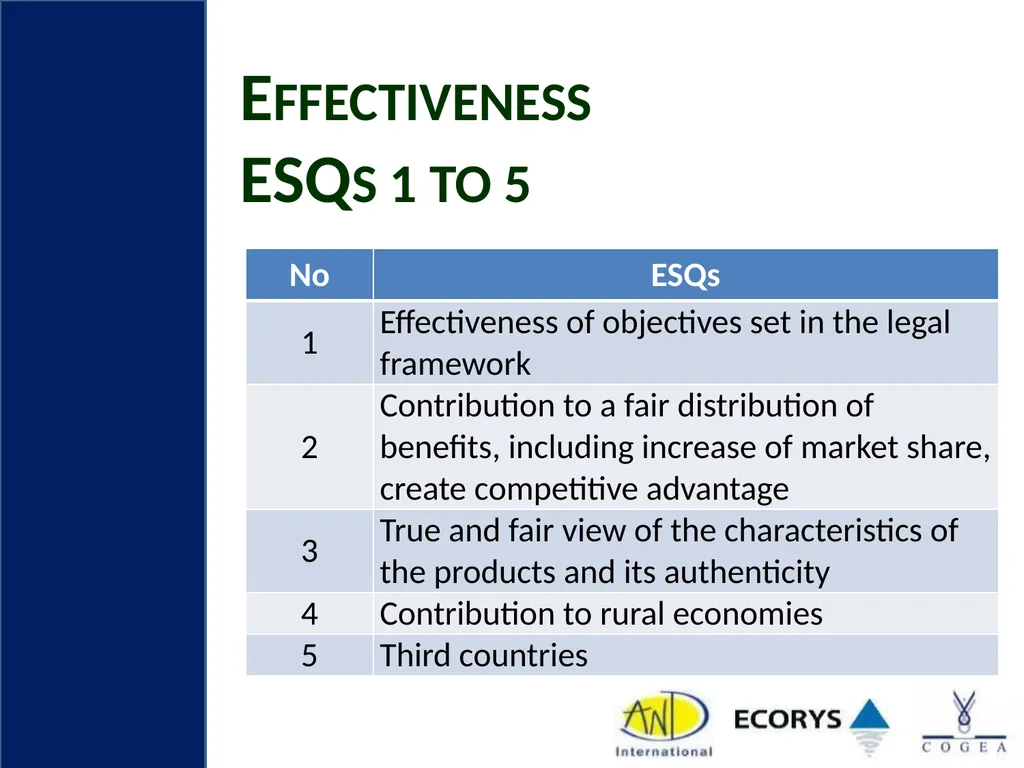
slide6. Effectiveness ESQs 1 to 5<br>
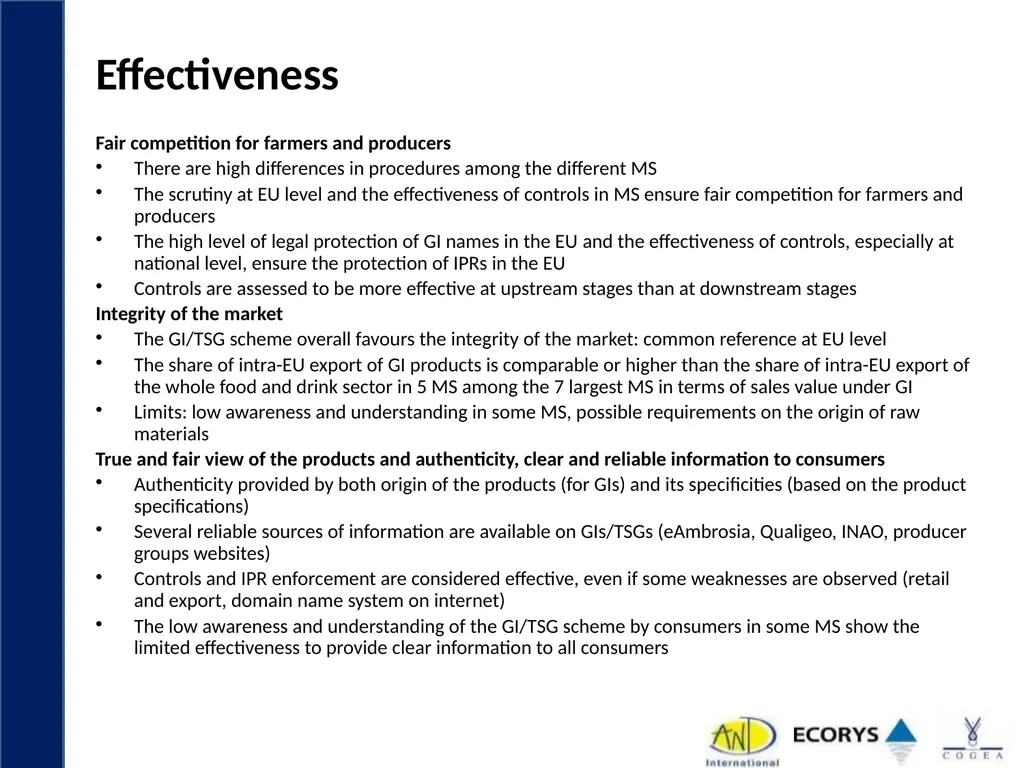
slide7. Effectiveness Fair competition for farmers and producers
There are high differences in procedures among the different MS
The scrutiny at EU level and the effectiveness of controls in MS ensure fair competition for farmers and producers
The high level of legal protection of GI names in the EU and the effectiveness of controls, especially at national level, ensure the protection of IPRs in the EU
Controls are assessed to be more effective at upstream stages than at downstream stages
Integrity of the market
The GI/TSG scheme overall favours the integrity of the market: common reference at EU level
The share of intra-EU export of GI products is comparable or higher than the share of intra-EU export of the whole food and drink sector in 5 MS among the 7 largest MS in terms of sales value under GI
Limits: low awareness and understanding in some MS, possible requirements on the origin of raw materials
True and fair view of the products and authenticity, clear and reliable information to consumers
Authenticity provided by both origin of the products (for GIs) and its specificities (based on the product specifications)
Several reliable sources of information are available on GIs/TSGs (eAmbrosia, Qualigeo, INAO, producer groups websites)
Controls and IPR enforcement are considered effective, even if some weaknesses are observed (retail and export, domain name system on internet)
The low awareness and understanding of the GI/TSG scheme by consumers in some MS show the limited effectiveness to provide clear information to all consumers<br>
slide8. Effectiveness - Fair return for farmers and producers Increase of market share
GI/TSG sales have increased more rapidly than the whole food and drink sector. Exception for GI spirits drinks exports that increased in a lesser extent than the whole spirit drinks exports.
Positive impacts are not systematic and the effects are not homogenous. This depends on the context of establishment of the GI/TSG, the targeted market, the governance and the content of the PS.
64% of GIs increased in sales value between 2010 and 2017, 46% in volume (based on data from DG AGRI study on the value of GI/TSGs, 2019).
Competitive advantages
In some situations, existence of price premium and price stability are strong competitive advantages.
Low level of awareness of European consumers in some MS limits the impacts of these competitive advantages. However, some protected names benefit of a strong notoriety.
Other benefits: higher price stability, synergies with tourism, increase of land price and improvement of quality management.
Fair distribution of benefits
In many cases, GI/TSG implementation has increased bargaining power of farmers and processors.
GI/TSG has increased the concentration of benefits at some level of the supply chain for some products: mainly farmers and processors, it may be exporters in some cases.
The main parameters that have an impact of the distribution of benefits are the organisation of the supply chain and the number of operators.<br>
slide9. Effectiveness 5 - Impacts in rural areas Farmers Income
GI/TSG may have a positive impact on income:
Higher farm income or processing income due to GI/TSG registration is perceived by 52% and 54% of producer groups (electronic survey with producer groups). The producer groups survey survey also shows that “the increase of prices” ranks only fourth among the incentive for registration.
Based on FADN analysis in the wine sector, GI farmers tend to get a higher income than non-GI farms. However, there are some differences at national level (better situation for GIs in IT, ES and PT, better situation for non-GI in RO and HU and mixed results in BG and EL)
Employment in rural areas
GI/TSG marketing chains play a positive role in the local employment
The increase of the GI/TSG sales led to increase the number of jobs in this sector, with a quicker pace than in the whole food and drink sectors.
The number of farms and processing companies involved in GIs marketing chain have risen; consequently number of jobs, located in the GIs protected areas have risen too (based on desk research in FR and ES).
In most cases (based on case studies and desk research), GI product have significant or major impact on local development and jobs (creation or maintaining).
Diversification
GIs value chains have strong relationship with tourism and on-farm processing.<br>
slide10. Effectiveness - Third country GIs IPR protection was the main driver for non-EU stakeholders who are involved in GIs when they applied for the registration in the EU by direct application.
Most of the producer groups of third country GIs exporting on the EU market do not consider that EU registration permitted to increase sales volumes.
Main impact of registration is higher IPR protection.
Price and growth of these GIs seem to be a negligible benefit of the EU registration; and are considered to be mostly determined by other factors: brand communication, relation between offer and demand, etc.<br>
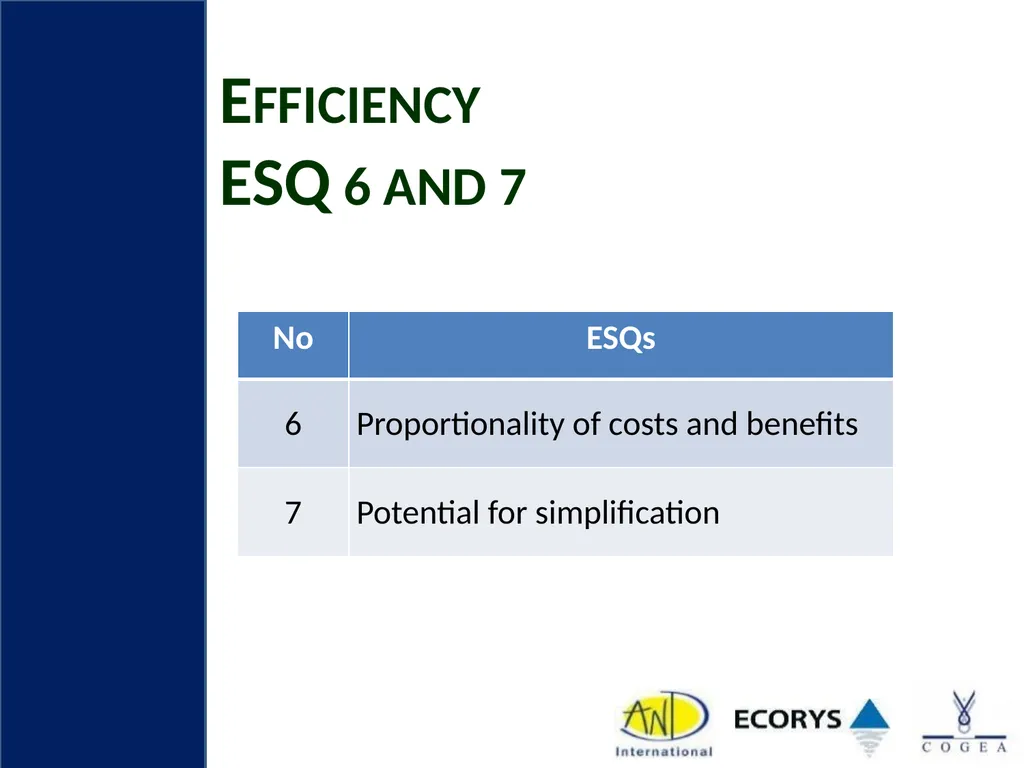
slide11. Efficiency ESQ 6 and 7<br>
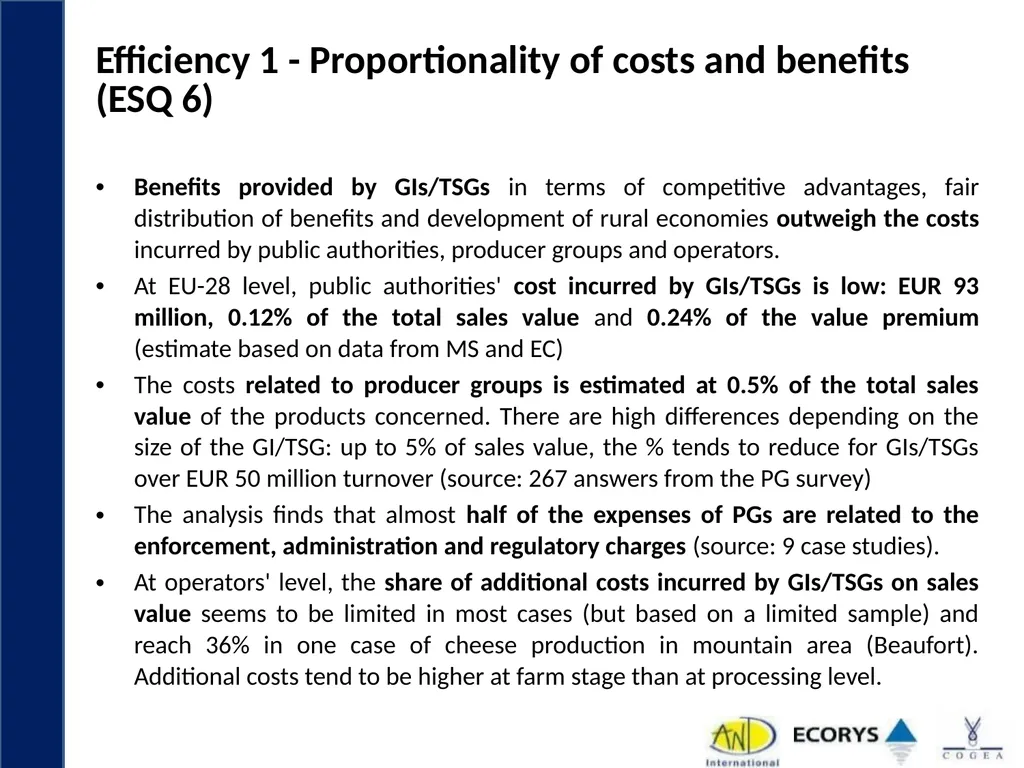
slide12. Efficiency 1 - Proportionality of costs and benefits (ESQ 6) Benefits provided by GIs/TSGs in terms of competitive advantages, fair distribution of benefits and development of rural economies outweigh the costs incurred by public authorities, producer groups and operators.
At EU-28 level, public authorities' cost incurred by GIs/TSGs is low: EUR 93 million, 0.12% of the total sales value and 0.24% of the value premium (estimate based on data from MS and EC)
The costs related to producer groups is estimated at 0.5% of the total sales value of the products concerned. There are high differences depending on the size of the GI/TSG: up to 5% of sales value, the % tends to reduce for GIs/TSGs over EUR 50 million turnover (source: 267 answers from the PG survey)
The analysis finds that almost half of the expenses of PGs are related to the enforcement, administration and regulatory charges (source: 9 case studies).
At operators' level, the share of additional costs incurred by GIs/TSGs on sales value seems to be limited in most cases (but based on a limited sample) and reach 36% in one case of cheese production in mountain area (Beaufort). Additional costs tend to be higher at farm stage than at processing level.<br>
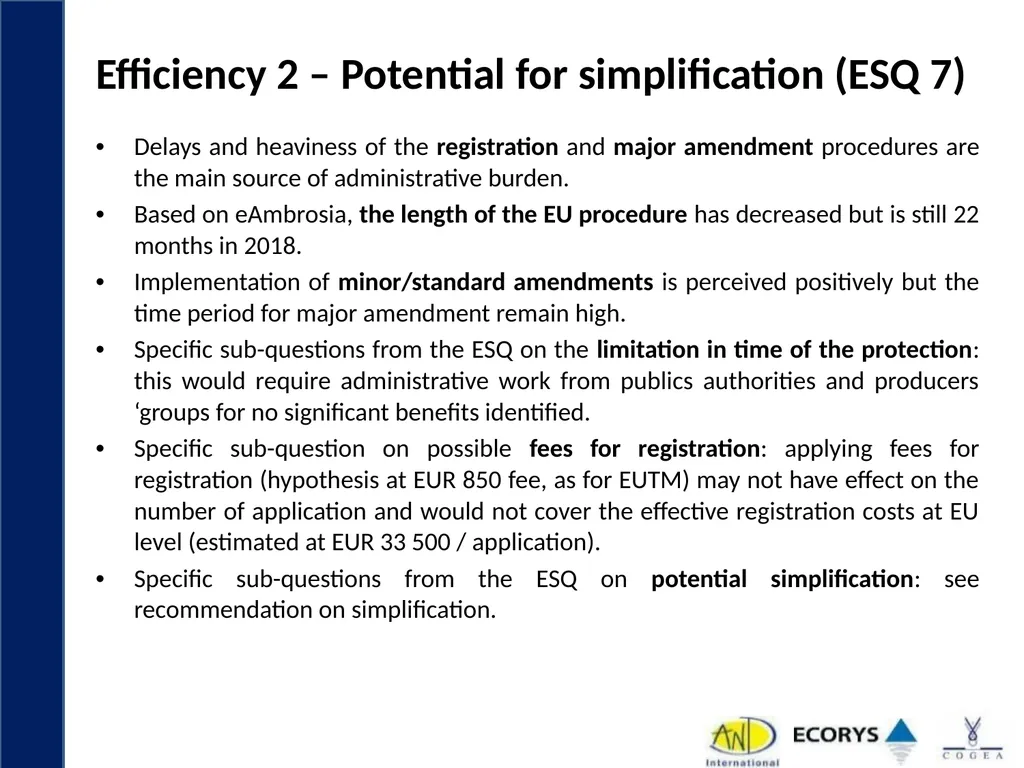
slide13. Efficiency 2 – Potential for simplification (ESQ 7) Delays and heaviness of the registration and major amendment procedures are the main source of administrative burden.
Based on eAmbrosia, the length of the EU procedure has decreased but is still 22 months in 2018.
Implementation of minor/standard amendments is perceived positively but the time period for major amendment remain high.
Specific sub-questions from the ESQ on the limitation in time of the protection: this would require administrative work from publics authorities and producers ‘groups for no significant benefits identified.
Specific sub-question on possible fees for registration: applying fees for registration (hypothesis at EUR 850 fee, as for EUTM) may not have effect on the number of application and would not cover the effective registration costs at EU level (estimated at EUR 33 500 / application).
Specific sub-questions from the ESQ on potential simplification: see recommendation on simplification.<br>
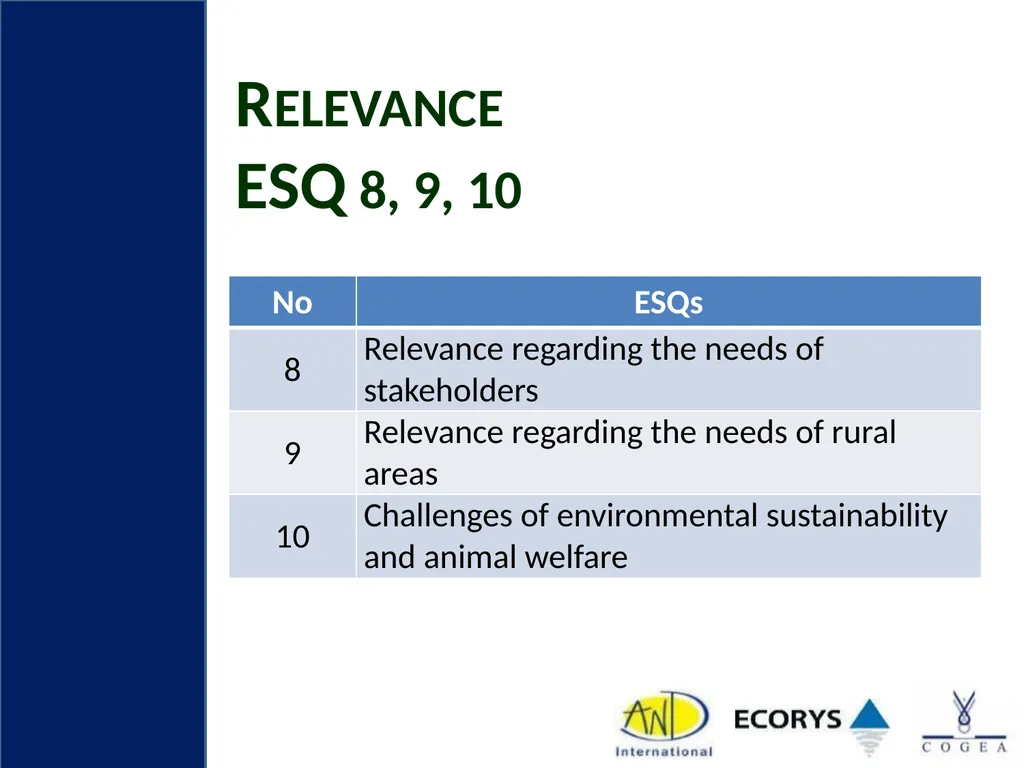
slide14. Relevance ESQ 8, 9, 10<br>
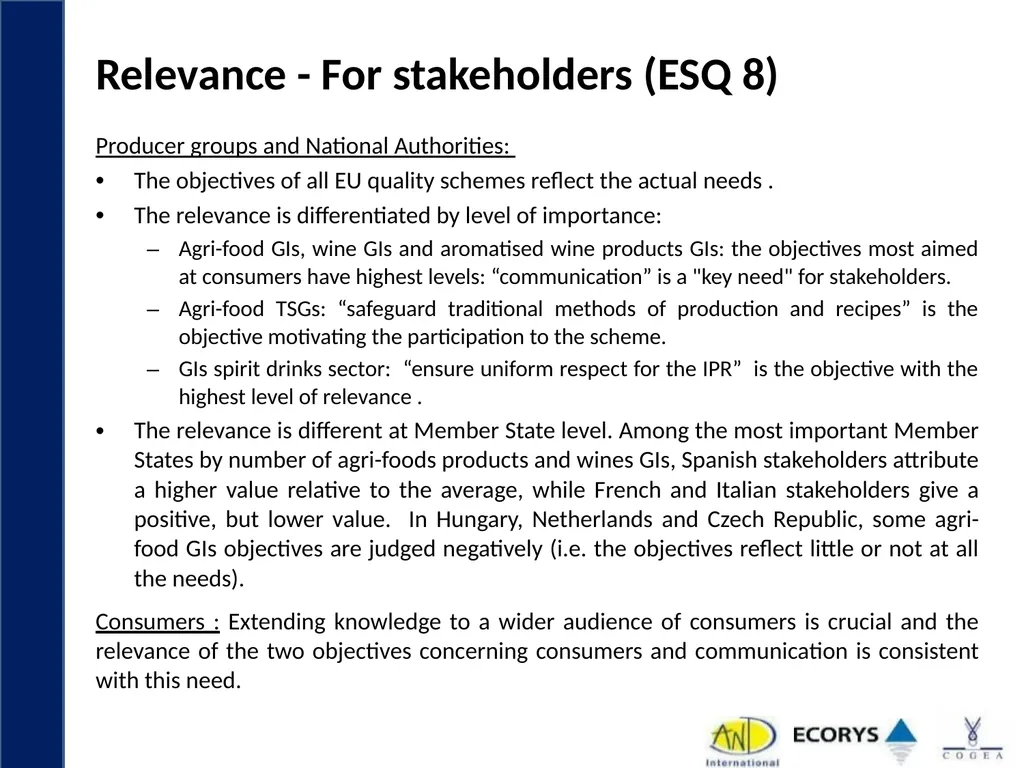
slide15. Relevance - For stakeholders (ESQ 8) Producer groups and National Authorities:
The objectives of all EU quality schemes reflect the actual needs .
The relevance is differentiated by level of importance:
Agri-food GIs, wine GIs and aromatised wine products GIs: the objectives most aimed at consumers have highest levels: “communication” is a "key need" for stakeholders.
Agri-food TSGs: “safeguard traditional methods of production and recipes” is the objective motivating the participation to the scheme.
GIs spirit drinks sector: “ensure uniform respect for the IPR” is the objective with the highest level of relevance .
The relevance is different at Member State level. Among the most important Member States by number of agri-foods products and wines GIs, Spanish stakeholders attribute a higher value relative to the average, while French and Italian stakeholders give a positive, but lower value. In Hungary, Netherlands and Czech Republic, some agri-food GIs objectives are judged negatively (i.e. the objectives reflect little or not at all the needs).
Consumers : Extending knowledge to a wider audience of consumers is crucial and the relevance of the two objectives concerning consumers and communication is consistent with this need.<br>
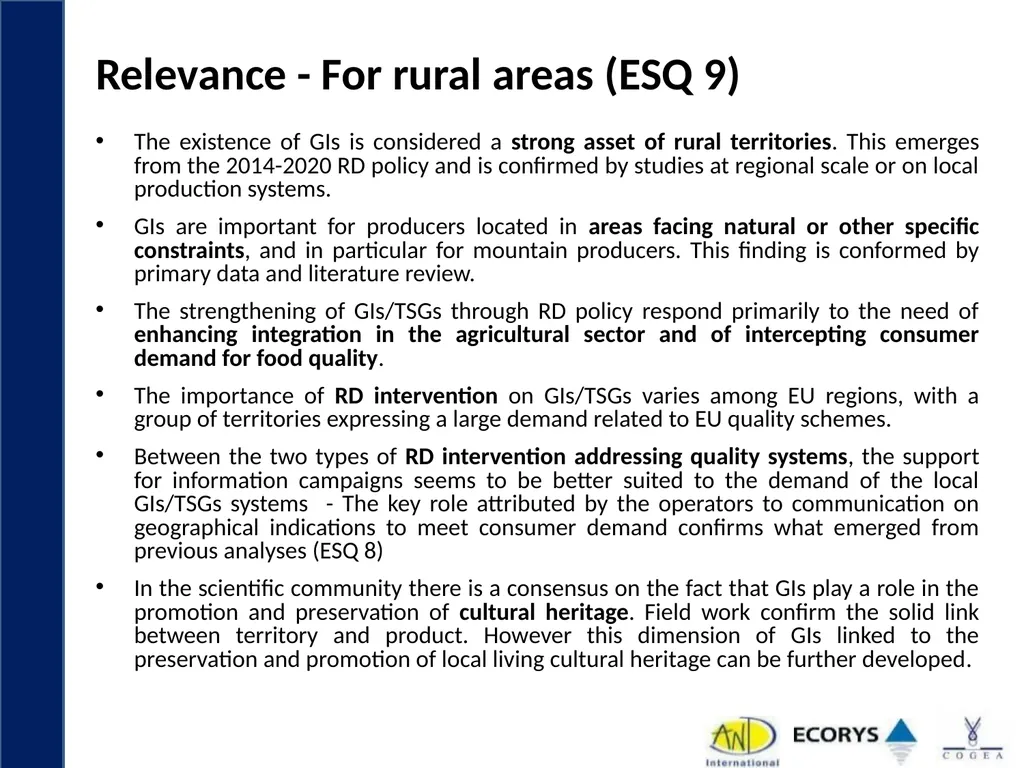
slide16. Relevance - For rural areas (ESQ 9) The existence of GIs is considered a strong asset of rural territories. This emerges from the 2014-2020 RD policy and is confirmed by studies at regional scale or on local production systems.
GIs are important for producers located in areas facing natural or other specific constraints, and in particular for mountain producers. This finding is conformed by primary data and literature review.
The strengthening of GIs/TSGs through RD policy respond primarily to the need of enhancing integration in the agricultural sector and of intercepting consumer demand for food quality.
The importance of RD intervention on GIs/TSGs varies among EU regions, with a group of territories expressing a large demand related to EU quality schemes.
Between the two types of RD intervention addressing quality systems, the support for information campaigns seems to be better suited to the demand of the local GIs/TSGs systems - The key role attributed by the operators to communication on geographical indications to meet consumer demand confirms what emerged from previous analyses (ESQ 8)
In the scientific community there is a consensus on the fact that GIs play a role in the promotion and preservation of cultural heritage. Field work confirm the solid link between territory and product. However this dimension of GIs linked to the preservation and promotion of local living cultural heritage can be further developed.<br>
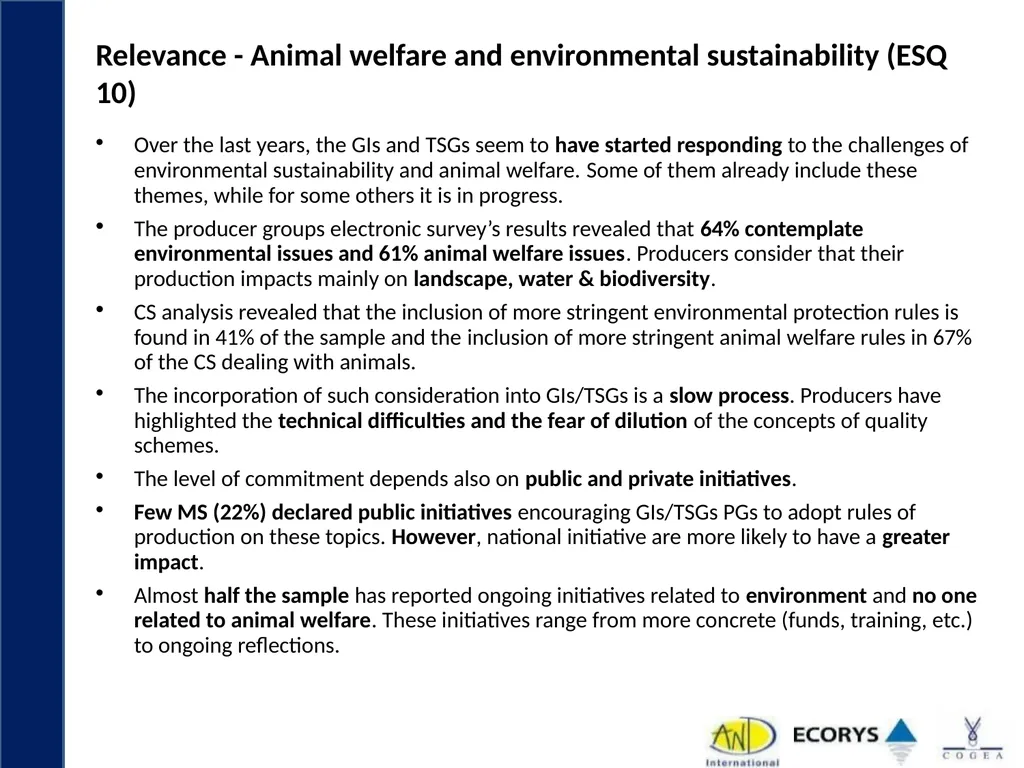
slide17. Relevance - Animal welfare and environmental sustainability (ESQ 10) Over the last years, the GIs and TSGs seem to have started responding to the challenges of environmental sustainability and animal welfare. Some of them already include these themes, while for some others it is in progress.
The producer groups electronic survey’s results revealed that 64% contemplate environmental issues and 61% animal welfare issues. Producers consider that their production impacts mainly on landscape, water & biodiversity.
CS analysis revealed that the inclusion of more stringent environmental protection rules is found in 41% of the sample and the inclusion of more stringent animal welfare rules in 67% of the CS dealing with animals.
The incorporation of such consideration into GIs/TSGs is a slow process. Producers have highlighted the technical difficulties and the fear of dilution of the concepts of quality schemes.
The level of commitment depends also on public and private initiatives.
Few MS (22%) declared public initiatives encouraging GIs/TSGs PGs to adopt rules of production on these topics. However, national initiative are more likely to have a greater impact.
Almost half the sample has reported ongoing initiatives related to environment and no one related to animal welfare. These initiatives range from more concrete (funds, training, etc.) to ongoing reflections.<br>
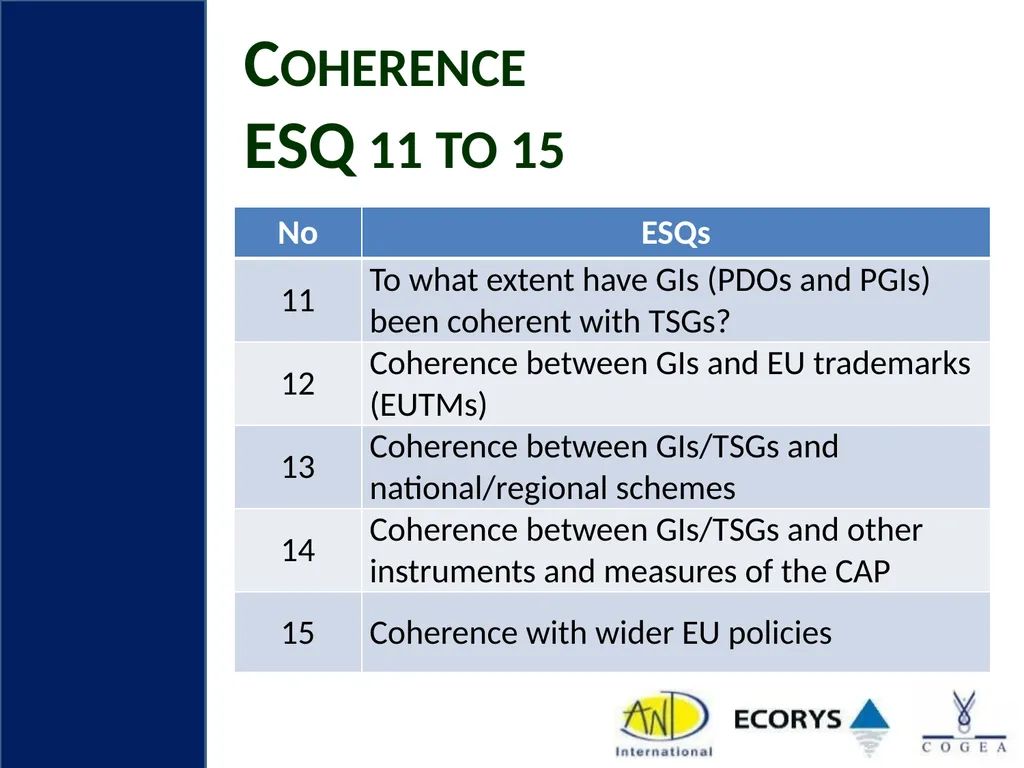
slide18. Coherence ESQ 11 to 15<br>
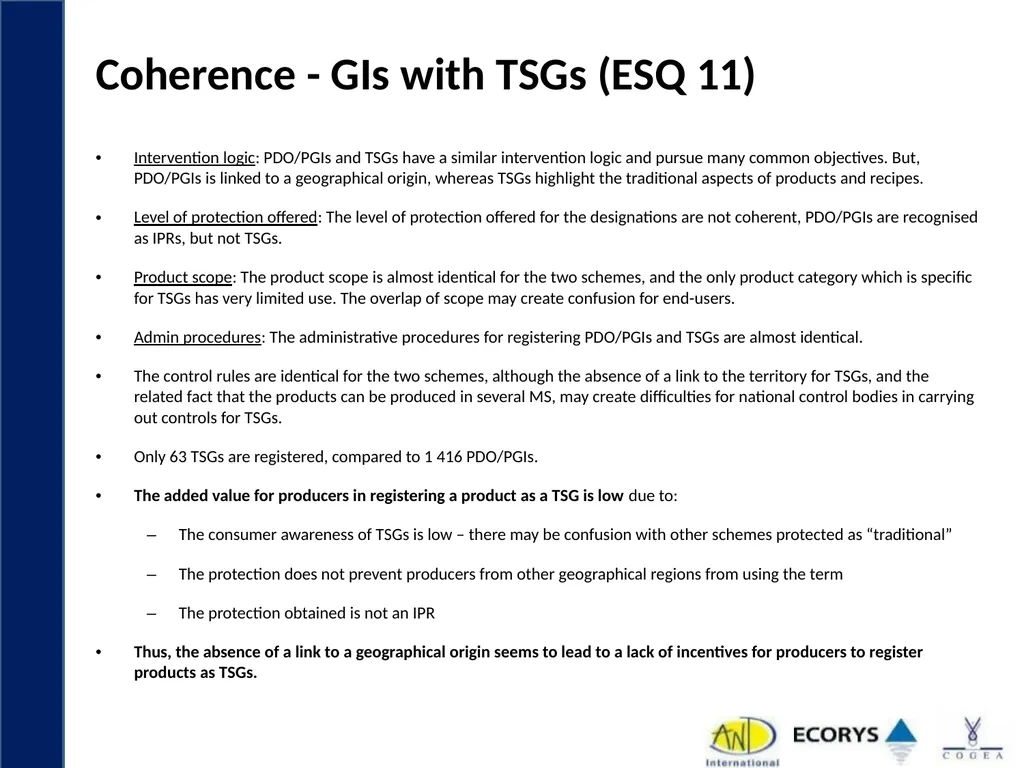
slide19. Coherence - GIs with TSGs (ESQ 11) Intervention logic: PDO/PGIs and TSGs have a similar intervention logic and pursue many common objectives. But, PDO/PGIs is linked to a geographical origin, whereas TSGs highlight the traditional aspects of products and recipes.
Level of protection offered: The level of protection offered for the designations are not coherent, PDO/PGIs are recognised as IPRs, but not TSGs.
Product scope: The product scope is almost identical for the two schemes, and the only product category which is specific for TSGs has very limited use. The overlap of scope may create confusion for end-users.
Admin procedures: The administrative procedures for registering PDO/PGIs and TSGs are almost identical.
The control rules are identical for the two schemes, although the absence of a link to the territory for TSGs, and the related fact that the products can be produced in several MS, may create difficulties for national control bodies in carrying out controls for TSGs.
Only 63 TSGs are registered, compared to 1 416 PDO/PGIs.
The added value for producers in registering a product as a TSG is low due to:
The consumer awareness of TSGs is low – there may be confusion with other schemes protected as “traditional”
The protection does not prevent producers from other geographical regions from using the term
The protection obtained is not an IPR
Thus, the absence of a link to a geographical origin seems to lead to a lack of incentives for producers to register products as TSGs.<br>
slide20. Coherence - GIs with EUTMs (ESQ 12) The extent to which the level of protection offered by EU legislation on GIs is compatible and comparable to the one offered for EUTMs:
Both GIs and EUTMs are registered IPRs intended to regulate the correct use of names and signs and granting protection and specific rights. However, they have different functions:
GIs protect a public interest and indicate a territorial origin based on which the right is granted, including a reputation associated with the territory.
EUTMs (individual and collective) protect a private interest and indicate the commercial origin of the goods and/or services for which the mark is granted.
TMs and GIs offer complementary protection to producers, who may seek parallel protection as TMs and GIs may co-exist.
The level of protection offered by the EU legislation on GIs is compatible with and comparable to the one offered for TMs.
No contradictions between the protection offered by individual marks and certification marks compared to GIs was found.
The only contradiction is represented by EU collective marks, where similar characteristics to the GI protection can in some cases cause a potential overlap between the two protections. A court case is currently pending before the Court of Justice of the European Union (CJEU), CJ C-766/18 P BBQLOUMI / HALLOUMI, which might shed some further light on this issue.<br>
slide21. Coherence - GIs with EUTMs (ESQ 12) The extent to which the rules on use of PDO/PGIs or EUTMs in the sale name of a final product that contains among its ingredients a product whose sale name is protected as a PDO/PGI or an EUTM create disproportionate protection between PDO/PGI users and EUTM holders:
There is a difference between the regulation of use of PDO/PGIs and EUTMs in final products’s sales names, due to that TMs confer exclusive, private rights to its holder(s) whereas PDO/PGIs confer a “collective right” to all producers in the geographical territory willing to produce according to the defined production rules.
As such, TM holders have, in general, greater possibilities to control the use of the TM in the sales names of other products through private contracts.
However, the EUTM legislation does not offer a general exclusive prerogative for the TM holder protecting the use of the TM in the sales names of other products (similar vs dissimilar goods).
PDO/PGI holders have more difficulties in preventing others from the use of a PDO/PGI name or symbol.
CJEU ruling: The use of a PDO/PGI name in the sales name of a final product is lawful, even without the consent of the PDO/PGI producer, if the final product has, as one of its characteristics, a taste attributable primarily to the presence of that PDO/PGI ingredient.
Additional legislation specifying the conditions under which industry may use a PDO/PGI in final products sales name has been defined in Italy.<br>
slide22. Coherence - GIs/TSGs with national and regional schemes (ESQ 13) Limitations:
The study does not include and does not take any position on the compatibility of the presented schemes with EU law, in particular regarding the exclusive character of Regulation (EU) N° 1151/2012 (see C-478/07) or regarding the prohibition of restrictions to the free movement of goods (Article 34 TFUE, cases C-13/78 or C-325/00)”.
Conclusions:
The national/regional schemes analysed share some common objectives with EU GIs/TSGs.
When pursuing objectives related to environment and animal welfare, national/regional schemes are complementary to the EU quality schemes.<br>
slide23. Coherence - GIs/TSGs with national and regional schemes (ESQ 13) Main focus of the schemes:
The requirements and criteria of national/regional schemes are often more general as compared with GIs and TSGs, while national/regional schemes often aim at characterising the whole basket of products covered by the scheme, rather than the specificities of individual products.
National/regional schemes often have a main area of focus, whilst GI schemes present a combination of stringent quality and origin requirements.
Level of protection:
Regional schemes typically do not offer IPR protection of the names, which is the case for the quality schemes.
Product scope:
Overall, the product scope of the national/regional schemes analysed overlaps with that of GIs and TSGs
Some of the national/regional schemes present a narrower sectorial coverage, in line with their specific objectives.
Coexistence with GIs:
The abundance of quality labels on the market generates confusion among consumers; however, consumers generally show higher awareness of national/regional schemes, as compared to GIs and TSGs.
National/regional schemes can represent a first informal step to prepare to enter EU Quality schemes. In this case, there is a synergy between the two types of schemes.<br>
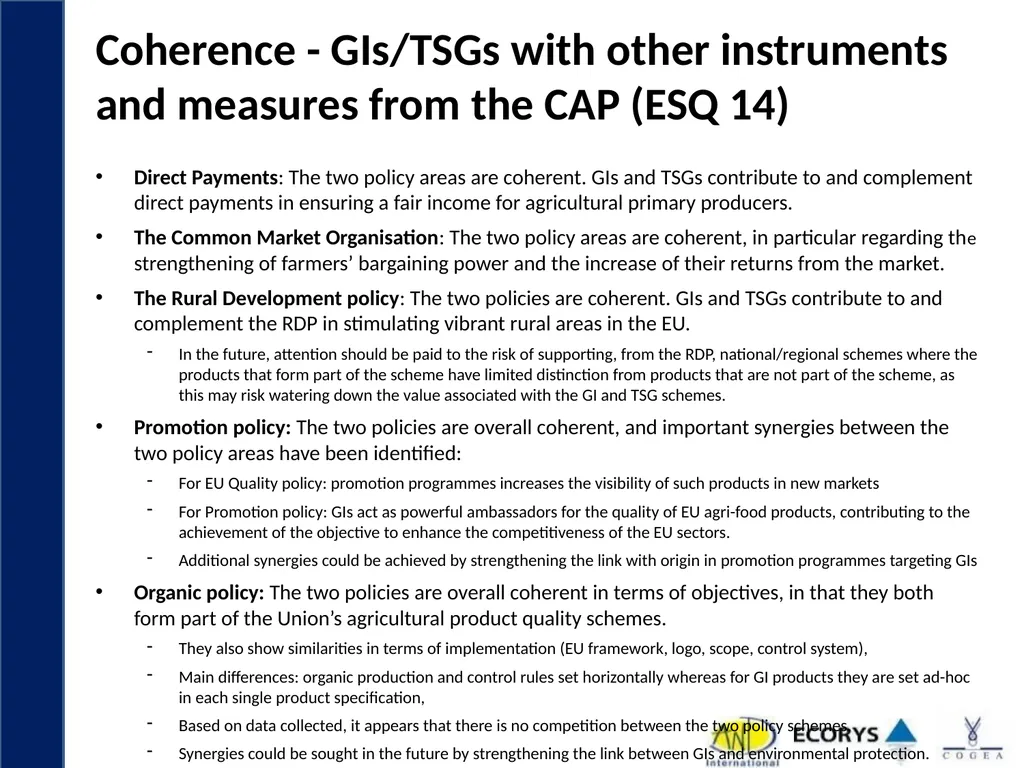
slide24. Coherence - GIs/TSGs with other instruments and measures from the CAP (ESQ 14) Direct Payments: The two policy areas are coherent. GIs and TSGs contribute to and complement direct payments in ensuring a fair income for agricultural primary producers.
The Common Market Organisation: The two policy areas are coherent, in particular regarding the strengthening of farmers’ bargaining power and the increase of their returns from the market.
The Rural Development policy: The two policies are coherent. GIs and TSGs contribute to and complement the RDP in stimulating vibrant rural areas in the EU.
In the future, attention should be paid to the risk of supporting, from the RDP, national/regional schemes where the products that form part of the scheme have limited distinction from products that are not part of the scheme, as this may risk watering down the value associated with the GI and TSG schemes.
Promotion policy: The two policies are overall coherent, and important synergies between the two policy areas have been identified:
For EU Quality policy: promotion programmes increases the visibility of such products in new markets
For Promotion policy: GIs act as powerful ambassadors for the quality of EU agri-food products, contributing to the achievement of the objective to enhance the competitiveness of the EU sectors.
Additional synergies could be achieved by strengthening the link with origin in promotion programmes targeting GIs
Organic policy: The two policies are overall coherent in terms of objectives, in that they both form part of the Union’s agricultural product quality schemes.
They also show similarities in terms of implementation (EU framework, logo, scope, control system),
Main differences: organic production and control rules set horizontally whereas for GI products they are set ad-hoc in each single product specification,
Based on data collected, it appears that there is no competition between the two policy schemes.
Synergies could be sought in the future by strengthening the link between GIs and environmental protection.<br>
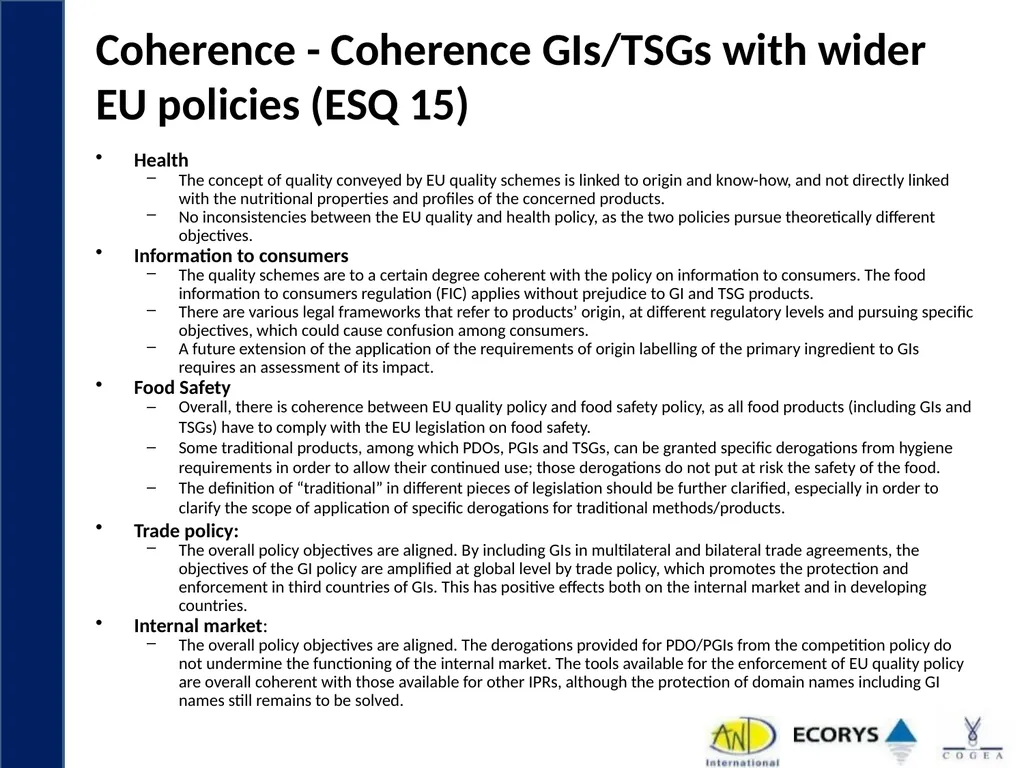
slide25. Coherence - Coherence GIs/TSGs with wider EU policies (ESQ 15) Health
The concept of quality conveyed by EU quality schemes is linked to origin and know-how, and not directly linked with the nutritional properties and profiles of the concerned products.
No inconsistencies between the EU quality and health policy, as the two policies pursue theoretically different objectives.
Information to consumers
The quality schemes are to a certain degree coherent with the policy on information to consumers. The food information to consumers regulation (FIC) applies without prejudice to GI and TSG products.
There are various legal frameworks that refer to products’ origin, at different regulatory levels and pursuing specific objectives, which could cause confusion among consumers.
A future extension of the application of the requirements of origin labelling of the primary ingredient to GIs requires an assessment of its impact.
Food Safety
Overall, there is coherence between EU quality policy and food safety policy, as all food products (including GIs and TSGs) have to comply with the EU legislation on food safety.
Some traditional products, among which PDOs, PGIs and TSGs, can be granted specific derogations from hygiene requirements in order to allow their continued use; those derogations do not put at risk the safety of the food.
The definition of “traditional” in different pieces of legislation should be further clarified, especially in order to clarify the scope of application of specific derogations for traditional methods/products.
Trade policy:
The overall policy objectives are aligned. By including GIs in multilateral and bilateral trade agreements, the objectives of the GI policy are amplified at global level by trade policy, which promotes the protection and enforcement in third countries of GIs. This has positive effects both on the internal market and in developing countries.
Internal market:
The overall policy objectives are aligned. The derogations provided for PDO/PGIs from the competition policy do not undermine the functioning of the internal market. The tools available for the enforcement of EU quality policy are overall coherent with those available for other IPRs, although the protection of domain names including GI names still remains to be solved.<br>
slide26. EU added value ESQ 16<br>
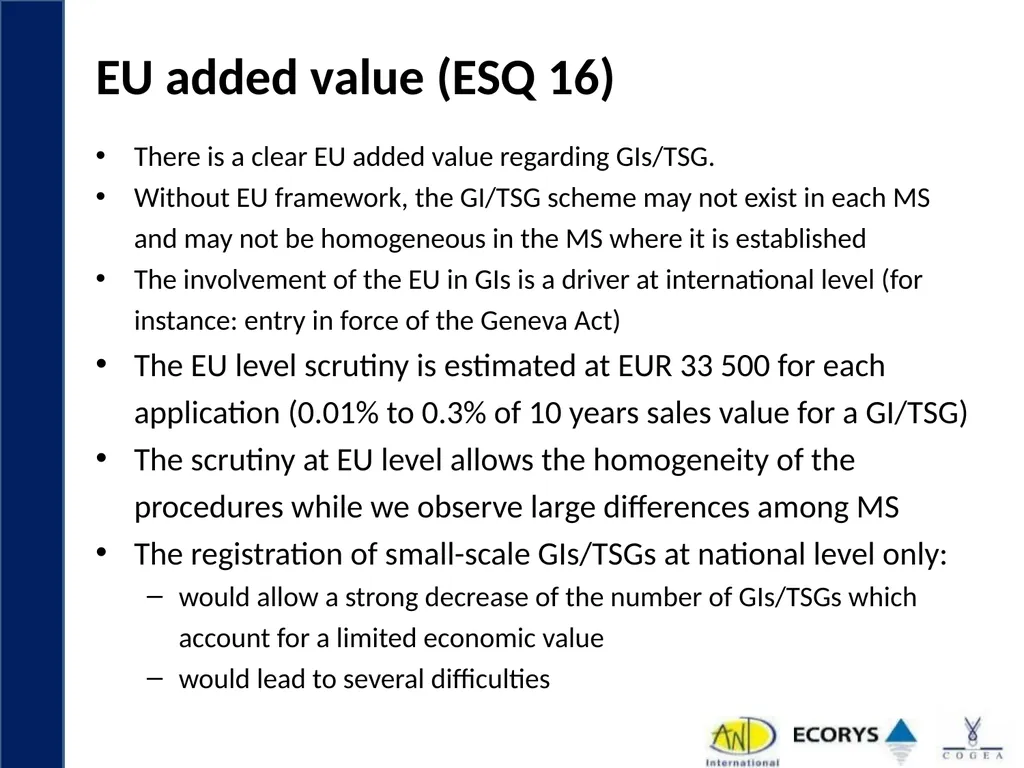
slide27. EU added value (ESQ 16) There is a clear EU added value regarding GIs/TSG.
Without EU framework, the GI/TSG scheme may not exist in each MS and may not be homogeneous in the MS where it is established
The involvement of the EU in GIs is a driver at international level (for instance: entry in force of the Geneva Act)
The EU level scrutiny is estimated at EUR 33 500 for each application (0.01% to 0.3% of 10 years sales value for a GI/TSG)
The scrutiny at EU level allows the homogeneity of the procedures while we observe large differences among MS
The registration of small-scale GIs/TSGs at national level only:
would allow a strong decrease of the number of GIs/TSGs which account for a limited economic value
would lead to several difficulties<br>
slide28. Recommandations<br>
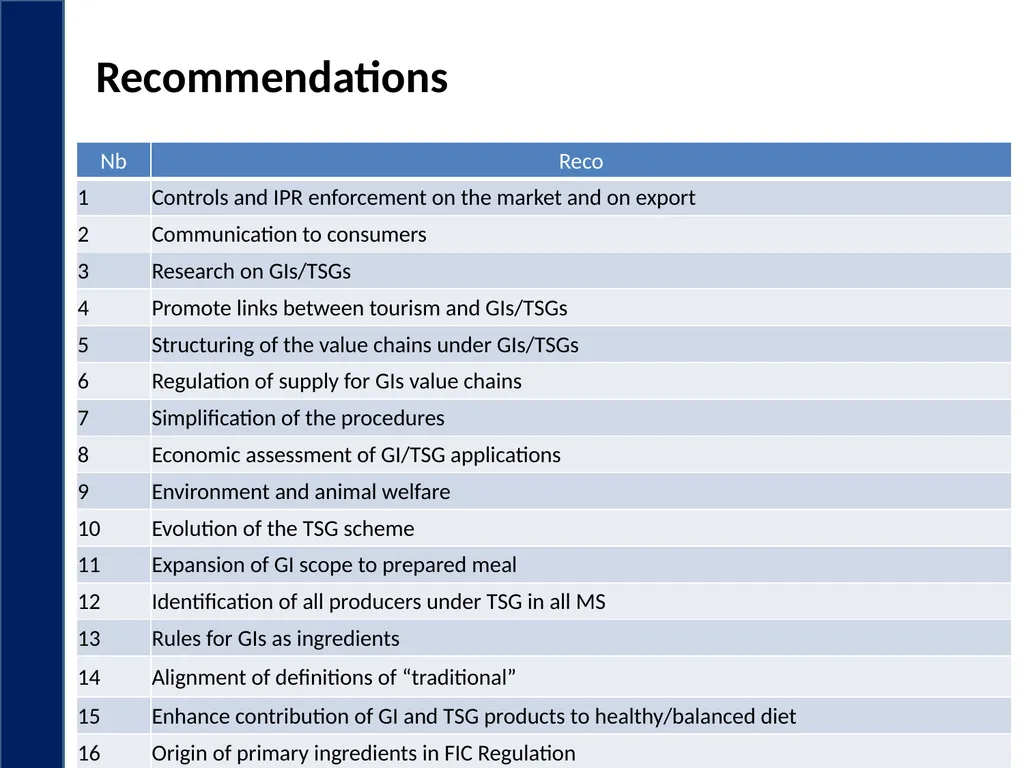
slide29. Recommendations<br>
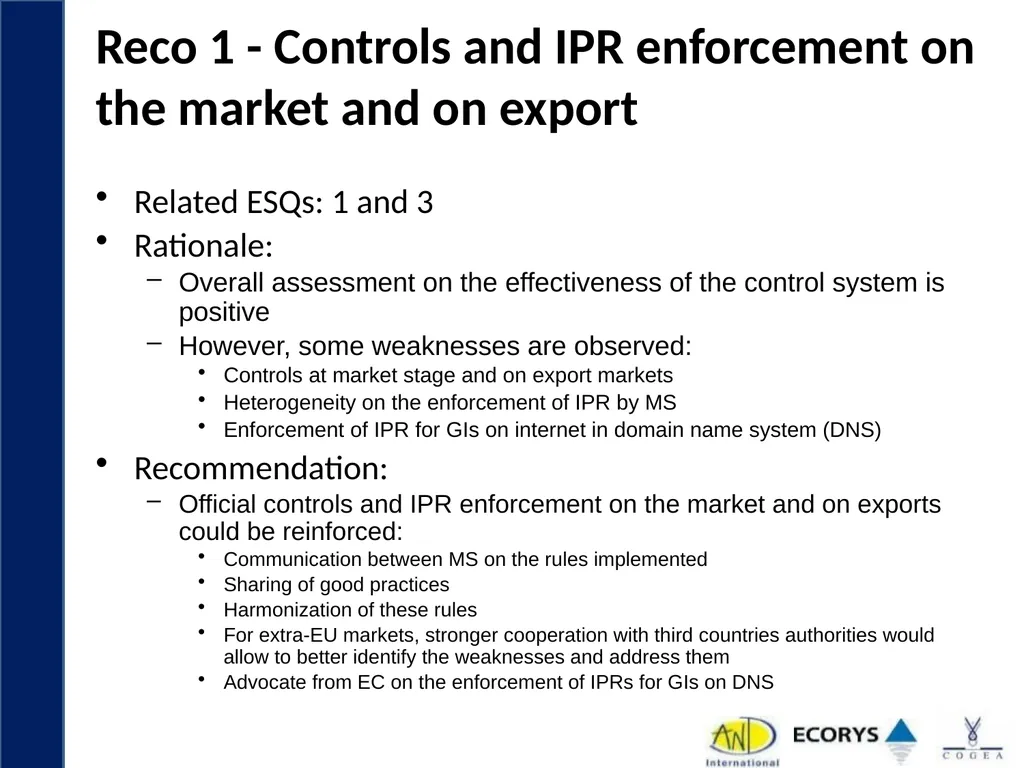
slide30. Reco 1 - Controls and IPR enforcement on the market and on export Related ESQs: 1 and 3
Rationale:
Overall assessment on the effectiveness of the control system is positive
However, some weaknesses are observed:
Controls at market stage and on export markets
Heterogeneity on the enforcement of IPR by MS
Enforcement of IPR for GIs on internet in domain name system (DNS)
Recommendation:
Official controls and IPR enforcement on the market and on exports could be reinforced:
Communication between MS on the rules implemented
Sharing of good practices
Harmonization of these rules
For extra-EU markets, stronger cooperation with third countries authorities would allow to better identify the weaknesses and address them
Advocate from EC on the enforcement of IPRs for GIs on DNS<br>
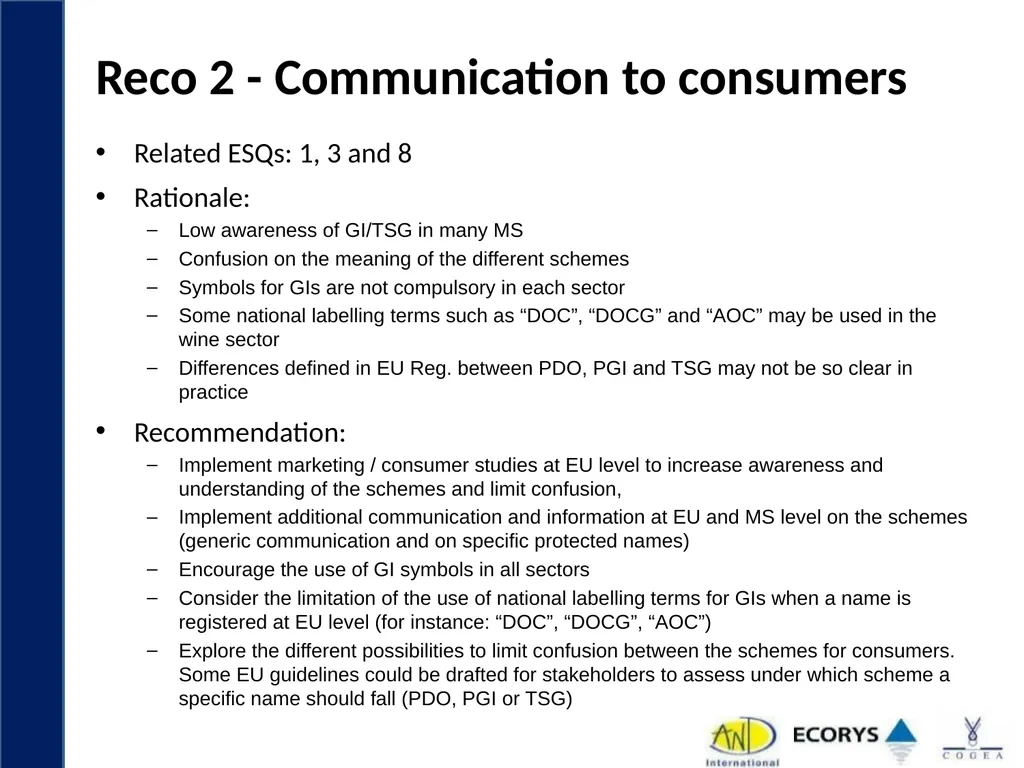
slide31. Reco 2 - Communication to consumers Related ESQs: 1, 3 and 8
Rationale:
Low awareness of GI/TSG in many MS
Confusion on the meaning of the different schemes
Symbols for GIs are not compulsory in each sector
Some national labelling terms such as “DOC”, “DOCG” and “AOC” may be used in the wine sector
Differences defined in EU Reg. between PDO, PGI and TSG may not be so clear in practice
Recommendation:
Implement marketing / consumer studies at EU level to increase awareness and understanding of the schemes and limit confusion,
Implement additional communication and information at EU and MS level on the schemes (generic communication and on specific protected names)
Encourage the use of GI symbols in all sectors
Consider the limitation of the use of national labelling terms for GIs when a name is registered at EU level (for instance: “DOC”, “DOCG”, “AOC”)
Explore the different possibilities to limit confusion between the schemes for consumers. Some EU guidelines could be drafted for stakeholders to assess under which scheme a specific name should fall (PDO, PGI or TSG)<br>
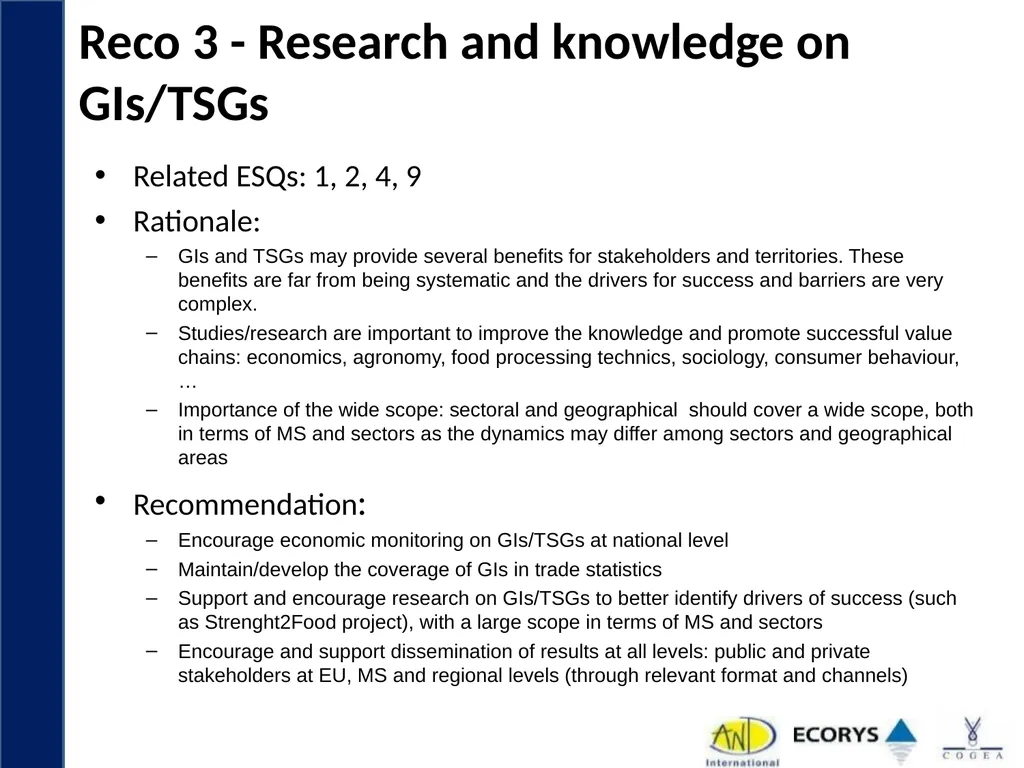
slide32. Reco 3 - Research and knowledge on GIs/TSGs Related ESQs: 1, 2, 4, 9
Rationale:
GIs and TSGs may provide several benefits for stakeholders and territories. These benefits are far from being systematic and the drivers for success and barriers are very complex.
Studies/research are important to improve the knowledge and promote successful value chains: economics, agronomy, food processing technics, sociology, consumer behaviour,…
Importance of the wide scope: sectoral and geographical should cover a wide scope, both in terms of MS and sectors as the dynamics may differ among sectors and geographical areas
Recommendation:
Encourage economic monitoring on GIs/TSGs at national level
Maintain/develop the coverage of GIs in trade statistics
Support and encourage research on GIs/TSGs to better identify drivers of success (such as Strenght2Food project), with a large scope in terms of MS and sectors
Encourage and support dissemination of results at all levels: public and private stakeholders at EU, MS and regional levels (through relevant format and channels)<br>
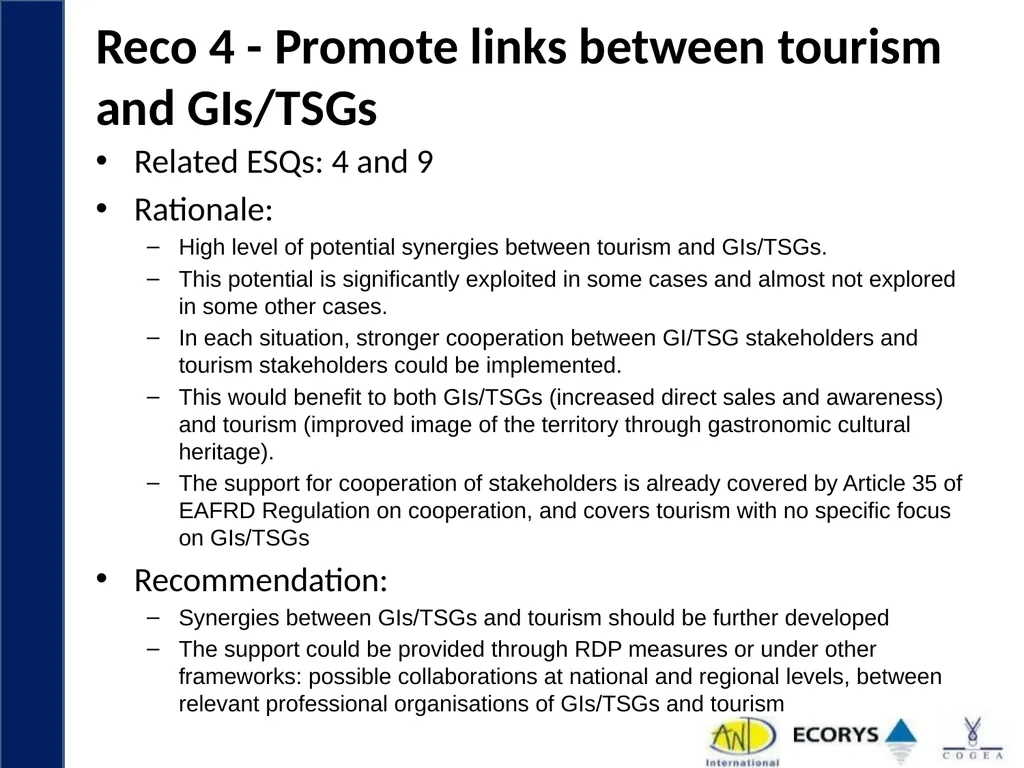
slide33. Reco 4 - Promote links between tourism and GIs/TSGs Related ESQs: 4 and 9
Rationale:
High level of potential synergies between tourism and GIs/TSGs.
This potential is significantly exploited in some cases and almost not explored in some other cases.
In each situation, stronger cooperation between GI/TSG stakeholders and tourism stakeholders could be implemented.
This would benefit to both GIs/TSGs (increased direct sales and awareness) and tourism (improved image of the territory through gastronomic cultural heritage).
The support for cooperation of stakeholders is already covered by Article 35 of EAFRD Regulation on cooperation, and covers tourism with no specific focus on GIs/TSGs
Recommendation:
Synergies between GIs/TSGs and tourism should be further developed
The support could be provided through RDP measures or under other frameworks: possible collaborations at national and regional levels, between relevant professional organisations of GIs/TSGs and tourism<br>
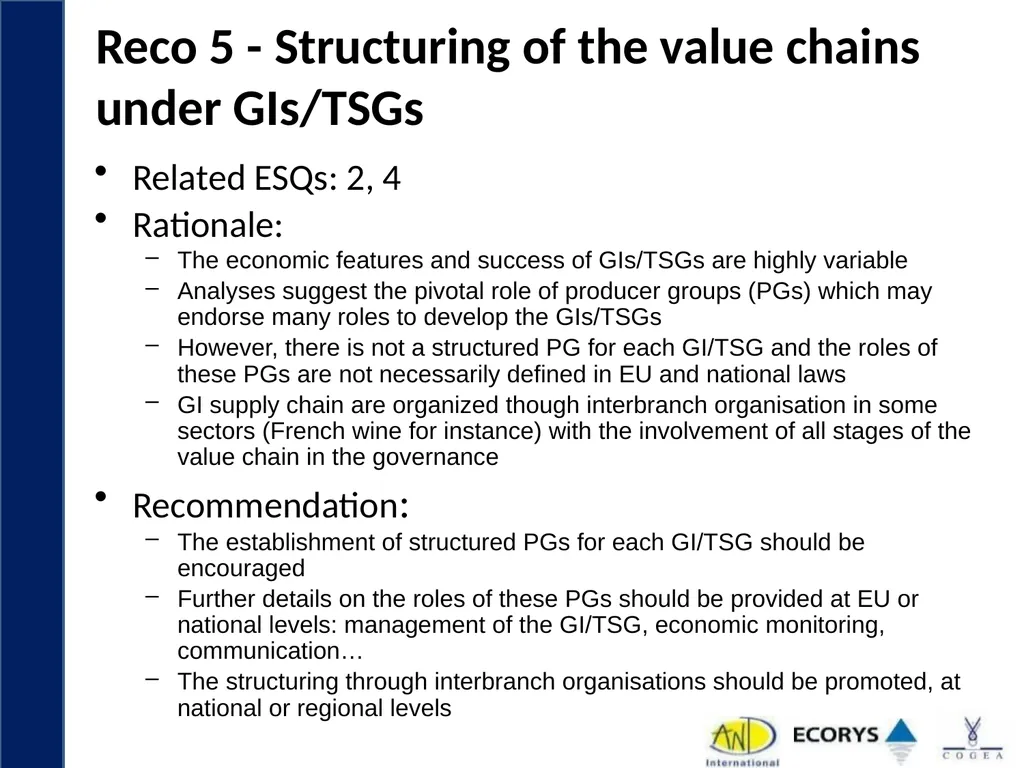
slide34. Reco 5 - Structuring of the value chains under GIs/TSGs Related ESQs: 2, 4
Rationale:
The economic features and success of GIs/TSGs are highly variable
Analyses suggest the pivotal role of producer groups (PGs) which may endorse many roles to develop the GIs/TSGs
However, there is not a structured PG for each GI/TSG and the roles of these PGs are not necessarily defined in EU and national laws
GI supply chain are organized though interbranch organisation in some sectors (French wine for instance) with the involvement of all stages of the value chain in the governance
Recommendation:
The establishment of structured PGs for each GI/TSG should be encouraged
Further details on the roles of these PGs should be provided at EU or national levels: management of the GI/TSG, economic monitoring, communication…
The structuring through interbranch organisations should be promoted, at national or regional levels<br>
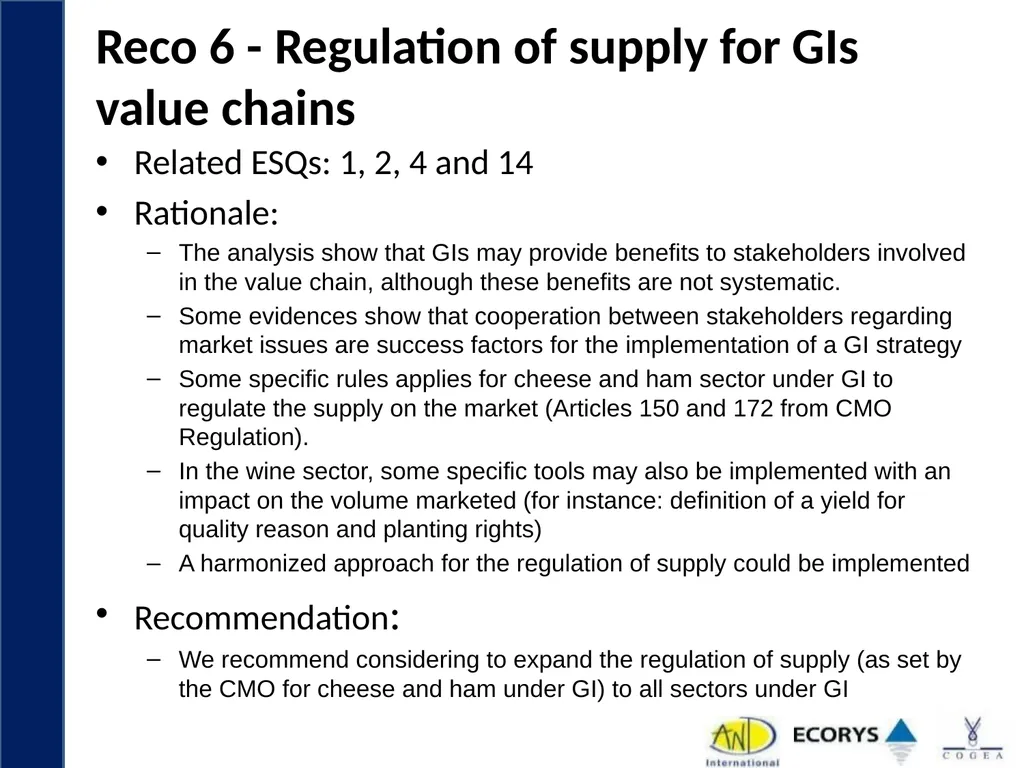
slide35. Reco 6 - Regulation of supply for GIs value chains Related ESQs: 1, 2, 4 and 14
Rationale:
The analysis show that GIs may provide benefits to stakeholders involved in the value chain, although these benefits are not systematic.
Some evidences show that cooperation between stakeholders regarding market issues are success factors for the implementation of a GI strategy
Some specific rules applies for cheese and ham sector under GI to regulate the supply on the market (Articles 150 and 172 from CMO Regulation).
In the wine sector, some specific tools may also be implemented with an impact on the volume marketed (for instance: definition of a yield for quality reason and planting rights)
A harmonized approach for the regulation of supply could be implemented
Recommendation:
We recommend considering to expand the regulation of supply (as set by the CMO for cheese and ham under GI) to all sectors under GI<br>
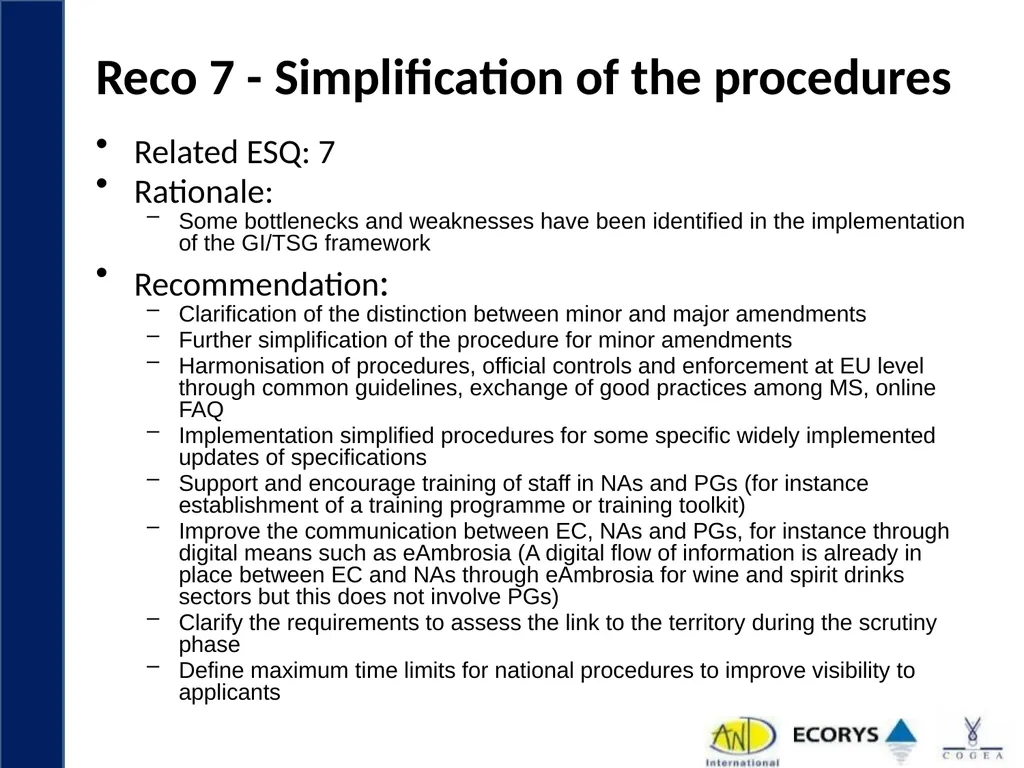
slide36. Reco 7 - Simplification of the procedures Related ESQ: 7
Rationale:
Some bottlenecks and weaknesses have been identified in the implementation of the GI/TSG framework
Recommendation:
Clarification of the distinction between minor and major amendments
Further simplification of the procedure for minor amendments
Harmonisation of procedures, official controls and enforcement at EU level through common guidelines, exchange of good practices among MS, online FAQ
Implementation simplified procedures for some specific widely implemented updates of specifications
Support and encourage training of staff in NAs and PGs (for instance establishment of a training programme or training toolkit)
Improve the communication between EC, NAs and PGs, for instance through digital means such as eAmbrosia (A digital flow of information is already in place between EC and NAs through eAmbrosia for wine and spirit drinks sectors but this does not involve PGs)
Clarify the requirements to assess the link to the territory during the scrutiny phase
Define maximum time limits for national procedures to improve visibility to applicants<br>
slide37. Reco 8 - Economic assessment of GI/TSG applications Related ESQ: 1, 2, 4, 16
Rationale:
We observe some large differences in the economic features of the GI/TSG value chains.
Some value chains meet large success while the development of some others is very limited.
The application and registration of each GI/TSG and modification of product specifications ask a lot of time from both applicants and public bodies in charge of scrutiny and registration.
A better identification of the weaknesses of some applications would allow to improve the quality of the application
In some cases, this would also allow to orientate stakeholders toward other schemes if the GI/TSG project does not appear relevant
Recommendation:
The economic assessment of the GI/TSG applications by NAs should be encouraged at the application stage. This economic assessment would cover the potential volume of production covered by the GI/TSG, the demand from the market, the expected impacts from of the registration and the relevance of the PS
A technical assistance could be provided to the PG at the stage of the application to elaborate adequate application, with a relevant PS and strategy.<br>
slide38. Reco 9 - Environment and animal welfare Related ESQ: 10
Rationale:
There is a growing integration of environment and animal welfare in GIs and TSGs, further integration could be reached
Recommendation:
The set-up of an ad hoc expert group to define “sustainable criteria” by sectors, with the priority on:
agri-environment measures in the wine sector
animal welfare which could cover a wide range of GIs/TSGs
The update of products specifications could be promoted to include these criteria through simplified procedures
Encourage the certification of GI/TSG farmers/producers under environment and animal welfare schemes, through direct certification or equivalence between the GI/TSG and these other schemes
A better monitoring of the share of organic production under GI/TSG, to allow tracking the reaching of the level set in Farm to Fork strategy<br>
slide39. Reco 10 - Evolution of the TSG scheme Related ESQ: 11
Rationale:
TSGs has been implemented by the EU in 1992, with PDOs and PGIs in the agri-food sector.
28 years after the implementation of the scheme, there are 1 377 PDOs/PGIS registered in the agri-food sector and only 63 TSGs.
This shows a low attractiveness of the TSGs compared to PDOs/PGIs for stakeholders.
Some evidences suggest the low attractiveness is because TSGs are not linked to a specific origin and does not provide an IPR to stakeholders. Thus, group of producers registering a TSG cannot prevent producers from other area to use the TSG
In addition, demarcation line between GIs and TSGs may not be fully clear on the field: “traditional” names may be linked in some cases to specific geographical areas (even if this is not part of the PS as TSGs are not linked to a protected area).
Recommendation:
Reassess the added value of TSGs
Consider the possibility to phase-out the TSG scheme, over a 10 years period for instance. The phase-out could be implemented as follows:
The possibility for some TSGs to evolve toward a GI through an assessment of the link to a specific geographical area could be evaluated, where this link to a specific geographical area could be establised, such as “ Spišské párky” which is highly rooted in Czechia and Slovakia for example
Some TSGs could evolve toward an "optional quality term" (as mountain products) or code of good practices defined at national level if they are not linked to a specific geographical area, such as “hay milk”<br>
slide40. Reco 11 – Expansion of GI scope to prepared meal Related ESQ: 11
Rationale:
Prepared meals are covered by TSGs but not by GIs
We do not identify clear rationale for this distinction
However, the coverage of prepared meals by GIs could lead to implementation difficulties in the restaurants (restaurants could not use the protected names out of the production area)
Recommendation:
Consider the possibility to expand the scope of GIs to prepared meals, under the Regulation on agricultural products and foodstuffs
Specific attention should be paid to potential negative effects stemming from this for the restaurant sector which may need to be further explored<br>
slide41. Reco 12 – Identification of all producers under TSG in all MS Related ESQ: 11
Rationale:
We observe some weaknesses in the administrative framework when stakeholders are involved in a TSG in a different MS from the MS which initiated the application.
This leads to difficulties in the definition of control plans and the implementation of official controls
Recommendation:
The implementation of the control framework should be adapted in order to better identify all producers involved in a TSG in each MS. The obligation to register to the relevant NA or to a PG when producing a TSG should be considered<br>
slide42. Reco 13 – Rules for GIs as ingredients Related ESQ: 12
Rationale:
There is a difference of treatment between PDO/PGIs and EUTMs used in final products’ sales name making it easier for EUTMs, compared to PDO/PGIs, to control the use through private contracts.
Additional rules could be provided for GIs, providing for an agreement to be concluded between the company mentioning in the sales name of its product the GI name of the product which is used as an ingredient and the PG managing the GI.
Recommendation:
Examine the need for an evolvement of EU legislation in order to incorporate the possibility to resolve the issue of the use of GIs in final products’ sales name, when the GI has been used as an ingredient, through the use of contracts between the involved economic operators.<br>
slide43. Reco 14 – Alignment of definitions of “traditional” Related ESQ: 15
Rationale:
“Traditional” is the rationale to authorise a derogation to food safety standard set out in Regulation (EC) No 852/2004
However, the definitions of the term “traditional” is not homogenous between TSG Regulation, food safety Regulation and national laws
Recommendation:
Consider the possibility to align the definitions of "traditional" between TSG Regulation, Regulation (EC) No 2074/2005 and national laws<br>
slide44. Reco 15 – Enhance contribution of GI and TSG products to healthy and balanced diet Related ESQ: 15
Rationale:
GIs and TSGs cover a wide range of food and drink products.
There is no inconsistency between GI/TSG and EU health policy, as the two policies pursue theoretically different objectives.
A further synergy could be reached by promoting research and innovation projects on the nutritional properties of GIs and TSGs.
Recommendation:
We suggest further efforts in supporting research initiatives that explores the nutritional aspects of GIs/TSGs.<br>
slide45. Reco 16 – Origin of primary ingredients in FIC Regulation Related ESQ: 15
Rationale:
The Article 26 of the Food Information to Consumer Regulation (FIC Regulation) regarding the origin of food also applies to GIs .
However, GIs are temporarily exempted from the scope of application of Commission Implementing Regulation (EU) 2018/775.
Recommendation:
The future extension of the application of the requirements of origin labelling of the primary ingredient to GIs would require an assessment of its impact<br>
slide2. Introduction - objectives Study conducted from December 2019 to December 2020
Objectives:
provide an evaluation on the EU quality policy on GIs and TSGs protected in the EU,
provide answers to 16 evaluation study questions (ESQs) on 5 themes: effectiveness, efficiency, relevance, coherence and EU added value.<br>
slide3. Introduction – coverage Geographical coverage: EU 28
Period covered: 30 May 2008 to 2020
GIs and TSGs covered (data on the 01/01/2020):
3 286 GIs and TSG registered by MS (3 224 GIs and 62 TSGs)
32 GIs registered by third countries through direct application
Sectoral coverage: agricultural products, foodstuffs, spirit drinks, wines and aromatised wine products.
Regulatory coverage:
Spirit drinks: Regulation (EC) No 110/2008 until 7 June 2019 and Regulation (EU) 2019/787 Since 8 June 2019,
Agricultural products and foodstuffs: Regulation (EU) No 1151/2012
Wines: Regulation (EU) No 1308/2013,
Aromatised wine products: Regulation (EU) No 251/2014.<br>
slide4. Methodology - List of tools<br>
slide5. Main conclusions by theme<br>
slide6. Effectiveness ESQs 1 to 5<br>
slide7. Effectiveness Fair competition for farmers and producers
There are high differences in procedures among the different MS
The scrutiny at EU level and the effectiveness of controls in MS ensure fair competition for farmers and producers
The high level of legal protection of GI names in the EU and the effectiveness of controls, especially at national level, ensure the protection of IPRs in the EU
Controls are assessed to be more effective at upstream stages than at downstream stages
Integrity of the market
The GI/TSG scheme overall favours the integrity of the market: common reference at EU level
The share of intra-EU export of GI products is comparable or higher than the share of intra-EU export of the whole food and drink sector in 5 MS among the 7 largest MS in terms of sales value under GI
Limits: low awareness and understanding in some MS, possible requirements on the origin of raw materials
True and fair view of the products and authenticity, clear and reliable information to consumers
Authenticity provided by both origin of the products (for GIs) and its specificities (based on the product specifications)
Several reliable sources of information are available on GIs/TSGs (eAmbrosia, Qualigeo, INAO, producer groups websites)
Controls and IPR enforcement are considered effective, even if some weaknesses are observed (retail and export, domain name system on internet)
The low awareness and understanding of the GI/TSG scheme by consumers in some MS show the limited effectiveness to provide clear information to all consumers<br>
slide8. Effectiveness - Fair return for farmers and producers Increase of market share
GI/TSG sales have increased more rapidly than the whole food and drink sector. Exception for GI spirits drinks exports that increased in a lesser extent than the whole spirit drinks exports.
Positive impacts are not systematic and the effects are not homogenous. This depends on the context of establishment of the GI/TSG, the targeted market, the governance and the content of the PS.
64% of GIs increased in sales value between 2010 and 2017, 46% in volume (based on data from DG AGRI study on the value of GI/TSGs, 2019).
Competitive advantages
In some situations, existence of price premium and price stability are strong competitive advantages.
Low level of awareness of European consumers in some MS limits the impacts of these competitive advantages. However, some protected names benefit of a strong notoriety.
Other benefits: higher price stability, synergies with tourism, increase of land price and improvement of quality management.
Fair distribution of benefits
In many cases, GI/TSG implementation has increased bargaining power of farmers and processors.
GI/TSG has increased the concentration of benefits at some level of the supply chain for some products: mainly farmers and processors, it may be exporters in some cases.
The main parameters that have an impact of the distribution of benefits are the organisation of the supply chain and the number of operators.<br>
slide9. Effectiveness 5 - Impacts in rural areas Farmers Income
GI/TSG may have a positive impact on income:
Higher farm income or processing income due to GI/TSG registration is perceived by 52% and 54% of producer groups (electronic survey with producer groups). The producer groups survey survey also shows that “the increase of prices” ranks only fourth among the incentive for registration.
Based on FADN analysis in the wine sector, GI farmers tend to get a higher income than non-GI farms. However, there are some differences at national level (better situation for GIs in IT, ES and PT, better situation for non-GI in RO and HU and mixed results in BG and EL)
Employment in rural areas
GI/TSG marketing chains play a positive role in the local employment
The increase of the GI/TSG sales led to increase the number of jobs in this sector, with a quicker pace than in the whole food and drink sectors.
The number of farms and processing companies involved in GIs marketing chain have risen; consequently number of jobs, located in the GIs protected areas have risen too (based on desk research in FR and ES).
In most cases (based on case studies and desk research), GI product have significant or major impact on local development and jobs (creation or maintaining).
Diversification
GIs value chains have strong relationship with tourism and on-farm processing.<br>
slide10. Effectiveness - Third country GIs IPR protection was the main driver for non-EU stakeholders who are involved in GIs when they applied for the registration in the EU by direct application.
Most of the producer groups of third country GIs exporting on the EU market do not consider that EU registration permitted to increase sales volumes.
Main impact of registration is higher IPR protection.
Price and growth of these GIs seem to be a negligible benefit of the EU registration; and are considered to be mostly determined by other factors: brand communication, relation between offer and demand, etc.<br>
slide11. Efficiency ESQ 6 and 7<br>
slide12. Efficiency 1 - Proportionality of costs and benefits (ESQ 6) Benefits provided by GIs/TSGs in terms of competitive advantages, fair distribution of benefits and development of rural economies outweigh the costs incurred by public authorities, producer groups and operators.
At EU-28 level, public authorities' cost incurred by GIs/TSGs is low: EUR 93 million, 0.12% of the total sales value and 0.24% of the value premium (estimate based on data from MS and EC)
The costs related to producer groups is estimated at 0.5% of the total sales value of the products concerned. There are high differences depending on the size of the GI/TSG: up to 5% of sales value, the % tends to reduce for GIs/TSGs over EUR 50 million turnover (source: 267 answers from the PG survey)
The analysis finds that almost half of the expenses of PGs are related to the enforcement, administration and regulatory charges (source: 9 case studies).
At operators' level, the share of additional costs incurred by GIs/TSGs on sales value seems to be limited in most cases (but based on a limited sample) and reach 36% in one case of cheese production in mountain area (Beaufort). Additional costs tend to be higher at farm stage than at processing level.<br>
slide13. Efficiency 2 – Potential for simplification (ESQ 7) Delays and heaviness of the registration and major amendment procedures are the main source of administrative burden.
Based on eAmbrosia, the length of the EU procedure has decreased but is still 22 months in 2018.
Implementation of minor/standard amendments is perceived positively but the time period for major amendment remain high.
Specific sub-questions from the ESQ on the limitation in time of the protection: this would require administrative work from publics authorities and producers ‘groups for no significant benefits identified.
Specific sub-question on possible fees for registration: applying fees for registration (hypothesis at EUR 850 fee, as for EUTM) may not have effect on the number of application and would not cover the effective registration costs at EU level (estimated at EUR 33 500 / application).
Specific sub-questions from the ESQ on potential simplification: see recommendation on simplification.<br>
slide14. Relevance ESQ 8, 9, 10<br>
slide15. Relevance - For stakeholders (ESQ 8) Producer groups and National Authorities:
The objectives of all EU quality schemes reflect the actual needs .
The relevance is differentiated by level of importance:
Agri-food GIs, wine GIs and aromatised wine products GIs: the objectives most aimed at consumers have highest levels: “communication” is a "key need" for stakeholders.
Agri-food TSGs: “safeguard traditional methods of production and recipes” is the objective motivating the participation to the scheme.
GIs spirit drinks sector: “ensure uniform respect for the IPR” is the objective with the highest level of relevance .
The relevance is different at Member State level. Among the most important Member States by number of agri-foods products and wines GIs, Spanish stakeholders attribute a higher value relative to the average, while French and Italian stakeholders give a positive, but lower value. In Hungary, Netherlands and Czech Republic, some agri-food GIs objectives are judged negatively (i.e. the objectives reflect little or not at all the needs).
Consumers : Extending knowledge to a wider audience of consumers is crucial and the relevance of the two objectives concerning consumers and communication is consistent with this need.<br>
slide16. Relevance - For rural areas (ESQ 9) The existence of GIs is considered a strong asset of rural territories. This emerges from the 2014-2020 RD policy and is confirmed by studies at regional scale or on local production systems.
GIs are important for producers located in areas facing natural or other specific constraints, and in particular for mountain producers. This finding is conformed by primary data and literature review.
The strengthening of GIs/TSGs through RD policy respond primarily to the need of enhancing integration in the agricultural sector and of intercepting consumer demand for food quality.
The importance of RD intervention on GIs/TSGs varies among EU regions, with a group of territories expressing a large demand related to EU quality schemes.
Between the two types of RD intervention addressing quality systems, the support for information campaigns seems to be better suited to the demand of the local GIs/TSGs systems - The key role attributed by the operators to communication on geographical indications to meet consumer demand confirms what emerged from previous analyses (ESQ 8)
In the scientific community there is a consensus on the fact that GIs play a role in the promotion and preservation of cultural heritage. Field work confirm the solid link between territory and product. However this dimension of GIs linked to the preservation and promotion of local living cultural heritage can be further developed.<br>
slide17. Relevance - Animal welfare and environmental sustainability (ESQ 10) Over the last years, the GIs and TSGs seem to have started responding to the challenges of environmental sustainability and animal welfare. Some of them already include these themes, while for some others it is in progress.
The producer groups electronic survey’s results revealed that 64% contemplate environmental issues and 61% animal welfare issues. Producers consider that their production impacts mainly on landscape, water & biodiversity.
CS analysis revealed that the inclusion of more stringent environmental protection rules is found in 41% of the sample and the inclusion of more stringent animal welfare rules in 67% of the CS dealing with animals.
The incorporation of such consideration into GIs/TSGs is a slow process. Producers have highlighted the technical difficulties and the fear of dilution of the concepts of quality schemes.
The level of commitment depends also on public and private initiatives.
Few MS (22%) declared public initiatives encouraging GIs/TSGs PGs to adopt rules of production on these topics. However, national initiative are more likely to have a greater impact.
Almost half the sample has reported ongoing initiatives related to environment and no one related to animal welfare. These initiatives range from more concrete (funds, training, etc.) to ongoing reflections.<br>
slide18. Coherence ESQ 11 to 15<br>
slide19. Coherence - GIs with TSGs (ESQ 11) Intervention logic: PDO/PGIs and TSGs have a similar intervention logic and pursue many common objectives. But, PDO/PGIs is linked to a geographical origin, whereas TSGs highlight the traditional aspects of products and recipes.
Level of protection offered: The level of protection offered for the designations are not coherent, PDO/PGIs are recognised as IPRs, but not TSGs.
Product scope: The product scope is almost identical for the two schemes, and the only product category which is specific for TSGs has very limited use. The overlap of scope may create confusion for end-users.
Admin procedures: The administrative procedures for registering PDO/PGIs and TSGs are almost identical.
The control rules are identical for the two schemes, although the absence of a link to the territory for TSGs, and the related fact that the products can be produced in several MS, may create difficulties for national control bodies in carrying out controls for TSGs.
Only 63 TSGs are registered, compared to 1 416 PDO/PGIs.
The added value for producers in registering a product as a TSG is low due to:
The consumer awareness of TSGs is low – there may be confusion with other schemes protected as “traditional”
The protection does not prevent producers from other geographical regions from using the term
The protection obtained is not an IPR
Thus, the absence of a link to a geographical origin seems to lead to a lack of incentives for producers to register products as TSGs.<br>
slide20. Coherence - GIs with EUTMs (ESQ 12) The extent to which the level of protection offered by EU legislation on GIs is compatible and comparable to the one offered for EUTMs:
Both GIs and EUTMs are registered IPRs intended to regulate the correct use of names and signs and granting protection and specific rights. However, they have different functions:
GIs protect a public interest and indicate a territorial origin based on which the right is granted, including a reputation associated with the territory.
EUTMs (individual and collective) protect a private interest and indicate the commercial origin of the goods and/or services for which the mark is granted.
TMs and GIs offer complementary protection to producers, who may seek parallel protection as TMs and GIs may co-exist.
The level of protection offered by the EU legislation on GIs is compatible with and comparable to the one offered for TMs.
No contradictions between the protection offered by individual marks and certification marks compared to GIs was found.
The only contradiction is represented by EU collective marks, where similar characteristics to the GI protection can in some cases cause a potential overlap between the two protections. A court case is currently pending before the Court of Justice of the European Union (CJEU), CJ C-766/18 P BBQLOUMI / HALLOUMI, which might shed some further light on this issue.<br>
slide21. Coherence - GIs with EUTMs (ESQ 12) The extent to which the rules on use of PDO/PGIs or EUTMs in the sale name of a final product that contains among its ingredients a product whose sale name is protected as a PDO/PGI or an EUTM create disproportionate protection between PDO/PGI users and EUTM holders:
There is a difference between the regulation of use of PDO/PGIs and EUTMs in final products’s sales names, due to that TMs confer exclusive, private rights to its holder(s) whereas PDO/PGIs confer a “collective right” to all producers in the geographical territory willing to produce according to the defined production rules.
As such, TM holders have, in general, greater possibilities to control the use of the TM in the sales names of other products through private contracts.
However, the EUTM legislation does not offer a general exclusive prerogative for the TM holder protecting the use of the TM in the sales names of other products (similar vs dissimilar goods).
PDO/PGI holders have more difficulties in preventing others from the use of a PDO/PGI name or symbol.
CJEU ruling: The use of a PDO/PGI name in the sales name of a final product is lawful, even without the consent of the PDO/PGI producer, if the final product has, as one of its characteristics, a taste attributable primarily to the presence of that PDO/PGI ingredient.
Additional legislation specifying the conditions under which industry may use a PDO/PGI in final products sales name has been defined in Italy.<br>
slide22. Coherence - GIs/TSGs with national and regional schemes (ESQ 13) Limitations:
The study does not include and does not take any position on the compatibility of the presented schemes with EU law, in particular regarding the exclusive character of Regulation (EU) N° 1151/2012 (see C-478/07) or regarding the prohibition of restrictions to the free movement of goods (Article 34 TFUE, cases C-13/78 or C-325/00)”.
Conclusions:
The national/regional schemes analysed share some common objectives with EU GIs/TSGs.
When pursuing objectives related to environment and animal welfare, national/regional schemes are complementary to the EU quality schemes.<br>
slide23. Coherence - GIs/TSGs with national and regional schemes (ESQ 13) Main focus of the schemes:
The requirements and criteria of national/regional schemes are often more general as compared with GIs and TSGs, while national/regional schemes often aim at characterising the whole basket of products covered by the scheme, rather than the specificities of individual products.
National/regional schemes often have a main area of focus, whilst GI schemes present a combination of stringent quality and origin requirements.
Level of protection:
Regional schemes typically do not offer IPR protection of the names, which is the case for the quality schemes.
Product scope:
Overall, the product scope of the national/regional schemes analysed overlaps with that of GIs and TSGs
Some of the national/regional schemes present a narrower sectorial coverage, in line with their specific objectives.
Coexistence with GIs:
The abundance of quality labels on the market generates confusion among consumers; however, consumers generally show higher awareness of national/regional schemes, as compared to GIs and TSGs.
National/regional schemes can represent a first informal step to prepare to enter EU Quality schemes. In this case, there is a synergy between the two types of schemes.<br>
slide24. Coherence - GIs/TSGs with other instruments and measures from the CAP (ESQ 14) Direct Payments: The two policy areas are coherent. GIs and TSGs contribute to and complement direct payments in ensuring a fair income for agricultural primary producers.
The Common Market Organisation: The two policy areas are coherent, in particular regarding the strengthening of farmers’ bargaining power and the increase of their returns from the market.
The Rural Development policy: The two policies are coherent. GIs and TSGs contribute to and complement the RDP in stimulating vibrant rural areas in the EU.
In the future, attention should be paid to the risk of supporting, from the RDP, national/regional schemes where the products that form part of the scheme have limited distinction from products that are not part of the scheme, as this may risk watering down the value associated with the GI and TSG schemes.
Promotion policy: The two policies are overall coherent, and important synergies between the two policy areas have been identified:
For EU Quality policy: promotion programmes increases the visibility of such products in new markets
For Promotion policy: GIs act as powerful ambassadors for the quality of EU agri-food products, contributing to the achievement of the objective to enhance the competitiveness of the EU sectors.
Additional synergies could be achieved by strengthening the link with origin in promotion programmes targeting GIs
Organic policy: The two policies are overall coherent in terms of objectives, in that they both form part of the Union’s agricultural product quality schemes.
They also show similarities in terms of implementation (EU framework, logo, scope, control system),
Main differences: organic production and control rules set horizontally whereas for GI products they are set ad-hoc in each single product specification,
Based on data collected, it appears that there is no competition between the two policy schemes.
Synergies could be sought in the future by strengthening the link between GIs and environmental protection.<br>
slide25. Coherence - Coherence GIs/TSGs with wider EU policies (ESQ 15) Health
The concept of quality conveyed by EU quality schemes is linked to origin and know-how, and not directly linked with the nutritional properties and profiles of the concerned products.
No inconsistencies between the EU quality and health policy, as the two policies pursue theoretically different objectives.
Information to consumers
The quality schemes are to a certain degree coherent with the policy on information to consumers. The food information to consumers regulation (FIC) applies without prejudice to GI and TSG products.
There are various legal frameworks that refer to products’ origin, at different regulatory levels and pursuing specific objectives, which could cause confusion among consumers.
A future extension of the application of the requirements of origin labelling of the primary ingredient to GIs requires an assessment of its impact.
Food Safety
Overall, there is coherence between EU quality policy and food safety policy, as all food products (including GIs and TSGs) have to comply with the EU legislation on food safety.
Some traditional products, among which PDOs, PGIs and TSGs, can be granted specific derogations from hygiene requirements in order to allow their continued use; those derogations do not put at risk the safety of the food.
The definition of “traditional” in different pieces of legislation should be further clarified, especially in order to clarify the scope of application of specific derogations for traditional methods/products.
Trade policy:
The overall policy objectives are aligned. By including GIs in multilateral and bilateral trade agreements, the objectives of the GI policy are amplified at global level by trade policy, which promotes the protection and enforcement in third countries of GIs. This has positive effects both on the internal market and in developing countries.
Internal market:
The overall policy objectives are aligned. The derogations provided for PDO/PGIs from the competition policy do not undermine the functioning of the internal market. The tools available for the enforcement of EU quality policy are overall coherent with those available for other IPRs, although the protection of domain names including GI names still remains to be solved.<br>
slide26. EU added value ESQ 16<br>
slide27. EU added value (ESQ 16) There is a clear EU added value regarding GIs/TSG.
Without EU framework, the GI/TSG scheme may not exist in each MS and may not be homogeneous in the MS where it is established
The involvement of the EU in GIs is a driver at international level (for instance: entry in force of the Geneva Act)
The EU level scrutiny is estimated at EUR 33 500 for each application (0.01% to 0.3% of 10 years sales value for a GI/TSG)
The scrutiny at EU level allows the homogeneity of the procedures while we observe large differences among MS
The registration of small-scale GIs/TSGs at national level only:
would allow a strong decrease of the number of GIs/TSGs which account for a limited economic value
would lead to several difficulties<br>
slide28. Recommandations<br>
slide29. Recommendations<br>
slide30. Reco 1 - Controls and IPR enforcement on the market and on export Related ESQs: 1 and 3
Rationale:
Overall assessment on the effectiveness of the control system is positive
However, some weaknesses are observed:
Controls at market stage and on export markets
Heterogeneity on the enforcement of IPR by MS
Enforcement of IPR for GIs on internet in domain name system (DNS)
Recommendation:
Official controls and IPR enforcement on the market and on exports could be reinforced:
Communication between MS on the rules implemented
Sharing of good practices
Harmonization of these rules
For extra-EU markets, stronger cooperation with third countries authorities would allow to better identify the weaknesses and address them
Advocate from EC on the enforcement of IPRs for GIs on DNS<br>
slide31. Reco 2 - Communication to consumers Related ESQs: 1, 3 and 8
Rationale:
Low awareness of GI/TSG in many MS
Confusion on the meaning of the different schemes
Symbols for GIs are not compulsory in each sector
Some national labelling terms such as “DOC”, “DOCG” and “AOC” may be used in the wine sector
Differences defined in EU Reg. between PDO, PGI and TSG may not be so clear in practice
Recommendation:
Implement marketing / consumer studies at EU level to increase awareness and understanding of the schemes and limit confusion,
Implement additional communication and information at EU and MS level on the schemes (generic communication and on specific protected names)
Encourage the use of GI symbols in all sectors
Consider the limitation of the use of national labelling terms for GIs when a name is registered at EU level (for instance: “DOC”, “DOCG”, “AOC”)
Explore the different possibilities to limit confusion between the schemes for consumers. Some EU guidelines could be drafted for stakeholders to assess under which scheme a specific name should fall (PDO, PGI or TSG)<br>
slide32. Reco 3 - Research and knowledge on GIs/TSGs Related ESQs: 1, 2, 4, 9
Rationale:
GIs and TSGs may provide several benefits for stakeholders and territories. These benefits are far from being systematic and the drivers for success and barriers are very complex.
Studies/research are important to improve the knowledge and promote successful value chains: economics, agronomy, food processing technics, sociology, consumer behaviour,…
Importance of the wide scope: sectoral and geographical should cover a wide scope, both in terms of MS and sectors as the dynamics may differ among sectors and geographical areas
Recommendation:
Encourage economic monitoring on GIs/TSGs at national level
Maintain/develop the coverage of GIs in trade statistics
Support and encourage research on GIs/TSGs to better identify drivers of success (such as Strenght2Food project), with a large scope in terms of MS and sectors
Encourage and support dissemination of results at all levels: public and private stakeholders at EU, MS and regional levels (through relevant format and channels)<br>
slide33. Reco 4 - Promote links between tourism and GIs/TSGs Related ESQs: 4 and 9
Rationale:
High level of potential synergies between tourism and GIs/TSGs.
This potential is significantly exploited in some cases and almost not explored in some other cases.
In each situation, stronger cooperation between GI/TSG stakeholders and tourism stakeholders could be implemented.
This would benefit to both GIs/TSGs (increased direct sales and awareness) and tourism (improved image of the territory through gastronomic cultural heritage).
The support for cooperation of stakeholders is already covered by Article 35 of EAFRD Regulation on cooperation, and covers tourism with no specific focus on GIs/TSGs
Recommendation:
Synergies between GIs/TSGs and tourism should be further developed
The support could be provided through RDP measures or under other frameworks: possible collaborations at national and regional levels, between relevant professional organisations of GIs/TSGs and tourism<br>
slide34. Reco 5 - Structuring of the value chains under GIs/TSGs Related ESQs: 2, 4
Rationale:
The economic features and success of GIs/TSGs are highly variable
Analyses suggest the pivotal role of producer groups (PGs) which may endorse many roles to develop the GIs/TSGs
However, there is not a structured PG for each GI/TSG and the roles of these PGs are not necessarily defined in EU and national laws
GI supply chain are organized though interbranch organisation in some sectors (French wine for instance) with the involvement of all stages of the value chain in the governance
Recommendation:
The establishment of structured PGs for each GI/TSG should be encouraged
Further details on the roles of these PGs should be provided at EU or national levels: management of the GI/TSG, economic monitoring, communication…
The structuring through interbranch organisations should be promoted, at national or regional levels<br>
slide35. Reco 6 - Regulation of supply for GIs value chains Related ESQs: 1, 2, 4 and 14
Rationale:
The analysis show that GIs may provide benefits to stakeholders involved in the value chain, although these benefits are not systematic.
Some evidences show that cooperation between stakeholders regarding market issues are success factors for the implementation of a GI strategy
Some specific rules applies for cheese and ham sector under GI to regulate the supply on the market (Articles 150 and 172 from CMO Regulation).
In the wine sector, some specific tools may also be implemented with an impact on the volume marketed (for instance: definition of a yield for quality reason and planting rights)
A harmonized approach for the regulation of supply could be implemented
Recommendation:
We recommend considering to expand the regulation of supply (as set by the CMO for cheese and ham under GI) to all sectors under GI<br>
slide36. Reco 7 - Simplification of the procedures Related ESQ: 7
Rationale:
Some bottlenecks and weaknesses have been identified in the implementation of the GI/TSG framework
Recommendation:
Clarification of the distinction between minor and major amendments
Further simplification of the procedure for minor amendments
Harmonisation of procedures, official controls and enforcement at EU level through common guidelines, exchange of good practices among MS, online FAQ
Implementation simplified procedures for some specific widely implemented updates of specifications
Support and encourage training of staff in NAs and PGs (for instance establishment of a training programme or training toolkit)
Improve the communication between EC, NAs and PGs, for instance through digital means such as eAmbrosia (A digital flow of information is already in place between EC and NAs through eAmbrosia for wine and spirit drinks sectors but this does not involve PGs)
Clarify the requirements to assess the link to the territory during the scrutiny phase
Define maximum time limits for national procedures to improve visibility to applicants<br>
slide37. Reco 8 - Economic assessment of GI/TSG applications Related ESQ: 1, 2, 4, 16
Rationale:
We observe some large differences in the economic features of the GI/TSG value chains.
Some value chains meet large success while the development of some others is very limited.
The application and registration of each GI/TSG and modification of product specifications ask a lot of time from both applicants and public bodies in charge of scrutiny and registration.
A better identification of the weaknesses of some applications would allow to improve the quality of the application
In some cases, this would also allow to orientate stakeholders toward other schemes if the GI/TSG project does not appear relevant
Recommendation:
The economic assessment of the GI/TSG applications by NAs should be encouraged at the application stage. This economic assessment would cover the potential volume of production covered by the GI/TSG, the demand from the market, the expected impacts from of the registration and the relevance of the PS
A technical assistance could be provided to the PG at the stage of the application to elaborate adequate application, with a relevant PS and strategy.<br>
slide38. Reco 9 - Environment and animal welfare Related ESQ: 10
Rationale:
There is a growing integration of environment and animal welfare in GIs and TSGs, further integration could be reached
Recommendation:
The set-up of an ad hoc expert group to define “sustainable criteria” by sectors, with the priority on:
agri-environment measures in the wine sector
animal welfare which could cover a wide range of GIs/TSGs
The update of products specifications could be promoted to include these criteria through simplified procedures
Encourage the certification of GI/TSG farmers/producers under environment and animal welfare schemes, through direct certification or equivalence between the GI/TSG and these other schemes
A better monitoring of the share of organic production under GI/TSG, to allow tracking the reaching of the level set in Farm to Fork strategy<br>
slide39. Reco 10 - Evolution of the TSG scheme Related ESQ: 11
Rationale:
TSGs has been implemented by the EU in 1992, with PDOs and PGIs in the agri-food sector.
28 years after the implementation of the scheme, there are 1 377 PDOs/PGIS registered in the agri-food sector and only 63 TSGs.
This shows a low attractiveness of the TSGs compared to PDOs/PGIs for stakeholders.
Some evidences suggest the low attractiveness is because TSGs are not linked to a specific origin and does not provide an IPR to stakeholders. Thus, group of producers registering a TSG cannot prevent producers from other area to use the TSG
In addition, demarcation line between GIs and TSGs may not be fully clear on the field: “traditional” names may be linked in some cases to specific geographical areas (even if this is not part of the PS as TSGs are not linked to a protected area).
Recommendation:
Reassess the added value of TSGs
Consider the possibility to phase-out the TSG scheme, over a 10 years period for instance. The phase-out could be implemented as follows:
The possibility for some TSGs to evolve toward a GI through an assessment of the link to a specific geographical area could be evaluated, where this link to a specific geographical area could be establised, such as “ Spišské párky” which is highly rooted in Czechia and Slovakia for example
Some TSGs could evolve toward an "optional quality term" (as mountain products) or code of good practices defined at national level if they are not linked to a specific geographical area, such as “hay milk”<br>
slide40. Reco 11 – Expansion of GI scope to prepared meal Related ESQ: 11
Rationale:
Prepared meals are covered by TSGs but not by GIs
We do not identify clear rationale for this distinction
However, the coverage of prepared meals by GIs could lead to implementation difficulties in the restaurants (restaurants could not use the protected names out of the production area)
Recommendation:
Consider the possibility to expand the scope of GIs to prepared meals, under the Regulation on agricultural products and foodstuffs
Specific attention should be paid to potential negative effects stemming from this for the restaurant sector which may need to be further explored<br>
slide41. Reco 12 – Identification of all producers under TSG in all MS Related ESQ: 11
Rationale:
We observe some weaknesses in the administrative framework when stakeholders are involved in a TSG in a different MS from the MS which initiated the application.
This leads to difficulties in the definition of control plans and the implementation of official controls
Recommendation:
The implementation of the control framework should be adapted in order to better identify all producers involved in a TSG in each MS. The obligation to register to the relevant NA or to a PG when producing a TSG should be considered<br>
slide42. Reco 13 – Rules for GIs as ingredients Related ESQ: 12
Rationale:
There is a difference of treatment between PDO/PGIs and EUTMs used in final products’ sales name making it easier for EUTMs, compared to PDO/PGIs, to control the use through private contracts.
Additional rules could be provided for GIs, providing for an agreement to be concluded between the company mentioning in the sales name of its product the GI name of the product which is used as an ingredient and the PG managing the GI.
Recommendation:
Examine the need for an evolvement of EU legislation in order to incorporate the possibility to resolve the issue of the use of GIs in final products’ sales name, when the GI has been used as an ingredient, through the use of contracts between the involved economic operators.<br>
slide43. Reco 14 – Alignment of definitions of “traditional” Related ESQ: 15
Rationale:
“Traditional” is the rationale to authorise a derogation to food safety standard set out in Regulation (EC) No 852/2004
However, the definitions of the term “traditional” is not homogenous between TSG Regulation, food safety Regulation and national laws
Recommendation:
Consider the possibility to align the definitions of "traditional" between TSG Regulation, Regulation (EC) No 2074/2005 and national laws<br>
slide44. Reco 15 – Enhance contribution of GI and TSG products to healthy and balanced diet Related ESQ: 15
Rationale:
GIs and TSGs cover a wide range of food and drink products.
There is no inconsistency between GI/TSG and EU health policy, as the two policies pursue theoretically different objectives.
A further synergy could be reached by promoting research and innovation projects on the nutritional properties of GIs and TSGs.
Recommendation:
We suggest further efforts in supporting research initiatives that explores the nutritional aspects of GIs/TSGs.<br>
slide45. Reco 16 – Origin of primary ingredients in FIC Regulation Related ESQ: 15
Rationale:
The Article 26 of the Food Information to Consumer Regulation (FIC Regulation) regarding the origin of food also applies to GIs .
However, GIs are temporarily exempted from the scope of application of Commission Implementing Regulation (EU) 2018/775.
Recommendation:
The future extension of the application of the requirements of origin labelling of the primary ingredient to GIs would require an assessment of its impact<br>