
Events Management: Principles & Practice, 4th

Description: Events Management: Principles Practice, 4th Edition By Razaq Raj and Tahir Rashid Chapter 10 Marketing Process, Communications And Public Relations These are some bullet points: The focus will be upon positioning an event favourably in
Related Topics
Download Presentation
"Events Management: Principles & Practice, 4th" is the property of its rightful owner. Permission is granted to download and print the materials on this website for personal, non-commercial use only, and to display it on your personal computer provided you do not modify the materials and that you retain all copyright notices contained in the materials. By downloading content from our website, you accept the terms of this agreement.
Presentation Transcript
slide1. Events Management: Principles & Practice, 4th Edition
By Razaq Raj and Tahir Rashid<br>
slide2. Chapter 10 Marketing Process, Communications And Public Relations These are some bullet points:
The focus will be upon positioning an event favourably in the mind of its target market in order to ensure long-term success.
The chapter look at the marketing concepts and marketing research in relation to events.
The chapter will then examine the behaviour of consumers and how they can be segmented.
A detailed discussion follow on the marketing mix and its constituents: product, price, place and promotion, as applied to events.<br>
slide3. Application of the Marketing Concept to Events There have been numerous definitions of marketing and no single definition is correct. Below are just a few of the definitions which have been used.
The process by which companies create value for customers and build strong customer relationships in order to capture value from customers in return. (Kotler and Armstrong, 2014: 27)
Marketing is the achievement of corporate goals through meeting and exceeding customer needs better than the competition. (Jobber and Chadwick, 2019: 8)<br>
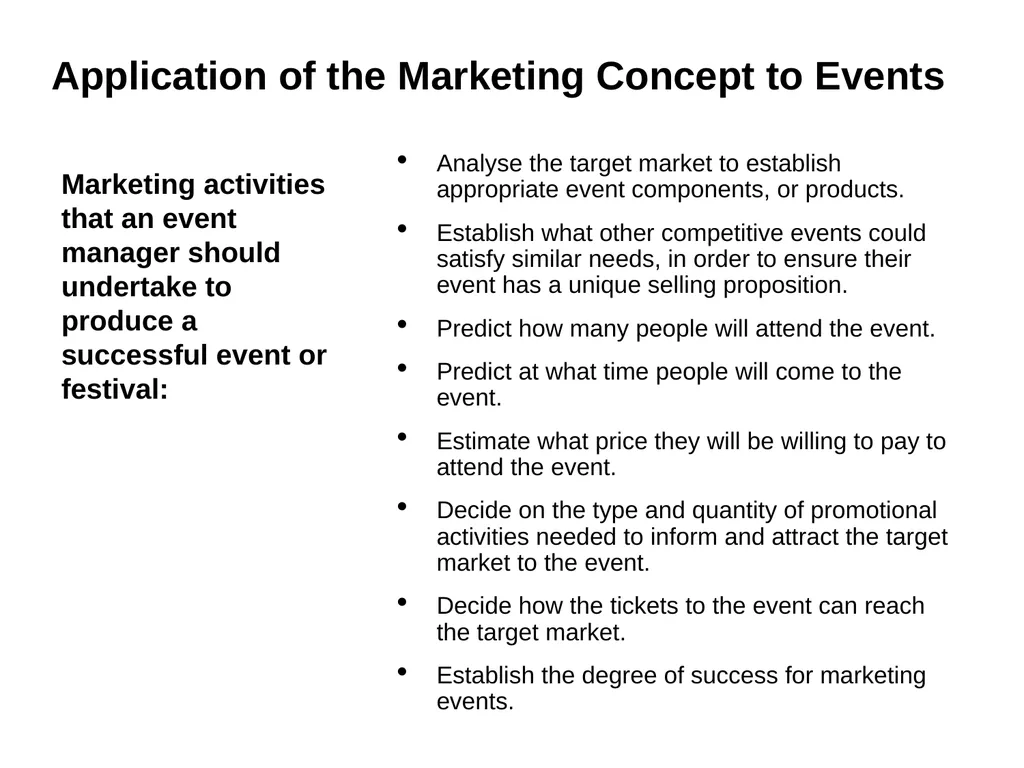
slide4. Analyse the target market to establish appropriate event components, or products.
Establish what other competitive events could satisfy similar needs, in order to ensure their event has a unique selling proposition.
Predict how many people will attend the event.
Predict at what time people will come to the event.
Estimate what price they will be willing to pay to attend the event.
Decide on the type and quantity of promotional activities needed to inform and attract the target market to the event.
Decide how the tickets to the event can reach the target market.
Establish the degree of success for marketing events. Marketing activities that an event manager should undertake to produce a successful event or festival: Application of the Marketing Concept to Events<br>
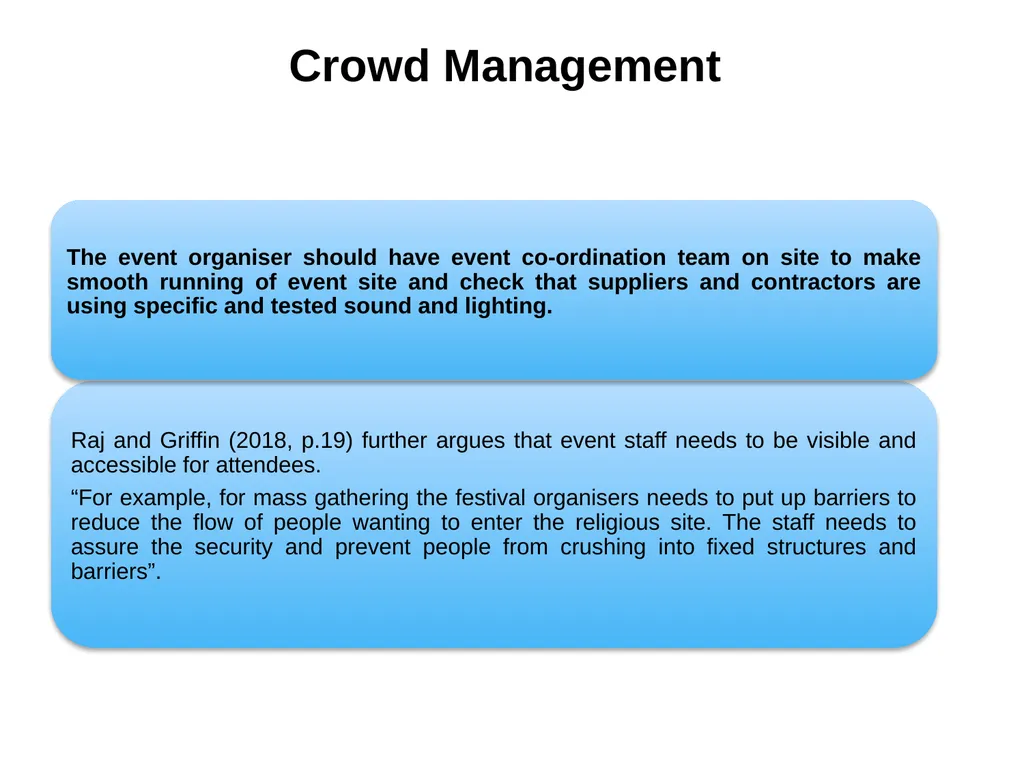
slide5. Crowd Management<br>
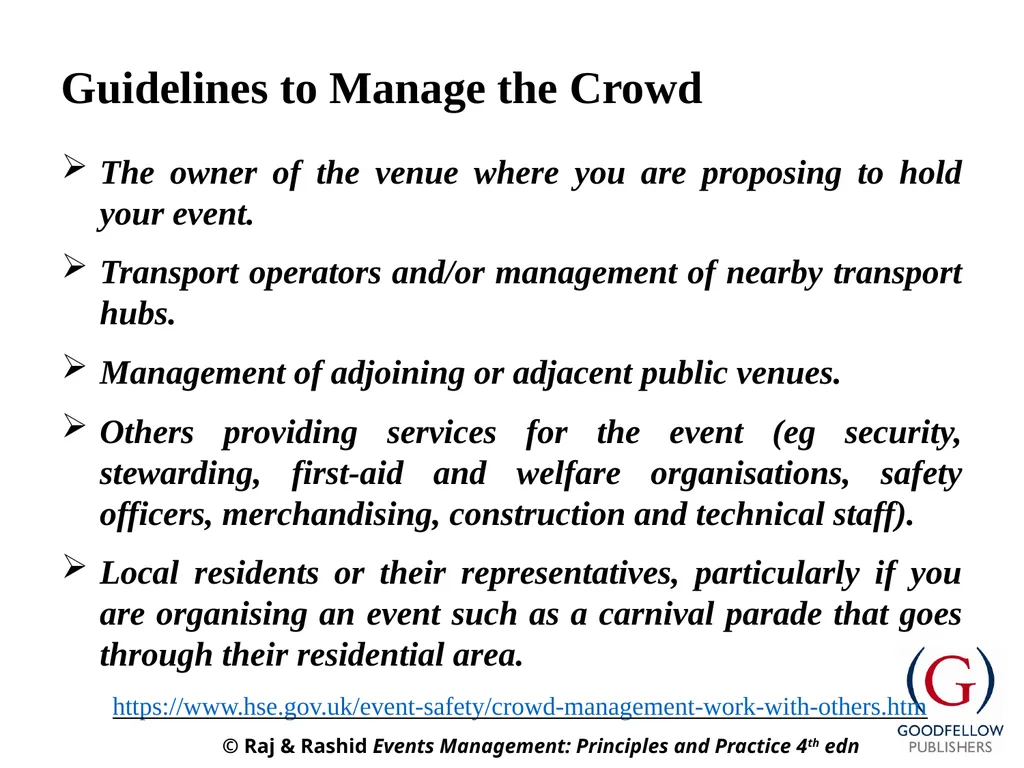
slide6. Guidelines to Manage the Crowd The owner of the venue where you are proposing to hold your event.
Transport operators and/or management of nearby transport hubs.
Management of adjoining or adjacent public venues.
Others providing services for the event (eg security, stewarding, first-aid and welfare organisations, safety officers, merchandising, construction and technical staff).
Local residents or their representatives, particularly if you are organising an event such as a carnival parade that goes through their residential area.
https://www.hse.gov.uk/event-safety/crowd-management-work-with-others.htm<br>
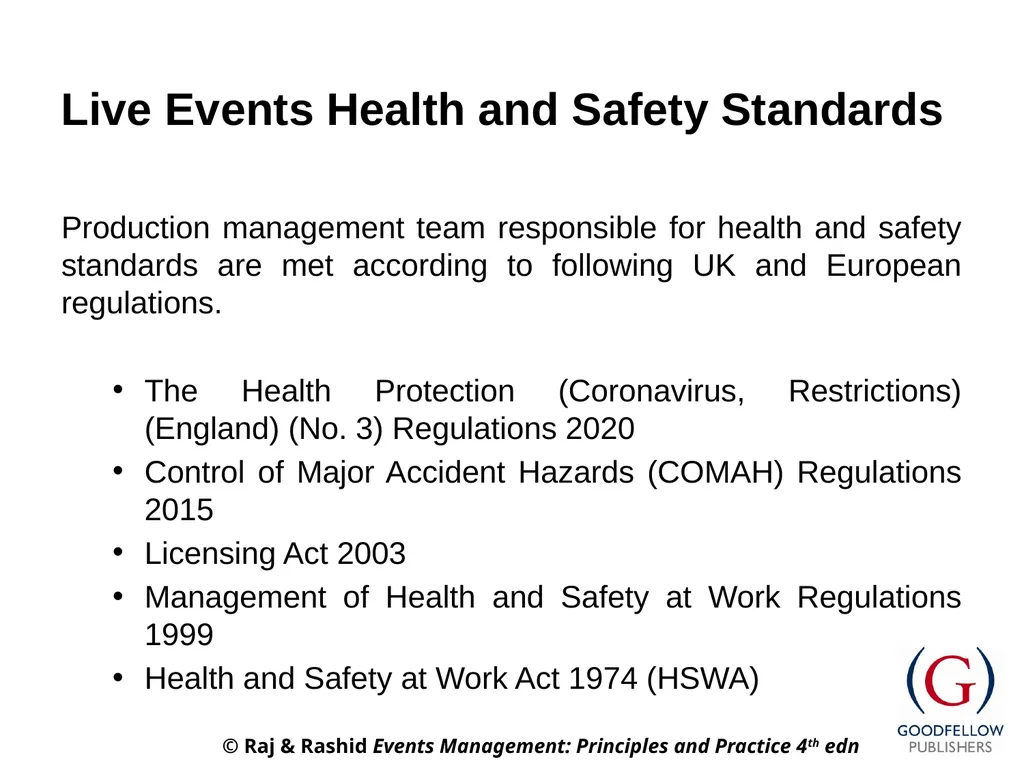
slide7. Live Events Health and Safety Standards Production management team responsible for health and safety standards are met according to following UK and European regulations.
The Health Protection (Coronavirus, Restrictions) (England) (No. 3) Regulations 2020
Control of Major Accident Hazards (COMAH) Regulations 2015
Licensing Act 2003
Management of Health and Safety at Work Regulations 1999
Health and Safety at Work Act 1974 (HSWA)<br>
slide8. Event Production Team and Safety Advisory Group (SAG) The Health and Safety Executives (HSE) have recommended the event organiser should work with local authority Safety Advisory Group (SAG).
SAGs are set up by the local authority (LA) and made up of representatives from all emergency services, key stakeholders and event organiser.
The SAGs are based within each local authority boundaries.
SAGs help event organisers with the site production, health and safety, planning, security and cooperation and between appropriate agencies.<br>
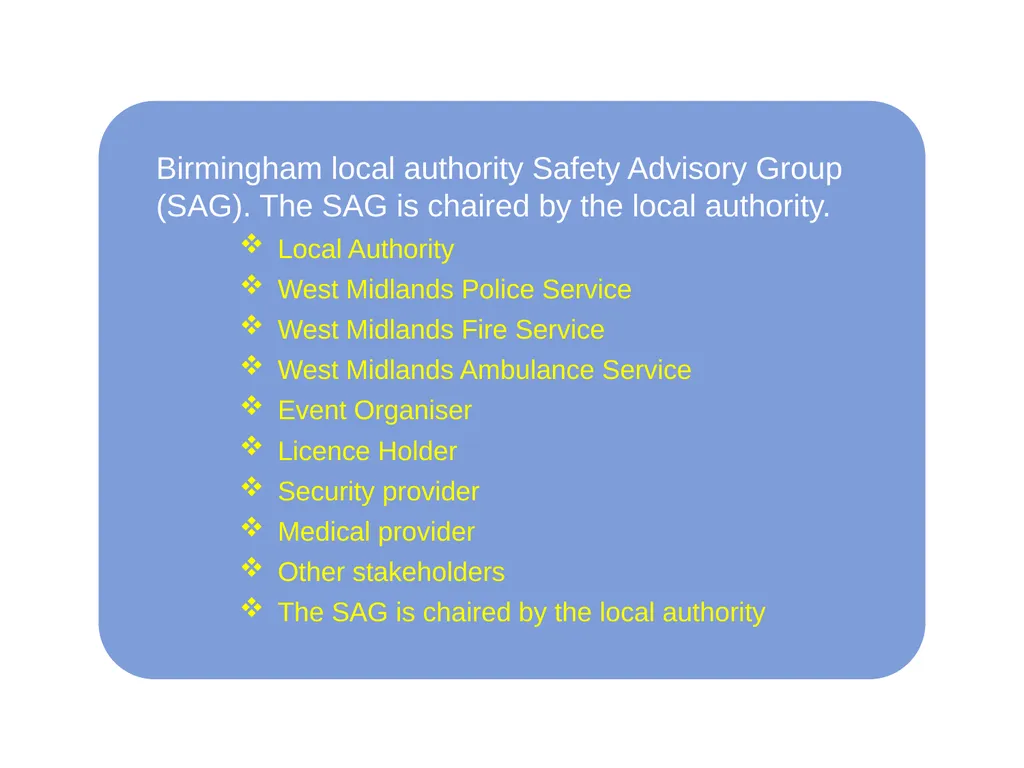
slide9. Birmingham local authority Safety Advisory Group (SAG). The SAG is chaired by the local authority.
Local Authority
West Midlands Police Service
West Midlands Fire Service
West Midlands Ambulance Service
Event Organiser
Licence Holder
Security provider
Medical provider
Other stakeholders
The SAG is chaired by the local authority<br>
slide10. Erection of Temporary Demountable Structures Department of Communities and Local Government and the Institutions of Structural and Civil Engineers (2017) has issued guideline for event industry to follow use of temporary demountable structures such as:
Stage structures
Marquees
Grandstands for sport events
Temporary Barriers
Towers and Masts for Media facilities
Lighting Towers<br>
slide11. Temporary Demountable Structures Temporary structure check list.
Site Structure drawings
Full calculations of temporary structure capacity
Design loads of temporary structure
Relevant test results being carried at site
Risk assessments covering the design and erection
Safety method declaration of site
Completion certificate of temporary structure<br>
slide12. The lighting and sound system is one of the key areas of the event and festival industry.
sound system is required need meet the safety and noise requirements. Lighting and Sound System<br>
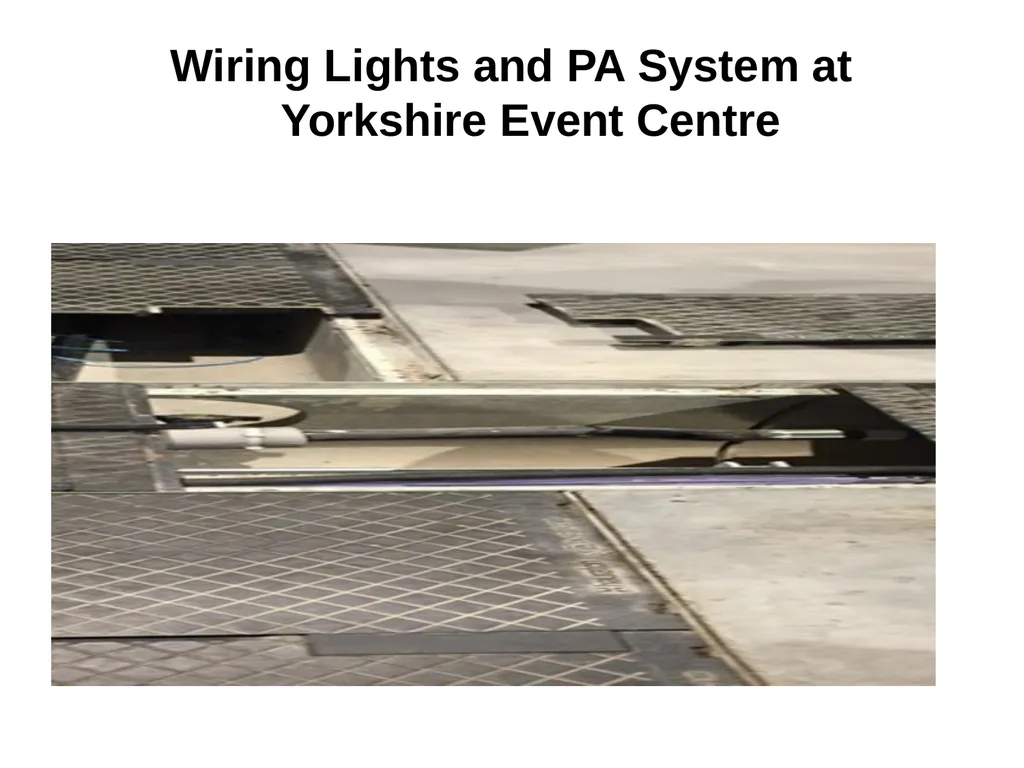
slide13. Wiring Lights and PA System at Yorkshire Event Centre<br>
slide14. Live Event Sound and Lights Phases<br>
slide15. Summary The responsibility of the production team to verify that all staging, lighting, sound system, videos screens, wireless communication, power distribution and all other key technical equipment able to deliver to high quality to enhance the experience of event attendees.
It is important contractors and suppliers should have safety records of lighting that are being provided for the event and it is responsibility of the event organisers to check, if the lightings that are being installed conform to regulations.
All electrical equipment brought to onsite by the contractors should be meet the safety stand-ards and are in good condition.<br>
By Razaq Raj and Tahir Rashid<br>
slide2. Chapter 10 Marketing Process, Communications And Public Relations These are some bullet points:
The focus will be upon positioning an event favourably in the mind of its target market in order to ensure long-term success.
The chapter look at the marketing concepts and marketing research in relation to events.
The chapter will then examine the behaviour of consumers and how they can be segmented.
A detailed discussion follow on the marketing mix and its constituents: product, price, place and promotion, as applied to events.<br>
slide3. Application of the Marketing Concept to Events There have been numerous definitions of marketing and no single definition is correct. Below are just a few of the definitions which have been used.
The process by which companies create value for customers and build strong customer relationships in order to capture value from customers in return. (Kotler and Armstrong, 2014: 27)
Marketing is the achievement of corporate goals through meeting and exceeding customer needs better than the competition. (Jobber and Chadwick, 2019: 8)<br>
slide4. Analyse the target market to establish appropriate event components, or products.
Establish what other competitive events could satisfy similar needs, in order to ensure their event has a unique selling proposition.
Predict how many people will attend the event.
Predict at what time people will come to the event.
Estimate what price they will be willing to pay to attend the event.
Decide on the type and quantity of promotional activities needed to inform and attract the target market to the event.
Decide how the tickets to the event can reach the target market.
Establish the degree of success for marketing events. Marketing activities that an event manager should undertake to produce a successful event or festival: Application of the Marketing Concept to Events<br>
slide5. Crowd Management<br>
slide6. Guidelines to Manage the Crowd The owner of the venue where you are proposing to hold your event.
Transport operators and/or management of nearby transport hubs.
Management of adjoining or adjacent public venues.
Others providing services for the event (eg security, stewarding, first-aid and welfare organisations, safety officers, merchandising, construction and technical staff).
Local residents or their representatives, particularly if you are organising an event such as a carnival parade that goes through their residential area.
https://www.hse.gov.uk/event-safety/crowd-management-work-with-others.htm<br>
slide7. Live Events Health and Safety Standards Production management team responsible for health and safety standards are met according to following UK and European regulations.
The Health Protection (Coronavirus, Restrictions) (England) (No. 3) Regulations 2020
Control of Major Accident Hazards (COMAH) Regulations 2015
Licensing Act 2003
Management of Health and Safety at Work Regulations 1999
Health and Safety at Work Act 1974 (HSWA)<br>
slide8. Event Production Team and Safety Advisory Group (SAG) The Health and Safety Executives (HSE) have recommended the event organiser should work with local authority Safety Advisory Group (SAG).
SAGs are set up by the local authority (LA) and made up of representatives from all emergency services, key stakeholders and event organiser.
The SAGs are based within each local authority boundaries.
SAGs help event organisers with the site production, health and safety, planning, security and cooperation and between appropriate agencies.<br>
slide9. Birmingham local authority Safety Advisory Group (SAG). The SAG is chaired by the local authority.
Local Authority
West Midlands Police Service
West Midlands Fire Service
West Midlands Ambulance Service
Event Organiser
Licence Holder
Security provider
Medical provider
Other stakeholders
The SAG is chaired by the local authority<br>
slide10. Erection of Temporary Demountable Structures Department of Communities and Local Government and the Institutions of Structural and Civil Engineers (2017) has issued guideline for event industry to follow use of temporary demountable structures such as:
Stage structures
Marquees
Grandstands for sport events
Temporary Barriers
Towers and Masts for Media facilities
Lighting Towers<br>
slide11. Temporary Demountable Structures Temporary structure check list.
Site Structure drawings
Full calculations of temporary structure capacity
Design loads of temporary structure
Relevant test results being carried at site
Risk assessments covering the design and erection
Safety method declaration of site
Completion certificate of temporary structure<br>
slide12. The lighting and sound system is one of the key areas of the event and festival industry.
sound system is required need meet the safety and noise requirements. Lighting and Sound System<br>
slide13. Wiring Lights and PA System at Yorkshire Event Centre<br>
slide14. Live Event Sound and Lights Phases<br>
slide15. Summary The responsibility of the production team to verify that all staging, lighting, sound system, videos screens, wireless communication, power distribution and all other key technical equipment able to deliver to high quality to enhance the experience of event attendees.
It is important contractors and suppliers should have safety records of lighting that are being provided for the event and it is responsibility of the event organisers to check, if the lightings that are being installed conform to regulations.
All electrical equipment brought to onsite by the contractors should be meet the safety stand-ards and are in good condition.<br>