
Evolution of Management Thought Pre-scientific
LV
Published · 90 slides · 0 views

1 / 1





Description
Evolution of Management Thought Pre-scientific management period Classical theory Neo-classical theory or behavior approach Bureaucratic Model of Max Weber Pre-scientific management period Professor Charles Babbage United Kingdom (1729
Related Topics
Share
Embed code
Download this presentation From Below
"Evolution of Management Thought Pre-scientific" is the property of its rightful owner. Permission is granted to download and print the materials on this website for personal, non-commercial use only, and to display it on your personal computer provided you do not modify the materials and that you retain all copyright notices contained in the materials. By downloading content from our website, you accept the terms of this agreement.
Presentation Transcript
01
Evolution of Management Thought Pre-scientific management period
Classical theory
Neo-classical theory or behavior approach
Bureaucratic Model of Max Weber<br>
Classical theory
Neo-classical theory or behavior approach
Bureaucratic Model of Max Weber<br>
02
Pre-scientific management period Professor Charles Babbage – United Kingdom (1729 – 1871)
Prof Babbage, a renowned professor in mathematics at Cambridge University discovered that manufacturers were relying on guesswork and suggestions and urged them to utilize mathematics and science to be more accurate and productive.
Robert Owens – United Kingdom (1771 – 1858)
Robert was regarded as the father of personnel management because of his approach and focus on employee welfare. He encouraged the training of workers, education for their children, canteens in the workplace, shorter working hours, among others.<br>
Prof Babbage, a renowned professor in mathematics at Cambridge University discovered that manufacturers were relying on guesswork and suggestions and urged them to utilize mathematics and science to be more accurate and productive.
Robert Owens – United Kingdom (1771 – 1858)
Robert was regarded as the father of personnel management because of his approach and focus on employee welfare. He encouraged the training of workers, education for their children, canteens in the workplace, shorter working hours, among others.<br>
03
Classical theory The beginning of what is known as the science of management started in the last decade of the 19th century. Names like Emerson, F.W. Taylor, H.L. Grant and others, paved the way for the establishment of what is called scientific management.
During the classical period, management thought was focused on job content, standardization, the division of labor, and scientific approach towards organization. It also was closely related to the industrial revolution as well as the rise of large-scale enterprise.<br>
During the classical period, management thought was focused on job content, standardization, the division of labor, and scientific approach towards organization. It also was closely related to the industrial revolution as well as the rise of large-scale enterprise.<br>
04
Neo –Classical Theory The neo-classical theory gave more profound emphasis on employee relationship in the work environment.
Bureaucratic Model of Max Weber
A German Sociologist called Max Weber proposed this model. And it includes a system of rules, division of labor hinged on functional specialization, legal authority and power, the hierarchy of authority and placement of employees based on their technical competence.<br>
Bureaucratic Model of Max Weber
A German Sociologist called Max Weber proposed this model. And it includes a system of rules, division of labor hinged on functional specialization, legal authority and power, the hierarchy of authority and placement of employees based on their technical competence.<br>
05
Five Functions of Management 1) Planning
2)Organizing
3) Staffing
4) Directing
5) Controlling<br>
2)Organizing
3) Staffing
4) Directing
5) Controlling<br>
06
Definition of OB Fred Luthans – “ OB is directly concerned with the understanding, prediction and control of human behavior in organization.”
Keith Davis quoted as " Organizational Behavior is the study and application of knowledge about how people act within organization.“
Scope Of OB
1 ) People
2) Structure
3) Technlogy
4) Social System<br>
Keith Davis quoted as " Organizational Behavior is the study and application of knowledge about how people act within organization.“
Scope Of OB
1 ) People
2) Structure
3) Technlogy
4) Social System<br>
07
Importance of OB Understanding the relationship between an organisation and its employees
Motivating employees
Improving industrial/ labour relations
Effective utilisation of Human Resource
Predicting human behaviour<br>
Motivating employees
Improving industrial/ labour relations
Effective utilisation of Human Resource
Predicting human behaviour<br>
08
Relationship Between OB and Individual a.Individual characteristics
b. Individual motivation
c. Rewards/punishment.
d. Stress<br>
b. Individual motivation
c. Rewards/punishment.
d. Stress<br>
09
Limitations of OB Emphasis on principles, not practice
No improvement in industrial relations
Behavioral Bias
The techniques of OB are oversimplified.<br>
No improvement in industrial relations
Behavioral Bias
The techniques of OB are oversimplified.<br>
10
Evolution of OB 1) Industrial Revolution
2) Scientific management (Early 20th Century)
3) Human Relations Movement ( 1920 s to 1940 s)
4) Organizational Behavior ( starting from 1950s)<br>
2) Scientific management (Early 20th Century)
3) Human Relations Movement ( 1920 s to 1940 s)
4) Organizational Behavior ( starting from 1950s)<br>
11
Industrial Revolution The Industrial Revolution was a period from the 18th to the 19th century where major changes in agriculture, transportation and technology had a deep effect on socio economic and cultural conditions of the Britain.<br>
12
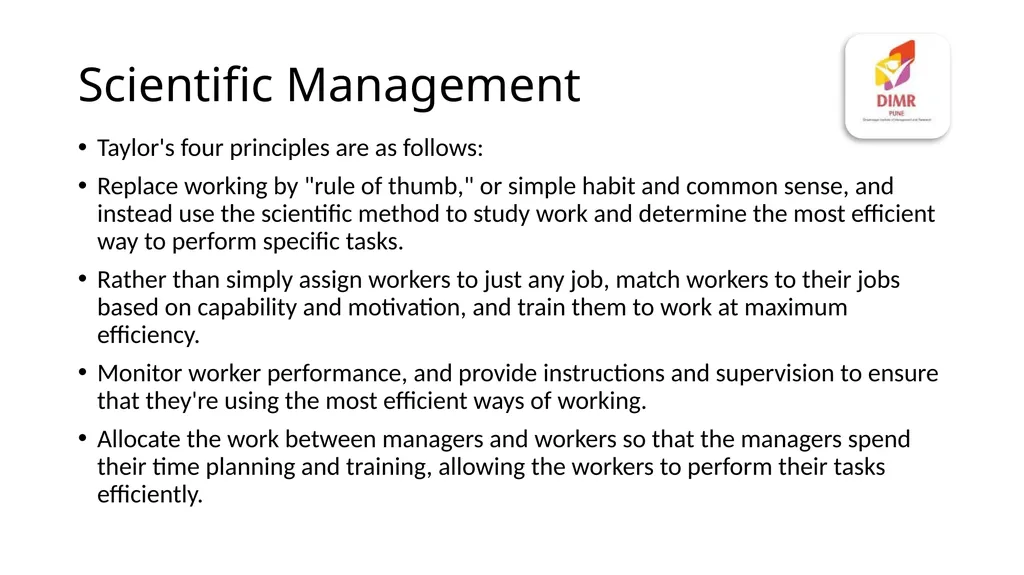
Scientific Management Taylor's four principles are as follows:
Replace working by "rule of thumb," or simple habit and common sense, and instead use the scientific method to study work and determine the most efficient way to perform specific tasks.
Rather than simply assign workers to just any job, match workers to their jobs based on capability and motivation, and train them to work at maximum efficiency.
Monitor worker performance, and provide instructions and supervision to ensure that they're using the most efficient ways of working.
Allocate the work between managers and workers so that the managers spend their time planning and training, allowing the workers to perform their tasks efficiently.<br>
Replace working by "rule of thumb," or simple habit and common sense, and instead use the scientific method to study work and determine the most efficient way to perform specific tasks.
Rather than simply assign workers to just any job, match workers to their jobs based on capability and motivation, and train them to work at maximum efficiency.
Monitor worker performance, and provide instructions and supervision to ensure that they're using the most efficient ways of working.
Allocate the work between managers and workers so that the managers spend their time planning and training, allowing the workers to perform their tasks efficiently.<br>
13
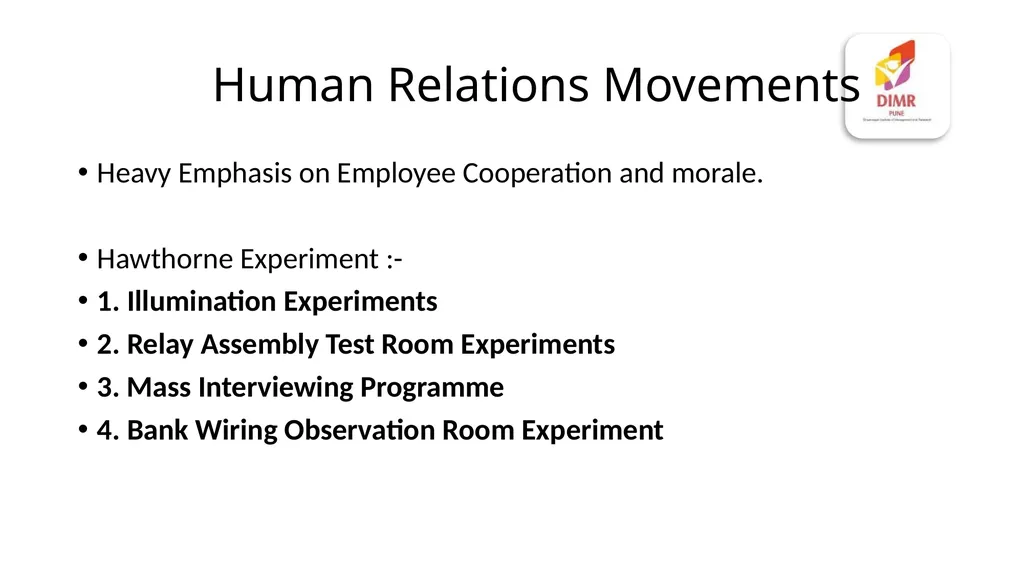
Human Relations Movements Heavy Emphasis on Employee Cooperation and morale.
Hawthorne Experiment :-
1. Illumination Experiments
2. Relay Assembly Test Room Experiments
3. Mass Interviewing Programme
4. Bank Wiring Observation Room Experiment<br>
Hawthorne Experiment :-
1. Illumination Experiments
2. Relay Assembly Test Room Experiments
3. Mass Interviewing Programme
4. Bank Wiring Observation Room Experiment<br>
14
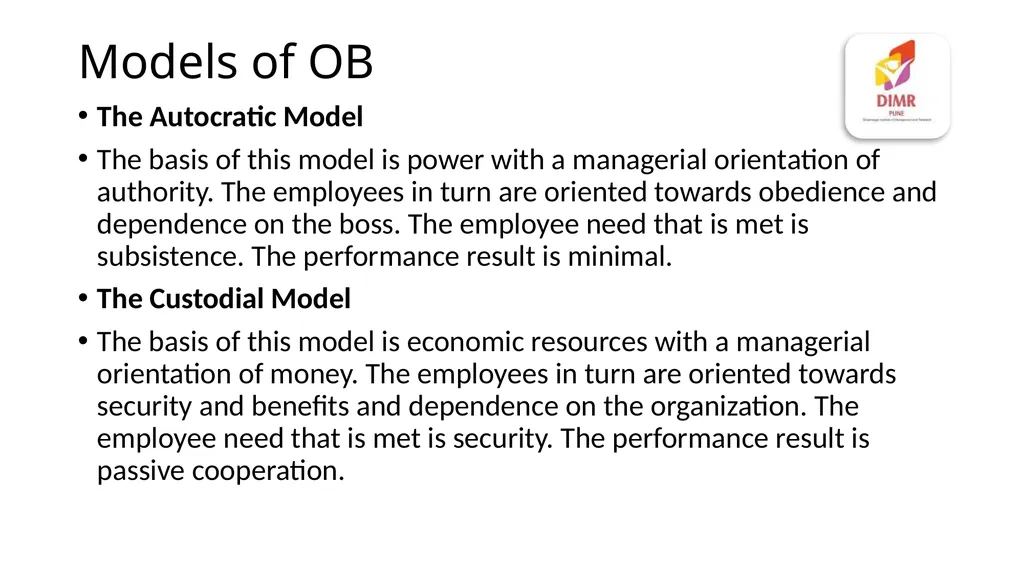
Models of OB The Autocratic Model
The basis of this model is power with a managerial orientation of authority. The employees in turn are oriented towards obedience and dependence on the boss. The employee need that is met is subsistence. The performance result is minimal.
The Custodial Model
The basis of this model is economic resources with a managerial orientation of money. The employees in turn are oriented towards security and benefits and dependence on the organization. The employee need that is met is security. The performance result is passive cooperation.<br>
The basis of this model is power with a managerial orientation of authority. The employees in turn are oriented towards obedience and dependence on the boss. The employee need that is met is subsistence. The performance result is minimal.
The Custodial Model
The basis of this model is economic resources with a managerial orientation of money. The employees in turn are oriented towards security and benefits and dependence on the organization. The employee need that is met is security. The performance result is passive cooperation.<br>
15
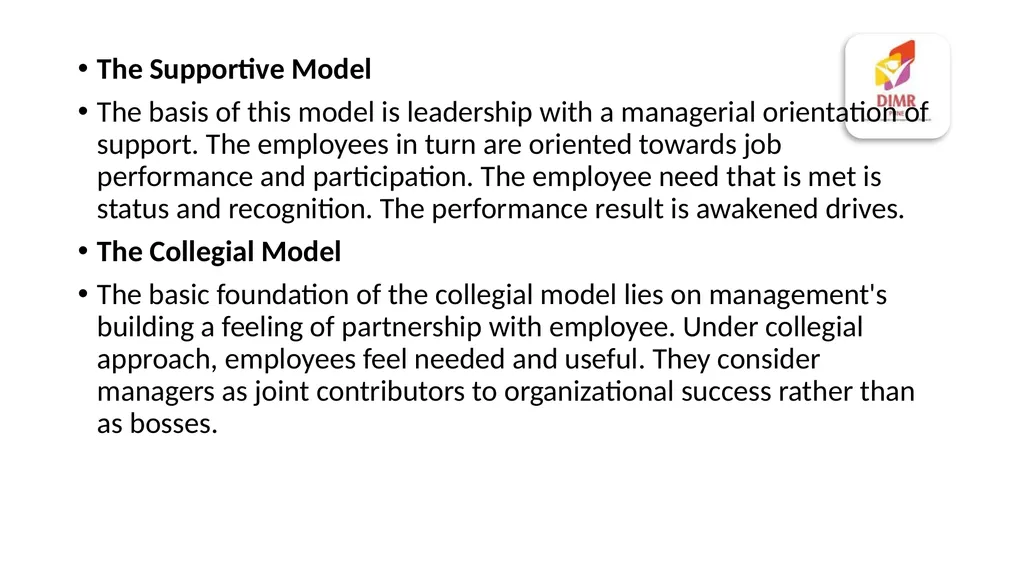
The Supportive Model
The basis of this model is leadership with a managerial orientation of support. The employees in turn are oriented towards job performance and participation. The employee need that is met is status and recognition. The performance result is awakened drives.
The Collegial Model
The basic foundation of the collegial model lies on management's building a feeling of partnership with employee. Under collegial approach, employees feel needed and useful. They consider managers as joint contributors to organizational success rather than as bosses.<br>
The basis of this model is leadership with a managerial orientation of support. The employees in turn are oriented towards job performance and participation. The employee need that is met is status and recognition. The performance result is awakened drives.
The Collegial Model
The basic foundation of the collegial model lies on management's building a feeling of partnership with employee. Under collegial approach, employees feel needed and useful. They consider managers as joint contributors to organizational success rather than as bosses.<br>
16
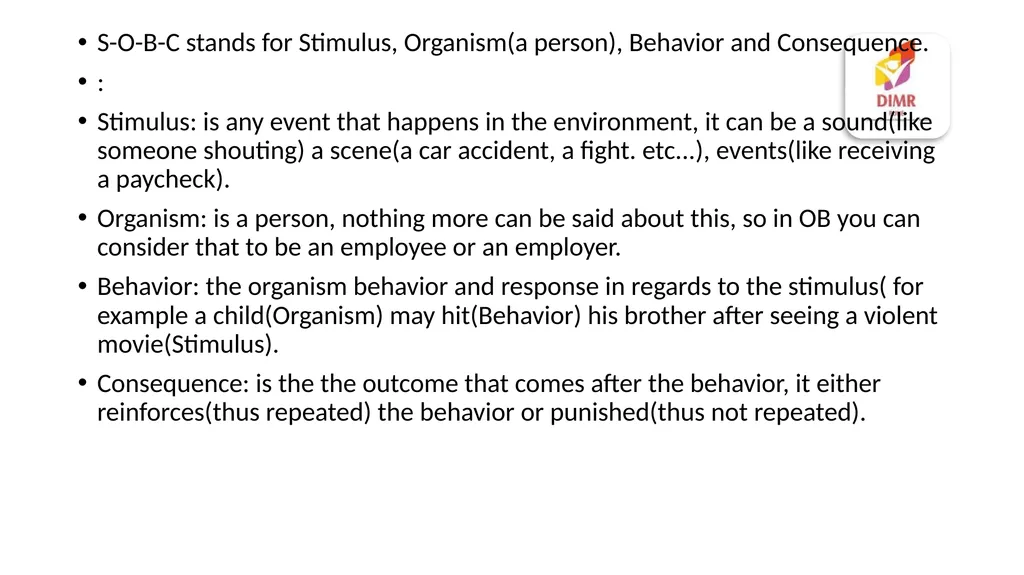
S-O-B-C stands for Stimulus, Organism(a person), Behavior and Consequence.
:
Stimulus: is any event that happens in the environment, it can be a sound(like someone shouting) a scene(a car accident, a fight. etc...), events(like receiving a paycheck).
Organism: is a person, nothing more can be said about this, so in OB you can consider that to be an employee or an employer.
Behavior: the organism behavior and response in regards to the stimulus( for example a child(Organism) may hit(Behavior) his brother after seeing a violent movie(Stimulus).
Consequence: is the the outcome that comes after the behavior, it either reinforces(thus repeated) the behavior or punished(thus not repeated).<br>
:
Stimulus: is any event that happens in the environment, it can be a sound(like someone shouting) a scene(a car accident, a fight. etc...), events(like receiving a paycheck).
Organism: is a person, nothing more can be said about this, so in OB you can consider that to be an employee or an employer.
Behavior: the organism behavior and response in regards to the stimulus( for example a child(Organism) may hit(Behavior) his brother after seeing a violent movie(Stimulus).
Consequence: is the the outcome that comes after the behavior, it either reinforces(thus repeated) the behavior or punished(thus not repeated).<br>
17
Values Values represent stable, long lasting beliefs about what is important.
Attitudes represent beliefs, feelings and action tendencies towards objects, ideas or people.
Emotions are intense feelings that are directed at someone or something.
M. Haralambos, “A value is a belief that something is good and desirable”.
Thurstone said, “An attitude denotes the sum total of man’s inclinations and feelings, prejudice or bias, preconceived notions, ideas, fears, threats, and other any specific topic.”
The Oxford Dictionary definition of emotion is "A strong feeling deriving from one's circumstances, mood, or relationships with others."<br>
Attitudes represent beliefs, feelings and action tendencies towards objects, ideas or people.
Emotions are intense feelings that are directed at someone or something.
M. Haralambos, “A value is a belief that something is good and desirable”.
Thurstone said, “An attitude denotes the sum total of man’s inclinations and feelings, prejudice or bias, preconceived notions, ideas, fears, threats, and other any specific topic.”
The Oxford Dictionary definition of emotion is "A strong feeling deriving from one's circumstances, mood, or relationships with others."<br>
18
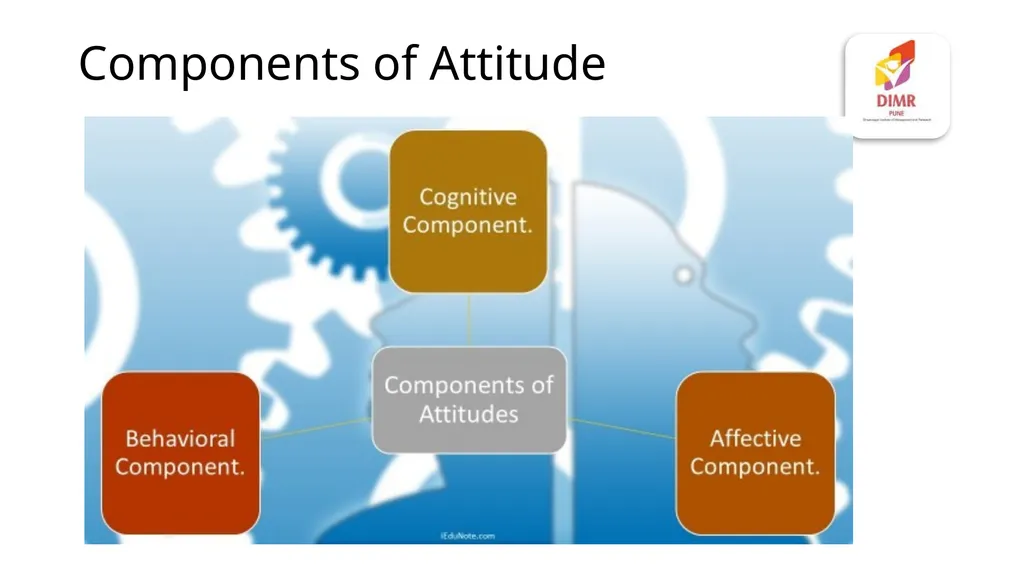
Components of Attitude<br>
19
Cognitive Component
The cognitive component of attitudes refers to the beliefs, thoughts, and attributes that we would associate with an object. It is the opinion or belief segment of an attitude. It refers to that part of attitude which is related in general knowledge of a person.
Affective Component
Affective component is the emotional or feeling segment of an attitude.
It is related to the statement which affects another person.
Behavioral Component
Behavior component of an attitude consists of a person’s tendencies to behave’in a particular way toward an object. It refers to that part of attitude which reflects the intention of a person in the short-run or long run.<br>
The cognitive component of attitudes refers to the beliefs, thoughts, and attributes that we would associate with an object. It is the opinion or belief segment of an attitude. It refers to that part of attitude which is related in general knowledge of a person.
Affective Component
Affective component is the emotional or feeling segment of an attitude.
It is related to the statement which affects another person.
Behavioral Component
Behavior component of an attitude consists of a person’s tendencies to behave’in a particular way toward an object. It refers to that part of attitude which reflects the intention of a person in the short-run or long run.<br>
20
Importance of Attitude IN improving the relationship among the individuals.
Creates a positive environment
Helps to Achieve Goals and Career success
Stress reduction and management
Better health
Improves motivation for yourself and others
Improves the attitude of other employees<br>
Creates a positive environment
Helps to Achieve Goals and Career success
Stress reduction and management
Better health
Improves motivation for yourself and others
Improves the attitude of other employees<br>
21
Relationship Between Behavior and Attitude Attitude begins in the mind and then gets reflected in the body.
Your attitude affects your behavior.
Behavior is the way a person responds to his attitude. This response is either positive or negative, depending on how that views his position.<br>
Your attitude affects your behavior.
Behavior is the way a person responds to his attitude. This response is either positive or negative, depending on how that views his position.<br>
22
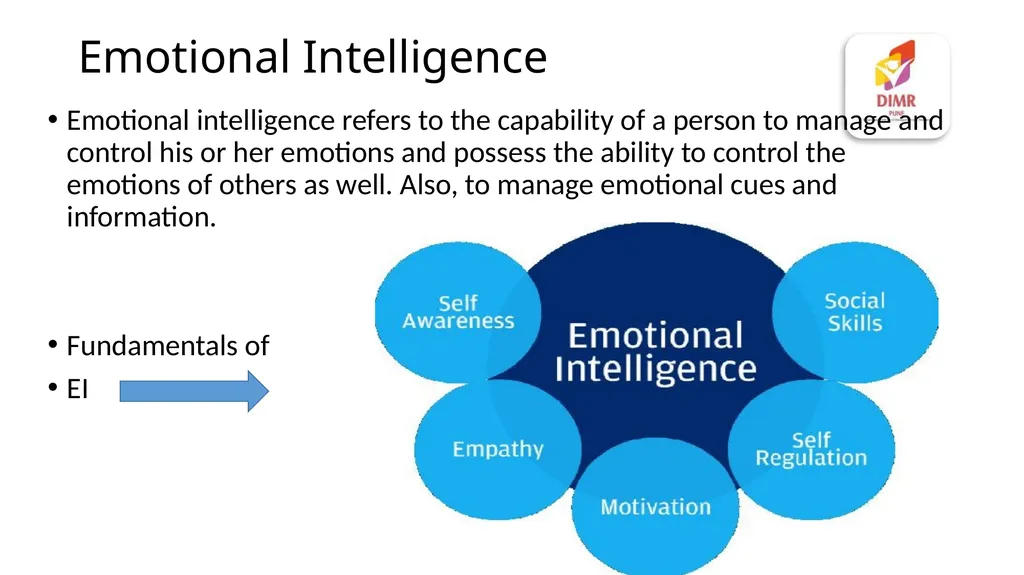
Emotional Intelligence Emotional intelligence refers to the capability of a person to manage and control his or her emotions and possess the ability to control the emotions of others as well. Also, to manage emotional cues and information.
Fundamentals of
EI<br>
Fundamentals of
EI<br>
23
1 )Self-awareness is the ability to accurately recognize your: emotions, strengths, limitations, actions and understand how these affect others around you.
2) Self-regulation allows you to wisely manage your emotions and impulses - you show or restrain certain emotions depending on what is necessary and beneficial for the situation.
3 ) Empathy
To be empathetic means you are able to identify and understand others' emotions i.e. imagining yourself in someone else's position.
Motivation
Being self-motivated consists of: enjoying what you do, working towards achieving your goals and not being motivated by money or status.
Social skills
Effective social skills consist of managing relationships in a way that benefits the organisation.<br>
2) Self-regulation allows you to wisely manage your emotions and impulses - you show or restrain certain emotions depending on what is necessary and beneficial for the situation.
3 ) Empathy
To be empathetic means you are able to identify and understand others' emotions i.e. imagining yourself in someone else's position.
Motivation
Being self-motivated consists of: enjoying what you do, working towards achieving your goals and not being motivated by money or status.
Social skills
Effective social skills consist of managing relationships in a way that benefits the organisation.<br>
24
Benefits of EI It allows for better team work.
You can handle those tough conversations
You can deal with change.
It’s an essential people skill.
It’s a key feature of a strong leader<br>
You can handle those tough conversations
You can deal with change.
It’s an essential people skill.
It’s a key feature of a strong leader<br>
25
Difference Between EQ and IQ EQ or say Emotional Quotient refers to a person’s ability to understand his/her emotion along with the other person’s emotions,
whereas IQ stands for Intelligence Quotient indicates a person’s intelligence level.<br>
whereas IQ stands for Intelligence Quotient indicates a person’s intelligence level.<br>
26
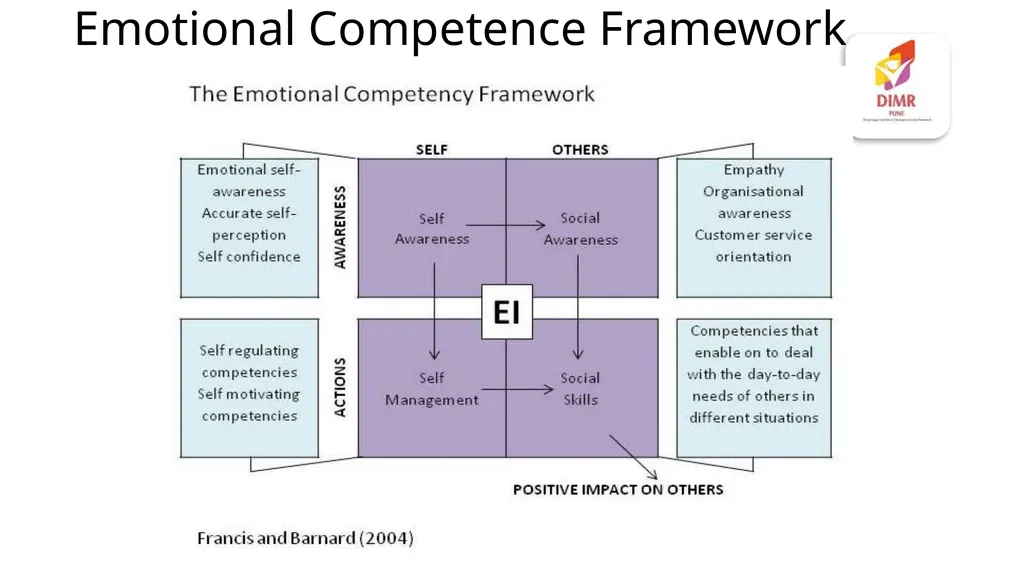
Emotional Competence Framework<br>
27
Personality R.B.Cattell “ Personality is that which permits a prediction of what a person will do in a given situation.”
Importance of personality in Organization :-
1) Helps to Communicate Effectively
2) Prevents Burnouts
3) Decreases Conflicts and improves collaborations
4) Helps motivate the employees
5) Improves chances of Success.<br>
Importance of personality in Organization :-
1) Helps to Communicate Effectively
2) Prevents Burnouts
3) Decreases Conflicts and improves collaborations
4) Helps motivate the employees
5) Improves chances of Success.<br>
28
The Myers-Briggs Type Indicator It’s a personality test . Developed by Katherine Briggs and her daughter Isabel Briggs Myers in 1942.Based on this, individuals are classified as :-
1) E /I (Extroversion/ Introversion )
2) S/N (Sensitive / Intuitions )
3) T/F (Thinking /Feeling)
4) J/P ( Judging/Perceiving)<br>
1) E /I (Extroversion/ Introversion )
2) S/N (Sensitive / Intuitions )
3) T/F (Thinking /Feeling)
4) J/P ( Judging/Perceiving)<br>
29
Extroversion/ Introversion :- Extrovert are outgoing, sociable and assertive. Introverts are quite and shy.
Sensitive / Intuitions :- Sensing types are practical and prefer routine and order. They focus on details. Intuitions rely on unconscious process and even inspiration.
Thinking / Feeling :- Thinking types use reason and logic to handle problems. Feeling types rely on their personal values and emotions.
Judging / Perceiving :- Judging types want control and prefer their world to be ordered and structured . Perceiving types are flexible and spontaneous.<br>
Sensitive / Intuitions :- Sensing types are practical and prefer routine and order. They focus on details. Intuitions rely on unconscious process and even inspiration.
Thinking / Feeling :- Thinking types use reason and logic to handle problems. Feeling types rely on their personal values and emotions.
Judging / Perceiving :- Judging types want control and prefer their world to be ordered and structured . Perceiving types are flexible and spontaneous.<br>
30
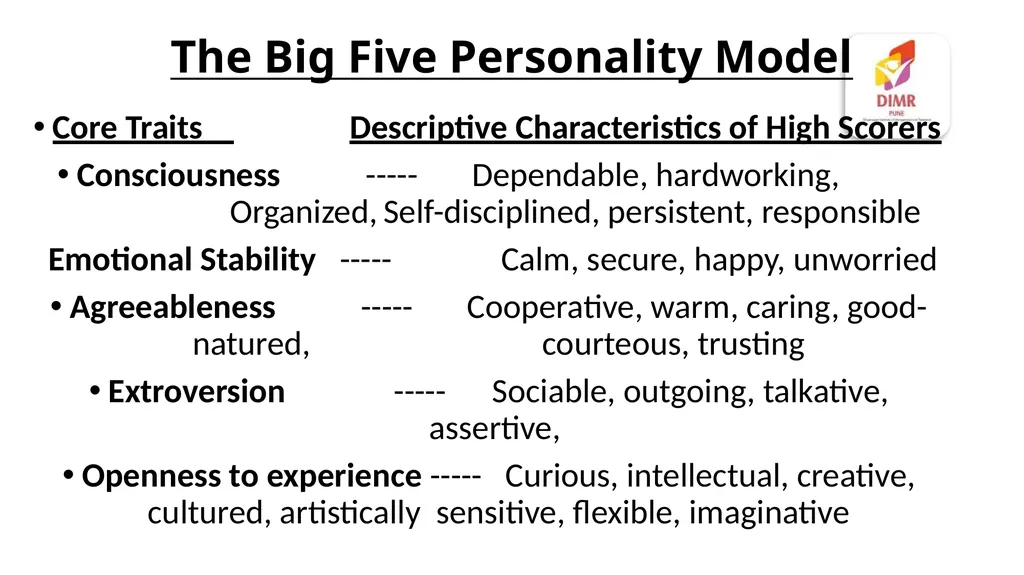
The Big Five Personality Model Core Traits Descriptive Characteristics of High Scorers
Consciousness ----- Dependable, hardworking, Organized, Self-disciplined, persistent, responsible
Emotional Stability ----- Calm, secure, happy, unworried
Agreeableness ----- Cooperative, warm, caring, good-natured, courteous, trusting
Extroversion ----- Sociable, outgoing, talkative, assertive,
Openness to experience ----- Curious, intellectual, creative, cultured, artistically sensitive, flexible, imaginative<br>
Consciousness ----- Dependable, hardworking, Organized, Self-disciplined, persistent, responsible
Emotional Stability ----- Calm, secure, happy, unworried
Agreeableness ----- Cooperative, warm, caring, good-natured, courteous, trusting
Extroversion ----- Sociable, outgoing, talkative, assertive,
Openness to experience ----- Curious, intellectual, creative, cultured, artistically sensitive, flexible, imaginative<br>
31
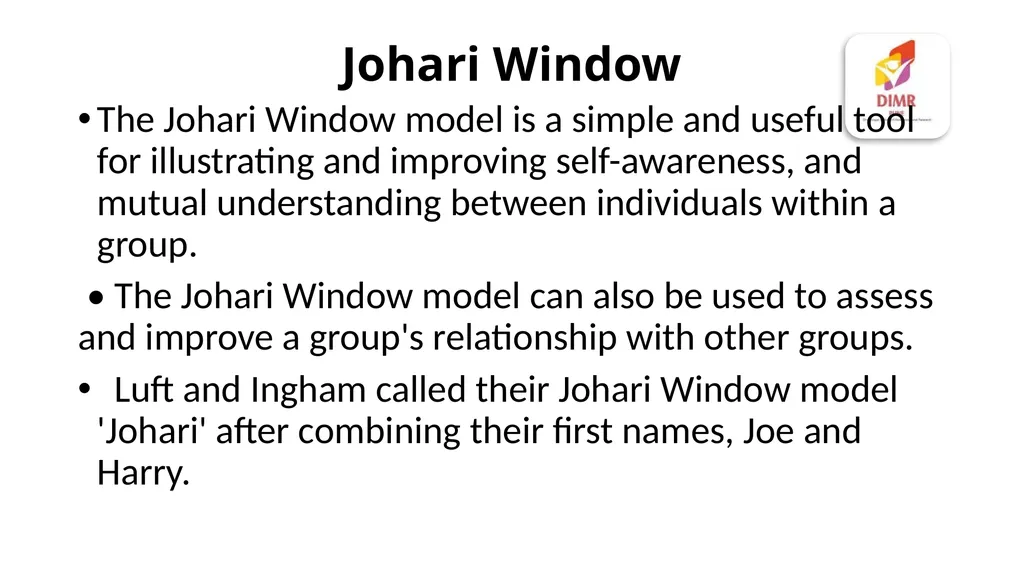
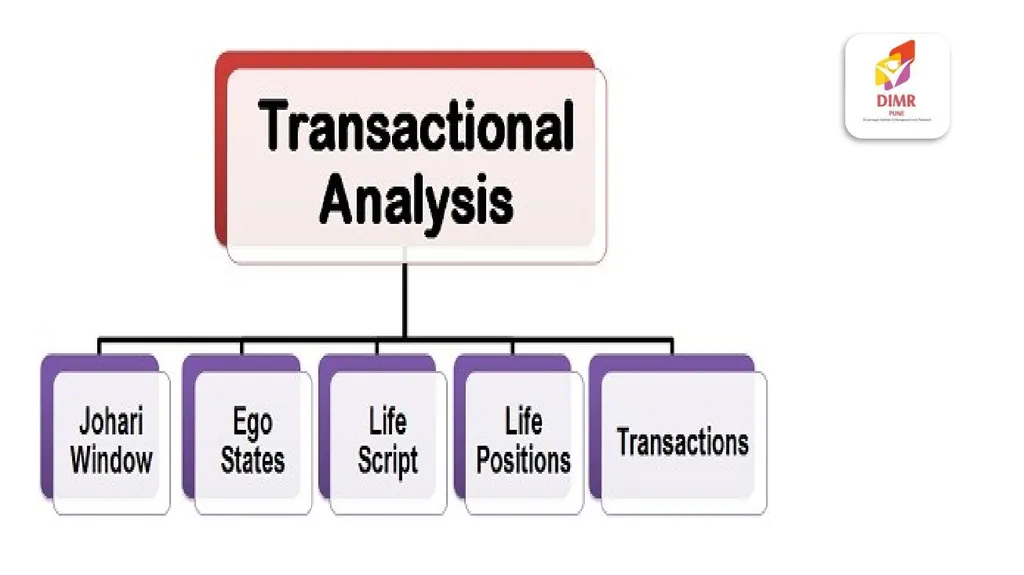
Johari Window The Johari Window model is a simple and useful tool for illustrating and improving self-awareness, and mutual understanding between individuals within a group.
• The Johari Window model can also be used to assess and improve a group's relationship with other groups.
Luft and Ingham called their Johari Window model 'Johari' after combining their first names, Joe and Harry.<br>
• The Johari Window model can also be used to assess and improve a group's relationship with other groups.
Luft and Ingham called their Johari Window model 'Johari' after combining their first names, Joe and Harry.<br>
32
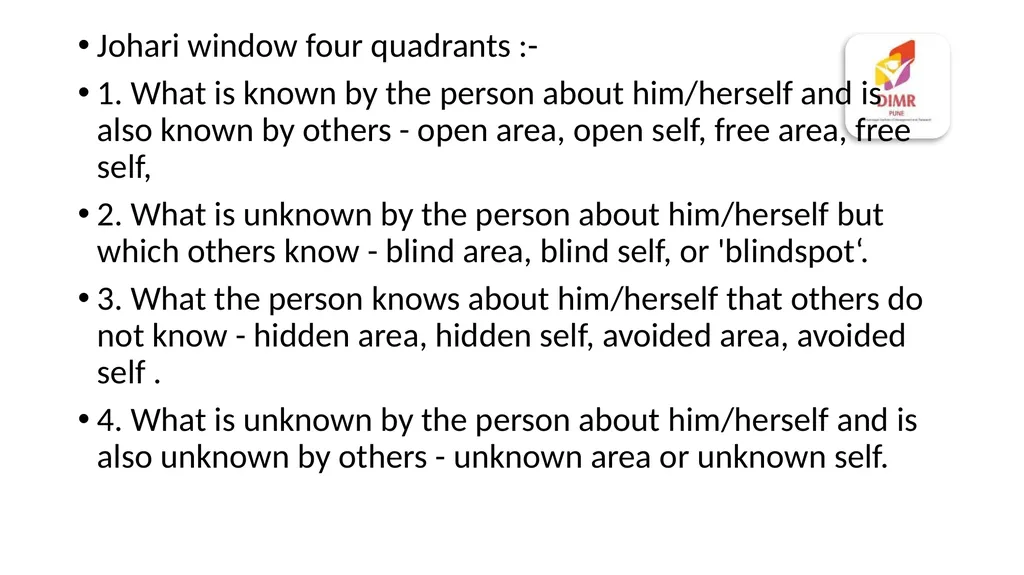
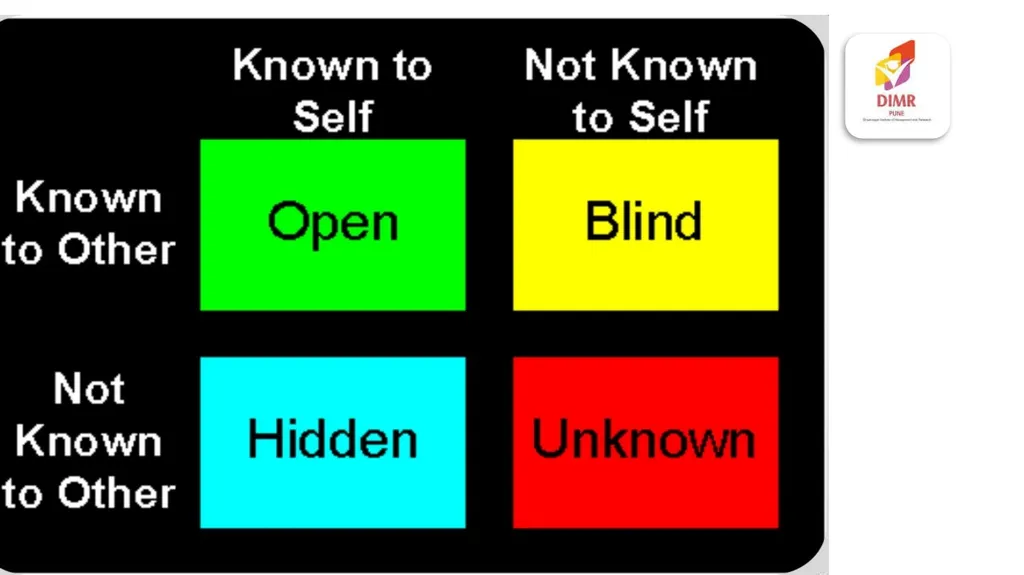
Johari window four quadrants :-
1. What is known by the person about him/herself and is also known by others - open area, open self, free area, free self,
2. What is unknown by the person about him/herself but which others know - blind area, blind self, or 'blindspot‘.
3. What the person knows about him/herself that others do not know - hidden area, hidden self, avoided area, avoided self .
4. What is unknown by the person about him/herself and is also unknown by others - unknown area or unknown self.<br>
1. What is known by the person about him/herself and is also known by others - open area, open self, free area, free self,
2. What is unknown by the person about him/herself but which others know - blind area, blind self, or 'blindspot‘.
3. What the person knows about him/herself that others do not know - hidden area, hidden self, avoided area, avoided self .
4. What is unknown by the person about him/herself and is also unknown by others - unknown area or unknown self.<br>
33
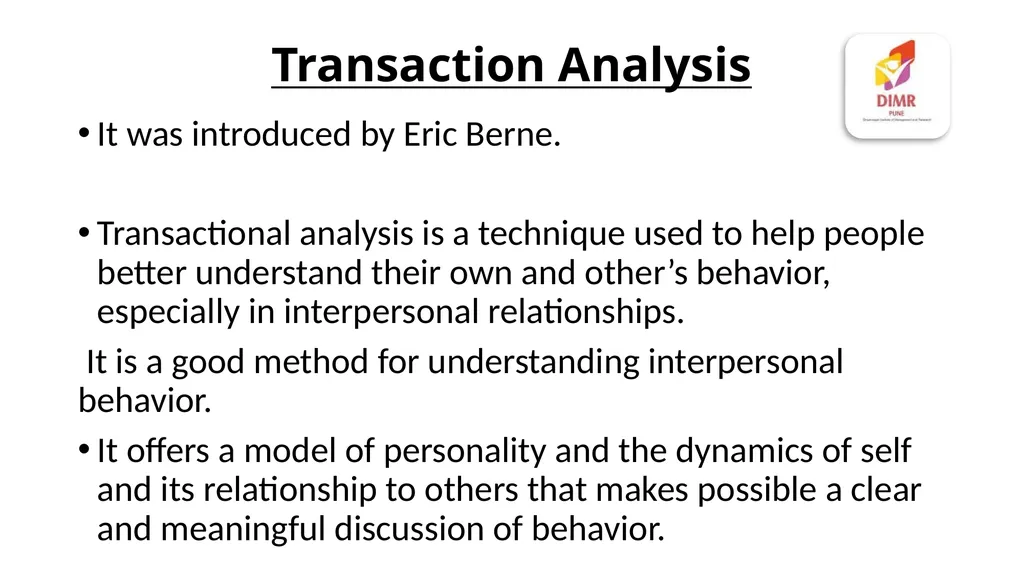
Transaction Analysis It was introduced by Eric Berne.
Transactional analysis is a technique used to help people better understand their own and other’s behavior, especially in interpersonal relationships.
It is a good method for understanding interpersonal behavior.
It offers a model of personality and the dynamics of self and its relationship to others that makes possible a clear and meaningful discussion of behavior.<br>
Transactional analysis is a technique used to help people better understand their own and other’s behavior, especially in interpersonal relationships.
It is a good method for understanding interpersonal behavior.
It offers a model of personality and the dynamics of self and its relationship to others that makes possible a clear and meaningful discussion of behavior.<br>
34
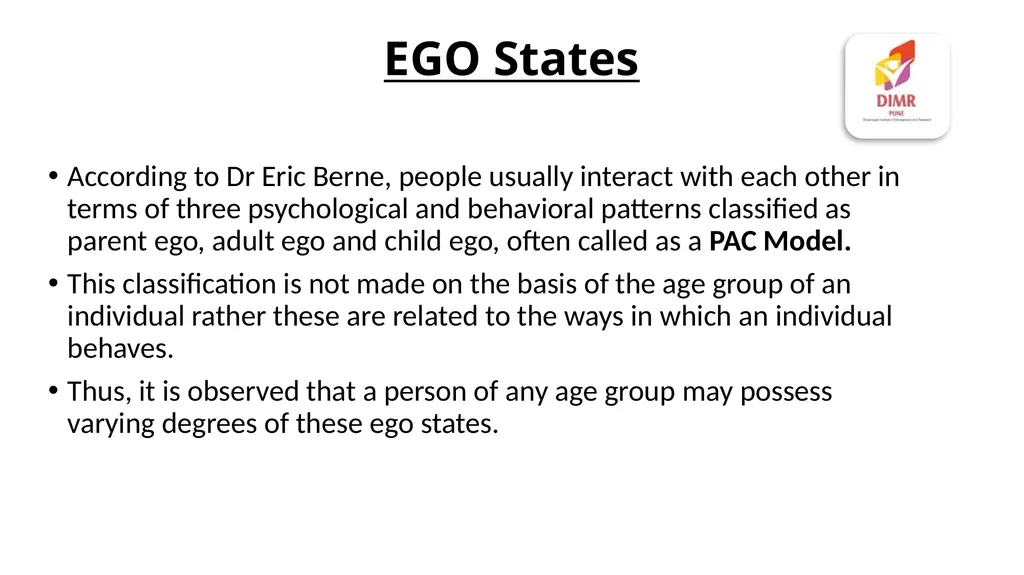
EGO States According to Dr Eric Berne, people usually interact with each other in terms of three psychological and behavioral patterns classified as parent ego, adult ego and child ego, often called as a PAC Model.
This classification is not made on the basis of the age group of an individual rather these are related to the ways in which an individual behaves.
Thus, it is observed that a person of any age group may possess varying degrees of these ego states.<br>
This classification is not made on the basis of the age group of an individual rather these are related to the ways in which an individual behaves.
Thus, it is observed that a person of any age group may possess varying degrees of these ego states.<br>
35
1. Parent ego state: The parent ego state means that the values, attitudes and behaviors of parents an integral part of the personality of an individual.
These people tend to talk to people and treat others like children. The characteristics of a person with parent ego state are:• Judgemental• Rule maker• Moralizing• Over protective• indispensable
Adult ego state: The adult ego state is authentic, direct, reality based, fact seeking and problem solving. They assume that human beings as equal, worthy and responsible. The process of adult ego state formation goes through one’s own experiences and continuously updating attitudes left over from childhood. People with adult ego state, gather relevant information, carefully analyze it, generate alternatives and make logical choices.•
3.Child ego state: the child ego state is characterized by very immature behavior. The important features of child ego state are creativity, anxiety, depression, dependence, fear, joy, emotional sentimental etc.<br>
These people tend to talk to people and treat others like children. The characteristics of a person with parent ego state are:• Judgemental• Rule maker• Moralizing• Over protective• indispensable
Adult ego state: The adult ego state is authentic, direct, reality based, fact seeking and problem solving. They assume that human beings as equal, worthy and responsible. The process of adult ego state formation goes through one’s own experiences and continuously updating attitudes left over from childhood. People with adult ego state, gather relevant information, carefully analyze it, generate alternatives and make logical choices.•
3.Child ego state: the child ego state is characterized by very immature behavior. The important features of child ego state are creativity, anxiety, depression, dependence, fear, joy, emotional sentimental etc.<br>
36
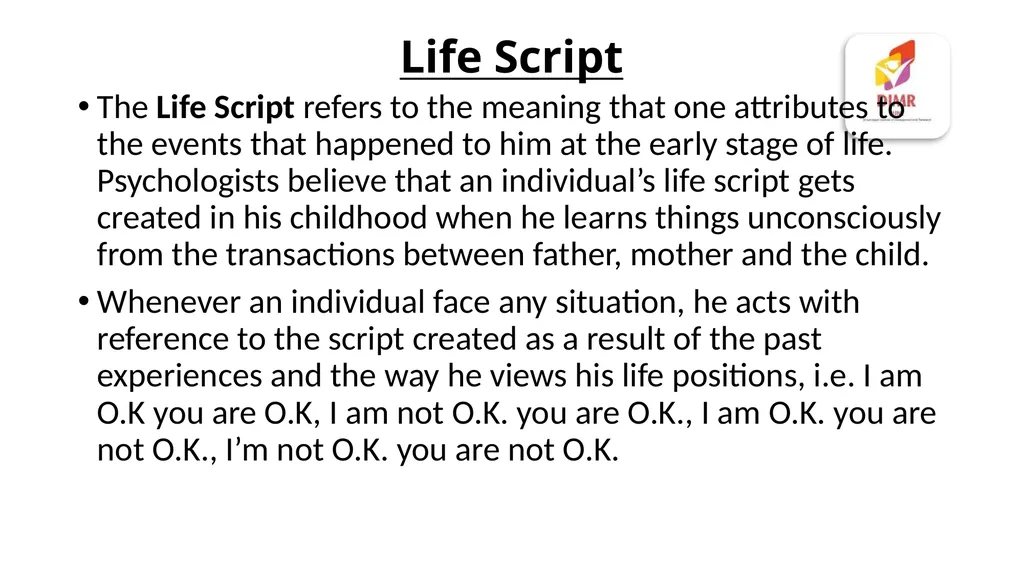
Life Script The Life Script refers to the meaning that one attributes to the events that happened to him at the early stage of life. Psychologists believe that an individual’s life script gets created in his childhood when he learns things unconsciously from the transactions between father, mother and the child.
Whenever an individual face any situation, he acts with reference to the script created as a result of the past experiences and the way he views his life positions, i.e. I am O.K you are O.K, I am not O.K. you are O.K., I am O.K. you are not O.K., I’m not O.K. you are not O.K.<br>
Whenever an individual face any situation, he acts with reference to the script created as a result of the past experiences and the way he views his life positions, i.e. I am O.K you are O.K, I am not O.K. you are O.K., I am O.K. you are not O.K., I’m not O.K. you are not O.K.<br>
37
Life Positions The Life Positions refers to the specific behavior towards others that an individual learns on the basis of certain assumptions made very early in the life.
I am O.K., You are O.K.: This life position shows that an individual has several O.K. experiences with others. This means, an individual encountered no severe problems or issues with others in his childhood and had a normal relationship with them. This position is based on the adult ego.
I am O.K., You are not O.K.: This life position is created when an individual was too much ignored when he was a child. Here, an individual believes that he is right, and all the others around him are wrong. These are the individual who possesses the rebellion child ego and put blame on others for anything that goes wrong with them.<br>
I am O.K., You are O.K.: This life position shows that an individual has several O.K. experiences with others. This means, an individual encountered no severe problems or issues with others in his childhood and had a normal relationship with them. This position is based on the adult ego.
I am O.K., You are not O.K.: This life position is created when an individual was too much ignored when he was a child. Here, an individual believes that he is right, and all the others around him are wrong. These are the individual who possesses the rebellion child ego and put blame on others for anything that goes wrong with them.<br>
38
I am not O.K., you are O.K.: This life position gets created when an individual feels that others do things better than him. He feels inferior to others and believes that others can do many things which he cannot do by himself.
am not O.K., you are not O.K.: This kind of life position is created by those who lacks interest in living. They feel life is not worth living and are the ones who have been neglected by their parents in their childhood and were brought up by the servants.<br>
am not O.K., you are not O.K.: This kind of life position is created by those who lacks interest in living. They feel life is not worth living and are the ones who have been neglected by their parents in their childhood and were brought up by the servants.<br>
39
Transcation The heart of transactional analysis is the study and diagramming of the exchanges between two persons.
Transactional analysis can help us to determine which ego state is most heavily influencing our behavior and the behavior of the other people with whom we interact.
Depending on the ego states of the persons involved in transactions, there may be three types of transactions:
1.Complementary transactions: Both people are operating from the same ego state. There can be nine complementary transactions.<br>
Transactional analysis can help us to determine which ego state is most heavily influencing our behavior and the behavior of the other people with whom we interact.
Depending on the ego states of the persons involved in transactions, there may be three types of transactions:
1.Complementary transactions: Both people are operating from the same ego state. There can be nine complementary transactions.<br>
40
2)Crossed transactions: a crossed transaction is one in which the sender sends message a behavior on the basis of his ego state, but this message is reacted to by an unexpected ego state on the part of the receiver. Crossed communication should be avoided as far as possible. Whenever such transactions occur, communication tends to blocked and a satisfactory transaction is not accomplished.
3.Ulterior transactions: This is the most complex transaction because the communication has the double meaning. Such as, on the surface level the communication may have a clear adult message, but it may carry some hidden message on the psychological level and gets misinterpreted.<br>
3.Ulterior transactions: This is the most complex transaction because the communication has the double meaning. Such as, on the surface level the communication may have a clear adult message, but it may carry some hidden message on the psychological level and gets misinterpreted.<br>
41
Perception ) Collins and Drever:- “Perception is the immediate apprehension of an object or situation affecting any or all of the sense organs by way of sensation.”
2) Stephen P.Robbins:- “Perception can be defined as a process by which individuals organise and interpret their sensory impressions in order to give meaning to their environments.”<br>
2) Stephen P.Robbins:- “Perception can be defined as a process by which individuals organise and interpret their sensory impressions in order to give meaning to their environments.”<br>
42
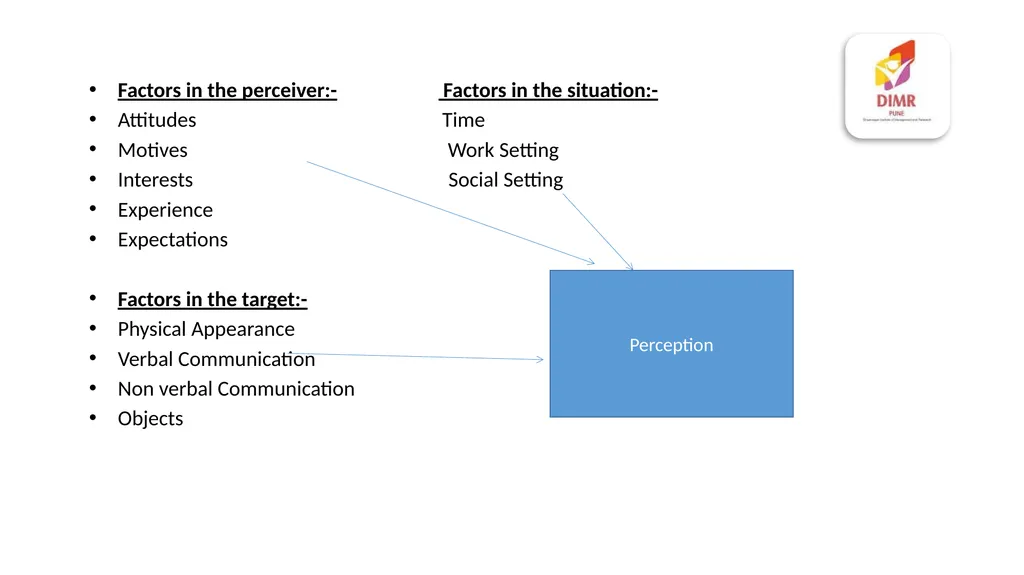
Factors in the perceiver:- Factors in the situation:-
Attitudes Time
Motives Work Setting
Interests Social Setting
Experience
Expectations
Factors in the target:-
Physical Appearance
Verbal Communication
Non verbal Communication
Objects Perception<br>
Attitudes Time
Motives Work Setting
Interests Social Setting
Experience
Expectations
Factors in the target:-
Physical Appearance
Verbal Communication
Non verbal Communication
Objects Perception<br>
43
Selective perception is a perceptual process in which a person only perceives what he desires to and sets aside or ignores other perceptions or viewpoints.
Social Perception:-
Social Perception is directly concerned with how one individual perceives other individuals, how we get to know others.
Attribution Theory:-
Attribution simply refers to how people explain the cause of another’s or their own behaviour. It is the cognitive process by which people draw conclusions about the factors that influence or make sense of one another’s behaviour..
Behaviour – 1) Internal – Behaviour Under personal Control
2) External :- Behaviour Forced by Situations
Depends on three factors :- 1) Distinctiveness 2 )Consensus 3) Consistency<br>
Social Perception:-
Social Perception is directly concerned with how one individual perceives other individuals, how we get to know others.
Attribution Theory:-
Attribution simply refers to how people explain the cause of another’s or their own behaviour. It is the cognitive process by which people draw conclusions about the factors that influence or make sense of one another’s behaviour..
Behaviour – 1) Internal – Behaviour Under personal Control
2) External :- Behaviour Forced by Situations
Depends on three factors :- 1) Distinctiveness 2 )Consensus 3) Consistency<br>
44
1) Distinctiveness :- Whether an individual displays different behavior in different situations.
2)Consensus :- People facing a similar situation respond in a same way.
3) Consistency :- How much consistent a persons actions are .<br>
2)Consensus :- People facing a similar situation respond in a same way.
3) Consistency :- How much consistent a persons actions are .<br>
45
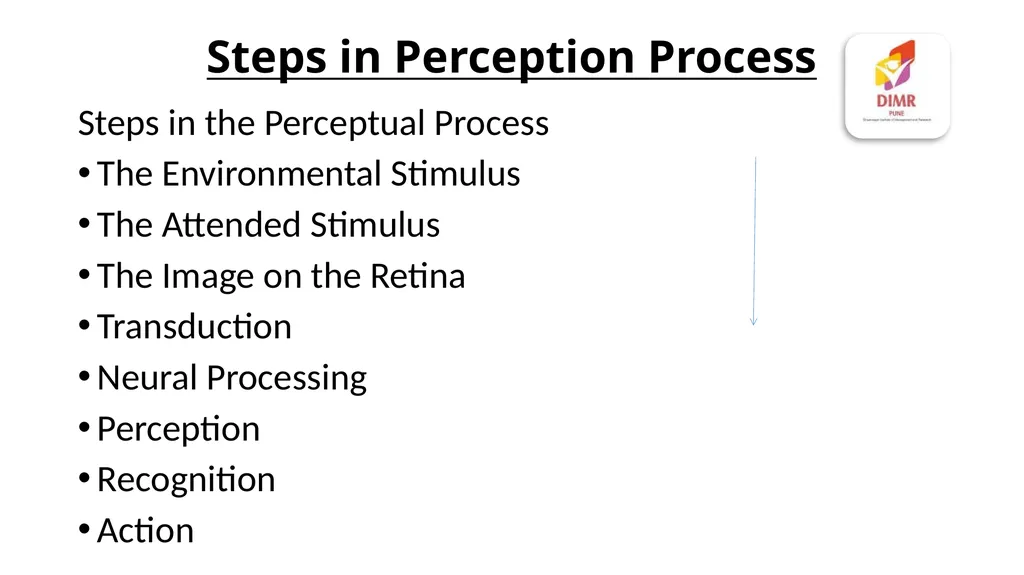
Steps in Perception Process Steps in the Perceptual Process
The Environmental Stimulus
The Attended Stimulus
The Image on the Retina
Transduction
Neural Processing
Perception
Recognition
Action<br>
The Environmental Stimulus
The Attended Stimulus
The Image on the Retina
Transduction
Neural Processing
Perception
Recognition
Action<br>
46
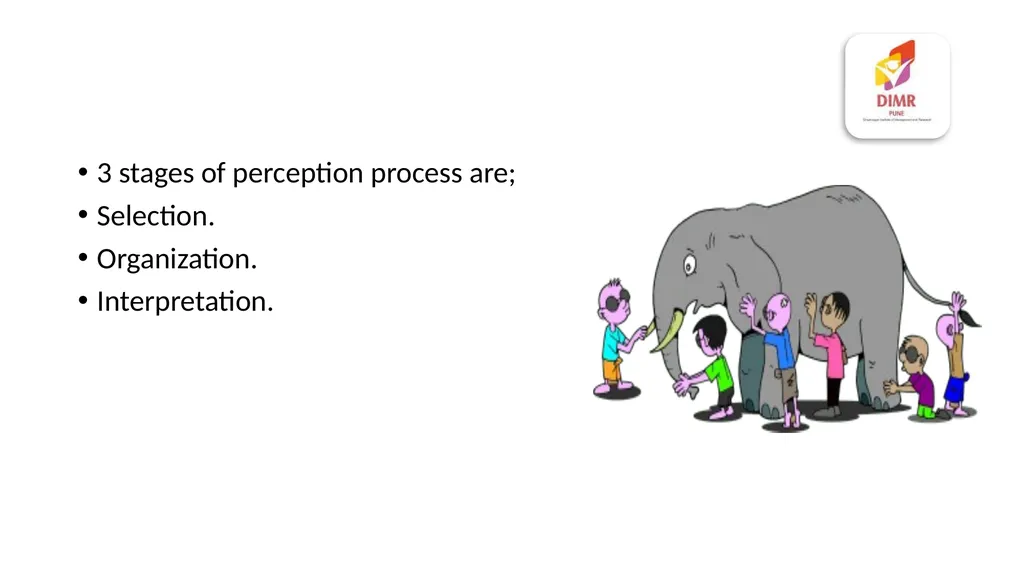
3 stages of perception process are;
Selection.
Organization.
Interpretation.<br>
Selection.
Organization.
Interpretation.<br>
47
Stereotyping Stereotyping:-
The term stereotype refers to the tendency to perceive another person (hence social perception)as belonging to a single class or category. It is the fact that stereotyping may attribute favourable or unfavourable traits to the person being perceived. Most often a person is put into a stereotype because the perceiver knows only the overall category to which the person belongs.<br>
The term stereotype refers to the tendency to perceive another person (hence social perception)as belonging to a single class or category. It is the fact that stereotyping may attribute favourable or unfavourable traits to the person being perceived. Most often a person is put into a stereotype because the perceiver knows only the overall category to which the person belongs.<br>
48
Halo Effect:- The halo effect in social perception is very similar to stereotyping. Halo is often discussed in performance appraisal when a rather makes an error in judging a person’s total personality and/or performance on the basis of a single positive trait such as intelligence, appearance, dependability or cooperativeness.
Characteristics of halo Effect:-
It is a common rating error.
It has both true and illusory components.
It has led to inflated co relations among rating dimensions and is due to influence of a general evaluation and specific judgements.
It has negative consequences and should be avoided or removed.<br>
Characteristics of halo Effect:-
It is a common rating error.
It has both true and illusory components.
It has led to inflated co relations among rating dimensions and is due to influence of a general evaluation and specific judgements.
It has negative consequences and should be avoided or removed.<br>
49
Motive and Motivation Smith and Cronje “ Motive is a drive that motivates individual to take the action he believes will satisfy his needs.”
S. P. Robbins “ Motivation is the willingness to exert high levels of effort towards organisational goals, conditioned by the effort and ability to satisfy some individual need.”<br>
S. P. Robbins “ Motivation is the willingness to exert high levels of effort towards organisational goals, conditioned by the effort and ability to satisfy some individual need.”<br>
50
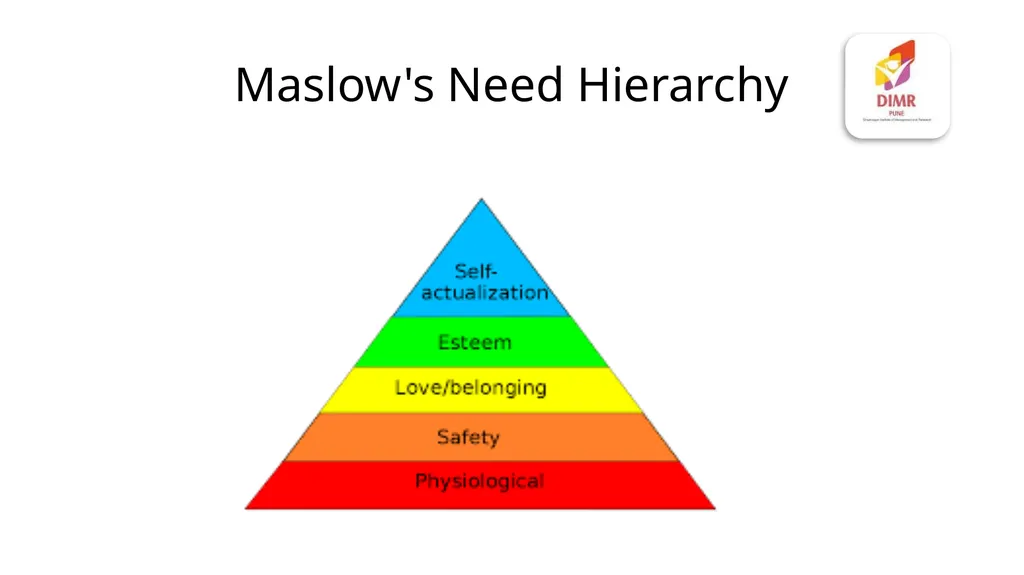
Maslow's Need Hierarchy<br>
51
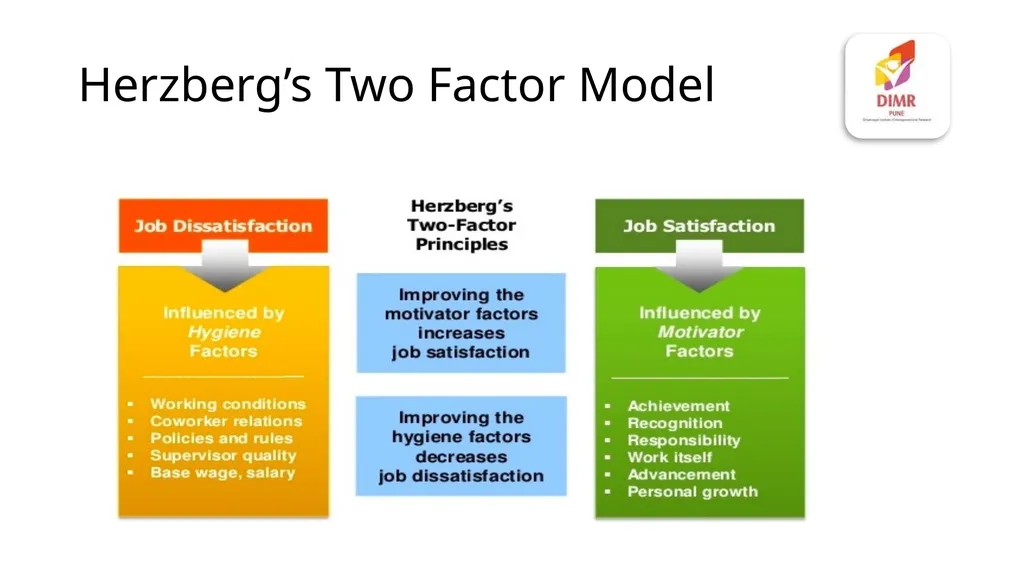
Herzberg’s Two Factor Model<br>
52
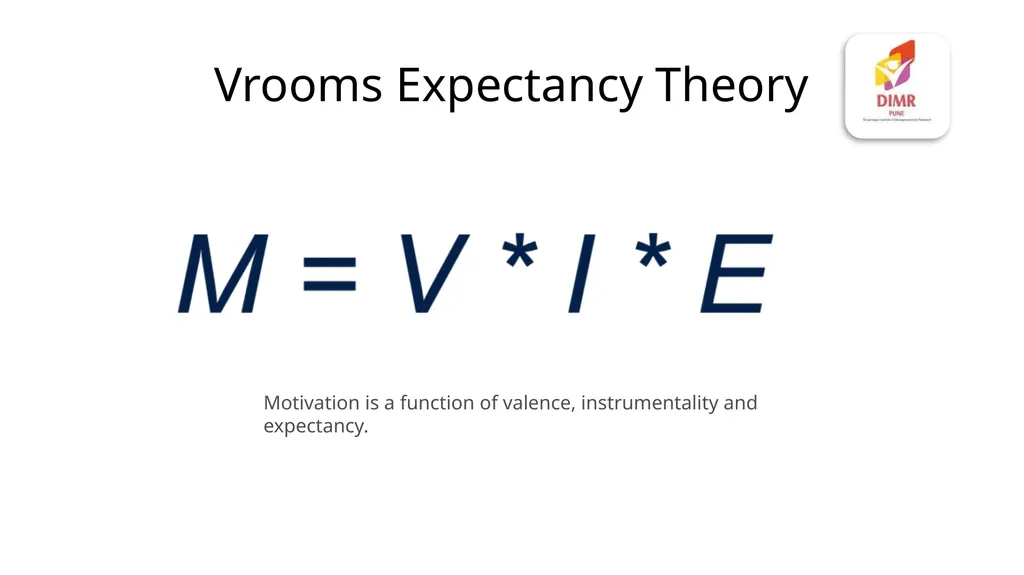
Vrooms Expectancy Theory Motivation is a function of valence, instrumentality and expectancy.<br>
53
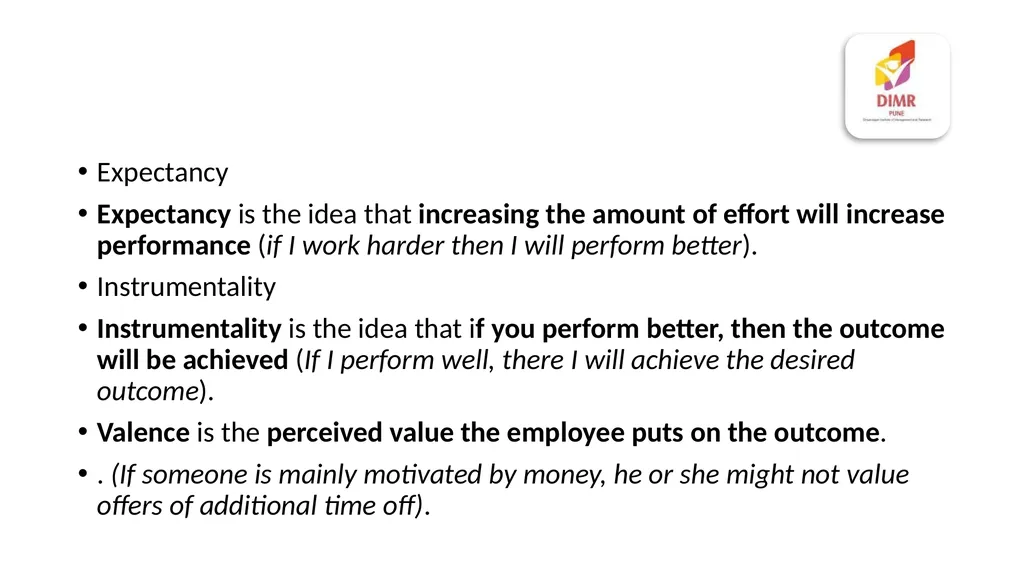
Expectancy
Expectancy is the idea that increasing the amount of effort will increase performance (if I work harder then I will perform better).
Instrumentality
Instrumentality is the idea that if you perform better, then the outcome will be achieved (If I perform well, there I will achieve the desired outcome).
Valence is the perceived value the employee puts on the outcome.
. (If someone is mainly motivated by money, he or she might not value offers of additional time off).<br>
Expectancy is the idea that increasing the amount of effort will increase performance (if I work harder then I will perform better).
Instrumentality
Instrumentality is the idea that if you perform better, then the outcome will be achieved (If I perform well, there I will achieve the desired outcome).
Valence is the perceived value the employee puts on the outcome.
. (If someone is mainly motivated by money, he or she might not value offers of additional time off).<br>
54
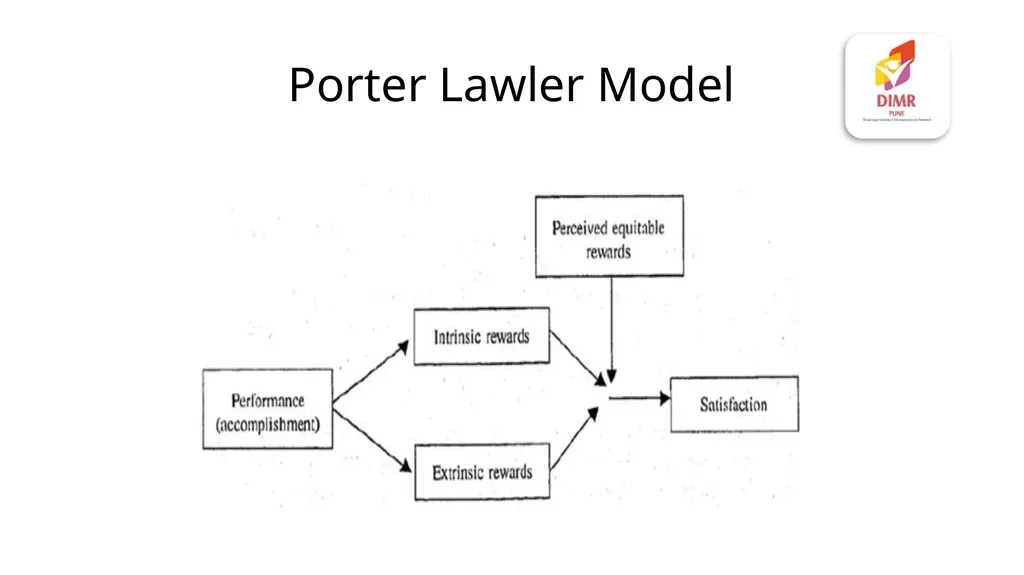
Porter Lawler Model<br>
55
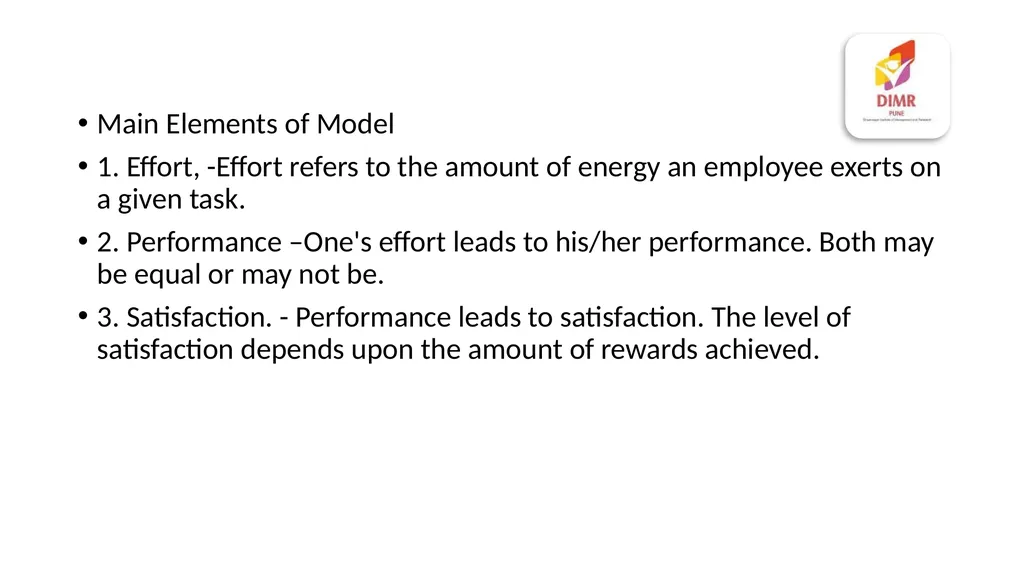
Main Elements of Model
1. Effort, -Effort refers to the amount of energy an employee exerts on a given task.
2. Performance –One's effort leads to his/her performance. Both may be equal or may not be.
3. Satisfaction. - Performance leads to satisfaction. The level of satisfaction depends upon the amount of rewards achieved.<br>
1. Effort, -Effort refers to the amount of energy an employee exerts on a given task.
2. Performance –One's effort leads to his/her performance. Both may be equal or may not be.
3. Satisfaction. - Performance leads to satisfaction. The level of satisfaction depends upon the amount of rewards achieved.<br>
56
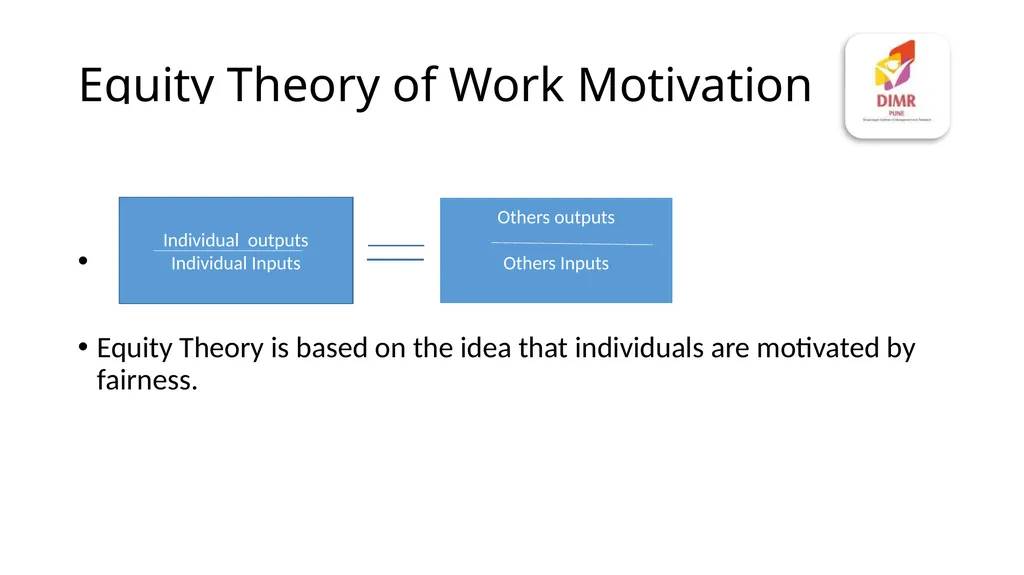
Equity Theory of Work Motivation Equity Theory is based on the idea that individuals are motivated by fairness. Individual outputs
Individual Inputs Others outputs
Others Inputs<br>
Individual Inputs Others outputs
Others Inputs<br>
57
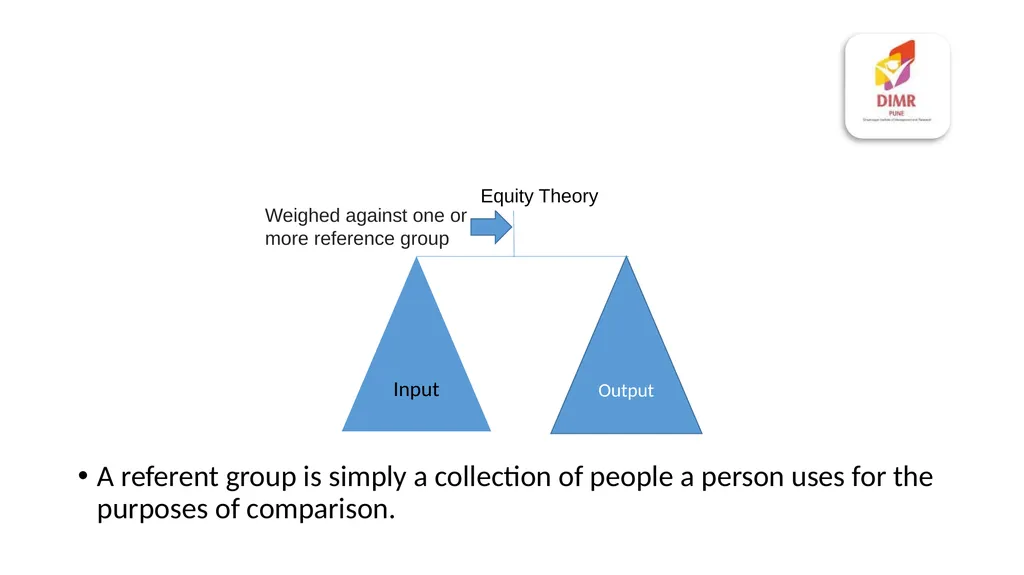
A referent group is simply a collection of people a person uses for the purposes of comparison. Input Output Equity Theory Weighed against one or
more reference group<br>
more reference group<br>
58
“ Leadership is ultimately about creating a way for people to contribute to making something extraordinary happen.”
Alan Keith
“ An activity or set of activities, observable to others that occurs in group,organisation or institution involving a leader and followers who willingly subscribe to common purpose and work together to achieve them.”
Prof. Kenneth Clark<br>
Alan Keith
“ An activity or set of activities, observable to others that occurs in group,organisation or institution involving a leader and followers who willingly subscribe to common purpose and work together to achieve them.”
Prof. Kenneth Clark<br>
59
Styles of Leadership Autocratic/ Dictatorial Leadership Style :-
Autocratic leader often called a “dictator". The autocratic leader gives orders, which must be obeyed by the subordinates. Leader S S S S S<br>
Autocratic leader often called a “dictator". The autocratic leader gives orders, which must be obeyed by the subordinates. Leader S S S S S<br>
60
Democratic/Participative Leadership Style:-
It decentralizes managerial authority. The leader’s decision is taken after consultation with his followers and after their participation in decision making process. Leader S S S S S S<br>
It decentralizes managerial authority. The leader’s decision is taken after consultation with his followers and after their participation in decision making process. Leader S S S S S S<br>
61
Laissez Faire Leadership ( Free Rein) A leader is passive and takes no special initiative to accomplish group goals. He leaves the group entirely to itself. Leader S S S S S<br>
62
Trait Approach :-
Trait approach is a traditional approach to the theory of leadership. According to these theories, it is thought that a leader has specific trait of mind and intelligence. The trait theory holds the view that successful leader possess these basic qualities and these are inherited rather than acquired. Out of this approach, came the popular belief that “Leaders are born and not made”.
According to Trait theory, a leader is expected to posses the following traits:
a)Good personality
b)Tirelessness
c) Ability to take quick decision
d)Courage<br>
Trait approach is a traditional approach to the theory of leadership. According to these theories, it is thought that a leader has specific trait of mind and intelligence. The trait theory holds the view that successful leader possess these basic qualities and these are inherited rather than acquired. Out of this approach, came the popular belief that “Leaders are born and not made”.
According to Trait theory, a leader is expected to posses the following traits:
a)Good personality
b)Tirelessness
c) Ability to take quick decision
d)Courage<br>
63
Types of Trait Theory:- Stogdill’s Trait Theory
Ghiselli’s Personal Traits
Stogdill’s Trait Factors:- In the late 1940s,Ralph Stogdill reported on the basis of at least 15 studies that leader posses
Intelligence
Physical Features
Inner Motivation Drive
Self-Confidence<br>
Stogdill’s Trait Factors:- In the late 1940s,Ralph Stogdill reported on the basis of at least 15 studies that leader posses
Intelligence
Physical Features
Inner Motivation Drive
Self-Confidence<br>
64
Ghiselli’s Personal Traits:-
Edwin Ghiselli has conducted extensive research on the relationship between personality and motivational traits and leadership effectiveness. His findings suggest that the following personality traits range from being very important to unimportant in relation to leadership success.
Very Important:-
Decisiveness
Intellectual capacity
Job achievement orientation
Self-actualisation feelings
Moderately Important:-
a)Affinity for working class
b)Drive and initiative
c)Need for a lot of money
d)Need for job security
Almost No Importance:-Masculinity versus femininity
Again, the problem with Ghiselli’s research is that several of the traits are interdependent and there is no indication of how much of any trait a person should have to be an effective leader.<br>
Edwin Ghiselli has conducted extensive research on the relationship between personality and motivational traits and leadership effectiveness. His findings suggest that the following personality traits range from being very important to unimportant in relation to leadership success.
Very Important:-
Decisiveness
Intellectual capacity
Job achievement orientation
Self-actualisation feelings
Moderately Important:-
a)Affinity for working class
b)Drive and initiative
c)Need for a lot of money
d)Need for job security
Almost No Importance:-Masculinity versus femininity
Again, the problem with Ghiselli’s research is that several of the traits are interdependent and there is no indication of how much of any trait a person should have to be an effective leader.<br>
65
Behavioural Theory of Leadership
In this approach, the emphasis is on the actual behaviour and action of the leaders and not on their traits or characteristics. In other words, this approach emphasizes that strong leadership is the result of effective role behaviour.
This approach states that the leader uses three skills to lead his followers. These skills are: technical (refers to a person's knowledge of the process of technique), human (refers to ability to interact with people and conceptual (refers to manager's ideas which enable a manager to set up models and design plans).<br>
In this approach, the emphasis is on the actual behaviour and action of the leaders and not on their traits or characteristics. In other words, this approach emphasizes that strong leadership is the result of effective role behaviour.
This approach states that the leader uses three skills to lead his followers. These skills are: technical (refers to a person's knowledge of the process of technique), human (refers to ability to interact with people and conceptual (refers to manager's ideas which enable a manager to set up models and design plans).<br>
66
Unit IV -Conflict Management Conflict -“Any tension experienced when one perceives another as thwarting or frustrating his or her needs, or is likely to do so.”
Chung and Meggison (1981) “The struggle between incompatible or opposing needs,wishes,ideas,interests or people.”
Conflict management is the practice of being able to identify and handle conflicts sensibly, fairly, and efficiently. Since conflicts in a business are a natural part of the workplace, it is important that there are people who understand conflicts and know how to resolve them.<br>
Chung and Meggison (1981) “The struggle between incompatible or opposing needs,wishes,ideas,interests or people.”
Conflict management is the practice of being able to identify and handle conflicts sensibly, fairly, and efficiently. Since conflicts in a business are a natural part of the workplace, it is important that there are people who understand conflicts and know how to resolve them.<br>
67
Sources of conflict Goal incompatibility and differentiation
Interdependence
Uncertainty and resource scarcity
Reward systems
Poor management.
Unfair treatment.
Unclear job roles.
Inadequate training.
Poor communication.<br>
Interdependence
Uncertainty and resource scarcity
Reward systems
Poor management.
Unfair treatment.
Unclear job roles.
Inadequate training.
Poor communication.<br>
68
Types of Conflict Task Conflict
Relationship Conflict
Value Conflict
Intergroup Conflict
Interorganisational Conflict<br>
Relationship Conflict
Value Conflict
Intergroup Conflict
Interorganisational Conflict<br>
69
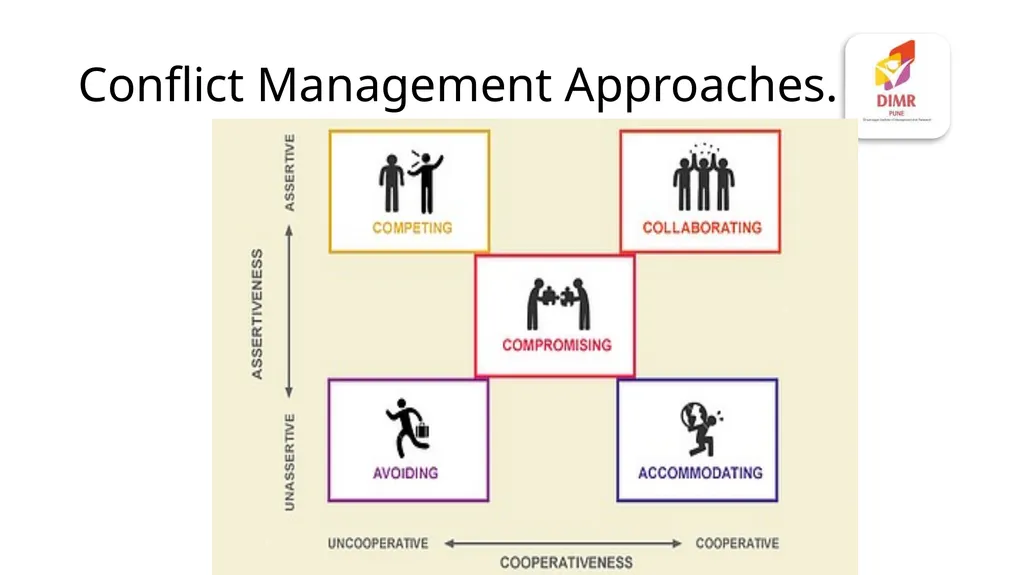
Conflict Management Approaches.<br>
70
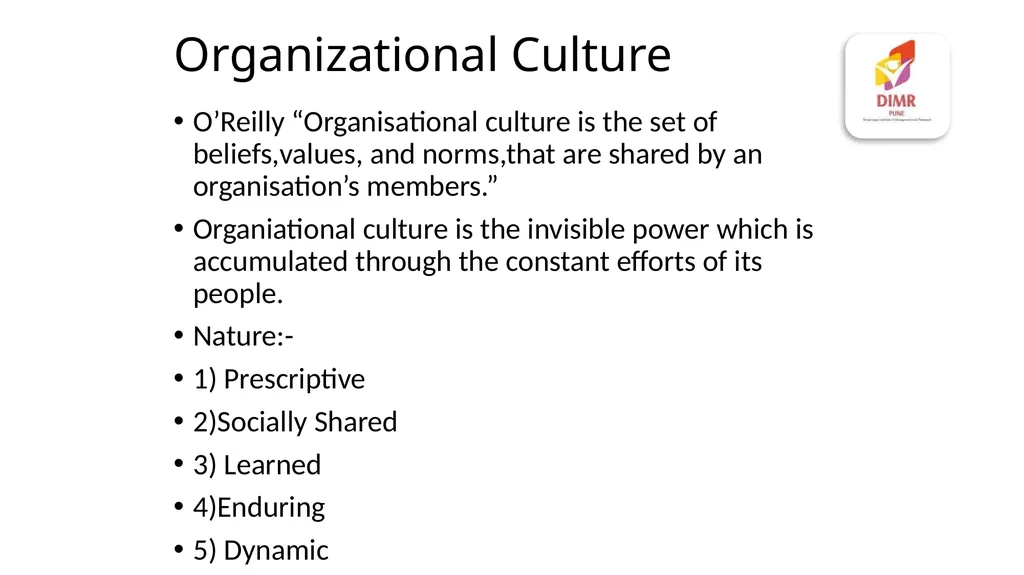
Organizational Culture O’Reilly “Organisational culture is the set of beliefs,values, and norms,that are shared by an organisation’s members.”
Organiational culture is the invisible power which is accumulated through the constant efforts of its people.
Nature:-
1) Prescriptive
2)Socially Shared
3) Learned
4)Enduring
5) Dynamic<br>
Organiational culture is the invisible power which is accumulated through the constant efforts of its people.
Nature:-
1) Prescriptive
2)Socially Shared
3) Learned
4)Enduring
5) Dynamic<br>
71
Origin of Organisational Culture Founder’s Values
Preferences
Industry Demands<br>
Preferences
Industry Demands<br>
72
The functions of organizational culture The guiding function.
The incentive function.
The cohesion function
The constraint function<br>
The incentive function.
The cohesion function
The constraint function<br>
73
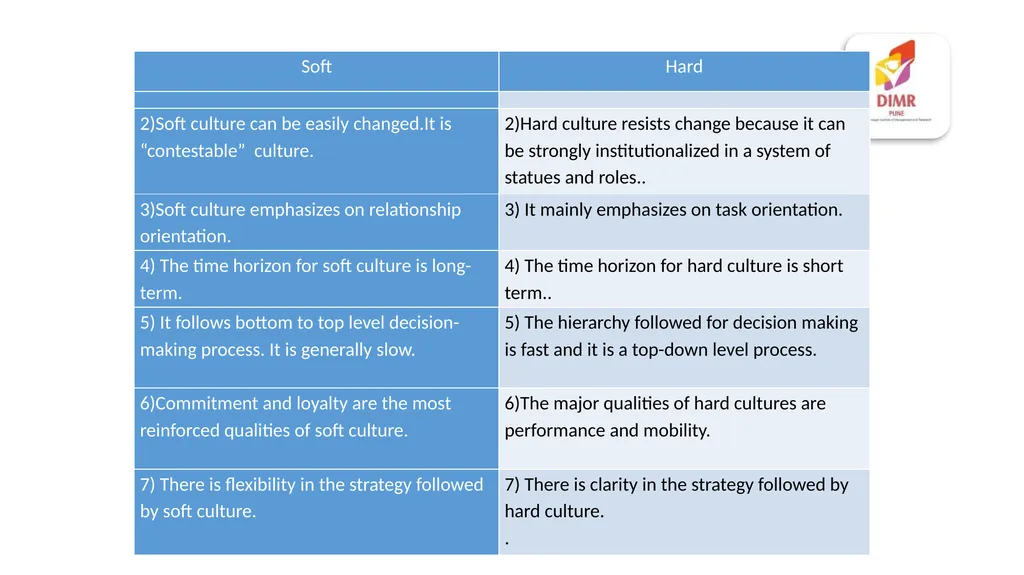
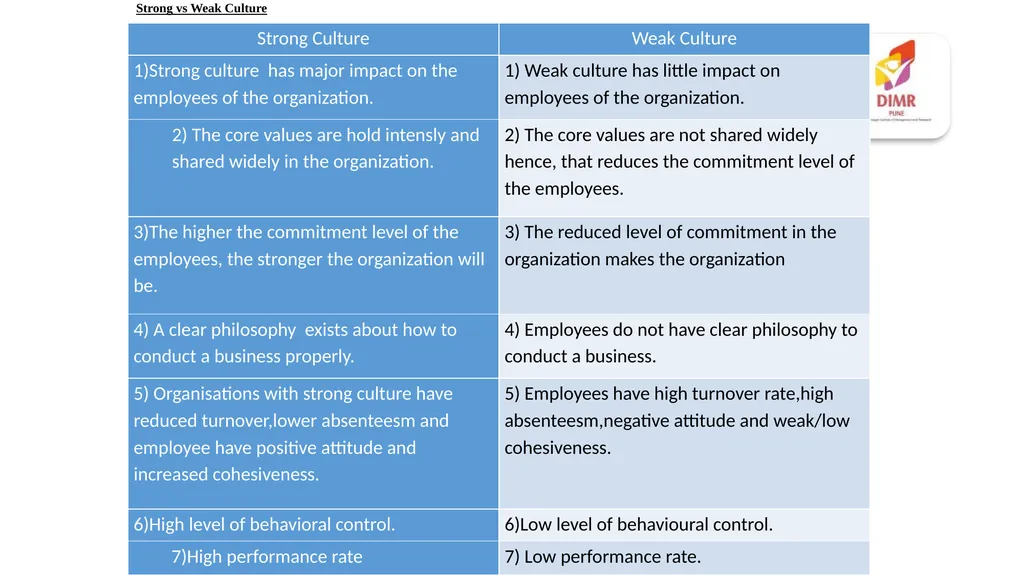
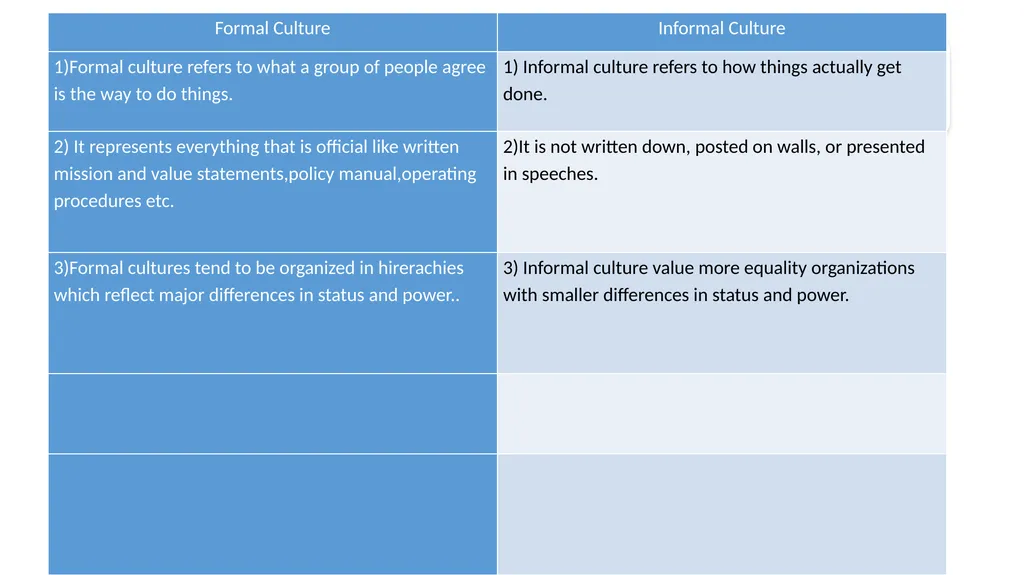
Types of Culture Strong vs Weak Culture<br>
74
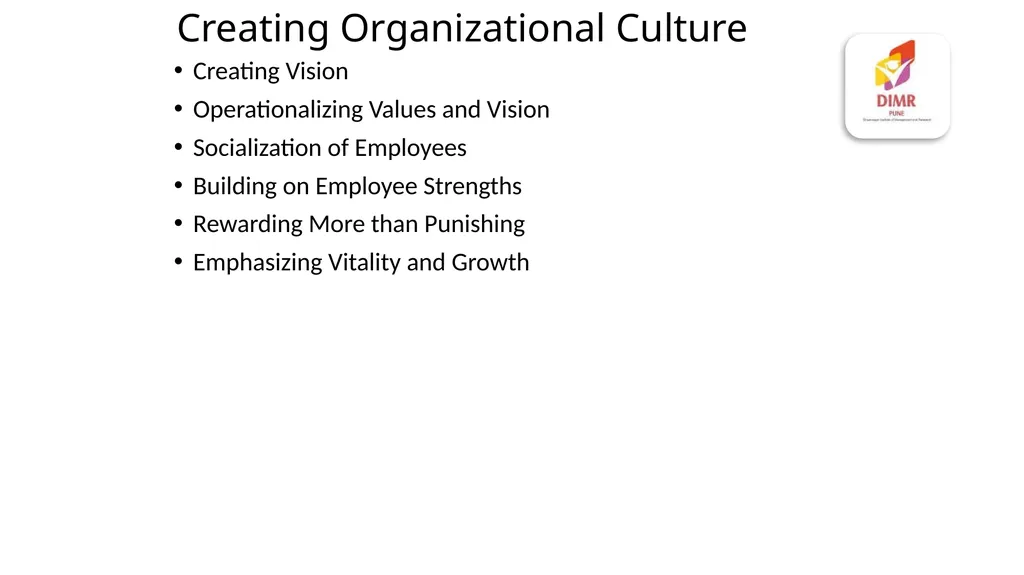
Creating Organizational Culture Creating Vision
Operationalizing Values and Vision
Socialization of Employees
Building on Employee Strengths
Rewarding More than Punishing
Emphasizing Vitality and Growth<br>
Operationalizing Values and Vision
Socialization of Employees
Building on Employee Strengths
Rewarding More than Punishing
Emphasizing Vitality and Growth<br>
75
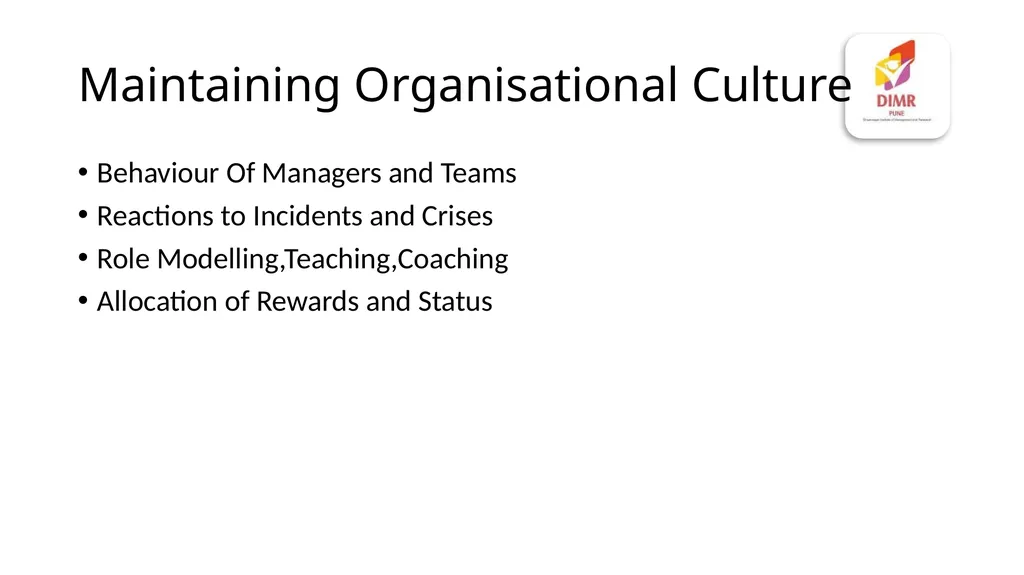
Maintaining Organisational Culture Behaviour Of Managers and Teams
Reactions to Incidents and Crises
Role Modelling,Teaching,Coaching
Allocation of Rewards and Status<br>
Reactions to Incidents and Crises
Role Modelling,Teaching,Coaching
Allocation of Rewards and Status<br>
76
Managing Cultural Diversity
1 ) Understanding Cultural Differences
2) Introducing Free Speech
3) Practicing Effective Communication
4) Awareness<br>
1 ) Understanding Cultural Differences
2) Introducing Free Speech
3) Practicing Effective Communication
4) Awareness<br>
77
Organisational Change Change refers to any alteration that occurs in total work environment.
Organizational change is defined as change that has an impact on the way that work is performed and has significant effects on staff.
Organizational change can have impact irrespective of whether changes are viewed as large or small.<br>
Organizational change is defined as change that has an impact on the way that work is performed and has significant effects on staff.
Organizational change can have impact irrespective of whether changes are viewed as large or small.<br>
78
Nature Of Organizational Change:-
Change Disturbs Old Equilibrium
Change Affects Whole organization
Change is a continuous Process
Change may be Reactive or Proactive
Change may be planned or unplanned
Types of Organizational Change
Happeneed change
Reactive Change
Anticipatory Change
Planned Change
Process-oriented Change<br>
Change Disturbs Old Equilibrium
Change Affects Whole organization
Change is a continuous Process
Change may be Reactive or Proactive
Change may be planned or unplanned
Types of Organizational Change
Happeneed change
Reactive Change
Anticipatory Change
Planned Change
Process-oriented Change<br>
79
The forces that acts as Stimulants to Change:-
External Forces:-.
Technology
Marketing Conditions
Social Changes
Political Forces
Globalisation
Internal Forces :-
Changes in managerial personnel
Changes in Employee Expectations
Deficiencies in existing structure
Changes in work Climate<br>
External Forces:-.
Technology
Marketing Conditions
Social Changes
Political Forces
Globalisation
Internal Forces :-
Changes in managerial personnel
Changes in Employee Expectations
Deficiencies in existing structure
Changes in work Climate<br>
80
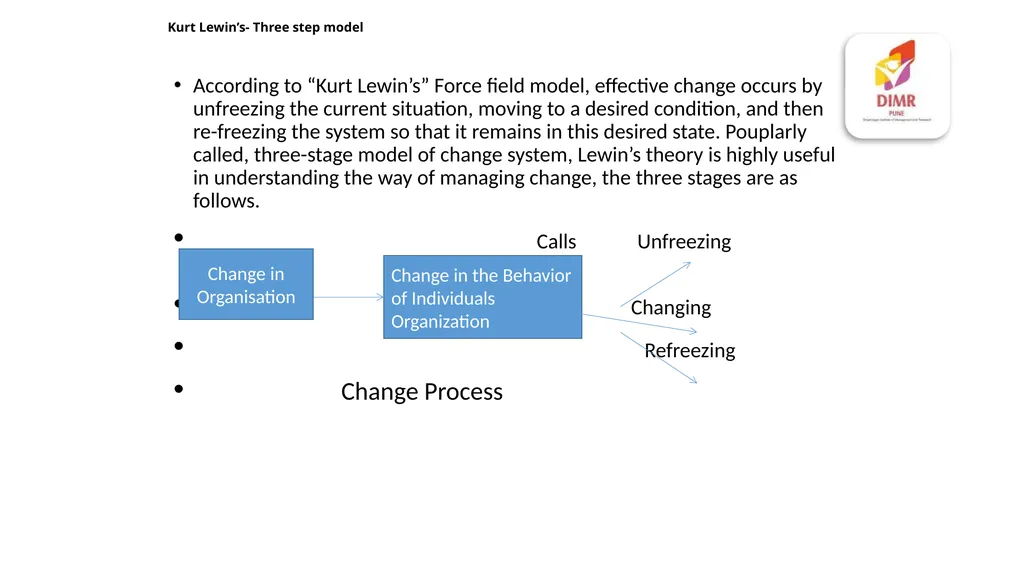
Kurt Lewin’s- Three step model According to “Kurt Lewin’s” Force field model, effective change occurs by unfreezing the current situation, moving to a desired condition, and then re-freezing the system so that it remains in this desired state. Pouplarly called, three-stage model of change system, Lewin’s theory is highly useful in understanding the way of managing change, the three stages are as follows.
Calls Unfreezing UnFreezing
Changing
Refreezing
Change Process Change in the Behavior of Individuals Organization Change in Organisation<br>
Calls Unfreezing UnFreezing
Changing
Refreezing
Change Process Change in the Behavior of Individuals Organization Change in Organisation<br>
81
How to Overcome the Resistance to Change Effectively engage employees
Implement change in several stages
Communicate change effectively
Participation and involvement<br>
Implement change in several stages
Communicate change effectively
Participation and involvement<br>
82
Methods of Implementing Organizational Change:- Top-Down Approach
Laissez Faire Approach
Collaborative Approach<br>
Laissez Faire Approach
Collaborative Approach<br>
83
Learning Organization:- According to Nancy Dixon “ The essence of organizational learning is the organization’s ability to use the amazing mental capacity of all its members to create the kind of processes that will improve its own.”
According to Sandra Kerka “ Learning organizations seem to work on the assumption that learning is valuable, continuous, and most effective when shared and that every experience is an opportunity to learn.”
The process of developing a learning organization involves following steps:-
Commitement of Top Management
Sharing of Commitment and Creation of Vision
Wider Acceptability of Desirability of learning Organisation
New Techniques/Structures/Processes
Commitment of Entire Workforce<br>
According to Sandra Kerka “ Learning organizations seem to work on the assumption that learning is valuable, continuous, and most effective when shared and that every experience is an opportunity to learn.”
The process of developing a learning organization involves following steps:-
Commitement of Top Management
Sharing of Commitment and Creation of Vision
Wider Acceptability of Desirability of learning Organisation
New Techniques/Structures/Processes
Commitment of Entire Workforce<br>
84
Change refers to any alteration that occurs in total work environment.
Organizational change is defined as change that has an impact on the way that work is performed and has significant effects on staff.<br>
Organizational change is defined as change that has an impact on the way that work is performed and has significant effects on staff.<br>