
Example Mapping and Challenges Tanzania
MJ
Published · 27 slides · 0 views
1 / 1





Description
Example Mapping and Challenges Tanzania stakeholder meeting Nov 2016 ART DELIVERY 1. Desk review Retention on ART 2009-2014 Source: IeDEA-WHO 2015 Data from 6 regions 41 countries 304,000 patients Retention worse for Men Children
Related Topics
Share
Embed code
Download this presentation From Below
"Example Mapping and Challenges Tanzania" is the property of its rightful owner. Permission is granted to download and print the materials on this website for personal, non-commercial use only, and to display it on your personal computer provided you do not modify the materials and that you retain all copyright notices contained in the materials. By downloading content from our website, you accept the terms of this agreement.
Presentation Transcript
01
Example
Mapping and Challenges
Tanzania stakeholder meeting
Nov 2016<br>
02
ART DELIVERY<br>
03
1. Desk review<br>
04
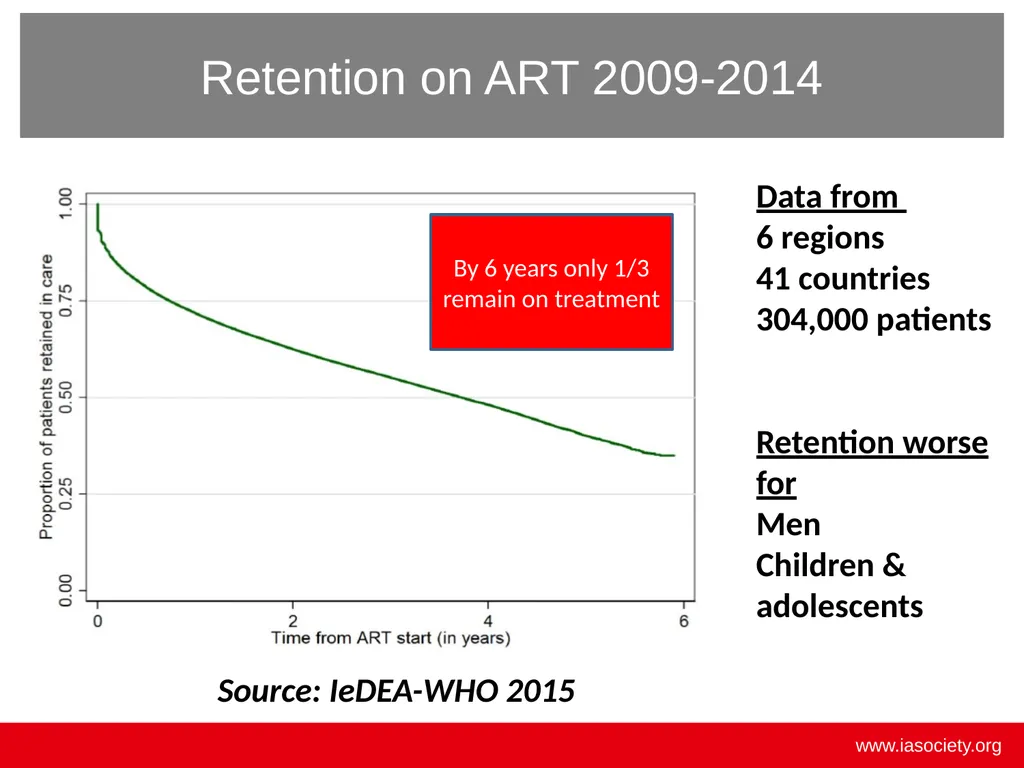
Retention on ART 2009-2014 Source: IeDEA-WHO 2015 Data from
6 regions
41 countries
304,000 patients
Retention worse for
Men
Children & adolescents By 6 years only 1/3 remain on treatment<br>
6 regions
41 countries
304,000 patients
Retention worse for
Men
Children & adolescents By 6 years only 1/3 remain on treatment<br>
05
Retention in East Africa (1) Geng et al Clin Infect Dis. 2016 Apr Retention in Care and Patient-Reported Reasons for Undocumented Transfer or Stopping Care Among HIV-Infected Patients on Antiretroviral Therapy in Eastern Africa: Application of a Sampling-Based Approach
18 081 patients, 3150 (18%) were lost to follow-up
2 years after ART,
69% were in care at their original clinic,
14% transferred (4% official and 10% unofficial),
6% were alive but out of care,
6% died in care (<60 days after last visit), and
6% died out of care (≥ 60 days after last visit). Silent Transfers<br>
18 081 patients, 3150 (18%) were lost to follow-up
2 years after ART,
69% were in care at their original clinic,
14% transferred (4% official and 10% unofficial),
6% were alive but out of care,
6% died in care (<60 days after last visit), and
6% died out of care (≥ 60 days after last visit). Silent Transfers<br>
06
Retention in East Africa (2) Among lost patients found in care elsewhere,
structural barriers (e.g., transportation) were most prevalent (65%),
followed by clinic-based (e.g., waiting times) (33%)
psychosocial (e.g., stigma) (27%).
Among patients not in care elsewhere,
psychosocial barriers were most prevalent (76%),
followed by structural (51%) and
clinic based (15%).<br>
structural barriers (e.g., transportation) were most prevalent (65%),
followed by clinic-based (e.g., waiting times) (33%)
psychosocial (e.g., stigma) (27%).
Among patients not in care elsewhere,
psychosocial barriers were most prevalent (76%),
followed by structural (51%) and
clinic based (15%).<br>
07
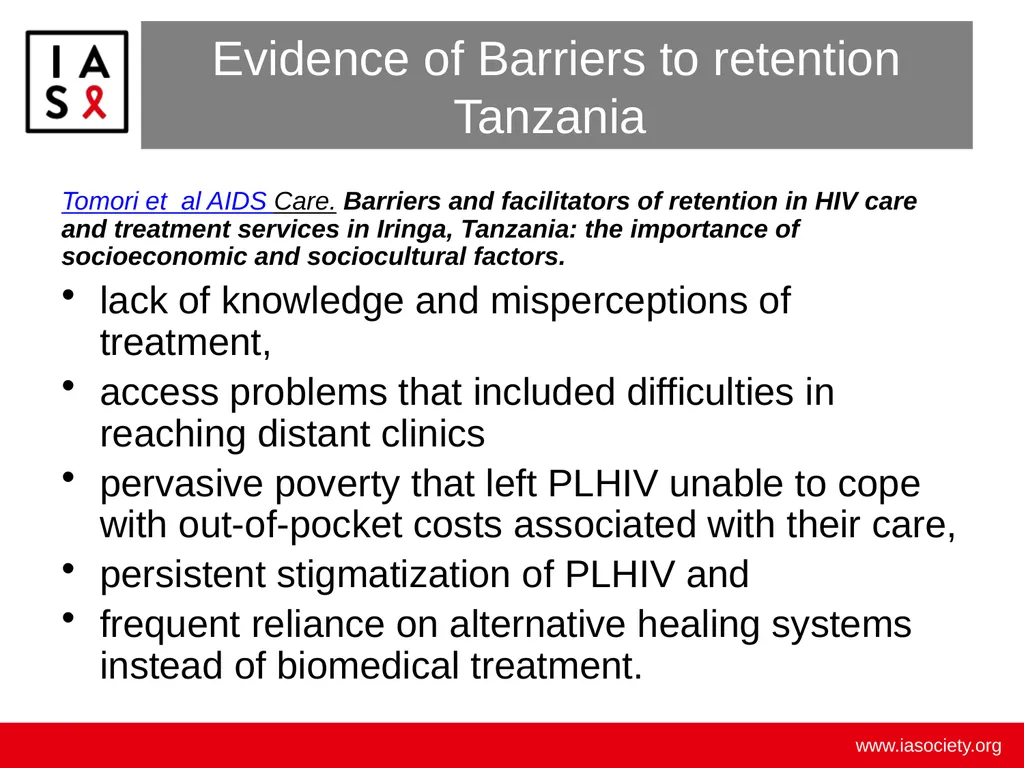
Evidence of Barriers to retention Tanzania Tomori et al AIDS Care. Barriers and facilitators of retention in HIV care and treatment services in Iringa, Tanzania: the importance of socioeconomic and sociocultural factors.
lack of knowledge and misperceptions of treatment,
access problems that included difficulties in reaching distant clinics
pervasive poverty that left PLHIV unable to cope with out-of-pocket costs associated with their care,
persistent stigmatization of PLHIV and
frequent reliance on alternative healing systems instead of biomedical treatment.<br>
lack of knowledge and misperceptions of treatment,
access problems that included difficulties in reaching distant clinics
pervasive poverty that left PLHIV unable to cope with out-of-pocket costs associated with their care,
persistent stigmatization of PLHIV and
frequent reliance on alternative healing systems instead of biomedical treatment.<br>
08
2. Feedback from field visits and implementing partner interviews<br>
09
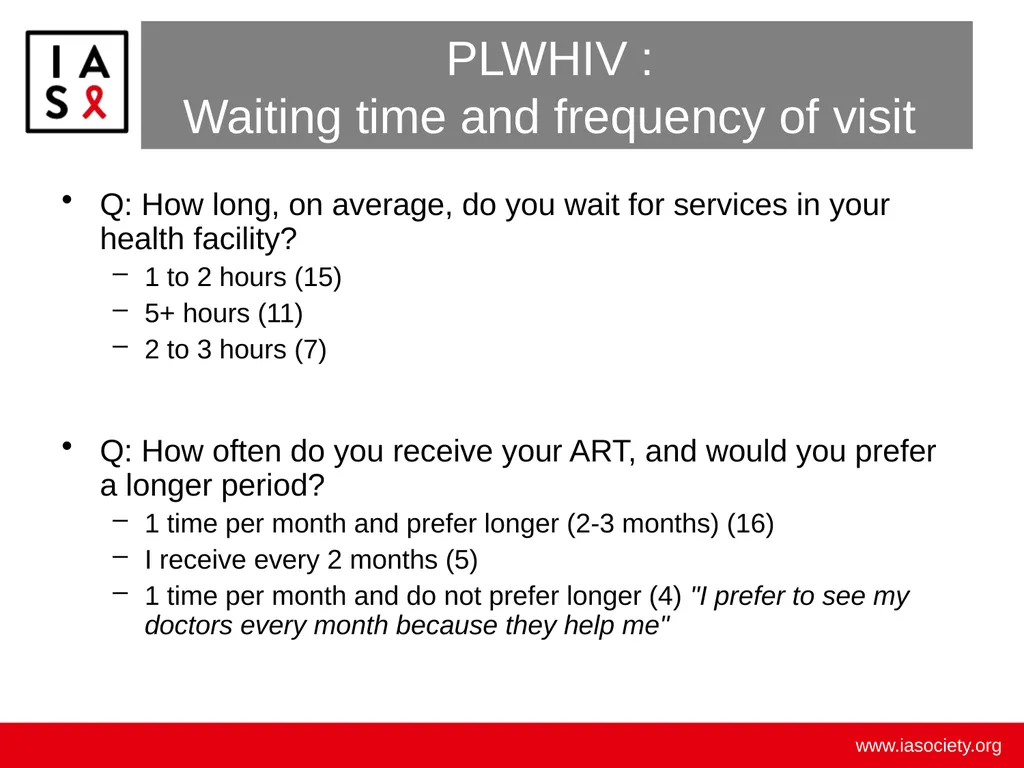
PLWHIV :
Waiting time and frequency of visit Q: How long, on average, do you wait for services in your health facility?
1 to 2 hours (15)
5+ hours (11)
2 to 3 hours (7)
Q: How often do you receive your ART, and would you prefer a longer period?
1 time per month and prefer longer (2-3 months) (16)
I receive every 2 months (5)
1 time per month and do not prefer longer (4) "I prefer to see my doctors every month because they help me"<br>
1 to 2 hours (15)
5+ hours (11)
2 to 3 hours (7)
Q: How often do you receive your ART, and would you prefer a longer period?
1 time per month and prefer longer (2-3 months) (16)
I receive every 2 months (5)
1 time per month and do not prefer longer (4) "I prefer to see my doctors every month because they help me"<br>
10
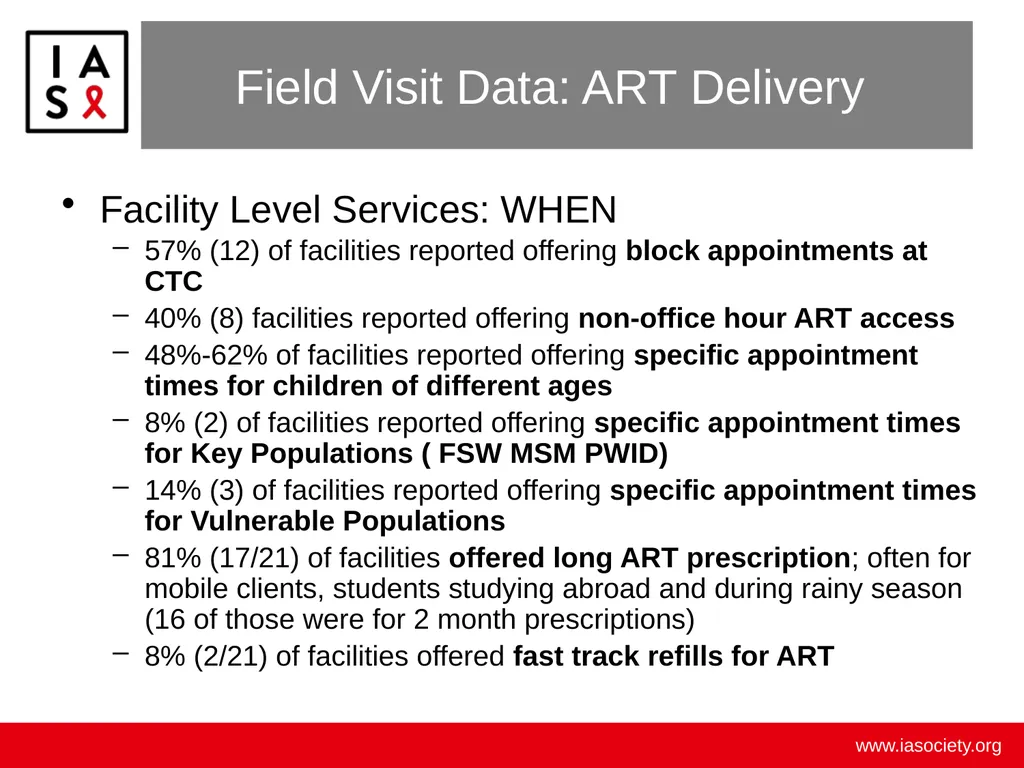
Field Visit Data: ART Delivery Facility Level Services: WHEN
57% (12) of facilities reported offering block appointments at CTC
40% (8) facilities reported offering non-office hour ART access
48%-62% of facilities reported offering specific appointment times for children of different ages
8% (2) of facilities reported offering specific appointment times for Key Populations ( FSW MSM PWID)
14% (3) of facilities reported offering specific appointment times for Vulnerable Populations
81% (17/21) of facilities offered long ART prescription; often for mobile clients, students studying abroad and during rainy season (16 of those were for 2 month prescriptions)
8% (2/21) of facilities offered fast track refills for ART<br>
57% (12) of facilities reported offering block appointments at CTC
40% (8) facilities reported offering non-office hour ART access
48%-62% of facilities reported offering specific appointment times for children of different ages
8% (2) of facilities reported offering specific appointment times for Key Populations ( FSW MSM PWID)
14% (3) of facilities reported offering specific appointment times for Vulnerable Populations
81% (17/21) of facilities offered long ART prescription; often for mobile clients, students studying abroad and during rainy season (16 of those were for 2 month prescriptions)
8% (2/21) of facilities offered fast track refills for ART<br>
11
Field Visit Data:
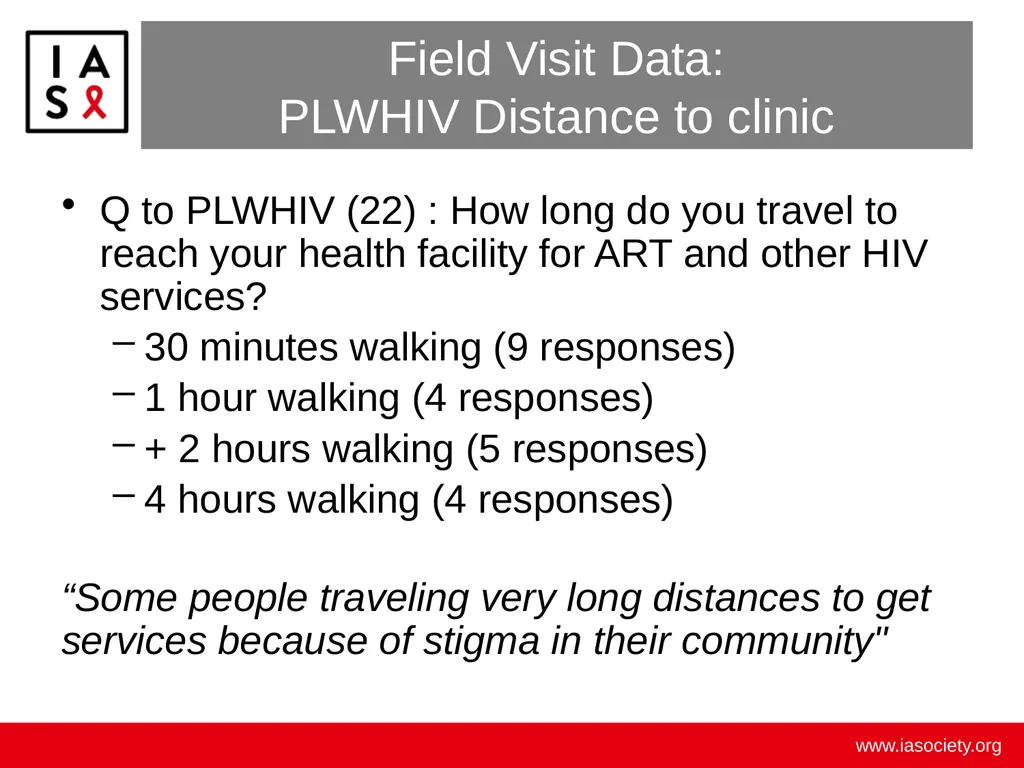
PLWHIV Distance to clinic Q to PLWHIV (22) : How long do you travel to reach your health facility for ART and other HIV services?
30 minutes walking (9 responses)
1 hour walking (4 responses)
+ 2 hours walking (5 responses)
4 hours walking (4 responses)
“Some people traveling very long distances to get services because of stigma in their community"<br>
30 minutes walking (9 responses)
1 hour walking (4 responses)
+ 2 hours walking (5 responses)
4 hours walking (4 responses)
“Some people traveling very long distances to get services because of stigma in their community"<br>
12
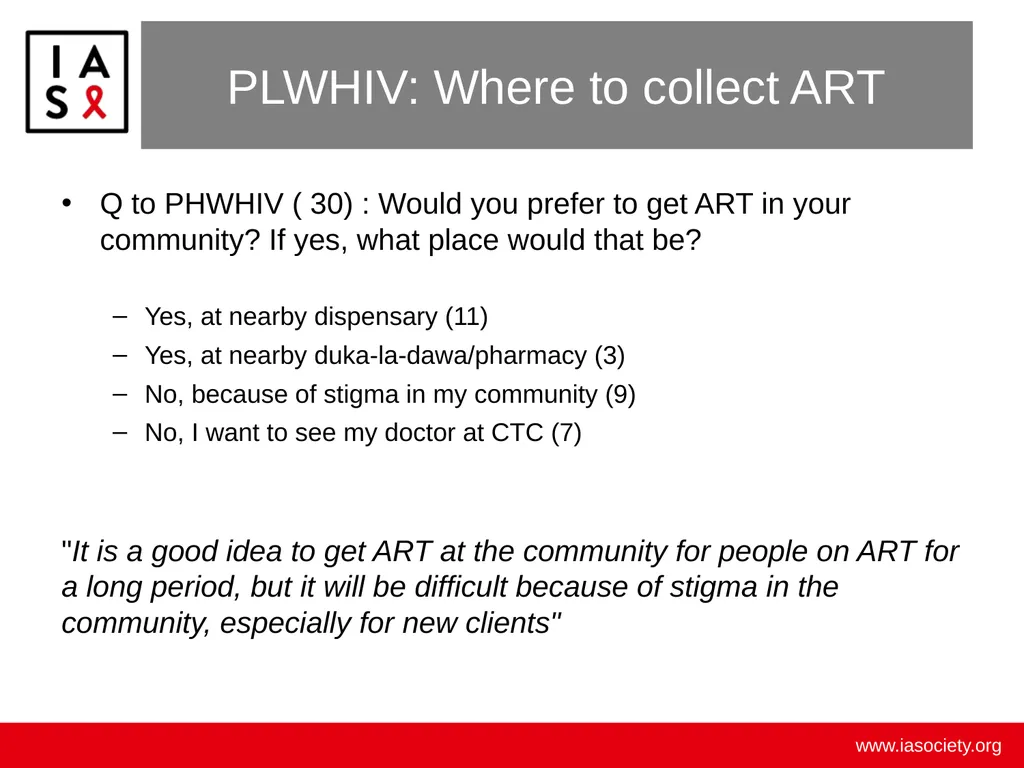
PLWHIV: Where to collect ART Q to PHWHIV ( 30) : Would you prefer to get ART in your community? If yes, what place would that be?
Yes, at nearby dispensary (11)
Yes, at nearby duka-la-dawa/pharmacy (3)
No, because of stigma in my community (9)
No, I want to see my doctor at CTC (7)
"It is a good idea to get ART at the community for people on ART for a long period, but it will be difficult because of stigma in the community, especially for new clients"<br>
Yes, at nearby dispensary (11)
Yes, at nearby duka-la-dawa/pharmacy (3)
No, because of stigma in my community (9)
No, I want to see my doctor at CTC (7)
"It is a good idea to get ART at the community for people on ART for a long period, but it will be difficult because of stigma in the community, especially for new clients"<br>
13
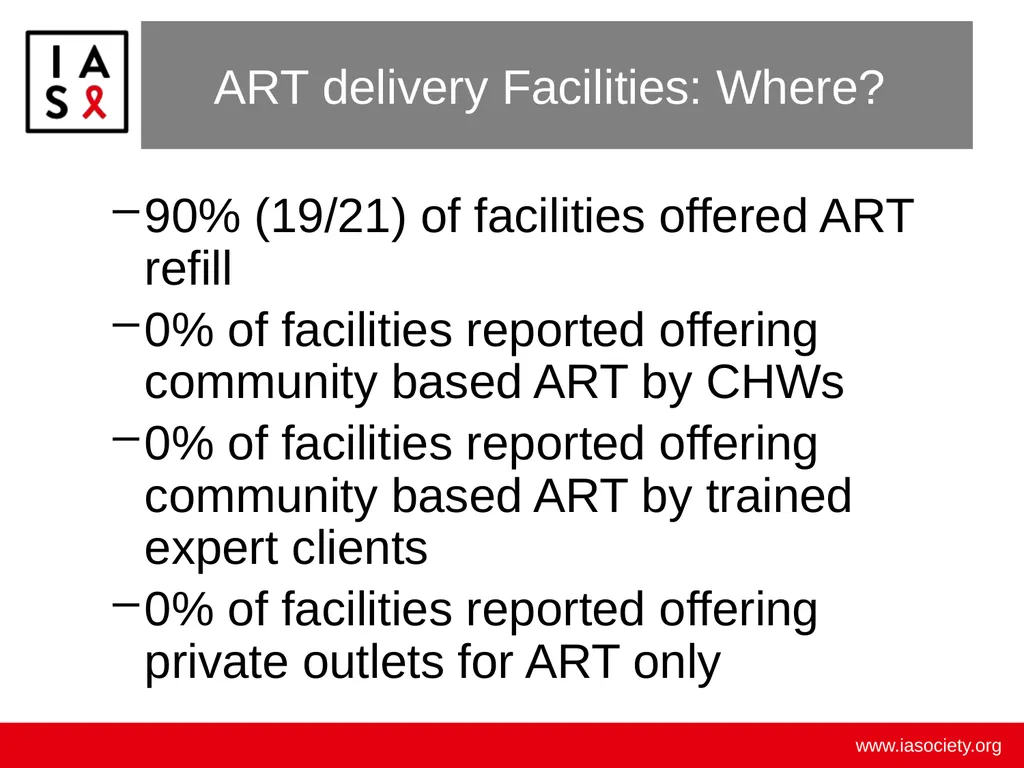
ART delivery Facilities: Where? 90% (19/21) of facilities offered ART refill
0% of facilities reported offering community based ART by CHWs
0% of facilities reported offering community based ART by trained expert clients
0% of facilities reported offering private outlets for ART only<br>
0% of facilities reported offering community based ART by CHWs
0% of facilities reported offering community based ART by trained expert clients
0% of facilities reported offering private outlets for ART only<br>
14
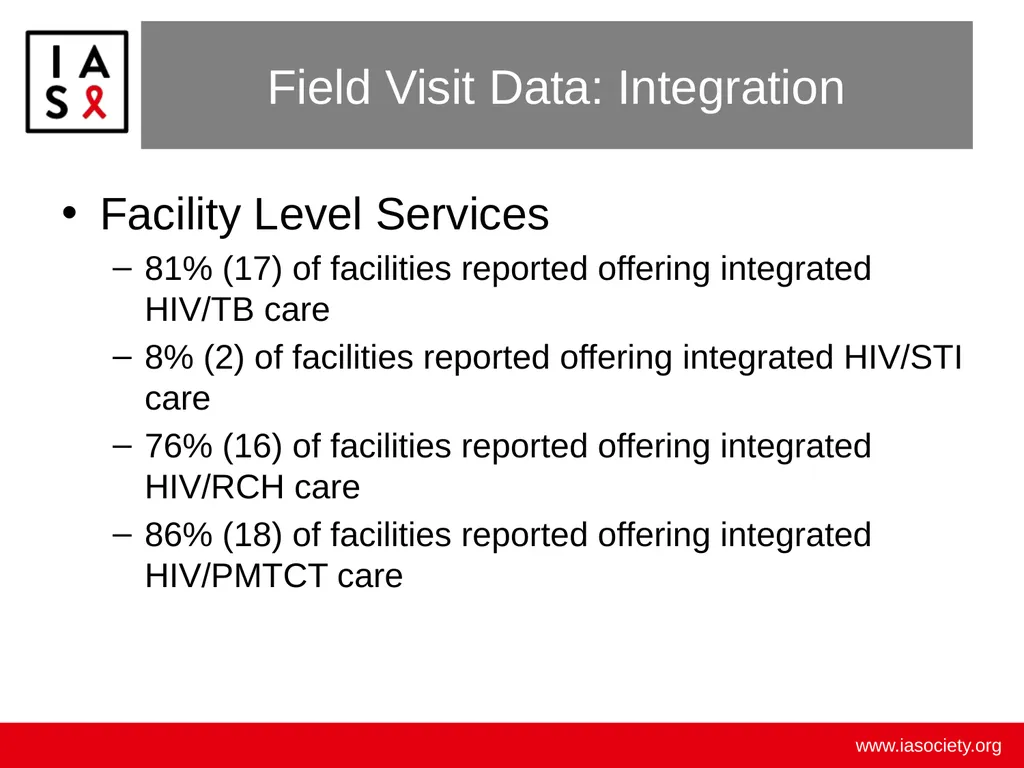
Field Visit Data: Integration Facility Level Services
81% (17) of facilities reported offering integrated HIV/TB care
8% (2) of facilities reported offering integrated HIV/STI care
76% (16) of facilities reported offering integrated HIV/RCH care
86% (18) of facilities reported offering integrated HIV/PMTCT care<br>
81% (17) of facilities reported offering integrated HIV/TB care
8% (2) of facilities reported offering integrated HIV/STI care
76% (16) of facilities reported offering integrated HIV/RCH care
86% (18) of facilities reported offering integrated HIV/PMTCT care<br>
15
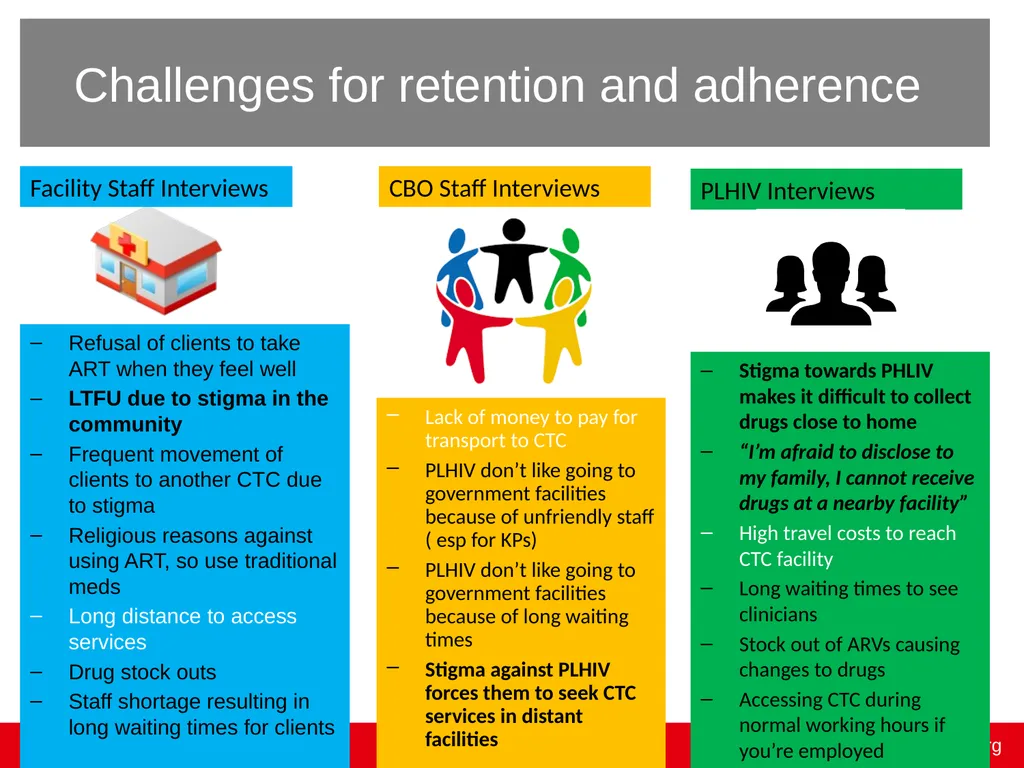
Challenges for retention and adherence Refusal of clients to take ART when they feel well
LTFU due to stigma in the community
Frequent movement of clients to another CTC due to stigma
Religious reasons against using ART, so use traditional meds
Long distance to access services
Drug stock outs
Staff shortage resulting in long waiting times for clients Facility Staff Interviews CBO Staff Interviews Lack of money to pay for transport to CTC
PLHIV don’t like going to government facilities because of unfriendly staff ( esp for KPs)
PLHIV don’t like going to government facilities because of long waiting times
Stigma against PLHIV forces them to seek CTC services in distant facilities PLHIV Interviews Stigma towards PHLIV makes it difficult to collect drugs close to home
“I’m afraid to disclose to my family, I cannot receive drugs at a nearby facility”
High travel costs to reach CTC facility
Long waiting times to see clinicians
Stock out of ARVs causing changes to drugs
Accessing CTC during normal working hours if you’re employed<br>
LTFU due to stigma in the community
Frequent movement of clients to another CTC due to stigma
Religious reasons against using ART, so use traditional meds
Long distance to access services
Drug stock outs
Staff shortage resulting in long waiting times for clients Facility Staff Interviews CBO Staff Interviews Lack of money to pay for transport to CTC
PLHIV don’t like going to government facilities because of unfriendly staff ( esp for KPs)
PLHIV don’t like going to government facilities because of long waiting times
Stigma against PLHIV forces them to seek CTC services in distant facilities PLHIV Interviews Stigma towards PHLIV makes it difficult to collect drugs close to home
“I’m afraid to disclose to my family, I cannot receive drugs at a nearby facility”
High travel costs to reach CTC facility
Long waiting times to see clinicians
Stock out of ARVs causing changes to drugs
Accessing CTC during normal working hours if you’re employed<br>
16
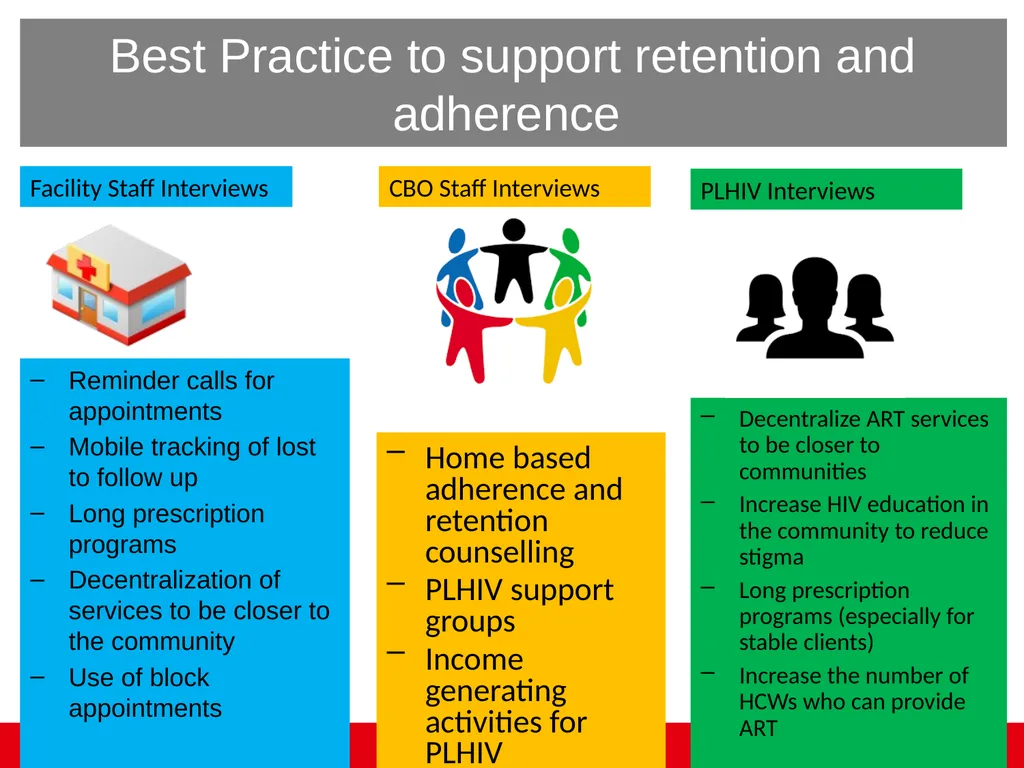
Best Practice to support retention and adherence Reminder calls for appointments
Mobile tracking of lost to follow up
Long prescription programs
Decentralization of services to be closer to the community
Use of block appointments Facility Staff Interviews CBO Staff Interviews Home based adherence and retention counselling
PLHIV support groups
Income generating activities for PLHIV PLHIV Interviews Decentralize ART services to be closer to communities
Increase HIV education in the community to reduce stigma
Long prescription programs (especially for stable clients)
Increase the number of HCWs who can provide ART<br>
Mobile tracking of lost to follow up
Long prescription programs
Decentralization of services to be closer to the community
Use of block appointments Facility Staff Interviews CBO Staff Interviews Home based adherence and retention counselling
PLHIV support groups
Income generating activities for PLHIV PLHIV Interviews Decentralize ART services to be closer to communities
Increase HIV education in the community to reduce stigma
Long prescription programs (especially for stable clients)
Increase the number of HCWs who can provide ART<br>
17
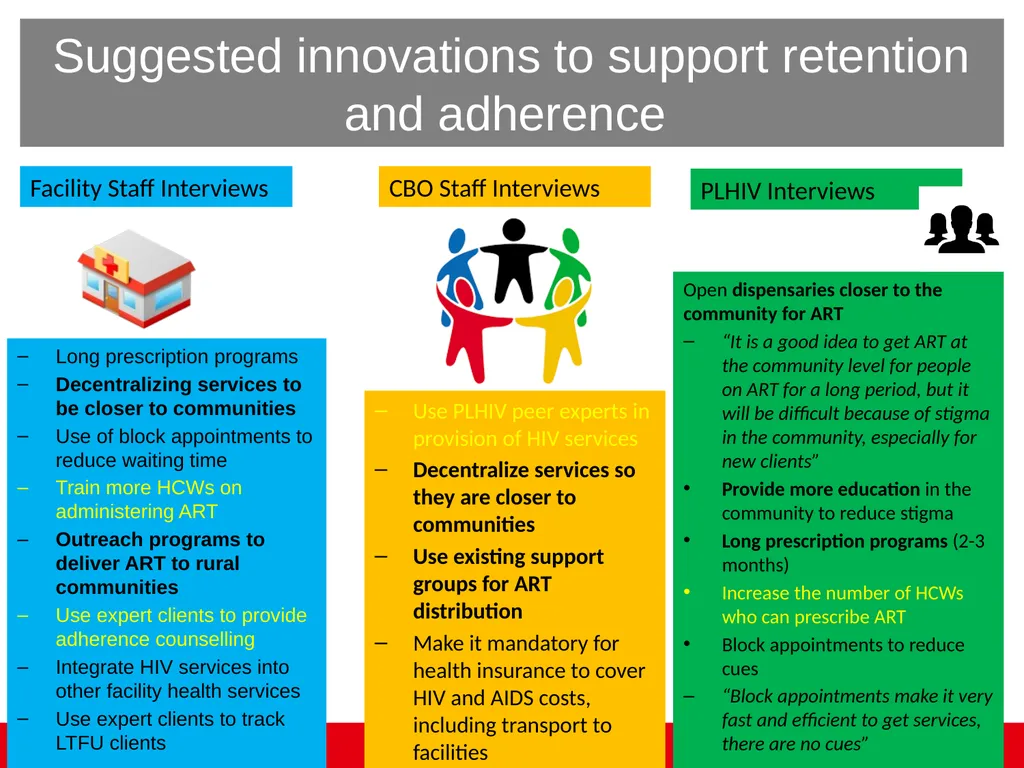
Suggested innovations to support retention and adherence Long prescription programs
Decentralizing services to be closer to communities
Use of block appointments to reduce waiting time
Train more HCWs on administering ART
Outreach programs to deliver ART to rural communities
Use expert clients to provide adherence counselling
Integrate HIV services into other facility health services
Use expert clients to track LTFU clients Facility Staff Interviews CBO Staff Interviews Use PLHIV peer experts in provision of HIV services
Decentralize services so they are closer to communities
Use existing support groups for ART distribution
Make it mandatory for health insurance to cover HIV and AIDS costs, including transport to facilities PLHIV Interviews Open dispensaries closer to the community for ART
“It is a good idea to get ART at the community level for people on ART for a long period, but it will be difficult because of stigma in the community, especially for new clients”
Provide more education in the community to reduce stigma
Long prescription programs (2-3 months)
Increase the number of HCWs who can prescribe ART
Block appointments to reduce cues
“Block appointments make it very fast and efficient to get services, there are no cues”<br>
Decentralizing services to be closer to communities
Use of block appointments to reduce waiting time
Train more HCWs on administering ART
Outreach programs to deliver ART to rural communities
Use expert clients to provide adherence counselling
Integrate HIV services into other facility health services
Use expert clients to track LTFU clients Facility Staff Interviews CBO Staff Interviews Use PLHIV peer experts in provision of HIV services
Decentralize services so they are closer to communities
Use existing support groups for ART distribution
Make it mandatory for health insurance to cover HIV and AIDS costs, including transport to facilities PLHIV Interviews Open dispensaries closer to the community for ART
“It is a good idea to get ART at the community level for people on ART for a long period, but it will be difficult because of stigma in the community, especially for new clients”
Provide more education in the community to reduce stigma
Long prescription programs (2-3 months)
Increase the number of HCWs who can prescribe ART
Block appointments to reduce cues
“Block appointments make it very fast and efficient to get services, there are no cues”<br>
18
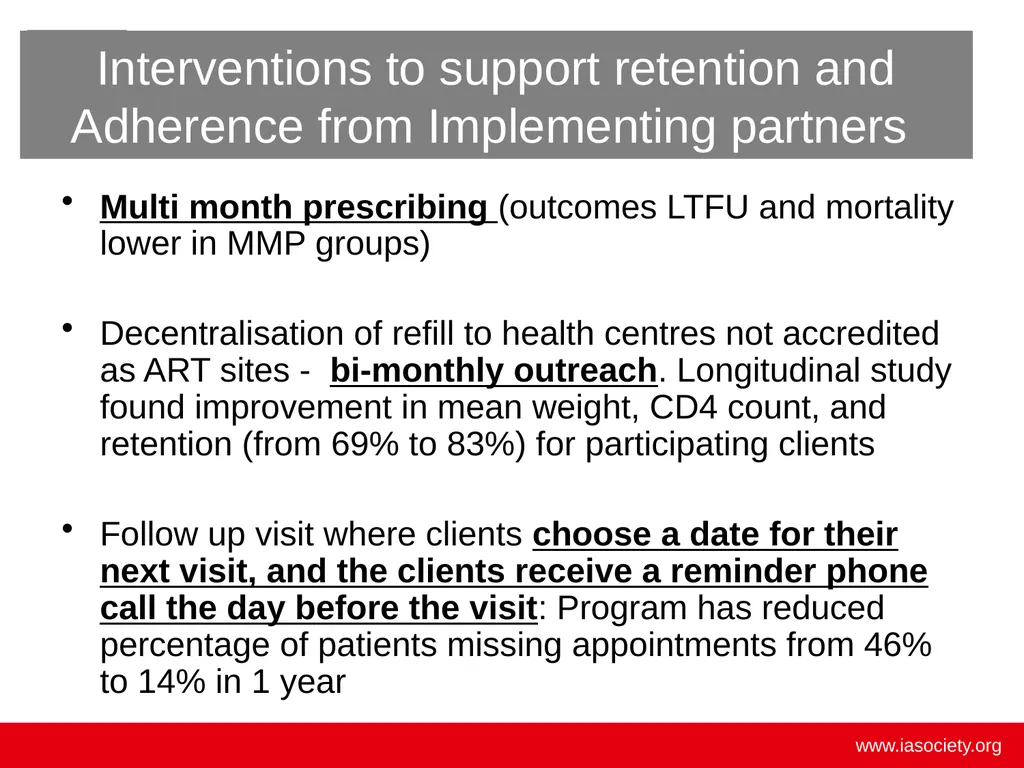
Interventions to support retention and Adherence from Implementing partners Multi month prescribing (outcomes LTFU and mortality lower in MMP groups)
Decentralisation of refill to health centres not accredited as ART sites - bi-monthly outreach. Longitudinal study found improvement in mean weight, CD4 count, and retention (from 69% to 83%) for participating clients
Follow up visit where clients choose a date for their next visit, and the clients receive a reminder phone call the day before the visit: Program has reduced percentage of patients missing appointments from 46% to 14% in 1 year<br>
Decentralisation of refill to health centres not accredited as ART sites - bi-monthly outreach. Longitudinal study found improvement in mean weight, CD4 count, and retention (from 69% to 83%) for participating clients
Follow up visit where clients choose a date for their next visit, and the clients receive a reminder phone call the day before the visit: Program has reduced percentage of patients missing appointments from 46% to 14% in 1 year<br>
19
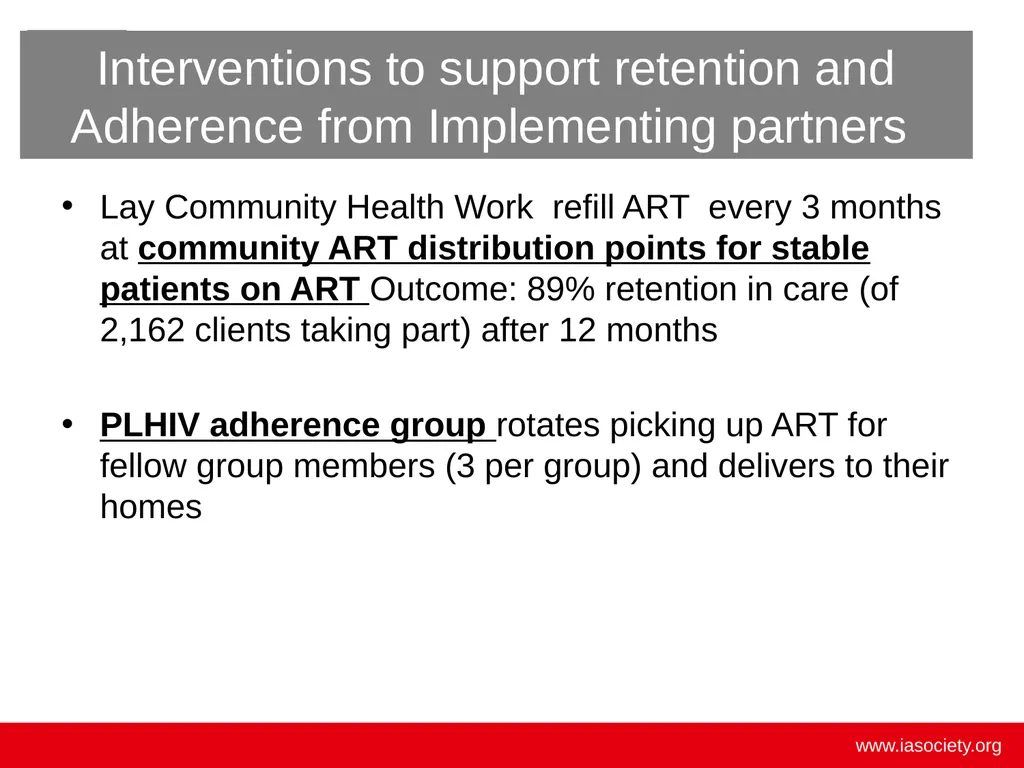
Interventions to support retention and Adherence from Implementing partners Lay Community Health Work refill ART every 3 months at community ART distribution points for stable patients on ART Outcome: 89% retention in care (of 2,162 clients taking part) after 12 months
PLHIV adherence group rotates picking up ART for fellow group members (3 per group) and delivers to their homes<br>
PLHIV adherence group rotates picking up ART for fellow group members (3 per group) and delivers to their homes<br>
20
3. Policy assessment against WHO recommendations<br>
21
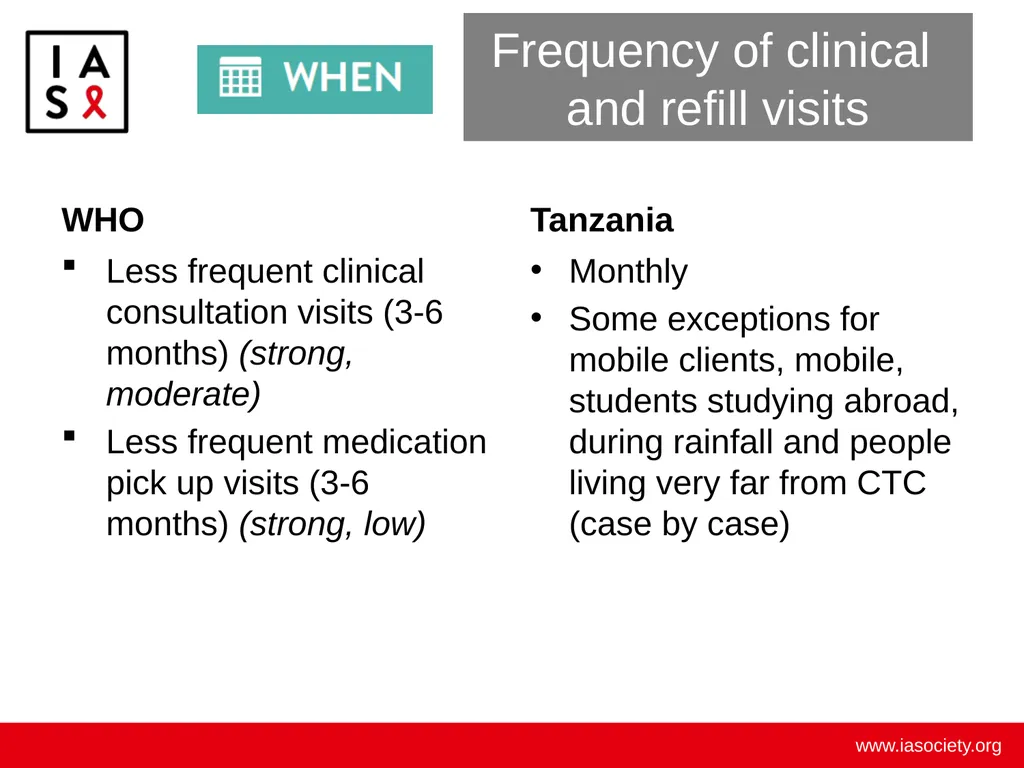
Frequency of clinical
and refill visits WHO Less frequent clinical consultation visits (3-6 months) (strong, moderate)
Less frequent medication pick up visits (3-6 months) (strong, low) Tanzania Monthly
Some exceptions for mobile clients, mobile, students studying abroad, during rainfall and people living very far from CTC (case by case)<br>
Less frequent medication pick up visits (3-6 months) (strong, low) Tanzania Monthly
Some exceptions for mobile clients, mobile, students studying abroad, during rainfall and people living very far from CTC (case by case)<br>
22
Location of clinical review and ART refills WHO Initiation and maintenance in peripheral facilities
Initiation of ART at peripheral facilities with maintenance at the community level Tanzania Decentralisation to primary care clinic
Decentralise for B+ to dispensaries<br>
Initiation of ART at peripheral facilities with maintenance at the community level Tanzania Decentralisation to primary care clinic
Decentralise for B+ to dispensaries<br>
23
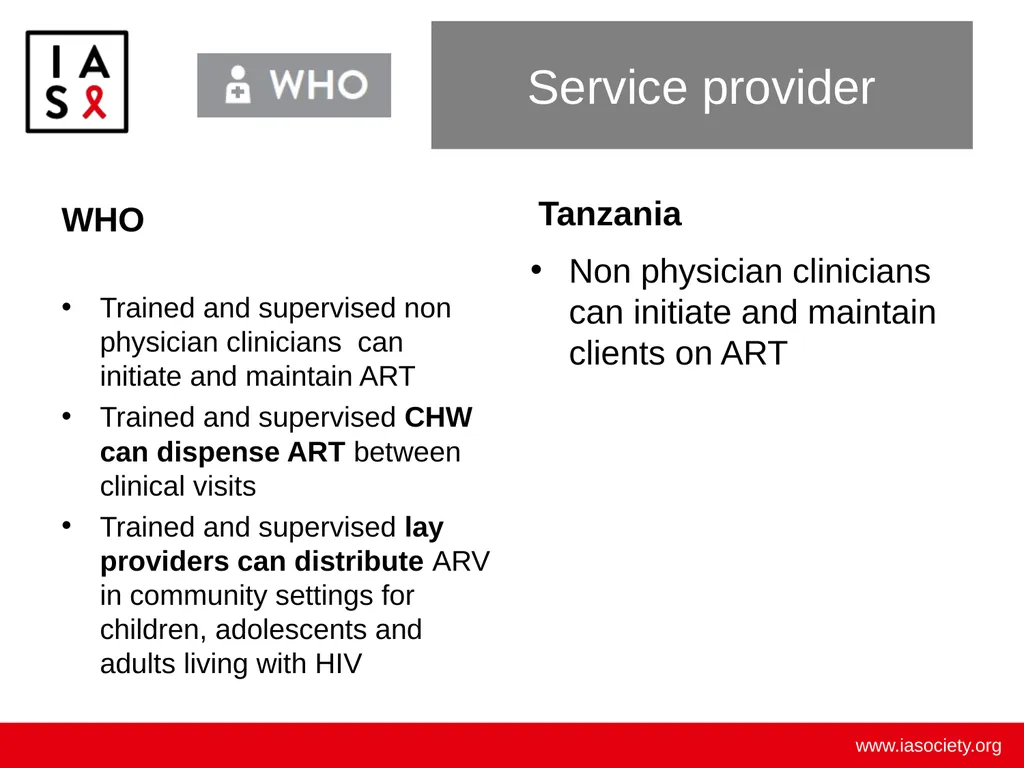
Service provider WHO Trained and supervised non physician clinicians can initiate and maintain ART
Trained and supervised CHW can dispense ART between clinical visits
Trained and supervised lay providers can distribute ARV in community settings for children, adolescents and adults living with HIV Tanzania Non physician clinicians can initiate and maintain clients on ART<br>
Trained and supervised CHW can dispense ART between clinical visits
Trained and supervised lay providers can distribute ARV in community settings for children, adolescents and adults living with HIV Tanzania Non physician clinicians can initiate and maintain clients on ART<br>