
Examples Chapter Two – 2D Potential Flow Theory By

Description: Examples Chapter Two 2D Potential Flow Theory By Dawit M. 11272019 1 Outline Example 1: Irrotationality Example 2: Circulation Example 3: Flow over Rankine Half Body Example 4: Non lifting Flow over a Circular Cylinder Example 5:
Related Topics
Download Presentation
"Examples Chapter Two – 2D Potential Flow Theory By" is the property of its rightful owner. Permission is granted to download and print the materials on this website for personal, non-commercial use only, and to display it on your personal computer provided you do not modify the materials and that you retain all copyright notices contained in the materials. By downloading content from our website, you accept the terms of this agreement.
Presentation Transcript
slide1. Examples Chapter Two – 2D Potential Flow Theory By Dawit M. 11/27/2019 1<br>
slide2. Outline Example 1: Irrotationality
Example 2: Circulation
Example 3: Flow over Rankine Half Body
Example 4: Non – lifting Flow over a Circular Cylinder
Example 5: Lifting Flow over a Circular Cylinder
Example 6: Kutta – Jowkoweski Theorem
Example 7: Superposition of Elementary Flows 11/27/2019 2<br>
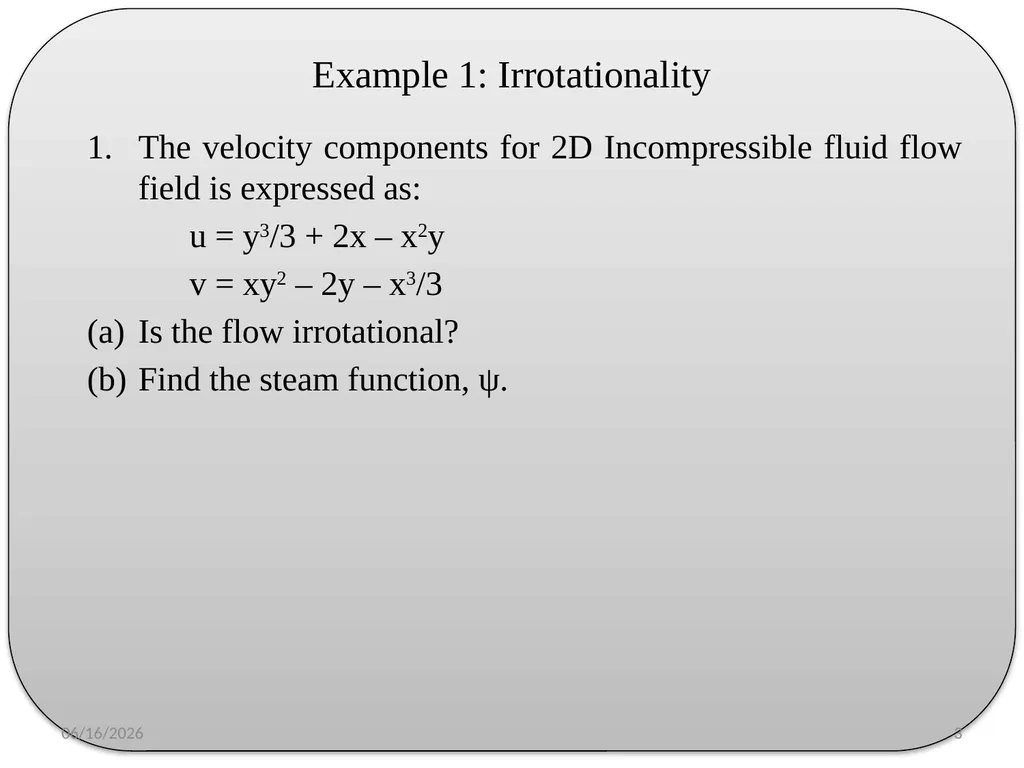
slide3. Example 1: Irrotationality The velocity components for 2D Incompressible fluid flow field is expressed as:
u = y3/3 + 2x – x2y
v = xy2 – 2y – x3/3
Is the flow irrotational?
Find the steam function, ψ. 11/27/2019 3<br>
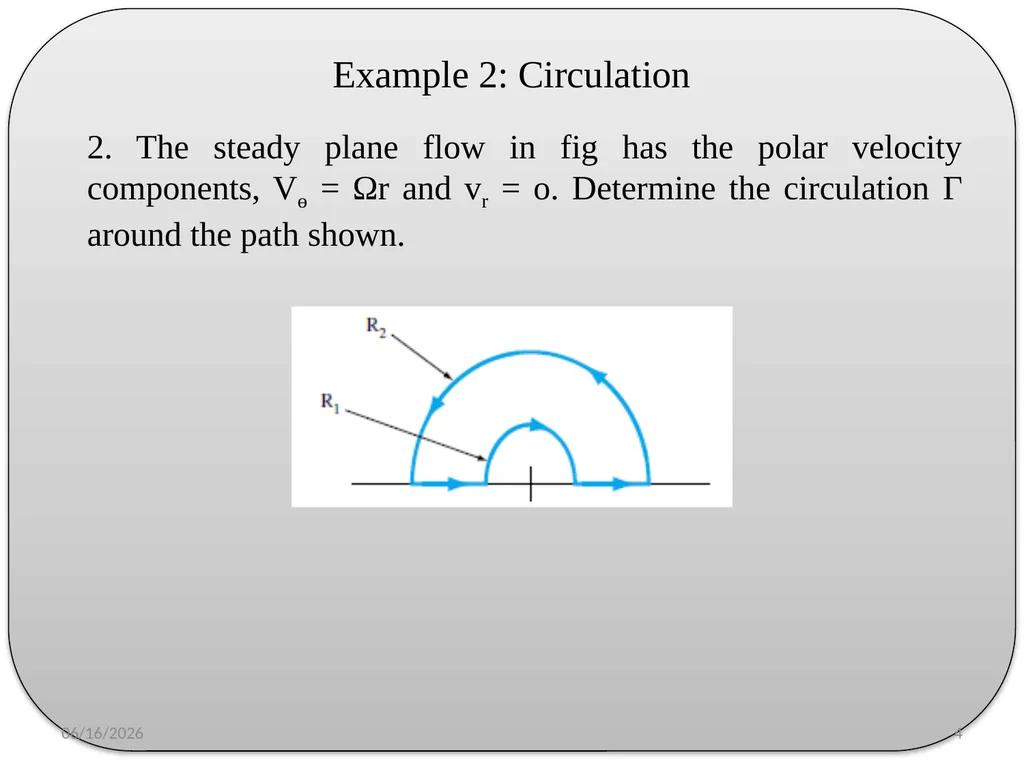
slide4. Example 2: Circulation 2. The steady plane flow in fig has the polar velocity components, Vɵ = Ωr and vr = o. Determine the circulation Γ around the path shown. 11/27/2019 4<br>
slide5. Example 3: Flow over Rankine Half Body 3. Obtain and expression of the dividing streamline for a flow resulting from a superposition of a free stream at 20m/s on a two dimensional source with a strength (˄) of 10m2/s. Sketch the flow pattern. 11/27/2019 5<br>
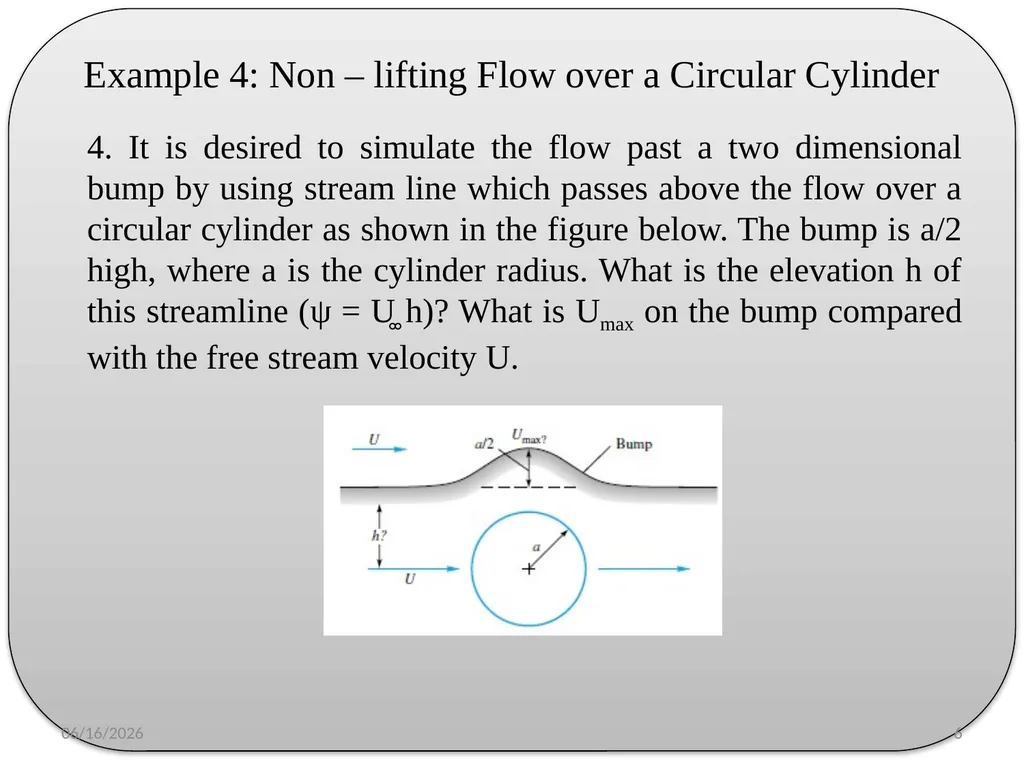
slide6. Example 4: Non – lifting Flow over a Circular Cylinder 4. It is desired to simulate the flow past a two dimensional bump by using stream line which passes above the flow over a circular cylinder as shown in the figure below. The bump is a/2 high, where a is the cylinder radius. What is the elevation h of this streamline (ψ = U͚ h)? What is Umax on the bump compared with the free stream velocity U. 11/27/2019 6<br>
slide7. Example 5: Lifting Flow over a Circular Cylinder 5. A circular cylinder 0.5m diameter rotates at 600 rpm clockwise in a uniform stream of 15m/s.
Locate the stagnation points
Calculate the maximum rotational speed (the stagnation point has to be relocated) 11/27/2019 7<br>
slide8. Example 6: Kutta – Jowkoweski Theorem 6. Consider a lifting flow over a circular cylinder with diameter of 0.5m. The free stream velocity is 25m/s, the maximum velocity on the surface of the cylinder is 75 m/s. Calculate the lift per unit span on the cylinder. (Take ρ ͚ = 0.91kg/m3) 11/27/2019 8<br>
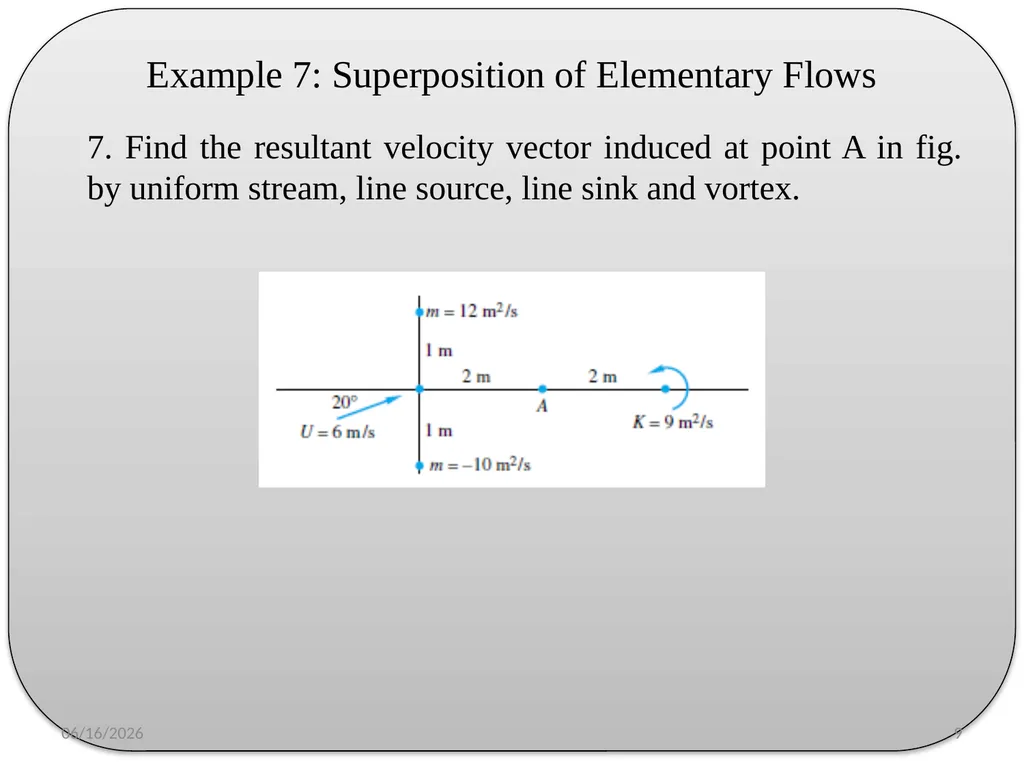
slide9. Example 7: Superposition of Elementary Flows 7. Find the resultant velocity vector induced at point A in fig. by uniform stream, line source, line sink and vortex. 11/27/2019 9<br>
slide10. Thank You! Any Questions? 11/27/2019 10<br>
slide2. Outline Example 1: Irrotationality
Example 2: Circulation
Example 3: Flow over Rankine Half Body
Example 4: Non – lifting Flow over a Circular Cylinder
Example 5: Lifting Flow over a Circular Cylinder
Example 6: Kutta – Jowkoweski Theorem
Example 7: Superposition of Elementary Flows 11/27/2019 2<br>
slide3. Example 1: Irrotationality The velocity components for 2D Incompressible fluid flow field is expressed as:
u = y3/3 + 2x – x2y
v = xy2 – 2y – x3/3
Is the flow irrotational?
Find the steam function, ψ. 11/27/2019 3<br>
slide4. Example 2: Circulation 2. The steady plane flow in fig has the polar velocity components, Vɵ = Ωr and vr = o. Determine the circulation Γ around the path shown. 11/27/2019 4<br>
slide5. Example 3: Flow over Rankine Half Body 3. Obtain and expression of the dividing streamline for a flow resulting from a superposition of a free stream at 20m/s on a two dimensional source with a strength (˄) of 10m2/s. Sketch the flow pattern. 11/27/2019 5<br>
slide6. Example 4: Non – lifting Flow over a Circular Cylinder 4. It is desired to simulate the flow past a two dimensional bump by using stream line which passes above the flow over a circular cylinder as shown in the figure below. The bump is a/2 high, where a is the cylinder radius. What is the elevation h of this streamline (ψ = U͚ h)? What is Umax on the bump compared with the free stream velocity U. 11/27/2019 6<br>
slide7. Example 5: Lifting Flow over a Circular Cylinder 5. A circular cylinder 0.5m diameter rotates at 600 rpm clockwise in a uniform stream of 15m/s.
Locate the stagnation points
Calculate the maximum rotational speed (the stagnation point has to be relocated) 11/27/2019 7<br>
slide8. Example 6: Kutta – Jowkoweski Theorem 6. Consider a lifting flow over a circular cylinder with diameter of 0.5m. The free stream velocity is 25m/s, the maximum velocity on the surface of the cylinder is 75 m/s. Calculate the lift per unit span on the cylinder. (Take ρ ͚ = 0.91kg/m3) 11/27/2019 8<br>
slide9. Example 7: Superposition of Elementary Flows 7. Find the resultant velocity vector induced at point A in fig. by uniform stream, line source, line sink and vortex. 11/27/2019 9<br>
slide10. Thank You! Any Questions? 11/27/2019 10<br>