Examples of applying this knowledge to everyday activities 1 Tooth brushing Visual Try using a mirror Try visual cue cards Consider lighting brighter, artificial lights can be distractingunsettling Copying doing together Vestibular Does
"Examples of applying this knowledge to everyday" is the property of its rightful owner. Permission is granted to
download and print the materials on this website for personal, non-commercial use only, and to display it
on your personal computer provided you do not modify the materials and that you retain all copyright
notices contained in the materials. By downloading content from our website, you accept the terms of this
agreement.
Presentation Transcript
01
Examples of applying this knowledge to everyday activities 1<br>
02
Tooth brushing Visual
Try using a mirror
Try visual cue cards
Consider lighting – brighter, artificial lights can be distracting/unsettling
Copying/ doing together
Vestibular
Does your child feel stable? Try encouraging them to sit on a chair/stool/beanbag 2<br>
03
Tooth Brushing Proprioception
Remember this is calming – try carrying out heavy muscle work activity prior to tooth brushing eg wall push ups, blow football/blowing bubbles
Try introducing a big squashy bean bag or cushion to sit in
Electric toothbrushes will give more feedback
Auditory
Consider the impact of background noise e.g. fan/radiator, others in bathroom and effect of echo which can unsettling/distracting
Auditory input could be used as a support e.g. tooth brushing song, brush to the duration of their favourite song 3<br>
04
Tooth Brushing Smell
Strong smells can be distracting and can sometimes cause a strong disgust response. Preferred smells can promote calm and concentration
Taste
Some children dislike the flavour of toothpaste. Experiment with different flavours/makes. ‘Ora nurse’ is a make of unflavoured toothpaste available.
Tactile
Preparation activities e.g. desensitise mouth with blowing/sucking games or bottle, deep pressure around mouth with flannel, change texture of toothbrush bristles, double sided brushes, temperature of water 4<br>
05
Hair brushing Tactile
Consider the texture of the hairbrush bristles. Remember touch under your own control is easier to tolerate so encourage your child to do as much independently as possible
Try encouraging your child to complete some self head massage to desensitise prior to brush – stroke down head with flat palms
Proprioception
Remember that heavy muscle work activities are calming, try to complete some of these prior to hair brushing if challenging. Consider seating options- stable seating will help your child feel calmer and in more control 5<br>
06
Hair Brushing Visual
Consider lighting – glare and artificial lights can be unsettling/distracting
Use a mirror to support – if your child can see what is happening it will be easier to tolerate
Minimise visual distractions
Auditory
Minimise auditory distractions, consider background
Try creating a calm environment with calm music 6<br>
07
Hair Brushing Vestibular
Ensure your child is in a stable position
Consider head movements and how this can affect balance therefore sitting to brush may be more easily tolerated
Smell
Ensure your child is comfortable with the smell of any hair products used – encourage them to help choose their own if possible 7<br>
08
Sleep Tactile
Bath time 30min before bed, Bedding, deep pressure more calming than light pressure, consider preferred materials/textures, consider natural fibres vs synthetic (cotton/polyester), temperature of room and bedding (see handout), texture of toys
Vestibular
Consider sense of security – some children feel safer with a bed lower to the floor or with a less bouncy mattress
Proprioception
Incorporate heavy muscle work into bedtime routine appropriate to the child, eg yoga for children 8<br>
09
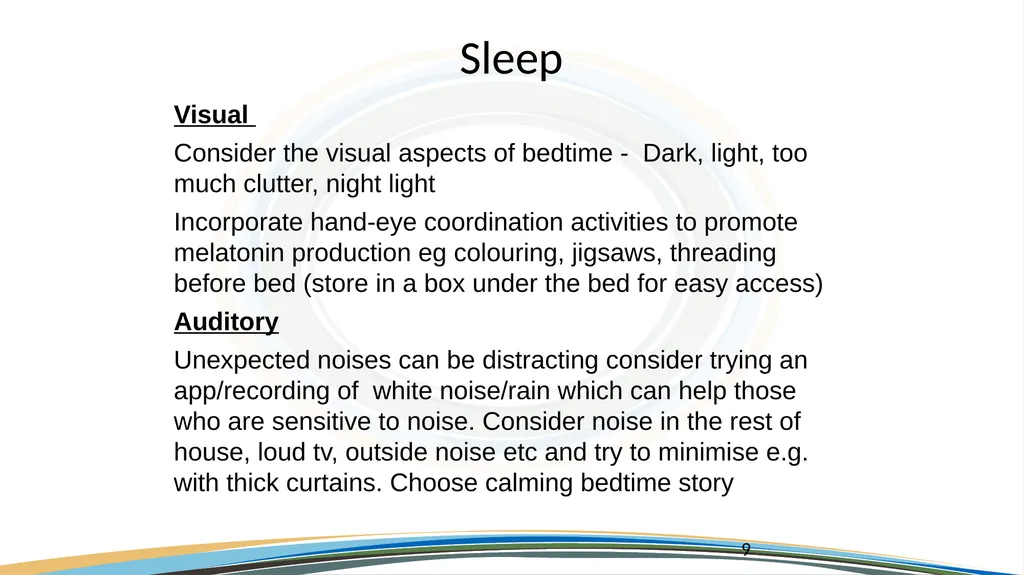
Sleep Visual
Consider the visual aspects of bedtime - Dark, light, too much clutter, night light
Incorporate hand-eye coordination activities to promote melatonin production eg colouring, jigsaws, threading before bed (store in a box under the bed for easy access)
Auditory
Unexpected noises can be distracting consider trying an app/recording of white noise/rain which can help those who are sensitive to noise. Consider noise in the rest of house, loud tv, outside noise etc and try to minimise e.g. with thick curtains. Choose calming bedtime story 9<br>
10
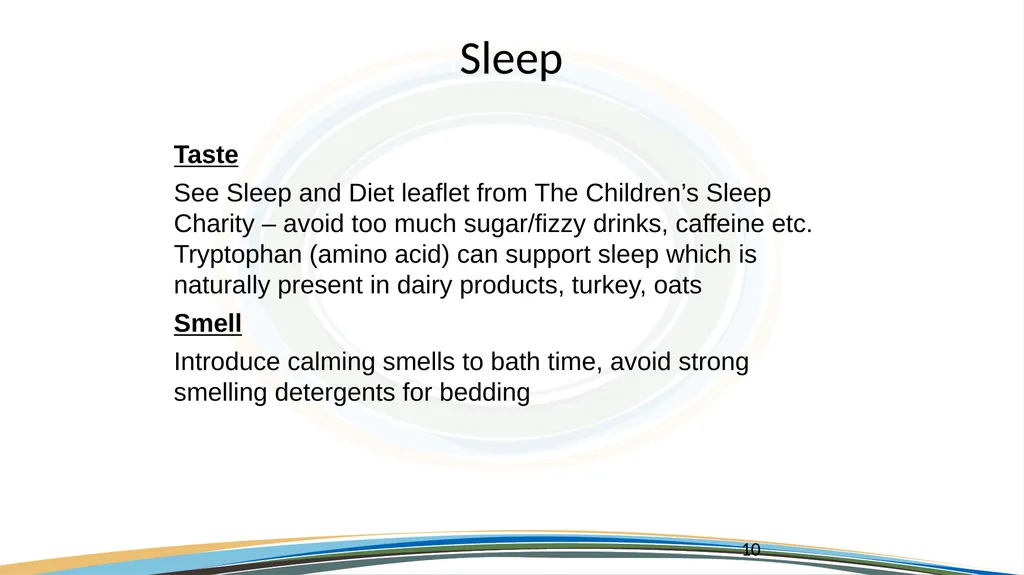
Sleep Taste
See Sleep and Diet leaflet from The Children’s Sleep Charity – avoid too much sugar/fizzy drinks, caffeine etc. Tryptophan (amino acid) can support sleep which is naturally present in dairy products, turkey, oats
Smell
Introduce calming smells to bath time, avoid strong smelling detergents for bedding 10<br>