
EXECUTIVE SUMMARY 1 ‘Growing KwaZulu-Natal

Description: EXECUTIVE SUMMARY 1 Growing KwaZulu-Natal Together KWAZULU-NATAL UPDATE REPORT ON COVID-19 2 Growing KwaZulu-Natal Together The Provincial Response 2. The Provincial response is coordinated through the DDMOSS structures in the
Related Topics
Download Presentation
"EXECUTIVE SUMMARY 1 ‘Growing KwaZulu-Natal" is the property of its rightful owner. Permission is granted to download and print the materials on this website for personal, non-commercial use only, and to display it on your personal computer provided you do not modify the materials and that you retain all copyright notices contained in the materials. By downloading content from our website, you accept the terms of this agreement.
Presentation Transcript
slide1. EXECUTIVE SUMMARY 1 ‘Growing KwaZulu-Natal Together’ KWAZULU-NATAL UPDATE REPORT ON
COVID-19<br>
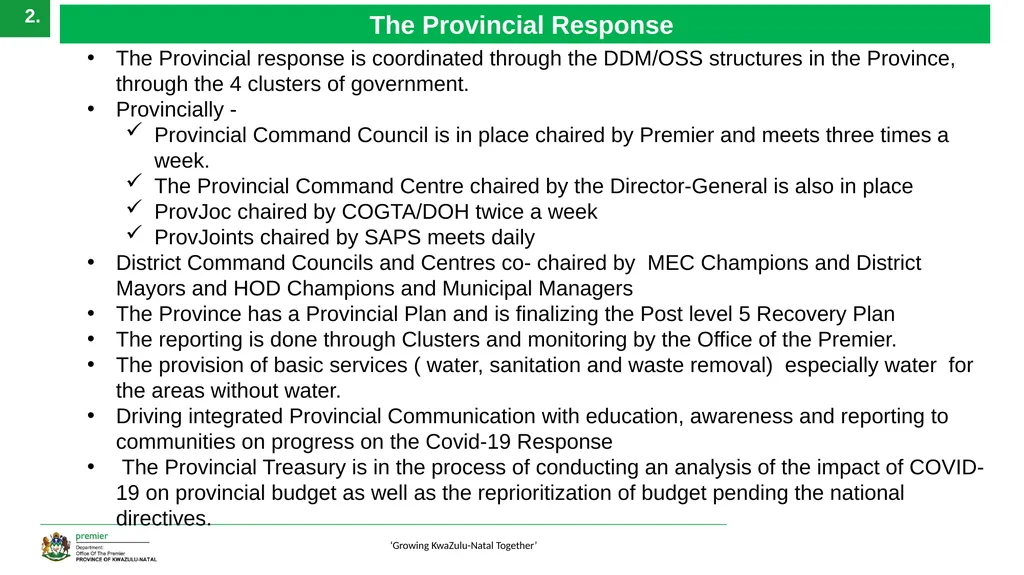
slide2. 2 ‘Growing KwaZulu-Natal Together’ The Provincial Response 2. The Provincial response is coordinated through the DDM/OSS structures in the Province, through the 4 clusters of government.
Provincially -
Provincial Command Council is in place chaired by Premier and meets three times a week.
The Provincial Command Centre chaired by the Director-General is also in place
ProvJoc chaired by COGTA/DOH twice a week
ProvJoints chaired by SAPS meets daily
District Command Councils and Centres co- chaired by MEC Champions and District Mayors and HOD Champions and Municipal Managers
The Province has a Provincial Plan and is finalizing the Post level 5 Recovery Plan
The reporting is done through Clusters and monitoring by the Office of the Premier.
The provision of basic services ( water, sanitation and waste removal) especially water for the areas without water.
Driving integrated Provincial Communication with education, awareness and reporting to communities on progress on the Covid-19 Response
The Provincial Treasury is in the process of conducting an analysis of the impact of COVID-19 on provincial budget as well as the reprioritization of budget pending the national directives.<br>
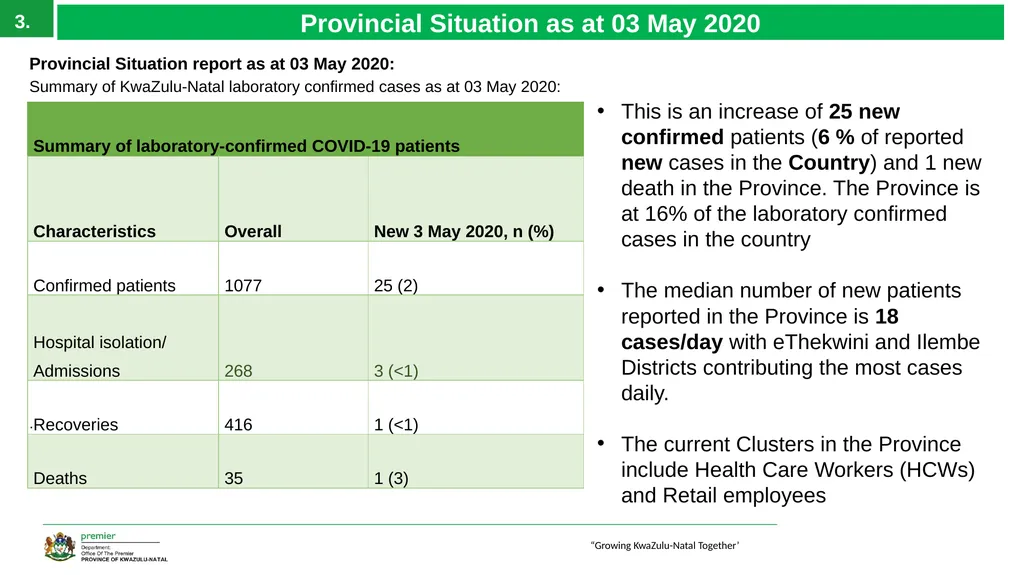
slide3. 3 “Growing KwaZulu-Natal Together’ Provincial Situation as at 03 May 2020 Provincial Situation report as at 03 May 2020:
Summary of KwaZulu-Natal laboratory confirmed cases as at 03 May 2020:
. This is an increase of 25 new confirmed patients (6 % of reported new cases in the Country) and 1 new death in the Province. The Province is at 16% of the laboratory confirmed cases in the country
The median number of new patients reported in the Province is 18 cases/day with eThekwini and Ilembe Districts contributing the most cases daily.
The current Clusters in the Province include Health Care Workers (HCWs) and Retail employees 3.<br>
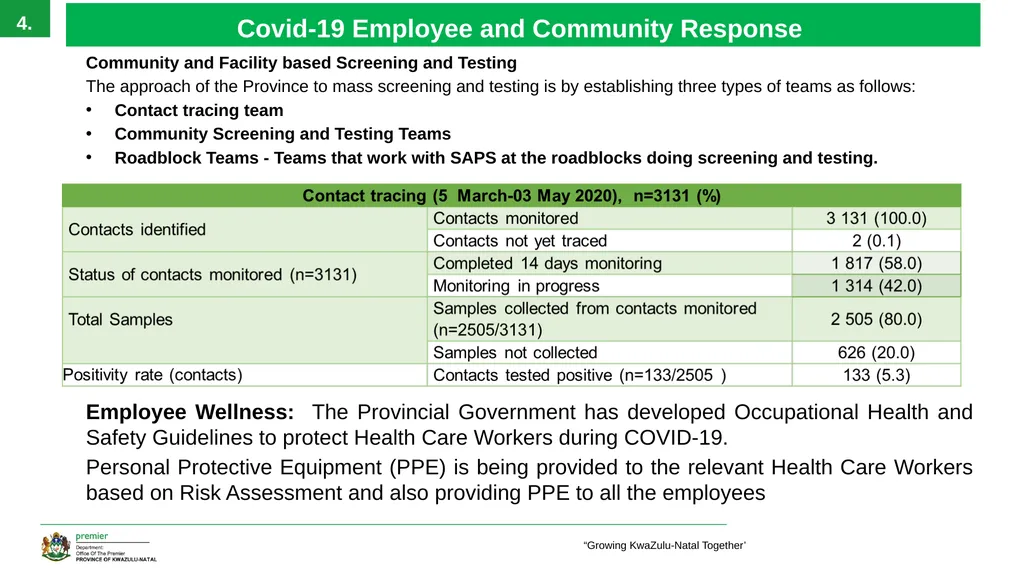
slide4. 4. “Growing KwaZulu-Natal Together’ Covid-19 Employee and Community Response Community and Facility based Screening and Testing
The approach of the Province to mass screening and testing is by establishing three types of teams as follows:
Contact tracing team
Community Screening and Testing Teams
Roadblock Teams - Teams that work with SAPS at the roadblocks doing screening and testing.
Employee Wellness: The Provincial Government has developed Occupational Health and Safety Guidelines to protect Health Care Workers during COVID-19.
Personal Protective Equipment (PPE) is being provided to the relevant Health Care Workers based on Risk Assessment and also providing PPE to all the employees<br>
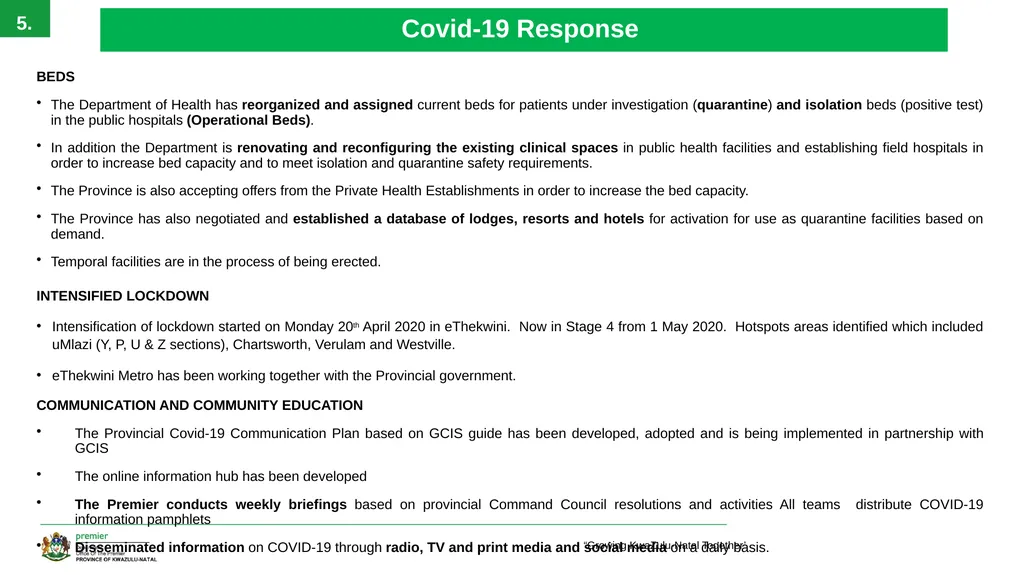
slide5. 5 “Growing KwaZulu-Natal Together’ Covid-19 Response BEDS
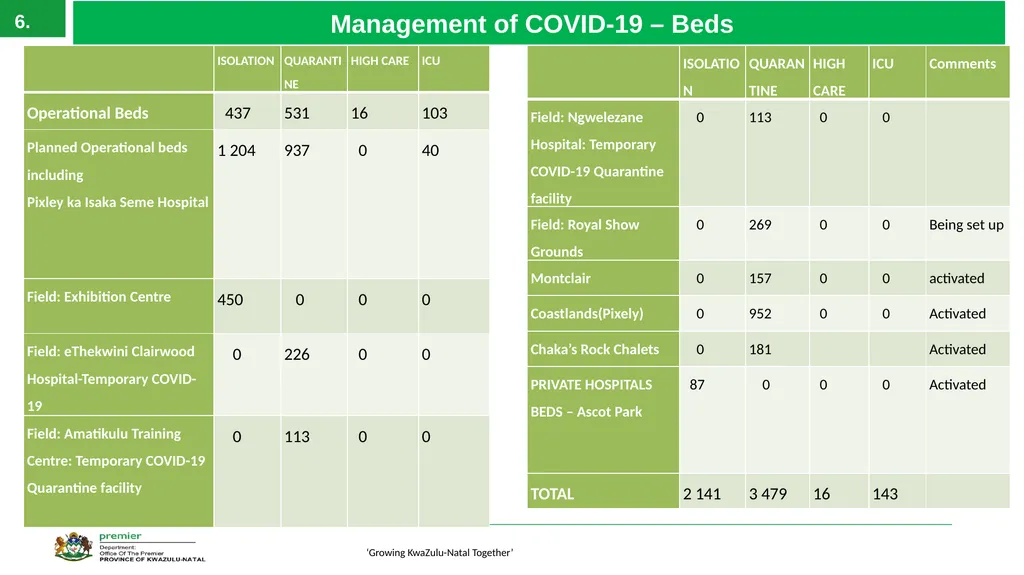
The Department of Health has reorganized and assigned current beds for patients under investigation (quarantine) and isolation beds (positive test) in the public hospitals (Operational Beds).
In addition the Department is renovating and reconfiguring the existing clinical spaces in public health facilities and establishing field hospitals in order to increase bed capacity and to meet isolation and quarantine safety requirements.
The Province is also accepting offers from the Private Health Establishments in order to increase the bed capacity.
The Province has also negotiated and established a database of lodges, resorts and hotels for activation for use as quarantine facilities based on demand.
Temporal facilities are in the process of being erected.
INTENSIFIED LOCKDOWN
Intensification of lockdown started on Monday 20th April 2020 in eThekwini. Now in Stage 4 from 1 May 2020. Hotspots areas identified which included uMlazi (Y, P, U & Z sections), Chartsworth, Verulam and Westville.
eThekwini Metro has been working together with the Provincial government.
COMMUNICATION AND COMMUNITY EDUCATION
The Provincial Covid-19 Communication Plan based on GCIS guide has been developed, adopted and is being implemented in partnership with GCIS
The online information hub has been developed
The Premier conducts weekly briefings based on provincial Command Council resolutions and activities All teams distribute COVID-19 information pamphlets
Disseminated information on COVID-19 through radio, TV and print media and social media on a daily basis. 5.<br>
slide6. 6 ‘Growing KwaZulu-Natal Together’ Management of COVID-19 – Beds 6.<br>
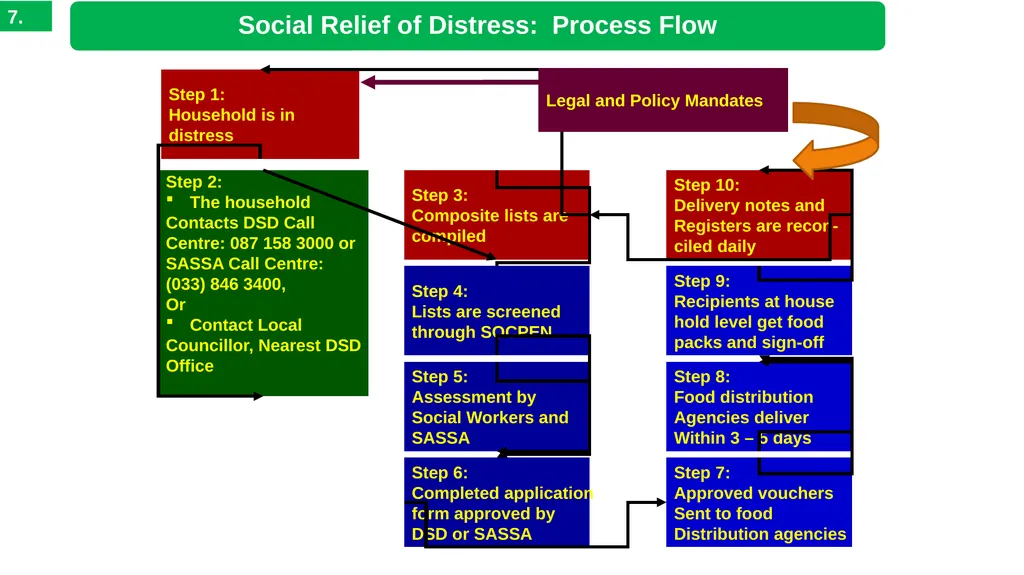
slide7. Step 1:
Household is in
distress Step 2:
The household
Contacts DSD Call
Centre: 087 158 3000 or
SASSA Call Centre:
(033) 846 3400,
Or
Contact Local
Councillor, Nearest DSD
Office Step 3:
Composite lists are
compiled Step 10:
Delivery notes and
Registers are recon-
ciled daily Step 4:
Lists are screened
through SOCPEN Step 5:
Assessment by
Social Workers and
SASSA Step 6:
Completed application
form approved by
DSD or SASSA Step 9:
Recipients at house
hold level get food
packs and sign-off Step 8:
Food distribution
Agencies deliver
Within 3 – 5 days Step 7:
Approved vouchers
Sent to food
Distribution agencies Legal and Policy Mandates Social Relief of Distress: Process Flow 7.<br>
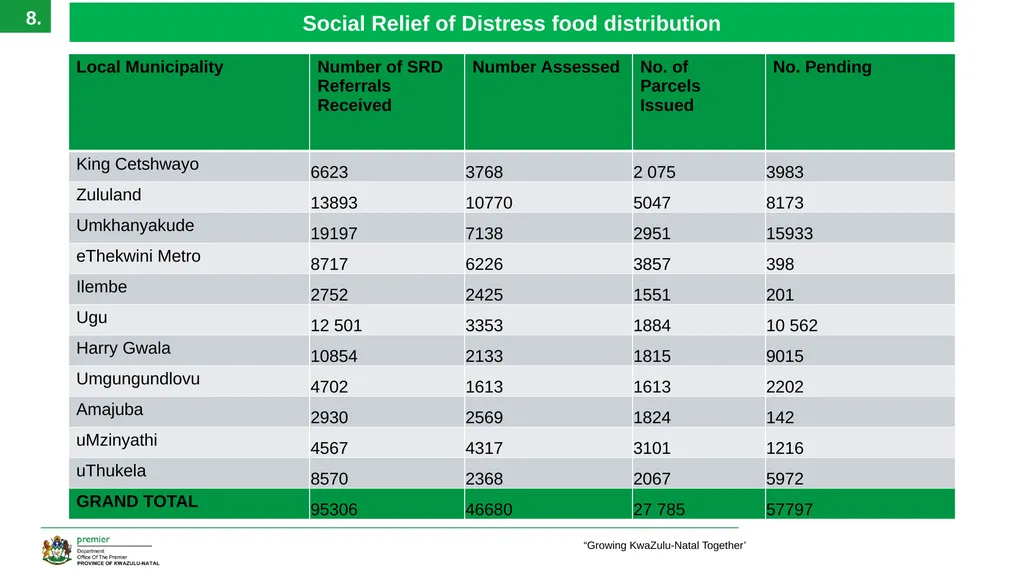
slide8. 8. “Growing KwaZulu-Natal Together’ Social Relief of Distress food distribution<br>
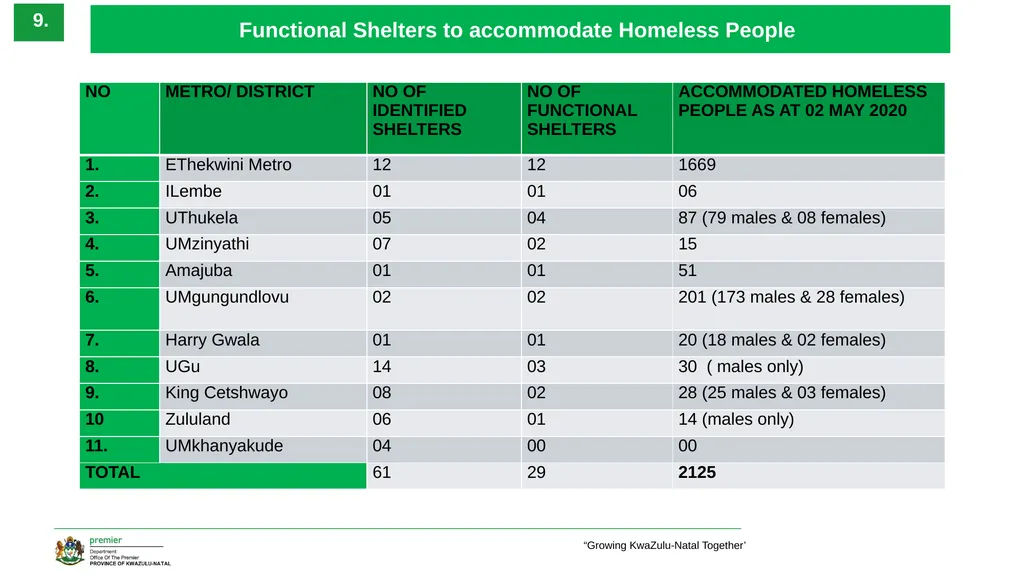
slide9. 9. “Growing KwaZulu-Natal Together’ Functional Shelters to accommodate Homeless People<br>
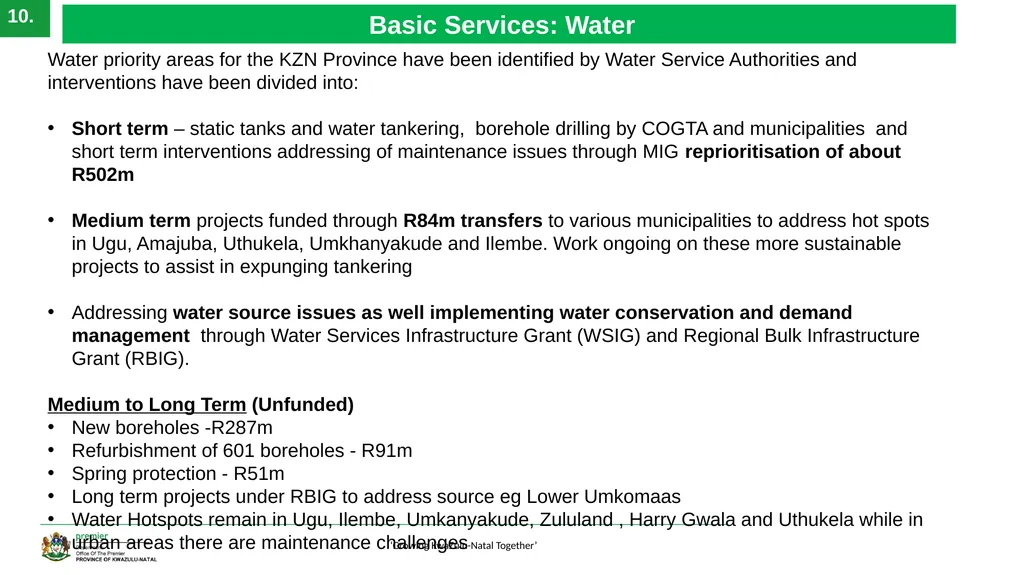
slide10. 10 ‘Growing KwaZulu-Natal Together’ Basic Services: Water 10. Water priority areas for the KZN Province have been identified by Water Service Authorities and interventions have been divided into:
Short term – static tanks and water tankering, borehole drilling by COGTA and municipalities and short term interventions addressing of maintenance issues through MIG reprioritisation of about R502m
Medium term projects funded through R84m transfers to various municipalities to address hot spots in Ugu, Amajuba, Uthukela, Umkhanyakude and Ilembe. Work ongoing on these more sustainable projects to assist in expunging tankering
Addressing water source issues as well implementing water conservation and demand management through Water Services Infrastructure Grant (WSIG) and Regional Bulk Infrastructure Grant (RBIG).
Medium to Long Term (Unfunded)
New boreholes -R287m
Refurbishment of 601 boreholes - R91m
Spring protection - R51m
Long term projects under RBIG to address source eg Lower Umkomaas
Water Hotspots remain in Ugu, Ilembe, Umkanyakude, Zululand , Harry Gwala and Uthukela while in urban areas there are maintenance challenges<br>
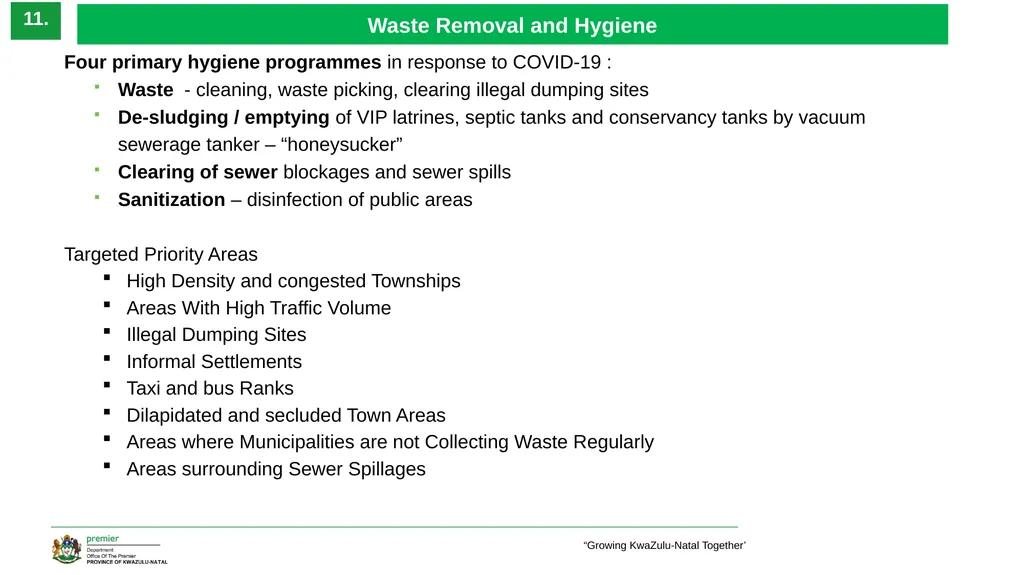
slide11. 11. “Growing KwaZulu-Natal Together’ Waste Removal and Hygiene Four primary hygiene programmes in response to COVID-19 :
Waste - cleaning, waste picking, clearing illegal dumping sites
De-sludging / emptying of VIP latrines, septic tanks and conservancy tanks by vacuum sewerage tanker – “honeysucker”
Clearing of sewer blockages and sewer spills
Sanitization – disinfection of public areas
Targeted Priority Areas
High Density and congested Townships
Areas With High Traffic Volume
Illegal Dumping Sites
Informal Settlements
Taxi and bus Ranks
Dilapidated and secluded Town Areas
Areas where Municipalities are not Collecting Waste Regularly
Areas surrounding Sewer Spillages<br>
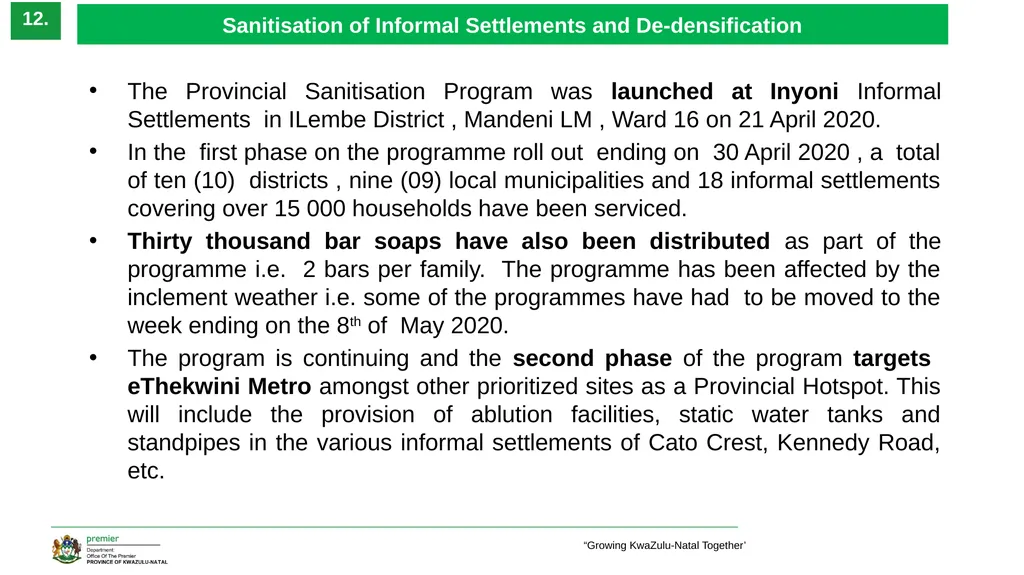
slide12. 12. “Growing KwaZulu-Natal Together’ Sanitisation of Informal Settlements and De-densification The Provincial Sanitisation Program was launched at Inyoni Informal Settlements in ILembe District , Mandeni LM , Ward 16 on 21 April 2020.
In the first phase on the programme roll out ending on 30 April 2020 , a total of ten (10) districts , nine (09) local municipalities and 18 informal settlements covering over 15 000 households have been serviced.
Thirty thousand bar soaps have also been distributed as part of the programme i.e. 2 bars per family. The programme has been affected by the inclement weather i.e. some of the programmes have had to be moved to the week ending on the 8th of May 2020.
The program is continuing and the second phase of the program targets eThekwini Metro amongst other prioritized sites as a Provincial Hotspot. This will include the provision of ablution facilities, static water tanks and standpipes in the various informal settlements of Cato Crest, Kennedy Road, etc.<br>
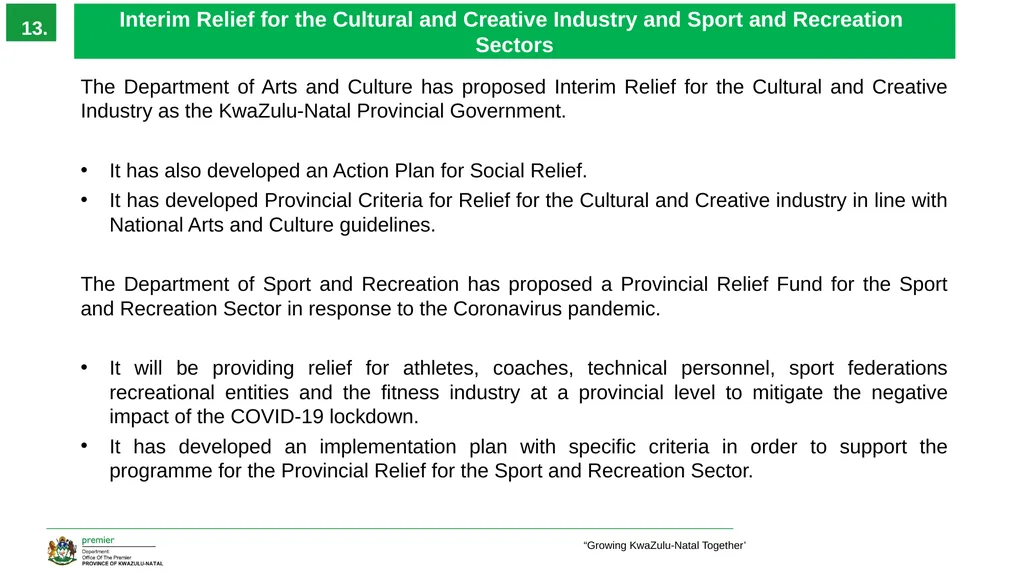
slide13. 13. “Growing KwaZulu-Natal Together’ Interim Relief for the Cultural and Creative Industry and Sport and Recreation Sectors The Department of Arts and Culture has proposed Interim Relief for the Cultural and Creative Industry as the KwaZulu-Natal Provincial Government.
It has also developed an Action Plan for Social Relief.
It has developed Provincial Criteria for Relief for the Cultural and Creative industry in line with National Arts and Culture guidelines.
The Department of Sport and Recreation has proposed a Provincial Relief Fund for the Sport and Recreation Sector in response to the Coronavirus pandemic.
It will be providing relief for athletes, coaches, technical personnel, sport federations recreational entities and the fitness industry at a provincial level to mitigate the negative impact of the COVID-19 lockdown.
It has developed an implementation plan with specific criteria in order to support the programme for the Provincial Relief for the Sport and Recreation Sector.<br>
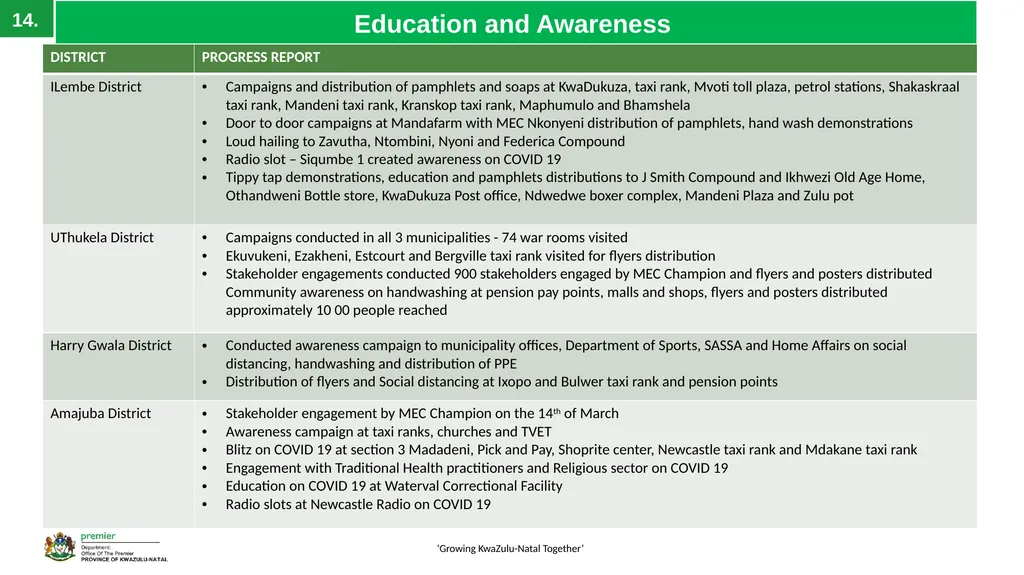
slide14. 14 ‘Growing KwaZulu-Natal Together’ Education and Awareness 14.<br>
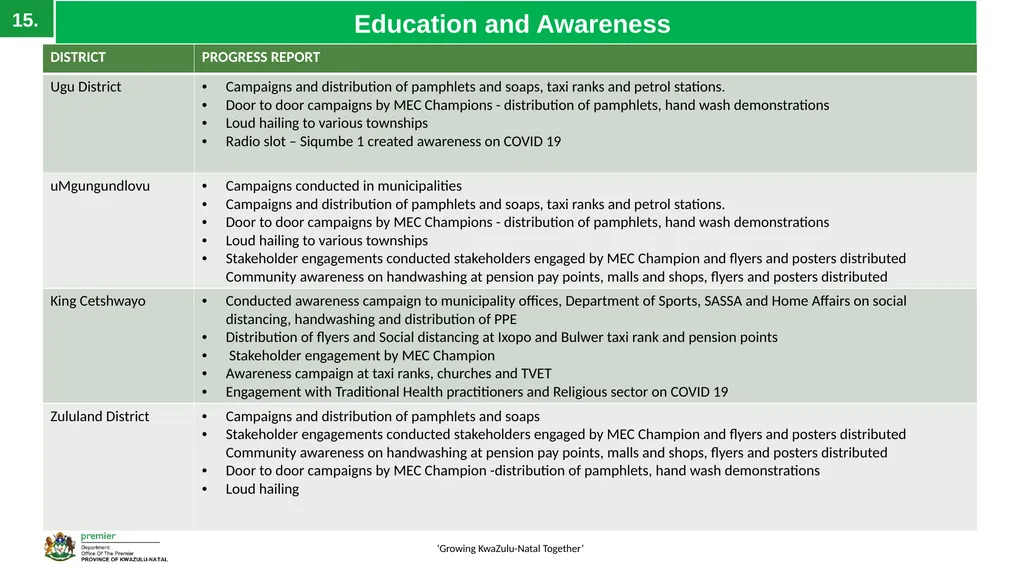
slide15. 15 ‘Growing KwaZulu-Natal Together’ Education and Awareness 15.<br>
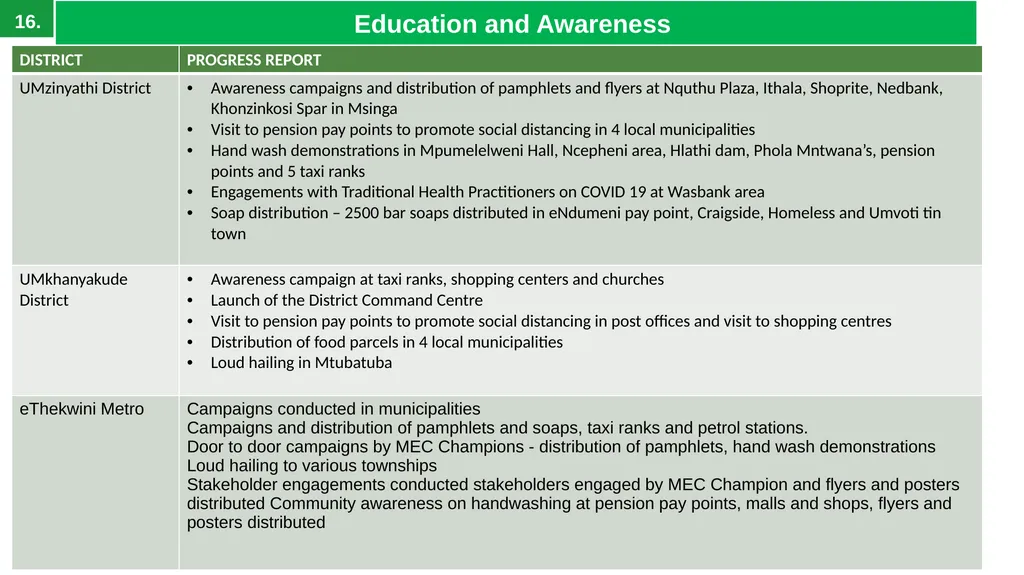
slide16. 16 ‘Growing KwaZulu-Natal Together’ Education and Awareness 16.<br>
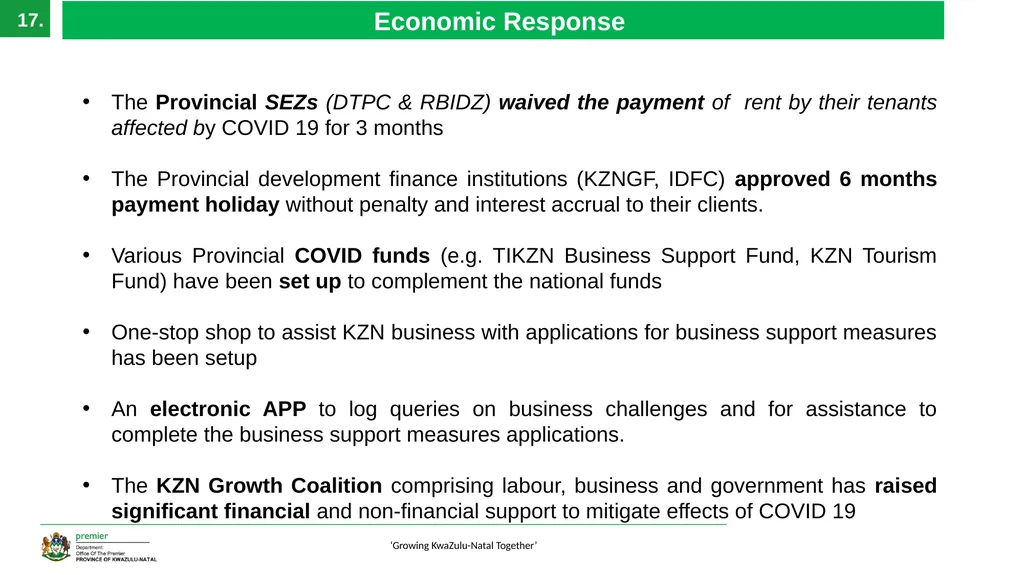
slide17. 17 ‘Growing KwaZulu-Natal Together’ Economic Response 17. The Provincial SEZs (DTPC & RBIDZ) waived the payment of rent by their tenants affected by COVID 19 for 3 months
The Provincial development finance institutions (KZNGF, IDFC) approved 6 months payment holiday without penalty and interest accrual to their clients.
Various Provincial COVID funds (e.g. TIKZN Business Support Fund, KZN Tourism Fund) have been set up to complement the national funds
One-stop shop to assist KZN business with applications for business support measures has been setup
An electronic APP to log queries on business challenges and for assistance to complete the business support measures applications.
The KZN Growth Coalition comprising labour, business and government has raised significant financial and non-financial support to mitigate effects of COVID 19<br>
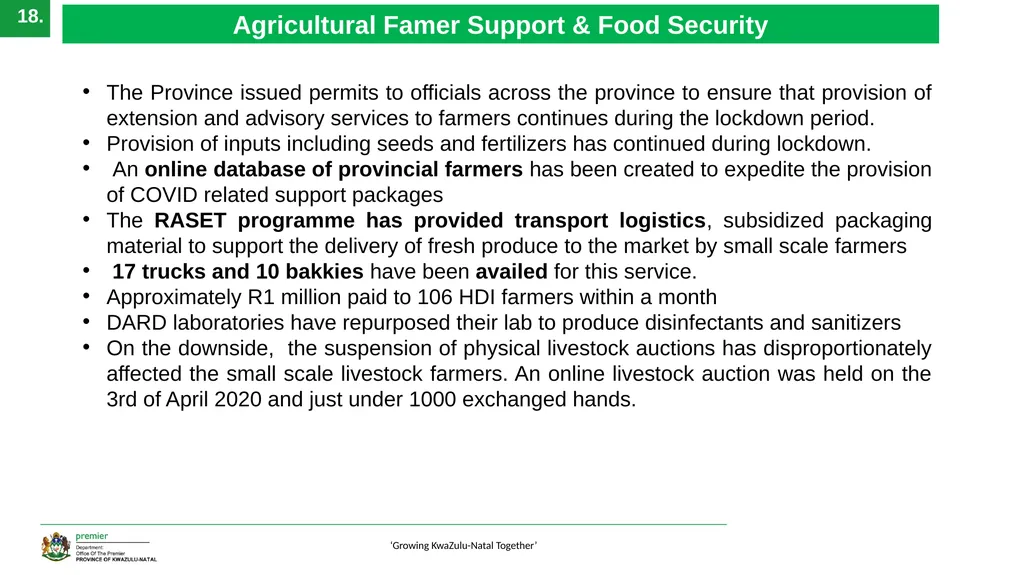
slide18. 18 ‘Growing KwaZulu-Natal Together’ Agricultural Famer Support & Food Security 18. The Province issued permits to officials across the province to ensure that provision of extension and advisory services to farmers continues during the lockdown period.
Provision of inputs including seeds and fertilizers has continued during lockdown.
An online database of provincial farmers has been created to expedite the provision of COVID related support packages
The RASET programme has provided transport logistics, subsidized packaging material to support the delivery of fresh produce to the market by small scale farmers
17 trucks and 10 bakkies have been availed for this service.
Approximately R1 million paid to 106 HDI farmers within a month
DARD laboratories have repurposed their lab to produce disinfectants and sanitizers
On the downside, the suspension of physical livestock auctions has disproportionately affected the small scale livestock farmers. An online livestock auction was held on the 3rd of April 2020 and just under 1000 exchanged hands.<br>
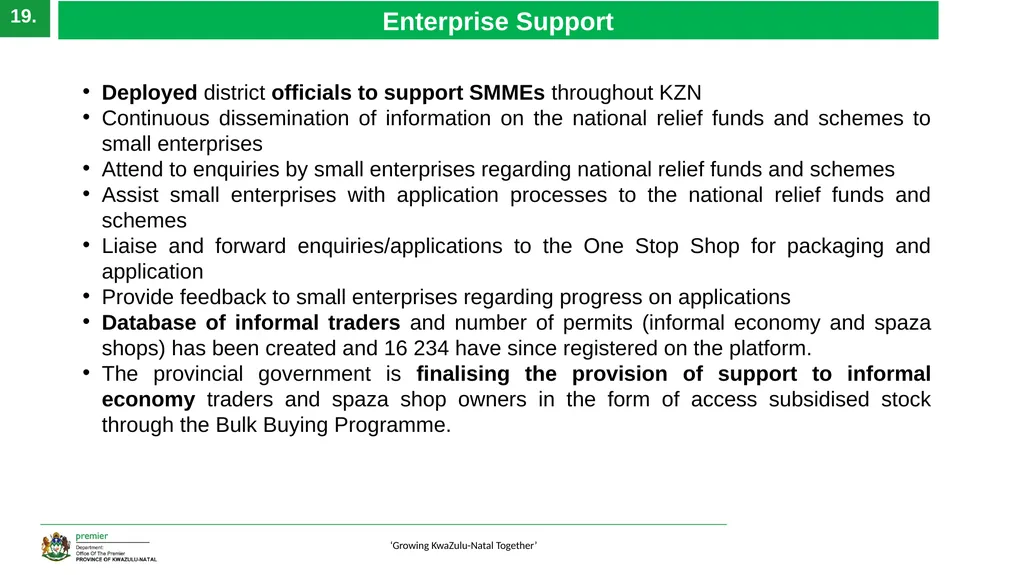
slide19. 19 ‘Growing KwaZulu-Natal Together’ Enterprise Support 19. Deployed district officials to support SMMEs throughout KZN
Continuous dissemination of information on the national relief funds and schemes to small enterprises
Attend to enquiries by small enterprises regarding national relief funds and schemes
Assist small enterprises with application processes to the national relief funds and schemes
Liaise and forward enquiries/applications to the One Stop Shop for packaging and application
Provide feedback to small enterprises regarding progress on applications
Database of informal traders and number of permits (informal economy and spaza shops) has been created and 16 234 have since registered on the platform.
The provincial government is finalising the provision of support to informal economy traders and spaza shop owners in the form of access subsidised stock through the Bulk Buying Programme.<br>
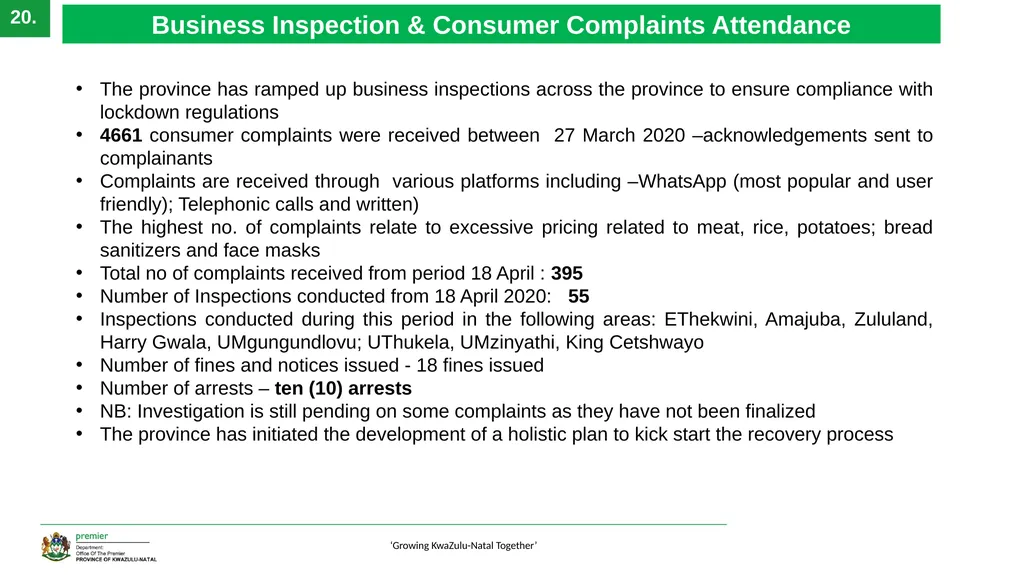
slide20. 20 ‘Growing KwaZulu-Natal Together’ Business Inspection & Consumer Complaints Attendance 20. The province has ramped up business inspections across the province to ensure compliance with lockdown regulations
4661 consumer complaints were received between 27 March 2020 –acknowledgements sent to complainants
Complaints are received through various platforms including –WhatsApp (most popular and user friendly); Telephonic calls and written)
The highest no. of complaints relate to excessive pricing related to meat, rice, potatoes; bread sanitizers and face masks
Total no of complaints received from period 18 April : 395
Number of Inspections conducted from 18 April 2020: 55
Inspections conducted during this period in the following areas: EThekwini, Amajuba, Zululand, Harry Gwala, UMgungundlovu; UThukela, UMzinyathi, King Cetshwayo
Number of fines and notices issued - 18 fines issued
Number of arrests – ten (10) arrests
NB: Investigation is still pending on some complaints as they have not been finalized
The province has initiated the development of a holistic plan to kick start the recovery process<br>
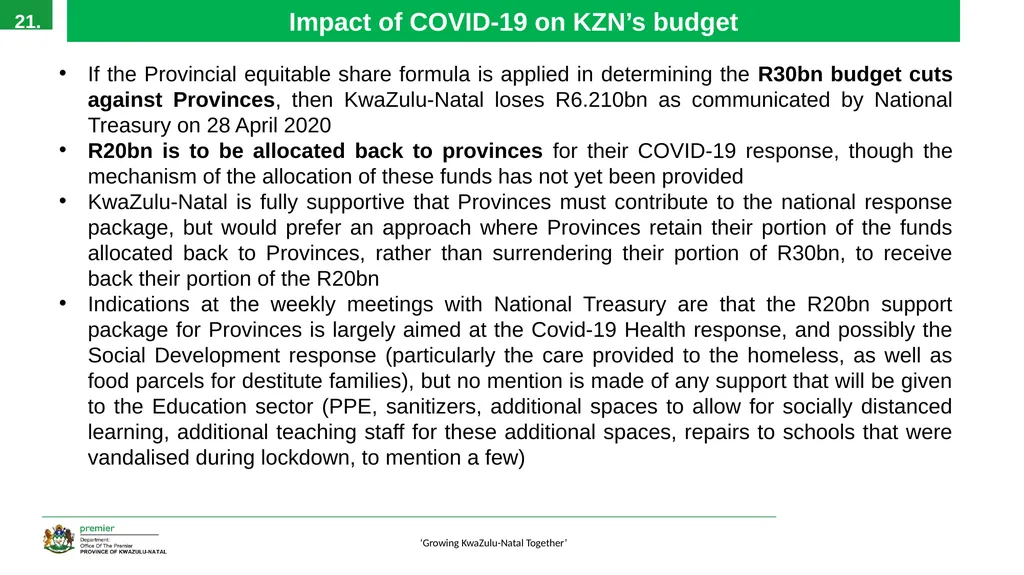
slide21. 21 ‘Growing KwaZulu-Natal Together’ Impact of COVID-19 on KZN’s budget 21. If the Provincial equitable share formula is applied in determining the R30bn budget cuts against Provinces, then KwaZulu-Natal loses R6.210bn as communicated by National Treasury on 28 April 2020
R20bn is to be allocated back to provinces for their COVID-19 response, though the mechanism of the allocation of these funds has not yet been provided
KwaZulu-Natal is fully supportive that Provinces must contribute to the national response package, but would prefer an approach where Provinces retain their portion of the funds allocated back to Provinces, rather than surrendering their portion of R30bn, to receive back their portion of the R20bn
Indications at the weekly meetings with National Treasury are that the R20bn support package for Provinces is largely aimed at the Covid-19 Health response, and possibly the Social Development response (particularly the care provided to the homeless, as well as food parcels for destitute families), but no mention is made of any support that will be given to the Education sector (PPE, sanitizers, additional spaces to allow for socially distanced learning, additional teaching staff for these additional spaces, repairs to schools that were vandalised during lockdown, to mention a few)<br>
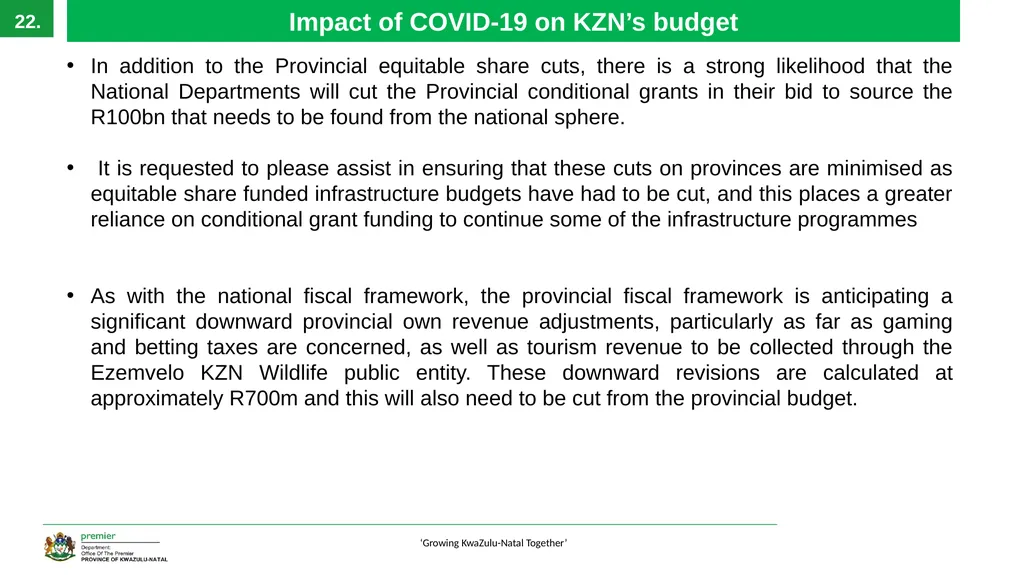
slide22. 22 ‘Growing KwaZulu-Natal Together’ Impact of COVID-19 on KZN’s budget 22. In addition to the Provincial equitable share cuts, there is a strong likelihood that the National Departments will cut the Provincial conditional grants in their bid to source the R100bn that needs to be found from the national sphere.
It is requested to please assist in ensuring that these cuts on provinces are minimised as equitable share funded infrastructure budgets have had to be cut, and this places a greater reliance on conditional grant funding to continue some of the infrastructure programmes
As with the national fiscal framework, the provincial fiscal framework is anticipating a significant downward provincial own revenue adjustments, particularly as far as gaming and betting taxes are concerned, as well as tourism revenue to be collected through the Ezemvelo KZN Wildlife public entity. These downward revisions are calculated at approximately R700m and this will also need to be cut from the provincial budget.<br>
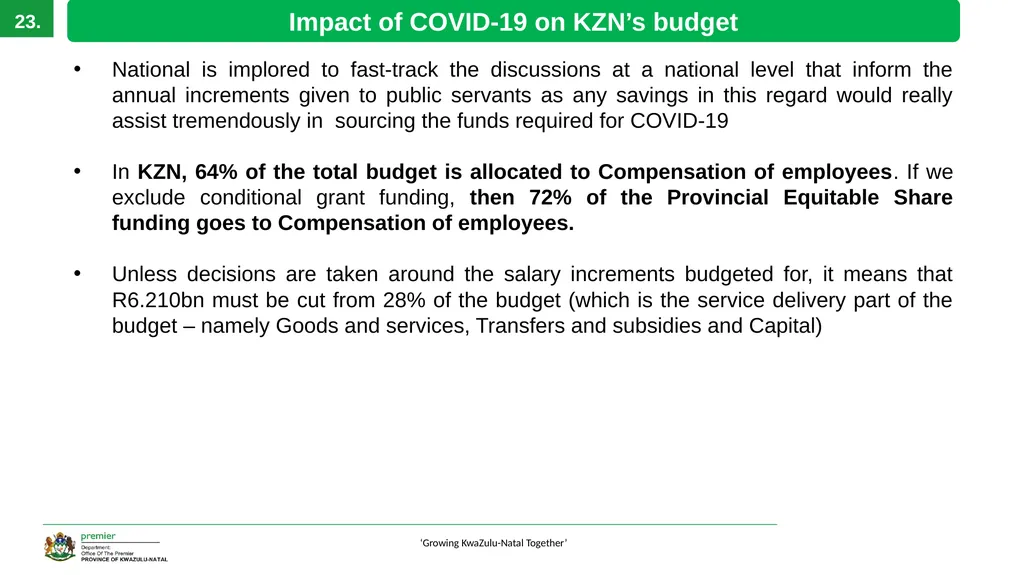
slide23. 23 ‘Growing KwaZulu-Natal Together’ 23. National is implored to fast-track the discussions at a national level that inform the annual increments given to public servants as any savings in this regard would really assist tremendously in sourcing the funds required for COVID-19
In KZN, 64% of the total budget is allocated to Compensation of employees. If we exclude conditional grant funding, then 72% of the Provincial Equitable Share funding goes to Compensation of employees.
Unless decisions are taken around the salary increments budgeted for, it means that R6.210bn must be cut from 28% of the budget (which is the service delivery part of the budget – namely Goods and services, Transfers and subsidies and Capital) Impact of COVID-19 on KZN’s budget<br>
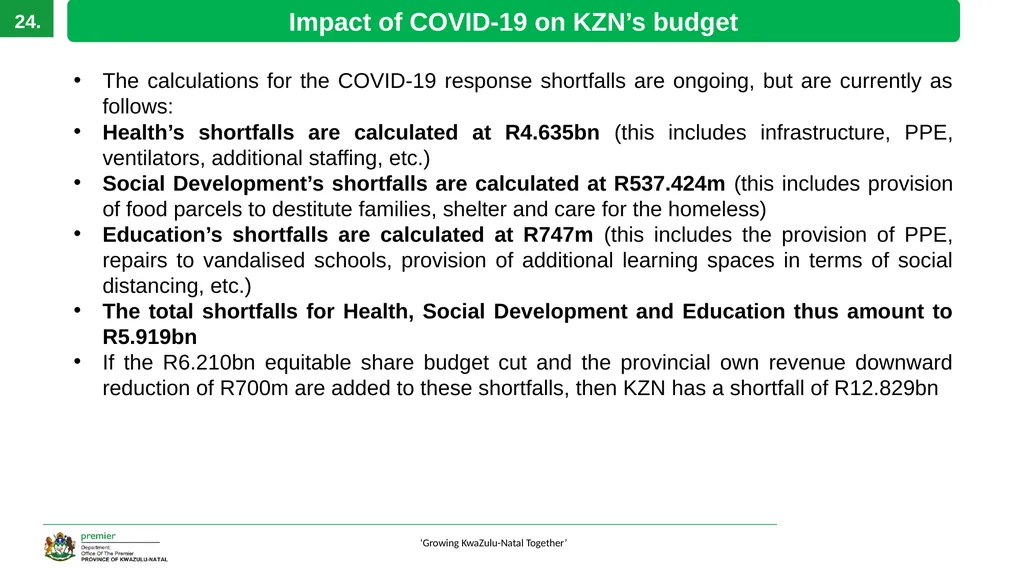
slide24. 24 ‘Growing KwaZulu-Natal Together’ 24. The calculations for the COVID-19 response shortfalls are ongoing, but are currently as follows:
Health’s shortfalls are calculated at R4.635bn (this includes infrastructure, PPE, ventilators, additional staffing, etc.)
Social Development’s shortfalls are calculated at R537.424m (this includes provision of food parcels to destitute families, shelter and care for the homeless)
Education’s shortfalls are calculated at R747m (this includes the provision of PPE, repairs to vandalised schools, provision of additional learning spaces in terms of social distancing, etc.)
The total shortfalls for Health, Social Development and Education thus amount to R5.919bn
If the R6.210bn equitable share budget cut and the provincial own revenue downward reduction of R700m are added to these shortfalls, then KZN has a shortfall of R12.829bn Impact of COVID-19 on KZN’s budget<br>
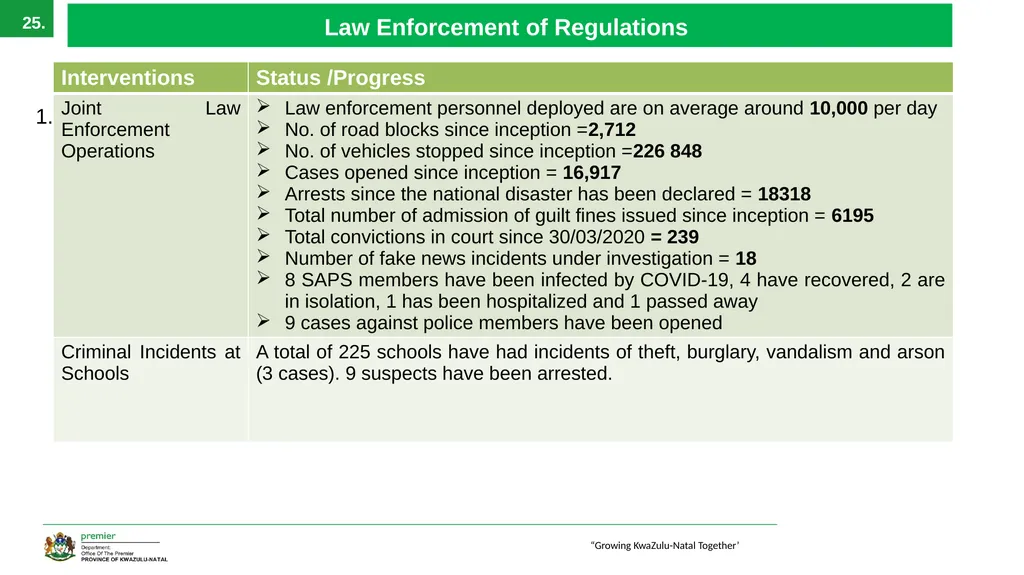
slide25. 25 “Growing KwaZulu-Natal Together’ Law Enforcement of Regulations 1. 25.<br>
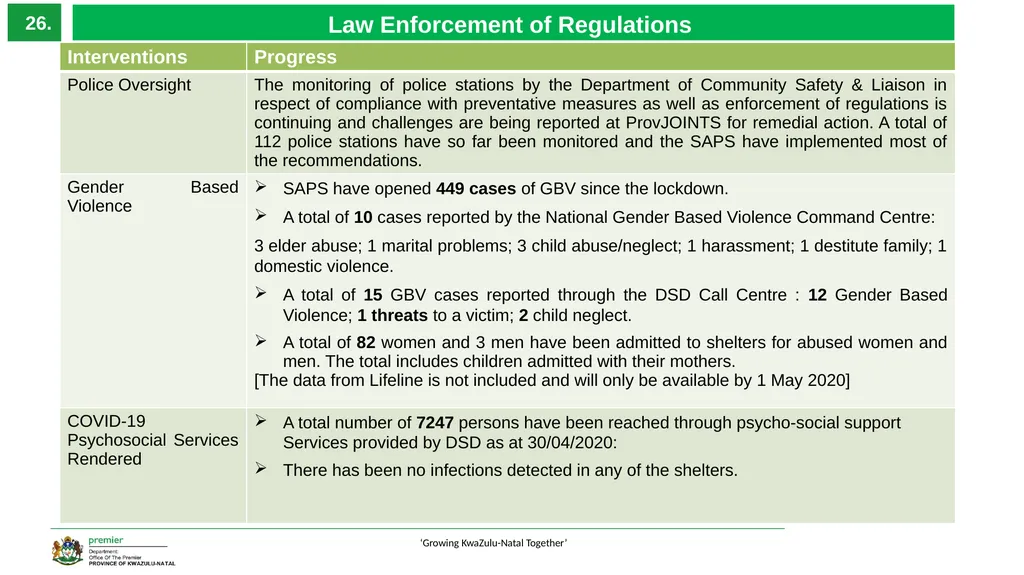
slide26. 26 ‘Growing KwaZulu-Natal Together’ Law Enforcement of Regulations 26.<br>
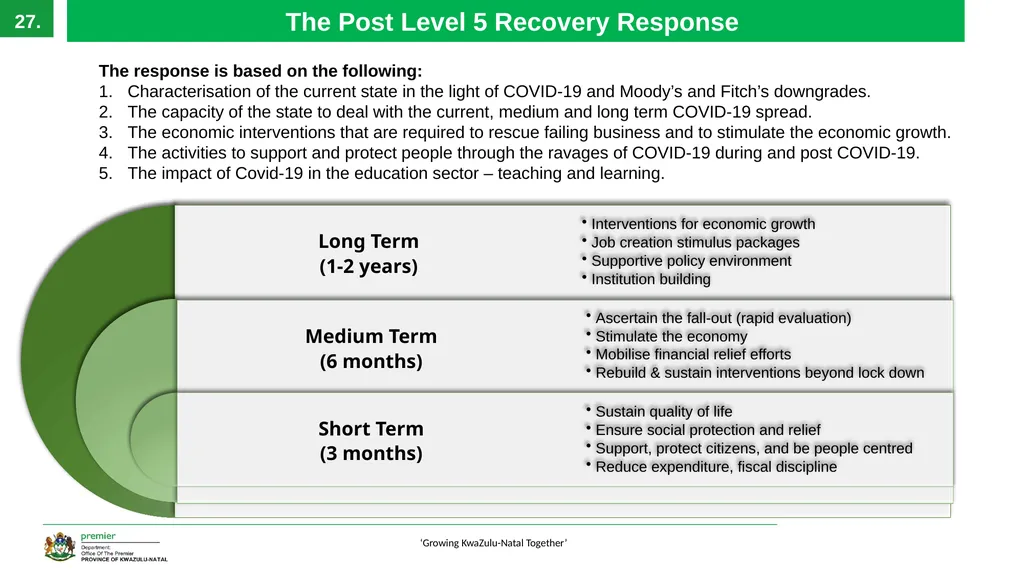
slide27. 27 ‘Growing KwaZulu-Natal Together’ The Post Level 5 Recovery Response The response is based on the following:
Characterisation of the current state in the light of COVID-19 and Moody’s and Fitch’s downgrades.
The capacity of the state to deal with the current, medium and long term COVID-19 spread.
The economic interventions that are required to rescue failing business and to stimulate the economic growth.
The activities to support and protect people through the ravages of COVID-19 during and post COVID-19.
The impact of Covid-19 in the education sector – teaching and learning. 27.<br>
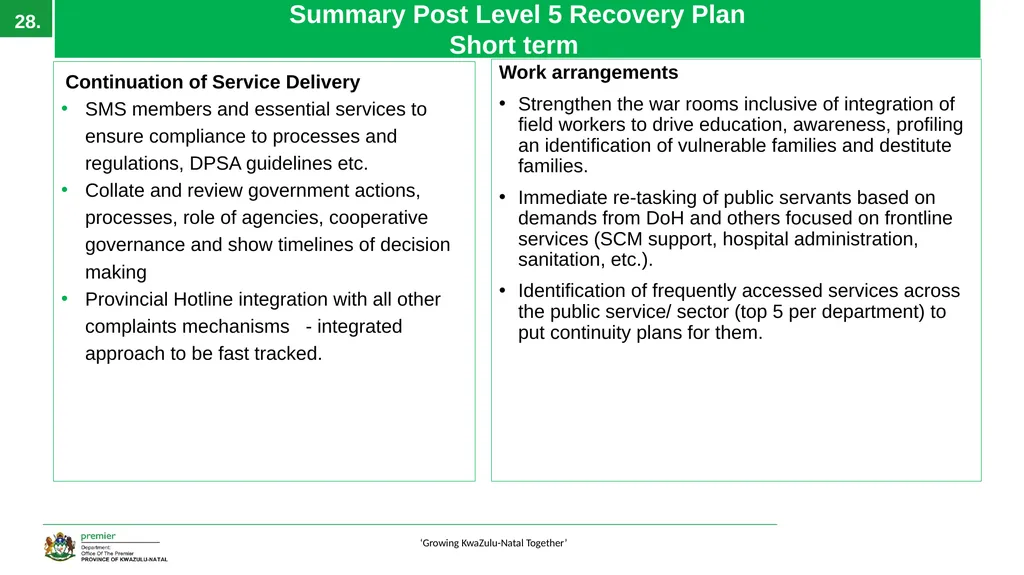
slide28. 28 ‘Growing KwaZulu-Natal Together’ Summary Post Level 5 Recovery Plan Short term Continuation of Service Delivery
SMS members and essential services to ensure compliance to processes and regulations, DPSA guidelines etc.
Collate and review government actions, processes, role of agencies, cooperative governance and show timelines of decision making
Provincial Hotline integration with all other complaints mechanisms - integrated approach to be fast tracked. Work arrangements
Strengthen the war rooms inclusive of integration of field workers to drive education, awareness, profiling an identification of vulnerable families and destitute families.
Immediate re-tasking of public servants based on demands from DoH and others focused on frontline services (SCM support, hospital administration, sanitation, etc.).
Identification of frequently accessed services across the public service/ sector (top 5 per department) to put continuity plans for them. 28.<br>
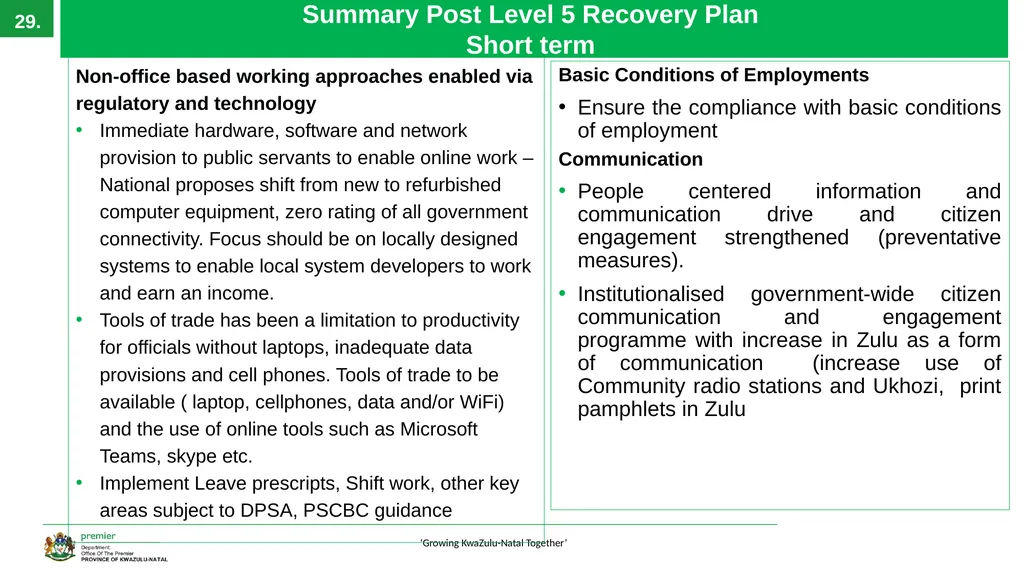
slide29. 29 ‘Growing KwaZulu-Natal Together’ Summary Post Level 5 Recovery Plan Short term Non-office based working approaches enabled via regulatory and technology
Immediate hardware, software and network provision to public servants to enable online work – National proposes shift from new to refurbished computer equipment, zero rating of all government connectivity. Focus should be on locally designed systems to enable local system developers to work and earn an income.
Tools of trade has been a limitation to productivity for officials without laptops, inadequate data provisions and cell phones. Tools of trade to be available ( laptop, cellphones, data and/or WiFi) and the use of online tools such as Microsoft Teams, skype etc.
Implement Leave prescripts, Shift work, other key areas subject to DPSA, PSCBC guidance Basic Conditions of Employments
Ensure the compliance with basic conditions of employment
Communication
People centered information and communication drive and citizen engagement strengthened (preventative measures).
Institutionalised government-wide citizen communication and engagement programme with increase in Zulu as a form of communication (increase use of Community radio stations and Ukhozi, print pamphlets in Zulu 29.<br>
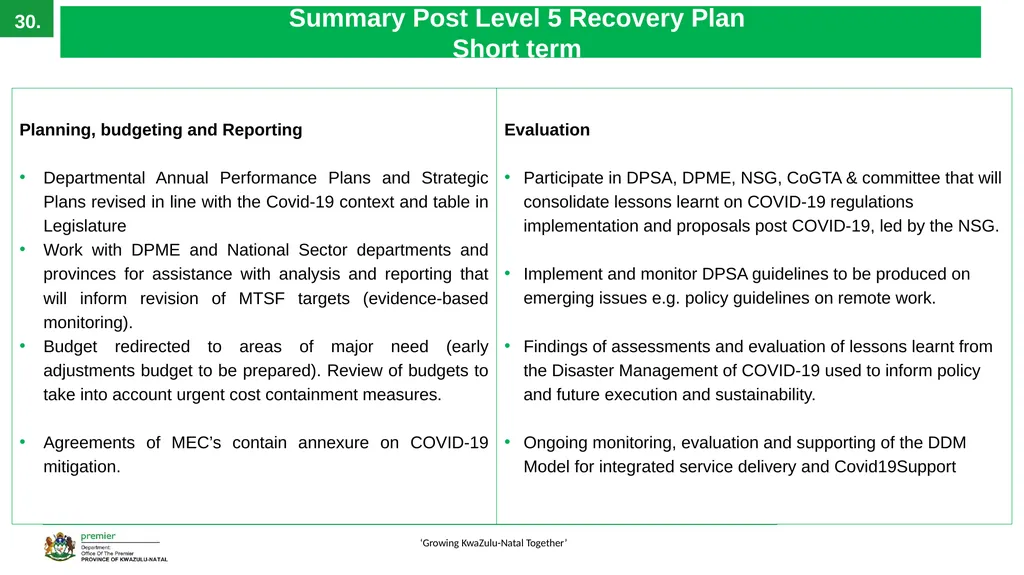
slide30. 30 ‘Growing KwaZulu-Natal Together’ Summary Post Level 5 Recovery Plan Short term Planning, budgeting and Reporting
Departmental Annual Performance Plans and Strategic Plans revised in line with the Covid-19 context and table in Legislature
Work with DPME and National Sector departments and provinces for assistance with analysis and reporting that will inform revision of MTSF targets (evidence-based monitoring).
Budget redirected to areas of major need (early adjustments budget to be prepared). Review of budgets to take into account urgent cost containment measures.
Agreements of MEC’s contain annexure on COVID-19 mitigation. Evaluation
Participate in DPSA, DPME, NSG, CoGTA & committee that will consolidate lessons learnt on COVID-19 regulations implementation and proposals post COVID-19, led by the NSG.
Implement and monitor DPSA guidelines to be produced on emerging issues e.g. policy guidelines on remote work.
Findings of assessments and evaluation of lessons learnt from the Disaster Management of COVID-19 used to inform policy and future execution and sustainability.
Ongoing monitoring, evaluation and supporting of the DDM Model for integrated service delivery and Covid19Support 30.<br>
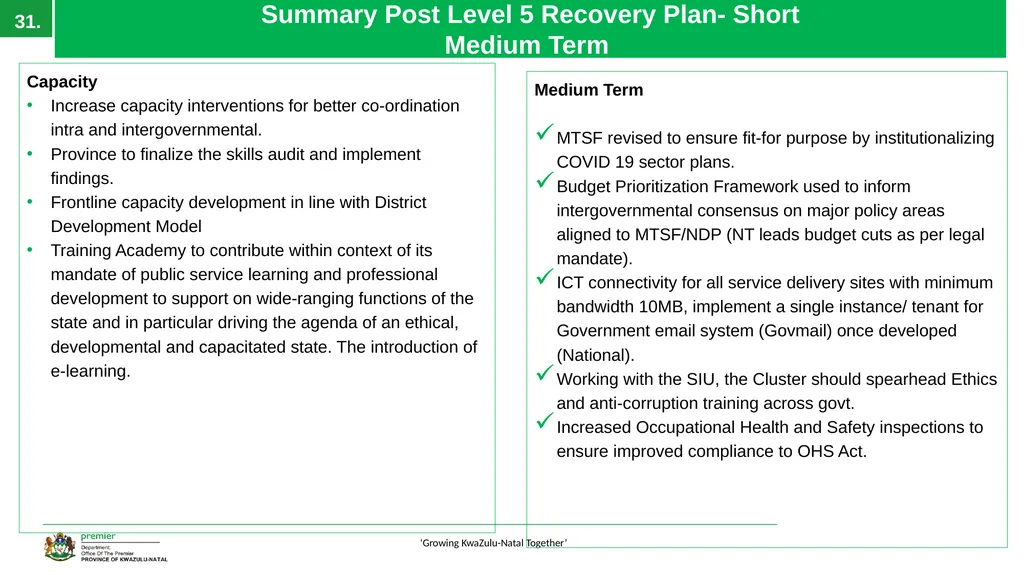
slide31. 31 ‘Growing KwaZulu-Natal Together’ Summary Post Level 5 Recovery Plan- Short Medium Term Capacity
Increase capacity interventions for better co-ordination intra and intergovernmental.
Province to finalize the skills audit and implement findings.
Frontline capacity development in line with District Development Model
Training Academy to contribute within context of its mandate of public service learning and professional development to support on wide-ranging functions of the state and in particular driving the agenda of an ethical, developmental and capacitated state. The introduction of e-learning. Medium Term
MTSF revised to ensure fit-for purpose by institutionalizing COVID 19 sector plans.
Budget Prioritization Framework used to inform intergovernmental consensus on major policy areas aligned to MTSF/NDP (NT leads budget cuts as per legal mandate).
ICT connectivity for all service delivery sites with minimum bandwidth 10MB, implement a single instance/ tenant for Government email system (Govmail) once developed (National).
Working with the SIU, the Cluster should spearhead Ethics and anti-corruption training across govt.
Increased Occupational Health and Safety inspections to ensure improved compliance to OHS Act. 31.<br>
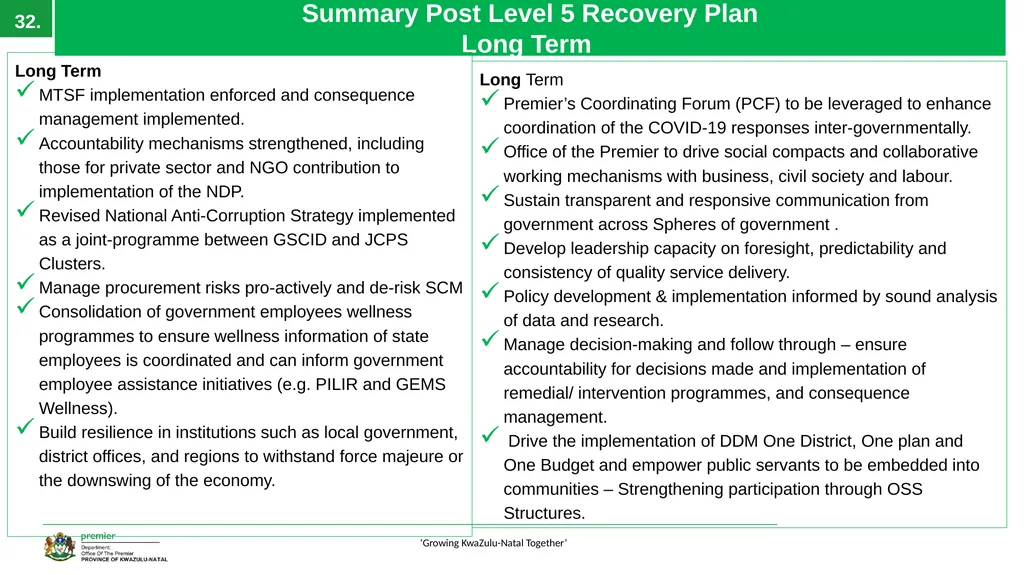
slide32. 32 ‘Growing KwaZulu-Natal Together’ Summary Post Level 5 Recovery Plan Long Term Long Term
Premier’s Coordinating Forum (PCF) to be leveraged to enhance coordination of the COVID-19 responses inter-governmentally.
Office of the Premier to drive social compacts and collaborative working mechanisms with business, civil society and labour.
Sustain transparent and responsive communication from government across Spheres of government .
Develop leadership capacity on foresight, predictability and consistency of quality service delivery.
Policy development & implementation informed by sound analysis of data and research.
Manage decision-making and follow through – ensure accountability for decisions made and implementation of remedial/ intervention programmes, and consequence management.
Drive the implementation of DDM One District, One plan and One Budget and empower public servants to be embedded into communities – Strengthening participation through OSS Structures. Long Term
MTSF implementation enforced and consequence management implemented.
Accountability mechanisms strengthened, including those for private sector and NGO contribution to implementation of the NDP.
Revised National Anti-Corruption Strategy implemented as a joint-programme between GSCID and JCPS Clusters.
Manage procurement risks pro-actively and de-risk SCM
Consolidation of government employees wellness programmes to ensure wellness information of state employees is coordinated and can inform government employee assistance initiatives (e.g. PILIR and GEMS Wellness).
Build resilience in institutions such as local government, district offices, and regions to withstand force majeure or the downswing of the economy. 32.<br>
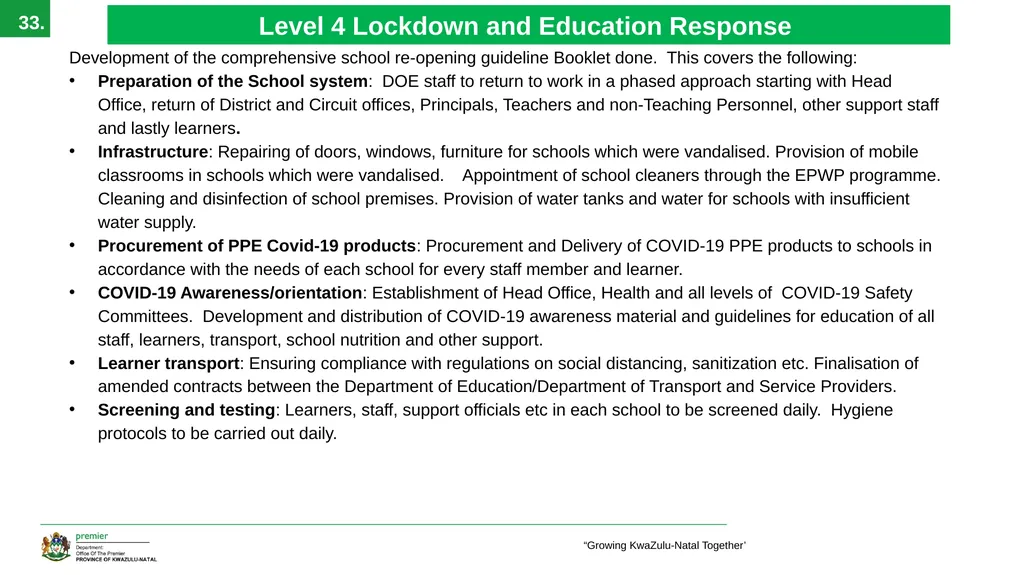
slide33. 33. “Growing KwaZulu-Natal Together’ Level 4 Lockdown and Education Response Development of the comprehensive school re-opening guideline Booklet done. This covers the following:
Preparation of the School system: DOE staff to return to work in a phased approach starting with Head Office, return of District and Circuit offices, Principals, Teachers and non-Teaching Personnel, other support staff and lastly learners.
Infrastructure: Repairing of doors, windows, furniture for schools which were vandalised. Provision of mobile classrooms in schools which were vandalised. Appointment of school cleaners through the EPWP programme. Cleaning and disinfection of school premises. Provision of water tanks and water for schools with insufficient water supply.
Procurement of PPE Covid-19 products: Procurement and Delivery of COVID-19 PPE products to schools in accordance with the needs of each school for every staff member and learner.
COVID-19 Awareness/orientation: Establishment of Head Office, Health and all levels of COVID-19 Safety Committees. Development and distribution of COVID-19 awareness material and guidelines for education of all staff, learners, transport, school nutrition and other support.
Learner transport: Ensuring compliance with regulations on social distancing, sanitization etc. Finalisation of amended contracts between the Department of Education/Department of Transport and Service Providers.
Screening and testing: Learners, staff, support officials etc in each school to be screened daily. Hygiene protocols to be carried out daily.<br>
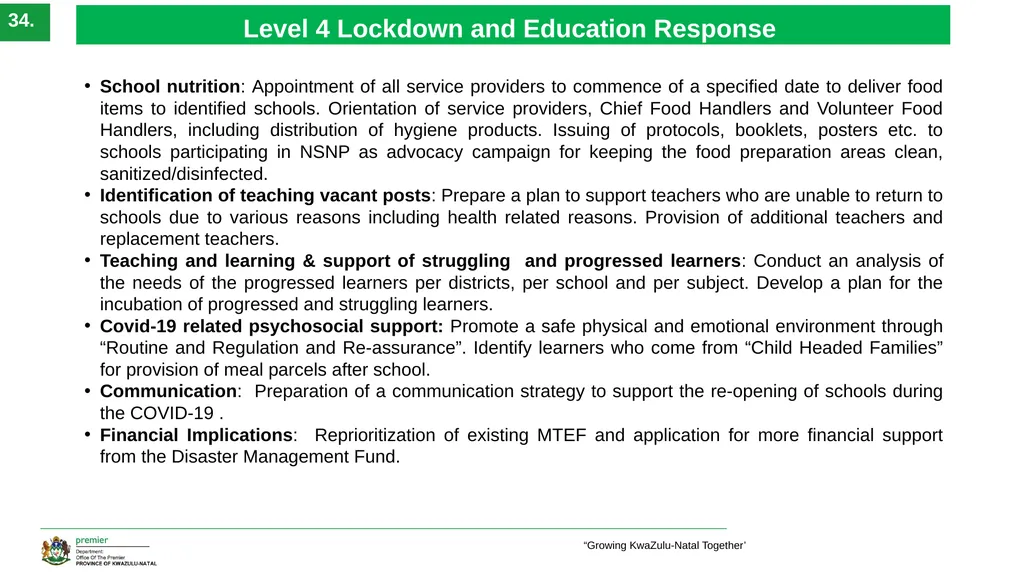
slide34. 34. “Growing KwaZulu-Natal Together’ Level 4 Lockdown and Education Response School nutrition: Appointment of all service providers to commence of a specified date to deliver food items to identified schools. Orientation of service providers, Chief Food Handlers and Volunteer Food Handlers, including distribution of hygiene products. Issuing of protocols, booklets, posters etc. to schools participating in NSNP as advocacy campaign for keeping the food preparation areas clean, sanitized/disinfected.
Identification of teaching vacant posts: Prepare a plan to support teachers who are unable to return to schools due to various reasons including health related reasons. Provision of additional teachers and replacement teachers.
Teaching and learning & support of struggling and progressed learners: Conduct an analysis of the needs of the progressed learners per districts, per school and per subject. Develop a plan for the incubation of progressed and struggling learners.
Covid-19 related psychosocial support: Promote a safe physical and emotional environment through “Routine and Regulation and Re-assurance”. Identify learners who come from “Child Headed Families” for provision of meal parcels after school.
Communication: Preparation of a communication strategy to support the re-opening of schools during the COVID-19 .
Financial Implications: Reprioritization of existing MTEF and application for more financial support from the Disaster Management Fund.<br>
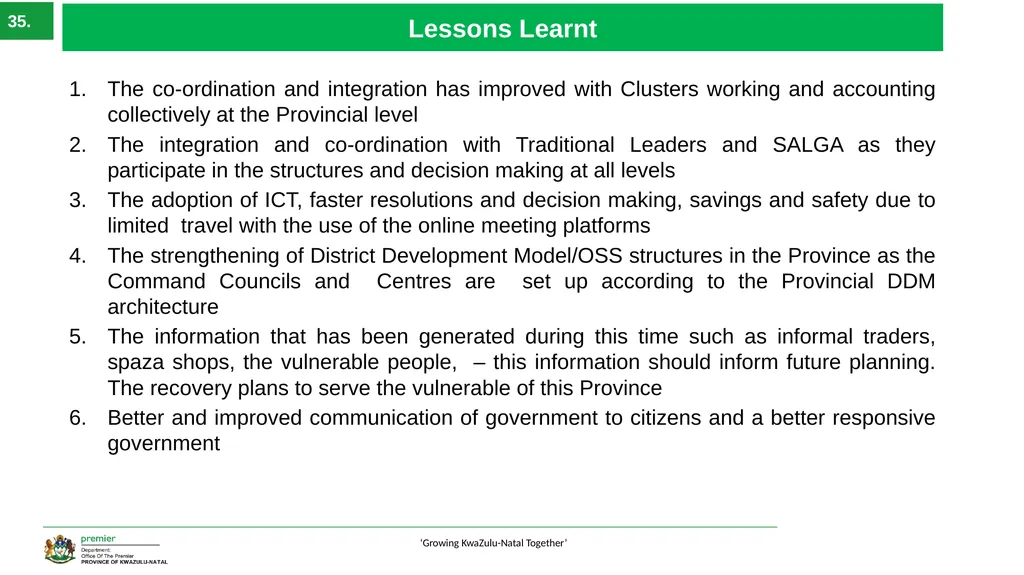
slide35. 35 ‘Growing KwaZulu-Natal Together’ Lessons Learnt The co-ordination and integration has improved with Clusters working and accounting collectively at the Provincial level
The integration and co-ordination with Traditional Leaders and SALGA as they participate in the structures and decision making at all levels
The adoption of ICT, faster resolutions and decision making, savings and safety due to limited travel with the use of the online meeting platforms
The strengthening of District Development Model/OSS structures in the Province as the Command Councils and Centres are set up according to the Provincial DDM architecture
The information that has been generated during this time such as informal traders, spaza shops, the vulnerable people, – this information should inform future planning. The recovery plans to serve the vulnerable of this Province
Better and improved communication of government to citizens and a better responsive government 35.<br>
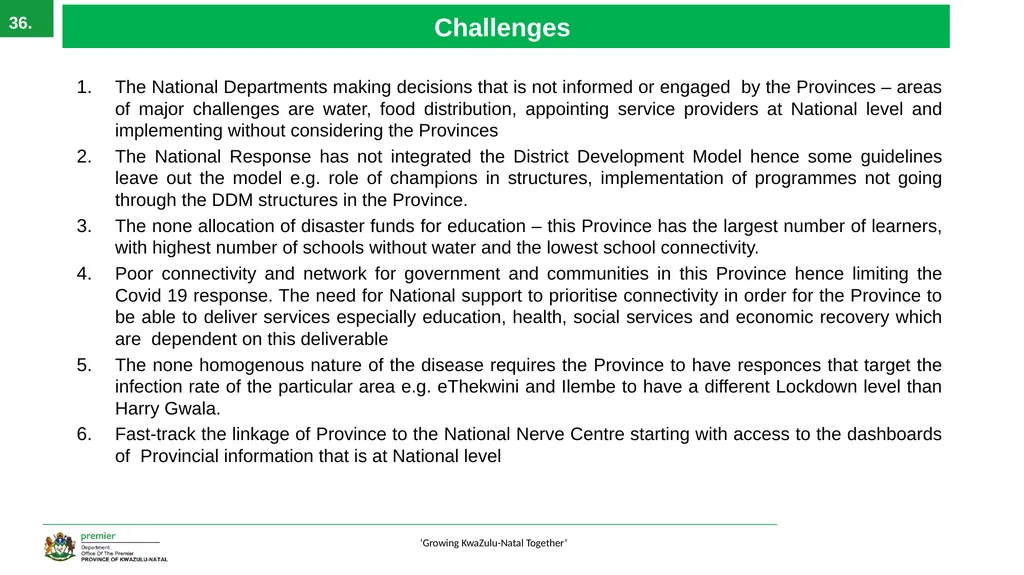
slide36. 36 ‘Growing KwaZulu-Natal Together’ Challenges The National Departments making decisions that is not informed or engaged by the Provinces – areas of major challenges are water, food distribution, appointing service providers at National level and implementing without considering the Provinces
The National Response has not integrated the District Development Model hence some guidelines leave out the model e.g. role of champions in structures, implementation of programmes not going through the DDM structures in the Province.
The none allocation of disaster funds for education – this Province has the largest number of learners, with highest number of schools without water and the lowest school connectivity.
Poor connectivity and network for government and communities in this Province hence limiting the Covid 19 response. The need for National support to prioritise connectivity in order for the Province to be able to deliver services especially education, health, social services and economic recovery which are dependent on this deliverable
The none homogenous nature of the disease requires the Province to have responces that target the infection rate of the particular area e.g. eThekwini and Ilembe to have a different Lockdown level than Harry Gwala.
Fast-track the linkage of Province to the National Nerve Centre starting with access to the dashboards of Provincial information that is at National level 36.<br>
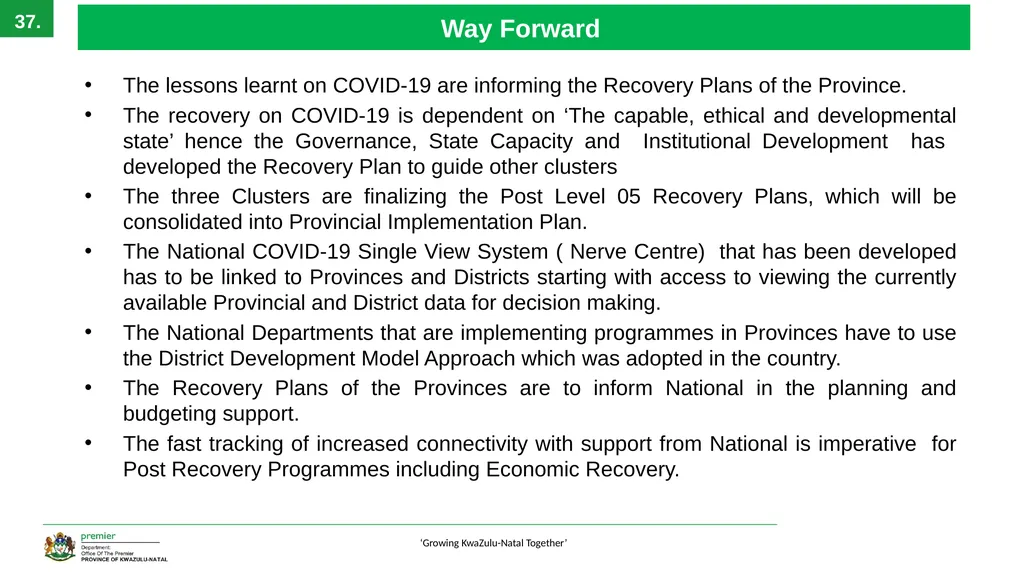
slide37. 37 ‘Growing KwaZulu-Natal Together’ Way Forward The lessons learnt on COVID-19 are informing the Recovery Plans of the Province.
The recovery on COVID-19 is dependent on ‘The capable, ethical and developmental state’ hence the Governance, State Capacity and Institutional Development has developed the Recovery Plan to guide other clusters
The three Clusters are finalizing the Post Level 05 Recovery Plans, which will be consolidated into Provincial Implementation Plan.
The National COVID-19 Single View System ( Nerve Centre) that has been developed has to be linked to Provinces and Districts starting with access to viewing the currently available Provincial and District data for decision making.
The National Departments that are implementing programmes in Provinces have to use the District Development Model Approach which was adopted in the country.
The Recovery Plans of the Provinces are to inform National in the planning and budgeting support.
The fast tracking of increased connectivity with support from National is imperative for Post Recovery Programmes including Economic Recovery. 37.<br>
COVID-19<br>
slide2. 2 ‘Growing KwaZulu-Natal Together’ The Provincial Response 2. The Provincial response is coordinated through the DDM/OSS structures in the Province, through the 4 clusters of government.
Provincially -
Provincial Command Council is in place chaired by Premier and meets three times a week.
The Provincial Command Centre chaired by the Director-General is also in place
ProvJoc chaired by COGTA/DOH twice a week
ProvJoints chaired by SAPS meets daily
District Command Councils and Centres co- chaired by MEC Champions and District Mayors and HOD Champions and Municipal Managers
The Province has a Provincial Plan and is finalizing the Post level 5 Recovery Plan
The reporting is done through Clusters and monitoring by the Office of the Premier.
The provision of basic services ( water, sanitation and waste removal) especially water for the areas without water.
Driving integrated Provincial Communication with education, awareness and reporting to communities on progress on the Covid-19 Response
The Provincial Treasury is in the process of conducting an analysis of the impact of COVID-19 on provincial budget as well as the reprioritization of budget pending the national directives.<br>
slide3. 3 “Growing KwaZulu-Natal Together’ Provincial Situation as at 03 May 2020 Provincial Situation report as at 03 May 2020:
Summary of KwaZulu-Natal laboratory confirmed cases as at 03 May 2020:
. This is an increase of 25 new confirmed patients (6 % of reported new cases in the Country) and 1 new death in the Province. The Province is at 16% of the laboratory confirmed cases in the country
The median number of new patients reported in the Province is 18 cases/day with eThekwini and Ilembe Districts contributing the most cases daily.
The current Clusters in the Province include Health Care Workers (HCWs) and Retail employees 3.<br>
slide4. 4. “Growing KwaZulu-Natal Together’ Covid-19 Employee and Community Response Community and Facility based Screening and Testing
The approach of the Province to mass screening and testing is by establishing three types of teams as follows:
Contact tracing team
Community Screening and Testing Teams
Roadblock Teams - Teams that work with SAPS at the roadblocks doing screening and testing.
Employee Wellness: The Provincial Government has developed Occupational Health and Safety Guidelines to protect Health Care Workers during COVID-19.
Personal Protective Equipment (PPE) is being provided to the relevant Health Care Workers based on Risk Assessment and also providing PPE to all the employees<br>
slide5. 5 “Growing KwaZulu-Natal Together’ Covid-19 Response BEDS
The Department of Health has reorganized and assigned current beds for patients under investigation (quarantine) and isolation beds (positive test) in the public hospitals (Operational Beds).
In addition the Department is renovating and reconfiguring the existing clinical spaces in public health facilities and establishing field hospitals in order to increase bed capacity and to meet isolation and quarantine safety requirements.
The Province is also accepting offers from the Private Health Establishments in order to increase the bed capacity.
The Province has also negotiated and established a database of lodges, resorts and hotels for activation for use as quarantine facilities based on demand.
Temporal facilities are in the process of being erected.
INTENSIFIED LOCKDOWN
Intensification of lockdown started on Monday 20th April 2020 in eThekwini. Now in Stage 4 from 1 May 2020. Hotspots areas identified which included uMlazi (Y, P, U & Z sections), Chartsworth, Verulam and Westville.
eThekwini Metro has been working together with the Provincial government.
COMMUNICATION AND COMMUNITY EDUCATION
The Provincial Covid-19 Communication Plan based on GCIS guide has been developed, adopted and is being implemented in partnership with GCIS
The online information hub has been developed
The Premier conducts weekly briefings based on provincial Command Council resolutions and activities All teams distribute COVID-19 information pamphlets
Disseminated information on COVID-19 through radio, TV and print media and social media on a daily basis. 5.<br>
slide6. 6 ‘Growing KwaZulu-Natal Together’ Management of COVID-19 – Beds 6.<br>
slide7. Step 1:
Household is in
distress Step 2:
The household
Contacts DSD Call
Centre: 087 158 3000 or
SASSA Call Centre:
(033) 846 3400,
Or
Contact Local
Councillor, Nearest DSD
Office Step 3:
Composite lists are
compiled Step 10:
Delivery notes and
Registers are recon-
ciled daily Step 4:
Lists are screened
through SOCPEN Step 5:
Assessment by
Social Workers and
SASSA Step 6:
Completed application
form approved by
DSD or SASSA Step 9:
Recipients at house
hold level get food
packs and sign-off Step 8:
Food distribution
Agencies deliver
Within 3 – 5 days Step 7:
Approved vouchers
Sent to food
Distribution agencies Legal and Policy Mandates Social Relief of Distress: Process Flow 7.<br>
slide8. 8. “Growing KwaZulu-Natal Together’ Social Relief of Distress food distribution<br>
slide9. 9. “Growing KwaZulu-Natal Together’ Functional Shelters to accommodate Homeless People<br>
slide10. 10 ‘Growing KwaZulu-Natal Together’ Basic Services: Water 10. Water priority areas for the KZN Province have been identified by Water Service Authorities and interventions have been divided into:
Short term – static tanks and water tankering, borehole drilling by COGTA and municipalities and short term interventions addressing of maintenance issues through MIG reprioritisation of about R502m
Medium term projects funded through R84m transfers to various municipalities to address hot spots in Ugu, Amajuba, Uthukela, Umkhanyakude and Ilembe. Work ongoing on these more sustainable projects to assist in expunging tankering
Addressing water source issues as well implementing water conservation and demand management through Water Services Infrastructure Grant (WSIG) and Regional Bulk Infrastructure Grant (RBIG).
Medium to Long Term (Unfunded)
New boreholes -R287m
Refurbishment of 601 boreholes - R91m
Spring protection - R51m
Long term projects under RBIG to address source eg Lower Umkomaas
Water Hotspots remain in Ugu, Ilembe, Umkanyakude, Zululand , Harry Gwala and Uthukela while in urban areas there are maintenance challenges<br>
slide11. 11. “Growing KwaZulu-Natal Together’ Waste Removal and Hygiene Four primary hygiene programmes in response to COVID-19 :
Waste - cleaning, waste picking, clearing illegal dumping sites
De-sludging / emptying of VIP latrines, septic tanks and conservancy tanks by vacuum sewerage tanker – “honeysucker”
Clearing of sewer blockages and sewer spills
Sanitization – disinfection of public areas
Targeted Priority Areas
High Density and congested Townships
Areas With High Traffic Volume
Illegal Dumping Sites
Informal Settlements
Taxi and bus Ranks
Dilapidated and secluded Town Areas
Areas where Municipalities are not Collecting Waste Regularly
Areas surrounding Sewer Spillages<br>
slide12. 12. “Growing KwaZulu-Natal Together’ Sanitisation of Informal Settlements and De-densification The Provincial Sanitisation Program was launched at Inyoni Informal Settlements in ILembe District , Mandeni LM , Ward 16 on 21 April 2020.
In the first phase on the programme roll out ending on 30 April 2020 , a total of ten (10) districts , nine (09) local municipalities and 18 informal settlements covering over 15 000 households have been serviced.
Thirty thousand bar soaps have also been distributed as part of the programme i.e. 2 bars per family. The programme has been affected by the inclement weather i.e. some of the programmes have had to be moved to the week ending on the 8th of May 2020.
The program is continuing and the second phase of the program targets eThekwini Metro amongst other prioritized sites as a Provincial Hotspot. This will include the provision of ablution facilities, static water tanks and standpipes in the various informal settlements of Cato Crest, Kennedy Road, etc.<br>
slide13. 13. “Growing KwaZulu-Natal Together’ Interim Relief for the Cultural and Creative Industry and Sport and Recreation Sectors The Department of Arts and Culture has proposed Interim Relief for the Cultural and Creative Industry as the KwaZulu-Natal Provincial Government.
It has also developed an Action Plan for Social Relief.
It has developed Provincial Criteria for Relief for the Cultural and Creative industry in line with National Arts and Culture guidelines.
The Department of Sport and Recreation has proposed a Provincial Relief Fund for the Sport and Recreation Sector in response to the Coronavirus pandemic.
It will be providing relief for athletes, coaches, technical personnel, sport federations recreational entities and the fitness industry at a provincial level to mitigate the negative impact of the COVID-19 lockdown.
It has developed an implementation plan with specific criteria in order to support the programme for the Provincial Relief for the Sport and Recreation Sector.<br>
slide14. 14 ‘Growing KwaZulu-Natal Together’ Education and Awareness 14.<br>
slide15. 15 ‘Growing KwaZulu-Natal Together’ Education and Awareness 15.<br>
slide16. 16 ‘Growing KwaZulu-Natal Together’ Education and Awareness 16.<br>
slide17. 17 ‘Growing KwaZulu-Natal Together’ Economic Response 17. The Provincial SEZs (DTPC & RBIDZ) waived the payment of rent by their tenants affected by COVID 19 for 3 months
The Provincial development finance institutions (KZNGF, IDFC) approved 6 months payment holiday without penalty and interest accrual to their clients.
Various Provincial COVID funds (e.g. TIKZN Business Support Fund, KZN Tourism Fund) have been set up to complement the national funds
One-stop shop to assist KZN business with applications for business support measures has been setup
An electronic APP to log queries on business challenges and for assistance to complete the business support measures applications.
The KZN Growth Coalition comprising labour, business and government has raised significant financial and non-financial support to mitigate effects of COVID 19<br>
slide18. 18 ‘Growing KwaZulu-Natal Together’ Agricultural Famer Support & Food Security 18. The Province issued permits to officials across the province to ensure that provision of extension and advisory services to farmers continues during the lockdown period.
Provision of inputs including seeds and fertilizers has continued during lockdown.
An online database of provincial farmers has been created to expedite the provision of COVID related support packages
The RASET programme has provided transport logistics, subsidized packaging material to support the delivery of fresh produce to the market by small scale farmers
17 trucks and 10 bakkies have been availed for this service.
Approximately R1 million paid to 106 HDI farmers within a month
DARD laboratories have repurposed their lab to produce disinfectants and sanitizers
On the downside, the suspension of physical livestock auctions has disproportionately affected the small scale livestock farmers. An online livestock auction was held on the 3rd of April 2020 and just under 1000 exchanged hands.<br>
slide19. 19 ‘Growing KwaZulu-Natal Together’ Enterprise Support 19. Deployed district officials to support SMMEs throughout KZN
Continuous dissemination of information on the national relief funds and schemes to small enterprises
Attend to enquiries by small enterprises regarding national relief funds and schemes
Assist small enterprises with application processes to the national relief funds and schemes
Liaise and forward enquiries/applications to the One Stop Shop for packaging and application
Provide feedback to small enterprises regarding progress on applications
Database of informal traders and number of permits (informal economy and spaza shops) has been created and 16 234 have since registered on the platform.
The provincial government is finalising the provision of support to informal economy traders and spaza shop owners in the form of access subsidised stock through the Bulk Buying Programme.<br>
slide20. 20 ‘Growing KwaZulu-Natal Together’ Business Inspection & Consumer Complaints Attendance 20. The province has ramped up business inspections across the province to ensure compliance with lockdown regulations
4661 consumer complaints were received between 27 March 2020 –acknowledgements sent to complainants
Complaints are received through various platforms including –WhatsApp (most popular and user friendly); Telephonic calls and written)
The highest no. of complaints relate to excessive pricing related to meat, rice, potatoes; bread sanitizers and face masks
Total no of complaints received from period 18 April : 395
Number of Inspections conducted from 18 April 2020: 55
Inspections conducted during this period in the following areas: EThekwini, Amajuba, Zululand, Harry Gwala, UMgungundlovu; UThukela, UMzinyathi, King Cetshwayo
Number of fines and notices issued - 18 fines issued
Number of arrests – ten (10) arrests
NB: Investigation is still pending on some complaints as they have not been finalized
The province has initiated the development of a holistic plan to kick start the recovery process<br>
slide21. 21 ‘Growing KwaZulu-Natal Together’ Impact of COVID-19 on KZN’s budget 21. If the Provincial equitable share formula is applied in determining the R30bn budget cuts against Provinces, then KwaZulu-Natal loses R6.210bn as communicated by National Treasury on 28 April 2020
R20bn is to be allocated back to provinces for their COVID-19 response, though the mechanism of the allocation of these funds has not yet been provided
KwaZulu-Natal is fully supportive that Provinces must contribute to the national response package, but would prefer an approach where Provinces retain their portion of the funds allocated back to Provinces, rather than surrendering their portion of R30bn, to receive back their portion of the R20bn
Indications at the weekly meetings with National Treasury are that the R20bn support package for Provinces is largely aimed at the Covid-19 Health response, and possibly the Social Development response (particularly the care provided to the homeless, as well as food parcels for destitute families), but no mention is made of any support that will be given to the Education sector (PPE, sanitizers, additional spaces to allow for socially distanced learning, additional teaching staff for these additional spaces, repairs to schools that were vandalised during lockdown, to mention a few)<br>
slide22. 22 ‘Growing KwaZulu-Natal Together’ Impact of COVID-19 on KZN’s budget 22. In addition to the Provincial equitable share cuts, there is a strong likelihood that the National Departments will cut the Provincial conditional grants in their bid to source the R100bn that needs to be found from the national sphere.
It is requested to please assist in ensuring that these cuts on provinces are minimised as equitable share funded infrastructure budgets have had to be cut, and this places a greater reliance on conditional grant funding to continue some of the infrastructure programmes
As with the national fiscal framework, the provincial fiscal framework is anticipating a significant downward provincial own revenue adjustments, particularly as far as gaming and betting taxes are concerned, as well as tourism revenue to be collected through the Ezemvelo KZN Wildlife public entity. These downward revisions are calculated at approximately R700m and this will also need to be cut from the provincial budget.<br>
slide23. 23 ‘Growing KwaZulu-Natal Together’ 23. National is implored to fast-track the discussions at a national level that inform the annual increments given to public servants as any savings in this regard would really assist tremendously in sourcing the funds required for COVID-19
In KZN, 64% of the total budget is allocated to Compensation of employees. If we exclude conditional grant funding, then 72% of the Provincial Equitable Share funding goes to Compensation of employees.
Unless decisions are taken around the salary increments budgeted for, it means that R6.210bn must be cut from 28% of the budget (which is the service delivery part of the budget – namely Goods and services, Transfers and subsidies and Capital) Impact of COVID-19 on KZN’s budget<br>
slide24. 24 ‘Growing KwaZulu-Natal Together’ 24. The calculations for the COVID-19 response shortfalls are ongoing, but are currently as follows:
Health’s shortfalls are calculated at R4.635bn (this includes infrastructure, PPE, ventilators, additional staffing, etc.)
Social Development’s shortfalls are calculated at R537.424m (this includes provision of food parcels to destitute families, shelter and care for the homeless)
Education’s shortfalls are calculated at R747m (this includes the provision of PPE, repairs to vandalised schools, provision of additional learning spaces in terms of social distancing, etc.)
The total shortfalls for Health, Social Development and Education thus amount to R5.919bn
If the R6.210bn equitable share budget cut and the provincial own revenue downward reduction of R700m are added to these shortfalls, then KZN has a shortfall of R12.829bn Impact of COVID-19 on KZN’s budget<br>
slide25. 25 “Growing KwaZulu-Natal Together’ Law Enforcement of Regulations 1. 25.<br>
slide26. 26 ‘Growing KwaZulu-Natal Together’ Law Enforcement of Regulations 26.<br>
slide27. 27 ‘Growing KwaZulu-Natal Together’ The Post Level 5 Recovery Response The response is based on the following:
Characterisation of the current state in the light of COVID-19 and Moody’s and Fitch’s downgrades.
The capacity of the state to deal with the current, medium and long term COVID-19 spread.
The economic interventions that are required to rescue failing business and to stimulate the economic growth.
The activities to support and protect people through the ravages of COVID-19 during and post COVID-19.
The impact of Covid-19 in the education sector – teaching and learning. 27.<br>
slide28. 28 ‘Growing KwaZulu-Natal Together’ Summary Post Level 5 Recovery Plan Short term Continuation of Service Delivery
SMS members and essential services to ensure compliance to processes and regulations, DPSA guidelines etc.
Collate and review government actions, processes, role of agencies, cooperative governance and show timelines of decision making
Provincial Hotline integration with all other complaints mechanisms - integrated approach to be fast tracked. Work arrangements
Strengthen the war rooms inclusive of integration of field workers to drive education, awareness, profiling an identification of vulnerable families and destitute families.
Immediate re-tasking of public servants based on demands from DoH and others focused on frontline services (SCM support, hospital administration, sanitation, etc.).
Identification of frequently accessed services across the public service/ sector (top 5 per department) to put continuity plans for them. 28.<br>
slide29. 29 ‘Growing KwaZulu-Natal Together’ Summary Post Level 5 Recovery Plan Short term Non-office based working approaches enabled via regulatory and technology
Immediate hardware, software and network provision to public servants to enable online work – National proposes shift from new to refurbished computer equipment, zero rating of all government connectivity. Focus should be on locally designed systems to enable local system developers to work and earn an income.
Tools of trade has been a limitation to productivity for officials without laptops, inadequate data provisions and cell phones. Tools of trade to be available ( laptop, cellphones, data and/or WiFi) and the use of online tools such as Microsoft Teams, skype etc.
Implement Leave prescripts, Shift work, other key areas subject to DPSA, PSCBC guidance Basic Conditions of Employments
Ensure the compliance with basic conditions of employment
Communication
People centered information and communication drive and citizen engagement strengthened (preventative measures).
Institutionalised government-wide citizen communication and engagement programme with increase in Zulu as a form of communication (increase use of Community radio stations and Ukhozi, print pamphlets in Zulu 29.<br>
slide30. 30 ‘Growing KwaZulu-Natal Together’ Summary Post Level 5 Recovery Plan Short term Planning, budgeting and Reporting
Departmental Annual Performance Plans and Strategic Plans revised in line with the Covid-19 context and table in Legislature
Work with DPME and National Sector departments and provinces for assistance with analysis and reporting that will inform revision of MTSF targets (evidence-based monitoring).
Budget redirected to areas of major need (early adjustments budget to be prepared). Review of budgets to take into account urgent cost containment measures.
Agreements of MEC’s contain annexure on COVID-19 mitigation. Evaluation
Participate in DPSA, DPME, NSG, CoGTA & committee that will consolidate lessons learnt on COVID-19 regulations implementation and proposals post COVID-19, led by the NSG.
Implement and monitor DPSA guidelines to be produced on emerging issues e.g. policy guidelines on remote work.
Findings of assessments and evaluation of lessons learnt from the Disaster Management of COVID-19 used to inform policy and future execution and sustainability.
Ongoing monitoring, evaluation and supporting of the DDM Model for integrated service delivery and Covid19Support 30.<br>
slide31. 31 ‘Growing KwaZulu-Natal Together’ Summary Post Level 5 Recovery Plan- Short Medium Term Capacity
Increase capacity interventions for better co-ordination intra and intergovernmental.
Province to finalize the skills audit and implement findings.
Frontline capacity development in line with District Development Model
Training Academy to contribute within context of its mandate of public service learning and professional development to support on wide-ranging functions of the state and in particular driving the agenda of an ethical, developmental and capacitated state. The introduction of e-learning. Medium Term
MTSF revised to ensure fit-for purpose by institutionalizing COVID 19 sector plans.
Budget Prioritization Framework used to inform intergovernmental consensus on major policy areas aligned to MTSF/NDP (NT leads budget cuts as per legal mandate).
ICT connectivity for all service delivery sites with minimum bandwidth 10MB, implement a single instance/ tenant for Government email system (Govmail) once developed (National).
Working with the SIU, the Cluster should spearhead Ethics and anti-corruption training across govt.
Increased Occupational Health and Safety inspections to ensure improved compliance to OHS Act. 31.<br>
slide32. 32 ‘Growing KwaZulu-Natal Together’ Summary Post Level 5 Recovery Plan Long Term Long Term
Premier’s Coordinating Forum (PCF) to be leveraged to enhance coordination of the COVID-19 responses inter-governmentally.
Office of the Premier to drive social compacts and collaborative working mechanisms with business, civil society and labour.
Sustain transparent and responsive communication from government across Spheres of government .
Develop leadership capacity on foresight, predictability and consistency of quality service delivery.
Policy development & implementation informed by sound analysis of data and research.
Manage decision-making and follow through – ensure accountability for decisions made and implementation of remedial/ intervention programmes, and consequence management.
Drive the implementation of DDM One District, One plan and One Budget and empower public servants to be embedded into communities – Strengthening participation through OSS Structures. Long Term
MTSF implementation enforced and consequence management implemented.
Accountability mechanisms strengthened, including those for private sector and NGO contribution to implementation of the NDP.
Revised National Anti-Corruption Strategy implemented as a joint-programme between GSCID and JCPS Clusters.
Manage procurement risks pro-actively and de-risk SCM
Consolidation of government employees wellness programmes to ensure wellness information of state employees is coordinated and can inform government employee assistance initiatives (e.g. PILIR and GEMS Wellness).
Build resilience in institutions such as local government, district offices, and regions to withstand force majeure or the downswing of the economy. 32.<br>
slide33. 33. “Growing KwaZulu-Natal Together’ Level 4 Lockdown and Education Response Development of the comprehensive school re-opening guideline Booklet done. This covers the following:
Preparation of the School system: DOE staff to return to work in a phased approach starting with Head Office, return of District and Circuit offices, Principals, Teachers and non-Teaching Personnel, other support staff and lastly learners.
Infrastructure: Repairing of doors, windows, furniture for schools which were vandalised. Provision of mobile classrooms in schools which were vandalised. Appointment of school cleaners through the EPWP programme. Cleaning and disinfection of school premises. Provision of water tanks and water for schools with insufficient water supply.
Procurement of PPE Covid-19 products: Procurement and Delivery of COVID-19 PPE products to schools in accordance with the needs of each school for every staff member and learner.
COVID-19 Awareness/orientation: Establishment of Head Office, Health and all levels of COVID-19 Safety Committees. Development and distribution of COVID-19 awareness material and guidelines for education of all staff, learners, transport, school nutrition and other support.
Learner transport: Ensuring compliance with regulations on social distancing, sanitization etc. Finalisation of amended contracts between the Department of Education/Department of Transport and Service Providers.
Screening and testing: Learners, staff, support officials etc in each school to be screened daily. Hygiene protocols to be carried out daily.<br>
slide34. 34. “Growing KwaZulu-Natal Together’ Level 4 Lockdown and Education Response School nutrition: Appointment of all service providers to commence of a specified date to deliver food items to identified schools. Orientation of service providers, Chief Food Handlers and Volunteer Food Handlers, including distribution of hygiene products. Issuing of protocols, booklets, posters etc. to schools participating in NSNP as advocacy campaign for keeping the food preparation areas clean, sanitized/disinfected.
Identification of teaching vacant posts: Prepare a plan to support teachers who are unable to return to schools due to various reasons including health related reasons. Provision of additional teachers and replacement teachers.
Teaching and learning & support of struggling and progressed learners: Conduct an analysis of the needs of the progressed learners per districts, per school and per subject. Develop a plan for the incubation of progressed and struggling learners.
Covid-19 related psychosocial support: Promote a safe physical and emotional environment through “Routine and Regulation and Re-assurance”. Identify learners who come from “Child Headed Families” for provision of meal parcels after school.
Communication: Preparation of a communication strategy to support the re-opening of schools during the COVID-19 .
Financial Implications: Reprioritization of existing MTEF and application for more financial support from the Disaster Management Fund.<br>
slide35. 35 ‘Growing KwaZulu-Natal Together’ Lessons Learnt The co-ordination and integration has improved with Clusters working and accounting collectively at the Provincial level
The integration and co-ordination with Traditional Leaders and SALGA as they participate in the structures and decision making at all levels
The adoption of ICT, faster resolutions and decision making, savings and safety due to limited travel with the use of the online meeting platforms
The strengthening of District Development Model/OSS structures in the Province as the Command Councils and Centres are set up according to the Provincial DDM architecture
The information that has been generated during this time such as informal traders, spaza shops, the vulnerable people, – this information should inform future planning. The recovery plans to serve the vulnerable of this Province
Better and improved communication of government to citizens and a better responsive government 35.<br>
slide36. 36 ‘Growing KwaZulu-Natal Together’ Challenges The National Departments making decisions that is not informed or engaged by the Provinces – areas of major challenges are water, food distribution, appointing service providers at National level and implementing without considering the Provinces
The National Response has not integrated the District Development Model hence some guidelines leave out the model e.g. role of champions in structures, implementation of programmes not going through the DDM structures in the Province.
The none allocation of disaster funds for education – this Province has the largest number of learners, with highest number of schools without water and the lowest school connectivity.
Poor connectivity and network for government and communities in this Province hence limiting the Covid 19 response. The need for National support to prioritise connectivity in order for the Province to be able to deliver services especially education, health, social services and economic recovery which are dependent on this deliverable
The none homogenous nature of the disease requires the Province to have responces that target the infection rate of the particular area e.g. eThekwini and Ilembe to have a different Lockdown level than Harry Gwala.
Fast-track the linkage of Province to the National Nerve Centre starting with access to the dashboards of Provincial information that is at National level 36.<br>
slide37. 37 ‘Growing KwaZulu-Natal Together’ Way Forward The lessons learnt on COVID-19 are informing the Recovery Plans of the Province.
The recovery on COVID-19 is dependent on ‘The capable, ethical and developmental state’ hence the Governance, State Capacity and Institutional Development has developed the Recovery Plan to guide other clusters
The three Clusters are finalizing the Post Level 05 Recovery Plans, which will be consolidated into Provincial Implementation Plan.
The National COVID-19 Single View System ( Nerve Centre) that has been developed has to be linked to Provinces and Districts starting with access to viewing the currently available Provincial and District data for decision making.
The National Departments that are implementing programmes in Provinces have to use the District Development Model Approach which was adopted in the country.
The Recovery Plans of the Provinces are to inform National in the planning and budgeting support.
The fast tracking of increased connectivity with support from National is imperative for Post Recovery Programmes including Economic Recovery. 37.<br>