Explain the causes, events and consequences of the

Published  . 0 views
↓ Download
Explain the causes, events and consequences of the
1 / 1
Explain the causes, events and consequences of the - slide 1 of 20 Explain the causes, events and consequences of the - slide 2 of 20 Explain the causes, events and consequences of the - slide 3 of 20 Explain the causes, events and consequences of the - slide 4 of 20 Explain the causes, events and consequences of the - slide 5 of 20 Explain the causes, events and consequences of the - slide 6 of 20 Explain the causes, events and consequences of the - slide 7 of 20 Explain the causes, events and consequences of the - slide 8 of 20 Explain the causes, events and consequences of the - slide 9 of 20 Explain the causes, events and consequences of the - slide 10 of 20 Explain the causes, events and consequences of the - slide 11 of 20 Explain the causes, events and consequences of the - slide 12 of 20 Explain the causes, events and consequences of the - slide 13 of 20 Explain the causes, events and consequences of the - slide 14 of 20 Explain the causes, events and consequences of the - slide 15 of 20 Explain the causes, events and consequences of the - slide 16 of 20 Explain the causes, events and consequences of the - slide 17 of 20 Explain the causes, events and consequences of the - slide 18 of 20 Explain the causes, events and consequences of the - slide 19 of 20 Explain the causes, events and consequences of the - slide 20 of 20
Description: Explain the causes, events and consequences of the Essex Rebellion Using the information on page 24 to 25 and details from Starkey to create a flow diagram on the Essex rebellion: Understand why Elizabeths years were seen as being years of

Related Topics

Download Presentation

"Explain the causes, events and consequences of the" is the property of its rightful owner. Permission is granted to download and print the materials on this website for personal, non-commercial use only, and to display it on your personal computer provided you do not modify the materials and that you retain all copyright notices contained in the materials. By downloading content from our website, you accept the terms of this agreement.

Presentation Transcript

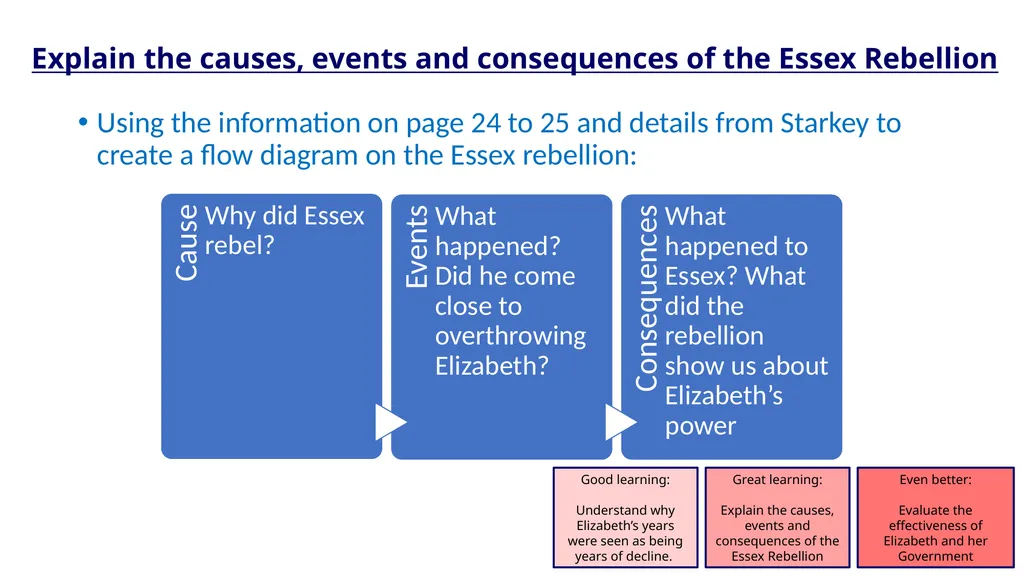
slide1. Explain the causes, events and consequences of the Essex Rebellion Using the information on page 24 to 25 and details from Starkey to create a flow diagram on the Essex rebellion:<br>
slide2. Understand why Elizabeth’s years were seen as being years of decline. Elizabeth’s reign is said to have included 30 years of success and 15 years of failure. In 1588, 30 years into Elizabeth’s reign the Spanish Armada was defeated and England had seen 30 years of very stable Government with very few changes to the Privy Council.
However one by one Elizabeth started to lose her trusted councillors:
Dudley died in 1588, Walsingham in 1590, Hatton in 1591 and Cecil in 1598 (he had been very ill for many years but Elizabeth would not let him resign)
She felt these losses and became angry, depressed and bad tempered. The young councillors who replaced those who died (William Cecil’s son Robert Cecil and Dudley’s step-son the Earl of Essex) were not as loyal to Elizabeth.
It was now clear that Elizabeth was getting old, would not marry and would not have children. People started to think about who the next monarch would be.
Many social and economic problems had not been with dealt with and there had been a lack of reform.
Parliament challenged Elizabeth over monopolies in 1601
The Earl of Essex led a Rebellion in London in 1601
The war with Spain was draining Crown finances Using the information on this slide to explain why the final years of Elizabeth’s reign were seen as years of decline. Identify two main causes of decline and write a paragraph about each.<br>
slide3. Elizabeth Lesson 7: A ‘Golden Age’: living standards and fashions Good learning:

Understand fashion and architecture in Elizabethan England Great learning:

Explain the structure of English society Even better:

Evaluate the evidence about changes in standards of living in Elizabethan Society Key Words:<br>
slide4. The Golden Age?

During Elizabeth l’s reign England experienced a blossoming culture – theatre, art, architecture, literature and music
How far Elizabeth is personally responsible for this is debatable
Golden age more of a myth than a reality?<br>
slide5. Explain the structure of English society Land owners Property owners Increasing power, wealth and influence<br>
slide6. Explain the structure of English society: Statistics Start of Elizabeth’s reign 2.8 million people, at the end of her reign 4.1 million people.
What does such a big rise in population tell you about living standards?
What would the consequences be of this significant change?<br>
slide7. Explain the structure of English society Pastimes – What are the differences between these two groups?
By Elizabeth’s time the upper classes saw their culture as superior. Huge inequalities existed within Tudor society and whilst the theatre was universally popular there were two cultures:
Higher society - the invention of the printing press and spread of education meant that gentlemen were part of an elitist culture involved in intellectual pursuits, such as reading the classics, studying music, hunting and hawking.
Lower society - the vast majority were involved in popular cultural pursuits, which gave them a brief escape from their harsh living conditions. Inns and taverns were an important part of every social ritual. Drinking, gambling on bear-baiting, cards, dice and racing were popular. Tobacco smoking was new and expensive but it was growing in popularity by the end of Elizabeth’s reign. Ordinary people also took part in wrestling, running races and football.<br>
slide8. An English Renaissance Elizabethan era saw an explosion of cultural achievement
Queen and court set fashions that were than copied
The Gentry became more important – they had disposable income which they invested in artists, builders, musicians, writers
Increase in literature due to the printing press (mass production)
Science started to develop (interest in planets & human body
Historians started to base their writings on past sources<br>
slide9. FASHION<br>
slide10. The difference in fashion 1568 – 2018 …<br>
slide11. Understand fashion in Elizabethan England The growth of the English wool industry and increased international trade and meant that a wide range of cloth was available
Fashion was an important status symbol
Fashion would display your social standing and this was controlled by law (Statutes of Apparel 1574) making people dress fitting their social rank.
Why do you think this was done? Do you think this has links to today?<br>
slide12. Elizabeth Video: https://www.youtube.com/watch?v=Tzt8f0FyiCE

Detailed video: https://www.youtube.com/watch?v=y87IOyUqUqU
Produce diagrams showing the fashions for gentlemen and women

P. 36<br>
slide13. Does anyone know what this building is?<br>
slide14. Hardwick Hall Was built by the Countess of Shrewsbury (known as Bess of Hardwick), after the queen Bess was the wealthiest woman in England
One of the many houses during Elizabeth’s reign to make a statement
Give an impression of style and wealth
Although did not reflect every sector of society throughout Elizabeth l’s reign<br>
slide15. Evaluate the evidence about changes in standards of living in Elizabethan Society Development Architecture (pages 33 and 37)

How did architecture change over time?
How did these mean life was improving for people in Elizabethan society?
Why did people have the money to make improvements?<br>
slide16. Main Points Building boom – extravagant country houses were built to reflect the wealth and stability of the era
Stronger government had a reflect on design – higher stability less of a need for defensive features (moats and drawbridges)
Architects focused on symmetry and size, designed to amaze all who saw them
Rising food prices had led to increased profits for landowners and houses that used the latest styles were a status symbol<br>
slide17. Evaluate the evidence about changes in standards of living in Elizabethan Society Using information from today’s lesson write a paragraph to explain what changes were taking place in the standard of living of English people.
Include:
Some detail on fashion
Some detail on pastimes
Some detail on architecture<br>
slide18. Flip Learning 3.1 – A Golden Age<br>
slide19. Income The Nobility and the Gentry
The Queen: £60,000 per annum
A Nobleman: £15,000 - £25,000 per annum
Country Gentleman (Gentry): £50 - £150 per annum
The Archbishop of Canterbury: £30,000 per annum
Town Dwellers
Successful Merchant: £100 - £25,000 per annum
Skilled Labourer: 8d - 12d per day
Carpenter: 5s per week
Unskilled Labourer: 3d - 4d per day Servants
Note: Servants incomes as they are listed here do not include tips, which could bring in more than regular wages.
Manservant: £2, 12s, 4d per annum)
Groom: £2 or less per annum
Maid: 40 shillings
Stable Boy: 40 shillings
Country Folk
Country Parson: 20s per annum
Field Worker: 2d - 3d per day
Ploughman: 1s per week with board
Shepherd: 6d per week with board
Thatcher: 2s for 5 days work<br>
slide20. Cost of living Clothing and Fabrics
Clothing for the Earl of Leicester: £563 for 7 doublets & 2 cloaks
Good Shirt: £1
Pair of knitted stockings: 15s
Courtier's breeches: £7
A good pair of boots: £4 - £·10 a pair
Shoes for a child: 7d a pair
Crimson satin: 3s a yard
Pair of Valencia gloves: 10d
Velvet: 34s a yard
Spanish leather pumps: 1s6d
A soldier's coat: 6s4d Food and Drink
A loaf of bread: 2d
200 herrings: 3s
A chicken: 1d
Raisins: 3d per pound
A goose: 4d
Best beef: 3d per pound
Best mutton: 11/2d per pound
Sugar: 1s per pound
Bottle of French Wine: 2s
A tankard of Ale: 1/2d Odds and Ends
Tobacco: 12s 64s per pound
A small, undecorated book: 8d
A large, ornamented book: 10s or more
A doctor's visit: 1 Mark
A Nicholas Hilliard miniature: £40
Typical tip for a servant: 3/4d
A pair of scissors: 6d
A post horse from Dover to London: 3s Major Outlays
Annual household expenses for the Earl of Derby: £3,000
Cost of rebuilding Kenilworth: £60,000
Housing
Lodging in an Inn: 2d per week (with Laundry)
A modest farm with an ancient lease: £4 - £5 per year
A modest farm with a new lease: £50 - £100 per year<br>