
Exploring Environmental Science for AP® 1st
MS
Published · 47 slides · 0 views
1 / 1



Description
Exploring Environmental Science for AP 1st Edition Chapter 1 The Environment and Sustainability Copyright 2018 Cengage Learning. All Rights Reserved. May not be copied, scanned, or duplicated, in whole or in part, except for use as
Related Topics
Share
Embed code
Download this presentation From Below
"Exploring Environmental Science for AP® 1st" is the property of its rightful owner. Permission is granted to download and print the materials on this website for personal, non-commercial use only, and to display it on your personal computer provided you do not modify the materials and that you retain all copyright notices contained in the materials. By downloading content from our website, you accept the terms of this agreement.
Presentation Transcript
01
Exploring Environmental Science for AP® 1st Edition Chapter 1
The Environment and Sustainability Copyright © 2018 Cengage Learning. All Rights Reserved. May not be copied, scanned, or duplicated, in whole or in part, except for use as permitted in a license distributed with a certain product or service or otherwise on a password-protected website for classroom use.<br>
The Environment and Sustainability Copyright © 2018 Cengage Learning. All Rights Reserved. May not be copied, scanned, or duplicated, in whole or in part, except for use as permitted in a license distributed with a certain product or service or otherwise on a password-protected website for classroom use.<br>
02
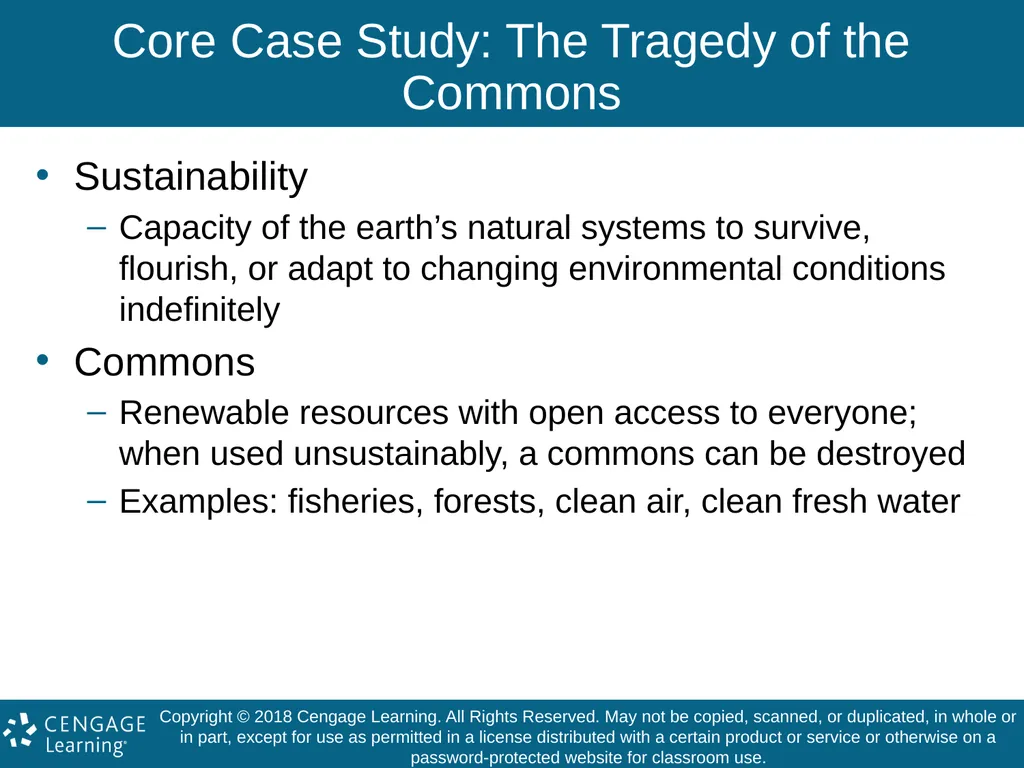
Core Case Study: The Tragedy of the Commons Sustainability
Capacity of the earth’s natural systems to survive, flourish, or adapt to changing environmental conditions indefinitely
Commons
Renewable resources with open access to everyone; when used unsustainably, a commons can be destroyed
Examples: fisheries, forests, clean air, clean fresh water<br>
Capacity of the earth’s natural systems to survive, flourish, or adapt to changing environmental conditions indefinitely
Commons
Renewable resources with open access to everyone; when used unsustainably, a commons can be destroyed
Examples: fisheries, forests, clean air, clean fresh water<br>
03
1.1 What Are Some Key Principles of Sustainability? (1 of 2) Environmental science studies connections in nature
How the earth works and has survived and thrived
How humans interact with the environment
How we can live more sustainably
Ecology
Branch of biology focusing on interaction of living things with their environment<br>
How the earth works and has survived and thrived
How humans interact with the environment
How we can live more sustainably
Ecology
Branch of biology focusing on interaction of living things with their environment<br>
04
What Are Some Key Principles of Sustainability? (2 of 2) Ecosystem
Set of organisms interacting in a defined area
Environmentalism (environmental activism)
Social movement dedicated to protecting the earth’s life and resources
Practiced in realms of politics and ethics
Findings of environmental science can provide evidence<br>
Set of organisms interacting in a defined area
Environmentalism (environmental activism)
Social movement dedicated to protecting the earth’s life and resources
Practiced in realms of politics and ethics
Findings of environmental science can provide evidence<br>
05
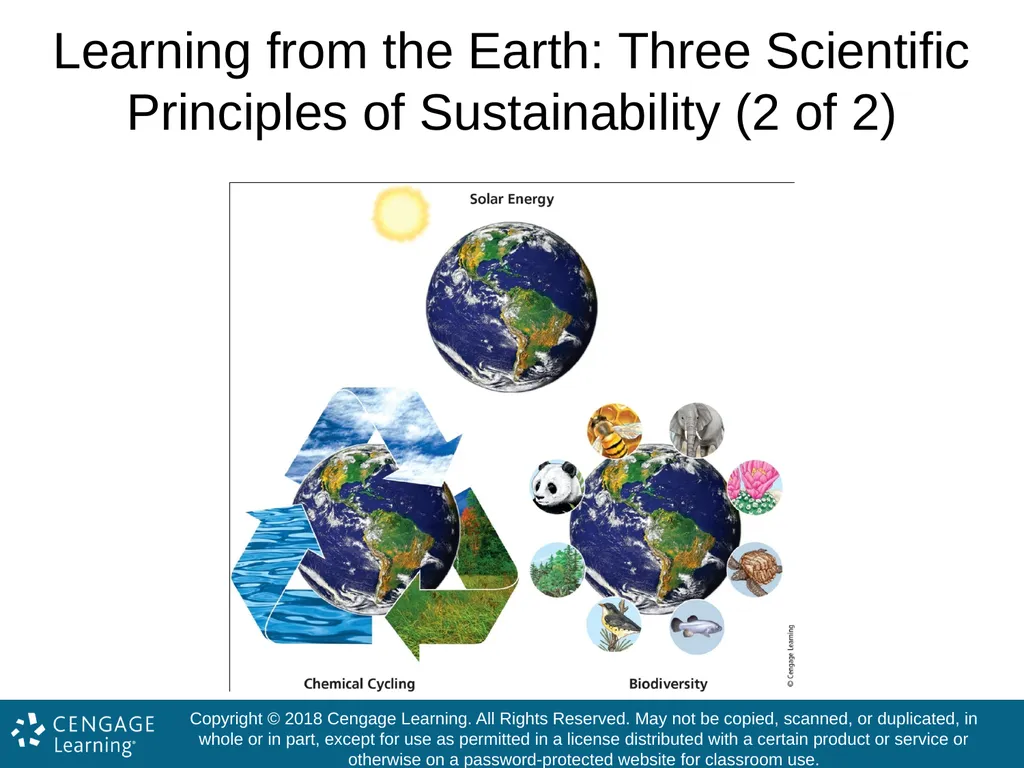
Learning from the Earth: Three Scientific Principles of Sustainability (1 of 2) Dependence on solar energy
The sun provides warmth and provides energy plants use to produce nutrients
Biodiversity
Astounding variety and adaptability of natural systems and species
Chemical (nutrient) cycling
Circulation from the environment to organisms and then back to the environment<br>
The sun provides warmth and provides energy plants use to produce nutrients
Biodiversity
Astounding variety and adaptability of natural systems and species
Chemical (nutrient) cycling
Circulation from the environment to organisms and then back to the environment<br>
06
Learning from the Earth: Three Scientific Principles of Sustainability (2 of 2)<br>
07
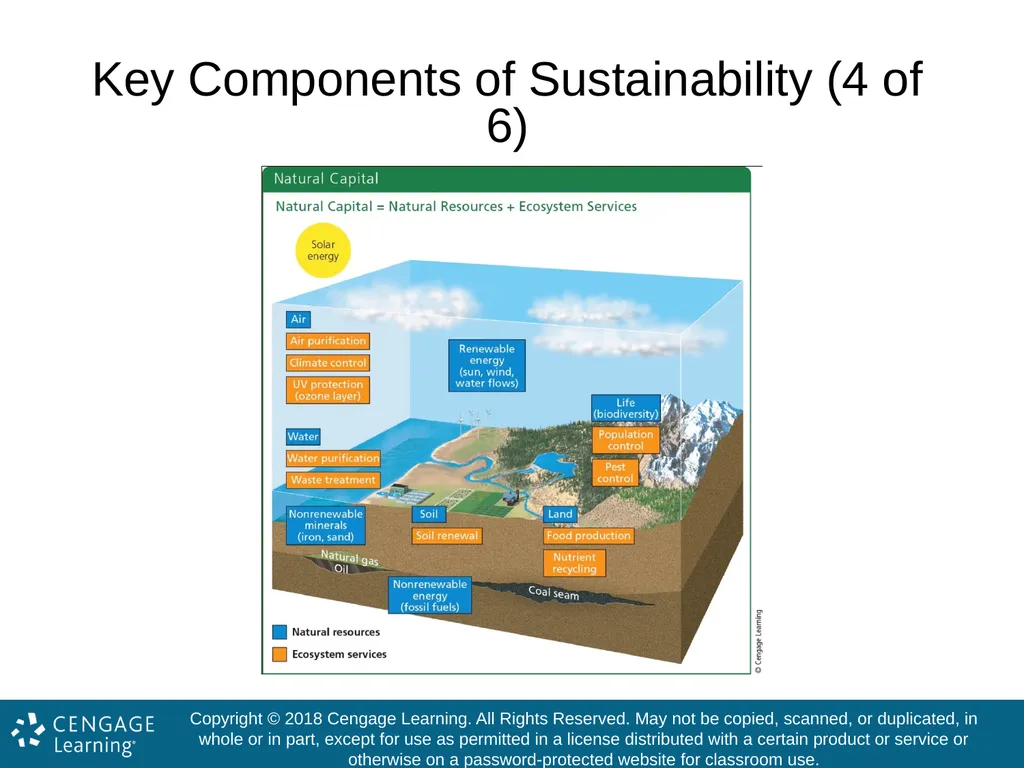
Key Components of Sustainability (1 of 6) Natural capital keeps humans and other species alive and supports economies
Natural resources: useful materials and energy in nature
May be inexhaustible, renewable, or nonrenewable (exhaustible)
Ecosystem services
Processes provided by healthy ecosystems<br>
Natural resources: useful materials and energy in nature
May be inexhaustible, renewable, or nonrenewable (exhaustible)
Ecosystem services
Processes provided by healthy ecosystems<br>
08
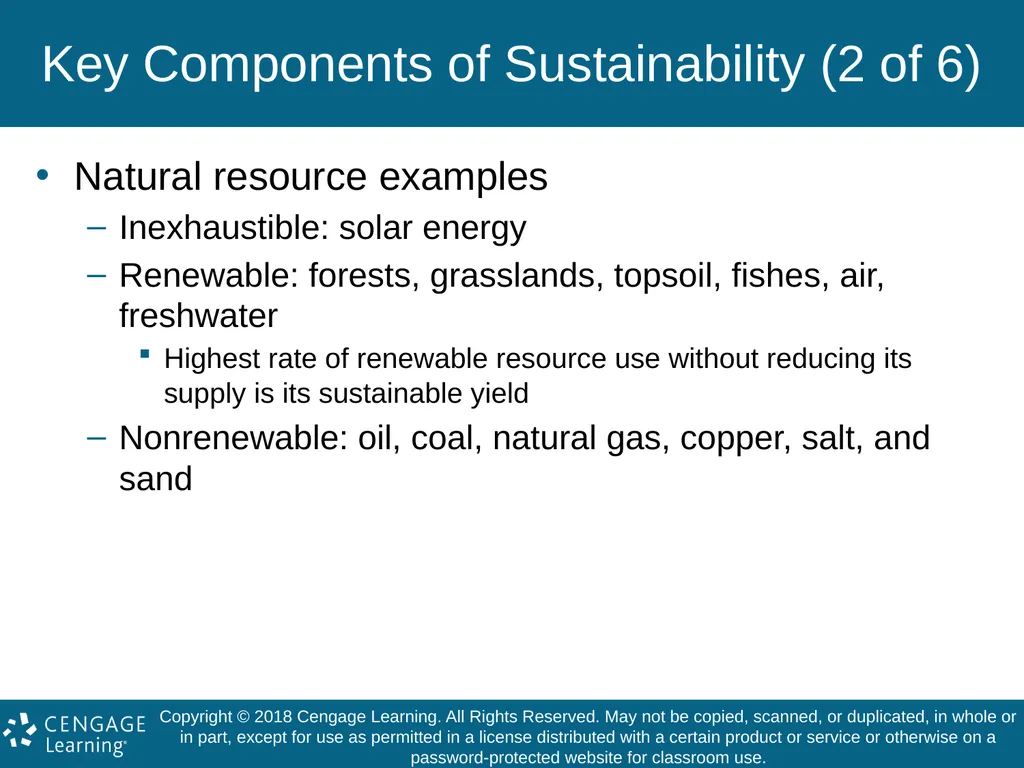
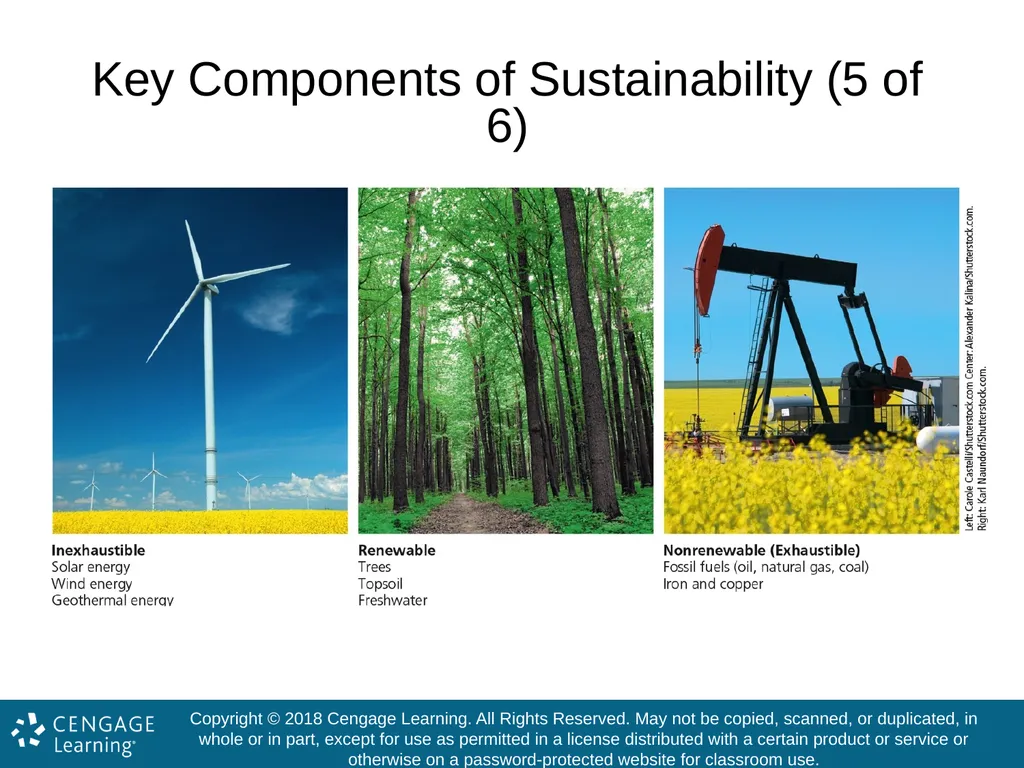
Key Components of Sustainability (2 of 6) Natural resource examples
Inexhaustible: solar energy
Renewable: forests, grasslands, topsoil, fishes, air, freshwater
Highest rate of renewable resource use without reducing its supply is its sustainable yield
Nonrenewable: oil, coal, natural gas, copper, salt, and sand<br>
Inexhaustible: solar energy
Renewable: forests, grasslands, topsoil, fishes, air, freshwater
Highest rate of renewable resource use without reducing its supply is its sustainable yield
Nonrenewable: oil, coal, natural gas, copper, salt, and sand<br>
09
Key Components of Sustainability (3 of 6) Nutrient cycling is a vital ecosystem service
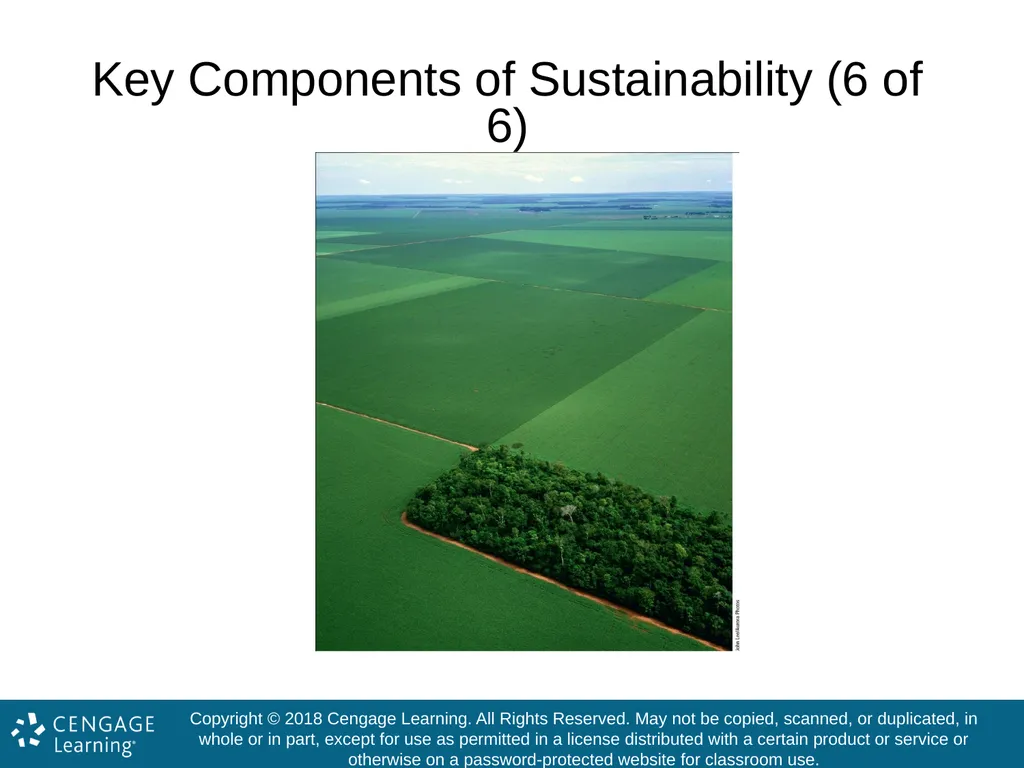
Human activities can degrade natural capital
Using renewable resources too fast
Overloading air, water, and soil with wastes and pollutants
Humans must provide solutions to environmental problems<br>
Human activities can degrade natural capital
Using renewable resources too fast
Overloading air, water, and soil with wastes and pollutants
Humans must provide solutions to environmental problems<br>
10
Key Components of Sustainability (4 of 6)<br>
11
Key Components of Sustainability (5 of 6)<br>
12
Key Components of Sustainability (6 of 6)<br>
13
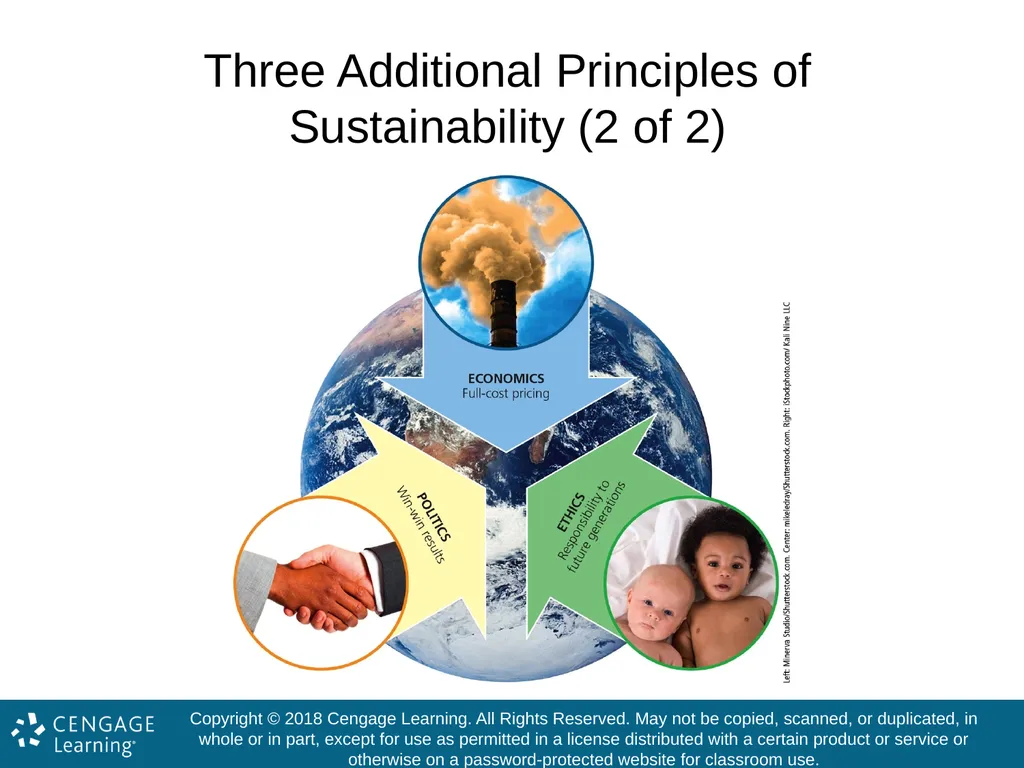
Three Additional Principles of Sustainability (1 of 2) Full-cost pricing
Include harmful environmental and health costs in market prices of goods and services
Win-win solutions
Look for solutions that will benefit people and the environment
A responsibility to future generations
Leave planet’s life-support system in same or better condition than it is now<br>
Include harmful environmental and health costs in market prices of goods and services
Win-win solutions
Look for solutions that will benefit people and the environment
A responsibility to future generations
Leave planet’s life-support system in same or better condition than it is now<br>
14
Three Additional Principles of Sustainability (2 of 2)<br>
15
Countries Differ in Their Resource Use and Environmental Impact More-developed countries
Industrialized nations with high average income per person
17% of the world’s population
Use 70% of world’s natural resources
Less-developed countries
83% of the world’s population
Use about 30% of world’s natural resources<br>
Industrialized nations with high average income per person
17% of the world’s population
Use 70% of world’s natural resources
Less-developed countries
83% of the world’s population
Use about 30% of world’s natural resources<br>
16
1.2 How Are Our Ecological Footprints Affecting the Earth? Many people have a better quality of life
Humans have developed useful materials and products
Life spans increasing
Food supply more abundant and safer
Exposure to toxic chemicals more avoidable
Humans have protected some endangered species and ecosystems
Taken steps to restore cleared lands<br>
Humans have developed useful materials and products
Life spans increasing
Food supply more abundant and safer
Exposure to toxic chemicals more avoidable
Humans have protected some endangered species and ecosystems
Taken steps to restore cleared lands<br>
17
We Are Living Unsustainably (1 of 3) Environmental degradation
Wasting, depleting, and degrading the earth’s natural capital
Human activities directly affect 83% of earth’s land surface
Urban development, crop and energy production, mining, timber cutting, and more
Species are becoming extinct 100 times faster than in prehuman times<br>
Wasting, depleting, and degrading the earth’s natural capital
Human activities directly affect 83% of earth’s land surface
Urban development, crop and energy production, mining, timber cutting, and more
Species are becoming extinct 100 times faster than in prehuman times<br>
18
We Are Living Unsustainably (2 of 3)<br>
19
Human Land Use: Private and Public Land
(1 of 2) Humans use 83% of earth’s land
Examples of degradation: forest loss, overgrazing of grasslands, soil erosion, oil spills, runoff of fertilizers in waterways
Private lands
Owned by individuals or businesses
Public lands
Jointly owned by citizens and government<br>
Examples of degradation: forest loss, overgrazing of grasslands, soil erosion, oil spills, runoff of fertilizers in waterways
Private lands
Owned by individuals or businesses
Public lands
Jointly owned by citizens and government<br>
20
Human Land Use: Private and Public Land
(1 of 2) Types of Federal Public Land
National Park System
National Forest System
Land managed by Bureau of Land Management
National Park System
National Wildlife Refuges
National Wilderness Preservation<br>
National Park System
National Forest System
Land managed by Bureau of Land Management
National Park System
National Wildlife Refuges
National Wilderness Preservation<br>
21
We Are Living Unsustainably (3 of 3)<br>
22
Our Growing Ecological Footprint Ecological footprint
Amount of biologically productive land and water needed to supply a population with renewable resources and recycle wastes
Sustainability measure that relates to the earth’s biocapacity
Ecological deficit
Footprint larger than biological capacity for replenishment<br>
Amount of biologically productive land and water needed to supply a population with renewable resources and recycle wastes
Sustainability measure that relates to the earth’s biocapacity
Ecological deficit
Footprint larger than biological capacity for replenishment<br>
23
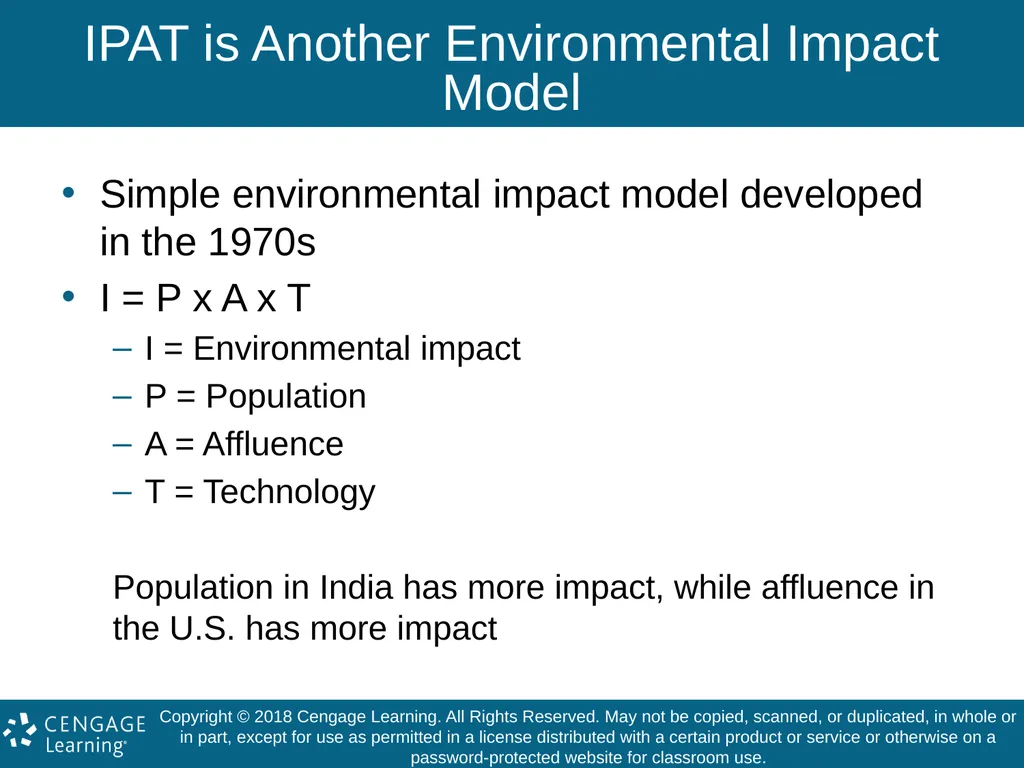
IPAT is Another Environmental Impact Model Simple environmental impact model developed in the 1970s
I = P x A x T
I = Environmental impact
P = Population
A = Affluence
T = Technology
Population in India has more impact, while affluence in the U.S. has more impact<br>
I = P x A x T
I = Environmental impact
P = Population
A = Affluence
T = Technology
Population in India has more impact, while affluence in the U.S. has more impact<br>
24
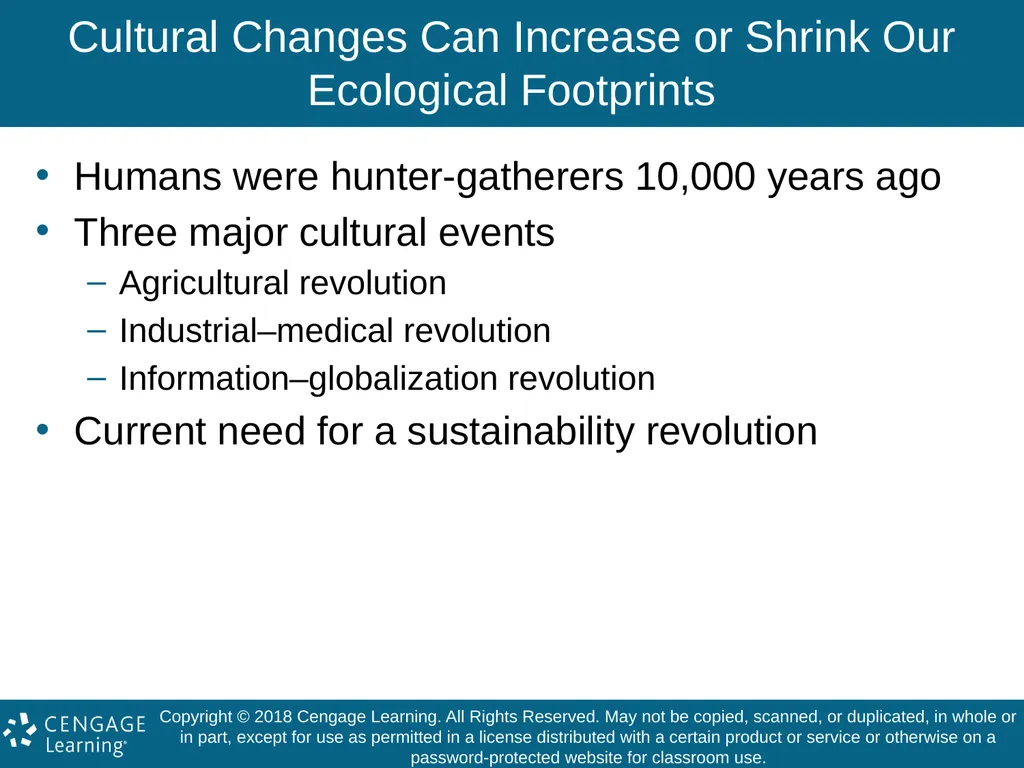
Cultural Changes Can Increase or Shrink Our Ecological Footprints Humans were hunter-gatherers 10,000 years ago
Three major cultural events
Agricultural revolution
Industrial–medical revolution
Information–globalization revolution
Current need for a sustainability revolution<br>
Three major cultural events
Agricultural revolution
Industrial–medical revolution
Information–globalization revolution
Current need for a sustainability revolution<br>
25
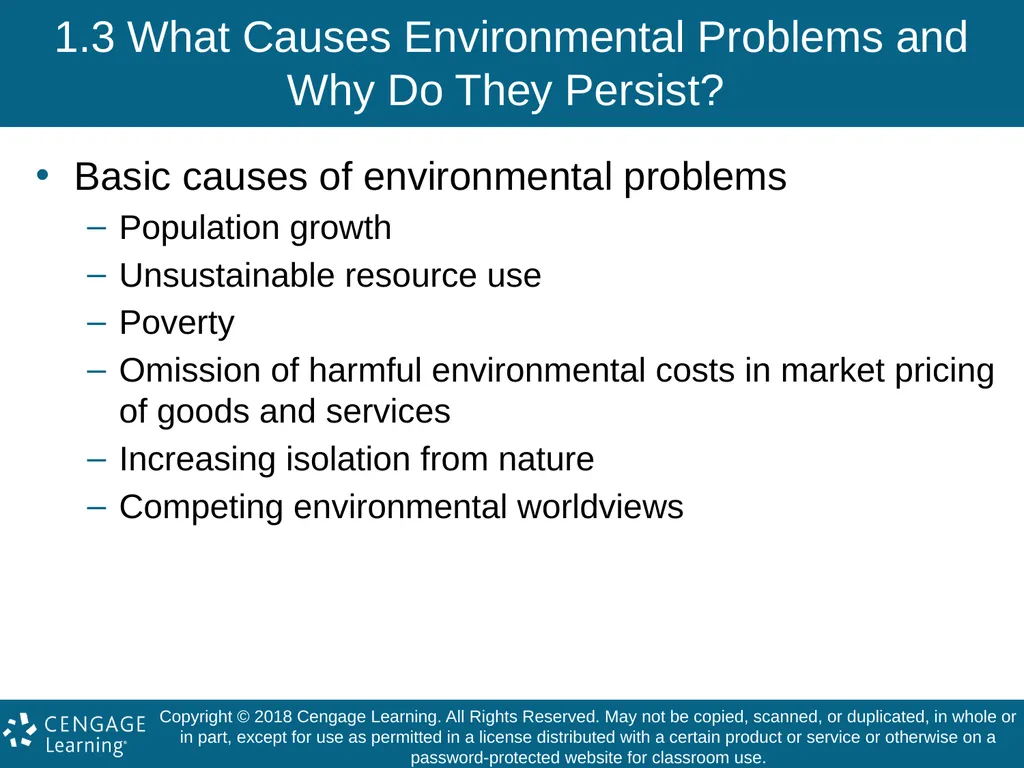
1.3 What Causes Environmental Problems and Why Do They Persist? Basic causes of environmental problems
Population growth
Unsustainable resource use
Poverty
Omission of harmful environmental costs in market pricing of goods and services
Increasing isolation from nature
Competing environmental worldviews<br>
Population growth
Unsustainable resource use
Poverty
Omission of harmful environmental costs in market pricing of goods and services
Increasing isolation from nature
Competing environmental worldviews<br>
26
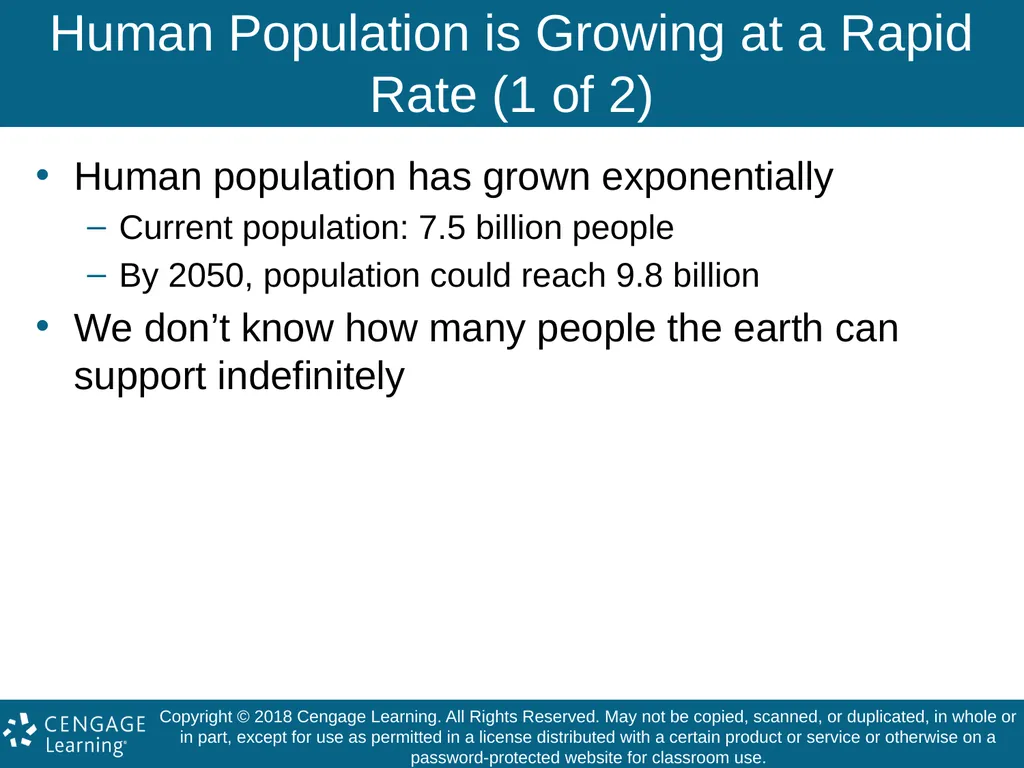
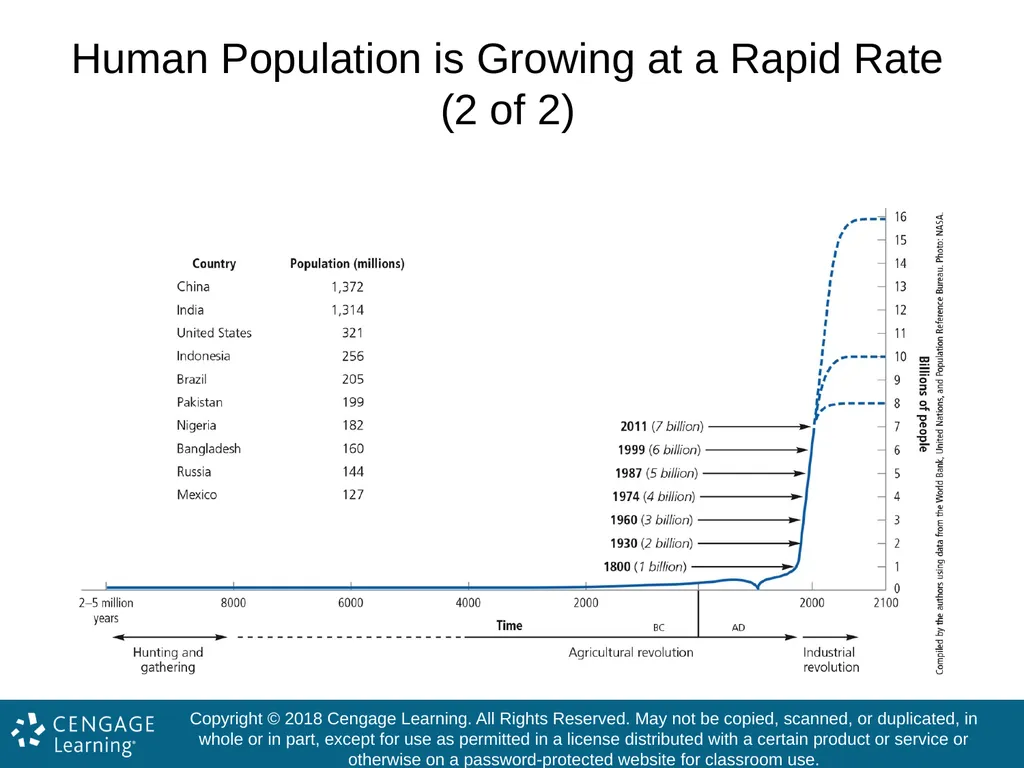
Human Population is Growing at a Rapid Rate (1 of 2) Human population has grown exponentially
Current population: 7.5 billion people
By 2050, population could reach 9.8 billion
We don’t know how many people the earth can support indefinitely<br>
Current population: 7.5 billion people
By 2050, population could reach 9.8 billion
We don’t know how many people the earth can support indefinitely<br>
27
Human Population is Growing at a Rapid Rate (2 of 2)<br>
28
Affluence and Unstainable Resource Use Affluence results in increased resource consumption per person
Increases environmental degradation, wastes, and pollution
Positive aspects of affluence
Better and widespread education
Increased awareness of environmental issues
Money available to develop technologies with beneficial environmental impacts<br>
Increases environmental degradation, wastes, and pollution
Positive aspects of affluence
Better and widespread education
Increased awareness of environmental issues
Money available to develop technologies with beneficial environmental impacts<br>
29
Poverty Has Harmful Environmental and Health Effects (1 of 3) People lack enough money to fulfill basic needs
Adequate food, water, shelter, health care, and education
Short-term survival more important than environmental concerns
Malnutrition and lack of clean drinking water
Causes premature death for 7 million children under age 5 each year<br>
Adequate food, water, shelter, health care, and education
Short-term survival more important than environmental concerns
Malnutrition and lack of clean drinking water
Causes premature death for 7 million children under age 5 each year<br>
30
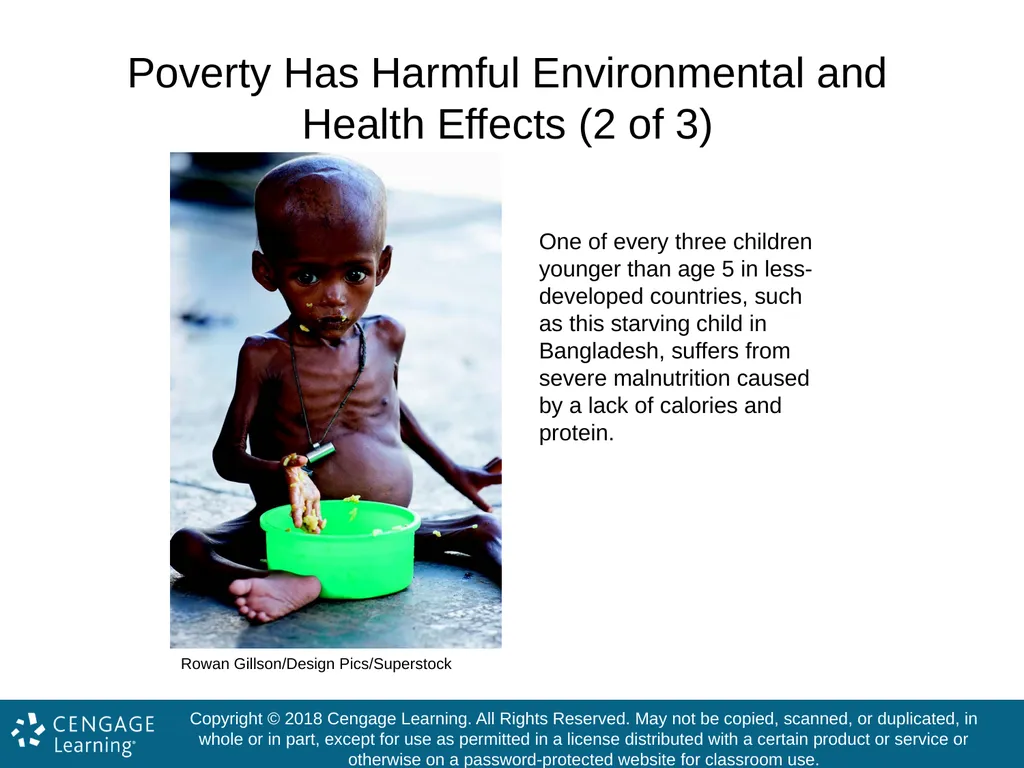
Poverty Has Harmful Environmental and Health Effects (2 of 3) Rowan Gillson/Design Pics/Superstock One of every three children younger than age 5 in less-developed countries, such as this starving child in
Bangladesh, suffers from severe malnutrition caused by a lack of calories and protein.<br>
Bangladesh, suffers from severe malnutrition caused by a lack of calories and protein.<br>
31
Poverty Has Harmful Environmental and Health Effects (3 of 3) Ways to reduce poverty include
Reduce malnutrition and infectious diseases
Provide universal primary school education
Reduce population growth
Make small, low-interest loans to poor people<br>
Reduce malnutrition and infectious diseases
Provide universal primary school education
Reduce population growth
Make small, low-interest loans to poor people<br>
32
Prices of Goods and Services Rarely Include Their Harmful Environmental and Health Costs Companies do not pay the environmental cost of resource use
Goods and services do not include the harmful environmental costs
Consumers lack information
Companies receive tax breaks and subsidies
Some subsidies encourage depletion of natural capital<br>
Goods and services do not include the harmful environmental costs
Consumers lack information
Companies receive tax breaks and subsidies
Some subsidies encourage depletion of natural capital<br>
33
People Are Increasingly Isolated from Nature Increasing populations in urban areas
Lack of contact with nature
Benefits of outdoor activities
Better health
Reduced stress
Improved mental capabilities
Increased imagination and creativity
Sense of connection with the earth<br>
Lack of contact with nature
Benefits of outdoor activities
Better health
Reduced stress
Improved mental capabilities
Increased imagination and creativity
Sense of connection with the earth<br>
34
People Have Different Views on Environmental Problems and Their Solutions (1 of 3) Environmental worldview
Set of assumptions and values about interactions with the natural world
Environmental ethics
Example ethical questions
Why should we care about the environment?
Do we have an obligation to protect other species against extinction caused by human actions?
Should every person be entitled to equal protection from environmental hazards?<br>
Set of assumptions and values about interactions with the natural world
Environmental ethics
Example ethical questions
Why should we care about the environment?
Do we have an obligation to protect other species against extinction caused by human actions?
Should every person be entitled to equal protection from environmental hazards?<br>
35
People Have Different Views on Environmental Problems and Their Solutions (2 of 3) Human-centered environmental worldview
Planetary management worldview
Stewardship worldview
Environmental wisdom<br>
Planetary management worldview
Stewardship worldview
Environmental wisdom<br>
36
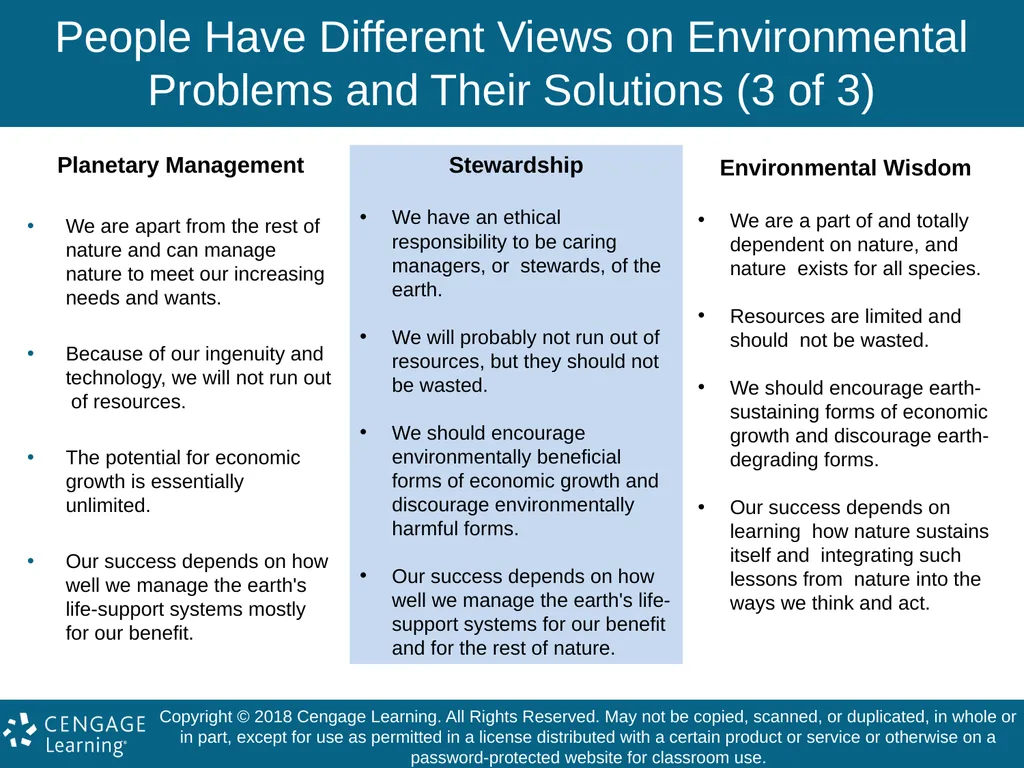
People Have Different Views on Environmental Problems and Their Solutions (3 of 3) Planetary Management
We are apart from the rest of nature and can manage nature to meet our increasing needs and wants.
Because of our ingenuity and technology, we will not run out of resources.
The potential for economic growth is essentially unlimited.
Our success depends on how well we manage the earth's life-support systems mostly for our benefit. Stewardship
We have an ethical responsibility to be caring managers, or stewards, of the earth.
We will probably not run out of resources, but they should not be wasted.
We should encourage environmentally beneficial forms of economic growth and discourage environmentally harmful forms.
Our success depends on how well we manage the earth's life-support systems for our benefit and for the rest of nature. Environmental Wisdom
We are a part of and totally dependent on nature, and nature exists for all species.
Resources are limited and should not be wasted.
We should encourage earth- sustaining forms of economic growth and discourage earth-degrading forms.
Our success depends on learning how nature sustains itself and integrating such lessons from nature into the ways we think and act.<br>
We are apart from the rest of nature and can manage nature to meet our increasing needs and wants.
Because of our ingenuity and technology, we will not run out of resources.
The potential for economic growth is essentially unlimited.
Our success depends on how well we manage the earth's life-support systems mostly for our benefit. Stewardship
We have an ethical responsibility to be caring managers, or stewards, of the earth.
We will probably not run out of resources, but they should not be wasted.
We should encourage environmentally beneficial forms of economic growth and discourage environmentally harmful forms.
Our success depends on how well we manage the earth's life-support systems for our benefit and for the rest of nature. Environmental Wisdom
We are a part of and totally dependent on nature, and nature exists for all species.
Resources are limited and should not be wasted.
We should encourage earth- sustaining forms of economic growth and discourage earth-degrading forms.
Our success depends on learning how nature sustains itself and integrating such lessons from nature into the ways we think and act.<br>
37
Revisiting the Tragedy of the Commons Increasing human population and affluence increases the demand for more fish, ultimately depleting fish resources
Isolation from nature results in a lack of understanding of the earth’s life support systems and how these systems support out economy
Cooperative allotment and enforcement systems control fish catches and ensure that harvests are kept at a sustainable level<br>
Isolation from nature results in a lack of understanding of the earth’s life support systems and how these systems support out economy
Cooperative allotment and enforcement systems control fish catches and ensure that harvests are kept at a sustainable level<br>
38
1.4 What is the Role of Economics? Economic Systems Depend on Natural Capital
Economics is the social science that deals with the production, distribution, and consumption of goods and services
Natural capital
Human capital
Manufactured capital
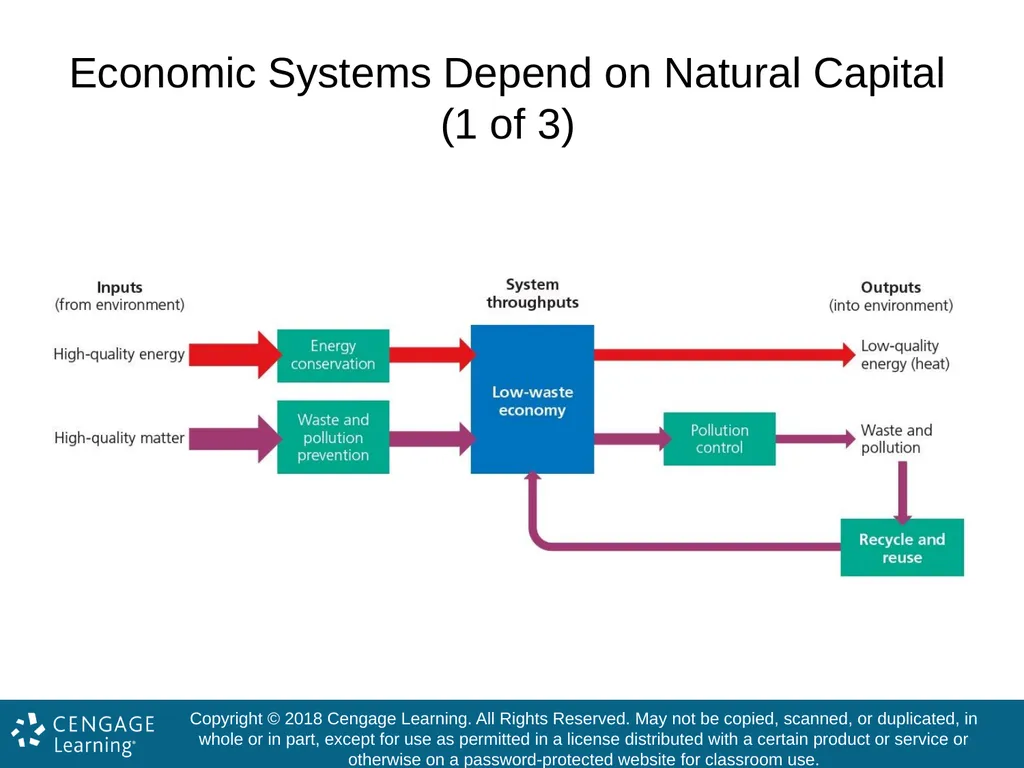
A low-throughput system uses nature as a model for a more sustainable economy<br>
Economics is the social science that deals with the production, distribution, and consumption of goods and services
Natural capital
Human capital
Manufactured capital
A low-throughput system uses nature as a model for a more sustainable economy<br>
39
Economic Systems Depend on Natural Capital (1 of 3)<br>
40
Economic Systems Depend on Natural Capital
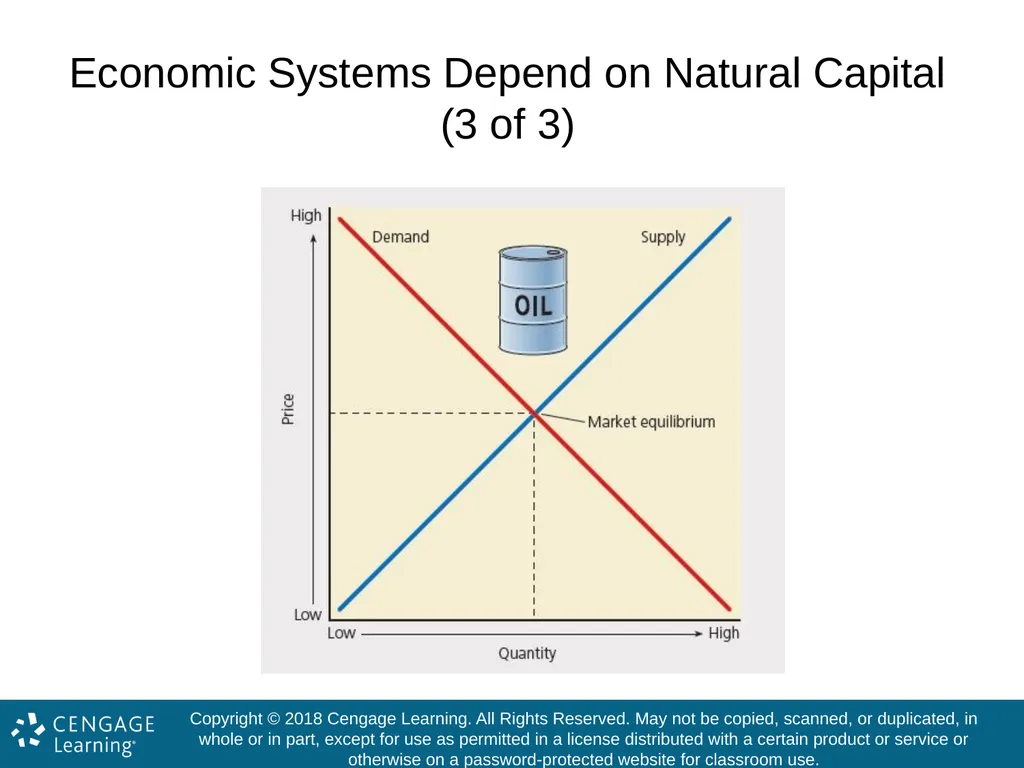
(2 of 3) In a free market society, economic decisions are governed by the interaction of supply and demand<br>
41
Economic Systems Depend on Natural Capital (3 of 3)<br>
42
Using Economic Tools to Deal with Environmental Problems (1 of 2) Full Cost Pricing
Inclusion of health and environmental costs in the price of products
Subsidies
Tax break given to a company in order to make them more competitive
Can help to provide jobs, but can also encourage environmental degradation<br>
Inclusion of health and environmental costs in the price of products
Subsidies
Tax break given to a company in order to make them more competitive
Can help to provide jobs, but can also encourage environmental degradation<br>
43
Using Economic Tools to Deal with Environmental Problems (2 of 2) Taxes
can encourage sustainability by taxing pollution but lowering taxes on labor, income, and wealth<br>
can encourage sustainability by taxing pollution but lowering taxes on labor, income, and wealth<br>
44
1.5 What is the Role of Government? Environmental policy
environmental laws, regulations, and programs that are designed , implemented, and enforced by one or more governmental agencies.
Environmental agencies
Environmental Protection Agency, Department of Energy, U.S. Fish and Wildlife Service, National Marine Fisheries Service, Occupational Safety and Health Administration
Implementing laws reduces pollution, saves wild species from extinction, and creates jobs and new technologies.<br>
environmental laws, regulations, and programs that are designed , implemented, and enforced by one or more governmental agencies.
Environmental agencies
Environmental Protection Agency, Department of Energy, U.S. Fish and Wildlife Service, National Marine Fisheries Service, Occupational Safety and Health Administration
Implementing laws reduces pollution, saves wild species from extinction, and creates jobs and new technologies.<br>
45
Global Environmental Security Both military security and economic security are preserved when environmental security is protected
The United Nations works to protect human health, the environment, reduce poverty, and provide infrastructure internationally<br>
The United Nations works to protect human health, the environment, reduce poverty, and provide infrastructure internationally<br>
46
1.6 What is an Environmentally Sustainable Society? Protecting Natural Capital and Living on its Income
Living sustainably means living on the natural capital that nature provides
plants, animals, soil, clean air, clean water<br>
Living sustainably means living on the natural capital that nature provides
plants, animals, soil, clean air, clean water<br>
47
We Can Live More Sustainably To live more sustainably
learn from nature
protect natural capital
stop wasting resources
recycle and reuse
use renewable resources no faster than they can regenerate
incorporate costs to health and environment in the price of the product
accept the responsibility of working together to pass the earth on to future generations in a condition as good or better than it is at present<br>
learn from nature
protect natural capital
stop wasting resources
recycle and reuse
use renewable resources no faster than they can regenerate
incorporate costs to health and environment in the price of the product
accept the responsibility of working together to pass the earth on to future generations in a condition as good or better than it is at present<br>