
Exploring the Relation between Biomedical Entities
TG
Published · 22 slides · 0 views
1 / 1

Description
Exploring the Relation between Biomedical Entities and Government Funding Fang Tan, Siting Yang, Xiaoyan Wu, Jian Xu School of Information Management, Sun Yat-Sen University Exploring the Relation between Biomedical Entities and Government
Related Topics
Share
Embed code
Download this presentation From Below
"Exploring the Relation between Biomedical Entities" is the property of its rightful owner. Permission is granted to download and print the materials on this website for personal, non-commercial use only, and to display it on your personal computer provided you do not modify the materials and that you retain all copyright notices contained in the materials. By downloading content from our website, you accept the terms of this agreement.
Presentation Transcript
01
Exploring the Relation between Biomedical Entities and Government Funding Fang Tan, Siting Yang, Xiaoyan Wu, Jian Xu School of Information Management, Sun Yat-Sen University<br>
02
Exploring the Relation between Biomedical Entities and Government Funding 02 CONTENTS INTRODUCTION 1 METHODOLOGY 3 4 CONCLUSION AND FUTURE WORK PRELIMINARY RESULTS 2 5 REFERENCES<br>
03
03 Background A dramatic increase in the number of biomedical literatures [1]
The federal government plays an important role in the development of scientific research. Exploring the Relation between Biomedical Entities and Government Funding<br>
The federal government plays an important role in the development of scientific research. Exploring the Relation between Biomedical Entities and Government Funding<br>
04
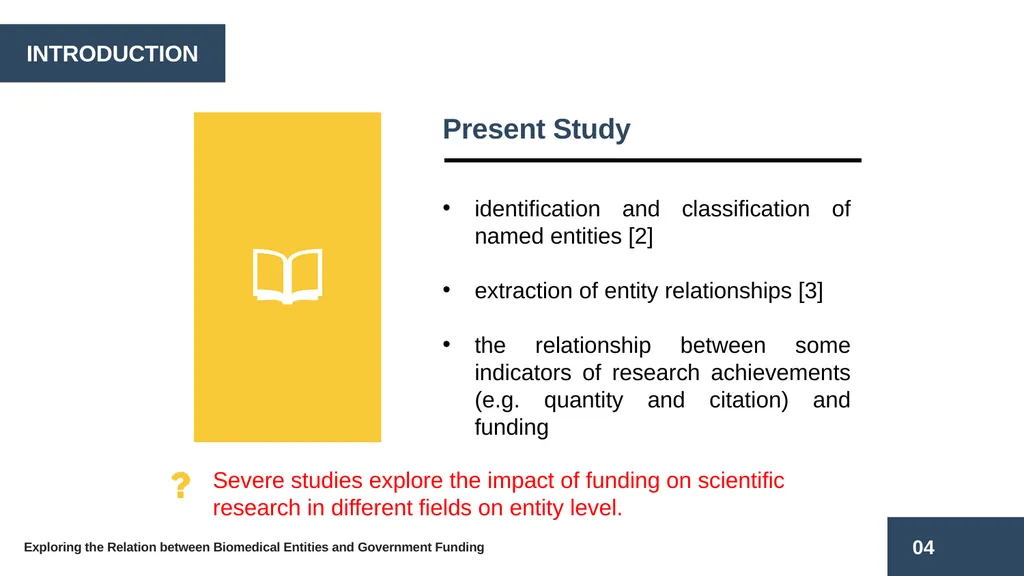
04 Present Study identification and classification of named entities [2]
extraction of entity relationships [3]
the relationship between some indicators of research achievements (e.g. quantity and citation) and funding Severe studies explore the impact of funding on scientific research in different fields on entity level. Exploring the Relation between Biomedical Entities and Government Funding<br>
extraction of entity relationships [3]
the relationship between some indicators of research achievements (e.g. quantity and citation) and funding Severe studies explore the impact of funding on scientific research in different fields on entity level. Exploring the Relation between Biomedical Entities and Government Funding<br>
05
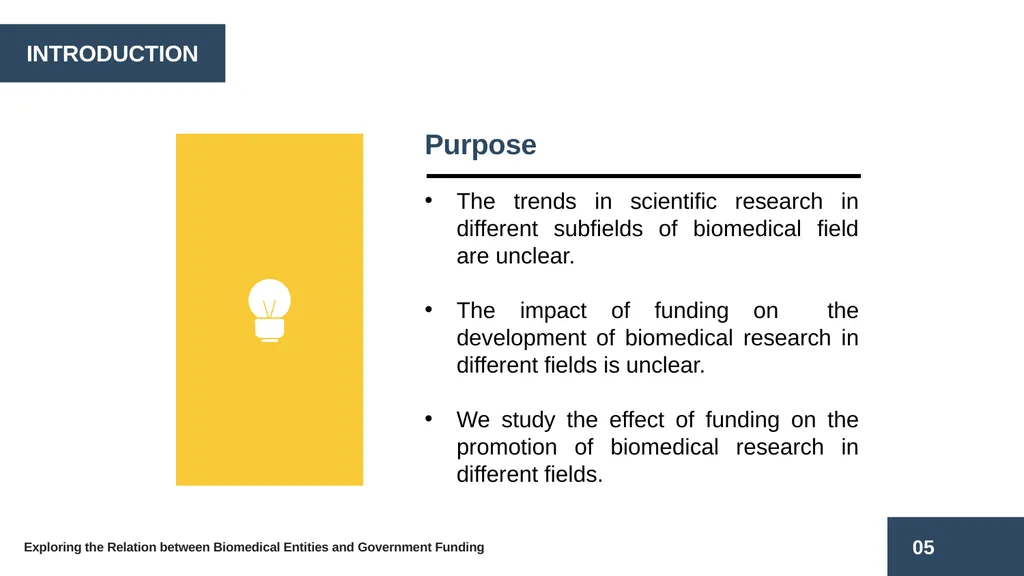
05 Purpose The trends in scientific research in different subfields of biomedical field are unclear.
The impact of funding on the development of biomedical research in different fields is unclear.
We study the effect of funding on the promotion of biomedical research in different fields. Exploring the Relation between Biomedical Entities and Government Funding<br>
The impact of funding on the development of biomedical research in different fields is unclear.
We study the effect of funding on the promotion of biomedical research in different fields. Exploring the Relation between Biomedical Entities and Government Funding<br>
06
Exploring the Relation between Biomedical Entities and Government Funding 06<br>
07
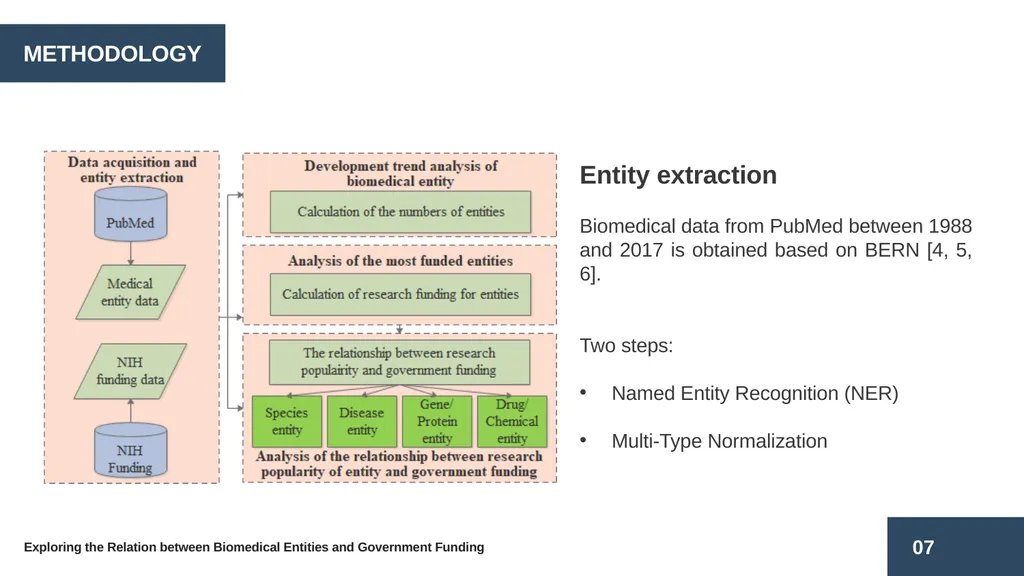
Exploring the Relation between Biomedical Entities and Government Funding 07 Entity extraction
Biomedical data from PubMed between 1988 and 2017 is obtained based on BERN [4, 5, 6].
Two steps:
Named Entity Recognition (NER)
Multi-Type Normalization<br>
Biomedical data from PubMed between 1988 and 2017 is obtained based on BERN [4, 5, 6].
Two steps:
Named Entity Recognition (NER)
Multi-Type Normalization<br>
08
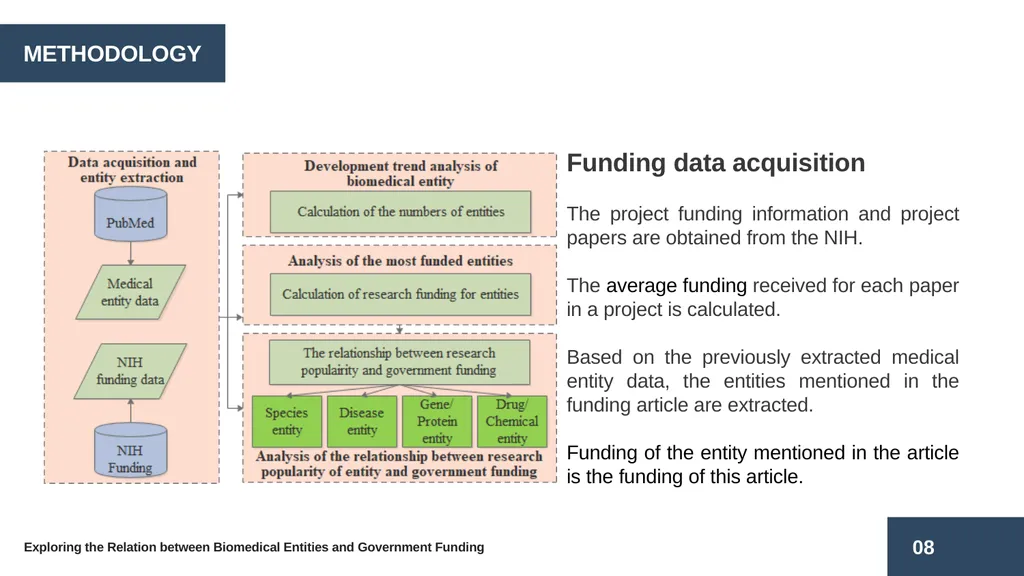
Exploring the Relation between Biomedical Entities and Government Funding 08 Funding data acquisition
The project funding information and project papers are obtained from the NIH.
The average funding received for each paper in a project is calculated.
Based on the previously extracted medical entity data, the entities mentioned in the funding article are extracted.
Funding of the entity mentioned in the article is the funding of this article.<br>
The project funding information and project papers are obtained from the NIH.
The average funding received for each paper in a project is calculated.
Based on the previously extracted medical entity data, the entities mentioned in the funding article are extracted.
Funding of the entity mentioned in the article is the funding of this article.<br>
09
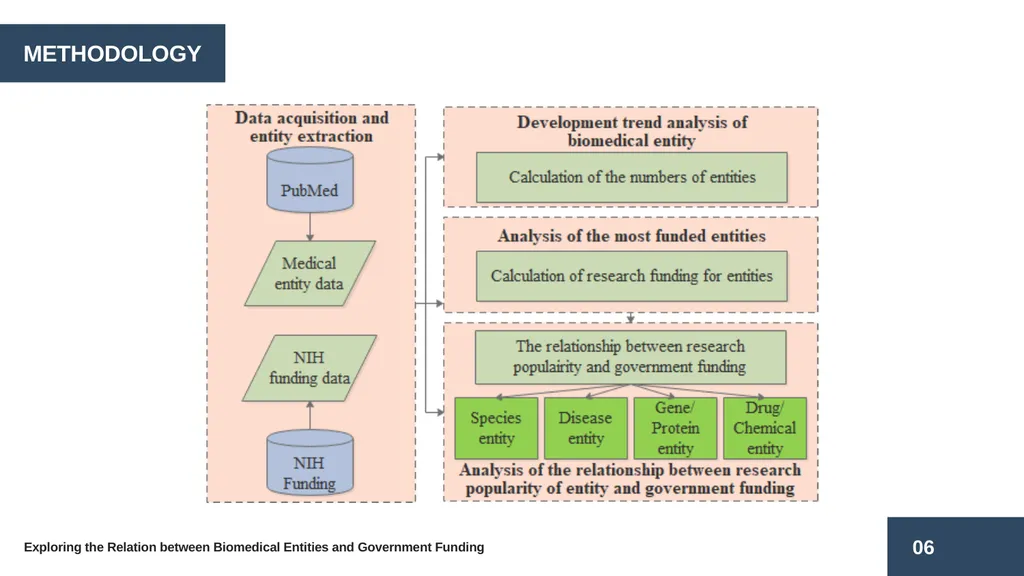
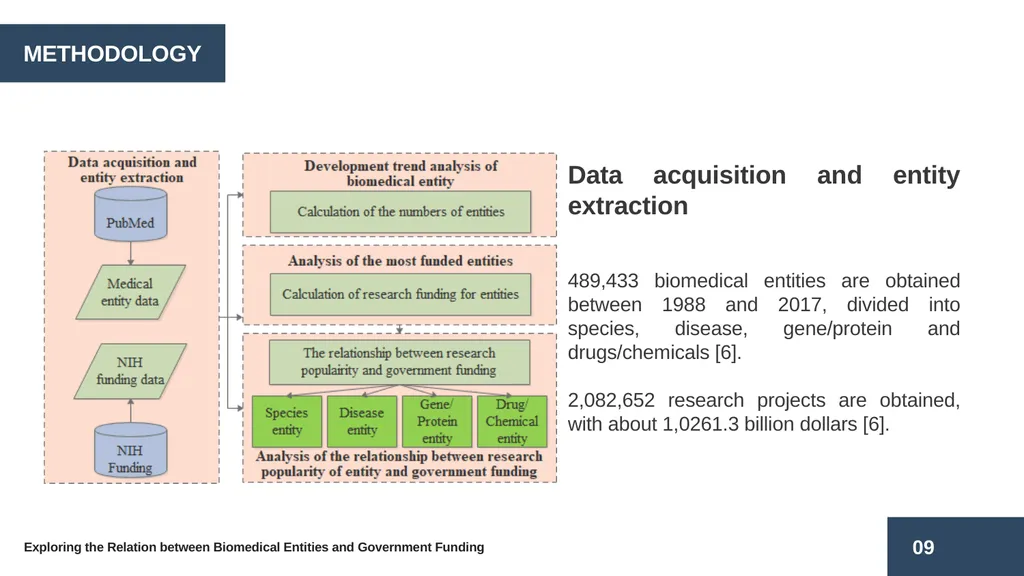
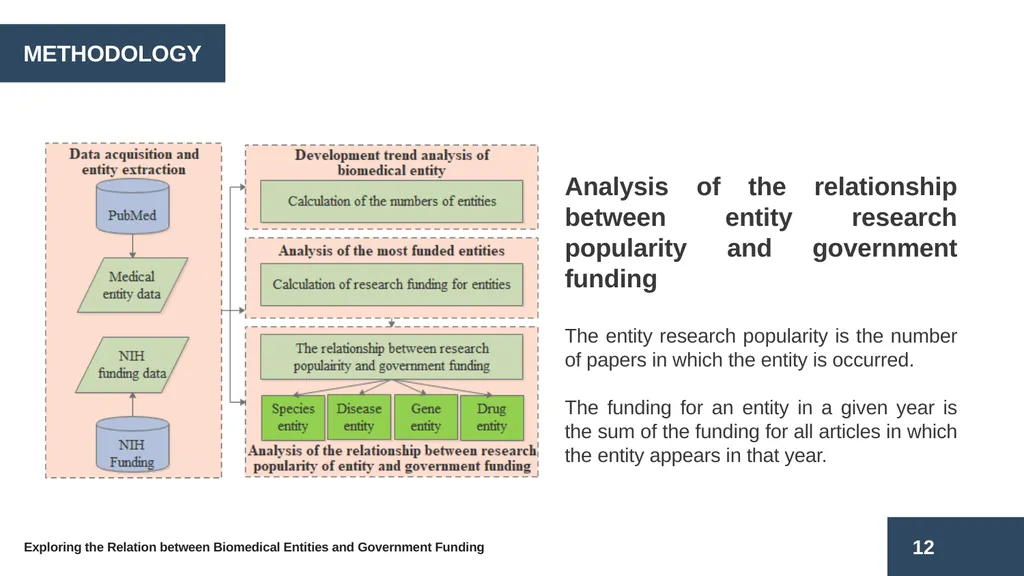
Exploring the Relation between Biomedical Entities and Government Funding 09 Data acquisition and entity extraction
489,433 biomedical entities are obtained between 1988 and 2017, divided into species, disease, gene/protein and drugs/chemicals [6].
2,082,652 research projects are obtained, with about 1,0261.3 billion dollars [6].<br>
489,433 biomedical entities are obtained between 1988 and 2017, divided into species, disease, gene/protein and drugs/chemicals [6].
2,082,652 research projects are obtained, with about 1,0261.3 billion dollars [6].<br>
10
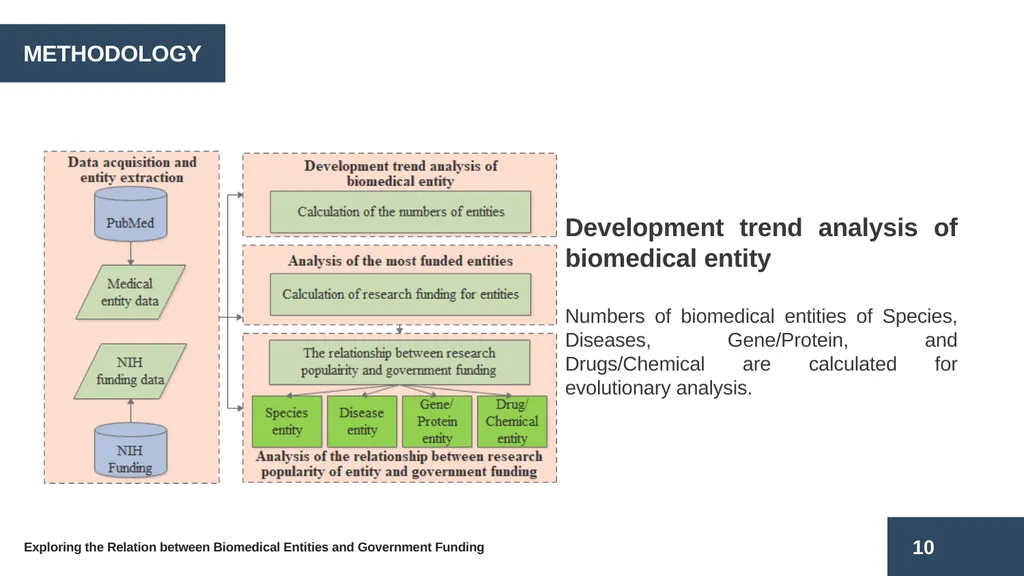
Exploring the Relation between Biomedical Entities and Government Funding 10 Development trend analysis of biomedical entity
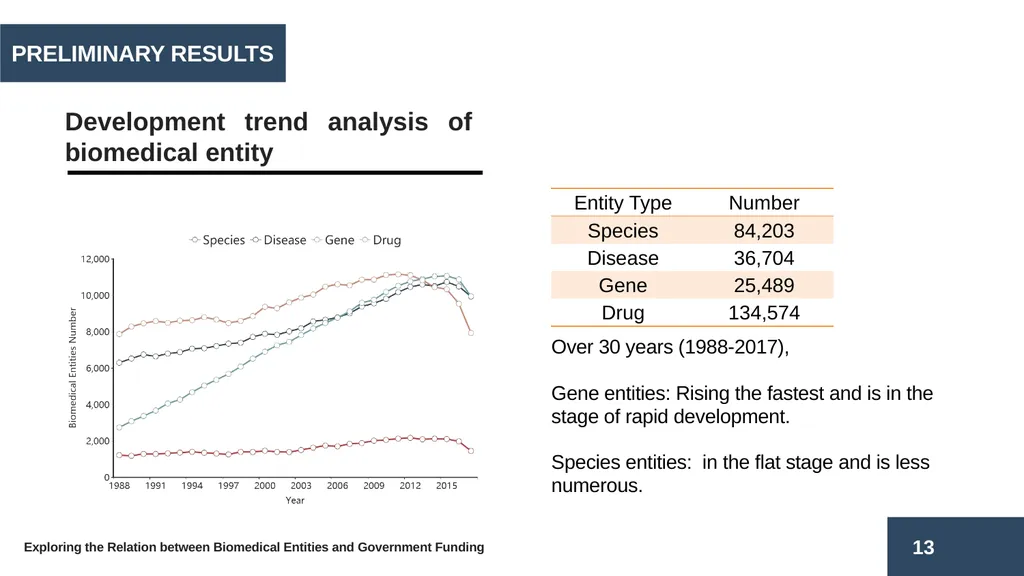
Numbers of biomedical entities of Species, Diseases, Gene/Protein, and Drugs/Chemical are calculated for evolutionary analysis.<br>
Numbers of biomedical entities of Species, Diseases, Gene/Protein, and Drugs/Chemical are calculated for evolutionary analysis.<br>
11
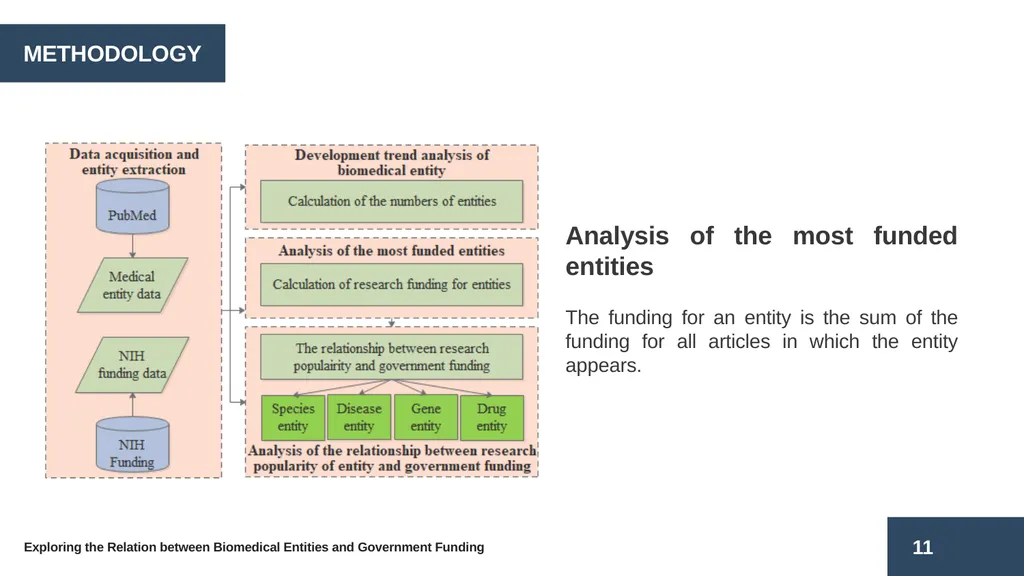
Exploring the Relation between Biomedical Entities and Government Funding 11 Analysis of the most funded entities
The funding for an entity is the sum of the funding for all articles in which the entity appears.<br>
The funding for an entity is the sum of the funding for all articles in which the entity appears.<br>
12
Exploring the Relation between Biomedical Entities and Government Funding 12 Analysis of the relationship between entity research popularity and government funding
The entity research popularity is the number of papers in which the entity is occurred.
The funding for an entity in a given year is the sum of the funding for all articles in which the entity appears in that year.<br>
The entity research popularity is the number of papers in which the entity is occurred.
The funding for an entity in a given year is the sum of the funding for all articles in which the entity appears in that year.<br>
13
Exploring the Relation between Biomedical Entities and Government Funding 13 PRELIMINARY RESULTS Development trend analysis of biomedical entity Over 30 years (1988-2017),
Gene entities: Rising the fastest and is in the stage of rapid development.
Species entities: in the flat stage and is less numerous.<br>
Gene entities: Rising the fastest and is in the stage of rapid development.
Species entities: in the flat stage and is less numerous.<br>
14
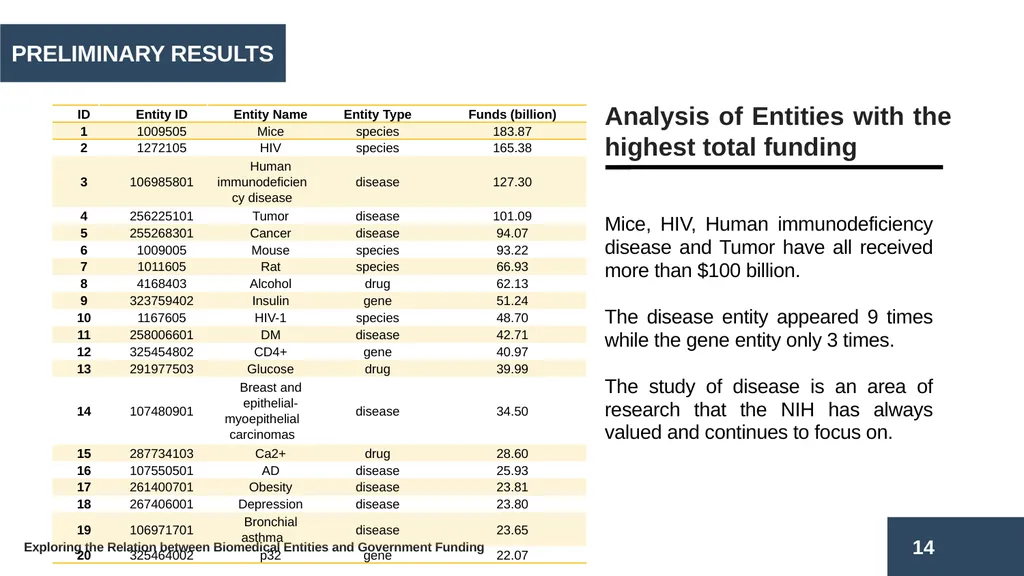
Exploring the Relation between Biomedical Entities and Government Funding 14 PRELIMINARY RESULTS Analysis of Entities with the highest total funding Mice, HIV, Human immunodeficiency disease and Tumor have all received more than $100 billion.
The disease entity appeared 9 times while the gene entity only 3 times.
The study of disease is an area of research that the NIH has always valued and continues to focus on.<br>
The disease entity appeared 9 times while the gene entity only 3 times.
The study of disease is an area of research that the NIH has always valued and continues to focus on.<br>
15
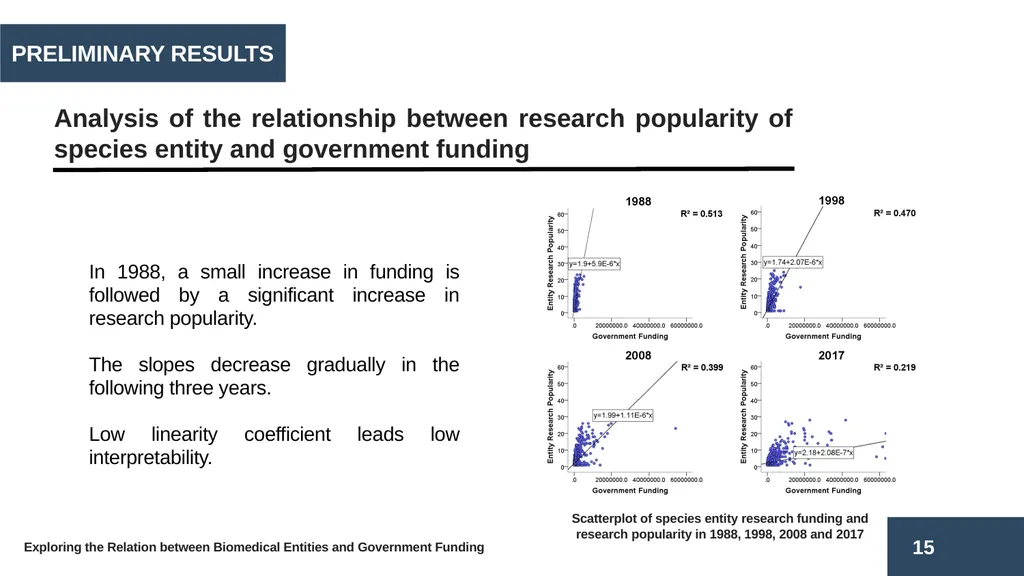
Exploring the Relation between Biomedical Entities and Government Funding 15 PRELIMINARY RESULTS Analysis of the relationship between research popularity of species entity and government funding In 1988, a small increase in funding is followed by a significant increase in research popularity.
The slopes decrease gradually in the following three years.
Low linearity coefficient leads low interpretability. Scatterplot of species entity research funding and research popularity in 1988, 1998, 2008 and 2017<br>
The slopes decrease gradually in the following three years.
Low linearity coefficient leads low interpretability. Scatterplot of species entity research funding and research popularity in 1988, 1998, 2008 and 2017<br>
16
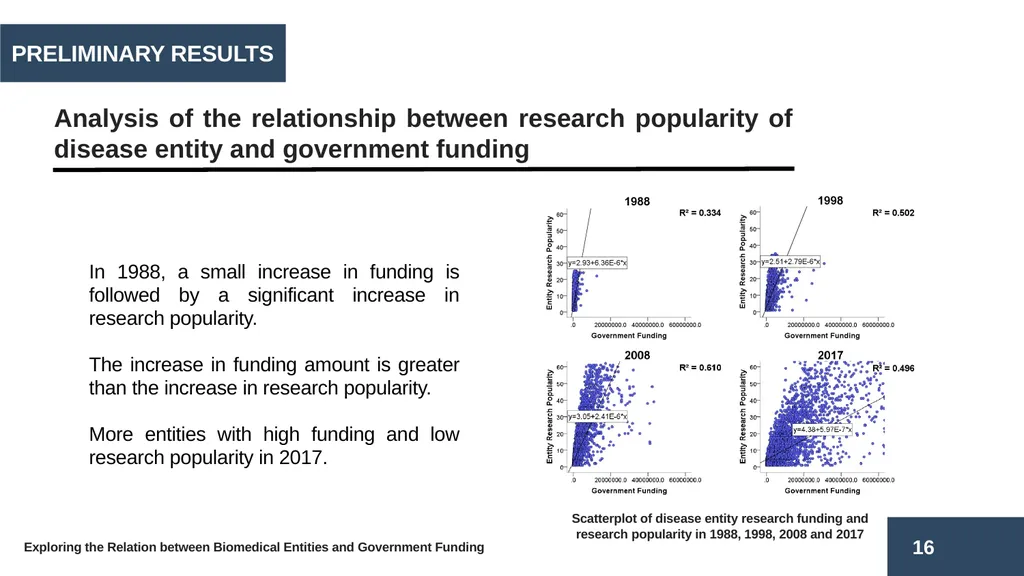
Exploring the Relation between Biomedical Entities and Government Funding 16 PRELIMINARY RESULTS Analysis of the relationship between research popularity of disease entity and government funding In 1988, a small increase in funding is followed by a significant increase in research popularity.
The increase in funding amount is greater than the increase in research popularity.
More entities with high funding and low research popularity in 2017. Scatterplot of disease entity research funding and research popularity in 1988, 1998, 2008 and 2017<br>
The increase in funding amount is greater than the increase in research popularity.
More entities with high funding and low research popularity in 2017. Scatterplot of disease entity research funding and research popularity in 1988, 1998, 2008 and 2017<br>
17
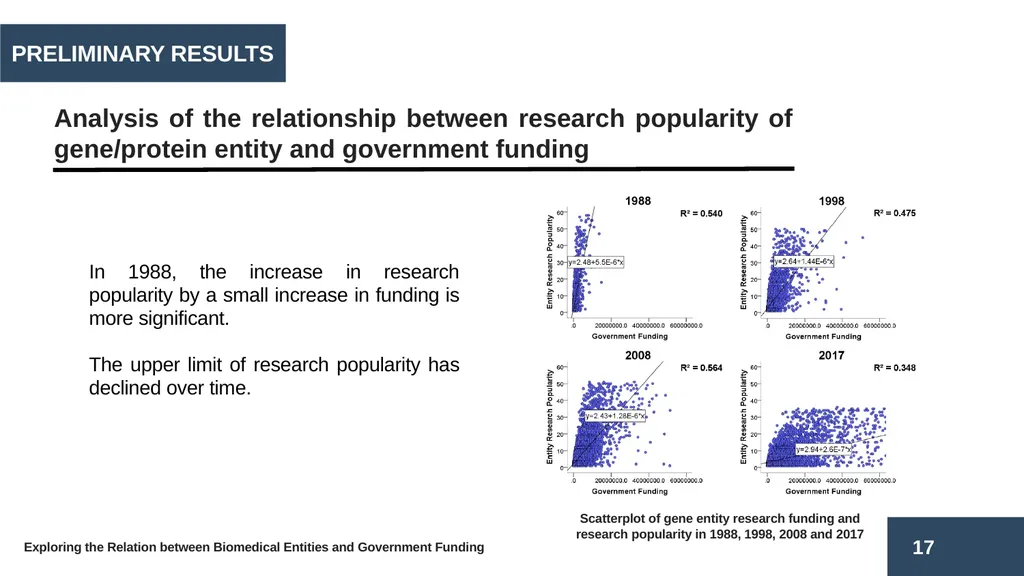
Exploring the Relation between Biomedical Entities and Government Funding 17 PRELIMINARY RESULTS Analysis of the relationship between research popularity of gene/protein entity and government funding In 1988, the increase in research popularity by a small increase in funding is more significant.
The upper limit of research popularity has declined over time. Scatterplot of gene entity research funding and research popularity in 1988, 1998, 2008 and 2017<br>
The upper limit of research popularity has declined over time. Scatterplot of gene entity research funding and research popularity in 1988, 1998, 2008 and 2017<br>
18
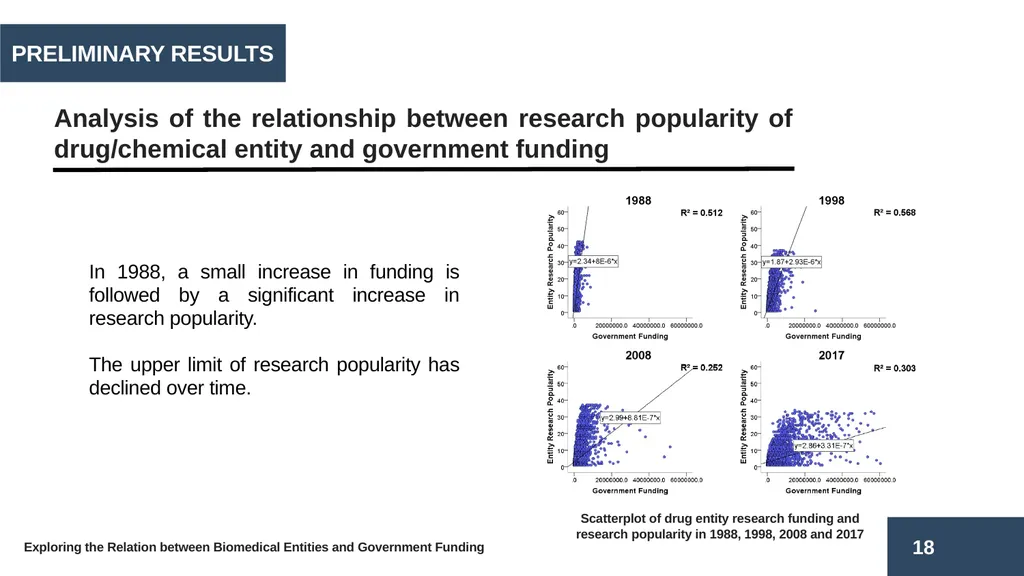
Exploring the Relation between Biomedical Entities and Government Funding 18 PRELIMINARY RESULTS Analysis of the relationship between research popularity of drug/chemical entity and government funding In 1988, a small increase in funding is followed by a significant increase in research popularity.
The upper limit of research popularity has declined over time. Scatterplot of drug entity research funding and research popularity in 1988, 1998, 2008 and 2017<br>
The upper limit of research popularity has declined over time. Scatterplot of drug entity research funding and research popularity in 1988, 1998, 2008 and 2017<br>
19
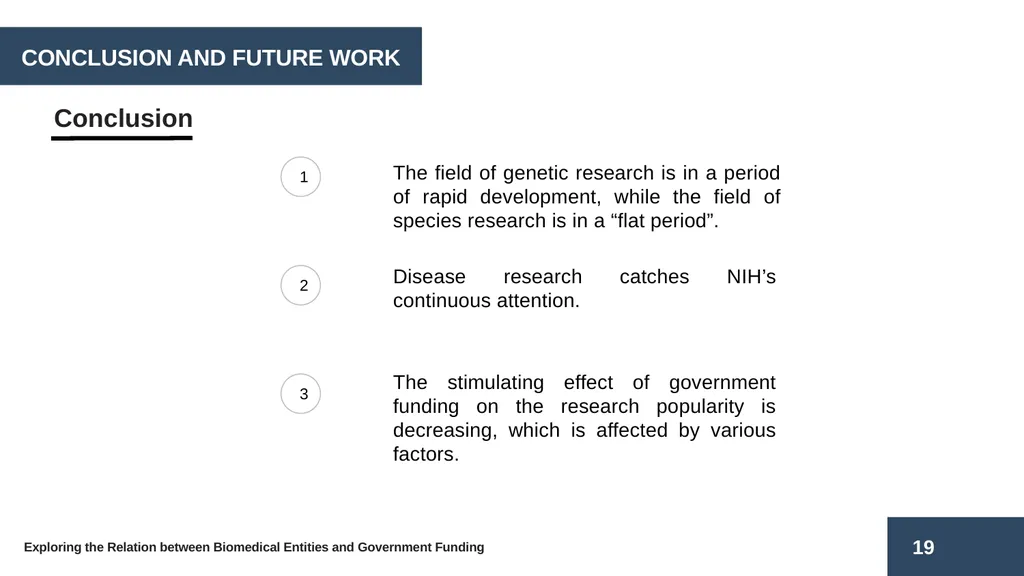
19 CONCLUSION AND FUTURE WORK The field of genetic research is in a period of rapid development, while the field of species research is in a “flat period”. The stimulating effect of government funding on the research popularity is decreasing, which is affected by various factors. Disease research catches NIH’s continuous attention. Conclusion Exploring the Relation between Biomedical Entities and Government Funding<br>
20
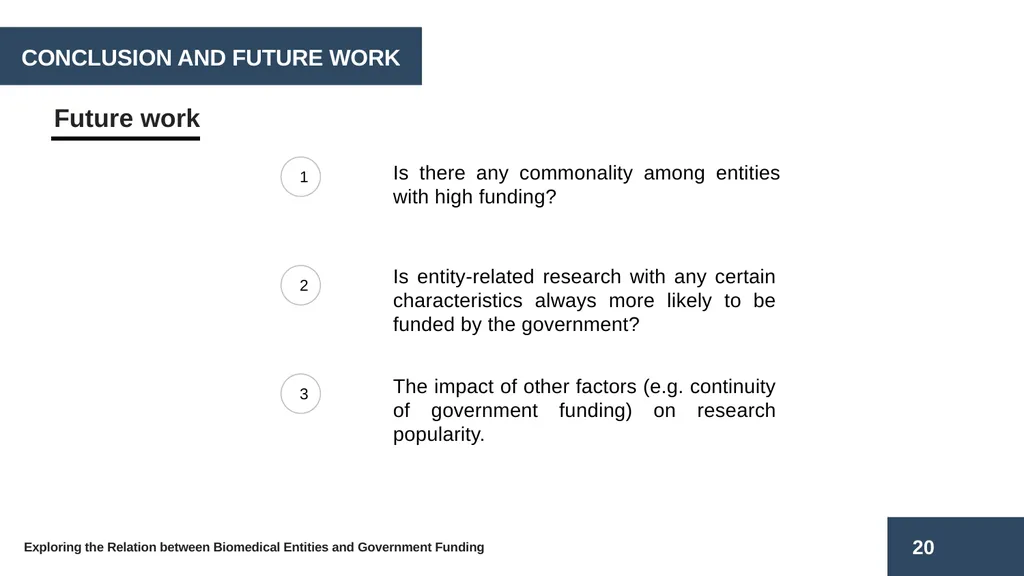
20 CONCLUSION AND FUTURE WORK Is there any commonality among entities with high funding? The impact of other factors (e.g. continuity of government funding) on research popularity. Is entity-related research with any certain characteristics always more likely to be funded by the government? Future work Exploring the Relation between Biomedical Entities and Government Funding<br>
21
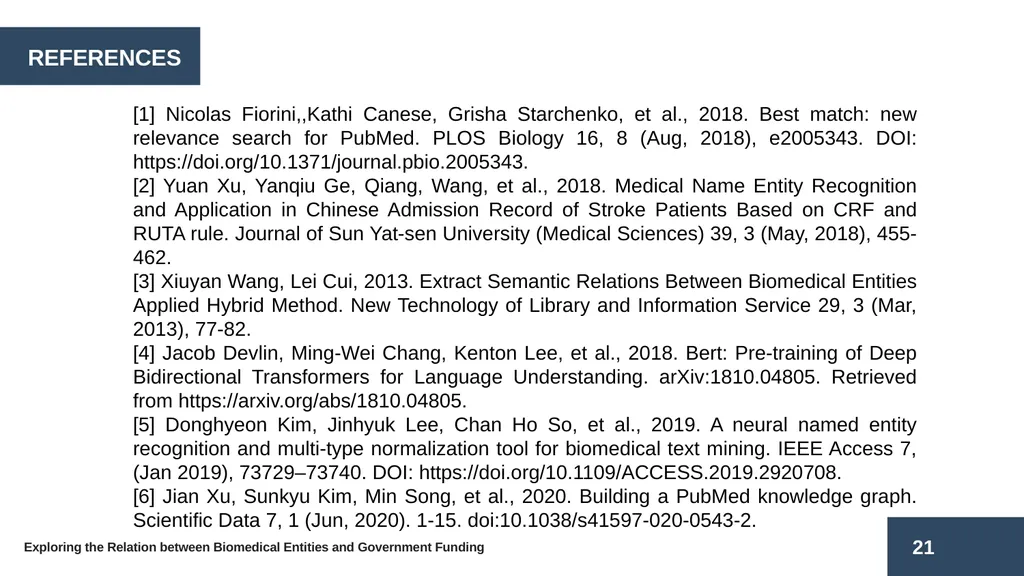
21 REFERENCES Exploring the Relation between Biomedical Entities and Government Funding [1] Nicolas Fiorini,,Kathi Canese, Grisha Starchenko, et al., 2018. Best match: new relevance search for PubMed. PLOS Biology 16, 8 (Aug, 2018), e2005343. DOI: https://doi.org/10.1371/journal.pbio.2005343.
[2] Yuan Xu, Yanqiu Ge, Qiang, Wang, et al., 2018. Medical Name Entity Recognition and Application in Chinese Admission Record of Stroke Patients Based on CRF and RUTA rule. Journal of Sun Yat-sen University (Medical Sciences) 39, 3 (May, 2018), 455-462.
[3] Xiuyan Wang, Lei Cui, 2013. Extract Semantic Relations Between Biomedical Entities Applied Hybrid Method. New Technology of Library and Information Service 29, 3 (Mar, 2013), 77-82.
[4] Jacob Devlin, Ming-Wei Chang, Kenton Lee, et al., 2018. Bert: Pre-training of Deep Bidirectional Transformers for Language Understanding. arXiv:1810.04805. Retrieved from https://arxiv.org/abs/1810.04805.
[5] Donghyeon Kim, Jinhyuk Lee, Chan Ho So, et al., 2019. A neural named entity recognition and multi-type normalization tool for biomedical text mining. IEEE Access 7, (Jan 2019), 73729–73740. DOI: https://doi.org/10.1109/ACCESS.2019.2920708.
[6] Jian Xu, Sunkyu Kim, Min Song, et al., 2020. Building a PubMed knowledge graph. Scientific Data 7, 1 (Jun, 2020). 1-15. doi:10.1038/s41597-020-0543-2.<br>
[2] Yuan Xu, Yanqiu Ge, Qiang, Wang, et al., 2018. Medical Name Entity Recognition and Application in Chinese Admission Record of Stroke Patients Based on CRF and RUTA rule. Journal of Sun Yat-sen University (Medical Sciences) 39, 3 (May, 2018), 455-462.
[3] Xiuyan Wang, Lei Cui, 2013. Extract Semantic Relations Between Biomedical Entities Applied Hybrid Method. New Technology of Library and Information Service 29, 3 (Mar, 2013), 77-82.
[4] Jacob Devlin, Ming-Wei Chang, Kenton Lee, et al., 2018. Bert: Pre-training of Deep Bidirectional Transformers for Language Understanding. arXiv:1810.04805. Retrieved from https://arxiv.org/abs/1810.04805.
[5] Donghyeon Kim, Jinhyuk Lee, Chan Ho So, et al., 2019. A neural named entity recognition and multi-type normalization tool for biomedical text mining. IEEE Access 7, (Jan 2019), 73729–73740. DOI: https://doi.org/10.1109/ACCESS.2019.2920708.
[6] Jian Xu, Sunkyu Kim, Min Song, et al., 2020. Building a PubMed knowledge graph. Scientific Data 7, 1 (Jun, 2020). 1-15. doi:10.1038/s41597-020-0543-2.<br>
22
Thank you! Fang Tan, Siting Yang, Xiaoyan Wu, Jian Xu School of Information Management, Sun Yat-Sen University Email: cathytf@163.com<br>