
Exploring the Transformative Experience of
CS
Published · 1 slides · 0 views
1 / 1
Description
Exploring the Transformative Experience of Undergraduate Geologic Field Camps Through the Lens of Gender and Diversity Eric M. Riggs1, Jessica L. McKay1, Ennea Fairchild2, Harmony Newman2, Krystal Hinerman3, Julie Sexton4 (1) Texas AM
Related Topics
Share
Embed code
Download this presentation From Below
"Exploring the Transformative Experience of" is the property of its rightful owner. Permission is granted to download and print the materials on this website for personal, non-commercial use only, and to display it on your personal computer provided you do not modify the materials and that you retain all copyright notices contained in the materials. By downloading content from our website, you accept the terms of this agreement.
Presentation Transcript
01
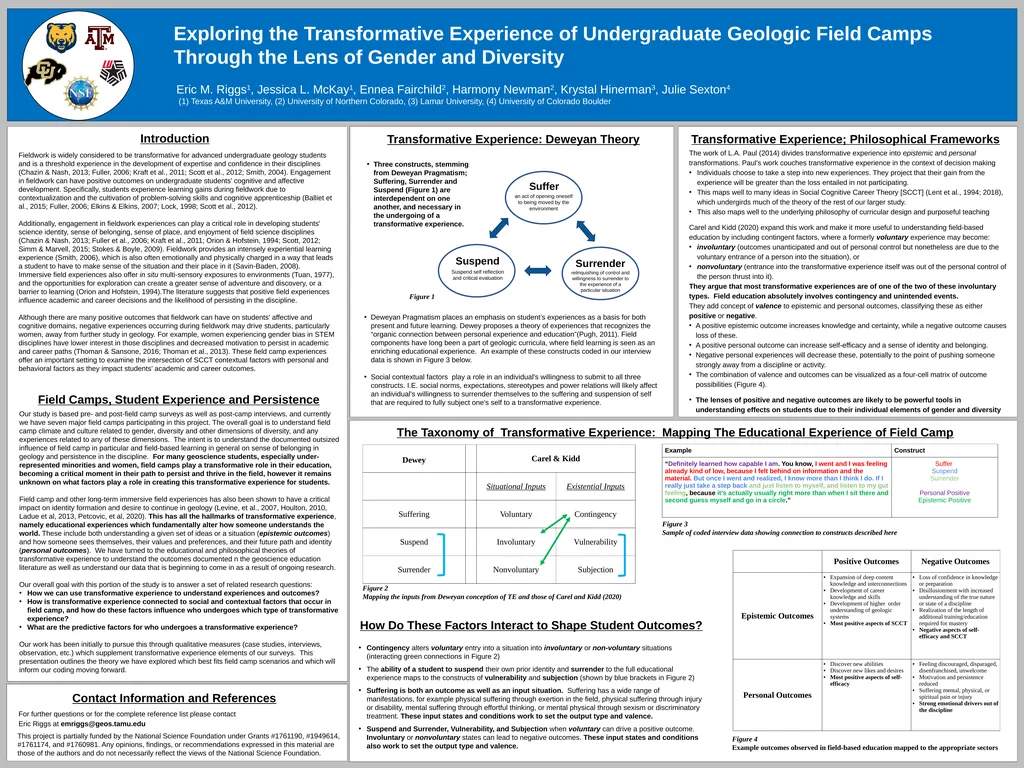
Exploring the Transformative Experience of Undergraduate Geologic Field Camps Through the Lens of Gender and Diversity Eric M. Riggs1, Jessica L. McKay1, Ennea Fairchild2, Harmony Newman2, Krystal Hinerman3, Julie Sexton4
(1) Texas A&M University, (2) University of Northern Colorado, (3) Lamar University, (4) University of Colorado Boulder Field Camps, Student Experience and Persistence The work of L.A. Paul (2014) divides transformative experience into epistemic and personal transformations. Paul’s work couches transformative experience in the context of decision making
Individuals choose to take a step into new experiences. They project that their gain from the experience will be greater than the loss entailed in not participating.
This maps well to many ideas in Social Cognitive Career Theory [SCCT] (Lent et al., 1994; 2018), which undergirds much of the theory of the rest of our larger study.
This also maps well to the underlying philosophy of curricular design and purposeful teaching
Carel and Kidd (2020) expand this work and make it more useful to understanding field-based education by including contingent factors, where a formerly voluntary experience may become:
involuntary (outcomes unanticipated and out of personal control but nonetheless are due to the voluntary entrance of a person into the situation), or
nonvoluntary (entrance into the transformative experience itself was out of the personal control of the person thrust into it).
They argue that most transformative experiences are of one of the two of these involuntary types. Field education absolutely involves contingency and unintended events.
They add concept of valence to epistemic and personal outcomes, classifying these as either positive or negative.
A positive epistemic outcome increases knowledge and certainty, while a negative outcome causes loss of these.
A positive personal outcome can increase self-efficacy and a sense of identity and belonging.
Negative personal experiences will decrease these, potentially to the point of pushing someone strongly away from a discipline or activity.
The combination of valence and outcomes can be visualized as a four-cell matrix of outcome possibilities (Figure 4).
The lenses of positive and negative outcomes are likely to be powerful tools in understanding effects on students due to their individual elements of gender and diversity Contact Information and References For further questions or for the complete reference list please contact
Eric Riggs at emriggs@geos.tamu.edu Introduction Fieldwork is widely considered to be transformative for advanced undergraduate geology students and is a threshold experience in the development of expertise and confidence in their disciplines (Chazin & Nash, 2013; Fuller, 2006; Kraft et al., 2011; Scott et al., 2012; Smith, 2004). Engagement in fieldwork can have positive outcomes on undergraduate students’ cognitive and affective development. Specifically, students experience learning gains during fieldwork due to contextualization and the cultivation of problem-solving skills and cognitive apprenticeship (Balliet et al., 2015; Fuller, 2006; Elkins & Elkins, 2007; Lock, 1998; Scott et al., 2012).
Additionally, engagement in fieldwork experiences can play a critical role in developing students' science identity, sense of belonging, sense of place, and enjoyment of field science disciplines (Chazin & Nash, 2013; Fuller et al., 2006; Kraft et al., 2011; Orion & Hofstein, 1994; Scott, 2012; Simm & Marvell, 2015; Stokes & Boyle, 2009). Fieldwork provides an intensely experiential learning experience (Smith, 2006), which is also often emotionally and physically charged in a way that leads a student to have to make sense of the situation and their place in it (Savin-Baden, 2008). Immersive field experiences also offer in situ multi-sensory exposures to environments (Tuan, 1977), and the opportunities for exploration can create a greater sense of adventure and discovery, or a barrier to learning (Orion and Hofstein, 1994).The literature suggests that positive field experiences influence academic and career decisions and the likelihood of persisting in the discipline.
Although there are many positive outcomes that fieldwork can have on students' affective and cognitive domains, negative experiences occurring during fieldwork may drive students, particularly women, away from further study in geology. For example, women experiencing gender bias in STEM disciplines have lower interest in those disciplines and decreased motivation to persist in academic and career paths (Thoman & Sansone, 2016; Thoman et al., 2013). These field camp experiences offer an important setting to examine the intersection of SCCT contextual factors with personal and behavioral factors as they impact students’ academic and career outcomes. This project is partially funded by the National Science Foundation under Grants #1761190, #1949614, #1761174, and #1760981. Any opinions, findings, or recommendations expressed in this material are those of the authors and do not necessarily reflect the views of the National Science Foundation. Our study is based pre- and post-field camp surveys as well as post-camp interviews, and currently we have seven major field camps participating in this project. The overall goal is to understand field camp climate and culture related to gender, diversity and other dimensions of diversity, and any experiences related to any of these dimensions. The intent is to understand the documented outsized influence of field camp in particular and field-based learning in general on sense of belonging in geology and persistence in the discipline. For many geoscience students, especially under-represented minorities and women, field camps play a transformative role in their education, becoming a critical moment in their path to persist and thrive in the field, however it remains unknown on what factors play a role in creating this transformative experience for students.
Field camp and other long-term immersive field experiences has also been shown to have a critical impact on identity formation and desire to continue in geology (Levine, et al., 2007, Houlton, 2010, Ladue et al, 2013, Petcovic, et al, 2020). This has all the hallmarks of transformative experience, namely educational experiences which fundamentally alter how someone understands the world. These include both understanding a given set of ideas or a situation (epistemic outcomes) and how someone sees themselves, their values and preferences, and their future path and identity (personal outcomes). We have turned to the educational and philosophical theories of transformative experience to understand the outcomes documented n the geoscience education literature as well as understand our data that is beginning to come in as a result of ongoing research.
Our overall goal with this portion of the study is to answer a set of related research questions:
How we can use transformative experience to understand experiences and outcomes?
How is transformative experience connected to social and contextual factors that occur in field camp, and how do these factors influence who undergoes which type of transformative experience?
What are the predictive factors for who undergoes a transformative experience?
Our work has been initially to pursue this through qualitative measures (case studies, interviews, observation, etc.) which supplement transformative experience elements of our surveys. This presentation outlines the theory we have explored which best fits field camp scenarios and which will inform our coding moving forward. Figure 4
Example outcomes observed in field-based education mapped to the appropriate sectors Contingency alters voluntary entry into a situation into involuntary or non-voluntary situations (interacting green connections in Figure 2)
The ability of a student to suspend their own prior identity and surrender to the full educational experience maps to the constructs of vulnerability and subjection (shown by blue brackets in Figure 2)
Suffering is both an outcome as well as an input situation. Suffering has a wide range of manifestations, for example physical suffering through exertion in the field, physical suffering through injury or disability, mental suffering through effortful thinking, or mental physical through sexism or discriminatory treatment. These input states and conditions work to set the output type and valence.
Suspend and Surrender, Vulnerability, and Subjection when voluntary can drive a positive outcome. Involuntary or nonvoluntary states can lead to negative outcomes. These input states and conditions also work to set the output type and valence. Figure 2
Mapping the inputs from Deweyan conception of TE and those of Carel and Kidd (2020) Deweyan Pragmatism places an emphasis on student’s experiences as a basis for both present and future learning. Dewey proposes a theory of experiences that recognizes the “organic connection between personal experience and education”(Pugh, 2011). Field components have long been a part of geologic curricula, where field learning is seen as an enriching educational experience. An example of these constructs coded in our interview data is shown in Figure 3 below.
Social contextual factors play a role in an individual's willingness to submit to all three constructs. I.E. social norms, expectations, stereotypes and power relations will likely affect an individual's willingness to surrender themselves to the suffering and suspension of self that are required to fully subject one’s self to a transformative experience. Transformative Experience; Philosophical Frameworks Transformative Experience: Deweyan Theory The Taxonomy of Transformative Experience: Mapping The Educational Experience of Field Camp Three constructs, stemming from Deweyan Pragmatism; Suffering, Surrender and Suspend (Figure 1) are interdependent on one another, and necessary in the undergoing of a transformative experience. Figure 1 Figure 3
Sample of coded interview data showing connection to constructs described here How Do These Factors Interact to Shape Student Outcomes? relinquishing of control and willingness to surrender to the experience of a
particular situation<br>
Individuals choose to take a step into new experiences. They project that their gain from the experience will be greater than the loss entailed in not participating.
This maps well to many ideas in Social Cognitive Career Theory [SCCT] (Lent et al., 1994; 2018), which undergirds much of the theory of the rest of our larger study.
This also maps well to the underlying philosophy of curricular design and purposeful teaching
Carel and Kidd (2020) expand this work and make it more useful to understanding field-based education by including contingent factors, where a formerly voluntary experience may become:
involuntary (outcomes unanticipated and out of personal control but nonetheless are due to the voluntary entrance of a person into the situation), or
nonvoluntary (entrance into the transformative experience itself was out of the personal control of the person thrust into it).
They argue that most transformative experiences are of one of the two of these involuntary types. Field education absolutely involves contingency and unintended events.
They add concept of valence to epistemic and personal outcomes, classifying these as either positive or negative.
A positive epistemic outcome increases knowledge and certainty, while a negative outcome causes loss of these.
A positive personal outcome can increase self-efficacy and a sense of identity and belonging.
Negative personal experiences will decrease these, potentially to the point of pushing someone strongly away from a discipline or activity.
The combination of valence and outcomes can be visualized as a four-cell matrix of outcome possibilities (Figure 4).
The lenses of positive and negative outcomes are likely to be powerful tools in understanding effects on students due to their individual elements of gender and diversity Contact Information and References For further questions or for the complete reference list please contact
Eric Riggs at emriggs@geos.tamu.edu Introduction Fieldwork is widely considered to be transformative for advanced undergraduate geology students and is a threshold experience in the development of expertise and confidence in their disciplines (Chazin & Nash, 2013; Fuller, 2006; Kraft et al., 2011; Scott et al., 2012; Smith, 2004). Engagement in fieldwork can have positive outcomes on undergraduate students’ cognitive and affective development. Specifically, students experience learning gains during fieldwork due to contextualization and the cultivation of problem-solving skills and cognitive apprenticeship (Balliet et al., 2015; Fuller, 2006; Elkins & Elkins, 2007; Lock, 1998; Scott et al., 2012).
Additionally, engagement in fieldwork experiences can play a critical role in developing students' science identity, sense of belonging, sense of place, and enjoyment of field science disciplines (Chazin & Nash, 2013; Fuller et al., 2006; Kraft et al., 2011; Orion & Hofstein, 1994; Scott, 2012; Simm & Marvell, 2015; Stokes & Boyle, 2009). Fieldwork provides an intensely experiential learning experience (Smith, 2006), which is also often emotionally and physically charged in a way that leads a student to have to make sense of the situation and their place in it (Savin-Baden, 2008). Immersive field experiences also offer in situ multi-sensory exposures to environments (Tuan, 1977), and the opportunities for exploration can create a greater sense of adventure and discovery, or a barrier to learning (Orion and Hofstein, 1994).The literature suggests that positive field experiences influence academic and career decisions and the likelihood of persisting in the discipline.
Although there are many positive outcomes that fieldwork can have on students' affective and cognitive domains, negative experiences occurring during fieldwork may drive students, particularly women, away from further study in geology. For example, women experiencing gender bias in STEM disciplines have lower interest in those disciplines and decreased motivation to persist in academic and career paths (Thoman & Sansone, 2016; Thoman et al., 2013). These field camp experiences offer an important setting to examine the intersection of SCCT contextual factors with personal and behavioral factors as they impact students’ academic and career outcomes. This project is partially funded by the National Science Foundation under Grants #1761190, #1949614, #1761174, and #1760981. Any opinions, findings, or recommendations expressed in this material are those of the authors and do not necessarily reflect the views of the National Science Foundation. Our study is based pre- and post-field camp surveys as well as post-camp interviews, and currently we have seven major field camps participating in this project. The overall goal is to understand field camp climate and culture related to gender, diversity and other dimensions of diversity, and any experiences related to any of these dimensions. The intent is to understand the documented outsized influence of field camp in particular and field-based learning in general on sense of belonging in geology and persistence in the discipline. For many geoscience students, especially under-represented minorities and women, field camps play a transformative role in their education, becoming a critical moment in their path to persist and thrive in the field, however it remains unknown on what factors play a role in creating this transformative experience for students.
Field camp and other long-term immersive field experiences has also been shown to have a critical impact on identity formation and desire to continue in geology (Levine, et al., 2007, Houlton, 2010, Ladue et al, 2013, Petcovic, et al, 2020). This has all the hallmarks of transformative experience, namely educational experiences which fundamentally alter how someone understands the world. These include both understanding a given set of ideas or a situation (epistemic outcomes) and how someone sees themselves, their values and preferences, and their future path and identity (personal outcomes). We have turned to the educational and philosophical theories of transformative experience to understand the outcomes documented n the geoscience education literature as well as understand our data that is beginning to come in as a result of ongoing research.
Our overall goal with this portion of the study is to answer a set of related research questions:
How we can use transformative experience to understand experiences and outcomes?
How is transformative experience connected to social and contextual factors that occur in field camp, and how do these factors influence who undergoes which type of transformative experience?
What are the predictive factors for who undergoes a transformative experience?
Our work has been initially to pursue this through qualitative measures (case studies, interviews, observation, etc.) which supplement transformative experience elements of our surveys. This presentation outlines the theory we have explored which best fits field camp scenarios and which will inform our coding moving forward. Figure 4
Example outcomes observed in field-based education mapped to the appropriate sectors Contingency alters voluntary entry into a situation into involuntary or non-voluntary situations (interacting green connections in Figure 2)
The ability of a student to suspend their own prior identity and surrender to the full educational experience maps to the constructs of vulnerability and subjection (shown by blue brackets in Figure 2)
Suffering is both an outcome as well as an input situation. Suffering has a wide range of manifestations, for example physical suffering through exertion in the field, physical suffering through injury or disability, mental suffering through effortful thinking, or mental physical through sexism or discriminatory treatment. These input states and conditions work to set the output type and valence.
Suspend and Surrender, Vulnerability, and Subjection when voluntary can drive a positive outcome. Involuntary or nonvoluntary states can lead to negative outcomes. These input states and conditions also work to set the output type and valence. Figure 2
Mapping the inputs from Deweyan conception of TE and those of Carel and Kidd (2020) Deweyan Pragmatism places an emphasis on student’s experiences as a basis for both present and future learning. Dewey proposes a theory of experiences that recognizes the “organic connection between personal experience and education”(Pugh, 2011). Field components have long been a part of geologic curricula, where field learning is seen as an enriching educational experience. An example of these constructs coded in our interview data is shown in Figure 3 below.
Social contextual factors play a role in an individual's willingness to submit to all three constructs. I.E. social norms, expectations, stereotypes and power relations will likely affect an individual's willingness to surrender themselves to the suffering and suspension of self that are required to fully subject one’s self to a transformative experience. Transformative Experience; Philosophical Frameworks Transformative Experience: Deweyan Theory The Taxonomy of Transformative Experience: Mapping The Educational Experience of Field Camp Three constructs, stemming from Deweyan Pragmatism; Suffering, Surrender and Suspend (Figure 1) are interdependent on one another, and necessary in the undergoing of a transformative experience. Figure 1 Figure 3
Sample of coded interview data showing connection to constructs described here How Do These Factors Interact to Shape Student Outcomes? relinquishing of control and willingness to surrender to the experience of a
particular situation<br>