
Extradition to Europe Past, Present, and Future
MS
Published · 12 slides · 0 views

1 / 1


Description
Extradition to Europe Past, Present, and Future Helen Malcolm QC 3 Raymond Buildings Grays Inn helen.malcolm3rblaw.com Extradition under the Framework Decision Agreement on the Withdrawal of the United Kingdom of Great Britain and
Related Topics
Share
Embed code
Download this presentation From Below
"Extradition to Europe Past, Present, and Future" is the property of its rightful owner. Permission is granted to download and print the materials on this website for personal, non-commercial use only, and to display it on your personal computer provided you do not modify the materials and that you retain all copyright notices contained in the materials. By downloading content from our website, you accept the terms of this agreement.
Presentation Transcript
01
Extradition to Europe
Past, Present, and Future Helen Malcolm QC
3 Raymond Buildings
Gray’s Inn
helen.malcolm@3rblaw.com<br>
3 Raymond Buildings
Gray’s Inn
helen.malcolm@3rblaw.com<br>
02
Extradition under the Framework Decision Agreement on the Withdrawal of the United Kingdom of Great Britain and Northern Ireland from the European Union and the European Atomic Energy Community 2019
(ratified by the UK 23.1.2020; and by the EU 30.1.2020)
Article 62(1)(b):
“Council Framework Decision 2002/584/JHA shall apply in respect of European arrest warrants where the requested person was arrested before the end of the transition period for the purposes of the execution of a European arrest warrant, irrespective of the decision of the executing judicial authority as to whether the requested person is to remain in detention or be provisionally released;”
By Art 185, Art 62 “shall apply as from the end of the transition period”<br>
(ratified by the UK 23.1.2020; and by the EU 30.1.2020)
Article 62(1)(b):
“Council Framework Decision 2002/584/JHA shall apply in respect of European arrest warrants where the requested person was arrested before the end of the transition period for the purposes of the execution of a European arrest warrant, irrespective of the decision of the executing judicial authority as to whether the requested person is to remain in detention or be provisionally released;”
By Art 185, Art 62 “shall apply as from the end of the transition period”<br>
03
Contd. Law Enforcement and Security (Amendment) (EU Exit) Regulations 2019 came into force on 31 December 2020. Regulation 57 of the Regulations 2019 states:
“57. Transitional provision
Regulations 53(2), 55, and 56 do not apply in a case where, before commencement day—
(a) a person has been arrested under a Part 1 warrant (within the meaning of the 2003 Act);
(b) a person has been arrested under section 5 of the 2003 Act (provisional arrest) 1, or
(c) a person has been extradited to or from the UK.”
Polakowski and Others [2021] EWHC Civ 53 (Admin)<br>
“57. Transitional provision
Regulations 53(2), 55, and 56 do not apply in a case where, before commencement day—
(a) a person has been arrested under a Part 1 warrant (within the meaning of the 2003 Act);
(b) a person has been arrested under section 5 of the 2003 Act (provisional arrest) 1, or
(c) a person has been extradited to or from the UK.”
Polakowski and Others [2021] EWHC Civ 53 (Admin)<br>
04
Court of Justice of the European Union Withdrawal Agreement 2019/C 384 (12.11.2019)
CHAPTER 1 JUDICIAL PROCEDURES ARTICLE 86
Pending cases before the Court of Justice of the European Union
“1. The Court of Justice of the European Union shall continue to have jurisdiction in any proceedings brought by or against the United Kingdom before the end of the transition period. Such jurisdiction shall apply to all stages of proceedings, including appeal proceedings before the Court of Justice and proceedings before the General Court where the case is referred back to the General Court.
2. The Court of Justice of the European Union shall continue to have jurisdiction to give preliminary rulings on requests from courts and tribunals of the United Kingdom made before the end of the transition period.”
ARTICLE 89:
Binding force and enforceability of judgments and orders
Art 89(1). “Judgments and orders of the Court of Justice of the European Union handed down before the end of the transition period, as well as such judgments and orders handed down after the end of the transition period in proceedings referred to in Articles 86 and 87, shall have binding force in their entirety on and in the United Kingdom.”<br>
CHAPTER 1 JUDICIAL PROCEDURES ARTICLE 86
Pending cases before the Court of Justice of the European Union
“1. The Court of Justice of the European Union shall continue to have jurisdiction in any proceedings brought by or against the United Kingdom before the end of the transition period. Such jurisdiction shall apply to all stages of proceedings, including appeal proceedings before the Court of Justice and proceedings before the General Court where the case is referred back to the General Court.
2. The Court of Justice of the European Union shall continue to have jurisdiction to give preliminary rulings on requests from courts and tribunals of the United Kingdom made before the end of the transition period.”
ARTICLE 89:
Binding force and enforceability of judgments and orders
Art 89(1). “Judgments and orders of the Court of Justice of the European Union handed down before the end of the transition period, as well as such judgments and orders handed down after the end of the transition period in proceedings referred to in Articles 86 and 87, shall have binding force in their entirety on and in the United Kingdom.”<br>
05
Contd. Polakowski:
“32. Fourth, this means that the principle that the 2003 Act must be read conformably with the Framework Directive, far from supporting the applicants’ case, tells against it. As noted above, domestic legislation expressly provides that the amendments to the 2003 Act made in consequence of the TCA do not apply in EAW cases where the arrest occurred before 11 p.m. on 31 December 2020. In those cases, it is the (unmodified) 2003 Act that applies. When construing the parts of that Act which implemented EU law, domestic courts will continue to be guided by decisions of the CJEU to the extent provided for by ss. 6, 7 and 7A-7C of the 2018 Act, although they will no longer be able to refer cases to the ECJ: see s. 6(1)(b). This means that CJEU case law will be available to elucidate the principles applicable in the cases of those arrested pursuant to EAWs prior to 11 p.m. on 31 December 2020. In cases referred by UK courts prior to the end of the transition period, but not yet decided, the CJEU retains jurisdiction pursuant to Article 86 of the Withdrawal Agreement and the judgment and order, when given, will be binding on the UK pursuant to Article 89. These provisions are given effect in domestic law by s. 7A of the 2018 Act. The submission that the applicants have been deprived of substantial protections conferred by EU law is therefore not made out.”<br>
“32. Fourth, this means that the principle that the 2003 Act must be read conformably with the Framework Directive, far from supporting the applicants’ case, tells against it. As noted above, domestic legislation expressly provides that the amendments to the 2003 Act made in consequence of the TCA do not apply in EAW cases where the arrest occurred before 11 p.m. on 31 December 2020. In those cases, it is the (unmodified) 2003 Act that applies. When construing the parts of that Act which implemented EU law, domestic courts will continue to be guided by decisions of the CJEU to the extent provided for by ss. 6, 7 and 7A-7C of the 2018 Act, although they will no longer be able to refer cases to the ECJ: see s. 6(1)(b). This means that CJEU case law will be available to elucidate the principles applicable in the cases of those arrested pursuant to EAWs prior to 11 p.m. on 31 December 2020. In cases referred by UK courts prior to the end of the transition period, but not yet decided, the CJEU retains jurisdiction pursuant to Article 86 of the Withdrawal Agreement and the judgment and order, when given, will be binding on the UK pursuant to Article 89. These provisions are given effect in domestic law by s. 7A of the 2018 Act. The submission that the applicants have been deprived of substantial protections conferred by EU law is therefore not made out.”<br>
06
Transitional cases Title VII of Part 3 of the Trade and Cooperation Agreement between the European Union and the European Atomic Energy Community of the One Part and the United Kingdom of Great Britain and Northern Ireland, of the Other Part (“the Trade and Cooperation Agreement”)
Article LAW SURR 112 of the Trade and Cooperation Agreement provides:
“This Title shall apply in respect of European arrest warrants issued in accordance with Council Framework Decision 2002/584/JHA by a State before the end of the transition period where the requested person has not been arrested for the purpose of its execution before the end of the transition period.”<br>
Article LAW SURR 112 of the Trade and Cooperation Agreement provides:
“This Title shall apply in respect of European arrest warrants issued in accordance with Council Framework Decision 2002/584/JHA by a State before the end of the transition period where the requested person has not been arrested for the purpose of its execution before the end of the transition period.”<br>
07
Contd. The European Union (Future Relationship) Act 2020 (“the Future Relationship Act”) brings the Trade and Coop Agreement provisions into force, as from 1/1/2021 (mostly).
Paragraph 10 of Part 2 of Schedule 6 of the Future Relationship Act, for instance, provides:
The amendments made by section 12 [modifications to the Extradition Act 2003] do not apply for the purpose of deciding whether the offence specified in a Part 1 warrant is an extradition offence if the person in respect of whom the warrant is issued is arrested under the warrant, or under section 5 of the Extradition Act 2003 on the basis of a belief related to the warrant, before IP completion day.<br>
Paragraph 10 of Part 2 of Schedule 6 of the Future Relationship Act, for instance, provides:
The amendments made by section 12 [modifications to the Extradition Act 2003] do not apply for the purpose of deciding whether the offence specified in a Part 1 warrant is an extradition offence if the person in respect of whom the warrant is issued is arrested under the warrant, or under section 5 of the Extradition Act 2003 on the basis of a belief related to the warrant, before IP completion day.<br>
08
Contd. See also (saving provision) section 29 of the Future Relationship Act:
29 General implementation of agreements
“(1) Existing domestic law has effect on and after the relevant day with such modifications as are required for the purposes of implementing in that law the Trade and Cooperation Agreement or the Security of Classified Information Agreement so far as the agreement concerned is not otherwise so implemented and so far as such implementation is necessary for the purposes of complying with the international obligations of the United Kingdom under the agreement.”<br>
29 General implementation of agreements
“(1) Existing domestic law has effect on and after the relevant day with such modifications as are required for the purposes of implementing in that law the Trade and Cooperation Agreement or the Security of Classified Information Agreement so far as the agreement concerned is not otherwise so implemented and so far as such implementation is necessary for the purposes of complying with the international obligations of the United Kingdom under the agreement.”<br>
09
Extradition post 1/1/2021 New scheme in Trade and Cooperation Agreement, Title VII
Potentially 3 different warrants circulating re one RP
Article LAW.SURR.77: Principle of proportionality
“Cooperation through the arrest warrant shall be necessary and proportionate, taking into account the rights of the requested person and the interests of the victims, and having regard to the seriousness of the act, the likely penalty that would be imposed and the possibility of a State taking measures less coercive than the surrender of the requested person particularly with a view to avoiding unnecessarily long periods of pre-trial detention.”<br>
Potentially 3 different warrants circulating re one RP
Article LAW.SURR.77: Principle of proportionality
“Cooperation through the arrest warrant shall be necessary and proportionate, taking into account the rights of the requested person and the interests of the victims, and having regard to the seriousness of the act, the likely penalty that would be imposed and the possibility of a State taking measures less coercive than the surrender of the requested person particularly with a view to avoiding unnecessarily long periods of pre-trial detention.”<br>
10
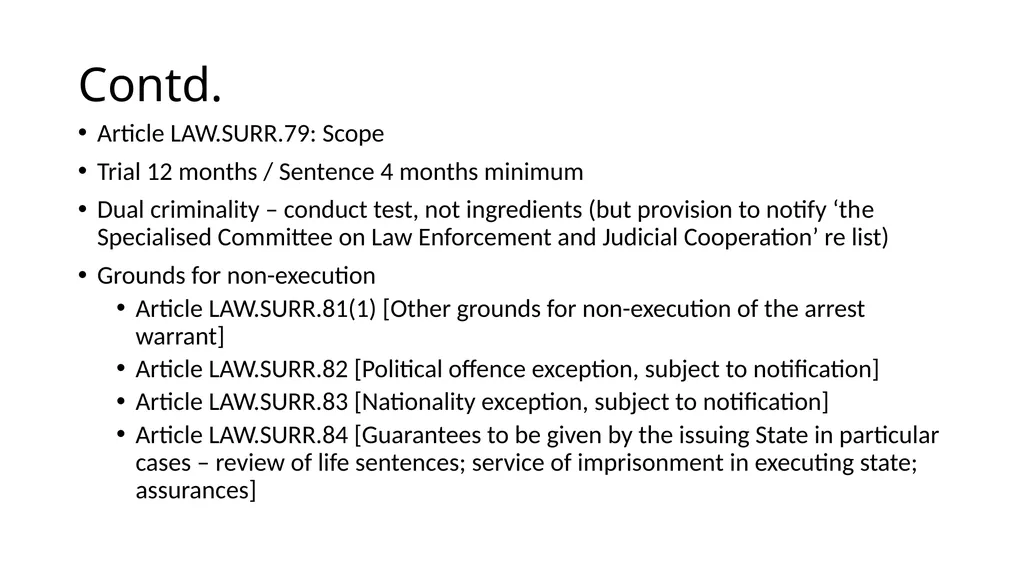
Contd. Article LAW.SURR.79: Scope
Trial 12 months / Sentence 4 months minimum
Dual criminality – conduct test, not ingredients (but provision to notify ‘the Specialised Committee on Law Enforcement and Judicial Cooperation’ re list)
Grounds for non-execution
Article LAW.SURR.81(1) [Other grounds for non-execution of the arrest warrant]
Article LAW.SURR.82 [Political offence exception, subject to notification]
Article LAW.SURR.83 [Nationality exception, subject to notification]
Article LAW.SURR.84 [Guarantees to be given by the issuing State in particular cases – review of life sentences; service of imprisonment in executing state; assurances]<br>
Trial 12 months / Sentence 4 months minimum
Dual criminality – conduct test, not ingredients (but provision to notify ‘the Specialised Committee on Law Enforcement and Judicial Cooperation’ re list)
Grounds for non-execution
Article LAW.SURR.81(1) [Other grounds for non-execution of the arrest warrant]
Article LAW.SURR.82 [Political offence exception, subject to notification]
Article LAW.SURR.83 [Nationality exception, subject to notification]
Article LAW.SURR.84 [Guarantees to be given by the issuing State in particular cases – review of life sentences; service of imprisonment in executing state; assurances]<br>
11
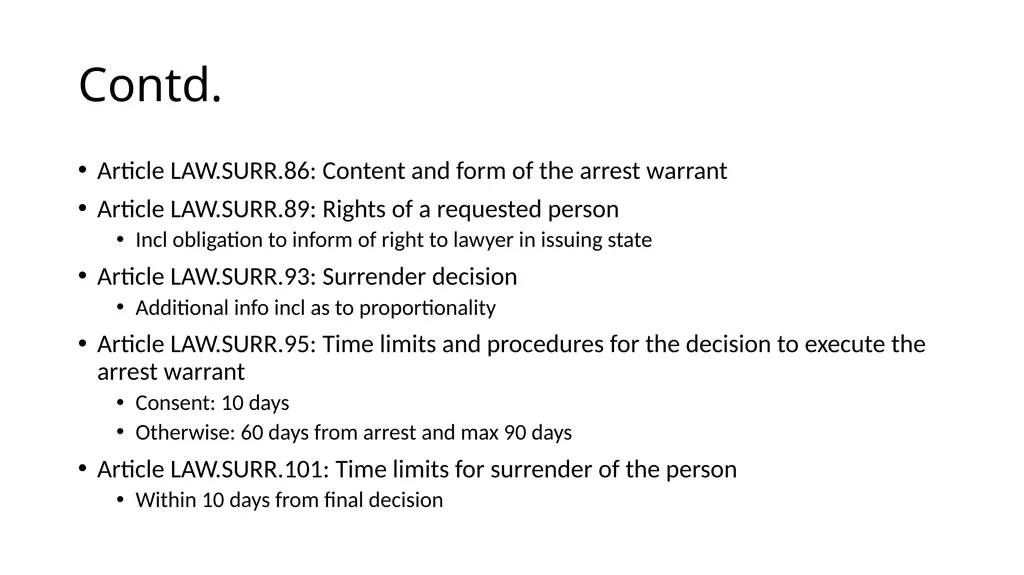
Contd. Article LAW.SURR.86: Content and form of the arrest warrant
Article LAW.SURR.89: Rights of a requested person
Incl obligation to inform of right to lawyer in issuing state
Article LAW.SURR.93: Surrender decision
Additional info incl as to proportionality
Article LAW.SURR.95: Time limits and procedures for the decision to execute the arrest warrant
Consent: 10 days
Otherwise: 60 days from arrest and max 90 days
Article LAW.SURR.101: Time limits for surrender of the person
Within 10 days from final decision<br>
Article LAW.SURR.89: Rights of a requested person
Incl obligation to inform of right to lawyer in issuing state
Article LAW.SURR.93: Surrender decision
Additional info incl as to proportionality
Article LAW.SURR.95: Time limits and procedures for the decision to execute the arrest warrant
Consent: 10 days
Otherwise: 60 days from arrest and max 90 days
Article LAW.SURR.101: Time limits for surrender of the person
Within 10 days from final decision<br>
12
Contd. s11 Future Relationship Act re-designates all Member States as Part 1 territories
(Norway and Iceland remain Part 2)
Differences from FD (see, following speakers) – but oblig to execute in Art 1(2) FD not replicated; however, encouragement to prosecute if not extraditing in Art LAW.SURR.83(3) (Germany, Austria, Slovenia?)
Dispute resolution: Title XII Review; Suspension; Title XIII Dispute Settlement
Specialised Committee on Law Enforcement and Judicial Cooperation
Current practice?<br>
(Norway and Iceland remain Part 2)
Differences from FD (see, following speakers) – but oblig to execute in Art 1(2) FD not replicated; however, encouragement to prosecute if not extraditing in Art LAW.SURR.83(3) (Germany, Austria, Slovenia?)
Dispute resolution: Title XII Review; Suspension; Title XIII Dispute Settlement
Specialised Committee on Law Enforcement and Judicial Cooperation
Current practice?<br>