
Extremist Hate Groups and the Lure toward Violence




Description: Extremist Hate Groups and the Lure toward Violence AKA Radical Beliefs and Violent Behavior Michael G. Ditsky, PhD Texas Licensed Psychologist Clinical and Forensic Services Sugar Land, Texas Learning Objectives Background 1) Describe the
Related Topics
Download Presentation
"Extremist Hate Groups and the Lure toward Violence" is the property of its rightful owner. Permission is granted to download and print the materials on this website for personal, non-commercial use only, and to display it on your personal computer provided you do not modify the materials and that you retain all copyright notices contained in the materials. By downloading content from our website, you accept the terms of this agreement.
Presentation Transcript
slide1. Extremist Hate Groups and the Lure toward Violence
AKA
“Radical Beliefs and Violent Behavior” Michael G. Ditsky, PhD
Texas Licensed Psychologist
Clinical and Forensic Services
Sugar Land, Texas<br>
slide2. Learning Objectives Background
1) Describe the psychology of terrorism
2) Summarize the psychological dimensions of a domestic terrorist
3) Focus on White Supremacy
4) Apply strategies to the counseling of a terrorist seeking rehabilitation: a case study of White Supremacy<br>
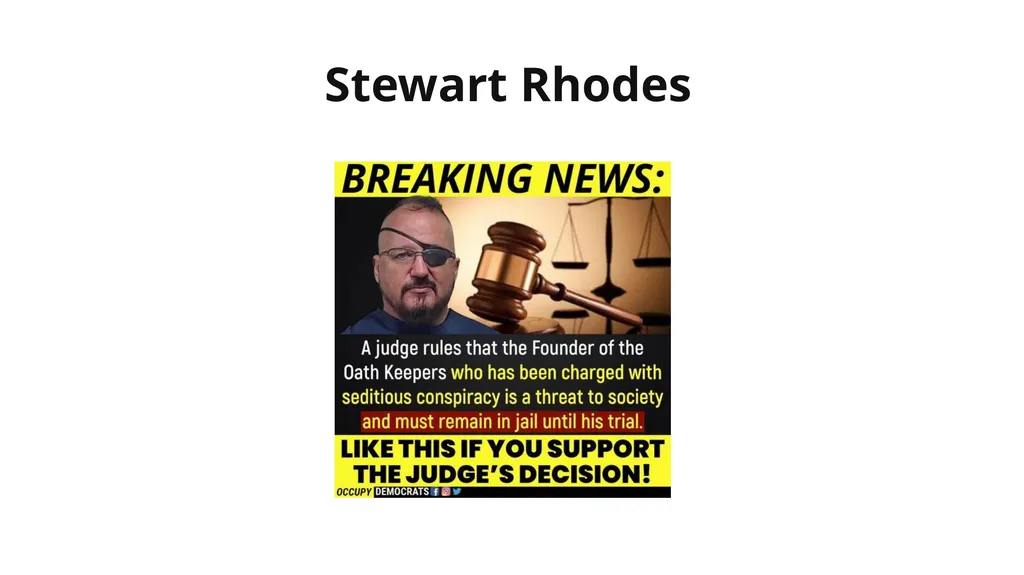
slide3. Stewart Rhodes<br>
slide4. What makes people violent extremists? The question of what makes people become radical, extremist, a violent extremist or a terrorist has been the subject of intense academic attention.
At the height of scholarly output, there was one new book on terrorism published every six hours.<br>
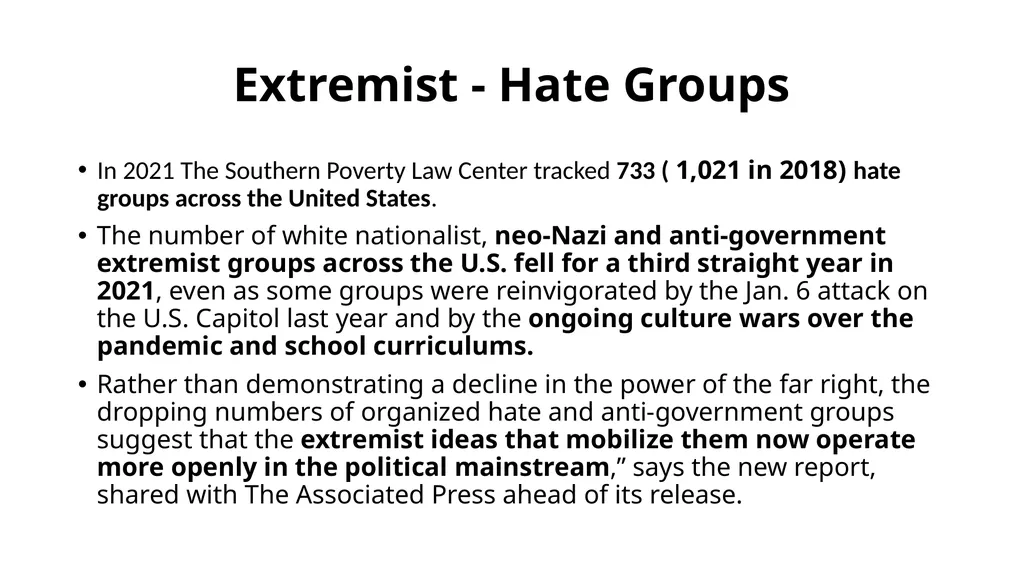
slide5. Extremist - Hate Groups In 2021 The Southern Poverty Law Center tracked 733 ( 1,021 in 2018) hate groups across the United States.
The number of white nationalist, neo-Nazi and anti-government extremist groups across the U.S. fell for a third straight year in 2021, even as some groups were reinvigorated by the Jan. 6 attack on the U.S. Capitol last year and by the ongoing culture wars over the pandemic and school curriculums.
Rather than demonstrating a decline in the power of the far right, the dropping numbers of organized hate and anti-government groups suggest that the extremist ideas that mobilize them now operate more openly in the political mainstream,” says the new report, shared with The Associated Press ahead of its release.<br>
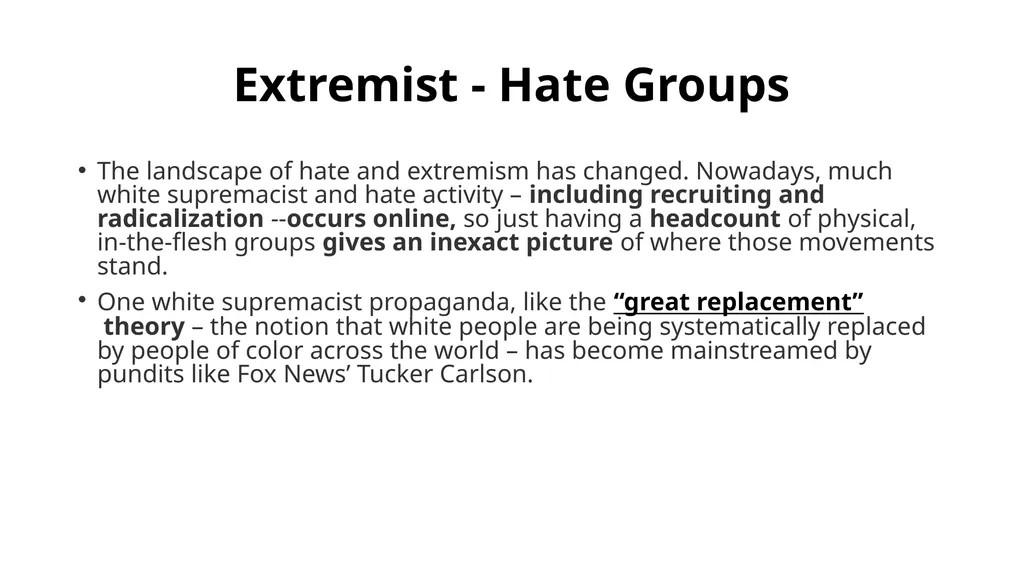
slide6. Extremist - Hate Groups The landscape of hate and extremism has changed. Nowadays, much white supremacist and hate activity – including recruiting and radicalization --occurs online, so just having a headcount of physical, in-the-flesh groups gives an inexact picture of where those movements stand.
One white supremacist propaganda, like the “great replacement” theory – the notion that white people are being systematically replaced by people of color across the world – has become mainstreamed by pundits like Fox News’ Tucker Carlson.
Extremists in the U.S. come in many nationalists, anti-LGBTQ zealots, racist skinheads, neo-Confederates and more.<br>
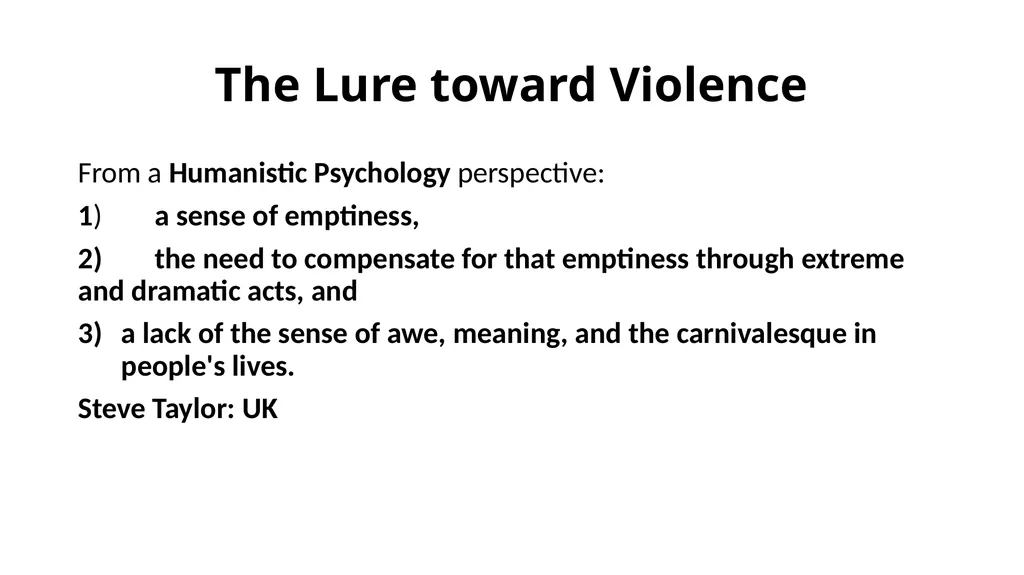
slide7. The Lure toward Violence From a Humanistic Psychology perspective:
1) a sense of emptiness,
2) the need to compensate for that emptiness through extreme and dramatic acts, and
a lack of the sense of awe, meaning, and the carnivalesque in people's lives.
Steve Taylor: UK<br>
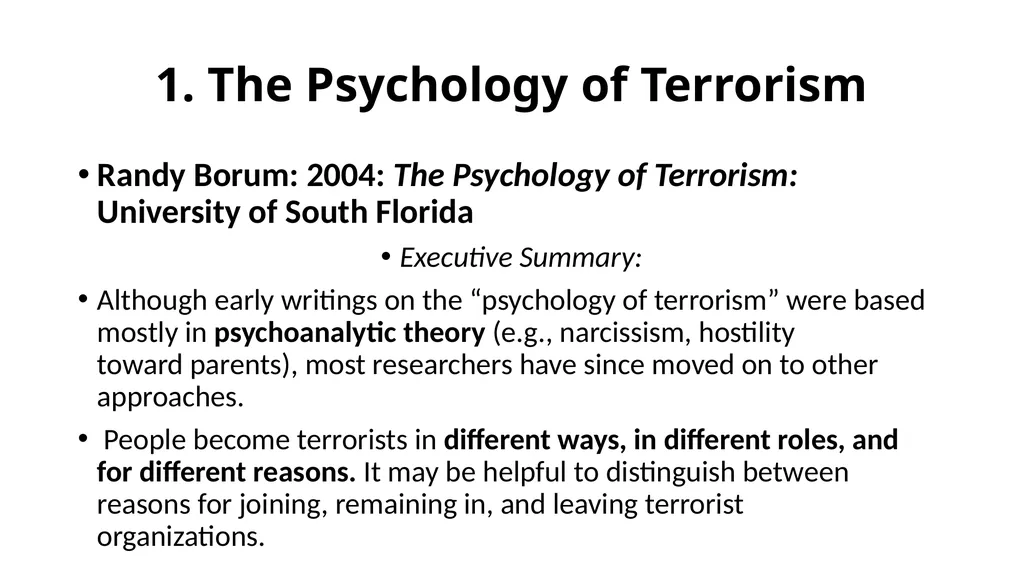
slide8. 1. The Psychology of Terrorism Randy Borum: 2004: The Psychology of Terrorism: University of South Florida
Executive Summary:
Although early writings on the “psychology of terrorism” were based mostly in psychoanalytic theory (e.g., narcissism, hostility toward parents), most researchers have since moved on to other approaches.
People become terrorists in different ways, in different roles, and for different reasons. It may be helpful to distinguish between reasons for joining, remaining in, and leaving terrorist organizations.<br>
slide9. The Psychology of Terrorism Perceived injustice, need for identity and need for belonging are common vulnerabilities among potential terrorists.
Mental illness is not a critical factor in explaining terrorist behavior. Also, most terrorists are not “psychopaths.”
There is no “terrorist personality”, nor is there any accurate profile – psychologically or otherwise – of the terrorist.<br>
slide10. The Psychology of Terrorism Histories of childhood abuse and trauma and themes of perceived injustice and humiliation often are prominent in terrorist biographies, but do not really help to explain terrorism.
• Terrorist ideologies tend to provide a set of beliefs that justify and mandate certain behaviors. Those beliefs are regarded as absolute, and the behaviors are seen as serving a meaningful cause.
Not all extremist ideologies promote violence, nor are all extremists violent. One might ask whether the ideology is driven more by promotion of the “cause” or destruction of those who oppose it.<br>
slide11. The Psychology of Terrorism The powerful, naturally-occurring barriers that inhibit human killing can be eroded either through outside social/environmental influences or by changing how one perceives the situation.
Terrorist groups, like all social collectives, have certain internal (e.g., mistrust, competition) and external (e.g. support, inter-group conflict) vulnerabilities to their existence.
Surprisingly, little research or analysis has been conducted on terrorist recruitment. Recruitment efforts do appear concentrated in areas where people feel most deprived and dissatisfied. Relationships are critical. Effective recruiters create and exploit a sense of urgency and imminence.<br>
slide12. The Psychology of Terrorism Effective leaders of terrorist organizations must be able to: maintain a collective belief system; establish and maintain organizational routines; control the flow of communication; manipulate incentives (and purposive goals) for followers; deflect conflict to external targets; and keep action going.
Research on the psychology of terrorism largely lacks substance and rigor. Cultural factors are important but have not been studied. Future research should be operationally-informed; maintain a behavior-based focus; and derive interpretations from analyses of incident-related behaviors.<br>
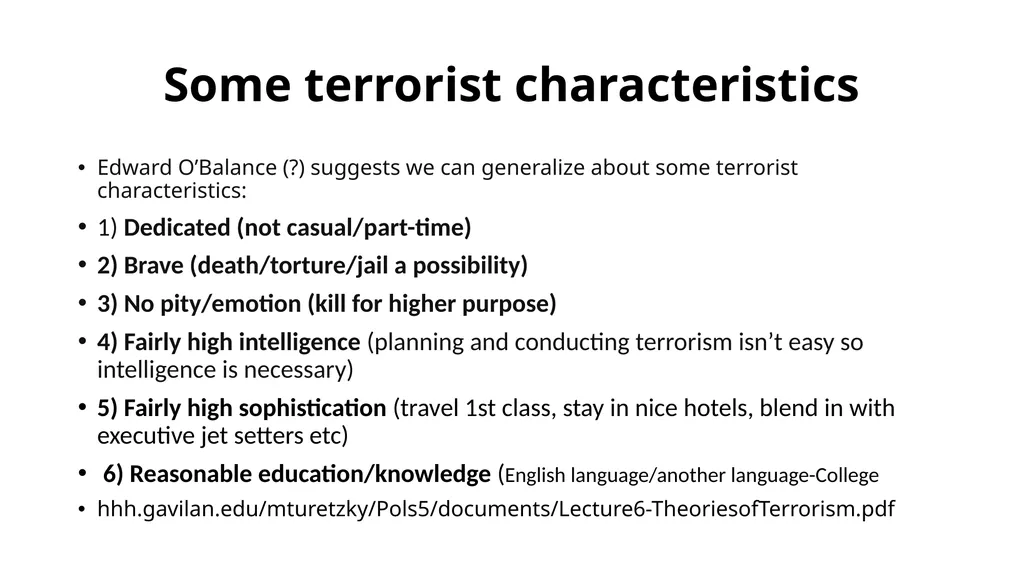
slide13. Some terrorist characteristics Edward O’Balance (?) suggests we can generalize about some terrorist characteristics:
1) Dedicated (not casual/part-time)
2) Brave (death/torture/jail a possibility)
3) No pity/emotion (kill for higher purpose)
4) Fairly high intelligence (planning and conducting terrorism isn’t easy so intelligence is necessary)
5) Fairly high sophistication (travel 1st class, stay in nice hotels, blend in with executive jet setters etc)
6) Reasonable education/knowledge (English language/another language-College
hhh.gavilan.edu/mturetzky/Pols5/documents/Lecture6-TheoriesofTerrorism.pdf<br>
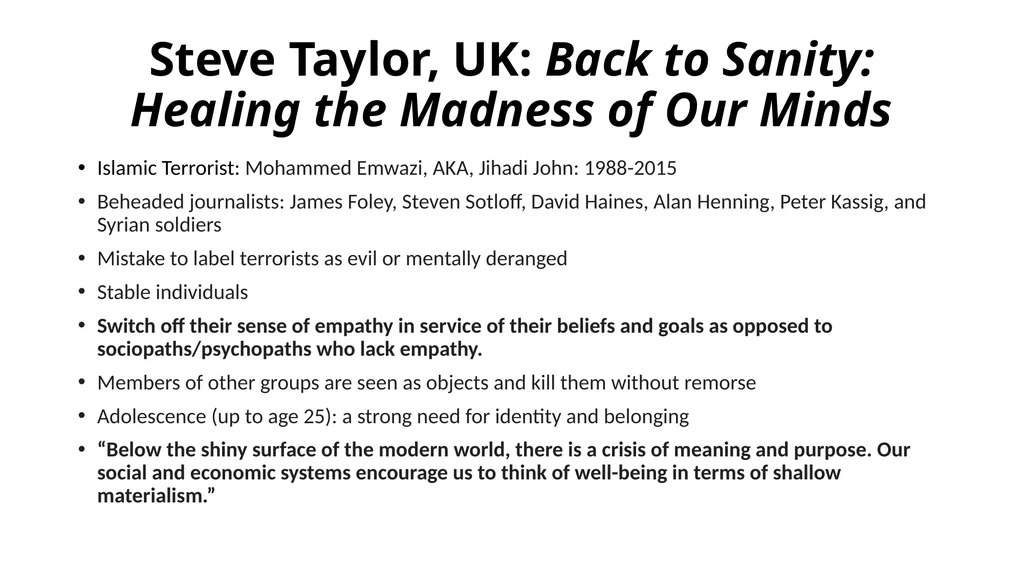
slide14. Steve Taylor, UK: Back to Sanity: Healing the Madness of Our Minds Islamic Terrorist: Mohammed Emwazi, AKA, Jihadi John: 1988-2015
Beheaded journalists: James Foley, Steven Sotloff, David Haines, Alan Henning, Peter Kassig, and Syrian soldiers
Mistake to label terrorists as evil or mentally deranged
Stable individuals
Switch off their sense of empathy in service of their beliefs and goals as opposed to sociopaths/psychopaths who lack empathy.
Members of other groups are seen as objects and kill them without remorse
Adolescence (up to age 25): a strong need for identity and belonging
“Below the shiny surface of the modern world, there is a crisis of meaning and purpose. Our social and economic systems encourage us to think of well-being in terms of shallow materialism.”<br>
slide15. 2. The Psychological Dimensions of Domestic Terrorists<br>
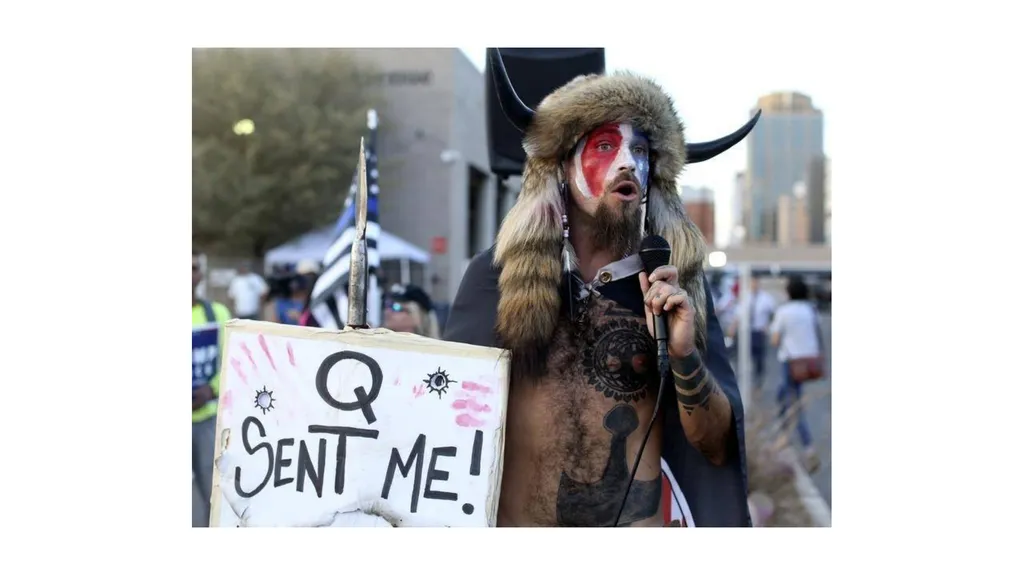
slide17. Jacob Chansley: Qanon Shaman AKA Yellowstone Wolf BOP psychologists diagnosed him with schizophrenia, bipolar disorder, depression, and anxiety.
Told his lawyer about being related to Jesus and Buddha.
Follower of Q conspiracy and has attended Q related rallies.
Told the FBI he was to appear at the capitol with other “patriots” at the request of then President Trump.
Has stated that “covid-1984 is a global propaganda hoax.”
Sentenced to 41 months jail. Pleaded guilty.<br>
slide18. Jacob Chansley, AKA, Jacob Angeli Born in Phoenix, Arizona. Some college. US Navy: 2005-2007: Refused anthrax vaccine; released in October 2007. Medals: National Defense Service Medal,
the Global War on Terrorism Service Medal,
the Sea Service Deployment Ribbon and
the Navy and Marine Corps Overseas Service Ribbon.<br>
slide19. Terrorist Psychology The two most significant scholarly reviews of the psychopathology
position both agree that evidence supporting terrorist normality
more plentiful and of better quality. Silke, A. (1998), Cheshire-Cat logic: The recurring theme of terrorist abnormality in psychological research, Psychology, Crime & Law, 4:1, 51–69.
Europol identified characteristics of jihadists perpetrating acts of terror in the EU and found that many perpetrators were not “strictly practicing their Islam religion”.<br>
slide20. Silke, A. (1998), Cheshire-Cat logic: The recurring theme of terrorist abnormality in psychological research Using an encounter from Alice In Wonderland as a metaphor, this article examines the long-running attempt to apply a psychopathology label to terrorists. The disorders of greatest interest to researchers (antisocial, narcissistic and paranoid personality disorders), are described in order to highlight their attraction for theorists. A review of evidence follows. The critique finds that the findings supporting the pathology model are rare and generally of poor quality.<br>
slide21. Silke, A. (1998), Cheshire-Cat logic: The recurring theme of terrorist abnormality in psychological research In contrast, the evidence suggesting terrorist normality is both more plentiful and of better quality. However, in response to a failure to find any major psychopathology, a trend has emerged which asserts that terrorists possess many of the traits of pathological personalities but do not possess the actual clinical disorders. This development has effectively tainted terrorists with a pathology aura, without offering any way to easily test or refute the accusations.<br>
slide22. Terrorist Psychology is really not Psychopathology In understanding the attraction of the experience of violent radicalism, three factors are often identified:
(1) the desire for excitement;
(2) the desire for ultimate meaning; and
(3) the desire for glory.
Cottee, S. & Hayward, K. (2011), Terrorist (e)motives: The existential attractions of terrorism, Studies in Conflict & Terrorism, 34, 963–986.
While most researchers indicate that there is a Terrorist Normality, some individuals within domestic terror groups may suffer from some form of psychopathology (Ditsky).<br>
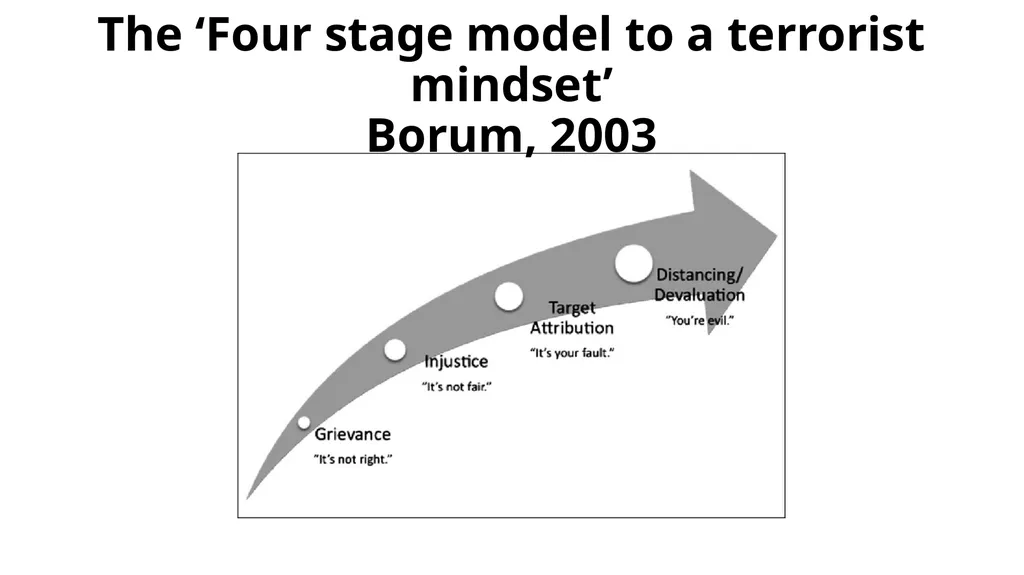
slide23. Borum’s ‘four stage model to a terrorist mindset’ (see figure below). The Federal Bureau of Investigation uses Borum’s ‘four stage model to a terrorist mindset’ (see figure below). It was originally developed as a ‘training heuristic for law enforcement’, not as a formal social science theory.
The initial stage details grievances to a disagreeable condition; this is then framed as an injustice, which evolves into blame being positioned onto another group.
These sentiments eventually develop into the final stage, whereby the radicalized individual demonizes a target group and thereby justifies violent acts toward them.<br>
slide24. The ‘Four stage model to a terrorist mindset’ Borum, 2003<br>
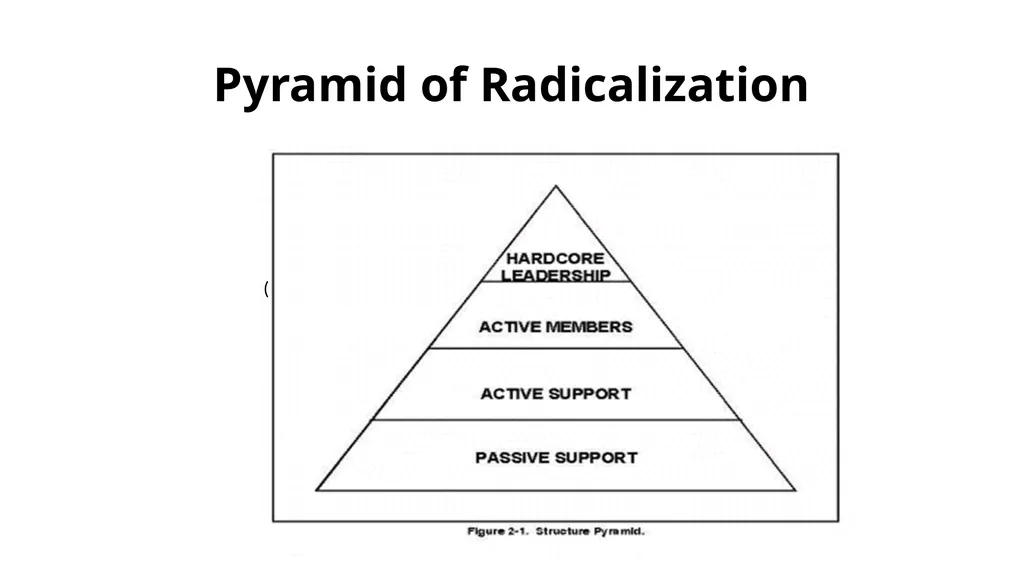
slide25. Pyramid of Radicalization (<br>
slide26. Pyramid of Radicalization Passive Support = Sympathizers. Agree with Cause but not violent means.
Active Support = Supporters. Justify Illegal/violent actions
Active Members = Activists. Legal/non-violent actors, support network & potential recruits
Hardcore Leadership = Radicals. Illegal/violent actors
Fewer people progress to each ascending level of the pyramid, and they become increasingly radicalized the closer they become to its apex. In this sense, the authors describe radicalization as a “gradient that distinguishes terrorists from their base of sympathizers.” McCauley, C. & Moskalenko, S. (2008), Mechanisms of political radicalization: Pathways towards terrorism, Terrorism and Political Violence, 20:3, 417.<br>
slide27. The Internet and Social Media For example, websites that had high level of violent content received negative reactions from the students and were considered reprehensible, making the students less likely to engage with them.
The majority of the 218 students surveyed rejected violent messages. When a website contains content that viewers deemed to be reprehensible by viewers, then, it can actually deter the viewer from engaging in radical or violent action.<br>
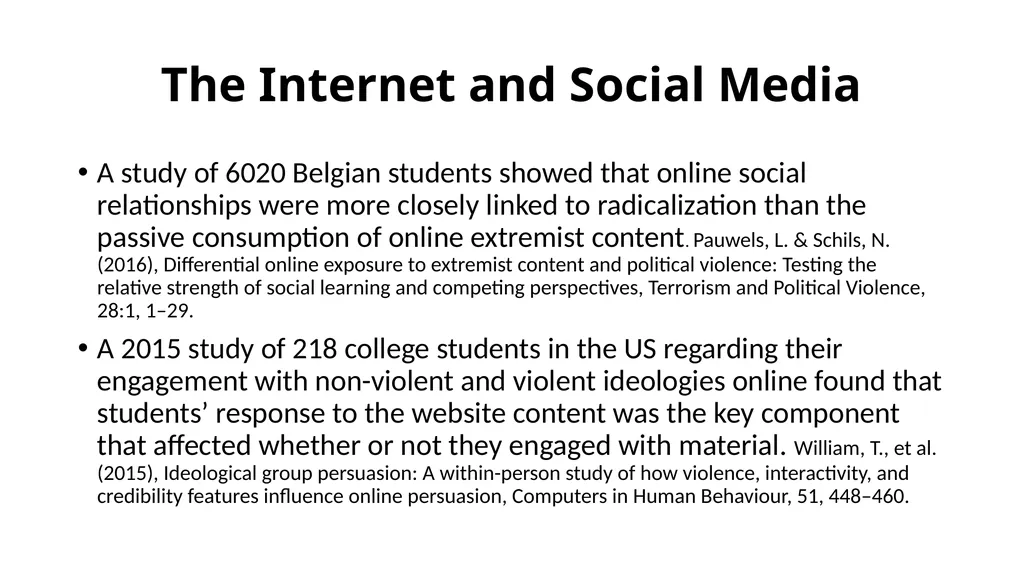
slide28. The Internet and Social Media A study of 6020 Belgian students showed that online social relationships were more closely linked to radicalization than the passive consumption of online extremist content. Pauwels, L. & Schils, N. (2016), Differential online exposure to extremist content and political violence: Testing the relative strength of social learning and competing perspectives, Terrorism and Political Violence, 28:1, 1–29.
A 2015 study of 218 college students in the US regarding their engagement with non-violent and violent ideologies online found that students’ response to the website content was the key component that affected whether or not they engaged with material. William, T., et al. (2015), Ideological group persuasion: A within-person study of how violence, interactivity, and credibility features influence online persuasion, Computers in Human Behaviour, 51, 448–460.<br>
slide29. NOTES There are numerous domestic terrorist groups all with differing ideologies and targets of terror.
There are numerous “cells,” independent group whose allegiance is to a specific ideology but not necessarily endorsed by the larger terrorist body of members with specific leaders.
The case study focuses on such an independent cell.<br>
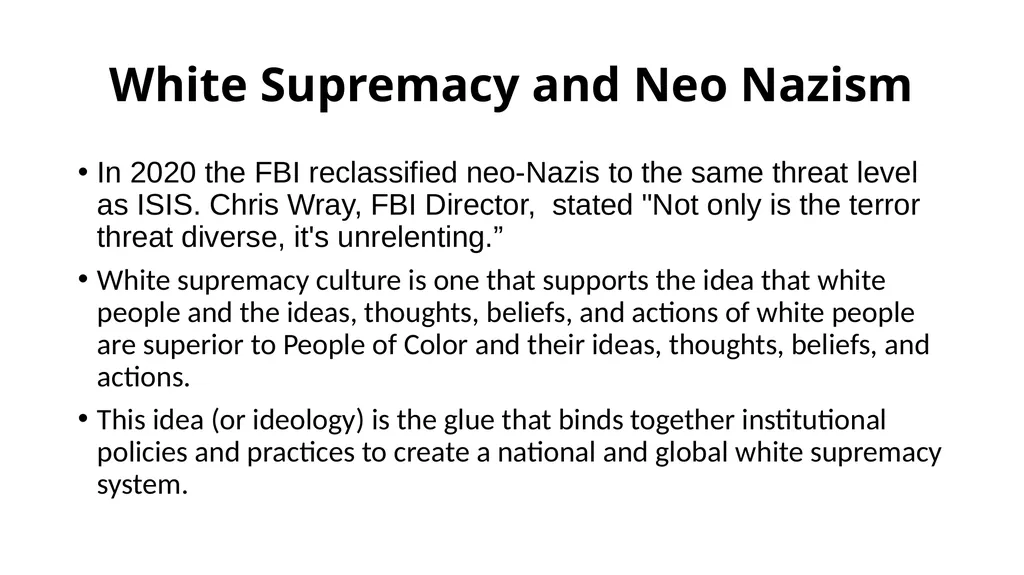
slide30. White Supremacy and Neo Nazism In 2020 the FBI reclassified neo-Nazis to the same threat level as ISIS. Chris Wray, FBI Director, stated "Not only is the terror threat diverse, it's unrelenting.”
White supremacy culture is one that supports the idea that white people and the ideas, thoughts, beliefs, and actions of white people are superior to People of Color and their ideas, thoughts, beliefs, and actions.
This idea (or ideology) is the glue that binds together institutional policies and practices to create a national and global white supremacy system.<br>
slide31. White Supremacy and Counseling Psychology: A Critical–Conceptual Framework Patrick R. Grzanka, Kirsten A. Gonzalez, and Lisa B. Spanierman We suggest three steps for sharpening counseling psychologists’ approaches to social justice:
rejecting racial progress narratives,
engaging in social justice-oriented practice with White clients,
and centering White supremacy as a key problem for the field of counseling psychology and allied helping professions.<br>
slide32. 3. A Case Study Jay, at present a 24-year-old Caucasian male
High Profile Parents
Youngest of Four Sons<br>
slide33. Jay College student in the northeast United States as the time of his indoctrination
Social Anxiety
Internet social network
White Supremacy/Neo-Nazi Sympathizer
Disaffected: dissatisfied with the people in authority and no longer willing to support them.
Increased radicalization
Initiator/Leader
Conspired to “blow-up northeast power grid,” along with two other white males<br>
slide34. Jay Never achieved “the plot”- ill formed; were to supply another group with “instruments of destruction.”
Shock: FBI raided his parents’ home in early August 2020: confiscated firearms, bomb making materials, ammo, etc. Led to remorse. Thrust into reality.
Saw himself as a loner preferring solitude but would like “real” relationships.<br>
slide35. Applying the Four Stage Model to Jay’s Terrorist Mindset Grievance: initially several components: social isolation, academic stagnation, thoughts of being “scammed” by his college degree, poor employment potential (why?) “It’s not right.” Rationalizing situation: begins to indulge in replacement theories on the internet. “Your generation.”
Injustice: “I am being replaced: it’s not fair!”
Target attribution: Increased attention to Neo-Nazi ideologies to POC: ‘It’s your fault.”
Devaluation: “You (POC) are evil.”
Radicalization is complete: and now a plan of violence.<br>
slide36. Three co-conspirators They reasoned that at the very least, a successful attempt on grids could plunge the country into chaos and knock out power for months, costing the government millions. It might also trigger an all-out race war or the “next Great Depression,” tilling the soil for a rise in white leaders<br>
slide37. Status as of April 1, 2022 Has been seen in Cognitive Behavior Therapy for 50 sessions including 3 with parents
Federal Court Hearing: February 23, 2022: Pleaded Guilty
Surrendered Passport
Confined to Southern Texas District
Ankle bracelet
Monthly Probation Report
Working full-time at Home Depot in wood products
Completed 2 courses towards a on line master’s degree in Construction Management at UTEP
Daily physical exercise
Participates in a weekly youth church group/multi-racial
June 2022 Sentencing: facing 15 years<br>
slide38. A Short Bibliography Borum, R. (2004) The Psychology of Terrorism: University of South Florida Press.
Grzanka, P. R., Gonzalez, K. A., & Spanierman, L. B. (2019). White Supremacy and Counseling Psychology: A Critical-Conceptual Framework. The Counseling Psychologist, Vol. 47 (4), 478-529.
hhh.gavilan.edu/mturetzky/Pols5/documents/Lecture6- TheoriesofTerrorism.pdf
Kteily, N., Bruneau, E., Waytz, A., & Cotterill, S. (2015). The ascent of man: Theoretical and empirical evidence for blatant dehumanization. Journal of Personality and Social Psychology, 109(5), 901.<br>
slide39. A Short Bibliography McCauley, C. & Moskalenko, S. (2008), Mechanisms of political radicalization: Pathways towards terrorism: Terrorism and Political Violence, 20:3, 417.
Miller, C., & Chauhan, L. S. (2017) Radical Beliefs and Violent Behavior. In De-radicalization: Scientific insights for policy © Flemish Peace Institute, Brussels, 8 September 2017, pg. 23-45.
National Strategy for Countering Domestic Terrorism. National Security Council. June 15, 2021.
Silke, A. (1998), Cheshire-Cat logic: The recurring theme of terrorist abnormality in psychological research: Psychology, Crime & Law, 4:1, 51–69.
Taylor, S. (2012). Back to Sanity: Healing the Madness of Our Minds. UK: Hay House<br>
Texas Licensed Psychologist
Clinical and Forensic Services
Sugar Land, Texas<br>
slide2. Learning Objectives Background
1) Describe the psychology of terrorism
2) Summarize the psychological dimensions of a domestic terrorist
3) Focus on White Supremacy
4) Apply strategies to the counseling of a terrorist seeking rehabilitation: a case study of White Supremacy<br>
slide3. Stewart Rhodes<br>
slide4. What makes people violent extremists? The question of what makes people become radical, extremist, a violent extremist or a terrorist has been the subject of intense academic attention.
At the height of scholarly output, there was one new book on terrorism published every six hours.<br>
slide5. Extremist - Hate Groups In 2021 The Southern Poverty Law Center tracked 733 ( 1,021 in 2018) hate groups across the United States.
The number of white nationalist, neo-Nazi and anti-government extremist groups across the U.S. fell for a third straight year in 2021, even as some groups were reinvigorated by the Jan. 6 attack on the U.S. Capitol last year and by the ongoing culture wars over the pandemic and school curriculums.
Rather than demonstrating a decline in the power of the far right, the dropping numbers of organized hate and anti-government groups suggest that the extremist ideas that mobilize them now operate more openly in the political mainstream,” says the new report, shared with The Associated Press ahead of its release.<br>
slide6. Extremist - Hate Groups The landscape of hate and extremism has changed. Nowadays, much white supremacist and hate activity – including recruiting and radicalization --occurs online, so just having a headcount of physical, in-the-flesh groups gives an inexact picture of where those movements stand.
One white supremacist propaganda, like the “great replacement” theory – the notion that white people are being systematically replaced by people of color across the world – has become mainstreamed by pundits like Fox News’ Tucker Carlson.
Extremists in the U.S. come in many nationalists, anti-LGBTQ zealots, racist skinheads, neo-Confederates and more.<br>
slide7. The Lure toward Violence From a Humanistic Psychology perspective:
1) a sense of emptiness,
2) the need to compensate for that emptiness through extreme and dramatic acts, and
a lack of the sense of awe, meaning, and the carnivalesque in people's lives.
Steve Taylor: UK<br>
slide8. 1. The Psychology of Terrorism Randy Borum: 2004: The Psychology of Terrorism: University of South Florida
Executive Summary:
Although early writings on the “psychology of terrorism” were based mostly in psychoanalytic theory (e.g., narcissism, hostility toward parents), most researchers have since moved on to other approaches.
People become terrorists in different ways, in different roles, and for different reasons. It may be helpful to distinguish between reasons for joining, remaining in, and leaving terrorist organizations.<br>
slide9. The Psychology of Terrorism Perceived injustice, need for identity and need for belonging are common vulnerabilities among potential terrorists.
Mental illness is not a critical factor in explaining terrorist behavior. Also, most terrorists are not “psychopaths.”
There is no “terrorist personality”, nor is there any accurate profile – psychologically or otherwise – of the terrorist.<br>
slide10. The Psychology of Terrorism Histories of childhood abuse and trauma and themes of perceived injustice and humiliation often are prominent in terrorist biographies, but do not really help to explain terrorism.
• Terrorist ideologies tend to provide a set of beliefs that justify and mandate certain behaviors. Those beliefs are regarded as absolute, and the behaviors are seen as serving a meaningful cause.
Not all extremist ideologies promote violence, nor are all extremists violent. One might ask whether the ideology is driven more by promotion of the “cause” or destruction of those who oppose it.<br>
slide11. The Psychology of Terrorism The powerful, naturally-occurring barriers that inhibit human killing can be eroded either through outside social/environmental influences or by changing how one perceives the situation.
Terrorist groups, like all social collectives, have certain internal (e.g., mistrust, competition) and external (e.g. support, inter-group conflict) vulnerabilities to their existence.
Surprisingly, little research or analysis has been conducted on terrorist recruitment. Recruitment efforts do appear concentrated in areas where people feel most deprived and dissatisfied. Relationships are critical. Effective recruiters create and exploit a sense of urgency and imminence.<br>
slide12. The Psychology of Terrorism Effective leaders of terrorist organizations must be able to: maintain a collective belief system; establish and maintain organizational routines; control the flow of communication; manipulate incentives (and purposive goals) for followers; deflect conflict to external targets; and keep action going.
Research on the psychology of terrorism largely lacks substance and rigor. Cultural factors are important but have not been studied. Future research should be operationally-informed; maintain a behavior-based focus; and derive interpretations from analyses of incident-related behaviors.<br>
slide13. Some terrorist characteristics Edward O’Balance (?) suggests we can generalize about some terrorist characteristics:
1) Dedicated (not casual/part-time)
2) Brave (death/torture/jail a possibility)
3) No pity/emotion (kill for higher purpose)
4) Fairly high intelligence (planning and conducting terrorism isn’t easy so intelligence is necessary)
5) Fairly high sophistication (travel 1st class, stay in nice hotels, blend in with executive jet setters etc)
6) Reasonable education/knowledge (English language/another language-College
hhh.gavilan.edu/mturetzky/Pols5/documents/Lecture6-TheoriesofTerrorism.pdf<br>
slide14. Steve Taylor, UK: Back to Sanity: Healing the Madness of Our Minds Islamic Terrorist: Mohammed Emwazi, AKA, Jihadi John: 1988-2015
Beheaded journalists: James Foley, Steven Sotloff, David Haines, Alan Henning, Peter Kassig, and Syrian soldiers
Mistake to label terrorists as evil or mentally deranged
Stable individuals
Switch off their sense of empathy in service of their beliefs and goals as opposed to sociopaths/psychopaths who lack empathy.
Members of other groups are seen as objects and kill them without remorse
Adolescence (up to age 25): a strong need for identity and belonging
“Below the shiny surface of the modern world, there is a crisis of meaning and purpose. Our social and economic systems encourage us to think of well-being in terms of shallow materialism.”<br>
slide15. 2. The Psychological Dimensions of Domestic Terrorists<br>
slide17. Jacob Chansley: Qanon Shaman AKA Yellowstone Wolf BOP psychologists diagnosed him with schizophrenia, bipolar disorder, depression, and anxiety.
Told his lawyer about being related to Jesus and Buddha.
Follower of Q conspiracy and has attended Q related rallies.
Told the FBI he was to appear at the capitol with other “patriots” at the request of then President Trump.
Has stated that “covid-1984 is a global propaganda hoax.”
Sentenced to 41 months jail. Pleaded guilty.<br>
slide18. Jacob Chansley, AKA, Jacob Angeli Born in Phoenix, Arizona. Some college. US Navy: 2005-2007: Refused anthrax vaccine; released in October 2007. Medals: National Defense Service Medal,
the Global War on Terrorism Service Medal,
the Sea Service Deployment Ribbon and
the Navy and Marine Corps Overseas Service Ribbon.<br>
slide19. Terrorist Psychology The two most significant scholarly reviews of the psychopathology
position both agree that evidence supporting terrorist normality
more plentiful and of better quality. Silke, A. (1998), Cheshire-Cat logic: The recurring theme of terrorist abnormality in psychological research, Psychology, Crime & Law, 4:1, 51–69.
Europol identified characteristics of jihadists perpetrating acts of terror in the EU and found that many perpetrators were not “strictly practicing their Islam religion”.<br>
slide20. Silke, A. (1998), Cheshire-Cat logic: The recurring theme of terrorist abnormality in psychological research Using an encounter from Alice In Wonderland as a metaphor, this article examines the long-running attempt to apply a psychopathology label to terrorists. The disorders of greatest interest to researchers (antisocial, narcissistic and paranoid personality disorders), are described in order to highlight their attraction for theorists. A review of evidence follows. The critique finds that the findings supporting the pathology model are rare and generally of poor quality.<br>
slide21. Silke, A. (1998), Cheshire-Cat logic: The recurring theme of terrorist abnormality in psychological research In contrast, the evidence suggesting terrorist normality is both more plentiful and of better quality. However, in response to a failure to find any major psychopathology, a trend has emerged which asserts that terrorists possess many of the traits of pathological personalities but do not possess the actual clinical disorders. This development has effectively tainted terrorists with a pathology aura, without offering any way to easily test or refute the accusations.<br>
slide22. Terrorist Psychology is really not Psychopathology In understanding the attraction of the experience of violent radicalism, three factors are often identified:
(1) the desire for excitement;
(2) the desire for ultimate meaning; and
(3) the desire for glory.
Cottee, S. & Hayward, K. (2011), Terrorist (e)motives: The existential attractions of terrorism, Studies in Conflict & Terrorism, 34, 963–986.
While most researchers indicate that there is a Terrorist Normality, some individuals within domestic terror groups may suffer from some form of psychopathology (Ditsky).<br>
slide23. Borum’s ‘four stage model to a terrorist mindset’ (see figure below). The Federal Bureau of Investigation uses Borum’s ‘four stage model to a terrorist mindset’ (see figure below). It was originally developed as a ‘training heuristic for law enforcement’, not as a formal social science theory.
The initial stage details grievances to a disagreeable condition; this is then framed as an injustice, which evolves into blame being positioned onto another group.
These sentiments eventually develop into the final stage, whereby the radicalized individual demonizes a target group and thereby justifies violent acts toward them.<br>
slide24. The ‘Four stage model to a terrorist mindset’ Borum, 2003<br>
slide25. Pyramid of Radicalization (<br>
slide26. Pyramid of Radicalization Passive Support = Sympathizers. Agree with Cause but not violent means.
Active Support = Supporters. Justify Illegal/violent actions
Active Members = Activists. Legal/non-violent actors, support network & potential recruits
Hardcore Leadership = Radicals. Illegal/violent actors
Fewer people progress to each ascending level of the pyramid, and they become increasingly radicalized the closer they become to its apex. In this sense, the authors describe radicalization as a “gradient that distinguishes terrorists from their base of sympathizers.” McCauley, C. & Moskalenko, S. (2008), Mechanisms of political radicalization: Pathways towards terrorism, Terrorism and Political Violence, 20:3, 417.<br>
slide27. The Internet and Social Media For example, websites that had high level of violent content received negative reactions from the students and were considered reprehensible, making the students less likely to engage with them.
The majority of the 218 students surveyed rejected violent messages. When a website contains content that viewers deemed to be reprehensible by viewers, then, it can actually deter the viewer from engaging in radical or violent action.<br>
slide28. The Internet and Social Media A study of 6020 Belgian students showed that online social relationships were more closely linked to radicalization than the passive consumption of online extremist content. Pauwels, L. & Schils, N. (2016), Differential online exposure to extremist content and political violence: Testing the relative strength of social learning and competing perspectives, Terrorism and Political Violence, 28:1, 1–29.
A 2015 study of 218 college students in the US regarding their engagement with non-violent and violent ideologies online found that students’ response to the website content was the key component that affected whether or not they engaged with material. William, T., et al. (2015), Ideological group persuasion: A within-person study of how violence, interactivity, and credibility features influence online persuasion, Computers in Human Behaviour, 51, 448–460.<br>
slide29. NOTES There are numerous domestic terrorist groups all with differing ideologies and targets of terror.
There are numerous “cells,” independent group whose allegiance is to a specific ideology but not necessarily endorsed by the larger terrorist body of members with specific leaders.
The case study focuses on such an independent cell.<br>
slide30. White Supremacy and Neo Nazism In 2020 the FBI reclassified neo-Nazis to the same threat level as ISIS. Chris Wray, FBI Director, stated "Not only is the terror threat diverse, it's unrelenting.”
White supremacy culture is one that supports the idea that white people and the ideas, thoughts, beliefs, and actions of white people are superior to People of Color and their ideas, thoughts, beliefs, and actions.
This idea (or ideology) is the glue that binds together institutional policies and practices to create a national and global white supremacy system.<br>
slide31. White Supremacy and Counseling Psychology: A Critical–Conceptual Framework Patrick R. Grzanka, Kirsten A. Gonzalez, and Lisa B. Spanierman We suggest three steps for sharpening counseling psychologists’ approaches to social justice:
rejecting racial progress narratives,
engaging in social justice-oriented practice with White clients,
and centering White supremacy as a key problem for the field of counseling psychology and allied helping professions.<br>
slide32. 3. A Case Study Jay, at present a 24-year-old Caucasian male
High Profile Parents
Youngest of Four Sons<br>
slide33. Jay College student in the northeast United States as the time of his indoctrination
Social Anxiety
Internet social network
White Supremacy/Neo-Nazi Sympathizer
Disaffected: dissatisfied with the people in authority and no longer willing to support them.
Increased radicalization
Initiator/Leader
Conspired to “blow-up northeast power grid,” along with two other white males<br>
slide34. Jay Never achieved “the plot”- ill formed; were to supply another group with “instruments of destruction.”
Shock: FBI raided his parents’ home in early August 2020: confiscated firearms, bomb making materials, ammo, etc. Led to remorse. Thrust into reality.
Saw himself as a loner preferring solitude but would like “real” relationships.<br>
slide35. Applying the Four Stage Model to Jay’s Terrorist Mindset Grievance: initially several components: social isolation, academic stagnation, thoughts of being “scammed” by his college degree, poor employment potential (why?) “It’s not right.” Rationalizing situation: begins to indulge in replacement theories on the internet. “Your generation.”
Injustice: “I am being replaced: it’s not fair!”
Target attribution: Increased attention to Neo-Nazi ideologies to POC: ‘It’s your fault.”
Devaluation: “You (POC) are evil.”
Radicalization is complete: and now a plan of violence.<br>
slide36. Three co-conspirators They reasoned that at the very least, a successful attempt on grids could plunge the country into chaos and knock out power for months, costing the government millions. It might also trigger an all-out race war or the “next Great Depression,” tilling the soil for a rise in white leaders<br>
slide37. Status as of April 1, 2022 Has been seen in Cognitive Behavior Therapy for 50 sessions including 3 with parents
Federal Court Hearing: February 23, 2022: Pleaded Guilty
Surrendered Passport
Confined to Southern Texas District
Ankle bracelet
Monthly Probation Report
Working full-time at Home Depot in wood products
Completed 2 courses towards a on line master’s degree in Construction Management at UTEP
Daily physical exercise
Participates in a weekly youth church group/multi-racial
June 2022 Sentencing: facing 15 years<br>
slide38. A Short Bibliography Borum, R. (2004) The Psychology of Terrorism: University of South Florida Press.
Grzanka, P. R., Gonzalez, K. A., & Spanierman, L. B. (2019). White Supremacy and Counseling Psychology: A Critical-Conceptual Framework. The Counseling Psychologist, Vol. 47 (4), 478-529.
hhh.gavilan.edu/mturetzky/Pols5/documents/Lecture6- TheoriesofTerrorism.pdf
Kteily, N., Bruneau, E., Waytz, A., & Cotterill, S. (2015). The ascent of man: Theoretical and empirical evidence for blatant dehumanization. Journal of Personality and Social Psychology, 109(5), 901.<br>
slide39. A Short Bibliography McCauley, C. & Moskalenko, S. (2008), Mechanisms of political radicalization: Pathways towards terrorism: Terrorism and Political Violence, 20:3, 417.
Miller, C., & Chauhan, L. S. (2017) Radical Beliefs and Violent Behavior. In De-radicalization: Scientific insights for policy © Flemish Peace Institute, Brussels, 8 September 2017, pg. 23-45.
National Strategy for Countering Domestic Terrorism. National Security Council. June 15, 2021.
Silke, A. (1998), Cheshire-Cat logic: The recurring theme of terrorist abnormality in psychological research: Psychology, Crime & Law, 4:1, 51–69.
Taylor, S. (2012). Back to Sanity: Healing the Madness of Our Minds. UK: Hay House<br>