
Factor Immobility, Unemployment, Wages, Prices,
PM
Published · 29 slides · 0 views

1 / 1

Description
Factor Immobility, Unemployment, Wages, Prices, and International Trade: Challenges to the Role of Trade in the H-O Framework Sherman Robinson IFPRI FAO worksop: Relationship Between Trade and Food Security Rome, March 2015 Benefits of
Related Topics
Share
Embed code
Download this presentation From Below
"Factor Immobility, Unemployment, Wages, Prices," is the property of its rightful owner. Permission is granted to download and print the materials on this website for personal, non-commercial use only, and to display it on your personal computer provided you do not modify the materials and that you retain all copyright notices contained in the materials. By downloading content from our website, you accept the terms of this agreement.
Presentation Transcript
01
Factor Immobility, Unemployment, Wages, Prices, and International Trade: Challenges to the Role of Trade in the H-O Framework Sherman Robinson
IFPRI
FAO worksop: “Relationship Between Trade and Food Security”
Rome, March 2015<br>
IFPRI
FAO worksop: “Relationship Between Trade and Food Security”
Rome, March 2015<br>
02
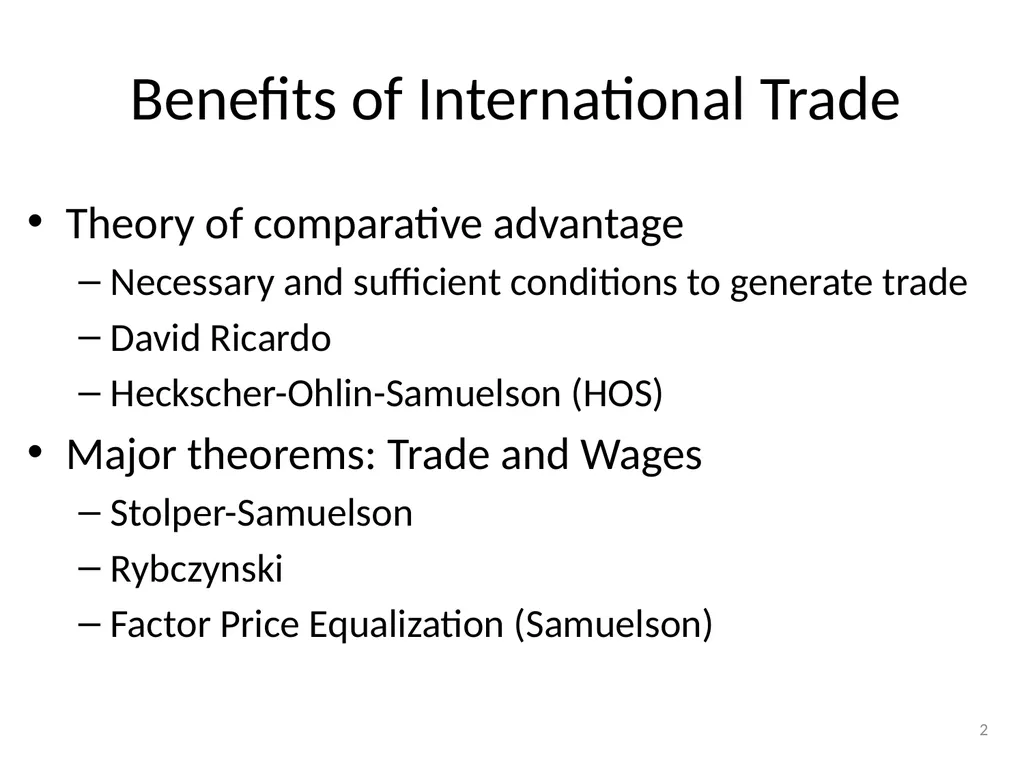
Benefits of International Trade Theory of comparative advantage
Necessary and sufficient conditions to generate trade
David Ricardo
Heckscher-Ohlin-Samuelson (HOS)
Major theorems: Trade and Wages
Stolper-Samuelson
Rybczynski
Factor Price Equalization (Samuelson) 2<br>
Necessary and sufficient conditions to generate trade
David Ricardo
Heckscher-Ohlin-Samuelson (HOS)
Major theorems: Trade and Wages
Stolper-Samuelson
Rybczynski
Factor Price Equalization (Samuelson) 2<br>
03
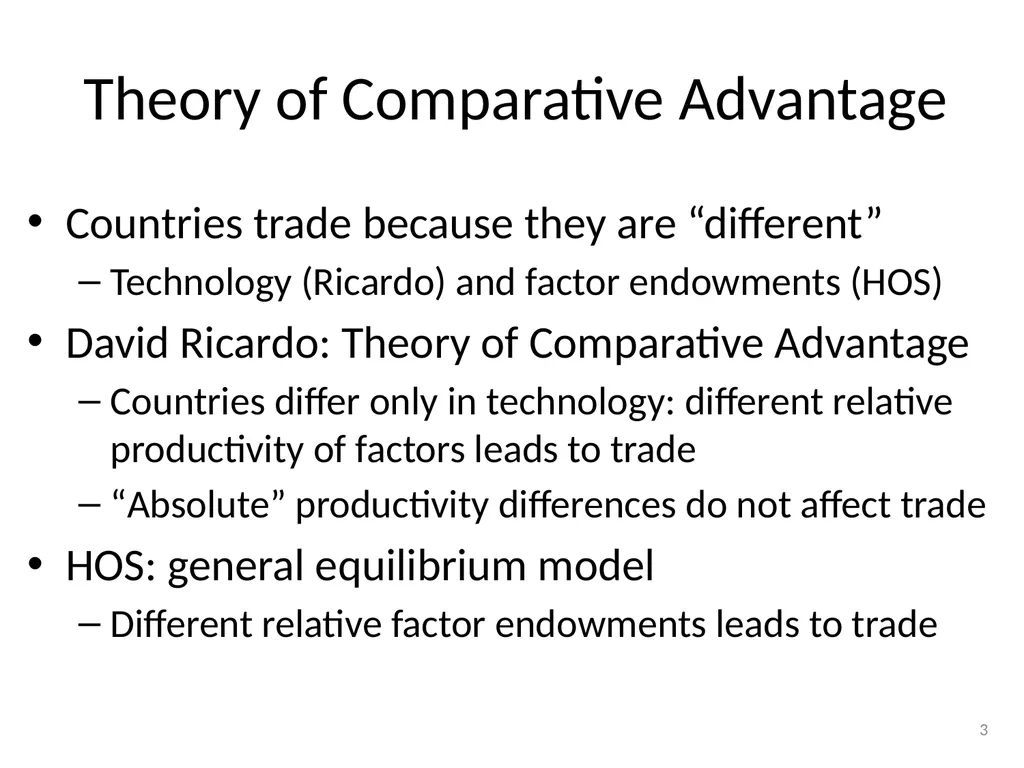
Theory of Comparative Advantage Countries trade because they are “different”
Technology (Ricardo) and factor endowments (HOS)
David Ricardo: Theory of Comparative Advantage
Countries differ only in technology: different relative productivity of factors leads to trade
“Absolute” productivity differences do not affect trade
HOS: general equilibrium model
Different relative factor endowments leads to trade 3<br>
Technology (Ricardo) and factor endowments (HOS)
David Ricardo: Theory of Comparative Advantage
Countries differ only in technology: different relative productivity of factors leads to trade
“Absolute” productivity differences do not affect trade
HOS: general equilibrium model
Different relative factor endowments leads to trade 3<br>
04
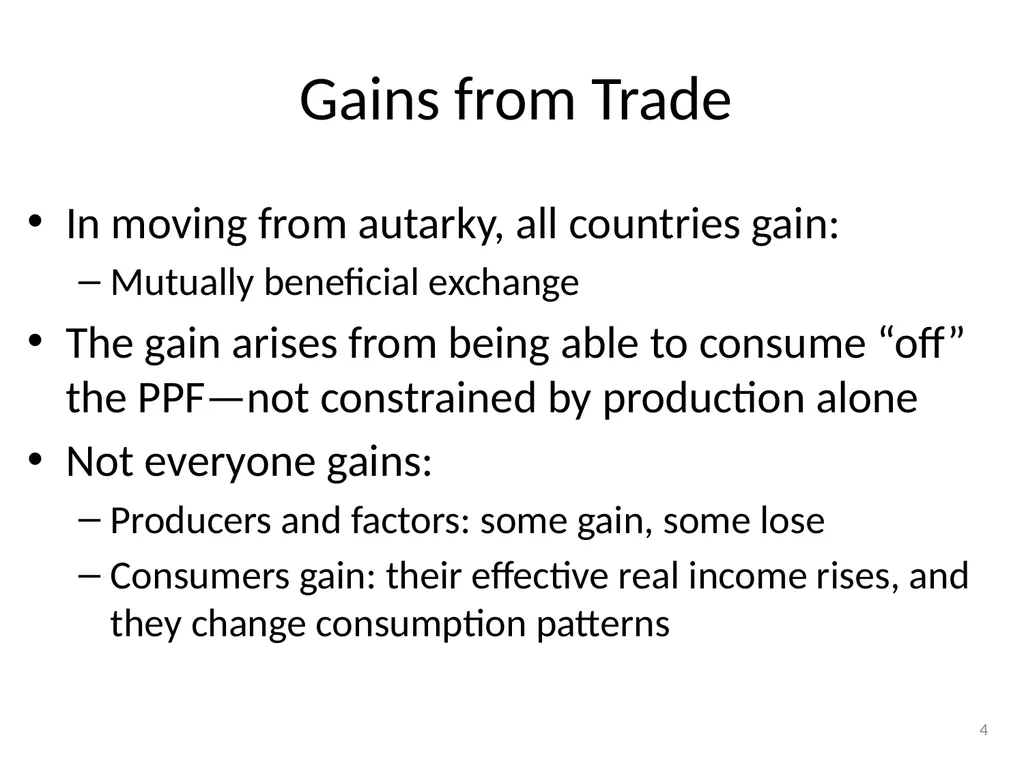
Gains from Trade In moving from autarky, all countries gain:
Mutually beneficial exchange
The gain arises from being able to consume “off” the PPF—not constrained by production alone
Not everyone gains:
Producers and factors: some gain, some lose
Consumers gain: their effective real income rises, and they change consumption patterns 4<br>
Mutually beneficial exchange
The gain arises from being able to consume “off” the PPF—not constrained by production alone
Not everyone gains:
Producers and factors: some gain, some lose
Consumers gain: their effective real income rises, and they change consumption patterns 4<br>
05
Trade Fallacies Countries lose from trade if they are less produc-tive in all sectors—no “absolute” advantage
Not true. Comparative, not absolute, advantage determines gains from trade
Labor (“jobs”) in high wage countries will be seriously damaged by trade with low-wage countries (Perot-Choate on NAFTA)
Trade effects on wages are weak. But labor will be reallocated across sectors as a result of trade. 5<br>
Not true. Comparative, not absolute, advantage determines gains from trade
Labor (“jobs”) in high wage countries will be seriously damaged by trade with low-wage countries (Perot-Choate on NAFTA)
Trade effects on wages are weak. But labor will be reallocated across sectors as a result of trade. 5<br>
06
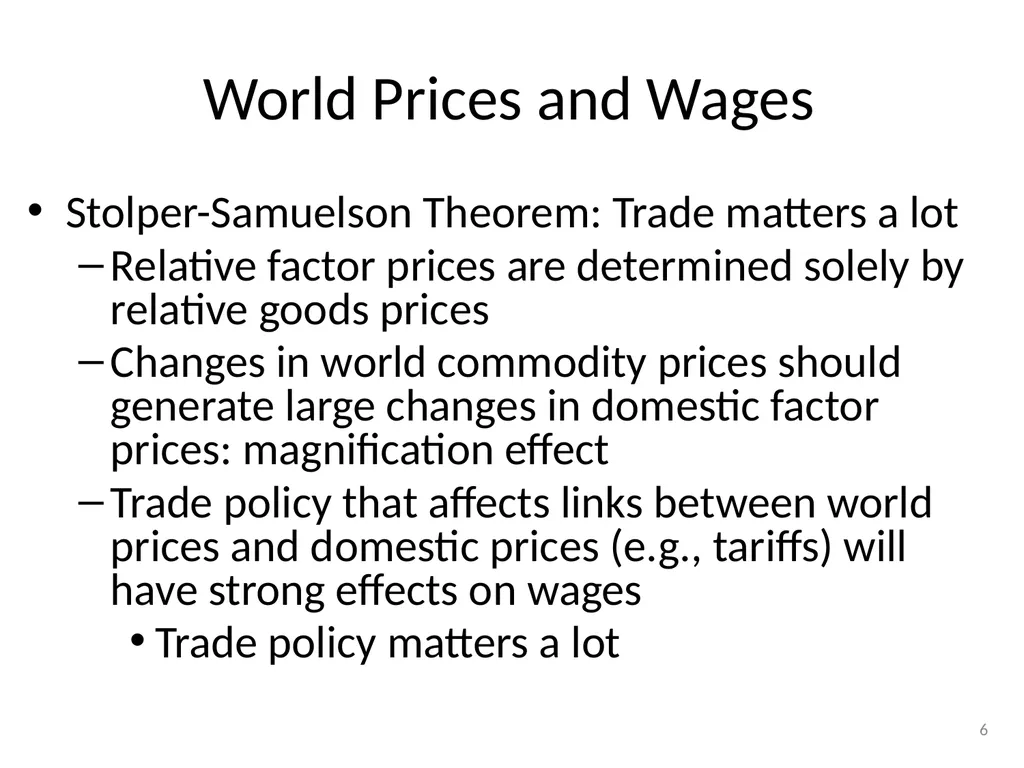
6 World Prices and Wages Stolper-Samuelson Theorem: Trade matters a lot
Relative factor prices are determined solely by relative goods prices
Changes in world commodity prices should generate large changes in domestic factor prices: magnification effect
Trade policy that affects links between world prices and domestic prices (e.g., tariffs) will have strong effects on wages
Trade policy matters a lot<br>
Relative factor prices are determined solely by relative goods prices
Changes in world commodity prices should generate large changes in domestic factor prices: magnification effect
Trade policy that affects links between world prices and domestic prices (e.g., tariffs) will have strong effects on wages
Trade policy matters a lot<br>
07
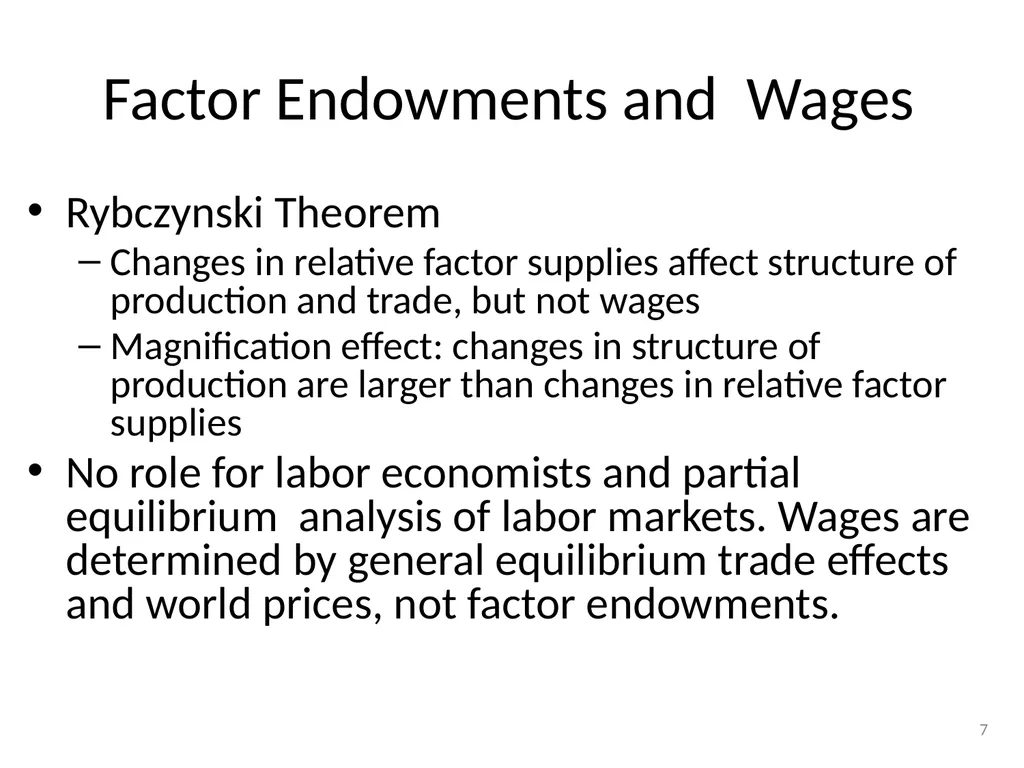
Factor Endowments and Wages Rybczynski Theorem
Changes in relative factor supplies affect structure of production and trade, but not wages
Magnification effect: changes in structure of production are larger than changes in relative factor supplies
No role for labor economists and partial equilibrium analysis of labor markets. Wages are determined by general equilibrium trade effects and world prices, not factor endowments. 7<br>
Changes in relative factor supplies affect structure of production and trade, but not wages
Magnification effect: changes in structure of production are larger than changes in relative factor supplies
No role for labor economists and partial equilibrium analysis of labor markets. Wages are determined by general equilibrium trade effects and world prices, not factor endowments. 7<br>
08
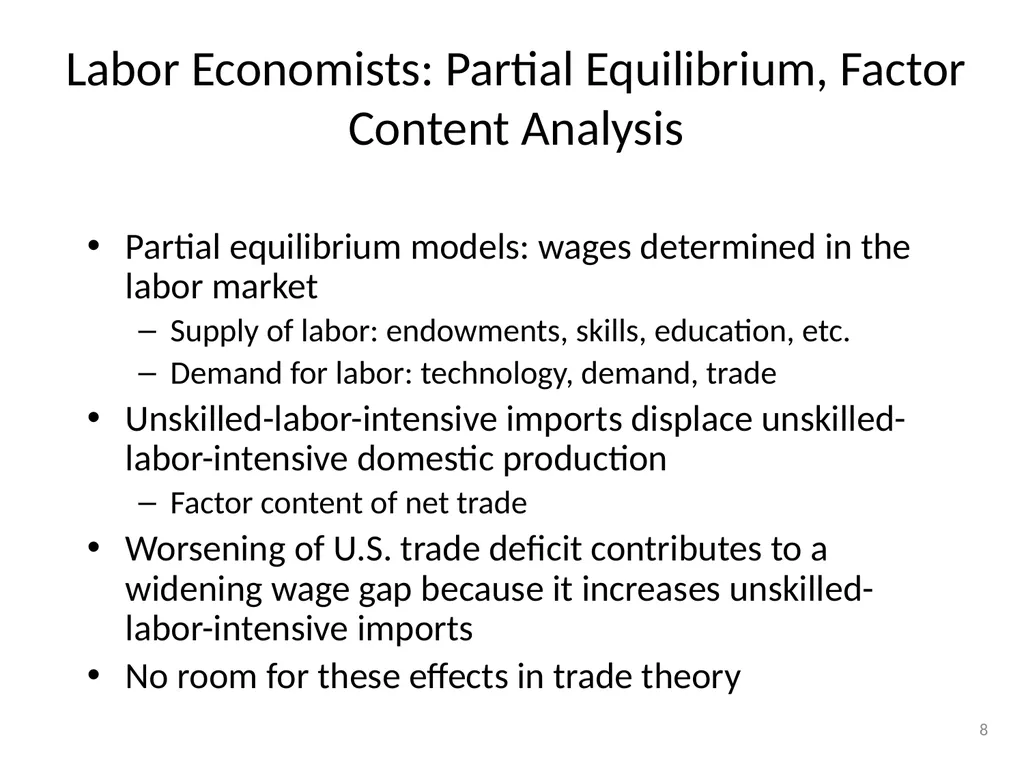
8 Labor Economists: Partial Equilibrium, Factor Content Analysis Partial equilibrium models: wages determined in the labor market
Supply of labor: endowments, skills, education, etc.
Demand for labor: technology, demand, trade
Unskilled-labor-intensive imports displace unskilled-labor-intensive domestic production
Factor content of net trade
Worsening of U.S. trade deficit contributes to a widening wage gap because it increases unskilled-labor-intensive imports
No room for these effects in trade theory<br>
Supply of labor: endowments, skills, education, etc.
Demand for labor: technology, demand, trade
Unskilled-labor-intensive imports displace unskilled-labor-intensive domestic production
Factor content of net trade
Worsening of U.S. trade deficit contributes to a widening wage gap because it increases unskilled-labor-intensive imports
No room for these effects in trade theory<br>
09
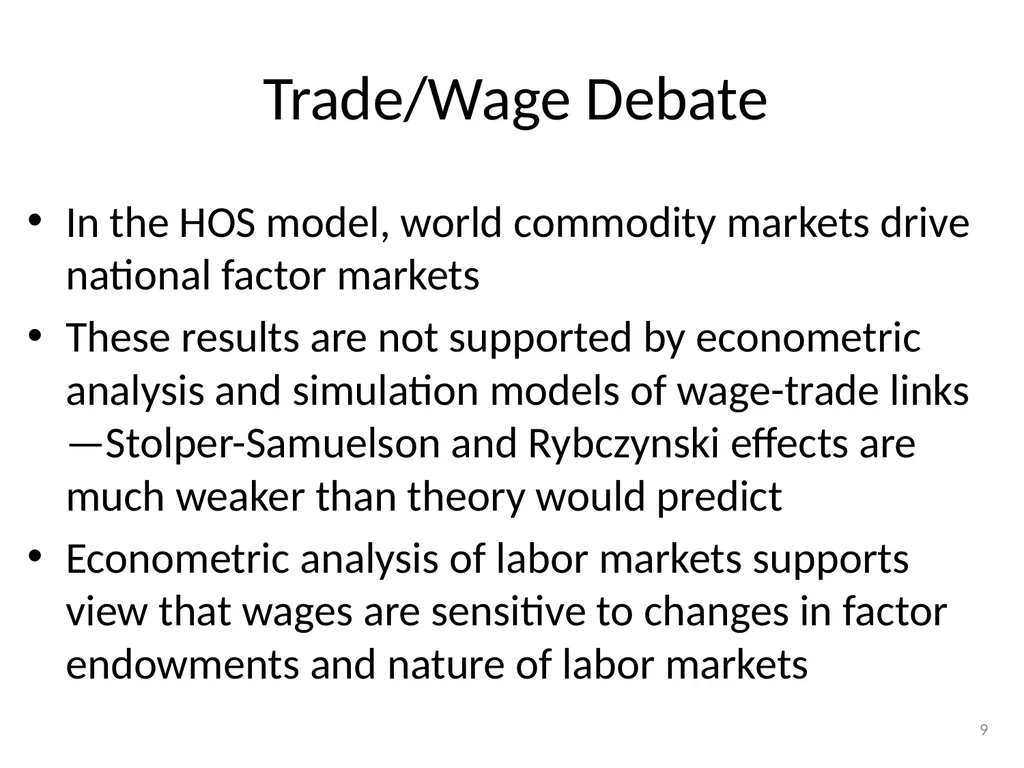
Trade/Wage Debate In the HOS model, world commodity markets drive national factor markets
These results are not supported by econometric analysis and simulation models of wage-trade links—Stolper-Samuelson and Rybczynski effects are much weaker than theory would predict
Econometric analysis of labor markets supports view that wages are sensitive to changes in factor endowments and nature of labor markets 9<br>
These results are not supported by econometric analysis and simulation models of wage-trade links—Stolper-Samuelson and Rybczynski effects are much weaker than theory would predict
Econometric analysis of labor markets supports view that wages are sensitive to changes in factor endowments and nature of labor markets 9<br>
10
Factor Price Equalization Theorem If two countries with identical technologies but different factor proportions (e.g., K/L ratios) trade freely, factor prices will equalize (Samuelson)
Trade in goods equalizes factor prices, “substituting” for trade in factors (e.g., foreign investment)
Assumption of “identical technology” is very strong: only difference is factor endowments
Very “delicate” theorem: not supported by empirical work (econometrics and simulation) 10<br>
Trade in goods equalizes factor prices, “substituting” for trade in factors (e.g., foreign investment)
Assumption of “identical technology” is very strong: only difference is factor endowments
Very “delicate” theorem: not supported by empirical work (econometrics and simulation) 10<br>
11
Stolper-Samuelson Theorem What happens if the world price of a traded commodity changes?
An increase in the relative price of a good will increase the real return to the factor used intensively in that good, and reduce the real return to the other factor.
Jones: Magnification Effect. The percent change in factor prices will exceed the change in product prices.
Distributional implications of changes in trade 11<br>
An increase in the relative price of a good will increase the real return to the factor used intensively in that good, and reduce the real return to the other factor.
Jones: Magnification Effect. The percent change in factor prices will exceed the change in product prices.
Distributional implications of changes in trade 11<br>
12
Rybczynski Theorem What happens if there is uneven factor growth in a country (e.g., K/L rises), with no change in world prices?
Output of the sector intensive in the growing factor increases, while output in the other sector decreases.
Factor prices (e.g., wages, profits) will NOT change
Magnification effect: percent output changes will exceed percent factor endowment changes 12<br>
Output of the sector intensive in the growing factor increases, while output in the other sector decreases.
Factor prices (e.g., wages, profits) will NOT change
Magnification effect: percent output changes will exceed percent factor endowment changes 12<br>
13
Summary: Major Theorems (1) Factor price equalization: free trade will result in factor prices being identical across countries
(2) Rybczynski: An increase in the endowment of a factor at constant commodity prices will increase absolutely the production of the good which uses that factor intensively, and decrease absolutely production of the other good
(3) Stolper-Samuelson: A rise in the price of a good raises absolutely the real return to the factor used intensively in the production of that good, and decreases absolutely the real return to the other factor
Magnification Effect in both Stolper-Samuelson and Rybczynski Theorems 13<br>
(2) Rybczynski: An increase in the endowment of a factor at constant commodity prices will increase absolutely the production of the good which uses that factor intensively, and decrease absolutely production of the other good
(3) Stolper-Samuelson: A rise in the price of a good raises absolutely the real return to the factor used intensively in the production of that good, and decreases absolutely the real return to the other factor
Magnification Effect in both Stolper-Samuelson and Rybczynski Theorems 13<br>
14
HOS Empirical Models Stolper-Samuelson implies that tariffs should have a major impact on wages and output
Removing tariffs (liberalization) should have a major impact (e.g., magnification effect)
Rybczynski implies major changes in trade structure with growth in endowments
Empirical results with simulation models indicate much smaller impacts than these theorems imply 14<br>
Removing tariffs (liberalization) should have a major impact (e.g., magnification effect)
Rybczynski implies major changes in trade structure with growth in endowments
Empirical results with simulation models indicate much smaller impacts than these theorems imply 14<br>
15
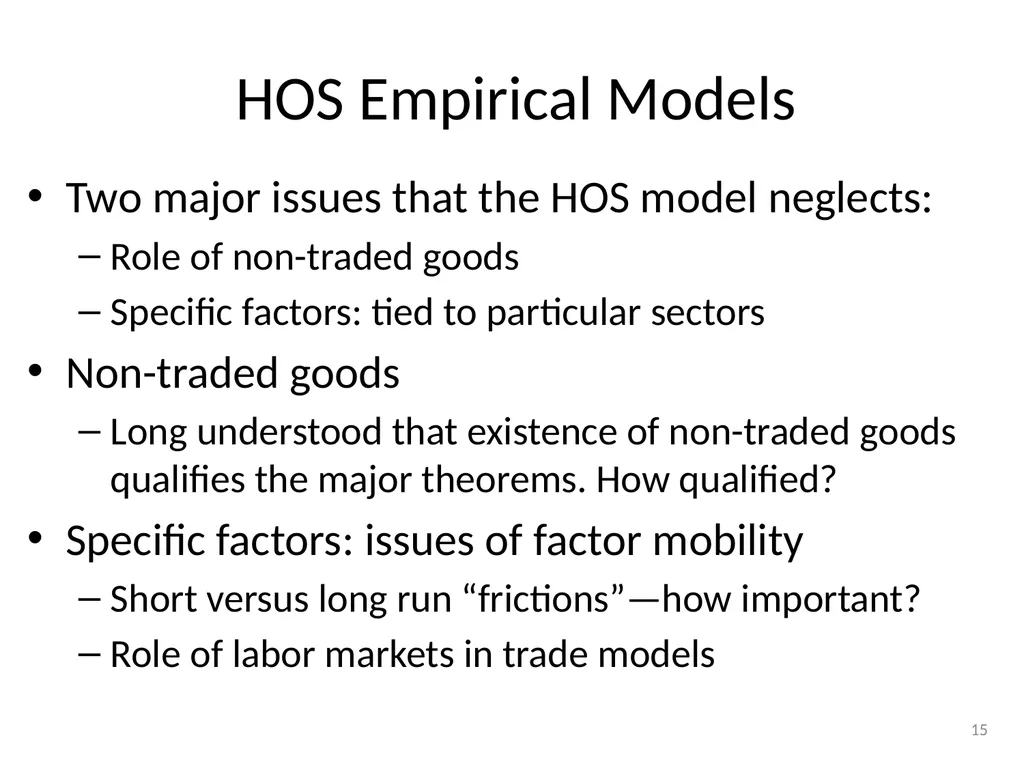
HOS Empirical Models Two major issues that the HOS model neglects:
Role of non-traded goods
Specific factors: tied to particular sectors
Non-traded goods
Long understood that existence of non-traded goods qualifies the major theorems. How qualified?
Specific factors: issues of factor mobility
Short versus long run “frictions”—how important?
Role of labor markets in trade models 15<br>
Role of non-traded goods
Specific factors: tied to particular sectors
Non-traded goods
Long understood that existence of non-traded goods qualifies the major theorems. How qualified?
Specific factors: issues of factor mobility
Short versus long run “frictions”—how important?
Role of labor markets in trade models 15<br>
16
16 Trade Model with Differentiated Goods Expand the HOS model to include goods that are differentiated by country of origin
Armington insight: Traded and domestic goods are imperfect substitutes
The model can accommodate “two-way trade” observed in the data: more realistic than HOS
Weaker link between world and domestic prices
Specification is standard in all trade-focused CGE simulation models<br>
Armington insight: Traded and domestic goods are imperfect substitutes
The model can accommodate “two-way trade” observed in the data: more realistic than HOS
Weaker link between world and domestic prices
Specification is standard in all trade-focused CGE simulation models<br>
17
Trade-Wages in CGE Models Implications of the Armington assumption
Assumption of imperfect substitutability greatly improves the realism of trade simulation models (e.g., CGE models)
Robinson, Thierfelder, de Melo, Devarajan and others have worked out the analytics of the HOS model with the Armington specification
Trade shares matter
substitution/transformation elasticities matter 17<br>
Assumption of imperfect substitutability greatly improves the realism of trade simulation models (e.g., CGE models)
Robinson, Thierfelder, de Melo, Devarajan and others have worked out the analytics of the HOS model with the Armington specification
Trade shares matter
substitution/transformation elasticities matter 17<br>
18
18 Trade Theorems: Analytic Results Stolper-Samuelson Theorem
Sign of wage effect depends on Armington elasticity
Magnification effect greatly weakened
Rybczynski Theorem
Magnification effect greatly weakened
Wages change with changes in factor supplies
Trade balance changes affect wages
Sign opposite from that of labor economists
Room for labor economists: endowments matter
Migration and skill upgrading more important than commodity prices<br>
Sign of wage effect depends on Armington elasticity
Magnification effect greatly weakened
Rybczynski Theorem
Magnification effect greatly weakened
Wages change with changes in factor supplies
Trade balance changes affect wages
Sign opposite from that of labor economists
Room for labor economists: endowments matter
Migration and skill upgrading more important than commodity prices<br>
19
Trade and Growth: New Trade Theory Trade-productivity-growth links. The failure of “standard” trade theory to account for growth led to what Thierfelder and Robinson call “The Search for Large Numbers”
Rent seeking, imperfect competition, challenge-response models, research, etc.
Stylized facts: globalization, evolution of trade blocs, supply/value chains
Need for trade theory to catch up with trends 19<br>
Rent seeking, imperfect competition, challenge-response models, research, etc.
Stylized facts: globalization, evolution of trade blocs, supply/value chains
Need for trade theory to catch up with trends 19<br>
20
Trade Theory, Regional Integration,
Regional Trade Agreements (RTAs) and Economic Development Sherman Robinson
IFPRI
March 2015<br>
IFPRI
March 2015<br>
21
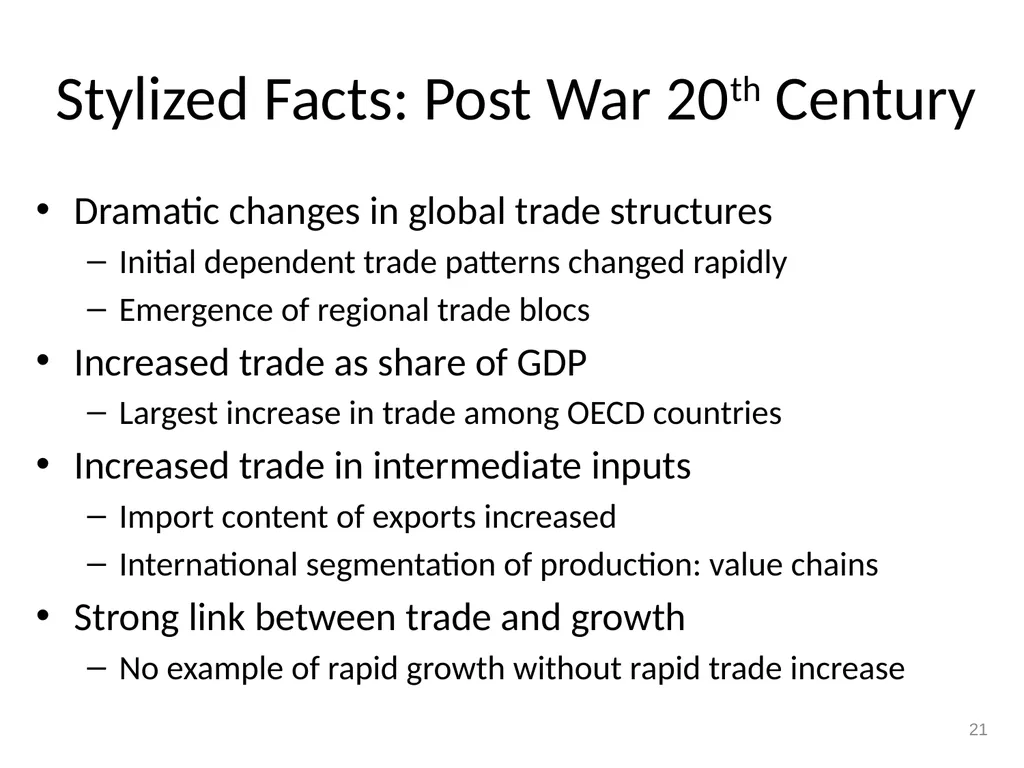
21 Stylized Facts: Post War 20th Century Dramatic changes in global trade structures
Initial dependent trade patterns changed rapidly
Emergence of regional trade blocs
Increased trade as share of GDP
Largest increase in trade among OECD countries
Increased trade in intermediate inputs
Import content of exports increased
International segmentation of production: value chains
Strong link between trade and growth
No example of rapid growth without rapid trade increase<br>
Initial dependent trade patterns changed rapidly
Emergence of regional trade blocs
Increased trade as share of GDP
Largest increase in trade among OECD countries
Increased trade in intermediate inputs
Import content of exports increased
International segmentation of production: value chains
Strong link between trade and growth
No example of rapid growth without rapid trade increase<br>
22
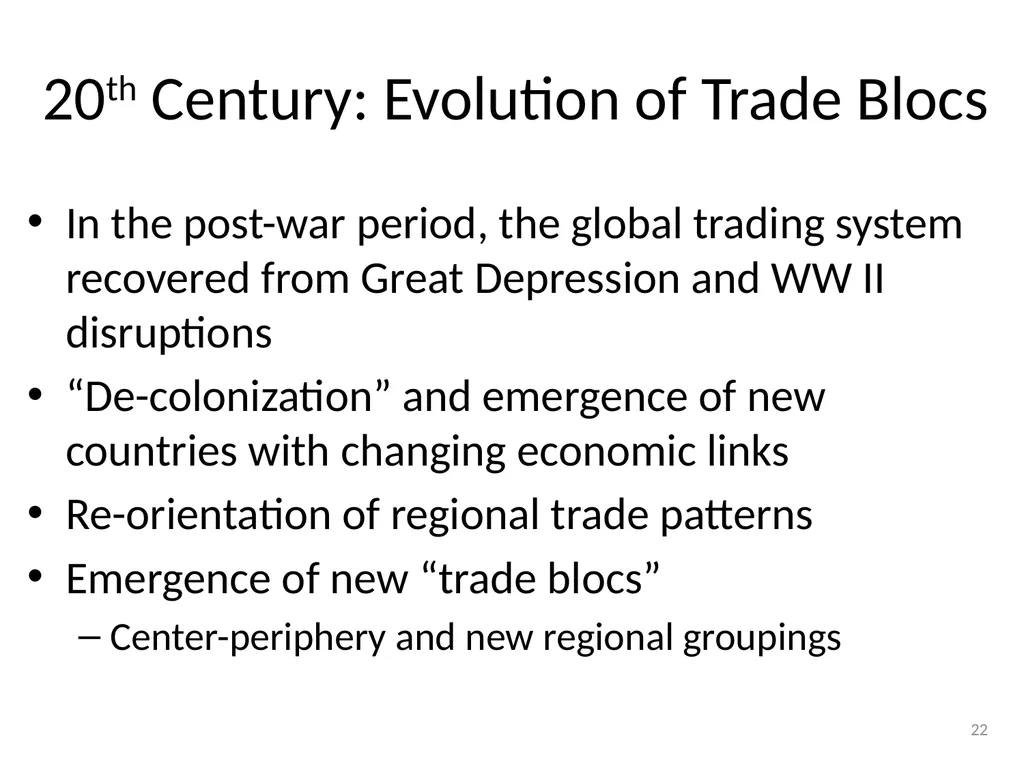
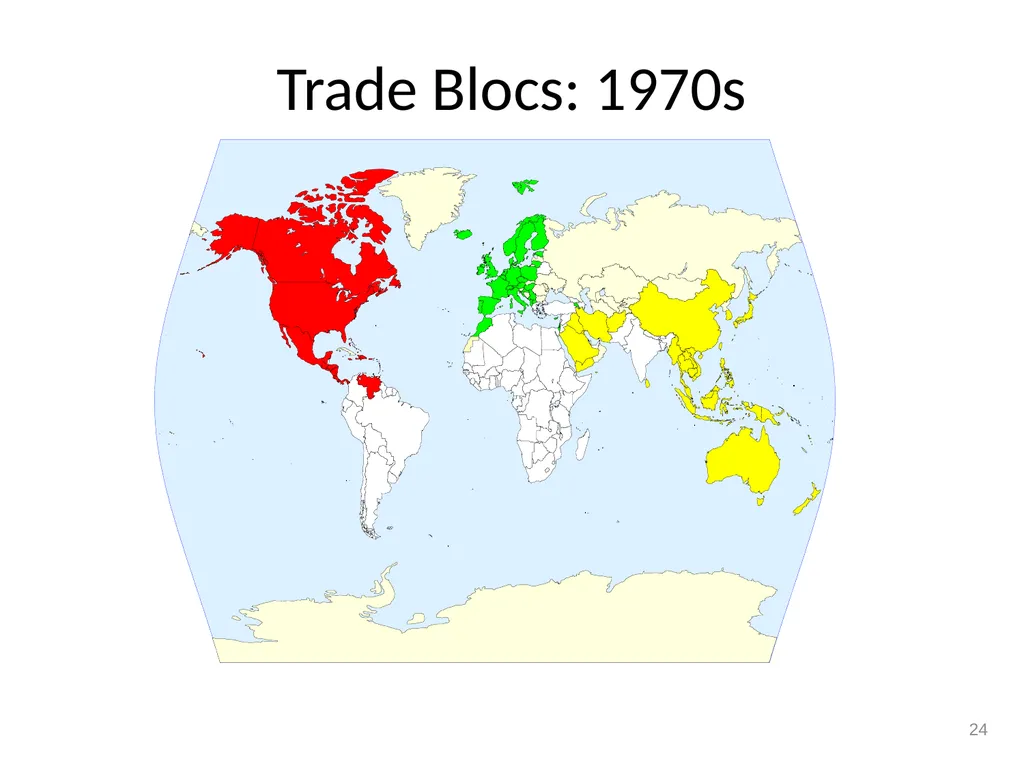
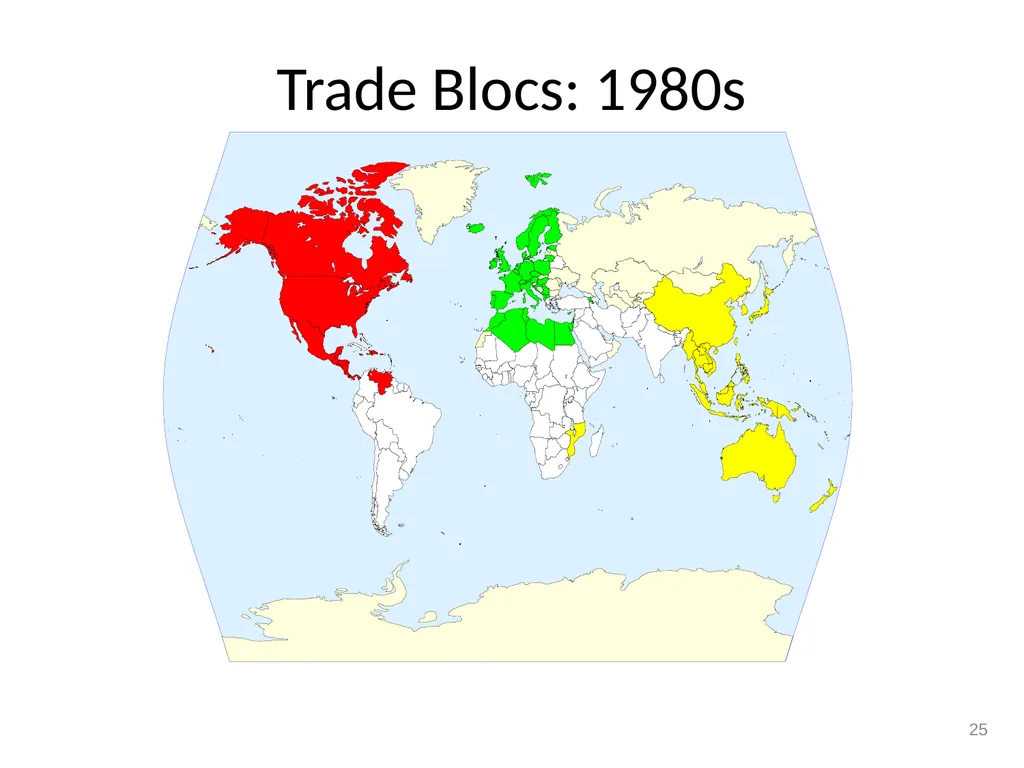
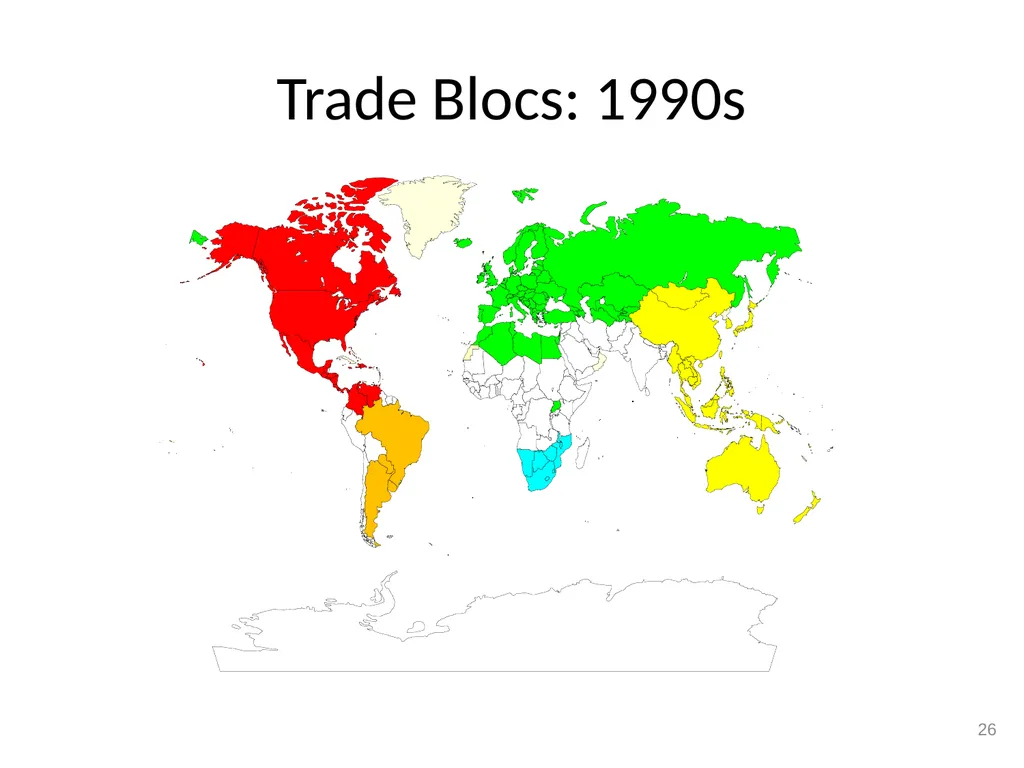
20th Century: Evolution of Trade Blocs In the post-war period, the global trading system recovered from Great Depression and WW II disruptions
“De-colonization” and emergence of new countries with changing economic links
Re-orientation of regional trade patterns
Emergence of new “trade blocs”
Center-periphery and new regional groupings 22<br>
“De-colonization” and emergence of new countries with changing economic links
Re-orientation of regional trade patterns
Emergence of new “trade blocs”
Center-periphery and new regional groupings 22<br>
23
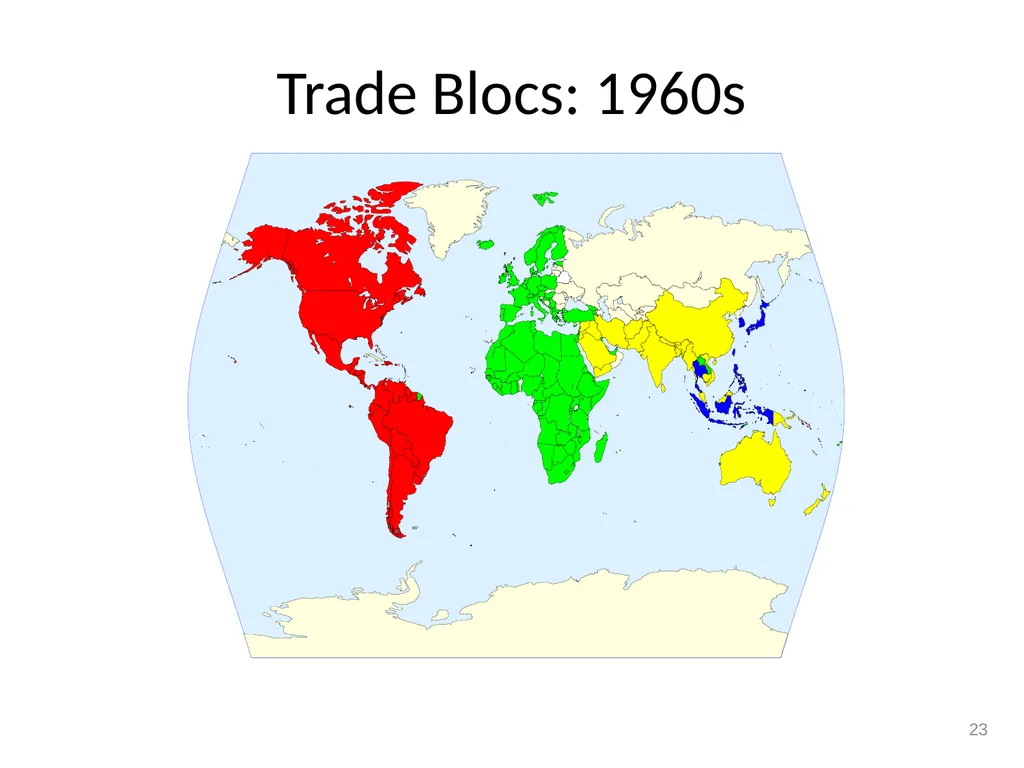
Trade Blocs: 1960s 23<br>
24
Trade Blocs: 1970s 24<br>
25
Trade Blocs: 1980s 25<br>
26
Trade Blocs: 1990s 26<br>
27
27 Export Shares: 1960s Europe + N America + Asia-UK Asia-US Total Europe + 75.4 14.2 8.2 2.3 100 N America + 37.5 44.5 8.3 9.7 100 Asia-UK 48.8 12.7 20.6 18.0 100 Asia-US 23.0 37.3 19.5 20.2 100<br>
28
28 Shares of World Trade: 1960s Europe + N America + Asia-UK Asia-US Total Europe + 39.7 7.5 4.3 1.2 52.7 N America + 11.2 13.3 2.5 2.9 29.9 Asia-UK 5.0 1.3 2.1 1.9 10.3 Asia-US 1.6 2.6 1.4 1.4 7.1 Total 57.6 24.7 10.3 7.4 100<br>
29
Export Shares: 1990s 29<br>
30
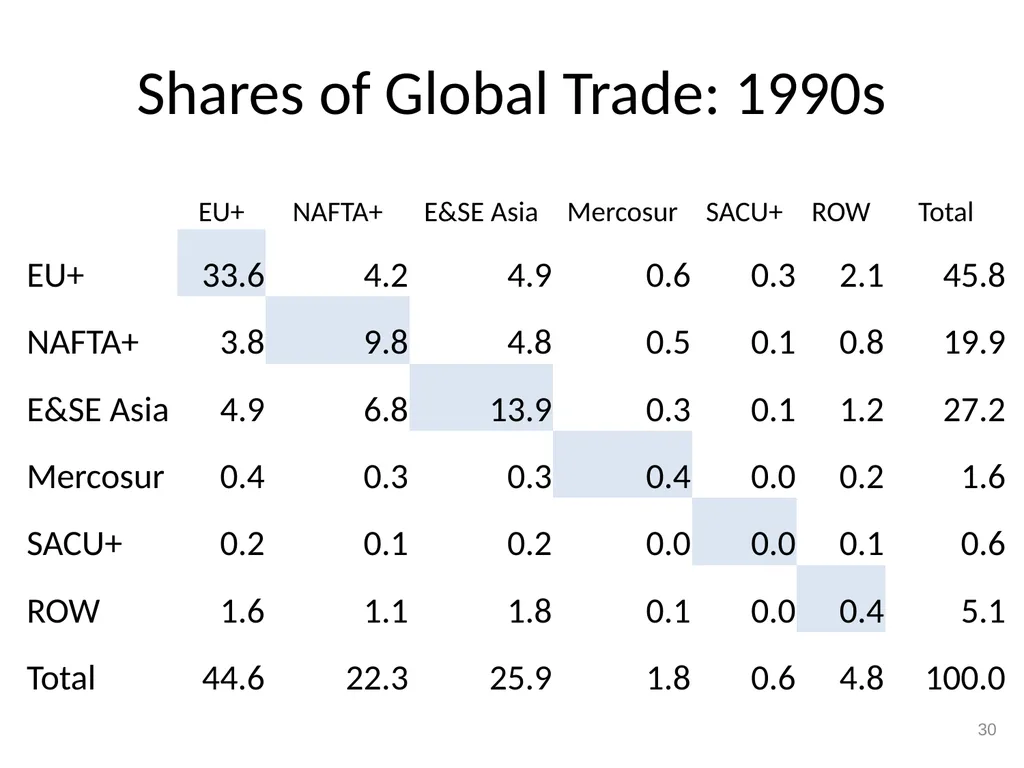
Shares of Global Trade: 1990s 30<br>
31
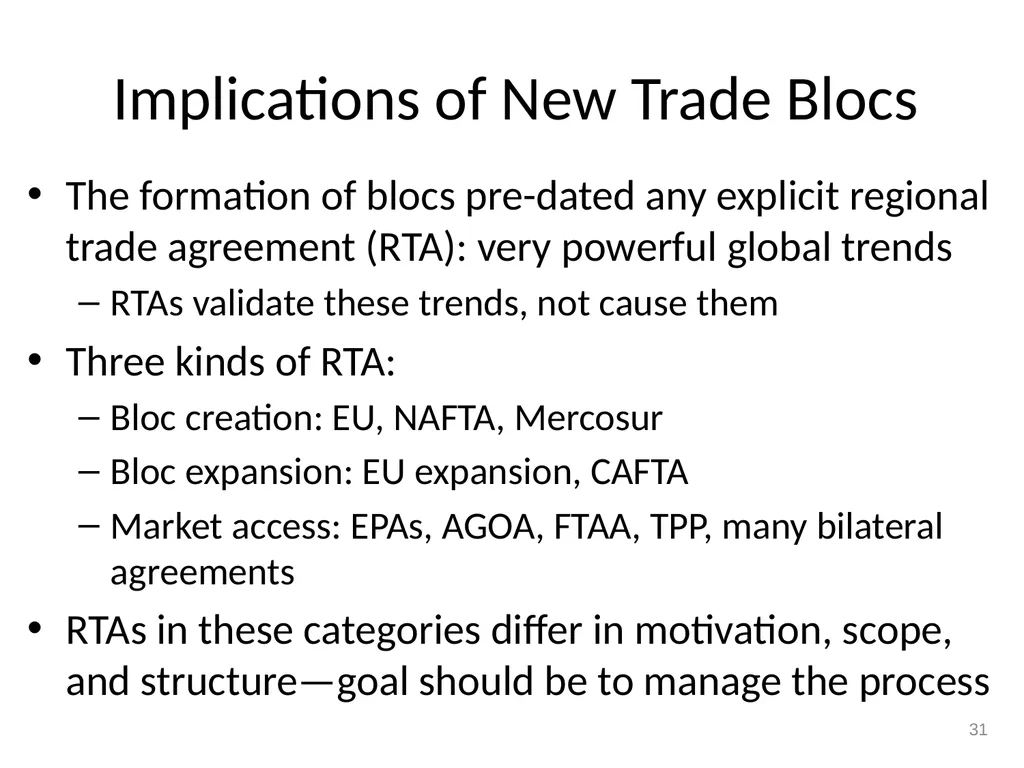
31 Implications of New Trade Blocs The formation of blocs pre-dated any explicit regional trade agreement (RTA): very powerful global trends
RTAs validate these trends, not cause them
Three kinds of RTA:
Bloc creation: EU, NAFTA, Mercosur
Bloc expansion: EU expansion, CAFTA
Market access: EPAs, AGOA, FTAA, TPP, many bilateral agreements
RTAs in these categories differ in motivation, scope, and structure—goal should be to manage the process<br>
RTAs validate these trends, not cause them
Three kinds of RTA:
Bloc creation: EU, NAFTA, Mercosur
Bloc expansion: EU expansion, CAFTA
Market access: EPAs, AGOA, FTAA, TPP, many bilateral agreements
RTAs in these categories differ in motivation, scope, and structure—goal should be to manage the process<br>
32
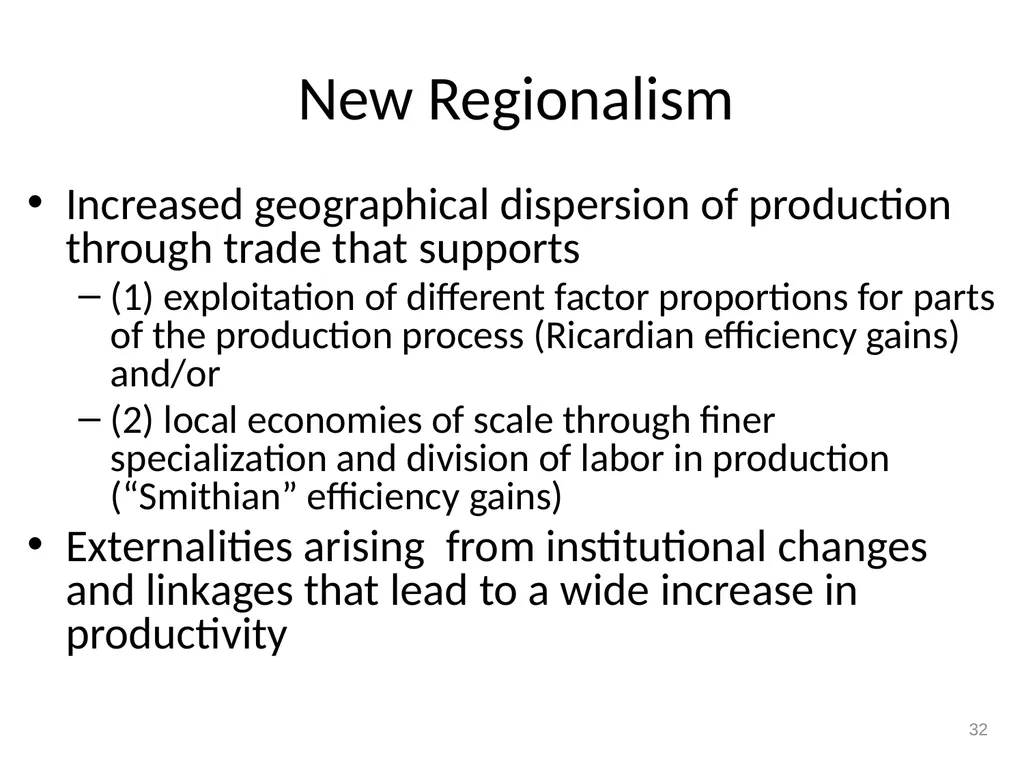
32 New Regionalism Increased geographical dispersion of production through trade that supports
(1) exploitation of different factor proportions for parts of the production process (Ricardian efficiency gains) and/or
(2) local economies of scale through finer specialization and division of labor in production (“Smithian” efficiency gains)
Externalities arising from institutional changes and linkages that lead to a wide increase in productivity<br>
(1) exploitation of different factor proportions for parts of the production process (Ricardian efficiency gains) and/or
(2) local economies of scale through finer specialization and division of labor in production (“Smithian” efficiency gains)
Externalities arising from institutional changes and linkages that lead to a wide increase in productivity<br>
33
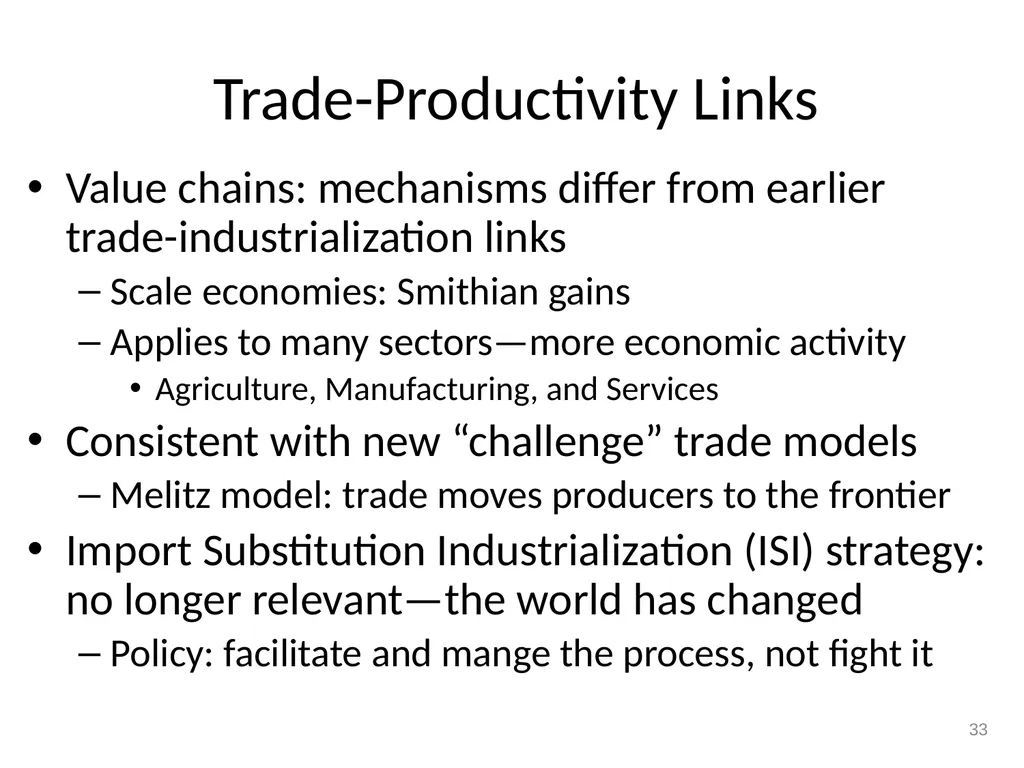
33 Trade-Productivity Links Value chains: mechanisms differ from earlier trade-industrialization links
Scale economies: Smithian gains
Applies to many sectors—more economic activity
Agriculture, Manufacturing, and Services
Consistent with new “challenge” trade models
Melitz model: trade moves producers to the frontier
Import Substitution Industrialization (ISI) strategy: no longer relevant—the world has changed
Policy: facilitate and mange the process, not fight it<br>
Scale economies: Smithian gains
Applies to many sectors—more economic activity
Agriculture, Manufacturing, and Services
Consistent with new “challenge” trade models
Melitz model: trade moves producers to the frontier
Import Substitution Industrialization (ISI) strategy: no longer relevant—the world has changed
Policy: facilitate and mange the process, not fight it<br>
34
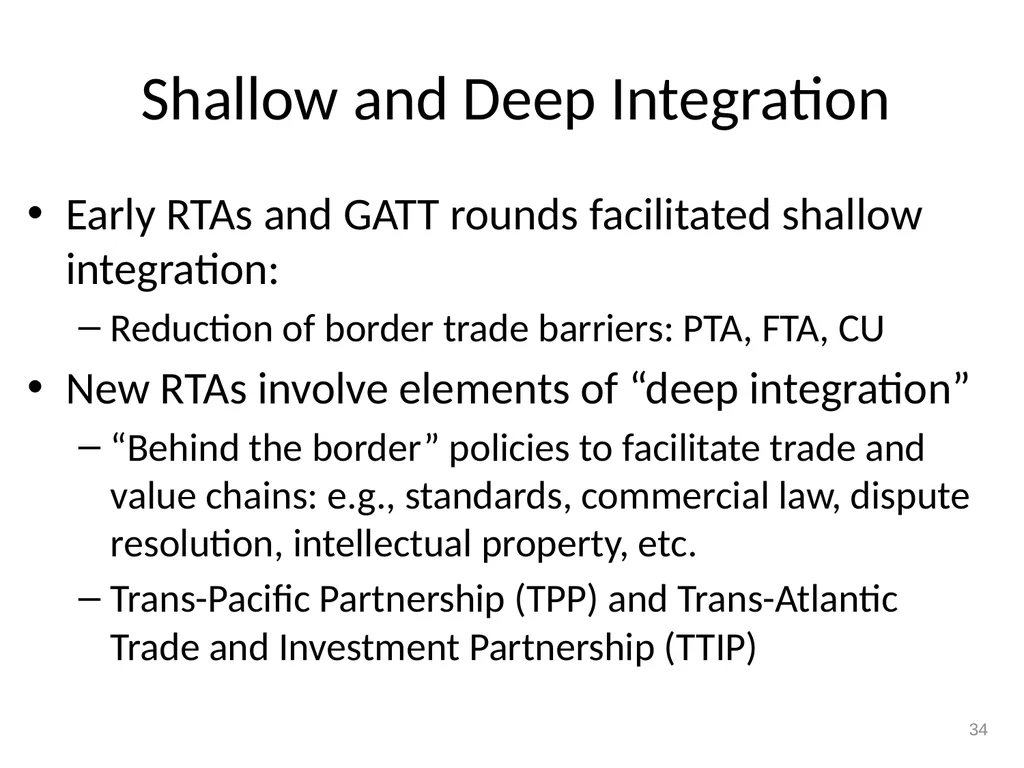
34 Shallow and Deep Integration Early RTAs and GATT rounds facilitated shallow integration:
Reduction of border trade barriers: PTA, FTA, CU
New RTAs involve elements of “deep integration”
“Behind the border” policies to facilitate trade and value chains: e.g., standards, commercial law, dispute resolution, intellectual property, etc.
Trans-Pacific Partnership (TPP) and Trans-Atlantic Trade and Investment Partnership (TTIP)<br>
Reduction of border trade barriers: PTA, FTA, CU
New RTAs involve elements of “deep integration”
“Behind the border” policies to facilitate trade and value chains: e.g., standards, commercial law, dispute resolution, intellectual property, etc.
Trans-Pacific Partnership (TPP) and Trans-Atlantic Trade and Investment Partnership (TTIP)<br>
35
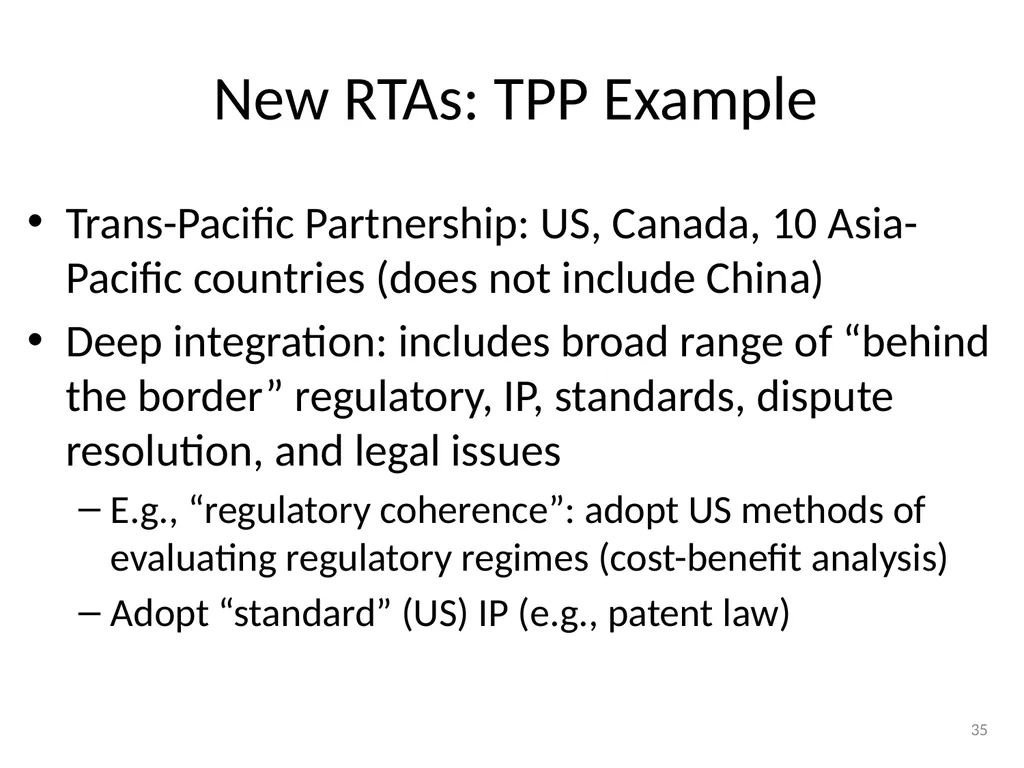
New RTAs: TPP Example Trans-Pacific Partnership: US, Canada, 10 Asia-Pacific countries (does not include China)
Deep integration: includes broad range of “behind the border” regulatory, IP, standards, dispute resolution, and legal issues
E.g., “regulatory coherence”: adopt US methods of evaluating regulatory regimes (cost-benefit analysis)
Adopt “standard” (US) IP (e.g., patent law) 35<br>
Deep integration: includes broad range of “behind the border” regulatory, IP, standards, dispute resolution, and legal issues
E.g., “regulatory coherence”: adopt US methods of evaluating regulatory regimes (cost-benefit analysis)
Adopt “standard” (US) IP (e.g., patent law) 35<br>
36
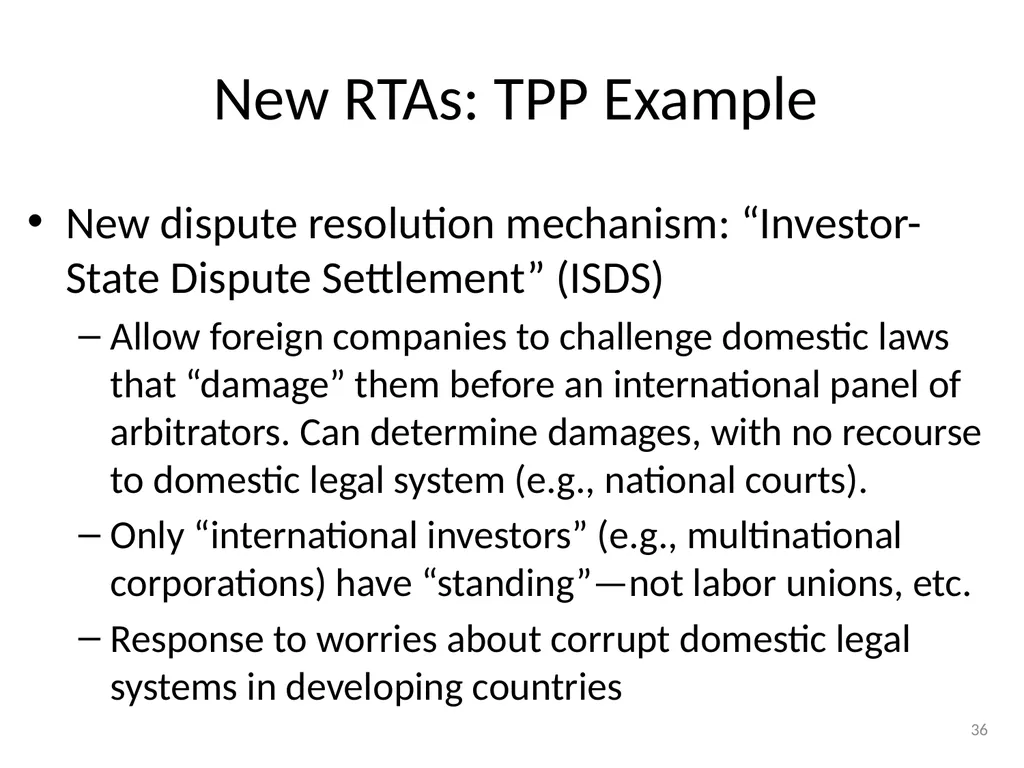
New RTAs: TPP Example New dispute resolution mechanism: “Investor-State Dispute Settlement” (ISDS)
Allow foreign companies to challenge domestic laws that “damage” them before an international panel of arbitrators. Can determine damages, with no recourse to domestic legal system (e.g., national courts).
Only “international investors” (e.g., multinational corporations) have “standing”—not labor unions, etc.
Response to worries about corrupt domestic legal systems in developing countries 36<br>
Allow foreign companies to challenge domestic laws that “damage” them before an international panel of arbitrators. Can determine damages, with no recourse to domestic legal system (e.g., national courts).
Only “international investors” (e.g., multinational corporations) have “standing”—not labor unions, etc.
Response to worries about corrupt domestic legal systems in developing countries 36<br>
37
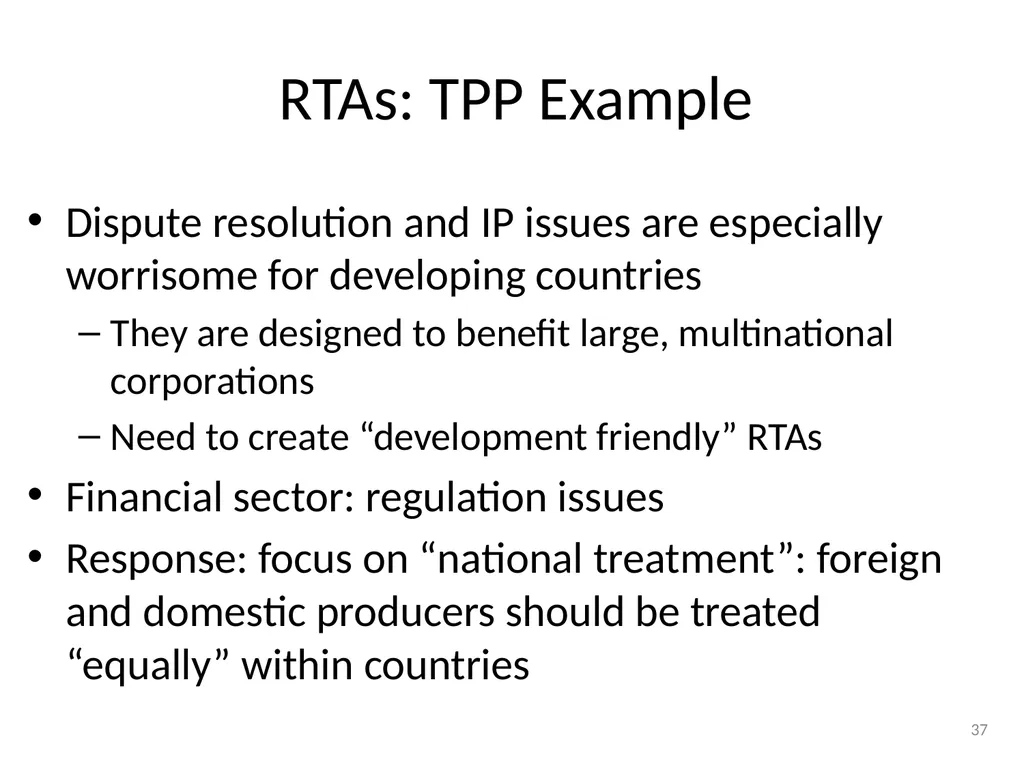
RTAs: TPP Example Dispute resolution and IP issues are especially worrisome for developing countries
They are designed to benefit large, multinational corporations
Need to create “development friendly” RTAs
Financial sector: regulation issues
Response: focus on “national treatment”: foreign and domestic producers should be treated “equally” within countries 37<br>
They are designed to benefit large, multinational corporations
Need to create “development friendly” RTAs
Financial sector: regulation issues
Response: focus on “national treatment”: foreign and domestic producers should be treated “equally” within countries 37<br>
38
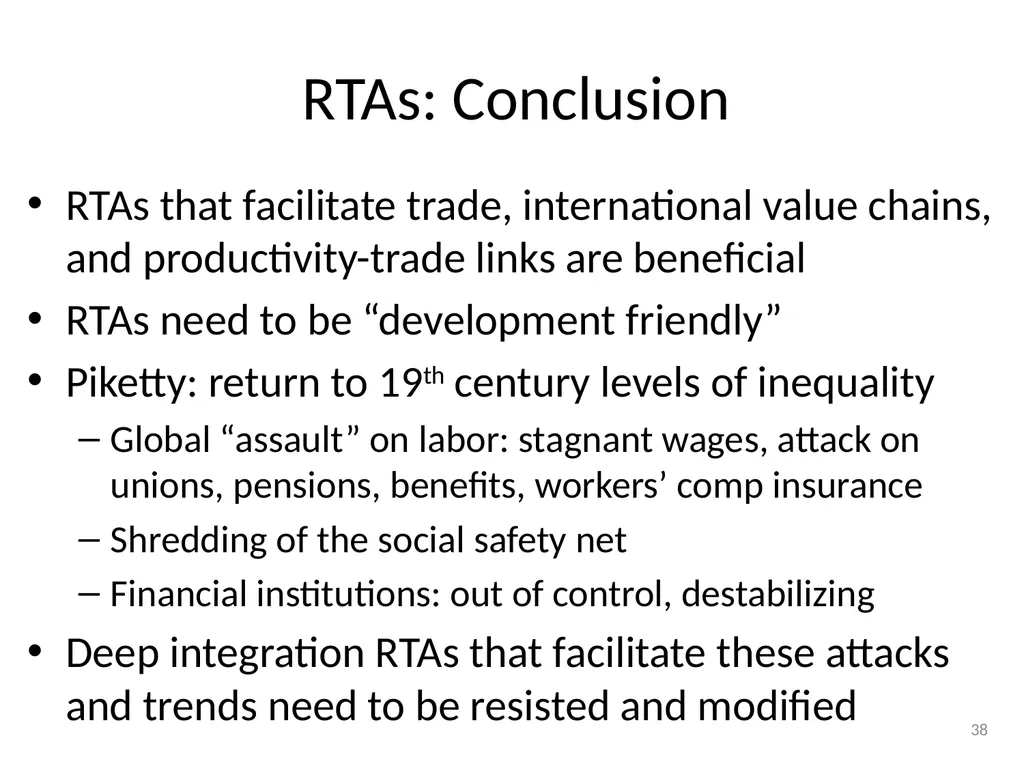
RTAs: Conclusion RTAs that facilitate trade, international value chains, and productivity-trade links are beneficial
RTAs need to be “development friendly”
Piketty: return to 19th century levels of inequality
Global “assault” on labor: stagnant wages, attack on unions, pensions, benefits, workers’ comp insurance
Shredding of the social safety net
Financial institutions: out of control, destabilizing
Deep integration RTAs that facilitate these attacks and trends need to be resisted and modified 38<br>
RTAs need to be “development friendly”
Piketty: return to 19th century levels of inequality
Global “assault” on labor: stagnant wages, attack on unions, pensions, benefits, workers’ comp insurance
Shredding of the social safety net
Financial institutions: out of control, destabilizing
Deep integration RTAs that facilitate these attacks and trends need to be resisted and modified 38<br>
39
References on Trade Theory 39<br>
40
References Thierfelder, Karen and Sherman Robinson. 2003. “Trade and Tradability: Exports, Imports, and Factor Markets in the Salter-Swan Model.” The Economic Record, Vol. 79, No. 244, March, pp. 103-111.
de Melo, Jaime, and Sherman Robinson. 1989. “Product Differentiation and the Treatment of Foreign Trade in Computable General Equilibrium Models of Small Economies.” Journal of International Economics. Vol. 27, Nos. 1-2, pp. 47-67.
Devarajan, Shantayanan, Jeffrey D. Lewis, and Sherman Robinson. 1993. “External Shocks, Purchasing Power Parity, and the Equilibrium Real Exchange Rate.” World Bank Economic Review. Vol. 7, No. 1, pp. 45-63.
Devarajan, Shantayanan, Delfin S. Go, Jeffrey D. Lewis, Sherman Robinson, and Pekka Sinko. 1997. "Simple General Equilibrium Modeling." In Joseph F. Francois and Kenneth A. Reinert, eds., Applied Methods for Trade Policy Analysis: A Handbook. Cambridge: Cambridge University Press. 40<br>
de Melo, Jaime, and Sherman Robinson. 1989. “Product Differentiation and the Treatment of Foreign Trade in Computable General Equilibrium Models of Small Economies.” Journal of International Economics. Vol. 27, Nos. 1-2, pp. 47-67.
Devarajan, Shantayanan, Jeffrey D. Lewis, and Sherman Robinson. 1993. “External Shocks, Purchasing Power Parity, and the Equilibrium Real Exchange Rate.” World Bank Economic Review. Vol. 7, No. 1, pp. 45-63.
Devarajan, Shantayanan, Delfin S. Go, Jeffrey D. Lewis, Sherman Robinson, and Pekka Sinko. 1997. "Simple General Equilibrium Modeling." In Joseph F. Francois and Kenneth A. Reinert, eds., Applied Methods for Trade Policy Analysis: A Handbook. Cambridge: Cambridge University Press. 40<br>
41
References Devarajan, Shantayanan, Jeffrey D. Lewis, and Sherman Robinson. 1990. "Policy Lessons from Trade-focused, Two-sector Models." Journal of Policy Modeling 12(4): 625-57.
Robinson, Sherman and Karen Thierfelder. 2002. “Trade Liberalisation and Regional Integration: The Search for Large Numbers.” Australian Journal of Agricultural and Resource Economics, Vol. 46, No. 4 (December), pp. 585-604.
Devarajan, Shantayanan and Sherman Robinson. 2013. “Contribution of Computable General Equilibrium Modeling to Policy Formulation in Developing Countries.” In Peter B. Dixon and Dale W. Jorgenson, eds., Handbook of Computable General Equilibrium Modeling, Volume 1A. Amsterdam: Elsevier/North Holland. Pp. 277-302. 41<br>
Robinson, Sherman and Karen Thierfelder. 2002. “Trade Liberalisation and Regional Integration: The Search for Large Numbers.” Australian Journal of Agricultural and Resource Economics, Vol. 46, No. 4 (December), pp. 585-604.
Devarajan, Shantayanan and Sherman Robinson. 2013. “Contribution of Computable General Equilibrium Modeling to Policy Formulation in Developing Countries.” In Peter B. Dixon and Dale W. Jorgenson, eds., Handbook of Computable General Equilibrium Modeling, Volume 1A. Amsterdam: Elsevier/North Holland. Pp. 277-302. 41<br>
42
References on Regionalism, Trade, and Growth 42<br>
43
43 Readings Burfisher, Mary, Sherman Robinson, and Karen Thierfelder. 2004. “Regionalism: Old and New, Theory and Practice.” In G. Anania, M. E. Bohman, C. A. Carter and A. F. McCalla, eds., Agricultural Policy Reform and the WTO: Where Are We Heading?, Edward Elgar, Cheltenham, UK & Northampton MA, USA. Also available as MTID Discussion Paper No. 65, Markets, Trade and Institutions Division, IFPRI, February, 2004.
IDS Asian Drivers Team (2006). “The Impact of Asian Drivers on the Developing World.” IDS Bulletin, Vol. 37, No. 1 (January), pp. 3-11.
Evans, David, Raphael Kaplinsky, and Sherman Robinson (2006). “Deep and Shallow Integration in Asia: Towards a Holistic Account.” IDS Bulletin, Vol. 37, No. 1 (January), pp. 12-22.
Burfisher, Mary, Sherman Robinson, and Karen Thierfelder. 2002. “The Global Impacts of Farm Policy Reforms in Organization for Economic Cooperation and Development Countries.” American Journal of Agricultural Economics, Vol. 84, No. 3 (August), pp 774-781.<br>
IDS Asian Drivers Team (2006). “The Impact of Asian Drivers on the Developing World.” IDS Bulletin, Vol. 37, No. 1 (January), pp. 3-11.
Evans, David, Raphael Kaplinsky, and Sherman Robinson (2006). “Deep and Shallow Integration in Asia: Towards a Holistic Account.” IDS Bulletin, Vol. 37, No. 1 (January), pp. 12-22.
Burfisher, Mary, Sherman Robinson, and Karen Thierfelder. 2002. “The Global Impacts of Farm Policy Reforms in Organization for Economic Cooperation and Development Countries.” American Journal of Agricultural Economics, Vol. 84, No. 3 (August), pp 774-781.<br>
44
44 Readings Schiff, M. and L. A. Winters (2003). Regional Integration and Development. Oxford University Press. Chapters 2, 3
Baldwin R. E. (1997). “The causes of regionalism”, The World Economy, 20, pp. 865-88.
Baldwin, R., J. Francois and R. Portes (1997). “The costs and benefits of EU enlargement to the East”, Economic Policy, 24, 125-176.
World Bank (2000) Trade Blocs, World Bank, Washington, DC.
World Bank. 2004. Global Economic Prospects, 2005: Trade, Regionalism, and Development. Washington: World Bank.<br>
Baldwin R. E. (1997). “The causes of regionalism”, The World Economy, 20, pp. 865-88.
Baldwin, R., J. Francois and R. Portes (1997). “The costs and benefits of EU enlargement to the East”, Economic Policy, 24, 125-176.
World Bank (2000) Trade Blocs, World Bank, Washington, DC.
World Bank. 2004. Global Economic Prospects, 2005: Trade, Regionalism, and Development. Washington: World Bank.<br>
45
45 Readings Rodriguez, F. and Dani Rodrik (2001) “Trade policy and economic growth: a skeptic’s guide to the evidence.” NBER Macroeconomics Annual, 2000, Vol. 15, MIT Press.
Rodrik, Dani (1999) The New Global Economy and Developing Countries: Making Openness Work, Overseas Development Council, Washington.
Winters L A (2000) “Trade Policy as Development Policy: Building on Fifty Years’ Experience “, Proceedings for High Level Round Table ,Tenth United Nations Conference on Trade and Development, Bangkok, February, 2000.
Greenaway, David (1988). Economic Development and International Trade. Macmillan. Chapters by Reidel (3: “Trade as an engine of growth”) and Milner (4: “Trade strategies and development”).<br>
Rodrik, Dani (1999) The New Global Economy and Developing Countries: Making Openness Work, Overseas Development Council, Washington.
Winters L A (2000) “Trade Policy as Development Policy: Building on Fifty Years’ Experience “, Proceedings for High Level Round Table ,Tenth United Nations Conference on Trade and Development, Bangkok, February, 2000.
Greenaway, David (1988). Economic Development and International Trade. Macmillan. Chapters by Reidel (3: “Trade as an engine of growth”) and Milner (4: “Trade strategies and development”).<br>