
Falls Risk and Prevention in People with
CP
Published · 52 slides · 0 views

1 / 1
Description
Falls Risk and Prevention in People with Intellectual and Developmental Disabilities (IDD) Presented by the Massachusetts Department of Developmental Services (DDS) and the Center for Developmental Disabilities Evaluation and Research
Related Topics
Share
Embed code
Download this presentation From Below
"Falls Risk and Prevention in People with" is the property of its rightful owner. Permission is granted to download and print the materials on this website for personal, non-commercial use only, and to display it on your personal computer provided you do not modify the materials and that you retain all copyright notices contained in the materials. By downloading content from our website, you accept the terms of this agreement.
Presentation Transcript
01
Falls Risk and Prevention in People with Intellectual and Developmental Disabilities (IDD)
Presented by the Massachusetts Department of Developmental Services (DDS) and the Center for Developmental Disabilities Evaluation and Research (CDDER), UMass Medical School<br>
02
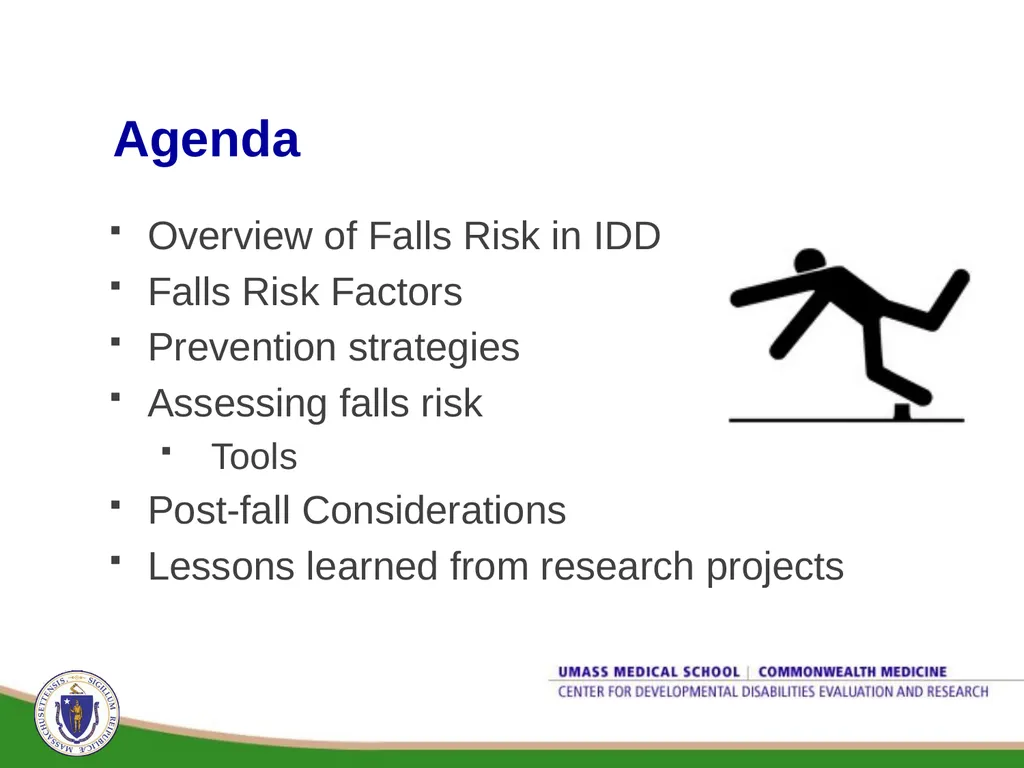
Agenda Overview of Falls Risk in IDD
Falls Risk Factors
Prevention strategies
Assessing falls risk
Tools
Post-fall Considerations
Lessons learned from research projects<br>
Falls Risk Factors
Prevention strategies
Assessing falls risk
Tools
Post-fall Considerations
Lessons learned from research projects<br>
03
Falls Risk – Across the lifespan The risk of falling for people with intellectual and developmental disability (IDD) is similar to the risk of falling in the elderly population (over age 65) but is experienced across the lifespan.
Higher risk at earlier ages<br>
Higher risk at earlier ages<br>
04
Falls Risk – Greater than the general population Falls are more common in people with IDD aged 18-64 than in the same age group across the general population
People with IDD fall at least as often as the elderly population (similar fall rates)<br>
People with IDD fall at least as often as the elderly population (similar fall rates)<br>
05
Falls in the DDS Population Nationally, about 30% of adults with I/DD fall each year
About two-thirds of adults who fall will fall more than once
15% of falls result in serious injury
In one HCSIS analysis there were 1500 serous falls May be as many as 10,000 falls happening each year<br>
About two-thirds of adults who fall will fall more than once
15% of falls result in serious injury
In one HCSIS analysis there were 1500 serous falls May be as many as 10,000 falls happening each year<br>
06
High Injury Rates Falls contribute to as many as 50-60% of reported injuries regardless of age.
Significantly more likely (RR=2.9) than adults in the general population to experience at least one injury from a fall.
Emergency Room (ER) usage data consistently identifies injuries as the top causes of ER visits and falls as the top cause of injury.
Falls can also be fatal.<br>
Significantly more likely (RR=2.9) than adults in the general population to experience at least one injury from a fall.
Emergency Room (ER) usage data consistently identifies injuries as the top causes of ER visits and falls as the top cause of injury.
Falls can also be fatal.<br>
07
Fall Complications Physical Injury
Major and minor injuries
15% of falls result in serious injuries
Psychological
Fear of falling
50% of people who fall avoid activities out of fear of falling again -Tedaskar, Rein, ‘Falls and People with Intellectual & Developmental Disabilities’<br>
Major and minor injuries
15% of falls result in serious injuries
Psychological
Fear of falling
50% of people who fall avoid activities out of fear of falling again -Tedaskar, Rein, ‘Falls and People with Intellectual & Developmental Disabilities’<br>
08
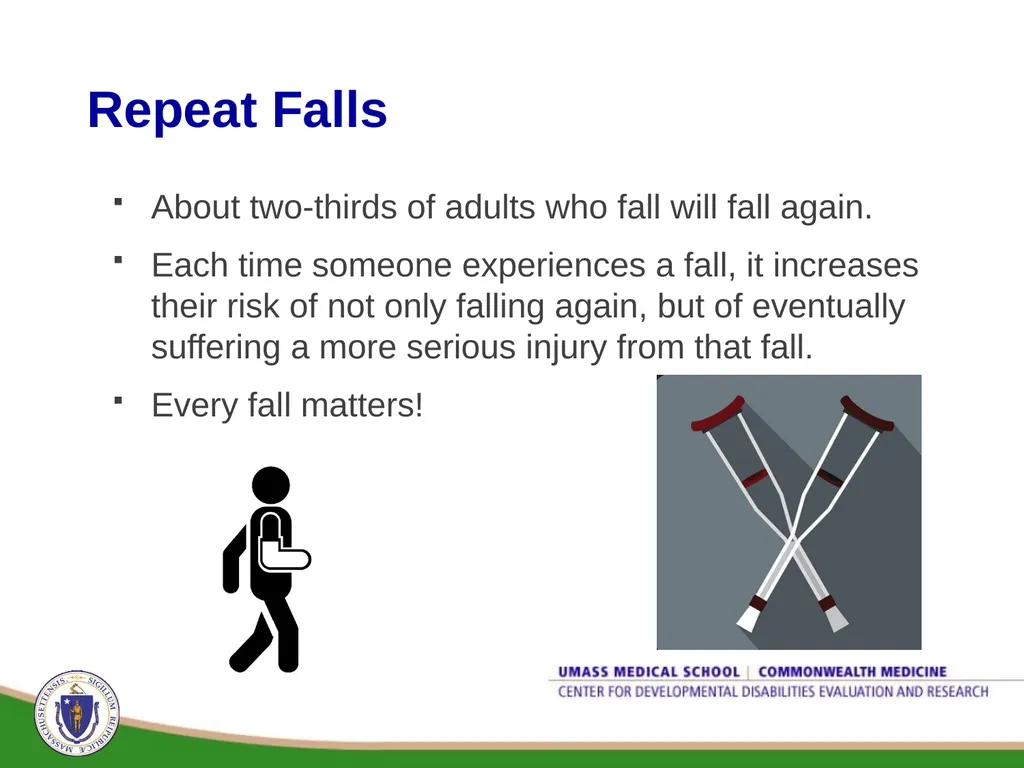
Repeat Falls About two-thirds of adults who fall will fall again.
Each time someone experiences a fall, it increases their risk of not only falling again, but of eventually suffering a more serious injury from that fall.
Every fall matters!<br>
Each time someone experiences a fall, it increases their risk of not only falling again, but of eventually suffering a more serious injury from that fall.
Every fall matters!<br>
09
What is a fall? A fall is any loss of balance or uncontrolled, unintended contact with a surface or object. This includes the floor, furnishings or other persons.
This also Includes falling back onto a chair or bed after rising, if the transition is not controlled.<br>
This also Includes falling back onto a chair or bed after rising, if the transition is not controlled.<br>
10
Falls Risk Factors<br>
11
Why Falls Occur Falls are caused by a combination of internal (intrinsic) AND external (extrinsic) risk factors.<br>
12
Internal Falls Risk Factors Previous Falls
Poor eyesight or vision loss
Weak muscle strength
Weak or unstable balance
Unsteady gait (walking)
Elimination problems
Cognitive Impairments
Medication<br>
Poor eyesight or vision loss
Weak muscle strength
Weak or unstable balance
Unsteady gait (walking)
Elimination problems
Cognitive Impairments
Medication<br>
13
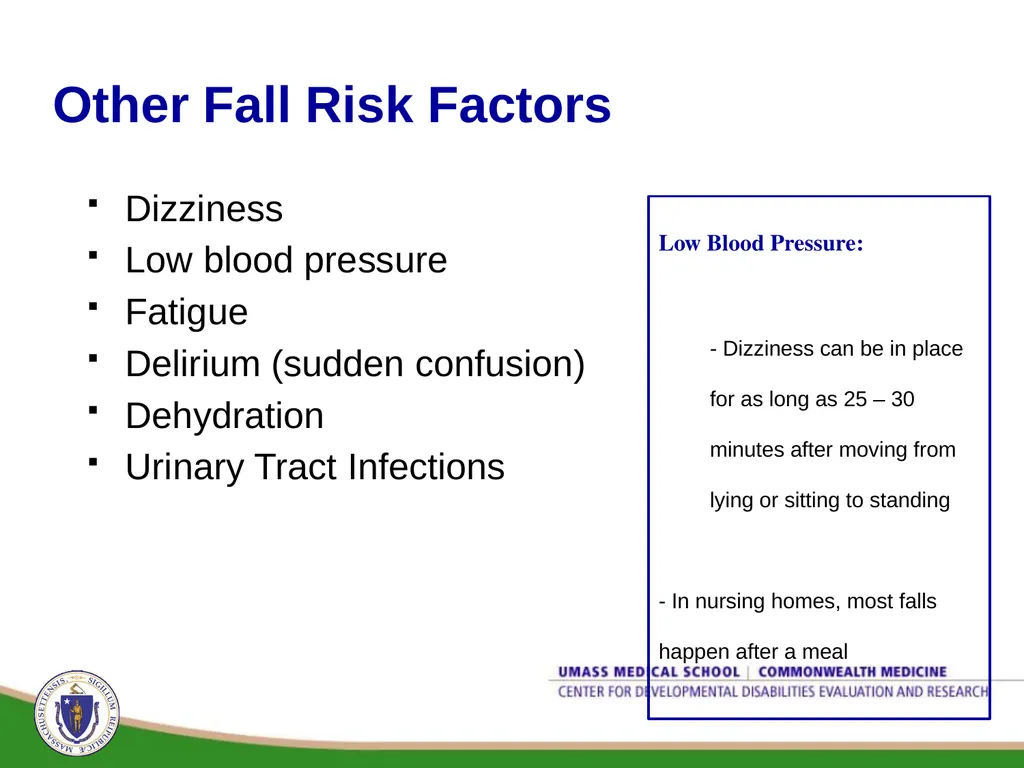
Other Fall Risk Factors Dizziness
Low blood pressure
Fatigue
Delirium (sudden confusion)
Dehydration
Urinary Tract Infections Low Blood Pressure:
- Dizziness can be in place for as long as 25 – 30 minutes after moving from lying or sitting to standing
- In nursing homes, most falls happen after a meal<br>
Low blood pressure
Fatigue
Delirium (sudden confusion)
Dehydration
Urinary Tract Infections Low Blood Pressure:
- Dizziness can be in place for as long as 25 – 30 minutes after moving from lying or sitting to standing
- In nursing homes, most falls happen after a meal<br>
14
Associated Conditions Seizure or other neurological disorders
Aggressive behaviors
Impaired ambulation or mobility
Osteoporosis (fracture risk)<br>
Aggressive behaviors
Impaired ambulation or mobility
Osteoporosis (fracture risk)<br>
15
Medication Use Common side effects like dizziness, confusion, fatigue, and sleepiness can affect a person's fall risk
Anti-seizure, psychotropic and antidepressants are most likely to cause this fall risk
New drugs can cause new interactions
Check your handout<br>
Anti-seizure, psychotropic and antidepressants are most likely to cause this fall risk
New drugs can cause new interactions
Check your handout<br>
16
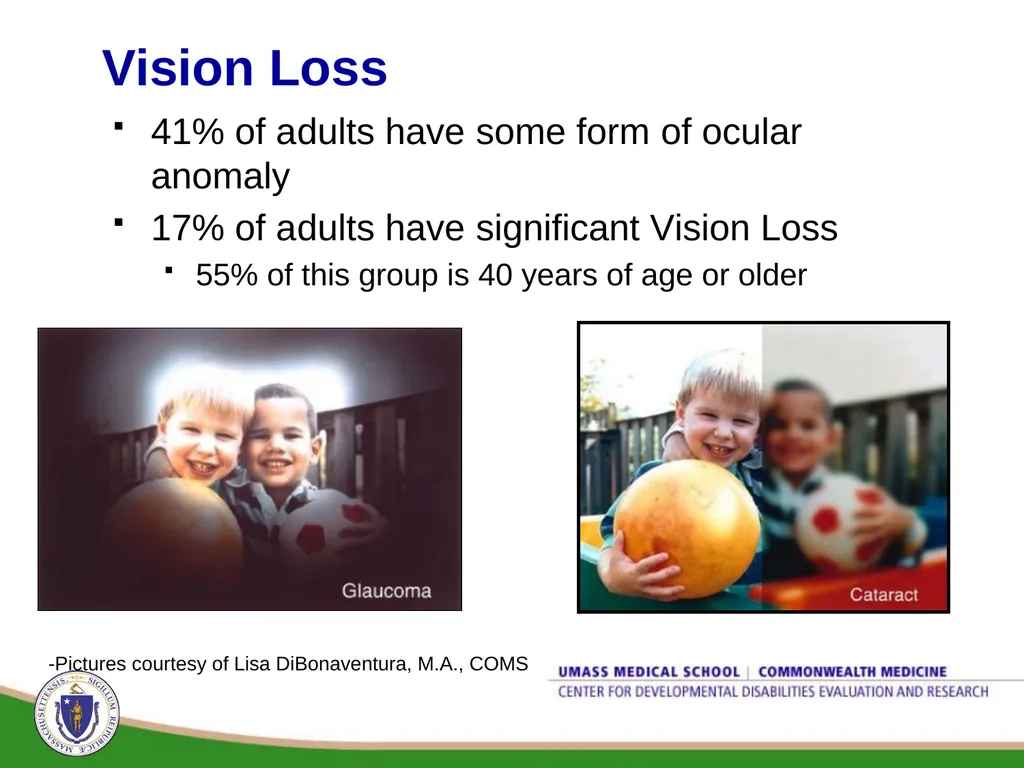
Vision Loss 41% of adults have some form of ocular anomaly
17% of adults have significant Vision Loss
55% of this group is 40 years of age or older -Pictures courtesy of Lisa DiBonaventura, M.A., COMS<br>
17% of adults have significant Vision Loss
55% of this group is 40 years of age or older -Pictures courtesy of Lisa DiBonaventura, M.A., COMS<br>
17
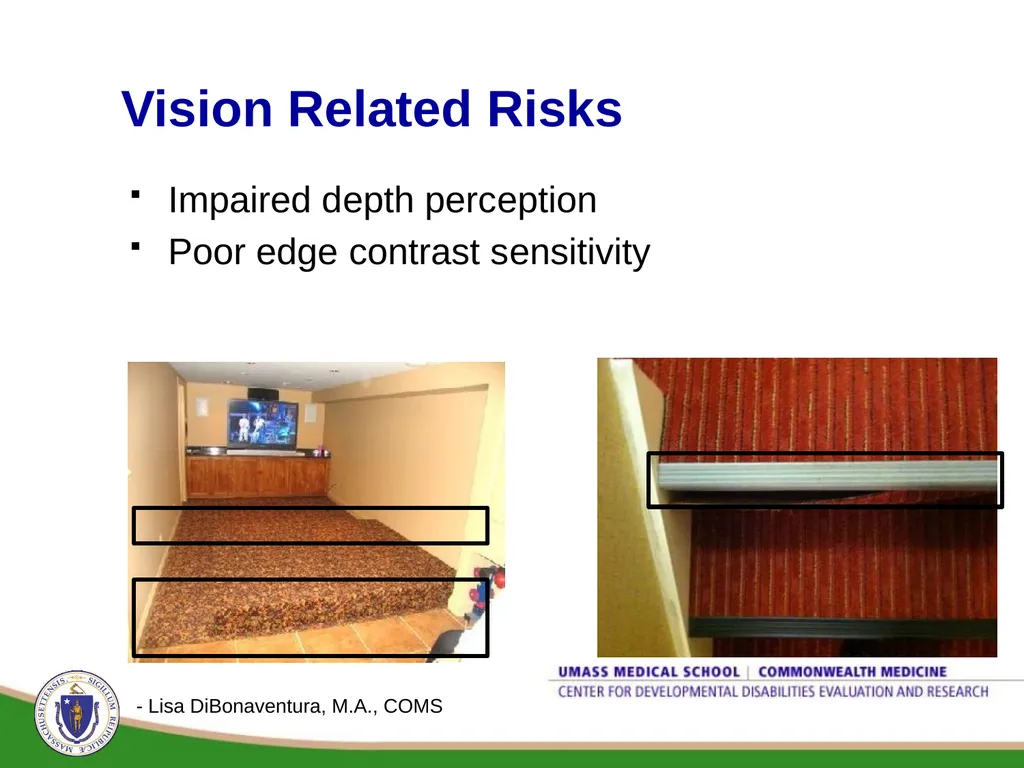
Vision Related Risks Impaired depth perception
Poor edge contrast sensitivity - Lisa DiBonaventura, M.A., COMS<br>
Poor edge contrast sensitivity - Lisa DiBonaventura, M.A., COMS<br>
18
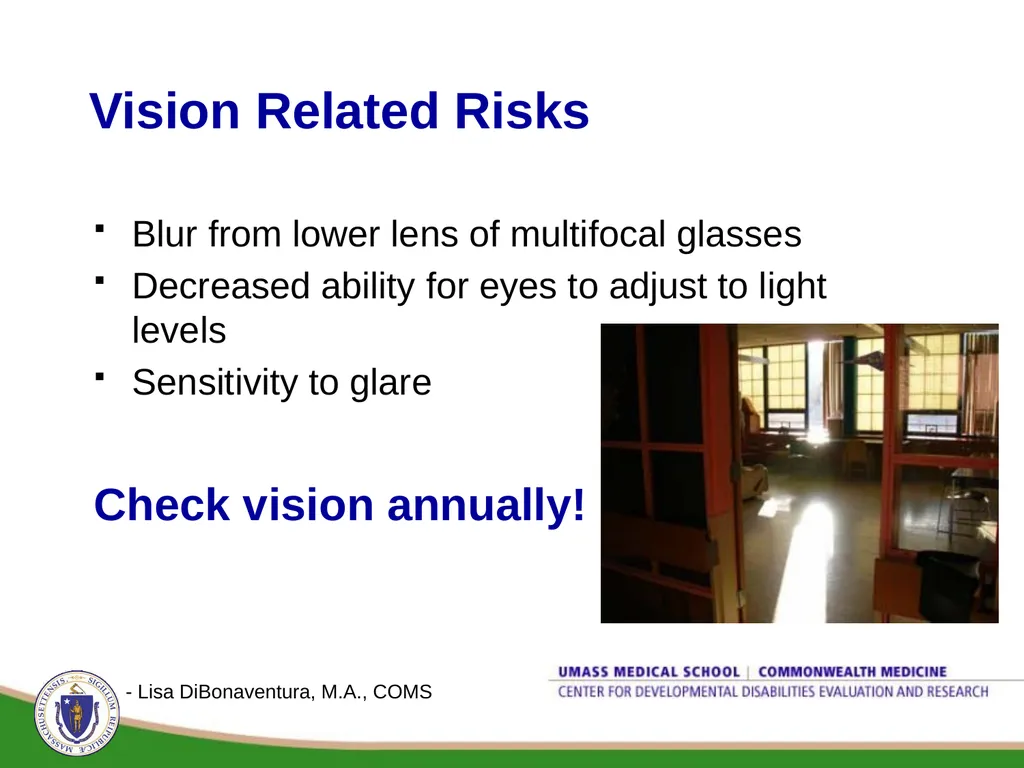
Vision Related Risks Blur from lower lens of multifocal glasses
Decreased ability for eyes to adjust to light levels
Sensitivity to glare
Check vision annually! - Lisa DiBonaventura, M.A., COMS<br>
Decreased ability for eyes to adjust to light levels
Sensitivity to glare
Check vision annually! - Lisa DiBonaventura, M.A., COMS<br>
19
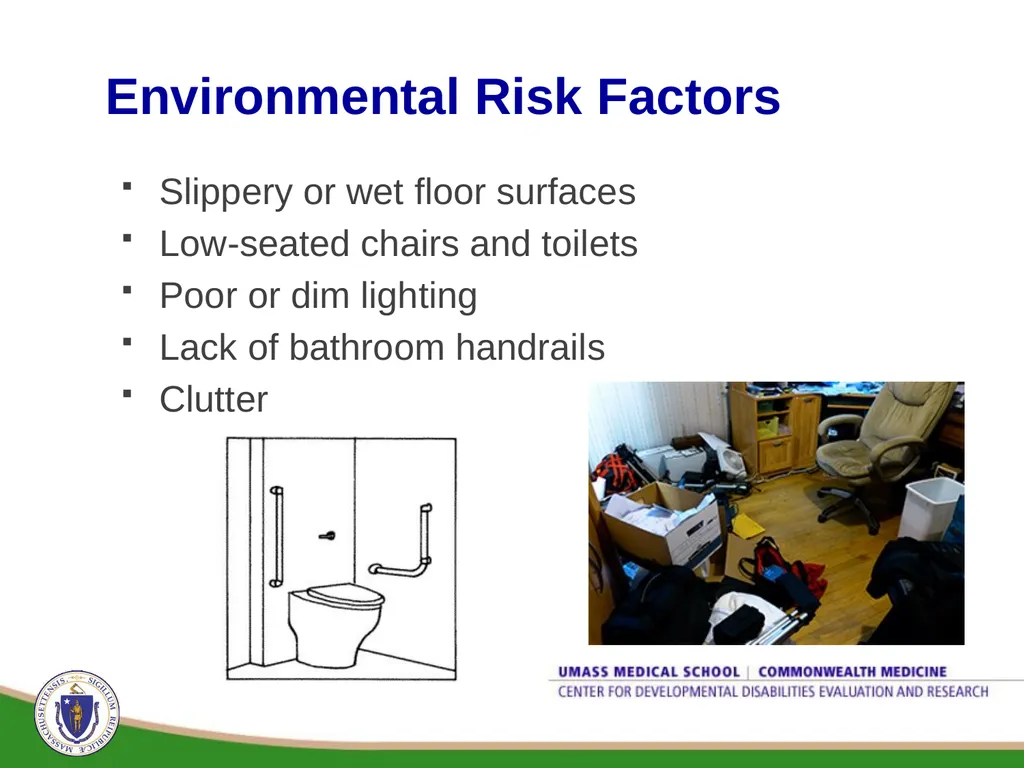
Environmental Risk Factors Slippery or wet floor surfaces
Low-seated chairs and toilets
Poor or dim lighting
Lack of bathroom handrails
Clutter<br>
Low-seated chairs and toilets
Poor or dim lighting
Lack of bathroom handrails
Clutter<br>
20
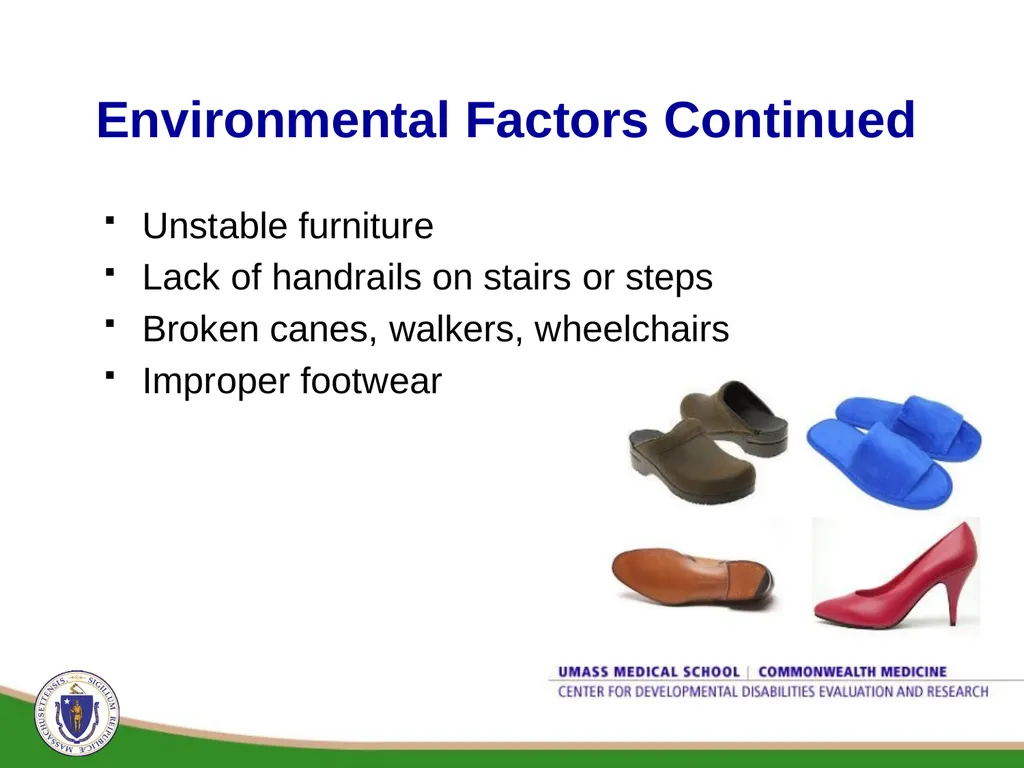
Environmental Factors Continued Unstable furniture
Lack of handrails on stairs or steps
Broken canes, walkers, wheelchairs
Improper footwear<br>
Lack of handrails on stairs or steps
Broken canes, walkers, wheelchairs
Improper footwear<br>
21
Prevention Strategies<br>
22
Preventive Strategies Medical
Rehabilitative
Environmental
Staff
Educational
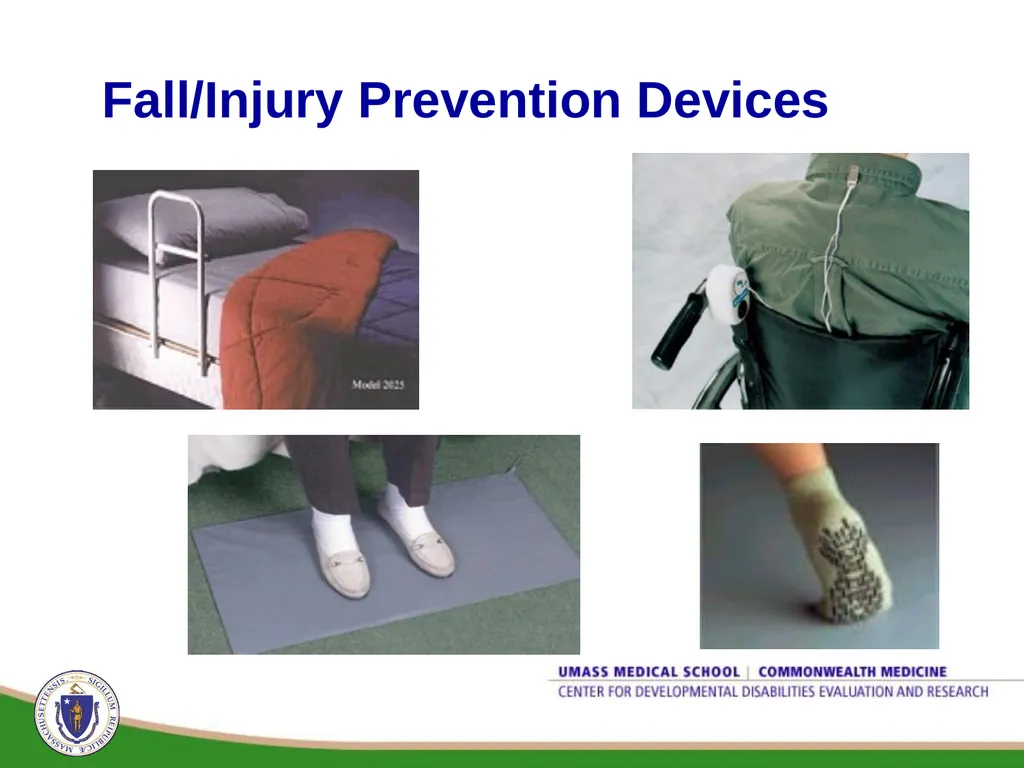
Use of Fall/Injury Prevention Devices<br>
Rehabilitative
Environmental
Staff
Educational
Use of Fall/Injury Prevention Devices<br>
23
Medical Strategies Recognize signs and symptoms of underlying illness
Review medication usage and potentially discontinue inappropriate or excessive medications
Diagnose and treat osteoporosis -Tedaskar, Rein, ‘Falls and People with Intellectual & Developmental Disabilities’<br>
Review medication usage and potentially discontinue inappropriate or excessive medications
Diagnose and treat osteoporosis -Tedaskar, Rein, ‘Falls and People with Intellectual & Developmental Disabilities’<br>
24
Rehabilitative Strategies Exercise programs
Walking and endurance
Training geared towards increasing balance, strength, and flexibility
Ensure footwear fits properly and is slip-resistant
Consider canes and walkers to improve balance -Tedaskar, Rein, ‘Falls and People with Intellectual & Developmental Disabilities’<br>
Walking and endurance
Training geared towards increasing balance, strength, and flexibility
Ensure footwear fits properly and is slip-resistant
Consider canes and walkers to improve balance -Tedaskar, Rein, ‘Falls and People with Intellectual & Developmental Disabilities’<br>
25
Environmental Strategies Identifying and eliminating hazards
Reduce clutter
Install grab bars and handrails
Replace lights
Remove unstable or low furniture
Use color contrast
Simplifying the environment to improve mobility
Reposition furniture
Consider door alarms -Tedaskar, Rein, ‘Falls and People with Intellectual & Developmental Disabilities’<br>
Reduce clutter
Install grab bars and handrails
Replace lights
Remove unstable or low furniture
Use color contrast
Simplifying the environment to improve mobility
Reposition furniture
Consider door alarms -Tedaskar, Rein, ‘Falls and People with Intellectual & Developmental Disabilities’<br>
26
Staff Strategies Staff have a key role in reducing falls:
Be aware of which persons are at fall risk
Report any sudden “change of condition” in persons
Anticipate the needs of persons at fall risk and meet their needs
Provide extra supervision for persons at particular fall risk
How to communicate risk across locations or shifts? -Tedaskar, Rein, ‘Falls and People with Intellectual & Developmental Disabilities’<br>
Be aware of which persons are at fall risk
Report any sudden “change of condition” in persons
Anticipate the needs of persons at fall risk and meet their needs
Provide extra supervision for persons at particular fall risk
How to communicate risk across locations or shifts? -Tedaskar, Rein, ‘Falls and People with Intellectual & Developmental Disabilities’<br>
27
Educational Strategies Educate people about their own fall risk
Ask for assistance when rising from a seated position
Ask for assistance when walking
Be extra cautious during icy or slippery conditions<br>
Ask for assistance when rising from a seated position
Ask for assistance when walking
Be extra cautious during icy or slippery conditions<br>
28
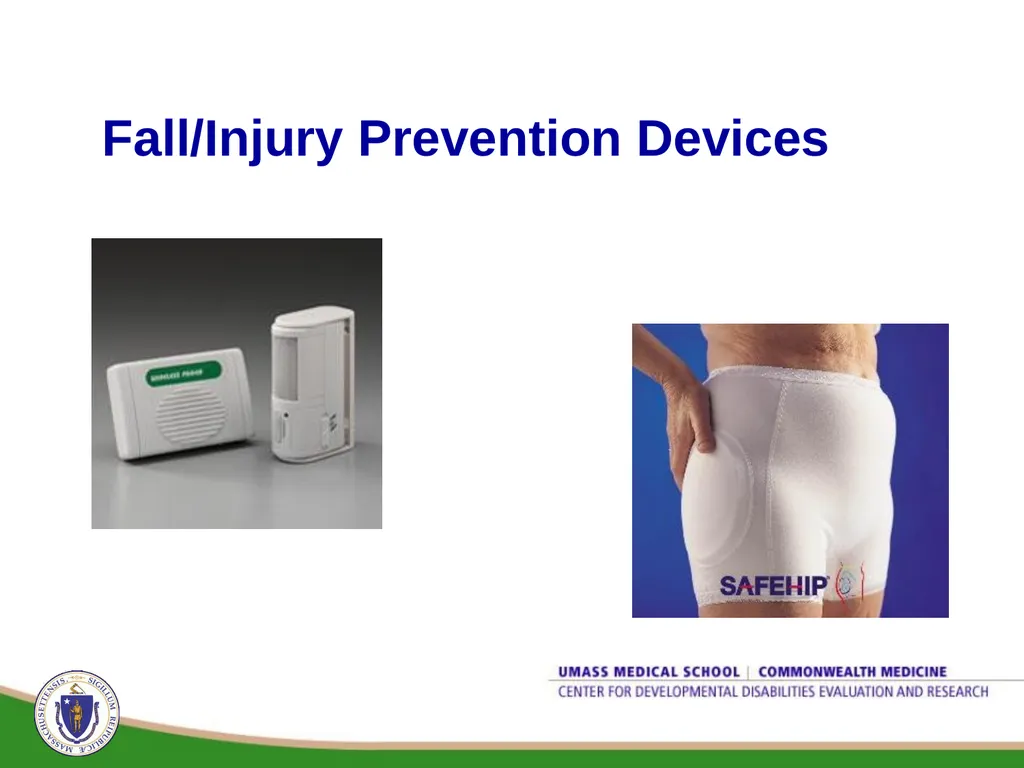
Fall/Injury Prevention Devices<br>
29
Fall/Injury Prevention Devices<br>
30
Fall Assessment Who is most at risk?<br>
31
How to Stop Falls Falls can be reduced by adhering to an organized step-by step process:
Determine who is at risk of falling and why
Incorporate one or more of the preventive strategies designed to reduce that fall risk
Conduct post-fall assessments to identify patterns and assess intervention effectiveness<br>
Determine who is at risk of falling and why
Incorporate one or more of the preventive strategies designed to reduce that fall risk
Conduct post-fall assessments to identify patterns and assess intervention effectiveness<br>
32
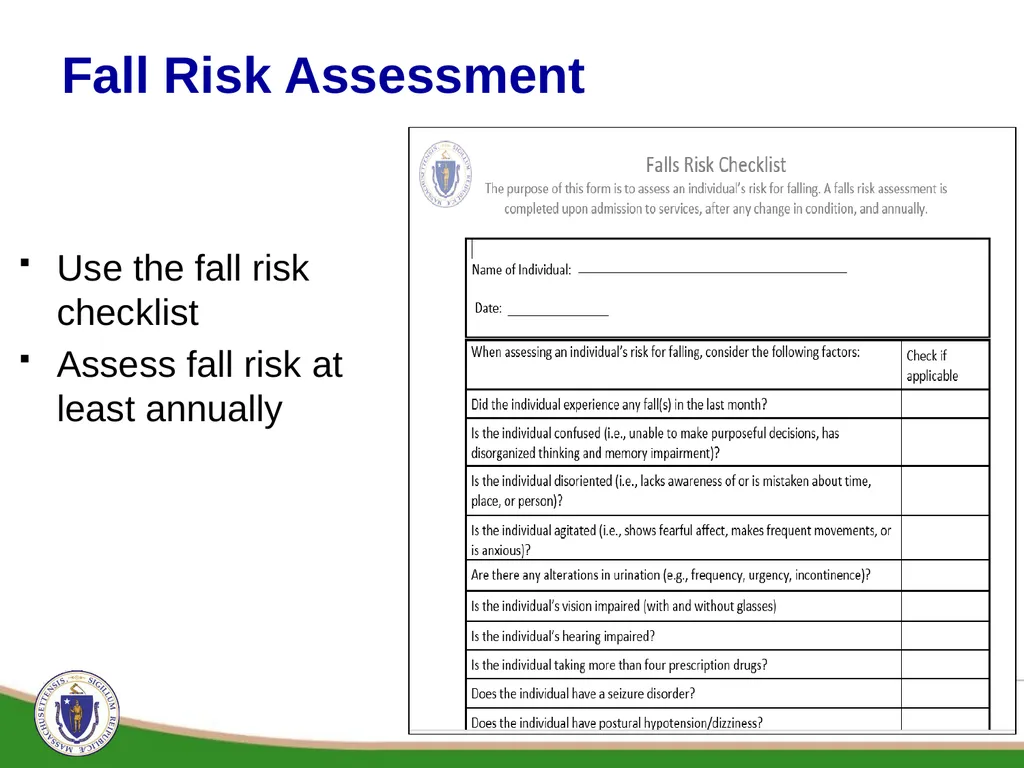
Step One: Assess Fall Risk There are many ways to assess risk:
Falls Risk Checklist
2. Timed Get Up and Go<br>
Falls Risk Checklist
2. Timed Get Up and Go<br>
33
Fall Risk Assessment Use the fall risk checklist
Assess fall risk at least annually<br>
Assess fall risk at least annually<br>
34
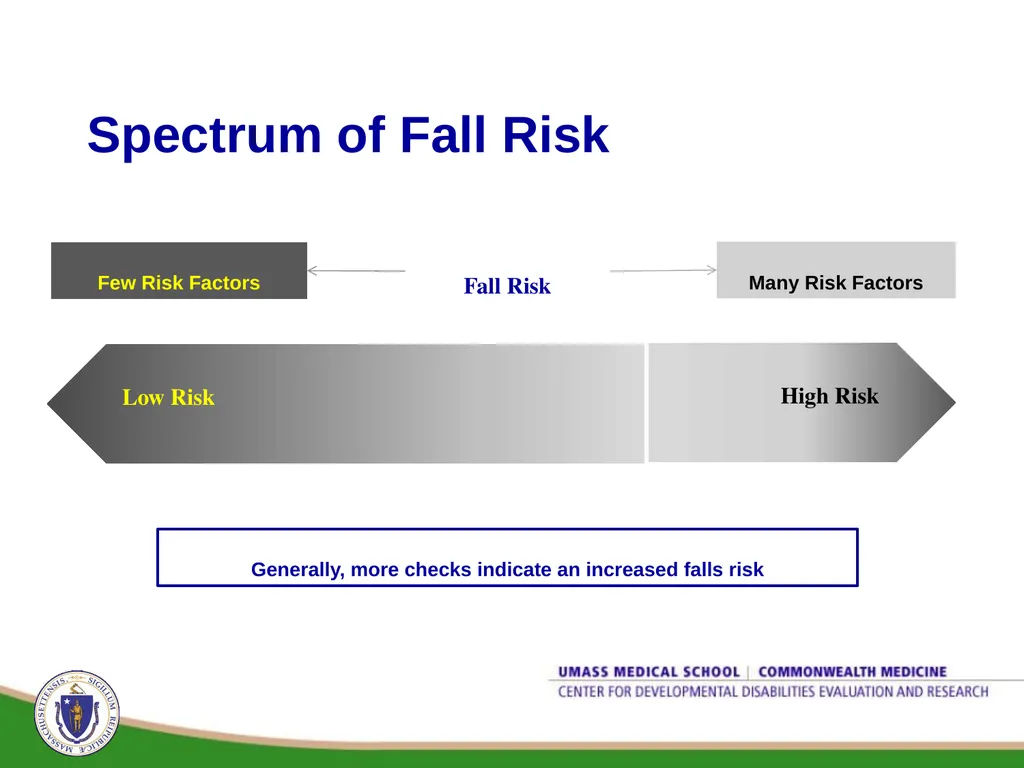
High Risk Low Risk Spectrum of Fall Risk Generally, more checks indicate an increased falls risk<br>
35
TUG (Timed get Up and Go) Timed get up and go test
Person rises from seated position, walks about 10 feet (3 meters), turns, walks back then sits again
Watch for unsteady balance and gait and refer as necessary.
https://www.cdc.gov/steadi/pdf/STEADI-Assessment-TUG-508.pdf<br>
Person rises from seated position, walks about 10 feet (3 meters), turns, walks back then sits again
Watch for unsteady balance and gait and refer as necessary.
https://www.cdc.gov/steadi/pdf/STEADI-Assessment-TUG-508.pdf<br>
36
Step Two: Implement falls prevention strategies This may include developing a falls protocol or risk plan
It will probably include Universal AND Individual Strategies
PT or OT customized interventions<br>
It will probably include Universal AND Individual Strategies
PT or OT customized interventions<br>
37
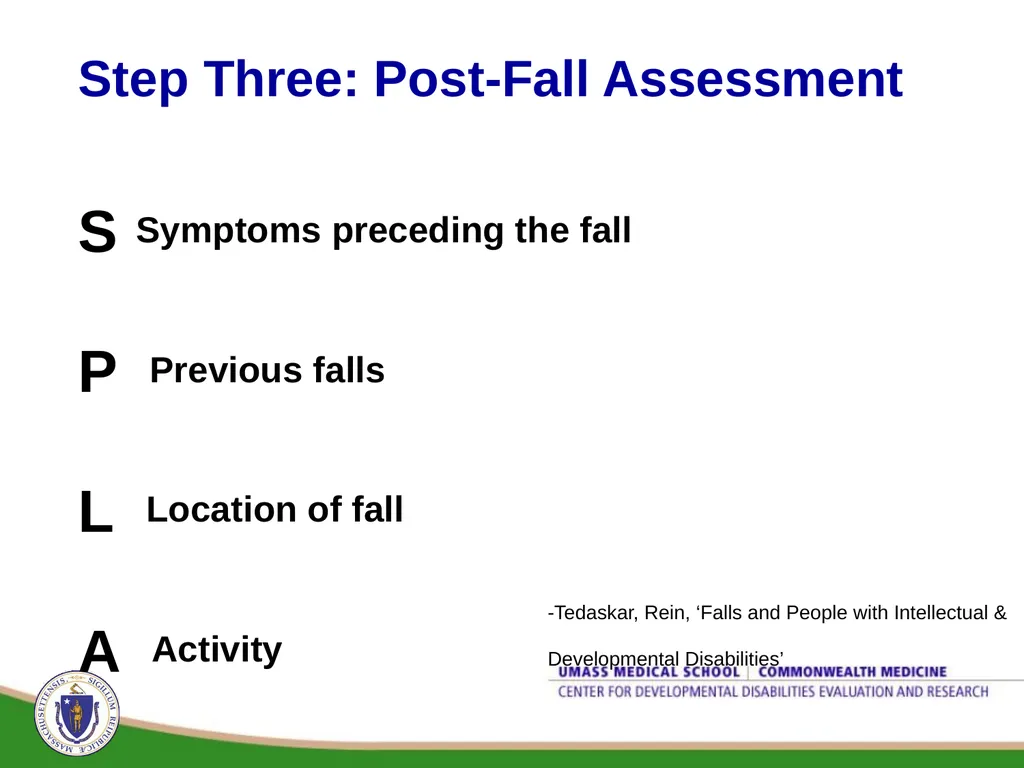
Step Three: Post-Fall Assessment S Symptoms preceding the fall
P Previous falls
L Location of fall
A Activity
T Time of day
T Trauma -Tedaskar, Rein, ‘Falls and People with Intellectual & Developmental Disabilities’<br>
P Previous falls
L Location of fall
A Activity
T Time of day
T Trauma -Tedaskar, Rein, ‘Falls and People with Intellectual & Developmental Disabilities’<br>
38
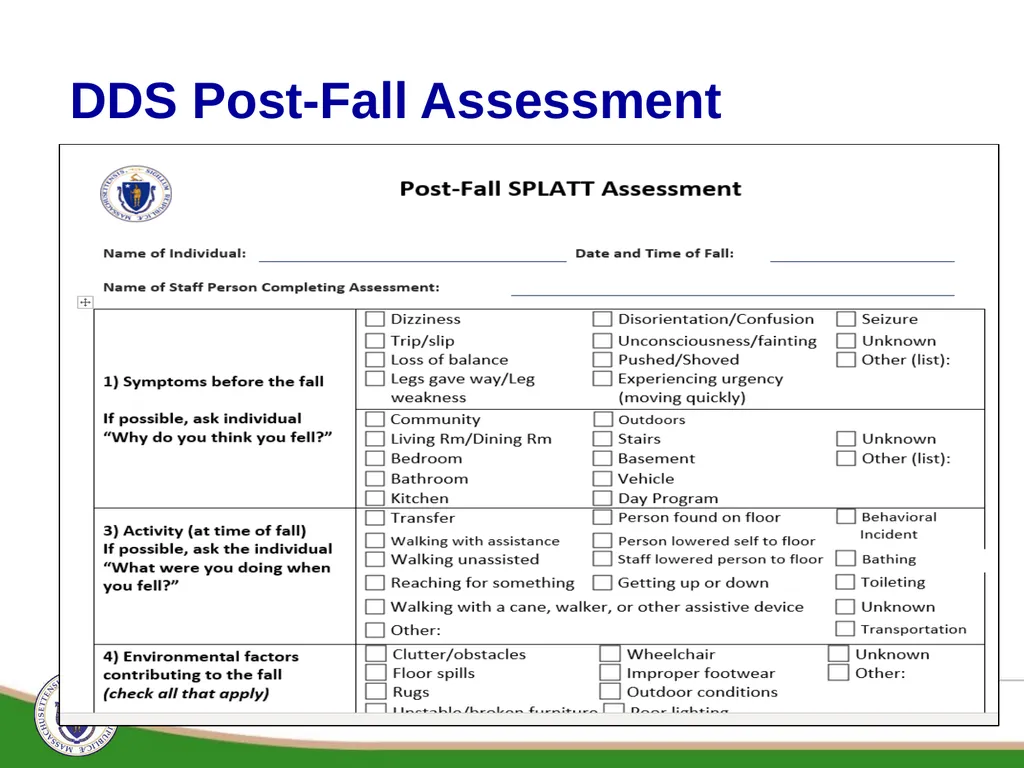
DDS Post-Fall Assessment<br>
39
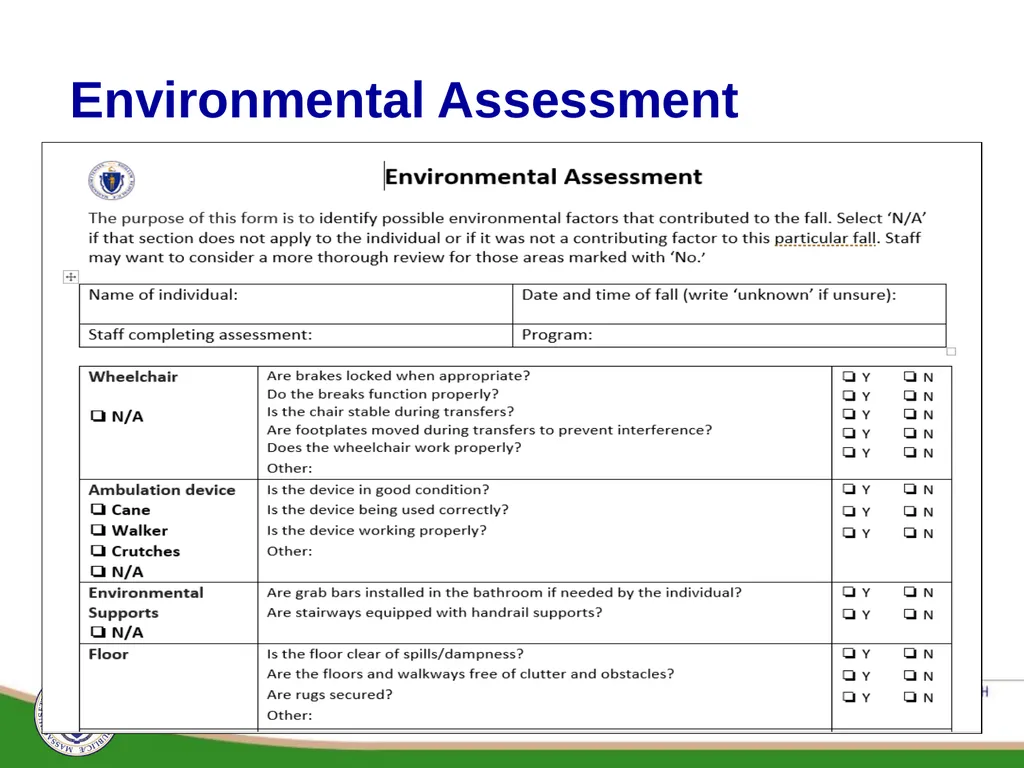
Environmental Assessment<br>
40
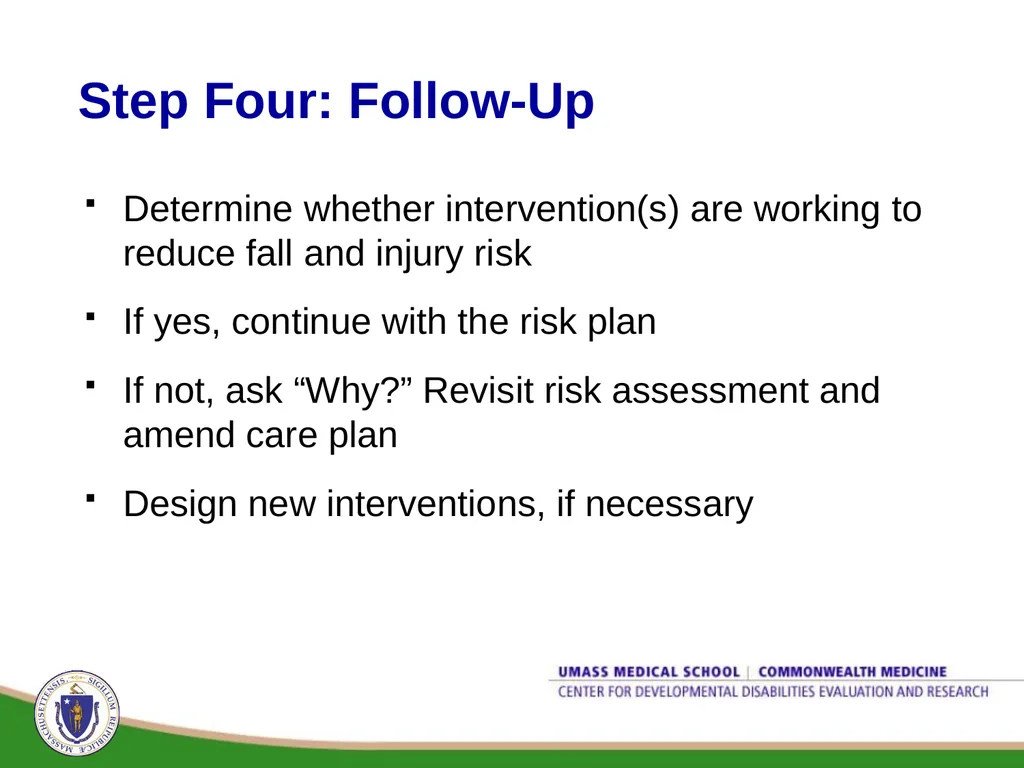
Step Four: Follow-Up Determine whether intervention(s) are working to reduce fall and injury risk
If yes, continue with the risk plan
If not, ask “Why?” Revisit risk assessment and amend care plan
Design new interventions, if necessary<br>
If yes, continue with the risk plan
If not, ask “Why?” Revisit risk assessment and amend care plan
Design new interventions, if necessary<br>
41
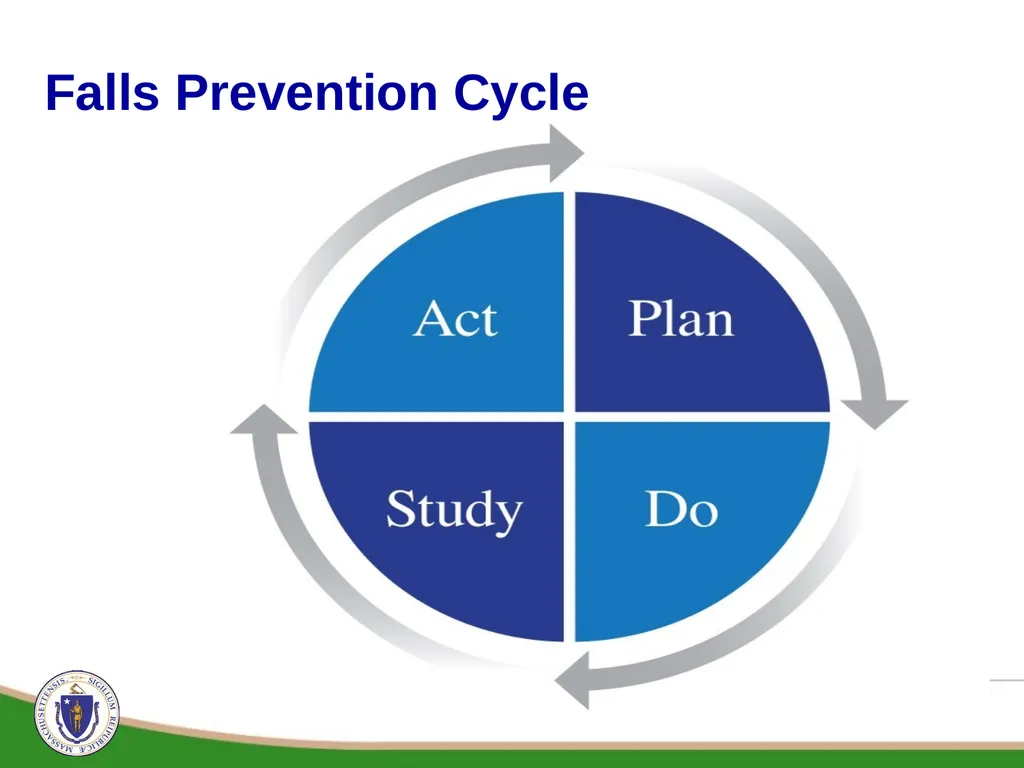
Falls Prevention Cycle<br>
42
Research “Lessons Learned”<br>
43
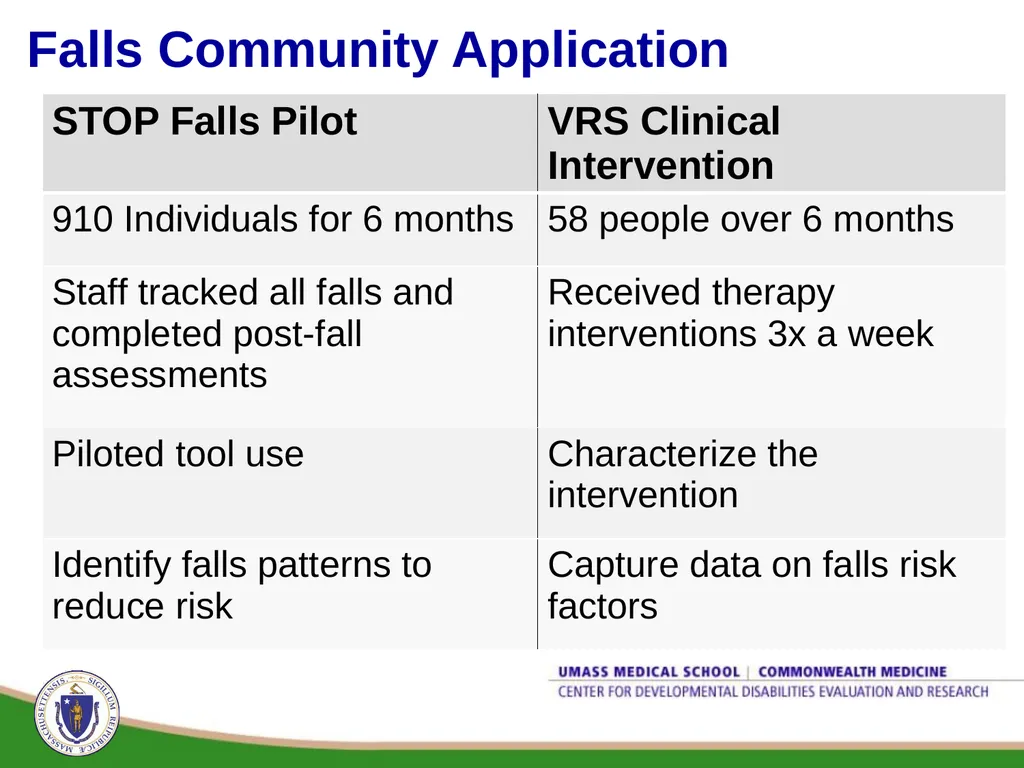
Falls Community Application<br>
44
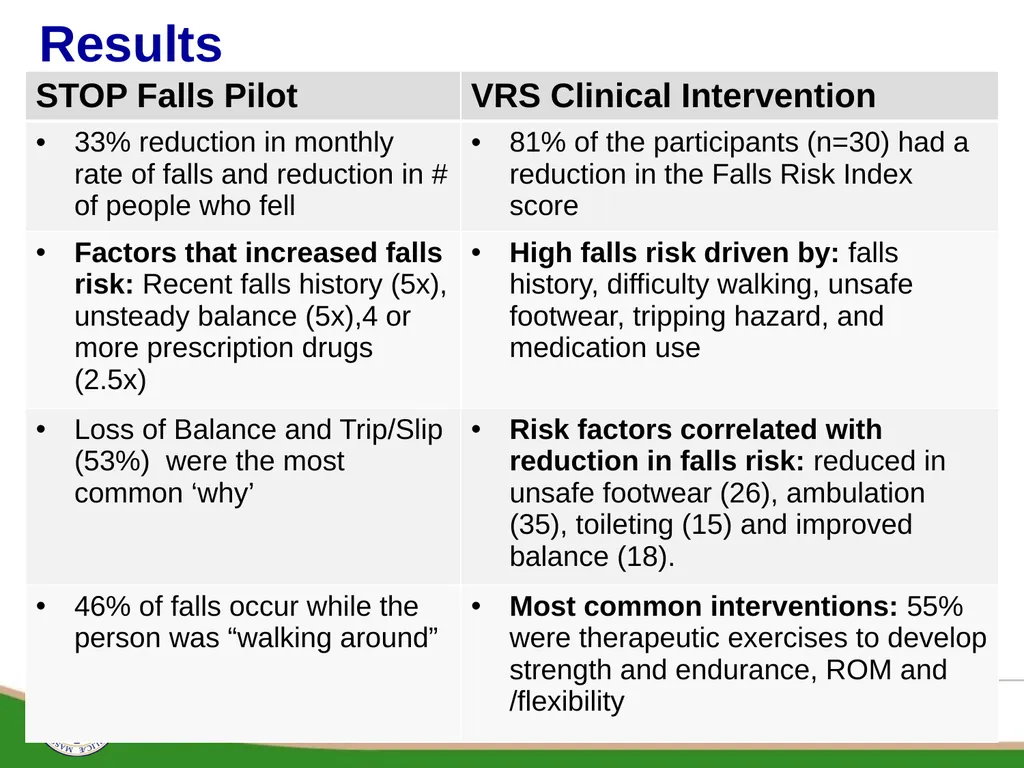
Results<br>
45
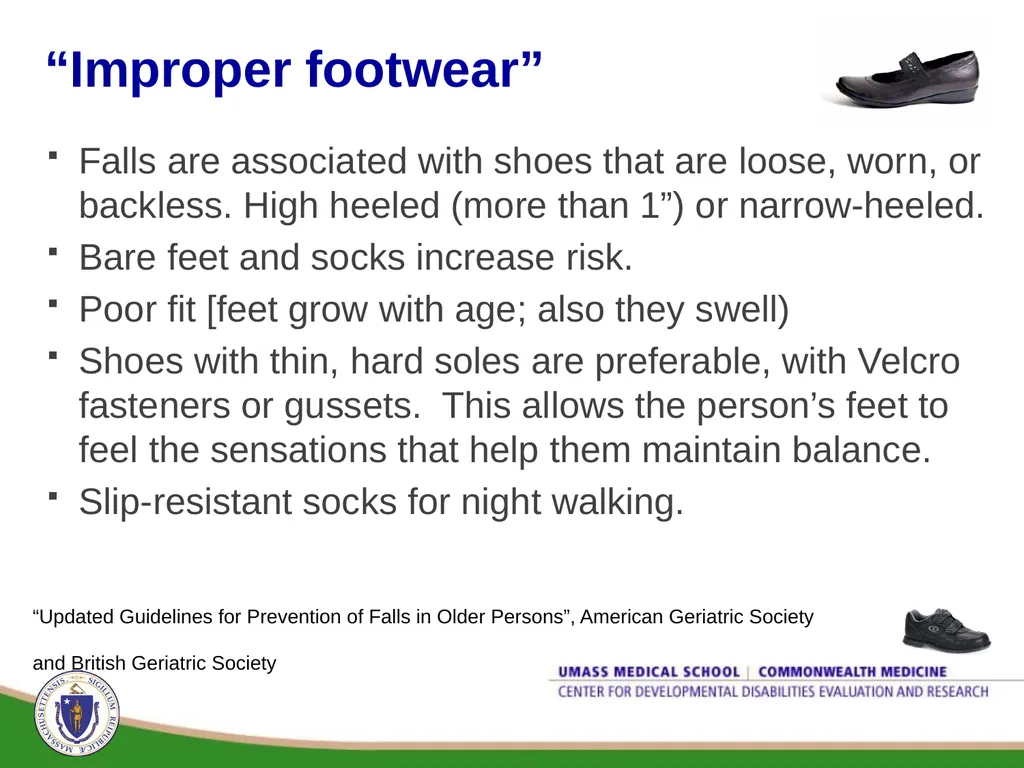
“Improper footwear” Falls are associated with shoes that are loose, worn, or backless. High heeled (more than 1”) or narrow-heeled.
Bare feet and socks increase risk.
Poor fit [feet grow with age; also they swell)
Shoes with thin, hard soles are preferable, with Velcro fasteners or gussets. This allows the person’s feet to feel the sensations that help them maintain balance.
Slip-resistant socks for night walking. “Updated Guidelines for Prevention of Falls in Older Persons”, American Geriatric Society and British Geriatric Society<br>
Bare feet and socks increase risk.
Poor fit [feet grow with age; also they swell)
Shoes with thin, hard soles are preferable, with Velcro fasteners or gussets. This allows the person’s feet to feel the sensations that help them maintain balance.
Slip-resistant socks for night walking. “Updated Guidelines for Prevention of Falls in Older Persons”, American Geriatric Society and British Geriatric Society<br>
46
Case Studies<br>
47
CASE STUDY #1 Gertrude is 57 and has Down Syndrome
She takes a multivitamin, calcium, and eye drops for dry eyes every day
She lives in a community residence which recently underwent a major renovation
Last winter she broke her hip
She appears confused, refuses to go outside in the cold, and bumps into things<br>
She takes a multivitamin, calcium, and eye drops for dry eyes every day
She lives in a community residence which recently underwent a major renovation
Last winter she broke her hip
She appears confused, refuses to go outside in the cold, and bumps into things<br>
48
CASE STUDY #2 Elizabeth is 45 years old with limited verbal skills
She has a seizure disorder and takes Tegretol 3 times a day
No longer interested in favorite activities
Seems a little unsteady and has difficulty navigating the carpeted stairs to her room
Recently fell in the community and skinned her knees<br>
She has a seizure disorder and takes Tegretol 3 times a day
No longer interested in favorite activities
Seems a little unsteady and has difficulty navigating the carpeted stairs to her room
Recently fell in the community and skinned her knees<br>
49
CASE STUDY #3 Jonathan is 78 years old
He has a seizure disorder and takes Tegretol 3 times a day
Takes hypertension medication and a diuretic in the early morning
Has almost fallen on several occasions in the bathroom and is incontinent of urine
Staff encourage him to wait for assistance when he is unsteady, but he refuses<br>
He has a seizure disorder and takes Tegretol 3 times a day
Takes hypertension medication and a diuretic in the early morning
Has almost fallen on several occasions in the bathroom and is incontinent of urine
Staff encourage him to wait for assistance when he is unsteady, but he refuses<br>
50
CASE STUDY #4 Eric is 47 years old and has CP
He has a significant seizure disorder and takes Tegretol and Keppra 4x/day, along with a multivitamin and Colace
Lately, Eric seems less able to help with transfers and has fallen once transferring into the bathtub
He has started to refuse baths and only allows certain staff to help him<br>
He has a significant seizure disorder and takes Tegretol and Keppra 4x/day, along with a multivitamin and Colace
Lately, Eric seems less able to help with transfers and has fallen once transferring into the bathtub
He has started to refuse baths and only allows certain staff to help him<br>
51
References Finlayson, M. et al (2010). Injuries, falls and accidents among adults with intellectual disabilities. Prospective cohort study. JIDR, 54(11), 966-980.
Sherrard J, Tonge BJ & Ozanne-Smith J (2001) Injury in young people with intellectual disability: descriptive epidemiology. Injury Prevention 7, 56-61.
Hsieh, K., Heller, T., & Miller, B. (2001). Risk factors for injuries and falls among adults with developmental disabilities. JIDR, 45(1), 76-82.
Cox, CR et all (2010). Incidence of and risk factors for falls among adults with an intellectual disability. JIDR 54(12) 1045-1057.
Grant, HJ. (2001). Falls among person who have developmental disabilities in institutional and group home settings. Journal on Developmental Disabilities, 8(1), 57-73.
Wagemans, AMA & Cluitmans, JJM. (2006). Falls and fractures: a major health risk for adults with intellectual disabilities in residential settings. Journal of Policy and Practice in Intellectual Disabilities 3, 136-138.
Smulders, E., Enkelaar, L. Weerdesteyn, V., Geurts, A. C. H. & van Schrojenstein Lantman-deValk, H. (2013). Falls in older persons with intellectual disabilities:fall rate, circumstances and consequences. Journal of Intellectual Disability Research. 57(12). December.<br>
Sherrard J, Tonge BJ & Ozanne-Smith J (2001) Injury in young people with intellectual disability: descriptive epidemiology. Injury Prevention 7, 56-61.
Hsieh, K., Heller, T., & Miller, B. (2001). Risk factors for injuries and falls among adults with developmental disabilities. JIDR, 45(1), 76-82.
Cox, CR et all (2010). Incidence of and risk factors for falls among adults with an intellectual disability. JIDR 54(12) 1045-1057.
Grant, HJ. (2001). Falls among person who have developmental disabilities in institutional and group home settings. Journal on Developmental Disabilities, 8(1), 57-73.
Wagemans, AMA & Cluitmans, JJM. (2006). Falls and fractures: a major health risk for adults with intellectual disabilities in residential settings. Journal of Policy and Practice in Intellectual Disabilities 3, 136-138.
Smulders, E., Enkelaar, L. Weerdesteyn, V., Geurts, A. C. H. & van Schrojenstein Lantman-deValk, H. (2013). Falls in older persons with intellectual disabilities:fall rate, circumstances and consequences. Journal of Intellectual Disability Research. 57(12). December.<br>
52
References Willgoss TG, Yohannes AM & Mitchell D. (2010) Review of risk factors and preventative strategies for fall related injuries in people with intellectual disabilities. Journal of Clinical Nursing 19, 2100–9.
Sherrard J, Tonge BJ & Ozanne-Smith J (2001) Injury in young people with intellectual disability: descriptive epidemiology. Injury Prevention 7, 56-61.
Wang D, McDermott S, Sease T. (2002). Analysis of hospital use for injury among individuals with mental retardation. Journal of Injury Control and Safety Promotion 9 (v2), 30.<br>
Sherrard J, Tonge BJ & Ozanne-Smith J (2001) Injury in young people with intellectual disability: descriptive epidemiology. Injury Prevention 7, 56-61.
Wang D, McDermott S, Sease T. (2002). Analysis of hospital use for injury among individuals with mental retardation. Journal of Injury Control and Safety Promotion 9 (v2), 30.<br>