
FAO Strategic Framework for Social Protection:

Description: FAO Strategic Framework for Social Protection: Inclusive Development for all Natalia Winder Rossi, Deputy Director Team LeaderDelivery Manager, Social Protection New York, May 2017 Overview Overall approach: rationale and niche Overall
Related Topics
Download Presentation
"FAO Strategic Framework for Social Protection:" is the property of its rightful owner. Permission is granted to download and print the materials on this website for personal, non-commercial use only, and to display it on your personal computer provided you do not modify the materials and that you retain all copyright notices contained in the materials. By downloading content from our website, you accept the terms of this agreement.
Presentation Transcript
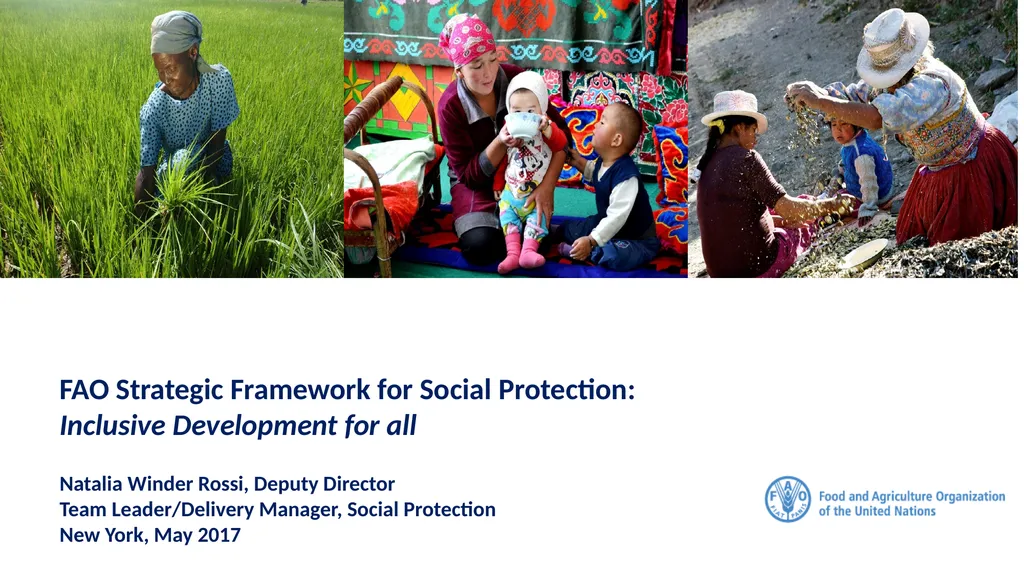
slide1. FAO Strategic Framework for Social Protection: Inclusive Development for all
Natalia Winder Rossi, Deputy Director
Team Leader/Delivery Manager, Social Protection
New York, May 2017<br>
slide2. Overview Overall approach: rationale and niche
Overall strategy and approach (thematic and entry points) Social Protection: From Protection to Production<br>
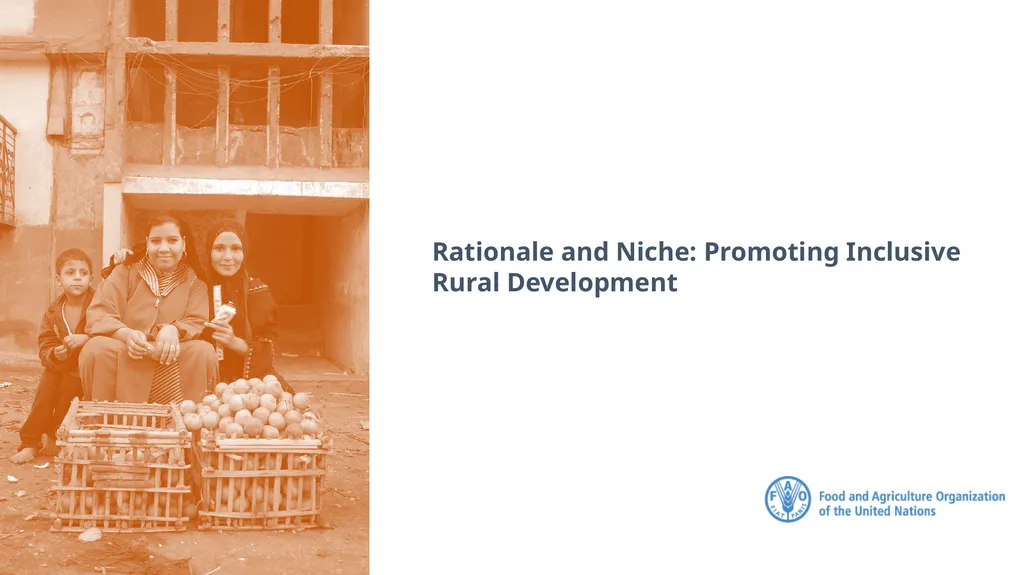
slide3. Rationale and Niche: Promoting Inclusive Rural Development<br>
slide4. Social protection as a corporate priority SP as a corporate priority to promote inclusive rural development
Outcome in the Strategic Framework – contributing the Strategic Programme on Reducing Rural Poverty (SP3)
Also recognized as a key component for SP on Resilience (SP5) and on Eradication of Hunger, Food Insecurity and Malnutrition (SP1)
FAO Social Protection Framework (*2017)
Rationale for FAO’s engagement:
Solid evidence on the role social protection plays in strategic areas of FAO’s work:
Right to Food and Right to Social protection
10 divisions contributing to Social Protection across SPs; Working across all regions Social Protection: From Protection to Production<br>
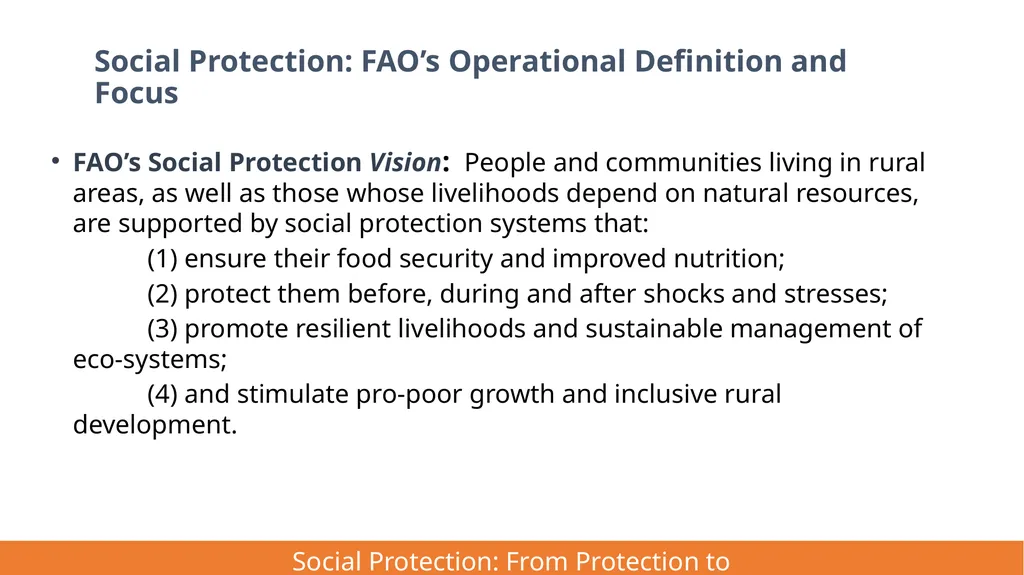
slide5. Social Protection: FAO’s Operational Definition and Focus FAO’s Social Protection Vision: People and communities living in rural areas, as well as those whose livelihoods depend on natural resources, are supported by social protection systems that:
(1) ensure their food security and improved nutrition;
(2) protect them before, during and after shocks and stresses;
(3) promote resilient livelihoods and sustainable management of eco-systems;
(4) and stimulate pro-poor growth and inclusive rural development. Social Protection: From Protection to Production<br>
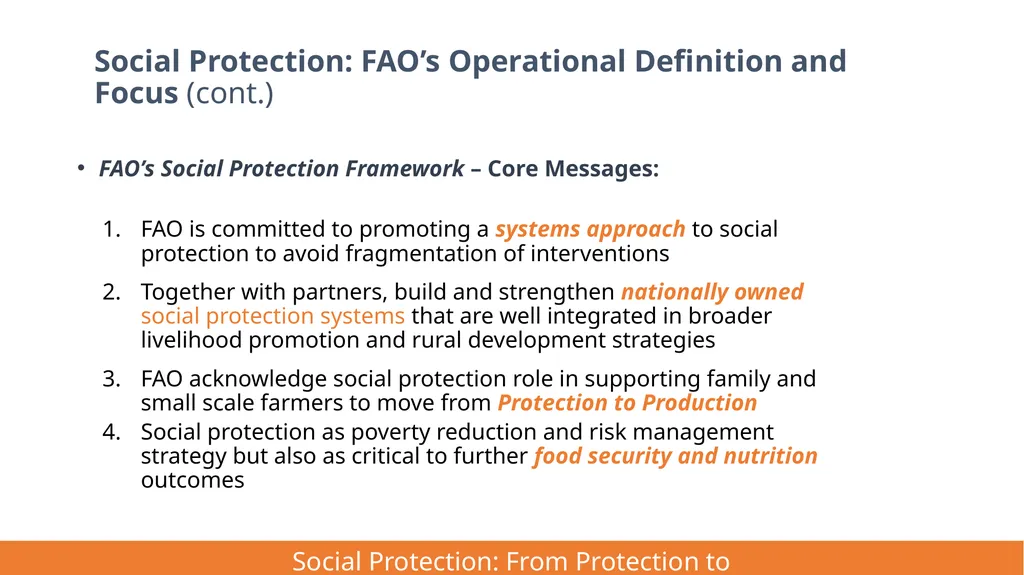
slide6. Social Protection: FAO’s Operational Definition and Focus (cont.) FAO’s Social Protection Framework – Core Messages:
FAO is committed to promoting a systems approach to social protection to avoid fragmentation of interventions
Together with partners, build and strengthen nationally owned social protection systems that are well integrated in broader livelihood promotion and rural development strategies
FAO acknowledge social protection role in supporting family and small scale farmers to move from Protection to Production
Social protection as poverty reduction and risk management strategy but also as critical to further food security and nutrition outcomes Social Protection: From Protection to Production<br>
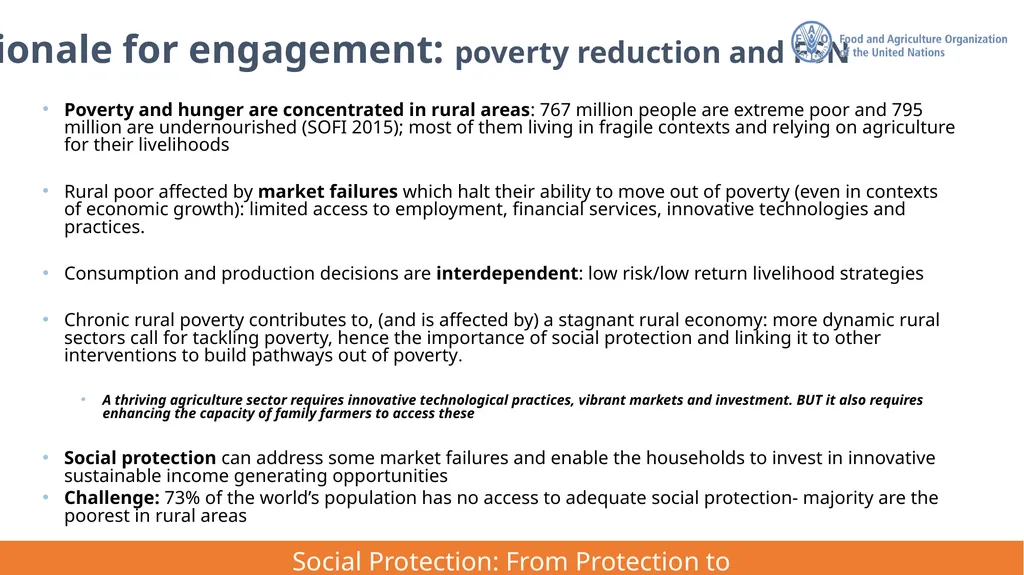
slide7. Rationale for engagement: poverty reduction and FSN Poverty and hunger are concentrated in rural areas: 767 million people are extreme poor and 795 million are undernourished (SOFI 2015); most of them living in fragile contexts and relying on agriculture for their livelihoods
Rural poor affected by market failures which halt their ability to move out of poverty (even in contexts of economic growth): limited access to employment, financial services, innovative technologies and practices.
Consumption and production decisions are interdependent: low risk/low return livelihood strategies
Chronic rural poverty contributes to, (and is affected by) a stagnant rural economy: more dynamic rural sectors call for tackling poverty, hence the importance of social protection and linking it to other interventions to build pathways out of poverty.
A thriving agriculture sector requires innovative technological practices, vibrant markets and investment. BUT it also requires enhancing the capacity of family farmers to access these
Social protection can address some market failures and enable the households to invest in innovative sustainable income generating opportunities
Challenge: 73% of the world’s population has no access to adequate social protection- majority are the poorest in rural areas Social Protection: From Protection to Production Social Protection: From Protection to Production<br>
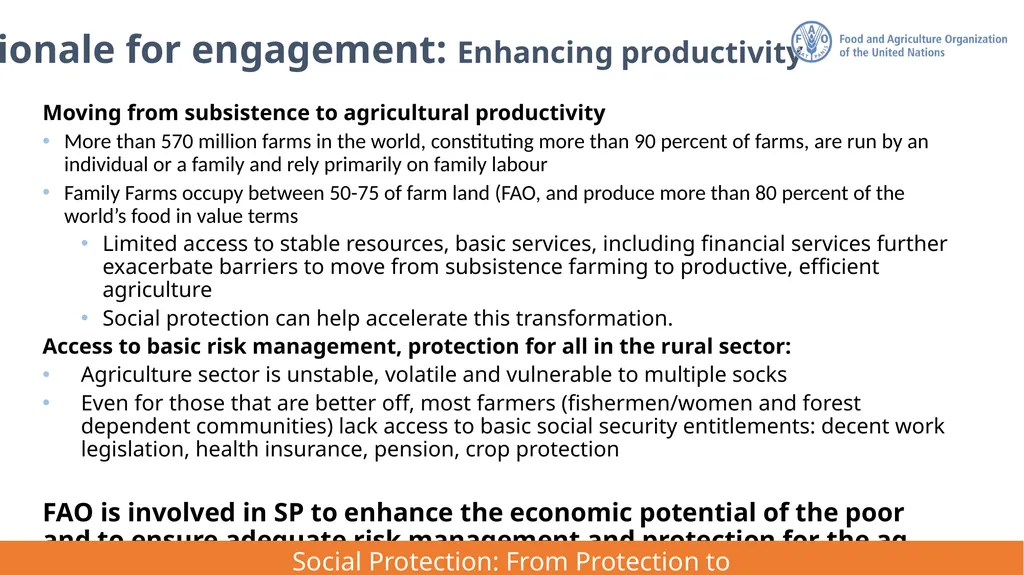
slide8. Rationale for engagement: Enhancing productivity Moving from subsistence to agricultural productivity
More than 570 million farms in the world, constituting more than 90 percent of farms, are run by an individual or a family and rely primarily on family labour
Family Farms occupy between 50-75 of farm land (FAO, and produce more than 80 percent of the world’s food in value terms
Limited access to stable resources, basic services, including financial services further exacerbate barriers to move from subsistence farming to productive, efficient agriculture
Social protection can help accelerate this transformation.
Access to basic risk management, protection for all in the rural sector:
Agriculture sector is unstable, volatile and vulnerable to multiple socks
Even for those that are better off, most farmers (fishermen/women and forest dependent communities) lack access to basic social security entitlements: decent work legislation, health insurance, pension, crop protection
FAO is involved in SP to enhance the economic potential of the poor and to ensure adequate risk management and protection for the ag sector as a whole Social Protection: From Protection to Production Social Protection: From Protection to Production<br>
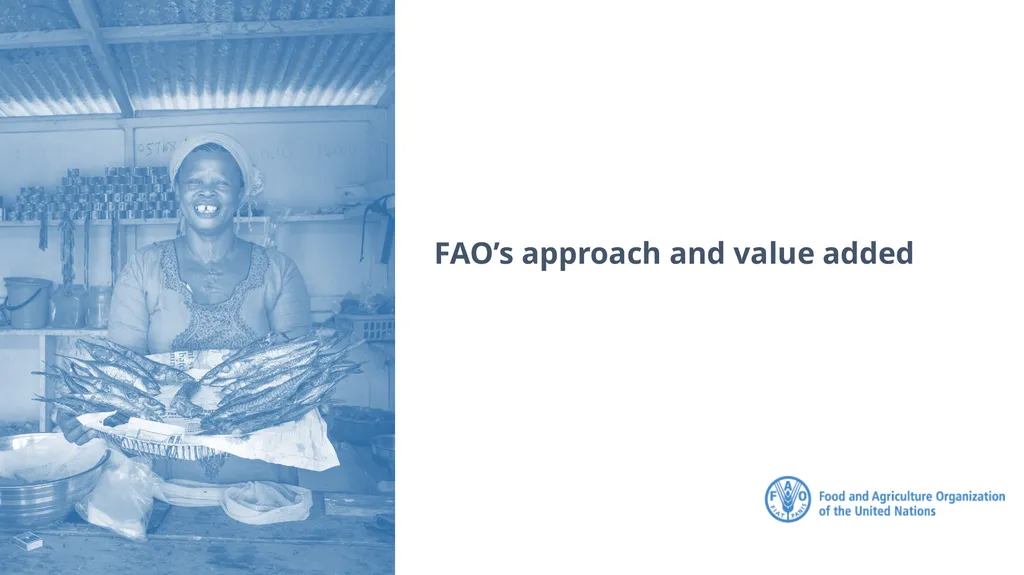
slide9. FAO’s approach and value added<br>
slide10. What does FAO want to accomplish by end of …2019? Concrete contribution to countries' ability to reach SDG target 1.3: expansion of coverage of social protection (and its link with SDG2)
What is FAO’s contribution? Specific niche?
Economic case for scale-up
Ensuring the (adequate) coverage of social assistance and social security to agriculture sectors, including forestry, fisheries and other
From Protection to Production: Complementing social protection interventions with productive and nutrition interventions to support a sustainable move out of poverty (linking SD1 and SD2)
Resilient livelihoods: Enhance the capacity of social protection systems to effectively and timely prevent and respond to crises to protect lives and livelihoods Social Protection: From Protection to Production<br>
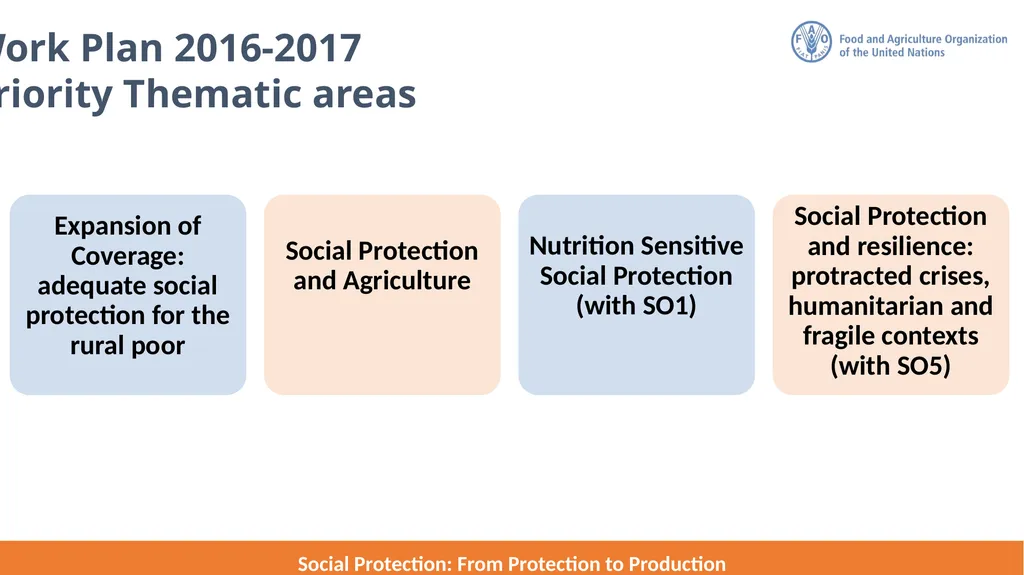
slide11. Work Plan 2016-2017
Priority Thematic areas Social Protection: From Protection to Production<br>
slide12. FAO’s value added and approach Economic case for scale-up of national social protection programmes:
linked to SDG 1.3- specific focus on rural/agriculture sector (social assistance and security; including decent work)
Ensuring coverage of the agriculture sector (including small scale fisheries and forest dependent communities)
Specific contribution to Global Initiative on Universal Coverage
Evidence generation: economic and productive impacts on social protection (households and local economies)*
From Protection to Production
Aim to maximize social and economic impacts, while contributing to FSN
Support a sustainable move out of poverty: integrated approach
Differentiated approaches based on livelihood profile, and pathways out of poverty
Gender-sensitive social protection approaches
Integrated approach: Social protection PLUS; SP as part of broader rural development strategies
Social protection as a core pillar of resilience building (*fragile / humanitarian contexts)
Shock-responsive social protection for resilient livelihoods Social Protection: From Protection to Production Social Protection: From Protection to Production<br>
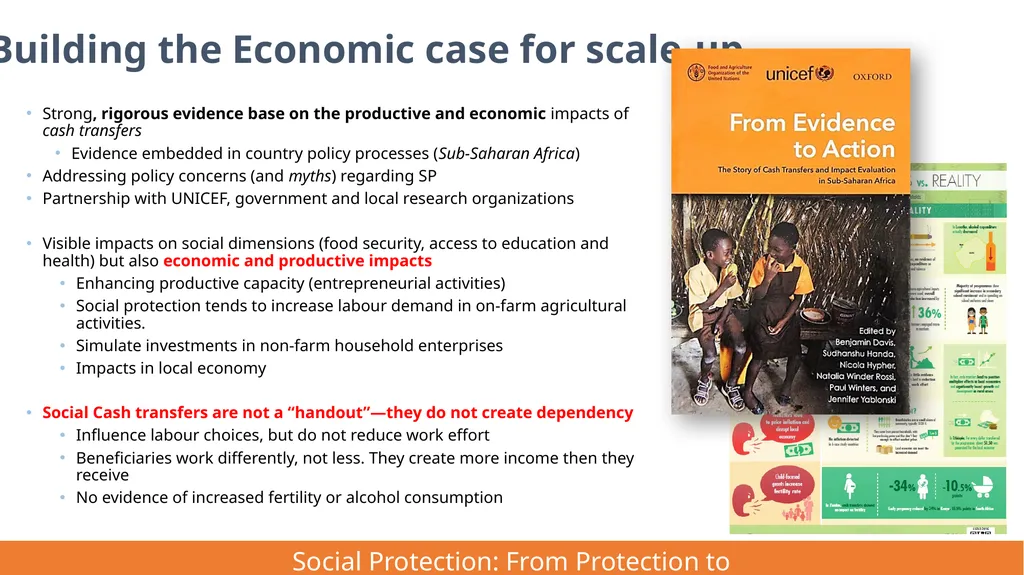
slide13. 1. Building the Economic case for scale-up Strong, rigorous evidence base on the productive and economic impacts of cash transfers
Evidence embedded in country policy processes (Sub-Saharan Africa)
Addressing policy concerns (and myths) regarding SP
Partnership with UNICEF, government and local research organizations
Visible impacts on social dimensions (food security, access to education and health) but also economic and productive impacts
Enhancing productive capacity (entrepreneurial activities)
Social protection tends to increase labour demand in on-farm agricultural activities.
Simulate investments in non-farm household enterprises
Impacts in local economy
Social Cash transfers are not a “handout”—they do not create dependency
Influence labour choices, but do not reduce work effort
Beneficiaries work differently, not less. They create more income then they receive
No evidence of increased fertility or alcohol consumption Social Protection: From Protection to Production Social Protection: From Protection to Production<br>
slide14. Building the Economic case for scale-up Current role: Broadening the analytical agenda:
Social protection PLUS: CASH+; homegrown school feeding (Zambia, Lesotho, Kyrgyzstan)- SP and FSN
Comparing efficiency and impact of different interventions (eg: cash vs. input subsidies)
Evaluation of cash based interventions in fragile and emergency contexts (Sahel)
Analytical review of barriers to access social protection in rural areas
Costed models to expand social insurance to rural farmers (Mali, Lebanon)
Linking farmers registries with SP MIS
Livelihood profile analysis to identify differentiated packages of SP and SP+ interventions
Assessing the specific vulnerabilities of fisher folk and forest depending communities
Budget analysis: efficiency of allocation
Wider partnerships (ILO, IRAM, WFP, other) Social Protection: From Protection to Production<br>
slide15. 2. From Protection to Production: SP /AG/ FSN coherence Systems approach: SOFA 2015 main message: Social protection generates important social and economic impacts; but by itself it will not be able to sustainably move people out of poverty---- there is a need for an integrated approach
What is our current role?
Promoting coherence between social protection, FSN, agriculture, NRM and resilience policies (Rwanda, Zambia, Senegal)
Operationalization of this coherence- programmatic approach: bringing FAO’s specific technical expertise on AG to design pro-poor complementary interventions
Integrating SP into wider rural development, poverty reduction, food security and nutrition, NRM, resilience and climate change polices/plans (El Salvador, Colombia)
Policy and legal support to countries to include the agriculture sector as part of labor/social security legislation and benefits
Recognizing the need for differentiated approaches- as population moves out of poverty
Adjust existing benefits to better serve the needs (and vulnerabilities) of rural sector (rural SPF) Social Protection: From Protection to Production Social Protection: From Protection to Production<br>
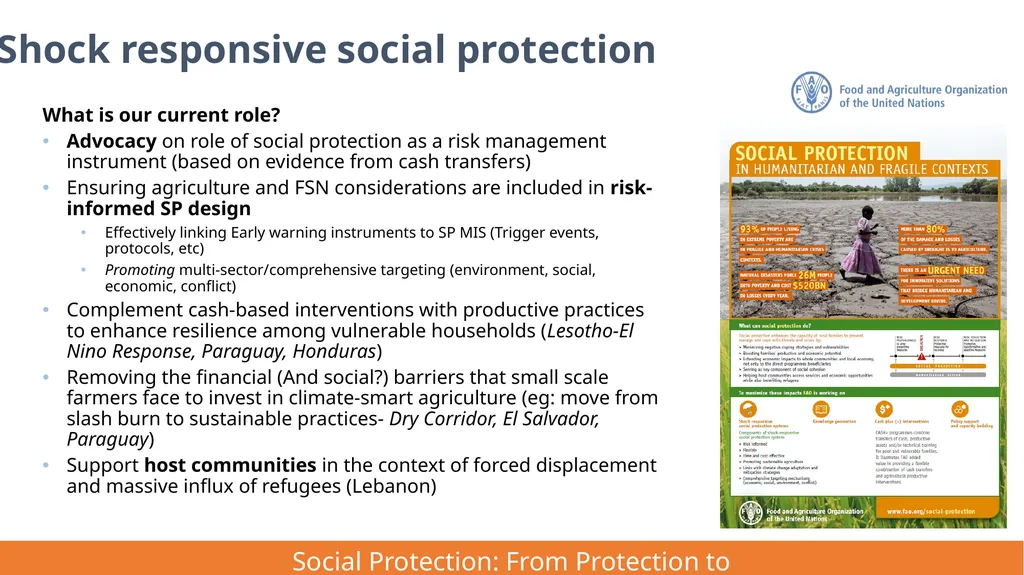
slide16. 3. Shock responsive social protection What is our current role?
Advocacy on role of social protection as a risk management instrument (based on evidence from cash transfers)
Ensuring agriculture and FSN considerations are included in risk-informed SP design
Effectively linking Early warning instruments to SP MIS (Trigger events, protocols, etc)
Promoting multi-sector/comprehensive targeting (environment, social, economic, conflict)
Complement cash-based interventions with productive practices to enhance resilience among vulnerable households (Lesotho-El Nino Response, Paraguay, Honduras)
Removing the financial (And social?) barriers that small scale farmers face to invest in climate-smart agriculture (eg: move from slash burn to sustainable practices- Dry Corridor, El Salvador, Paraguay)
Support host communities in the context of forced displacement and massive influx of refugees (Lebanon) Social Protection: From Protection to Production Social Protection: From Protection to Production<br>
slide17. Country level engagement strategy<br>
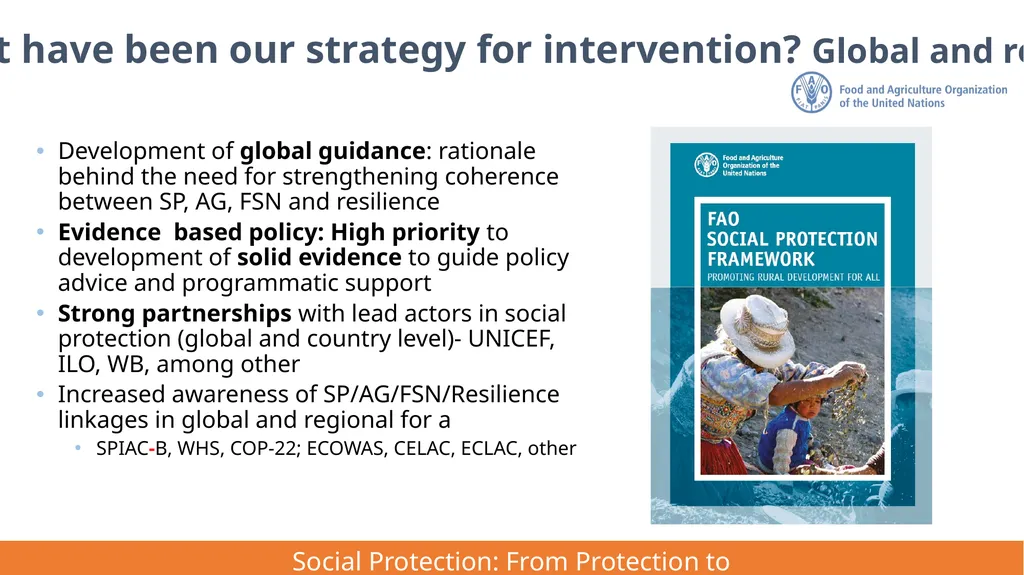
slide18. What have been our strategy for intervention? Global and regional Development of global guidance: rationale behind the need for strengthening coherence between SP, AG, FSN and resilience
Evidence based policy: High priority to development of solid evidence to guide policy advice and programmatic support
Strong partnerships with lead actors in social protection (global and country level)- UNICEF, ILO, WB, among other
Increased awareness of SP/AG/FSN/Resilience linkages in global and regional for a
SPIAC-B, WHS, COP-22; ECOWAS, CELAC, ECLAC, other Social Protection: From Protection to Production Social Protection: From Protection to Production<br>
slide19. Summary<br>
slide20. Summary: FAO value added Adding FAO’s voice to government and development partners’ efforts towards universal coverage, scale-up and expansion of systems- strong role of partnerships
Facilitating dialogue between social and agriculture, nutrition, natural resource management and resilience-related sectors
Focusing on “leaving no one behind”- family farming, forest/fish dependent communities- Ag sector
Strengthening the economic case for social protection (PtoP; SOFA):at household and at local economy levels
Development of policy tools to strengthen the food security and NUTRITION focus of SP Systems
Contributing to maximize rural development outcomes by operationalizing linkages between social protection and natural resource management interventions (social protection+)- development, fragile and humanitarian contexts
Identifying specific social and economic vulnerabilities of rural poor and make sure these are included in the design of social protection
Comprehensive packages to contribute to further FSN outcomes through social protection Social Protection: From Protection to Production Social Protection: From Protection to Production<br>
slide21. Many thanks
http://www.fao.org/social-protection/en/<br>
Natalia Winder Rossi, Deputy Director
Team Leader/Delivery Manager, Social Protection
New York, May 2017<br>
slide2. Overview Overall approach: rationale and niche
Overall strategy and approach (thematic and entry points) Social Protection: From Protection to Production<br>
slide3. Rationale and Niche: Promoting Inclusive Rural Development<br>
slide4. Social protection as a corporate priority SP as a corporate priority to promote inclusive rural development
Outcome in the Strategic Framework – contributing the Strategic Programme on Reducing Rural Poverty (SP3)
Also recognized as a key component for SP on Resilience (SP5) and on Eradication of Hunger, Food Insecurity and Malnutrition (SP1)
FAO Social Protection Framework (*2017)
Rationale for FAO’s engagement:
Solid evidence on the role social protection plays in strategic areas of FAO’s work:
Right to Food and Right to Social protection
10 divisions contributing to Social Protection across SPs; Working across all regions Social Protection: From Protection to Production<br>
slide5. Social Protection: FAO’s Operational Definition and Focus FAO’s Social Protection Vision: People and communities living in rural areas, as well as those whose livelihoods depend on natural resources, are supported by social protection systems that:
(1) ensure their food security and improved nutrition;
(2) protect them before, during and after shocks and stresses;
(3) promote resilient livelihoods and sustainable management of eco-systems;
(4) and stimulate pro-poor growth and inclusive rural development. Social Protection: From Protection to Production<br>
slide6. Social Protection: FAO’s Operational Definition and Focus (cont.) FAO’s Social Protection Framework – Core Messages:
FAO is committed to promoting a systems approach to social protection to avoid fragmentation of interventions
Together with partners, build and strengthen nationally owned social protection systems that are well integrated in broader livelihood promotion and rural development strategies
FAO acknowledge social protection role in supporting family and small scale farmers to move from Protection to Production
Social protection as poverty reduction and risk management strategy but also as critical to further food security and nutrition outcomes Social Protection: From Protection to Production<br>
slide7. Rationale for engagement: poverty reduction and FSN Poverty and hunger are concentrated in rural areas: 767 million people are extreme poor and 795 million are undernourished (SOFI 2015); most of them living in fragile contexts and relying on agriculture for their livelihoods
Rural poor affected by market failures which halt their ability to move out of poverty (even in contexts of economic growth): limited access to employment, financial services, innovative technologies and practices.
Consumption and production decisions are interdependent: low risk/low return livelihood strategies
Chronic rural poverty contributes to, (and is affected by) a stagnant rural economy: more dynamic rural sectors call for tackling poverty, hence the importance of social protection and linking it to other interventions to build pathways out of poverty.
A thriving agriculture sector requires innovative technological practices, vibrant markets and investment. BUT it also requires enhancing the capacity of family farmers to access these
Social protection can address some market failures and enable the households to invest in innovative sustainable income generating opportunities
Challenge: 73% of the world’s population has no access to adequate social protection- majority are the poorest in rural areas Social Protection: From Protection to Production Social Protection: From Protection to Production<br>
slide8. Rationale for engagement: Enhancing productivity Moving from subsistence to agricultural productivity
More than 570 million farms in the world, constituting more than 90 percent of farms, are run by an individual or a family and rely primarily on family labour
Family Farms occupy between 50-75 of farm land (FAO, and produce more than 80 percent of the world’s food in value terms
Limited access to stable resources, basic services, including financial services further exacerbate barriers to move from subsistence farming to productive, efficient agriculture
Social protection can help accelerate this transformation.
Access to basic risk management, protection for all in the rural sector:
Agriculture sector is unstable, volatile and vulnerable to multiple socks
Even for those that are better off, most farmers (fishermen/women and forest dependent communities) lack access to basic social security entitlements: decent work legislation, health insurance, pension, crop protection
FAO is involved in SP to enhance the economic potential of the poor and to ensure adequate risk management and protection for the ag sector as a whole Social Protection: From Protection to Production Social Protection: From Protection to Production<br>
slide9. FAO’s approach and value added<br>
slide10. What does FAO want to accomplish by end of …2019? Concrete contribution to countries' ability to reach SDG target 1.3: expansion of coverage of social protection (and its link with SDG2)
What is FAO’s contribution? Specific niche?
Economic case for scale-up
Ensuring the (adequate) coverage of social assistance and social security to agriculture sectors, including forestry, fisheries and other
From Protection to Production: Complementing social protection interventions with productive and nutrition interventions to support a sustainable move out of poverty (linking SD1 and SD2)
Resilient livelihoods: Enhance the capacity of social protection systems to effectively and timely prevent and respond to crises to protect lives and livelihoods Social Protection: From Protection to Production<br>
slide11. Work Plan 2016-2017
Priority Thematic areas Social Protection: From Protection to Production<br>
slide12. FAO’s value added and approach Economic case for scale-up of national social protection programmes:
linked to SDG 1.3- specific focus on rural/agriculture sector (social assistance and security; including decent work)
Ensuring coverage of the agriculture sector (including small scale fisheries and forest dependent communities)
Specific contribution to Global Initiative on Universal Coverage
Evidence generation: economic and productive impacts on social protection (households and local economies)*
From Protection to Production
Aim to maximize social and economic impacts, while contributing to FSN
Support a sustainable move out of poverty: integrated approach
Differentiated approaches based on livelihood profile, and pathways out of poverty
Gender-sensitive social protection approaches
Integrated approach: Social protection PLUS; SP as part of broader rural development strategies
Social protection as a core pillar of resilience building (*fragile / humanitarian contexts)
Shock-responsive social protection for resilient livelihoods Social Protection: From Protection to Production Social Protection: From Protection to Production<br>
slide13. 1. Building the Economic case for scale-up Strong, rigorous evidence base on the productive and economic impacts of cash transfers
Evidence embedded in country policy processes (Sub-Saharan Africa)
Addressing policy concerns (and myths) regarding SP
Partnership with UNICEF, government and local research organizations
Visible impacts on social dimensions (food security, access to education and health) but also economic and productive impacts
Enhancing productive capacity (entrepreneurial activities)
Social protection tends to increase labour demand in on-farm agricultural activities.
Simulate investments in non-farm household enterprises
Impacts in local economy
Social Cash transfers are not a “handout”—they do not create dependency
Influence labour choices, but do not reduce work effort
Beneficiaries work differently, not less. They create more income then they receive
No evidence of increased fertility or alcohol consumption Social Protection: From Protection to Production Social Protection: From Protection to Production<br>
slide14. Building the Economic case for scale-up Current role: Broadening the analytical agenda:
Social protection PLUS: CASH+; homegrown school feeding (Zambia, Lesotho, Kyrgyzstan)- SP and FSN
Comparing efficiency and impact of different interventions (eg: cash vs. input subsidies)
Evaluation of cash based interventions in fragile and emergency contexts (Sahel)
Analytical review of barriers to access social protection in rural areas
Costed models to expand social insurance to rural farmers (Mali, Lebanon)
Linking farmers registries with SP MIS
Livelihood profile analysis to identify differentiated packages of SP and SP+ interventions
Assessing the specific vulnerabilities of fisher folk and forest depending communities
Budget analysis: efficiency of allocation
Wider partnerships (ILO, IRAM, WFP, other) Social Protection: From Protection to Production<br>
slide15. 2. From Protection to Production: SP /AG/ FSN coherence Systems approach: SOFA 2015 main message: Social protection generates important social and economic impacts; but by itself it will not be able to sustainably move people out of poverty---- there is a need for an integrated approach
What is our current role?
Promoting coherence between social protection, FSN, agriculture, NRM and resilience policies (Rwanda, Zambia, Senegal)
Operationalization of this coherence- programmatic approach: bringing FAO’s specific technical expertise on AG to design pro-poor complementary interventions
Integrating SP into wider rural development, poverty reduction, food security and nutrition, NRM, resilience and climate change polices/plans (El Salvador, Colombia)
Policy and legal support to countries to include the agriculture sector as part of labor/social security legislation and benefits
Recognizing the need for differentiated approaches- as population moves out of poverty
Adjust existing benefits to better serve the needs (and vulnerabilities) of rural sector (rural SPF) Social Protection: From Protection to Production Social Protection: From Protection to Production<br>
slide16. 3. Shock responsive social protection What is our current role?
Advocacy on role of social protection as a risk management instrument (based on evidence from cash transfers)
Ensuring agriculture and FSN considerations are included in risk-informed SP design
Effectively linking Early warning instruments to SP MIS (Trigger events, protocols, etc)
Promoting multi-sector/comprehensive targeting (environment, social, economic, conflict)
Complement cash-based interventions with productive practices to enhance resilience among vulnerable households (Lesotho-El Nino Response, Paraguay, Honduras)
Removing the financial (And social?) barriers that small scale farmers face to invest in climate-smart agriculture (eg: move from slash burn to sustainable practices- Dry Corridor, El Salvador, Paraguay)
Support host communities in the context of forced displacement and massive influx of refugees (Lebanon) Social Protection: From Protection to Production Social Protection: From Protection to Production<br>
slide17. Country level engagement strategy<br>
slide18. What have been our strategy for intervention? Global and regional Development of global guidance: rationale behind the need for strengthening coherence between SP, AG, FSN and resilience
Evidence based policy: High priority to development of solid evidence to guide policy advice and programmatic support
Strong partnerships with lead actors in social protection (global and country level)- UNICEF, ILO, WB, among other
Increased awareness of SP/AG/FSN/Resilience linkages in global and regional for a
SPIAC-B, WHS, COP-22; ECOWAS, CELAC, ECLAC, other Social Protection: From Protection to Production Social Protection: From Protection to Production<br>
slide19. Summary<br>
slide20. Summary: FAO value added Adding FAO’s voice to government and development partners’ efforts towards universal coverage, scale-up and expansion of systems- strong role of partnerships
Facilitating dialogue between social and agriculture, nutrition, natural resource management and resilience-related sectors
Focusing on “leaving no one behind”- family farming, forest/fish dependent communities- Ag sector
Strengthening the economic case for social protection (PtoP; SOFA):at household and at local economy levels
Development of policy tools to strengthen the food security and NUTRITION focus of SP Systems
Contributing to maximize rural development outcomes by operationalizing linkages between social protection and natural resource management interventions (social protection+)- development, fragile and humanitarian contexts
Identifying specific social and economic vulnerabilities of rural poor and make sure these are included in the design of social protection
Comprehensive packages to contribute to further FSN outcomes through social protection Social Protection: From Protection to Production Social Protection: From Protection to Production<br>
slide21. Many thanks
http://www.fao.org/social-protection/en/<br>