
Federal Public Service Workplace Psychological
SN
Published · 30 slides · 0 views

1 / 1
Description
Federal Public Service Workplace Psychological Health and Safety Union of Safety and Justice Employees May 30th 2018 Denis St-Jean Public Service Alliance of Canada Joint Task Force on Mental Health Membership Mandate Over the years, we
Related Topics
Share
Embed code
Download this presentation From Below
"Federal Public Service Workplace Psychological" is the property of its rightful owner. Permission is granted to download and print the materials on this website for personal, non-commercial use only, and to display it on your personal computer provided you do not modify the materials and that you retain all copyright notices contained in the materials. By downloading content from our website, you accept the terms of this agreement.
Presentation Transcript
01
Federal Public Service
Workplace Psychological Health and Safety Union of Safety and Justice Employees
May 30th 2018
Denis St-Jean
Public Service Alliance of Canada
Joint Task Force on Mental Health<br>
May 30th 2018
Denis St-Jean
Public Service Alliance of Canada
Joint Task Force on Mental Health<br>
02
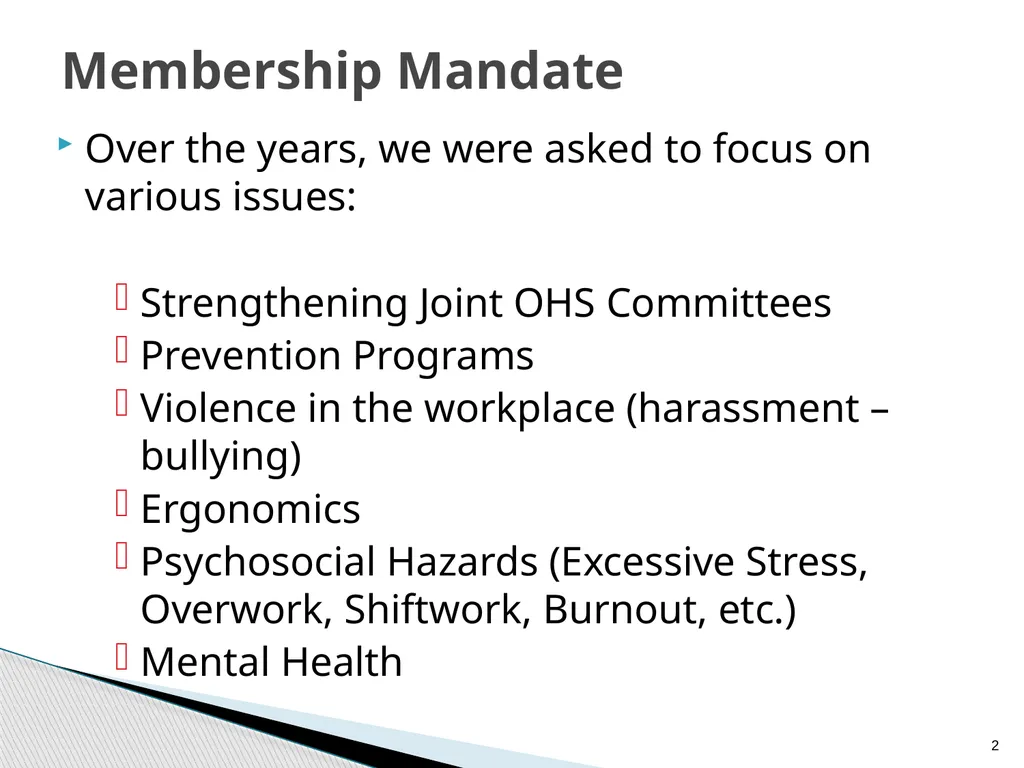
Membership Mandate Over the years, we were asked to focus on various issues:
Strengthening Joint OHS Committees
Prevention Programs
Violence in the workplace (harassment – bullying)
Ergonomics
Psychosocial Hazards (Excessive Stress, Overwork, Shiftwork, Burnout, etc.)
Mental Health 2<br>
Strengthening Joint OHS Committees
Prevention Programs
Violence in the workplace (harassment – bullying)
Ergonomics
Psychosocial Hazards (Excessive Stress, Overwork, Shiftwork, Burnout, etc.)
Mental Health 2<br>
03
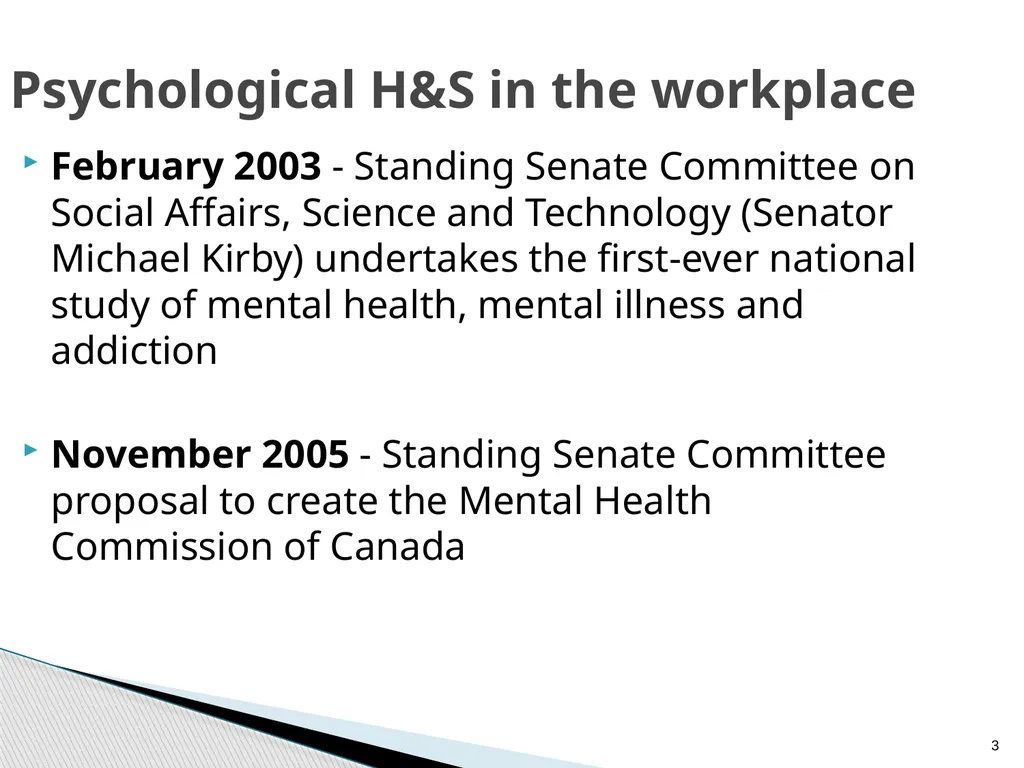
3 Psychological H&S in the workplace February 2003 - Standing Senate Committee on Social Affairs, Science and Technology (Senator Michael Kirby) undertakes the first-ever national study of mental health, mental illness and addiction
November 2005 - Standing Senate Committee proposal to create the Mental Health Commission of Canada<br>
November 2005 - Standing Senate Committee proposal to create the Mental Health Commission of Canada<br>
04
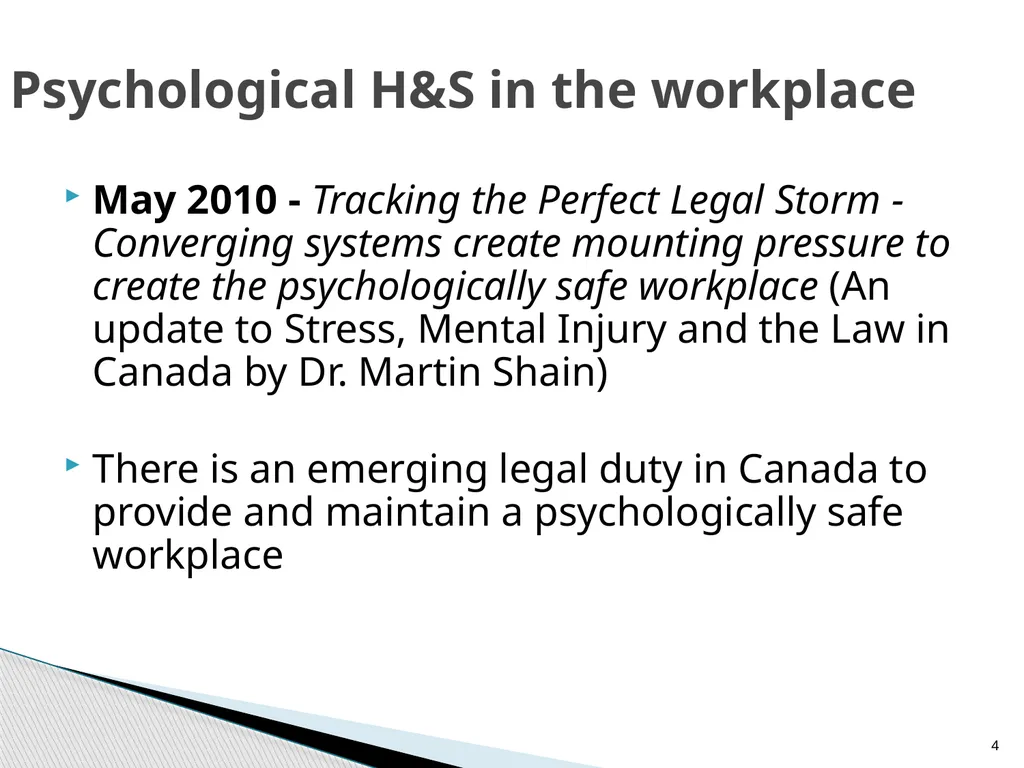
4 Psychological H&S in the workplace May 2010 - Tracking the Perfect Legal Storm - Converging systems create mounting pressure to create the psychologically safe workplace (An update to Stress, Mental Injury and the Law in Canada by Dr. Martin Shain)
There is an emerging legal duty in Canada to provide and maintain a psychologically safe workplace<br>
There is an emerging legal duty in Canada to provide and maintain a psychologically safe workplace<br>
05
5 Psychological H&S in the workplace September 30, 2010: A group of executives, labour leaders, OHS professionals, government agencies and experts in law and policy came together to look at the implications of Dr. Shain’s paper entitled "Tracking the Perfect Legal Storm“
The group was tasked with considering what employers need to know to provide a psychologically safe workplace in today’s economic environment<br>
The group was tasked with considering what employers need to know to provide a psychologically safe workplace in today’s economic environment<br>
06
6 Psychological H&S in the workplace January 2011 - MHCC was awarded funding for the development of the proposed National Standard from:
HRSDC
Health Canada
Public Health Agency of Canada
Bell Canada, and
Great-West Life Centre for Mental Health in the Workplace.<br>
HRSDC
Health Canada
Public Health Agency of Canada
Bell Canada, and
Great-West Life Centre for Mental Health in the Workplace.<br>
07
7 Psychological H&S in the workplace January 2011 - The Bureau de normalisation du Québec (BNQ) and CSA Standards initiated a project to establish a Technical Committee on Psychological Health and Safety in the Workplace
Standard was released January 16, 2013<br>
Standard was released January 16, 2013<br>
08
Creating and Sustaining a Psychologically Safe Workplace = Goal #1 of the Standard
A psychologically safe workplace is:
One that allows no significant harm or injury
to employee mental health in negligent, reckless
or intentional ways
One in which every reasonable effort is made
to protect the mental health of employees [due diligence] 8<br>
A psychologically safe workplace is:
One that allows no significant harm or injury
to employee mental health in negligent, reckless
or intentional ways
One in which every reasonable effort is made
to protect the mental health of employees [due diligence] 8<br>
09
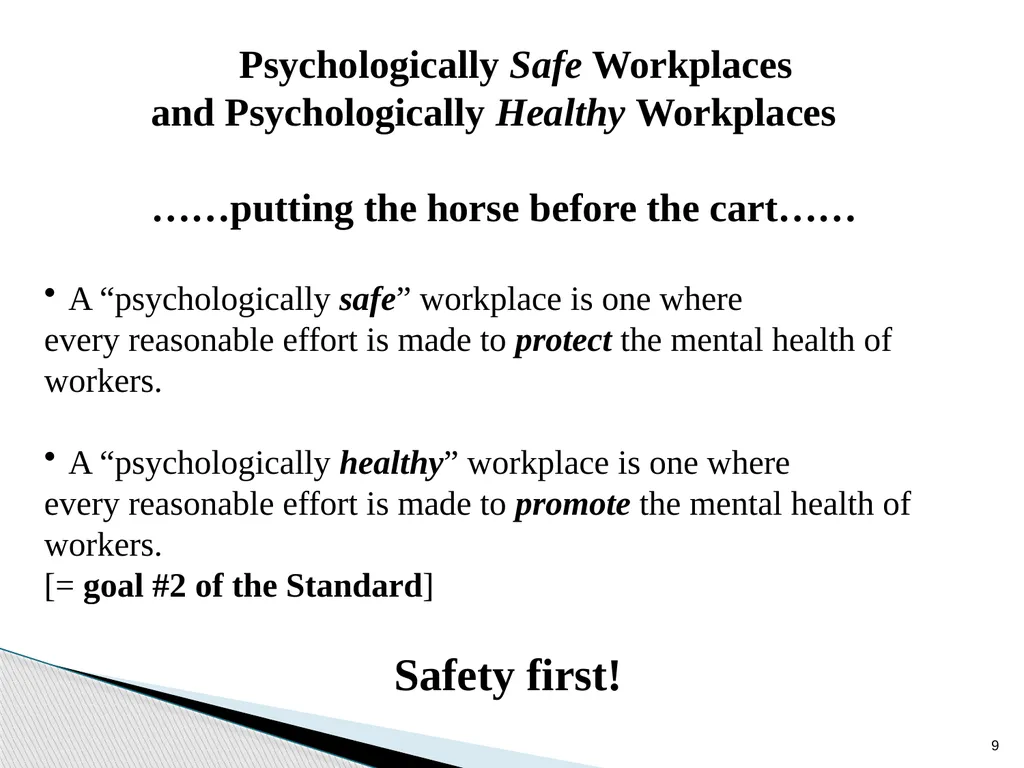
A “psychologically safe” workplace is one where
every reasonable effort is made to protect the mental health of workers.
A “psychologically healthy” workplace is one where
every reasonable effort is made to promote the mental health of workers.
[= goal #2 of the Standard]
Safety first! Psychologically Safe Workplaces
and Psychologically Healthy Workplaces
……putting the horse before the cart…… 9<br>
every reasonable effort is made to protect the mental health of workers.
A “psychologically healthy” workplace is one where
every reasonable effort is made to promote the mental health of workers.
[= goal #2 of the Standard]
Safety first! Psychologically Safe Workplaces
and Psychologically Healthy Workplaces
……putting the horse before the cart…… 9<br>
10
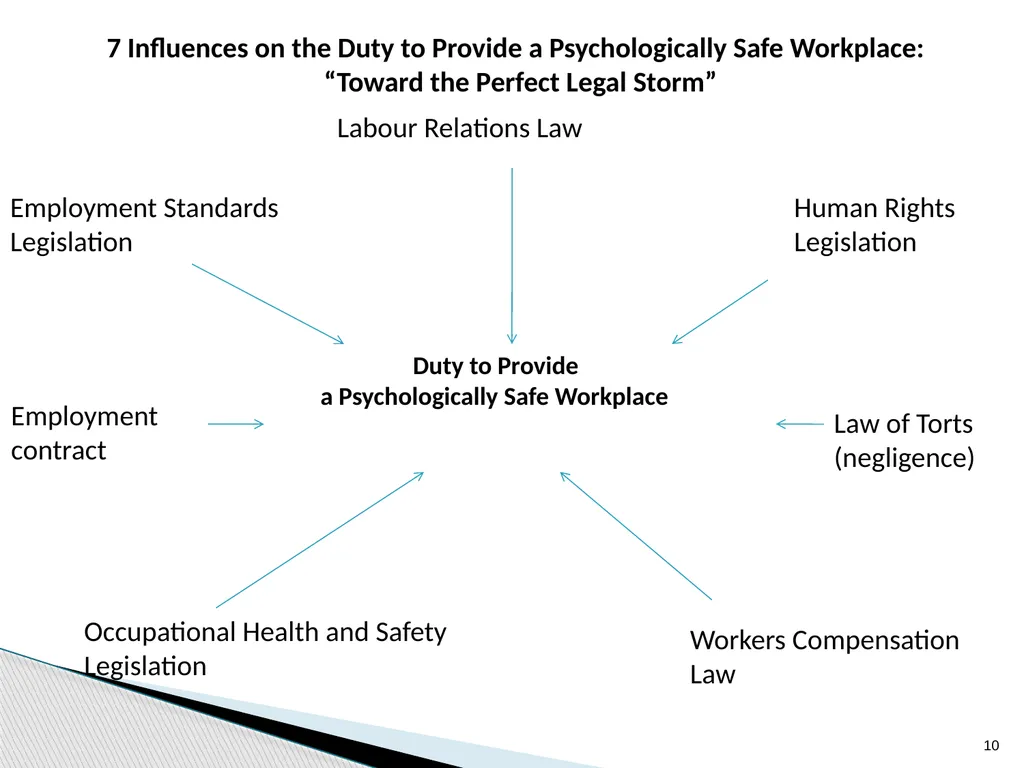
Duty to Provide
a Psychologically Safe Workplace Labour Relations Law Employment Standards
Legislation Employment
contract Law of Torts
(negligence) Human Rights
Legislation Occupational Health and Safety
Legislation Workers Compensation Law 7 Influences on the Duty to Provide a Psychologically Safe Workplace:
“Toward the Perfect Legal Storm” 10<br>
a Psychologically Safe Workplace Labour Relations Law Employment Standards
Legislation Employment
contract Law of Torts
(negligence) Human Rights
Legislation Occupational Health and Safety
Legislation Workers Compensation Law 7 Influences on the Duty to Provide a Psychologically Safe Workplace:
“Toward the Perfect Legal Storm” 10<br>
11
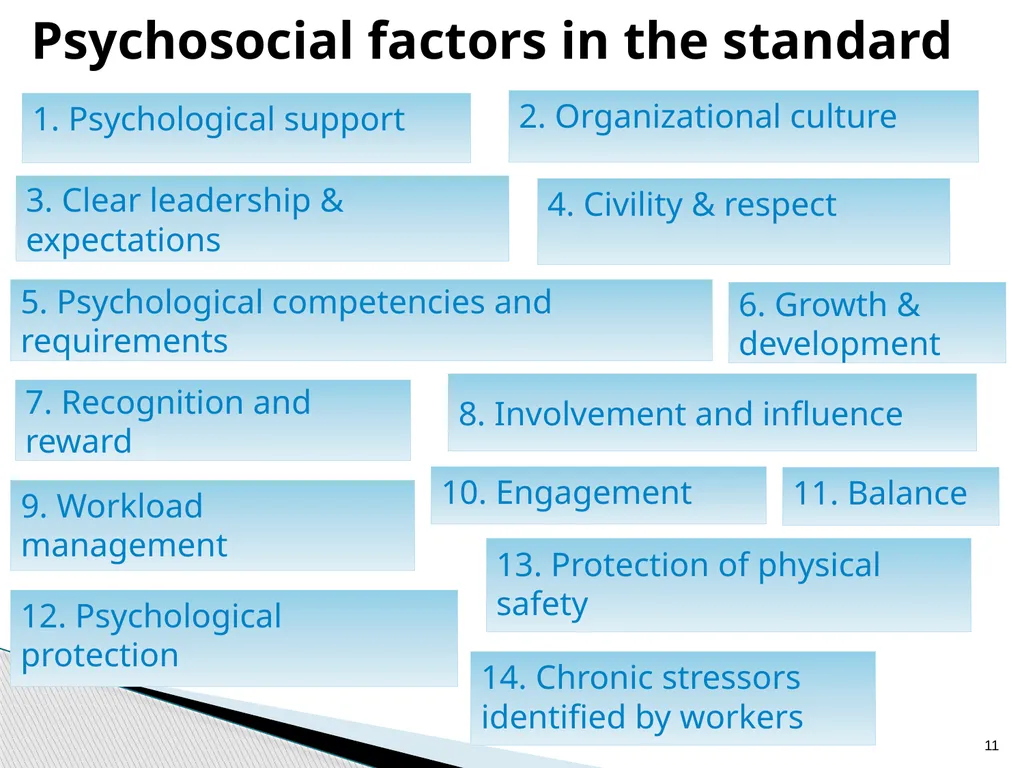
1. Psychological support Psychosocial factors in the standard 3. Clear leadership & expectations 5. Psychological competencies and requirements 2. Organizational culture 4. Civility & respect 6. Growth & development 7. Recognition and reward 8. Involvement and influence 9. Workload management 10. Engagement 11. Balance 12. Psychological protection 13. Protection of physical safety 11 14. Chronic stressors identified by workers<br>
12
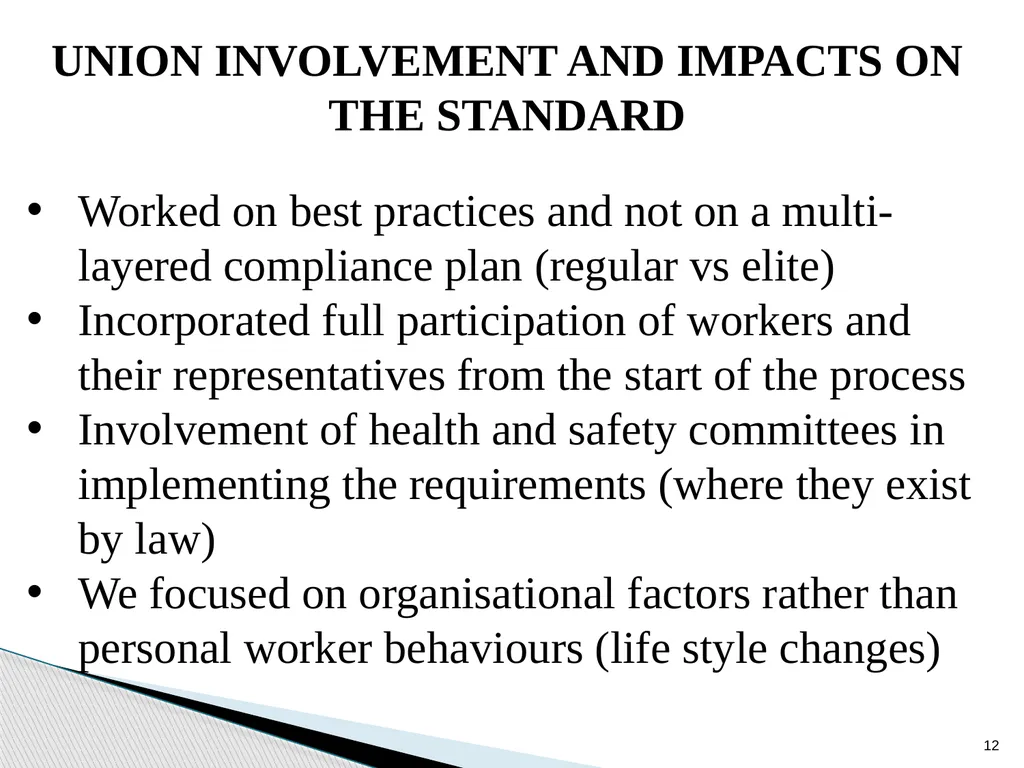
UNION INVOLVEMENT AND IMPACTS ON THE STANDARD
Worked on best practices and not on a multi-layered compliance plan (regular vs elite)
Incorporated full participation of workers and their representatives from the start of the process
Involvement of health and safety committees in implementing the requirements (where they exist by law)
We focused on organisational factors rather than personal worker behaviours (life style changes) 12<br>
Worked on best practices and not on a multi-layered compliance plan (regular vs elite)
Incorporated full participation of workers and their representatives from the start of the process
Involvement of health and safety committees in implementing the requirements (where they exist by law)
We focused on organisational factors rather than personal worker behaviours (life style changes) 12<br>
13
UNION INVOLVEMENT AND IMPACTS ON THE STANDARD
Protect the right of confidentiality of workers (data collection and data analysis)
Included the hierarchy of control measures in assessing risks
Included critical events preparedness (organisational and individual)
Included diversity statement (consider the unique needs of diverse populations and groups within the workplace) 13<br>
Protect the right of confidentiality of workers (data collection and data analysis)
Included the hierarchy of control measures in assessing risks
Included critical events preparedness (organisational and individual)
Included diversity statement (consider the unique needs of diverse populations and groups within the workplace) 13<br>
14
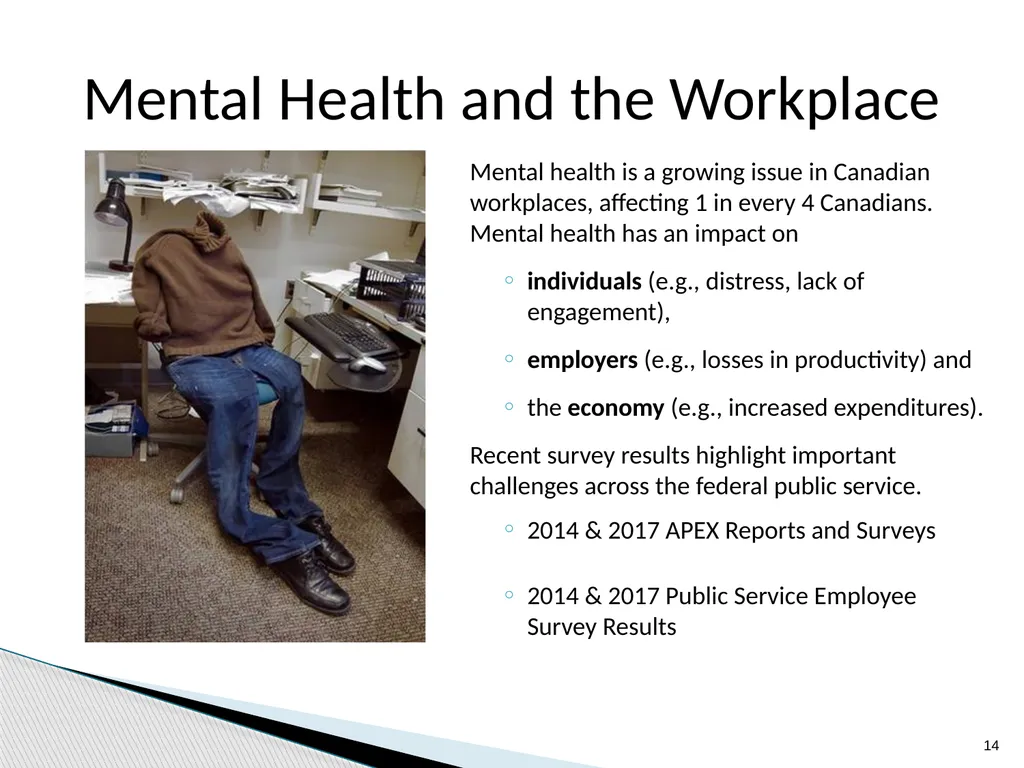
Mental Health and the Workplace Mental health is a growing issue in Canadian workplaces, affecting 1 in every 4 Canadians. Mental health has an impact on
individuals (e.g., distress, lack of engagement),
employers (e.g., losses in productivity) and
the economy (e.g., increased expenditures).
Recent survey results highlight important challenges across the federal public service.
2014 & 2017 APEX Reports and Surveys
2014 & 2017 Public Service Employee Survey Results 14<br>
individuals (e.g., distress, lack of engagement),
employers (e.g., losses in productivity) and
the economy (e.g., increased expenditures).
Recent survey results highlight important challenges across the federal public service.
2014 & 2017 APEX Reports and Surveys
2014 & 2017 Public Service Employee Survey Results 14<br>
15
In March 2015, the President of the Treasury Board and the Public Service Alliance of Canada (PSAC) reached an agreement to establish a Joint Task Force to address mental health issues in the Public Service.
The agreement focuses on measures to improve mental health in the workplace and alignment with the National Standard of Canada for Psychological Health and Safety in the Workplace.
The Joint Task Force comprises a Steering Committee and a Technical Committee.
The Steering Committee is co-chaired by the Chief Human Resources Officer and the President of PSAC, and provides guidance and leadership to the Technical Committee.
The Technical Committee is composed of representatives of the bargaining agent and Employer sides, and is co-chaired by representatives of TBS and PSAC. Joint Task Force on Mental Health 15<br>
The agreement focuses on measures to improve mental health in the workplace and alignment with the National Standard of Canada for Psychological Health and Safety in the Workplace.
The Joint Task Force comprises a Steering Committee and a Technical Committee.
The Steering Committee is co-chaired by the Chief Human Resources Officer and the President of PSAC, and provides guidance and leadership to the Technical Committee.
The Technical Committee is composed of representatives of the bargaining agent and Employer sides, and is co-chaired by representatives of TBS and PSAC. Joint Task Force on Mental Health 15<br>
16
Joint Task Force on Mental Health Steering Committee members
Bargaining Agent Members
Robyn Benson (Co-Chair) President, Public Service Alliance of Canada
Ron Cochrane Executive Director, Professional Association of Foreign Service Officers
Debi Daviau President, Professional Institute of the Public Service of Canada
Employer Members
Anne Marie Smart (Co-Chair as of September 2015) Chief Human Resources Officer, Treasury Board of Canada Secretariat Technical Committee members
Bargaining Agent Members
Bob Kingston (Co-Chair), Public Service Alliance of Canada
Lisa Addario, Public Service Alliance of Canada
Shannon Bittman/Shirley Friesen, Professional Institute of the Public Service of Canada
Sandra Guttmann, Association of Justice Counsel
Jerry Ryan, Federal Government Dockyard Trades and Labour Council (East)
Sari Sairanen, Unifor (Headquarters)
Denis St-Jean, Public Service Alliance of Canada
Employer Members
Caroline Curran (Co-Chair), Treasury Board of Canada Secretariat
Brenda Baxter, Labour Program , Employment and Social Development Canada
Barbara Carswell, Foreign Affairs, Trade and Development Canada
Hilary Flett, Health Canada
Lisa Janes, Canada Border Services Agency
Brian McKee, National Managers Community
Hélène Nadeau, Association of Professional Executives of the Public Service of Canada
Stephanie Priest, Public Health Agency of Canada 16<br>
Bargaining Agent Members
Robyn Benson (Co-Chair) President, Public Service Alliance of Canada
Ron Cochrane Executive Director, Professional Association of Foreign Service Officers
Debi Daviau President, Professional Institute of the Public Service of Canada
Employer Members
Anne Marie Smart (Co-Chair as of September 2015) Chief Human Resources Officer, Treasury Board of Canada Secretariat Technical Committee members
Bargaining Agent Members
Bob Kingston (Co-Chair), Public Service Alliance of Canada
Lisa Addario, Public Service Alliance of Canada
Shannon Bittman/Shirley Friesen, Professional Institute of the Public Service of Canada
Sandra Guttmann, Association of Justice Counsel
Jerry Ryan, Federal Government Dockyard Trades and Labour Council (East)
Sari Sairanen, Unifor (Headquarters)
Denis St-Jean, Public Service Alliance of Canada
Employer Members
Caroline Curran (Co-Chair), Treasury Board of Canada Secretariat
Brenda Baxter, Labour Program , Employment and Social Development Canada
Barbara Carswell, Foreign Affairs, Trade and Development Canada
Hilary Flett, Health Canada
Lisa Janes, Canada Border Services Agency
Brian McKee, National Managers Community
Hélène Nadeau, Association of Professional Executives of the Public Service of Canada
Stephanie Priest, Public Health Agency of Canada 16<br>
17
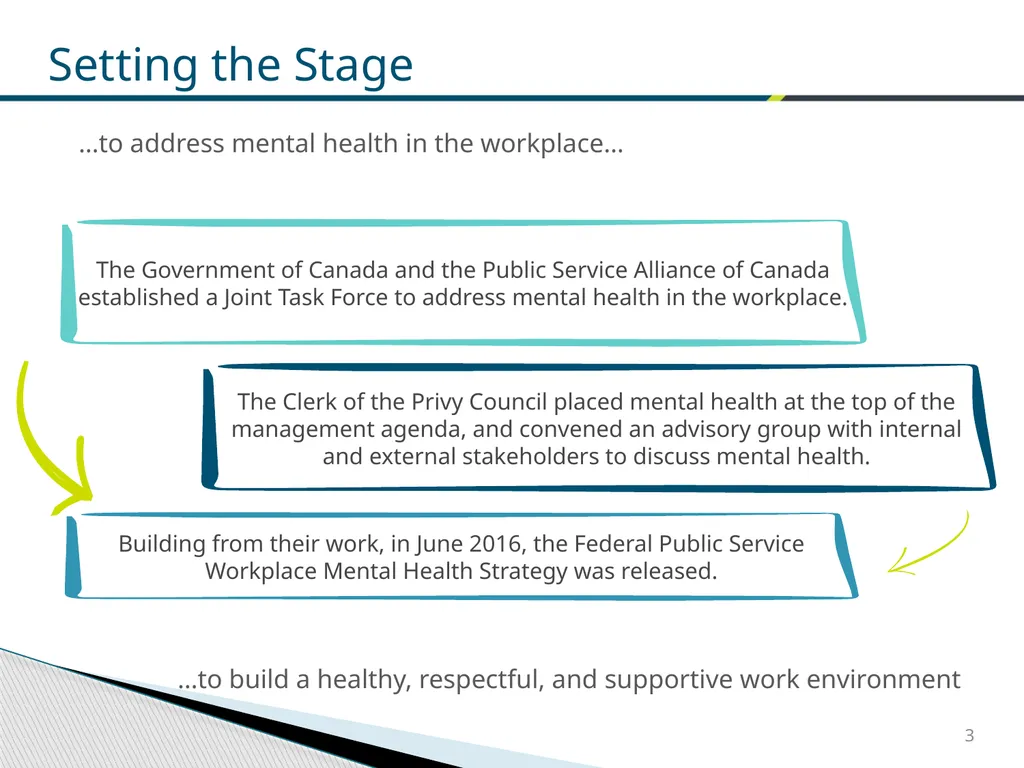
Setting the Stage The Government of Canada and the Public Service Alliance of Canada established a Joint Task Force to address mental health in the workplace. The Clerk of the Privy Council placed mental health at the top of the management agenda, and convened an advisory group with internal and external stakeholders to discuss mental health. Building from their work, in June 2016, the Federal Public Service Workplace Mental Health Strategy was released. …to build a healthy, respectful, and supportive work environment …to address mental health in the workplace… 3<br>
18
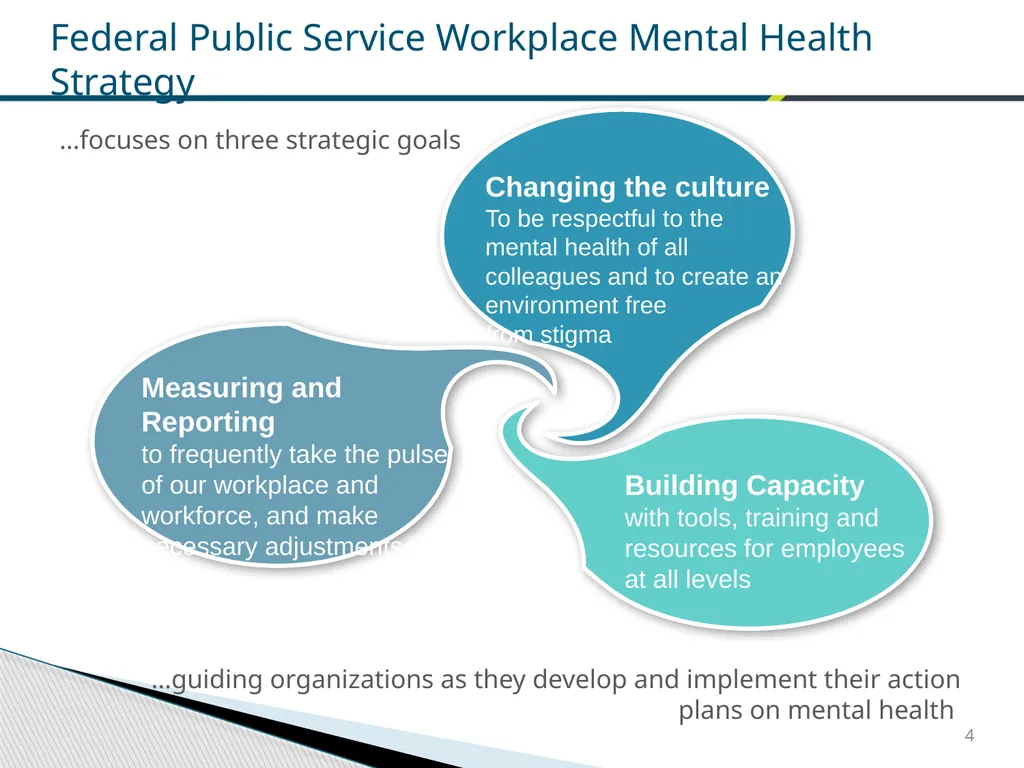
Federal Public Service Workplace Mental Health Strategy …focuses on three strategic goals 4 …guiding organizations as they develop and implement their action plans on mental health<br>
19
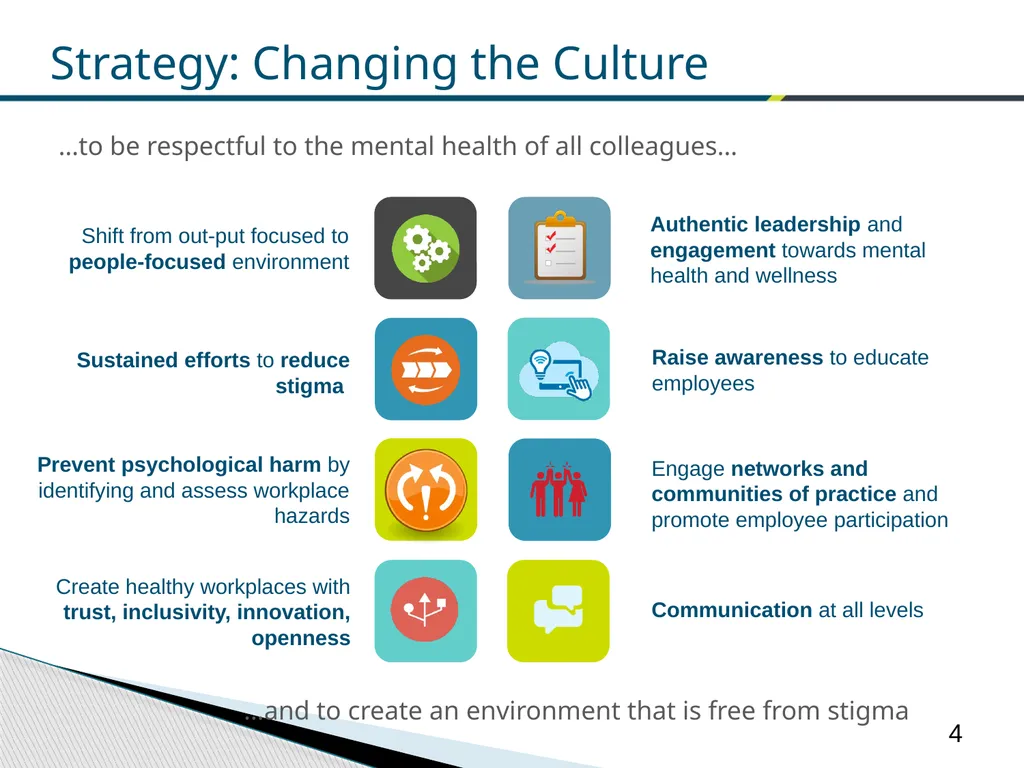
Strategy: Changing the Culture …to be respectful to the mental health of all colleagues… …and to create an environment that is free from stigma Shift from out-put focused to people-focused environment Sustained efforts to reduce stigma Prevent psychological harm by identifying and assess workplace hazards Create healthy workplaces with trust, inclusivity, innovation, openness Communication at all levels Engage networks and communities of practice and promote employee participation Raise awareness to educate employees Authentic leadership and engagement towards mental health and wellness 4<br>
20
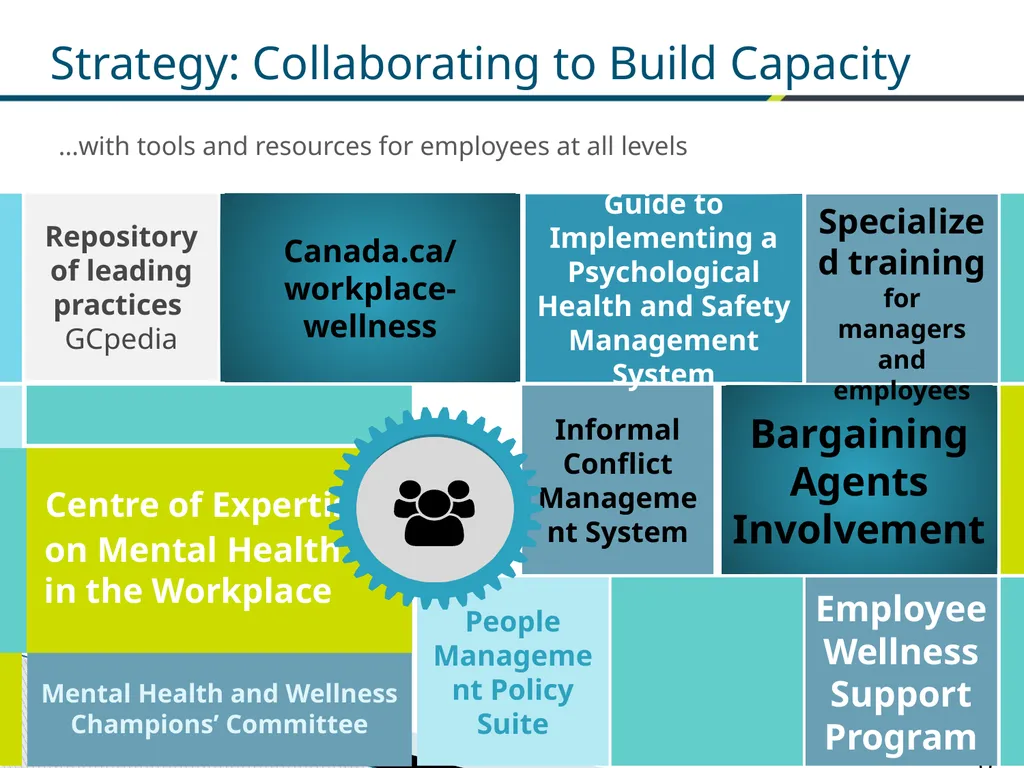
Mental Health and Wellness Champions’ Committee Centre of Expertise
on Mental Health
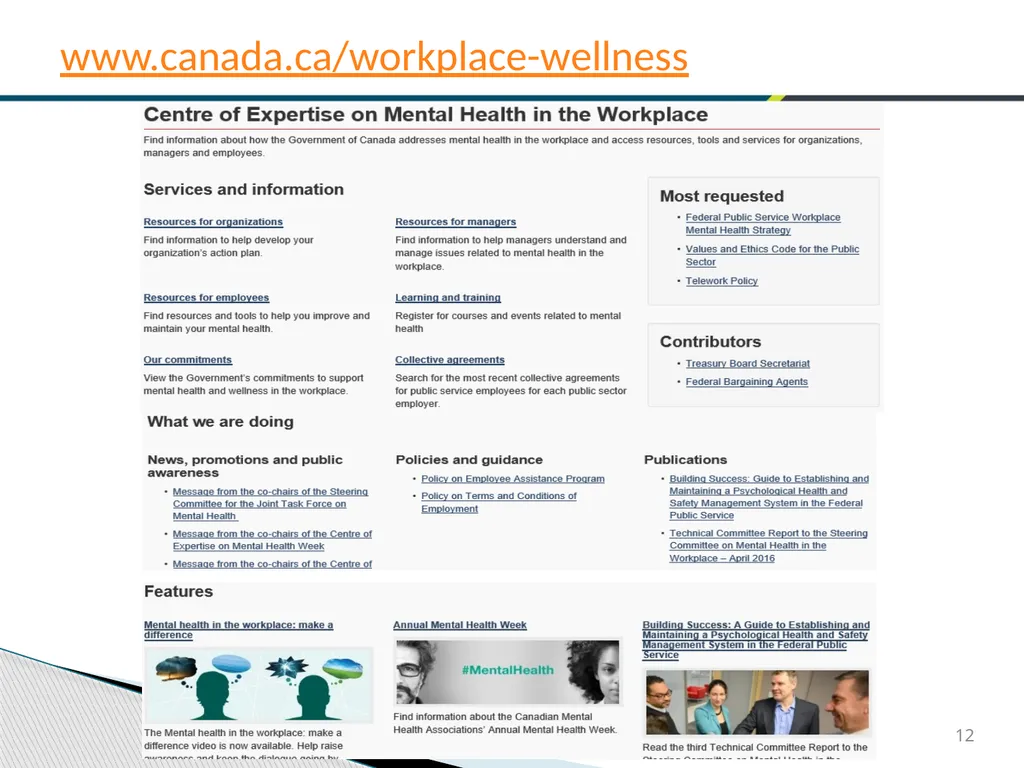
in the Workplace 20 Bargaining Agents Involvement Informal Conflict Management System People Management Policy Suite Employee Wellness Support Program Canada.ca/
workplace-wellness Repository of leading practices
GCpedia Guide to Implementing a Psychological Health and Safety Management System Specialized training
for managers and employees Strategy: Collaborating to Build Capacity …with tools and resources for employees at all levels<br>
on Mental Health
in the Workplace 20 Bargaining Agents Involvement Informal Conflict Management System People Management Policy Suite Employee Wellness Support Program Canada.ca/
workplace-wellness Repository of leading practices
GCpedia Guide to Implementing a Psychological Health and Safety Management System Specialized training
for managers and employees Strategy: Collaborating to Build Capacity …with tools and resources for employees at all levels<br>
21
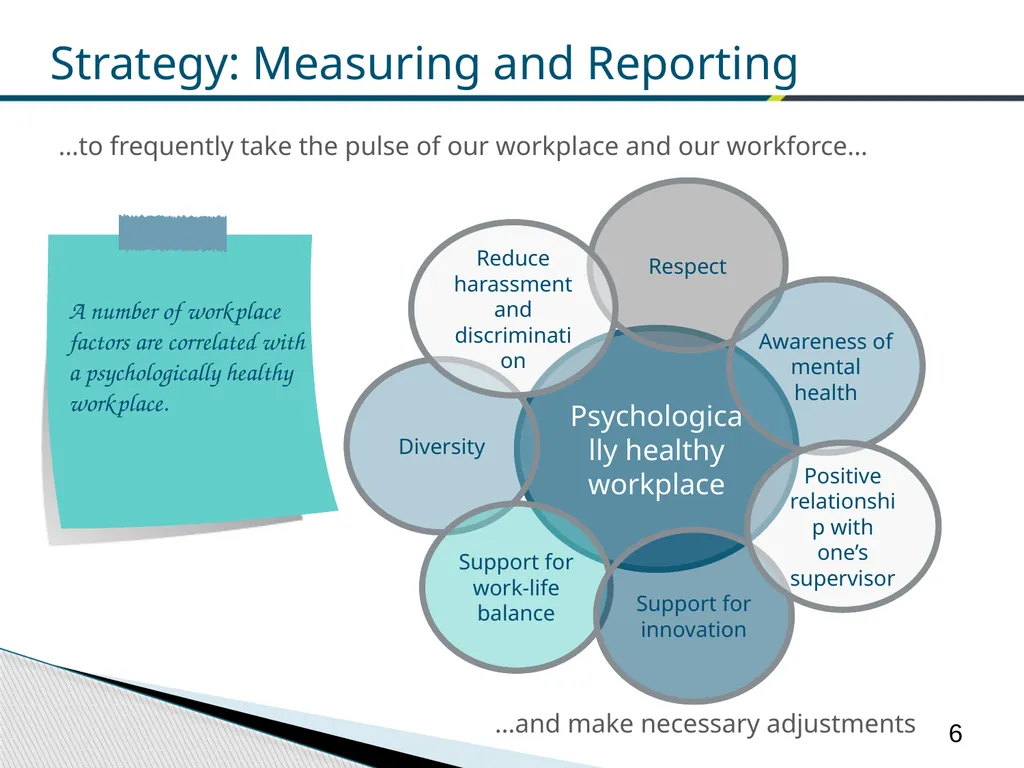
Strategy: Measuring and Reporting …to frequently take the pulse of our workplace and our workforce… …and make necessary adjustments 6<br>
22
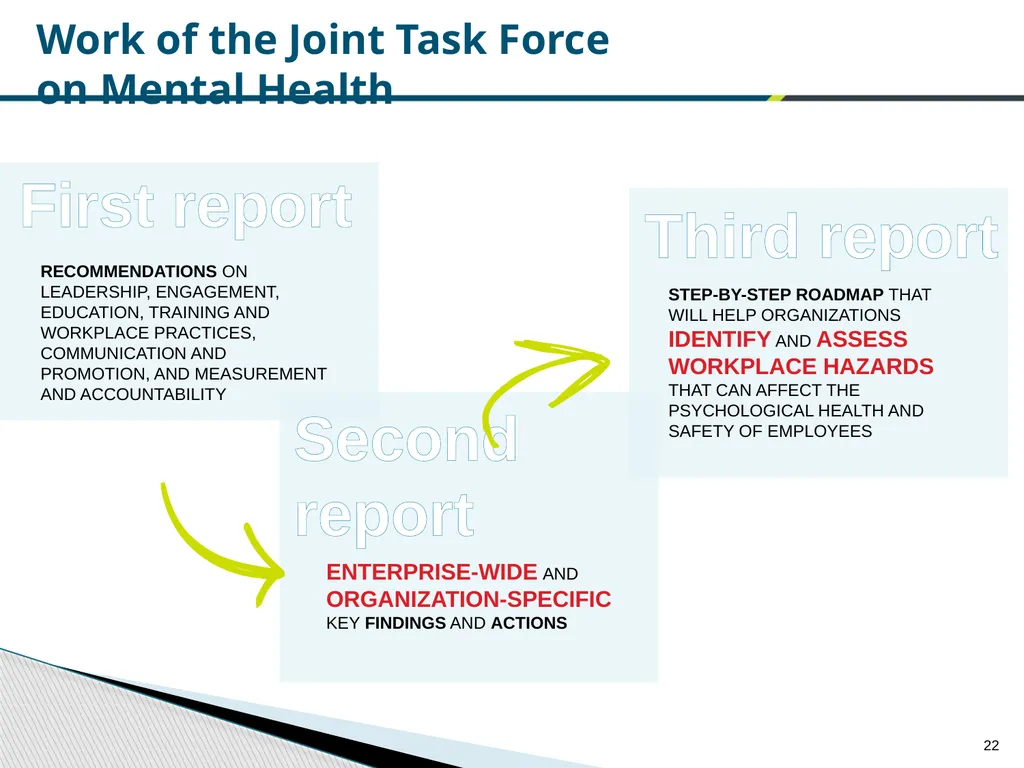
22 Work of the Joint Task Force on Mental Health Recommendations on leadership, engagement, education, training and workplace practices, communication and promotion, and measurement and accountability First report enterprise-wide and organization-specific key findings and actions Second report Step-by-step roadmap that will help organizations identify and assess workplace hazards that can affect the psychological health and safety of employees Third report<br>
23
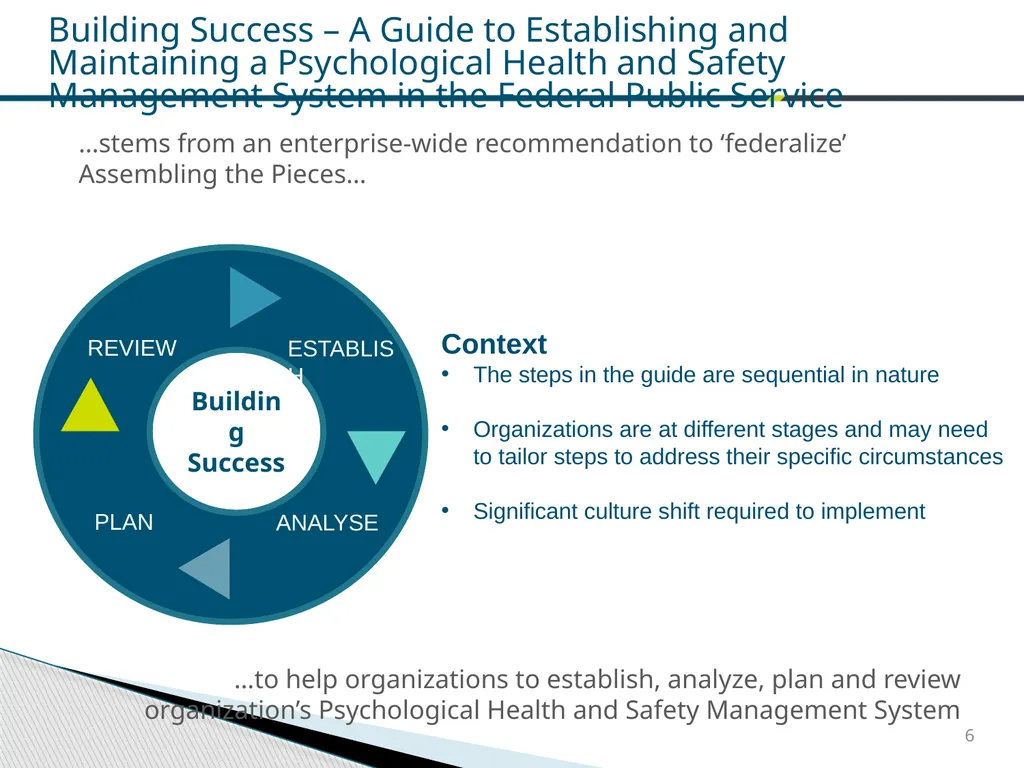
Building Success – A Guide to Establishing and Maintaining a Psychological Health and Safety Management System in the Federal Public Service …stems from an enterprise-wide recommendation to ‘federalize’ Assembling the Pieces… …to help organizations to establish, analyze, plan and review organization’s Psychological Health and Safety Management System Context
The steps in the guide are sequential in nature
Organizations are at different stages and may need to tailor steps to address their specific circumstances
Significant culture shift required to implement 6<br>
The steps in the guide are sequential in nature
Organizations are at different stages and may need to tailor steps to address their specific circumstances
Significant culture shift required to implement 6<br>
24
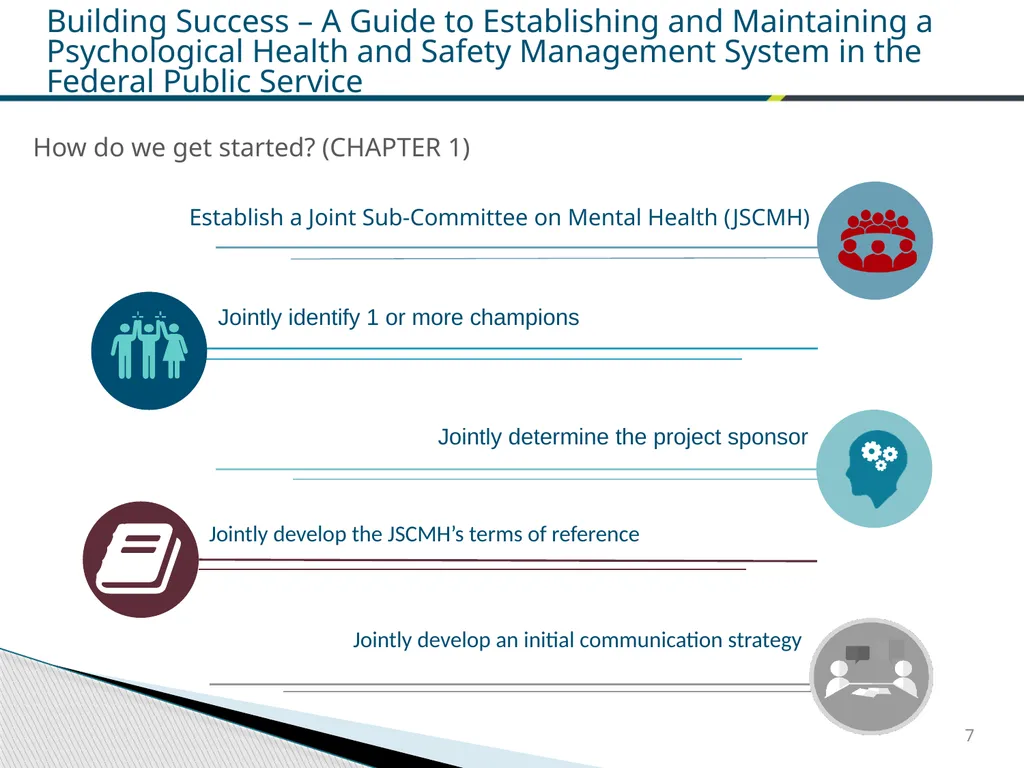
How do we get started? (CHAPTER 1) 7 Building Success – A Guide to Establishing and Maintaining a Psychological Health and Safety Management System in the Federal Public Service<br>
25
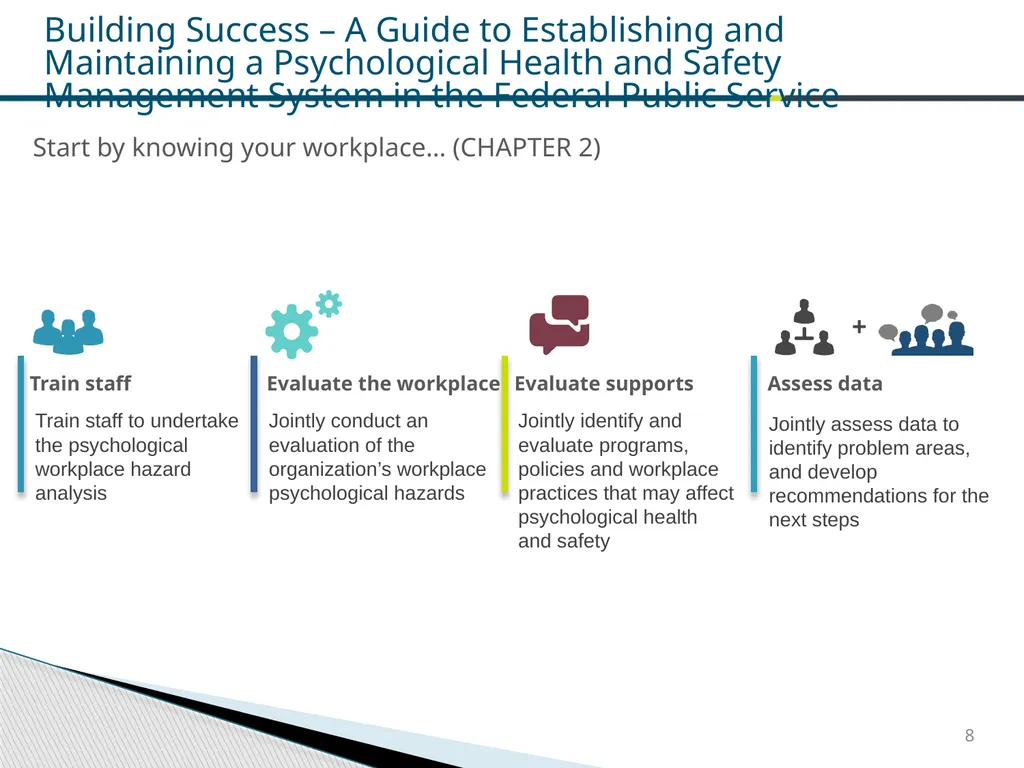
Building Success – A Guide to Establishing and Maintaining a Psychological Health and Safety Management System in the Federal Public Service Start by knowing your workplace… (CHAPTER 2) Assess data Evaluate the workplace Jointly conduct an evaluation of the organization’s workplace psychological hazards Jointly assess data to identify problem areas, and develop recommendations for the next steps + 8<br>
26
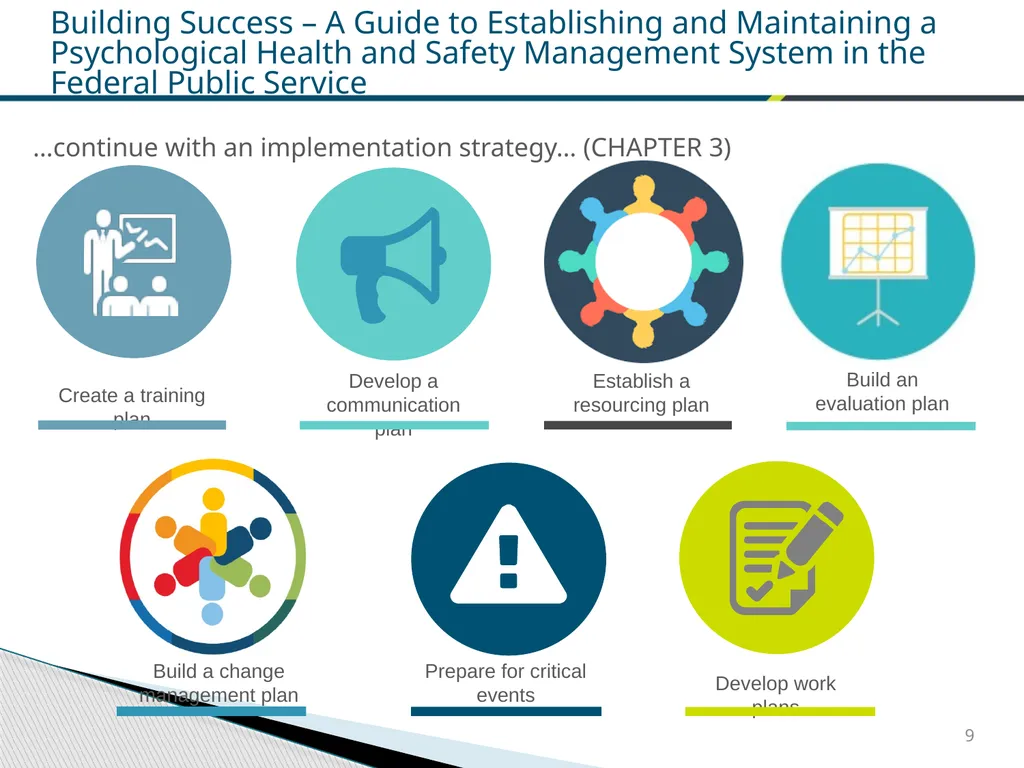
…continue with an implementation strategy… (CHAPTER 3) Develop work plans Building Success – A Guide to Establishing and Maintaining a Psychological Health and Safety Management System in the Federal Public Service 9<br>
27
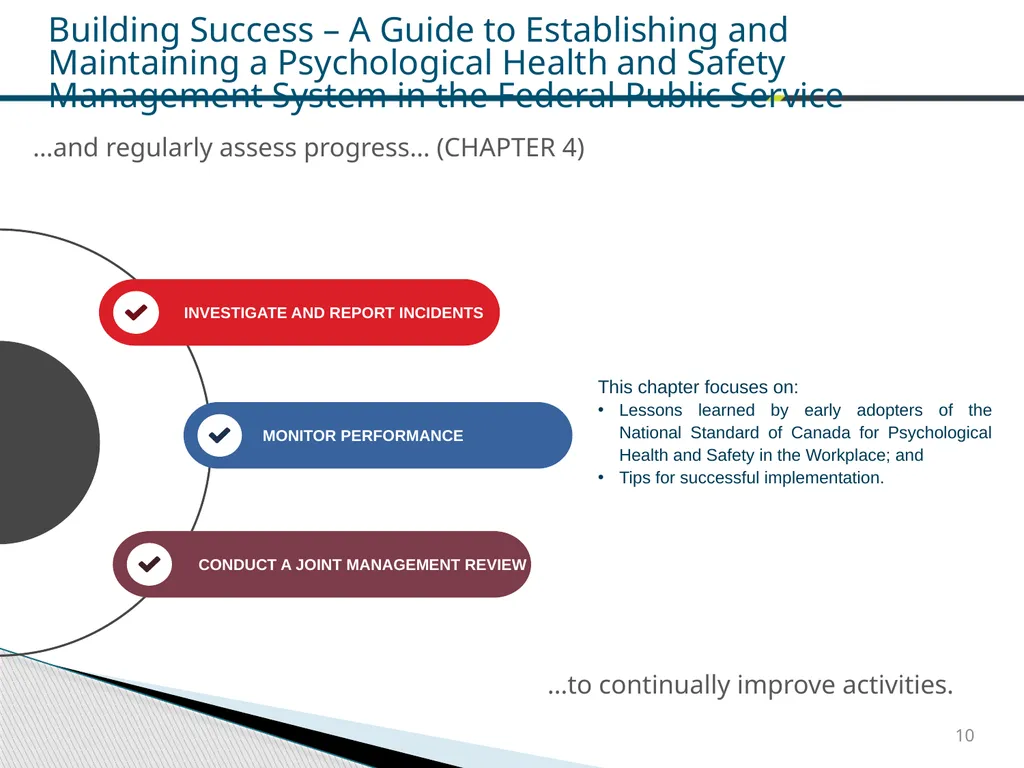
Building Success – A Guide to Establishing and Maintaining a Psychological Health and Safety Management System in the Federal Public Service …and regularly assess progress… (CHAPTER 4) PRIORITIES INTEGRATION …to continually improve activities. This chapter focuses on:
Lessons learned by early adopters of the National Standard of Canada for Psychological Health and Safety in the Workplace; and
Tips for successful implementation. 10<br>
Lessons learned by early adopters of the National Standard of Canada for Psychological Health and Safety in the Workplace; and
Tips for successful implementation. 10<br>
28
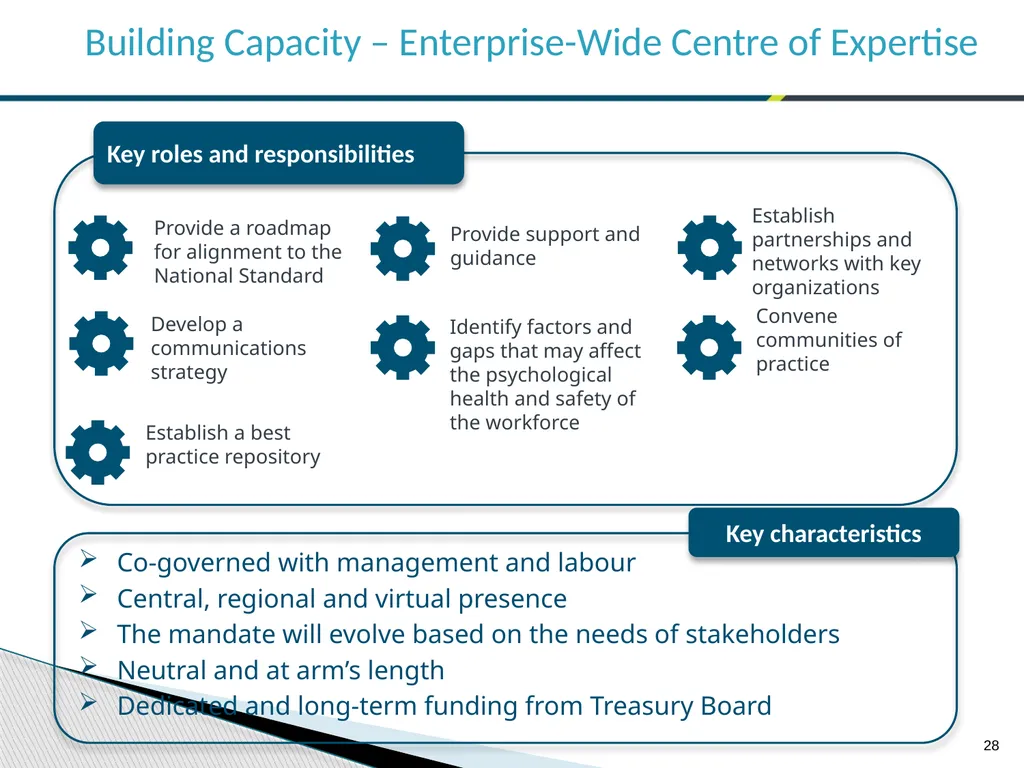
28 Building Capacity – Enterprise-Wide Centre of Expertise Provide a roadmap for alignment to the National Standard Develop a communications strategy Establish partnerships and networks with key organizations Provide support and guidance Identify factors and gaps that may affect the psychological health and safety of the workforce Establish a best practice repository Key roles and responsibilities Convene communities of practice Key characteristics Co-governed with management and labour
Central, regional and virtual presence
The mandate will evolve based on the needs of stakeholders
Neutral and at arm’s length
Dedicated and long-term funding from Treasury Board<br>
Central, regional and virtual presence
The mandate will evolve based on the needs of stakeholders
Neutral and at arm’s length
Dedicated and long-term funding from Treasury Board<br>
29
www.canada.ca/workplace-wellness 12<br>
30
30 CSA’s website:
www.csa.ca/z1003 Where can you find the standard?<br>
www.csa.ca/z1003 Where can you find the standard?<br>