Feeding Infants in the CACFP Lesson 10 Creditable Infant Foods: Part 2 Agenda Sugar Limit for Ready-to-Eat Cereal Sugar Limit for Yogurt Parent-Provided Meal Component Accommodating Special Dietary Needs Communicating With Parents Summary 2
"Feeding Infants in the CACFP Lesson 10 Creditable" is the property of its rightful owner. Permission is granted to
download and print the materials on this website for personal, non-commercial use only, and to display it
on your personal computer provided you do not modify the materials and that you retain all copyright
notices contained in the materials. By downloading content from our website, you accept the terms of this
agreement.
Presentation Transcript
01
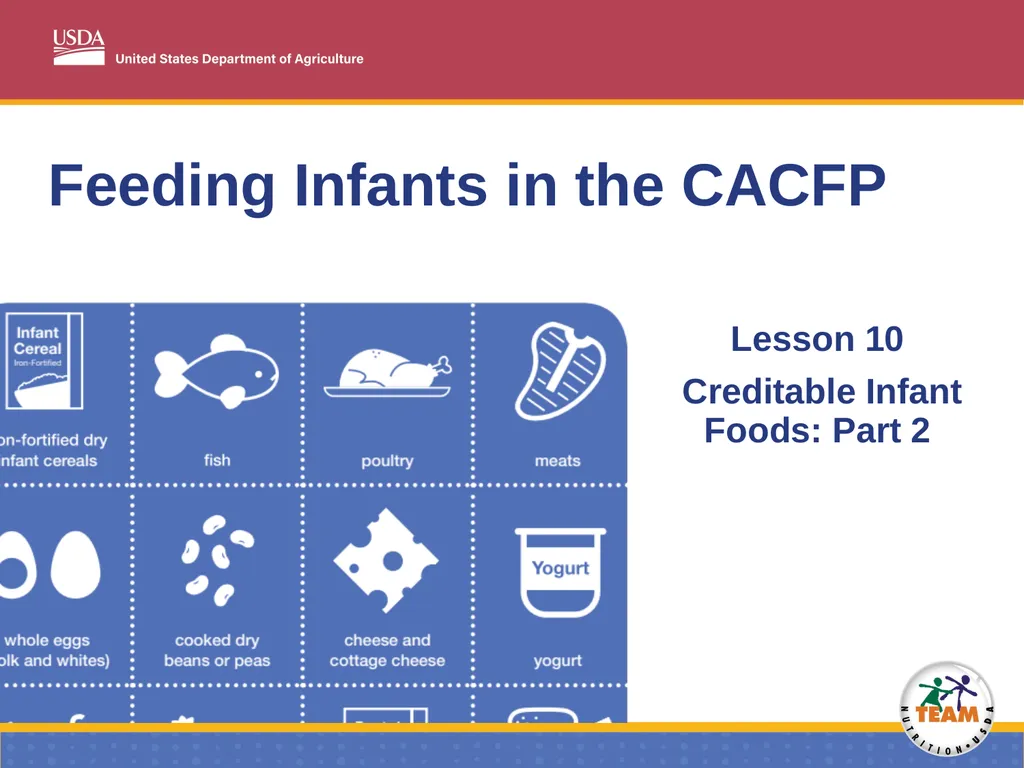
Feeding Infants in the CACFP Lesson 10
Creditable Infant Foods: Part 2<br>
02
Agenda Sugar Limit for Ready-to-Eat Cereal
Sugar Limit for Yogurt
Parent-Provided Meal Component
Accommodating Special Dietary Needs
Communicating With Parents
Summary 2<br>
03
Pre-Test #1 Yes or No?
The ready-to-eat cereal you are serving at snack contains 8 grams of sugar per dry ounce. Is this cereal creditable as part of a reimbursable snack for infants? 3<br>
04
Pre-Test #2 Yes or No?
The yogurt you are serving at lunch contains 24 grams of sugar per 6 ounces. Is this yogurt creditable? 4<br>
05
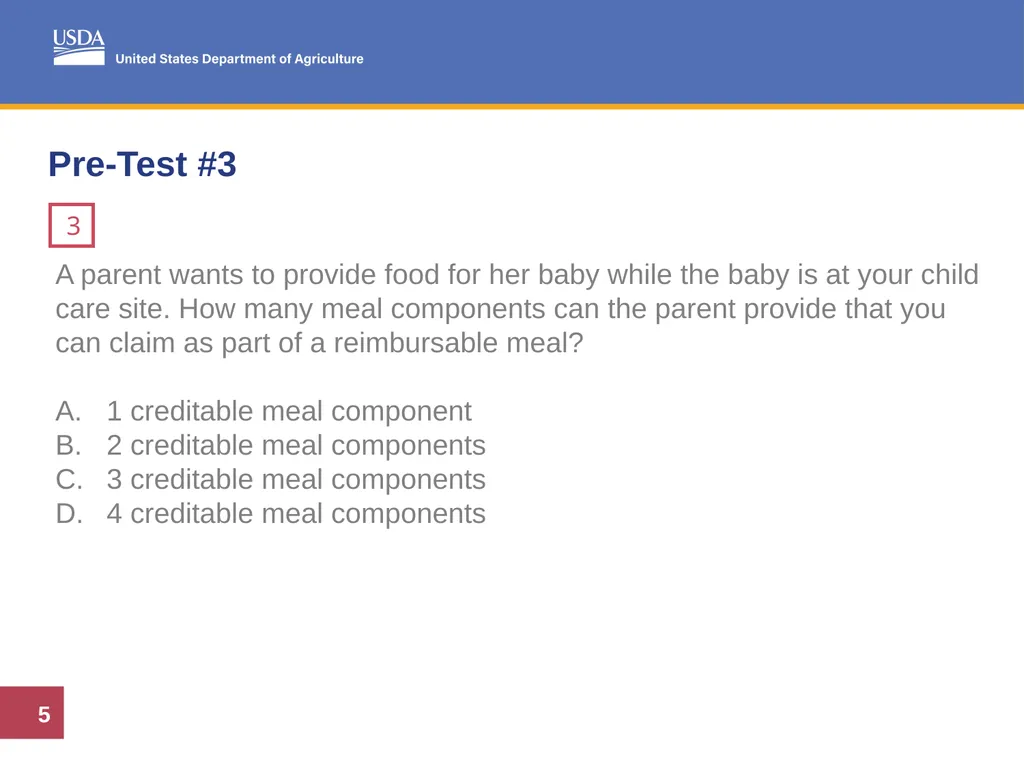
Pre-Test #3 A parent wants to provide food for her baby while the baby is at your child care site. How many meal components can the parent provide that you can claim as part of a reimbursable meal?
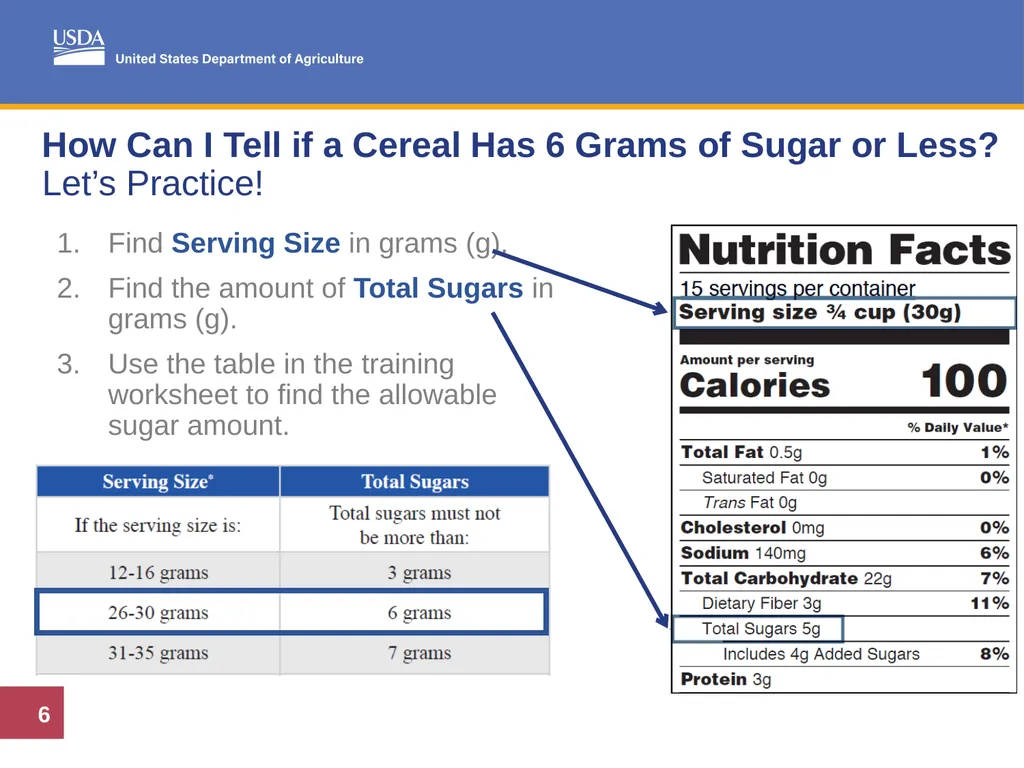
How Can I Tell if a Cereal Has 6 Grams of Sugar or Less? Let’s Practice! Find Serving Size in grams (g).
Find the amount of Total Sugars in grams (g).
Use the table in the training worksheet to find the allowable sugar amount. 6<br>
07
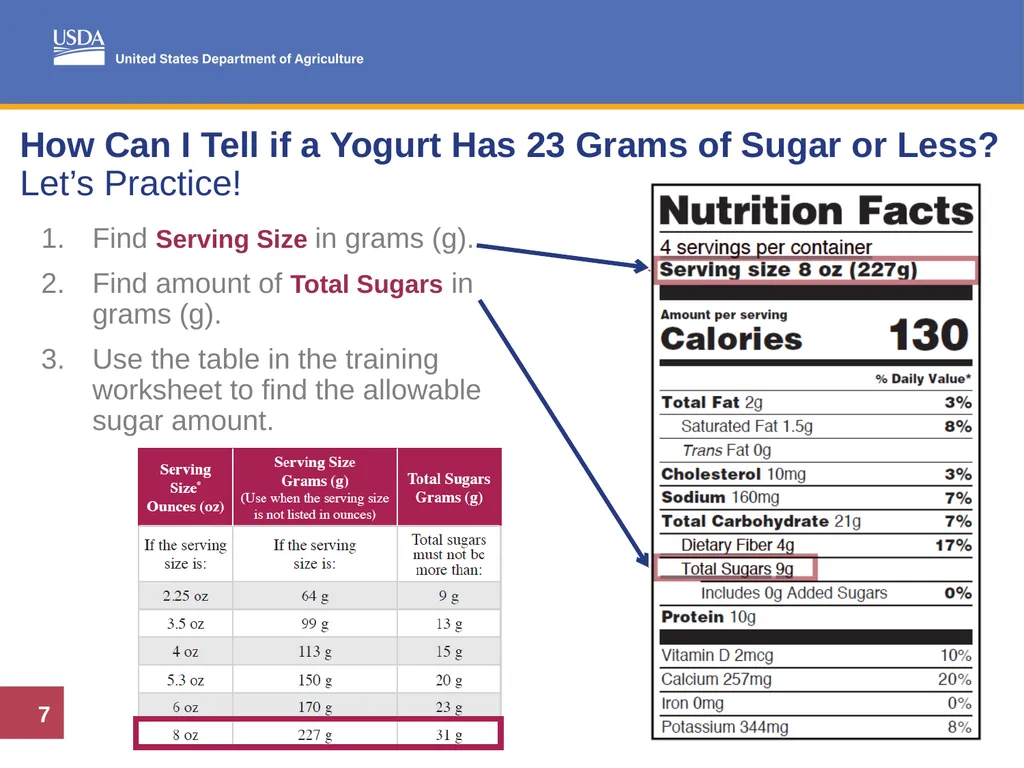
How Can I Tell if a Yogurt Has 23 Grams of Sugar or Less? Let’s Practice! Find Serving Size in grams (g).
Find amount of Total Sugars in grams (g).
Use the table in the training worksheet to find the allowable sugar amount. 7<br>
08
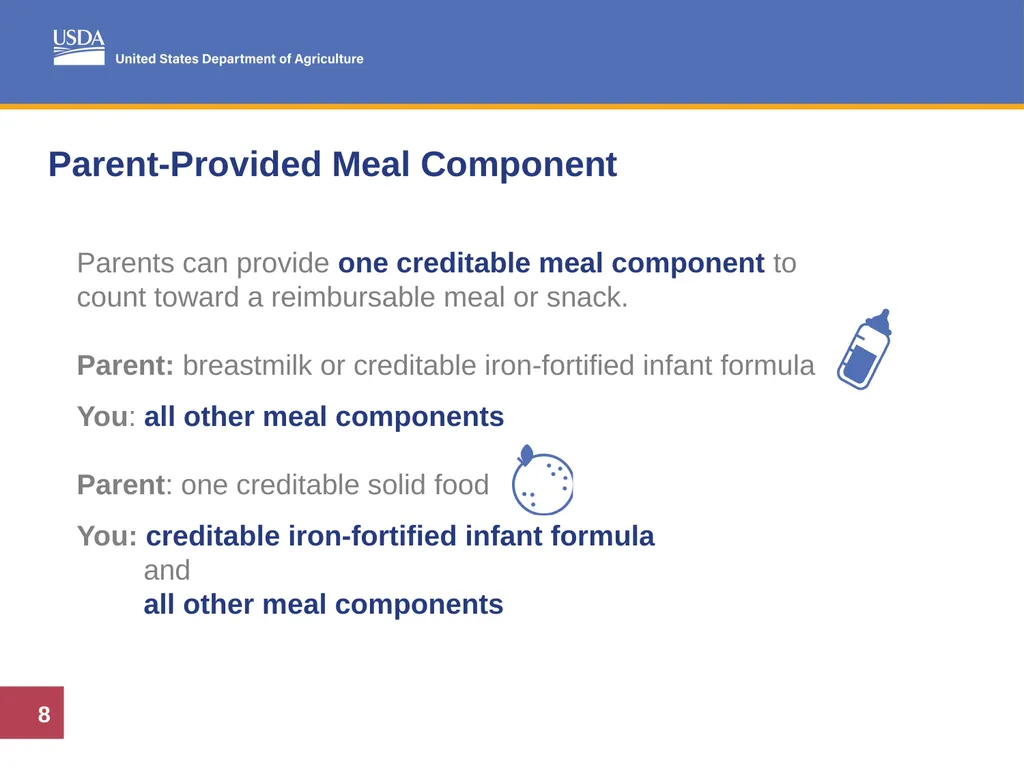
Parent-Provided Meal Component Parents can provide one creditable meal component to count toward a reimbursable meal or snack.
Parent: breastmilk or creditable iron-fortified infant formula
You: all other meal components
Parent: one creditable solid food
You: creditable iron-fortified infant formula
and
all other meal components 8<br>
09
Accommodating Special Dietary Needs Food allergies or intolerances
Religious reasons
Look for substitutions within the same meal component. 9<br>
10
Medical Statement The medical statement must include the following:
Name of food(s) to be avoided,
Explanation of how the food(s) affects the baby, and
Signature of the baby’s health care provider on the form.
Recommendations for substitutions of foods can be included.
Keep the medical statement on file in a secure location at your child care site. 10<br>
11
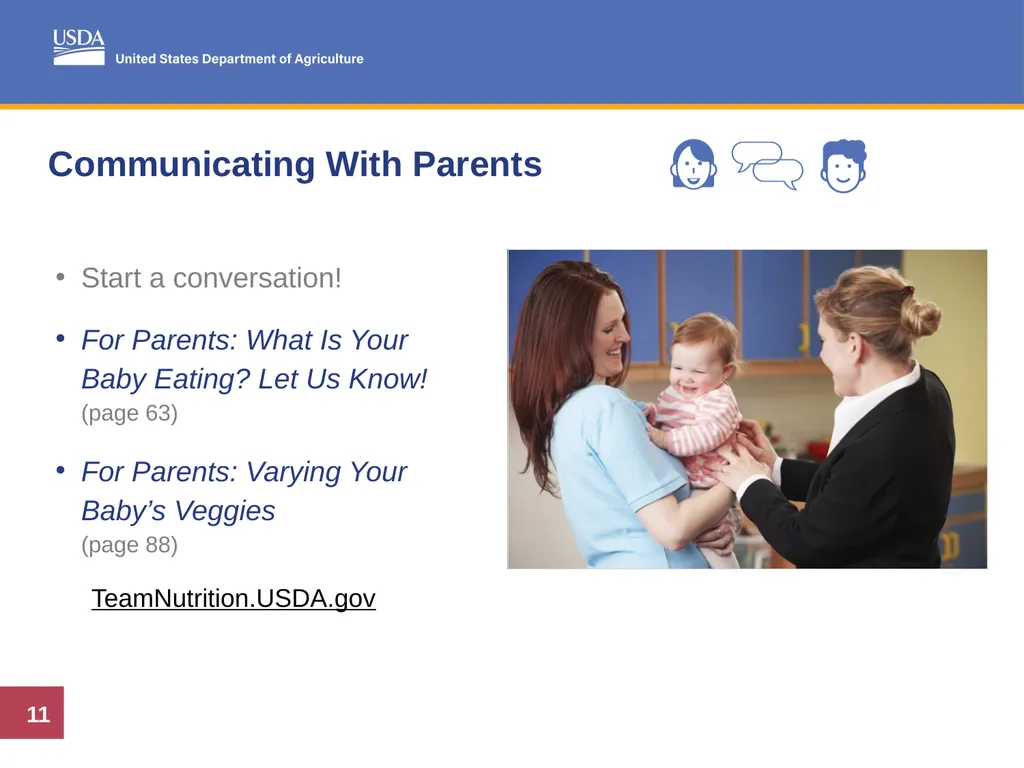
Communicating With Parents Start a conversation!
For Parents: What Is Your Baby Eating? Let Us Know! (page 63)
For Parents: Varying Your Baby’s Veggies (page 88) TeamNutrition.USDA.gov 11<br>
12
Summary Refer to:
Training Worksheet: Choose Breakfast Cereals That Are Lower in Sugar
Training Worksheet: Choose Yogurts That Are Lower in Sugar
Parents can provide one creditable meal component.
Offer food substitutions for babies with special dietary needs.
Substitutions due to disability or special dietary needs require a signed medical statement.
Start a conversation!
For Parents: What Is Your Baby Eating? Let Us Know! (page 63)
For Parents: Varying Your Baby’s Veggies (page 88) 12 TeamNutrition.USDA.gov<br>
13
Feeding Babies Game Show 13<br>
14
Yes or No?
The ready-to-eat cereal you are serving at snack contains 8 grams of sugar per dry ounce. Is this cereal creditable as part of a reimbursable snack for infants?
No Post-Test #1 14<br>
15
Yes or No?
The yogurt you are serving at lunch contains 24 grams of sugar per 6 ounces. Is this yogurt creditable?
No Post-Test #2 15<br>
16
A parent wants to provide food for her baby while the baby is at your child care site. How many meal components can the parent provide that you can claim as part of a reimbursable meal?
1 creditable meal component
2 creditable meal components
3 creditable meal components
4 creditable meal components A parent wants to provide food for her baby while the baby is at your child care site. How many meal components can the parent provide that you can claim as part of a reimbursable meal?
Presentation End In accordance with Federal civil rights law and U.S. Department of Agriculture (USDA) civil rights regulations and policies, the USDA, its Agencies, offices, and employees, and institutions participating in or administering USDA programs are prohibited from discriminating based on race, color, national origin, religion, sex, gender identity (including gender expression), sexual orientation, disability, age, marital status, family/parental status, income derived from a public assistance program, political beliefs, or reprisal or retaliation for prior civil rights activity, in any program or activity conducted or funded by USDA (not all bases apply to all programs). Remedies and complaint filing deadlines vary by program or incident.
Persons with disabilities who require alternative means of communication for program information (e.g., Braille, large print, audiotape, American Sign Language, etc.) should contact the responsible Agency or USDA’s TARGET Center at (202) 720-2600 (voice and TTY) or contact USDA through the Federal Relay Service at (800) 877-8339. Additionally, program information may be made available in languages other than English.
To file a program discrimination complaint, complete the USDA Program Discrimination Complaint Form, AD-3027, found online at http://www.ascr.usda.gov/complaint_filing_cust.htmland at any USDA office or write a letter addressed to USDA and provide in the letter all of the information requested in the form. To request a copy of the complaint form, call (866) 632-9992. Submit your completed form or letter to USDA by: (1) mail: U.S. Department of Agriculture, Office of the Assistant Secretary for Civil Rights, 1400 Independence Avenue, SW, Washington, D.C. 20250-9410; (2) fax: (202) 690-7442; or (3) email: program.intake@usda.gov.
USDA is an equal opportunity provider, employer, and lender.
United States Department of Agriculture – Food and Nutrition Service – November 2019 – Slightly Revised April 2024 – FNS-785 To learn more about the CACFP or access materials, visit: