Feeding Standard- I (Comparative Type) Course No. : ANN 605 Course Name : Ruminant Nutrition Unit : II Lecture : One Dr. Pankaj Kumar Singh Department of Animal Nutrition Bihar Animal Sciences University, Patna, Bihar, India What is feeding
"Feeding Standard- I (Comparative Type) Course No." is the property of its rightful owner. Permission is granted to
download and print the materials on this website for personal, non-commercial use only, and to display it
on your personal computer provided you do not modify the materials and that you retain all copyright
notices contained in the materials. By downloading content from our website, you accept the terms of this
agreement.
Presentation Transcript
01
Feeding Standard- I (Comparative Type) Course No. : ANN 605
Course Name : Ruminant Nutrition
Unit : II
Lecture : One Dr. Pankaj Kumar Singh
Department of Animal Nutrition
Bihar Animal Sciences University, Patna, Bihar, India<br>
02
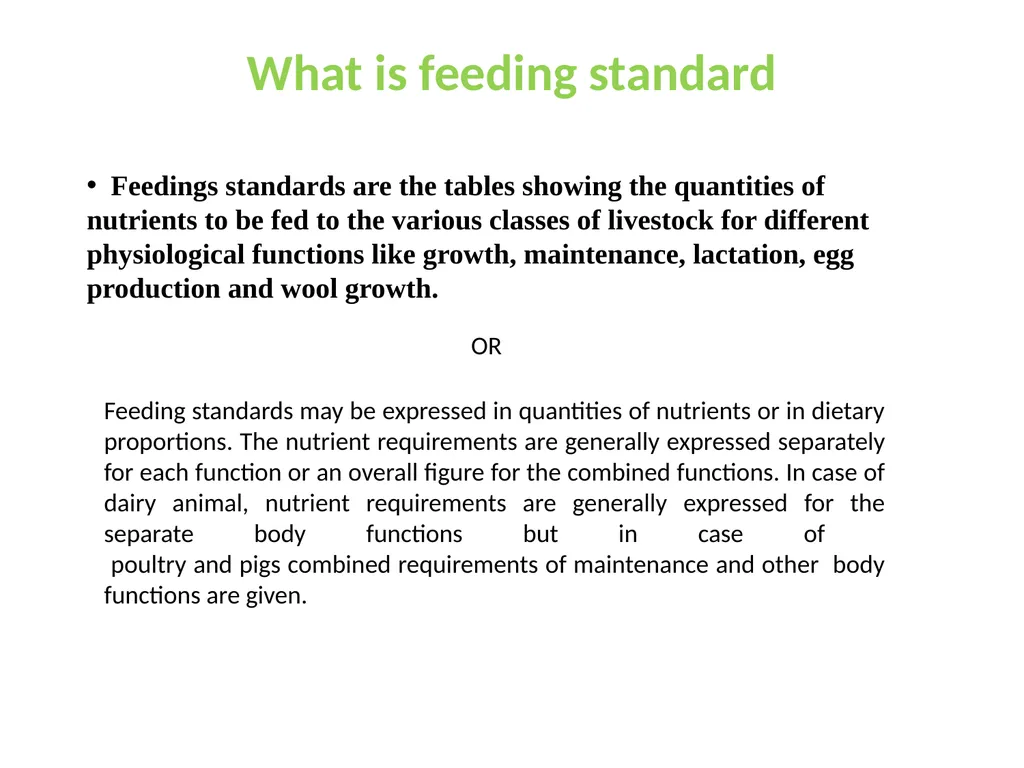
What is feeding standard Feedings standards are the tables showing the quantities of nutrients to be fed to the various classes of livestock for different physiological functions like growth, maintenance, lactation, egg production and wool growth. OR Feeding standards may be expressed in quantities of nutrients or in dietary proportions. The nutrient requirements are generally expressed separately for each function or an overall figure for the combined functions. In case of dairy animal, nutrient requirements are generally expressed for the separate body functions but in case of poultry and pigs combined requirements of maintenance and other body functions are given.<br>
03
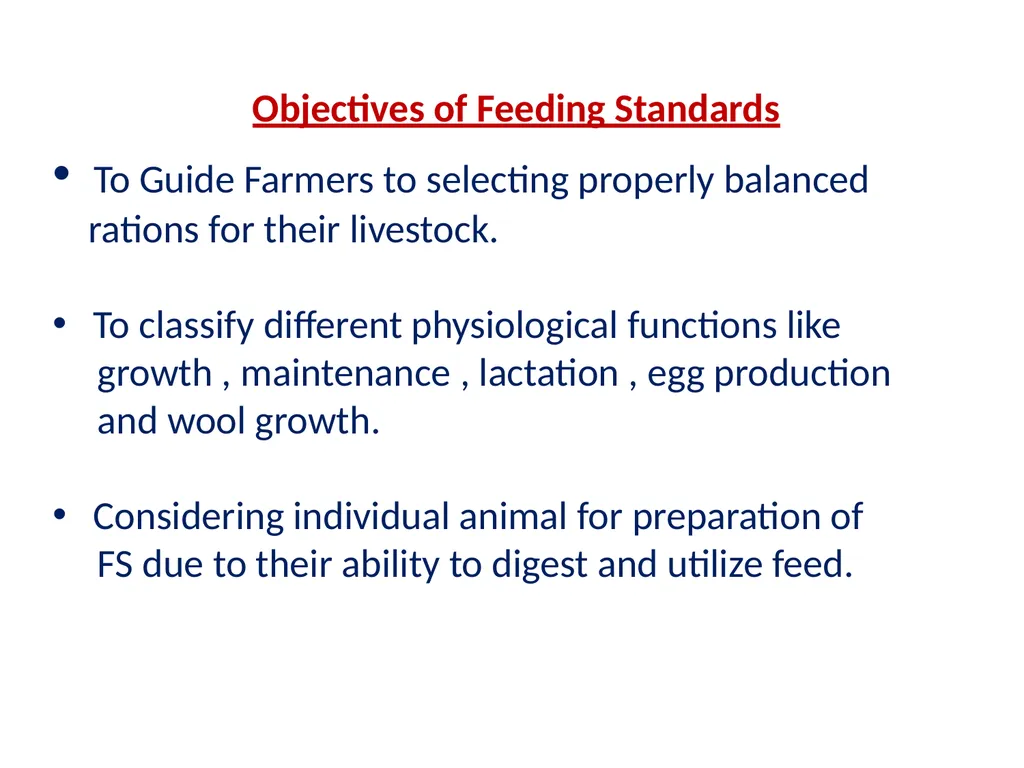
Objectives of Feeding Standards To Guide Farmers to selecting properly balanced rations for their livestock.
To classify different physiological functions like growth , maintenance , lactation , egg production and wool growth.
Considering individual animal for preparation of FS due to their ability to digest and utilize feed.<br>
04
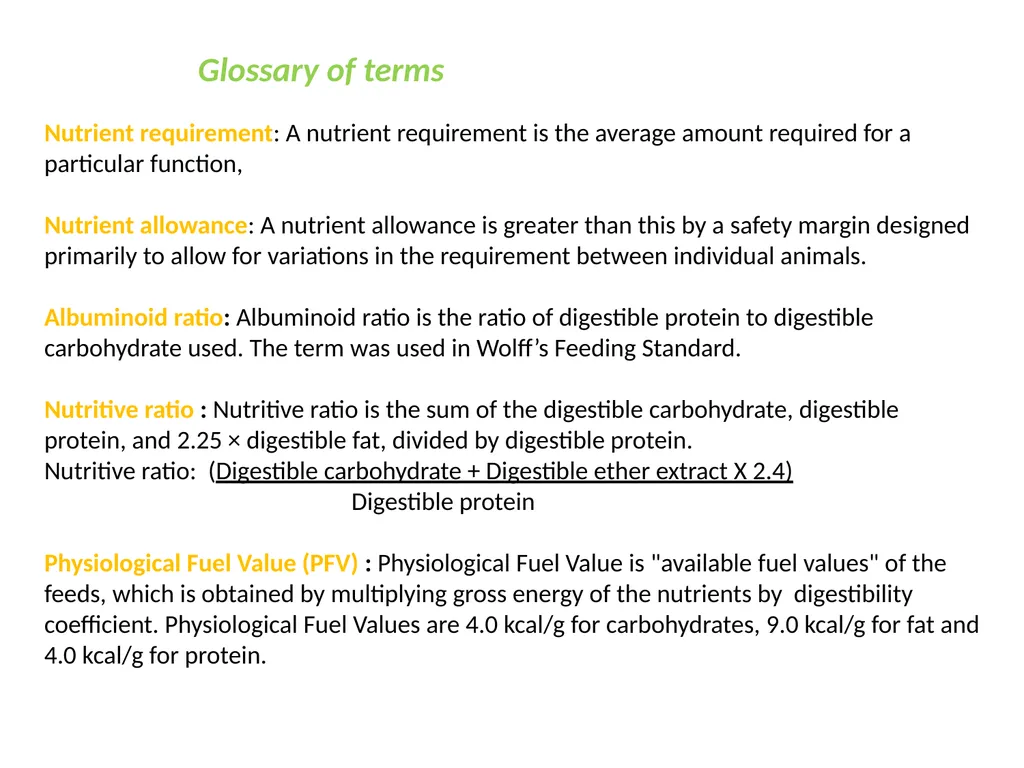
Nutrient requirement: A nutrient requirement is the average amount required for a particular function,
Nutrient allowance: A nutrient allowance is greater than this by a safety margin designed primarily to allow for variations in the requirement between individual animals.
Albuminoid ratio: Albuminoid ratio is the ratio of digestible protein to digestible
carbohydrate used. The term was used in Wolff’s Feeding Standard.
Nutritive ratio : Nutritive ratio is the sum of the digestible carbohydrate, digestible
protein, and 2.25 × digestible fat, divided by digestible protein.
Nutritive ratio: (Digestible carbohydrate + Digestible ether extract X 2.4)
Digestible protein
Physiological Fuel Value (PFV) : Physiological Fuel Value is "available fuel values" of the feeds, which is obtained by multiplying gross energy of the nutrients by digestibility coefficient. Physiological Fuel Values are 4.0 kcal/g for carbohydrates, 9.0 kcal/g for fat and 4.0 kcal/g for protein. Glossary of terms<br>
05
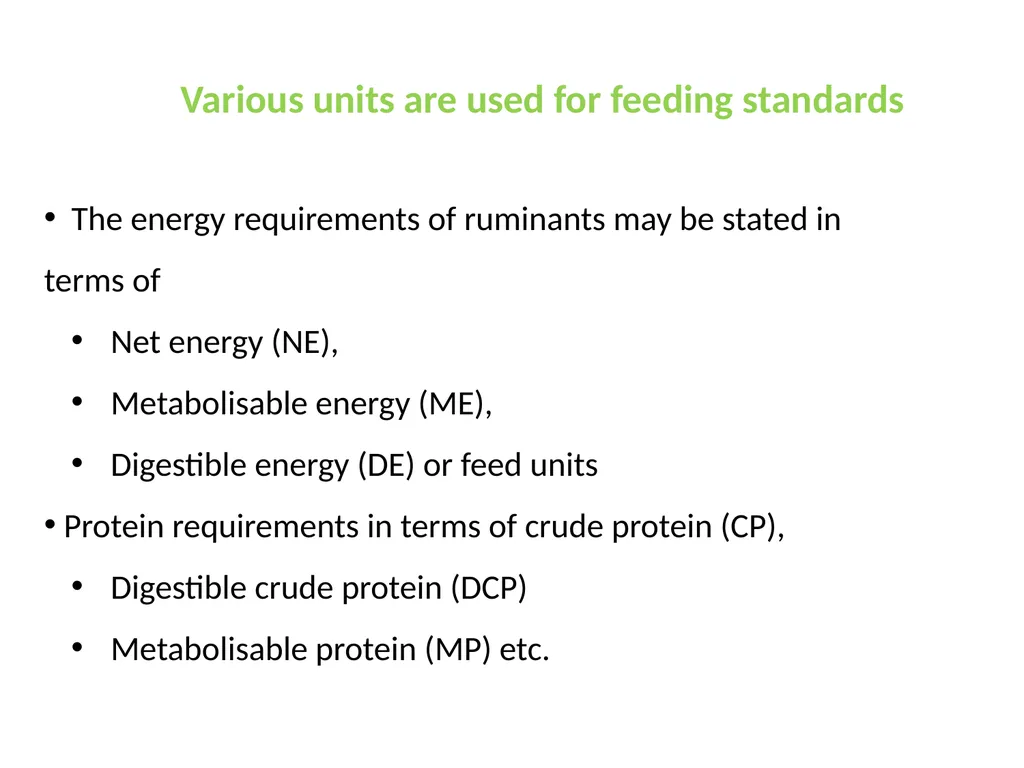
Various units are used for feeding standards The energy requirements of ruminants may be stated in terms of
Net energy (NE),
Metabolisable energy (ME),
Digestible energy (DE) or feed units
Protein requirements in terms of crude protein (CP),
Digestible crude protein (DCP)
Metabolisable protein (MP) etc.<br>
06
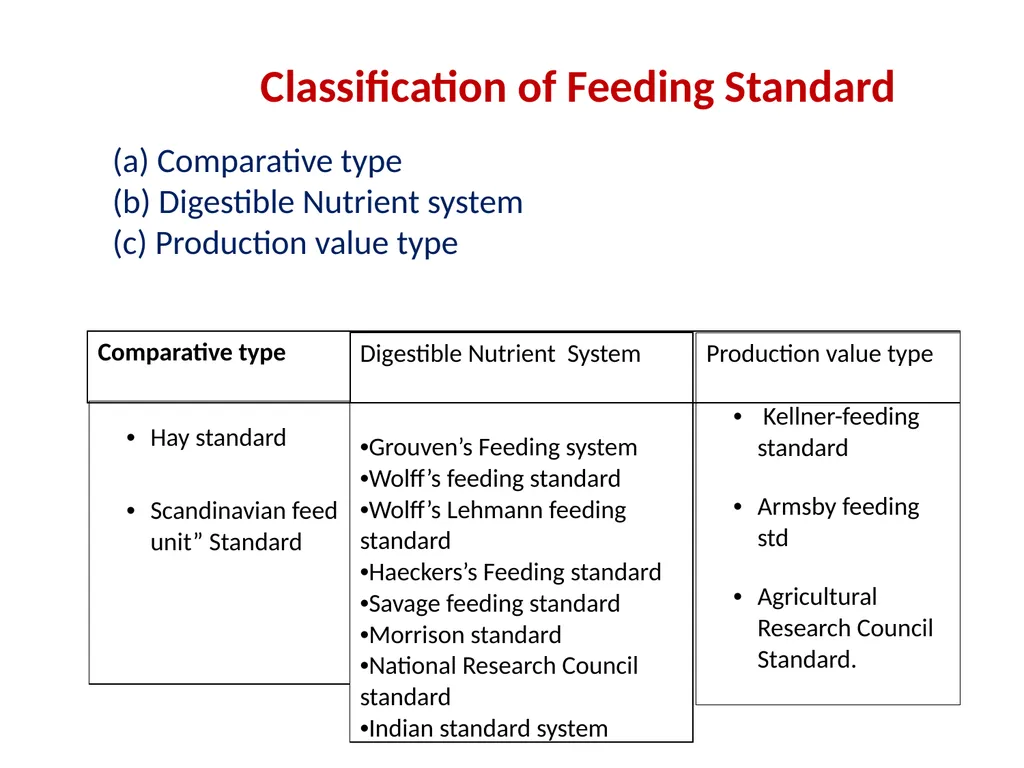
Classification of Feeding Standard (a) Comparative type
(b) Digestible Nutrient system
(c) Production value type<br>
07
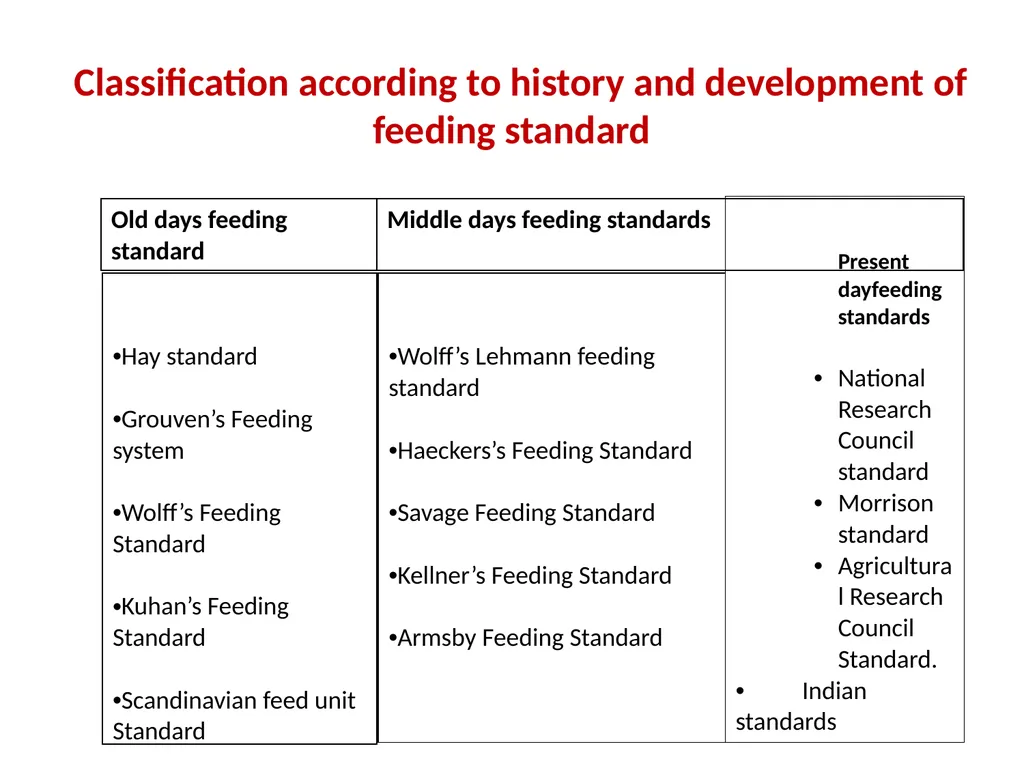
Classification according to history and development of feeding standard<br>
08
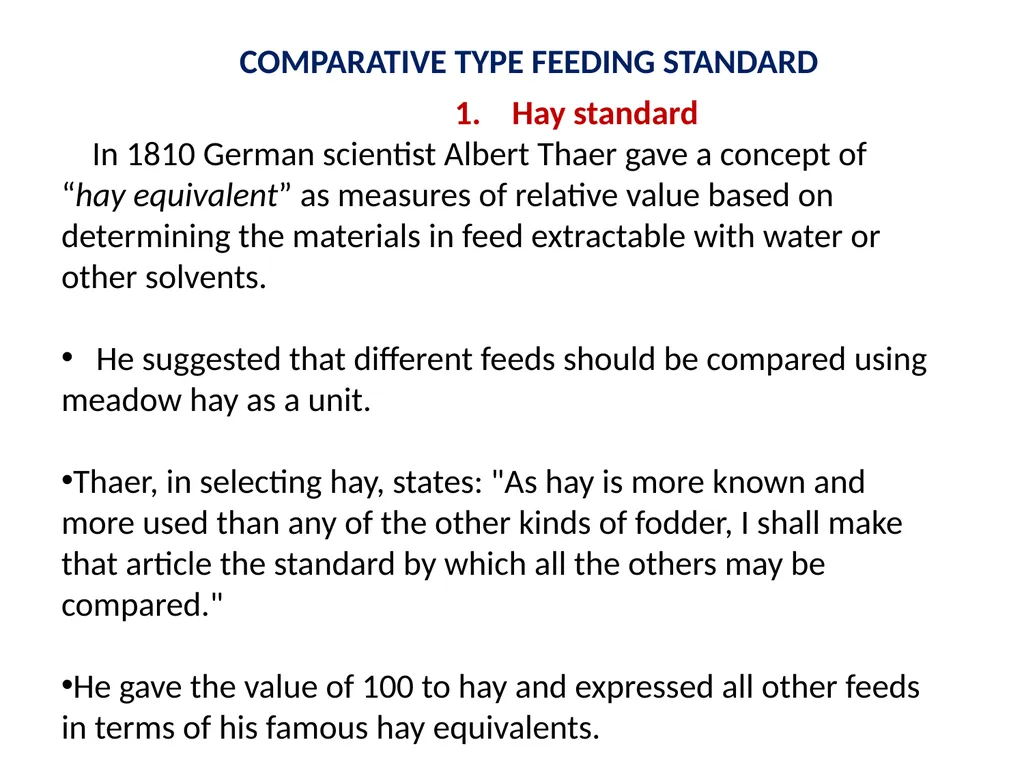
COMPARATIVE TYPE FEEDING STANDARD 1. Hay standard
In 1810 German scientist Albert Thaer gave a concept of “hay equivalent” as measures of relative value based on determining the materials in feed extractable with water or other solvents.
He suggested that different feeds should be compared using meadow hay as a unit.
Thaer, in selecting hay, states: "As hay is more known and more used than any of the other kinds of fodder, I shall make that article the standard by which all the others may be compared."
He gave the value of 100 to hay and expressed all other feeds in terms of his famous hay equivalents.<br>
09
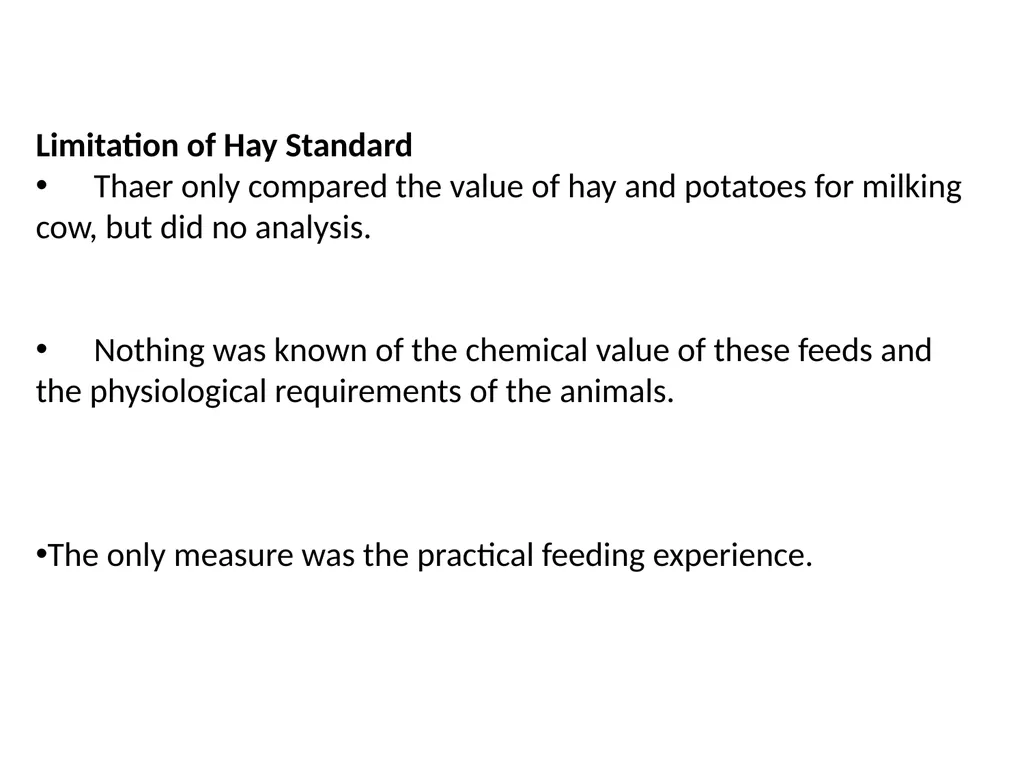
Limitation of Hay Standard
Thaer only compared the value of hay and potatoes for milking cow, but did no analysis.
Nothing was known of the chemical value of these feeds and the physiological requirements of the animals.
The only measure was the practical feeding experience.<br>
10
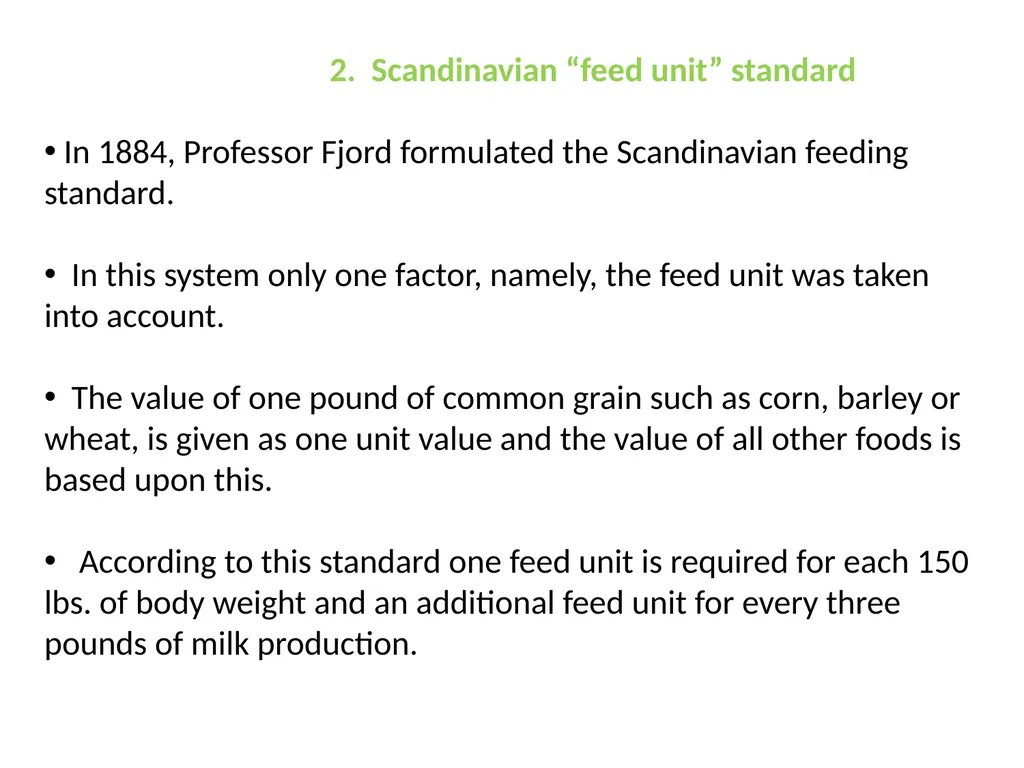
2. Scandinavian “feed unit” standard
In 1884, Professor Fjord formulated the Scandinavian feeding standard.
In this system only one factor, namely, the feed unit was taken into account.
The value of one pound of common grain such as corn, barley or wheat, is given as one unit value and the value of all other foods is based upon this.
According to this standard one feed unit is required for each 150 lbs. of body weight and an additional feed unit for every three pounds of milk production.<br>
11
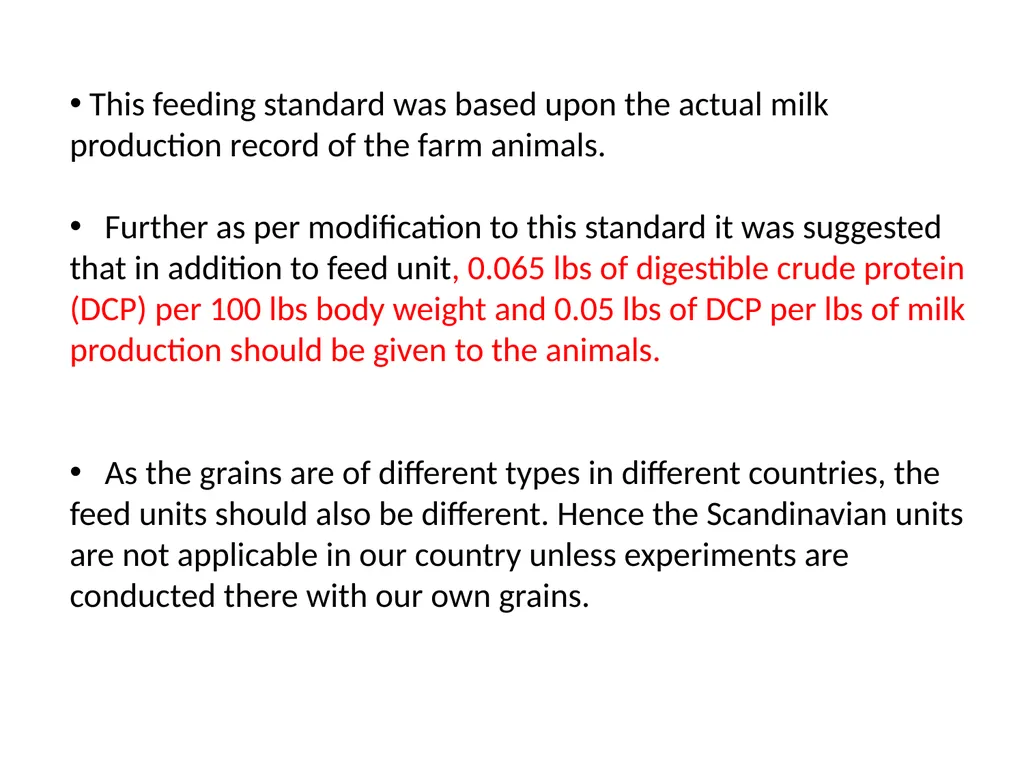
This feeding standard was based upon the actual milk production record of the farm animals.
Further as per modification to this standard it was suggested that in addition to feed unit, 0.065 lbs of digestible crude protein (DCP) per 100 lbs body weight and 0.05 lbs of DCP per lbs of milk production should be given to the animals.
As the grains are of different types in different countries, the feed units should also be different. Hence the Scandinavian units are not applicable in our country unless experiments are conducted there with our own grains.<br>
12
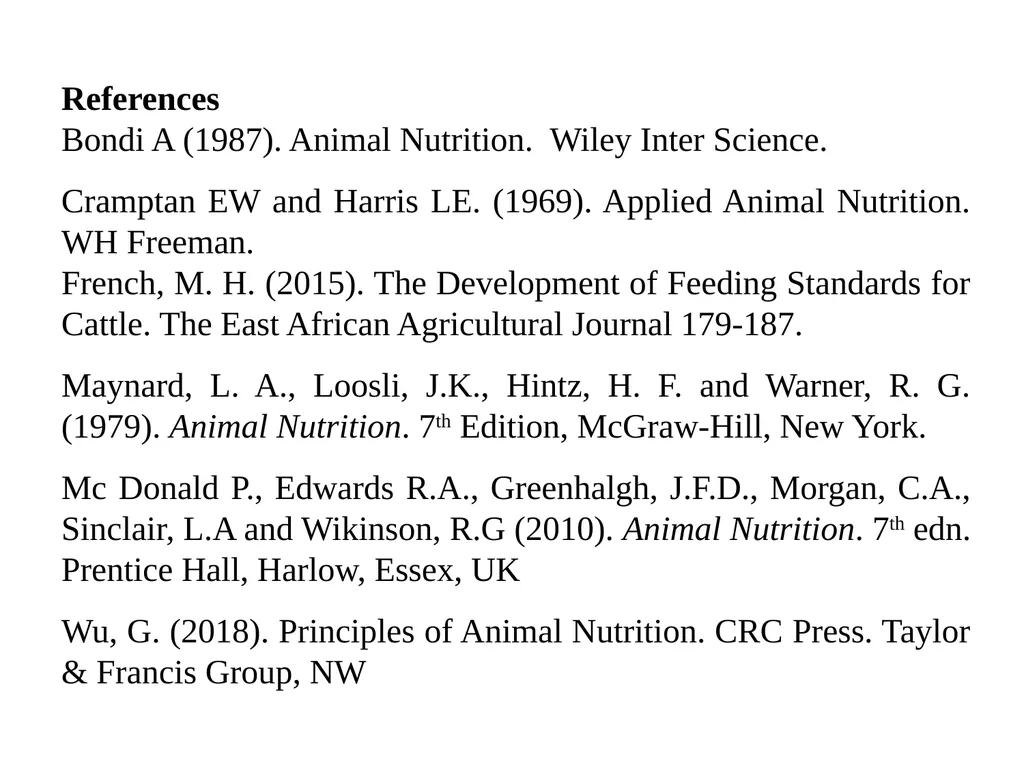
References
Bondi A (1987). Animal Nutrition. Wiley Inter Science.
Cramptan EW and Harris LE. (1969). Applied Animal Nutrition. WH Freeman.
French, M. H. (2015). The Development of Feeding Standards for Cattle. The East African Agricultural Journal 179-187.
Maynard, L. A., Loosli, J.K., Hintz, H. F. and Warner, R. G. (1979). Animal Nutrition. 7th Edition, McGraw-Hill, New York.
Mc Donald P., Edwards R.A., Greenhalgh, J.F.D., Morgan, C.A., Sinclair, L.A and Wikinson, R.G (2010). Animal Nutrition. 7th edn. Prentice Hall, Harlow, Essex, UK
Wu, G. (2018). Principles of Animal Nutrition. CRC Press. Taylor & Francis Group, NW<br>