
FEMA/EMI Virtual Table Top Exercise (VTTX)
SN
Published · 28 slides · 0 views
1 / 1
Description
FEMAEMI Virtual Table Top Exercise (VTTX) Large-Scale Power Outage January 23, 24, 25 2024 Welcome and Introductions Opening Remarks: Emergency Management Institute (EMI) Introductions: EMI Attending Agencies and Federal Emergency
Related Topics
Share
Embed code
Download this presentation From Below
"FEMA/EMI Virtual Table Top Exercise (VTTX)" is the property of its rightful owner. Permission is granted to download and print the materials on this website for personal, non-commercial use only, and to display it on your personal computer provided you do not modify the materials and that you retain all copyright notices contained in the materials. By downloading content from our website, you accept the terms of this agreement.
Presentation Transcript
01
FEMA/EMI
Virtual Table Top Exercise
(VTTX)
Large-Scale Power Outage
January 23, 24, 25 2024<br>
02
Welcome and Introductions Opening Remarks:
Emergency Management Institute (EMI)
Introductions:
EMI
Attending Agencies and Federal Emergency Management Agency 2<br>
Emergency Management Institute (EMI)
Introductions:
EMI
Attending Agencies and Federal Emergency Management Agency 2<br>
03
Exercise Scope Focus on the role of your organization(s) in response to potential consequences of a large-scale power outage in your area, as well as the interdisciplinary and interagency coordination at the Federal, Native American, regional, State, and local levels. Federal Emergency Management Agency 3<br>
04
Exercise Objectives Review participants knowledge, skills, and abilities to effectively conduct emergency response and recovery.
Enable participants to better coordinate response operations with counterparts from local government, state governments, tribal, territorial, federal agencies, private sector organizations, and nongovernmental agencies.
Allow participating locations to share real-time related preparation, response and recovery solutions with all participants. Federal Emergency Management Agency 4<br>
Enable participants to better coordinate response operations with counterparts from local government, state governments, tribal, territorial, federal agencies, private sector organizations, and nongovernmental agencies.
Allow participating locations to share real-time related preparation, response and recovery solutions with all participants. Federal Emergency Management Agency 4<br>
05
Exercise Overview This is a four-hour, continuous, interactive exercise that will require schedule discipline.
The VTTX consists of:
Introductions
Three Modules (Preparedness, Response, Recovery)
Participant engagement encouraged both locally and cross-community.
Time awareness during questions, brief outs, etc. Federal Emergency Management Agency 5<br>
The VTTX consists of:
Introductions
Three Modules (Preparedness, Response, Recovery)
Participant engagement encouraged both locally and cross-community.
Time awareness during questions, brief outs, etc. Federal Emergency Management Agency 5<br>
06
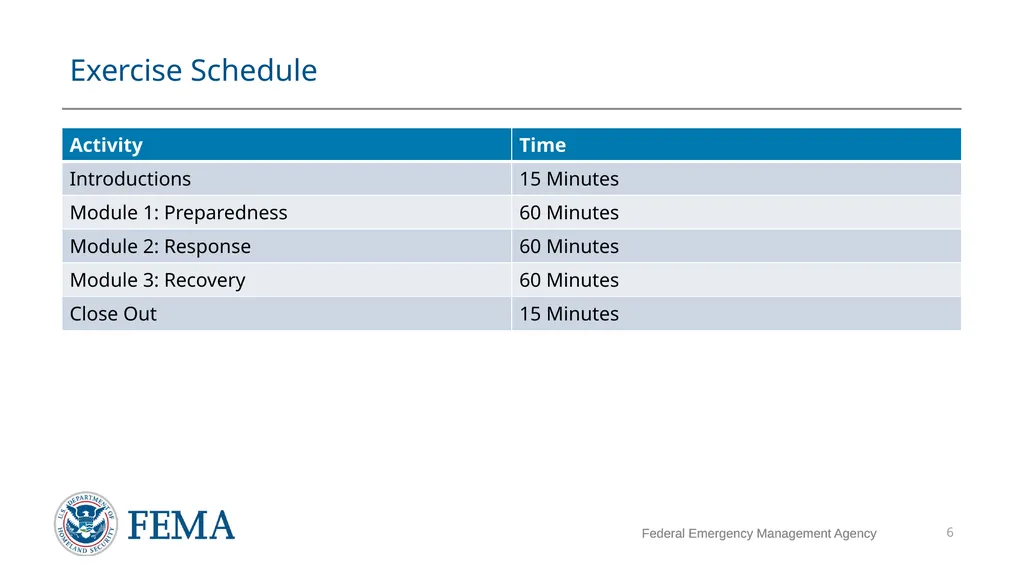
Exercise Schedule Federal Emergency Management Agency 6<br>
07
Assumption and Artificialities The scenario is plausible, and events occur as they are presented.
There is no hidden agenda, and there are no trick questions.
All players receive information at the same time. Federal Emergency Management Agency 7<br>
There is no hidden agenda, and there are no trick questions.
All players receive information at the same time. Federal Emergency Management Agency 7<br>
08
Ground Rules Do NOT critique the scenario
Trying to find holes or inconsistencies in the scenario is counter-productive and disruptive; the scenario should stimulate discussion.
Draw from your previous experience
As you participate, please utilize your knowledge of how the Whole Community works together in response/recovery situations.
Do NOT assume information
If questions arise that are not answered by the provided material, please ask the facilitator to address the issue with the virtual group.
Participation is encouraged
Speak freely, respect others when they are speaking
Participate in your disaster role as if the event were occurring
Processes and decision making are more important than the details
The facilitator's job is to help you come up with solutions Federal Emergency Management Agency 8<br>
Trying to find holes or inconsistencies in the scenario is counter-productive and disruptive; the scenario should stimulate discussion.
Draw from your previous experience
As you participate, please utilize your knowledge of how the Whole Community works together in response/recovery situations.
Do NOT assume information
If questions arise that are not answered by the provided material, please ask the facilitator to address the issue with the virtual group.
Participation is encouraged
Speak freely, respect others when they are speaking
Participate in your disaster role as if the event were occurring
Processes and decision making are more important than the details
The facilitator's job is to help you come up with solutions Federal Emergency Management Agency 8<br>
09
Module 1: Preparedness<br>
10
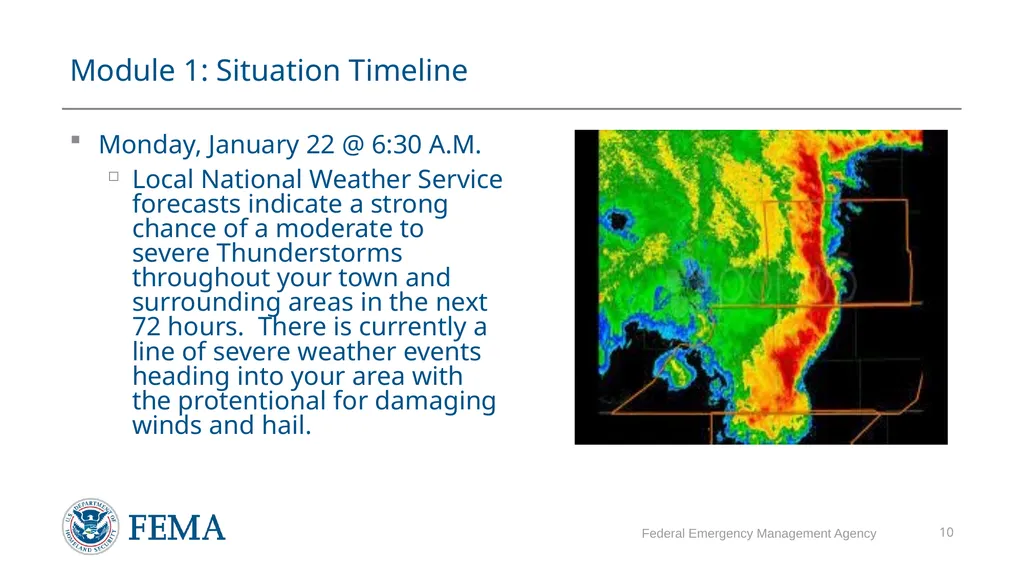
Monday, January 22 @ 6:30 A.M.
Local National Weather Service forecasts indicate a strong chance of a moderate to severe Thunderstorms throughout your town and surrounding areas in the next 72 hours. There is currently a line of severe weather events heading into your area with the protentional for damaging winds and hail. Module 1: Situation Timeline Federal Emergency Management Agency 10<br>
Local National Weather Service forecasts indicate a strong chance of a moderate to severe Thunderstorms throughout your town and surrounding areas in the next 72 hours. There is currently a line of severe weather events heading into your area with the protentional for damaging winds and hail. Module 1: Situation Timeline Federal Emergency Management Agency 10<br>
11
Monday, January 22 @ 5:30 P.M.
The media is reporting that there are long lines at the supermarket, and they are starting to sell out of some items.
There have also been reports of long lines at gas stations.
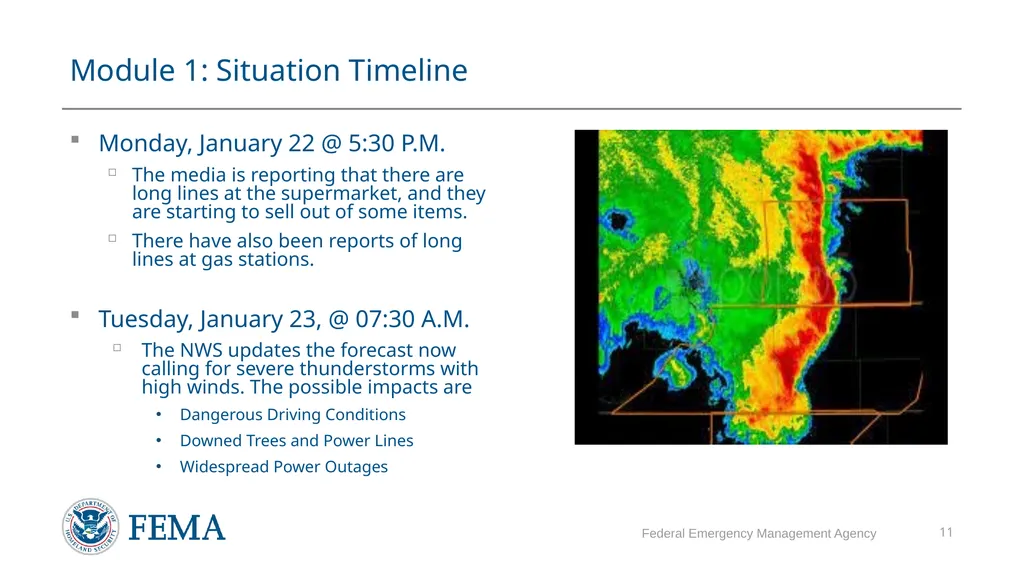
Tuesday, January 23, @ 07:30 A.M.
The NWS updates the forecast now calling for severe thunderstorms with high winds. The possible impacts are
Dangerous Driving Conditions
Downed Trees and Power Lines
Widespread Power Outages Module 1: Situation Timeline Federal Emergency Management Agency 11<br>
The media is reporting that there are long lines at the supermarket, and they are starting to sell out of some items.
There have also been reports of long lines at gas stations.
Tuesday, January 23, @ 07:30 A.M.
The NWS updates the forecast now calling for severe thunderstorms with high winds. The possible impacts are
Dangerous Driving Conditions
Downed Trees and Power Lines
Widespread Power Outages Module 1: Situation Timeline Federal Emergency Management Agency 11<br>
12
Approaching storm
Possible power outages
Dangerous driving conditions
Reports of a surge of customers at gas stations and supermarkets.
Public notification Key Issues 12<br>
Possible power outages
Dangerous driving conditions
Reports of a surge of customers at gas stations and supermarkets.
Public notification Key Issues 12<br>
13
Module 1: Discussion Questions Should an EOC be staffed?
Are you starting to think of a staffing plan?
What are some reasonable assumptions and what assumptions should be avoided in regard to this storm?
What warning and notification systems are available for the community?
What are some of the ways you collect information?
What are some of the ways you validate that information?
What agencies need to be involved at this point?
What are the incident and resource priorities?
What are some of the possible needs from the utility companies? And what do they need from Emergency Management? Federal Emergency Management Agency 13<br>
Are you starting to think of a staffing plan?
What are some reasonable assumptions and what assumptions should be avoided in regard to this storm?
What warning and notification systems are available for the community?
What are some of the ways you collect information?
What are some of the ways you validate that information?
What agencies need to be involved at this point?
What are the incident and resource priorities?
What are some of the possible needs from the utility companies? And what do they need from Emergency Management? Federal Emergency Management Agency 13<br>
14
Module 1: Brief Out EMI will facilitate the brief out discussion from each site.
Please keep each brief out concise, and to the point.
Please feel free to ask questions. Federal Emergency Management Agency 14<br>
Please keep each brief out concise, and to the point.
Please feel free to ask questions. Federal Emergency Management Agency 14<br>
15
Module 2: Response<br>
16
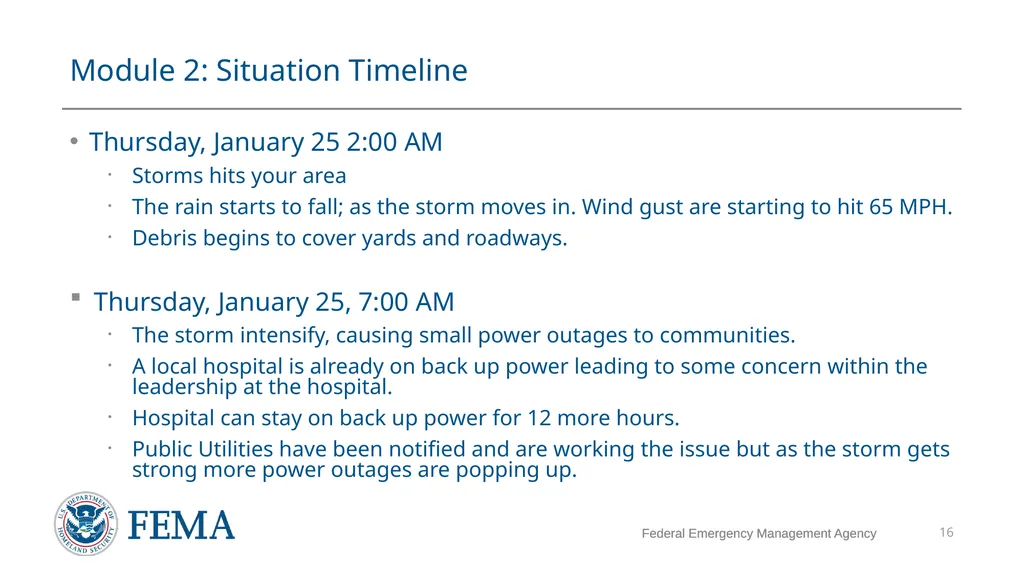
Module 2: Situation Timeline Thursday, January 25 2:00 AM
Storms hits your area
The rain starts to fall; as the storm moves in. Wind gust are starting to hit 65 MPH.
Debris begins to cover yards and roadways.
Thursday, January 25, 7:00 AM
The storm intensify, causing small power outages to communities.
A local hospital is already on back up power leading to some concern within the leadership at the hospital.
Hospital can stay on back up power for 12 more hours.
Public Utilities have been notified and are working the issue but as the storm gets strong more power outages are popping up. Federal Emergency Management Agency 16<br>
Storms hits your area
The rain starts to fall; as the storm moves in. Wind gust are starting to hit 65 MPH.
Debris begins to cover yards and roadways.
Thursday, January 25, 7:00 AM
The storm intensify, causing small power outages to communities.
A local hospital is already on back up power leading to some concern within the leadership at the hospital.
Hospital can stay on back up power for 12 more hours.
Public Utilities have been notified and are working the issue but as the storm gets strong more power outages are popping up. Federal Emergency Management Agency 16<br>
17
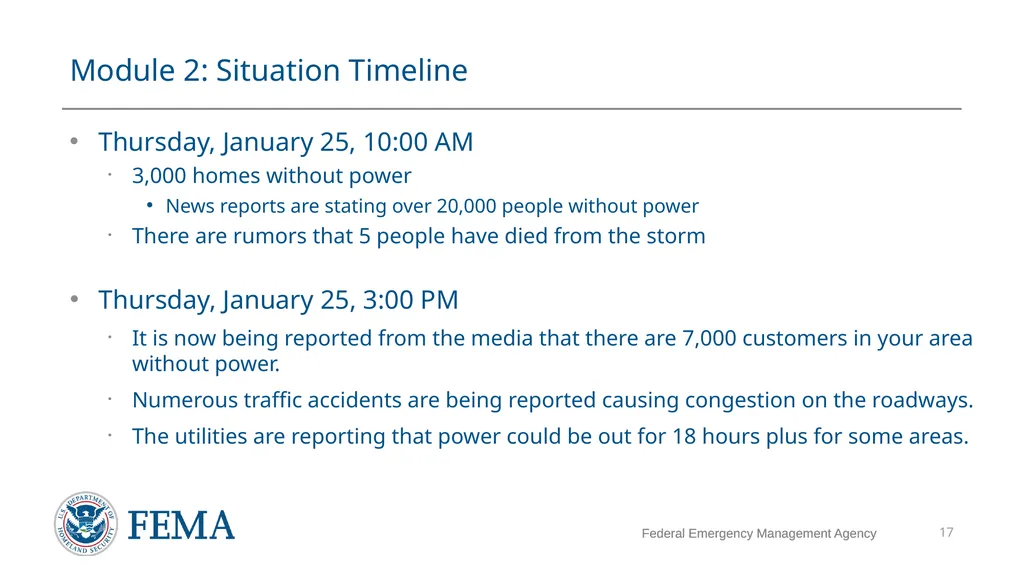
Module 2: Situation Timeline Thursday, January 25, 10:00 AM
3,000 homes without power
News reports are stating over 20,000 people without power
There are rumors that 5 people have died from the storm
Thursday, January 25, 3:00 PM
It is now being reported from the media that there are 7,000 customers in your area without power.
Numerous traffic accidents are being reported causing congestion on the roadways.
The utilities are reporting that power could be out for 18 hours plus for some areas. Federal Emergency Management Agency 17<br>
3,000 homes without power
News reports are stating over 20,000 people without power
There are rumors that 5 people have died from the storm
Thursday, January 25, 3:00 PM
It is now being reported from the media that there are 7,000 customers in your area without power.
Numerous traffic accidents are being reported causing congestion on the roadways.
The utilities are reporting that power could be out for 18 hours plus for some areas. Federal Emergency Management Agency 17<br>
18
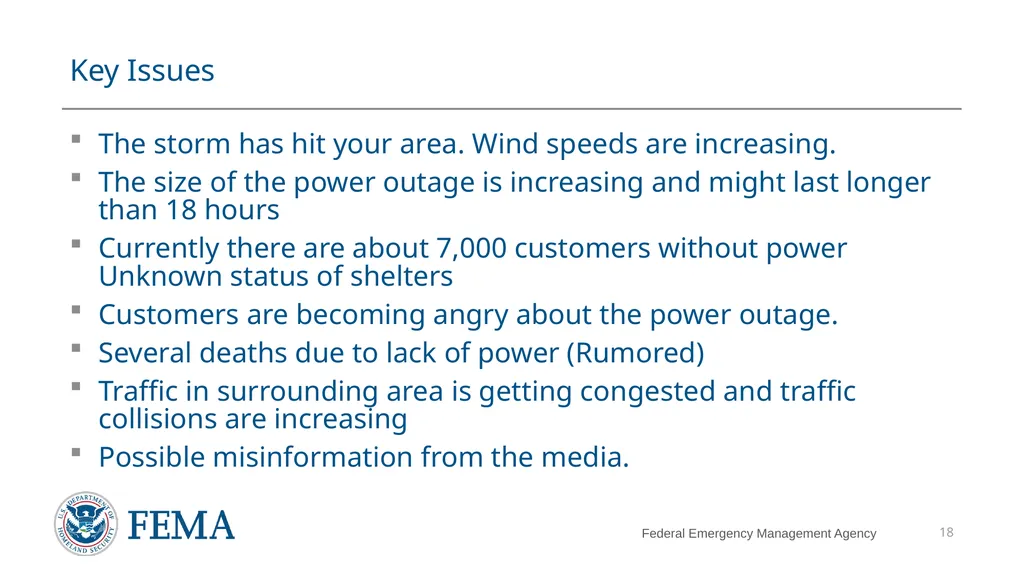
The storm has hit your area. Wind speeds are increasing.
The size of the power outage is increasing and might last longer than 18 hours
Currently there are about 7,000 customers without power Unknown status of shelters
Customers are becoming angry about the power outage.
Several deaths due to lack of power (Rumored)
Traffic in surrounding area is getting congested and traffic collisions are increasing
Possible misinformation from the media. Key Issues 18<br>
The size of the power outage is increasing and might last longer than 18 hours
Currently there are about 7,000 customers without power Unknown status of shelters
Customers are becoming angry about the power outage.
Several deaths due to lack of power (Rumored)
Traffic in surrounding area is getting congested and traffic collisions are increasing
Possible misinformation from the media. Key Issues 18<br>
19
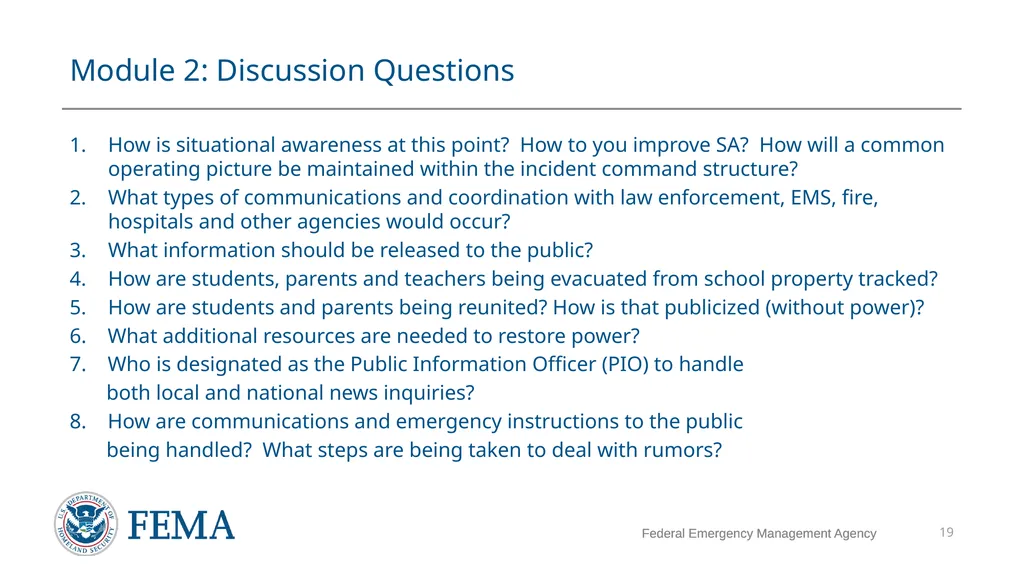
Module 2: Discussion Questions How is situational awareness at this point? How to you improve SA? How will a common operating picture be maintained within the incident command structure?
What types of communications and coordination with law enforcement, EMS, fire, hospitals and other agencies would occur?
What information should be released to the public?
How are students, parents and teachers being evacuated from school property tracked?
How are students and parents being reunited? How is that publicized (without power)?
6. What additional resources are needed to restore power?
7. Who is designated as the Public Information Officer (PIO) to handle
both local and national news inquiries?
8. How are communications and emergency instructions to the public
being handled? What steps are being taken to deal with rumors? Federal Emergency Management Agency 19<br>
What types of communications and coordination with law enforcement, EMS, fire, hospitals and other agencies would occur?
What information should be released to the public?
How are students, parents and teachers being evacuated from school property tracked?
How are students and parents being reunited? How is that publicized (without power)?
6. What additional resources are needed to restore power?
7. Who is designated as the Public Information Officer (PIO) to handle
both local and national news inquiries?
8. How are communications and emergency instructions to the public
being handled? What steps are being taken to deal with rumors? Federal Emergency Management Agency 19<br>
20
Module 2: Brief Out EMI will facilitate the brief out discussion from each site.
Please keep each brief out concise, and to the point.
Please feel free to ask questions. Federal Emergency Management Agency 20<br>
Please keep each brief out concise, and to the point.
Please feel free to ask questions. Federal Emergency Management Agency 20<br>
21
Module 3: Recovery<br>
22
Module 3: Situation Timeline Monday, January 29, 12:00 PM
1,000 homes that include 5,000 people are still without power
A state and federal disaster declaration was approved
Most business reopened and people returning to work. Calls for Police, Fire and EMS have curtailed to normal service
Monday, January 29, 3:00 PM
Recovery efforts are still ongoing and an estimated 700 are still living in shelters and hotels (the ones with power).
Power should be returned to all customers by the end of the week.
Media is still reporting on the frustration of the community over the response to the storm. Federal Emergency Management Agency 22<br>
1,000 homes that include 5,000 people are still without power
A state and federal disaster declaration was approved
Most business reopened and people returning to work. Calls for Police, Fire and EMS have curtailed to normal service
Monday, January 29, 3:00 PM
Recovery efforts are still ongoing and an estimated 700 are still living in shelters and hotels (the ones with power).
Power should be returned to all customers by the end of the week.
Media is still reporting on the frustration of the community over the response to the storm. Federal Emergency Management Agency 22<br>
23
Module 3: Key Issues Power still out for an estimated 5,000 people.
Logistics of replacement equipment/supplies.
Utility crews still working to restore power to some areas.
Media is still broadcasting live on government failures during the response.
Some folks are still in hotels and shelters. Federal Emergency Management Agency 23<br>
Logistics of replacement equipment/supplies.
Utility crews still working to restore power to some areas.
Media is still broadcasting live on government failures during the response.
Some folks are still in hotels and shelters. Federal Emergency Management Agency 23<br>
24
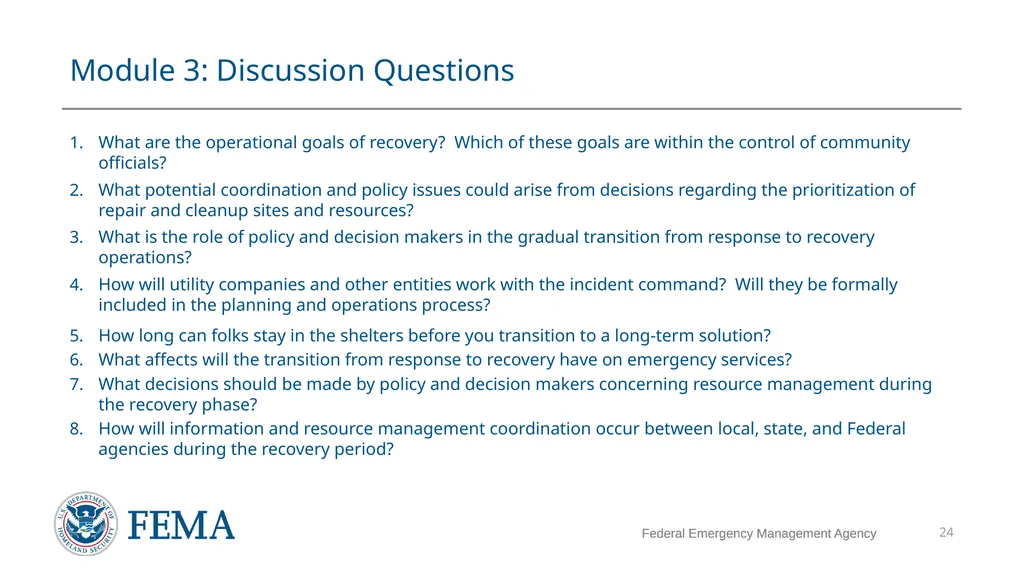
Module 3: Discussion Questions What are the operational goals of recovery? Which of these goals are within the control of community officials?
What potential coordination and policy issues could arise from decisions regarding the prioritization of repair and cleanup sites and resources?
What is the role of policy and decision makers in the gradual transition from response to recovery operations?
How will utility companies and other entities work with the incident command? Will they be formally included in the planning and operations process?
How long can folks stay in the shelters before you transition to a long-term solution?
What affects will the transition from response to recovery have on emergency services?
What decisions should be made by policy and decision makers concerning resource management during the recovery phase?
How will information and resource management coordination occur between local, state, and Federal agencies during the recovery period? Federal Emergency Management Agency 24<br>
What potential coordination and policy issues could arise from decisions regarding the prioritization of repair and cleanup sites and resources?
What is the role of policy and decision makers in the gradual transition from response to recovery operations?
How will utility companies and other entities work with the incident command? Will they be formally included in the planning and operations process?
How long can folks stay in the shelters before you transition to a long-term solution?
What affects will the transition from response to recovery have on emergency services?
What decisions should be made by policy and decision makers concerning resource management during the recovery phase?
How will information and resource management coordination occur between local, state, and Federal agencies during the recovery period? Federal Emergency Management Agency 24<br>
25
Module 3: Brief Out EMI will facilitate the brief out discussion from each site.
Please keep each brief out concise, and to the point.
Please feel free to ask questions. Federal Emergency Management Agency 25<br>
Please keep each brief out concise, and to the point.
Please feel free to ask questions. Federal Emergency Management Agency 25<br>
26
Lessons Learned
Actions for Follow-Up
Comments/Feedback
Credit/Certificate ENDEX 26<br>
Actions for Follow-Up
Comments/Feedback
Credit/Certificate ENDEX 26<br>
27
Contact Slide Option 2<br>
28
Thank you for participating.<br>