
Fermentation Author: Multiple Authors Citation:
CP
Published · 21 slides · 0 views
1 / 1






Description
Fermentation Author: Multiple Authors Citation: Multiple Authors. 2012. Fermentation. Publication Date: November 2012 American Society For Microbiology Peptone Media with Phenol Red IndicatorPeptone media with phenol red indicator. From
Related Topics
Share
Embed code
Download this presentation From Below
"Fermentation Author: Multiple Authors Citation:" is the property of its rightful owner. Permission is granted to download and print the materials on this website for personal, non-commercial use only, and to display it on your personal computer provided you do not modify the materials and that you retain all copyright notices contained in the materials. By downloading content from our website, you accept the terms of this agreement.
Presentation Transcript
01
Fermentation Author: Multiple Authors
Citation: Multiple Authors. 2012. Fermentation.
Publication Date: November 2012<br>
Citation: Multiple Authors. 2012. Fermentation.
Publication Date: November 2012<br>
02
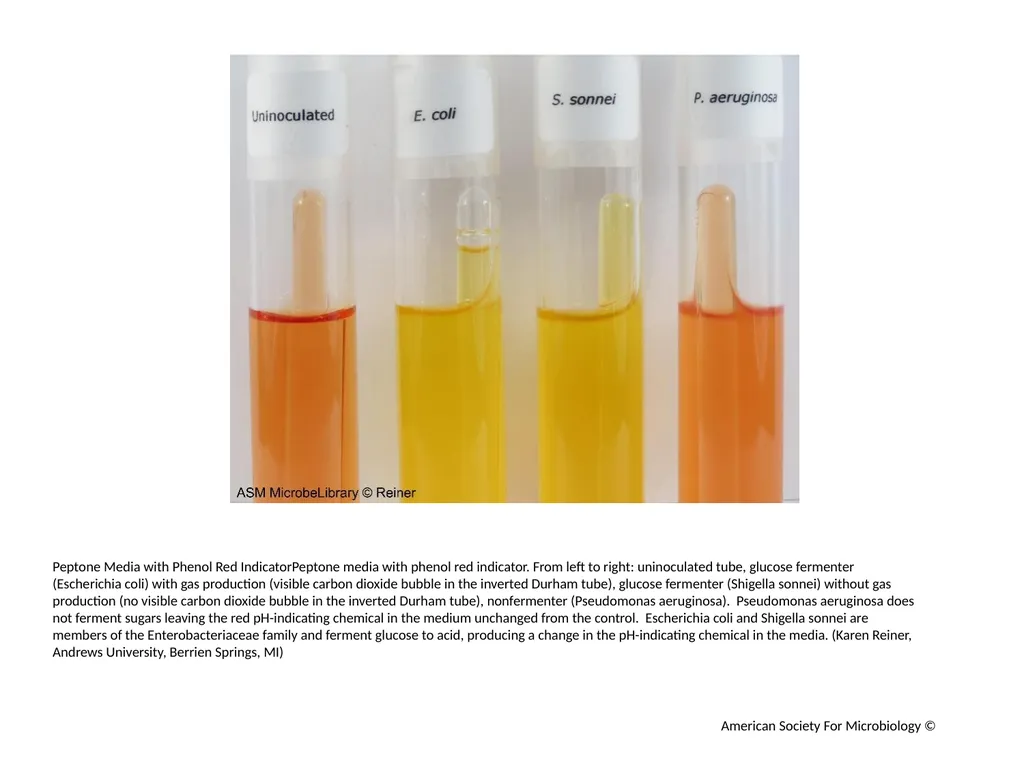
American Society For Microbiology © Peptone Media with Phenol Red IndicatorPeptone media with phenol red indicator. From left to right: uninoculated tube, glucose fermenter (Escherichia coli) with gas production (visible carbon dioxide bubble in the inverted Durham tube), glucose fermenter (Shigella sonnei) without gas production (no visible carbon dioxide bubble in the inverted Durham tube), nonfermenter (Pseudomonas aeruginosa). Pseudomonas aeruginosa does not ferment sugars leaving the red pH-indicating chemical in the medium unchanged from the control. Escherichia coli and Shigella sonnei are members of the Enterobacteriaceae family and ferment glucose to acid, producing a change in the pH-indicating chemical in the media. (Karen Reiner, Andrews University, Berrien Springs, MI)<br>
03
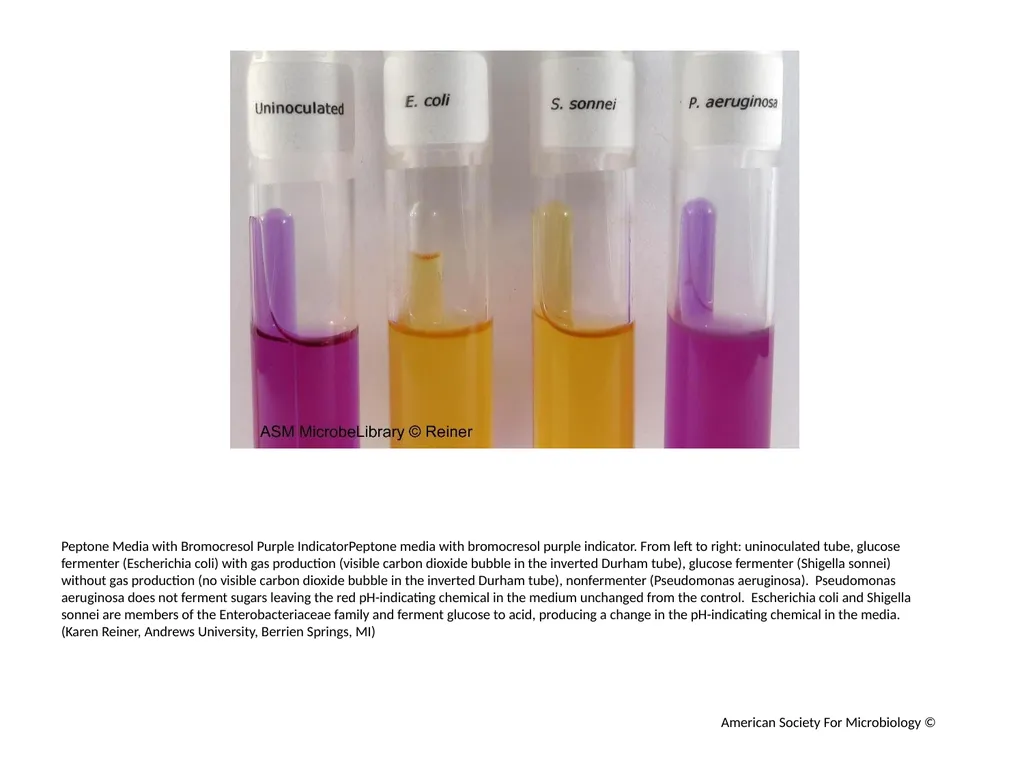
American Society For Microbiology © Peptone Media with Bromocresol Purple IndicatorPeptone media with bromocresol purple indicator. From left to right: uninoculated tube, glucose fermenter (Escherichia coli) with gas production (visible carbon dioxide bubble in the inverted Durham tube), glucose fermenter (Shigella sonnei) without gas production (no visible carbon dioxide bubble in the inverted Durham tube), nonfermenter (Pseudomonas aeruginosa). Pseudomonas aeruginosa does not ferment sugars leaving the red pH-indicating chemical in the medium unchanged from the control. Escherichia coli and Shigella sonnei are members of the Enterobacteriaceae family and ferment glucose to acid, producing a change in the pH-indicating chemical in the media. (Karen Reiner, Andrews University, Berrien Springs, MI)<br>
04
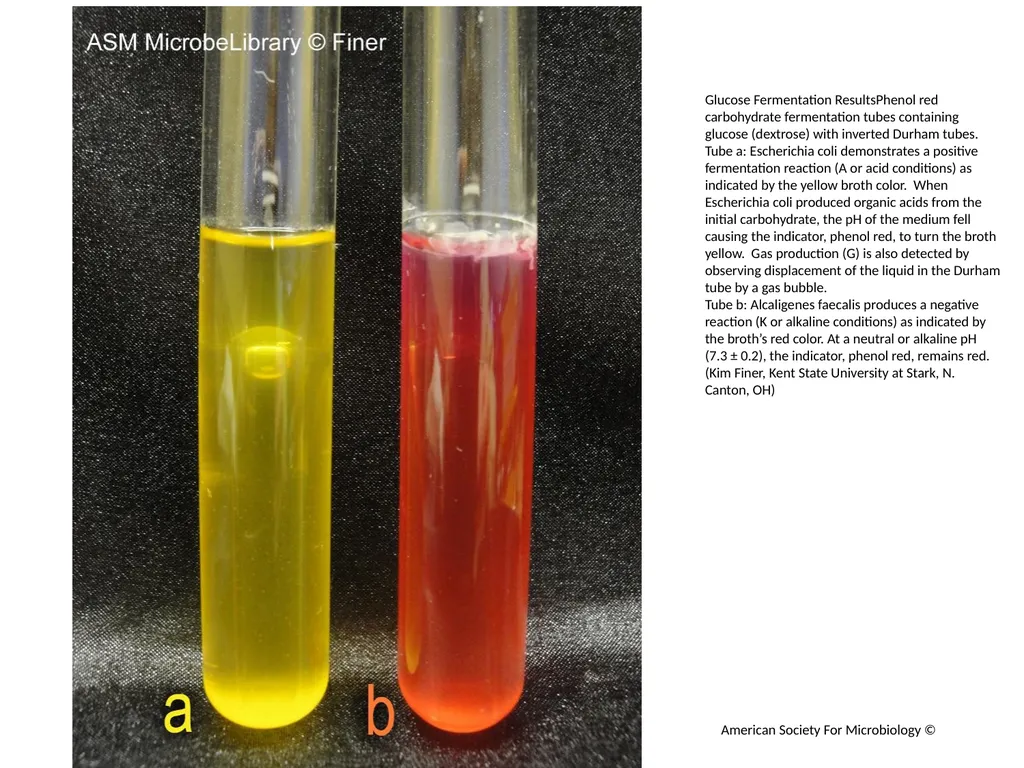
American Society For Microbiology © Glucose Fermentation ResultsPhenol red carbohydrate fermentation tubes containing glucose (dextrose) with inverted Durham tubes.
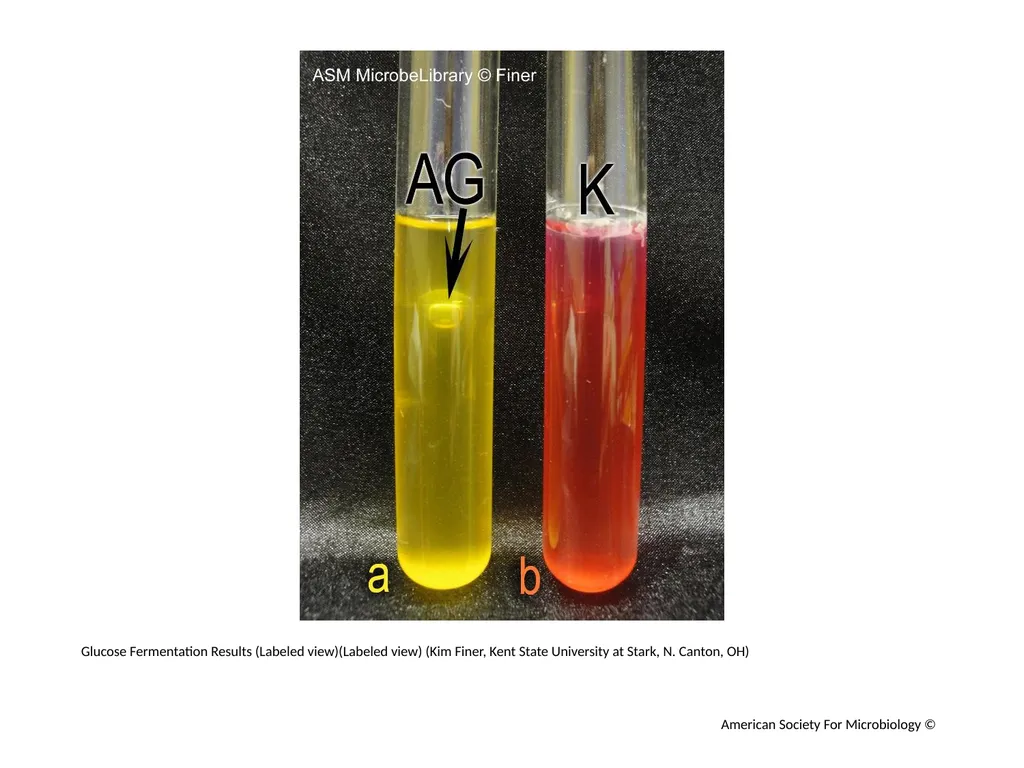
Tube a: Escherichia coli demonstrates a positive fermentation reaction (A or acid conditions) as indicated by the yellow broth color. When Escherichia coli produced organic acids from the initial carbohydrate, the pH of the medium fell causing the indicator, phenol red, to turn the broth yellow. Gas production (G) is also detected by observing displacement of the liquid in the Durham tube by a gas bubble.
Tube b: Alcaligenes faecalis produces a negative reaction (K or alkaline conditions) as indicated by the broth’s red color. At a neutral or alkaline pH (7.3 ± 0.2), the indicator, phenol red, remains red. (Kim Finer, Kent State University at Stark, N. Canton, OH)<br>
Tube a: Escherichia coli demonstrates a positive fermentation reaction (A or acid conditions) as indicated by the yellow broth color. When Escherichia coli produced organic acids from the initial carbohydrate, the pH of the medium fell causing the indicator, phenol red, to turn the broth yellow. Gas production (G) is also detected by observing displacement of the liquid in the Durham tube by a gas bubble.
Tube b: Alcaligenes faecalis produces a negative reaction (K or alkaline conditions) as indicated by the broth’s red color. At a neutral or alkaline pH (7.3 ± 0.2), the indicator, phenol red, remains red. (Kim Finer, Kent State University at Stark, N. Canton, OH)<br>
05
Glucose Fermentation Results (Labeled view)(Labeled view) (Kim Finer, Kent State University at Stark, N. Canton, OH) American Society For Microbiology ©<br>
06
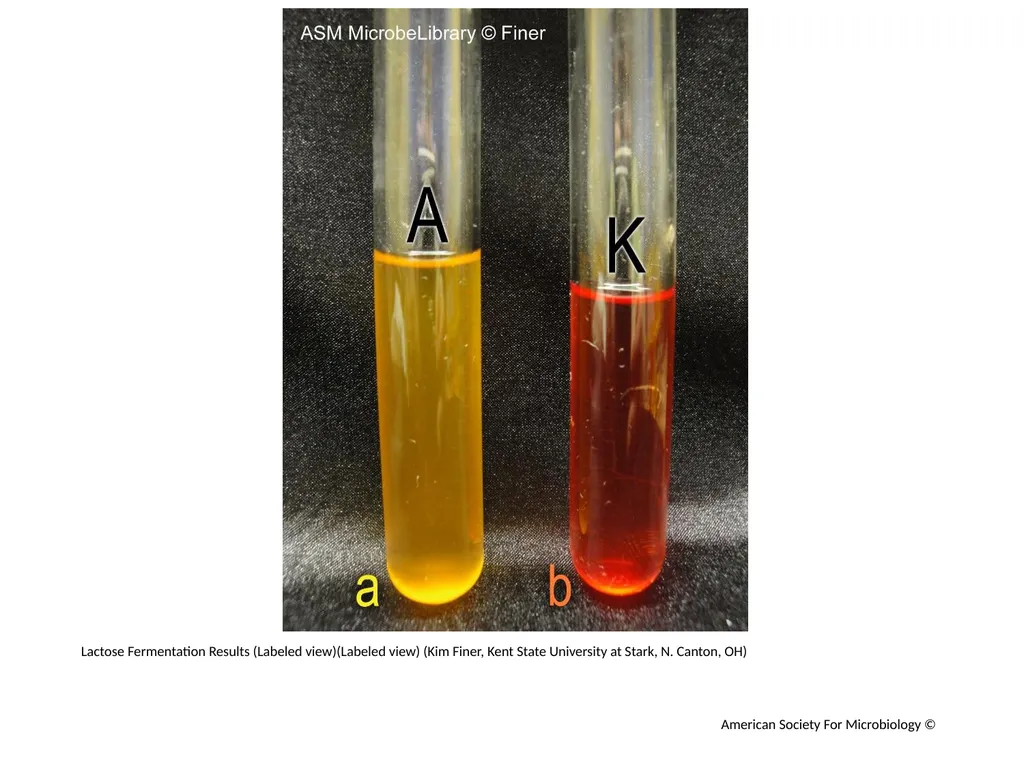
Lactose Fermentation ResultsPhenol red carbohydrate fermentation tubes containing lactose.
Tube a: Citrobacter freundii demonstrates a positive fermentation reaction (A or acid conditions) as indicated by the yellow color of the broth. When Citrobacter freundii produced organic acids from the initial carbohydrate, the pH of the medium fell causing the indicator, phenol red, to turn the broth yellow.
Tube b: Salmonella enterica serovar Typhimurium produces a negative reaction (K or alkaline conditions) as indicated by the broth's red color. At a neutral or alkaline pH (7.3 ± 0.2), the indicator, phenol red, remains red. (Kim Finer, Kent State University at Stark, N. Canton, OH) American Society For Microbiology ©<br>
Tube a: Citrobacter freundii demonstrates a positive fermentation reaction (A or acid conditions) as indicated by the yellow color of the broth. When Citrobacter freundii produced organic acids from the initial carbohydrate, the pH of the medium fell causing the indicator, phenol red, to turn the broth yellow.
Tube b: Salmonella enterica serovar Typhimurium produces a negative reaction (K or alkaline conditions) as indicated by the broth's red color. At a neutral or alkaline pH (7.3 ± 0.2), the indicator, phenol red, remains red. (Kim Finer, Kent State University at Stark, N. Canton, OH) American Society For Microbiology ©<br>
07
Lactose Fermentation Results (Labeled view)(Labeled view) (Kim Finer, Kent State University at Stark, N. Canton, OH) American Society For Microbiology ©<br>
08
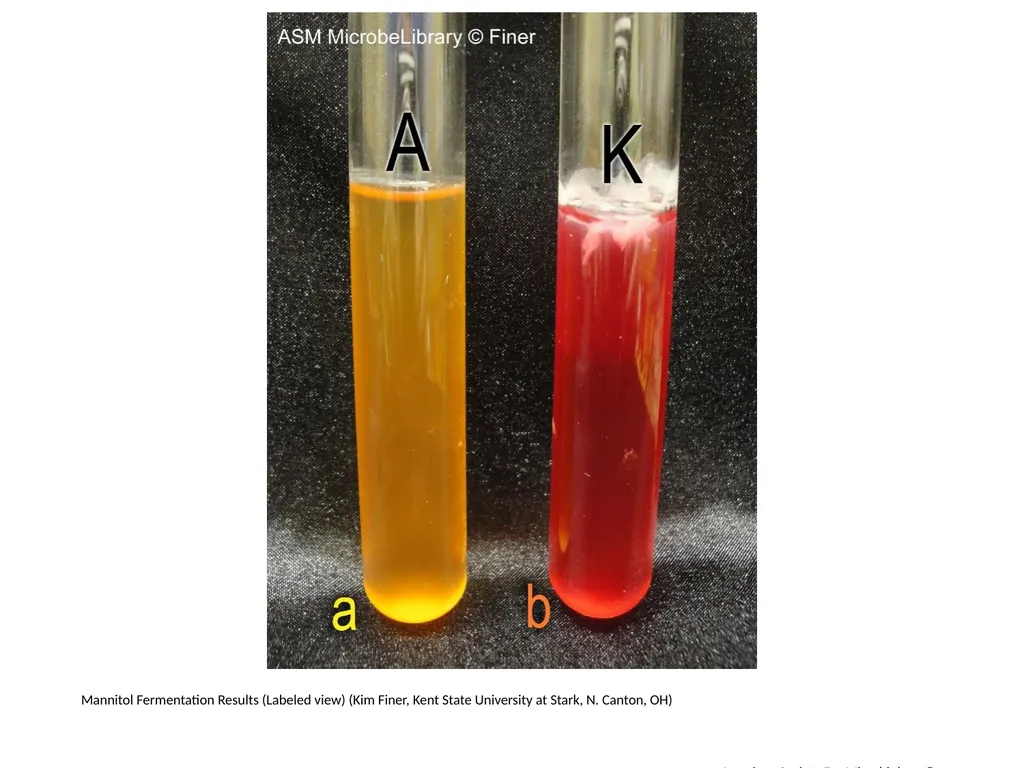
Mannitol Fermentation Results (Labeled view) (Kim Finer, Kent State University at Stark, N. Canton, OH) American Society For Microbiology ©<br>
09
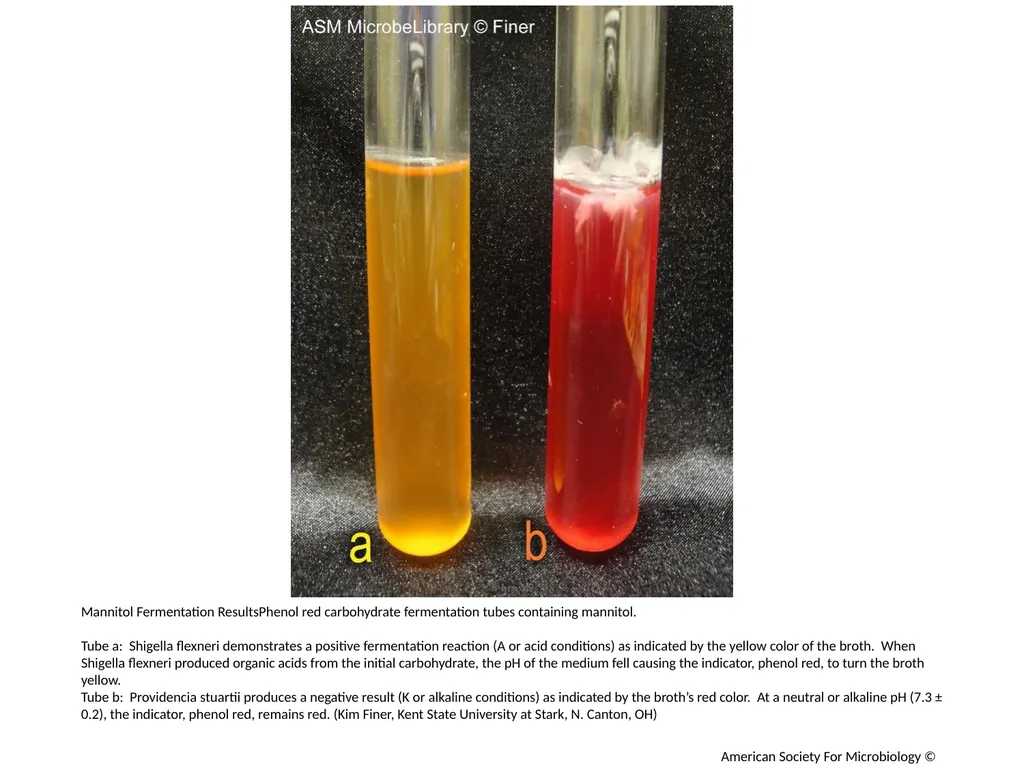
Mannitol Fermentation ResultsPhenol red carbohydrate fermentation tubes containing mannitol.
Tube a: Shigella flexneri demonstrates a positive fermentation reaction (A or acid conditions) as indicated by the yellow color of the broth. When Shigella flexneri produced organic acids from the initial carbohydrate, the pH of the medium fell causing the indicator, phenol red, to turn the broth yellow.
Tube b: Providencia stuartii produces a negative result (K or alkaline conditions) as indicated by the broth’s red color. At a neutral or alkaline pH (7.3 ± 0.2), the indicator, phenol red, remains red. (Kim Finer, Kent State University at Stark, N. Canton, OH) American Society For Microbiology ©<br>
Tube a: Shigella flexneri demonstrates a positive fermentation reaction (A or acid conditions) as indicated by the yellow color of the broth. When Shigella flexneri produced organic acids from the initial carbohydrate, the pH of the medium fell causing the indicator, phenol red, to turn the broth yellow.
Tube b: Providencia stuartii produces a negative result (K or alkaline conditions) as indicated by the broth’s red color. At a neutral or alkaline pH (7.3 ± 0.2), the indicator, phenol red, remains red. (Kim Finer, Kent State University at Stark, N. Canton, OH) American Society For Microbiology ©<br>
10
Escherichia coli in a TSI Slant
Escherichia coli in a triple sugar iron (TSI) slant. This medium contains glucose, lactose, and sucrose. Escherichia coli
ferments glucose and lactose producing acid and carbon dioxide. Acid causes the phenol red indicator in the agar to turn yellow. Carbon dioxide is observed as bubbles or cracks in the agar. There is no hydrogen sulfide production, as indicated by the lack of black precipitate in the agar. (Diane Hartman, Baylor University, Waco, TX) American Society For Microbiology ©<br>
Escherichia coli in a triple sugar iron (TSI) slant. This medium contains glucose, lactose, and sucrose. Escherichia coli
ferments glucose and lactose producing acid and carbon dioxide. Acid causes the phenol red indicator in the agar to turn yellow. Carbon dioxide is observed as bubbles or cracks in the agar. There is no hydrogen sulfide production, as indicated by the lack of black precipitate in the agar. (Diane Hartman, Baylor University, Waco, TX) American Society For Microbiology ©<br>
11
Alcaligenes faecalis in a TSI Slant
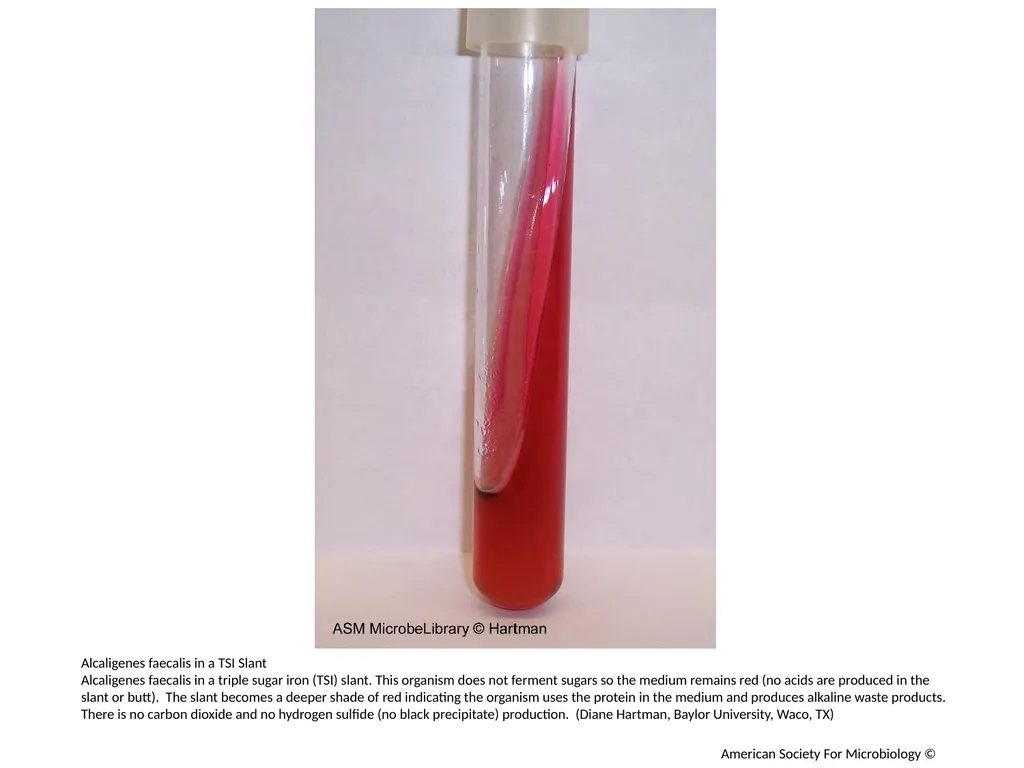
Alcaligenes faecalis in a triple sugar iron (TSI) slant. This organism does not ferment sugars so the medium remains red (no acids are produced in the slant or butt). The slant becomes a deeper shade of red indicating the organism uses the protein in the medium and produces alkaline waste products. There is no carbon dioxide and no hydrogen sulfide (no black precipitate) production. (Diane Hartman, Baylor University, Waco, TX) American Society For Microbiology ©<br>
Alcaligenes faecalis in a triple sugar iron (TSI) slant. This organism does not ferment sugars so the medium remains red (no acids are produced in the slant or butt). The slant becomes a deeper shade of red indicating the organism uses the protein in the medium and produces alkaline waste products. There is no carbon dioxide and no hydrogen sulfide (no black precipitate) production. (Diane Hartman, Baylor University, Waco, TX) American Society For Microbiology ©<br>
12
Proteus vulgaris in a TSI Slant
Proteus vulgaris in a triple sugar iron (TSI) slant. This organism ferments glucose and sucrose. Acid causes the phenol red indicator in the agar to turn yellow. There is a small carbon dioxide bubble in the bottom right area of the tube. The black precipitate indicates hydrogen sulfide was produced. (Diane Hartman, Baylor University, Waco, TX) American Society For Microbiology ©<br>
Proteus vulgaris in a triple sugar iron (TSI) slant. This organism ferments glucose and sucrose. Acid causes the phenol red indicator in the agar to turn yellow. There is a small carbon dioxide bubble in the bottom right area of the tube. The black precipitate indicates hydrogen sulfide was produced. (Diane Hartman, Baylor University, Waco, TX) American Society For Microbiology ©<br>
13
Proteus mirabilis in a TSI Slant
Proteus mirabilis in a triple sugar iron (TSI) slant. This organism ferments only glucose, indicated by the red coloring of the agar. The slant is red due to depletion of glucose and the subsequent digestion of proteins in the agar. There is a large carbon dioxide bubble in the bottom right area of the tube, and the black precipitate indicates hydrogen sulfide was produced. (Diane Hartman, Baylor University, Waco, TX) American Society For Microbiology ©<br>
Proteus mirabilis in a triple sugar iron (TSI) slant. This organism ferments only glucose, indicated by the red coloring of the agar. The slant is red due to depletion of glucose and the subsequent digestion of proteins in the agar. There is a large carbon dioxide bubble in the bottom right area of the tube, and the black precipitate indicates hydrogen sulfide was produced. (Diane Hartman, Baylor University, Waco, TX) American Society For Microbiology ©<br>
14
Morganella morganii in a TSI Slant
Morganella morganii in a triple sugar iron (TSI) slant. This organism ferments only glucose, indicated by the red coloring of the agar. The slant is red due to depletion of glucose and the subsequent digestion of proteins in the agar. There is a large carbon dioxide bubble in the bottom right area of the tube, and the black precipitate indicates hydrogen sulfide was produced. (Diane Hartman, Baylor University, Waco, TX) American Society For Microbiology ©<br>
Morganella morganii in a triple sugar iron (TSI) slant. This organism ferments only glucose, indicated by the red coloring of the agar. The slant is red due to depletion of glucose and the subsequent digestion of proteins in the agar. There is a large carbon dioxide bubble in the bottom right area of the tube, and the black precipitate indicates hydrogen sulfide was produced. (Diane Hartman, Baylor University, Waco, TX) American Society For Microbiology ©<br>
15
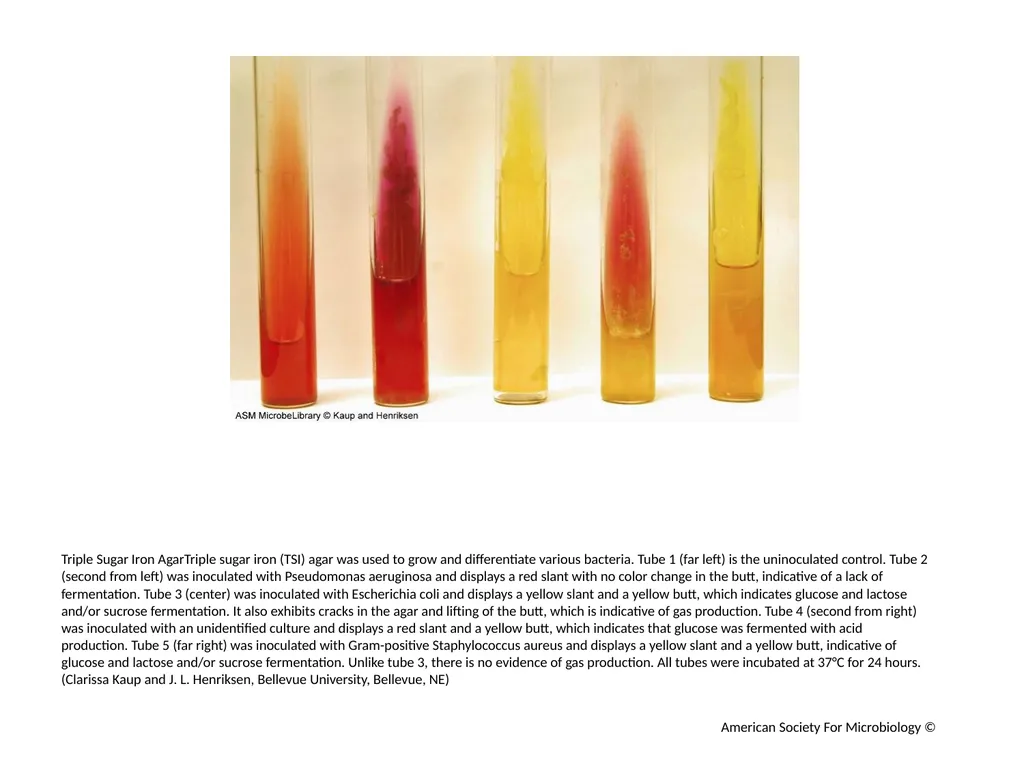
American Society For Microbiology © Triple Sugar Iron AgarTriple sugar iron (TSI) agar was used to grow and differentiate various bacteria. Tube 1 (far left) is the uninoculated control. Tube 2 (second from left) was inoculated with Pseudomonas aeruginosa and displays a red slant with no color change in the butt, indicative of a lack of fermentation. Tube 3 (center) was inoculated with Escherichia coli and displays a yellow slant and a yellow butt, which indicates glucose and lactose and/or sucrose fermentation. It also exhibits cracks in the agar and lifting of the butt, which is indicative of gas production. Tube 4 (second from right) was inoculated with an unidentified culture and displays a red slant and a yellow butt, which indicates that glucose was fermented with acid production. Tube 5 (far right) was inoculated with Gram-positive Staphylococcus aureus and displays a yellow slant and a yellow butt, indicative of glucose and lactose and/or sucrose fermentation. Unlike tube 3, there is no evidence of gas production. All tubes were incubated at 37°C for 24 hours. (Clarissa Kaup and J. L. Henriksen, Bellevue University, Bellevue, NE)<br>
16
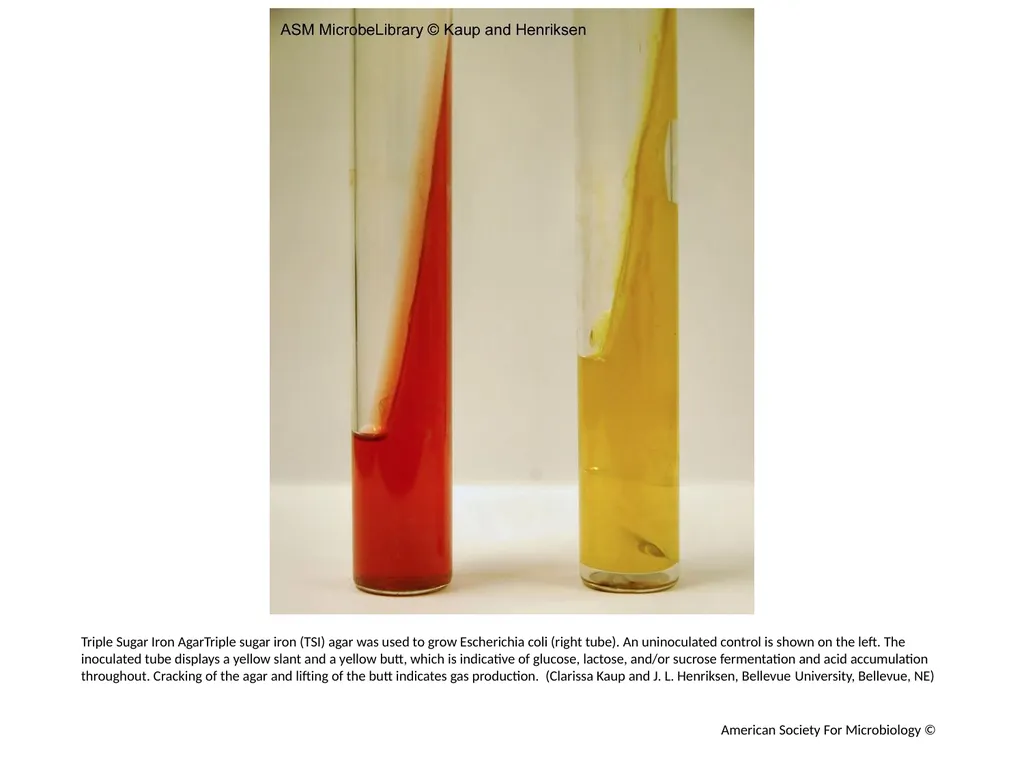
Triple Sugar Iron AgarTriple sugar iron (TSI) agar was used to grow Escherichia coli (right tube). An uninoculated control is shown on the left. The inoculated tube displays a yellow slant and a yellow butt, which is indicative of glucose, lactose, and/or sucrose fermentation and acid accumulation throughout. Cracking of the agar and lifting of the butt indicates gas production. (Clarissa Kaup and J. L. Henriksen, Bellevue University, Bellevue, NE) American Society For Microbiology ©<br>
17
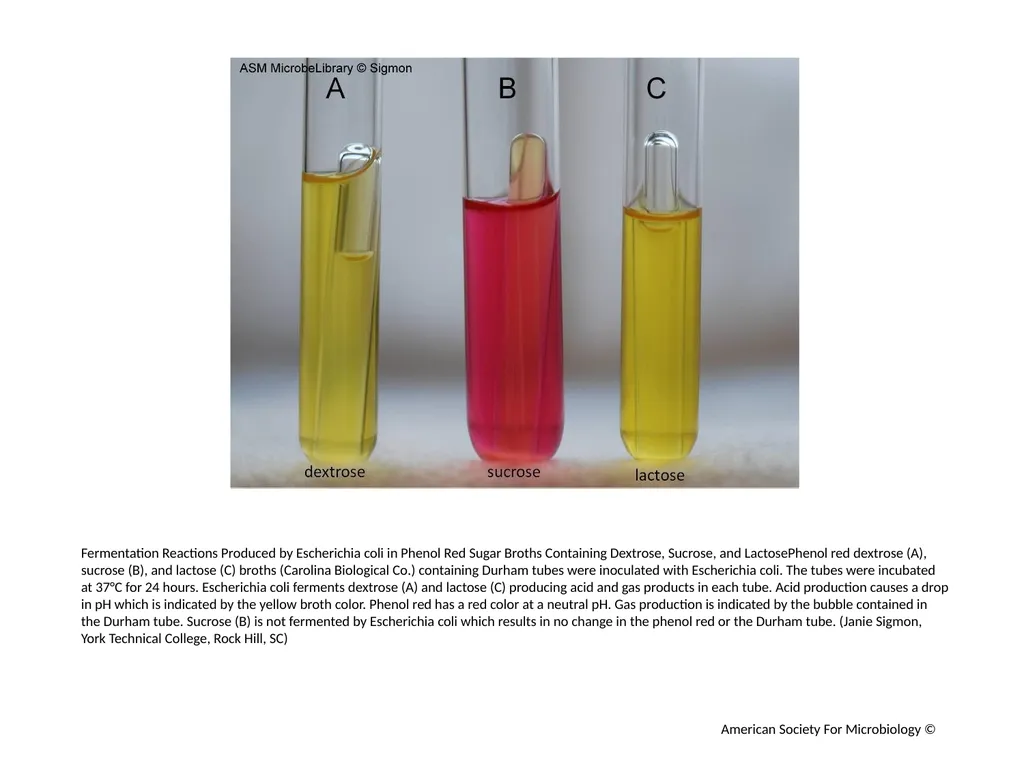
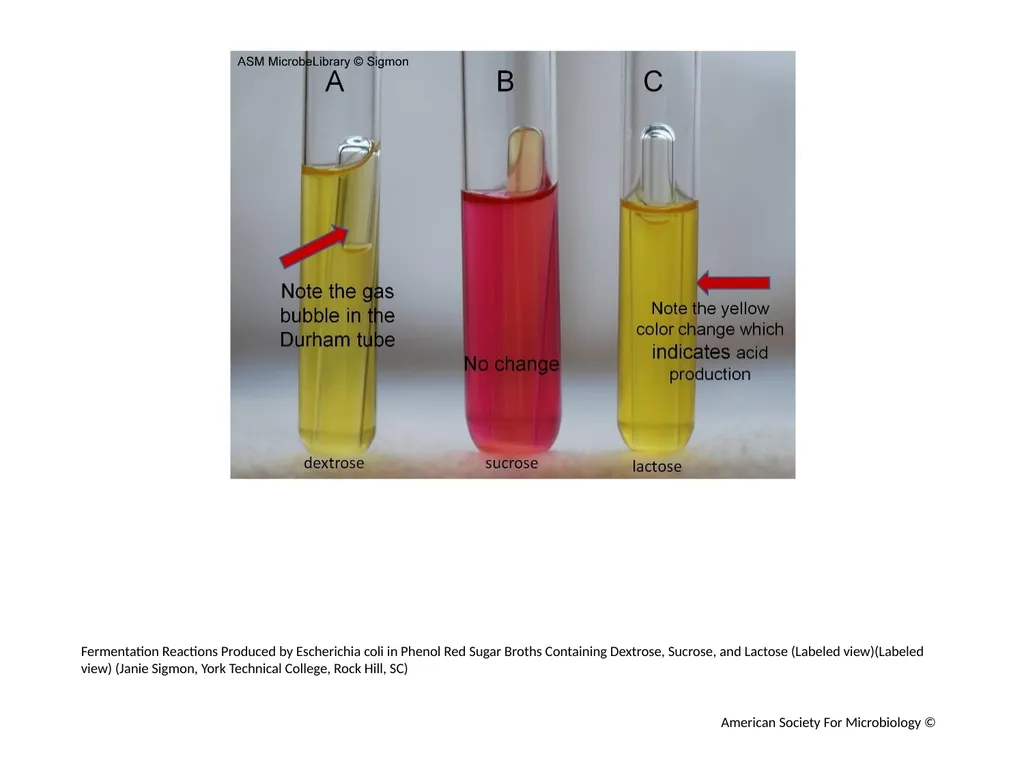
American Society For Microbiology © Fermentation Reactions Produced by Escherichia coli in Phenol Red Sugar Broths Containing Dextrose, Sucrose, and LactosePhenol red dextrose (A), sucrose (B), and lactose (C) broths (Carolina Biological Co.) containing Durham tubes were inoculated with Escherichia coli. The tubes were incubated at 37°C for 24 hours. Escherichia coli ferments dextrose (A) and lactose (C) producing acid and gas products in each tube. Acid production causes a drop in pH which is indicated by the yellow broth color. Phenol red has a red color at a neutral pH. Gas production is indicated by the bubble contained in the Durham tube. Sucrose (B) is not fermented by Escherichia coli which results in no change in the phenol red or the Durham tube. (Janie Sigmon, York Technical College, Rock Hill, SC)<br>
18
Fermentation Reactions Produced by Escherichia coli in Phenol Red Sugar Broths Containing Dextrose, Sucrose, and Lactose (Labeled view)(Labeled view) (Janie Sigmon, York Technical College, Rock Hill, SC) American Society For Microbiology ©<br>
19
Proteus vulgaris Carbohydrate Fermentation
Proteus vulgaris carbohydrate fermentation. (A) The yellow color of the phenol red glucose broth indicates acid production with no gas (no bubble in the Durham tube). (B) The red color of the phenol red lactose broth indicates no acid production but growth is visible. (C) The yellow color of the phenol red sucrose broth indicates acid production; gas production is evident from the bubble in the Durham tube. (Tasha Sturm, Cabrillo College, Aptos, CA) American Society For Microbiology ©<br>
Proteus vulgaris carbohydrate fermentation. (A) The yellow color of the phenol red glucose broth indicates acid production with no gas (no bubble in the Durham tube). (B) The red color of the phenol red lactose broth indicates no acid production but growth is visible. (C) The yellow color of the phenol red sucrose broth indicates acid production; gas production is evident from the bubble in the Durham tube. (Tasha Sturm, Cabrillo College, Aptos, CA) American Society For Microbiology ©<br>
20
Proteus vulgaris Carbohydrate Fermentation (Labeled view)(Labeled view) (Tasha Sturm, Cabrillo College, Aptos, CA) American Society For Microbiology ©<br>
21
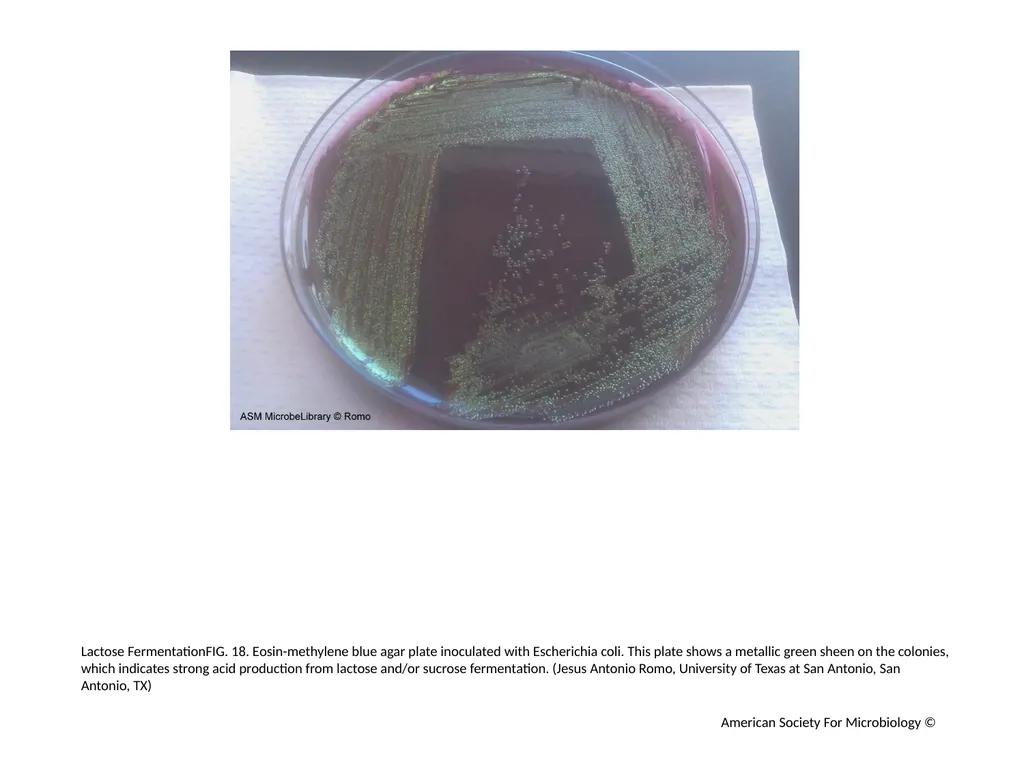
Lactose FermentationFIG. 18. Eosin-methylene blue agar plate inoculated with Escherichia coli. This plate shows a metallic green sheen on the colonies, which indicates strong acid production from lactose and/or sucrose fermentation. (Jesus Antonio Romo, University of Texas at San Antonio, San Antonio, TX) American Society For Microbiology ©<br>