Fiasco rules Troy Williamson Get into groups of 3-5 and grab ONE laptop for your group. Then go onto the website, www.catchyourhare.com diceroller Lesson outline: Overview of Fiasco Summary Fiasco: Setup Playing the game Act One Summary
"Fiasco rules Troy Williamson Get into groups of" is the property of its rightful owner. Permission is granted to
download and print the materials on this website for personal, non-commercial use only, and to display it
on your personal computer provided you do not modify the materials and that you retain all copyright
notices contained in the materials. By downloading content from our website, you accept the terms of this
agreement.
Share
Embed code
Presentation Transcript
01
Fiasco rules Troy Williamson Get into groups of 3-5 and grab ONE laptop for your group.
Then go onto the website, www.catchyourhare.com/ diceroller/<br>
02
Lesson outline: Overview of Fiasco
Summary
Fiasco:
Setup
Playing the game – Act One<br>
03
Summary Fiasco is a highly collaborative game in which every player should always be engaged – either actively playing a character or throwing out suggestions, brainstorming scene ideas and listening for ways to make each scene hit harder than the last. Because the pace is so frantic, every choice you make has to matter a lot.
A game of Fiasco begins with The Setup – a group activity where you and your friends create a potent and unstable set of circumstances.
First, choose a Playset, which fixes the game in a particular time and place. Then, using a pile of dice, create an interconnected circle of Relationships and Details pulled from the Playset. Once you’ve created a situation poised on the brink of juicy disaster, you create your characters based on your choices.<br>
04
Importance of collaboration/enthusiasm In order for this game to work well, it is important that you collaborate and are enthusiastic.
The more you collaborate and are enthusiastic, the more involved you will all be with your group’s story and the more fun you will have.<br>
05
Disclaimer If you are not interested in trying this game, you are more than welcome to write a narrative instead.
This game is simply a little experiment of mine to try something fun and engaging, but I understand it might not be for everyone.
However, please make your character before you opt out, as it might help convince you otherwise.<br>
06
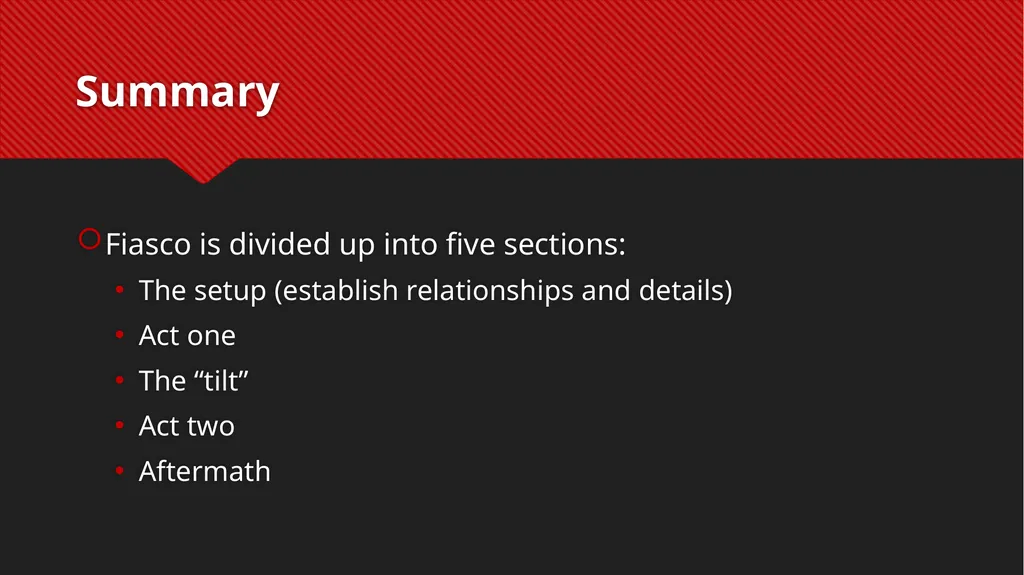
Summary Fiasco is divided up into five sections:
The setup (establish relationships and details)
Act one
The “tilt”
Act two
Aftermath<br>
07
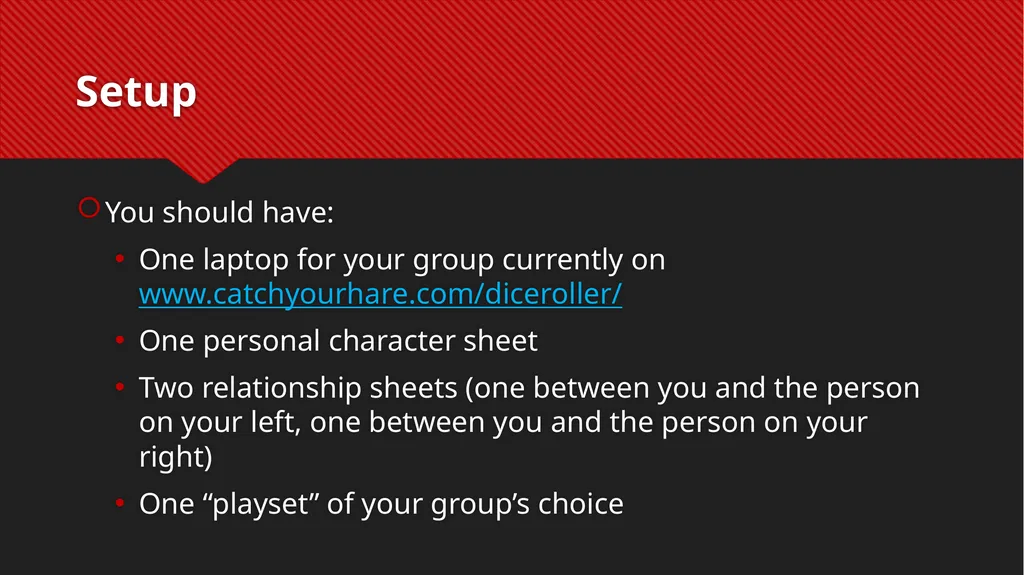
Setup You should have:
One laptop for your group currently on www.catchyourhare.com/diceroller/
One personal character sheet
Two relationship sheets (one between you and the person on your left, one between you and the person on your right)
One “playset” of your group’s choice<br>
08
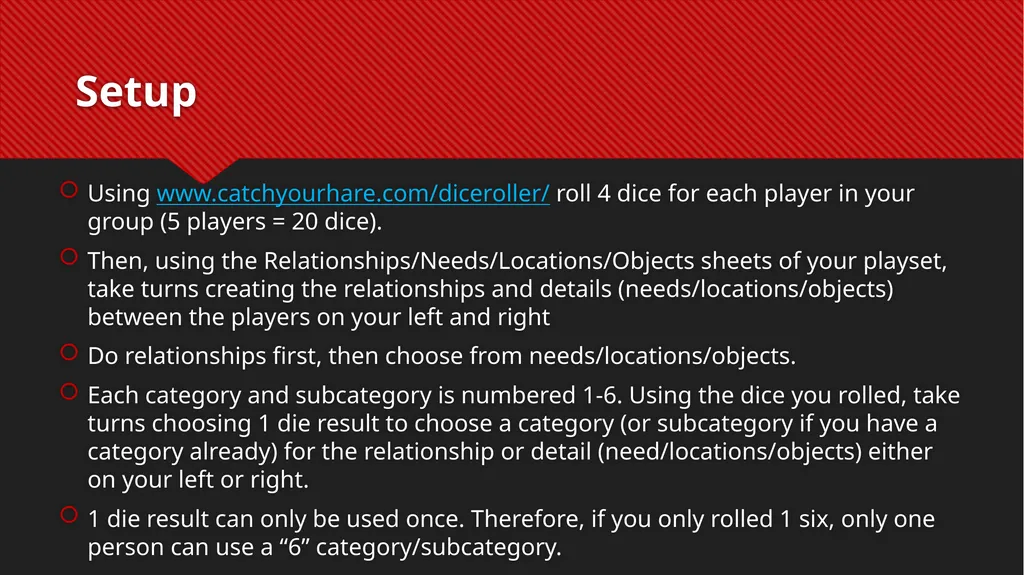
Setup Using www.catchyourhare.com/diceroller/ roll 4 dice for each player in your group (5 players = 20 dice).
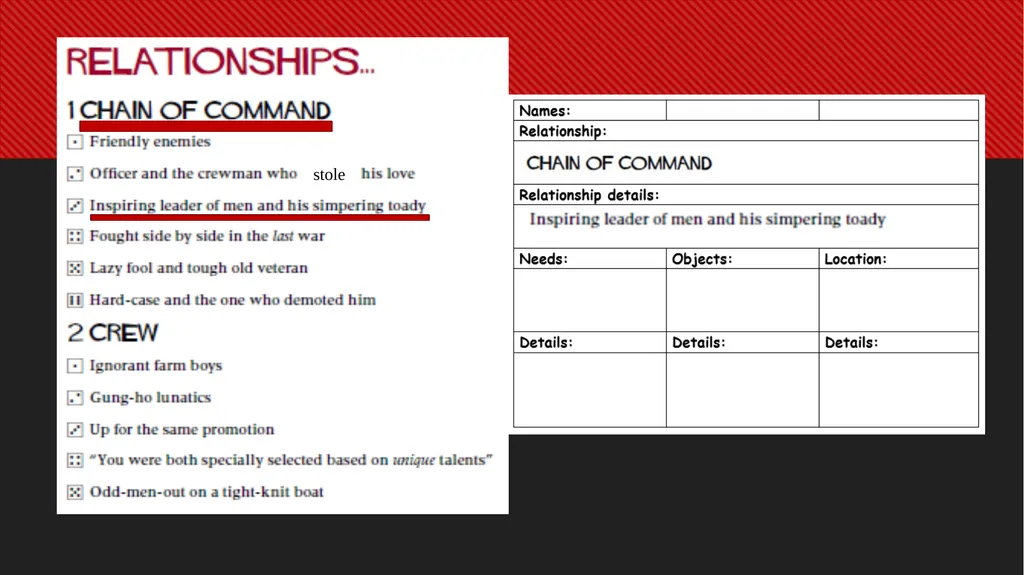
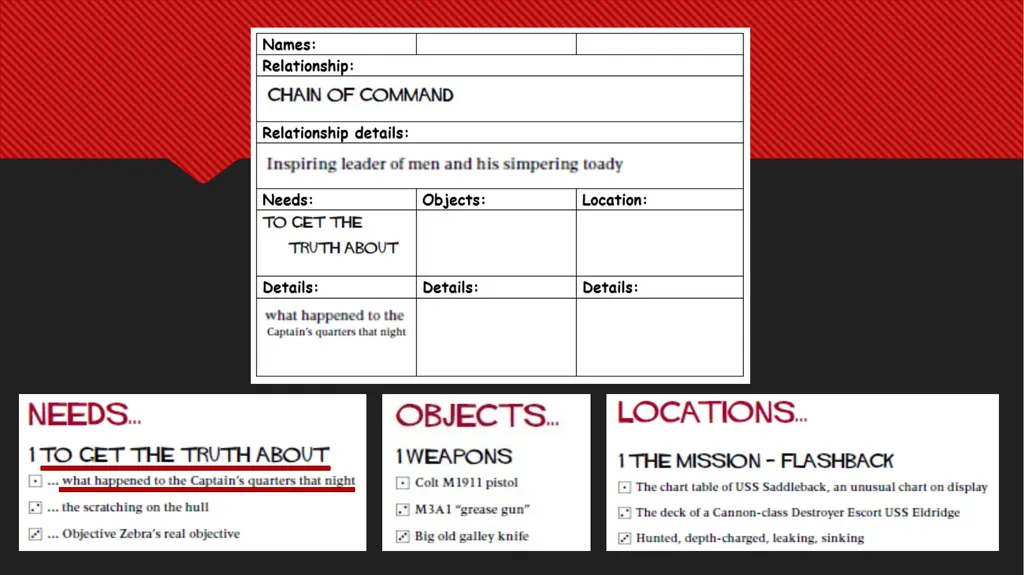
Then, using the Relationships/Needs/Locations/Objects sheets of your playset, take turns creating the relationships and details (needs/locations/objects) between the players on your left and right
Do relationships first, then choose from needs/locations/objects.
Each category and subcategory is numbered 1-6. Using the dice you rolled, take turns choosing 1 die result to choose a category (or subcategory if you have a category already) for the relationship or detail (need/locations/objects) either on your left or right.
1 die result can only be used once. Therefore, if you only rolled 1 six, only one person can use a “6” category/subcategory.<br>
09
stole<br>
10
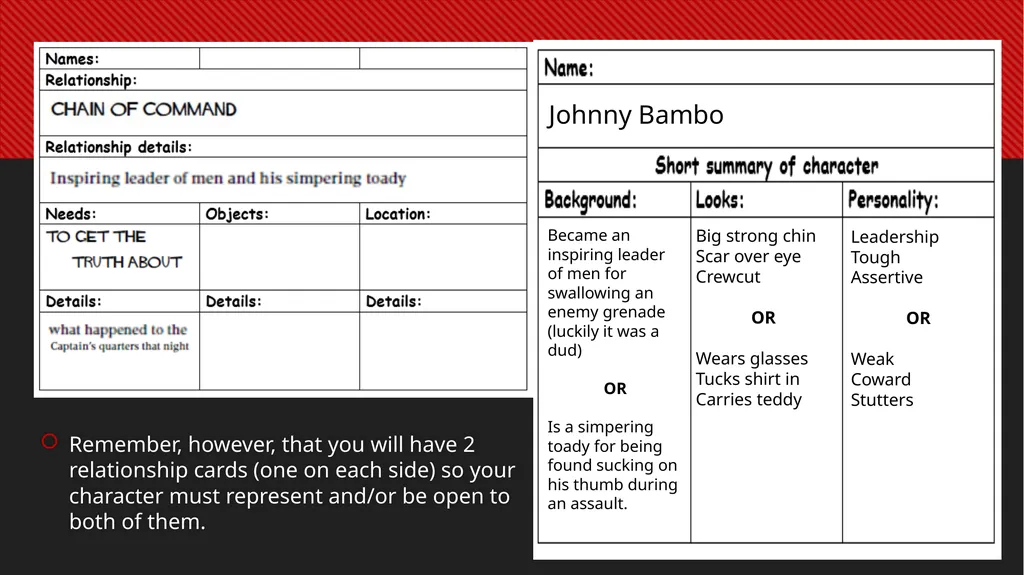
Remember, however, that you will have 2 relationship cards (one on each side) so your character must represent and/or be open to both of them. Johnny Bambo Became an inspiring leader of men for swallowing an enemy grenade (luckily it was a dud)
OR
Is a simpering toady for being found sucking on his thumb during an assault. Big strong chin
Scar over eye
Crewcut
OR
Wears glasses
Tucks shirt in
Carries teddy Leadership
Tough
Assertive
OR
Weak
Coward
Stutters<br>
11
Introduction Now, before we start the game, this is a good opportunity in your groups to read your playset’s “score” and introduce your characters.
Learning the “score” and getting to know each other’s characters will make it a lot easier to have ideas for the story and create interactions between your characters.
Spend a few minutes now reading out the score and taking turns to introduce your character (and even relationships) to your group.<br>
12
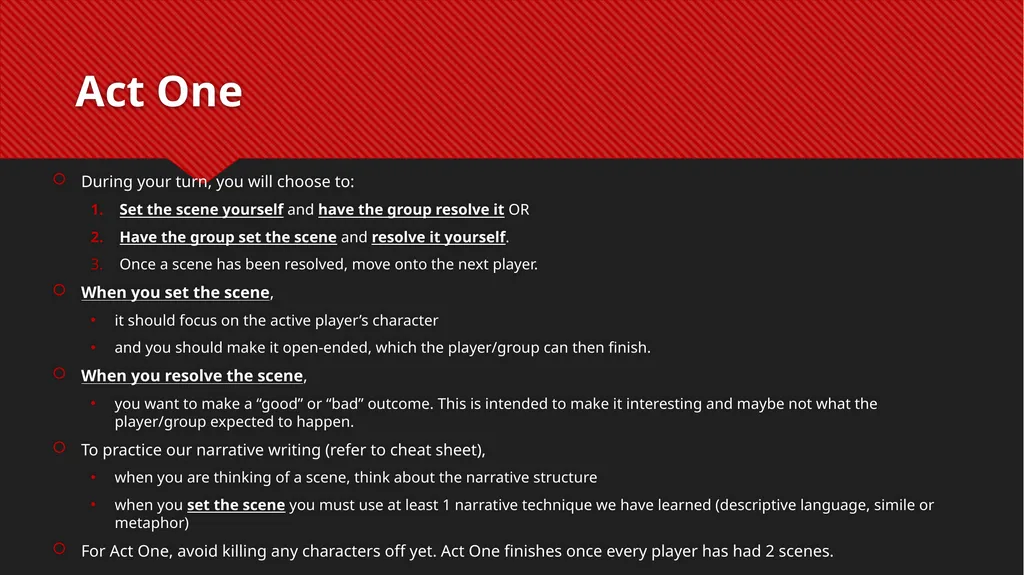
Act One During your turn, you will choose to:
Set the scene yourself and have the group resolve it OR
Have the group set the scene and resolve it yourself.
Once a scene has been resolved, move onto the next player.
When you set the scene,
it should focus on the active player’s character
and you should make it open-ended, which the player/group can then finish.
When you resolve the scene,
you want to make a “good” or “bad” outcome. This is intended to make it interesting and maybe not what the player/group expected to happen.
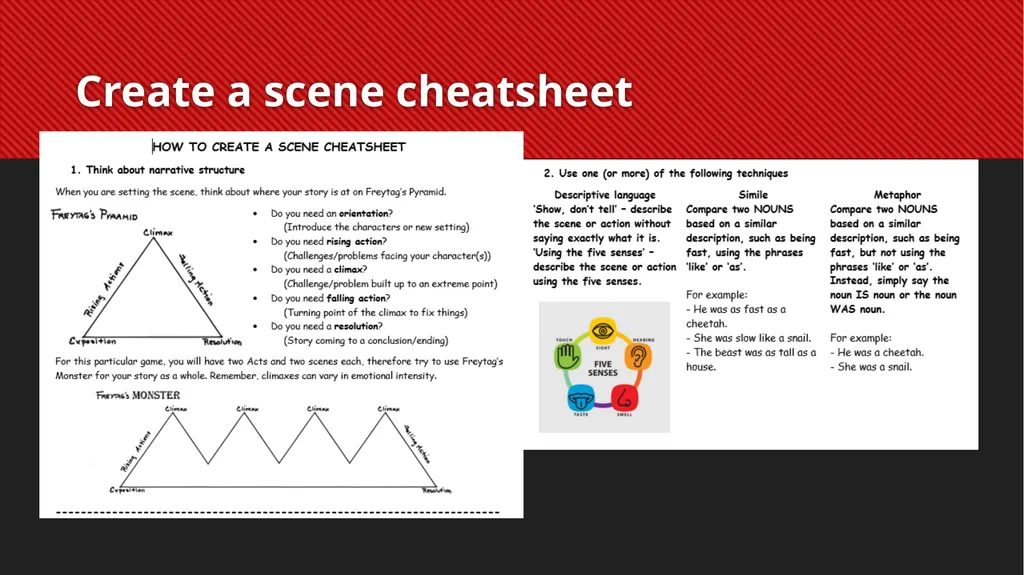
To practice our narrative writing (refer to cheat sheet),
when you are thinking of a scene, think about the narrative structure
when you set the scene you must use at least 1 narrative technique we have learned (descriptive language, simile or metaphor)
For Act One, avoid killing any characters off yet. Act One finishes once every player has had 2 scenes.<br>
13
Create a scene cheatsheet<br>
14
The Tilt Now that you have done two scenes each, the tilt is designed to shake things up a bit.
Roll the dice I have provided you, with green = category and red = subcategory.
Use these dice to then choose the categories and subcategories for your tilt conditions.
These new conditions MUST be implemented into Act Two of your story, so be sure that someone in your group writes them down.<br>
15
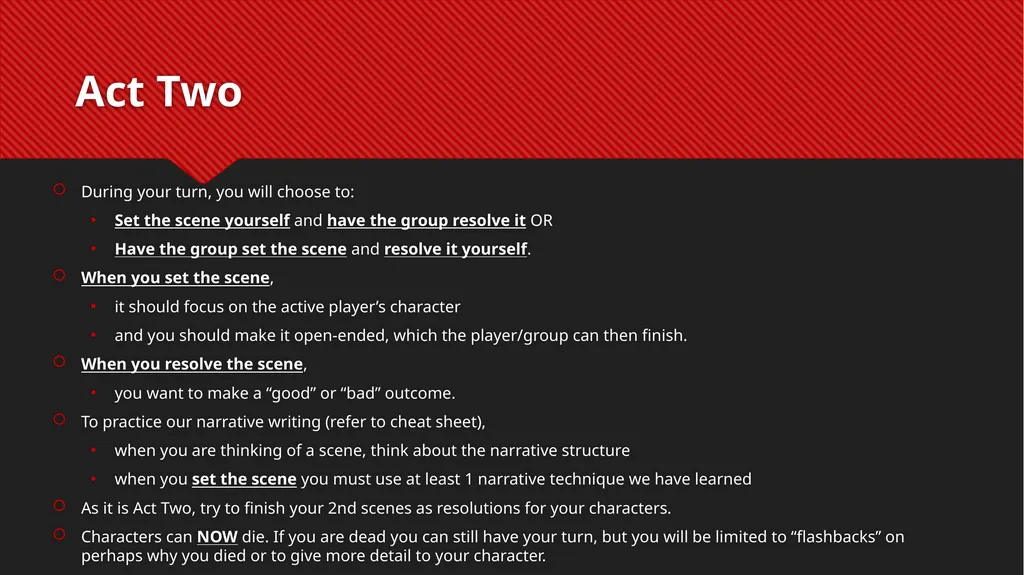
Act Two During your turn, you will choose to:
Set the scene yourself and have the group resolve it OR
Have the group set the scene and resolve it yourself.
When you set the scene,
it should focus on the active player’s character
and you should make it open-ended, which the player/group can then finish.
When you resolve the scene,
you want to make a “good” or “bad” outcome.
To practice our narrative writing (refer to cheat sheet),
when you are thinking of a scene, think about the narrative structure
when you set the scene you must use at least 1 narrative technique we have learned
As it is Act Two, try to finish your 2nd scenes as resolutions for your characters.
Characters can NOW die. If you are dead you can still have your turn, but you will be limited to “flashbacks” on perhaps why you died or to give more detail to your character.<br>
16
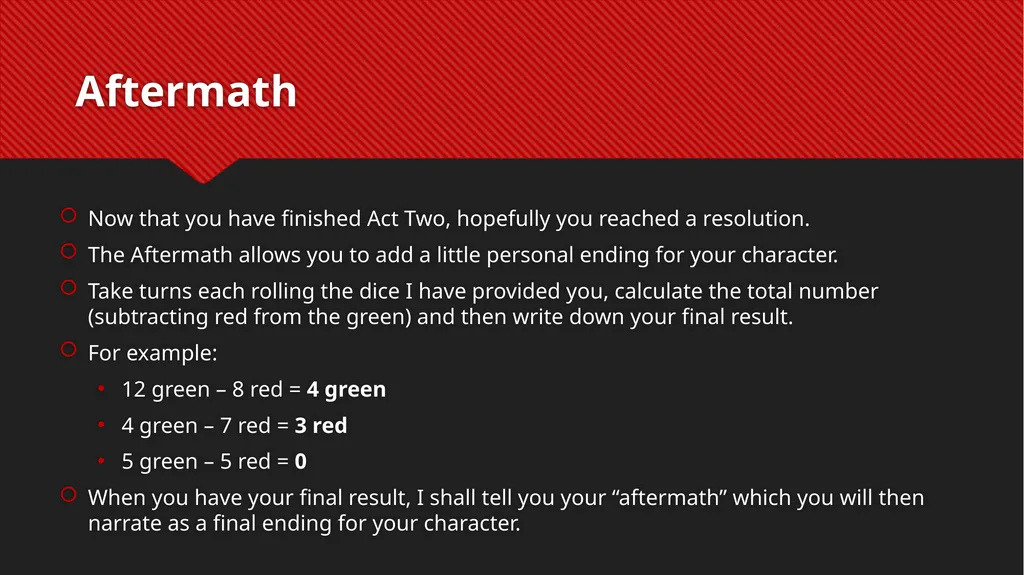
Aftermath Now that you have finished Act Two, hopefully you reached a resolution.
The Aftermath allows you to add a little personal ending for your character.
Take turns each rolling the dice I have provided you, calculate the total number (subtracting red from the green) and then write down your final result.
For example:
12 green – 8 red = 4 green
4 green – 7 red = 3 red
5 green – 5 red = 0
When you have your final result, I shall tell you your “aftermath” which you will then narrate as a final ending for your character.<br>