
Film Analysis THE SHAWSHANK REDEMPTION – frank
DJ
Published · 19 slides · 0 views

1 / 1

Description
Film Analysis THE SHAWSHANK REDEMPTION frank darabont Learning Intentions: 1. Analyse the stylistic features used by Frank Darabont to present the idea of hope in The Shawshank Redemption 2. Discuss the stylistic features used to present
Related Topics
Share
Embed code
Download this presentation From Below
"Film Analysis THE SHAWSHANK REDEMPTION – frank" is the property of its rightful owner. Permission is granted to download and print the materials on this website for personal, non-commercial use only, and to display it on your personal computer provided you do not modify the materials and that you retain all copyright notices contained in the materials. By downloading content from our website, you accept the terms of this agreement.
Presentation Transcript
01
Film Analysis
THE SHAWSHANK REDEMPTION – frank darabont Learning Intentions:
1. Analyse the stylistic features used by Frank Darabont to present the idea of hope in The Shawshank Redemption
2. Discuss the stylistic features used to present an idea (or ideas) in The Shawshank Redemption
3. Explore the stylistic features used to present different perspectives in The Shawshank Redemption<br>
1. Analyse the stylistic features used by Frank Darabont to present the idea of hope in The Shawshank Redemption
2. Discuss the stylistic features used to present an idea (or ideas) in The Shawshank Redemption
3. Explore the stylistic features used to present different perspectives in The Shawshank Redemption<br>
02
Essay questions: Analyse the stylistic features used by Frank Darabont to present the idea of hope in The Shawshank Redemption
Discuss the stylistic features used to present an idea (or ideas) in The Shawshank Redemption
Explore the stylistic features used to present different perspectives in The Shawshank Redemption<br>
Discuss the stylistic features used to present an idea (or ideas) in The Shawshank Redemption
Explore the stylistic features used to present different perspectives in The Shawshank Redemption<br>
03
You will be assessed on your ability to… demonstrate knowledge and understanding of ideas and perspectives in the text (KU1)
demonstrate knowledge and understanding of the ways the author of the text uses language features, stylistic features, and conventions (KU2)
analyse and evaluate the ways ideas, perspectives, and/or aspects of culture are represented in the text (An1)
analyse the language features, stylistic features, and conventions, and evaluate how they influence the audience (An2)
Fluently integrated use of evidence from the text to develop and support a response. (Ap 2)
Sophisticated use of accurate, clear, and fluent expression. (Ap 3)<br>
demonstrate knowledge and understanding of the ways the author of the text uses language features, stylistic features, and conventions (KU2)
analyse and evaluate the ways ideas, perspectives, and/or aspects of culture are represented in the text (An1)
analyse the language features, stylistic features, and conventions, and evaluate how they influence the audience (An2)
Fluently integrated use of evidence from the text to develop and support a response. (Ap 2)
Sophisticated use of accurate, clear, and fluent expression. (Ap 3)<br>
04
Stylistic features What are stylistic features?
- Mise-en-scene - Cinematography - Editing (relating images in a logical sequence/continuity) - Sound
While you can analyse each od these elements separately, a more insightful and complex analysis will explain how these elements combine to help create the film’s overall meaning.<br>
- Mise-en-scene - Cinematography - Editing (relating images in a logical sequence/continuity) - Sound
While you can analyse each od these elements separately, a more insightful and complex analysis will explain how these elements combine to help create the film’s overall meaning.<br>
05
Mis-en-scene Mise-en-scene means ‘staging an action’
It refers to all of the visual elements within the frame at any given point in the film
There are four elements of mise-en-scene: setting, lighting, costumes and acting style:
SETTING: A film can be shot in a studio or on location, depending on the film’s budget and how natural or realistic the director wishes the film to look.
LIGHTING: Can vary in colour, intensity and direction, creating mood and illuminating particular objects or actors while leaving other elements in the shadows
COSTUMES: include clothes worn by the actors as well as individual props, make-up and hairstyles
ACTING STYLE: this includes the actor’s body language, gestures, facial expressions, vocal pitch and tone, and pace of delivery<br>
It refers to all of the visual elements within the frame at any given point in the film
There are four elements of mise-en-scene: setting, lighting, costumes and acting style:
SETTING: A film can be shot in a studio or on location, depending on the film’s budget and how natural or realistic the director wishes the film to look.
LIGHTING: Can vary in colour, intensity and direction, creating mood and illuminating particular objects or actors while leaving other elements in the shadows
COSTUMES: include clothes worn by the actors as well as individual props, make-up and hairstyles
ACTING STYLE: this includes the actor’s body language, gestures, facial expressions, vocal pitch and tone, and pace of delivery<br>
06
cinematography This is the art of capturing images on film. The cinematographer uses all the resources of the camera to produce a varied and engaging film style that also helps the story.
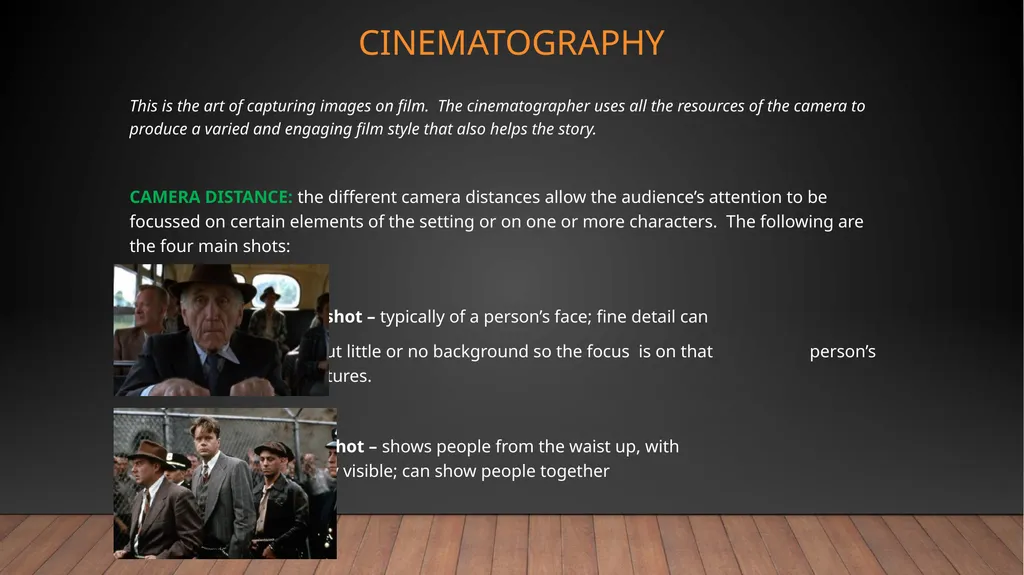
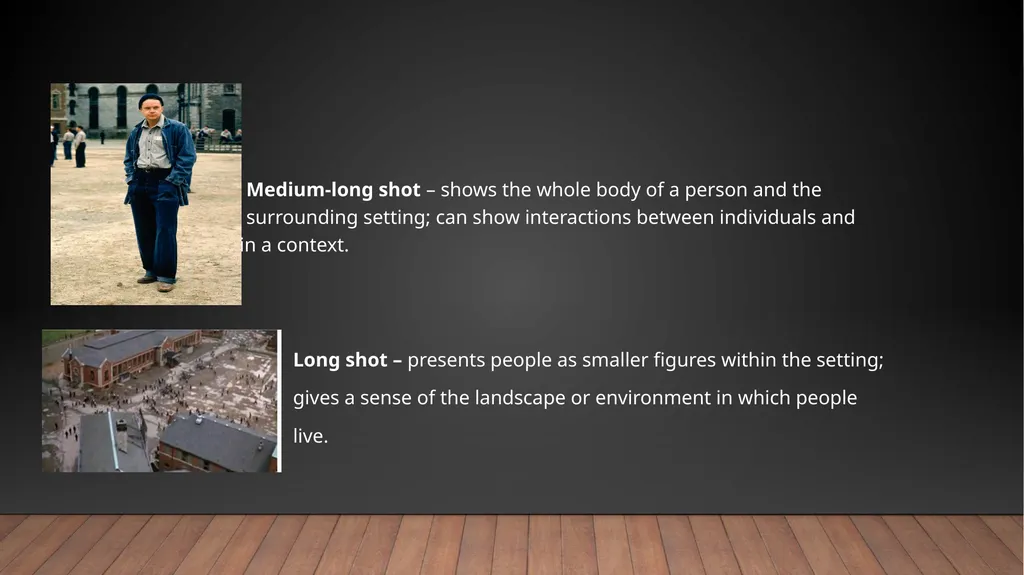
CAMERA DISTANCE: the different camera distances allow the audience’s attention to be focussed on certain elements of the setting or on one or more characters. The following are the four main shots:
Close-up shot – typically of a person’s face; fine detail can
be seen but little or no background so the focus is on that person’s facial expression and features.
Medium shot – shows people from the waist up, with background details clearly visible; can show people together<br>
CAMERA DISTANCE: the different camera distances allow the audience’s attention to be focussed on certain elements of the setting or on one or more characters. The following are the four main shots:
Close-up shot – typically of a person’s face; fine detail can
be seen but little or no background so the focus is on that person’s facial expression and features.
Medium shot – shows people from the waist up, with background details clearly visible; can show people together<br>
07
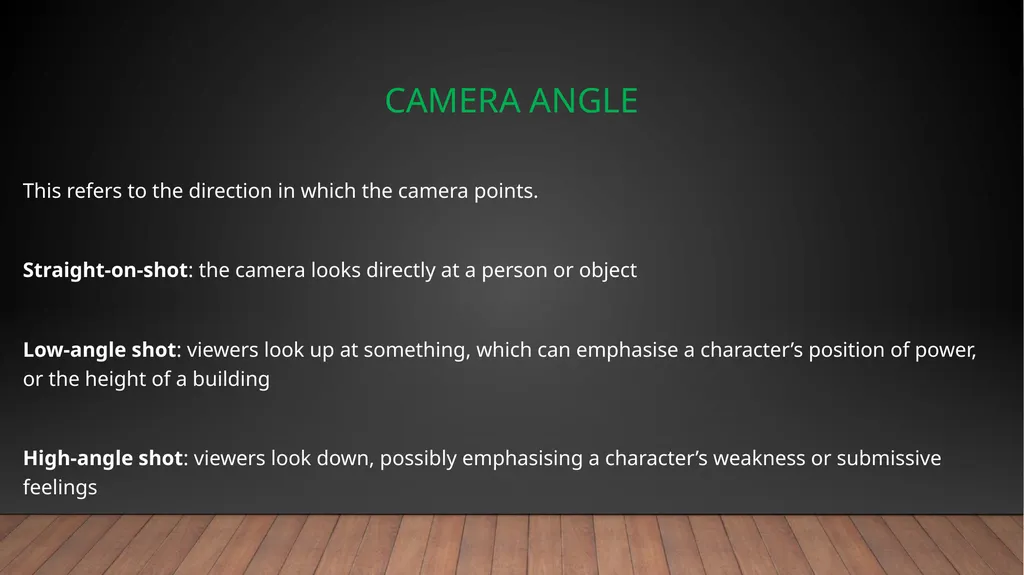
Medium-long shot – shows the whole body of a person and the surrounding setting; can show interactions between individuals and place them in a context.
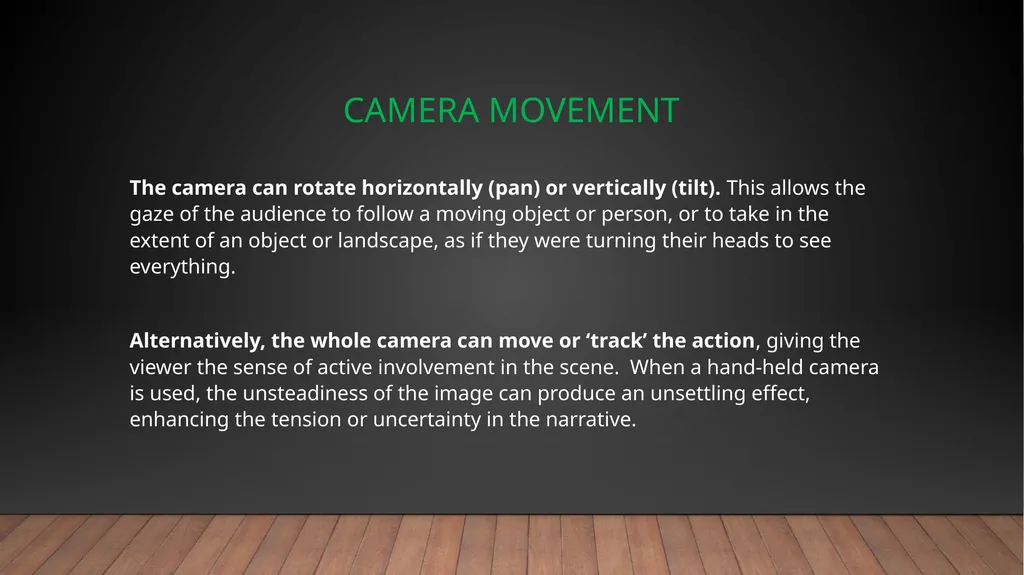
Long shot – presents people as smaller figures within the setting;
gives a sense of the landscape or environment in which people
live.<br>
Long shot – presents people as smaller figures within the setting;
gives a sense of the landscape or environment in which people
live.<br>
08
Camera Angle This refers to the direction in which the camera points.
Straight-on-shot: the camera looks directly at a person or object
Low-angle shot: viewers look up at something, which can emphasise a character’s position of power, or the height of a building
High-angle shot: viewers look down, possibly emphasising a character’s weakness or submissive feelings<br>
Straight-on-shot: the camera looks directly at a person or object
Low-angle shot: viewers look up at something, which can emphasise a character’s position of power, or the height of a building
High-angle shot: viewers look down, possibly emphasising a character’s weakness or submissive feelings<br>
09
Camera movement The camera can rotate horizontally (pan) or vertically (tilt). This allows the gaze of the audience to follow a moving object or person, or to take in the extent of an object or landscape, as if they were turning their heads to see everything.
Alternatively, the whole camera can move or ‘track’ the action, giving the viewer the sense of active involvement in the scene. When a hand-held camera is used, the unsteadiness of the image can produce an unsettling effect, enhancing the tension or uncertainty in the narrative.<br>
Alternatively, the whole camera can move or ‘track’ the action, giving the viewer the sense of active involvement in the scene. When a hand-held camera is used, the unsteadiness of the image can produce an unsettling effect, enhancing the tension or uncertainty in the narrative.<br>
10
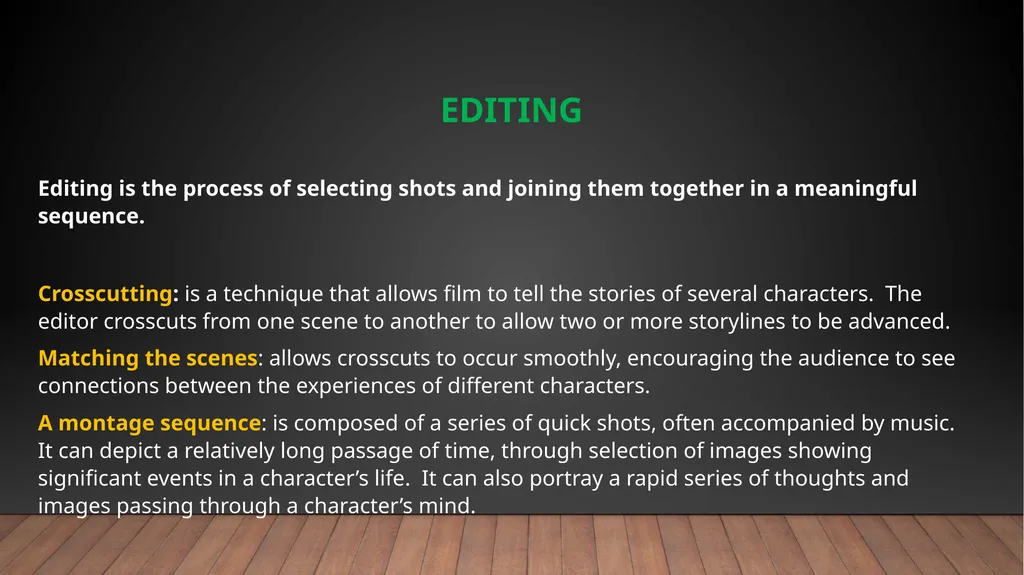
Editing Editing is the process of selecting shots and joining them together in a meaningful sequence.
Crosscutting: is a technique that allows film to tell the stories of several characters. The editor crosscuts from one scene to another to allow two or more storylines to be advanced.
Matching the scenes: allows crosscuts to occur smoothly, encouraging the audience to see connections between the experiences of different characters.
A montage sequence: is composed of a series of quick shots, often accompanied by music. It can depict a relatively long passage of time, through selection of images showing significant events in a character’s life. It can also portray a rapid series of thoughts and images passing through a character’s mind.<br>
Crosscutting: is a technique that allows film to tell the stories of several characters. The editor crosscuts from one scene to another to allow two or more storylines to be advanced.
Matching the scenes: allows crosscuts to occur smoothly, encouraging the audience to see connections between the experiences of different characters.
A montage sequence: is composed of a series of quick shots, often accompanied by music. It can depict a relatively long passage of time, through selection of images showing significant events in a character’s life. It can also portray a rapid series of thoughts and images passing through a character’s mind.<br>
11
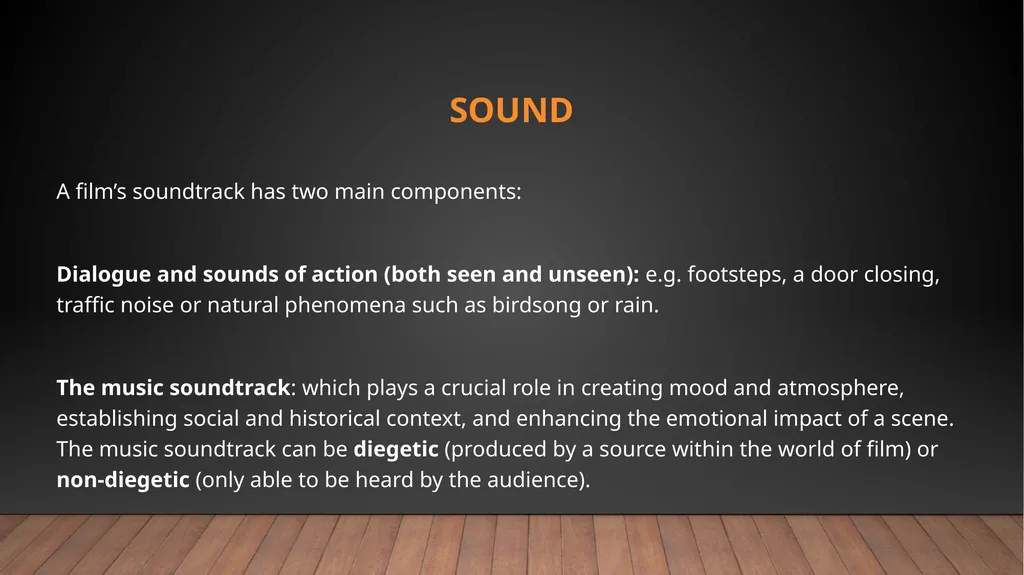
sound A film’s soundtrack has two main components:
Dialogue and sounds of action (both seen and unseen): e.g. footsteps, a door closing, traffic noise or natural phenomena such as birdsong or rain.
The music soundtrack: which plays a crucial role in creating mood and atmosphere, establishing social and historical context, and enhancing the emotional impact of a scene. The music soundtrack can be diegetic (produced by a source within the world of film) or non-diegetic (only able to be heard by the audience).<br>
Dialogue and sounds of action (both seen and unseen): e.g. footsteps, a door closing, traffic noise or natural phenomena such as birdsong or rain.
The music soundtrack: which plays a crucial role in creating mood and atmosphere, establishing social and historical context, and enhancing the emotional impact of a scene. The music soundtrack can be diegetic (produced by a source within the world of film) or non-diegetic (only able to be heard by the audience).<br>
12
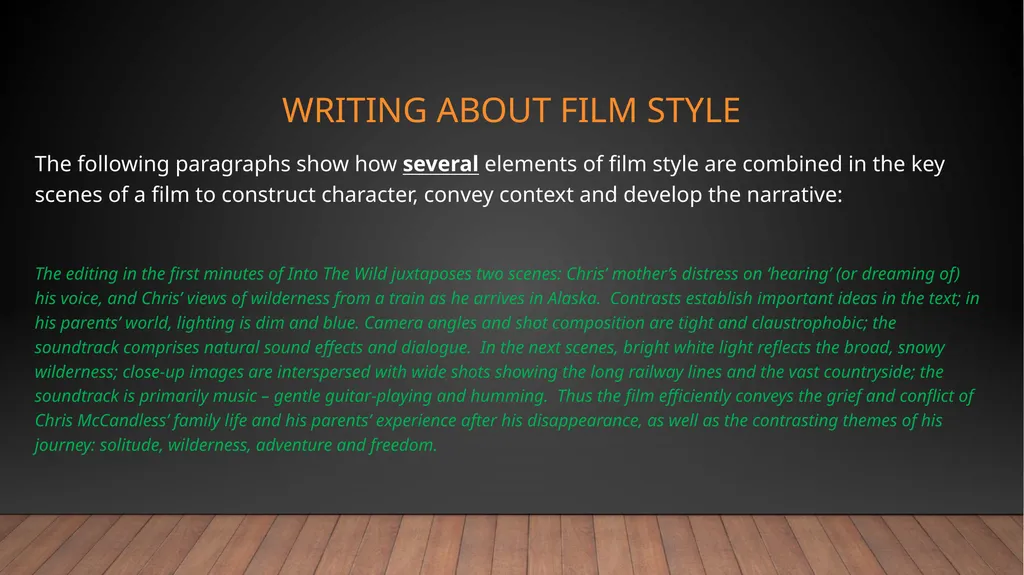
Writing about film style The following paragraphs show how several elements of film style are combined in the key scenes of a film to construct character, convey context and develop the narrative:
The editing in the first minutes of Into The Wild juxtaposes two scenes: Chris’ mother’s distress on ‘hearing’ (or dreaming of) his voice, and Chris’ views of wilderness from a train as he arrives in Alaska. Contrasts establish important ideas in the text; in his parents’ world, lighting is dim and blue. Camera angles and shot composition are tight and claustrophobic; the soundtrack comprises natural sound effects and dialogue. In the next scenes, bright white light reflects the broad, snowy wilderness; close-up images are interspersed with wide shots showing the long railway lines and the vast countryside; the soundtrack is primarily music – gentle guitar-playing and humming. Thus the film efficiently conveys the grief and conflict of Chris McCandless’ family life and his parents’ experience after his disappearance, as well as the contrasting themes of his journey: solitude, wilderness, adventure and freedom.<br>
The editing in the first minutes of Into The Wild juxtaposes two scenes: Chris’ mother’s distress on ‘hearing’ (or dreaming of) his voice, and Chris’ views of wilderness from a train as he arrives in Alaska. Contrasts establish important ideas in the text; in his parents’ world, lighting is dim and blue. Camera angles and shot composition are tight and claustrophobic; the soundtrack comprises natural sound effects and dialogue. In the next scenes, bright white light reflects the broad, snowy wilderness; close-up images are interspersed with wide shots showing the long railway lines and the vast countryside; the soundtrack is primarily music – gentle guitar-playing and humming. Thus the film efficiently conveys the grief and conflict of Chris McCandless’ family life and his parents’ experience after his disappearance, as well as the contrasting themes of his journey: solitude, wilderness, adventure and freedom.<br>
13
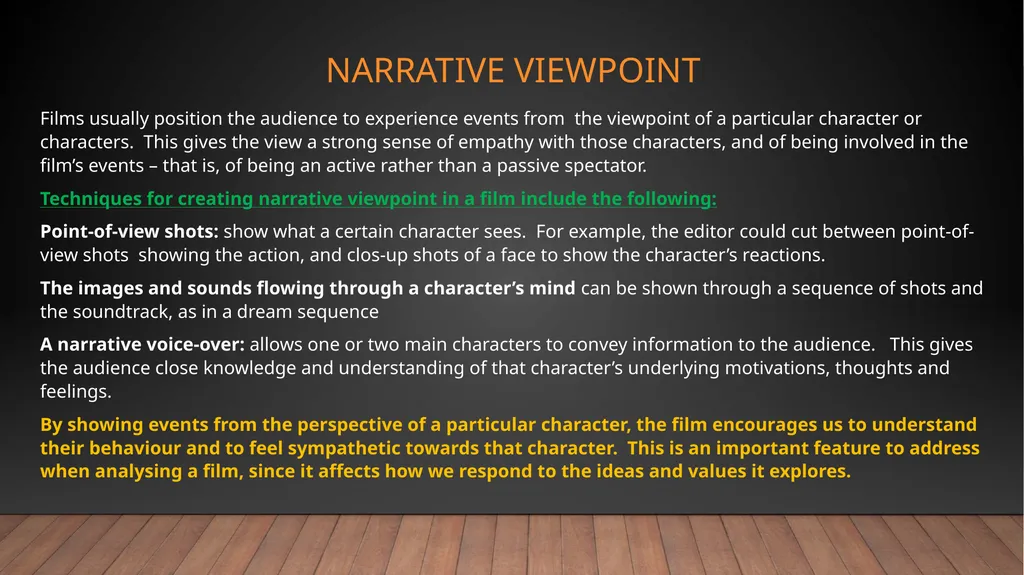
Narrative viewpoint Films usually position the audience to experience events from the viewpoint of a particular character or characters. This gives the view a strong sense of empathy with those characters, and of being involved in the film’s events – that is, of being an active rather than a passive spectator.
Techniques for creating narrative viewpoint in a film include the following:
Point-of-view shots: show what a certain character sees. For example, the editor could cut between point-of-view shots showing the action, and clos-up shots of a face to show the character’s reactions.
The images and sounds flowing through a character’s mind can be shown through a sequence of shots and the soundtrack, as in a dream sequence
A narrative voice-over: allows one or two main characters to convey information to the audience. This gives the audience close knowledge and understanding of that character’s underlying motivations, thoughts and feelings.
By showing events from the perspective of a particular character, the film encourages us to understand their behaviour and to feel sympathetic towards that character. This is an important feature to address when analysing a film, since it affects how we respond to the ideas and values it explores.<br>
Techniques for creating narrative viewpoint in a film include the following:
Point-of-view shots: show what a certain character sees. For example, the editor could cut between point-of-view shots showing the action, and clos-up shots of a face to show the character’s reactions.
The images and sounds flowing through a character’s mind can be shown through a sequence of shots and the soundtrack, as in a dream sequence
A narrative voice-over: allows one or two main characters to convey information to the audience. This gives the audience close knowledge and understanding of that character’s underlying motivations, thoughts and feelings.
By showing events from the perspective of a particular character, the film encourages us to understand their behaviour and to feel sympathetic towards that character. This is an important feature to address when analysing a film, since it affects how we respond to the ideas and values it explores.<br>
14
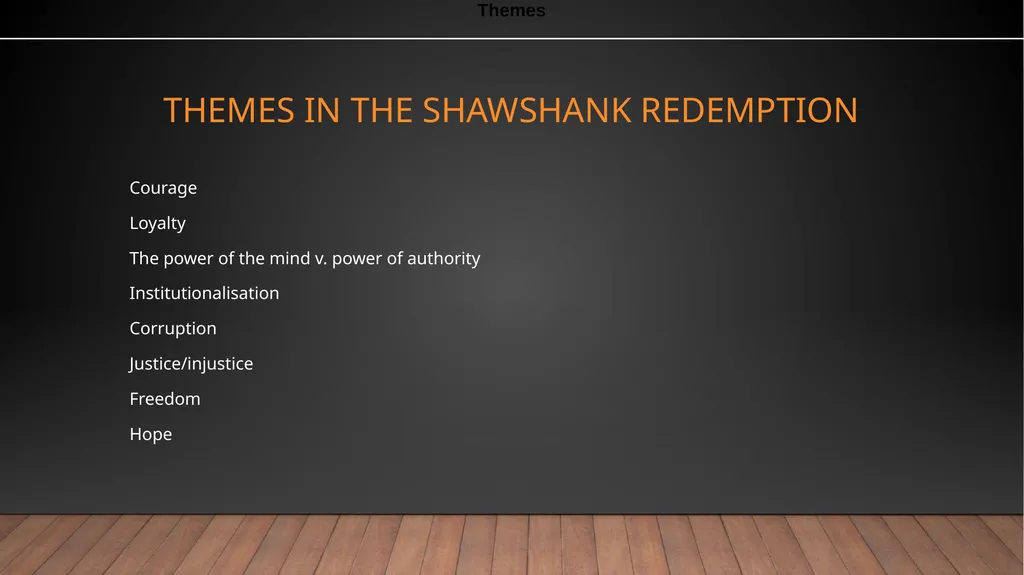
Themes in The Shawshank Redemption Courage
Loyalty
The power of the mind v. power of authority
Institutionalisation
Corruption
Justice/injustice
Freedom
Hope Themes<br>
Loyalty
The power of the mind v. power of authority
Institutionalisation
Corruption
Justice/injustice
Freedom
Hope Themes<br>
15
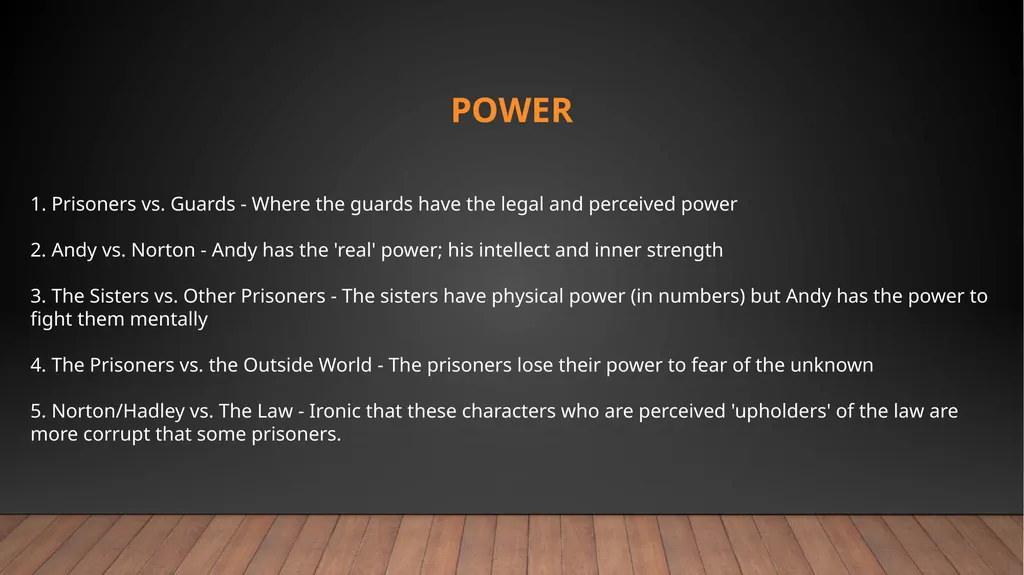
power Prisoners vs. Guards - Where the guards have the legal and perceived power
2. Andy vs. Norton - Andy has the 'real' power; his intellect and inner strength
3. The Sisters vs. Other Prisoners - The sisters have physical power (in numbers) but Andy has the power to fight them mentally
4. The Prisoners vs. the Outside World - The prisoners lose their power to fear of the unknown
5. Norton/Hadley vs. The Law - Ironic that these characters who are perceived 'upholders' of the law are more corrupt that some prisoners.<br>
2. Andy vs. Norton - Andy has the 'real' power; his intellect and inner strength
3. The Sisters vs. Other Prisoners - The sisters have physical power (in numbers) but Andy has the power to fight them mentally
4. The Prisoners vs. the Outside World - The prisoners lose their power to fear of the unknown
5. Norton/Hadley vs. The Law - Ironic that these characters who are perceived 'upholders' of the law are more corrupt that some prisoners.<br>
16
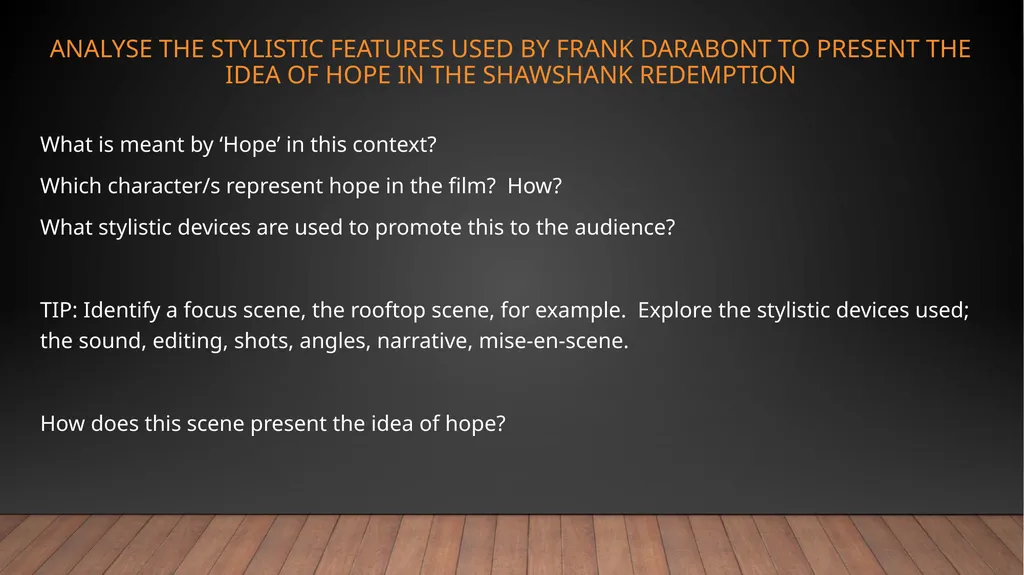
Analyse the stylistic features used by Frank Darabont to present the idea of hope in The Shawshank Redemption What is meant by ‘Hope’ in this context?
Which character/s represent hope in the film? How?
What stylistic devices are used to promote this to the audience?
TIP: Identify a focus scene, the rooftop scene, for example. Explore the stylistic devices used; the sound, editing, shots, angles, narrative, mise-en-scene.
How does this scene present the idea of hope?<br>
Which character/s represent hope in the film? How?
What stylistic devices are used to promote this to the audience?
TIP: Identify a focus scene, the rooftop scene, for example. Explore the stylistic devices used; the sound, editing, shots, angles, narrative, mise-en-scene.
How does this scene present the idea of hope?<br>
17
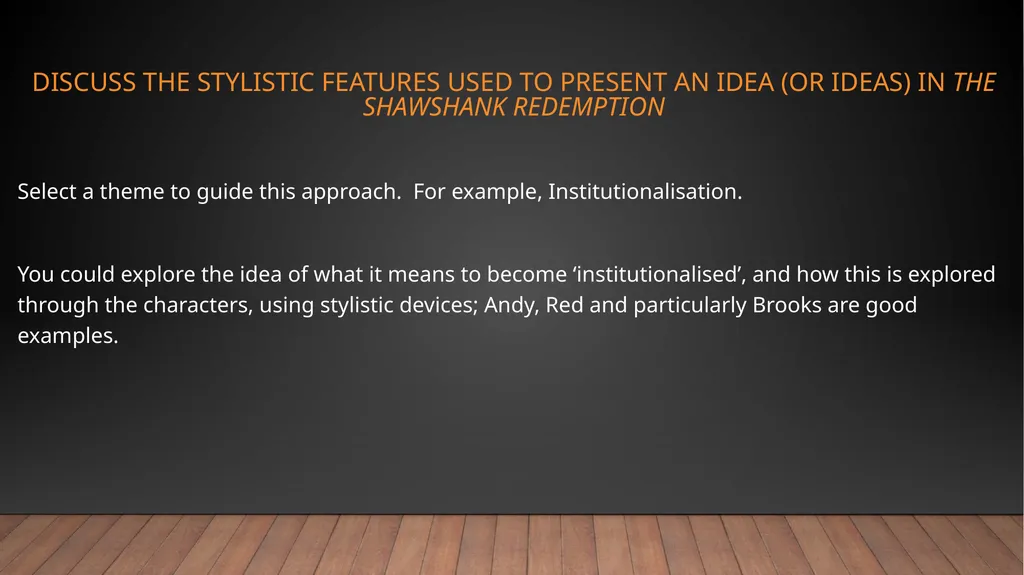
Discuss the stylistic features used to present an idea (or ideas) in The Shawshank Redemption Select a theme to guide this approach. For example, Institutionalisation.
You could explore the idea of what it means to become ‘institutionalised’, and how this is explored through the characters, using stylistic devices; Andy, Red and particularly Brooks are good examples.<br>
You could explore the idea of what it means to become ‘institutionalised’, and how this is explored through the characters, using stylistic devices; Andy, Red and particularly Brooks are good examples.<br>
18
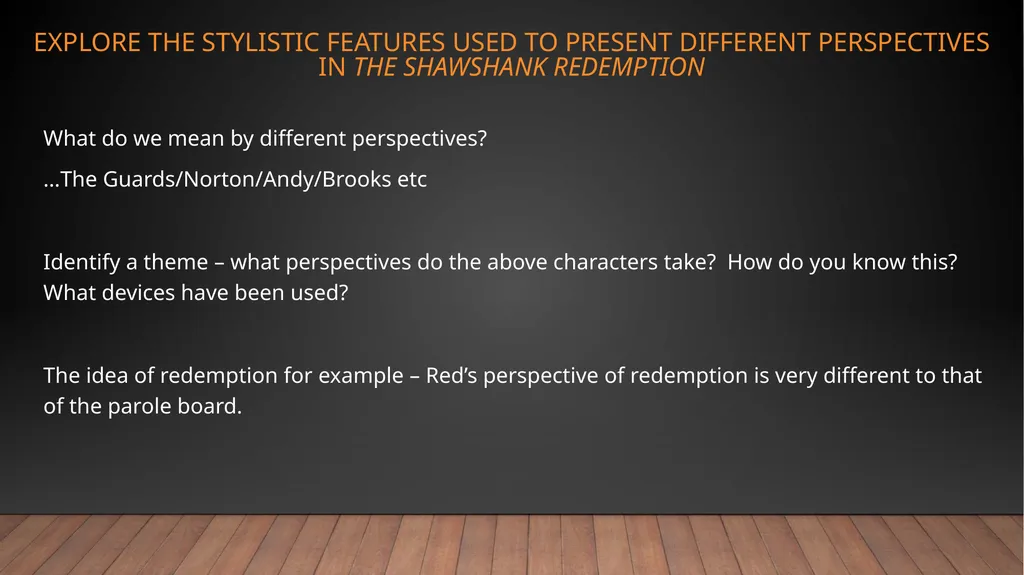
Explore the stylistic features used to present different perspectives in The Shawshank Redemption What do we mean by different perspectives?
…The Guards/Norton/Andy/Brooks etc
Identify a theme – what perspectives do the above characters take? How do you know this? What devices have been used?
The idea of redemption for example – Red’s perspective of redemption is very different to that of the parole board.<br>
…The Guards/Norton/Andy/Brooks etc
Identify a theme – what perspectives do the above characters take? How do you know this? What devices have been used?
The idea of redemption for example – Red’s perspective of redemption is very different to that of the parole board.<br>
19
Draft due Draft should be uploaded to DayMap on or before Friday, 31st March
(WEEK 9)<br>
(WEEK 9)<br>