
Filter convergence improved over flight Improved
JO
Published · 1 slides · 0 views
1 / 1
Description
Filter convergence improved over flight Improved process noise and bias tuning All measurements accepted Unchanged meas. quality time tag errors Benjamin Leser1, Sun Hur-Diaz2, Anne Long1, Carl De Vries1, Nathan Esantsi2, Liam Greenlee3,
Related Topics
Share
Embed code
Download this presentation From Below
"Filter convergence improved over flight Improved" is the property of its rightful owner. Permission is granted to download and print the materials on this website for personal, non-commercial use only, and to display it on your personal computer provided you do not modify the materials and that you retain all copyright notices contained in the materials. By downloading content from our website, you accept the terms of this agreement.
Presentation Transcript
01
Filter convergence improved over flight
Improved process noise and bias tuning
All measurements accepted
Unchanged meas. quality & time tag errors Benjamin Leser1, Sun Hur-Diaz2, Anne Long1, Carl De Vries1, Nathan Esantsi2, Liam Greenlee3, Michael Romeo2, Nathan Stacey2
1a.i. solutions, Inc 2NASA Goddard Space Flight Center 3Aurora Engineering One-Way Forward (OWF) Navigation OWF DWE Navigation Ground station sends uplink signal
S/C transponder receives uplink signal and forms pseudorange and Doppler observables
S/C flight computer processes observables to estimate S/C trajectory OWF DWE Pros:
Enables non-cooperative tracking for multiple users at a time
Users don't need to transmit during tracking passes
Onboard, real-time processing of observables Two-way DWE Navigation Ground station sends uplink signal
S/C transponder receives uplink signal and transmits back down to Earth
Ground station receives the downlink signal and forms range and Doppler observables
Ground system processes observables to estimate S/C trajectory Two-way DWE Cons:
Strictly cooperative
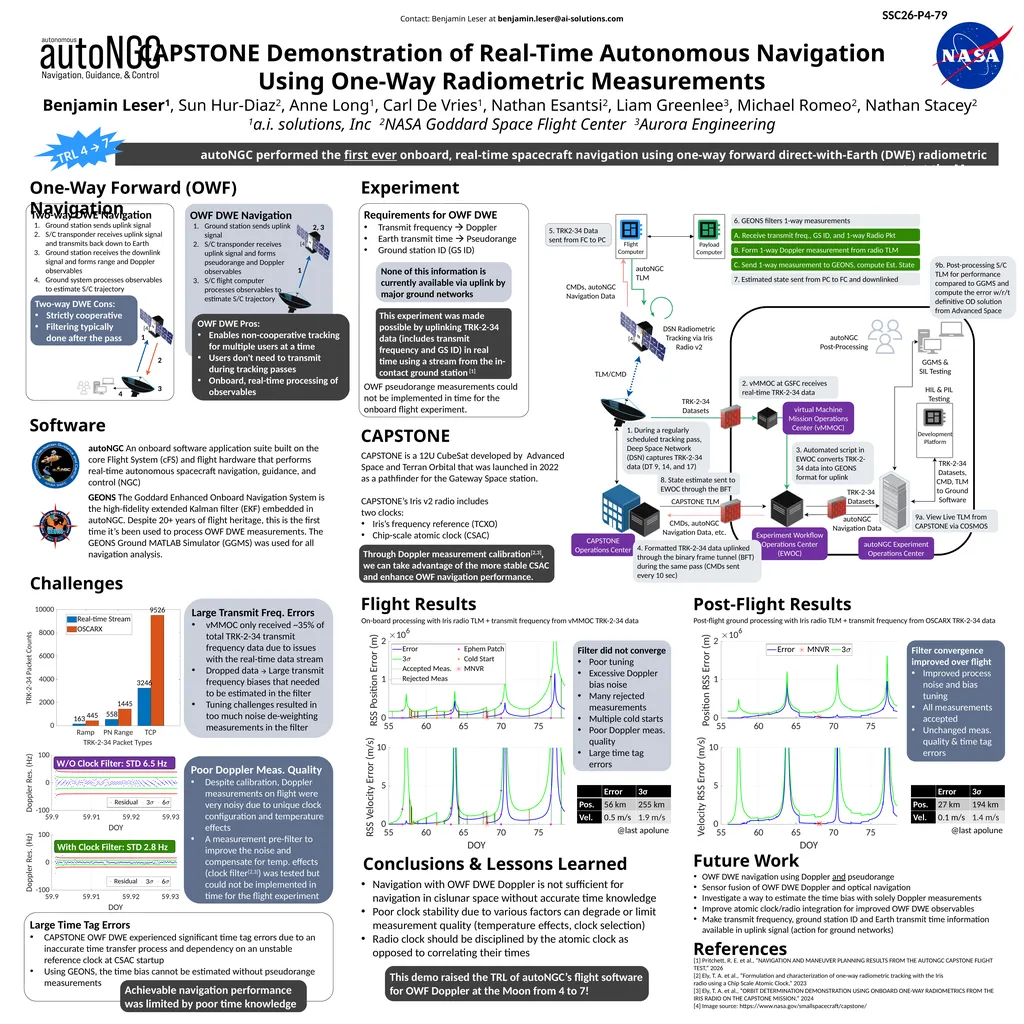
Filtering typically done after the pass 9b. Post-processing S/C TLM for performance compared to GGMS and compute the error w/r/t definitive OD solution from Advanced Space 1. During a regularly scheduled tracking pass, Deep Space Network (DSN) captures TRK-2-34 data (DT 9, 14, and 17) 2. vMMOC at GSFC receives real-time TRK-2-34 data 3. Automated script in EWOC converts TRK-2-34 data into GEONS format for uplink 5. TRK2-34 Data sent from FC to PC 9a. View Live TLM from CAPSTONE via COSMOS 6. GEONS filters 1-way measurements A. Receive transmit freq., GS ID, and 1-way Radio Pkt 7. Estimated state sent from PC to FC and downlinked C. Send 1-way measurement to GEONS, compute Est. State CMDs, autoNGC Navigation Data autoNGC TLM Flight Computer Payload Computer DSN Radiometric Tracking via Iris Radio v2 TRK-2-34 Datasets TLM/CMD virtual Machine Mission Operations Center (vMMOC) Experiment Workflow Operations Center (EWOC) autoNGC Experiment Operations Center autoNGC
Post-Processing GGMS & SIL Testing Development Platform TRK-2-34 Datasets, CMD, TLM to Ground Software TRK-2-34 Datasets autoNGC Navigation Data CAPSTONE TLM CMDs, autoNGC Navigation Data, etc. CAPSTONE Operations Center B. Form 1-way Doppler measurement from radio TLM 4. Formatted TRK-2-34 data uplinked through the binary frame tunnel (BFT) during the same pass (CMDs sent every 10 sec) 8. State estimate sent to EWOC through the BFT Software Experiment Requirements for OWF DWE
Transmit frequency Doppler
Earth transmit time Pseudorange
Ground station ID (GS ID)
OWF pseudorange measurements could not be implemented in time for the onboard flight experiment. None of this information is currently available via uplink by major ground networks autoNGC An onboard software application suite built on the core Flight System (cFS) and flight hardware that performs real-time autonomous spacecraft navigation, guidance, and control (NGC) GEONS The Goddard Enhanced Onboard Navigation System is the high-fidelity extended Kalman filter (EKF) embedded in autoNGC. Despite 20+ years of flight heritage, this is the first time it’s been used to process OWF DWE measurements. The GEONS Ground MATLAB Simulator (GGMS) was used for all navigation analysis. Challenges Large Transmit Freq. Errors
vMMOC only received ~35% of total TRK-2-34 transmit frequency data due to issues with the real-time data stream
Dropped data Large transmit frequency biases that needed to be estimated in the filter
Tuning challenges resulted in too much noise de-weighting measurements in the filter W/O Clock Filter: STD 6.5 Hz With Clock Filter: STD 2.8 Hz Poor Doppler Meas. Quality
Despite calibration, Doppler measurements on flight were very noisy due to unique clock configuration and temperature effects
A measurement pre-filter to improve the noise and compensate for temp. effects (clock filter[2,3]) was tested but could not be implemented in time for the flight experiment Large Time Tag Errors
CAPSTONE OWF DWE experienced significant time tag errors due to an inaccurate time transfer process and dependency on an unstable reference clock at CSAC startup
Using GEONS, the time bias cannot be estimated without pseudorange measurements Achievable navigation performance was limited by poor time knowledge Flight Results Post-Flight Results On-board processing with Iris radio TLM + transmit frequency from vMMOC TRK-2-34 data Post-flight ground processing with Iris radio TLM + transmit frequency from OSCARX TRK-2-34 data Conclusions & Lessons Learned Future Work Navigation with OWF DWE Doppler is not sufficient for navigation in cislunar space without accurate time knowledge
Poor clock stability due to various factors can degrade or limit measurement quality (temperature effects, clock selection)
Radio clock should be disciplined by the atomic clock as opposed to correlating their times OWF DWE navigation using Doppler and pseudorange
Sensor fusion of OWF DWE Doppler and optical navigation
Investigate a way to estimate the time bias with solely Doppler measurements
Improve atomic clock/radio integration for improved OWF DWE observables
Make transmit frequency, ground station ID and Earth transmit time information available in uplink signal (action for ground networks) Filter did not converge
Poor tuning
Excessive Doppler bias noise
Many rejected measurements
Multiple cold starts
Poor Doppler meas. quality
Large time tag errors References [1] Pritchett, R. E. et al., “NAVIGATION AND MANEUVER PLANNING RESULTS FROM THE AUTONGC CAPSTONE FLIGHT TEST,” 2026
[2] Ely, T. A. et al., “Formulation and characterization of one-way radiometric tracking with the Iris
radio using a Chip Scale Atomic Clock,” 2023
[3] Ely, T. A. et al., “ORBIT DETERMINATION DEMONSTRATION USING ONBOARD ONE-WAY RADIOMETRICS FROM THE IRIS RADIO ON THE CAPSTONE MISSION,” 2024
[4] Image source: https://www.nasa.gov/smallspacecraft/capstone/ This experiment was made possible by uplinking TRK-2-34 data (includes transmit frequency and GS ID) in real time using a stream from the in-contact ground station [1] This demo raised the TRL of autoNGC’s flight software for OWF Doppler at the Moon from 4 to 7! CAPSTONE CAPSTONE is a 12U CubeSat developed by Advanced Space and Terran Orbital that was launched in 2022 as a pathfinder for the Gateway Space station.
CAPSTONE’s Iris v2 radio includes
two clocks:
Iris’s frequency reference (TCXO)
Chip-scale atomic clock (CSAC) Through Doppler measurement calibration[2,3], we can take advantage of the more stable CSAC and enhance OWF navigation performance. HIL & PIL Testing Contact: Benjamin Leser at benjamin.leser@ai-solutions.com CAPSTONE Demonstration of Real-Time Autonomous Navigation
Using One-Way Radiometric Measurements autoNGC performed the first ever onboard, real-time spacecraft navigation using one-way forward direct-with-Earth (DWE) radiometric measurements at the Moon [4] [4] [4] @last apolune @last apolune TRL 4 7 SSC26-P4-79<br>
Improved process noise and bias tuning
All measurements accepted
Unchanged meas. quality & time tag errors Benjamin Leser1, Sun Hur-Diaz2, Anne Long1, Carl De Vries1, Nathan Esantsi2, Liam Greenlee3, Michael Romeo2, Nathan Stacey2
1a.i. solutions, Inc 2NASA Goddard Space Flight Center 3Aurora Engineering One-Way Forward (OWF) Navigation OWF DWE Navigation Ground station sends uplink signal
S/C transponder receives uplink signal and forms pseudorange and Doppler observables
S/C flight computer processes observables to estimate S/C trajectory OWF DWE Pros:
Enables non-cooperative tracking for multiple users at a time
Users don't need to transmit during tracking passes
Onboard, real-time processing of observables Two-way DWE Navigation Ground station sends uplink signal
S/C transponder receives uplink signal and transmits back down to Earth
Ground station receives the downlink signal and forms range and Doppler observables
Ground system processes observables to estimate S/C trajectory Two-way DWE Cons:
Strictly cooperative
Filtering typically done after the pass 9b. Post-processing S/C TLM for performance compared to GGMS and compute the error w/r/t definitive OD solution from Advanced Space 1. During a regularly scheduled tracking pass, Deep Space Network (DSN) captures TRK-2-34 data (DT 9, 14, and 17) 2. vMMOC at GSFC receives real-time TRK-2-34 data 3. Automated script in EWOC converts TRK-2-34 data into GEONS format for uplink 5. TRK2-34 Data sent from FC to PC 9a. View Live TLM from CAPSTONE via COSMOS 6. GEONS filters 1-way measurements A. Receive transmit freq., GS ID, and 1-way Radio Pkt 7. Estimated state sent from PC to FC and downlinked C. Send 1-way measurement to GEONS, compute Est. State CMDs, autoNGC Navigation Data autoNGC TLM Flight Computer Payload Computer DSN Radiometric Tracking via Iris Radio v2 TRK-2-34 Datasets TLM/CMD virtual Machine Mission Operations Center (vMMOC) Experiment Workflow Operations Center (EWOC) autoNGC Experiment Operations Center autoNGC
Post-Processing GGMS & SIL Testing Development Platform TRK-2-34 Datasets, CMD, TLM to Ground Software TRK-2-34 Datasets autoNGC Navigation Data CAPSTONE TLM CMDs, autoNGC Navigation Data, etc. CAPSTONE Operations Center B. Form 1-way Doppler measurement from radio TLM 4. Formatted TRK-2-34 data uplinked through the binary frame tunnel (BFT) during the same pass (CMDs sent every 10 sec) 8. State estimate sent to EWOC through the BFT Software Experiment Requirements for OWF DWE
Transmit frequency Doppler
Earth transmit time Pseudorange
Ground station ID (GS ID)
OWF pseudorange measurements could not be implemented in time for the onboard flight experiment. None of this information is currently available via uplink by major ground networks autoNGC An onboard software application suite built on the core Flight System (cFS) and flight hardware that performs real-time autonomous spacecraft navigation, guidance, and control (NGC) GEONS The Goddard Enhanced Onboard Navigation System is the high-fidelity extended Kalman filter (EKF) embedded in autoNGC. Despite 20+ years of flight heritage, this is the first time it’s been used to process OWF DWE measurements. The GEONS Ground MATLAB Simulator (GGMS) was used for all navigation analysis. Challenges Large Transmit Freq. Errors
vMMOC only received ~35% of total TRK-2-34 transmit frequency data due to issues with the real-time data stream
Dropped data Large transmit frequency biases that needed to be estimated in the filter
Tuning challenges resulted in too much noise de-weighting measurements in the filter W/O Clock Filter: STD 6.5 Hz With Clock Filter: STD 2.8 Hz Poor Doppler Meas. Quality
Despite calibration, Doppler measurements on flight were very noisy due to unique clock configuration and temperature effects
A measurement pre-filter to improve the noise and compensate for temp. effects (clock filter[2,3]) was tested but could not be implemented in time for the flight experiment Large Time Tag Errors
CAPSTONE OWF DWE experienced significant time tag errors due to an inaccurate time transfer process and dependency on an unstable reference clock at CSAC startup
Using GEONS, the time bias cannot be estimated without pseudorange measurements Achievable navigation performance was limited by poor time knowledge Flight Results Post-Flight Results On-board processing with Iris radio TLM + transmit frequency from vMMOC TRK-2-34 data Post-flight ground processing with Iris radio TLM + transmit frequency from OSCARX TRK-2-34 data Conclusions & Lessons Learned Future Work Navigation with OWF DWE Doppler is not sufficient for navigation in cislunar space without accurate time knowledge
Poor clock stability due to various factors can degrade or limit measurement quality (temperature effects, clock selection)
Radio clock should be disciplined by the atomic clock as opposed to correlating their times OWF DWE navigation using Doppler and pseudorange
Sensor fusion of OWF DWE Doppler and optical navigation
Investigate a way to estimate the time bias with solely Doppler measurements
Improve atomic clock/radio integration for improved OWF DWE observables
Make transmit frequency, ground station ID and Earth transmit time information available in uplink signal (action for ground networks) Filter did not converge
Poor tuning
Excessive Doppler bias noise
Many rejected measurements
Multiple cold starts
Poor Doppler meas. quality
Large time tag errors References [1] Pritchett, R. E. et al., “NAVIGATION AND MANEUVER PLANNING RESULTS FROM THE AUTONGC CAPSTONE FLIGHT TEST,” 2026
[2] Ely, T. A. et al., “Formulation and characterization of one-way radiometric tracking with the Iris
radio using a Chip Scale Atomic Clock,” 2023
[3] Ely, T. A. et al., “ORBIT DETERMINATION DEMONSTRATION USING ONBOARD ONE-WAY RADIOMETRICS FROM THE IRIS RADIO ON THE CAPSTONE MISSION,” 2024
[4] Image source: https://www.nasa.gov/smallspacecraft/capstone/ This experiment was made possible by uplinking TRK-2-34 data (includes transmit frequency and GS ID) in real time using a stream from the in-contact ground station [1] This demo raised the TRL of autoNGC’s flight software for OWF Doppler at the Moon from 4 to 7! CAPSTONE CAPSTONE is a 12U CubeSat developed by Advanced Space and Terran Orbital that was launched in 2022 as a pathfinder for the Gateway Space station.
CAPSTONE’s Iris v2 radio includes
two clocks:
Iris’s frequency reference (TCXO)
Chip-scale atomic clock (CSAC) Through Doppler measurement calibration[2,3], we can take advantage of the more stable CSAC and enhance OWF navigation performance. HIL & PIL Testing Contact: Benjamin Leser at benjamin.leser@ai-solutions.com CAPSTONE Demonstration of Real-Time Autonomous Navigation
Using One-Way Radiometric Measurements autoNGC performed the first ever onboard, real-time spacecraft navigation using one-way forward direct-with-Earth (DWE) radiometric measurements at the Moon [4] [4] [4] @last apolune @last apolune TRL 4 7 SSC26-P4-79<br>