
Finance Topic: Budget Balances and Errors










Description: Finance Topic: Budget Balances and Errors ConnectCarolina User Group March 20, 2015 Agenda 3 What are the user group meetings? Deep dives into hot topics A chance to ask questions Open to anyone who uses ConnectCarolina Find topics, dates
Related Topics
Download Presentation
"Finance Topic: Budget Balances and Errors" is the property of its rightful owner. Permission is granted to download and print the materials on this website for personal, non-commercial use only, and to display it on your personal computer provided you do not modify the materials and that you retain all copyright notices contained in the materials. By downloading content from our website, you accept the terms of this agreement.
Presentation Transcript
slide1. Finance Topic:
Budget Balances and Errors ConnectCarolina User Group March 20, 2015<br>
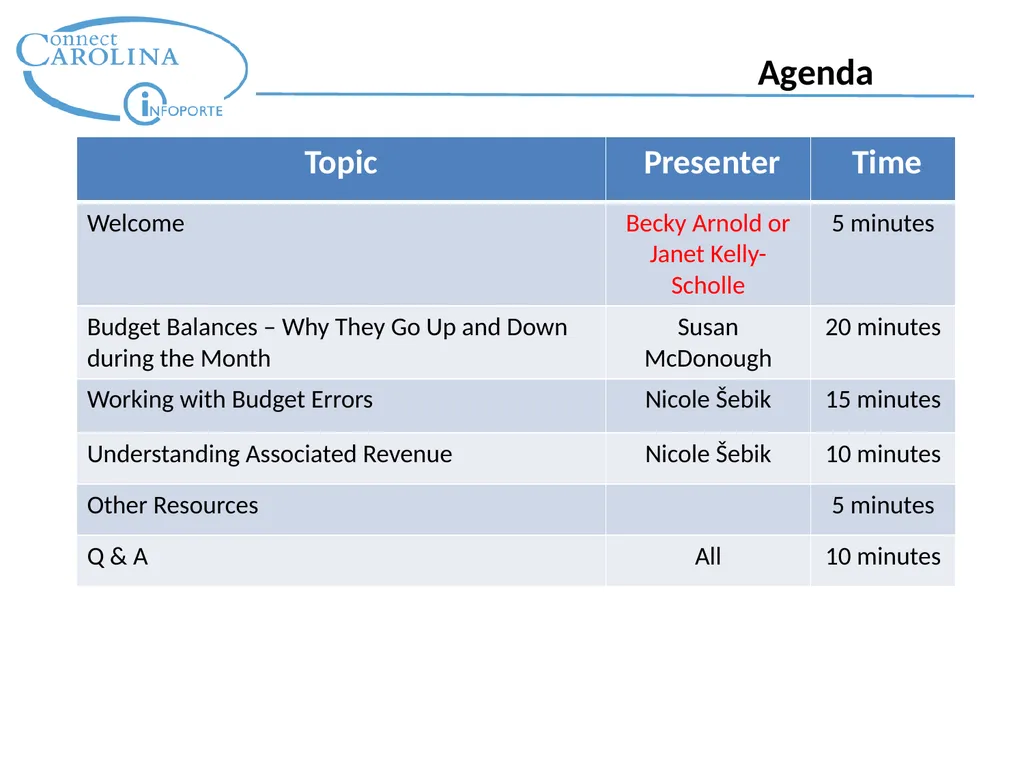
slide2. Agenda<br>
slide3. 3 What are the user group meetings? “Deep dives” into hot topics
A chance to ask questions
Open to anyone who uses ConnectCarolina
Find topics, dates and times on ccinfo.unc.edu, User Groups tab
Please encourage your coworkers to come<br>
slide4. Remember: Getting Help The Help Desk is the best way to ensure your question or issue doesn’t get lost
Include specific examples and screenshots if possible
It’s okay to put in a help ticket to ask, “How do I….”
It’s a way to request enhancements
Two key ways:
919-962-HELP
help.unc.edu<br>
slide5. Budget Balances – Why They Go Up and Down during the Month Susan McDonough Change Management Analyst<br>
slide6. Before diving into budget balances in InfoPorte, let’s make sure we’re all clear on where ConnectCarolina stores budget information … 6<br>
slide7. How ConnectCarolina Tracks Budget Info The part of the system that tracks budget information is called “Commitment Control”
The information is tracked in seven ledgers (think of them as checkbooks)—these are called the “Commitment Control ledgers” or sometimes the “KK ledgers”<br>
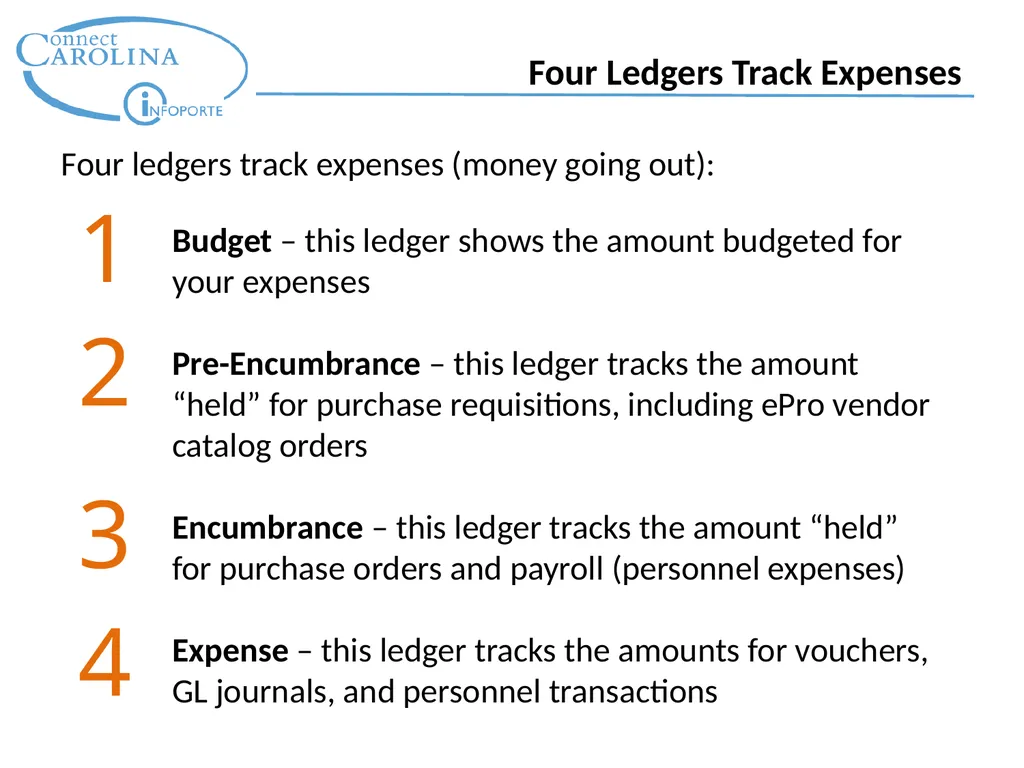
slide8. Four Ledgers Track Expenses Four ledgers track expenses (money going out): Budget – this ledger shows the amount budgeted for your expenses
Pre-Encumbrance – this ledger tracks the amount “held” for purchase requisitions, including ePro vendor catalog orders
Encumbrance – this ledger tracks the amount “held” for purchase orders and payroll (personnel expenses)
Expense – this ledger tracks the amounts for vouchers, GL journals, and personnel transactions 1 3 2 4<br>
slide9. Next let’s talk about where you see budget balances … 9<br>
slide10. 10 Viewing Your Balances You see your available balances in InfoPorte on one of these screens:
Ledger Rollup – shows Trust, F&A, State Fund balances
OSR Ledger Rollup – shows Contract and Grant balances
The Ledger Rollup screens show the expense and revenue amounts recorded to date in the Commitment Control ledgers, and your resulting available budget: Budget ledger Pre-encumbrance ledger Encumbrance ledger Expense ledger<br>
slide11. So why do my balances go up and down during the month? 11<br>
slide12. 12 Balances in InfoPorte fluctuate more than in FRS because of two reasons: Why Balances Go Up and Down 1 2 the University’s shift to accrual accounting Let’s look at those in more detail. the budget checking process<br>
slide13. 13 With accrual accounting, we now start recording expenses at the time of budget checking instead of payment. A Shift to Accrual Accounting Every finance transaction goes through the following steps:
Create the transaction
Budget check the transaction
Approve the transaction
Post the transaction
Payment happens at some point after posting, usually depending on vendor terms. For example, 30 days after receipt of invoice.<br>
slide14. 14 A Shift to Accrual Accounting That means more opportunity for changes that affect your balances.
For purchases on a requisition, here’s what could change:
A chartfield
A purchase quantity or dollar amount
A requisition or purchase order may be deleted, and the encumbered amount is restored to the budget.<br>
slide15. 15 Budget Checking Moves Expenses through Commitment Control Ledgers Each time a transaction is budget checked in ConnectCarolina, it:
hits one of your expense Commitment Control ledgers
shows in that ledger and your available budget balance the next day in InfoPorte
As a purchase evolves from a requisition to a voucher and is budget checked at each stage, the expense amount moves from one ledger to another, as shown in the next diagram.<br>
slide16. 16 Budget Checking Moves Expenses through Commitment Control Ledgers<br>
slide17. 17 Budget Checking Moves Expenses through Commitment Control Ledgers Not all transactions go through all the Commitment Control ledgers
For example, campus vouchers skip the Pre-Encumbrance and Encumbrance ledgers and go directly to the Expense ledger
Why is this? Think of it this way:
When you enter a campus voucher, you have an invoice in hand. That means you have the goods or services in hand, and you are now required to pay for them.
You don’t need to encumber (that is, put a hold on) the funds in case the purchase goes through. The purchase is completed, so you can go straight to expense (which is to say, the money has been spent).<br>
slide18. 18 Example of Purchase Req Budget Check Changing a Balance in InfoPorte Let’s look at how budget checking affects your balance:
You have a $500 budget to start. The ledger balances and available budget look like this:<br>
slide19. 19 Example of Purchase Req Budget Check Changing a Balance in InfoPorte Jason orders $50 in office supplies through the ePro Vendor Catalog, which creates a purchase req. It passes budget checking. It hasn’t been approved or posted.
When the purchase req passes budget checking, it increases the Pre-Encumbrance balance by $50.
Your budget balance now looks like this:<br>
slide20. 20 When Will My Balances Be Frozen? We’re still working on getting your available balances on the ledger rollups frozen – permanently – when Accounting Services closes the month
What is frozen at month close is the Budget and Actuals YTD (Expense) column in InfoPorte
But, as of now, these columns are not frozen because of the way purchases are handled in Commitment Control:
Pre-Encumbrance
Encumbrance
Available Balance
Let’s look at an example of why on the next slide.<br>
slide21. 21 Example of Balances with Current Month Close Process Let’s say you have a Purchase Order for $50 that was encumbered – but not posted – in the current month.
Your Budget is $500 and the Expense (Actuals YTD) is $150.
Your Available Balance at month close looks like this in InfoPorte:<br>
slide22. 22 Example of Balances with Current Month Close Process Next month, the voucher is processed to pay the $50 Purchase Order.
The voucher payment relieves the Encumbrance from the prior month, and the expense is recorded in the next month.
Your Available Balance for the prior month increases after the Encumbrance is relieved and looks like this:<br>
slide23. 23 Key Takeaways Our new accrual accounting system plays a role in available balance fluctuations. Expenses are recorded at the time of budget checking instead of payment, creating a longer time period where changes may occur. Individual ledger amounts also change as transactions are budget checked – as a requisition, then a purchase order, and then a voucher.
The balances move to a new ledger with each budget check.
Balances in InfoPorte aren’t frozen when Accounting Services closes the month, only the Budget and Actuals YTD (Expenses) are frozen at this time.<br>
slide24. Working with Budget Errors Nicole Šebik Change Management Analyst<br>
slide25. Working with Budget Errors Under Commitment Control, transactions that fail budget check generate budget errors.
You can’t proceed until the error is corrected.
Transactions that generate budget errors are:
Purchase requisitions
Purchase orders
Vouchers
GL journals
Budget adjustments (budget transfers and budget journals)<br>
slide26. Resolving Budget Errors The best way to resolve a budget error varies by the error and the situation
Here are the most common solutions:
Change the chartfield string to one with enough budget
Reduce the dollar amount of the transaction
Add or transfer budget to the chartfield string:
If requesting budget for a State, F&A or Trust fund, work with your Finance team.
If requesting budget for a contract or grant, work with OSR.<br>
slide27. Overriding Budget Errors In rare cases, you can request an override to a budget error.
Example: At year end, you may need to push through some State expenses
Only Central Office can override errors.
If your error needs an override, e-mail one of these:
The Budget Office for State, F&A, and Trust fund errors.
OSR for contracts and grants errors
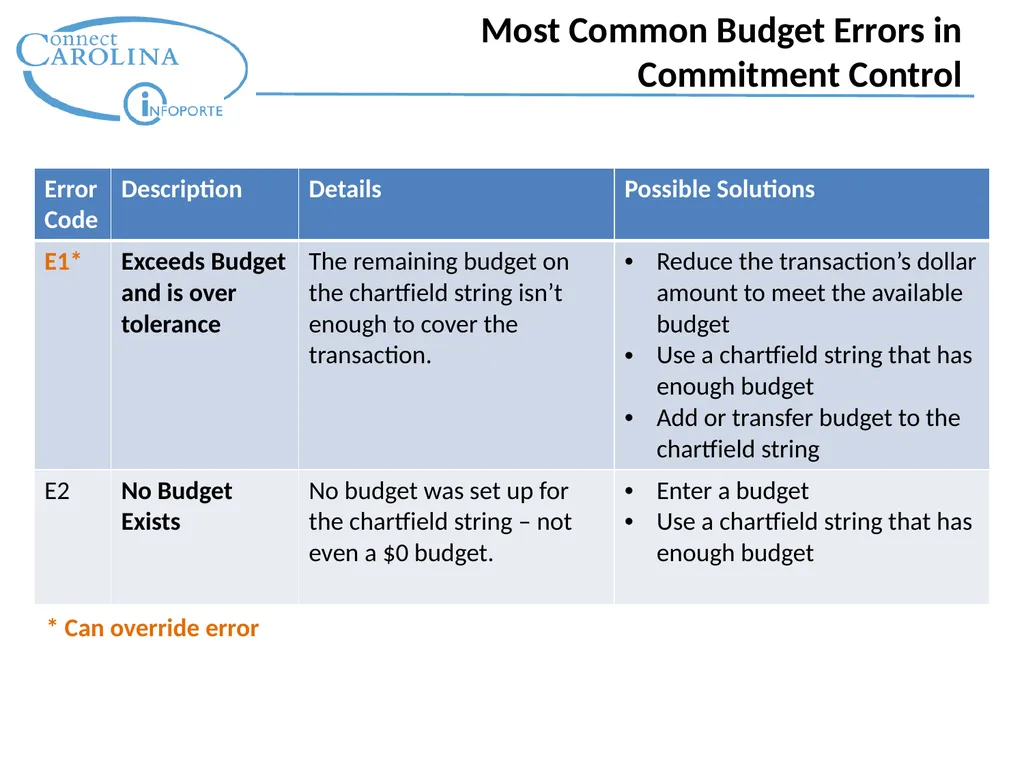
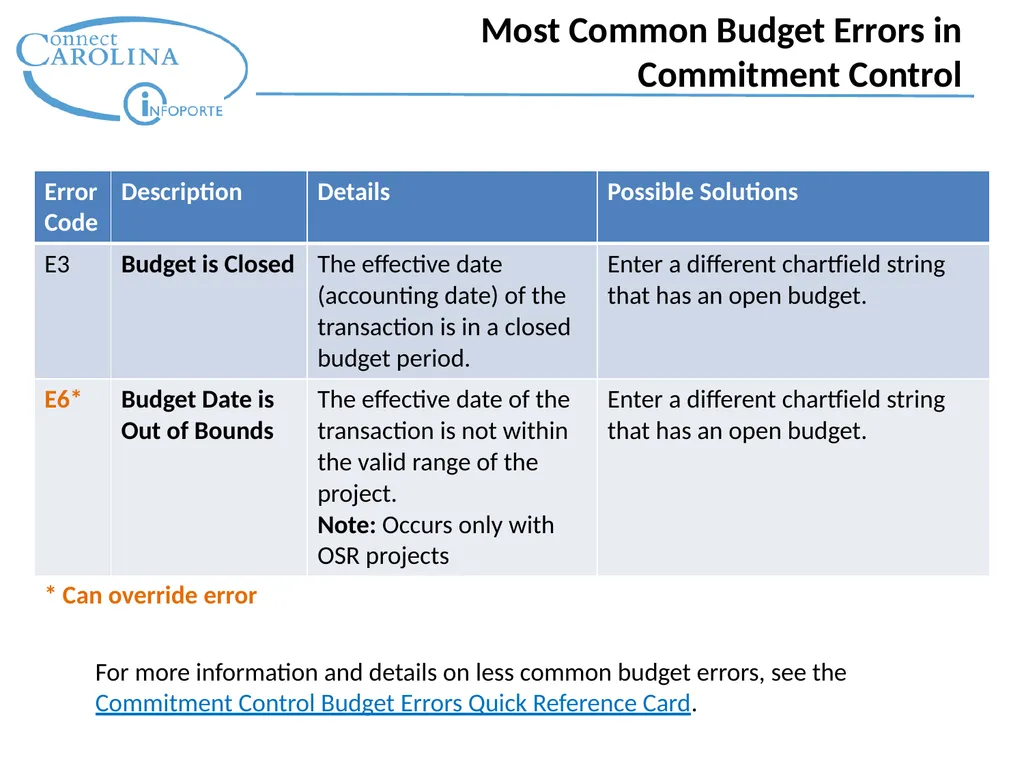
Note: Not all budget errors can be overridden. The table on the next slides highlight in orange which ones can be along with common errors and solutions.<br>
slide28. Most Common Budget Errors in Commitment Control * Can override error<br>
slide29. For more information and details on less common budget errors, see the Commitment Control Budget Errors Quick Reference Card. * Can override error Most Common Budget Errors in Commitment Control<br>
slide30. 30 Key Takeaways You need to resolve budget errors before the transaction can proceed.
Resolve budget errors in one of these ways:
Change the chartfield string
Reduce the dollar amount
Work with the appropriate department to add or transfer budget to the chartfield
In rare cases, request an override from Central Office<br>
slide31. Understanding Associated Revenue Nicole Šebik Change Management Analyst<br>
slide32. Associated Revenue Purpose is to increase spending authority automatically.
Similar to Automatic Budget Create in FRS; however, Associated Revenue increases spending authority but doesn’t create budget.
Applies to Trust funds only. Defines a relationship between revenue and expense.<br>
slide33. Associated Revenue Expense Ledger Amount Budget $0 Pre - Encumbrance $0 Encumbrance $0 Expense $1000 Budget Balance - $1000 Associated Revenue $3000 Available Budget $2000 Available Budget is also referred to as the spending authority. On applicable trusts, the greater of revenue estimate or recognized revenue is applied to the Associated Revenue line.<br>
slide34. 34 Associated Budgets table Look up the source in the Associated Budgets table How do I know if my trust is associated?<br>
slide35. 35 Associated Revenue If the trust is associated, it’s in the table. Enter the source you want to search for.<br>
slide36. 36 Associated Revenue If the source is found, you’ll see it on the first line. You’ll get this message if the source is not associated.<br>
slide37. 37 Associated Revenue Account, Cost Code 1, and Cost Code 3 don’t affect association The association is based on the combination of Fund—Source—Dept—Program (if used) listed in the table<br>
slide38. 38 Associated Revenue Which revenue transactions are associated? Yes No No<br>
slide39. 39 Associated Revenue Which transactions are associated? No Yes No<br>
slide40. 40 Associated Revenue Use the Budgets Overview inquiry in ConnectCarolina. How do I see associated revenue in my budget?<br>
slide41. 41 Associated Revenue Online Help has directions on using the Budgets Overview inquiry Top right corner of ConnectCarolina<br>
slide42. 42 Associated Revenue Budget Overview: Looking at the Numbers Remember, associate revenue is the greater of Revenue Estimate or Recognized Revenue. ?<br>
slide43. 43 Associated Revenue You have to look at the detailed results. What’s the difference between total Recognized Revenue and total Associate Revenue? Associated Budgets table<br>
slide44. 44 Associated Revenue Line 3 is the associated line. All of the revenue is “Recognized,” but only line 3 is “Associated.”<br>
slide45. When the budget moves<br>
slide46. Associated Budgets Increasing an Expense budget on an associated budget will inflate the spending authority.<br>
slide47. 47 Key Takeaways Associated Revenue automatically increases spending authority
Only Trust funds have Associated Revenue
The greater of Revenue Estimate or Recognized Revenue is associated
It’s the combination of Fund—Source—Dept—Program (if used) that matters
ConnectCarolina’s Budgets Overview inquiry is the best tool for viewing associated budgets
Don’t forget to use a Ledger Inquiry Set!<br>
slide48. 48 ccinfo.unc.edu<br>
slide49. 49 ccinfo.unc.edu<br>
slide50. ? Questions 50<br>
slide51. See you at the next Finance user group meeting 11:00 on April 17, Genome Sciences G100<br>
slide2. Agenda<br>
slide3. 3 What are the user group meetings? “Deep dives” into hot topics
A chance to ask questions
Open to anyone who uses ConnectCarolina
Find topics, dates and times on ccinfo.unc.edu, User Groups tab
Please encourage your coworkers to come<br>
slide4. Remember: Getting Help The Help Desk is the best way to ensure your question or issue doesn’t get lost
Include specific examples and screenshots if possible
It’s okay to put in a help ticket to ask, “How do I….”
It’s a way to request enhancements
Two key ways:
919-962-HELP
help.unc.edu<br>
slide5. Budget Balances – Why They Go Up and Down during the Month Susan McDonough Change Management Analyst<br>
slide6. Before diving into budget balances in InfoPorte, let’s make sure we’re all clear on where ConnectCarolina stores budget information … 6<br>
slide7. How ConnectCarolina Tracks Budget Info The part of the system that tracks budget information is called “Commitment Control”
The information is tracked in seven ledgers (think of them as checkbooks)—these are called the “Commitment Control ledgers” or sometimes the “KK ledgers”<br>
slide8. Four Ledgers Track Expenses Four ledgers track expenses (money going out): Budget – this ledger shows the amount budgeted for your expenses
Pre-Encumbrance – this ledger tracks the amount “held” for purchase requisitions, including ePro vendor catalog orders
Encumbrance – this ledger tracks the amount “held” for purchase orders and payroll (personnel expenses)
Expense – this ledger tracks the amounts for vouchers, GL journals, and personnel transactions 1 3 2 4<br>
slide9. Next let’s talk about where you see budget balances … 9<br>
slide10. 10 Viewing Your Balances You see your available balances in InfoPorte on one of these screens:
Ledger Rollup – shows Trust, F&A, State Fund balances
OSR Ledger Rollup – shows Contract and Grant balances
The Ledger Rollup screens show the expense and revenue amounts recorded to date in the Commitment Control ledgers, and your resulting available budget: Budget ledger Pre-encumbrance ledger Encumbrance ledger Expense ledger<br>
slide11. So why do my balances go up and down during the month? 11<br>
slide12. 12 Balances in InfoPorte fluctuate more than in FRS because of two reasons: Why Balances Go Up and Down 1 2 the University’s shift to accrual accounting Let’s look at those in more detail. the budget checking process<br>
slide13. 13 With accrual accounting, we now start recording expenses at the time of budget checking instead of payment. A Shift to Accrual Accounting Every finance transaction goes through the following steps:
Create the transaction
Budget check the transaction
Approve the transaction
Post the transaction
Payment happens at some point after posting, usually depending on vendor terms. For example, 30 days after receipt of invoice.<br>
slide14. 14 A Shift to Accrual Accounting That means more opportunity for changes that affect your balances.
For purchases on a requisition, here’s what could change:
A chartfield
A purchase quantity or dollar amount
A requisition or purchase order may be deleted, and the encumbered amount is restored to the budget.<br>
slide15. 15 Budget Checking Moves Expenses through Commitment Control Ledgers Each time a transaction is budget checked in ConnectCarolina, it:
hits one of your expense Commitment Control ledgers
shows in that ledger and your available budget balance the next day in InfoPorte
As a purchase evolves from a requisition to a voucher and is budget checked at each stage, the expense amount moves from one ledger to another, as shown in the next diagram.<br>
slide16. 16 Budget Checking Moves Expenses through Commitment Control Ledgers<br>
slide17. 17 Budget Checking Moves Expenses through Commitment Control Ledgers Not all transactions go through all the Commitment Control ledgers
For example, campus vouchers skip the Pre-Encumbrance and Encumbrance ledgers and go directly to the Expense ledger
Why is this? Think of it this way:
When you enter a campus voucher, you have an invoice in hand. That means you have the goods or services in hand, and you are now required to pay for them.
You don’t need to encumber (that is, put a hold on) the funds in case the purchase goes through. The purchase is completed, so you can go straight to expense (which is to say, the money has been spent).<br>
slide18. 18 Example of Purchase Req Budget Check Changing a Balance in InfoPorte Let’s look at how budget checking affects your balance:
You have a $500 budget to start. The ledger balances and available budget look like this:<br>
slide19. 19 Example of Purchase Req Budget Check Changing a Balance in InfoPorte Jason orders $50 in office supplies through the ePro Vendor Catalog, which creates a purchase req. It passes budget checking. It hasn’t been approved or posted.
When the purchase req passes budget checking, it increases the Pre-Encumbrance balance by $50.
Your budget balance now looks like this:<br>
slide20. 20 When Will My Balances Be Frozen? We’re still working on getting your available balances on the ledger rollups frozen – permanently – when Accounting Services closes the month
What is frozen at month close is the Budget and Actuals YTD (Expense) column in InfoPorte
But, as of now, these columns are not frozen because of the way purchases are handled in Commitment Control:
Pre-Encumbrance
Encumbrance
Available Balance
Let’s look at an example of why on the next slide.<br>
slide21. 21 Example of Balances with Current Month Close Process Let’s say you have a Purchase Order for $50 that was encumbered – but not posted – in the current month.
Your Budget is $500 and the Expense (Actuals YTD) is $150.
Your Available Balance at month close looks like this in InfoPorte:<br>
slide22. 22 Example of Balances with Current Month Close Process Next month, the voucher is processed to pay the $50 Purchase Order.
The voucher payment relieves the Encumbrance from the prior month, and the expense is recorded in the next month.
Your Available Balance for the prior month increases after the Encumbrance is relieved and looks like this:<br>
slide23. 23 Key Takeaways Our new accrual accounting system plays a role in available balance fluctuations. Expenses are recorded at the time of budget checking instead of payment, creating a longer time period where changes may occur. Individual ledger amounts also change as transactions are budget checked – as a requisition, then a purchase order, and then a voucher.
The balances move to a new ledger with each budget check.
Balances in InfoPorte aren’t frozen when Accounting Services closes the month, only the Budget and Actuals YTD (Expenses) are frozen at this time.<br>
slide24. Working with Budget Errors Nicole Šebik Change Management Analyst<br>
slide25. Working with Budget Errors Under Commitment Control, transactions that fail budget check generate budget errors.
You can’t proceed until the error is corrected.
Transactions that generate budget errors are:
Purchase requisitions
Purchase orders
Vouchers
GL journals
Budget adjustments (budget transfers and budget journals)<br>
slide26. Resolving Budget Errors The best way to resolve a budget error varies by the error and the situation
Here are the most common solutions:
Change the chartfield string to one with enough budget
Reduce the dollar amount of the transaction
Add or transfer budget to the chartfield string:
If requesting budget for a State, F&A or Trust fund, work with your Finance team.
If requesting budget for a contract or grant, work with OSR.<br>
slide27. Overriding Budget Errors In rare cases, you can request an override to a budget error.
Example: At year end, you may need to push through some State expenses
Only Central Office can override errors.
If your error needs an override, e-mail one of these:
The Budget Office for State, F&A, and Trust fund errors.
OSR for contracts and grants errors
Note: Not all budget errors can be overridden. The table on the next slides highlight in orange which ones can be along with common errors and solutions.<br>
slide28. Most Common Budget Errors in Commitment Control * Can override error<br>
slide29. For more information and details on less common budget errors, see the Commitment Control Budget Errors Quick Reference Card. * Can override error Most Common Budget Errors in Commitment Control<br>
slide30. 30 Key Takeaways You need to resolve budget errors before the transaction can proceed.
Resolve budget errors in one of these ways:
Change the chartfield string
Reduce the dollar amount
Work with the appropriate department to add or transfer budget to the chartfield
In rare cases, request an override from Central Office<br>
slide31. Understanding Associated Revenue Nicole Šebik Change Management Analyst<br>
slide32. Associated Revenue Purpose is to increase spending authority automatically.
Similar to Automatic Budget Create in FRS; however, Associated Revenue increases spending authority but doesn’t create budget.
Applies to Trust funds only. Defines a relationship between revenue and expense.<br>
slide33. Associated Revenue Expense Ledger Amount Budget $0 Pre - Encumbrance $0 Encumbrance $0 Expense $1000 Budget Balance - $1000 Associated Revenue $3000 Available Budget $2000 Available Budget is also referred to as the spending authority. On applicable trusts, the greater of revenue estimate or recognized revenue is applied to the Associated Revenue line.<br>
slide34. 34 Associated Budgets table Look up the source in the Associated Budgets table How do I know if my trust is associated?<br>
slide35. 35 Associated Revenue If the trust is associated, it’s in the table. Enter the source you want to search for.<br>
slide36. 36 Associated Revenue If the source is found, you’ll see it on the first line. You’ll get this message if the source is not associated.<br>
slide37. 37 Associated Revenue Account, Cost Code 1, and Cost Code 3 don’t affect association The association is based on the combination of Fund—Source—Dept—Program (if used) listed in the table<br>
slide38. 38 Associated Revenue Which revenue transactions are associated? Yes No No<br>
slide39. 39 Associated Revenue Which transactions are associated? No Yes No<br>
slide40. 40 Associated Revenue Use the Budgets Overview inquiry in ConnectCarolina. How do I see associated revenue in my budget?<br>
slide41. 41 Associated Revenue Online Help has directions on using the Budgets Overview inquiry Top right corner of ConnectCarolina<br>
slide42. 42 Associated Revenue Budget Overview: Looking at the Numbers Remember, associate revenue is the greater of Revenue Estimate or Recognized Revenue. ?<br>
slide43. 43 Associated Revenue You have to look at the detailed results. What’s the difference between total Recognized Revenue and total Associate Revenue? Associated Budgets table<br>
slide44. 44 Associated Revenue Line 3 is the associated line. All of the revenue is “Recognized,” but only line 3 is “Associated.”<br>
slide45. When the budget moves<br>
slide46. Associated Budgets Increasing an Expense budget on an associated budget will inflate the spending authority.<br>
slide47. 47 Key Takeaways Associated Revenue automatically increases spending authority
Only Trust funds have Associated Revenue
The greater of Revenue Estimate or Recognized Revenue is associated
It’s the combination of Fund—Source—Dept—Program (if used) that matters
ConnectCarolina’s Budgets Overview inquiry is the best tool for viewing associated budgets
Don’t forget to use a Ledger Inquiry Set!<br>
slide48. 48 ccinfo.unc.edu<br>
slide49. 49 ccinfo.unc.edu<br>
slide50. ? Questions 50<br>
slide51. See you at the next Finance user group meeting 11:00 on April 17, Genome Sciences G100<br>