
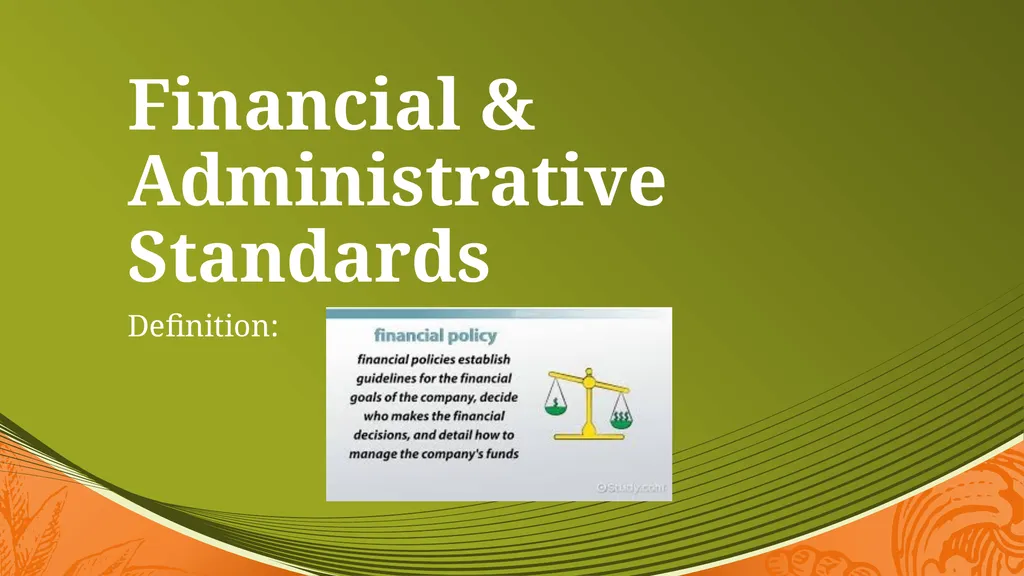
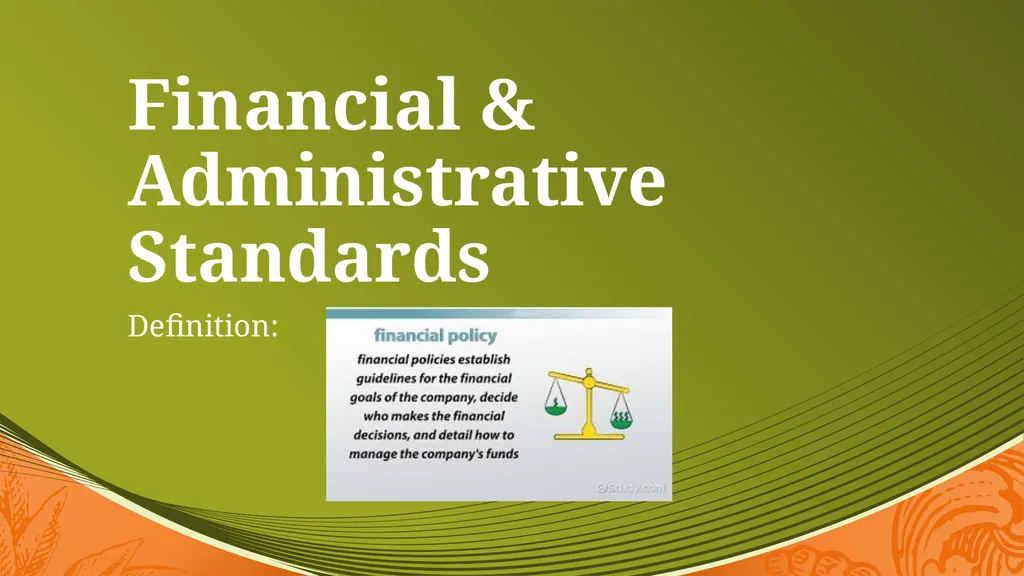
Financial & Administrative Standards Definition: 2



Description: Financial Administrative Standards Definition: 2 CFR Part 200 Uniform grant guidance Some changes are related to this new Super-Circular 200.303 Internal controls. The non-Federal entity must: (a) Establish and maintain effective
Related Topics
Download Presentation
"Financial & Administrative Standards Definition: 2" is the property of its rightful owner. Permission is granted to download and print the materials on this website for personal, non-commercial use only, and to display it on your personal computer provided you do not modify the materials and that you retain all copyright notices contained in the materials. By downloading content from our website, you accept the terms of this agreement.
Presentation Transcript
slide1. Financial & Administrative Standards Definition:<br>
slide2. 2 CFR Part 200 Uniform grant guidance Some changes are related to this new “Super-Circular”
200.303 Internal controls. The non-Federal entity must:
(a) Establish and maintain effective internal controls that provide reasonable assurance that the non-Federal entity is managing the Federal award in compliance with Federal statutes, regulations, and the terms and conditions of the Federal award.<br>
slide3. 2 CFR 200.305 Payment. The Federal awarding agency and pass-through entity [CYFD] must not require separate depository [bank] accounts for funds provided to a non-Federal entity or establish any eligibility requirements for depositories for funds provided to the non-Federal entity. However, the non-federal entity must be able to account for the receipt, obligation and expenditure of all funds<br>
slide4. 2 CFR 200.318 General procurement standards.: (a) The non-Federal entity must use its own documented procurement procedures which reflect applicable State & local laws and regulations, provided that the procurements conform to applicable Federal law and the standards identified in this section.
(b) Non-Federal entities must maintain oversight to ensure that contractors perform in accordance with the terms, conditions, and specifications of their contracts or purchase orders.
(c)(1) The non-Federal entity must maintain written standards of conduct covering conflicts of interest and governing the performance of its employees engaged in the selection, award and administration of contracts. No employee, officer, or agent must participate in the selection, award, or administration of a contract supported by a Federal award if he or she has a real or apparent conflict of interest.<br>
slide5. 2 CFR 200 200.333 Retention requirements for records. Financial records, supporting documents, statistical records, and all other non-Federal entity records pertinent to a Federal award must be retained for a period of three years from the date of submission of the final expenditure report or, for Federal awards that are renewed quarterly or annually, from the date of the submission of the quarterly or annual financial report, as reported to the Federal awarding agency or pass through entity in the case of a sub-recipient.<br>
slide6. Other sections of 2 CFR 200 include Subpart B—General Provisions
Subpart C—Pre-Federal Award Requirements and Contents of Federal Awards
Subpart D—Post Federal Award Requirements
Subpart E—Cost Principles
Subpart F—Audit Requirements<br>
slide7. CYFD – Administrative & Fiscal Standards<br>
slide8. Areas covered under the CYFD standards Non- Profit – 501 c 3 Organizations
Personnel
Fiscal Standards
Contractual Compliance
Insurance
Fiscal Records
Reporting
Record Retention
Audit requirements<br>
slide9. Non Profit Organizations Articles of Incorporation
Bylaws
Legal Requirements
Board composition
Board meeting minutes
Separate presentation at the end of the day.<br>
slide10. Personnel Organizational chart
Written personnel policies & procedures
Job descriptions
Personnel records<br>
slide11. Fiscal Standards Fiscal Records
Chart of Accounts
General Ledger
Cash receipt & disbursement journal
Inventory of Capital outlay
Payroll journal and employee earnings records
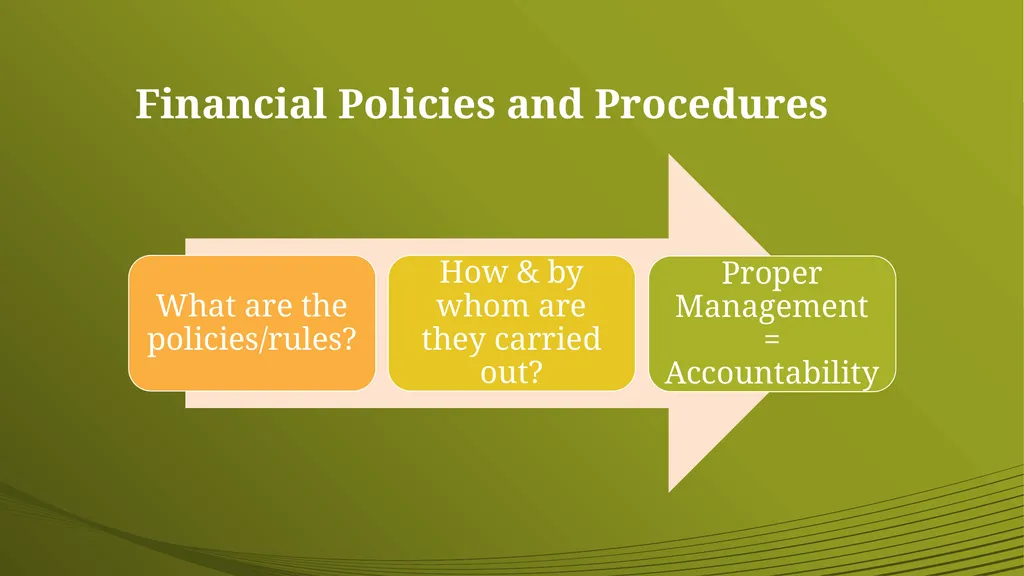
Financial Policies and Procedures<br>
slide12. Financial Policies and Procedures<br>
slide13. What policies must be in place? Budget Development and approval
Budget Tracking
Bank Account
Cash Management
Payroll processing
Purchasing/Procurement<br>
slide14. Policies that must be in place Inventory control
Conflict of Interest
Travel policies
Audit
Donations
Claim Submission<br>
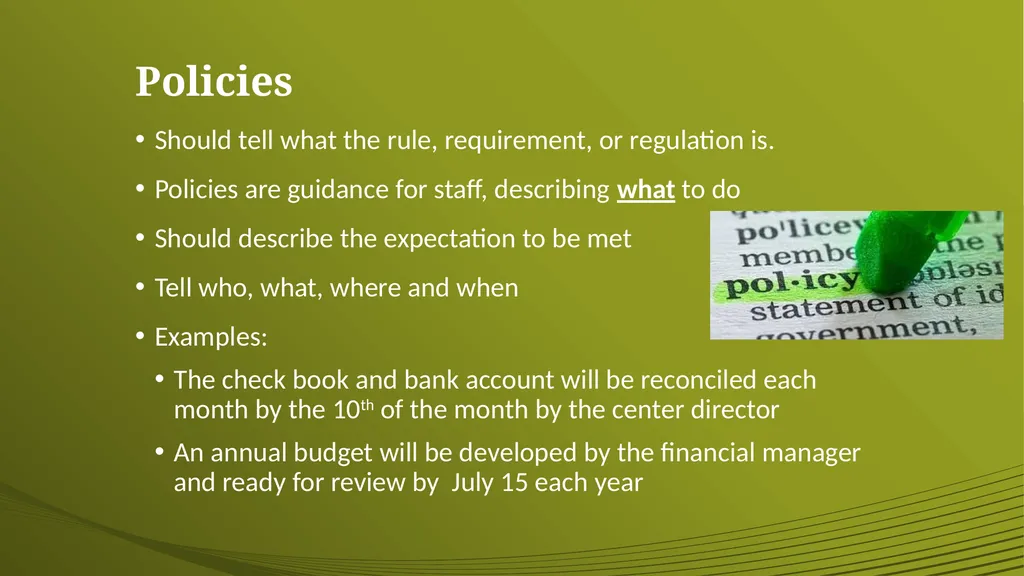
slide15. Policies Should tell what the rule, requirement, or regulation is.
Policies are guidance for staff, describing what to do
Should describe the expectation to be met
Tell who, what, where and when
Examples:
The check book and bank account will be reconciled each month by the 10th of the month by the center director
An annual budget will be developed by the financial manager and ready for review by July 15 each year<br>
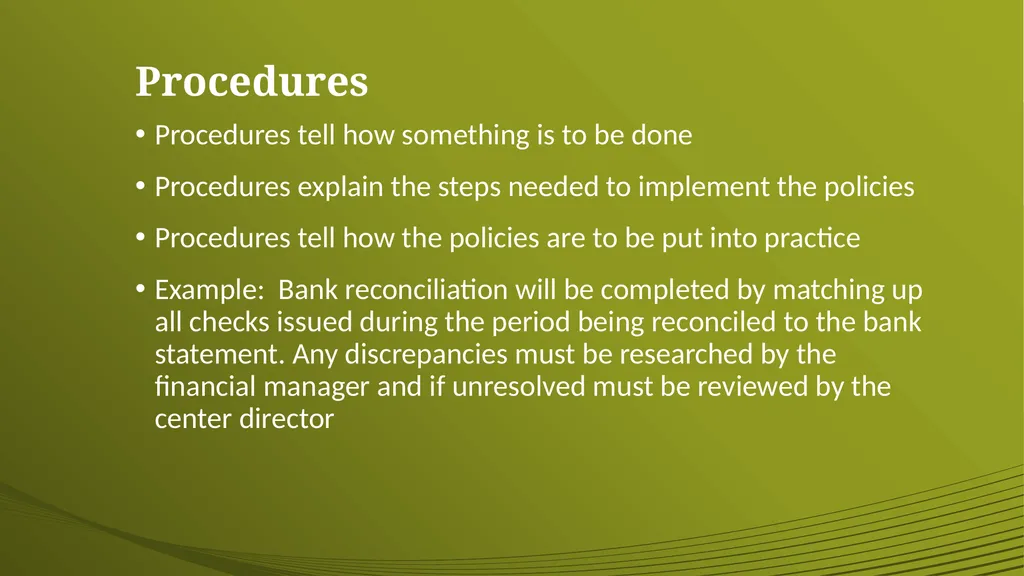
slide16. Procedures Procedures tell how something is to be done
Procedures explain the steps needed to implement the policies
Procedures tell how the policies are to be put into practice
Example: Bank reconciliation will be completed by matching up all checks issued during the period being reconciled to the bank statement. Any discrepancies must be researched by the financial manager and if unresolved must be reviewed by the center director<br>
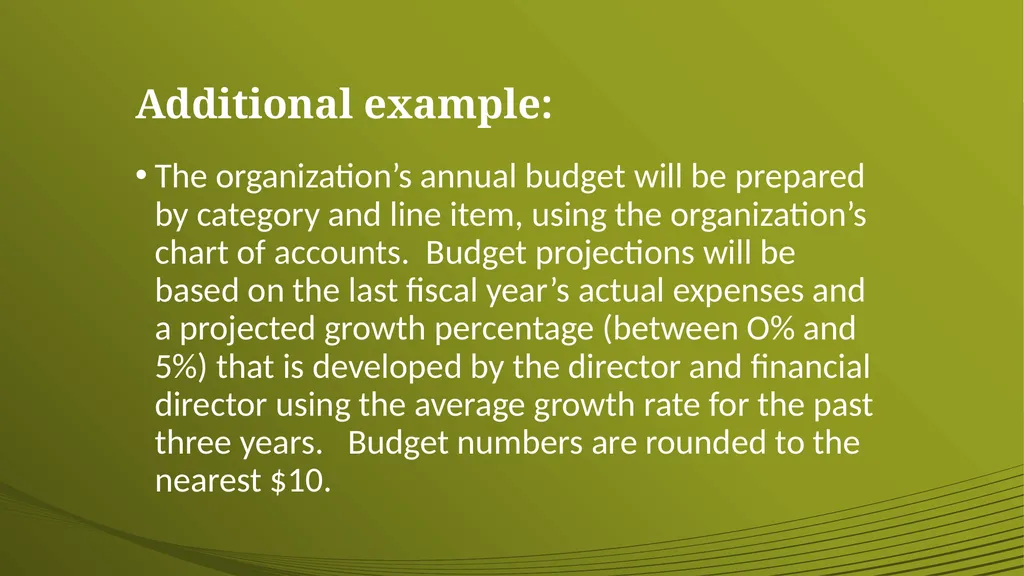
slide17. Additional example: The organization’s annual budget will be prepared by category and line item, using the organization’s chart of accounts. Budget projections will be based on the last fiscal year’s actual expenses and a projected growth percentage (between O% and 5%) that is developed by the director and financial director using the average growth rate for the past three years. Budget numbers are rounded to the nearest $10.<br>
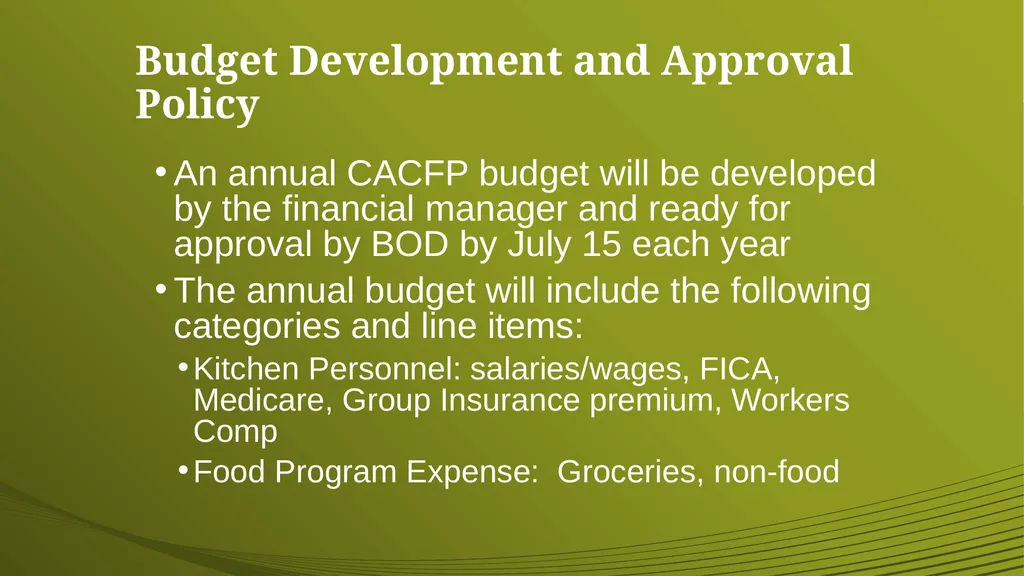
slide18. Budget Development and Approval Policy An annual CACFP budget will be developed by the financial manager and ready for approval by BOD by July 15 each year
The annual budget will include the following categories and line items:
Kitchen Personnel: salaries/wages, FICA, Medicare, Group Insurance premium, Workers Comp
Food Program Expense: Groceries, non-food<br>
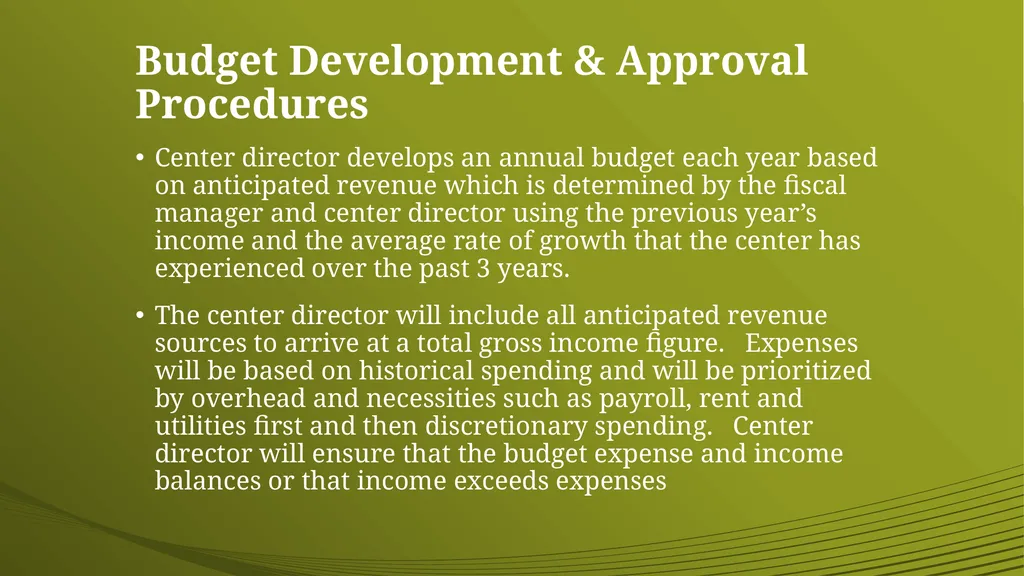
slide19. Budget Development & Approval Procedures Center director develops an annual budget each year based on anticipated revenue which is determined by the fiscal manager and center director using the previous year’s income and the average rate of growth that the center has experienced over the past 3 years.
The center director will include all anticipated revenue sources to arrive at a total gross income figure. Expenses will be based on historical spending and will be prioritized by overhead and necessities such as payroll, rent and utilities first and then discretionary spending. Center director will ensure that the budget expense and income balances or that income exceeds expenses<br>
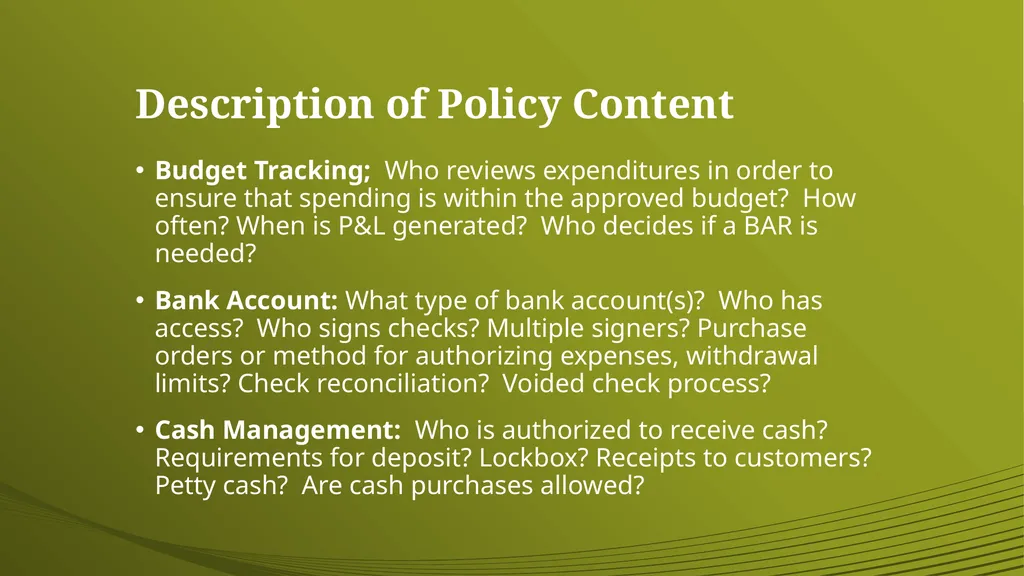
slide20. Description of Policy Content Budget Tracking; Who reviews expenditures in order to ensure that spending is within the approved budget? How often? When is P&L generated? Who decides if a BAR is needed?
Bank Account: What type of bank account(s)? Who has access? Who signs checks? Multiple signers? Purchase orders or method for authorizing expenses, withdrawal limits? Check reconciliation? Voided check process?
Cash Management: Who is authorized to receive cash? Requirements for deposit? Lockbox? Receipts to customers? Petty cash? Are cash purchases allowed?<br>
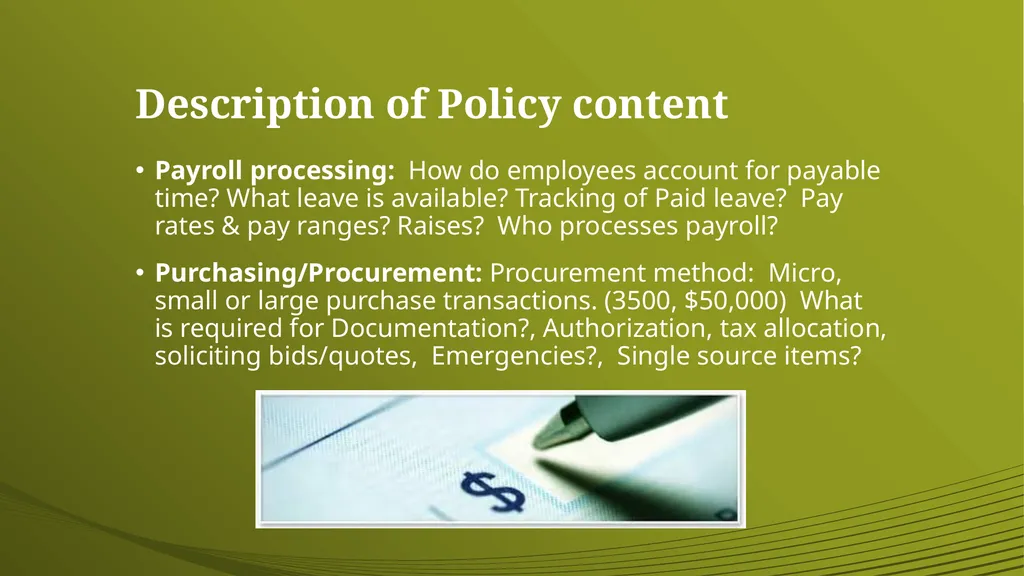
slide21. Description of Policy content Payroll processing: How do employees account for payable time? What leave is available? Tracking of Paid leave? Pay rates & pay ranges? Raises? Who processes payroll?
Purchasing/Procurement: Procurement method: Micro, small or large purchase transactions. (3500, $50,000) What is required for Documentation?, Authorization, tax allocation, soliciting bids/quotes, Emergencies?, Single source items?<br>
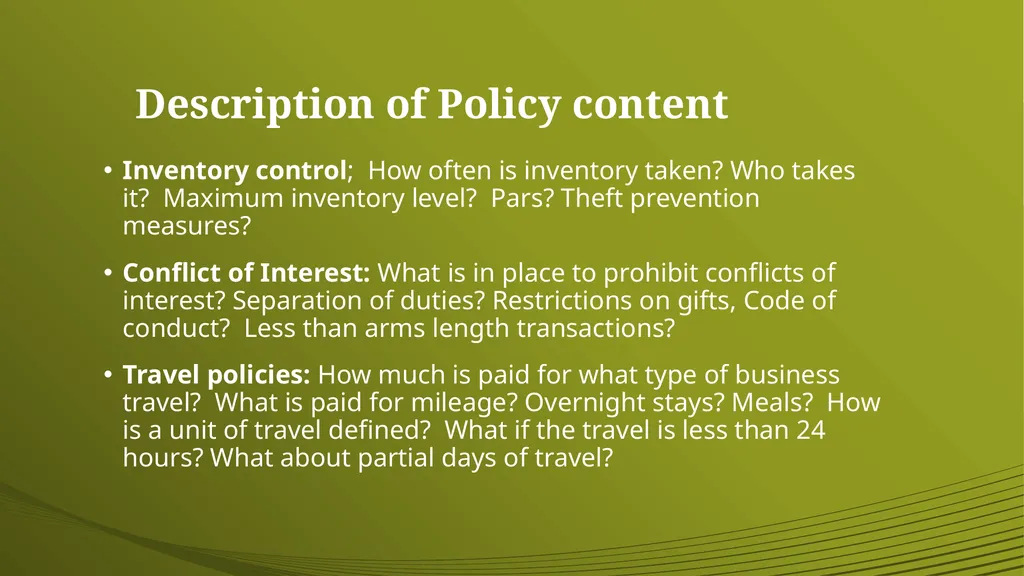
slide22. Description of Policy content Inventory control; How often is inventory taken? Who takes it? Maximum inventory level? Pars? Theft prevention measures?
Conflict of Interest: What is in place to prohibit conflicts of interest? Separation of duties? Restrictions on gifts, Code of conduct? Less than arms length transactions?
Travel policies: How much is paid for what type of business travel? What is paid for mileage? Overnight stays? Meals? How is a unit of travel defined? What if the travel is less than 24 hours? What about partial days of travel?<br>
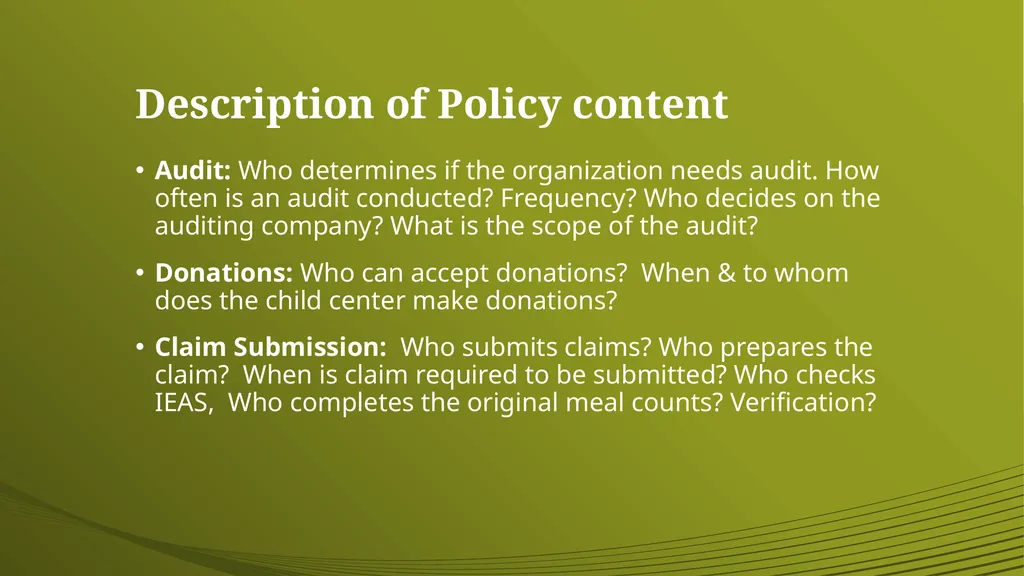
slide23. Description of Policy content Audit: Who determines if the organization needs audit. How often is an audit conducted? Frequency? Who decides on the auditing company? What is the scope of the audit?
Donations: Who can accept donations? When & to whom does the child center make donations?
Claim Submission: Who submits claims? Who prepares the claim? When is claim required to be submitted? Who checks IEAS, Who completes the original meal counts? Verification?<br>
slide24. What Questions do you have?<br>
slide2. 2 CFR Part 200 Uniform grant guidance Some changes are related to this new “Super-Circular”
200.303 Internal controls. The non-Federal entity must:
(a) Establish and maintain effective internal controls that provide reasonable assurance that the non-Federal entity is managing the Federal award in compliance with Federal statutes, regulations, and the terms and conditions of the Federal award.<br>
slide3. 2 CFR 200.305 Payment. The Federal awarding agency and pass-through entity [CYFD] must not require separate depository [bank] accounts for funds provided to a non-Federal entity or establish any eligibility requirements for depositories for funds provided to the non-Federal entity. However, the non-federal entity must be able to account for the receipt, obligation and expenditure of all funds<br>
slide4. 2 CFR 200.318 General procurement standards.: (a) The non-Federal entity must use its own documented procurement procedures which reflect applicable State & local laws and regulations, provided that the procurements conform to applicable Federal law and the standards identified in this section.
(b) Non-Federal entities must maintain oversight to ensure that contractors perform in accordance with the terms, conditions, and specifications of their contracts or purchase orders.
(c)(1) The non-Federal entity must maintain written standards of conduct covering conflicts of interest and governing the performance of its employees engaged in the selection, award and administration of contracts. No employee, officer, or agent must participate in the selection, award, or administration of a contract supported by a Federal award if he or she has a real or apparent conflict of interest.<br>
slide5. 2 CFR 200 200.333 Retention requirements for records. Financial records, supporting documents, statistical records, and all other non-Federal entity records pertinent to a Federal award must be retained for a period of three years from the date of submission of the final expenditure report or, for Federal awards that are renewed quarterly or annually, from the date of the submission of the quarterly or annual financial report, as reported to the Federal awarding agency or pass through entity in the case of a sub-recipient.<br>
slide6. Other sections of 2 CFR 200 include Subpart B—General Provisions
Subpart C—Pre-Federal Award Requirements and Contents of Federal Awards
Subpart D—Post Federal Award Requirements
Subpart E—Cost Principles
Subpart F—Audit Requirements<br>
slide7. CYFD – Administrative & Fiscal Standards<br>
slide8. Areas covered under the CYFD standards Non- Profit – 501 c 3 Organizations
Personnel
Fiscal Standards
Contractual Compliance
Insurance
Fiscal Records
Reporting
Record Retention
Audit requirements<br>
slide9. Non Profit Organizations Articles of Incorporation
Bylaws
Legal Requirements
Board composition
Board meeting minutes
Separate presentation at the end of the day.<br>
slide10. Personnel Organizational chart
Written personnel policies & procedures
Job descriptions
Personnel records<br>
slide11. Fiscal Standards Fiscal Records
Chart of Accounts
General Ledger
Cash receipt & disbursement journal
Inventory of Capital outlay
Payroll journal and employee earnings records
Financial Policies and Procedures<br>
slide12. Financial Policies and Procedures<br>
slide13. What policies must be in place? Budget Development and approval
Budget Tracking
Bank Account
Cash Management
Payroll processing
Purchasing/Procurement<br>
slide14. Policies that must be in place Inventory control
Conflict of Interest
Travel policies
Audit
Donations
Claim Submission<br>
slide15. Policies Should tell what the rule, requirement, or regulation is.
Policies are guidance for staff, describing what to do
Should describe the expectation to be met
Tell who, what, where and when
Examples:
The check book and bank account will be reconciled each month by the 10th of the month by the center director
An annual budget will be developed by the financial manager and ready for review by July 15 each year<br>
slide16. Procedures Procedures tell how something is to be done
Procedures explain the steps needed to implement the policies
Procedures tell how the policies are to be put into practice
Example: Bank reconciliation will be completed by matching up all checks issued during the period being reconciled to the bank statement. Any discrepancies must be researched by the financial manager and if unresolved must be reviewed by the center director<br>
slide17. Additional example: The organization’s annual budget will be prepared by category and line item, using the organization’s chart of accounts. Budget projections will be based on the last fiscal year’s actual expenses and a projected growth percentage (between O% and 5%) that is developed by the director and financial director using the average growth rate for the past three years. Budget numbers are rounded to the nearest $10.<br>
slide18. Budget Development and Approval Policy An annual CACFP budget will be developed by the financial manager and ready for approval by BOD by July 15 each year
The annual budget will include the following categories and line items:
Kitchen Personnel: salaries/wages, FICA, Medicare, Group Insurance premium, Workers Comp
Food Program Expense: Groceries, non-food<br>
slide19. Budget Development & Approval Procedures Center director develops an annual budget each year based on anticipated revenue which is determined by the fiscal manager and center director using the previous year’s income and the average rate of growth that the center has experienced over the past 3 years.
The center director will include all anticipated revenue sources to arrive at a total gross income figure. Expenses will be based on historical spending and will be prioritized by overhead and necessities such as payroll, rent and utilities first and then discretionary spending. Center director will ensure that the budget expense and income balances or that income exceeds expenses<br>
slide20. Description of Policy Content Budget Tracking; Who reviews expenditures in order to ensure that spending is within the approved budget? How often? When is P&L generated? Who decides if a BAR is needed?
Bank Account: What type of bank account(s)? Who has access? Who signs checks? Multiple signers? Purchase orders or method for authorizing expenses, withdrawal limits? Check reconciliation? Voided check process?
Cash Management: Who is authorized to receive cash? Requirements for deposit? Lockbox? Receipts to customers? Petty cash? Are cash purchases allowed?<br>
slide21. Description of Policy content Payroll processing: How do employees account for payable time? What leave is available? Tracking of Paid leave? Pay rates & pay ranges? Raises? Who processes payroll?
Purchasing/Procurement: Procurement method: Micro, small or large purchase transactions. (3500, $50,000) What is required for Documentation?, Authorization, tax allocation, soliciting bids/quotes, Emergencies?, Single source items?<br>
slide22. Description of Policy content Inventory control; How often is inventory taken? Who takes it? Maximum inventory level? Pars? Theft prevention measures?
Conflict of Interest: What is in place to prohibit conflicts of interest? Separation of duties? Restrictions on gifts, Code of conduct? Less than arms length transactions?
Travel policies: How much is paid for what type of business travel? What is paid for mileage? Overnight stays? Meals? How is a unit of travel defined? What if the travel is less than 24 hours? What about partial days of travel?<br>
slide23. Description of Policy content Audit: Who determines if the organization needs audit. How often is an audit conducted? Frequency? Who decides on the auditing company? What is the scope of the audit?
Donations: Who can accept donations? When & to whom does the child center make donations?
Claim Submission: Who submits claims? Who prepares the claim? When is claim required to be submitted? Who checks IEAS, Who completes the original meal counts? Verification?<br>
slide24. What Questions do you have?<br>