
Financial Controls Are Everyone’s Responsibility
Description: Financial Controls Are Everyones Responsibility Presented by Michael Bumgarner, CPA, CLM, CGMA Stacey Ransleben, CLM Chapter Resource Team January 14, 2020 What we will discuss today: Key Financial Controls Cyber Security Risks Best
Related Topics
Download Presentation
"Financial Controls Are Everyone’s Responsibility" is the property of its rightful owner. Permission is granted to download and print the materials on this website for personal, non-commercial use only, and to display it on your personal computer provided you do not modify the materials and that you retain all copyright notices contained in the materials. By downloading content from our website, you accept the terms of this agreement.
Presentation Transcript
slide1. Financial Controls Are Everyone’s Responsibility Presented by
Michael Bumgarner, CPA, CLM, CGMA
Stacey Ransleben, CLM Chapter Resource Team
January 14, 2020<br>
slide2. What we will discuss today: Key Financial Controls
Cyber Security Risks
Best Practices for Preserving Internal Financial Controls
Developing a Written Financial Policy
Understanding Bond Insurance Options<br>
slide3. What are some key financial controls Fiduciary Responsibilities
Segregation of duties
Expense authorization
Monitoring and reporting
Record keeping/Physical security<br>
slide4. Fiduciary Responsibilities of Chapters Board Members have ultimate responsibility and accountability for the chapter
Duty of care
Duty of loyalty
Duty of obedience
Who has the authority to make final decisions?
How to control activities (approvals, authorizations, reconciliations)<br>
slide5. Fiduciary Responsibilities of Chapters Chapter Budgets
Establish an annual budget of anticipated revenues, expenses and net profit or loss.
Review actual experience against the budget on a quarterly basis.
Separate budgets should be prepared (and reviewed by the chapter’s Board of Directors) for activities that occur during the course of the year such as seminars and surveys.
Include travel funds for the Chapter President and/or other officers to attend the Annual Conference, leadership and/or training sessions.<br>
slide6. Fiduciary Responsibilities of Chapters (cont.) Investment Policy
Financial Transactions
Cash Receipts
Cash Disbursements<br>
slide7. Fiduciary Responsibilities of Chapters (cont.) Banking Resolutions/Signature Cards
Bank Statements and Reconciliations
Credit Cards<br>
slide8. Fiduciary Responsibilities of Chapters (cont.) Insurance
General Liability – provided by ALA
Professional Liability - provided by ALA
Cyber liability- available for purchase
Fidelity Bond (Crime) – available for purchase
Directors & Officers Coverage (D&O) - available for purchase
Annual Tax Filing
Incorporation filings
ALA Volunteer Handbook – page 56
https://www.alanet.org/docs/default-source/Volunteer-Resources/ala-volunteer-handbook---2019.pdf?sfvrsn=12<br>
slide9. Segregation of Duties Why do we have to do this? It just adds time to the task at hand?
It protects the assets and reputation of the organization.
Just as important, it protects the assets and reputation of the officers and the Board members.<br>
slide10. Segregation of Duties (cont.) What does this even mean?
Effective internal controls limit any single individual from having control over two or more phases of a financial transaction or operation.
Segregation of duties is a key concept of internal controls and should be part of your written policy.
Its an appropriate level of checks and balances upon the activities of individuals.
Increased protection from fraud and errors must be balanced with the increased cost/effort require.
Depending on a company's size, functions and designations may vary. When duties cannot be separated, compensating controls should be in place.<br>
slide11. Segregation of Duties (cont.) General categories of functions to be separated:
Authorization function.
Recording function, (e.g. preparing source document or performance reports).
Custody of asset whether directly or indirectly, e.g. receiving checks in mail or implementing source code or database changes.
Reconciliation or audit.
Splitting one security key in two (more) parts between responsible persons.<br>
slide12. Expense Authorization Was the expense budgeted?
All disbursements, whether made by check, positive pay, or an e-pay system, should be approved by someone other than the person who physically makes the payment.
Cash expenditures should be avoided to the extent possible. Consistent with the proper segregation of duties, a single person should not be responsible for the collection, deposit, and reconciliation of cash receipts or other sources of income.
If it is necessary to make payments in cash, those payments should be fully documented through advance approval, signed receipts by persons receiving cash, and expense vouchers or other documentation that the cash was used appropriately.<br>
slide13. Monitoring and Reporting Reconcile and examine bank statements monthly
Should be reconciled on a monthly basis by someone who does not issue or sign checks on behalf of the organization.
Checks and other expenditures should be examined to verify that the payments are consistent with the organization’s activities and that the expenditures were appropriate.
Deposit activity should also be reviewed to ensure that it corresponds to expected revenues.
Standard Monthly Reporting/Treasurer’s Report
In addition to annual budget and financial statements, organizations should also prepare and distribute monthly financial reports for the board’s review and consideration
Independent Audits/Self audits
commitment to financial transparency
define specific financial responsibilities for each staff or Board member<br>
slide14. Record Keeping/Physical Security Maintain physical security of assets to ensure that only people who are authorized have physical or indirect access to money, securities, real estate and other valuable property.
Where are bank checks stored?
Is accounting software password protected?
Do you share passwords?
Are financial reports password protected when sent electronically?
Document retention
Have a document retention policy (more importantly follow it)!
Have a data back up plan
Ensure there are back ups of all electronically-stored financial data in the event of a computer outage.
Ensure you have alternative arrangements in place to address a situation in which the person who is normally responsible for the organization’s finances becomes suddenly unavailable.<br>
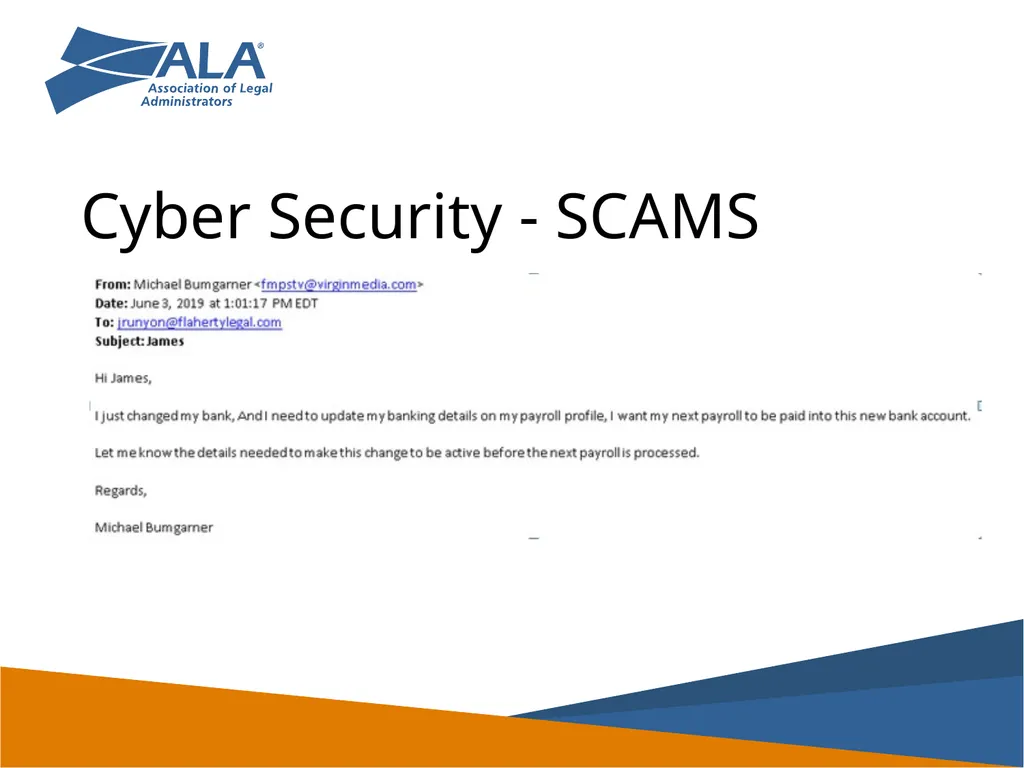
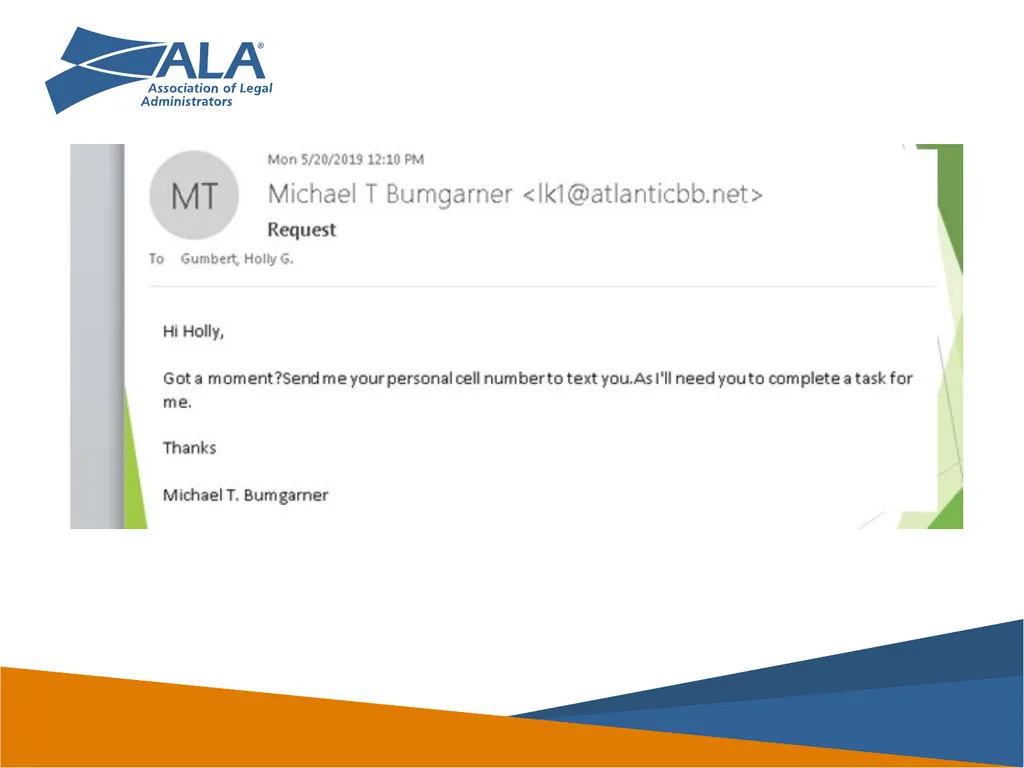
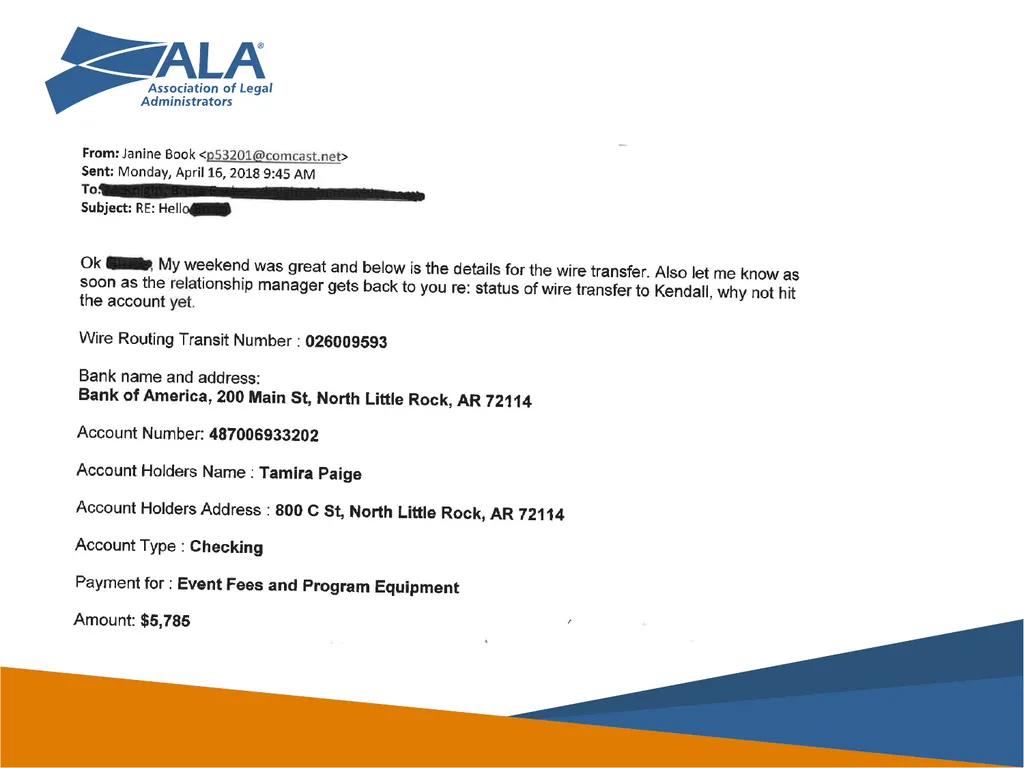
slide15. Cyber Security ALA Chapters have been the target of the occasional phishing scams. Here are a few tips to keep in mind when handling sensitive chapter information:
Verify the identity of the sender. If the sender’s email address isn’t one you are used to seeing reach out to the individual via phone for verification.
Never access chapter accounts using links sent via e-mail. Links, while convenient, can be problematic. Always access the website of your financial institution directly through your web browser. Similarly, never share account numbers via e-mail.<br>
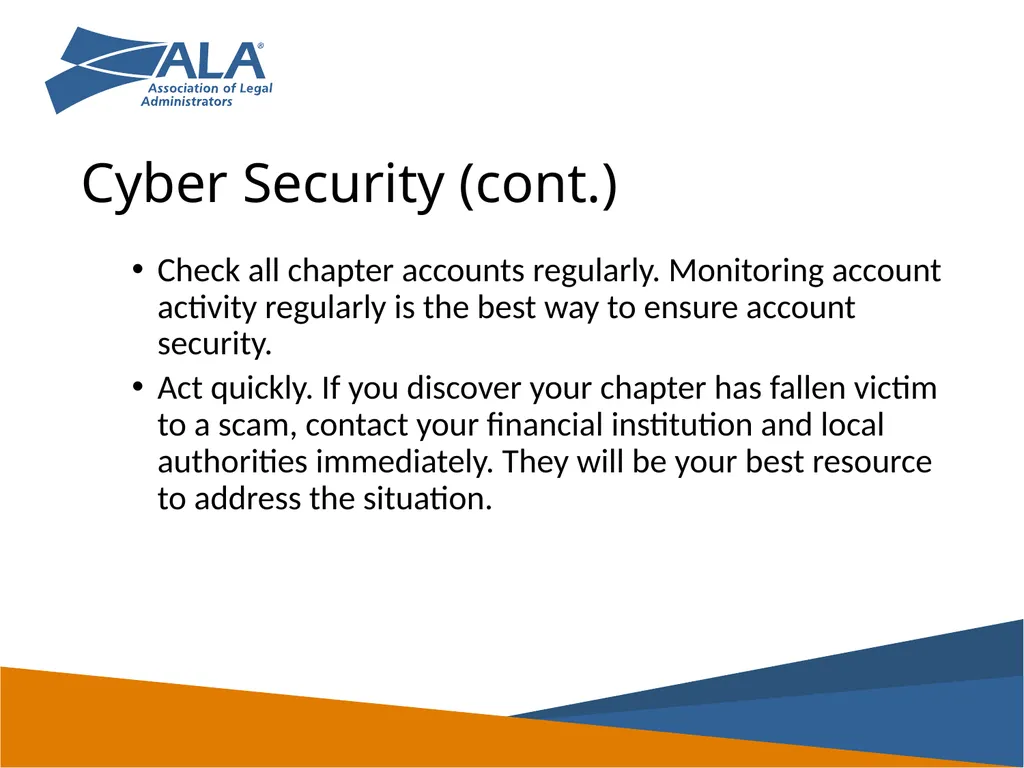
slide16. Cyber Security (cont.) Check all chapter accounts regularly. Monitoring account activity regularly is the best way to ensure account security.
Act quickly. If you discover your chapter has fallen victim to a scam, contact your financial institution and local authorities immediately. They will be your best resource to address the situation.<br>
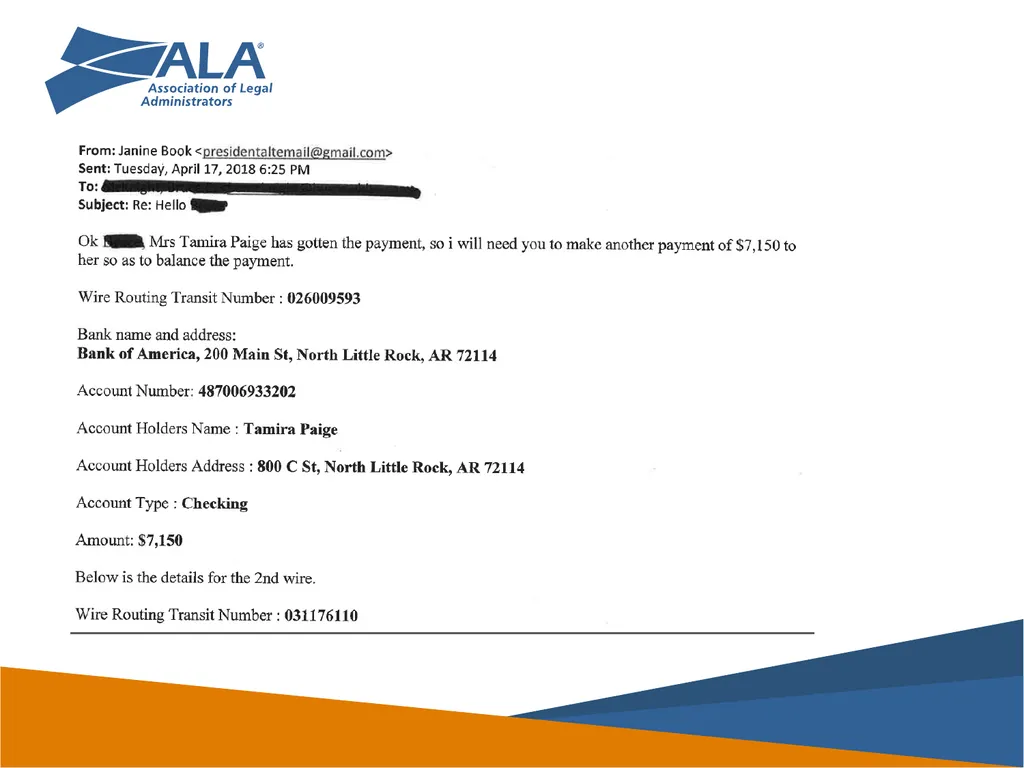
slide17. Cyber Security - SCAMS<br>
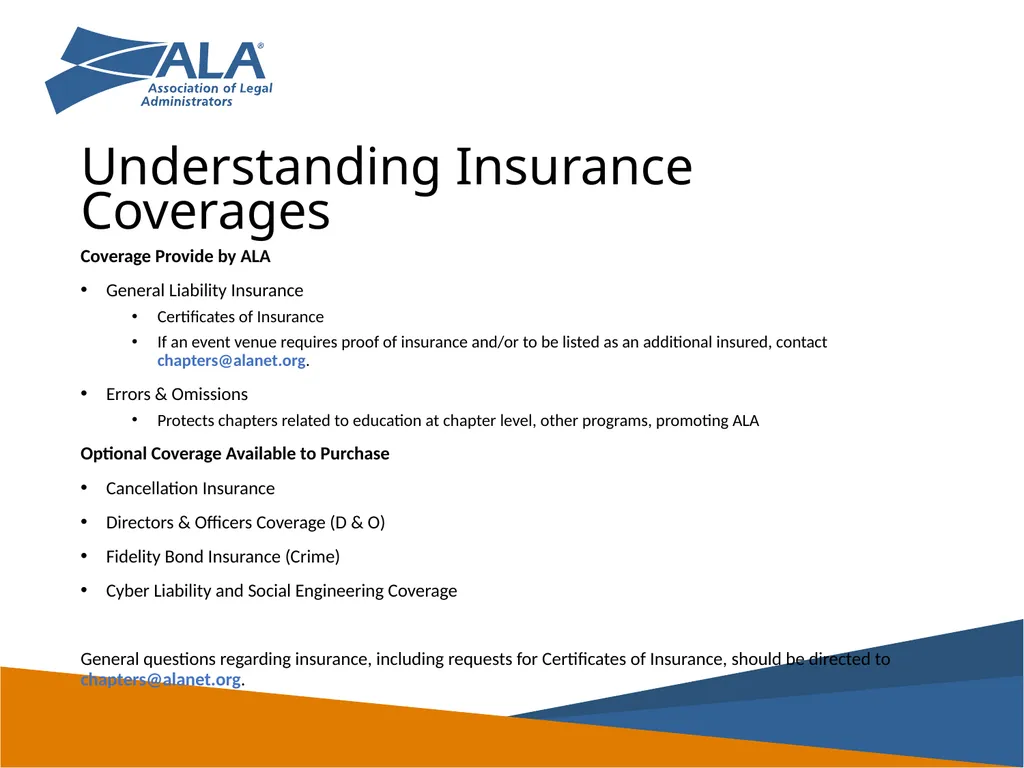
slide21. Understanding Insurance Coverages Coverage Provide by ALA
General Liability Insurance
Certificates of Insurance
If an event venue requires proof of insurance and/or to be listed as an additional insured, contact chapters@alanet.org.
Errors & Omissions
Protects chapters related to education at chapter level, other programs, promoting ALA
Optional Coverage Available to Purchase
Cancellation Insurance
Directors & Officers Coverage (D & O)
Fidelity Bond Insurance (Crime)
Cyber Liability and Social Engineering Coverage
General questions regarding insurance, including requests for Certificates of Insurance, should be directed to chapters@alanet.org.<br>
slide22. Understanding Insurance Coverages (cont.) ALA webinar https://www.alanet.org/membership/chapters/chapter-leader-resources/insurance-coverage-available-to-ala-chapters
Regan E. Katz
Wortham Insurance & Risk Management
713-346-1081
Regan.Katz@WorthamInsurance.com<br>
slide23. Why have a written policy? “Financial policies clarify the roles, authority, and responsibilities for essential financial management activities and decisions. In the absence of an adopted policy, staff and Board members are likely to operate under a set of assumptions that may or may not be accurate and productive.”
– Propel Nonprofits<br>
slide24. Best Practices for Preserving Internal Financial Controls Have your policy/guidelines in writing
Review annually with all new officers and committee chairs
Know what documentation you should be keeping, and be consistent.
Conduct a "surprise internal audit“
Monitoring<br>
Michael Bumgarner, CPA, CLM, CGMA
Stacey Ransleben, CLM Chapter Resource Team
January 14, 2020<br>
slide2. What we will discuss today: Key Financial Controls
Cyber Security Risks
Best Practices for Preserving Internal Financial Controls
Developing a Written Financial Policy
Understanding Bond Insurance Options<br>
slide3. What are some key financial controls Fiduciary Responsibilities
Segregation of duties
Expense authorization
Monitoring and reporting
Record keeping/Physical security<br>
slide4. Fiduciary Responsibilities of Chapters Board Members have ultimate responsibility and accountability for the chapter
Duty of care
Duty of loyalty
Duty of obedience
Who has the authority to make final decisions?
How to control activities (approvals, authorizations, reconciliations)<br>
slide5. Fiduciary Responsibilities of Chapters Chapter Budgets
Establish an annual budget of anticipated revenues, expenses and net profit or loss.
Review actual experience against the budget on a quarterly basis.
Separate budgets should be prepared (and reviewed by the chapter’s Board of Directors) for activities that occur during the course of the year such as seminars and surveys.
Include travel funds for the Chapter President and/or other officers to attend the Annual Conference, leadership and/or training sessions.<br>
slide6. Fiduciary Responsibilities of Chapters (cont.) Investment Policy
Financial Transactions
Cash Receipts
Cash Disbursements<br>
slide7. Fiduciary Responsibilities of Chapters (cont.) Banking Resolutions/Signature Cards
Bank Statements and Reconciliations
Credit Cards<br>
slide8. Fiduciary Responsibilities of Chapters (cont.) Insurance
General Liability – provided by ALA
Professional Liability - provided by ALA
Cyber liability- available for purchase
Fidelity Bond (Crime) – available for purchase
Directors & Officers Coverage (D&O) - available for purchase
Annual Tax Filing
Incorporation filings
ALA Volunteer Handbook – page 56
https://www.alanet.org/docs/default-source/Volunteer-Resources/ala-volunteer-handbook---2019.pdf?sfvrsn=12<br>
slide9. Segregation of Duties Why do we have to do this? It just adds time to the task at hand?
It protects the assets and reputation of the organization.
Just as important, it protects the assets and reputation of the officers and the Board members.<br>
slide10. Segregation of Duties (cont.) What does this even mean?
Effective internal controls limit any single individual from having control over two or more phases of a financial transaction or operation.
Segregation of duties is a key concept of internal controls and should be part of your written policy.
Its an appropriate level of checks and balances upon the activities of individuals.
Increased protection from fraud and errors must be balanced with the increased cost/effort require.
Depending on a company's size, functions and designations may vary. When duties cannot be separated, compensating controls should be in place.<br>
slide11. Segregation of Duties (cont.) General categories of functions to be separated:
Authorization function.
Recording function, (e.g. preparing source document or performance reports).
Custody of asset whether directly or indirectly, e.g. receiving checks in mail or implementing source code or database changes.
Reconciliation or audit.
Splitting one security key in two (more) parts between responsible persons.<br>
slide12. Expense Authorization Was the expense budgeted?
All disbursements, whether made by check, positive pay, or an e-pay system, should be approved by someone other than the person who physically makes the payment.
Cash expenditures should be avoided to the extent possible. Consistent with the proper segregation of duties, a single person should not be responsible for the collection, deposit, and reconciliation of cash receipts or other sources of income.
If it is necessary to make payments in cash, those payments should be fully documented through advance approval, signed receipts by persons receiving cash, and expense vouchers or other documentation that the cash was used appropriately.<br>
slide13. Monitoring and Reporting Reconcile and examine bank statements monthly
Should be reconciled on a monthly basis by someone who does not issue or sign checks on behalf of the organization.
Checks and other expenditures should be examined to verify that the payments are consistent with the organization’s activities and that the expenditures were appropriate.
Deposit activity should also be reviewed to ensure that it corresponds to expected revenues.
Standard Monthly Reporting/Treasurer’s Report
In addition to annual budget and financial statements, organizations should also prepare and distribute monthly financial reports for the board’s review and consideration
Independent Audits/Self audits
commitment to financial transparency
define specific financial responsibilities for each staff or Board member<br>
slide14. Record Keeping/Physical Security Maintain physical security of assets to ensure that only people who are authorized have physical or indirect access to money, securities, real estate and other valuable property.
Where are bank checks stored?
Is accounting software password protected?
Do you share passwords?
Are financial reports password protected when sent electronically?
Document retention
Have a document retention policy (more importantly follow it)!
Have a data back up plan
Ensure there are back ups of all electronically-stored financial data in the event of a computer outage.
Ensure you have alternative arrangements in place to address a situation in which the person who is normally responsible for the organization’s finances becomes suddenly unavailable.<br>
slide15. Cyber Security ALA Chapters have been the target of the occasional phishing scams. Here are a few tips to keep in mind when handling sensitive chapter information:
Verify the identity of the sender. If the sender’s email address isn’t one you are used to seeing reach out to the individual via phone for verification.
Never access chapter accounts using links sent via e-mail. Links, while convenient, can be problematic. Always access the website of your financial institution directly through your web browser. Similarly, never share account numbers via e-mail.<br>
slide16. Cyber Security (cont.) Check all chapter accounts regularly. Monitoring account activity regularly is the best way to ensure account security.
Act quickly. If you discover your chapter has fallen victim to a scam, contact your financial institution and local authorities immediately. They will be your best resource to address the situation.<br>
slide17. Cyber Security - SCAMS<br>
slide21. Understanding Insurance Coverages Coverage Provide by ALA
General Liability Insurance
Certificates of Insurance
If an event venue requires proof of insurance and/or to be listed as an additional insured, contact chapters@alanet.org.
Errors & Omissions
Protects chapters related to education at chapter level, other programs, promoting ALA
Optional Coverage Available to Purchase
Cancellation Insurance
Directors & Officers Coverage (D & O)
Fidelity Bond Insurance (Crime)
Cyber Liability and Social Engineering Coverage
General questions regarding insurance, including requests for Certificates of Insurance, should be directed to chapters@alanet.org.<br>
slide22. Understanding Insurance Coverages (cont.) ALA webinar https://www.alanet.org/membership/chapters/chapter-leader-resources/insurance-coverage-available-to-ala-chapters
Regan E. Katz
Wortham Insurance & Risk Management
713-346-1081
Regan.Katz@WorthamInsurance.com<br>
slide23. Why have a written policy? “Financial policies clarify the roles, authority, and responsibilities for essential financial management activities and decisions. In the absence of an adopted policy, staff and Board members are likely to operate under a set of assumptions that may or may not be accurate and productive.”
– Propel Nonprofits<br>
slide24. Best Practices for Preserving Internal Financial Controls Have your policy/guidelines in writing
Review annually with all new officers and committee chairs
Know what documentation you should be keeping, and be consistent.
Conduct a "surprise internal audit“
Monitoring<br>