
Financial Options Option Basics Financial Option A
OM
Published · 46 slides · 0 views

1 / 1
Description
Financial Options Option Basics Financial Option A contract that gives its owner the right (but not the obligation) to purchase or sell an asset at a fixed price as some future date Call Option A financial option that gives its owner the
Related Topics
Share
Embed code
Download this presentation From Below
"Financial Options Option Basics Financial Option A" is the property of its rightful owner. Permission is granted to download and print the materials on this website for personal, non-commercial use only, and to display it on your personal computer provided you do not modify the materials and that you retain all copyright notices contained in the materials. By downloading content from our website, you accept the terms of this agreement.
Presentation Transcript
01
Financial Options<br>
02
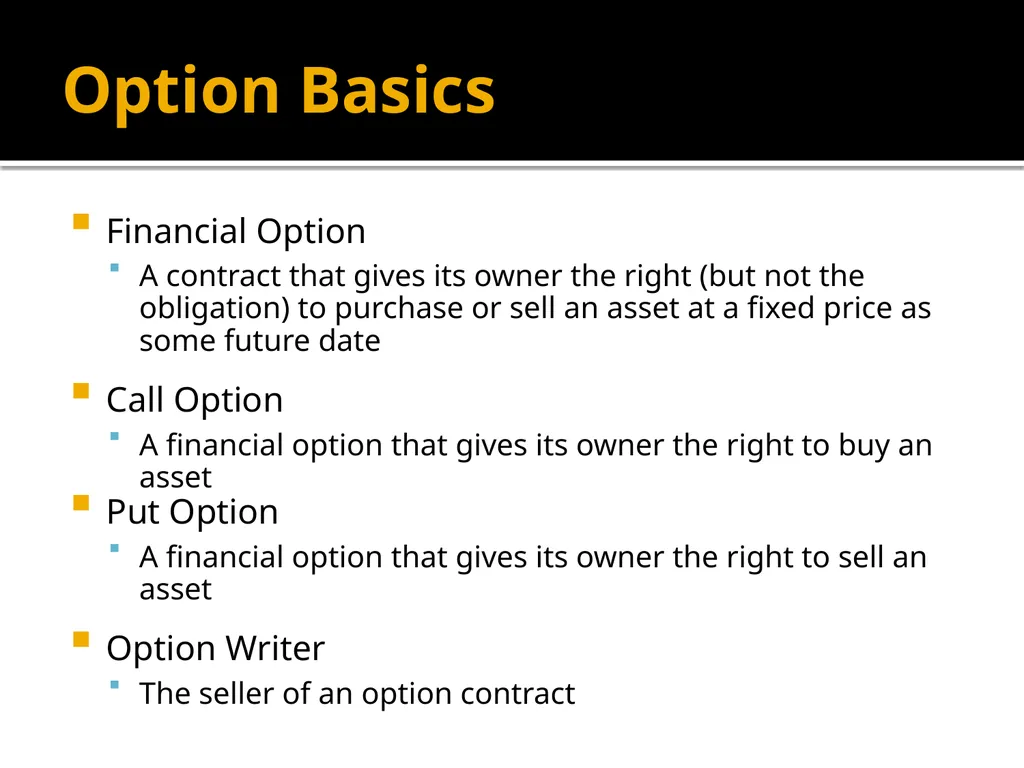
Option Basics Financial Option
A contract that gives its owner the right (but not the obligation) to purchase or sell an asset at a fixed price as some future date
Call Option
A financial option that gives its owner the right to buy an asset
Put Option
A financial option that gives its owner the right to sell an asset
Option Writer
The seller of an option contract<br>
A contract that gives its owner the right (but not the obligation) to purchase or sell an asset at a fixed price as some future date
Call Option
A financial option that gives its owner the right to buy an asset
Put Option
A financial option that gives its owner the right to sell an asset
Option Writer
The seller of an option contract<br>
03
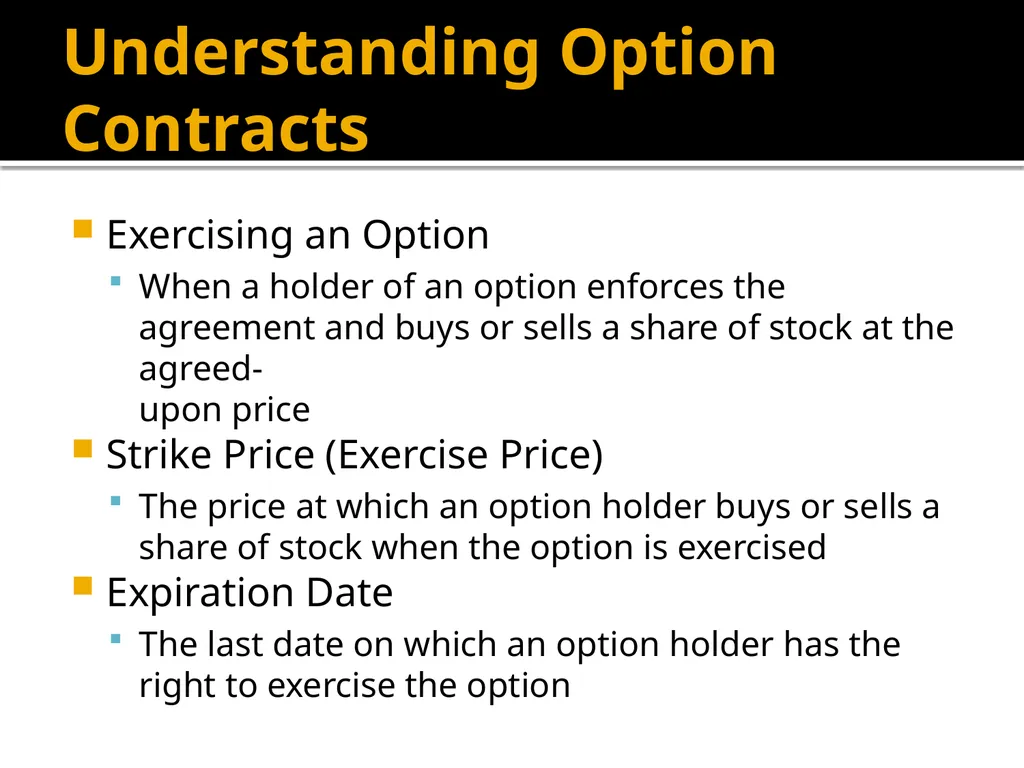
Understanding Option Contracts Exercising an Option
When a holder of an option enforces the agreement and buys or sells a share of stock at the agreed- upon price
Strike Price (Exercise Price)
The price at which an option holder buys or sells a share of stock when the option is exercised
Expiration Date
The last date on which an option holder has the right to exercise the option<br>
When a holder of an option enforces the agreement and buys or sells a share of stock at the agreed- upon price
Strike Price (Exercise Price)
The price at which an option holder buys or sells a share of stock when the option is exercised
Expiration Date
The last date on which an option holder has the right to exercise the option<br>
04
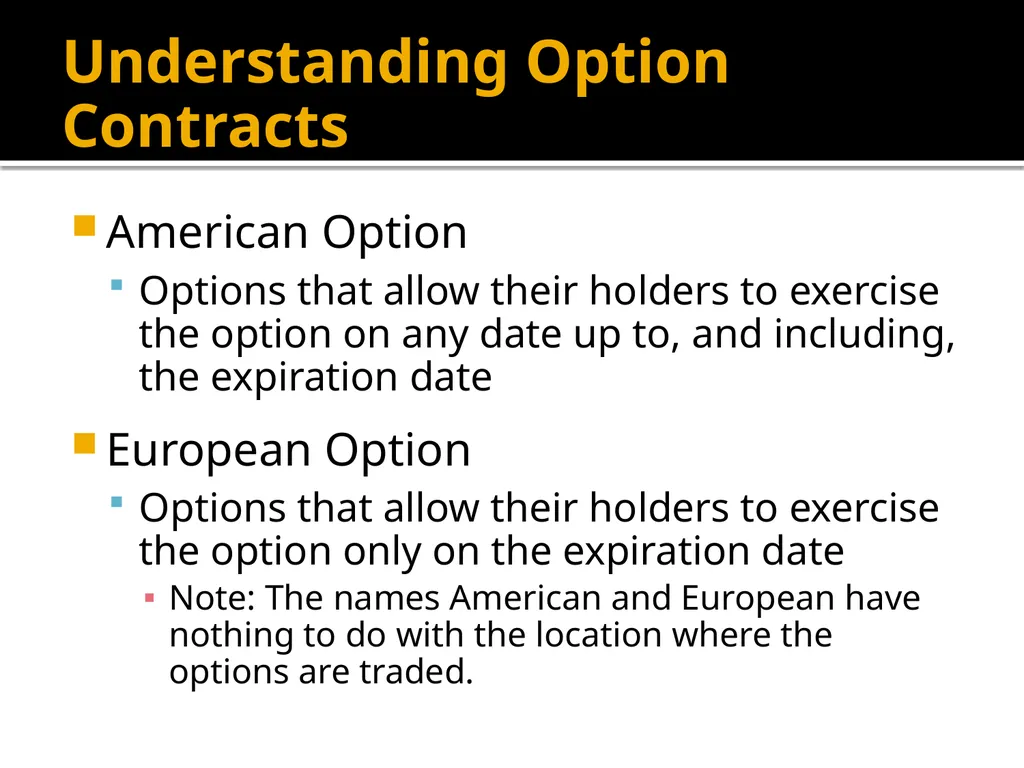
Understanding Option Contracts American Option
Options that allow their holders to exercise the option on any date up to, and including, the expiration date
European Option
Options that allow their holders to exercise the option only on the expiration date
Note: The names American and European have nothing to do with the location where the options are traded.<br>
Options that allow their holders to exercise the option on any date up to, and including, the expiration date
European Option
Options that allow their holders to exercise the option only on the expiration date
Note: The names American and European have nothing to do with the location where the options are traded.<br>
05
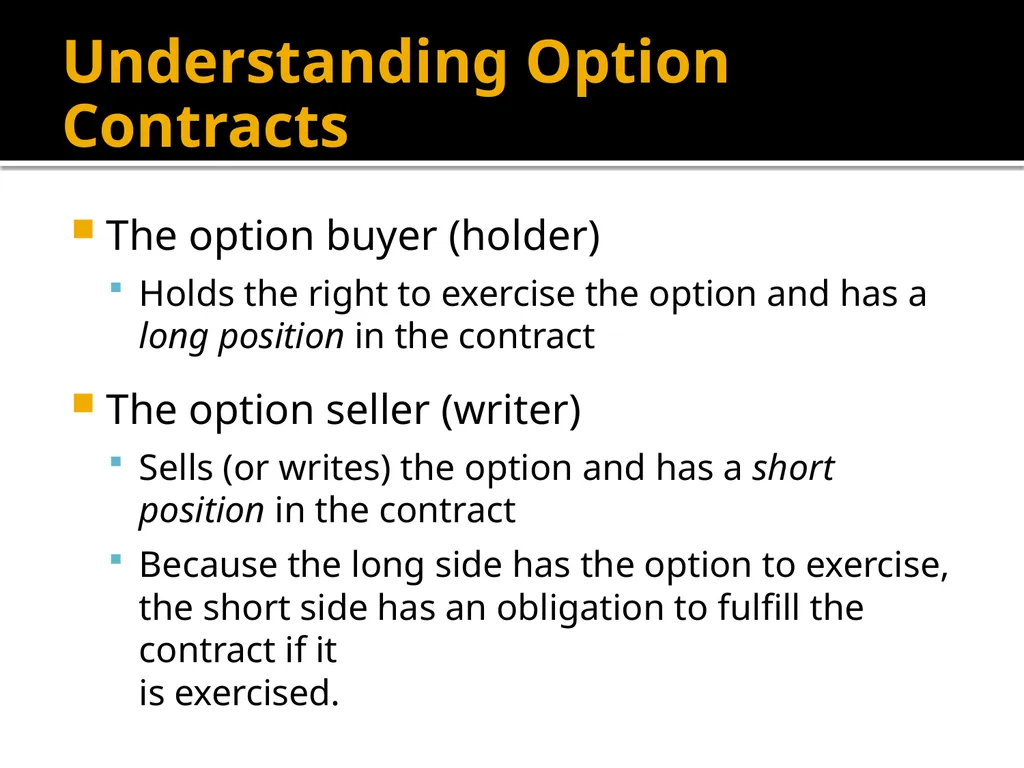
Understanding Option Contracts The option buyer (holder)
Holds the right to exercise the option and has a long position in the contract
The option seller (writer)
Sells (or writes) the option and has a short position in the contract
Because the long side has the option to exercise, the short side has an obligation to fulfill the contract if it is exercised.<br>
Holds the right to exercise the option and has a long position in the contract
The option seller (writer)
Sells (or writes) the option and has a short position in the contract
Because the long side has the option to exercise, the short side has an obligation to fulfill the contract if it is exercised.<br>
06
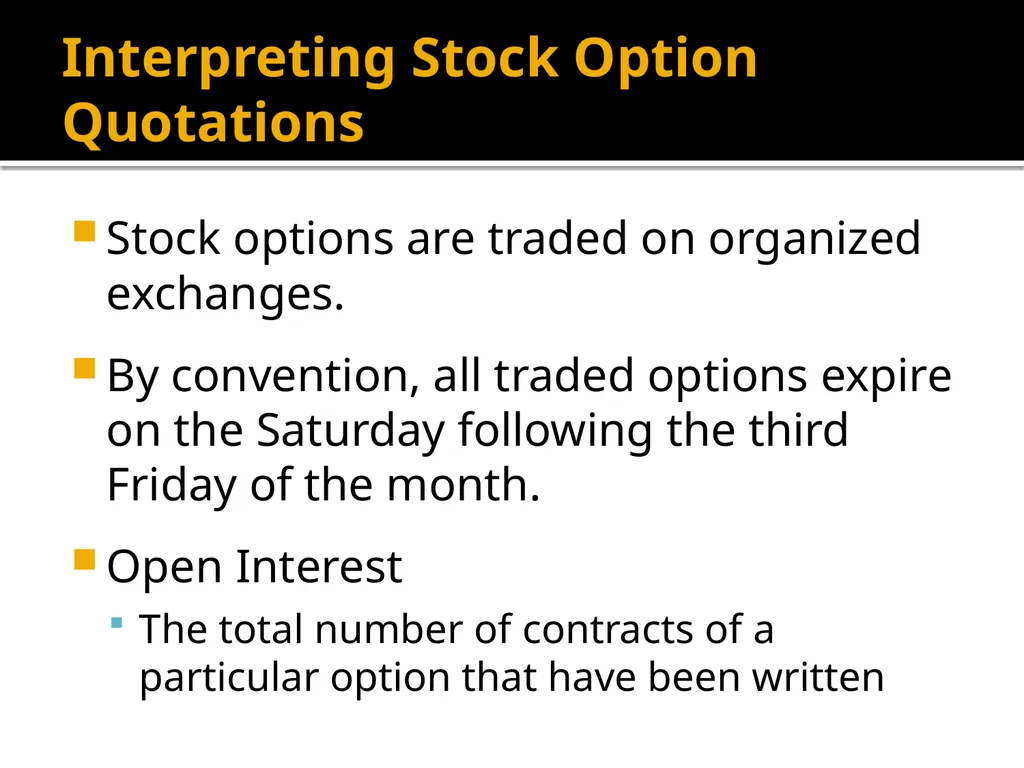
Interpreting Stock Option Quotations Stock options are traded on organized exchanges.
By convention, all traded options expire on the Saturday following the third Friday of the month.
Open Interest
The total number of contracts of a particular option that have been written<br>
By convention, all traded options expire on the Saturday following the third Friday of the month.
Open Interest
The total number of contracts of a particular option that have been written<br>
07
Interpreting Stock Option
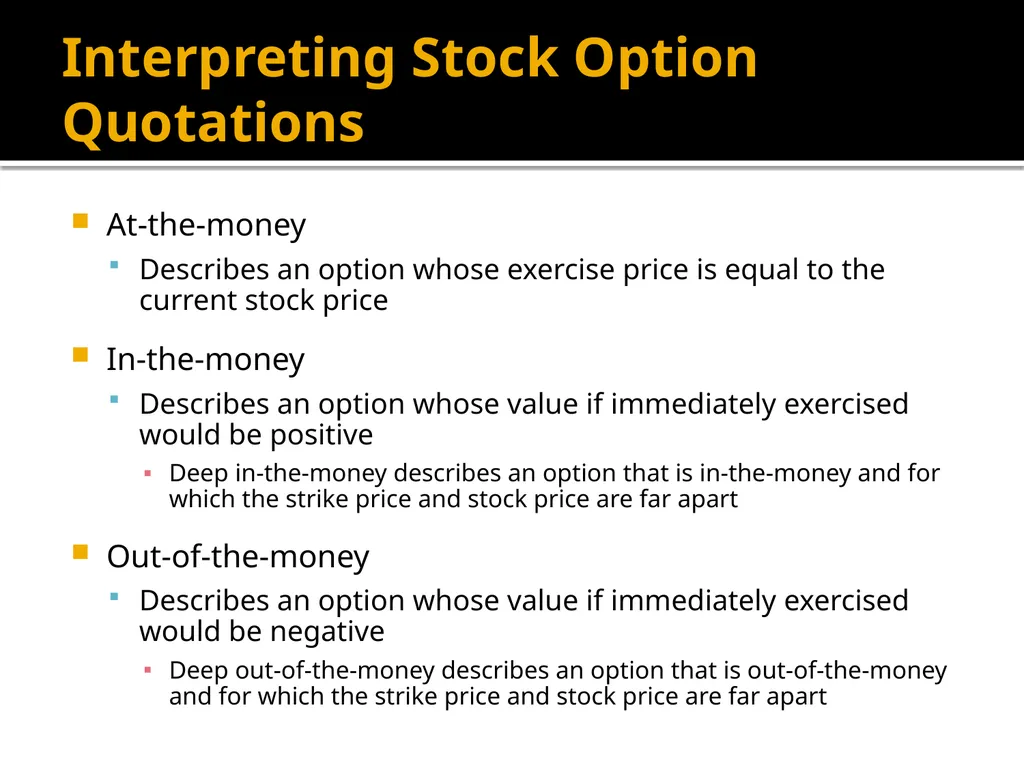
Quotations At-the-money
Describes an option whose exercise price is equal to the current stock price
In-the-money
Describes an option whose value if immediately exercised would be positive
Deep in-the-money describes an option that is in-the-money and for which the strike price and stock price are far apart
Out-of-the-money
Describes an option whose value if immediately exercised would be negative
Deep out-of-the-money describes an option that is out-of-the-money and for which the strike price and stock price are far apart<br>
Describes an option whose exercise price is equal to the current stock price
In-the-money
Describes an option whose value if immediately exercised would be positive
Deep in-the-money describes an option that is in-the-money and for which the strike price and stock price are far apart
Out-of-the-money
Describes an option whose value if immediately exercised would be negative
Deep out-of-the-money describes an option that is out-of-the-money and for which the strike price and stock price are far apart<br>
08
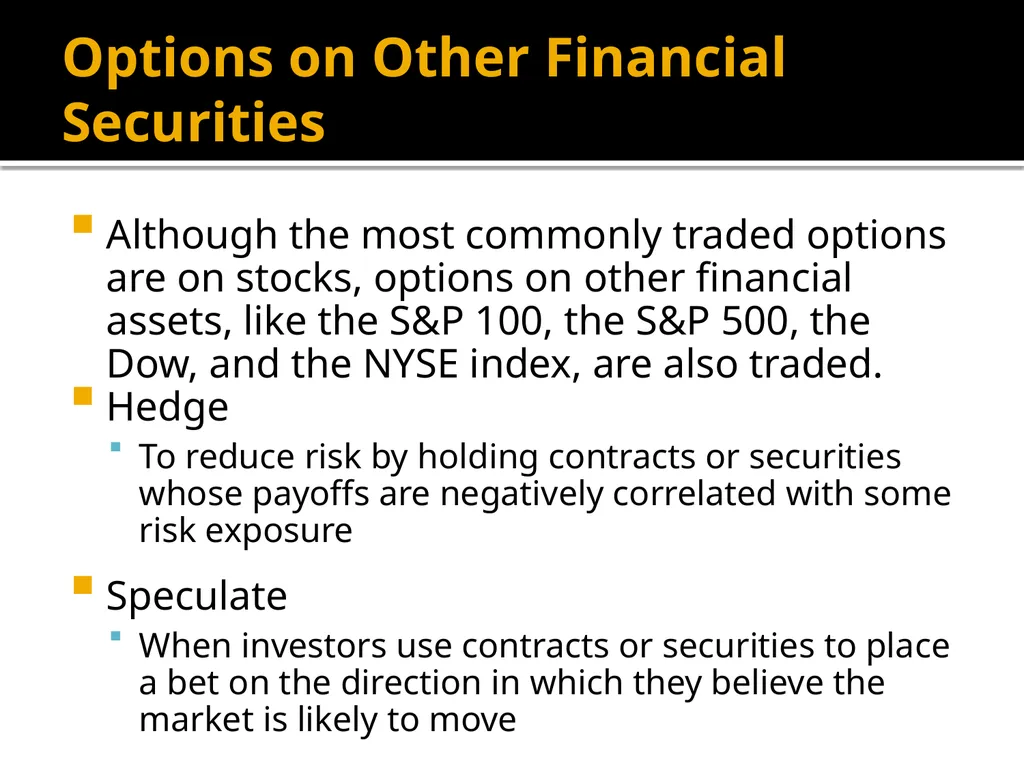
Options on Other Financial Securities Although the most commonly traded options are on stocks, options on other financial assets, like the S&P 100, the S&P 500, the Dow, and the NYSE index, are also traded.
Hedge
To reduce risk by holding contracts or securities whose payoffs are negatively correlated with some risk exposure
Speculate
When investors use contracts or securities to place a bet on the direction in which they believe the market is likely to move<br>
Hedge
To reduce risk by holding contracts or securities whose payoffs are negatively correlated with some risk exposure
Speculate
When investors use contracts or securities to place a bet on the direction in which they believe the market is likely to move<br>
09
Option Payoffs at Expiration Long Position in an Option Contract
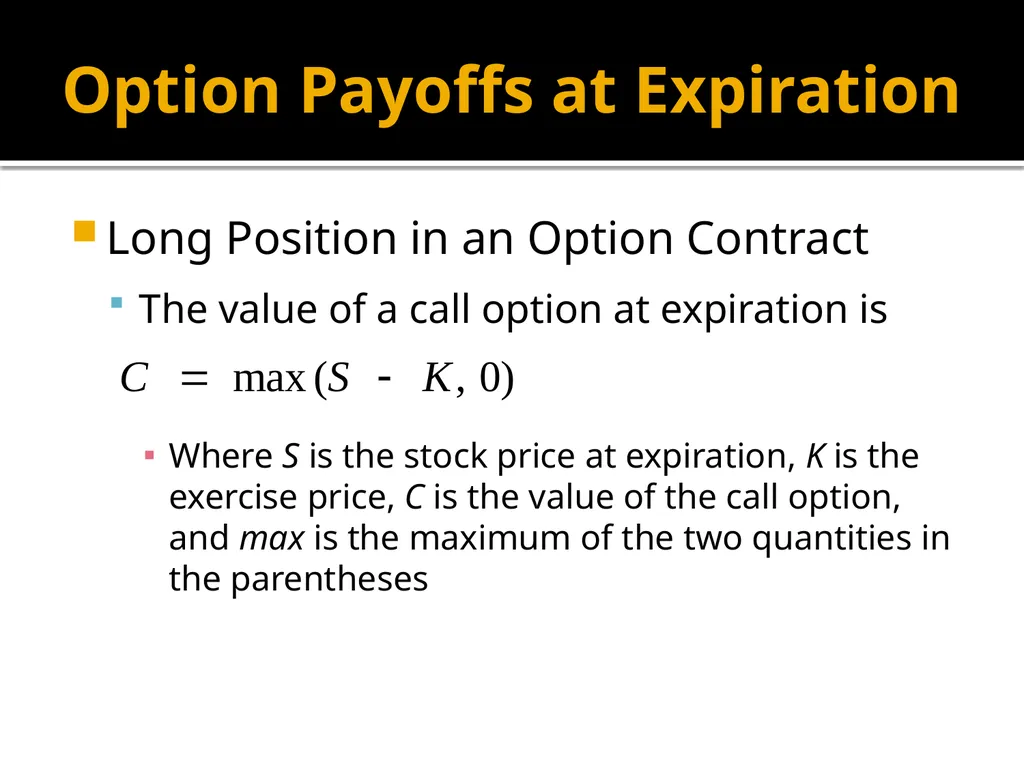
The value of a call option at expiration is
Where S is the stock price at expiration, K is the exercise price, C is the value of the call option, and max is the maximum of the two quantities in the parentheses<br>
The value of a call option at expiration is
Where S is the stock price at expiration, K is the exercise price, C is the value of the call option, and max is the maximum of the two quantities in the parentheses<br>
10
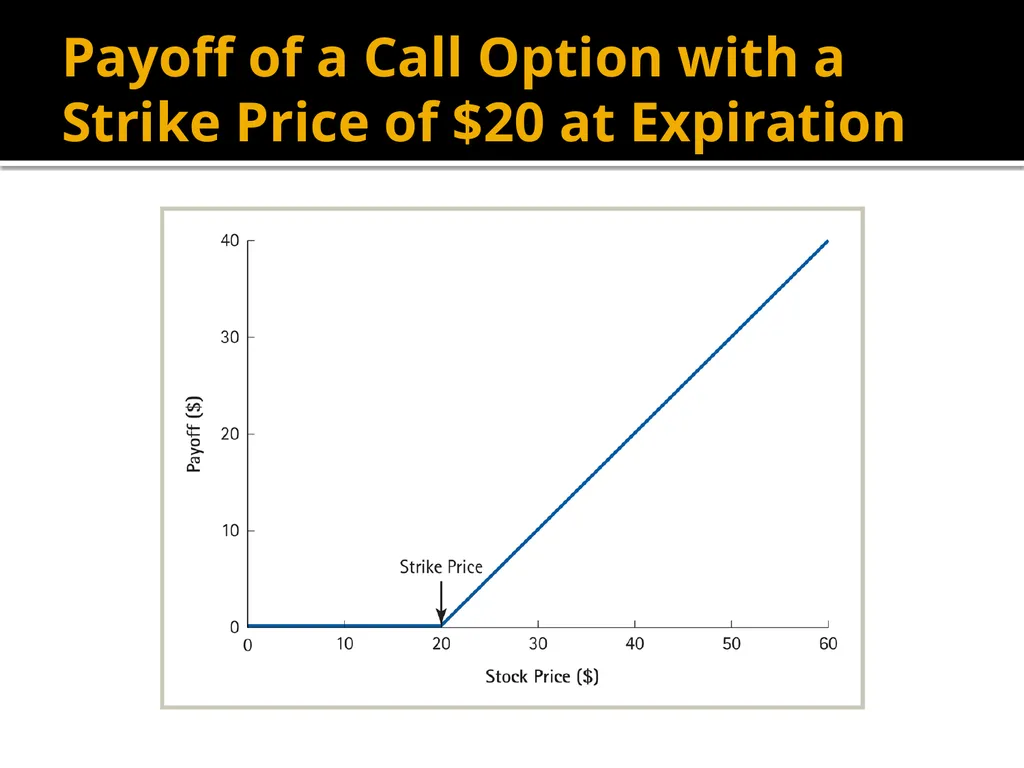
Payoff of a Call Option with a Strike Price of $20 at Expiration<br>
11
Option Payoffs at Expiration Long Position in an Option Contract
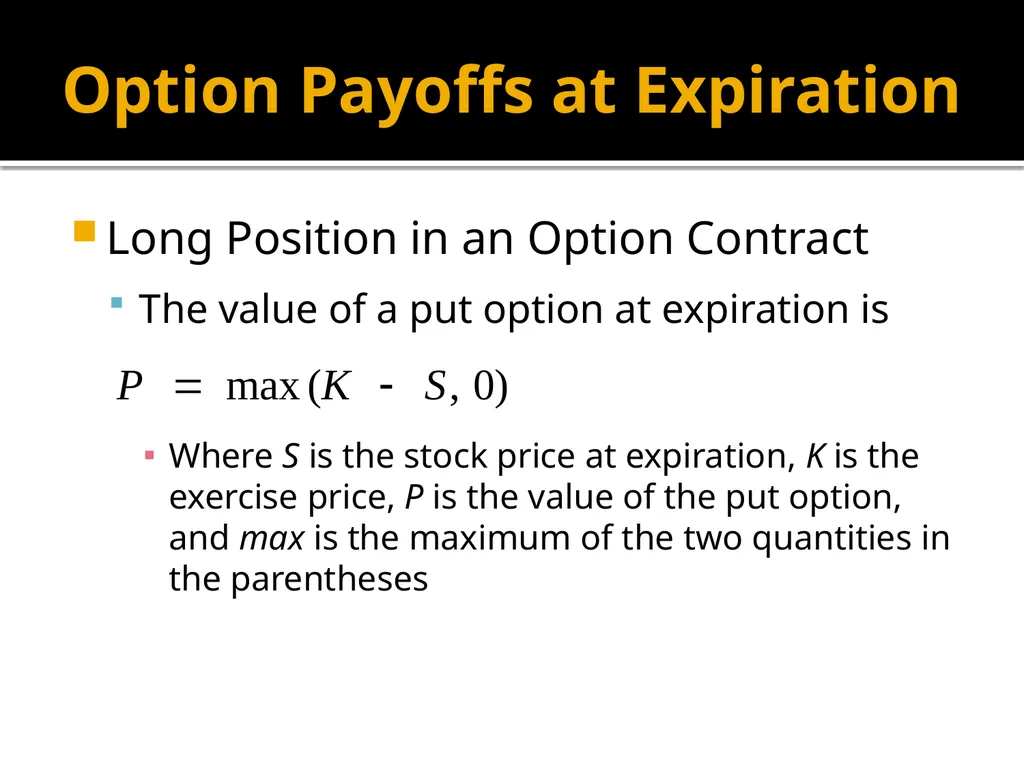
The value of a put option at expiration is
Where S is the stock price at expiration, K is the exercise price, P is the value of the put option, and max is the maximum of the two quantities in the parentheses<br>
The value of a put option at expiration is
Where S is the stock price at expiration, K is the exercise price, P is the value of the put option, and max is the maximum of the two quantities in the parentheses<br>
12
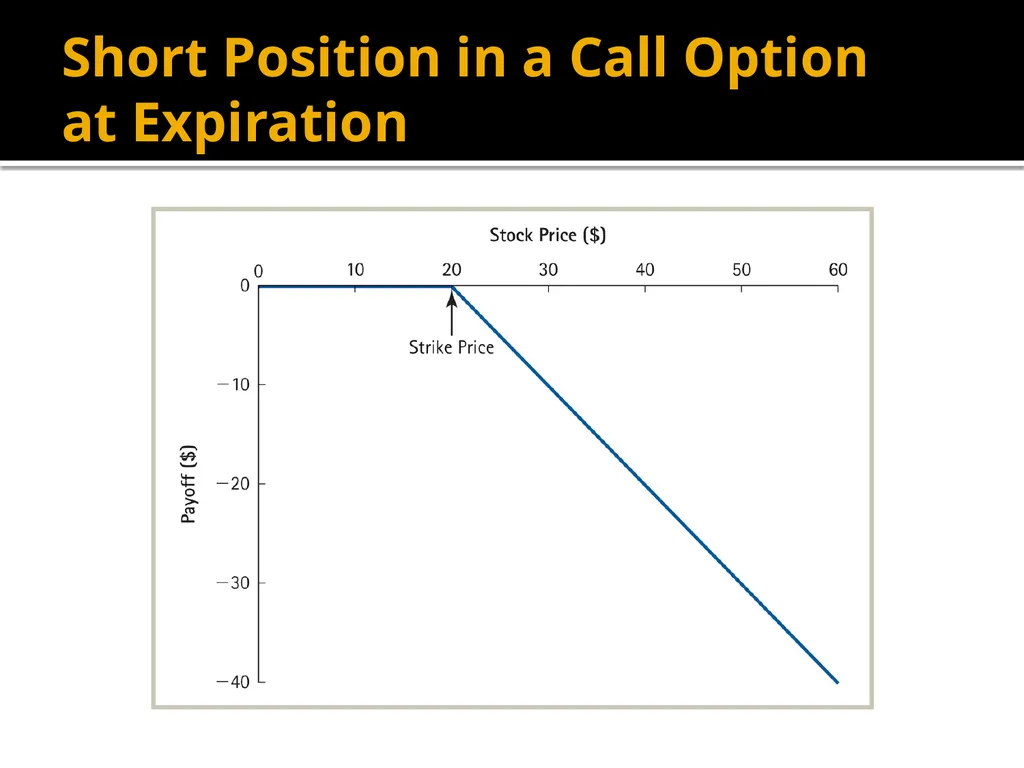
Short Position in an Option An investor that sells an option has an obligation.
This investor takes the opposite side of the contract to the investor who bought the option. Thus the seller’s cash flows are the negative of the buyer’s cash flows.<br>
This investor takes the opposite side of the contract to the investor who bought the option. Thus the seller’s cash flows are the negative of the buyer’s cash flows.<br>
13
Short Position in a Call Option
at Expiration<br>
14
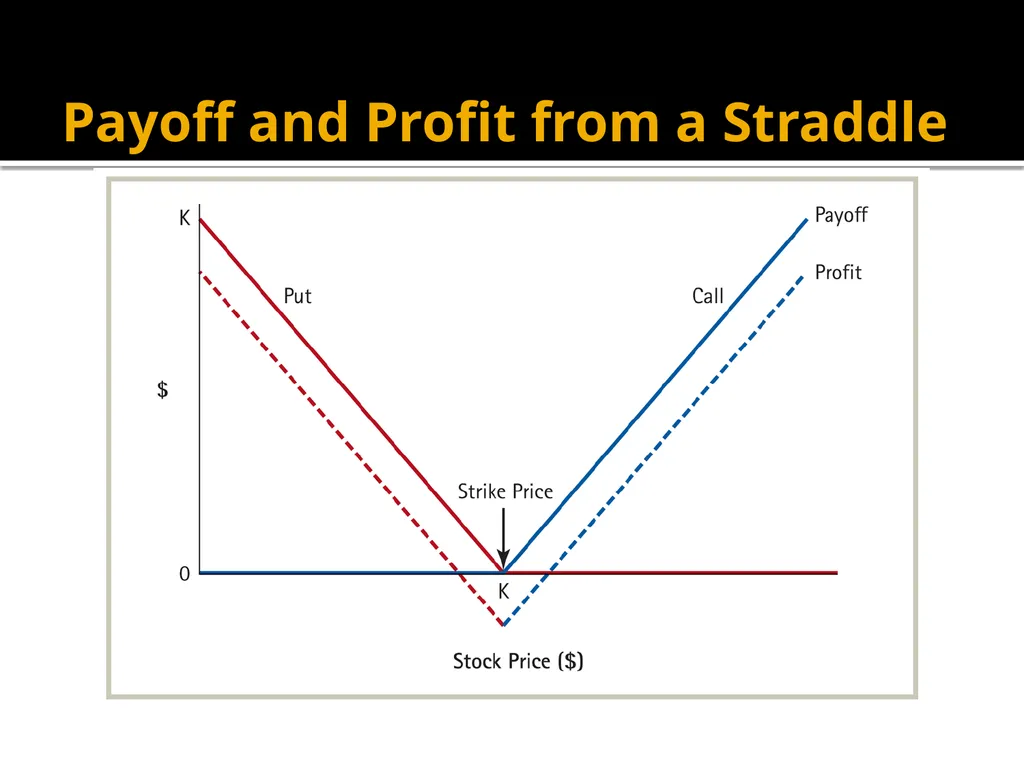
Combinations of Options Straddle
A portfolio that is long a call option and a put option on the same stock with the same exercise date and strike price
This strategy may be used if investors expect the stock to be very volatile and move up or down a large amount, but do not necessarily have a view on which direction the stock will move.<br>
A portfolio that is long a call option and a put option on the same stock with the same exercise date and strike price
This strategy may be used if investors expect the stock to be very volatile and move up or down a large amount, but do not necessarily have a view on which direction the stock will move.<br>
15
Payoff and Profit from a Straddle<br>
16
Combinations of Options Strangle
A portfolio that is long a call option and a put option on the same stock with the same exercise date but the strike price on the call exceeds the strike price on the put<br>
A portfolio that is long a call option and a put option on the same stock with the same exercise date but the strike price on the call exceeds the strike price on the put<br>
17
Combinations of Options Butterfly Spread
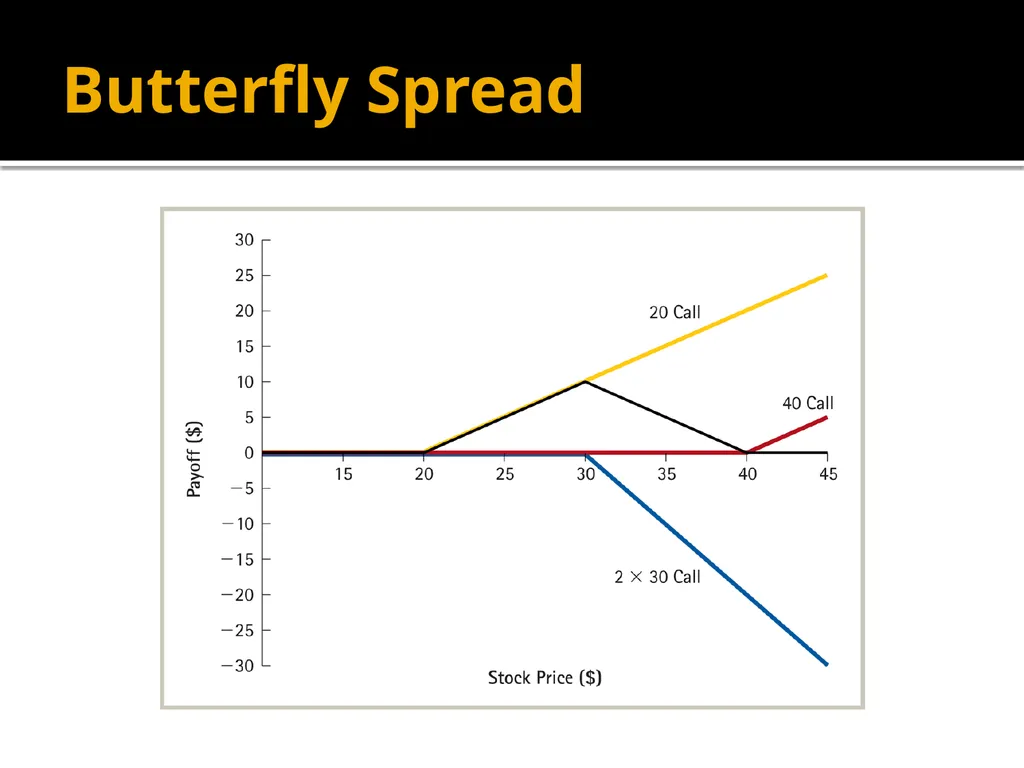
A portfolio that is long two call options with differing strike prices, and short two call options with a strike price equal to the average strike price of the first two calls
While a straddle strategy makes money when the stock and strike prices are far apart, a butterfly spread makes money when the stock and strike prices are close.<br>
A portfolio that is long two call options with differing strike prices, and short two call options with a strike price equal to the average strike price of the first two calls
While a straddle strategy makes money when the stock and strike prices are far apart, a butterfly spread makes money when the stock and strike prices are close.<br>
18
Butterfly Spread<br>
19
Combinations of Options Protective Put
A long position in a put held on a stock you already own
Portfolio Insurance
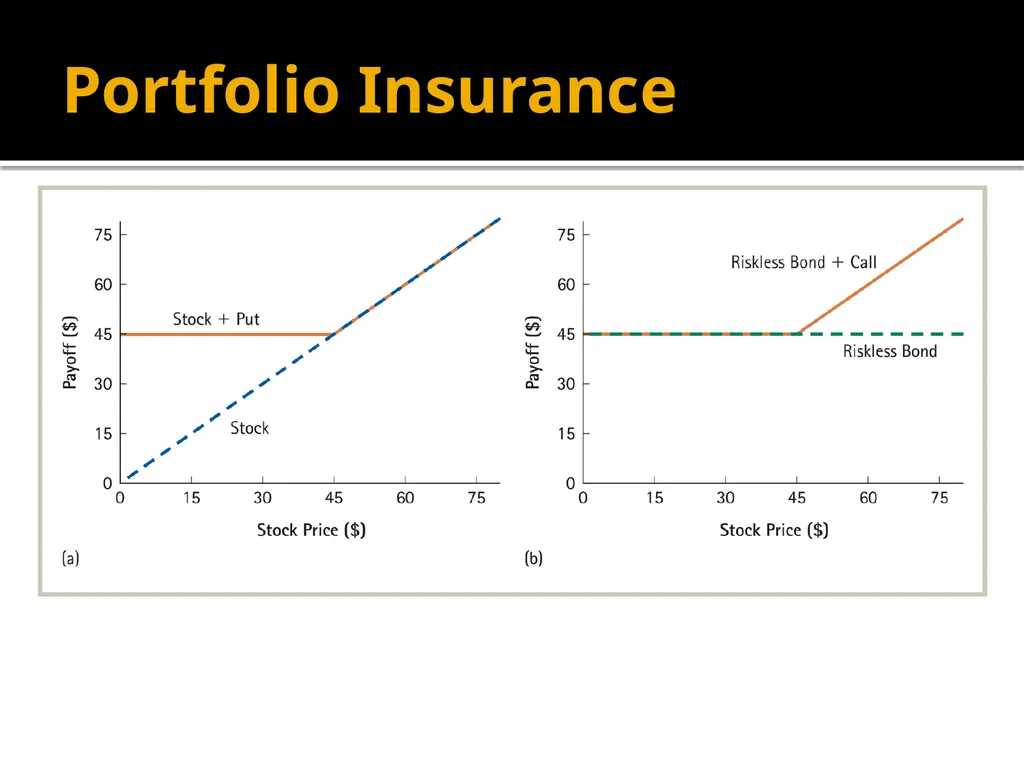
A protective put written on a portfolio rather than a single stock. When the put itself does not trade, it is synthetically created by constructing a replicating portfolio
Portfolio insurance can also be achieved by purchasing a bond and a call option.<br>
A long position in a put held on a stock you already own
Portfolio Insurance
A protective put written on a portfolio rather than a single stock. When the put itself does not trade, it is synthetically created by constructing a replicating portfolio
Portfolio insurance can also be achieved by purchasing a bond and a call option.<br>
20
Portfolio Insurance<br>
21
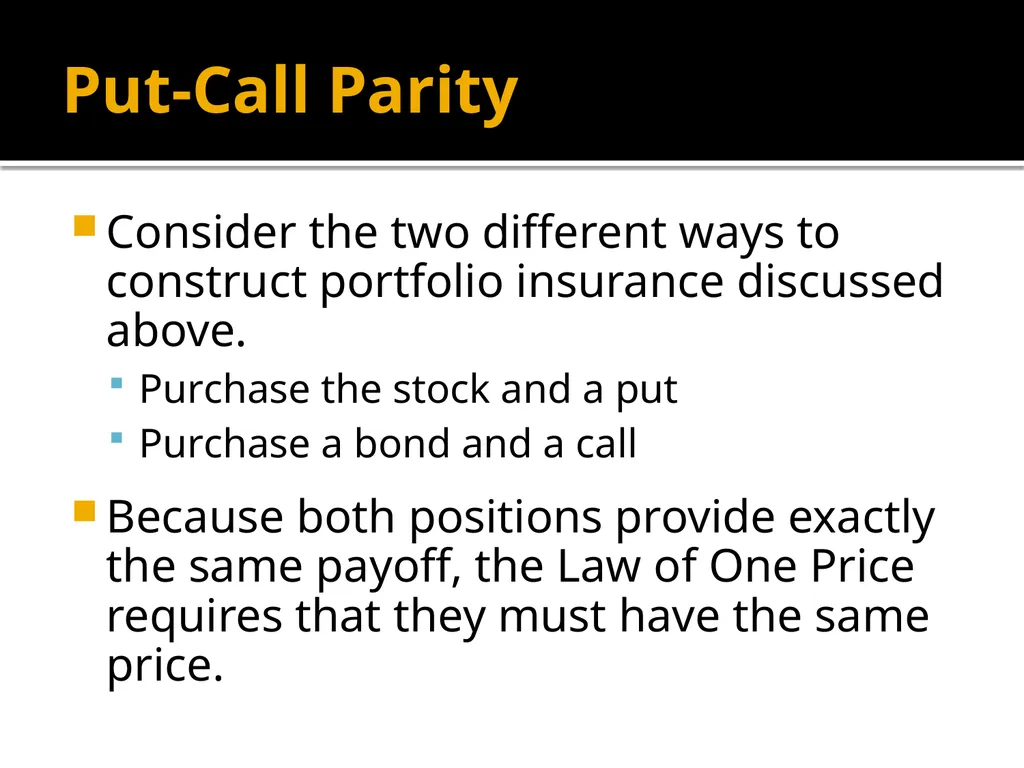
Put-Call Parity Consider the two different ways to construct portfolio insurance discussed above.
Purchase the stock and a put
Purchase a bond and a call
Because both positions provide exactly the same payoff, the Law of One Price requires that they must have the same price.<br>
Purchase the stock and a put
Purchase a bond and a call
Because both positions provide exactly the same payoff, the Law of One Price requires that they must have the same price.<br>
22
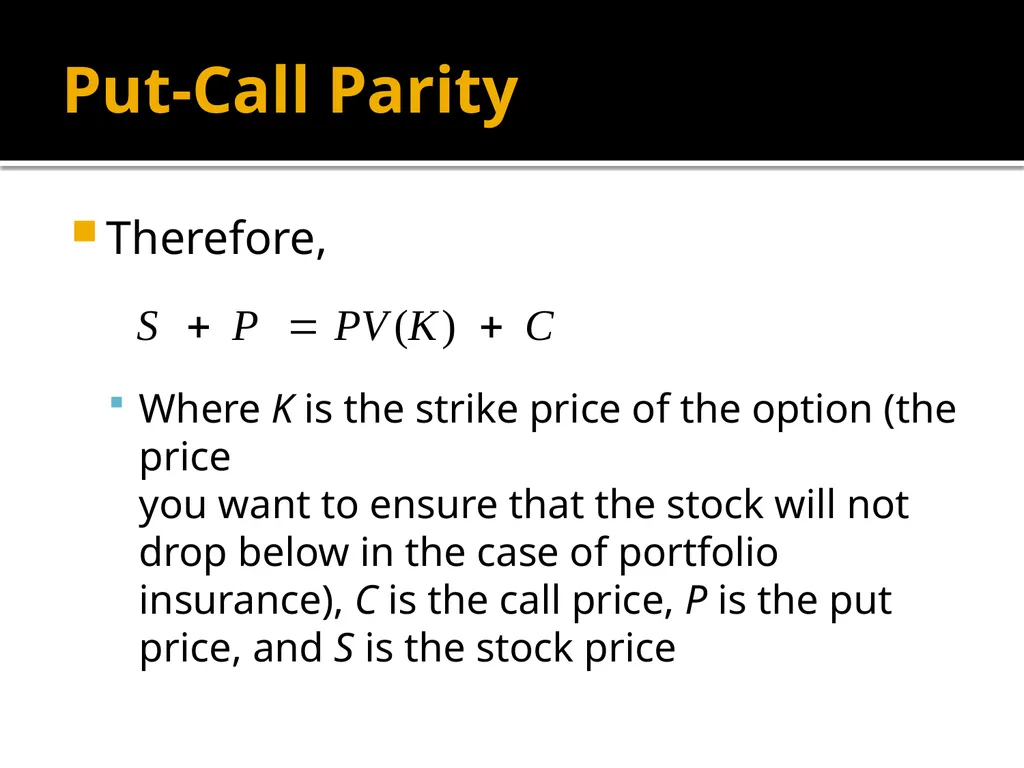
Put-Call Parity Therefore,
Where K is the strike price of the option (the price you want to ensure that the stock will not drop below in the case of portfolio insurance), C is the call price, P is the put price, and S is the stock price<br>
Where K is the strike price of the option (the price you want to ensure that the stock will not drop below in the case of portfolio insurance), C is the call price, P is the put price, and S is the stock price<br>
23
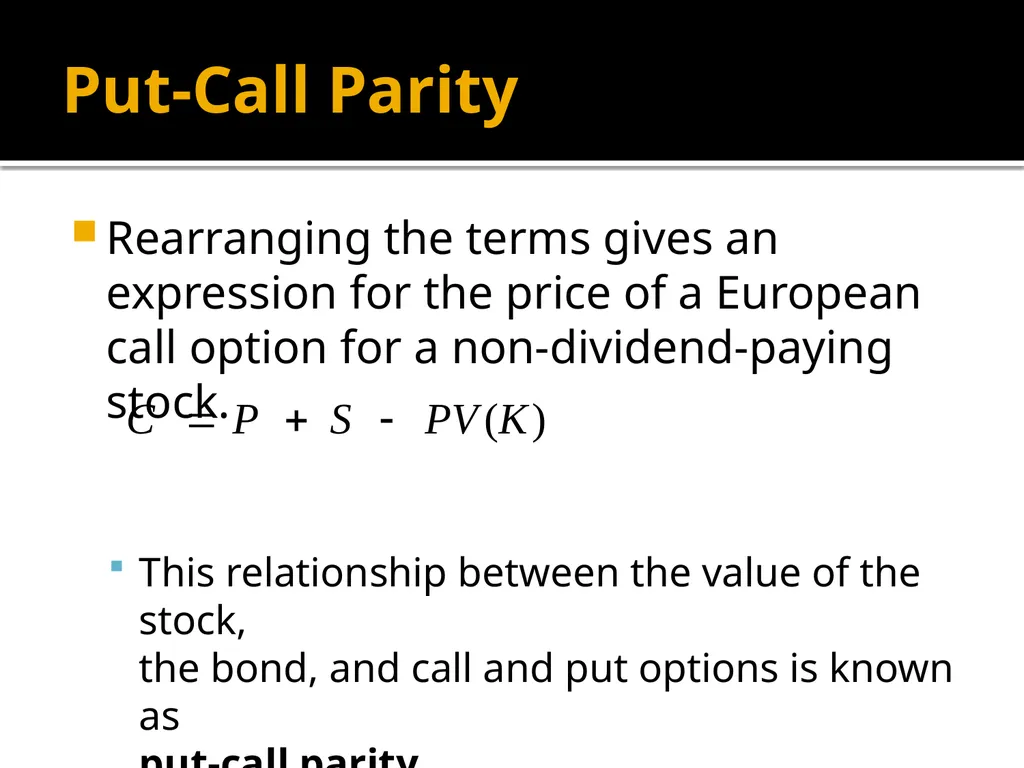
Put-Call Parity Rearranging the terms gives an expression for the price of a European call option for a non-dividend-paying stock.
This relationship between the value of the stock, the bond, and call and put options is known as put-call parity.<br>
This relationship between the value of the stock, the bond, and call and put options is known as put-call parity.<br>
24
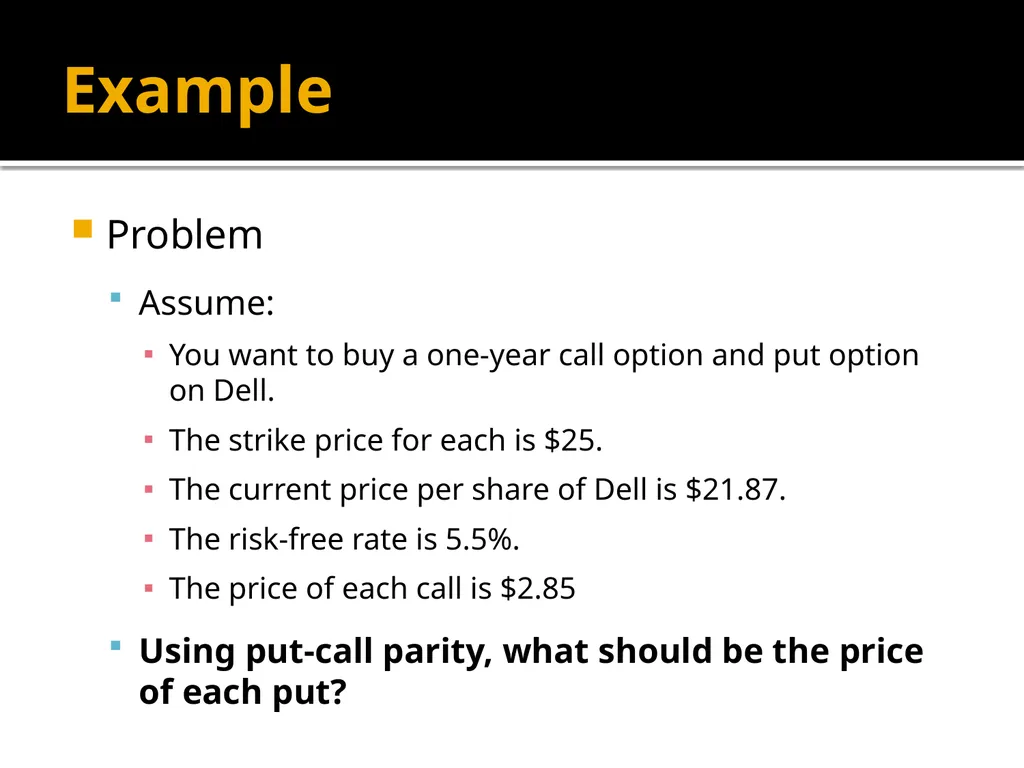
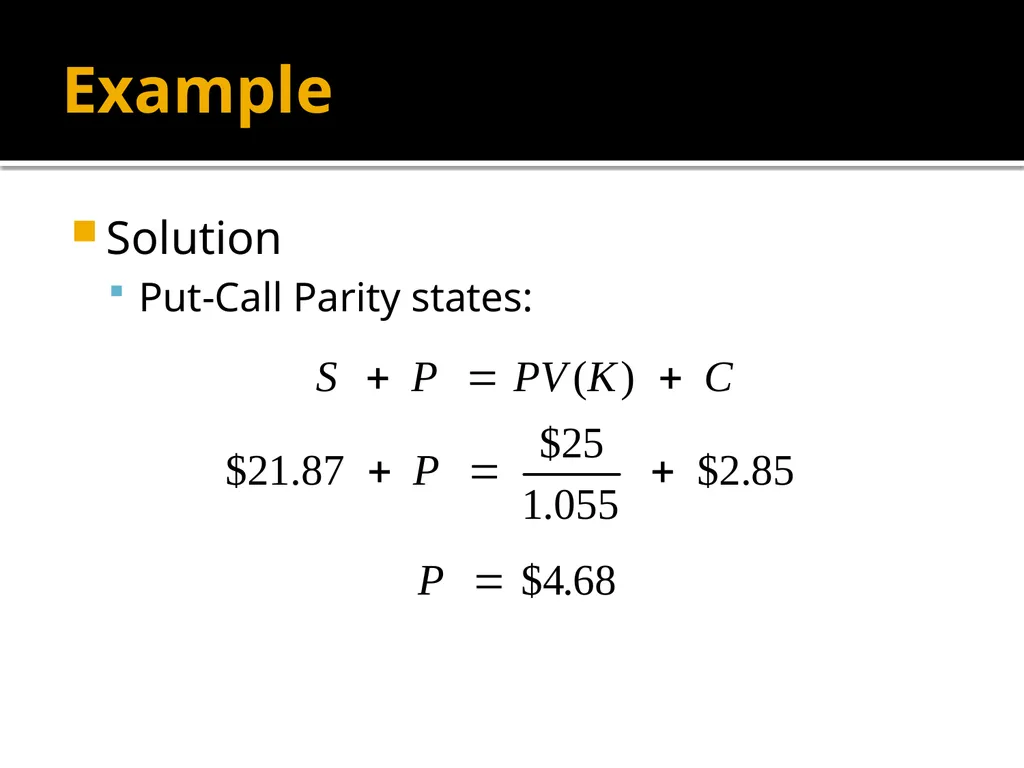
Example Problem
Assume:
You want to buy a one-year call option and put option on Dell.
The strike price for each is $25.
The current price per share of Dell is $21.87.
The risk-free rate is 5.5%.
The price of each call is $2.85
Using put-call parity, what should be the price of each put?<br>
Assume:
You want to buy a one-year call option and put option on Dell.
The strike price for each is $25.
The current price per share of Dell is $21.87.
The risk-free rate is 5.5%.
The price of each call is $2.85
Using put-call parity, what should be the price of each put?<br>
25
Example Solution
Put-Call Parity states:<br>
Put-Call Parity states:<br>
26
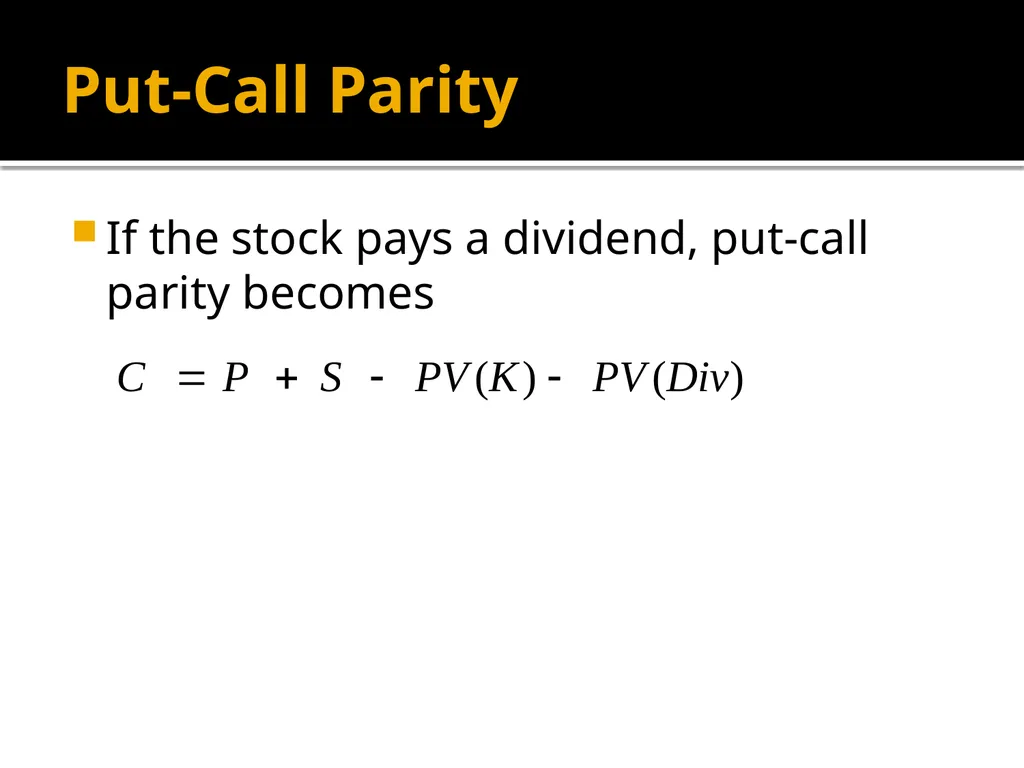
Put-Call Parity If the stock pays a dividend, put-call
parity becomes<br>
27
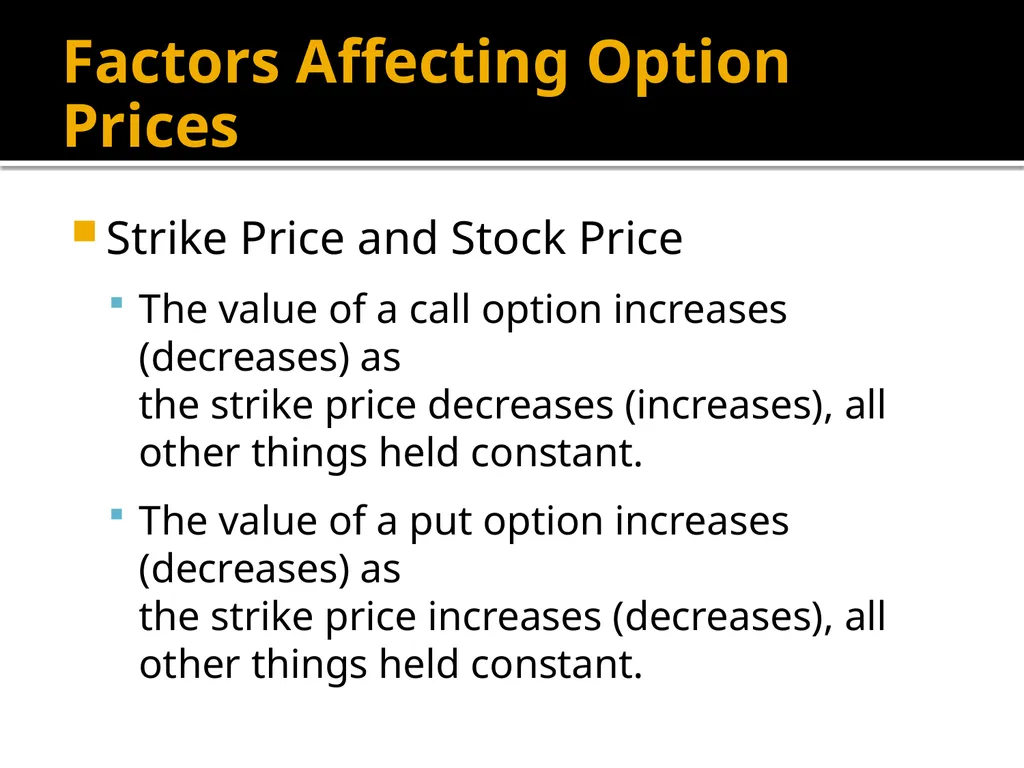
Factors Affecting Option Prices Strike Price and Stock Price
The value of a call option increases (decreases) as the strike price decreases (increases), all other things held constant.
The value of a put option increases (decreases) as the strike price increases (decreases), all other things held constant.<br>
The value of a call option increases (decreases) as the strike price decreases (increases), all other things held constant.
The value of a put option increases (decreases) as the strike price increases (decreases), all other things held constant.<br>
28
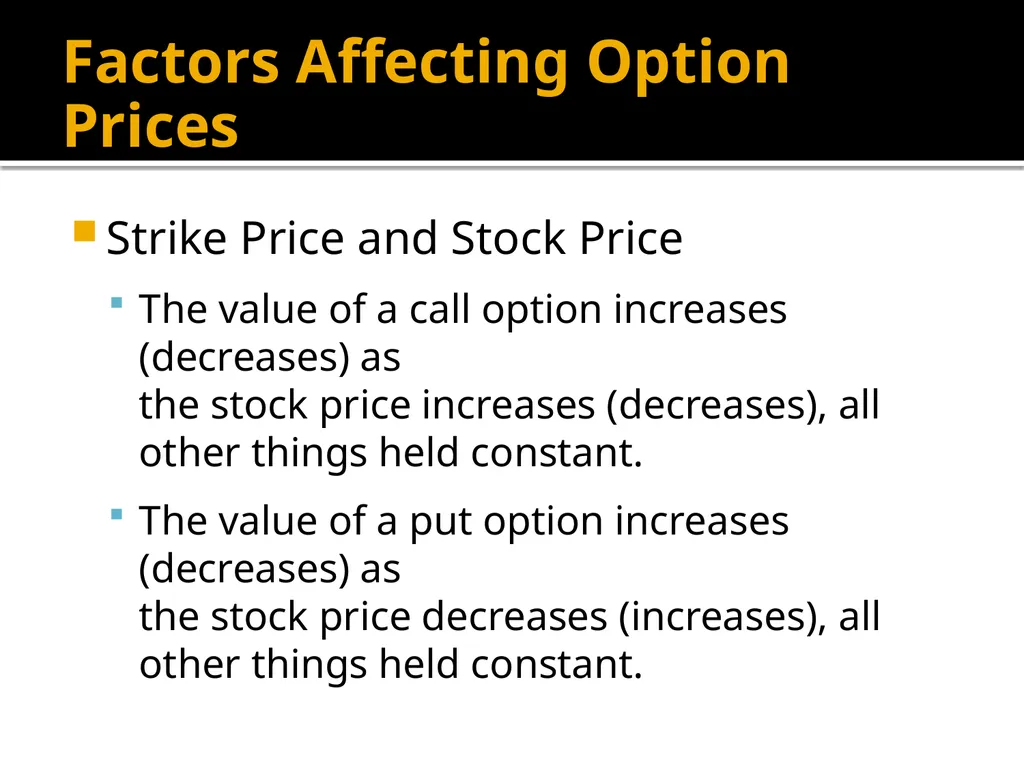
Factors Affecting Option Prices Strike Price and Stock Price
The value of a call option increases (decreases) as the stock price increases (decreases), all other things held constant.
The value of a put option increases (decreases) as the stock price decreases (increases), all other things held constant.<br>
The value of a call option increases (decreases) as the stock price increases (decreases), all other things held constant.
The value of a put option increases (decreases) as the stock price decreases (increases), all other things held constant.<br>
29
Arbitrage Bounds on Option Prices An American option cannot be worth less than its European counterpart.
A put option cannot be worth more than its strike price.
A call option cannot be worth more than the stock itself.<br>
A put option cannot be worth more than its strike price.
A call option cannot be worth more than the stock itself.<br>
30
Arbitrage Bounds on Option Prices Intrinsic Value
The amount by which an option is in-the-money, or zero if the option is out-of-the-money
An American option cannot be worth less than its intrinsic value
Time Value (sometimes called Option Value)
The difference between an option’s price and its intrinsic value
An American option cannot have a negative time value.<br>
The amount by which an option is in-the-money, or zero if the option is out-of-the-money
An American option cannot be worth less than its intrinsic value
Time Value (sometimes called Option Value)
The difference between an option’s price and its intrinsic value
An American option cannot have a negative time value.<br>
31
Option Prices and the Exercise Date For American options, the longer the time to the exercise date, the more valuable the option
An American option with a later exercise date cannot be worth less than an otherwise identical American option with an earlier exercise date.
However, a European option with a later exercise date can be worth less than an otherwise identical European option with an earlier exercise date<br>
An American option with a later exercise date cannot be worth less than an otherwise identical American option with an earlier exercise date.
However, a European option with a later exercise date can be worth less than an otherwise identical European option with an earlier exercise date<br>
32
Option Prices and Volatility The value of an option generally increases with the volatility of the stock.<br>
33
Exercising Options Early Although an American option cannot be worth less than its European counterpart, they may have equal value.<br>
34
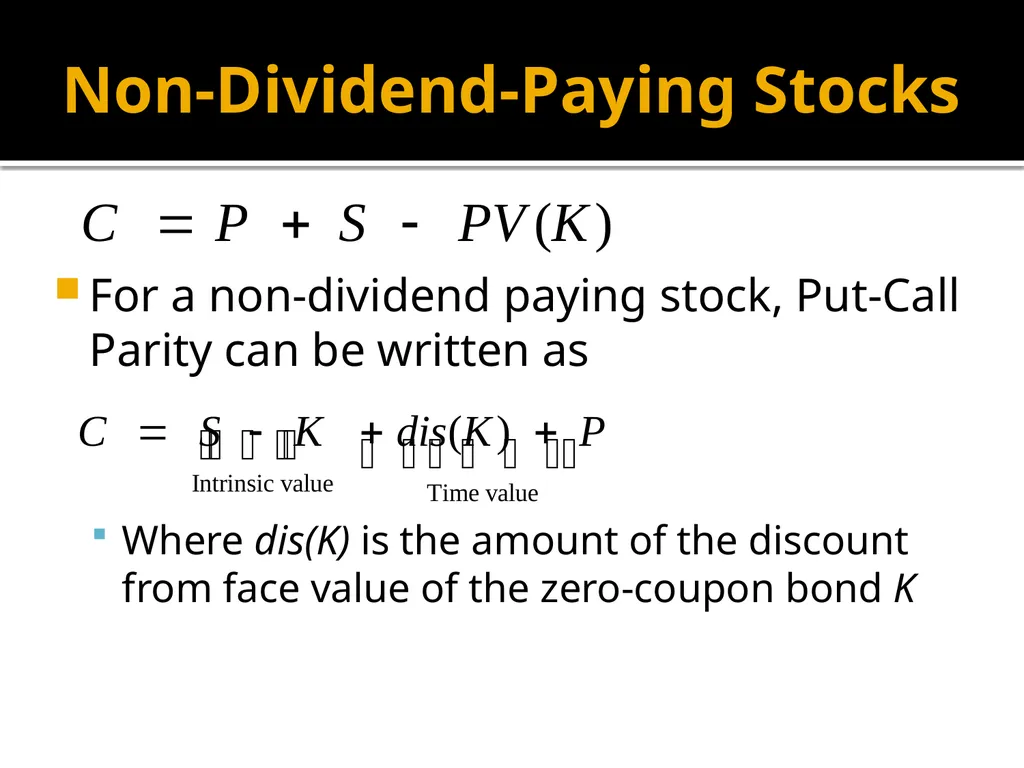
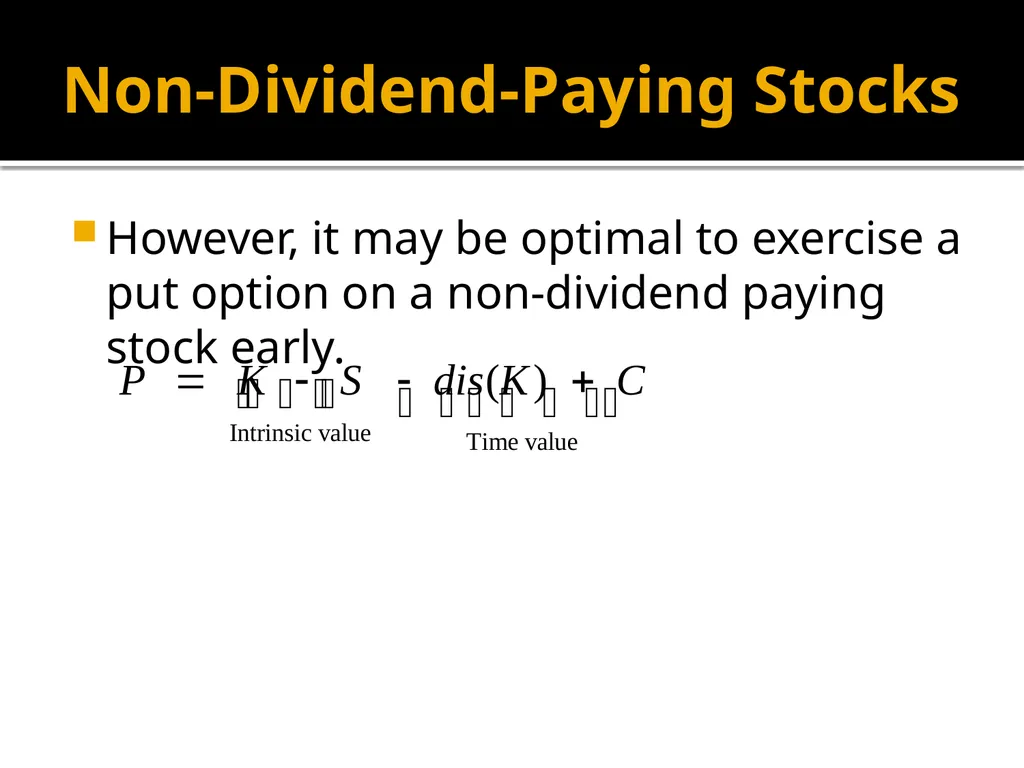
Non-Dividend-Paying Stocks For a non-dividend paying stock, Put-Call Parity can be written as
Where dis(K) is the amount of the discount from face value of the zero-coupon bond K<br>
Where dis(K) is the amount of the discount from face value of the zero-coupon bond K<br>
35
Non-Dividend-Paying Stocks Because dis(K) and P must be positive before the expiration date, a European call always has a positive time value.
Since an American option is worth at least as much as a European option, it must also have a positive time value before expiration.
Thus, the price of any call option on a non-dividend-paying stock always exceeds its intrinsic value prior to expiration.<br>
Since an American option is worth at least as much as a European option, it must also have a positive time value before expiration.
Thus, the price of any call option on a non-dividend-paying stock always exceeds its intrinsic value prior to expiration.<br>
36
Non-Dividend-Paying Stocks This implies that it is never optimal to exercise a call option on a non-dividend paying stock early.
You are always better off just selling the option.
Because it is never optimal to exercise an American call on a non-dividend-paying stock early, an American call on a non-dividend paying stock has the same price as its European counterpart.<br>
You are always better off just selling the option.
Because it is never optimal to exercise an American call on a non-dividend-paying stock early, an American call on a non-dividend paying stock has the same price as its European counterpart.<br>
37
Non-Dividend-Paying Stocks However, it may be optimal to exercise a put option on a non-dividend paying stock early.<br>
38
Non-Dividend-Paying Stocks When a put option is sufficiently deep in-the-money, dis(K) will be large relative to the value of the call, and the time value of a European put option will be negative. In that case, the European put will sell for less than its intrinsic value.
However, its American counterpart cannot sell for less than its intrinsic value, which implies that an American put option can be worth more than an otherwise identical European option.<br>
However, its American counterpart cannot sell for less than its intrinsic value, which implies that an American put option can be worth more than an otherwise identical European option.<br>
39
Options and Corporate Finance Equity as a Call Option
A share of stock can be thought of as a call option on the assets of the firm with a strike price equal to the value of debt outstanding.
If the firm’s value does not exceed the value of debt outstanding at the end of the period, the firm must declare bankruptcy and the equity holders receive nothing.
If the value exceeds the value of debt outstanding, the equity holders get whatever is left once the debt has been repaid.<br>
A share of stock can be thought of as a call option on the assets of the firm with a strike price equal to the value of debt outstanding.
If the firm’s value does not exceed the value of debt outstanding at the end of the period, the firm must declare bankruptcy and the equity holders receive nothing.
If the value exceeds the value of debt outstanding, the equity holders get whatever is left once the debt has been repaid.<br>
40
Debt as an Option Portfolio Debt holders can be viewed as owners of the firm having sold a call option with a strike price equal to the required debt payment.
If the value of the firm exceeds the required debt payment, the call will be exercised; the debt holders will therefore receive the strike price and give up the firm.
If the value of the firm does not exceed the required debt payment, the call will be worthless, the firm will declare bankruptcy, and the debt holders will be entitled to the firm’s assets.<br>
If the value of the firm exceeds the required debt payment, the call will be exercised; the debt holders will therefore receive the strike price and give up the firm.
If the value of the firm does not exceed the required debt payment, the call will be worthless, the firm will declare bankruptcy, and the debt holders will be entitled to the firm’s assets.<br>
41
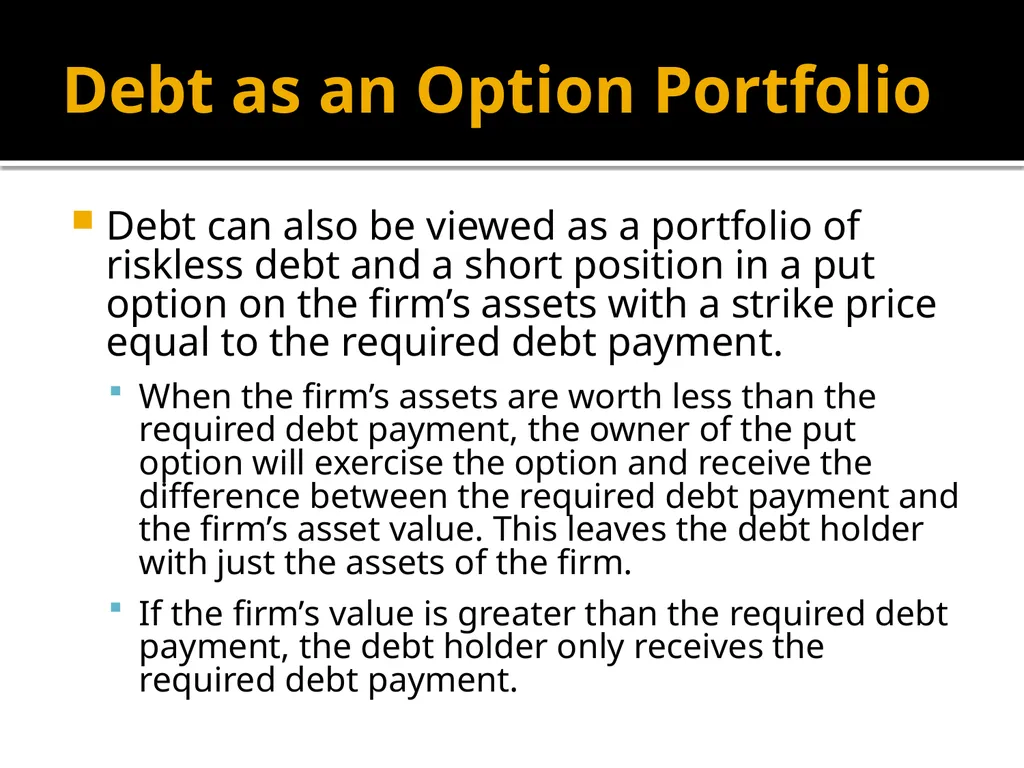
Debt as an Option Portfolio Debt can also be viewed as a portfolio of riskless debt and a short position in a put option on the firm’s assets with a strike price equal to the required debt payment.
When the firm’s assets are worth less than the required debt payment, the owner of the put option will exercise the option and receive the difference between the required debt payment and the firm’s asset value. This leaves the debt holder with just the assets of the firm.
If the firm’s value is greater than the required debt payment, the debt holder only receives the required debt payment.<br>
When the firm’s assets are worth less than the required debt payment, the owner of the put option will exercise the option and receive the difference between the required debt payment and the firm’s asset value. This leaves the debt holder with just the assets of the firm.
If the firm’s value is greater than the required debt payment, the debt holder only receives the required debt payment.<br>
42
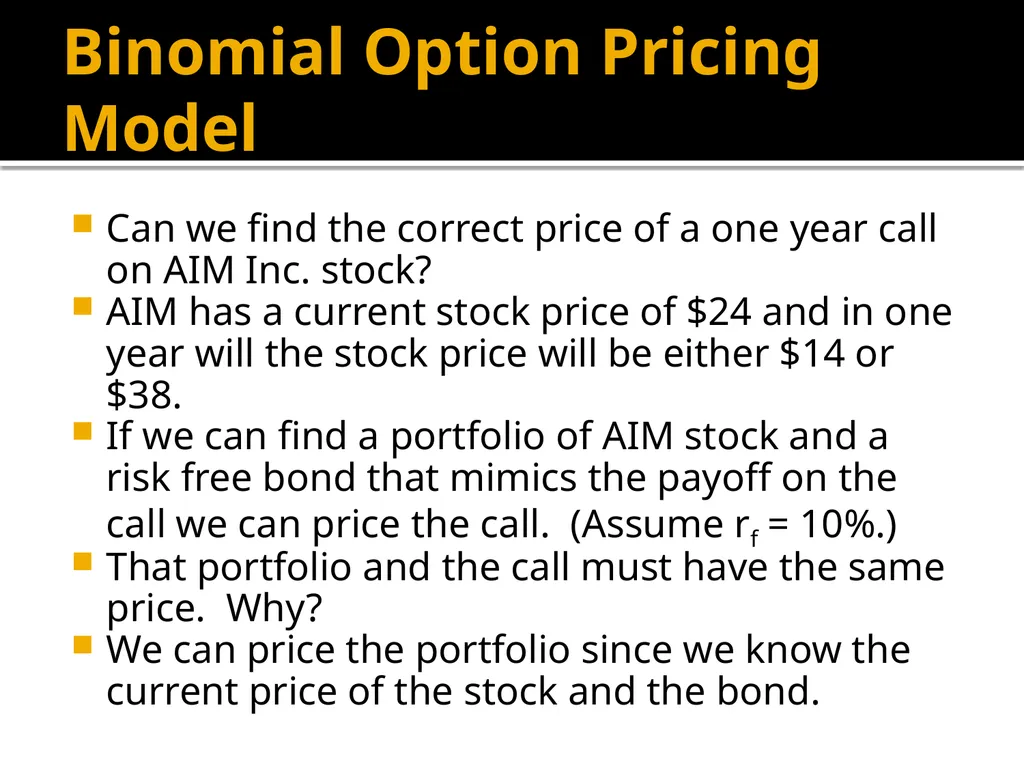
Binomial Option Pricing Model Can we find the correct price of a one year call on AIM Inc. stock?
AIM has a current stock price of $24 and in one year will the stock price will be either $14 or $38.
If we can find a portfolio of AIM stock and a risk free bond that mimics the payoff on the call we can price the call. (Assume rf = 10%.)
That portfolio and the call must have the same price. Why?
We can price the portfolio since we know the current price of the stock and the bond.<br>
AIM has a current stock price of $24 and in one year will the stock price will be either $14 or $38.
If we can find a portfolio of AIM stock and a risk free bond that mimics the payoff on the call we can price the call. (Assume rf = 10%.)
That portfolio and the call must have the same price. Why?
We can price the portfolio since we know the current price of the stock and the bond.<br>
43
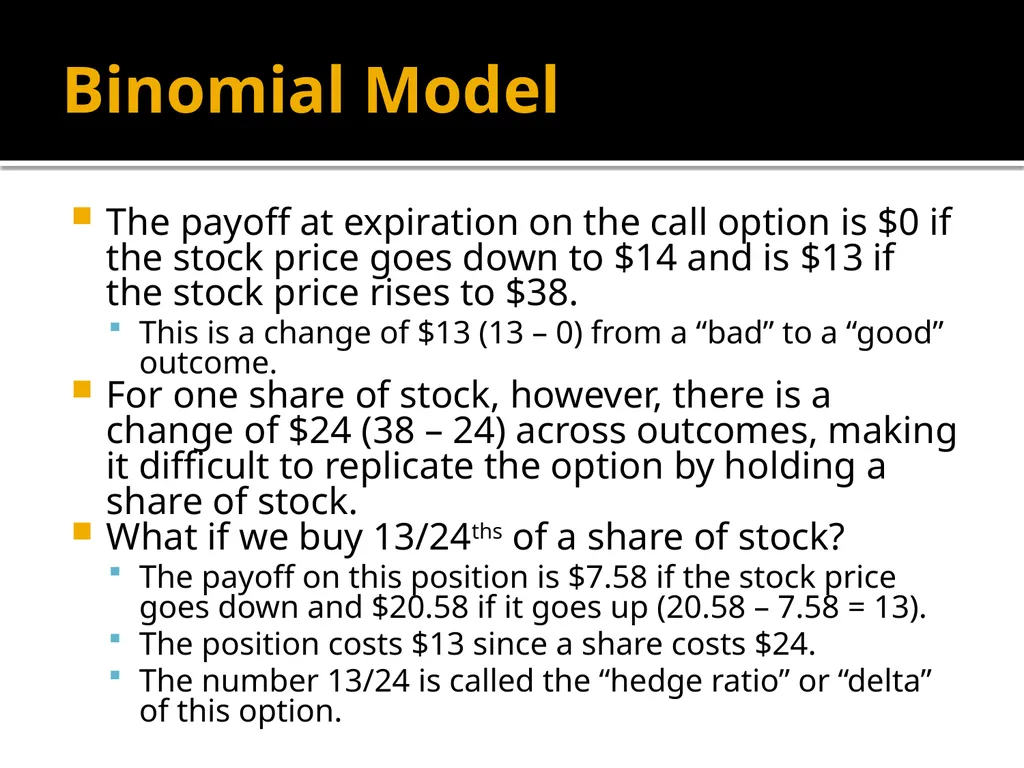
Binomial Model The payoff at expiration on the call option is $0 if the stock price goes down to $14 and is $13 if the stock price rises to $38.
This is a change of $13 (13 – 0) from a “bad” to a “good” outcome.
For one share of stock, however, there is a change of $24 (38 – 24) across outcomes, making it difficult to replicate the option by holding a share of stock.
What if we buy 13/24ths of a share of stock?
The payoff on this position is $7.58 if the stock price goes down and $20.58 if it goes up (20.58 – 7.58 = 13).
The position costs $13 since a share costs $24.
The number 13/24 is called the “hedge ratio” or “delta” of this option.<br>
This is a change of $13 (13 – 0) from a “bad” to a “good” outcome.
For one share of stock, however, there is a change of $24 (38 – 24) across outcomes, making it difficult to replicate the option by holding a share of stock.
What if we buy 13/24ths of a share of stock?
The payoff on this position is $7.58 if the stock price goes down and $20.58 if it goes up (20.58 – 7.58 = 13).
The position costs $13 since a share costs $24.
The number 13/24 is called the “hedge ratio” or “delta” of this option.<br>
44
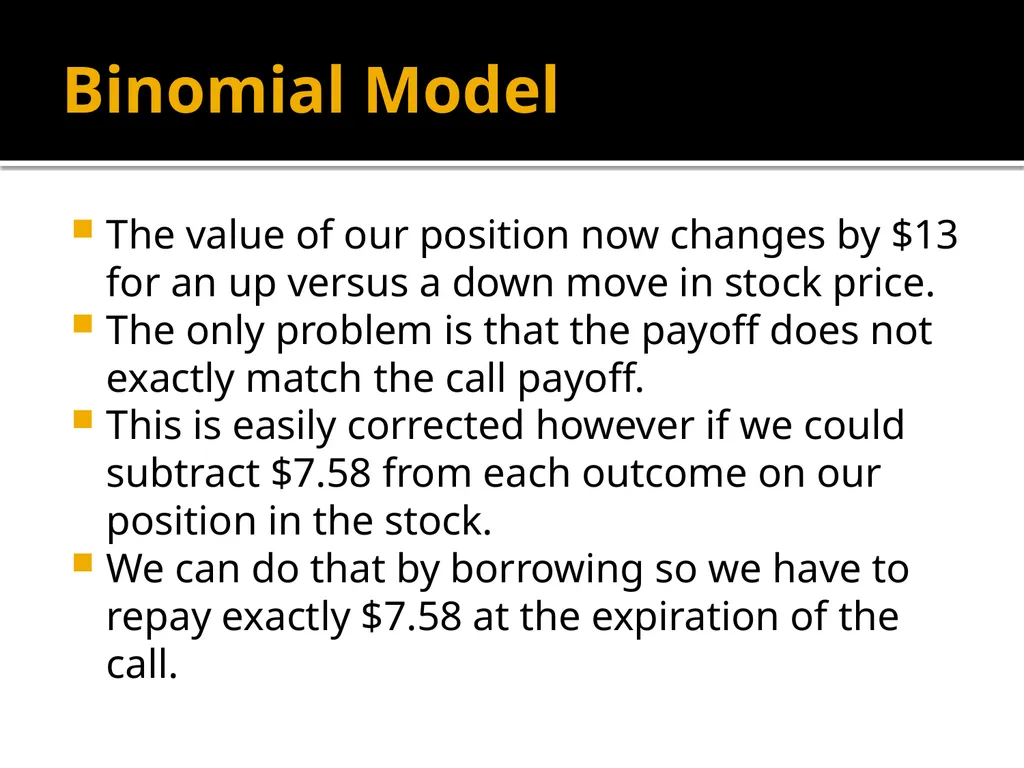
Binomial Model The value of our position now changes by $13 for an up versus a down move in stock price.
The only problem is that the payoff does not exactly match the call payoff.
This is easily corrected however if we could subtract $7.58 from each outcome on our position in the stock.
We can do that by borrowing so we have to repay exactly $7.58 at the expiration of the call.<br>
The only problem is that the payoff does not exactly match the call payoff.
This is easily corrected however if we could subtract $7.58 from each outcome on our position in the stock.
We can do that by borrowing so we have to repay exactly $7.58 at the expiration of the call.<br>
45
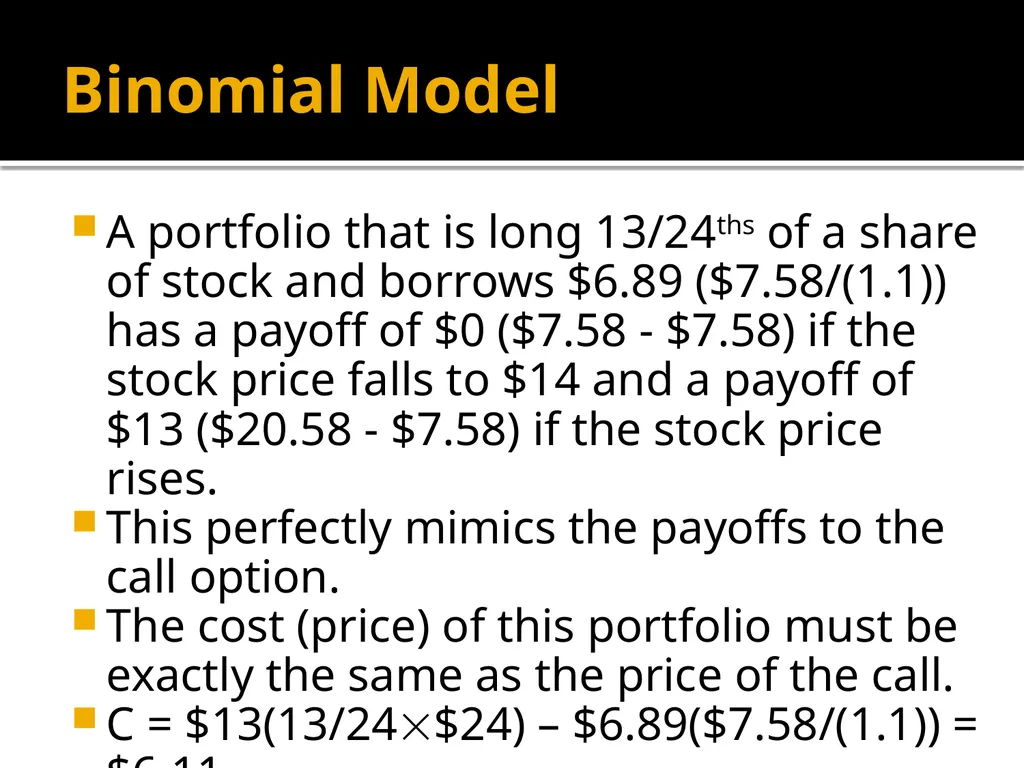
Binomial Model A portfolio that is long 13/24ths of a share of stock and borrows $6.89 ($7.58/(1.1)) has a payoff of $0 ($7.58 - $7.58) if the stock price falls to $14 and a payoff of $13 ($20.58 - $7.58) if the stock price rises.
This perfectly mimics the payoffs to the call option.
The cost (price) of this portfolio must be exactly the same as the price of the call.
C = $13(13/24$24) – $6.89($7.58/(1.1)) = $6.11<br>
This perfectly mimics the payoffs to the call option.
The cost (price) of this portfolio must be exactly the same as the price of the call.
C = $13(13/24$24) – $6.89($7.58/(1.1)) = $6.11<br>
46
Binomial Model This model, while very simple, captures the essence of most option pricing models.
The famous Black Scholes option pricing model follows from exactly this same logic, the main difference is that rather than a binomial model to capture stock prices we use a geometric Brownian motion (a continuous time stochastic process).
While there have been various extensions of the simple option pricing model, allowing random “jumps” in the stock price, stochastic volatility, etc., many of them still rely on the simple replicating portfolio argument presented in these notes.
Understanding options and the basics of option pricing can help in a variety of situations.<br>
The famous Black Scholes option pricing model follows from exactly this same logic, the main difference is that rather than a binomial model to capture stock prices we use a geometric Brownian motion (a continuous time stochastic process).
While there have been various extensions of the simple option pricing model, allowing random “jumps” in the stock price, stochastic volatility, etc., many of them still rely on the simple replicating portfolio argument presented in these notes.
Understanding options and the basics of option pricing can help in a variety of situations.<br>