
Finding the needle in the haystack Convergence of
Description: Finding the needle in the haystack Convergence of techniques at the inflection point of liquid biopsy Michele Canzi National Cancer Institute Symposium on Charting the Course of Liquid Biopsy in Precision, Prevention and Treatment December
Related Topics
Download Presentation
"Finding the needle in the haystack Convergence of" is the property of its rightful owner. Permission is granted to download and print the materials on this website for personal, non-commercial use only, and to display it on your personal computer provided you do not modify the materials and that you retain all copyright notices contained in the materials. By downloading content from our website, you accept the terms of this agreement.
Presentation Transcript
slide1. Finding the needle in the haystack Convergence of techniques
at the inflection point of liquid biopsy
Michele Canzi National Cancer Institute Symposium on Charting the Course of Liquid Biopsy in Precision, Prevention and Treatment December 15-16, 2021 michelecanzi@gmail.com
@michelecanzi<br>
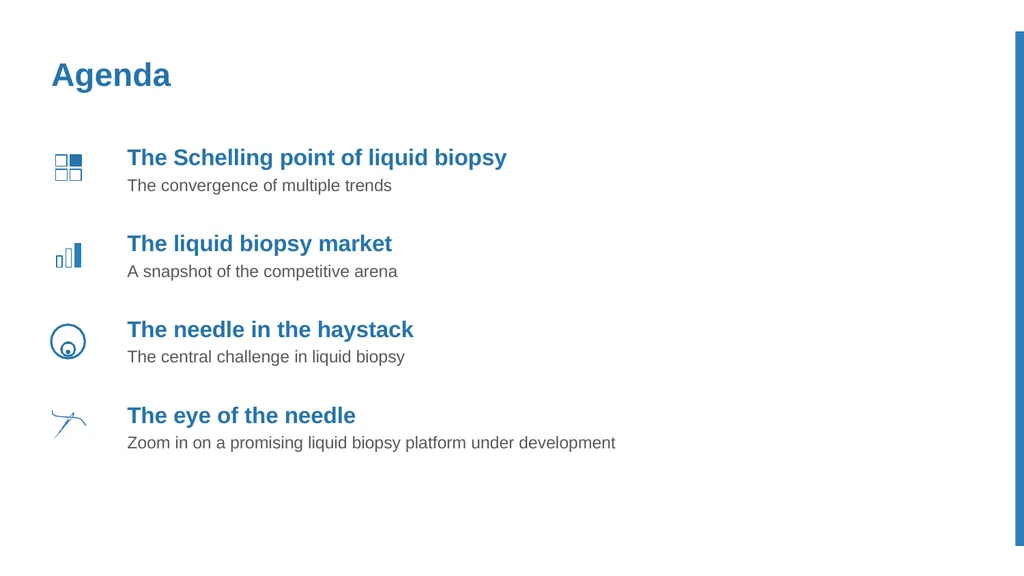
slide2. Agenda The Schelling point of liquid biopsy
The convergence of multiple trends
The liquid biopsy market
A snapshot of the competitive arena
The needle in the haystack
The central challenge in liquid biopsy
The eye of the needle
Zoom in on a promising liquid biopsy platform under development<br>
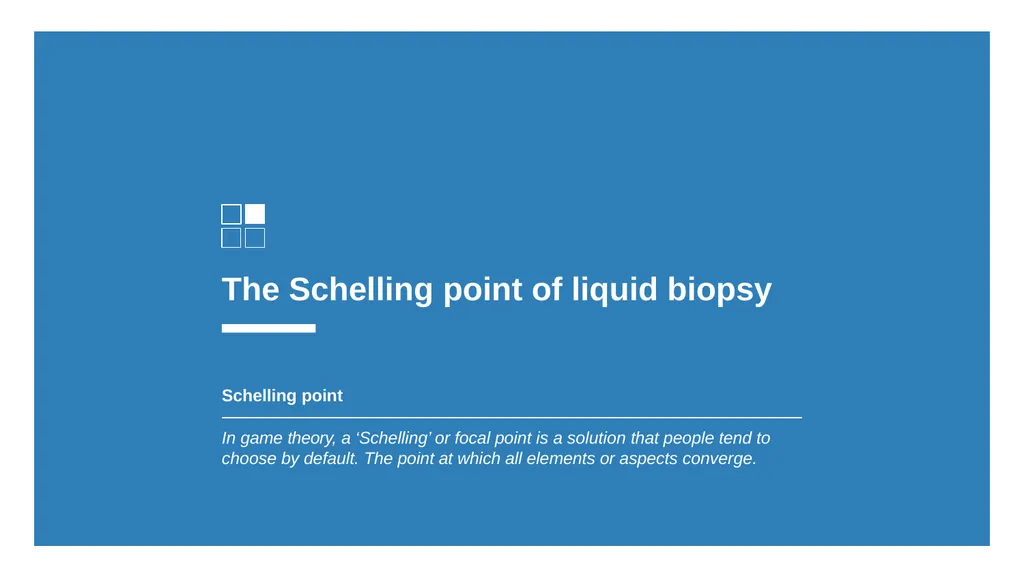
slide3. The Schelling point of liquid biopsy Schelling point
In game theory, a ‘Schelling’ or focal point is a solution that people tend to choose by default. The point at which all elements or aspects converge.<br>
slide4. The purpose of innovation The purpose of innovation is to reduce scarcity
Breakthroughs are faster, cheaper, better. Innovation allows to do more with less The ultimate purpose of innovation is to reduce mortality
Mortality is the ultimate scarcity. Life extension is the most important thing we can invent<br>
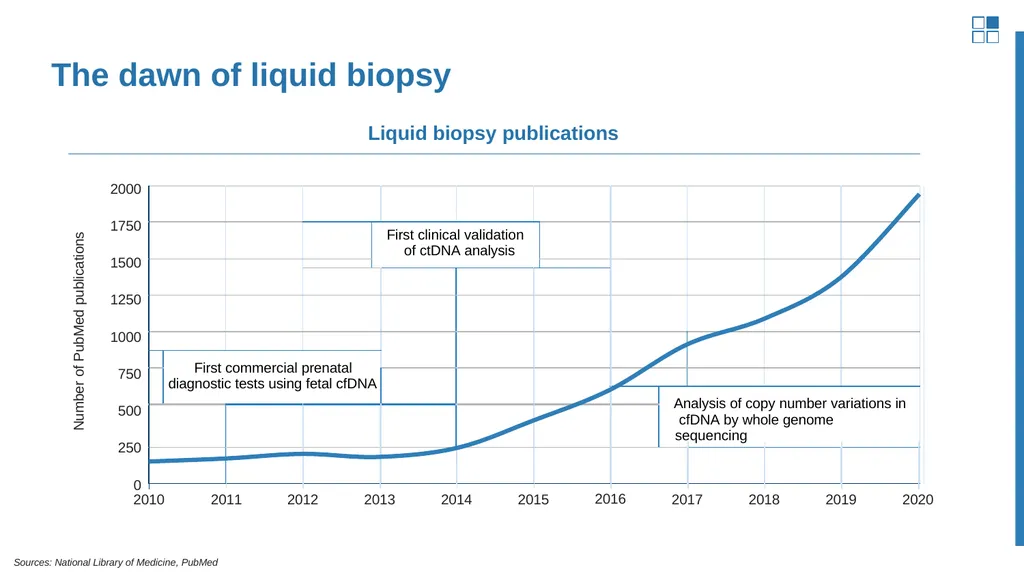
slide5. The dawn of liquid biopsy Liquid biopsy publications Sources: National Library of Medicine, PubMed<br>
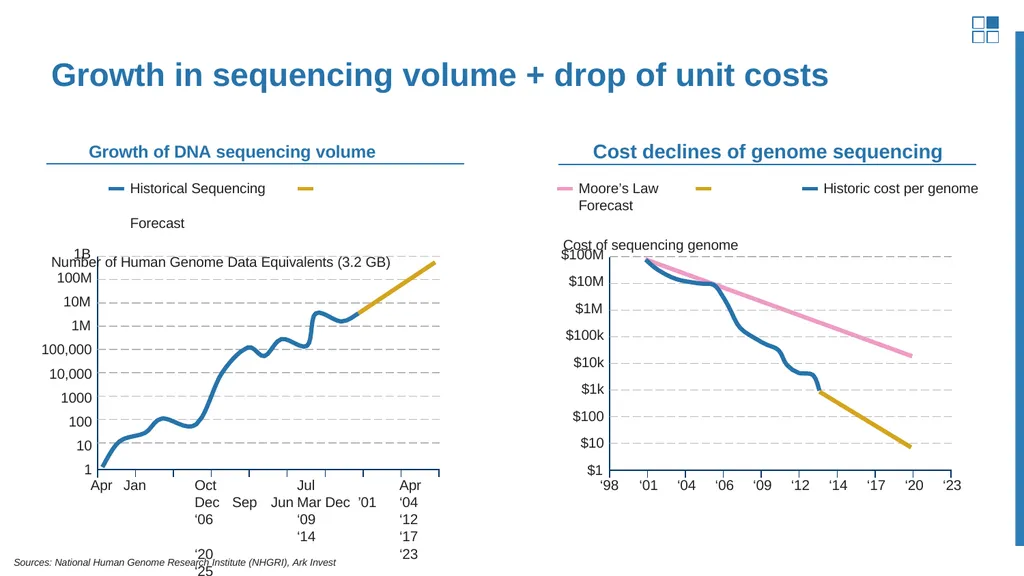
slide6. Growth in sequencing volume + drop of unit costs Growth of DNA sequencing volume Cost declines of genome sequencing Sources: National Human Genome Research Institute (NHGRI), Ark Invest<br>
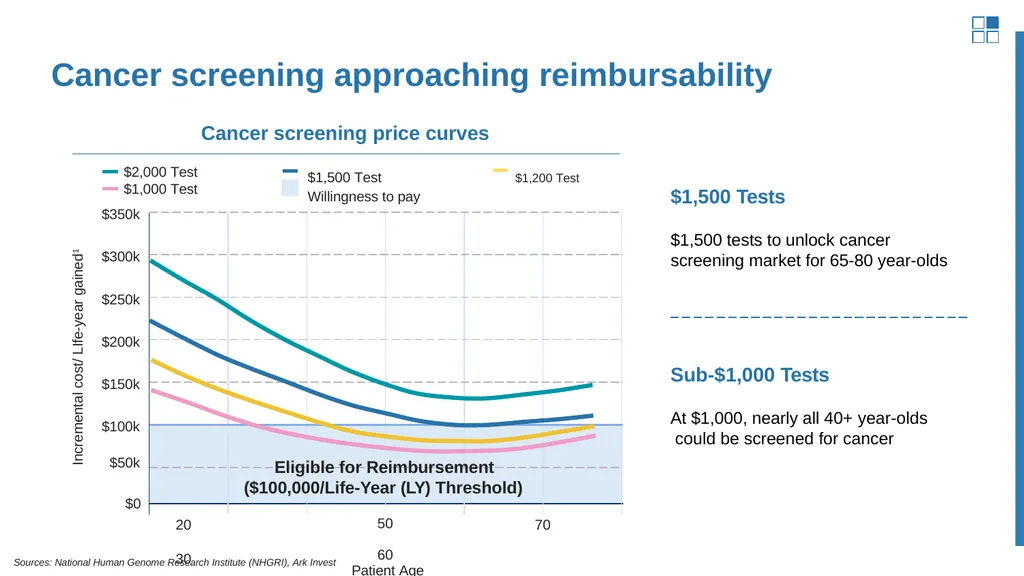
slide7. Cancer screening approaching reimbursability Cancer screening price curves $1,500 Tests
$1,500 tests to unlock cancer screening market for 65-80 year-olds Sub-$1,000 Tests
At $1,000, nearly all 40+ year-olds could be screened for cancer Sources: National Human Genome Research Institute (NHGRI), Ark Invest<br>
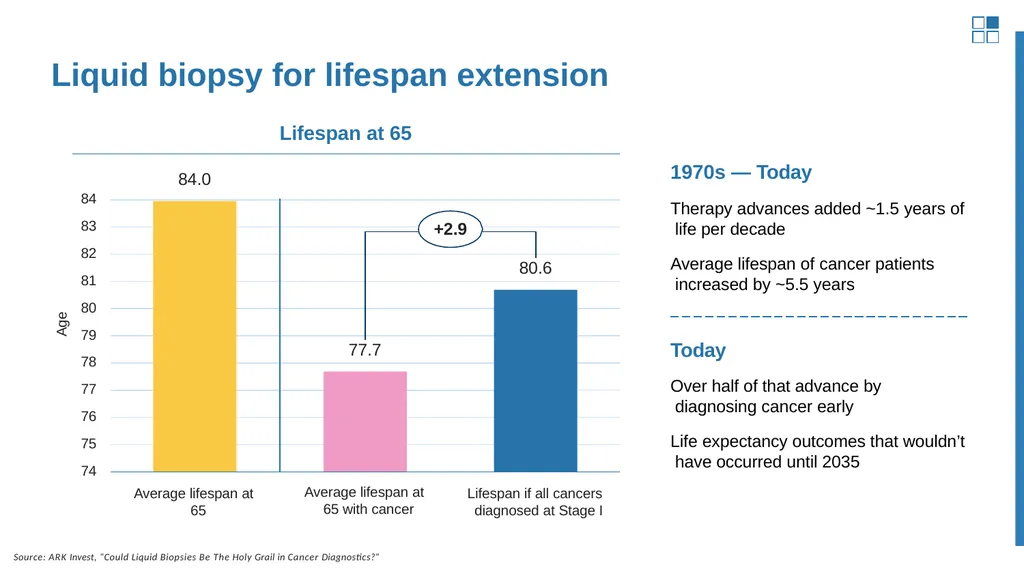
slide8. Liquid biopsy for lifespan extension Lifespan at 65 1970s — Today
Therapy advances added ~1.5 years of life per decade
Average lifespan of cancer patients increased by ~5.5 years Today
Over half of that advance by diagnosing cancer early
Life expectancy outcomes that wouldn’t have occurred until 2035 Source: ARK Invest, “Could Liquid Biopsies Be The Holy Grail in Cancer Diagnostics?”<br>
slide9. The liquid biopsy market<br>
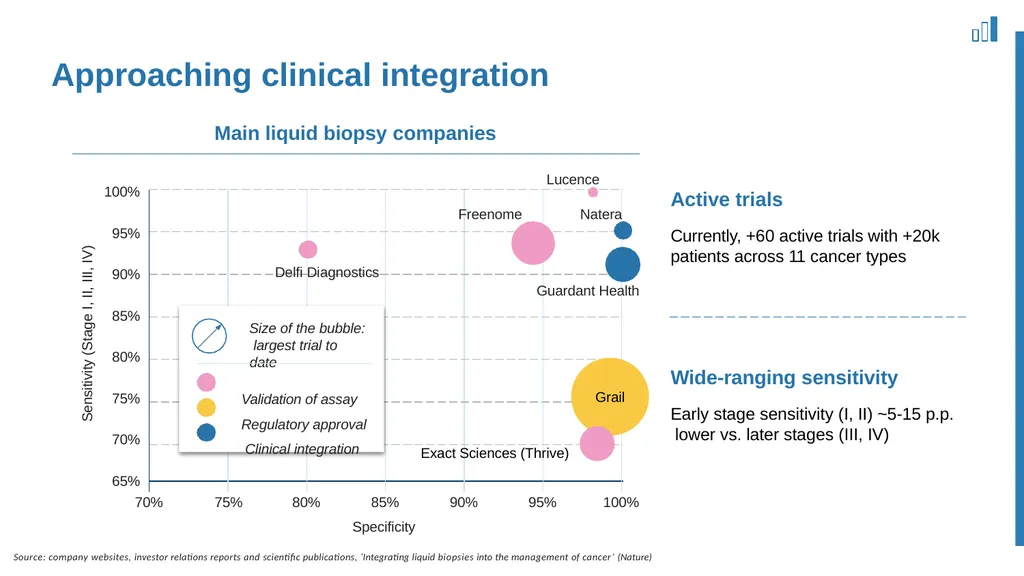
slide10. Approaching clinical integration Main liquid biopsy companies
Lucence Active trials
Currently, +60 active trials with +20k patients across 11 cancer types Wide-ranging sensitivity
Early stage sensitivity (I, II) ~5-15 p.p. lower vs. later stages (III, IV) Source: company websites, investor relations reports and scientific publications, ‘Integrating liquid biopsies into the management of cancer’ (Nature)<br>
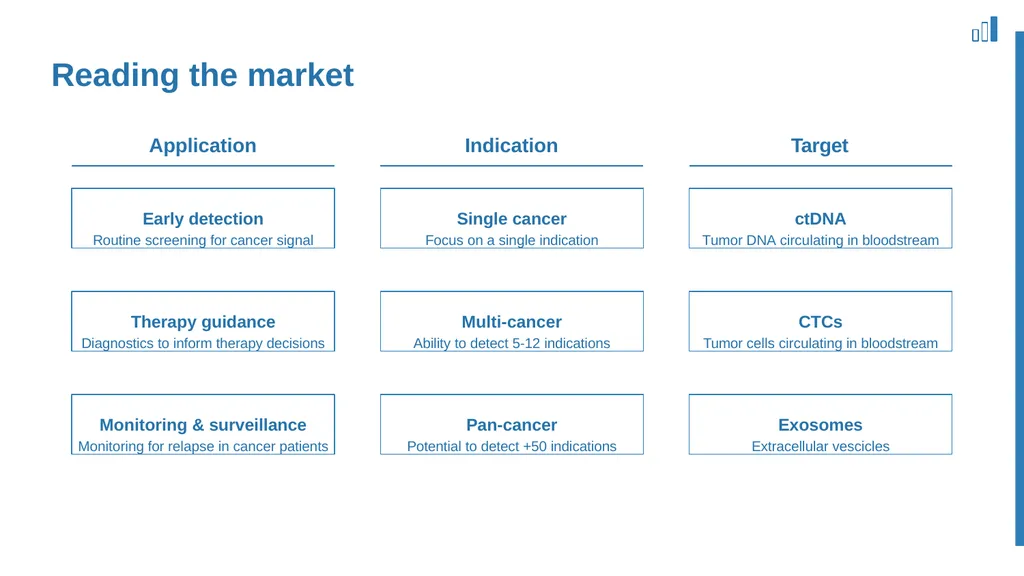
slide11. Reading the market Application Early detection
Routine screening for cancer signal Therapy guidance
Diagnostics to inform therapy decisions Monitoring & surveillance
Monitoring for relapse in cancer patients Indication Single cancer
Focus on a single indication Multi-cancer
Ability to detect 5-12 indications Pan-cancer
Potential to detect +50 indications Target ctDNA
Tumor DNA circulating in bloodstream CTCs
Tumor cells circulating in bloodstream Exosomes
Extracellular vescicles<br>
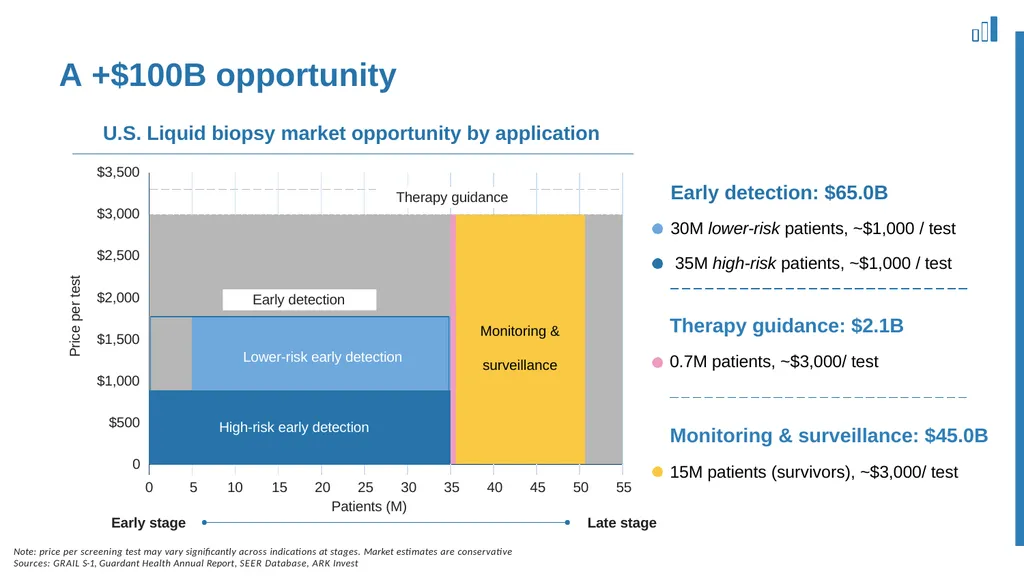
slide12. A +$100B opportunity U.S. Liquid biopsy market opportunity by application
$3,500 Early detection: $65.0B
30M lower-risk patients, ~$1,000 / test 35M high-risk patients, ~$1,000 / test Therapy guidance: $2.1B
0.7M patients, ~$3,000/ test Monitoring & surveillance: $45.0B
15M patients (survivors), ~$3,000/ test Note: price per screening test may vary significantly across indications at stages. Market estimates are conservative Sources: GRAIL S-1, Guardant Health Annual Report, SEER Database, ARK Invest<br>
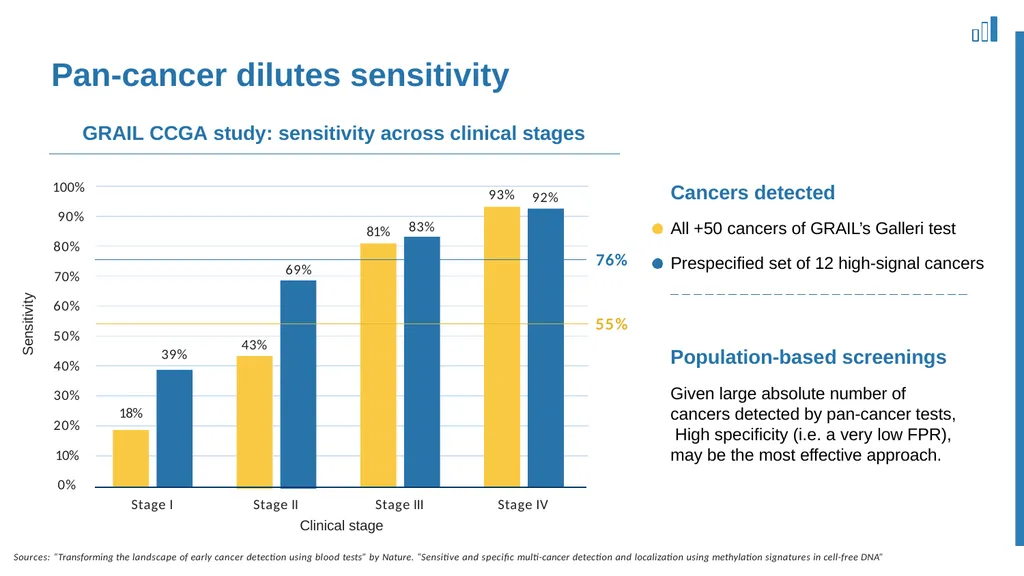
slide13. Pan-cancer dilutes sensitivity GRAIL CCGA study: sensitivity across clinical stages Cancers detected
All +50 cancers of GRAIL’s Galleri test Prespecified set of 12 high-signal cancers Population-based screenings
Given large absolute number of cancers detected by pan-cancer tests, High specificity (i.e. a very low FPR), may be the most effective approach. Sources: “Transforming the landscape of early cancer detection using blood tests” by Nature. “Sensitive and specific multi-cancer detection and localization using methylation signatures in cell-free DNA”<br>
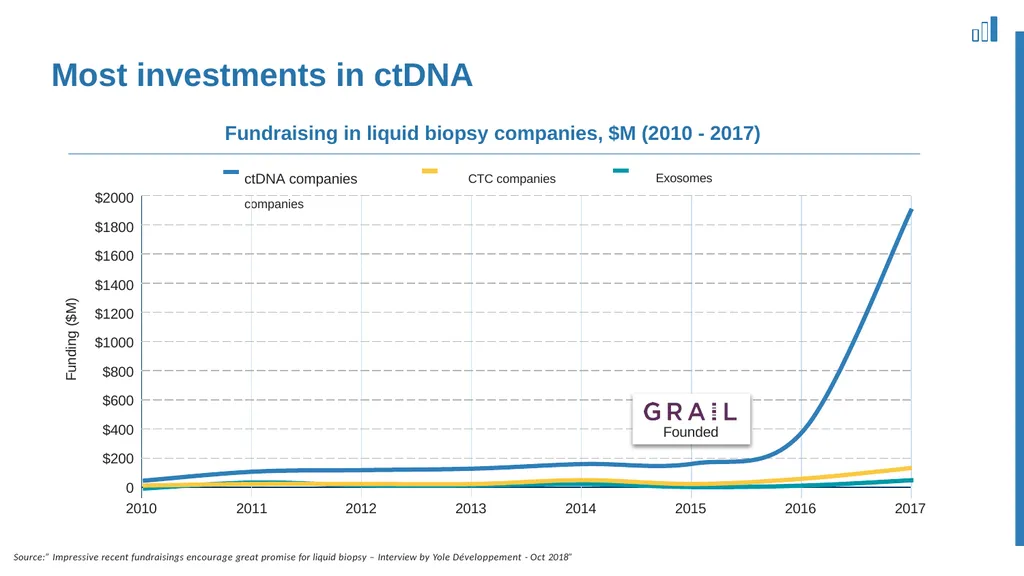
slide14. Most investments in ctDNA Fundraising in liquid biopsy companies, $M (2010 - 2017)
ctDNA companies CTC companies Exosomes companies Source:” Impressive recent fundraisings encourage great promise for liquid biopsy – Interview by Yole Développement - Oct 2018”<br>
slide15. The needle in the haystack<br>
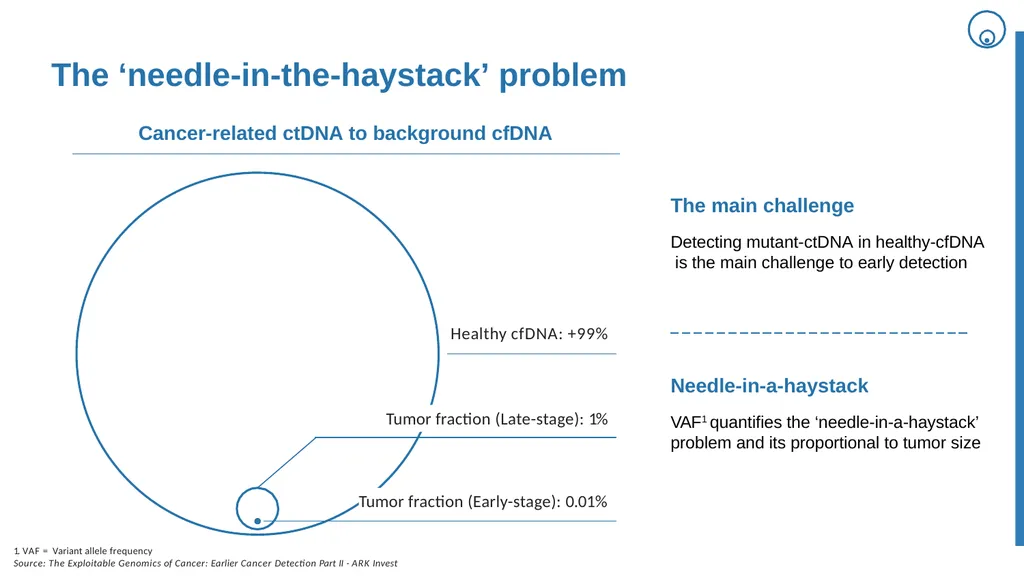
slide16. The ‘needle-in-the-haystack’ problem Cancer-related ctDNA to background cfDNA The main challenge
Detecting mutant-ctDNA in healthy-cfDNA is the main challenge to early detection Needle-in-a-haystack
VAF1 quantifies the ‘needle-in-a-haystack’ problem and its proportional to tumor size 1. VAF = Variant allele frequency
Source: The Exploitable Genomics of Cancer: Earlier Cancer Detection Part II - ARK Invest<br>
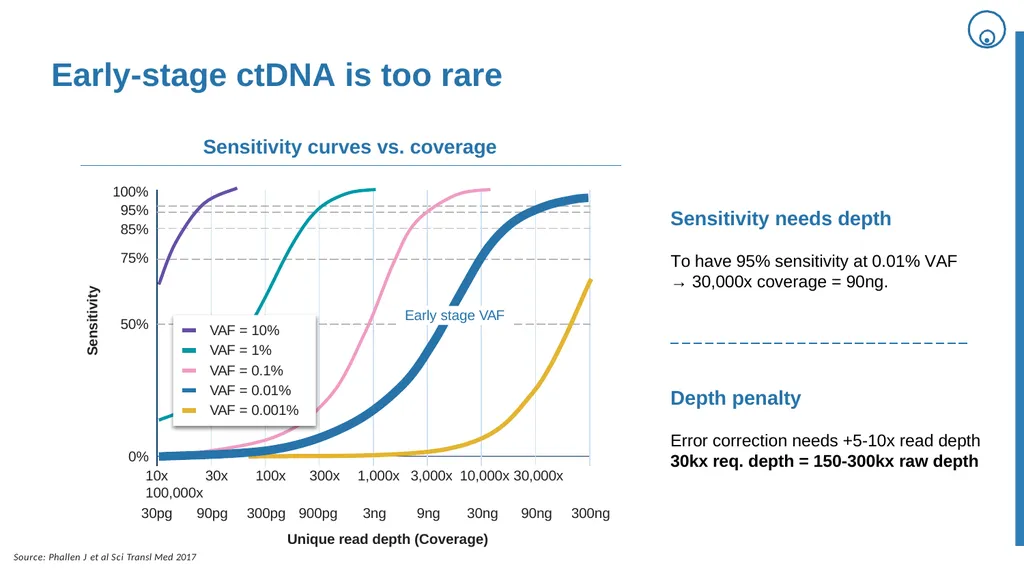
slide17. Early-stage ctDNA is too rare Sensitivity curves vs. coverage Sensitivity needs depth To have 95% sensitivity at 0.01% VAF
→ 30,000x coverage = 90ng. Depth penalty Error correction needs +5-10x read depth
30kx req. depth = 150-300kx raw depth Source: Phallen J et al Sci Transl Med 2017<br>
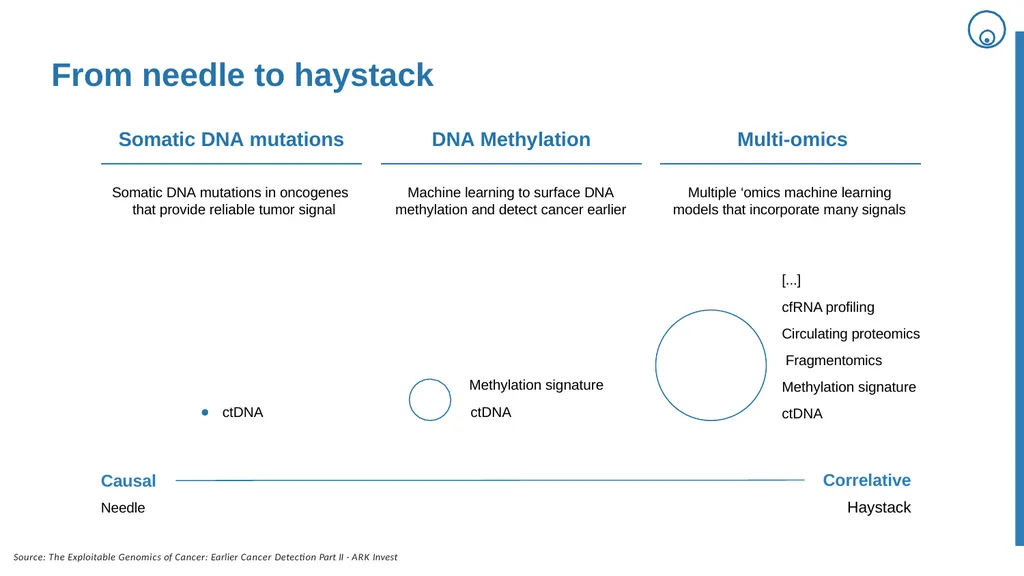
slide18. From needle to haystack Somatic DNA mutations Somatic DNA mutations in oncogenes that provide reliable tumor signal DNA Methylation Machine learning to surface DNA methylation and detect cancer earlier Multi-omics Multiple ‘omics machine learning models that incorporate many signals ctDNA Methylation signature
ctDNA [...]
cfRNA profiling Circulating proteomics Fragmentomics Methylation signature ctDNA Causal
Needle Correlative
Haystack Source: The Exploitable Genomics of Cancer: Earlier Cancer Detection Part II - ARK Invest<br>
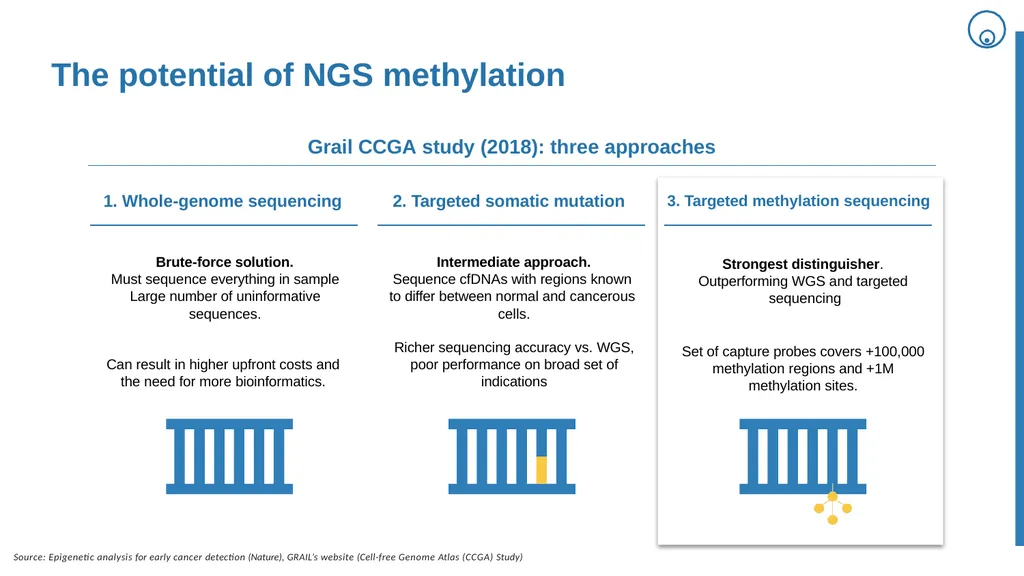
slide19. The potential of NGS methylation Grail CCGA study (2018): three approaches 1. Whole-genome sequencing Brute-force solution.
Must sequence everything in sample Large number of uninformative sequences. Can result in higher upfront costs and the need for more bioinformatics. 2. Targeted somatic mutation Intermediate approach.
Sequence cfDNAs with regions known to differ between normal and cancerous cells. Richer sequencing accuracy vs. WGS, poor performance on broad set of indications 3. Targeted methylation sequencing
Strongest distinguisher.
Outperforming WGS and targeted sequencing
Set of capture probes covers +100,000 methylation regions and +1M methylation sites. Source: Epigenetic analysis for early cancer detection (Nature), GRAIL’s website (Cell-free Genome Atlas (CCGA) Study)<br>
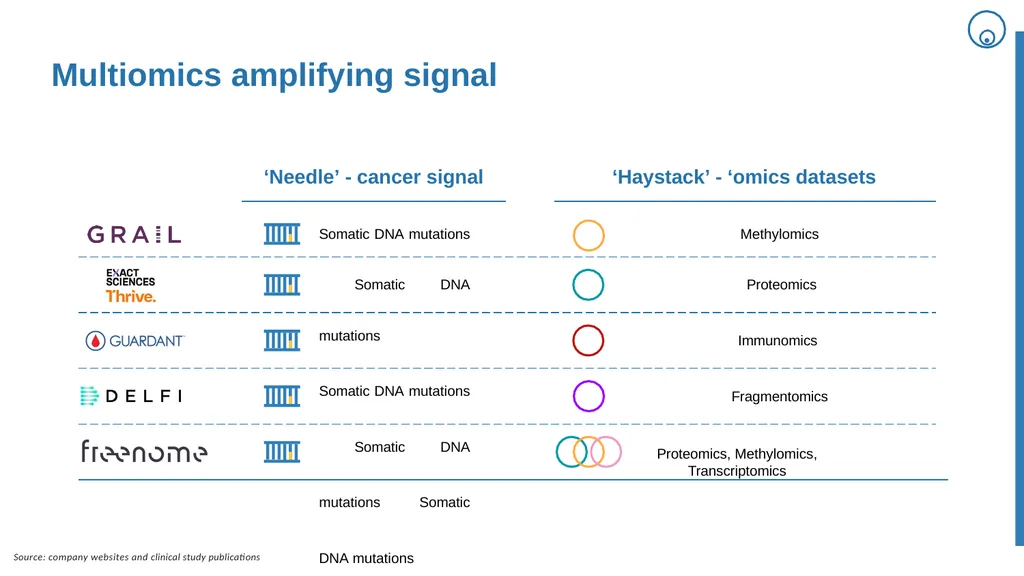
slide20. Multiomics amplifying signal ‘Needle’ - cancer signal
Somatic DNA mutations Somatic DNA mutations
Somatic DNA mutations Somatic DNA mutations Somatic DNA mutations ‘Haystack’ - ‘omics datasets
Methylomics Proteomics
Immunomics Fragmentomics
Proteomics, Methylomics, Transcriptomics Source: company websites and clinical study publications<br>
slide21. The ‘eye of the needle’<br>
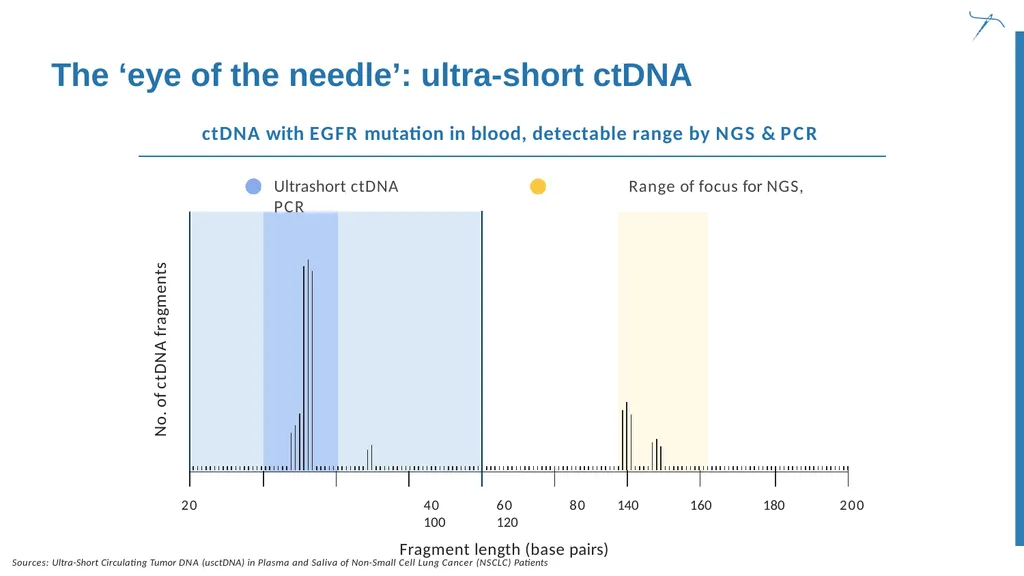
slide22. The ‘eye of the needle’: ultra-short ctDNA Sources: Ultra-Short Circulating Tumor DNA (usctDNA) in Plasma and Saliva of Non-Small Cell Lung Cancer (NSCLC) Patients<br>
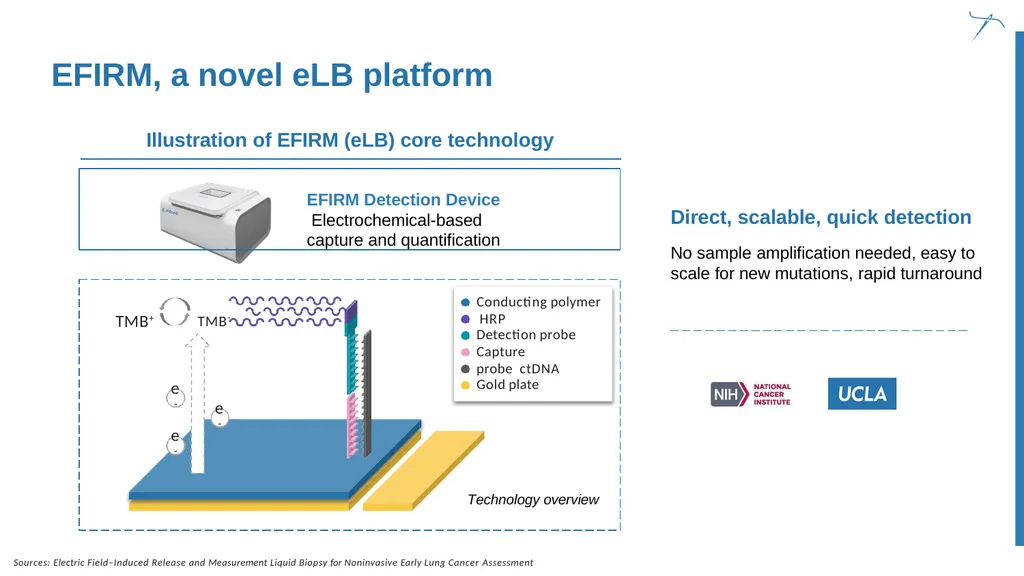
slide23. EFIRM, a novel eLB platform Illustration of EFIRM (eLB) core technology Direct, scalable, quick detection
No sample amplification needed, easy to scale for new mutations, rapid turnaround Sources: Electric Field–Induced Release and Measurement Liquid Biopsy for Noninvasive Early Lung Cancer Assessment<br>
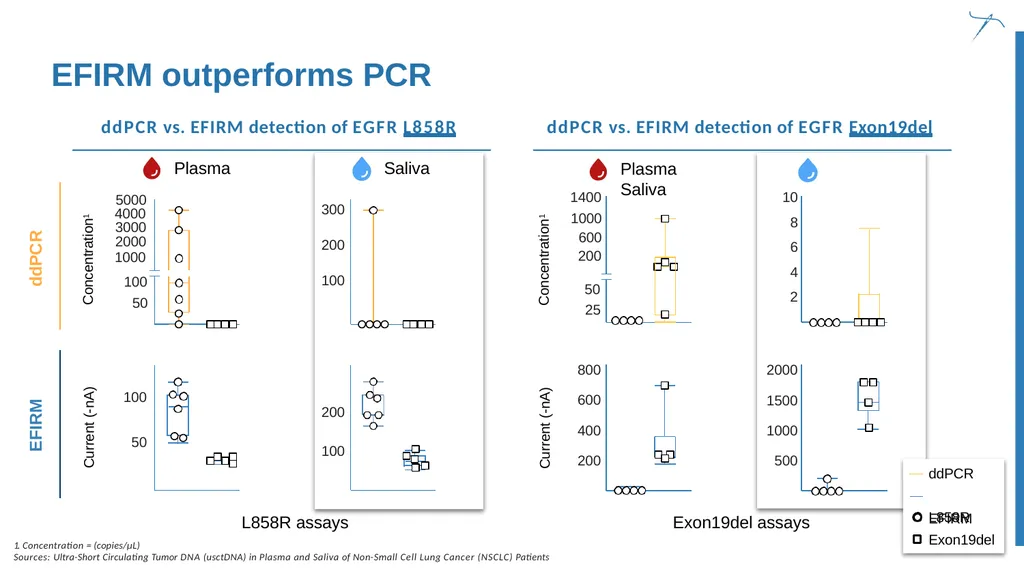
slide24. EFIRM outperforms PCR ddPCR vs. EFIRM detection of EGFR L858R 1. Concentration = (copies/μL)
Sources: Ultra-Short Circulating Tumor DNA (usctDNA) in Plasma and Saliva of Non-Small Cell Lung Cancer (NSCLC) Patients<br>
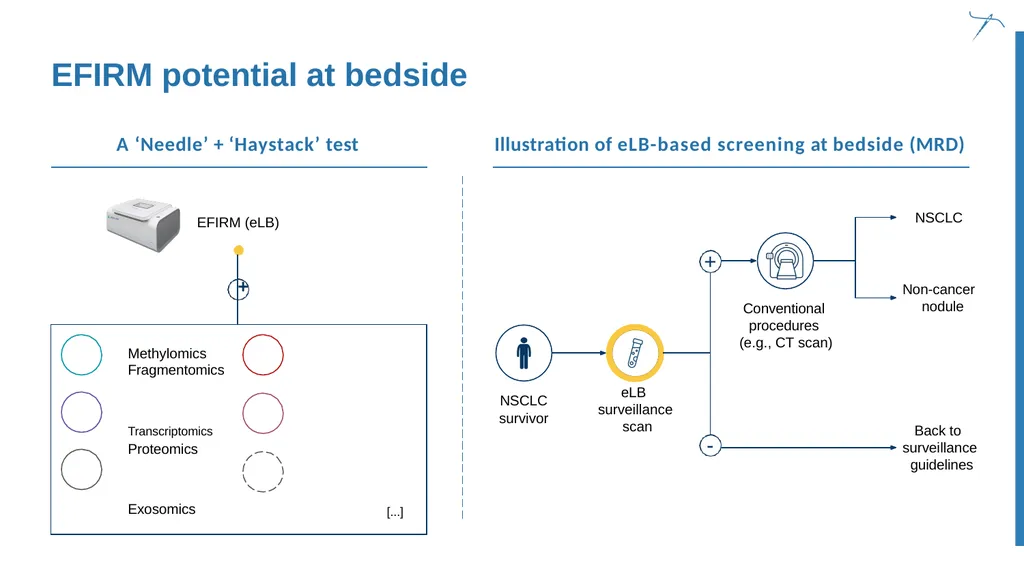
slide25. EFIRM potential at bedside A ‘Needle’ + ‘Haystack’ test Illustration of eLB-based screening at bedside (MRD)<br>
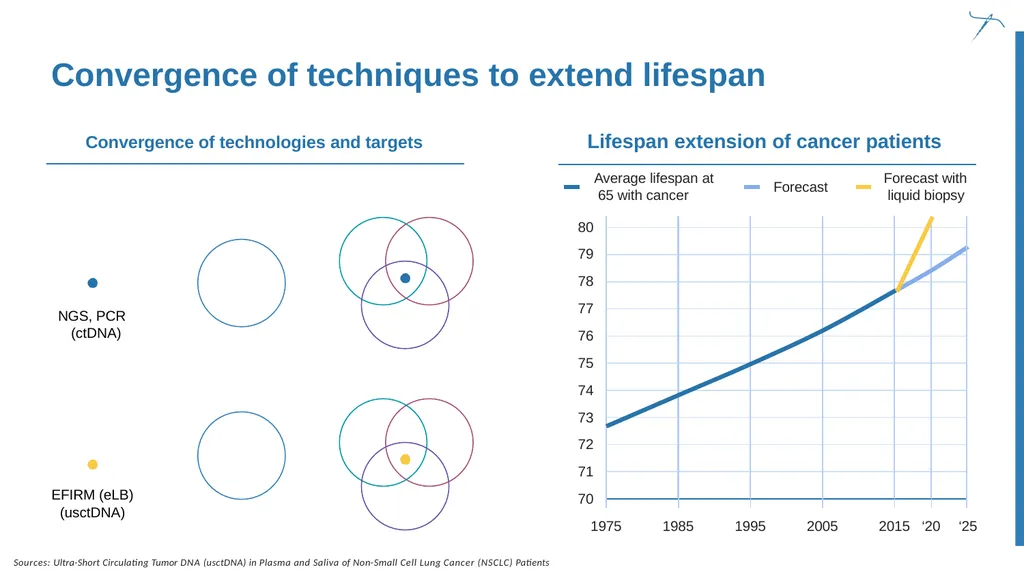
slide26. Convergence of techniques to extend lifespan Convergence of technologies and targets Lifespan extension of cancer patients Sources: Ultra-Short Circulating Tumor DNA (usctDNA) in Plasma and Saliva of Non-Small Cell Lung Cancer (NSCLC) Patients<br>
slide27. Thank you! michelecanzi@gmail.com @michelecanzi National Cancer Institute Symposium on Charting the Course of Liquid Biopsy in Precision, Prevention and Treatment December 15-16, 2021<br>
at the inflection point of liquid biopsy
Michele Canzi National Cancer Institute Symposium on Charting the Course of Liquid Biopsy in Precision, Prevention and Treatment December 15-16, 2021 michelecanzi@gmail.com
@michelecanzi<br>
slide2. Agenda The Schelling point of liquid biopsy
The convergence of multiple trends
The liquid biopsy market
A snapshot of the competitive arena
The needle in the haystack
The central challenge in liquid biopsy
The eye of the needle
Zoom in on a promising liquid biopsy platform under development<br>
slide3. The Schelling point of liquid biopsy Schelling point
In game theory, a ‘Schelling’ or focal point is a solution that people tend to choose by default. The point at which all elements or aspects converge.<br>
slide4. The purpose of innovation The purpose of innovation is to reduce scarcity
Breakthroughs are faster, cheaper, better. Innovation allows to do more with less The ultimate purpose of innovation is to reduce mortality
Mortality is the ultimate scarcity. Life extension is the most important thing we can invent<br>
slide5. The dawn of liquid biopsy Liquid biopsy publications Sources: National Library of Medicine, PubMed<br>
slide6. Growth in sequencing volume + drop of unit costs Growth of DNA sequencing volume Cost declines of genome sequencing Sources: National Human Genome Research Institute (NHGRI), Ark Invest<br>
slide7. Cancer screening approaching reimbursability Cancer screening price curves $1,500 Tests
$1,500 tests to unlock cancer screening market for 65-80 year-olds Sub-$1,000 Tests
At $1,000, nearly all 40+ year-olds could be screened for cancer Sources: National Human Genome Research Institute (NHGRI), Ark Invest<br>
slide8. Liquid biopsy for lifespan extension Lifespan at 65 1970s — Today
Therapy advances added ~1.5 years of life per decade
Average lifespan of cancer patients increased by ~5.5 years Today
Over half of that advance by diagnosing cancer early
Life expectancy outcomes that wouldn’t have occurred until 2035 Source: ARK Invest, “Could Liquid Biopsies Be The Holy Grail in Cancer Diagnostics?”<br>
slide9. The liquid biopsy market<br>
slide10. Approaching clinical integration Main liquid biopsy companies
Lucence Active trials
Currently, +60 active trials with +20k patients across 11 cancer types Wide-ranging sensitivity
Early stage sensitivity (I, II) ~5-15 p.p. lower vs. later stages (III, IV) Source: company websites, investor relations reports and scientific publications, ‘Integrating liquid biopsies into the management of cancer’ (Nature)<br>
slide11. Reading the market Application Early detection
Routine screening for cancer signal Therapy guidance
Diagnostics to inform therapy decisions Monitoring & surveillance
Monitoring for relapse in cancer patients Indication Single cancer
Focus on a single indication Multi-cancer
Ability to detect 5-12 indications Pan-cancer
Potential to detect +50 indications Target ctDNA
Tumor DNA circulating in bloodstream CTCs
Tumor cells circulating in bloodstream Exosomes
Extracellular vescicles<br>
slide12. A +$100B opportunity U.S. Liquid biopsy market opportunity by application
$3,500 Early detection: $65.0B
30M lower-risk patients, ~$1,000 / test 35M high-risk patients, ~$1,000 / test Therapy guidance: $2.1B
0.7M patients, ~$3,000/ test Monitoring & surveillance: $45.0B
15M patients (survivors), ~$3,000/ test Note: price per screening test may vary significantly across indications at stages. Market estimates are conservative Sources: GRAIL S-1, Guardant Health Annual Report, SEER Database, ARK Invest<br>
slide13. Pan-cancer dilutes sensitivity GRAIL CCGA study: sensitivity across clinical stages Cancers detected
All +50 cancers of GRAIL’s Galleri test Prespecified set of 12 high-signal cancers Population-based screenings
Given large absolute number of cancers detected by pan-cancer tests, High specificity (i.e. a very low FPR), may be the most effective approach. Sources: “Transforming the landscape of early cancer detection using blood tests” by Nature. “Sensitive and specific multi-cancer detection and localization using methylation signatures in cell-free DNA”<br>
slide14. Most investments in ctDNA Fundraising in liquid biopsy companies, $M (2010 - 2017)
ctDNA companies CTC companies Exosomes companies Source:” Impressive recent fundraisings encourage great promise for liquid biopsy – Interview by Yole Développement - Oct 2018”<br>
slide15. The needle in the haystack<br>
slide16. The ‘needle-in-the-haystack’ problem Cancer-related ctDNA to background cfDNA The main challenge
Detecting mutant-ctDNA in healthy-cfDNA is the main challenge to early detection Needle-in-a-haystack
VAF1 quantifies the ‘needle-in-a-haystack’ problem and its proportional to tumor size 1. VAF = Variant allele frequency
Source: The Exploitable Genomics of Cancer: Earlier Cancer Detection Part II - ARK Invest<br>
slide17. Early-stage ctDNA is too rare Sensitivity curves vs. coverage Sensitivity needs depth To have 95% sensitivity at 0.01% VAF
→ 30,000x coverage = 90ng. Depth penalty Error correction needs +5-10x read depth
30kx req. depth = 150-300kx raw depth Source: Phallen J et al Sci Transl Med 2017<br>
slide18. From needle to haystack Somatic DNA mutations Somatic DNA mutations in oncogenes that provide reliable tumor signal DNA Methylation Machine learning to surface DNA methylation and detect cancer earlier Multi-omics Multiple ‘omics machine learning models that incorporate many signals ctDNA Methylation signature
ctDNA [...]
cfRNA profiling Circulating proteomics Fragmentomics Methylation signature ctDNA Causal
Needle Correlative
Haystack Source: The Exploitable Genomics of Cancer: Earlier Cancer Detection Part II - ARK Invest<br>
slide19. The potential of NGS methylation Grail CCGA study (2018): three approaches 1. Whole-genome sequencing Brute-force solution.
Must sequence everything in sample Large number of uninformative sequences. Can result in higher upfront costs and the need for more bioinformatics. 2. Targeted somatic mutation Intermediate approach.
Sequence cfDNAs with regions known to differ between normal and cancerous cells. Richer sequencing accuracy vs. WGS, poor performance on broad set of indications 3. Targeted methylation sequencing
Strongest distinguisher.
Outperforming WGS and targeted sequencing
Set of capture probes covers +100,000 methylation regions and +1M methylation sites. Source: Epigenetic analysis for early cancer detection (Nature), GRAIL’s website (Cell-free Genome Atlas (CCGA) Study)<br>
slide20. Multiomics amplifying signal ‘Needle’ - cancer signal
Somatic DNA mutations Somatic DNA mutations
Somatic DNA mutations Somatic DNA mutations Somatic DNA mutations ‘Haystack’ - ‘omics datasets
Methylomics Proteomics
Immunomics Fragmentomics
Proteomics, Methylomics, Transcriptomics Source: company websites and clinical study publications<br>
slide21. The ‘eye of the needle’<br>
slide22. The ‘eye of the needle’: ultra-short ctDNA Sources: Ultra-Short Circulating Tumor DNA (usctDNA) in Plasma and Saliva of Non-Small Cell Lung Cancer (NSCLC) Patients<br>
slide23. EFIRM, a novel eLB platform Illustration of EFIRM (eLB) core technology Direct, scalable, quick detection
No sample amplification needed, easy to scale for new mutations, rapid turnaround Sources: Electric Field–Induced Release and Measurement Liquid Biopsy for Noninvasive Early Lung Cancer Assessment<br>
slide24. EFIRM outperforms PCR ddPCR vs. EFIRM detection of EGFR L858R 1. Concentration = (copies/μL)
Sources: Ultra-Short Circulating Tumor DNA (usctDNA) in Plasma and Saliva of Non-Small Cell Lung Cancer (NSCLC) Patients<br>
slide25. EFIRM potential at bedside A ‘Needle’ + ‘Haystack’ test Illustration of eLB-based screening at bedside (MRD)<br>
slide26. Convergence of techniques to extend lifespan Convergence of technologies and targets Lifespan extension of cancer patients Sources: Ultra-Short Circulating Tumor DNA (usctDNA) in Plasma and Saliva of Non-Small Cell Lung Cancer (NSCLC) Patients<br>
slide27. Thank you! michelecanzi@gmail.com @michelecanzi National Cancer Institute Symposium on Charting the Course of Liquid Biopsy in Precision, Prevention and Treatment December 15-16, 2021<br>