
Fire Department San Diego Training Alternative





Description: Fire Department San Diego Training Alternative Electric Drive Vehicles For the First Responder Federal Federal Fire Department San Diego Training Alternative Electric Drive Vehicles for the First Responder Training Resource National
Related Topics
Download Presentation
"Fire Department San Diego Training Alternative" is the property of its rightful owner. Permission is granted to download and print the materials on this website for personal, non-commercial use only, and to display it on your personal computer provided you do not modify the materials and that you retain all copyright notices contained in the materials. By downloading content from our website, you accept the terms of this agreement.
Presentation Transcript
slide1. Fire Department San Diego Training
Alternative Electric Drive Vehicles For the First Responder Federal Federal Fire Department San Diego Training<br>
slide2. Alternative Electric Drive Vehicles for the First Responder
Training Resource – National Alternative Fuels Training Consortium (NAFTC) Online Education Center
http://naftc.wvu.edu Federal Fire Department San Diego Federal Fire Department San Diego Training<br>
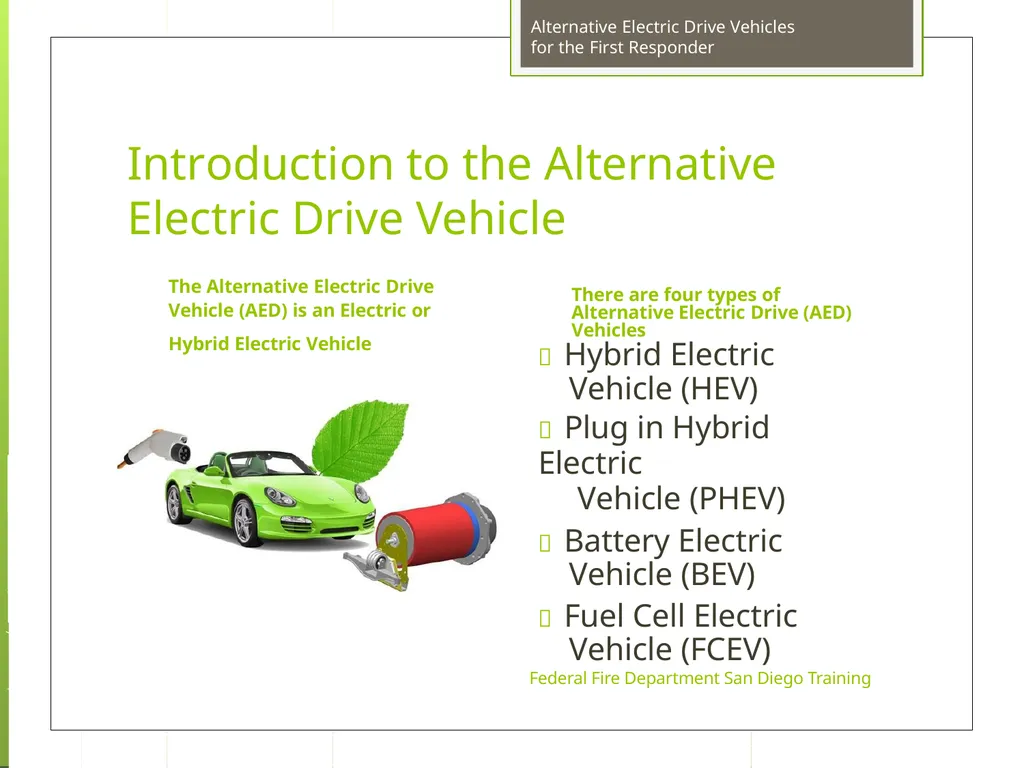
slide3. Introduction to the Alternative Electric Drive Vehicle
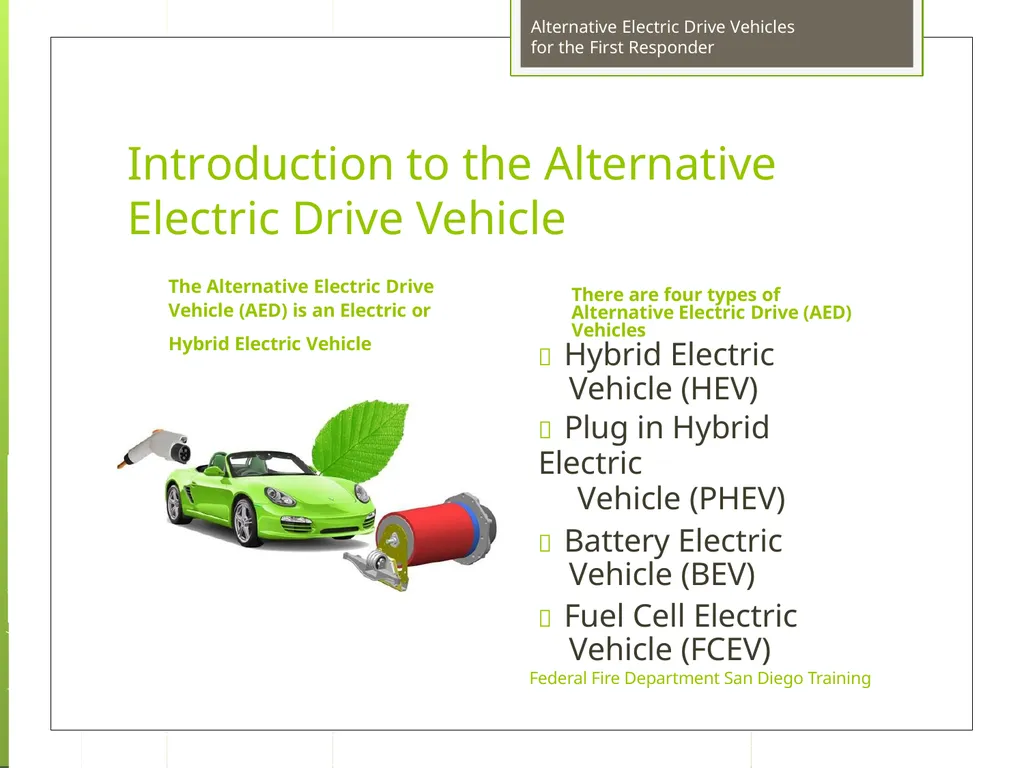
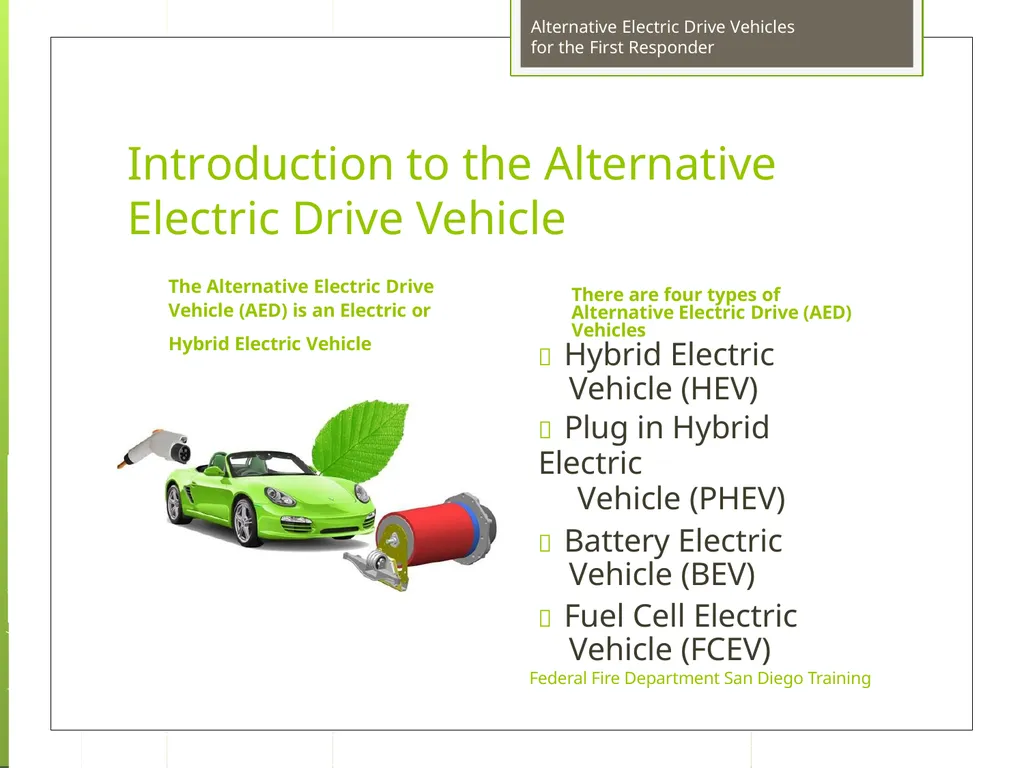
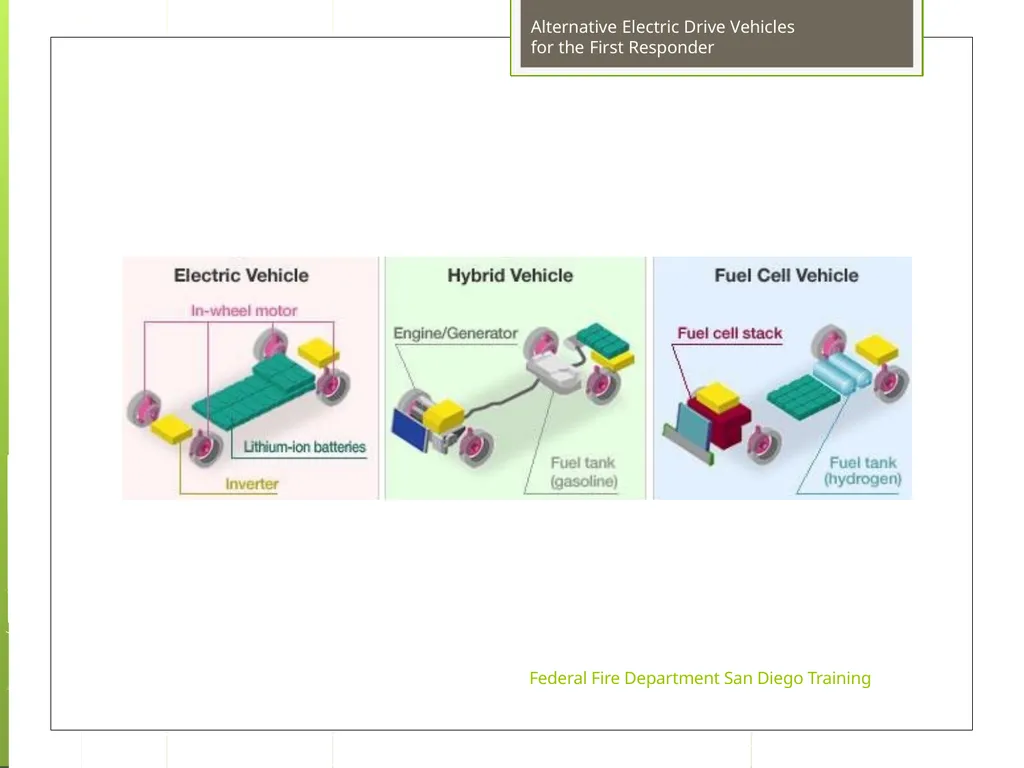
The Alternative Electric Drive Vehicle (AED) is an Electric or Hybrid Electric Vehicle There are four types of Alternative Electric Drive (AED) Vehicles Federal Fire Department San Diego Training Hybrid Electric Vehicle (HEV)
Plug in Hybrid Electric
Vehicle (PHEV)
Battery Electric Vehicle (BEV)
Fuel Cell Electric Vehicle (FCEV) Alternative Electric Drive Vehicles for the First Responder<br>
slide4. Alternative Electric Drive Vehicles for the First Responder
HEV’s are very popular and commonly found on the road. They combine an Internal Combustion Engine (ICE) with a Battery Electric Vehicle (BEV) Federal Fire Department San Diego Training to make a hybrid. These are popular because they do not have issues with the battery restricting range. These vehicles have benefits of fuel savings and are more environmentally friendly than a standard vehicle with just an ICE. Introduction to the Alternative Drive Vehicle
Hybrid Electric Vehicle (HEV)<br>
slide5. Characteristics of the Hybrid
Electric Vehicle (HEV)
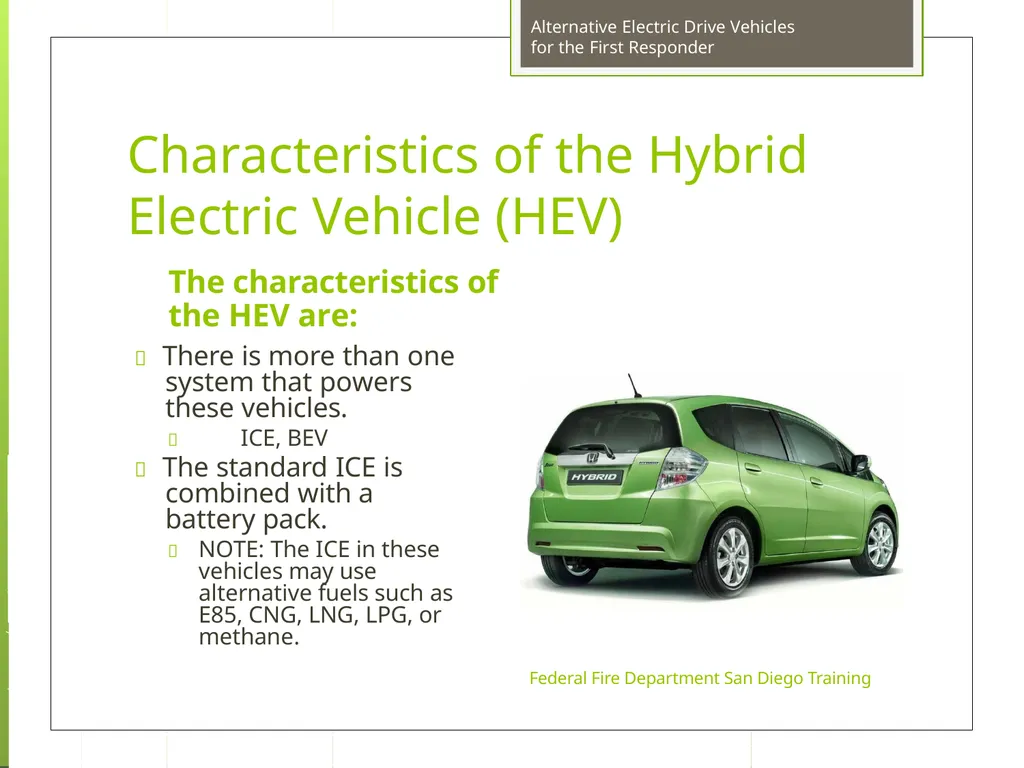
The characteristics of
the HEV are:
There is more than one system that powers these vehicles.
ICE, BEV
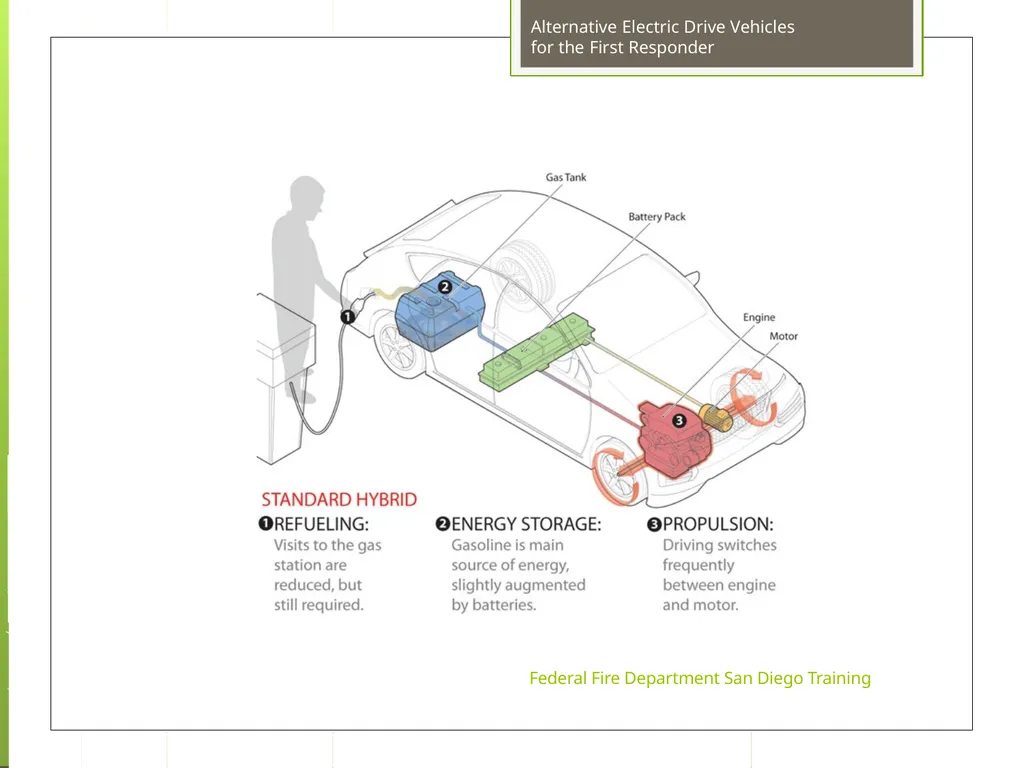
The standard ICE is combined with a battery pack.
NOTE: The ICE in these vehicles may use alternative fuels such as E85, CNG, LNG, LPG, or
methane. Alternative Electric Drive Vehicles for the First Responder Federal Fire Department San Diego Training<br>
slide6. Alternative Electric Drive Vehicles for the First Responder Federal Fire Department San Diego Training<br>
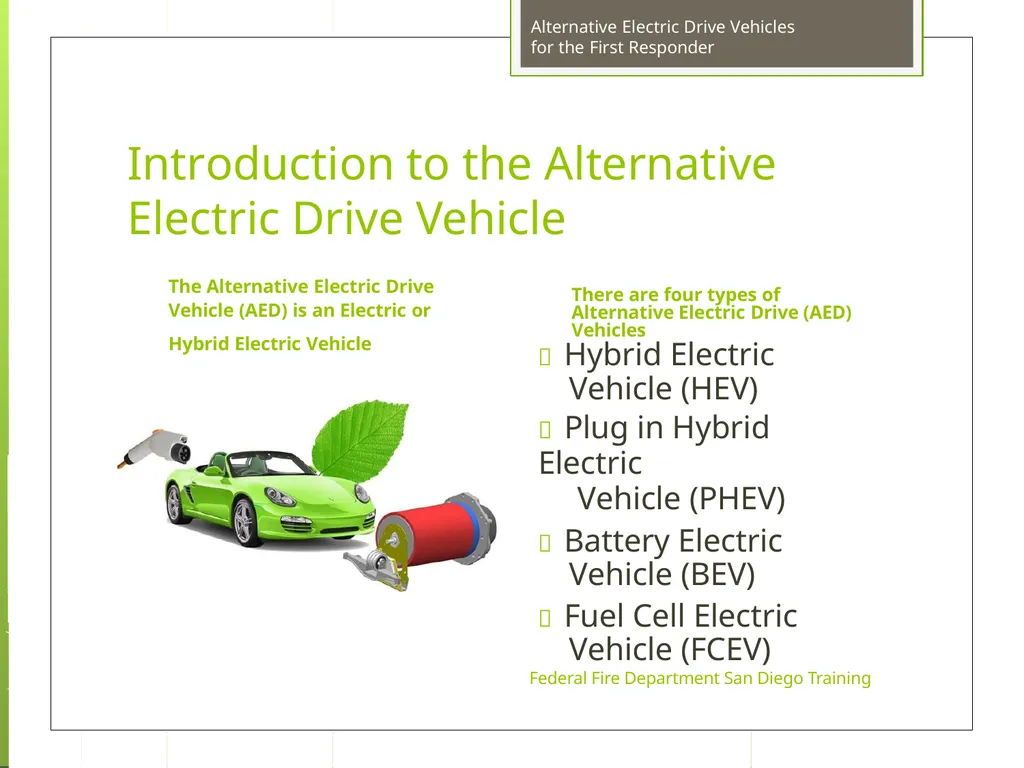
slide7. Introduction to the Alternative Electric Drive Vehicle
The Alternative Electric Drive Vehicle (AED) is an Electric or Hybrid Electric Vehicle There are four types of Alternative Electric Drive (AED) Vehicles Federal Fire Department San Diego Training Hybrid Electric Vehicle (HEV)
Plug in Hybrid Electric
Vehicle (PHEV)
Battery Electric Vehicle (BEV)
Fuel Cell Electric Vehicle (FCEV) Alternative Electric Drive Vehicles for the First Responder<br>
slide8. Alternative Electric Drive Vehicles for the First Responder
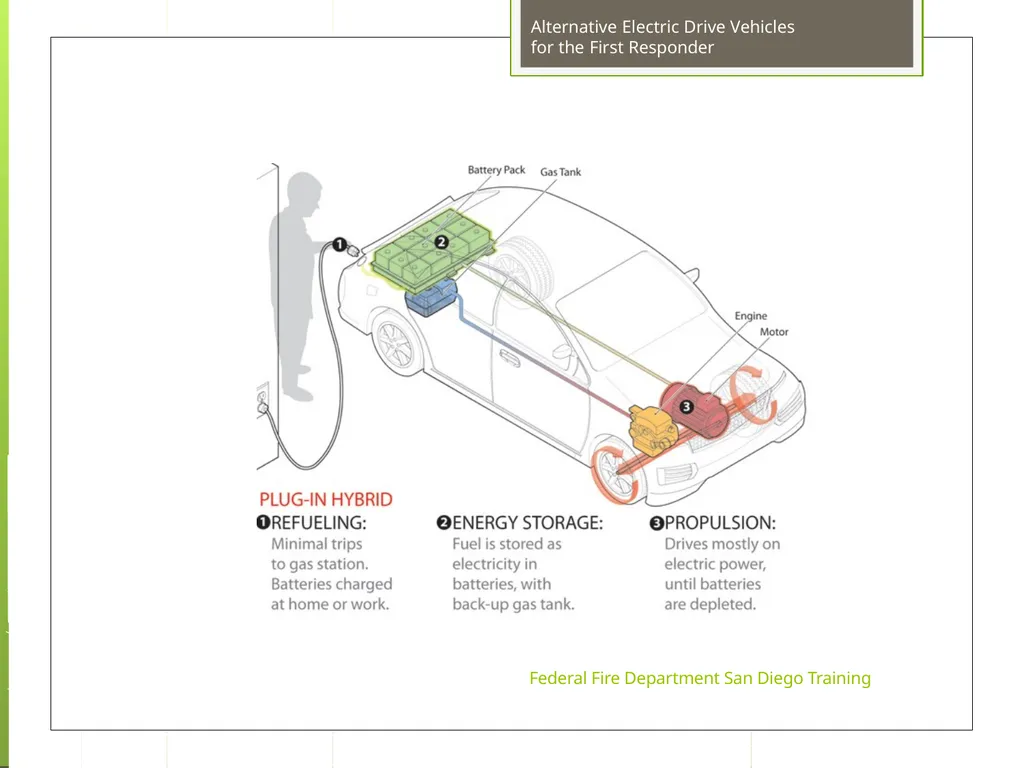
PHEV is similar to the HEV with the addition of a charging port to charge the battery.
PHEV’s combine an Internal Combustion Engine (ICE) with a Battery Electric Vehicle (BEV) and a charger for Federal Fire Department San Diego Training additional energy.
These are popular because they do not have issues with the battery restricting range. These vehicles have benefits of fuel savings and are more environmentally friendly than a standard vehicle with just an ICE. The plug in option greatly increases fuel savings. Introduction to the Alternative Drive Vehicle
Plug in Hybrid Electric Vehicle (PHEV)<br>
slide9. Characteristics of the Plug in
Hybrid Electric Vehicle (PHEV)
The characteristics of
the PHEV are:
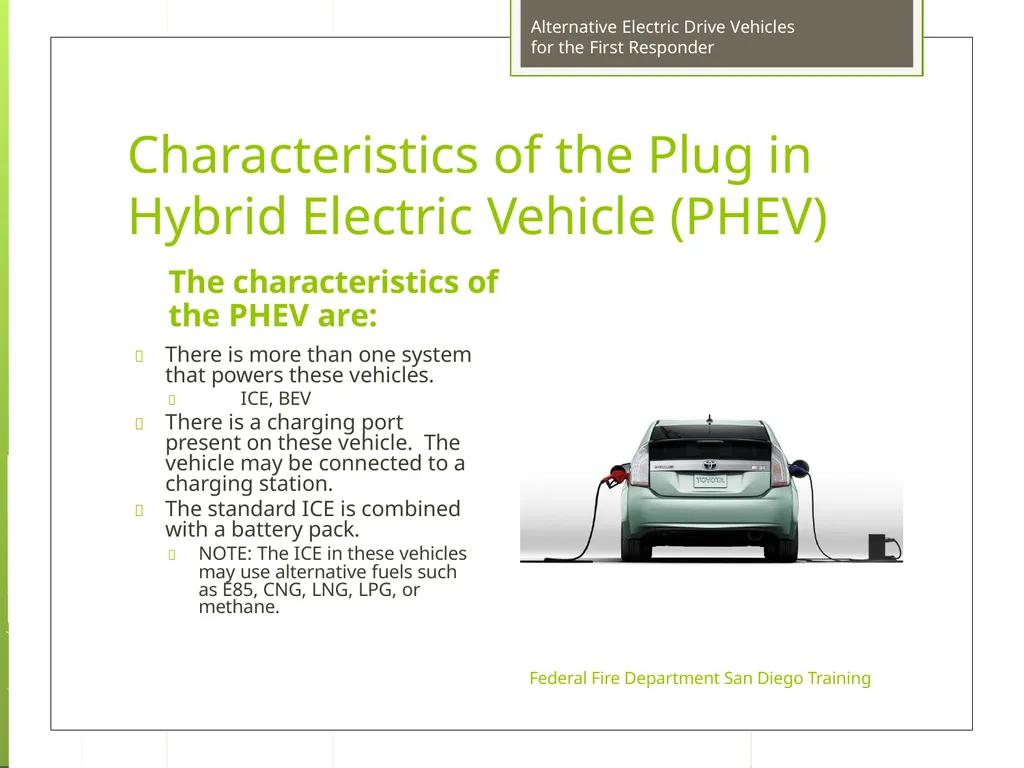
There is more than one system that powers these vehicles.
ICE, BEV
There is a charging port present on these vehicle. The vehicle may be connected to a charging station.
The standard ICE is combined with a battery pack.
NOTE: The ICE in these vehicles may use alternative fuels such as E85, CNG, LNG, LPG, or
methane. Alternative Electric Drive Vehicles for the First Responder Federal Fire Department San Diego Training<br>
slide10. Alternative Electric Drive Vehicles for the First Responder Federal Fire Department San Diego Training<br>
slide11. Introduction to the Alternative Electric Drive Vehicle
The Alternative Electric Drive Vehicle (AED) is an Electric or Hybrid Electric Vehicle There are four types of Alternative Electric Drive (AED) Vehicles Federal Fire Department San Diego Training Hybrid Electric Vehicle (HEV)
Plug in Hybrid Electric
Vehicle (PHEV)
Battery Electric Vehicle (BEV)
Fuel Cell Electric Vehicle (FCEV) Alternative Electric Drive Vehicles for the First Responder<br>
slide12. Alternative Electric Drive Vehicles for the First Responder
There are a relatively small amount of BEV’s on the road today when compared to conventional Federal Fire Department San Diego Training ICE and HEV’s. They are becoming more popular though because of the following:
Better battery power storage
Larger scale
manufacturing
Larger vehicle manufacturers are increasing their BEV model line up and lowering cost-to-own. There is no ICE present on these vehicles. The energy to power these vehicles is all electric and comes from the energy stored within the vehicle batteries. Introduction to the Alternative Drive Vehicle
Battery Electric Vehicle (BEV)<br>
slide13. Characteristics of the Battery
Electric Vehicle (BEV)
The characteristics of
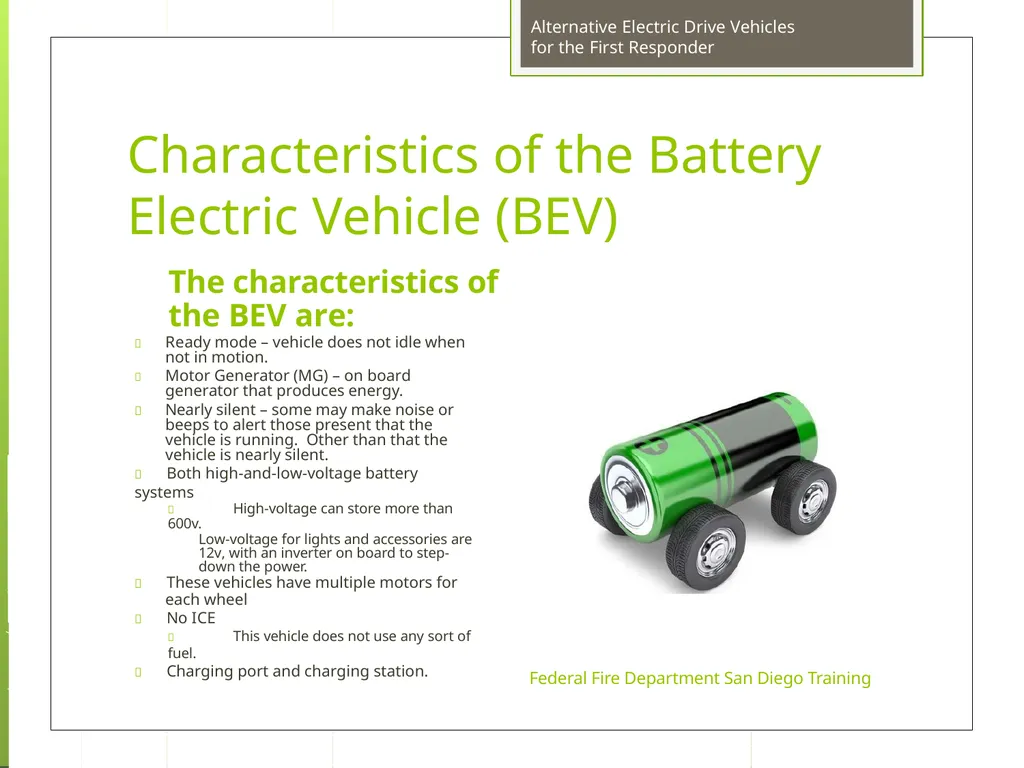
the BEV are: Ready mode – vehicle does not idle when not in motion.
Motor Generator (MG) – on board generator that produces energy.
Nearly silent – some may make noise or beeps to alert those present that the vehicle is running. Other than that the vehicle is nearly silent.
Both high-and-low-voltage battery systems
High-voltage can store more than 600v.
Low-voltage for lights and accessories are 12v, with an inverter on board to step- down the power.
These vehicles have multiple motors for
each wheel
No ICE
This vehicle does not use any sort of fuel.
Charging port and charging station. Alternative Electric Drive Vehicles for the First Responder Federal Fire Department San Diego Training<br>
slide14. Introduction to the Alternative Electric Drive Vehicle
The Alternative Electric Drive Vehicle (AED) is an Electric or Hybrid Electric Vehicle There are four types of Alternative Electric Drive (AED) Vehicles Federal Fire Department San Diego Training Hybrid Electric Vehicle (HEV)
Plug in Hybrid Electric
Vehicle (PHEV)
Battery Electric Vehicle (BEV)
Fuel Cell Electric Vehicle (FCEV) Alternative Electric Drive Vehicles for the First Responder<br>
slide15. Alternative Electric Drive Vehicles for the First Responder
FCEV’s are very rare, but they are on the road and you may encounter one. Federal Fire Department San Diego Training This type of vehicle uses hydrogen gas to power a fuel cell, which powers an electric motor. Introduction to the Alternative Drive Vehicle
Fuel Cell Electric Vehicle (FCEV)<br>
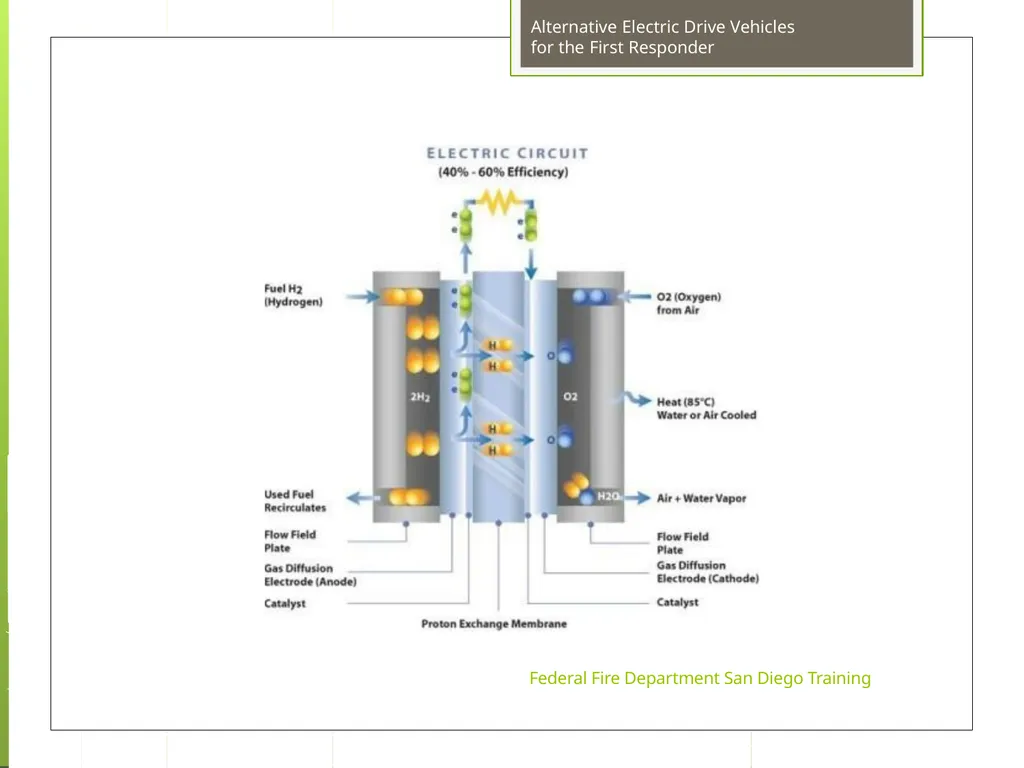
slide16. How does a Fuel Cell Electric
Vehicle (FCEV) Work? The way that this vehicle works is essentially as a Hybrid Electric Vehicle.
The fuel is the hydrogen.
FCEV’s convert hydrogen and oxygen to electricity which powers an electric motor.
FCEV’s have the same Motor Generator (MG), inverter, and Regenerative Braking that other AED vehicles have. Alternative Electric Drive Vehicles for the First Responder Federal Fire Department San Diego Training<br>
slide17. Alternative Electric Drive Vehicles for the First Responder Federal Fire Department San Diego Training<br>
slide18. Alternative Electric Drive Vehicles for the First Responder Federal Fire Department San Diego Training<br>
slide19. Alternative Electric Drive Vehicles for the First Responder Federal Fire Department San Diego Training<br>
slide20. Fuel Cell Electric Vehicle Safety
Generally speaking the hydrogen in the FCEV is safe. Hydrogen is one of the most abundant elements in nature, it is present in 75%of the atmosphere.
In the case of a spill, the hydrogen would vaporize and cause no hazard.
Hydrogen is stored under pressure of 5psig and liquefies at -423˚F. In a release to atmosphere it will combine with oxygen and form water vapor and quickly disperse.
Hydrogen is non-toxic, non-poisonous, and non-corrosive. Alternative Electric Drive Vehicles for the First Responder Federal Fire Department San Diego Training<br>
slide21. Fuel Cell Electric Vehicle
(FCEV) Risk Factors
There are several important considerations to take note of with FCEV’s.
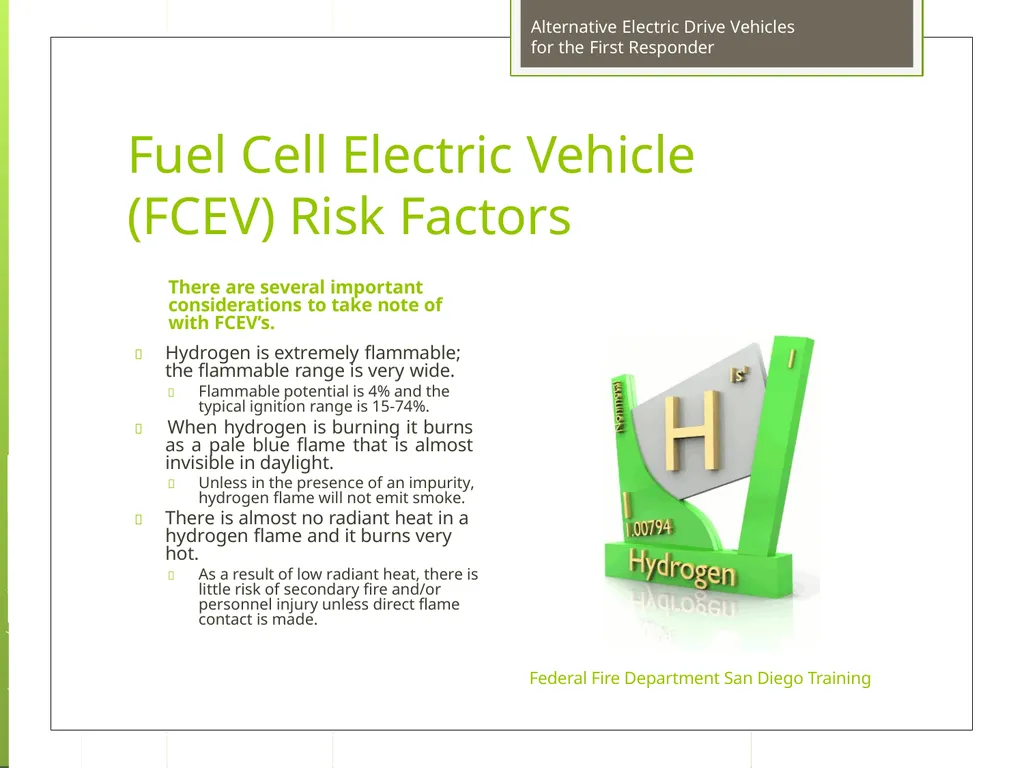
Hydrogen is extremely flammable; the flammable range is very wide.
Flammable potential is 4% and the typical ignition range is 15-74%.
When hydrogen is burning it burns as a pale blue flame that is almost invisible in daylight.
Unless in the presence of an impurity, hydrogen flame will not emit smoke.
There is almost no radiant heat in a hydrogen flame and it burns very hot.
As a result of low radiant heat, there is little risk of secondary fire and/or personnel injury unless direct flame contact is made. Alternative Electric Drive Vehicles for the First Responder Federal Fire Department San Diego Training<br>
slide22. Characteristics of the Fuel Cell
Electric Vehicle (FCEV)
The characteristics of
the FCEV are:
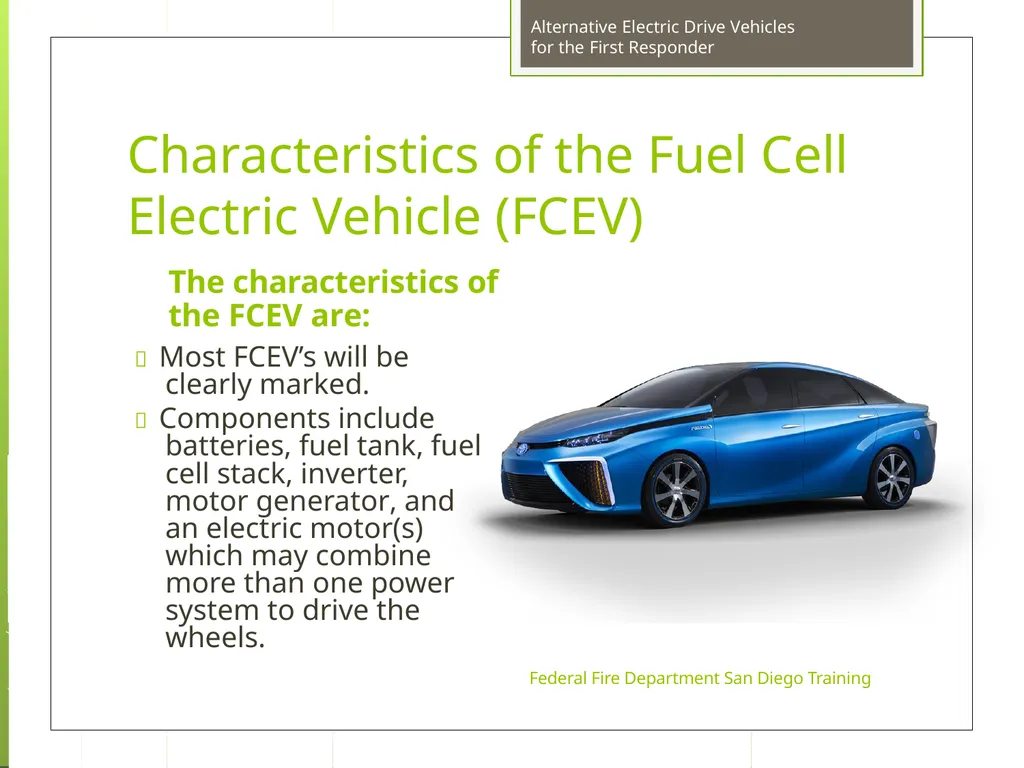
Most FCEV’s will be clearly marked.
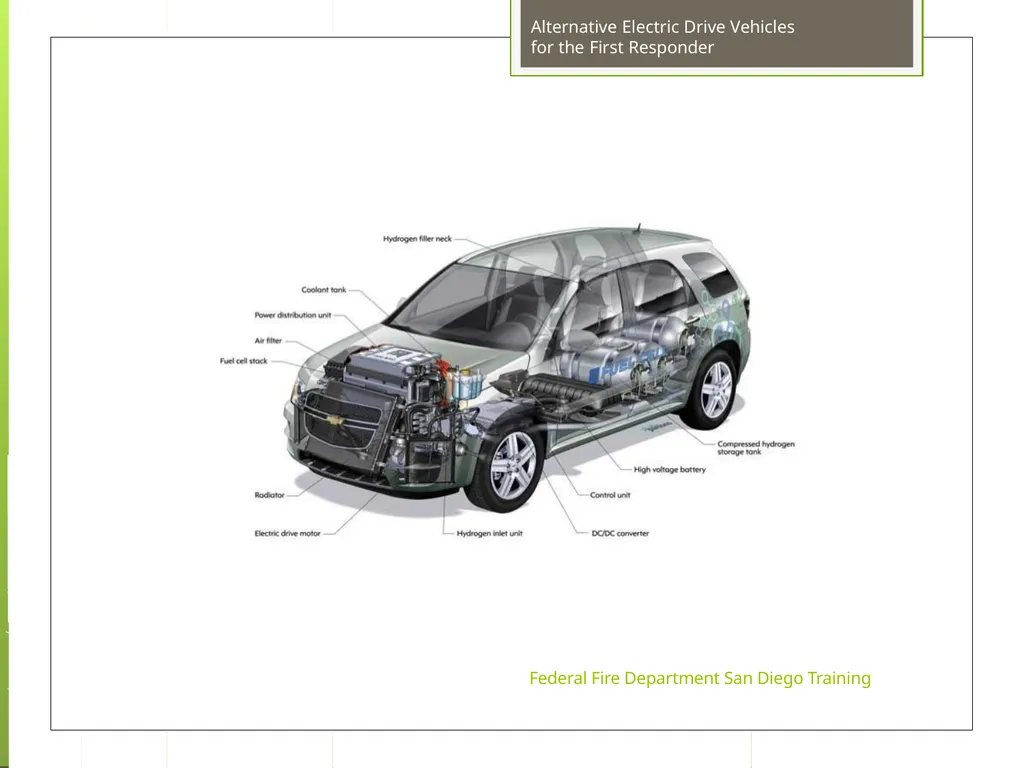
Components include batteries, fuel tank, fuel cell stack, inverter, motor generator, and an electric motor(s) which may combine more than one power system to drive the wheels. Alternative Electric Drive Vehicles for the First Responder Federal Fire Department San Diego Training<br>
slide23. Introduction to the Alternative Electric Drive Vehicle
The Alternative Electric Drive Vehicle (AED) is an Electric or Hybrid Electric Vehicle There are four types of Alternative Electric Drive (AED) Vehicles Federal Fire Department San Diego Training Hybrid Electric Vehicle (HEV)
Plug in Hybrid Electric Vehicle (PHEV)
Battery Electric Vehicle (BEV)
Fuel Cell Electric Vehicle (FCEV)
Most AED vehicles should be marked as such, but standard Internal Combustion Engine vehicles can be retrofitted with aftermarket kits to make them any one of the AED types. Alternative Electric Drive Vehicles for the First Responder<br>
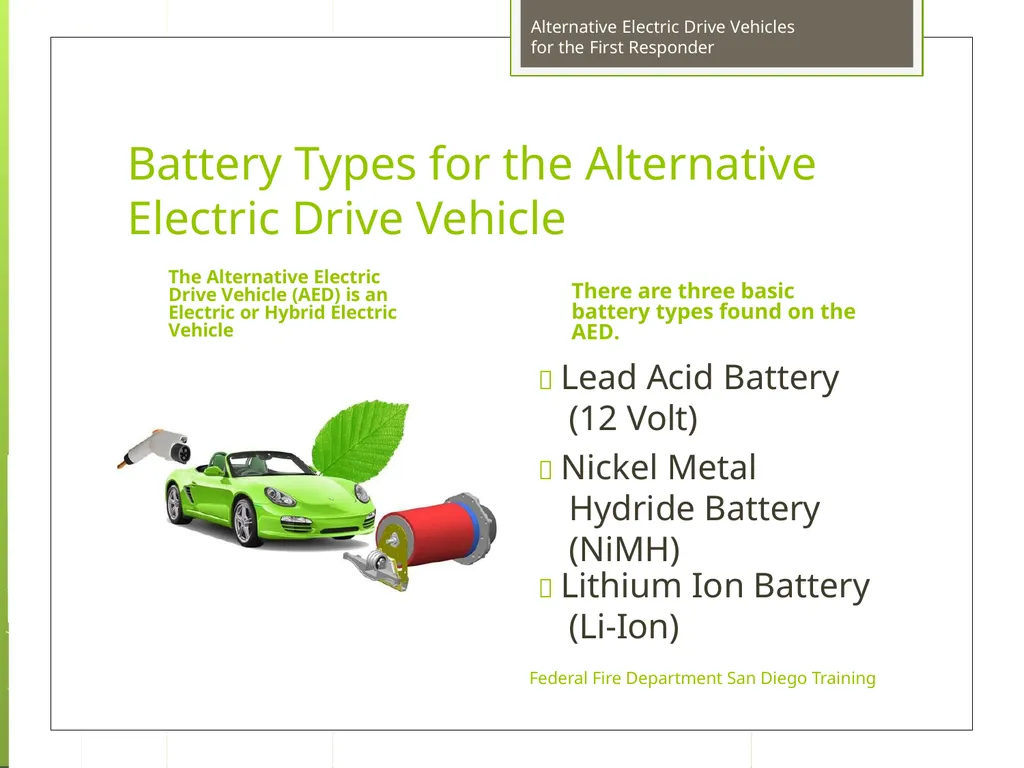
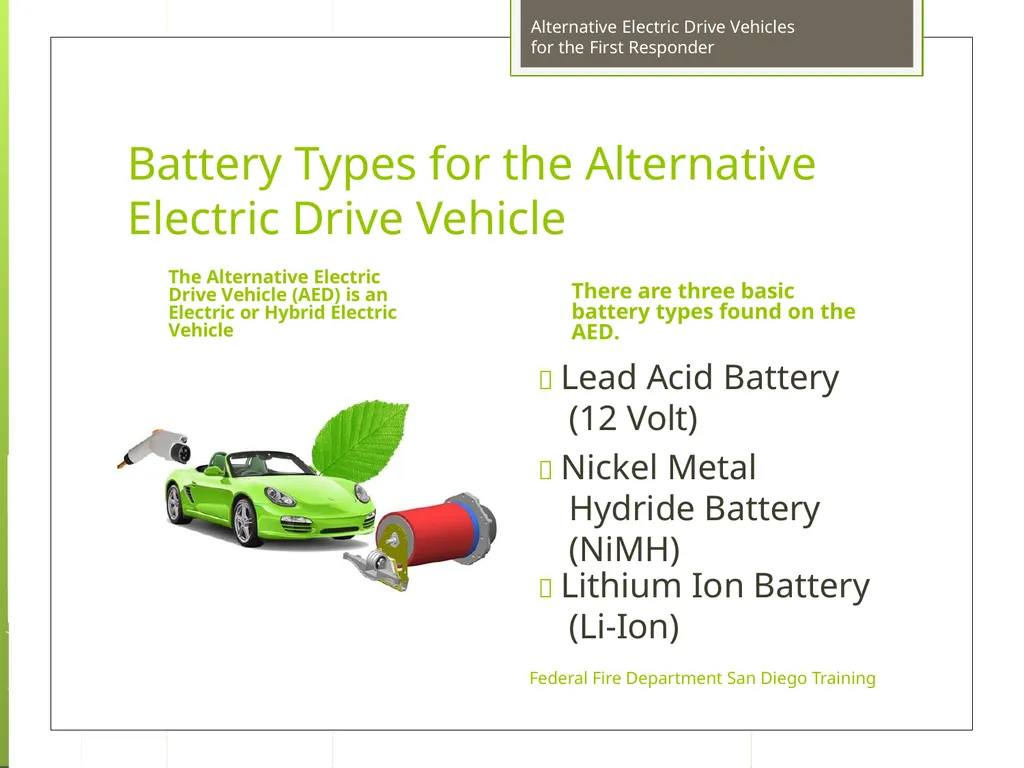
slide24. Battery Types for the Alternative Electric Drive Vehicle The Alternative Electric Drive Vehicle (AED) is an Electric or Hybrid Electric Vehicle There are three basic battery types found on the AED.
Lead Acid Battery (12 Volt)
Nickel Metal Hydride Battery (NiMH) Lithium Ion Battery
(Li-Ion) Alternative Electric Drive Vehicles for the First Responder Federal Fire Department San Diego Training<br>
slide25. Alternative Electric Drive Vehicles for the First Responder
These are conventional batteries, used for lighting and accessory controls such as ignition systems and radio. This is the same battery that can be found on the standard ICE vehicle. The standard 12- volt battery is used in conjunction with the high voltage system. Lead Acid Battery Type 12-volt battery type for the low voltage system. Federal Fire Department San Diego Training<br>
slide26. Safety With the Lead Acid
Battery
In an emergency situation the
following should be noted:
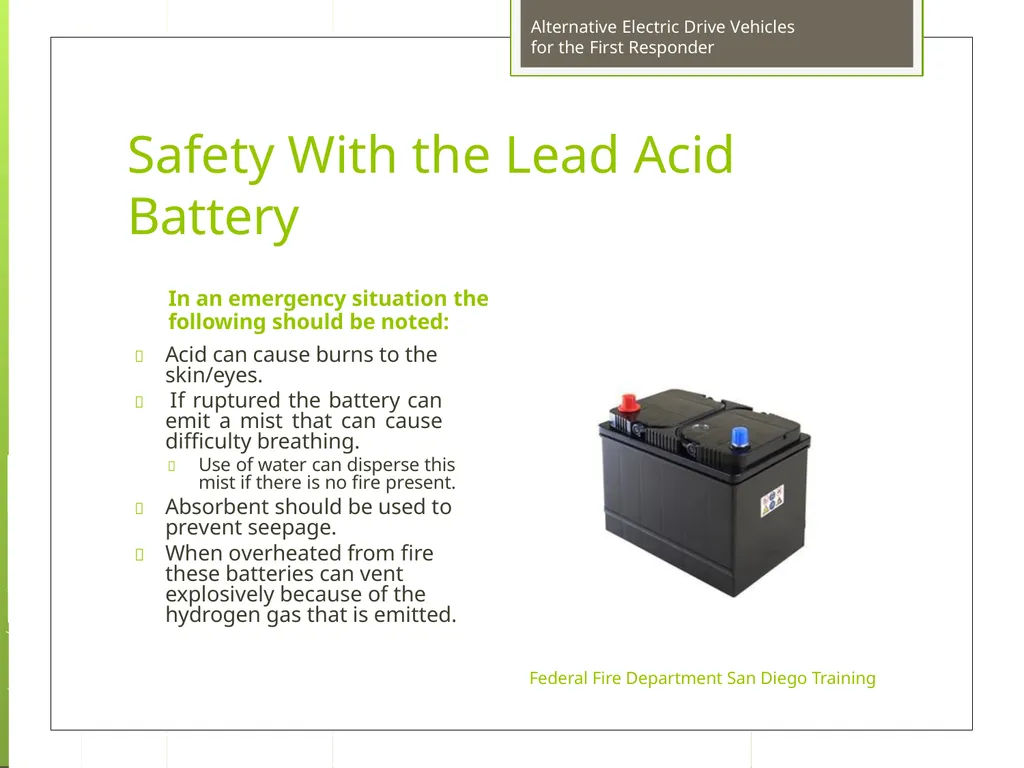
Acid can cause burns to the skin/eyes.
If ruptured the battery can emit a mist that can cause difficulty breathing.
Use of water can disperse this mist if there is no fire present.
Absorbent should be used to prevent seepage.
When overheated from fire these batteries can vent explosively because of the hydrogen gas that is emitted. Alternative Electric Drive Vehicles for the First Responder Federal Fire Department San Diego Training<br>
slide27. Battery Types for the Alternative Electric Drive Vehicle The Alternative Electric Drive Vehicle (AED) is an Electric or Hybrid Electric Vehicle There are three basic battery types found on the AED.
Lead Acid Battery (12 Volt)
Nickel Metal Hydride Battery (NiMH) Lithium Ion Battery
(Li-Ion) Alternative Electric Drive Vehicles for the First Responder Federal Fire Department San Diego Training<br>
slide28. Alternative Electric Drive Vehicles for the First Responder
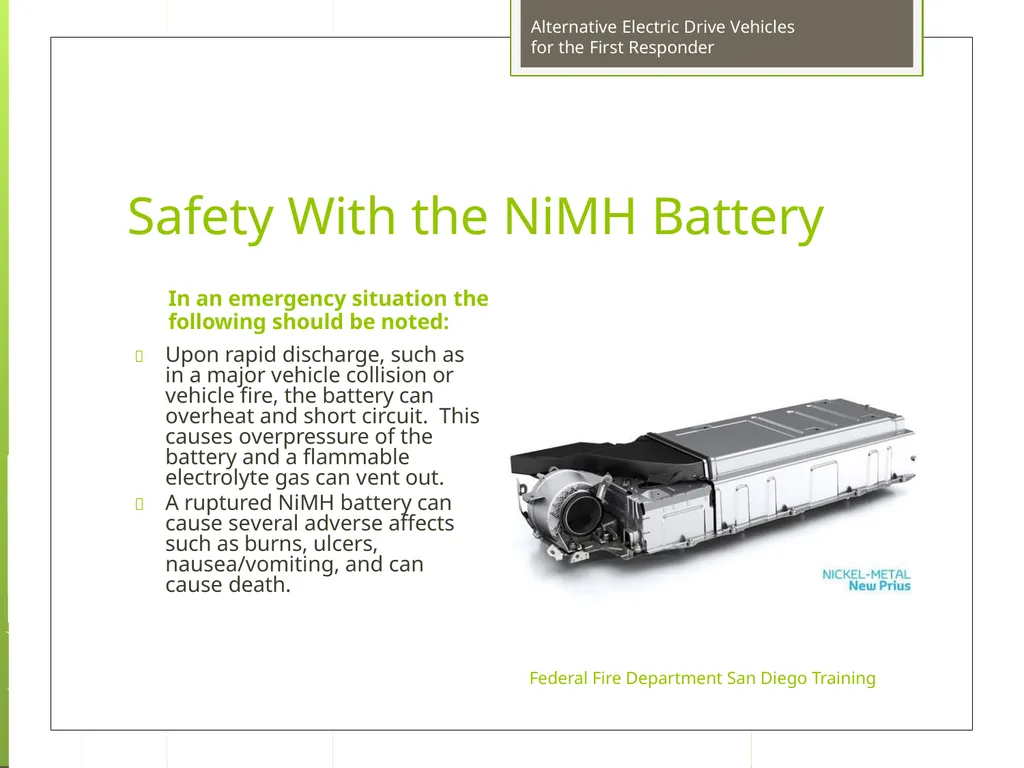
NiMH batteries are very common in current HEV and BEV vehicles due to their reliability and dependability.
NiMH are very safe and have a high tolerance for abuse.
Federal Motor Safety Standard 571.305 states that the battery should not overheat in a crash and that no electrolyte should spill into the passenger compartment upon collision.
Although safe, these batteries can be compromised in an emergency situation. NiMH (Nickel Metal Hydride) Battery Type
These are the most common high-voltage batteries found. They are very common in the current production HEV, and BEV. Federal Fire Department San Diego Training<br>
slide29. Safety With the NiMH Battery
In an emergency situation the
following should be noted:
Upon rapid discharge, such as in a major vehicle collision or vehicle fire, the battery can overheat and short circuit. This causes overpressure of the battery and a flammable electrolyte gas can vent out.
A ruptured NiMH battery can cause several adverse affects such as burns, ulcers, nausea/vomiting, and can cause death. Alternative Electric Drive Vehicles for the First Responder Federal Fire Department San Diego Training<br>
slide30. Battery Types for the Alternative Electric Drive Vehicle The Alternative Electric Drive Vehicle (AED) is an Electric or Hybrid Electric Vehicle There are three basic battery types found on the AED.
Lead Acid Battery (12 Volt)
Nickel Metal Hydride Battery (NiMH) Lithium Ion Battery
(Li-Ion) Alternative Electric Drive Vehicles for the First Responder Federal Fire Department San Diego Training<br>
slide31. Alternative Electric Drive Vehicles for the First Responder
These are the newest technology in high-voltage battery's for AED vehicles. They are becoming more common in all four types. There is no risk of electrolyte spill in these vehicles under most conditions because of a safety vent.
A safety vent is in place to keep the battery from overheating. Li-Ion (Lithium Ion) Battery Type
This is the newest technology for high- voltage batteries in vehicles. They are found in PHEV, and FCEV, but can also be found in new HEV and BEV as well. There will be a significant increase in Li-Ion batteries in future year models. Federal Fire Department San Diego Training<br>
slide32. Safety With the Li-Ion Battery
In an emergency situation the
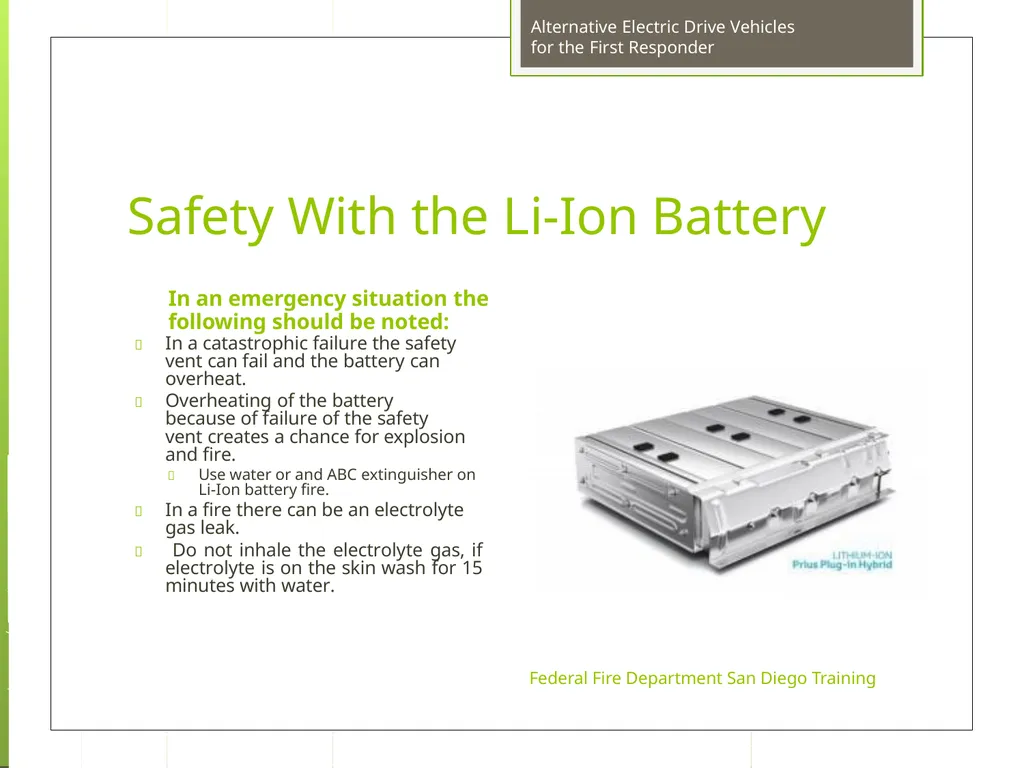
following should be noted: In a catastrophic failure the safety vent can fail and the battery can overheat.
Overheating of the battery because of failure of the safety
vent creates a chance for explosion and fire.
Use water or and ABC extinguisher on Li-Ion battery fire.
In a fire there can be an electrolyte gas leak.
Do not inhale the electrolyte gas, if electrolyte is on the skin wash for 15 minutes with water. Alternative Electric Drive Vehicles for the First Responder Federal Fire Department San Diego Training<br>
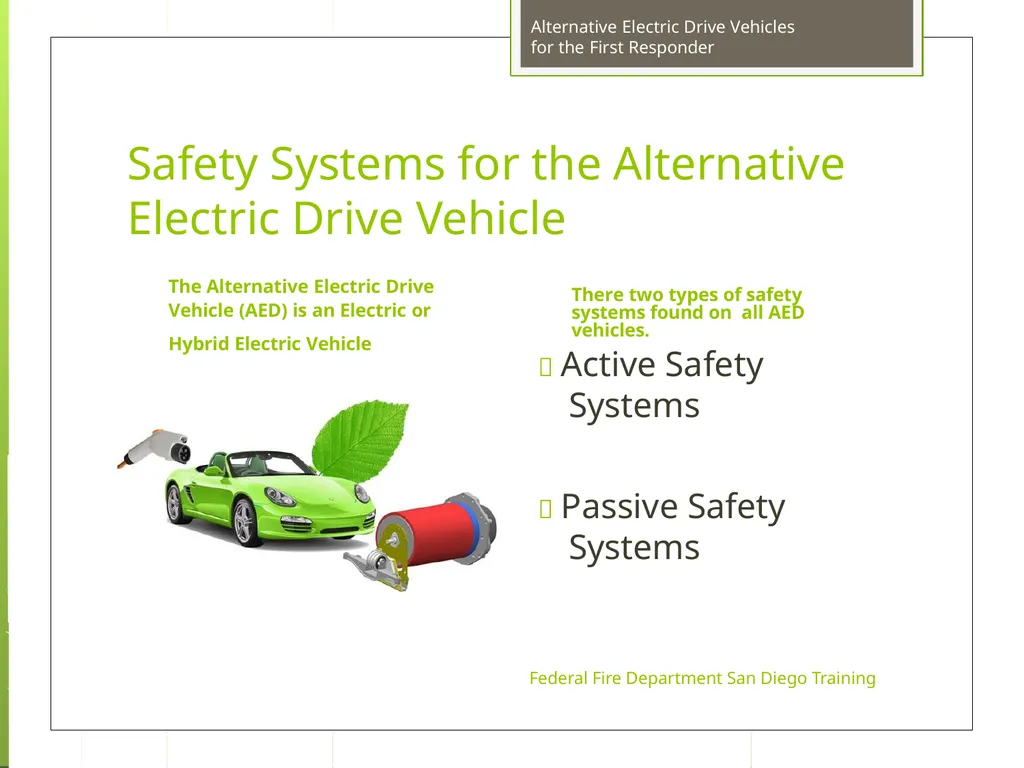
slide33. Safety Systems for the Alternative Electric Drive Vehicle
The Alternative Electric Drive Vehicle (AED) is an Electric or Hybrid Electric Vehicle There two types of safety systems found on all AED vehicles. Active Safety Systems
Passive Safety Systems Alternative Electric Drive Vehicles for the First Responder Federal Fire Department San Diego Training<br>
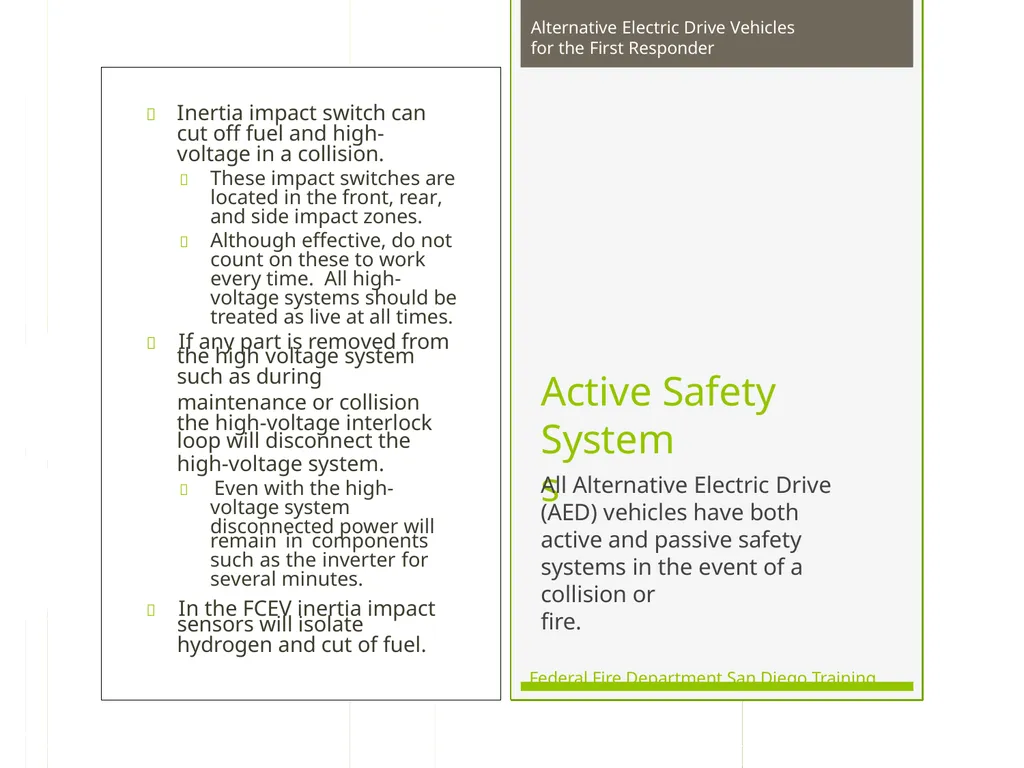
slide34. Alternative Electric Drive Vehicles for the First Responder
Inertia impact switch can cut off fuel and high- voltage in a collision.
These impact switches are located in the front, rear, and side impact zones.
Although effective, do not count on these to work every time. All high- voltage systems should be treated as live at all times.
If any part is removed from the high voltage system such as during maintenance or collision the high-voltage interlock loop will disconnect the
high-voltage system.
Even with the high- voltage system disconnected power will remain in components such as the inverter for several minutes. In the FCEV inertia impact sensors will isolate hydrogen and cut of fuel. Active Safety Systems All Alternative Electric Drive (AED) vehicles have both active and passive safety systems in the event of a collision or fire. Federal Fire Department San Diego Training<br>
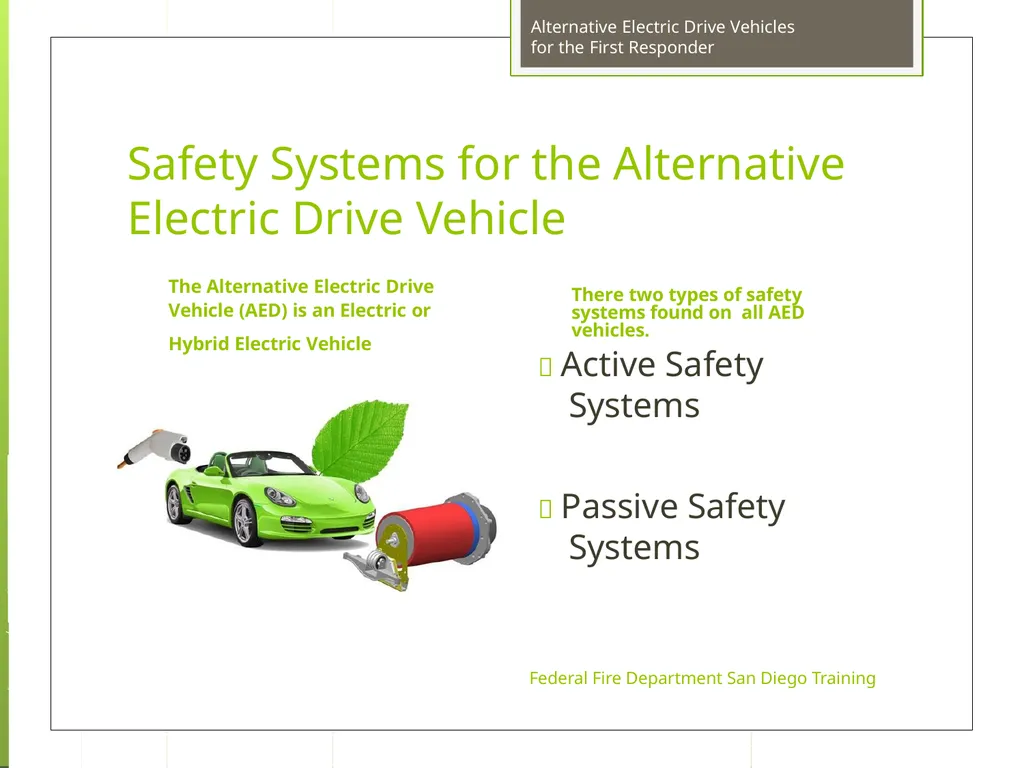
slide35. Safety Systems for the Alternative Electric Drive Vehicle
The Alternative Electric Drive Vehicle (AED) is an Electric or Hybrid Electric Vehicle There two types of safety systems found on all AED vehicles. Active Safety Systems
Passive Safety Systems Alternative Electric Drive Vehicles for the First Responder Federal Fire Department San Diego Training<br>
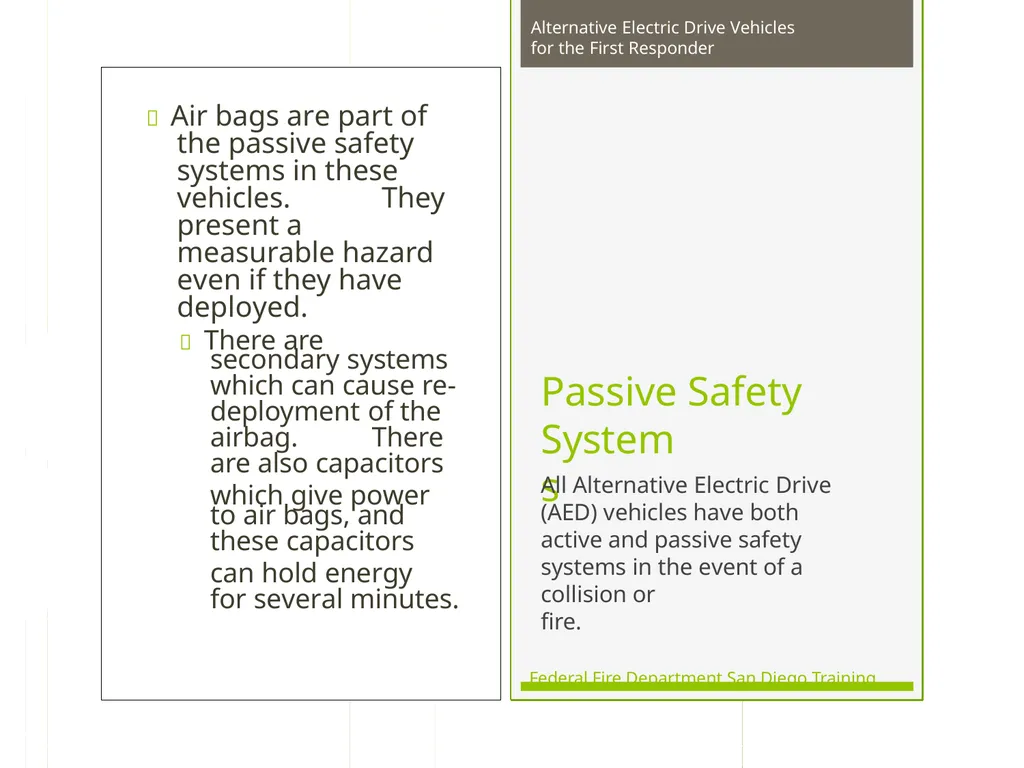
slide36. Alternative Electric Drive Vehicles for the First Responder
Air bags are part of the passive safety systems in these vehicles. They present a measurable hazard even if they have deployed.
There are secondary systems which can cause re-deployment of the airbag. There are also capacitors which give power to air bags, and these capacitors can hold energy for several minutes. Passive Safety Systems All Alternative Electric Drive (AED) vehicles have both active and passive safety systems in the event of a collision or fire. Federal Fire Department San Diego Training<br>
slide37. Passive Safety Systems
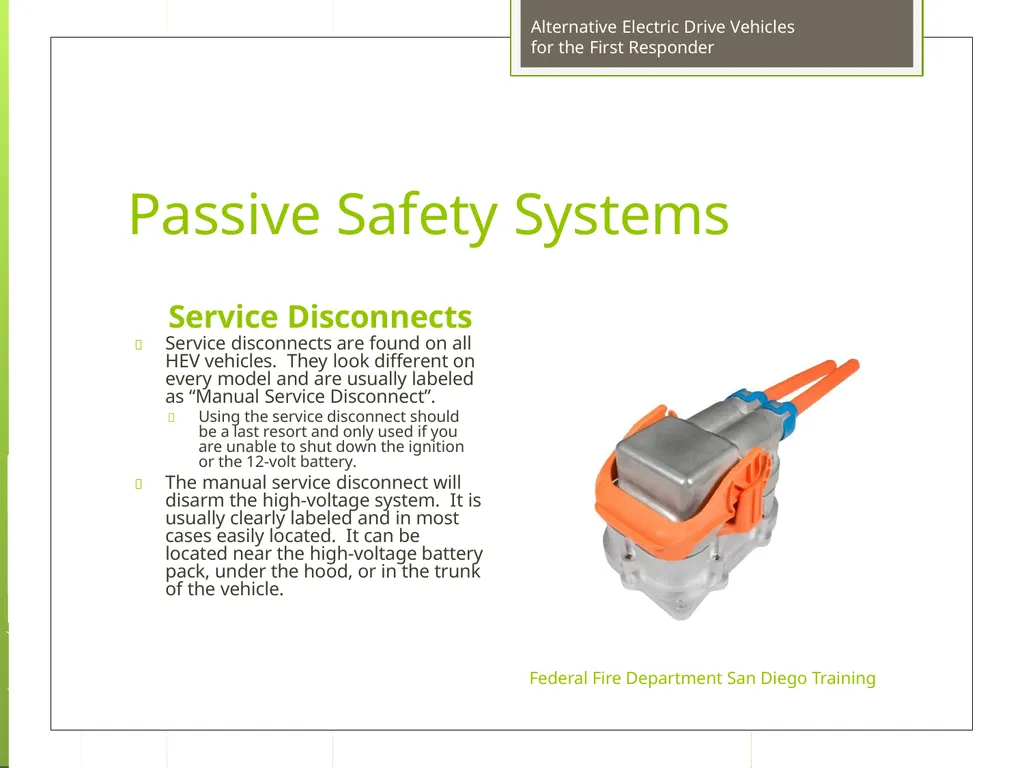
Service Disconnects Service disconnects are found on all HEV vehicles. They look different on every model and are usually labeled as “Manual Service Disconnect”.
Using the service disconnect should be a last resort and only used if you are unable to shut down the ignition or the 12-volt battery.
The manual service disconnect will disarm the high-voltage system. It is usually clearly labeled and in most cases easily located. It can be located near the high-voltage battery pack, under the hood, or in the trunk of the vehicle. Alternative Electric Drive Vehicles for the First Responder Federal Fire Department San Diego Training<br>
slide38. The Alternative Electric Drive Vehicle (AED) is an Electric or Hybrid Electric Vehicle Alternative Electric Drive Vehicles for the First Responder
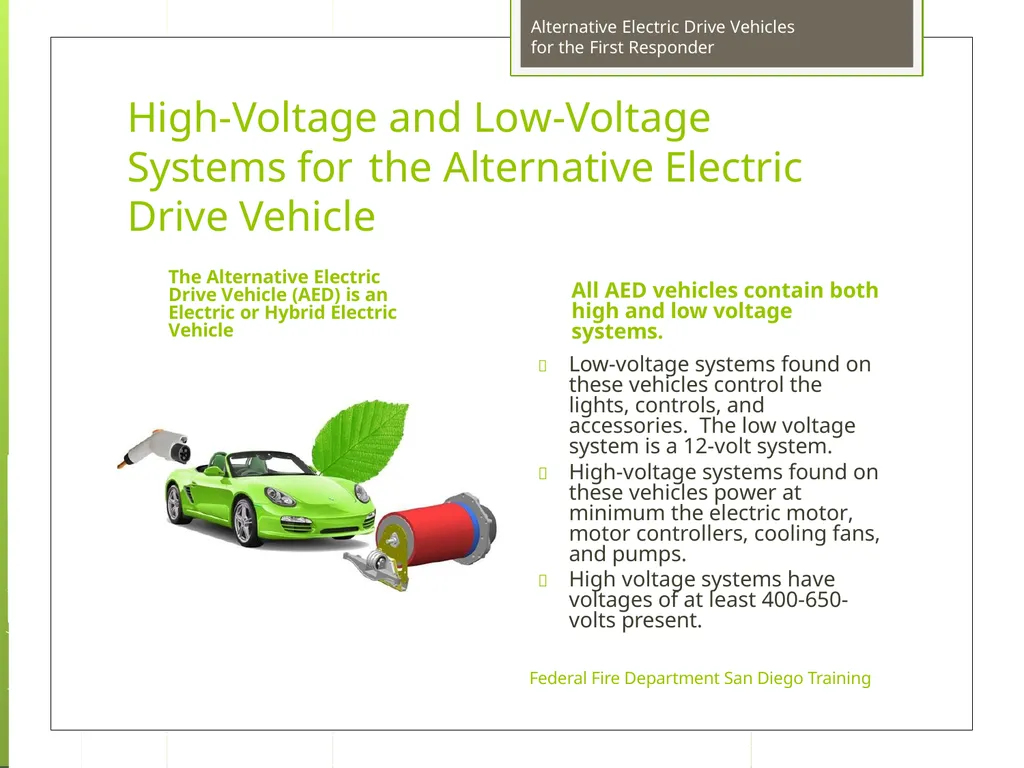
High-Voltage and Low-Voltage Systems for the Alternative Electric Drive Vehicle Federal Fire Department San Diego Training All AED vehicles contain both high and low voltage systems.
Low-voltage systems found on these vehicles control the lights, controls, and accessories. The low voltage system is a 12-volt system.
High-voltage systems found on these vehicles power at minimum the electric motor, motor controllers, cooling fans, and pumps.
High voltage systems have voltages of at least 400-650- volts present.<br>
slide39. High-Voltage and Low-Voltage systems Inverter and battery packs contain high-voltage at all times. All high- voltage systems should be labeled as so.
Never tamper or open inverter and batteries. These systems can store high-voltage for several minutes even when powered has been severed. Alternative Electric Drive Vehicles for the First Responder Federal Fire Department San Diego Training<br>
slide40. High-Voltage and Low-
Voltage Systems
There are typically two different colors that indicate high-voltage or medium-to-low-voltage.
Orange is high voltage.
This is a standard that will be found on all AED vehicles.
These can usually be found
along the drive train.
Blue is medium-to-low voltage.
This is not found on all AED vehicles.
Blue cables can go to components such as A/C or power storage.
Medium-to-low voltage does have the potential to electrocute, shock, and/or burn. Alternative Electric Drive Vehicles for the First Responder Federal Fire Department San Diego Training<br>
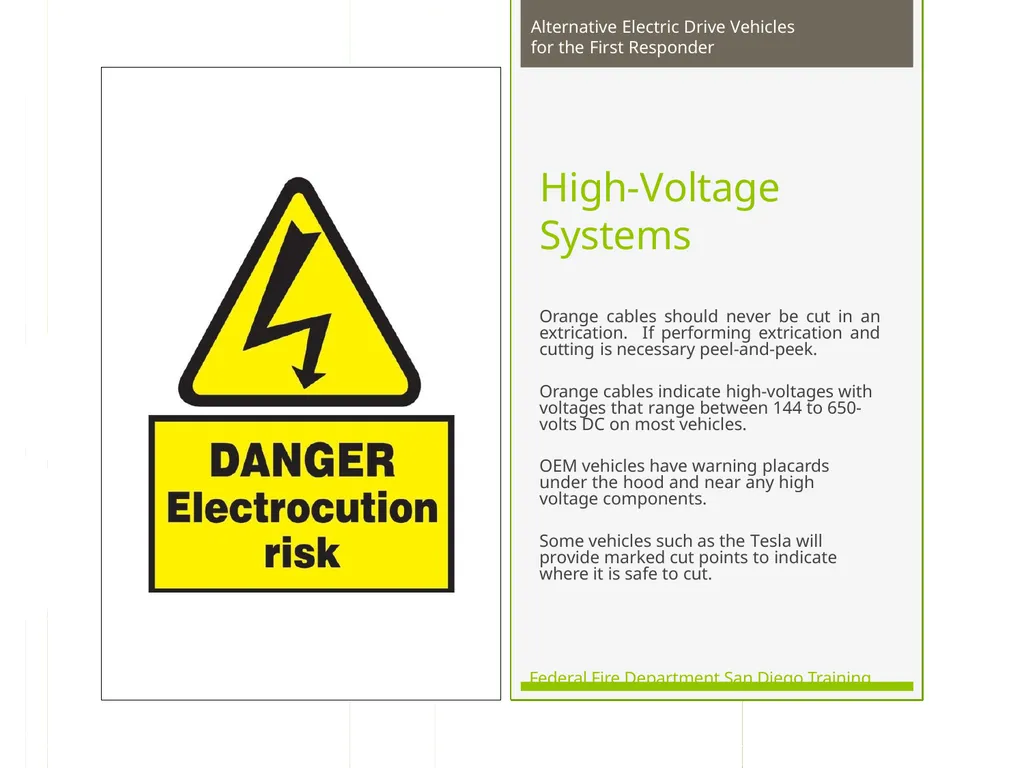
slide41. High-Voltage Systems Orange cables should never be cut in an extrication. If performing extrication and cutting is necessary peel-and-peek.
Orange cables indicate high-voltages with voltages that range between 144 to 650-volts DC on most vehicles.
OEM vehicles have warning placards under the hood and near any high voltage components.
Some vehicles such as the Tesla will provide marked cut points to indicate where it is safe to cut. Alternative Electric Drive Vehicles for the First Responder Federal Fire Department San Diego Training<br>
slide42. High-Voltage Systems
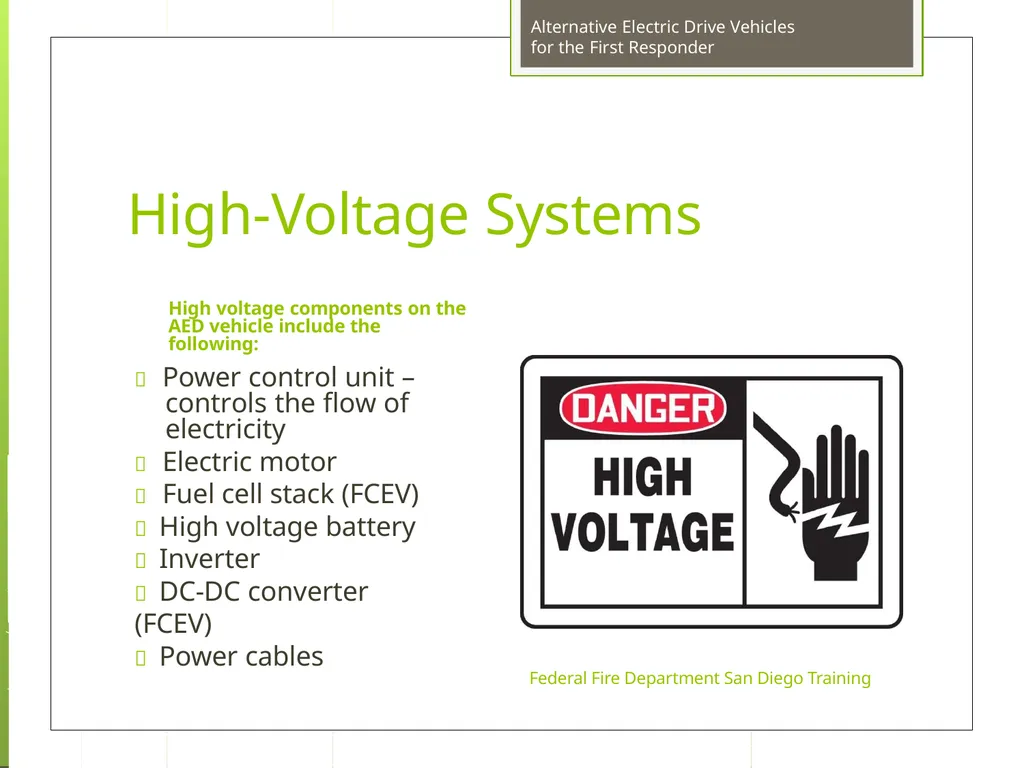
High voltage components on the AED vehicle include the following:
Power control unit – controls the flow of electricity
Electric motor
Fuel cell stack (FCEV)
High voltage battery
Inverter
DC-DC converter (FCEV)
Power cables Alternative Electric Drive Vehicles for the First Responder Federal Fire Department San Diego Training<br>
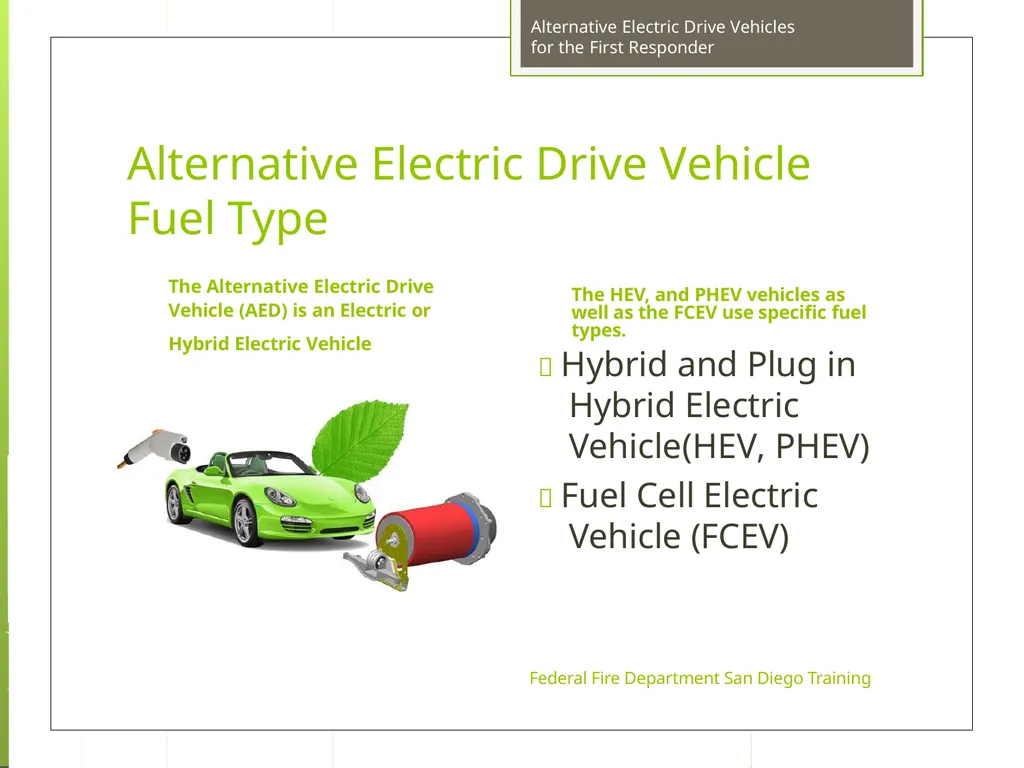
slide43. Alternative Electric Drive Vehicle Fuel Type
The Alternative Electric Drive Vehicle (AED) is an Electric or Hybrid Electric Vehicle The HEV, and PHEV vehicles as well as the FCEV use specific fuel types. Federal Fire Department San Diego Training Hybrid and Plug in Hybrid Electric Vehicle(HEV, PHEV)
Fuel Cell Electric Vehicle (FCEV) Alternative Electric Drive Vehicles for the First Responder<br>
slide44. Alternative Electric Drive Vehicles for the First Responder
Although the most commonly found fuel in these vehicles Federal Fire Department San Diego Training is gasoline, there can be several types of fuel that power these vehicles including but not limited to: Diesel
E85
Compressed Natural Gas (CNG) Liquefied Natural Gas (LNG)
Liquefied Petroleum Gas (LPG)
Methanol Hybrid Electric Vehicle (HEV) and Plug in Hybrid Electric Vehicle (PHEV) Fuel Type
HEV and PHEV use fuel to supplement the high-voltage system to power the vehicle. These vehicles contain an Internal Combustion Engine (ICE) as would your standard vehicle.<br>
slide45. Alternative Electric Drive Vehicles for the First Responder
Hydrogen storage is usually in the rear of the vehicle.
FCEV hydrogen sensing devices monitor the air for hydrogen, initiate shut down, and isolate hydrogen and electrical storage systems.
If a hydrogen leak is detected, such as in a collision, a hydrogen fuel Thermal Release Device (TRD) monitor will shut off excess flow through an automatic shut-off valve. This allows some hydrogen, but not a hazardous amount to vent.
Fuel pressure relief device senses increased pressure buildup such as from heat and protects the hydrogen cylinder by opening one of two relief valves. A hissing sound will be heard as excess hydrogen is released. Pressure Release Device
(PRD) Fuel Cell Electric
Vehicle (FCEV) Fuel Type FCEV uses hydrogen as its fuel type. The fuel cell powers the motor by converting hydrogen and oxygen into electricity. Federal Fire Department San Diego Training<br>
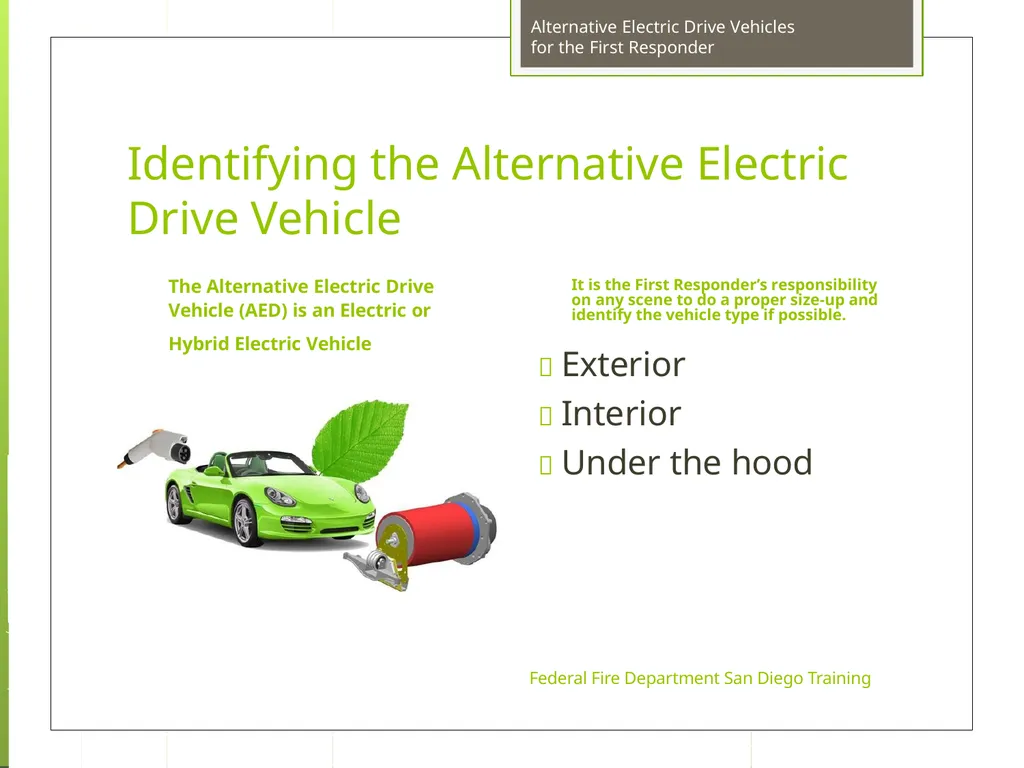
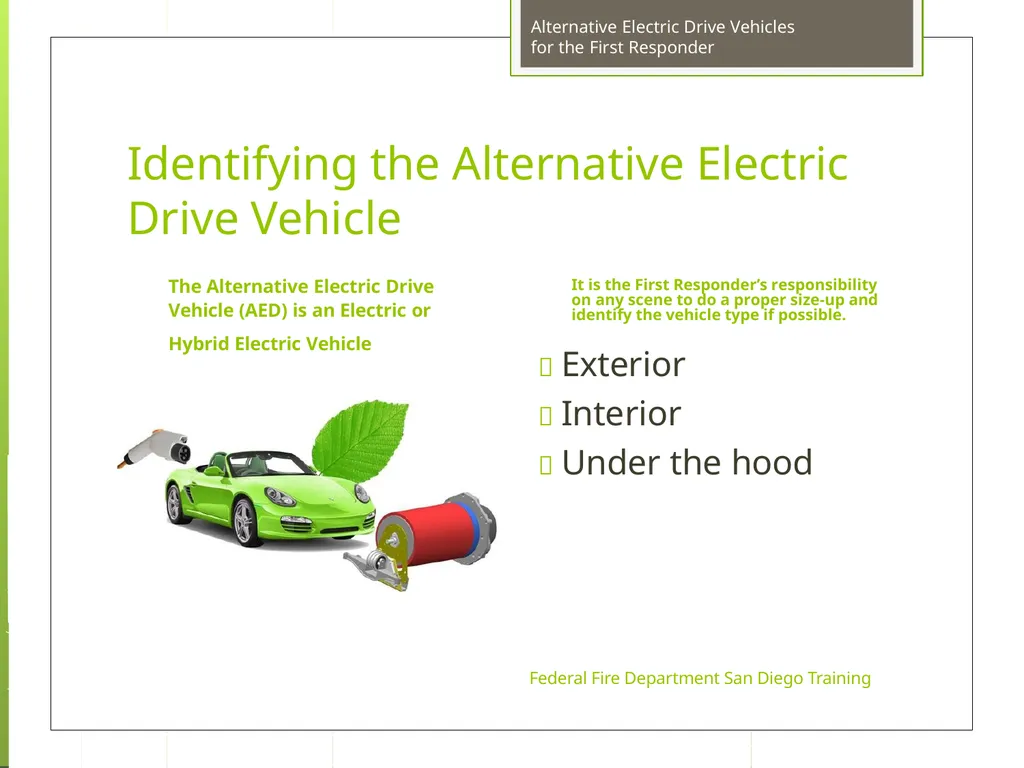
slide46. Identifying the Alternative Electric Drive Vehicle
The Alternative Electric Drive Vehicle (AED) is an Electric or Hybrid Electric Vehicle It is the First Responder’s responsibility on any scene to do a proper size-up and identify the vehicle type if possible. Federal Fire Department San Diego Training Exterior
Interior
Under the hood Alternative Electric Drive Vehicles for the First Responder<br>
slide47. AED Vehicle Exterior
Identification
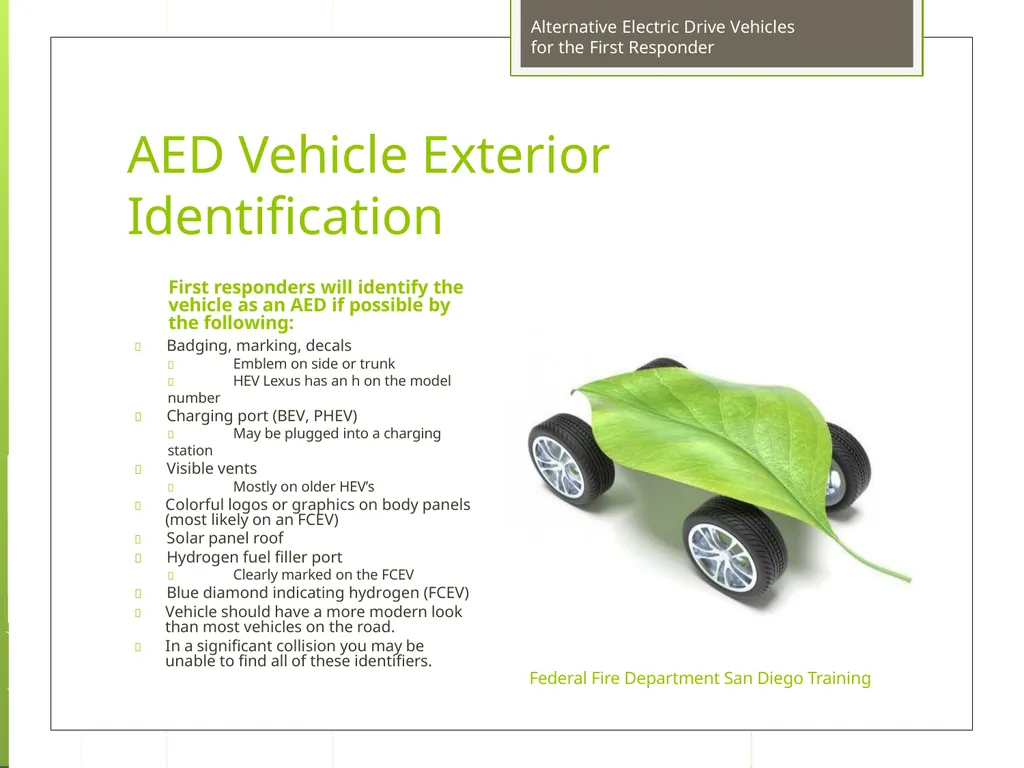
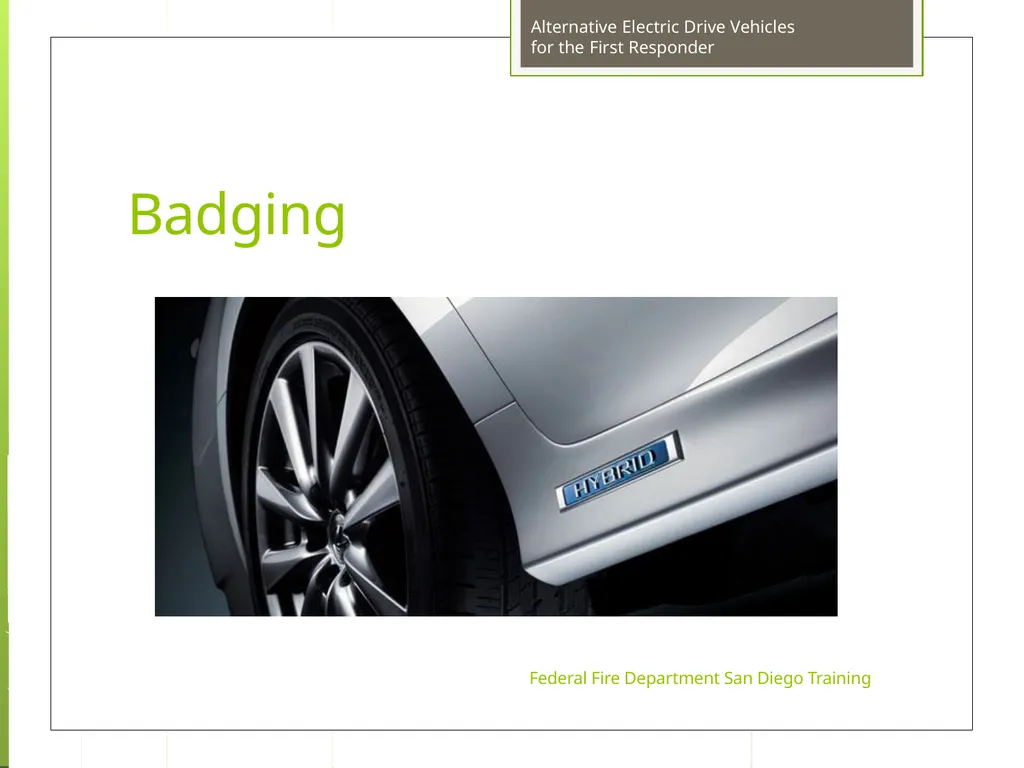
First responders will identify the vehicle as an AED if possible by the following: Badging, marking, decals
Emblem on side or trunk
HEV Lexus has an h on the model number
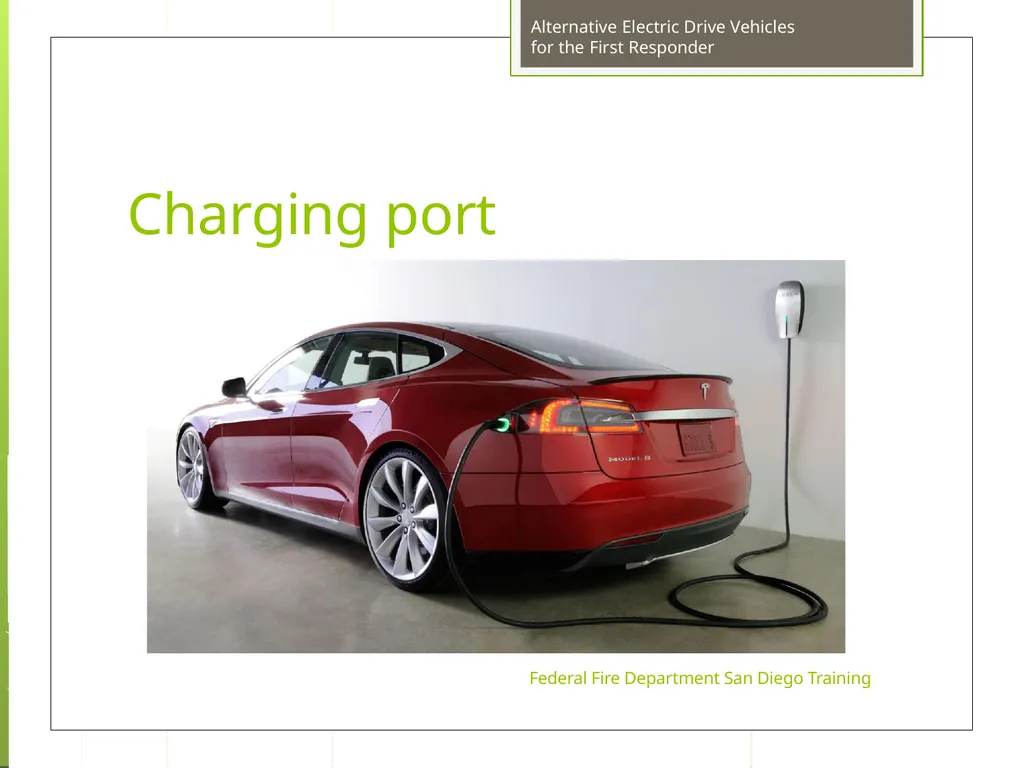
Charging port (BEV, PHEV)
May be plugged into a charging station
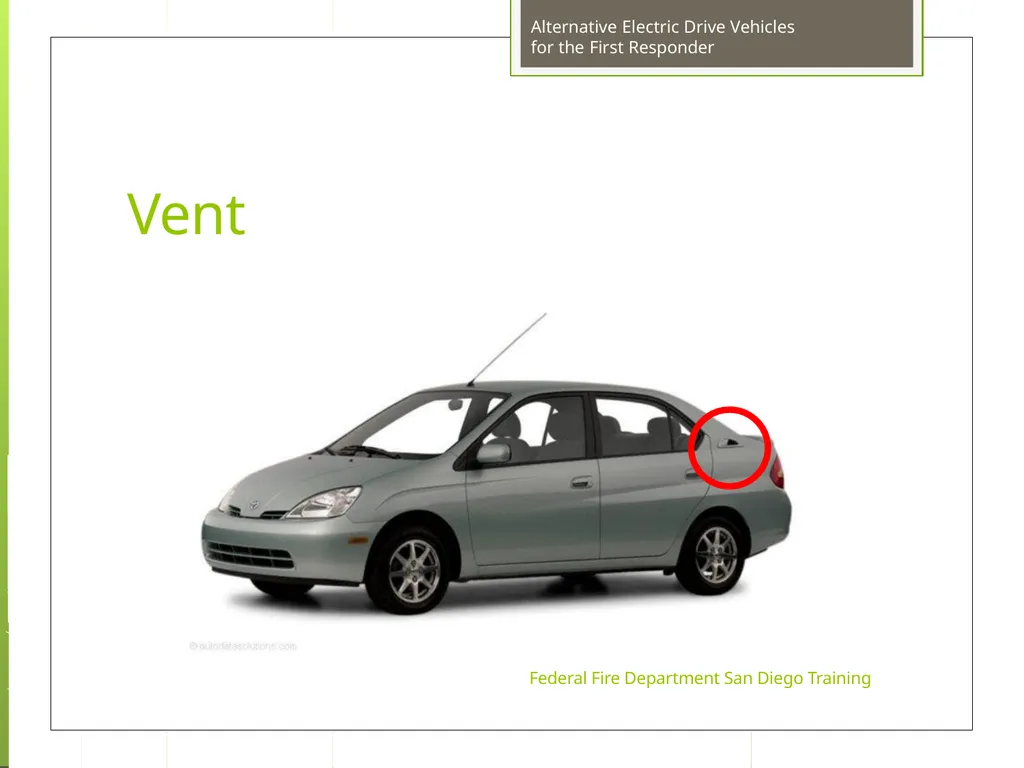
Visible vents
Mostly on older HEV’s
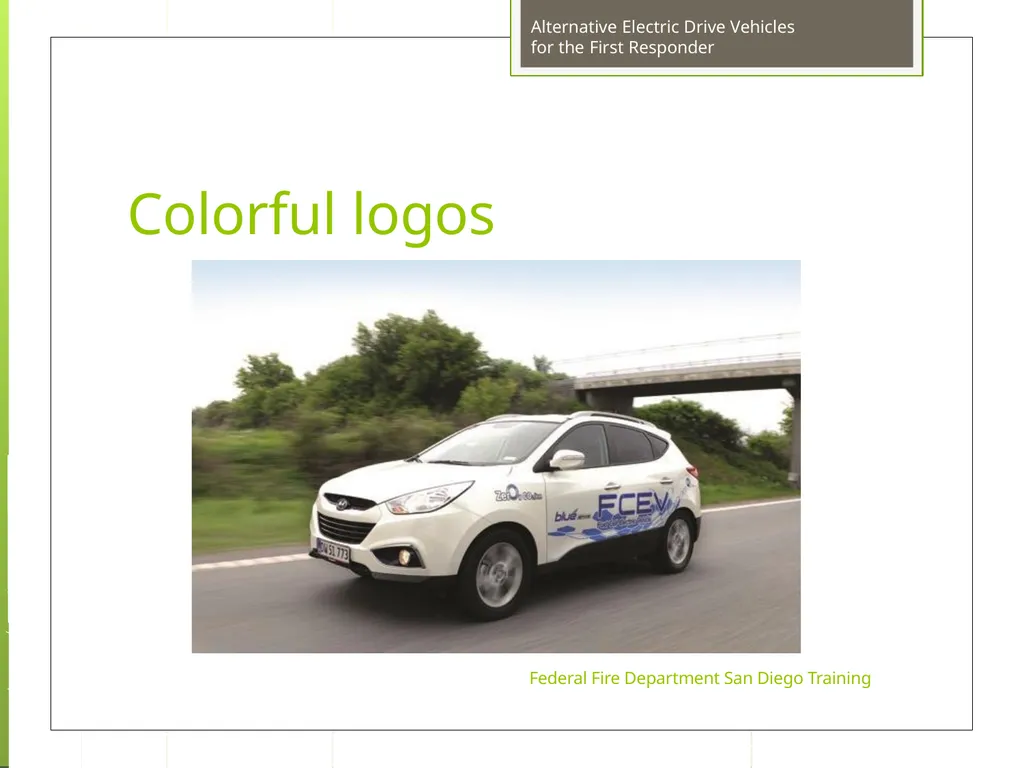
Colorful logos or graphics on body panels (most likely on an FCEV)
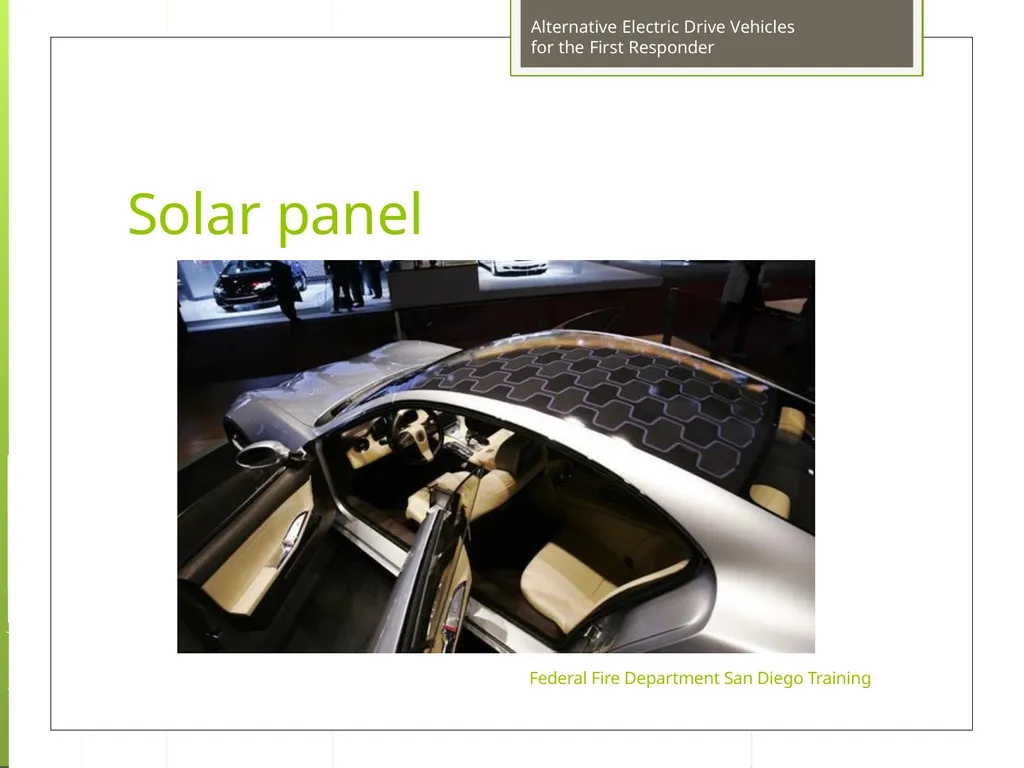
Solar panel roof
Hydrogen fuel filler port
Clearly marked on the FCEV
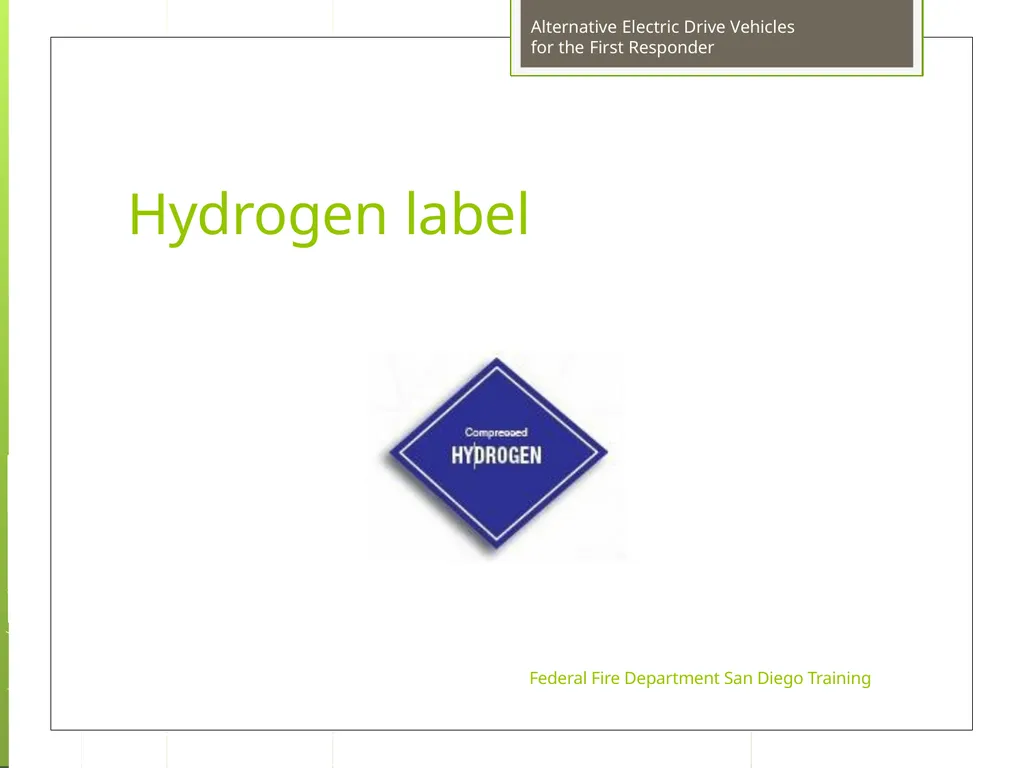
Blue diamond indicating hydrogen (FCEV)
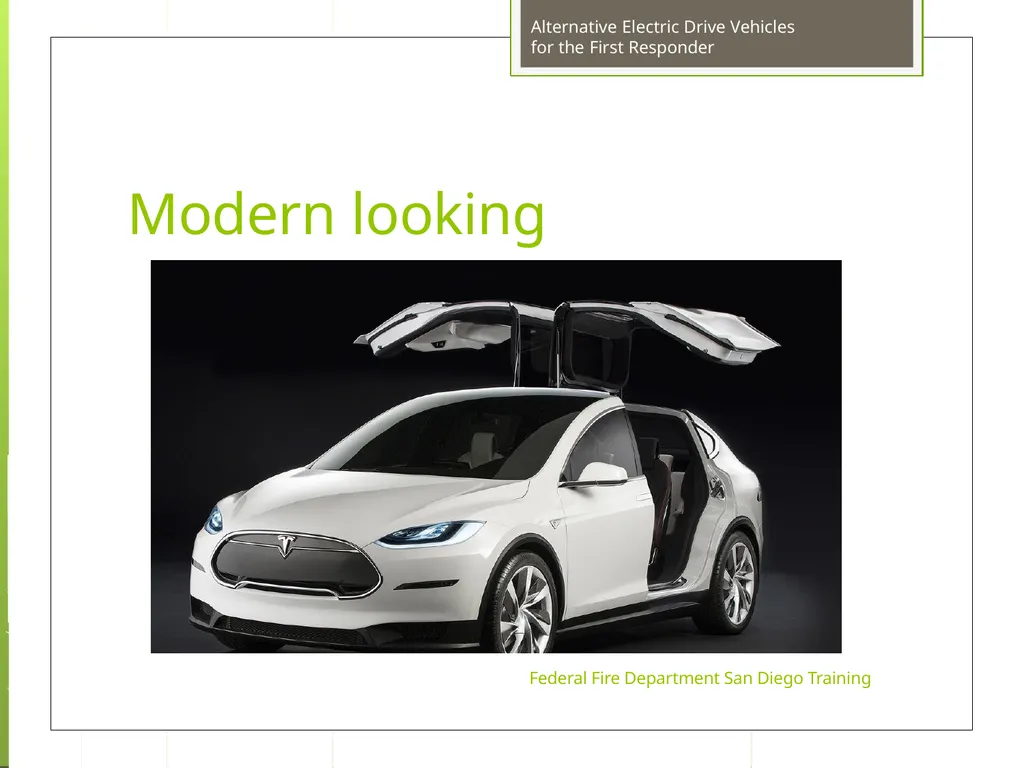
Vehicle should have a more modern look than most vehicles on the road.
In a significant collision you may be unable to find all of these identifiers. Alternative Electric Drive Vehicles for the First Responder Federal Fire Department San Diego Training<br>
slide48. Badging Alternative Electric Drive Vehicles for the First Responder Federal Fire Department San Diego Training<br>
slide49. Charging port Alternative Electric Drive Vehicles for the First Responder Federal Fire Department San Diego Training<br>
slide50. Vent Alternative Electric Drive Vehicles for the First Responder Federal Fire Department San Diego Training<br>
slide51. Colorful logos Alternative Electric Drive Vehicles for the First Responder Federal Fire Department San Diego Training<br>
slide52. Solar panel Alternative Electric Drive Vehicles for the First Responder Federal Fire Department San Diego Training<br>
slide53. Hydrogen fuel filler port Alternative Electric Drive Vehicles for the First Responder Federal Fire Department San Diego Training<br>
slide54. Hydrogen label Alternative Electric Drive Vehicles for the First Responder Federal Fire Department San Diego Training<br>
slide55. Modern looking Alternative Electric Drive Vehicles for the First Responder Federal Fire Department San Diego Training<br>
slide56. Identifying the Alternative Electric Drive Vehicle
The Alternative Electric Drive Vehicle (AED) is an Electric or Hybrid Electric Vehicle It is the First Responder’s responsibility on any scene to do a proper size-up and identify the vehicle type if possible. Federal Fire Department San Diego Training Exterior
Interior
Under the hood Alternative Electric Drive Vehicles for the First Responder<br>
slide57. AED Vehicle Interior
Identification
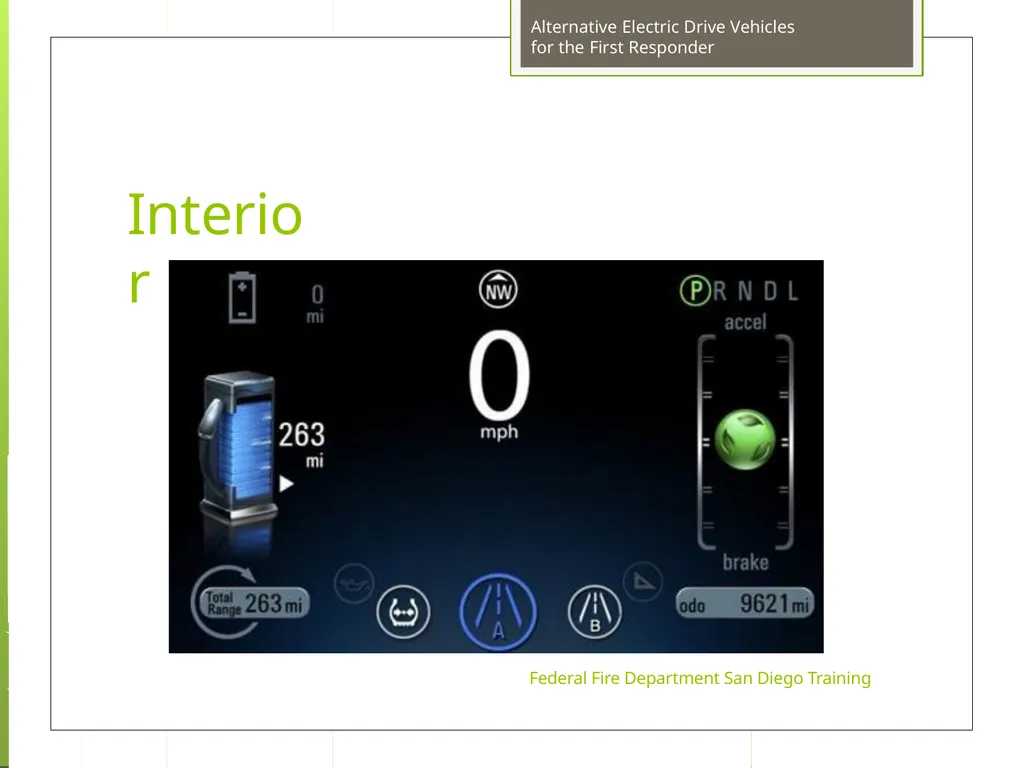
First responders will identify the vehicle as an AED if possible by the following: On the dash of the vehicle
Look for charging indicators.
On large or heavy duty vehicles
there will be a dashboard label.
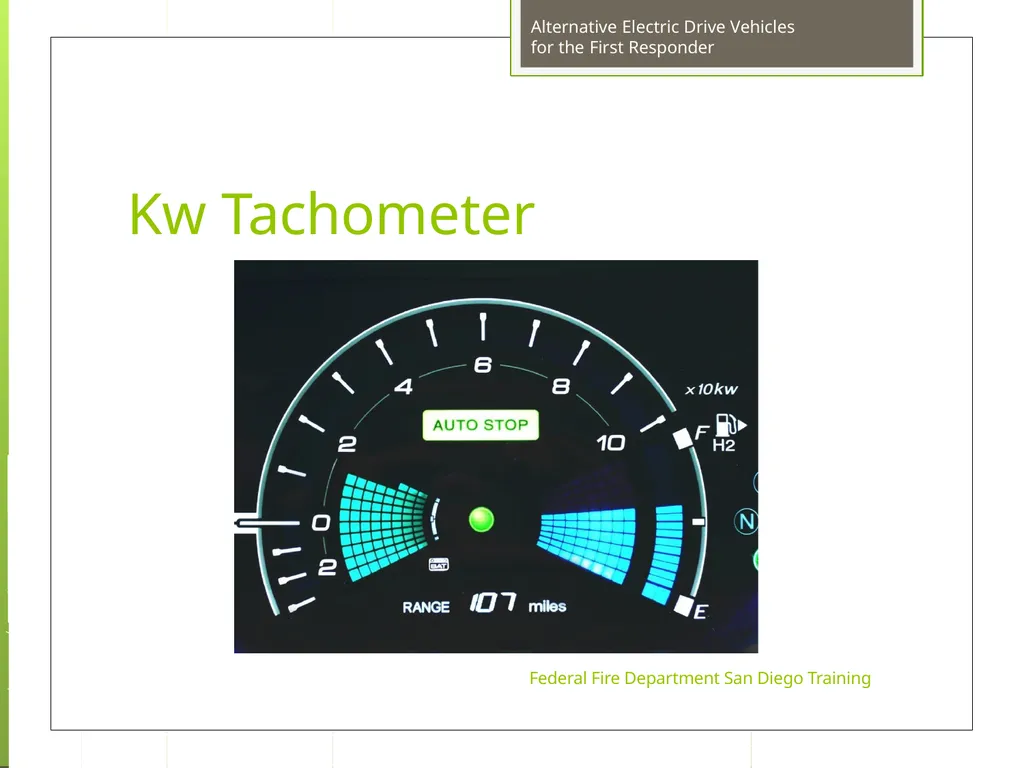
FCEV vehicles will not have a standard tachometer; instead they will have a Kw tachometer and will look different than a standard tachometer.
You may not be able to identify all of the AED vehicle indicators in the event of a significant collision. Alternative Electric Drive Vehicles for the First Responder Federal Fire Department San Diego Training<br>
slide58. Interior Alternative Electric Drive Vehicles for the First Responder Federal Fire Department San Diego Training<br>
slide59. Kw Tachometer Alternative Electric Drive Vehicles for the First Responder Federal Fire Department San Diego Training<br>
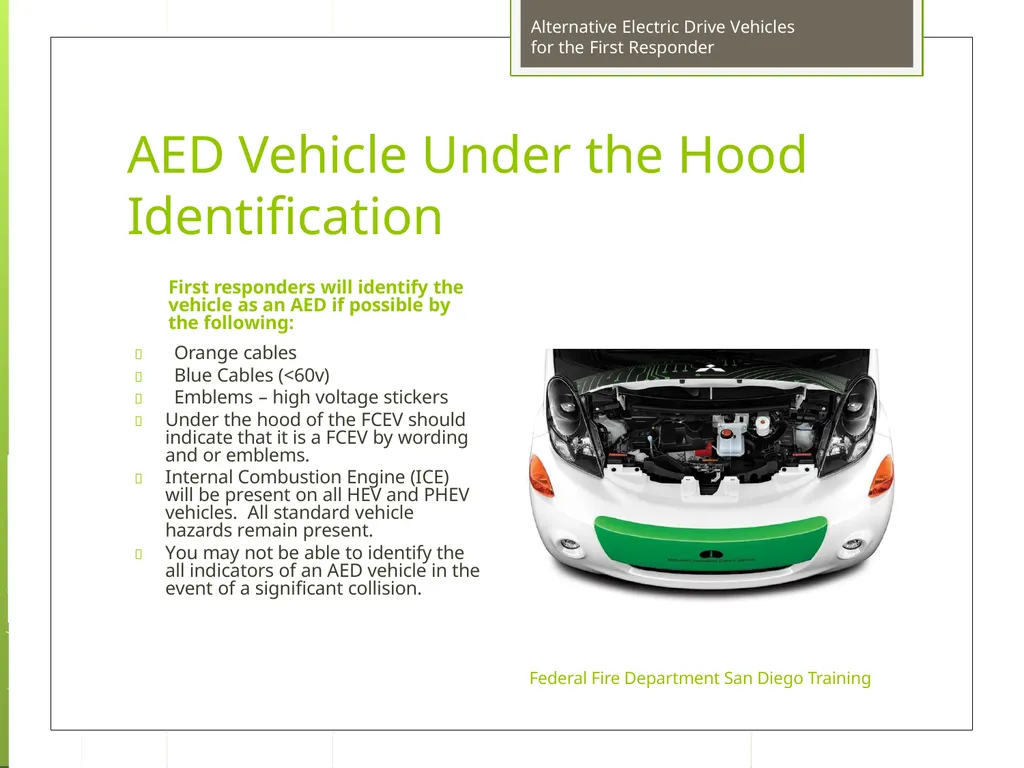
slide60. AED Vehicle Under the Hood
Identification
First responders will identify the vehicle as an AED if possible by the following:
Orange cables
Blue Cables (<60v)
Emblems – high voltage stickers
Under the hood of the FCEV should indicate that it is a FCEV by wording and or emblems.
Internal Combustion Engine (ICE) will be present on all HEV and PHEV vehicles. All standard vehicle hazards remain present.
You may not be able to identify the all indicators of an AED vehicle in the event of a significant collision. Alternative Electric Drive Vehicles for the First Responder Federal Fire Department San Diego Training<br>
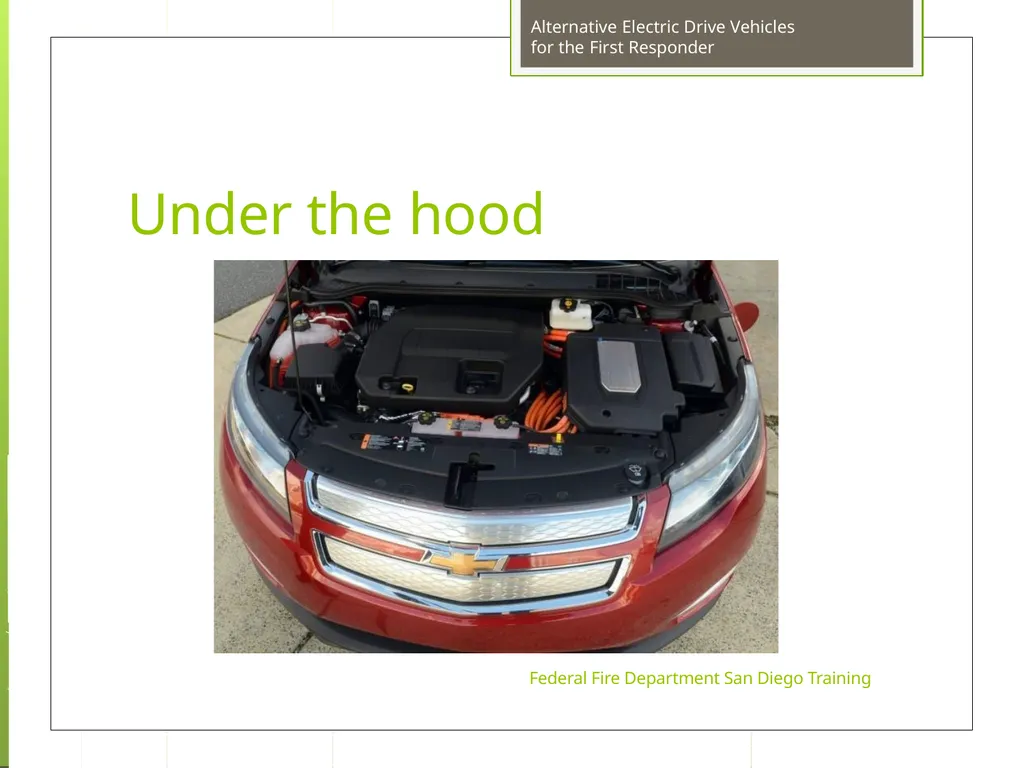
slide61. Under the hood Alternative Electric Drive Vehicles for the First Responder Federal Fire Department San Diego Training<br>
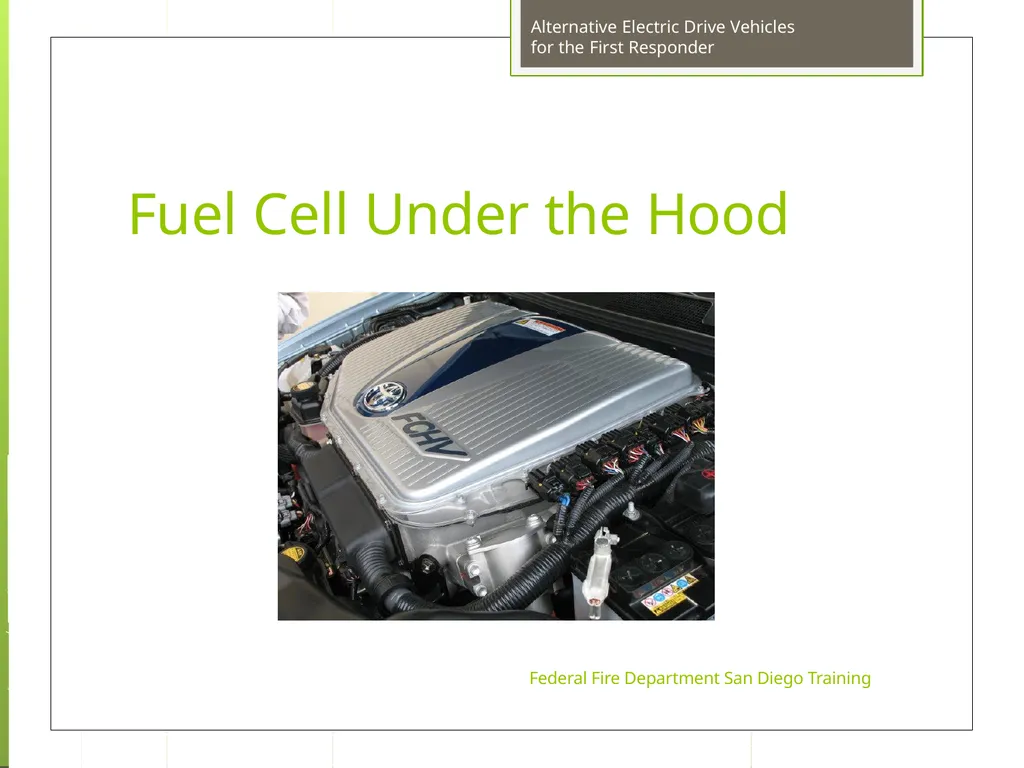
slide62. Fuel Cell Under the Hood Alternative Electric Drive Vehicles for the First Responder Federal Fire Department San Diego Training<br>
slide63. Emergency Response Guide to the Alternative Electric Drive (AED) Vehicle Alternative Electric Drive Vehicles for the First Responder Federal Fire Department San Diego Training<br>
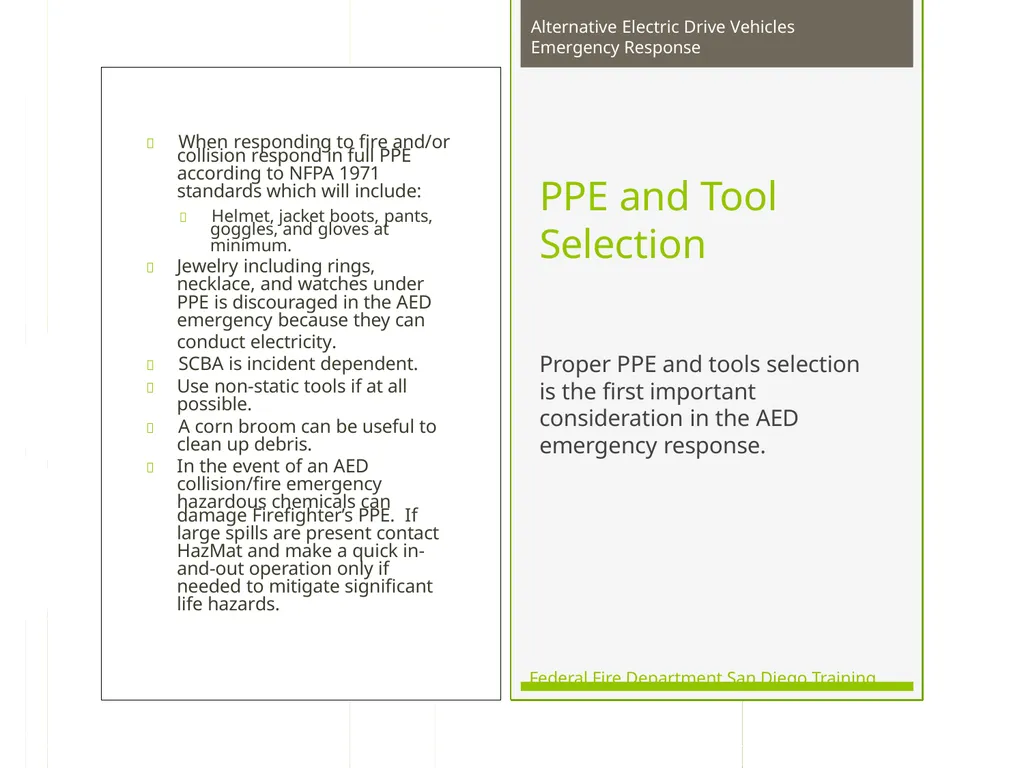
slide64. When responding to fire and/or collision respond in full PPE according to NFPA 1971 standards which will include: Helmet, jacket boots, pants, goggles, and gloves at minimum. Jewelry including rings, necklace, and watches under PPE is discouraged in the AED emergency because they can conduct electricity.
SCBA is incident dependent.
Use non-static tools if at all possible. A corn broom can be useful to clean up debris.
In the event of an AED collision/fire emergency hazardous chemicals can damage Firefighter’s PPE. If large spills are present contact HazMat and make a quick in- and-out operation only if needed to mitigate significant life hazards. PPE and Tool Selection Proper PPE and tools selection is the first important consideration in the AED emergency response. Alternative Electric Drive Vehicles Emergency Response Federal Fire Department San Diego Training<br>
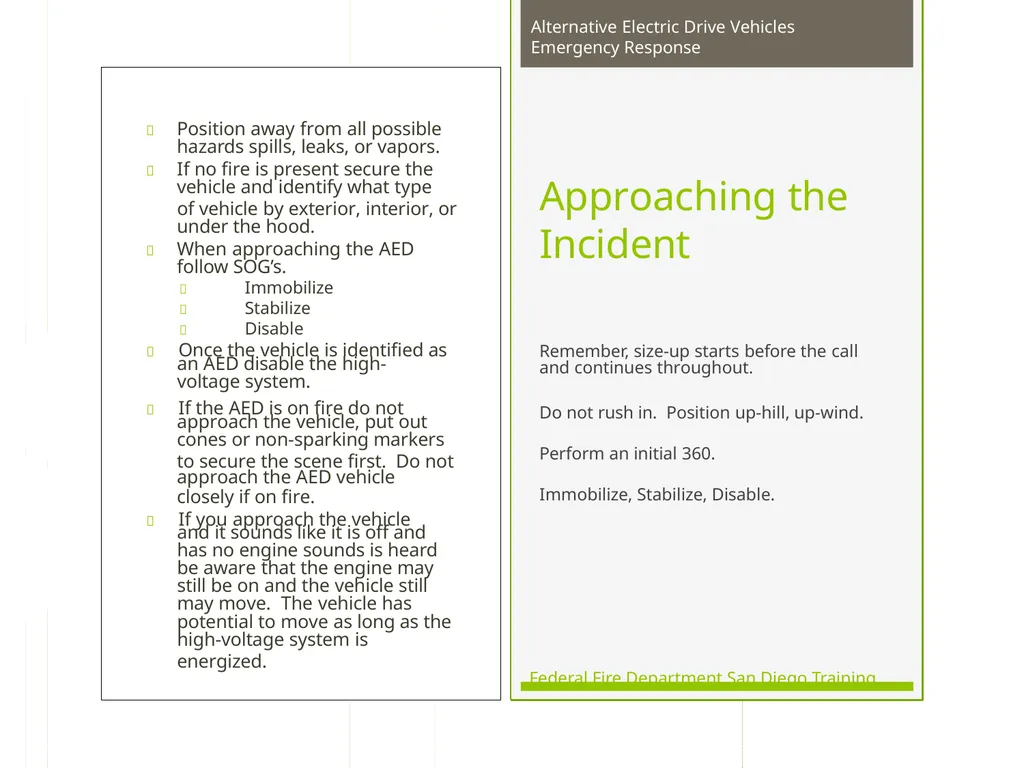
slide65. Position away from all possible hazards spills, leaks, or vapors.
If no fire is present secure the vehicle and identify what type energized. of vehicle by exterior, interior, or under the hood.
When approaching the AED follow SOG’s.
Immobilize
Stabilize
Disable Once the vehicle is identified as an AED disable the high- voltage system. If the AED is on fire do not approach the vehicle, put out cones or non-sparking markers to secure the scene first. Do not approach the AED vehicle
closely if on fire.
If you approach the vehicle and it sounds like it is off and has no engine sounds is heard be aware that the engine may still be on and the vehicle still may move. The vehicle has potential to move as long as the high-voltage system is Approaching the Incident Remember, size-up starts before the call and continues throughout. Do not rush in. Position up-hill, up-wind. Perform an initial 360. Immobilize, Stabilize, Disable. Alternative Electric Drive Vehicles Emergency Response Federal Fire Department San Diego Training<br>
slide66. Alternative Electric Drive Vehicles Emergency Response
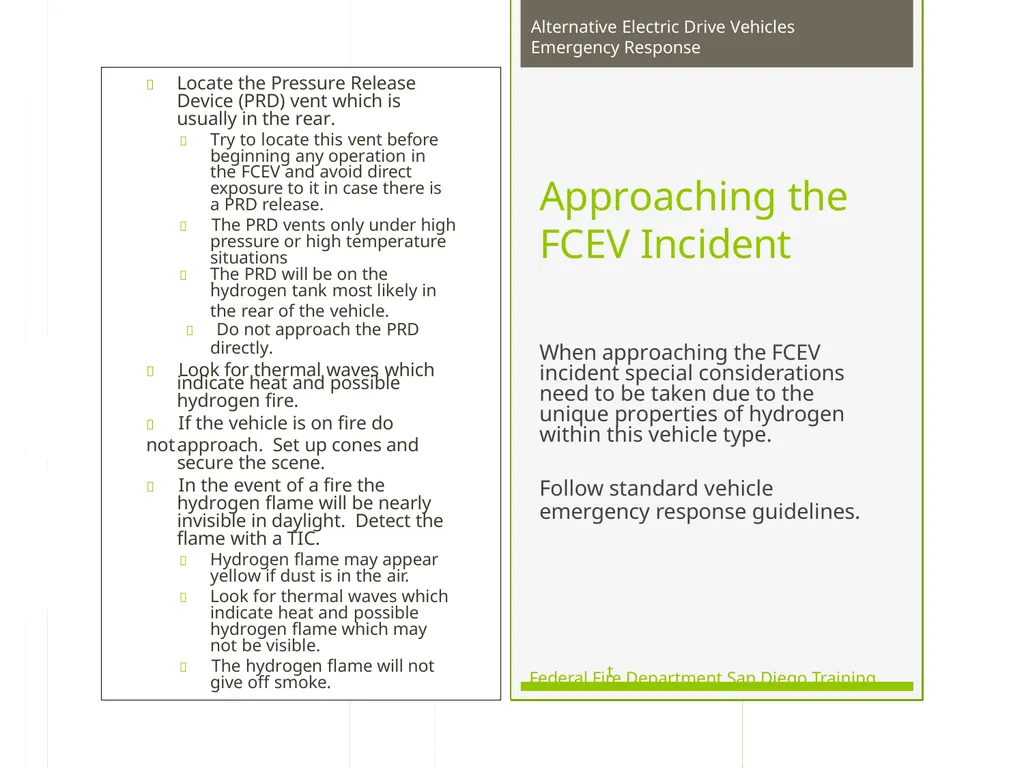
Locate the Pressure Release Device (PRD) vent which is usually in the rear.
Try to locate this vent before beginning any operation in the FCEV and avoid direct exposure to it in case there is a PRD release. The PRD vents only under high pressure or high temperature situations. The PRD will be on the hydrogen tank most likely in the rear of the vehicle.
Do not approach the PRD
directly. Look for thermal waves which indicate heat and possible hydrogen fire.
If the vehicle is on fire do not approach. Set up cones and secure the scene. In the event of a fire the hydrogen flame will be nearly invisible in daylight. Detect the flame with a TIC.
Hydrogen flame may appear yellow if dust is in the air.
Look for thermal waves which indicate heat and possible hydrogen flame which may not be visible. The hydrogen flame will not give off smoke. Approaching the FCEV Incident When approaching the FCEV incident special considerations need to be taken due to the unique properties of hydrogen within this vehicle type. Follow standard vehicle
emergency response guidelines. t Federal Fire Department San Diego Training<br>
slide67. Alternative Electric Drive Vehicles Emergency Response
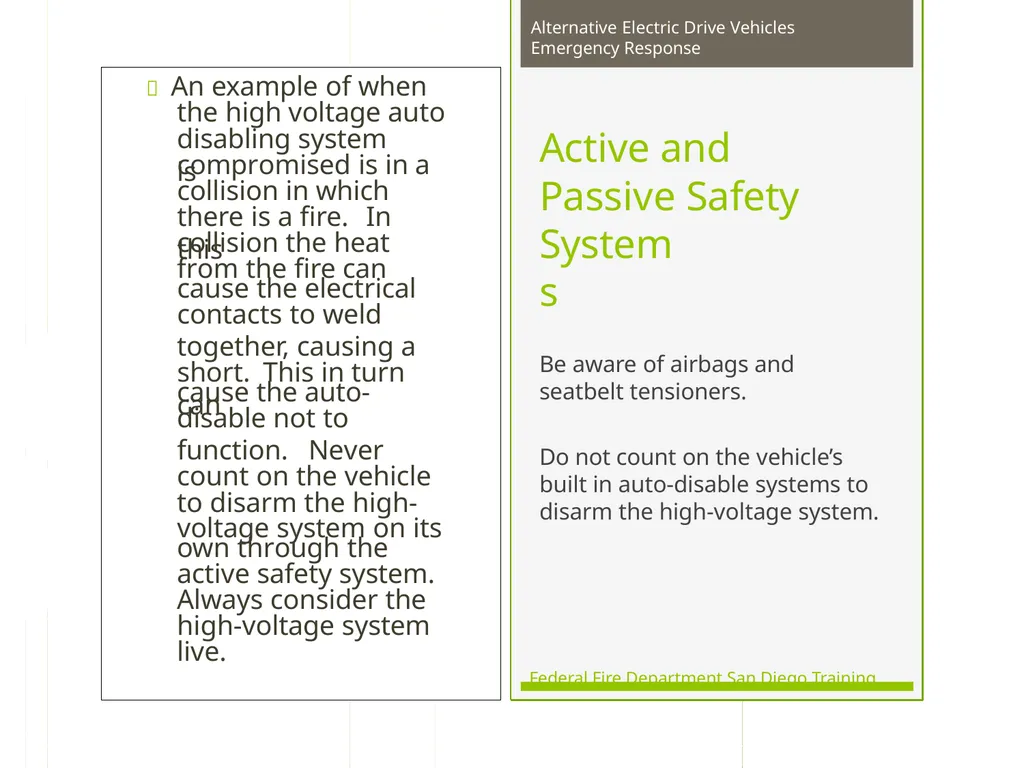
An example of when the high voltage auto disabling system is compromised is in a collision in which there is a fire. In this collision the heat from the fire can cause the electrical contacts to weld together, causing a short. This in turn can cause the auto- disable not to function. Never count on the vehicle to disarm the high- voltage system on its own through the active safety system. Always consider the high-voltage system live. Active and
Passive Safety Systems Be aware of airbags and seatbelt tensioners. Do not count on the vehicle’s built in auto-disable systems to disarm the high-voltage system. Federal Fire Department San Diego Training<br>
slide68. Alternative Electric Drive Vehicles Emergency Response
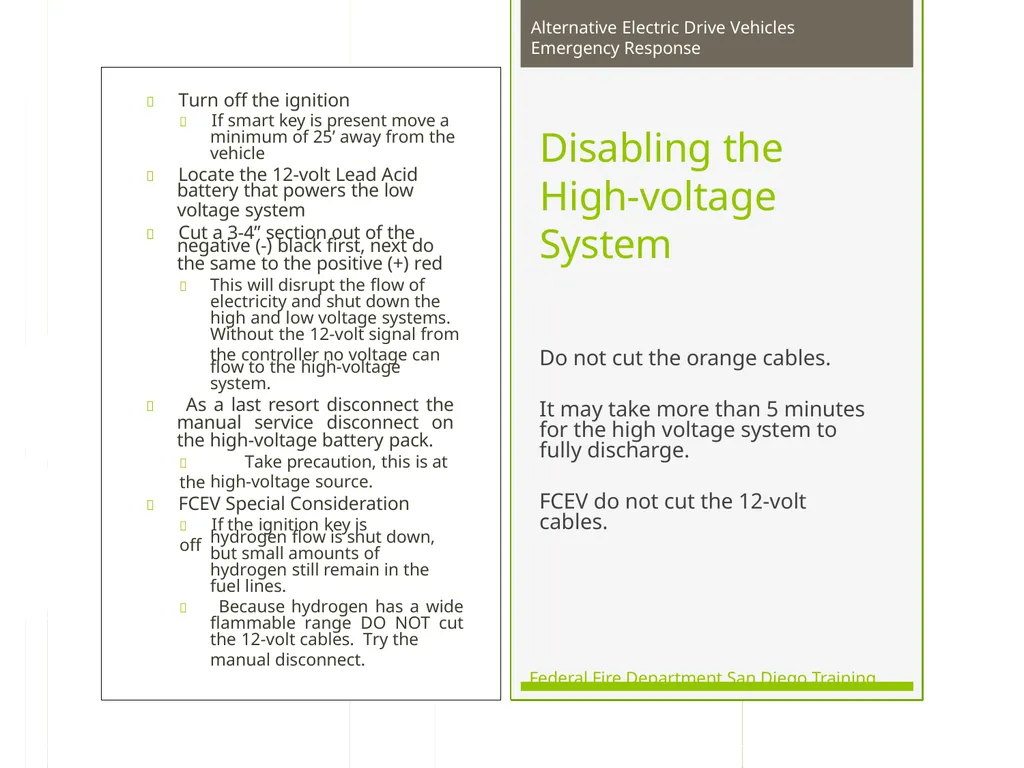
Turn off the ignition manual disconnect. If smart key is present move a minimum of 25’ away from the vehicle Locate the 12-volt Lead Acid battery that powers the low
voltage system Cut a 3-4” section out of the negative (-) black first, next do the same to the positive (+) red This will disrupt the flow of electricity and shut down the high and low voltage systems. Without the 12-volt signal from the controller no voltage can flow to the high-voltage system. As a last resort disconnect the manual service disconnect on the high-voltage battery pack.
Take precaution, this is at the high-voltage source.
FCEV Special Consideration If the ignition key is off hydrogen flow is shut down, but small amounts of hydrogen still remain in the fuel lines.
Because hydrogen has a wide flammable range DO NOT cut the 12-volt cables. Try the Disabling the
High-voltage System Do not cut the orange cables. It may take more than 5 minutes for the high voltage system to fully discharge. FCEV do not cut the 12-volt cables. Federal Fire Department San Diego Training<br>
slide69. Alternative Electric Drive Vehicles Emergency Response
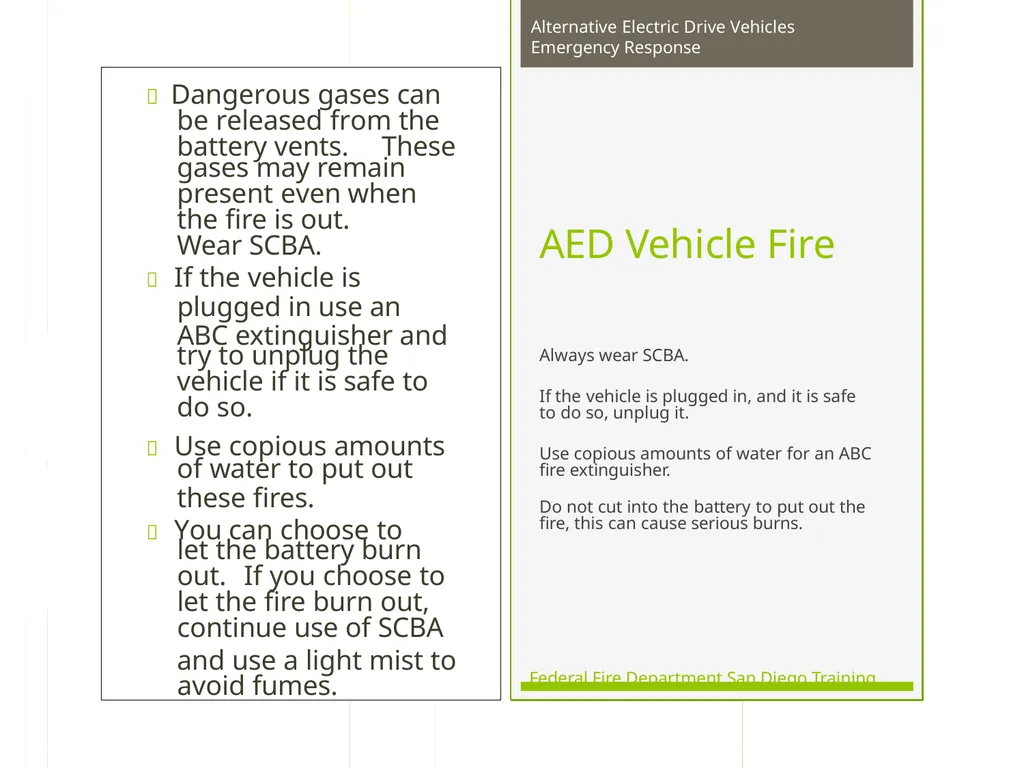
Dangerous gases can be released from the battery vents. These gases may remain present even when the fire is out. Wear SCBA.
If the vehicle is plugged in use an
ABC extinguisher and try to unplug the vehicle if it is safe to do so. Use copious amounts of water to put out
these fires.
You can choose to let the battery burn out. If you choose to let the fire burn out, continue use of SCBA and use a light mist to avoid fumes. AED Vehicle Fire Always wear SCBA. If the vehicle is plugged in, and it is safe to do so, unplug it. Use copious amounts of water for an ABC fire extinguisher. Do not cut into the battery to put out the fire, this can cause serious burns. Federal Fire Department San Diego Training<br>
slide70. Burns to self or personnel can occur from unknown hydrogen flame. Always use a TIC to
ensure no flame is present.
The flame itself is extremely hot. It is barely visible in daylight, lets off no smoke, and almost no radiant heat.
Do not attempt to extinguish the flame.
If you can isolate the hydrogen source do so, stop flow, then you can put out the flame, otherwise let it burn. It is better to let the hydrogen burn off then put out the flame and have un-burnt hydrogen gas pooling which can create a more hazardous situation.
Never stand near the Pressure/Temperature Release Device (PRD/TRD) vent.
Never spray water near a vent stack. FCEV Fire Special Considerations DO NOT ATEMPT TO EXTINGUISH Keep fire from spreading to exposures and let it burn out Alternative Electric Drive Vehicles Emergency Response Federal Fire Department San Diego Training<br>
slide71. Alternative Electric Drive Vehicles Emergency Response
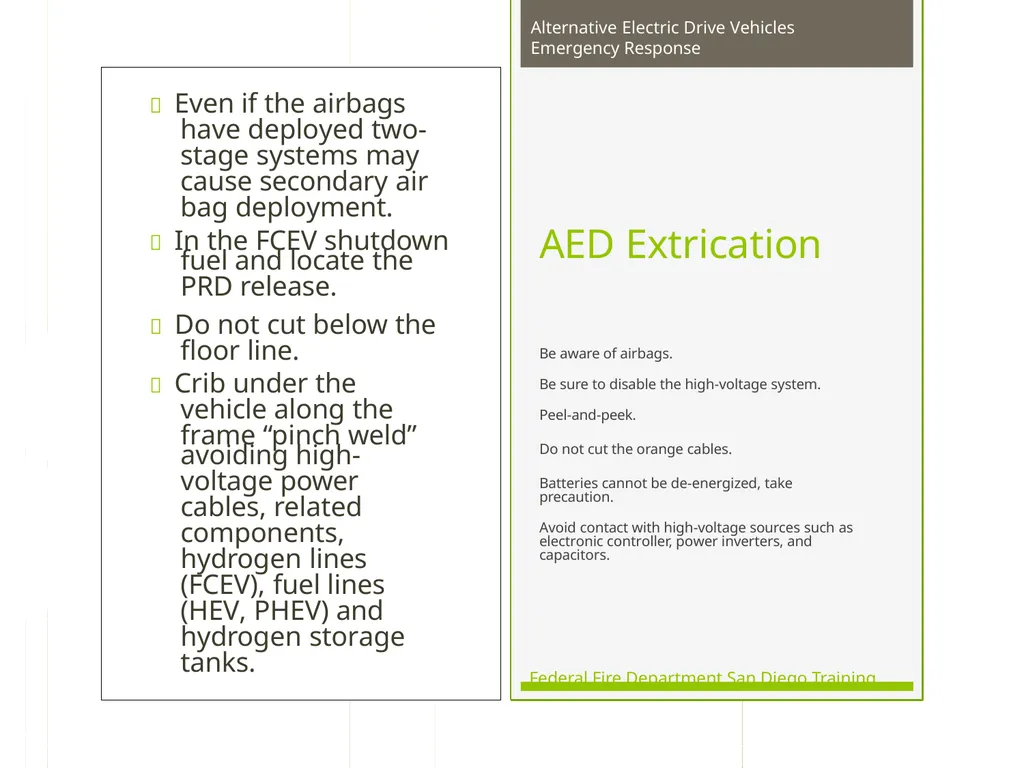
Even if the airbags have deployed two- stage systems may cause secondary air bag deployment. In the FCEV shutdown fuel and locate the PRD release. Do not cut below the floor line.
Crib under the vehicle along the frame “pinch weld” avoiding high- voltage power cables, related components, hydrogen lines (FCEV), fuel lines (HEV, PHEV) and
hydrogen storage tanks. AED Extrication Be aware of airbags. Be sure to disable the high-voltage system. Peel-and-peek. Do not cut the orange cables. Batteries cannot be de-energized, take precaution. Avoid contact with high-voltage sources such as electronic controller, power inverters, and capacitors. Federal Fire Department San Diego Training<br>
slide72. Alternative Electric Drive Vehicles for the First Responder
For additional training, including current and future vehicles visit:
http://naftc.wvu.edu Federal Fire Department San Diego Training Federal Fire Department San Diego Training<br>
Alternative Electric Drive Vehicles For the First Responder Federal Federal Fire Department San Diego Training<br>
slide2. Alternative Electric Drive Vehicles for the First Responder
Training Resource – National Alternative Fuels Training Consortium (NAFTC) Online Education Center
http://naftc.wvu.edu Federal Fire Department San Diego Federal Fire Department San Diego Training<br>
slide3. Introduction to the Alternative Electric Drive Vehicle
The Alternative Electric Drive Vehicle (AED) is an Electric or Hybrid Electric Vehicle There are four types of Alternative Electric Drive (AED) Vehicles Federal Fire Department San Diego Training Hybrid Electric Vehicle (HEV)
Plug in Hybrid Electric
Vehicle (PHEV)
Battery Electric Vehicle (BEV)
Fuel Cell Electric Vehicle (FCEV) Alternative Electric Drive Vehicles for the First Responder<br>
slide4. Alternative Electric Drive Vehicles for the First Responder
HEV’s are very popular and commonly found on the road. They combine an Internal Combustion Engine (ICE) with a Battery Electric Vehicle (BEV) Federal Fire Department San Diego Training to make a hybrid. These are popular because they do not have issues with the battery restricting range. These vehicles have benefits of fuel savings and are more environmentally friendly than a standard vehicle with just an ICE. Introduction to the Alternative Drive Vehicle
Hybrid Electric Vehicle (HEV)<br>
slide5. Characteristics of the Hybrid
Electric Vehicle (HEV)
The characteristics of
the HEV are:
There is more than one system that powers these vehicles.
ICE, BEV
The standard ICE is combined with a battery pack.
NOTE: The ICE in these vehicles may use alternative fuels such as E85, CNG, LNG, LPG, or
methane. Alternative Electric Drive Vehicles for the First Responder Federal Fire Department San Diego Training<br>
slide6. Alternative Electric Drive Vehicles for the First Responder Federal Fire Department San Diego Training<br>
slide7. Introduction to the Alternative Electric Drive Vehicle
The Alternative Electric Drive Vehicle (AED) is an Electric or Hybrid Electric Vehicle There are four types of Alternative Electric Drive (AED) Vehicles Federal Fire Department San Diego Training Hybrid Electric Vehicle (HEV)
Plug in Hybrid Electric
Vehicle (PHEV)
Battery Electric Vehicle (BEV)
Fuel Cell Electric Vehicle (FCEV) Alternative Electric Drive Vehicles for the First Responder<br>
slide8. Alternative Electric Drive Vehicles for the First Responder
PHEV is similar to the HEV with the addition of a charging port to charge the battery.
PHEV’s combine an Internal Combustion Engine (ICE) with a Battery Electric Vehicle (BEV) and a charger for Federal Fire Department San Diego Training additional energy.
These are popular because they do not have issues with the battery restricting range. These vehicles have benefits of fuel savings and are more environmentally friendly than a standard vehicle with just an ICE. The plug in option greatly increases fuel savings. Introduction to the Alternative Drive Vehicle
Plug in Hybrid Electric Vehicle (PHEV)<br>
slide9. Characteristics of the Plug in
Hybrid Electric Vehicle (PHEV)
The characteristics of
the PHEV are:
There is more than one system that powers these vehicles.
ICE, BEV
There is a charging port present on these vehicle. The vehicle may be connected to a charging station.
The standard ICE is combined with a battery pack.
NOTE: The ICE in these vehicles may use alternative fuels such as E85, CNG, LNG, LPG, or
methane. Alternative Electric Drive Vehicles for the First Responder Federal Fire Department San Diego Training<br>
slide10. Alternative Electric Drive Vehicles for the First Responder Federal Fire Department San Diego Training<br>
slide11. Introduction to the Alternative Electric Drive Vehicle
The Alternative Electric Drive Vehicle (AED) is an Electric or Hybrid Electric Vehicle There are four types of Alternative Electric Drive (AED) Vehicles Federal Fire Department San Diego Training Hybrid Electric Vehicle (HEV)
Plug in Hybrid Electric
Vehicle (PHEV)
Battery Electric Vehicle (BEV)
Fuel Cell Electric Vehicle (FCEV) Alternative Electric Drive Vehicles for the First Responder<br>
slide12. Alternative Electric Drive Vehicles for the First Responder
There are a relatively small amount of BEV’s on the road today when compared to conventional Federal Fire Department San Diego Training ICE and HEV’s. They are becoming more popular though because of the following:
Better battery power storage
Larger scale
manufacturing
Larger vehicle manufacturers are increasing their BEV model line up and lowering cost-to-own. There is no ICE present on these vehicles. The energy to power these vehicles is all electric and comes from the energy stored within the vehicle batteries. Introduction to the Alternative Drive Vehicle
Battery Electric Vehicle (BEV)<br>
slide13. Characteristics of the Battery
Electric Vehicle (BEV)
The characteristics of
the BEV are: Ready mode – vehicle does not idle when not in motion.
Motor Generator (MG) – on board generator that produces energy.
Nearly silent – some may make noise or beeps to alert those present that the vehicle is running. Other than that the vehicle is nearly silent.
Both high-and-low-voltage battery systems
High-voltage can store more than 600v.
Low-voltage for lights and accessories are 12v, with an inverter on board to step- down the power.
These vehicles have multiple motors for
each wheel
No ICE
This vehicle does not use any sort of fuel.
Charging port and charging station. Alternative Electric Drive Vehicles for the First Responder Federal Fire Department San Diego Training<br>
slide14. Introduction to the Alternative Electric Drive Vehicle
The Alternative Electric Drive Vehicle (AED) is an Electric or Hybrid Electric Vehicle There are four types of Alternative Electric Drive (AED) Vehicles Federal Fire Department San Diego Training Hybrid Electric Vehicle (HEV)
Plug in Hybrid Electric
Vehicle (PHEV)
Battery Electric Vehicle (BEV)
Fuel Cell Electric Vehicle (FCEV) Alternative Electric Drive Vehicles for the First Responder<br>
slide15. Alternative Electric Drive Vehicles for the First Responder
FCEV’s are very rare, but they are on the road and you may encounter one. Federal Fire Department San Diego Training This type of vehicle uses hydrogen gas to power a fuel cell, which powers an electric motor. Introduction to the Alternative Drive Vehicle
Fuel Cell Electric Vehicle (FCEV)<br>
slide16. How does a Fuel Cell Electric
Vehicle (FCEV) Work? The way that this vehicle works is essentially as a Hybrid Electric Vehicle.
The fuel is the hydrogen.
FCEV’s convert hydrogen and oxygen to electricity which powers an electric motor.
FCEV’s have the same Motor Generator (MG), inverter, and Regenerative Braking that other AED vehicles have. Alternative Electric Drive Vehicles for the First Responder Federal Fire Department San Diego Training<br>
slide17. Alternative Electric Drive Vehicles for the First Responder Federal Fire Department San Diego Training<br>
slide18. Alternative Electric Drive Vehicles for the First Responder Federal Fire Department San Diego Training<br>
slide19. Alternative Electric Drive Vehicles for the First Responder Federal Fire Department San Diego Training<br>
slide20. Fuel Cell Electric Vehicle Safety
Generally speaking the hydrogen in the FCEV is safe. Hydrogen is one of the most abundant elements in nature, it is present in 75%of the atmosphere.
In the case of a spill, the hydrogen would vaporize and cause no hazard.
Hydrogen is stored under pressure of 5psig and liquefies at -423˚F. In a release to atmosphere it will combine with oxygen and form water vapor and quickly disperse.
Hydrogen is non-toxic, non-poisonous, and non-corrosive. Alternative Electric Drive Vehicles for the First Responder Federal Fire Department San Diego Training<br>
slide21. Fuel Cell Electric Vehicle
(FCEV) Risk Factors
There are several important considerations to take note of with FCEV’s.
Hydrogen is extremely flammable; the flammable range is very wide.
Flammable potential is 4% and the typical ignition range is 15-74%.
When hydrogen is burning it burns as a pale blue flame that is almost invisible in daylight.
Unless in the presence of an impurity, hydrogen flame will not emit smoke.
There is almost no radiant heat in a hydrogen flame and it burns very hot.
As a result of low radiant heat, there is little risk of secondary fire and/or personnel injury unless direct flame contact is made. Alternative Electric Drive Vehicles for the First Responder Federal Fire Department San Diego Training<br>
slide22. Characteristics of the Fuel Cell
Electric Vehicle (FCEV)
The characteristics of
the FCEV are:
Most FCEV’s will be clearly marked.
Components include batteries, fuel tank, fuel cell stack, inverter, motor generator, and an electric motor(s) which may combine more than one power system to drive the wheels. Alternative Electric Drive Vehicles for the First Responder Federal Fire Department San Diego Training<br>
slide23. Introduction to the Alternative Electric Drive Vehicle
The Alternative Electric Drive Vehicle (AED) is an Electric or Hybrid Electric Vehicle There are four types of Alternative Electric Drive (AED) Vehicles Federal Fire Department San Diego Training Hybrid Electric Vehicle (HEV)
Plug in Hybrid Electric Vehicle (PHEV)
Battery Electric Vehicle (BEV)
Fuel Cell Electric Vehicle (FCEV)
Most AED vehicles should be marked as such, but standard Internal Combustion Engine vehicles can be retrofitted with aftermarket kits to make them any one of the AED types. Alternative Electric Drive Vehicles for the First Responder<br>
slide24. Battery Types for the Alternative Electric Drive Vehicle The Alternative Electric Drive Vehicle (AED) is an Electric or Hybrid Electric Vehicle There are three basic battery types found on the AED.
Lead Acid Battery (12 Volt)
Nickel Metal Hydride Battery (NiMH) Lithium Ion Battery
(Li-Ion) Alternative Electric Drive Vehicles for the First Responder Federal Fire Department San Diego Training<br>
slide25. Alternative Electric Drive Vehicles for the First Responder
These are conventional batteries, used for lighting and accessory controls such as ignition systems and radio. This is the same battery that can be found on the standard ICE vehicle. The standard 12- volt battery is used in conjunction with the high voltage system. Lead Acid Battery Type 12-volt battery type for the low voltage system. Federal Fire Department San Diego Training<br>
slide26. Safety With the Lead Acid
Battery
In an emergency situation the
following should be noted:
Acid can cause burns to the skin/eyes.
If ruptured the battery can emit a mist that can cause difficulty breathing.
Use of water can disperse this mist if there is no fire present.
Absorbent should be used to prevent seepage.
When overheated from fire these batteries can vent explosively because of the hydrogen gas that is emitted. Alternative Electric Drive Vehicles for the First Responder Federal Fire Department San Diego Training<br>
slide27. Battery Types for the Alternative Electric Drive Vehicle The Alternative Electric Drive Vehicle (AED) is an Electric or Hybrid Electric Vehicle There are three basic battery types found on the AED.
Lead Acid Battery (12 Volt)
Nickel Metal Hydride Battery (NiMH) Lithium Ion Battery
(Li-Ion) Alternative Electric Drive Vehicles for the First Responder Federal Fire Department San Diego Training<br>
slide28. Alternative Electric Drive Vehicles for the First Responder
NiMH batteries are very common in current HEV and BEV vehicles due to their reliability and dependability.
NiMH are very safe and have a high tolerance for abuse.
Federal Motor Safety Standard 571.305 states that the battery should not overheat in a crash and that no electrolyte should spill into the passenger compartment upon collision.
Although safe, these batteries can be compromised in an emergency situation. NiMH (Nickel Metal Hydride) Battery Type
These are the most common high-voltage batteries found. They are very common in the current production HEV, and BEV. Federal Fire Department San Diego Training<br>
slide29. Safety With the NiMH Battery
In an emergency situation the
following should be noted:
Upon rapid discharge, such as in a major vehicle collision or vehicle fire, the battery can overheat and short circuit. This causes overpressure of the battery and a flammable electrolyte gas can vent out.
A ruptured NiMH battery can cause several adverse affects such as burns, ulcers, nausea/vomiting, and can cause death. Alternative Electric Drive Vehicles for the First Responder Federal Fire Department San Diego Training<br>
slide30. Battery Types for the Alternative Electric Drive Vehicle The Alternative Electric Drive Vehicle (AED) is an Electric or Hybrid Electric Vehicle There are three basic battery types found on the AED.
Lead Acid Battery (12 Volt)
Nickel Metal Hydride Battery (NiMH) Lithium Ion Battery
(Li-Ion) Alternative Electric Drive Vehicles for the First Responder Federal Fire Department San Diego Training<br>
slide31. Alternative Electric Drive Vehicles for the First Responder
These are the newest technology in high-voltage battery's for AED vehicles. They are becoming more common in all four types. There is no risk of electrolyte spill in these vehicles under most conditions because of a safety vent.
A safety vent is in place to keep the battery from overheating. Li-Ion (Lithium Ion) Battery Type
This is the newest technology for high- voltage batteries in vehicles. They are found in PHEV, and FCEV, but can also be found in new HEV and BEV as well. There will be a significant increase in Li-Ion batteries in future year models. Federal Fire Department San Diego Training<br>
slide32. Safety With the Li-Ion Battery
In an emergency situation the
following should be noted: In a catastrophic failure the safety vent can fail and the battery can overheat.
Overheating of the battery because of failure of the safety
vent creates a chance for explosion and fire.
Use water or and ABC extinguisher on Li-Ion battery fire.
In a fire there can be an electrolyte gas leak.
Do not inhale the electrolyte gas, if electrolyte is on the skin wash for 15 minutes with water. Alternative Electric Drive Vehicles for the First Responder Federal Fire Department San Diego Training<br>
slide33. Safety Systems for the Alternative Electric Drive Vehicle
The Alternative Electric Drive Vehicle (AED) is an Electric or Hybrid Electric Vehicle There two types of safety systems found on all AED vehicles. Active Safety Systems
Passive Safety Systems Alternative Electric Drive Vehicles for the First Responder Federal Fire Department San Diego Training<br>
slide34. Alternative Electric Drive Vehicles for the First Responder
Inertia impact switch can cut off fuel and high- voltage in a collision.
These impact switches are located in the front, rear, and side impact zones.
Although effective, do not count on these to work every time. All high- voltage systems should be treated as live at all times.
If any part is removed from the high voltage system such as during maintenance or collision the high-voltage interlock loop will disconnect the
high-voltage system.
Even with the high- voltage system disconnected power will remain in components such as the inverter for several minutes. In the FCEV inertia impact sensors will isolate hydrogen and cut of fuel. Active Safety Systems All Alternative Electric Drive (AED) vehicles have both active and passive safety systems in the event of a collision or fire. Federal Fire Department San Diego Training<br>
slide35. Safety Systems for the Alternative Electric Drive Vehicle
The Alternative Electric Drive Vehicle (AED) is an Electric or Hybrid Electric Vehicle There two types of safety systems found on all AED vehicles. Active Safety Systems
Passive Safety Systems Alternative Electric Drive Vehicles for the First Responder Federal Fire Department San Diego Training<br>
slide36. Alternative Electric Drive Vehicles for the First Responder
Air bags are part of the passive safety systems in these vehicles. They present a measurable hazard even if they have deployed.
There are secondary systems which can cause re-deployment of the airbag. There are also capacitors which give power to air bags, and these capacitors can hold energy for several minutes. Passive Safety Systems All Alternative Electric Drive (AED) vehicles have both active and passive safety systems in the event of a collision or fire. Federal Fire Department San Diego Training<br>
slide37. Passive Safety Systems
Service Disconnects Service disconnects are found on all HEV vehicles. They look different on every model and are usually labeled as “Manual Service Disconnect”.
Using the service disconnect should be a last resort and only used if you are unable to shut down the ignition or the 12-volt battery.
The manual service disconnect will disarm the high-voltage system. It is usually clearly labeled and in most cases easily located. It can be located near the high-voltage battery pack, under the hood, or in the trunk of the vehicle. Alternative Electric Drive Vehicles for the First Responder Federal Fire Department San Diego Training<br>
slide38. The Alternative Electric Drive Vehicle (AED) is an Electric or Hybrid Electric Vehicle Alternative Electric Drive Vehicles for the First Responder
High-Voltage and Low-Voltage Systems for the Alternative Electric Drive Vehicle Federal Fire Department San Diego Training All AED vehicles contain both high and low voltage systems.
Low-voltage systems found on these vehicles control the lights, controls, and accessories. The low voltage system is a 12-volt system.
High-voltage systems found on these vehicles power at minimum the electric motor, motor controllers, cooling fans, and pumps.
High voltage systems have voltages of at least 400-650- volts present.<br>
slide39. High-Voltage and Low-Voltage systems Inverter and battery packs contain high-voltage at all times. All high- voltage systems should be labeled as so.
Never tamper or open inverter and batteries. These systems can store high-voltage for several minutes even when powered has been severed. Alternative Electric Drive Vehicles for the First Responder Federal Fire Department San Diego Training<br>
slide40. High-Voltage and Low-
Voltage Systems
There are typically two different colors that indicate high-voltage or medium-to-low-voltage.
Orange is high voltage.
This is a standard that will be found on all AED vehicles.
These can usually be found
along the drive train.
Blue is medium-to-low voltage.
This is not found on all AED vehicles.
Blue cables can go to components such as A/C or power storage.
Medium-to-low voltage does have the potential to electrocute, shock, and/or burn. Alternative Electric Drive Vehicles for the First Responder Federal Fire Department San Diego Training<br>
slide41. High-Voltage Systems Orange cables should never be cut in an extrication. If performing extrication and cutting is necessary peel-and-peek.
Orange cables indicate high-voltages with voltages that range between 144 to 650-volts DC on most vehicles.
OEM vehicles have warning placards under the hood and near any high voltage components.
Some vehicles such as the Tesla will provide marked cut points to indicate where it is safe to cut. Alternative Electric Drive Vehicles for the First Responder Federal Fire Department San Diego Training<br>
slide42. High-Voltage Systems
High voltage components on the AED vehicle include the following:
Power control unit – controls the flow of electricity
Electric motor
Fuel cell stack (FCEV)
High voltage battery
Inverter
DC-DC converter (FCEV)
Power cables Alternative Electric Drive Vehicles for the First Responder Federal Fire Department San Diego Training<br>
slide43. Alternative Electric Drive Vehicle Fuel Type
The Alternative Electric Drive Vehicle (AED) is an Electric or Hybrid Electric Vehicle The HEV, and PHEV vehicles as well as the FCEV use specific fuel types. Federal Fire Department San Diego Training Hybrid and Plug in Hybrid Electric Vehicle(HEV, PHEV)
Fuel Cell Electric Vehicle (FCEV) Alternative Electric Drive Vehicles for the First Responder<br>
slide44. Alternative Electric Drive Vehicles for the First Responder
Although the most commonly found fuel in these vehicles Federal Fire Department San Diego Training is gasoline, there can be several types of fuel that power these vehicles including but not limited to: Diesel
E85
Compressed Natural Gas (CNG) Liquefied Natural Gas (LNG)
Liquefied Petroleum Gas (LPG)
Methanol Hybrid Electric Vehicle (HEV) and Plug in Hybrid Electric Vehicle (PHEV) Fuel Type
HEV and PHEV use fuel to supplement the high-voltage system to power the vehicle. These vehicles contain an Internal Combustion Engine (ICE) as would your standard vehicle.<br>
slide45. Alternative Electric Drive Vehicles for the First Responder
Hydrogen storage is usually in the rear of the vehicle.
FCEV hydrogen sensing devices monitor the air for hydrogen, initiate shut down, and isolate hydrogen and electrical storage systems.
If a hydrogen leak is detected, such as in a collision, a hydrogen fuel Thermal Release Device (TRD) monitor will shut off excess flow through an automatic shut-off valve. This allows some hydrogen, but not a hazardous amount to vent.
Fuel pressure relief device senses increased pressure buildup such as from heat and protects the hydrogen cylinder by opening one of two relief valves. A hissing sound will be heard as excess hydrogen is released. Pressure Release Device
(PRD) Fuel Cell Electric
Vehicle (FCEV) Fuel Type FCEV uses hydrogen as its fuel type. The fuel cell powers the motor by converting hydrogen and oxygen into electricity. Federal Fire Department San Diego Training<br>
slide46. Identifying the Alternative Electric Drive Vehicle
The Alternative Electric Drive Vehicle (AED) is an Electric or Hybrid Electric Vehicle It is the First Responder’s responsibility on any scene to do a proper size-up and identify the vehicle type if possible. Federal Fire Department San Diego Training Exterior
Interior
Under the hood Alternative Electric Drive Vehicles for the First Responder<br>
slide47. AED Vehicle Exterior
Identification
First responders will identify the vehicle as an AED if possible by the following: Badging, marking, decals
Emblem on side or trunk
HEV Lexus has an h on the model number
Charging port (BEV, PHEV)
May be plugged into a charging station
Visible vents
Mostly on older HEV’s
Colorful logos or graphics on body panels (most likely on an FCEV)
Solar panel roof
Hydrogen fuel filler port
Clearly marked on the FCEV
Blue diamond indicating hydrogen (FCEV)
Vehicle should have a more modern look than most vehicles on the road.
In a significant collision you may be unable to find all of these identifiers. Alternative Electric Drive Vehicles for the First Responder Federal Fire Department San Diego Training<br>
slide48. Badging Alternative Electric Drive Vehicles for the First Responder Federal Fire Department San Diego Training<br>
slide49. Charging port Alternative Electric Drive Vehicles for the First Responder Federal Fire Department San Diego Training<br>
slide50. Vent Alternative Electric Drive Vehicles for the First Responder Federal Fire Department San Diego Training<br>
slide51. Colorful logos Alternative Electric Drive Vehicles for the First Responder Federal Fire Department San Diego Training<br>
slide52. Solar panel Alternative Electric Drive Vehicles for the First Responder Federal Fire Department San Diego Training<br>
slide53. Hydrogen fuel filler port Alternative Electric Drive Vehicles for the First Responder Federal Fire Department San Diego Training<br>
slide54. Hydrogen label Alternative Electric Drive Vehicles for the First Responder Federal Fire Department San Diego Training<br>
slide55. Modern looking Alternative Electric Drive Vehicles for the First Responder Federal Fire Department San Diego Training<br>
slide56. Identifying the Alternative Electric Drive Vehicle
The Alternative Electric Drive Vehicle (AED) is an Electric or Hybrid Electric Vehicle It is the First Responder’s responsibility on any scene to do a proper size-up and identify the vehicle type if possible. Federal Fire Department San Diego Training Exterior
Interior
Under the hood Alternative Electric Drive Vehicles for the First Responder<br>
slide57. AED Vehicle Interior
Identification
First responders will identify the vehicle as an AED if possible by the following: On the dash of the vehicle
Look for charging indicators.
On large or heavy duty vehicles
there will be a dashboard label.
FCEV vehicles will not have a standard tachometer; instead they will have a Kw tachometer and will look different than a standard tachometer.
You may not be able to identify all of the AED vehicle indicators in the event of a significant collision. Alternative Electric Drive Vehicles for the First Responder Federal Fire Department San Diego Training<br>
slide58. Interior Alternative Electric Drive Vehicles for the First Responder Federal Fire Department San Diego Training<br>
slide59. Kw Tachometer Alternative Electric Drive Vehicles for the First Responder Federal Fire Department San Diego Training<br>
slide60. AED Vehicle Under the Hood
Identification
First responders will identify the vehicle as an AED if possible by the following:
Orange cables
Blue Cables (<60v)
Emblems – high voltage stickers
Under the hood of the FCEV should indicate that it is a FCEV by wording and or emblems.
Internal Combustion Engine (ICE) will be present on all HEV and PHEV vehicles. All standard vehicle hazards remain present.
You may not be able to identify the all indicators of an AED vehicle in the event of a significant collision. Alternative Electric Drive Vehicles for the First Responder Federal Fire Department San Diego Training<br>
slide61. Under the hood Alternative Electric Drive Vehicles for the First Responder Federal Fire Department San Diego Training<br>
slide62. Fuel Cell Under the Hood Alternative Electric Drive Vehicles for the First Responder Federal Fire Department San Diego Training<br>
slide63. Emergency Response Guide to the Alternative Electric Drive (AED) Vehicle Alternative Electric Drive Vehicles for the First Responder Federal Fire Department San Diego Training<br>
slide64. When responding to fire and/or collision respond in full PPE according to NFPA 1971 standards which will include: Helmet, jacket boots, pants, goggles, and gloves at minimum. Jewelry including rings, necklace, and watches under PPE is discouraged in the AED emergency because they can conduct electricity.
SCBA is incident dependent.
Use non-static tools if at all possible. A corn broom can be useful to clean up debris.
In the event of an AED collision/fire emergency hazardous chemicals can damage Firefighter’s PPE. If large spills are present contact HazMat and make a quick in- and-out operation only if needed to mitigate significant life hazards. PPE and Tool Selection Proper PPE and tools selection is the first important consideration in the AED emergency response. Alternative Electric Drive Vehicles Emergency Response Federal Fire Department San Diego Training<br>
slide65. Position away from all possible hazards spills, leaks, or vapors.
If no fire is present secure the vehicle and identify what type energized. of vehicle by exterior, interior, or under the hood.
When approaching the AED follow SOG’s.
Immobilize
Stabilize
Disable Once the vehicle is identified as an AED disable the high- voltage system. If the AED is on fire do not approach the vehicle, put out cones or non-sparking markers to secure the scene first. Do not approach the AED vehicle
closely if on fire.
If you approach the vehicle and it sounds like it is off and has no engine sounds is heard be aware that the engine may still be on and the vehicle still may move. The vehicle has potential to move as long as the high-voltage system is Approaching the Incident Remember, size-up starts before the call and continues throughout. Do not rush in. Position up-hill, up-wind. Perform an initial 360. Immobilize, Stabilize, Disable. Alternative Electric Drive Vehicles Emergency Response Federal Fire Department San Diego Training<br>
slide66. Alternative Electric Drive Vehicles Emergency Response
Locate the Pressure Release Device (PRD) vent which is usually in the rear.
Try to locate this vent before beginning any operation in the FCEV and avoid direct exposure to it in case there is a PRD release. The PRD vents only under high pressure or high temperature situations. The PRD will be on the hydrogen tank most likely in the rear of the vehicle.
Do not approach the PRD
directly. Look for thermal waves which indicate heat and possible hydrogen fire.
If the vehicle is on fire do not approach. Set up cones and secure the scene. In the event of a fire the hydrogen flame will be nearly invisible in daylight. Detect the flame with a TIC.
Hydrogen flame may appear yellow if dust is in the air.
Look for thermal waves which indicate heat and possible hydrogen flame which may not be visible. The hydrogen flame will not give off smoke. Approaching the FCEV Incident When approaching the FCEV incident special considerations need to be taken due to the unique properties of hydrogen within this vehicle type. Follow standard vehicle
emergency response guidelines. t Federal Fire Department San Diego Training<br>
slide67. Alternative Electric Drive Vehicles Emergency Response
An example of when the high voltage auto disabling system is compromised is in a collision in which there is a fire. In this collision the heat from the fire can cause the electrical contacts to weld together, causing a short. This in turn can cause the auto- disable not to function. Never count on the vehicle to disarm the high- voltage system on its own through the active safety system. Always consider the high-voltage system live. Active and
Passive Safety Systems Be aware of airbags and seatbelt tensioners. Do not count on the vehicle’s built in auto-disable systems to disarm the high-voltage system. Federal Fire Department San Diego Training<br>
slide68. Alternative Electric Drive Vehicles Emergency Response
Turn off the ignition manual disconnect. If smart key is present move a minimum of 25’ away from the vehicle Locate the 12-volt Lead Acid battery that powers the low
voltage system Cut a 3-4” section out of the negative (-) black first, next do the same to the positive (+) red This will disrupt the flow of electricity and shut down the high and low voltage systems. Without the 12-volt signal from the controller no voltage can flow to the high-voltage system. As a last resort disconnect the manual service disconnect on the high-voltage battery pack.
Take precaution, this is at the high-voltage source.
FCEV Special Consideration If the ignition key is off hydrogen flow is shut down, but small amounts of hydrogen still remain in the fuel lines.
Because hydrogen has a wide flammable range DO NOT cut the 12-volt cables. Try the Disabling the
High-voltage System Do not cut the orange cables. It may take more than 5 minutes for the high voltage system to fully discharge. FCEV do not cut the 12-volt cables. Federal Fire Department San Diego Training<br>
slide69. Alternative Electric Drive Vehicles Emergency Response
Dangerous gases can be released from the battery vents. These gases may remain present even when the fire is out. Wear SCBA.
If the vehicle is plugged in use an
ABC extinguisher and try to unplug the vehicle if it is safe to do so. Use copious amounts of water to put out
these fires.
You can choose to let the battery burn out. If you choose to let the fire burn out, continue use of SCBA and use a light mist to avoid fumes. AED Vehicle Fire Always wear SCBA. If the vehicle is plugged in, and it is safe to do so, unplug it. Use copious amounts of water for an ABC fire extinguisher. Do not cut into the battery to put out the fire, this can cause serious burns. Federal Fire Department San Diego Training<br>
slide70. Burns to self or personnel can occur from unknown hydrogen flame. Always use a TIC to
ensure no flame is present.
The flame itself is extremely hot. It is barely visible in daylight, lets off no smoke, and almost no radiant heat.
Do not attempt to extinguish the flame.
If you can isolate the hydrogen source do so, stop flow, then you can put out the flame, otherwise let it burn. It is better to let the hydrogen burn off then put out the flame and have un-burnt hydrogen gas pooling which can create a more hazardous situation.
Never stand near the Pressure/Temperature Release Device (PRD/TRD) vent.
Never spray water near a vent stack. FCEV Fire Special Considerations DO NOT ATEMPT TO EXTINGUISH Keep fire from spreading to exposures and let it burn out Alternative Electric Drive Vehicles Emergency Response Federal Fire Department San Diego Training<br>
slide71. Alternative Electric Drive Vehicles Emergency Response
Even if the airbags have deployed two- stage systems may cause secondary air bag deployment. In the FCEV shutdown fuel and locate the PRD release. Do not cut below the floor line.
Crib under the vehicle along the frame “pinch weld” avoiding high- voltage power cables, related components, hydrogen lines (FCEV), fuel lines (HEV, PHEV) and
hydrogen storage tanks. AED Extrication Be aware of airbags. Be sure to disable the high-voltage system. Peel-and-peek. Do not cut the orange cables. Batteries cannot be de-energized, take precaution. Avoid contact with high-voltage sources such as electronic controller, power inverters, and capacitors. Federal Fire Department San Diego Training<br>
slide72. Alternative Electric Drive Vehicles for the First Responder
For additional training, including current and future vehicles visit:
http://naftc.wvu.edu Federal Fire Department San Diego Training Federal Fire Department San Diego Training<br>