
fire ecology The relationship between wildfire &
LS
Published · 33 slides · 0 views
1 / 1
Description
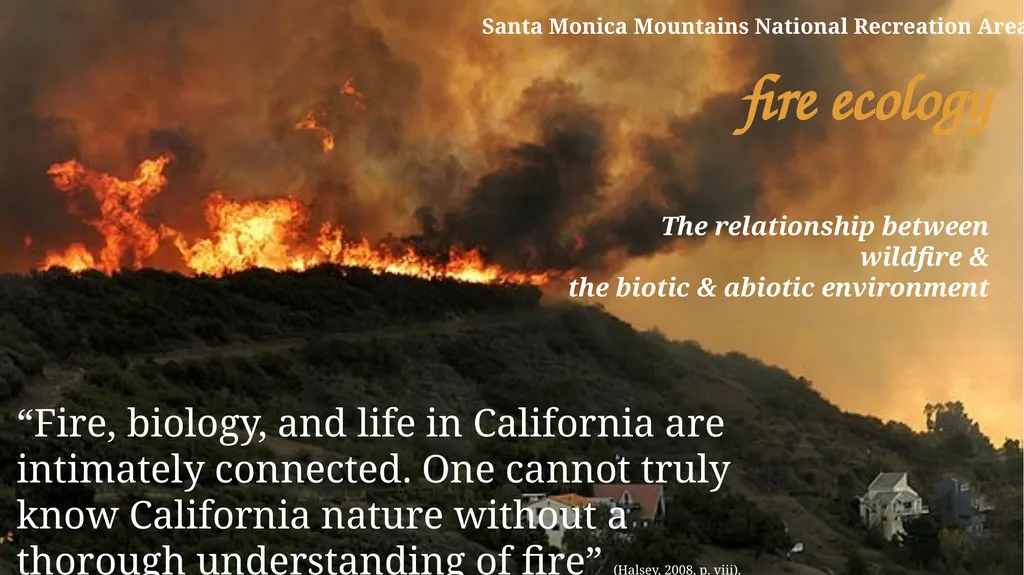
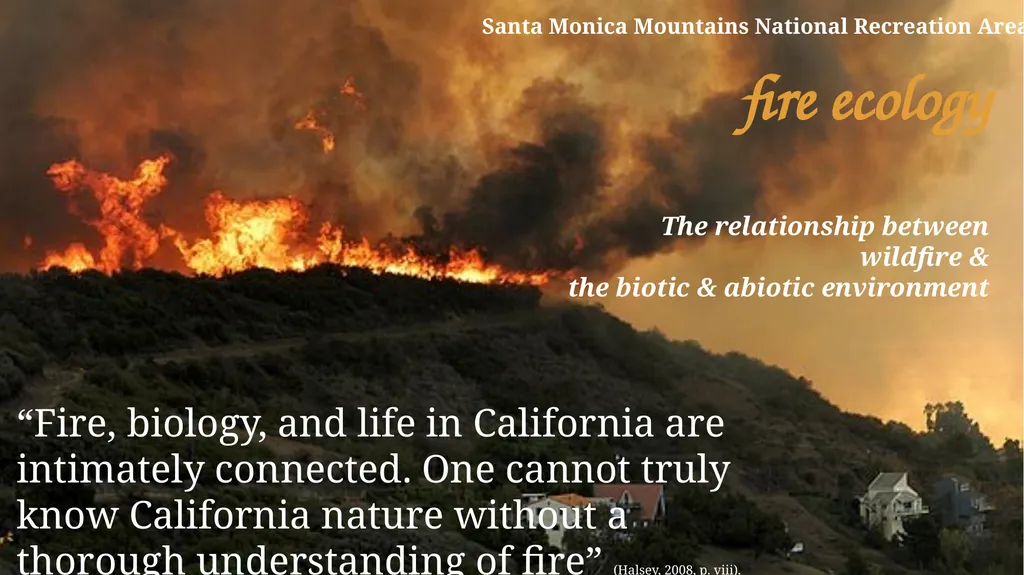
fire ecology The relationship between wildfire the biotic abiotic environment Fire, biology, and life in California are intimately connected. One cannot truly know California nature without a thorough understanding of fire (Halsey,
Related Topics
Share
Embed code
Download this presentation From Below
"fire ecology The relationship between wildfire &" is the property of its rightful owner. Permission is granted to download and print the materials on this website for personal, non-commercial use only, and to display it on your personal computer provided you do not modify the materials and that you retain all copyright notices contained in the materials. By downloading content from our website, you accept the terms of this agreement.
Presentation Transcript
01
fire ecology The relationship between wildfire &
the biotic & abiotic environment “Fire, biology, and life in California are intimately connected. One cannot truly know California nature without a thorough understanding of fire” (Halsey, 2008, p. viii). Santa Monica Mountains National Recreation Area<br>
the biotic & abiotic environment “Fire, biology, and life in California are intimately connected. One cannot truly know California nature without a thorough understanding of fire” (Halsey, 2008, p. viii). Santa Monica Mountains National Recreation Area<br>
02
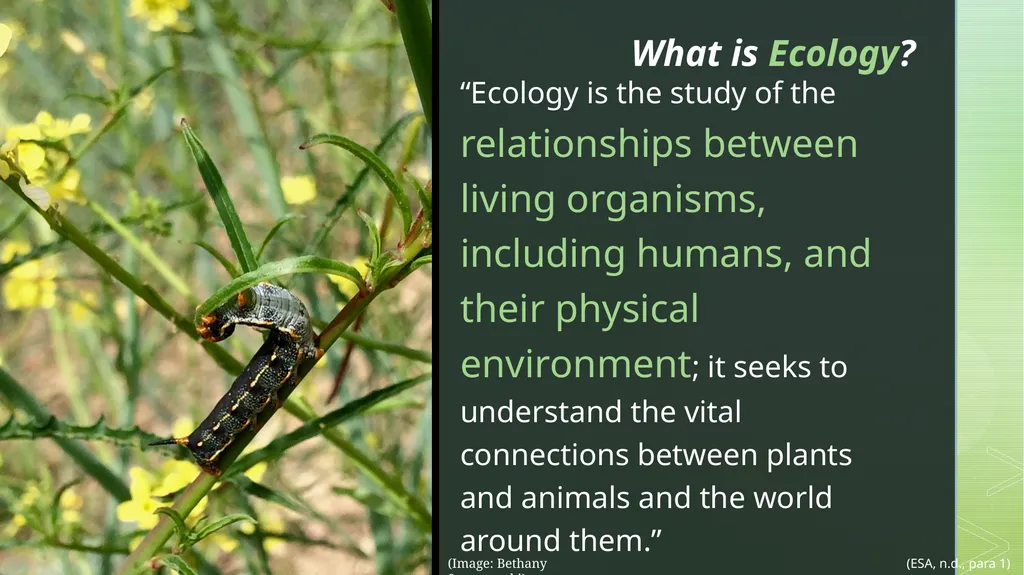
What is Ecology? “Ecology is the study of the relationships between living organisms, including humans, and their physical environment; it seeks to understand the vital connections between plants and animals and the world around them.” (ESA, n.d., para 1) (Image: Bethany Szczepanski)<br>
03
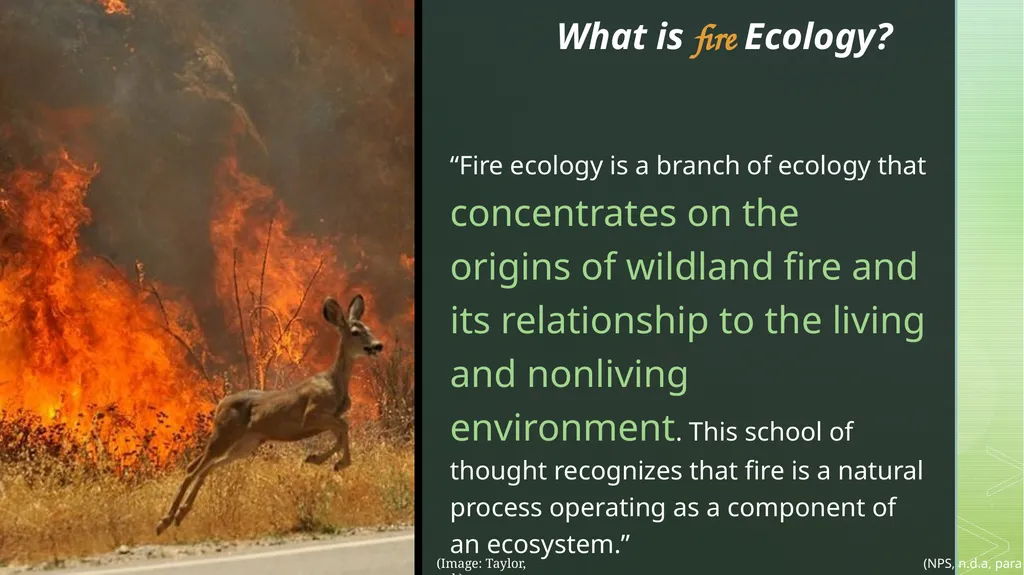
What is fire Ecology? “Fire ecology is a branch of ecology that concentrates on the origins of wildland fire and its relationship to the living and nonliving environment. This school of thought recognizes that fire is a natural process operating as a component of an ecosystem.” (NPS, n.d.a, para 1) (Image: Taylor, n.d.)<br>
04
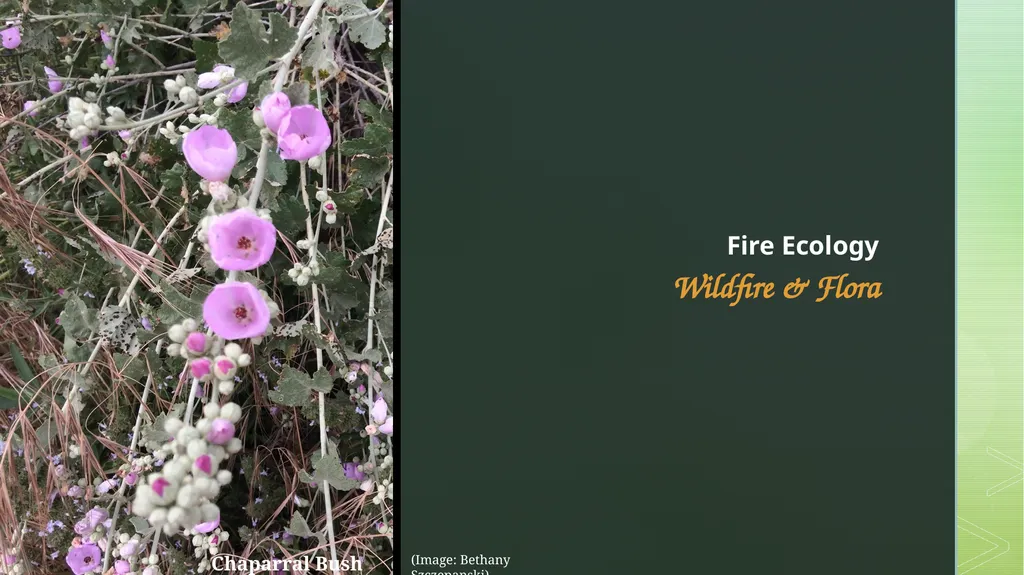
Wildfire & Flora Fire Ecology Chaparral Bush Mallow (Image: Bethany Szczepanski)<br>
05
Chaparral “Chaparral is a diverse, shrub-dominated plant community shaped by a Mediterranean-type climate (hot, dry summers and mild, wet winters), a complex mixture of relatively young soils, and large, infrequent, high-intensity fires.” (CCI, n.d.b)
“Large expanses of dense chaparral vegetation cover coastal mesas, canyons, foothills, and mountain slopes throughout California, southward into Baja California, and extending north into the Rogue River Valley of southwest Oregon. Disjunct patches of chaparral can also be found in central and southeastern Arizona and northern Mexico.” (CCI, n.d.b)
Chaparral is California’s most extensive plant community and most characteristic wilderness. (Halsey, 2008, p. 1)
Chaparral comprises about a quarter of the state’s native plant species, of which almost half are endemics (only found in California). (Litman, 2013, p. 2)<br>
“Large expanses of dense chaparral vegetation cover coastal mesas, canyons, foothills, and mountain slopes throughout California, southward into Baja California, and extending north into the Rogue River Valley of southwest Oregon. Disjunct patches of chaparral can also be found in central and southeastern Arizona and northern Mexico.” (CCI, n.d.b)
Chaparral is California’s most extensive plant community and most characteristic wilderness. (Halsey, 2008, p. 1)
Chaparral comprises about a quarter of the state’s native plant species, of which almost half are endemics (only found in California). (Litman, 2013, p. 2)<br>
06
The Relationship between Chaparral & Wildfire Fire is very important to shrublands.
Shrublands (like Chaparral) are composed of fire-prone species that are adapted to survive burning, and fire plays a major role in maintaining biodiversity.
You may hear “chaparral needs to burn,” or that “fire is good for the chaparral.”
However,
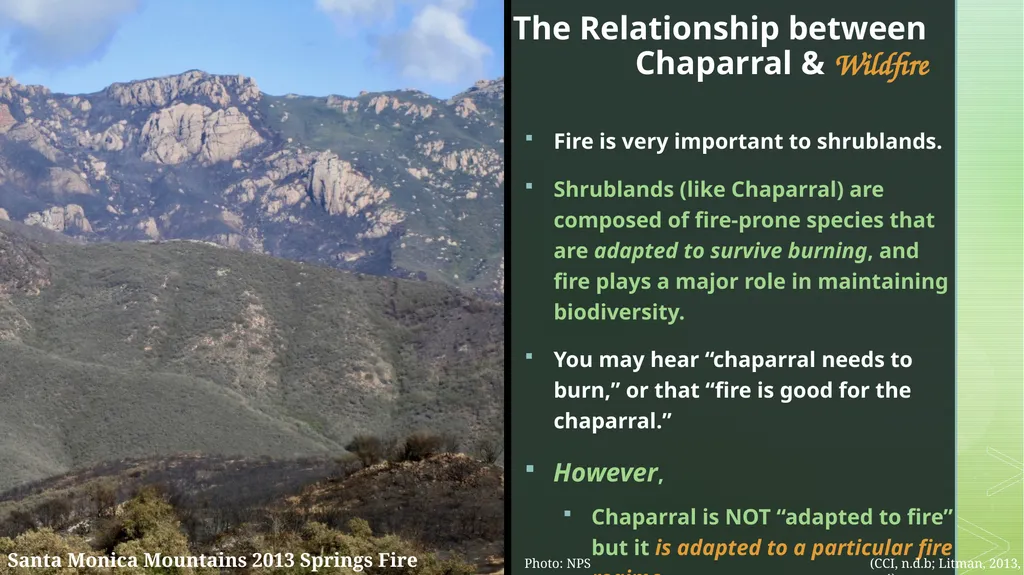
Chaparral is NOT “adapted to fire” but it is adapted to a particular fire regime. (CCI, n.d.b; Litman, 2013, p. 4) Santa Monica Mountains 2013 Springs Fire Burn Scar Photo: NPS<br>
Shrublands (like Chaparral) are composed of fire-prone species that are adapted to survive burning, and fire plays a major role in maintaining biodiversity.
You may hear “chaparral needs to burn,” or that “fire is good for the chaparral.”
However,
Chaparral is NOT “adapted to fire” but it is adapted to a particular fire regime. (CCI, n.d.b; Litman, 2013, p. 4) Santa Monica Mountains 2013 Springs Fire Burn Scar Photo: NPS<br>
07
Chaparral Natural fire Regime Characterized by:
A Fire Return Interval between 30-150+ years or more.
Fires occurring in the summer or fall when lightning appears.
Fires that burn with high intensity and severity (CCI, n.d.b)<br>
A Fire Return Interval between 30-150+ years or more.
Fires occurring in the summer or fall when lightning appears.
Fires that burn with high intensity and severity (CCI, n.d.b)<br>
08
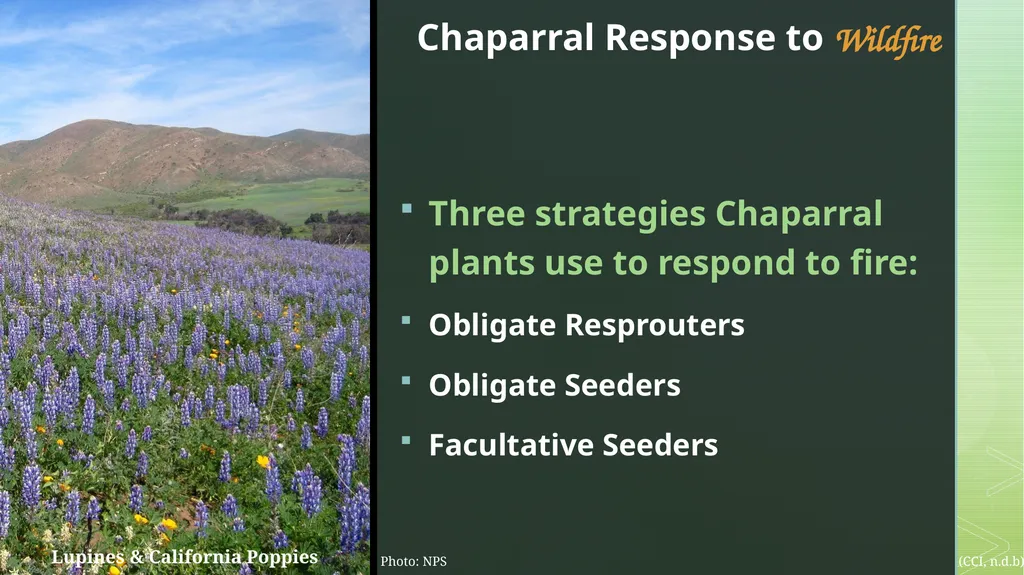
Chaparral Response to Wildfire Three strategies Chaparral plants use to respond to fire:
Obligate Resprouters
Obligate Seeders
Facultative Seeders (CCI, n.d.b) Photo: NPS Lupines & California Poppies<br>
Obligate Resprouters
Obligate Seeders
Facultative Seeders (CCI, n.d.b) Photo: NPS Lupines & California Poppies<br>
09
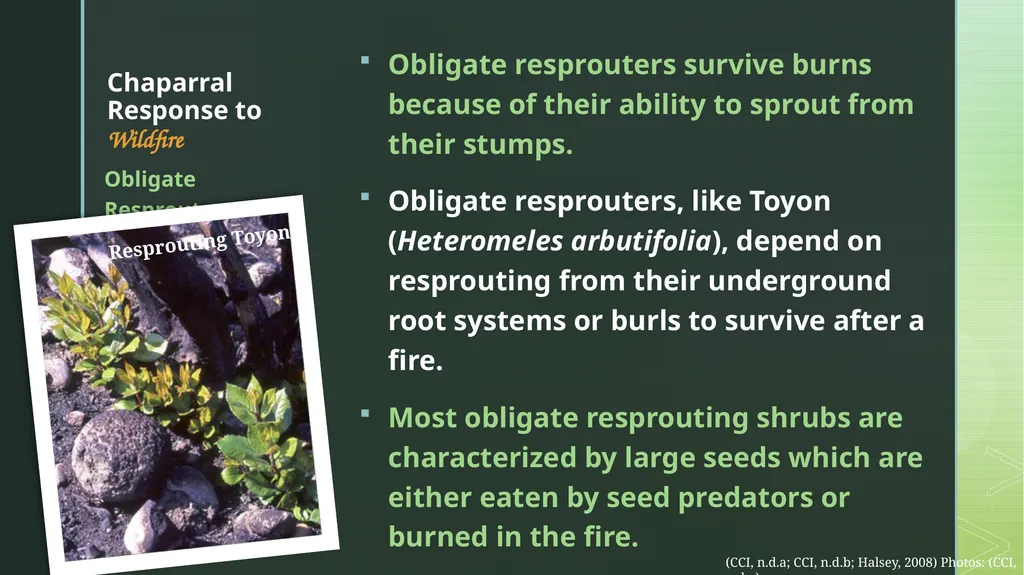
Chaparral Response to Wildfire Obligate resprouters survive burns because of their ability to sprout from their stumps.
Obligate resprouters, like Toyon (Heteromeles arbutifolia), depend on resprouting from their underground root systems or burls to survive after a fire.
Most obligate resprouting shrubs are characterized by large seeds which are either eaten by seed predators or burned in the fire. Obligate Resprouters (CCI, n.d.a; CCI, n.d.b; Halsey, 2008) Photos: (CCI, n.d.a) Resprouting Toyon<br>
Obligate resprouters, like Toyon (Heteromeles arbutifolia), depend on resprouting from their underground root systems or burls to survive after a fire.
Most obligate resprouting shrubs are characterized by large seeds which are either eaten by seed predators or burned in the fire. Obligate Resprouters (CCI, n.d.a; CCI, n.d.b; Halsey, 2008) Photos: (CCI, n.d.a) Resprouting Toyon<br>
10
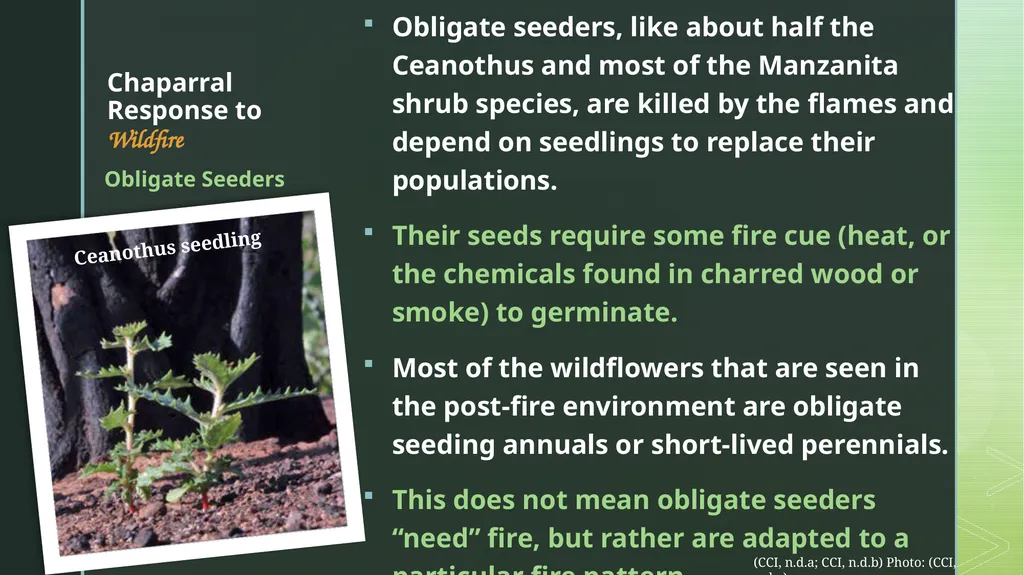
Chaparral Response to Wildfire Obligate seeders, like about half the Ceanothus and most of the Manzanita shrub species, are killed by the flames and depend on seedlings to replace their populations.
Their seeds require some fire cue (heat, or the chemicals found in charred wood or smoke) to germinate.
Most of the wildflowers that are seen in the post-fire environment are obligate seeding annuals or short-lived perennials.
This does not mean obligate seeders “need” fire, but rather are adapted to a particular fire pattern. Obligate Seeders (CCI, n.d.a; CCI, n.d.b) Photo: (CCI, n.d.a) Ceanothus seedling<br>
Their seeds require some fire cue (heat, or the chemicals found in charred wood or smoke) to germinate.
Most of the wildflowers that are seen in the post-fire environment are obligate seeding annuals or short-lived perennials.
This does not mean obligate seeders “need” fire, but rather are adapted to a particular fire pattern. Obligate Seeders (CCI, n.d.a; CCI, n.d.b) Photo: (CCI, n.d.a) Ceanothus seedling<br>
11
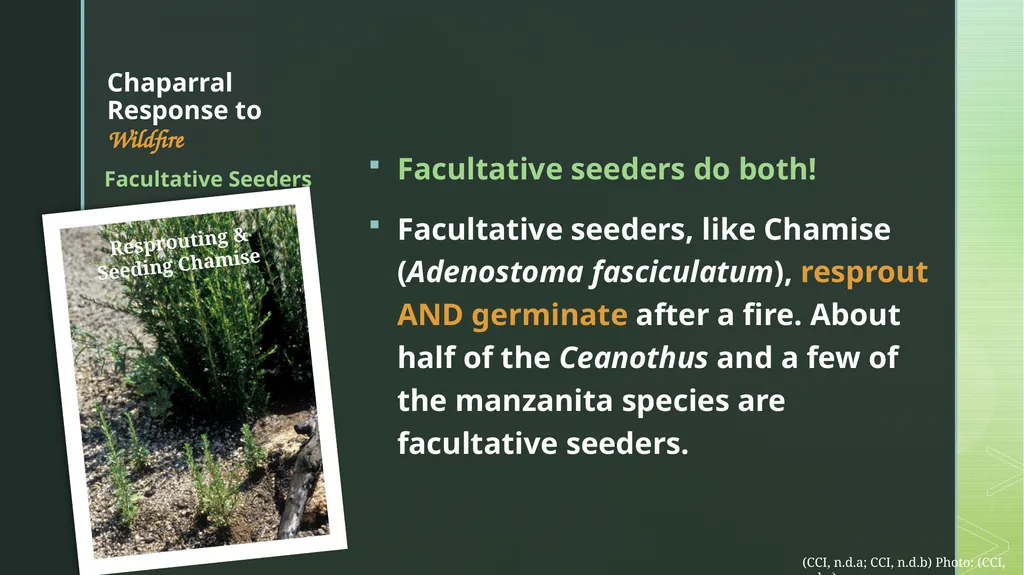
Chaparral Response to Wildfire Facultative seeders do both!
Facultative seeders, like Chamise (Adenostoma fasciculatum), resprout AND germinate after a fire. About half of the Ceanothus and a few of the manzanita species are facultative seeders. Facultative Seeders (CCI, n.d.a; CCI, n.d.b) Photo: (CCI, n.d.a) Resprouting & Seeding Chamise<br>
Facultative seeders, like Chamise (Adenostoma fasciculatum), resprout AND germinate after a fire. About half of the Ceanothus and a few of the manzanita species are facultative seeders. Facultative Seeders (CCI, n.d.a; CCI, n.d.b) Photo: (CCI, n.d.a) Resprouting & Seeding Chamise<br>
12
Changing Fire Return Intervals Effects on Flora<br>
13
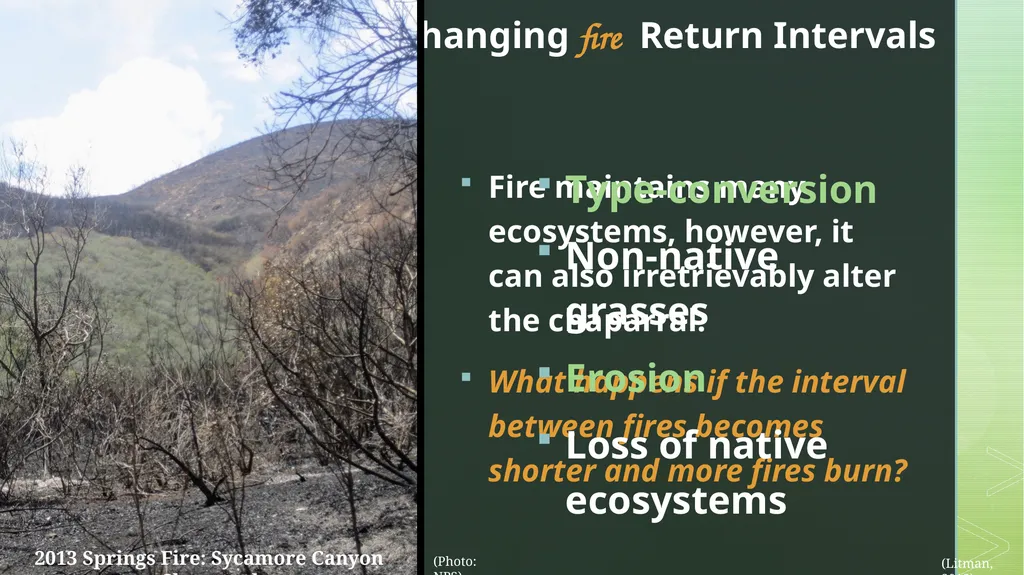
Changing fire Return Intervals Fire maintains many ecosystems, however, it can also irretrievably alter the chaparral.
What happens if the interval between fires becomes shorter and more fires burn? (Litman, 2013) 2013 Springs Fire: Sycamore Canyon Chaparral (Photo: NPS) Type-conversion
Non-native grasses
Erosion
Loss of native ecosystems<br>
What happens if the interval between fires becomes shorter and more fires burn? (Litman, 2013) 2013 Springs Fire: Sycamore Canyon Chaparral (Photo: NPS) Type-conversion
Non-native grasses
Erosion
Loss of native ecosystems<br>
14
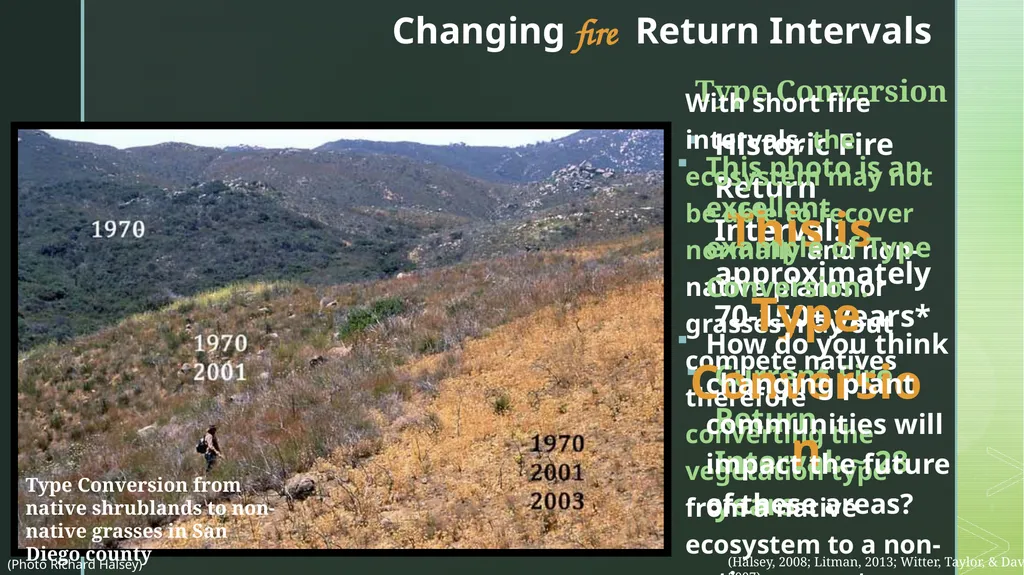
(Photo Richard Halsey) Changing fire Return Intervals Type Conversion Historic Fire Return Interval: approximately 70-150+ years*
Current Fire Return Interval: ~ 28 years Type Conversion from native shrublands to non-native grasses in San Diego county With short fire intervals, the ecosystem may not be able to recover normally and non-native plants or grasses may out compete natives therefore converting the vegetation type from a native ecosystem to a non-native ecosystem. This is
Type Conversion This photo is an excellent example of Type Conversion.
How do you think changing plant communities will impact the future of these areas? (Halsey, 2008; Litman, 2013; Witter, Taylor, & Davis, 2007)<br>
Current Fire Return Interval: ~ 28 years Type Conversion from native shrublands to non-native grasses in San Diego county With short fire intervals, the ecosystem may not be able to recover normally and non-native plants or grasses may out compete natives therefore converting the vegetation type from a native ecosystem to a non-native ecosystem. This is
Type Conversion This photo is an excellent example of Type Conversion.
How do you think changing plant communities will impact the future of these areas? (Halsey, 2008; Litman, 2013; Witter, Taylor, & Davis, 2007)<br>
15
Changing fire Return Intervals Non-native grasslands dry out earlier in the spring and increase the length of the fire season. They are highly combustible which increases the probability of ignition.
These grassy weeds, known as “flashy fuels” spread faster than Chaparral plants.
Loss of ecosystem services including carbon storage, erosion control, water provisioning, biodiversity, and aesthetic recreational values.
Type converted grasslands represent a loss of habitat for native Chaparral animals.
Loss of the native herbaceous flora that follows fire. These flowers act as nature’s own “band-aid” erosion control measure. These beautiful wildflowers and the Chaparral plants that follow are much better at erosion control than non-native grasses. Non-native Grasses,
Loss of Ecosystems, & Erosion (Halsey, 2008, p. 26 & 93; USGS, 2014) Consequences of type converted non-native grasslands:<br>
These grassy weeds, known as “flashy fuels” spread faster than Chaparral plants.
Loss of ecosystem services including carbon storage, erosion control, water provisioning, biodiversity, and aesthetic recreational values.
Type converted grasslands represent a loss of habitat for native Chaparral animals.
Loss of the native herbaceous flora that follows fire. These flowers act as nature’s own “band-aid” erosion control measure. These beautiful wildflowers and the Chaparral plants that follow are much better at erosion control than non-native grasses. Non-native Grasses,
Loss of Ecosystems, & Erosion (Halsey, 2008, p. 26 & 93; USGS, 2014) Consequences of type converted non-native grasslands:<br>
16
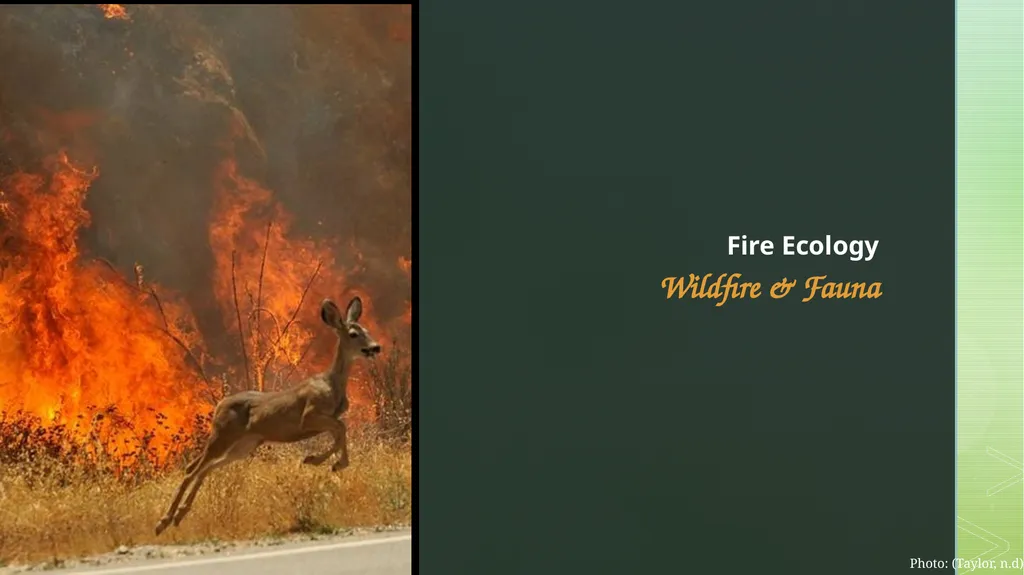
Wildfire & Fauna Fire Ecology Photo: (Taylor, n.d)<br>
17
Responses of fauna to Wildfire “Despite the perception by the general public that wildland fire is devastating to all animals, fires generally kill and injure a relatively small proportion of animal populations.”
Animals with limited mobility living above ground are the most vulnerable to injury & death from fire.
“Predators and scavengers are often attracted to burns because their food is more abundant or more exposed than on unburned sites.”
Burning increases seed visibility and availability for small mammals but also increases their visibility to predators. (Smith, 2000, p. 17 & 22)<br>
Animals with limited mobility living above ground are the most vulnerable to injury & death from fire.
“Predators and scavengers are often attracted to burns because their food is more abundant or more exposed than on unburned sites.”
Burning increases seed visibility and availability for small mammals but also increases their visibility to predators. (Smith, 2000, p. 17 & 22)<br>
18
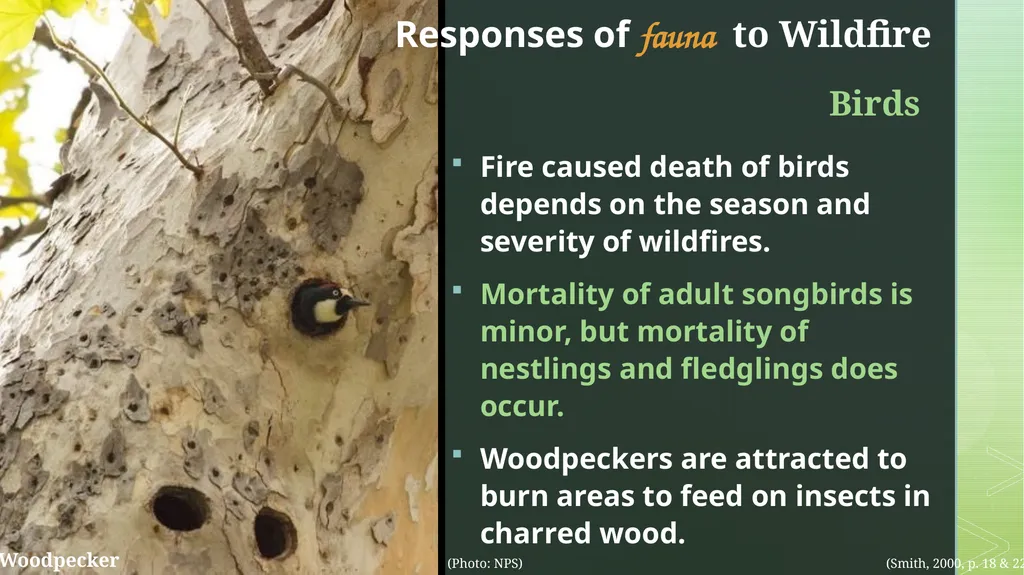
Responses of fauna to Wildfire Fire caused death of birds depends on the season and severity of wildfires.
Mortality of adult songbirds is minor, but mortality of nestlings and fledglings does occur.
Woodpeckers are attracted to burn areas to feed on insects in charred wood. (Smith, 2000, p. 18 & 22) Birds Woodpecker (Photo: NPS)<br>
Mortality of adult songbirds is minor, but mortality of nestlings and fledglings does occur.
Woodpeckers are attracted to burn areas to feed on insects in charred wood. (Smith, 2000, p. 18 & 22) Birds Woodpecker (Photo: NPS)<br>
19
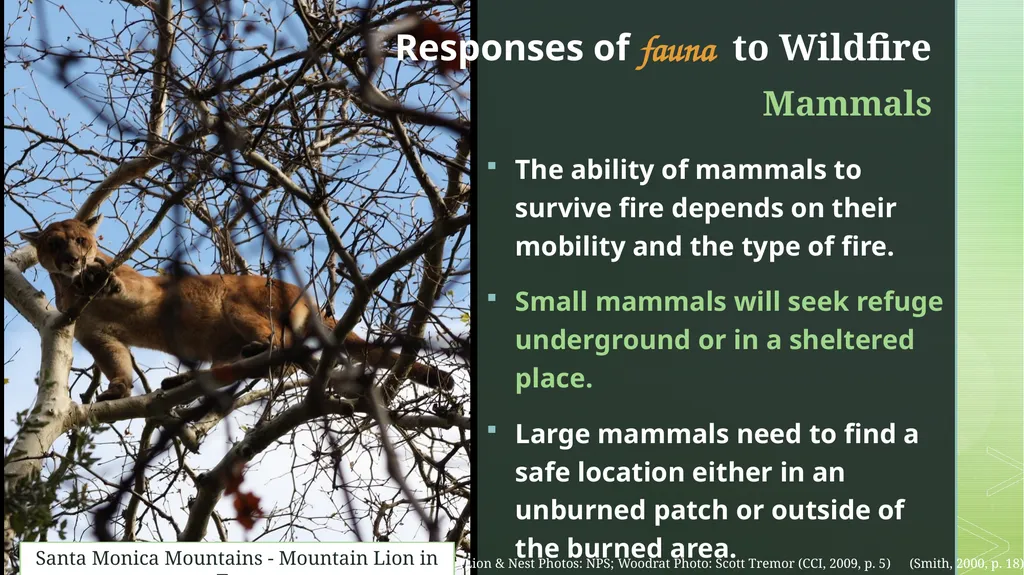
Woodrat & Nest Santa Monica Mountains - Mountain Lion in Tree The ability of mammals to survive fire depends on their mobility and the type of fire.
Small mammals will seek refuge underground or in a sheltered place.
Large mammals need to find a safe location either in an unburned patch or outside of the burned area. (Smith, 2000, p. 18) Mammals Responses of fauna to Wildfire (Lion & Nest Photos: NPS; Woodrat Photo: Scott Tremor (CCI, 2009, p. 5)<br>
Small mammals will seek refuge underground or in a sheltered place.
Large mammals need to find a safe location either in an unburned patch or outside of the burned area. (Smith, 2000, p. 18) Mammals Responses of fauna to Wildfire (Lion & Nest Photos: NPS; Woodrat Photo: Scott Tremor (CCI, 2009, p. 5)<br>
20
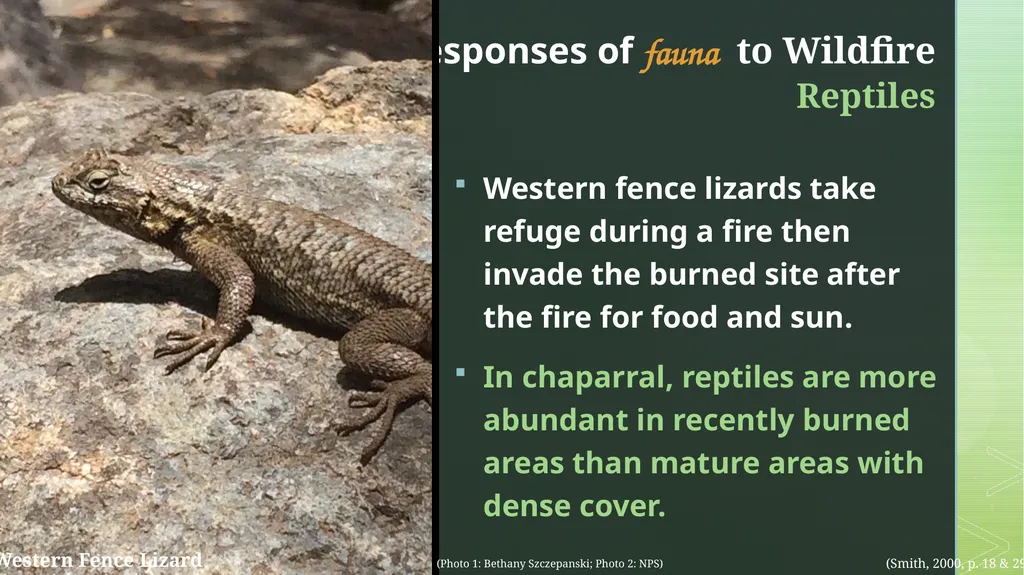
Western fence lizards take refuge during a fire then invade the burned site after the fire for food and sun.
In chaparral, reptiles are more abundant in recently burned areas than mature areas with dense cover. (Smith, 2000, p. 18 & 29) Reptiles Responses of fauna to Wildfire Western Fence Lizard after the Springs Fire Western Fence Lizard (Photo 1: Bethany Szczepanski; Photo 2: NPS)<br>
In chaparral, reptiles are more abundant in recently burned areas than mature areas with dense cover. (Smith, 2000, p. 18 & 29) Reptiles Responses of fauna to Wildfire Western Fence Lizard after the Springs Fire Western Fence Lizard (Photo 1: Bethany Szczepanski; Photo 2: NPS)<br>
21
Wildfire & Humans Fire Ecology<br>
22
Wildfire and Humans What is the relationship between humans and wildfire? Human Causation of Wildfires
Effects of Wildfires on Humans
Human Restoration & Recovery Efforts after Fire<br>
Effects of Wildfires on Humans
Human Restoration & Recovery Efforts after Fire<br>
23
Human Causation of Wildfires Wildfire and Humans<br>
24
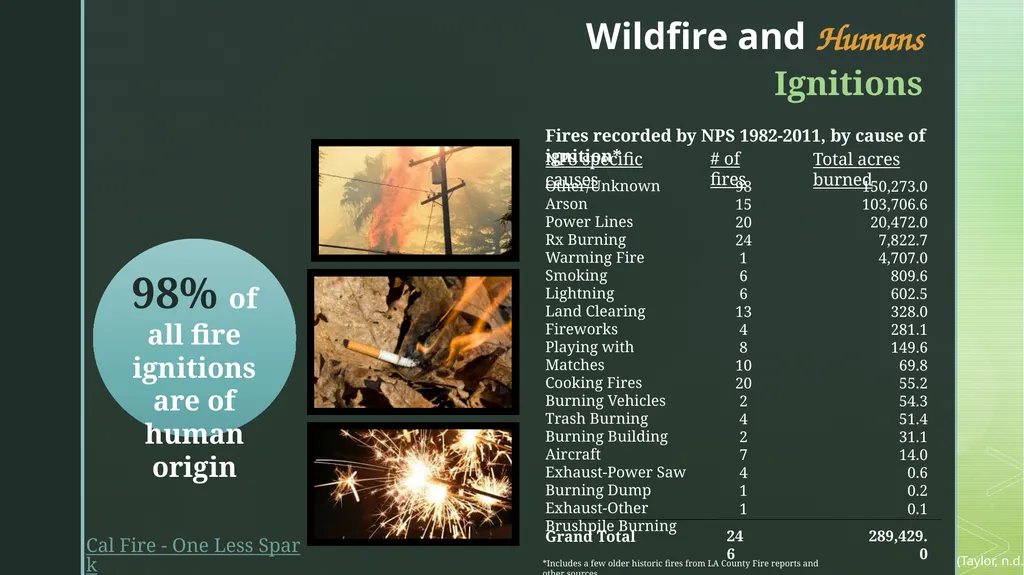
Ignitions (Taylor, n.d.) Cal Fire - One Less Spark Wildfire and Humans 98% of all fire ignitions are of human origin Fires recorded by NPS 1982-2011, by cause of ignition* # of fires NPS specific causes Total acres burned Other/Unknown
Arson
Power Lines
Rx Burning
Warming Fire
Smoking
Lightning
Land Clearing
Fireworks
Playing with Matches
Cooking Fires
Burning Vehicles
Trash Burning
Burning Building
Aircraft
Exhaust-Power Saw
Burning Dump
Exhaust-Other
Brushpile Burning 98
15
20
24
1
6
6
13
4
8
10
20
2
4
2
7
4
1
1 150,273.0
103,706.6
20,472.0
7,822.7
4,707.0
809.6
602.5
328.0
281.1
149.6
69.8
55.2
54.3
51.4
31.1
14.0
0.6
0.2
0.1 Grand Total 246 289,429.0 *Includes a few older historic fires from LA County Fire reports and other sources.<br>
Arson
Power Lines
Rx Burning
Warming Fire
Smoking
Lightning
Land Clearing
Fireworks
Playing with Matches
Cooking Fires
Burning Vehicles
Trash Burning
Burning Building
Aircraft
Exhaust-Power Saw
Burning Dump
Exhaust-Other
Brushpile Burning 98
15
20
24
1
6
6
13
4
8
10
20
2
4
2
7
4
1
1 150,273.0
103,706.6
20,472.0
7,822.7
4,707.0
809.6
602.5
328.0
281.1
149.6
69.8
55.2
54.3
51.4
31.1
14.0
0.6
0.2
0.1 Grand Total 246 289,429.0 *Includes a few older historic fires from LA County Fire reports and other sources.<br>
25
Effects of Wildfires on Humans Wildfire and Humans<br>
26
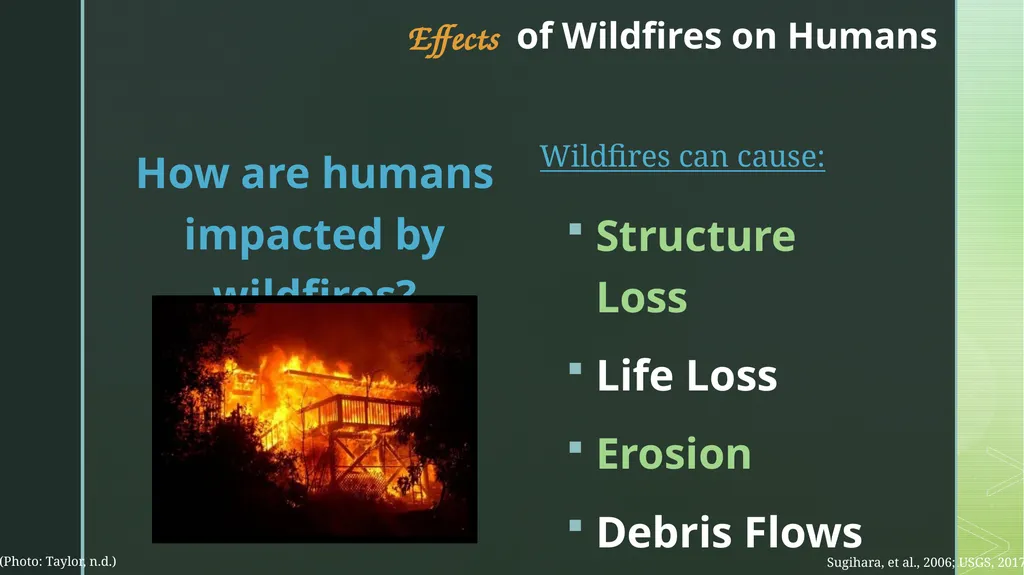
How are humans impacted by wildfires? Structure Loss
Life Loss
Erosion
Debris Flows Effects of Wildfires on Humans Wildfires can cause: (Photo: Taylor, n.d.) Sugihara, et al., 2006; USGS, 2017)<br>
Life Loss
Erosion
Debris Flows Effects of Wildfires on Humans Wildfires can cause: (Photo: Taylor, n.d.) Sugihara, et al., 2006; USGS, 2017)<br>
27
Human Restoration efforts after Wildfires Wildfire and Humans<br>
28
Restoration after Wildfire (Halsey, 2008, p. 90) After a fire, should we let nature restore itself as it has done many times before or should we step in to help? There is no simple answer.
Chaparral is good at recovering on its own.
However, since humans arrived, we have made many changes to the environment.
Therefore, there are circumstances when managers need to step in and help protect human life, property, and our native ecosystems from further degradation after a fire.<br>
Chaparral is good at recovering on its own.
However, since humans arrived, we have made many changes to the environment.
Therefore, there are circumstances when managers need to step in and help protect human life, property, and our native ecosystems from further degradation after a fire.<br>
29
Restoration after Wildfire (Halsey, 2008, p. 88) Springs Fire BAER Plan Burned Area Emergency Response (BAER) teams are a collection of scientists, foresters, and representatives from various government agencies responsible for identifying hazards and recommending mitigation they feel is needed to protect communities and resources from post-fire impacts.
Teams will identify:
where flooding or debris flows are likely to occur and how to reduce the impacts by clearing culverts or channels and having storm patrols.
where burned trees may be hazardous and need to be cut down.
areas where exposed cultural resource sites need to be protected from looting when they are exposed after a fire.<br>
Teams will identify:
where flooding or debris flows are likely to occur and how to reduce the impacts by clearing culverts or channels and having storm patrols.
where burned trees may be hazardous and need to be cut down.
areas where exposed cultural resource sites need to be protected from looting when they are exposed after a fire.<br>
30
Wildfire and Humans Human Recovery: Learning from Wildfires<br>
31
Learning from fires Wildfires are the most relevant in the Wildland Urban Interface (WUI). These are the locations where homes make direct contact with the natural environment.
In these places, it is important for citizens to take responsibility for wildland fire protection by creating an environment that will maximize the chance of survival for their homes while creating a safe space for firefighters to work.
It is also important for policy makers and urban planners to create safe and sustainable communities, so fire can continue to play its role within the natural landscapes that are so important for us and our future generations. (Halsey, 2008, p. xvii & 103-109) Southern California has a climate and vegetation that lead to extreme, uncontrollable fire behavior. Fire prevention and management strategies have had very little effect on reducing fires.
Fire has been present for millions of years and will continue to be here in the future. Thus, like other natural hazards, we must learn to live with wildfire.<br>
In these places, it is important for citizens to take responsibility for wildland fire protection by creating an environment that will maximize the chance of survival for their homes while creating a safe space for firefighters to work.
It is also important for policy makers and urban planners to create safe and sustainable communities, so fire can continue to play its role within the natural landscapes that are so important for us and our future generations. (Halsey, 2008, p. xvii & 103-109) Southern California has a climate and vegetation that lead to extreme, uncontrollable fire behavior. Fire prevention and management strategies have had very little effect on reducing fires.
Fire has been present for millions of years and will continue to be here in the future. Thus, like other natural hazards, we must learn to live with wildfire.<br>
32
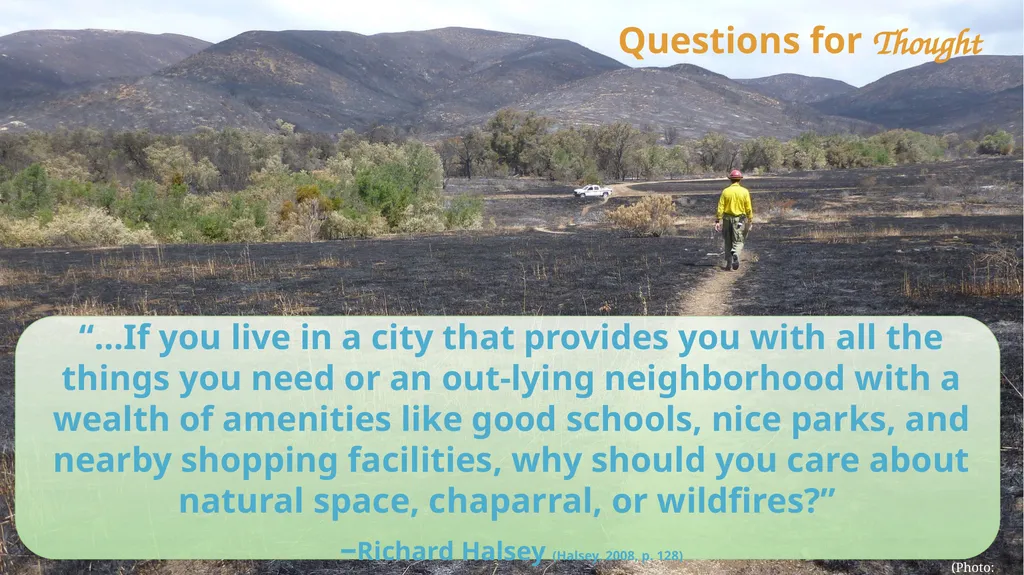
Questions for Thought “…If you live in a city that provides you with all the things you need or an out-lying neighborhood with a wealth of amenities like good schools, nice parks, and nearby shopping facilities, why should you care about natural space, chaparral, or wildfires?”
–Richard Halsey (Halsey, 2008, p. 128) (Photo: NPS)<br>
–Richard Halsey (Halsey, 2008, p. 128) (Photo: NPS)<br>
33
National Park Service (NPS). (2016). Create defensible space. Retrieved May 4, 2018, from https://www.nps.gov/samo/learn/management/create-defensible-space.htm
National Park Service (NPS). (2018). Fire ecology. Retrieved April 22, 2018, from https://www.nps.gov/samo/learn/management/fireecology.htm
National Park Service (NPS). (n.d.a). Learning about Fire Ecology Basics. Retrieved January 29, 2018, from https://www.nps.gov/articles/learning-about-fire-ecology-basics.htm)
National Park Service (NPS). (n.d.b). Wildland fire: Science ecology research. Retrieved April 21, 2018, from https://www.nps.gov/fire/wildland-fire/what-we-do/science-ecology-and-research.cfm
Paysen, T., Ansley, R.J., Brown, J., Gottfried, G., Haase, S., Harrington, M., …Wilson, R. (2000). Fire in western shrubland, woodland, and grassland ecosystems. Chapter 6. USDA Forest Service Gen. Tech. Rep. RMRS-GTR-42-vol. 2.
Quinn, R. D. (1979). Effects of fire on small mammals in the chaparral. Cal-Neva Wildlife Transactions.
Quinn, R. D. (1990). Habitat preferences and distribution of mammals in California chaparral. Res. Pap. PSW-202. Berkeley, CA: U.S. Department of Agriculture, Forest Service, Pacific Southwest Research Station.
Schwilk, D. W., & Keeley, J. E. (1998). Rodent populations after a large wildfire in California chaparral and coastal sage scrub. Southwestern Naturalist,43(4), 480-483.
Simons, L. H. (1991). Rodent dynamics in relation to fire in the Sonoran Desert. Journal of Mammalogy,72(3), 518-524. doi:10.2307/1382135
Singer, F. J., & Schullery, P. (1989). Yellowstone wildlife: Populations in process. Western Wildlands,15(2), 18-22.
Smith, J. K. (2000). Wildland fire in ecosystems: Effects of fire on fauna (Vol. 1, Gen Tech Rep RMRS-GTR-42). Fort Collins: U.S. Dept. of Agriculture, Forest Service, Rocky Mountain Research Station.
Sugihara, N. G., van Wagtendonk, J. W., Shaffer, K. E., Fites-Kaufman, J., Thode, A. (Eds.). (2006). Fire in california's ecosystems. Retrieved from https://ebookcentral.proquest.com
Taylor, R. S. (n.d.). Fire regime, fire history, and fire behavior in the Santa Monica Mountains [PowerPoint slides].
United States Geological Survey (USGS). (2014). Living with fire [film]. Retrieved April 24, 2018 from https://www.youtube.com/watch?v=aJ9mE0TzrX0
United States Geological Survey (USGS). (2017). Post-fire debris flow. Retrieved April 28, 2018, from https://ca.water.usgs.gov/flooding/wildfires-debris-flow.html
Wells, C.G., Campbell, R.E., DeBano, L.F., Lewis, C.E., Fredricksen, R.L., Franklin, E.C., …Dunn, P.H. (1979). Effects of fire on soil: a state of knowledge review. USDA Forest Service, General Technical Report WO-7.
Witter, M., Taylor, R., Davis, S. (2007). Vegetation response to wildfire and history in the Santa Monica mountains, California. In Flora and ecology of the Santa Monica Mountains: Proceedings of the 32nd annual Southern California Botanists symposium, ed. D.A. Knapp, (pp. 173-194). Southern California Botanists Special Publication No. 4, Fullerton, CA.
Wooten, G. (n.d.). Fire and fuels management: Definitions, ambiguous terminology and references. Retrieved April 13, 2018, from https://www.nps.gov/olym/learn/management/upload/fire-wildfire-definitions-2.pdf
Zedler, P.H. (1995). Fire frequency in southern California shrublands: Biological effects and management options. In Brushfires in California: Ecology and resource management, eds. J.E. Keeley and T. Scott, 101-112. International Association of Wildland Fire, Fairfield, WA. References Bendell, J. F. (1974). Effects of fire on birds and mammals. Fire and Ecosystems,73-138. doi:10.1016/b978-0-12-424255-5.50009-2
Biswell, H. H. (1989). Prescribed burning in California wildlands vegetation management. Berkeley: University of California Press.
California Chaparral Institute (CCI). (n.d.a). Fire and nature. Retrieved April 07, 2018, from http://www.californiachaparral.org/fire/firenature.html
California Chaparral Institute (CCI). (n.d.b). What’s the chaparral’s relationship to fire? [Informational Handout]. www.californiachaparral.org. Retrieved from personal communication from Richard Halsey
Carey, H. & Schumann, M. (2003). Modifying wildfire behavior – The effectiveness of fuel treatments: The status of our knowledge. National Community Forestry Center, Southwest Region. Working Paper April 2003.
DeBano, L.F., (1981). Water repellent soils: a state-of-the-art. USDA Forest Service, Pacific Southwest Forest and Range Experiment Station, General Technical Report PSW-46.
DeBano, L. F., Neary, D. G., & Ffolliott, P. F. (1998). Fire's effects on ecosystems. New York, NY: John Wiley and Sons.
Dodd, N. L. (1988). Fire management and southwestern raptors. In: Glinski, R. L.; Pendleton, Beth Giron; Moss, Mary Beth; [and others], eds. Proceedings of the southwest raptor symposium and workshop; 1986 May 21-24; Tucson, AZ. NWF Scientific and Technology Series No. 11. Washington, DC: National Wildlife Federation: 341-347.
Ecological Society of America (ESA). (n.d.). What does ecology have to do with me. Retrieved February 13, 2018, from https://www.esa.org/esa/education-and-diversity/what-does-ecology-have-to-do-with-me/
Erwin, W. J., & Stasiak, R. H. (1979). Vertebrate mortality during the burning of a reestablished prairie in Nebraska. American Midland Naturalist,101(1), 247. doi:10.2307/2424922
Ford, W. M., Menzel, M., Mcgill, D. W., Laerm, J., & Mccay, T. S. (1999). Effects of a community restoration fire on small mammals and herpetofauna in the southern Appalachians. Forest Ecology and Management,114(2-3), 233-243. doi:10.1016/s0378-1127(98)00354-5
Halsey, R. W. (2008). Fire, chaparral, and survival in southern California. San Diego, CA: Sunbelt Publications.
Hart, S. (1998). Beetle mania: An attraction to fire. BioScience,48(1), 3-5. doi:10.2307/1313221
Kaufman, G. A., Kaufman, D. W., & Finck, E. J. (1988). Influence of fire and topography on habitat selection by peromyscus maniculatus and reithrodontomys megalotis in ungrazed tallgrass prairie. Journal of Mammalogy,69(2), 342-352. doi:10.2307/1381384
Keeley, J.E., Pfaff, A.H., & Safford, H.D. (2005). Fire suppression impacts on postfire recovery of Sierra Nevada chaparral shrublands. International Journal of Wildland Fire, 14 (pp. 255-265).
Komarek, E. V., Sr. (1969). Fire and animal behavior. In: Proceedings, 9th annual Tall Timbers Fire Ecology conference; 1969 April 10-11; Tallahassee, FL. Tallahassee, FL: Tall Timbers Research Station: 161-207.
Lillywhite, H. B., & North, F. (1974). Perching behavior of sceloporus occidentalis in recently burned chaparral. Copeia,1974(1), 256. doi:10.2307/1443035
Litman, L. (Ed.). (2013). California’s native landscape. Forestland Steward, Summer 2013. Retrieved March 21, 2018, from http://calfire.ca.gov/foreststeward/pdf/news-summer2013.pdf
Morearty, D. J., Farris, R. E., Noda, D. K., & Stanton, P. A. (1985). Effects of fire on a coastal sage scrub bird community. The Southwestern Naturalist,30(3), 452. doi:10.2307/3671284
National Park Service (NPS). (2005). Environmental impact statement fire management plan. United State Department of the Interior, National Park Service. Santa Monica Mountains National Recreation Area, Thousand Oaks, CA.<br>
National Park Service (NPS). (2018). Fire ecology. Retrieved April 22, 2018, from https://www.nps.gov/samo/learn/management/fireecology.htm
National Park Service (NPS). (n.d.a). Learning about Fire Ecology Basics. Retrieved January 29, 2018, from https://www.nps.gov/articles/learning-about-fire-ecology-basics.htm)
National Park Service (NPS). (n.d.b). Wildland fire: Science ecology research. Retrieved April 21, 2018, from https://www.nps.gov/fire/wildland-fire/what-we-do/science-ecology-and-research.cfm
Paysen, T., Ansley, R.J., Brown, J., Gottfried, G., Haase, S., Harrington, M., …Wilson, R. (2000). Fire in western shrubland, woodland, and grassland ecosystems. Chapter 6. USDA Forest Service Gen. Tech. Rep. RMRS-GTR-42-vol. 2.
Quinn, R. D. (1979). Effects of fire on small mammals in the chaparral. Cal-Neva Wildlife Transactions.
Quinn, R. D. (1990). Habitat preferences and distribution of mammals in California chaparral. Res. Pap. PSW-202. Berkeley, CA: U.S. Department of Agriculture, Forest Service, Pacific Southwest Research Station.
Schwilk, D. W., & Keeley, J. E. (1998). Rodent populations after a large wildfire in California chaparral and coastal sage scrub. Southwestern Naturalist,43(4), 480-483.
Simons, L. H. (1991). Rodent dynamics in relation to fire in the Sonoran Desert. Journal of Mammalogy,72(3), 518-524. doi:10.2307/1382135
Singer, F. J., & Schullery, P. (1989). Yellowstone wildlife: Populations in process. Western Wildlands,15(2), 18-22.
Smith, J. K. (2000). Wildland fire in ecosystems: Effects of fire on fauna (Vol. 1, Gen Tech Rep RMRS-GTR-42). Fort Collins: U.S. Dept. of Agriculture, Forest Service, Rocky Mountain Research Station.
Sugihara, N. G., van Wagtendonk, J. W., Shaffer, K. E., Fites-Kaufman, J., Thode, A. (Eds.). (2006). Fire in california's ecosystems. Retrieved from https://ebookcentral.proquest.com
Taylor, R. S. (n.d.). Fire regime, fire history, and fire behavior in the Santa Monica Mountains [PowerPoint slides].
United States Geological Survey (USGS). (2014). Living with fire [film]. Retrieved April 24, 2018 from https://www.youtube.com/watch?v=aJ9mE0TzrX0
United States Geological Survey (USGS). (2017). Post-fire debris flow. Retrieved April 28, 2018, from https://ca.water.usgs.gov/flooding/wildfires-debris-flow.html
Wells, C.G., Campbell, R.E., DeBano, L.F., Lewis, C.E., Fredricksen, R.L., Franklin, E.C., …Dunn, P.H. (1979). Effects of fire on soil: a state of knowledge review. USDA Forest Service, General Technical Report WO-7.
Witter, M., Taylor, R., Davis, S. (2007). Vegetation response to wildfire and history in the Santa Monica mountains, California. In Flora and ecology of the Santa Monica Mountains: Proceedings of the 32nd annual Southern California Botanists symposium, ed. D.A. Knapp, (pp. 173-194). Southern California Botanists Special Publication No. 4, Fullerton, CA.
Wooten, G. (n.d.). Fire and fuels management: Definitions, ambiguous terminology and references. Retrieved April 13, 2018, from https://www.nps.gov/olym/learn/management/upload/fire-wildfire-definitions-2.pdf
Zedler, P.H. (1995). Fire frequency in southern California shrublands: Biological effects and management options. In Brushfires in California: Ecology and resource management, eds. J.E. Keeley and T. Scott, 101-112. International Association of Wildland Fire, Fairfield, WA. References Bendell, J. F. (1974). Effects of fire on birds and mammals. Fire and Ecosystems,73-138. doi:10.1016/b978-0-12-424255-5.50009-2
Biswell, H. H. (1989). Prescribed burning in California wildlands vegetation management. Berkeley: University of California Press.
California Chaparral Institute (CCI). (n.d.a). Fire and nature. Retrieved April 07, 2018, from http://www.californiachaparral.org/fire/firenature.html
California Chaparral Institute (CCI). (n.d.b). What’s the chaparral’s relationship to fire? [Informational Handout]. www.californiachaparral.org. Retrieved from personal communication from Richard Halsey
Carey, H. & Schumann, M. (2003). Modifying wildfire behavior – The effectiveness of fuel treatments: The status of our knowledge. National Community Forestry Center, Southwest Region. Working Paper April 2003.
DeBano, L.F., (1981). Water repellent soils: a state-of-the-art. USDA Forest Service, Pacific Southwest Forest and Range Experiment Station, General Technical Report PSW-46.
DeBano, L. F., Neary, D. G., & Ffolliott, P. F. (1998). Fire's effects on ecosystems. New York, NY: John Wiley and Sons.
Dodd, N. L. (1988). Fire management and southwestern raptors. In: Glinski, R. L.; Pendleton, Beth Giron; Moss, Mary Beth; [and others], eds. Proceedings of the southwest raptor symposium and workshop; 1986 May 21-24; Tucson, AZ. NWF Scientific and Technology Series No. 11. Washington, DC: National Wildlife Federation: 341-347.
Ecological Society of America (ESA). (n.d.). What does ecology have to do with me. Retrieved February 13, 2018, from https://www.esa.org/esa/education-and-diversity/what-does-ecology-have-to-do-with-me/
Erwin, W. J., & Stasiak, R. H. (1979). Vertebrate mortality during the burning of a reestablished prairie in Nebraska. American Midland Naturalist,101(1), 247. doi:10.2307/2424922
Ford, W. M., Menzel, M., Mcgill, D. W., Laerm, J., & Mccay, T. S. (1999). Effects of a community restoration fire on small mammals and herpetofauna in the southern Appalachians. Forest Ecology and Management,114(2-3), 233-243. doi:10.1016/s0378-1127(98)00354-5
Halsey, R. W. (2008). Fire, chaparral, and survival in southern California. San Diego, CA: Sunbelt Publications.
Hart, S. (1998). Beetle mania: An attraction to fire. BioScience,48(1), 3-5. doi:10.2307/1313221
Kaufman, G. A., Kaufman, D. W., & Finck, E. J. (1988). Influence of fire and topography on habitat selection by peromyscus maniculatus and reithrodontomys megalotis in ungrazed tallgrass prairie. Journal of Mammalogy,69(2), 342-352. doi:10.2307/1381384
Keeley, J.E., Pfaff, A.H., & Safford, H.D. (2005). Fire suppression impacts on postfire recovery of Sierra Nevada chaparral shrublands. International Journal of Wildland Fire, 14 (pp. 255-265).
Komarek, E. V., Sr. (1969). Fire and animal behavior. In: Proceedings, 9th annual Tall Timbers Fire Ecology conference; 1969 April 10-11; Tallahassee, FL. Tallahassee, FL: Tall Timbers Research Station: 161-207.
Lillywhite, H. B., & North, F. (1974). Perching behavior of sceloporus occidentalis in recently burned chaparral. Copeia,1974(1), 256. doi:10.2307/1443035
Litman, L. (Ed.). (2013). California’s native landscape. Forestland Steward, Summer 2013. Retrieved March 21, 2018, from http://calfire.ca.gov/foreststeward/pdf/news-summer2013.pdf
Morearty, D. J., Farris, R. E., Noda, D. K., & Stanton, P. A. (1985). Effects of fire on a coastal sage scrub bird community. The Southwestern Naturalist,30(3), 452. doi:10.2307/3671284
National Park Service (NPS). (2005). Environmental impact statement fire management plan. United State Department of the Interior, National Park Service. Santa Monica Mountains National Recreation Area, Thousand Oaks, CA.<br>