Fire Protection Systems Acceptance Requirements
Description: Fire Protection Systems Acceptance Requirements for Projects Ron Flynn, University Fire Marshal Chris McLaughlin, FP System Associate Kathy MacCheyne, Assistant Fire Marshal Cornell University Environmental Health and Safety Objective To
Related Topics
Download Presentation
"Fire Protection Systems Acceptance Requirements" is the property of its rightful owner. Permission is granted to download and print the materials on this website for personal, non-commercial use only, and to display it on your personal computer provided you do not modify the materials and that you retain all copyright notices contained in the materials. By downloading content from our website, you accept the terms of this agreement.
Presentation Transcript
slide1. Fire Protection Systems Acceptance Requirements for Projects
Ron Flynn, University Fire Marshal
Chris McLaughlin, FP System Associate
Kathy MacCheyne, Assistant Fire Marshal Cornell University Environmental Health and Safety<br>
slide2. Objective To assure Cornell University has adequate fire protection and life safety systems that comply with applicable codes and standards<br>
slide3. Where does it start? ●Plan Review;
NYS Codes
NFPA Standards as referenced by applicable codes
CU Design Standards<br>
slide4. Fire Protection System Shutdowns and Impairments ●Shutdowns: as needed for work in an affected area must be requested from Customer Service 48 Hrs in advance. Contractors are not allowed to remove, tape over, bag or otherwise disable detection or sprinkler coverage.
●Impairments “Fire Code of NYS Section 901.7” An Impairment: the disabling of fire alarm devices or sprinkler system coverage in a building”<br>
slide5. Fire Protection System Impairments, continued Simple/Partial Impairment is the disabling of fire alarm devices or sprinkler system coverage in the immediate area of where work is to be performed
“We will not allow the impairment of both the fire alarm system and sprinkler system to occur at the same time”
a. Requires a Shutdown request to Customer Service 48 Hrs in advance
b. No Fire Watch will be required in most cases<br>
slide6. Fire Protection System Impairments, continued Full System Impairment is the disabling of a Full Fire Protection “System” (Sprinkler, Fire Alarm, Standpipe, FDC, Fire Pump, etc). OR Disabling a large portion of a fire protection system (multiple floors or a large area.)
“We will not allow the impairment of both the fire alarm system and sprinkler system to occur at the same time”<br>
slide7. Fire Protection SystemImpairments, continued Requirements for a full Impairment
1. Fire Watch will be required (EH&S does not perform the fire watch, it is the responsibility of the contractor)
2. Impairment notice will be sent by EHS to various agencies as required by code
Must Provide the following information to EHS minimum of48 Hrs in advance (kem9@cornell.edu)
-Contractor name and cell number “ who is doing the work”
-Area of fire protection impacted and time frame
-Dedicated fire watcher name and number
**Can have NO other responsibilities other than fire watch
Requires a Shutdown request to Customer Service 48 Hrs in advance
**When in doubt: contact EHS a minimum of 48 hrs in advance<br>
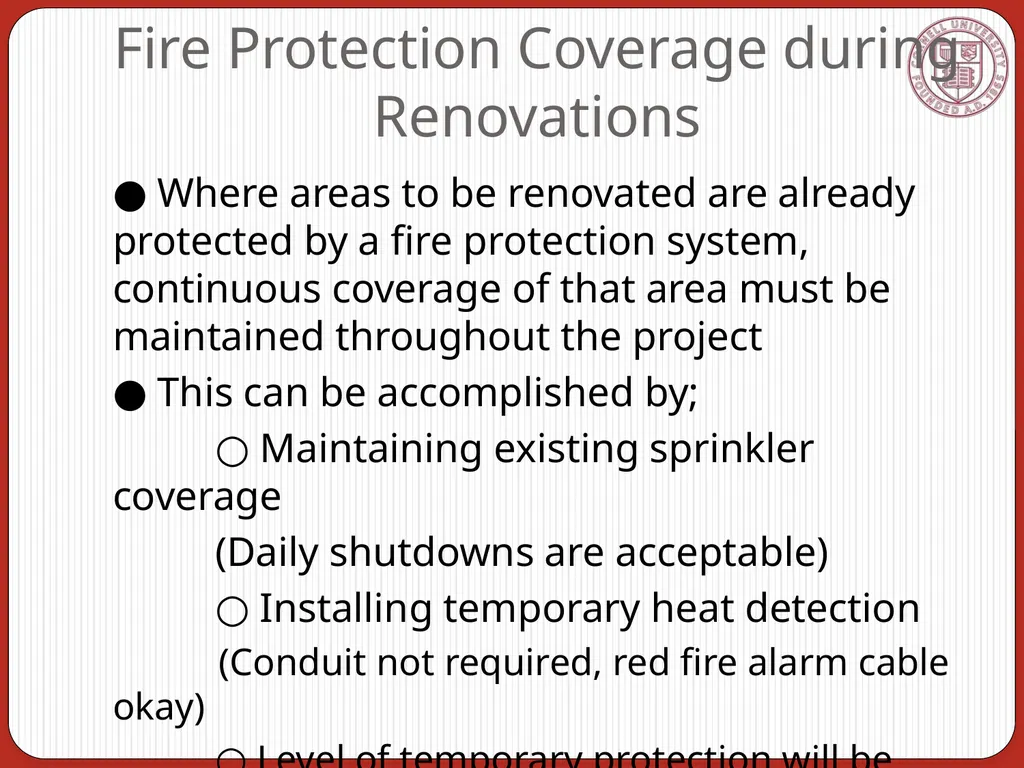
slide8. Fire Protection Coverage during Renovations ● Where areas to be renovated are already protected by a fire protection system, continuous coverage of that area must be maintained throughout the project
● This can be accomplished by;
○ Maintaining existing sprinkler coverage
(Daily shutdowns are acceptable)
○ Installing temporary heat detection
(Conduit not required, red fire alarm cable okay)
○ Level of temporary protection will be determined by the AHJ<br>
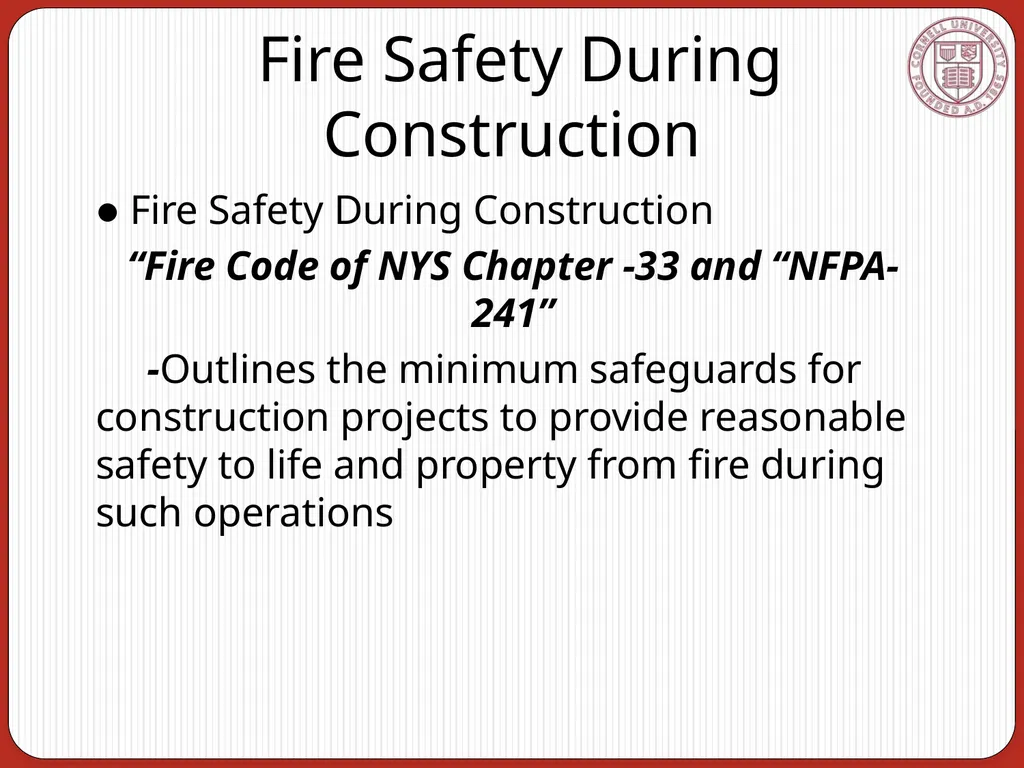
slide9. Fire Safety During Construction ● Fire Safety During Construction
“Fire Code of NYS Chapter -33 and “NFPA-241”
-Outlines the minimum safeguards for construction projects to provide reasonable safety to life and property from fire during such operations<br>
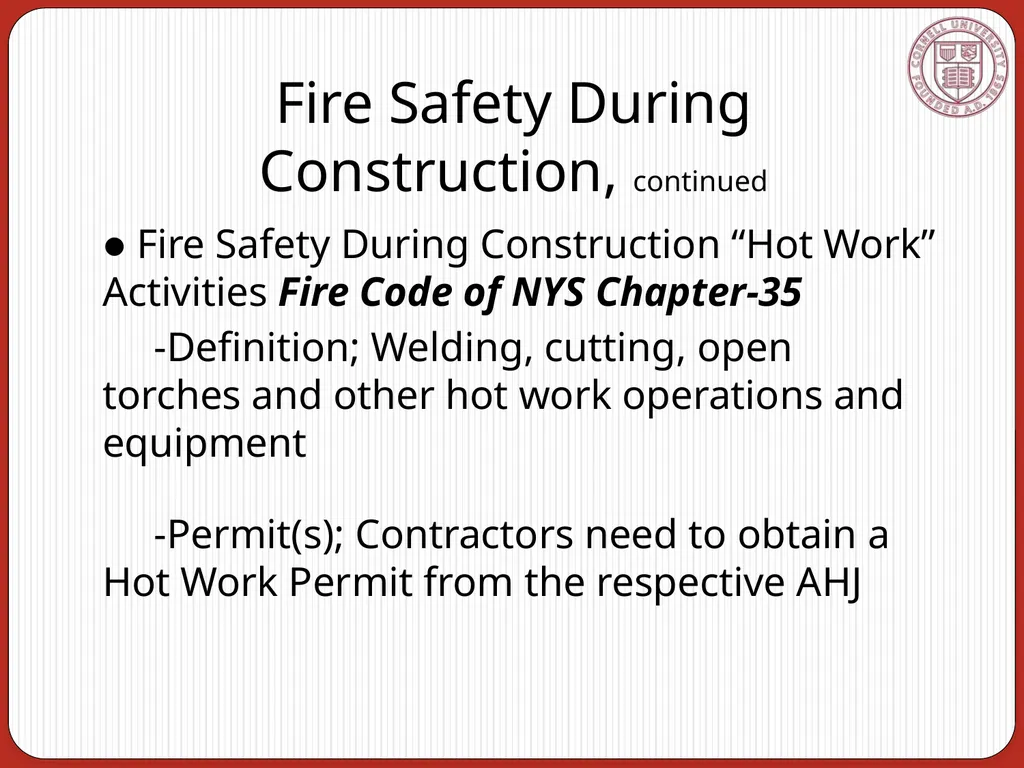
slide10. Fire Safety During Construction, continued ● Fire Safety During Construction “Hot Work” Activities Fire Code of NYS Chapter-35
-Definition; Welding, cutting, open torches and other hot work operations and equipment
-Permit(s); Contractors need to obtain a Hot Work Permit from the respective AHJ<br>
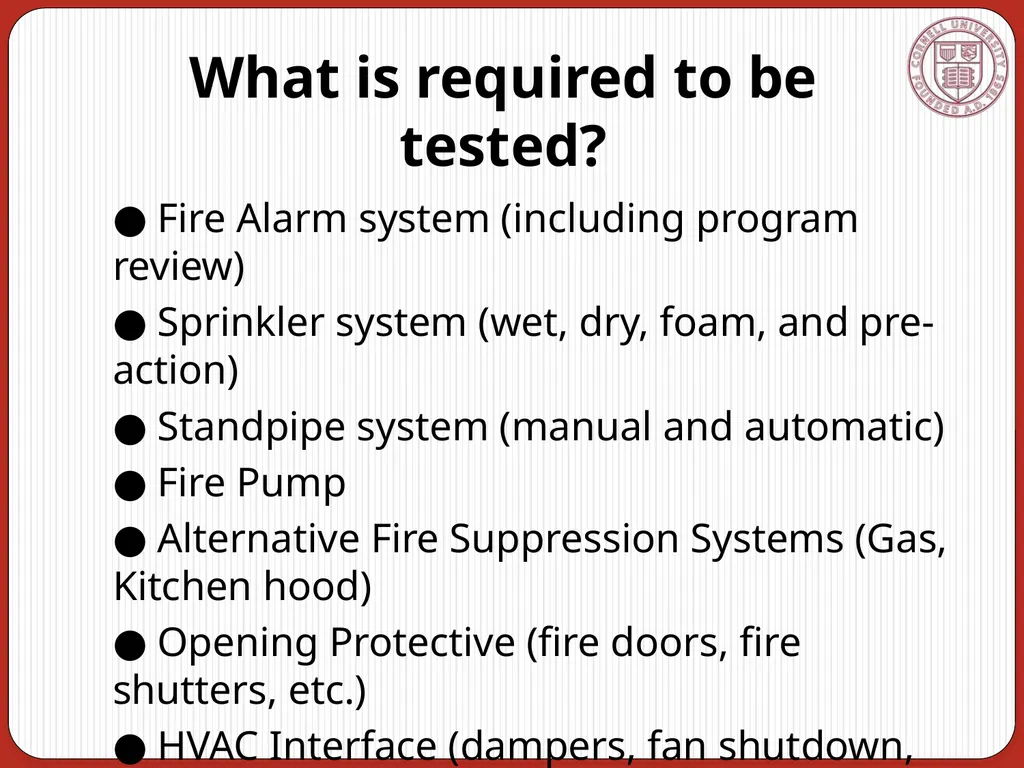
slide11. What is required to be tested? ● Fire Alarm system (including program review)
● Sprinkler system (wet, dry, foam, and pre-action)
● Standpipe system (manual and automatic)
● Fire Pump
● Alternative Fire Suppression Systems (Gas, Kitchen hood)
● Opening Protective (fire doors, fire shutters, etc.)
● HVAC Interface (dampers, fan shutdown,
atrium smoke exhaust, etc.)<br>
slide12. How to schedule acceptance tests ● All scheduling of tests to go through EH&S (Chris McLaughlin/Kathy MacCheyne).
- EH&S will contact the appropriate AHJ and set up time and date.
● All acceptance test;
- should be scheduled in advance of the project end date
- should not be scheduled until contractor has done all pre-testing of systems to lessen project impact<br>
slide13. How to schedule acceptance tests, continued ● Proper scheduling and pre-testing is essential for timely completion of projects due to multiple projects and limited testing resources
● Failure of device or system operation during final acceptance may result in termination of the test<br>
slide14. Acceptance Test Forms, continued ● Unless pre-approved, contractors “in house” paperwork will not be accepted
● EH&S can provide the project manager with the appropriate forms needed for acceptance testing. ● All required forms will need to be submitted to EH&S before final acceptance letter is issued.<br>
slide15. Acceptance Test Documentation Once Acceptance Test has been done, EH&S will distribute a Testing Letter listing the results of the test with any deficiencies as well as the completed standardized forms from the contractor to the following;
Project Manager
Construction Manager
AHJ<br>
slide16. Acceptance Test Documentation, continued ● Final letter of acceptance will not be provided until all deficiencies have been corrected and verified by EH&S
● Test results will not be provided to the contractors by EH&S unless authorized by Cornell Construction or Project Manager<br>
slide17. NFPA 80 Standard for Fire Doors and Other Opening Protectives ● Requirements to be verified
- Gaps around doors
- Visible inspection (including holes, labeling, field modifications, etc.)
- Closure operation (including hold open devices)
- Proper latching of door
- Coordinator
● All labeled doors must meet these requirements whether they are required by code or not<br>
slide18. EHS Fire Marshals GroupResponsibilities Plan Review: Primary Contact: Chris McLaughlin
Backup: Kathy MacCheyne
Impairments : Primary: Kathy MacCheyne
Backup: Ron Flynn
Acceptance Testing: Primary: Chris McLaughlin
Backup: Kathy MacCheyne
Fire Safety during Construction:
Primary: Ron Flynn
Backup: Kathy MacCheyne<br>
slide19. Summary Plan Review
Pre-planning for impairments, shutdowns and fire watch
Fire Protection Coverage During Renovations
Fire Safety During Construction
Acceptance Testing
Acceptance Testing Documentation<br>
slide20. Questions? Ron Flynn (rmf9@cornell.edu)
Chris McLaughlin (cjm358@cornell.edu)
Kathy MacCheyne (kem9@cornell.edu)
www.ehs.cornell.edu<br>

Ron Flynn, University Fire Marshal
Chris McLaughlin, FP System Associate
Kathy MacCheyne, Assistant Fire Marshal Cornell University Environmental Health and Safety<br>
slide2. Objective To assure Cornell University has adequate fire protection and life safety systems that comply with applicable codes and standards<br>
slide3. Where does it start? ●Plan Review;
NYS Codes
NFPA Standards as referenced by applicable codes
CU Design Standards<br>
slide4. Fire Protection System Shutdowns and Impairments ●Shutdowns: as needed for work in an affected area must be requested from Customer Service 48 Hrs in advance. Contractors are not allowed to remove, tape over, bag or otherwise disable detection or sprinkler coverage.
●Impairments “Fire Code of NYS Section 901.7” An Impairment: the disabling of fire alarm devices or sprinkler system coverage in a building”<br>
slide5. Fire Protection System Impairments, continued Simple/Partial Impairment is the disabling of fire alarm devices or sprinkler system coverage in the immediate area of where work is to be performed
“We will not allow the impairment of both the fire alarm system and sprinkler system to occur at the same time”
a. Requires a Shutdown request to Customer Service 48 Hrs in advance
b. No Fire Watch will be required in most cases<br>
slide6. Fire Protection System Impairments, continued Full System Impairment is the disabling of a Full Fire Protection “System” (Sprinkler, Fire Alarm, Standpipe, FDC, Fire Pump, etc). OR Disabling a large portion of a fire protection system (multiple floors or a large area.)
“We will not allow the impairment of both the fire alarm system and sprinkler system to occur at the same time”<br>
slide7. Fire Protection SystemImpairments, continued Requirements for a full Impairment
1. Fire Watch will be required (EH&S does not perform the fire watch, it is the responsibility of the contractor)
2. Impairment notice will be sent by EHS to various agencies as required by code
Must Provide the following information to EHS minimum of48 Hrs in advance (kem9@cornell.edu)
-Contractor name and cell number “ who is doing the work”
-Area of fire protection impacted and time frame
-Dedicated fire watcher name and number
**Can have NO other responsibilities other than fire watch
Requires a Shutdown request to Customer Service 48 Hrs in advance
**When in doubt: contact EHS a minimum of 48 hrs in advance<br>
slide8. Fire Protection Coverage during Renovations ● Where areas to be renovated are already protected by a fire protection system, continuous coverage of that area must be maintained throughout the project
● This can be accomplished by;
○ Maintaining existing sprinkler coverage
(Daily shutdowns are acceptable)
○ Installing temporary heat detection
(Conduit not required, red fire alarm cable okay)
○ Level of temporary protection will be determined by the AHJ<br>
slide9. Fire Safety During Construction ● Fire Safety During Construction
“Fire Code of NYS Chapter -33 and “NFPA-241”
-Outlines the minimum safeguards for construction projects to provide reasonable safety to life and property from fire during such operations<br>
slide10. Fire Safety During Construction, continued ● Fire Safety During Construction “Hot Work” Activities Fire Code of NYS Chapter-35
-Definition; Welding, cutting, open torches and other hot work operations and equipment
-Permit(s); Contractors need to obtain a Hot Work Permit from the respective AHJ<br>
slide11. What is required to be tested? ● Fire Alarm system (including program review)
● Sprinkler system (wet, dry, foam, and pre-action)
● Standpipe system (manual and automatic)
● Fire Pump
● Alternative Fire Suppression Systems (Gas, Kitchen hood)
● Opening Protective (fire doors, fire shutters, etc.)
● HVAC Interface (dampers, fan shutdown,
atrium smoke exhaust, etc.)<br>
slide12. How to schedule acceptance tests ● All scheduling of tests to go through EH&S (Chris McLaughlin/Kathy MacCheyne).
- EH&S will contact the appropriate AHJ and set up time and date.
● All acceptance test;
- should be scheduled in advance of the project end date
- should not be scheduled until contractor has done all pre-testing of systems to lessen project impact<br>
slide13. How to schedule acceptance tests, continued ● Proper scheduling and pre-testing is essential for timely completion of projects due to multiple projects and limited testing resources
● Failure of device or system operation during final acceptance may result in termination of the test<br>
slide14. Acceptance Test Forms, continued ● Unless pre-approved, contractors “in house” paperwork will not be accepted
● EH&S can provide the project manager with the appropriate forms needed for acceptance testing. ● All required forms will need to be submitted to EH&S before final acceptance letter is issued.<br>
slide15. Acceptance Test Documentation Once Acceptance Test has been done, EH&S will distribute a Testing Letter listing the results of the test with any deficiencies as well as the completed standardized forms from the contractor to the following;
Project Manager
Construction Manager
AHJ<br>
slide16. Acceptance Test Documentation, continued ● Final letter of acceptance will not be provided until all deficiencies have been corrected and verified by EH&S
● Test results will not be provided to the contractors by EH&S unless authorized by Cornell Construction or Project Manager<br>
slide17. NFPA 80 Standard for Fire Doors and Other Opening Protectives ● Requirements to be verified
- Gaps around doors
- Visible inspection (including holes, labeling, field modifications, etc.)
- Closure operation (including hold open devices)
- Proper latching of door
- Coordinator
● All labeled doors must meet these requirements whether they are required by code or not<br>
slide18. EHS Fire Marshals GroupResponsibilities Plan Review: Primary Contact: Chris McLaughlin
Backup: Kathy MacCheyne
Impairments : Primary: Kathy MacCheyne
Backup: Ron Flynn
Acceptance Testing: Primary: Chris McLaughlin
Backup: Kathy MacCheyne
Fire Safety during Construction:
Primary: Ron Flynn
Backup: Kathy MacCheyne<br>
slide19. Summary Plan Review
Pre-planning for impairments, shutdowns and fire watch
Fire Protection Coverage During Renovations
Fire Safety During Construction
Acceptance Testing
Acceptance Testing Documentation<br>
slide20. Questions? Ron Flynn (rmf9@cornell.edu)
Chris McLaughlin (cjm358@cornell.edu)
Kathy MacCheyne (kem9@cornell.edu)
www.ehs.cornell.edu<br>