
First section: Open-ended Instructions: explain
DJ
Published · 21 slides · 0 views
1 / 1









Description
First section: Open-ended Instructions: explain what you know about the references bolded in the poem (give and explain nicknames, notable events during periods of time (and what happened), when references happened). Each reference is worth
Related Topics
Share
Embed code
Download this presentation From Below
"First section: Open-ended Instructions: explain" is the property of its rightful owner. Permission is granted to download and print the materials on this website for personal, non-commercial use only, and to display it on your personal computer provided you do not modify the materials and that you retain all copyright notices contained in the materials. By downloading content from our website, you accept the terms of this agreement.
Presentation Transcript
01
First section: Open-ended Instructions: explain what you know about the references bolded in the poem (give and explain nicknames, notable events during periods of time (and what happened), when references happened). Each reference is worth one point.<br>
02
Evolution Langdon Smith<br>
03
When you were a tadpole and I was a fish
In the Paleozoic time,
And side by side on the ebbing tide
We sprawled through the ooze and slime,
Or skittered with many a caudal flip
Through the depths of the Cambrian fen,
My heart was rife with the joy of life,
For I loved you even then. The Paleozoic Era was the first era in the Phanerozoic Eon, actually the fourth and current eon in Earth’s history. In the beginning of this era, the Cambrian Explosion of life and diversity took place, from which many animal species today descended. Smith probably started at this point in time because there wasn’t much familiar life before this. A fen is a swampy wetland, and according to Wikipedia. I don’t think a fen would be found in the Cambrian period because it was actually a very barren place on land. However, the seas were full of life, so I guess Smith knew what he was talking about when he made the characters a tadpole and a fish.<br>
In the Paleozoic time,
And side by side on the ebbing tide
We sprawled through the ooze and slime,
Or skittered with many a caudal flip
Through the depths of the Cambrian fen,
My heart was rife with the joy of life,
For I loved you even then. The Paleozoic Era was the first era in the Phanerozoic Eon, actually the fourth and current eon in Earth’s history. In the beginning of this era, the Cambrian Explosion of life and diversity took place, from which many animal species today descended. Smith probably started at this point in time because there wasn’t much familiar life before this. A fen is a swampy wetland, and according to Wikipedia. I don’t think a fen would be found in the Cambrian period because it was actually a very barren place on land. However, the seas were full of life, so I guess Smith knew what he was talking about when he made the characters a tadpole and a fish.<br>
04
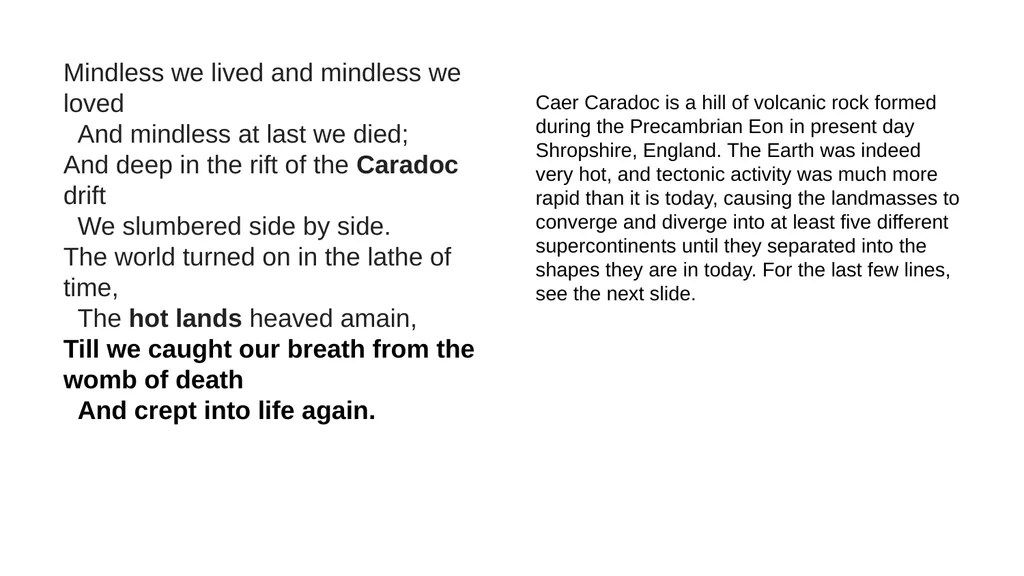
Mindless we lived and mindless we loved
And mindless at last we died;
And deep in the rift of the Caradoc drift
We slumbered side by side.
The world turned on in the lathe of time,
The hot lands heaved amain,
Till we caught our breath from the womb of death
And crept into life again. Caer Caradoc is a hill of volcanic rock formed during the Precambrian Eon in present day Shropshire, England. The Earth was indeed very hot, and tectonic activity was much more rapid than it is today, causing the landmasses to converge and diverge into at least five different supercontinents until they separated into the shapes they are in today. For the last few lines, see the next slide.<br>
And mindless at last we died;
And deep in the rift of the Caradoc drift
We slumbered side by side.
The world turned on in the lathe of time,
The hot lands heaved amain,
Till we caught our breath from the womb of death
And crept into life again. Caer Caradoc is a hill of volcanic rock formed during the Precambrian Eon in present day Shropshire, England. The Earth was indeed very hot, and tectonic activity was much more rapid than it is today, causing the landmasses to converge and diverge into at least five different supercontinents until they separated into the shapes they are in today. For the last few lines, see the next slide.<br>
05
We were amphibians, scaled and tailed,
And drab as a dead man's hand;
We coiled at ease 'neath the dripping trees
Or trailed through the mud and sand.
Croaking and blind, with our three-clawed feet
Writing a language dumb,
With never a spark in the empty dark
To hint at a life to come. When I read the purple part, I had a suspicion Smith didn’t just mean the two creatures died. I wasn’t sure until I saw the first line of this stanza. The Mesozoic Era, which follows the Paleozoic Era, is sometimes called the “age of the reptiles” after paleontologist Gideon Mantell noticed the dominance of reptiles during this time span. The bridge between the Paleozoic and Mesozoic eras was the Permian-Triassic extinction, in which almost all forms of life went extinct, including insects (this wasn’t the dinosaur one). There were trees during this time, unlike during the Cambrian period. I’m not sure what he means by “dripping”. Either this could refer to the cones they dropped or the periods of “intense rainfall” that occured during the generally dry Triassic (first part of the Mesozoic era) period.<br>
And drab as a dead man's hand;
We coiled at ease 'neath the dripping trees
Or trailed through the mud and sand.
Croaking and blind, with our three-clawed feet
Writing a language dumb,
With never a spark in the empty dark
To hint at a life to come. When I read the purple part, I had a suspicion Smith didn’t just mean the two creatures died. I wasn’t sure until I saw the first line of this stanza. The Mesozoic Era, which follows the Paleozoic Era, is sometimes called the “age of the reptiles” after paleontologist Gideon Mantell noticed the dominance of reptiles during this time span. The bridge between the Paleozoic and Mesozoic eras was the Permian-Triassic extinction, in which almost all forms of life went extinct, including insects (this wasn’t the dinosaur one). There were trees during this time, unlike during the Cambrian period. I’m not sure what he means by “dripping”. Either this could refer to the cones they dropped or the periods of “intense rainfall” that occured during the generally dry Triassic (first part of the Mesozoic era) period.<br>
06
Yet happy we lived and happy we loved,
And happy we died once more;
Our forms were rolled in the clinging mold
Of a Neocomian shore.
The eons came and the eons fled
And the sleep that wrapped us fast
Was riven away in a newer day
And the night of death was passed. Another extinction event! The Triassic-Jurassic extinction event happened between the first and second periods of the the Mesozoic Era. Neocomian is another name for the Lower/ Early Cretaceous epoch of the Cretaceous period. The rising sea levels during the Jurassic period resulted in the landmasses being covered with warm seas during the Cretaceous period, which might explain the reference to a beach. Clinging mold could refer to the abundance of chalk and therefore fossiliferous limestone during the Cretaceous period. When he says “eons came and eons fled”, it’s technically not possible because all of the points in time that occur in this poem are happening during one eon--the present eon, the Phanerozoic eon. By “night of death”, I’m not sure if he means the Cretaceous-Paleogene extinction event (the dinosaur one), or just a general occurrence.<br>
And happy we died once more;
Our forms were rolled in the clinging mold
Of a Neocomian shore.
The eons came and the eons fled
And the sleep that wrapped us fast
Was riven away in a newer day
And the night of death was passed. Another extinction event! The Triassic-Jurassic extinction event happened between the first and second periods of the the Mesozoic Era. Neocomian is another name for the Lower/ Early Cretaceous epoch of the Cretaceous period. The rising sea levels during the Jurassic period resulted in the landmasses being covered with warm seas during the Cretaceous period, which might explain the reference to a beach. Clinging mold could refer to the abundance of chalk and therefore fossiliferous limestone during the Cretaceous period. When he says “eons came and eons fled”, it’s technically not possible because all of the points in time that occur in this poem are happening during one eon--the present eon, the Phanerozoic eon. By “night of death”, I’m not sure if he means the Cretaceous-Paleogene extinction event (the dinosaur one), or just a general occurrence.<br>
07
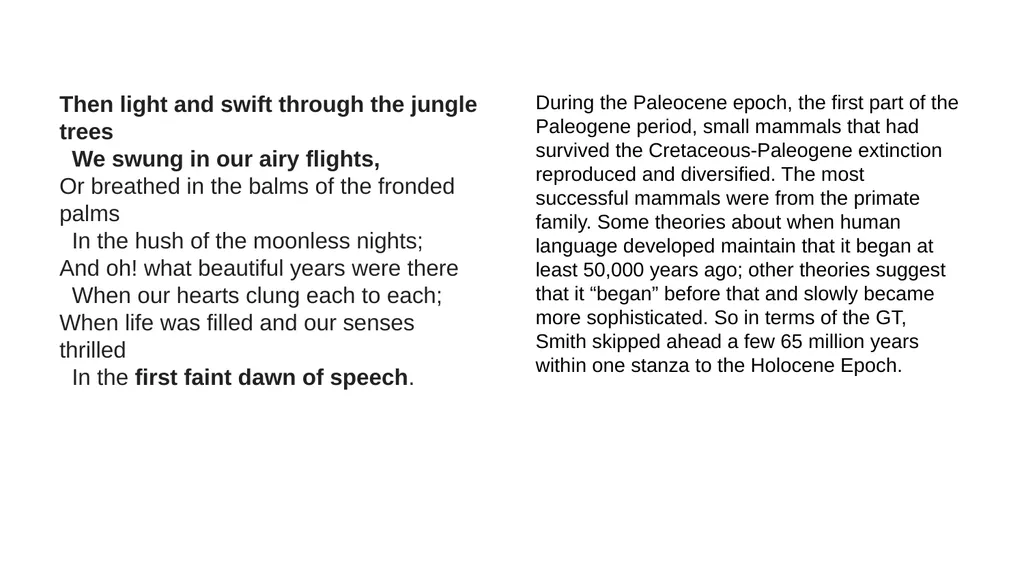
Then light and swift through the jungle trees
We swung in our airy flights,
Or breathed in the balms of the fronded palms
In the hush of the moonless nights;
And oh! what beautiful years were there
When our hearts clung each to each;
When life was filled and our senses thrilled
In the first faint dawn of speech. During the Paleocene epoch, the first part of the Paleogene period, small mammals that had survived the Cretaceous-Paleogene extinction reproduced and diversified. The most successful mammals were from the primate family. Some theories about when human language developed maintain that it began at least 50,000 years ago; other theories suggest that it “began” before that and slowly became more sophisticated. So in terms of the GT, Smith skipped ahead a few 65 million years within one stanza to the Holocene Epoch.<br>
We swung in our airy flights,
Or breathed in the balms of the fronded palms
In the hush of the moonless nights;
And oh! what beautiful years were there
When our hearts clung each to each;
When life was filled and our senses thrilled
In the first faint dawn of speech. During the Paleocene epoch, the first part of the Paleogene period, small mammals that had survived the Cretaceous-Paleogene extinction reproduced and diversified. The most successful mammals were from the primate family. Some theories about when human language developed maintain that it began at least 50,000 years ago; other theories suggest that it “began” before that and slowly became more sophisticated. So in terms of the GT, Smith skipped ahead a few 65 million years within one stanza to the Holocene Epoch.<br>
08
Thus life by life and love by love
We passed through the cycles strange,
And breath by breath and death by death
We followed the chain of change.
Till there came a time in the law of life
When over the nursing sod
The shadows broke and the soul awoke
In a strange, dim dream of God. It’s weird; according to Wikipedia, religious behavior in humans developed earlier than language. How can a community practice a religion without communication? However, the article also talks about how chimpanzees and bonobos possess qualities vital to religious behavior, such as “high intelligence, capacity for symbolic communication, a sense of social norms, realization of “self” and the concept of continuity”, so maybe it’s not that surprising. I guess Smith went back in time to the Paleolithic Age, the end of the Pleistocene Epoch.<br>
We passed through the cycles strange,
And breath by breath and death by death
We followed the chain of change.
Till there came a time in the law of life
When over the nursing sod
The shadows broke and the soul awoke
In a strange, dim dream of God. It’s weird; according to Wikipedia, religious behavior in humans developed earlier than language. How can a community practice a religion without communication? However, the article also talks about how chimpanzees and bonobos possess qualities vital to religious behavior, such as “high intelligence, capacity for symbolic communication, a sense of social norms, realization of “self” and the concept of continuity”, so maybe it’s not that surprising. I guess Smith went back in time to the Paleolithic Age, the end of the Pleistocene Epoch.<br>
09
I was thewed like an Auroch bull
And tusked like the great cave bear;
And you, my sweet, from head to feet
Were gowned in your glorious hair.
Deep in the gloom of a fireless cave,
When the night fell o'er the plain
And the moon hung red o'er the river bed
We mumbled the bones of the slain. This is chronological; aurochs were definitely around during the Neolithic Age, the first part of the Holocene Epoch. Cave bears were alive from the Pleistocene Epoch to about 28,000 years ago. They didn’t have tusks, but very large molars. They went extinct during the Last Glacial Maximum, during which a large percentage of the continents were covered with ice.<br>
And tusked like the great cave bear;
And you, my sweet, from head to feet
Were gowned in your glorious hair.
Deep in the gloom of a fireless cave,
When the night fell o'er the plain
And the moon hung red o'er the river bed
We mumbled the bones of the slain. This is chronological; aurochs were definitely around during the Neolithic Age, the first part of the Holocene Epoch. Cave bears were alive from the Pleistocene Epoch to about 28,000 years ago. They didn’t have tusks, but very large molars. They went extinct during the Last Glacial Maximum, during which a large percentage of the continents were covered with ice.<br>
10
I flaked a flint to a cutting edge
And shaped it with brutish craft;
I broke a shank from the woodland lank
And fitted it, head and haft;
Than I hid me close to the reedy tarn,
Where the mammoth came to drink;
Through the brawn and bone I drove the stone
And slew him upon the brink. Interesting, mammoths became extinct more recently than the cave bears--only 4,500 years ago. Maybe this is why scientists are trying to bring the mammoth back from extinction by looking for DNA in their remains.<br>
And shaped it with brutish craft;
I broke a shank from the woodland lank
And fitted it, head and haft;
Than I hid me close to the reedy tarn,
Where the mammoth came to drink;
Through the brawn and bone I drove the stone
And slew him upon the brink. Interesting, mammoths became extinct more recently than the cave bears--only 4,500 years ago. Maybe this is why scientists are trying to bring the mammoth back from extinction by looking for DNA in their remains.<br>
11
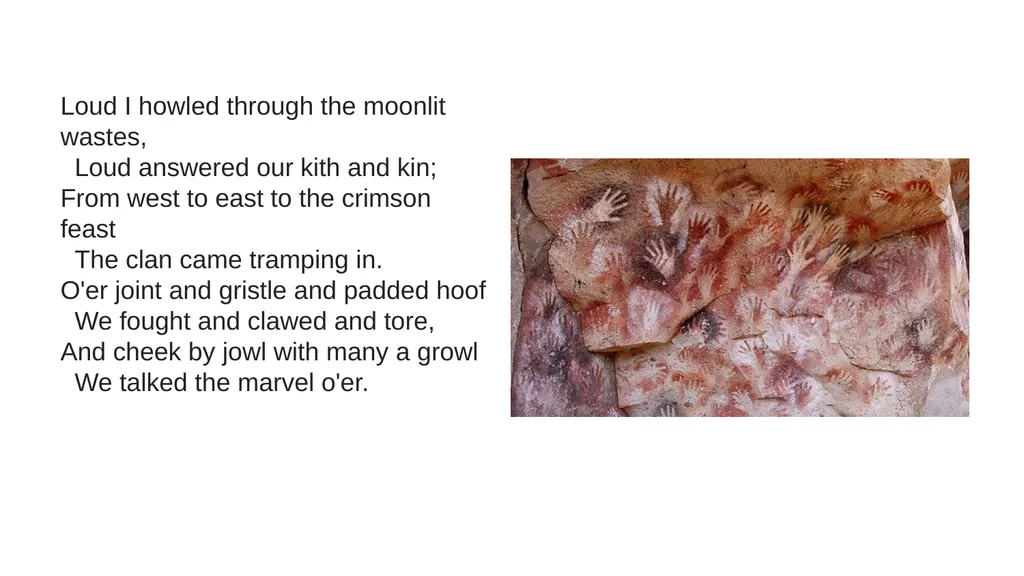
Loud I howled through the moonlit wastes,
Loud answered our kith and kin;
From west to east to the crimson feast
The clan came tramping in.
O'er joint and gristle and padded hoof
We fought and clawed and tore,
And cheek by jowl with many a growl
We talked the marvel o'er.<br>
Loud answered our kith and kin;
From west to east to the crimson feast
The clan came tramping in.
O'er joint and gristle and padded hoof
We fought and clawed and tore,
And cheek by jowl with many a growl
We talked the marvel o'er.<br>
12
I carved that fight on a reindeer bone
With rude and hairy hand;
I pictured his fall on the cavern wall
That men might understand.
For we lived by blood and the right of might
Ere human laws were drawn,
And the age of sin did not begin
Til our brutal tusks were gone.<br>
With rude and hairy hand;
I pictured his fall on the cavern wall
That men might understand.
For we lived by blood and the right of might
Ere human laws were drawn,
And the age of sin did not begin
Til our brutal tusks were gone.<br>
13
And that was a million years ago
In a time that no man knows;
Yet here tonight in the mellow light
We sit at Delmonico's.
Your eyes are deep as the Devon springs,
Your hair is dark as jet,
Your years are few, your life is new,
Your soul untried, and yet -- From Devonian Period of the Paleolithic Era, first of the Phanerozoic eon.<br>
In a time that no man knows;
Yet here tonight in the mellow light
We sit at Delmonico's.
Your eyes are deep as the Devon springs,
Your hair is dark as jet,
Your years are few, your life is new,
Your soul untried, and yet -- From Devonian Period of the Paleolithic Era, first of the Phanerozoic eon.<br>
14
Our trail is on the Kimmeridge clay
And the scarp of the Purbeck flags;
We have left our bones in the Bagshot stones
And deep in the Coralline crags;
Our love is old, our lives are old,
And death shall come amain;
Should it come today, what man may say
We shall not live again? Kimmeridge Clay Formation is a structure of fossil-containing clay from England. It formed during the Jurassic Period, beginning of the Mesozoic Era, middle of the Phanerozoic eon. Isle of Purbeck is a place also in England where fossil sites from many different periods have been uncovered: the Jurassic period rocks, Cretaceous period chalk, Eocene epoch clay. Coralline rock is formed from Coralline algae.<br>
And the scarp of the Purbeck flags;
We have left our bones in the Bagshot stones
And deep in the Coralline crags;
Our love is old, our lives are old,
And death shall come amain;
Should it come today, what man may say
We shall not live again? Kimmeridge Clay Formation is a structure of fossil-containing clay from England. It formed during the Jurassic Period, beginning of the Mesozoic Era, middle of the Phanerozoic eon. Isle of Purbeck is a place also in England where fossil sites from many different periods have been uncovered: the Jurassic period rocks, Cretaceous period chalk, Eocene epoch clay. Coralline rock is formed from Coralline algae.<br>
15
God wrought our souls from the Tremadoc beds
And furnish’d them wings to fly;
He sowed our spawn in the world's dim dawn,
And I know that it shall not die,
Though cities have sprung above the graves
Where the crook-bone men made war
And the ox-wain creaks o'er the buried caves
Where the mummied mammoths are. Tremadoc (now called Tremadog) Bay is a part of a bay outlined by the Cambrian Coast in England. Many of the GT names we’ve seen come from similarly named sites in England where fossils and rock structures from those period were found.<br>
And furnish’d them wings to fly;
He sowed our spawn in the world's dim dawn,
And I know that it shall not die,
Though cities have sprung above the graves
Where the crook-bone men made war
And the ox-wain creaks o'er the buried caves
Where the mummied mammoths are. Tremadoc (now called Tremadog) Bay is a part of a bay outlined by the Cambrian Coast in England. Many of the GT names we’ve seen come from similarly named sites in England where fossils and rock structures from those period were found.<br>
16
Then as we linger at luncheon here
O'er many a dainty dish,
Let us drink anew to the time when you
Were a tadpole and I was a fish. That was cool, especially since Smith wrote this in 1895 without Wikipedia. The poem seems less about evolution though and more about rebirth.<br>
O'er many a dainty dish,
Let us drink anew to the time when you
Were a tadpole and I was a fish. That was cool, especially since Smith wrote this in 1895 without Wikipedia. The poem seems less about evolution though and more about rebirth.<br>
17
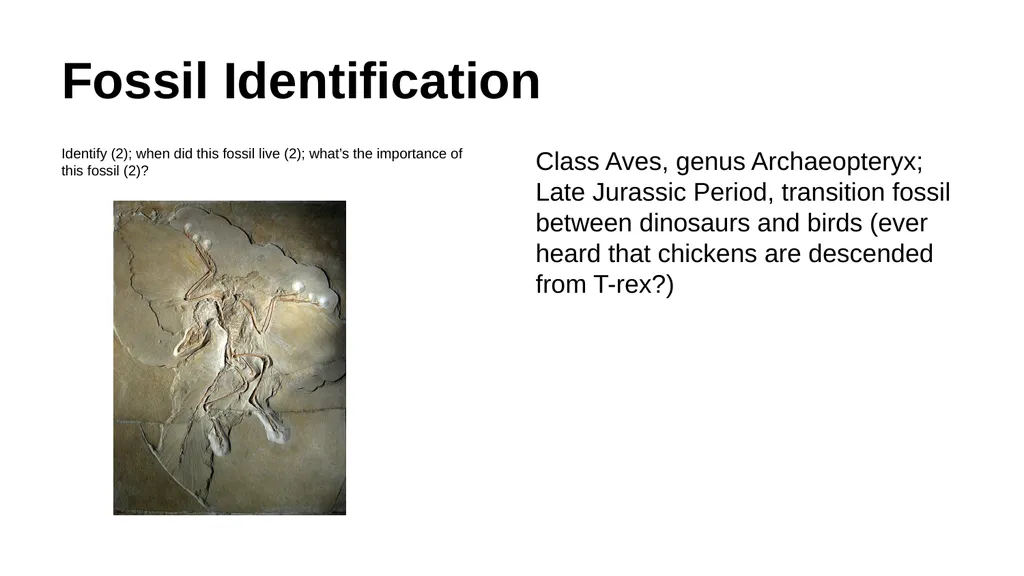
Fossil Identification Identify (2); when did this fossil live (2); what’s the importance of this fossil (2)? Class Aves, genus Archaeopteryx; Late Jurassic Period, transition fossil between dinosaurs and birds (ever heard that chickens are descended from T-rex?)<br>
18
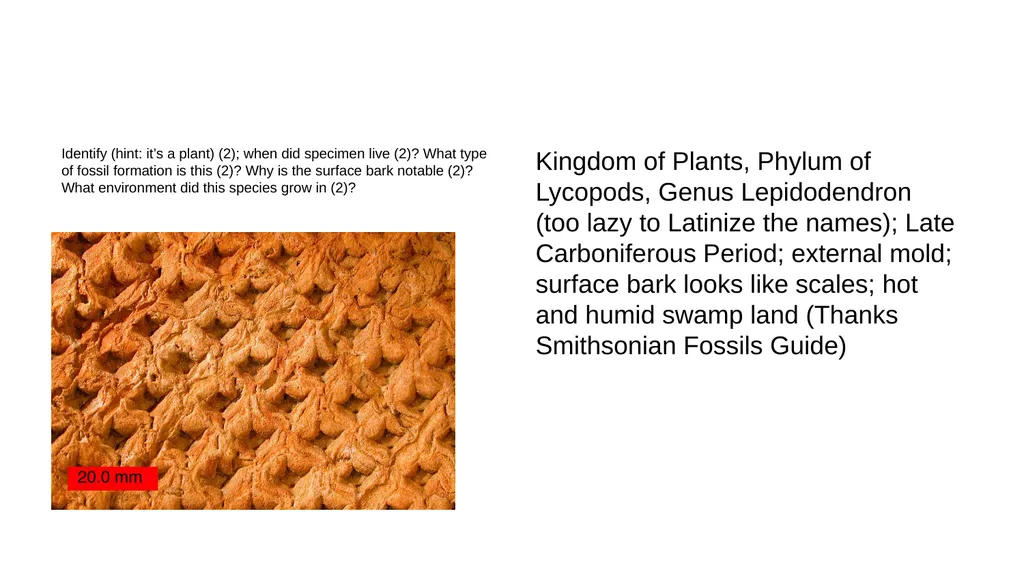
Identify (hint: it’s a plant) (2); when did specimen live (2)? What type of fossil formation is this (2)? Why is the surface bark notable (2)? What environment did this species grow in (2)? Kingdom of Plants, Phylum of Lycopods, Genus Lepidodendron (too lazy to Latinize the names); Late Carboniferous Period; external mold; surface bark looks like scales; hot and humid swamp land (Thanks Smithsonian Fossils Guide)<br>
19
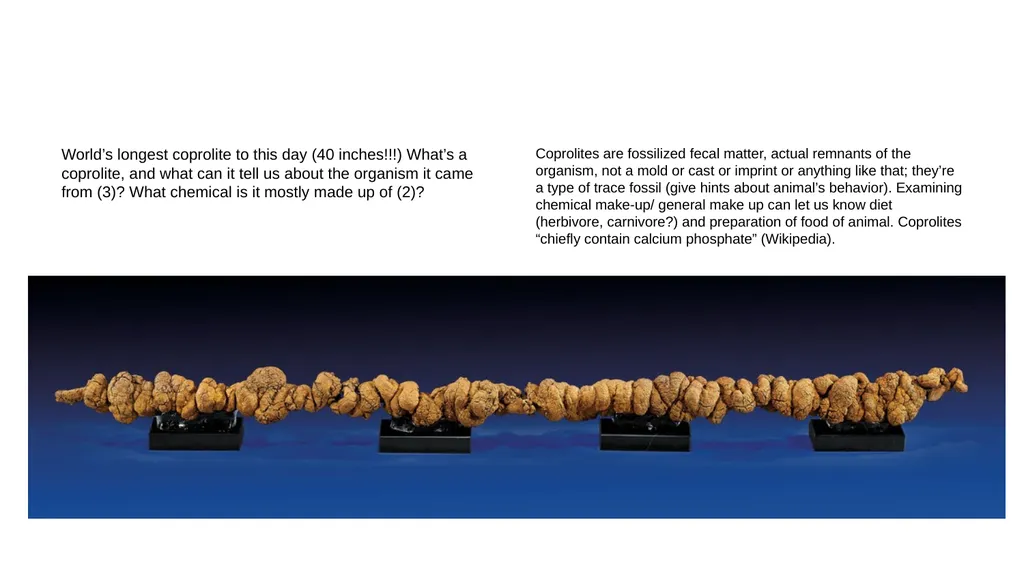
World’s longest coprolite to this day (40 inches!!!) What’s a coprolite, and what can it tell us about the organism it came from (3)? What chemical is it mostly made up of (2)? Coprolites are fossilized fecal matter, actual remnants of the organism, not a mold or cast or imprint or anything like that; they’re a type of trace fossil (give hints about animal’s behavior). Examining chemical make-up/ general make up can let us know diet (herbivore, carnivore?) and preparation of food of animal. Coprolites “chiefly contain calcium phosphate” (Wikipedia).<br>
20
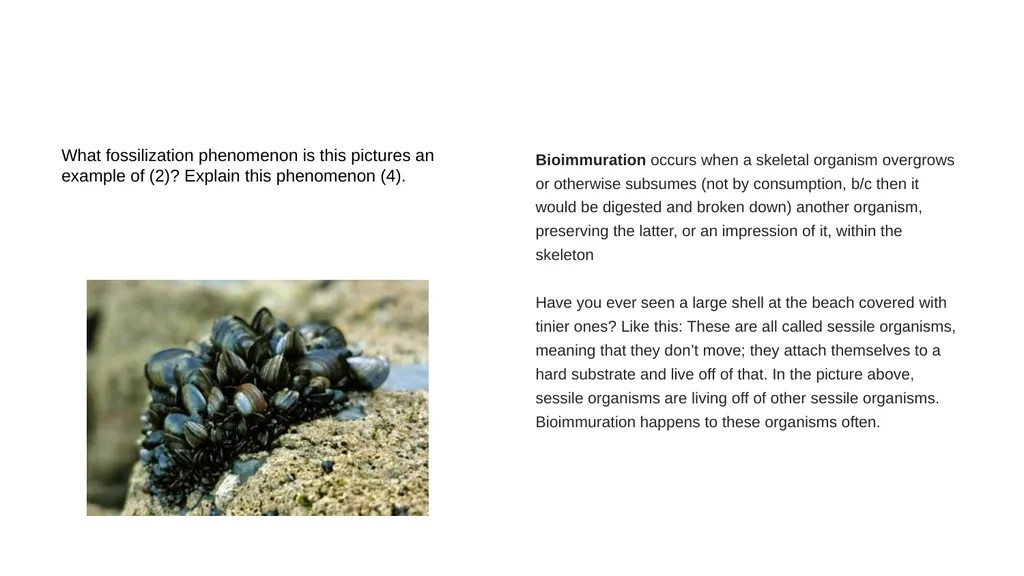
What fossilization phenomenon is this pictures an example of (2)? Explain this phenomenon (4). Bioimmuration occurs when a skeletal organism overgrows or otherwise subsumes (not by consumption, b/c then it would be digested and broken down) another organism, preserving the latter, or an impression of it, within the skeleton
Have you ever seen a large shell at the beach covered with tinier ones? Like this: These are all called sessile organisms, meaning that they don’t move; they attach themselves to a hard substrate and live off of that. In the picture above, sessile organisms are living off of other sessile organisms. Bioimmuration happens to these organisms often.<br>
Have you ever seen a large shell at the beach covered with tinier ones? Like this: These are all called sessile organisms, meaning that they don’t move; they attach themselves to a hard substrate and live off of that. In the picture above, sessile organisms are living off of other sessile organisms. Bioimmuration happens to these organisms often.<br>
21
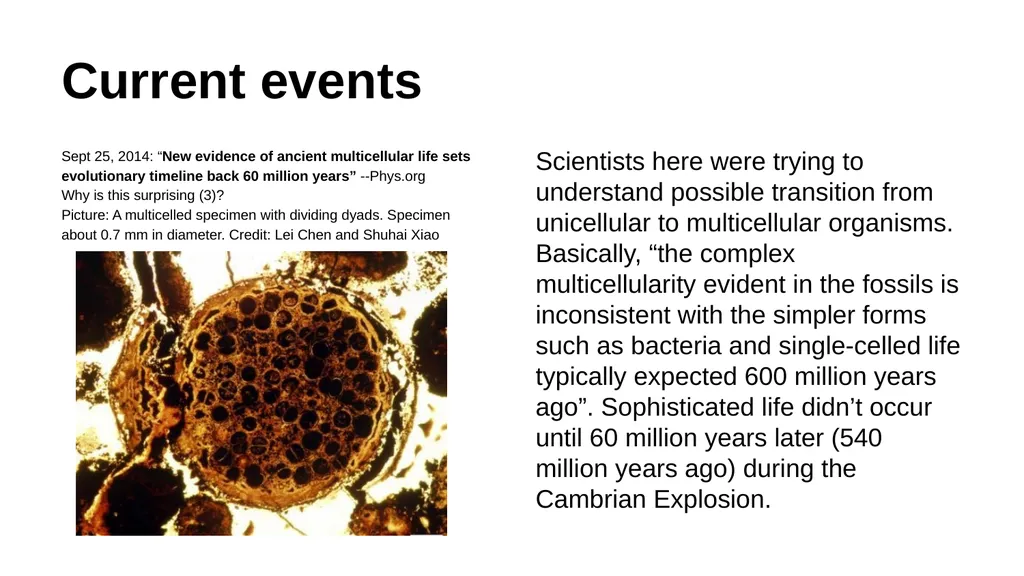
Current events Sept 25, 2014: “New evidence of ancient multicellular life sets evolutionary timeline back 60 million years” --Phys.org
Why is this surprising (3)?
Picture: A multicelled specimen with dividing dyads. Specimen about 0.7 mm in diameter. Credit: Lei Chen and Shuhai Xiao Scientists here were trying to understand possible transition from unicellular to multicellular organisms. Basically, “the complex multicellularity evident in the fossils is inconsistent with the simpler forms such as bacteria and single-celled life typically expected 600 million years ago”. Sophisticated life didn’t occur until 60 million years later (540 million years ago) during the Cambrian Explosion.<br>
Why is this surprising (3)?
Picture: A multicelled specimen with dividing dyads. Specimen about 0.7 mm in diameter. Credit: Lei Chen and Shuhai Xiao Scientists here were trying to understand possible transition from unicellular to multicellular organisms. Basically, “the complex multicellularity evident in the fossils is inconsistent with the simpler forms such as bacteria and single-celled life typically expected 600 million years ago”. Sophisticated life didn’t occur until 60 million years later (540 million years ago) during the Cambrian Explosion.<br>