Fiscal Policy in South Africa: From 1994 to now

Published  . 0 views
↓ Download
Fiscal Policy in South Africa: From 1994 to now
1 / 1
Fiscal Policy in South Africa: From 1994 to now - slide 1 of 37 Fiscal Policy in South Africa: From 1994 to now - slide 2 of 37 Fiscal Policy in South Africa: From 1994 to now - slide 3 of 37 Fiscal Policy in South Africa: From 1994 to now - slide 4 of 37 Fiscal Policy in South Africa: From 1994 to now - slide 5 of 37 Fiscal Policy in South Africa: From 1994 to now - slide 6 of 37 Fiscal Policy in South Africa: From 1994 to now - slide 7 of 37 Fiscal Policy in South Africa: From 1994 to now - slide 8 of 37 Fiscal Policy in South Africa: From 1994 to now - slide 9 of 37 Fiscal Policy in South Africa: From 1994 to now - slide 10 of 37 Fiscal Policy in South Africa: From 1994 to now - slide 11 of 37 Fiscal Policy in South Africa: From 1994 to now - slide 12 of 37 Fiscal Policy in South Africa: From 1994 to now - slide 13 of 37 Fiscal Policy in South Africa: From 1994 to now - slide 14 of 37 Fiscal Policy in South Africa: From 1994 to now - slide 15 of 37 Fiscal Policy in South Africa: From 1994 to now - slide 16 of 37 Fiscal Policy in South Africa: From 1994 to now - slide 17 of 37 Fiscal Policy in South Africa: From 1994 to now - slide 18 of 37 Fiscal Policy in South Africa: From 1994 to now - slide 19 of 37 Fiscal Policy in South Africa: From 1994 to now - slide 20 of 37 Fiscal Policy in South Africa: From 1994 to now - slide 21 of 37 Fiscal Policy in South Africa: From 1994 to now - slide 22 of 37 Fiscal Policy in South Africa: From 1994 to now - slide 23 of 37 Fiscal Policy in South Africa: From 1994 to now - slide 24 of 37 Fiscal Policy in South Africa: From 1994 to now - slide 25 of 37 Fiscal Policy in South Africa: From 1994 to now - slide 26 of 37 Fiscal Policy in South Africa: From 1994 to now - slide 27 of 37 Fiscal Policy in South Africa: From 1994 to now - slide 28 of 37 Fiscal Policy in South Africa: From 1994 to now - slide 29 of 37 Fiscal Policy in South Africa: From 1994 to now - slide 30 of 37 Fiscal Policy in South Africa: From 1994 to now - slide 31 of 37 Fiscal Policy in South Africa: From 1994 to now - slide 32 of 37 Fiscal Policy in South Africa: From 1994 to now - slide 33 of 37 Fiscal Policy in South Africa: From 1994 to now - slide 34 of 37 Fiscal Policy in South Africa: From 1994 to now - slide 35 of 37 Fiscal Policy in South Africa: From 1994 to now - slide 36 of 37 Fiscal Policy in South Africa: From 1994 to now - slide 37 of 37
Description: Fiscal Policy in South Africa: From 1994 to now Presentation to SA Parliamentary Portfolio Committees Chairs and Members Cape Town, 22 April 2025 Estian Calitz, Stellenbosch University Based on commissioned paper by Economic Research

Related Topics

Download Presentation

"Fiscal Policy in South Africa: From 1994 to now" is the property of its rightful owner. Permission is granted to download and print the materials on this website for personal, non-commercial use only, and to display it on your personal computer provided you do not modify the materials and that you retain all copyright notices contained in the materials. By downloading content from our website, you accept the terms of this agreement.

Presentation Transcript

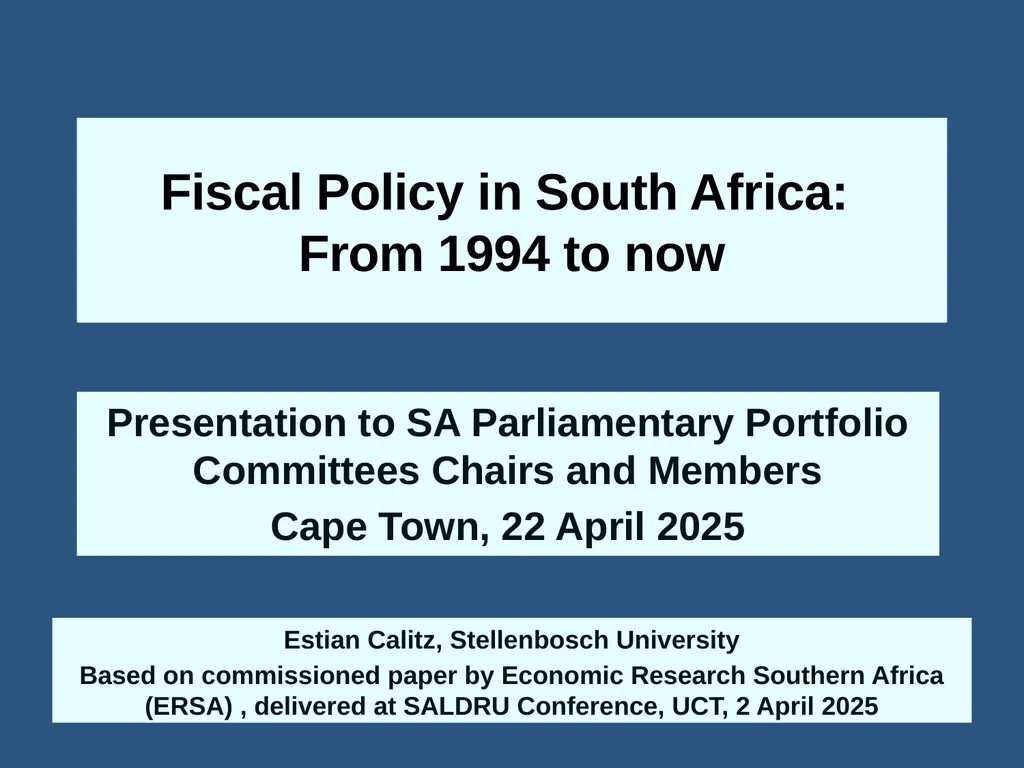
slide1. Fiscal Policy in South Africa: From 1994 to now Presentation to SA Parliamentary Portfolio Committees Chairs and Members
Cape Town, 22 April 2025 Estian Calitz, Stellenbosch University
Based on commissioned paper by Economic Research Southern Africa (ERSA) , delivered at SALDRU Conference, UCT, 2 April 2025<br>
slide2. Contents The phases
Phase 1
Phase 2
Phase 3
Phase 4
Where do we go from here?
Summary and policy implications for the future

Annexures to Paper
Important fiscal institutions established at the advent of democracy (Phase 1)
The average size of the South African public sector by different indicators, selected periods (current prices as % of GDP)
Changing International Views of the Role of Government and Fiscal Policy in Economies and the Nature of the South African Approach
Macroeconomic and Fiscal Policy Priorities in Budget Speeches, 1994 – 2024 2 2<br>
slide3. Average size of SA public sector, by different indicators and for selected periods (current prices, % of GDP)<br>
slide4. 1. The Phases<br>
slide5. Four phases A government is regarded as serious about ensuring sustainability if rising debt-to-GDP ratios are accompanied or preceded by an improvement in its primary surplus when real interest rates exceed real economic growth rates.<br>
slide6. 2. Phase 1<br>
slide7. Keys (1996), Liebenberg (1997, 1998), Manuel (1999)<br>
slide8. Food for thought In his 1997/98 Budget Speech, Finance Minister Trevor Manuel (Department of Finance, 1997a:8) emphasised that:
“it was well understood that growth and job creation are critical elements in redistributing income and reducing poverty”.
The importance of economic growth has been a recurrent theme up to the present. However, the National Treasury was confronted by major differences of opinion in the public debate about the nature of growth and the government's role in the economy
In his opening address to parliament in 1998, President Mandela said:
“Apartheid South Africa was over-governed and over-supervised. The size of the public service had nothing to do with public service. Government is not an employment agency. Put in simple terms, we need to cut spending on personnel.”
In 2025, this was still a big issue.<br>
slide9. Phase 1: Fiscal Consolidation (1994–2000) Focus: Stabilising public finances after years of economic and fiscal stress; macro, with micro interlinks where appropriate
Key Actions: Implementation of the GEAR strategy; reduction of budget deficits; enhancement of revenue collection.
Outcomes: Improved macroeconomic stability, reduced budget deficit and public debt and increased investor confidence; broadened tax base; tax burden lowered on low- and middle-income working people, but higher self-payment for former public services
Other features
Macroeconomic stabilisation prioritised to create conducive environment for growth.
GEAR emphasised deficit reduction, tax reform (Katz Commission), expenditure reprioritisation; accompanied by financial and trade liberalisation.
Fiscal discipline laid foundation for improved economic performance in subsequent years.
Consolidation efforts included government expenditure restraint and reprioritisation; and reforming tax administration to improve revenue collection efficiency.
Fiscal reforms underpinned achieving investment grade credit ratings.
Established several fiscal institutions - critical instruments of fiscal management.
Difficult task of reducing the primary Gini coefficient still lay ahead and became even more daunting. 9<br>
slide10. 3. Phase 2 EC FP 1994+ 10<br>
slide11. Manuel (2000-2008) EC FP 1994+ 11<br>
slide12. Food for thought “The government must act to ensure that we reduce the number of people dependent on social welfare, increasing the numbers that rely for their livelihood on normal participation in the economy.”
- From President Thabo Mbeki’s State of the Nation Address, 14 February 2003<br>
slide13. Phase 2: Fiscal Health (2001–2008)(1) Focus: Sustaining economic growth, expanding social development, increasing infrastructure investment, ensuring fiscal sustainability
Key Actions: Increased social spending on health, education, and welfare; infrastructure investments; corporate tax reductions; a more generous small business tax regime; inflation targeting; policies to promote private-sector growth.
Outcomes: longest economic upswing since WWII, average real GDP growth 4.2% pa; improved public services; expanded social grants; lower national debt-to-GDP ratio; peaking of South Africa’s sovereign investment grade rating; enhanced investor confidence; BUT: concerns appear regarding long-term fiscal sustainability as expenditure growth accelerated. 13<br>
slide14. Phase 2: Fiscal Health (2001–2008)(2) Prudent fiscal policy, a conservative mix of expenditure and taxes, reallocating budget funds, and substantial economic growth enabled a sustainable outcome.
Strong political commitment to fiscal restraint, especially from South African Presidents, helped the finance minister's task. Periods of high, stable economic growth also made it easier. The global commodity and credit boom of the early-to-mid 2000s obscured high spending growth and tax cuts. Even procyclical fiscal policy in the early 2000s did not present deficit or debt risks, BUT this would not have been affordable at lower growth rates. 14<br>
slide15. Phase 2: Fiscal Health (2001–2008)(3) Other features
Longest economic upswing since World War II, average real economic growth rate of 4.2% pa.; introduction of inflation targeting.
Significant progress in budget allocations for social development and poverty reduction, all while maintaining fiscal sustainability.
Prudent fiscal management: budget surplus (0.8% of GDP) in 2007/08; lowest national debt/GDP ratio in nearly 5 decades; improved credit rating.
BUT dependency on social welfare increased, contrary to earlier policy goals aimed at reducing reliance on state support​ (Mbeki).
Key ambition; to halve unemployment rate by 2014, reduce poverty, create job opportunities
Persistent tension between tax base broadening and narrowing
While investment incentives narrowed the tax base, the government also pursued base-broadening policies, such as introducing capital gains tax, transitioning to a residence-based tax system, closing loopholes, implementing a tax amnesty, and adopting a graduated corporate tax rate for small businesses 15<br>
slide16. 4. Phase 3 EC FP 1994+ 16<br>
slide17. Words of insight (or despair?) “Pouring money directly into Eskom in its current form is like pouring water into a sieve. I want to make it clear: the national government is not taking on Eskom’s debt. Eskom took on the debt. It must ultimately repay it. We are setting aside R23 billion a year to financially support Eskom during its reconfiguration.”
- Tito Mboweni (NT, Various years a – 2019:8):

R230 billion was allocated over ten years to achieve the restructuring of the electricity sector (2020/21 Budget Speech)
Later, some Eskom debt was indeed taken over by the national government.<br>
slide18. Manuel (2009), Gordhan (2010-14), Nene (2015), Van Rooyen (none); Gordhan (2016-17); Gigaba (2018), Mboweni (2019-20) 18<br>
slide19. Phase 3: The perfect storm (2009-2020)(1) Focus: Mitigating the impact of the global financial crisis and the Covid-19 pandemic
Key Actions: Counter-cyclical fiscal measures, including social support; high turnover of finance ministers (average length in office = 1 year and 8 months; shortest – one weekend); expenditure ceilings (2012) – they did reallocate resources, but at the cost of public investment
Outcomes: Some economic resilience during the crisis BUT higher debt-to-GDP ratios, partly due to poor economic growth; fiscal sustainability and international sovereign investment rating lost
Other features
The 2008 global financial crisis prompted the government to adopt counter-cyclical measures to support the economy – arguably with procyclical results; trade-offs between expansionary fiscal policy and fiscal consolidation.
Realisation (± 2015): countercyclical approach had reached its limits, budget deficit largely structural and could not be reduced through a cyclical upturn in revenues. 19<br>
slide20. Phase 3: The perfect storm (2009-2020)(2) Fiscal stimulus packages focused on infrastructure development and social assistance.
HOWEVER: General government's gross fixed investment fell by almost 26% from 2016 to 2020, with economic infrastructure investment declining by about 34% and investment by state-owned enterprises dropping by nearly 45%. In contrast, general government real consumption expenditure increased by 3.6%.
State capture
Fiscal strategy was not adjusted to lower economic growth, nor did economic strategy achieve higher growth; Earlier crowding out of public investment by consumption and later by debt cost were not turned around, however, and poor government services remained or increased in certain areas.
Unemployment increased significantly, raising long-term fiscal costs.
The crisis exposed vulnerabilities in the economy, such as the dependence on commodity exports and limited manufacturing capacity. 20<br>
slide21. Phase 3: The perfect storm (2009-2020)(3) South Africa’s underperforming growth strategies and industrial policies, receding international competitiveness and poor ranking of institutional effectiveness restricted fiscal scope.
At the start of the GFC, South Africa had relatively low budget deficit-to-GDP and government debt-to-GDP ratios and, therefore, substantial fiscal scope to absorb shocks. This changed quite rapidly. Within fifteen years, the SA debt-to-GDP burden rose from 23.6% in 2008/09 to 74.1% in 2023/24. A record budget deficit of 9.8% was recorded in 2020/21 during the Covid-19 pandemic, the worst in 60 years. The GFC shock to the economy was probably as disruptive, however.
Policy goals such as fiscal sustainability were undermined by state capture, ‘cold feet’ on wage bill containment , targeted free tertiary education and bailing out state-owned enterprises.
Cabinet did not accept collective responsibility for sound fiscal management. 21<br>
slide22. Phase 3: The perfect storm (2009-2020)(4) The impact of all external shocks and populist pressures on the fiscus was devastating.
Much of the build-up during phase 2 of a sound and sustainable fiscal state was destroyed.
SA’s fiscal health deteriorated substantially during these years, both by historical standards and compared to peer countries.
South Africa emerged from the great recession in a weak fiscal condition relative to peer countries, compared to its much better position before the GFC. 22<br>
slide23. 5. Phase 4 EC FP 1994+ 23<br>
slide24. Phase 4: Fiscal consolidation, again (2021-2024)(1) Focus: Addressing rising debt and restoring fiscal discipline.
Key Actions: Spending restraints, structural reforms, and revenue enhancement measures; planned use of gold and foreign exchange reserves to reduce government debt
Outcomes: Gradual deficit reduction but persistent growth constraints and socio-economic challenges.<br>
slide25. Phase 4: Fiscal consolidation, again (2021-2024)(2) Other features
In response to escalating debt levels, Government implemented measures to contain expenditure growth.
The introduction of spending ceilings (too high) and efforts to improve revenue collection have yielded some positive outcomes.
Economic growth remained subdued, and socio-economic challenges persisted.
Government's efforts to reform state-owned enterprises (SOEs) have faced delays, limiting the potential impact of fiscal consolidation efforts.
Persisting hardy annuals (government wage bill, poor service delivery, SOEs)<br>
slide26. 6. Where do we go from here? EC FP 1994+ 26<br>
slide27. Structural reforms Implementing reforms to improve business confidence, enhance productivity, and attract investment; in a sense foreign investment follows domestic investment

SA far below high-growth economies e.g. China (44%), India, Malaysia, Botswana, Thailand and Turkey (all above 25%). Recent years, SA public-sector I/GDP about 4%.
Target key sectors such as energy, telecommunications, and logistics, but the need for a rethinking of the role of government in this regard is evident
Streamlining regulatory processes
Promoting competition, investing in infrastructure.
Nature and role of incentives (activities rather than sectors?)<br>
slide28. Expenditure Efficiency Prioritising essential services while curbing wasteful expenditure.
Government must enhance public sector efficiency through performance-based budgeting and improved oversight mechanisms.
Strengthening public financial management frameworks can help reduce corruption and ensure better service delivery.
Cost-benefit, cost-effectiveness and other types of analysis<br>
slide29. Revenue mobilisation and the tax gap Little scope for higher tax revenue by way of new taxes and higher tax rates; more through broadening the tax base and enhancing tax compliance.
Efforts to reduce tax evasion and optimise tax incentives can generate additional fiscal space.
Expanding tax education initiatives and modernising tax collection systems can further support these efforts
(Social) rights imply social responsibilities<br>
slide30. Debt Management and fiscal anchors Establishing clear debt stabilisation targets to restore fiscal credibility.
A transparent, medium-term debt strategy is essential to maintain market confidence.
Introducing fiscal rules and regularly communicating debt reduction plans may help to reassure stakeholders BUT are no guarantee of success.
Commitment device
Circumvention
Complex
Rigidity – escape clauses
A non-populist parliament as custodian of the public purse<br>
slide31. 7. Summary and policy implications for the future EC FP 1994+ 31<br>
slide32. Maintain a Clear, Credible Fiscal Framework Consistency and transparency in fiscal policy foster investor confidence.
Regularly publishing fiscal reports and engaging with stakeholders can improve policy credibility.
Avoid creating destabilising expectations, including confusion about financing.
Cut the coat according to the cloth.<br>
slide33. Prioritise High-Impact Public Investments Crowd in public and private investment
Infrastructure projects with significant growth and employment potential should be prioritised.
Emphasis should be placed on projects that align with the country's long-term development plans.
Room for project finance, rather than tapping into consolidated budget borrowing by government.<br>
slide34. Implement Structural Reforms Reforms in the labour market, energy sector, and public enterprises are critical to unlocking growth potential.
Improving the operational efficiency of key SOEs, particularly Eskom and Transnet, is vital.
Unless and even when a higher growth path can be achieved, a redesign of government and expenditure priorities are essential to ensure the coat is cut according to the cloth.<br>
slide35. Strengthen Social Safety Nets Social protection programs must be maintained to support vulnerable populations, particularly in the context of high unemployment.
Expanding social assistance coverage while ensuring that funds are used effectively will be essential.
Zero-rating VAT fiscally very expensive in terms of tax revenue losses on account of middle- and high-income consumers buying zero-rated goods.
Avoid systemic welfare dependency through appropriate (re)design of welfare programmes and better opportunities for employment in the private sector.<br>
slide36. Concluding words South Africa’s fiscal policy must evolve to address the country’s complex socio-economic challenges while ensuring long-term sustainability.
By adopting prudent fiscal management, promoting inclusive growth, and implementing critical reforms, the country can build a resilient and prosperous future for all its citizens.
A collaborative approach involving government, private sector, and civil society stakeholders will be essential to successfully implement these policies and put the country on a higher economic growth path.
From the literature: a huge challenge, given low success of coalition government
The path forward requires bold, evidence-based decisions that prioritisation LT economic health over ST (political) gains. Continuous monitoring, evaluation, and adaptation of credible economic and fiscal strategies will be crucial in navigating future uncertainties.<br>
slide37. THANK YOU! 37<br>