
FIWARE Data Space Components Juanjo Hierro
OM
Published · 36 slides · 0 views
1 / 1

Description
FIWARE Data Space Components Juanjo Hierro Chairman, FIWARE TSC juanjose.hierrogmail.com Stefan Wiedemann Member, FIWARE TSC stefan.wiedemannseamware.com About FIWARE FIWARE brings a curated catalogue of open source components which can
Related Topics
Share
Embed code
Download this presentation From Below
"FIWARE Data Space Components Juanjo Hierro" is the property of its rightful owner. Permission is granted to download and print the materials on this website for personal, non-commercial use only, and to display it on your personal computer provided you do not modify the materials and that you retain all copyright notices contained in the materials. By downloading content from our website, you accept the terms of this agreement.
Presentation Transcript
01
FIWARE Data Space Components Juanjo Hierro
Chairman, FIWARE TSC
juanjose.hierro@gmail.com Stefan Wiedemann
Member, FIWARE TSC
stefan.wiedemann@seamware.com<br>
Chairman, FIWARE TSC
juanjose.hierro@gmail.com Stefan Wiedemann
Member, FIWARE TSC
stefan.wiedemann@seamware.com<br>
02
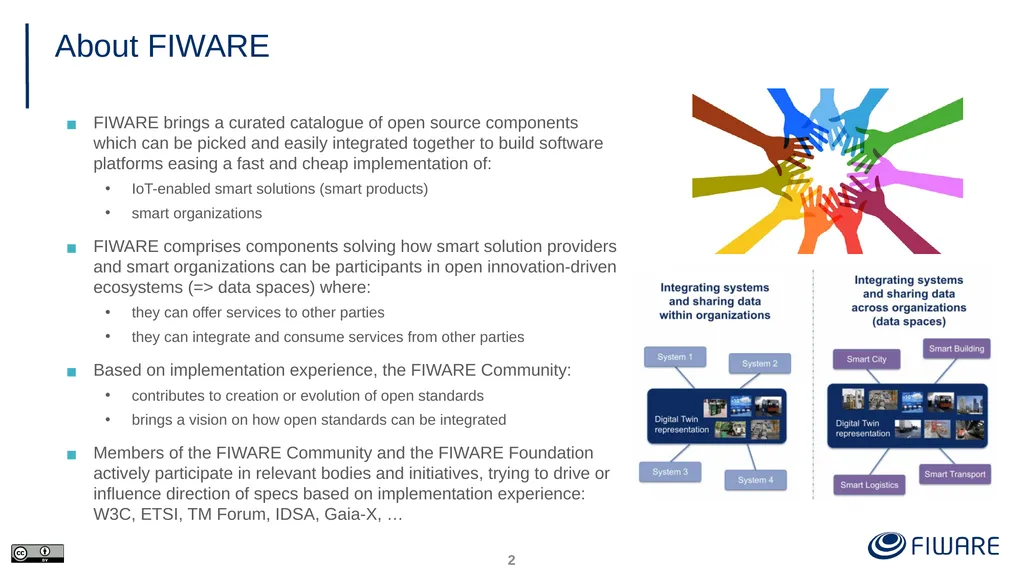
About FIWARE FIWARE brings a curated catalogue of open source components which can be picked and easily integrated together to build software platforms easing a fast and cheap implementation of:
IoT-enabled smart solutions (smart products)
smart organizations
FIWARE comprises components solving how smart solution providers and smart organizations can be participants in open innovation-driven ecosystems (=> data spaces) where:
they can offer services to other parties
they can integrate and consume services from other parties
Based on implementation experience, the FIWARE Community:
contributes to creation or evolution of open standards
brings a vision on how open standards can be integrated
Members of the FIWARE Community and the FIWARE Foundation actively participate in relevant bodies and initiatives, trying to drive or influence direction of specs based on implementation experience: W3C, ETSI, TM Forum, IDSA, Gaia-X, … 1<br>
IoT-enabled smart solutions (smart products)
smart organizations
FIWARE comprises components solving how smart solution providers and smart organizations can be participants in open innovation-driven ecosystems (=> data spaces) where:
they can offer services to other parties
they can integrate and consume services from other parties
Based on implementation experience, the FIWARE Community:
contributes to creation or evolution of open standards
brings a vision on how open standards can be integrated
Members of the FIWARE Community and the FIWARE Foundation actively participate in relevant bodies and initiatives, trying to drive or influence direction of specs based on implementation experience: W3C, ETSI, TM Forum, IDSA, Gaia-X, … 1<br>
03
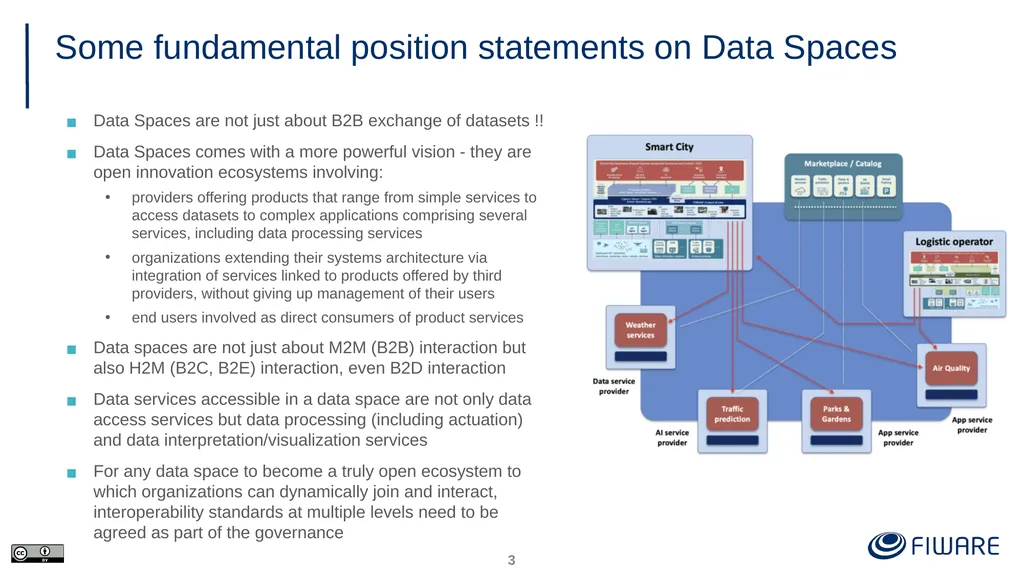
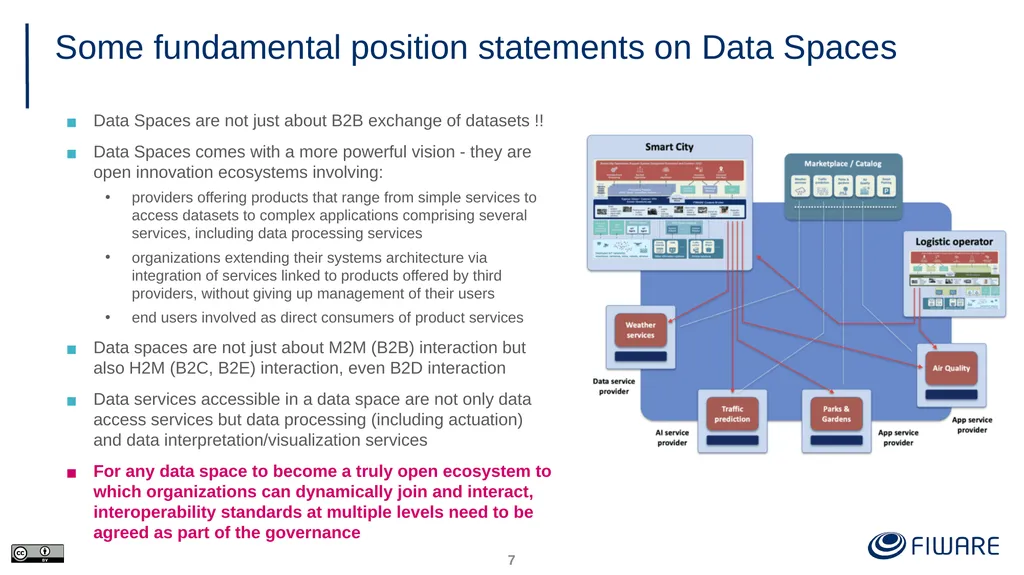
Some fundamental position statements on Data Spaces Data Spaces are not just about B2B exchange of datasets !!
Data Spaces comes with a more powerful vision - they are open innovation ecosystems involving:
providers offering products that range from simple services to access datasets to complex applications comprising several services, including data processing services
organizations extending their systems architecture via integration of services linked to products offered by third providers, without giving up management of their users
end users involved as direct consumers of product services
Data spaces are not just about M2M (B2B) interaction but also H2M (B2C, B2E) interaction, even B2D interaction
Data services accessible in a data space are not only data access services but data processing (including actuation) and data interpretation/visualization services
For any data space to become a truly open ecosystem to which organizations can dynamically join and interact, interoperability standards at multiple levels need to be agreed as part of the governance 2<br>
Data Spaces comes with a more powerful vision - they are open innovation ecosystems involving:
providers offering products that range from simple services to access datasets to complex applications comprising several services, including data processing services
organizations extending their systems architecture via integration of services linked to products offered by third providers, without giving up management of their users
end users involved as direct consumers of product services
Data spaces are not just about M2M (B2B) interaction but also H2M (B2C, B2E) interaction, even B2D interaction
Data services accessible in a data space are not only data access services but data processing (including actuation) and data interpretation/visualization services
For any data space to become a truly open ecosystem to which organizations can dynamically join and interact, interoperability standards at multiple levels need to be agreed as part of the governance 2<br>
04
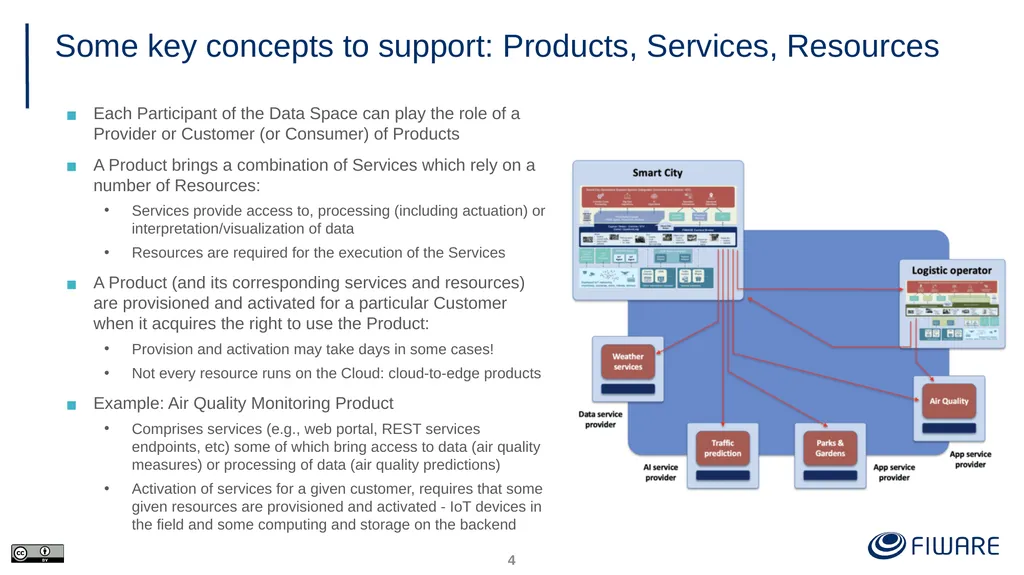
Some key concepts to support: Products, Services, Resources 3 Each Participant of the Data Space can play the role of a Provider or Customer (or Consumer) of Products
A Product brings a combination of Services which rely on a number of Resources:
Services provide access to, processing (including actuation) or interpretation/visualization of data
Resources are required for the execution of the Services
A Product (and its corresponding services and resources) are provisioned and activated for a particular Customer when it acquires the right to use the Product:
Provision and activation may take days in some cases!
Not every resource runs on the Cloud: cloud-to-edge products
Example: Air Quality Monitoring Product
Comprises services (e.g., web portal, REST services endpoints, etc) some of which bring access to data (air quality measures) or processing of data (air quality predictions)
Activation of services for a given customer, requires that some given resources are provisioned and activated - IoT devices in the field and some computing and storage on the backend<br>
A Product brings a combination of Services which rely on a number of Resources:
Services provide access to, processing (including actuation) or interpretation/visualization of data
Resources are required for the execution of the Services
A Product (and its corresponding services and resources) are provisioned and activated for a particular Customer when it acquires the right to use the Product:
Provision and activation may take days in some cases!
Not every resource runs on the Cloud: cloud-to-edge products
Example: Air Quality Monitoring Product
Comprises services (e.g., web portal, REST services endpoints, etc) some of which bring access to data (air quality measures) or processing of data (air quality predictions)
Activation of services for a given customer, requires that some given resources are provisioned and activated - IoT devices in the field and some computing and storage on the backend<br>
05
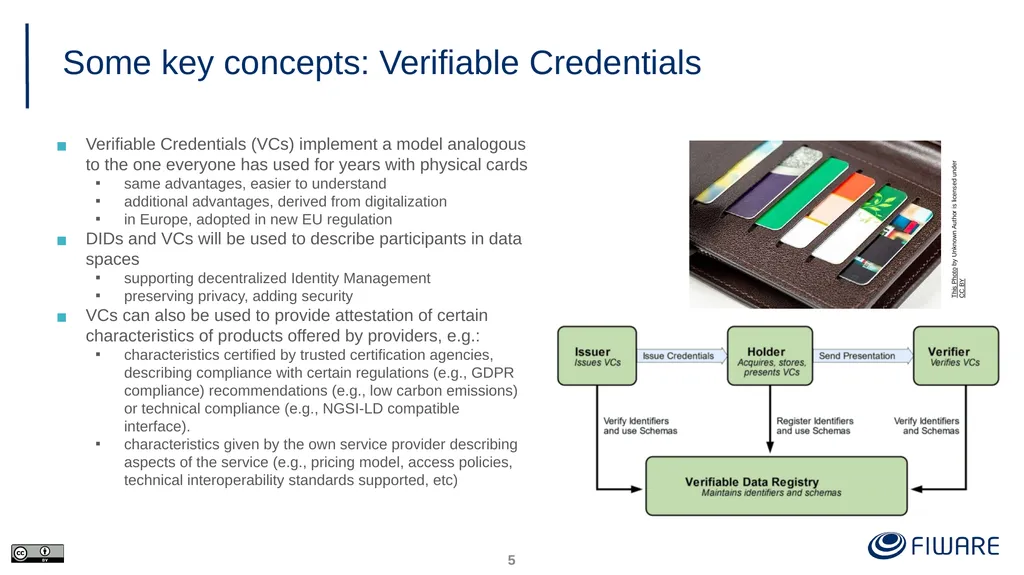
Some key concepts: Verifiable Credentials 4 This Photo by Unknown Author is licensed under CC BY Verifiable Credentials (VCs) implement a model analogous to the one everyone has used for years with physical cards
same advantages, easier to understand
additional advantages, derived from digitalization
in Europe, adopted in new EU regulation
DIDs and VCs will be used to describe participants in data spaces
supporting decentralized Identity Management
preserving privacy, adding security
VCs can also be used to provide attestation of certain characteristics of products offered by providers, e.g.:
characteristics certified by trusted certification agencies, describing compliance with certain regulations (e.g., GDPR compliance) recommendations (e.g., low carbon emissions) or technical compliance (e.g., NGSI-LD compatible interface).
characteristics given by the own service provider describing aspects of the service (e.g., pricing model, access policies, technical interoperability standards supported, etc)<br>
same advantages, easier to understand
additional advantages, derived from digitalization
in Europe, adopted in new EU regulation
DIDs and VCs will be used to describe participants in data spaces
supporting decentralized Identity Management
preserving privacy, adding security
VCs can also be used to provide attestation of certain characteristics of products offered by providers, e.g.:
characteristics certified by trusted certification agencies, describing compliance with certain regulations (e.g., GDPR compliance) recommendations (e.g., low carbon emissions) or technical compliance (e.g., NGSI-LD compatible interface).
characteristics given by the own service provider describing aspects of the service (e.g., pricing model, access policies, technical interoperability standards supported, etc)<br>
06
What it means acquiring rights to use a product/service? Inherent to the business logic of services linked to products is the definition of authorization policies that establish what certain users can do based on their credentials:
park visitors vs gardeners in connection to a parks&gardens management product
premium vs regular customers in connection to a packet service delivery product
Participants that acquire rights to use a product (data service):
become trusted issuers of VC including claims relevant for data service access
acquiring organizations can issue such VCs for users linked to the organization (employees, customers, devices, application agents)
When participants authenticate against a provider prior to request services of a product, it will be verified whether:
it owns VCs meaningful for the product
such VCs have been issued by a trusted issuer (participant which acquired the right to use the product) that remains a trusted participant 5<br>
park visitors vs gardeners in connection to a parks&gardens management product
premium vs regular customers in connection to a packet service delivery product
Participants that acquire rights to use a product (data service):
become trusted issuers of VC including claims relevant for data service access
acquiring organizations can issue such VCs for users linked to the organization (employees, customers, devices, application agents)
When participants authenticate against a provider prior to request services of a product, it will be verified whether:
it owns VCs meaningful for the product
such VCs have been issued by a trusted issuer (participant which acquired the right to use the product) that remains a trusted participant 5<br>
07
Some fundamental position statements on Data Spaces Data Spaces are not just about B2B exchange of datasets !!
Data Spaces comes with a more powerful vision - they are open innovation ecosystems involving:
providers offering products that range from simple services to access datasets to complex applications comprising several services, including data processing services
organizations extending their systems architecture via integration of services linked to products offered by third providers, without giving up management of their users
end users involved as direct consumers of product services
Data spaces are not just about M2M (B2B) interaction but also H2M (B2C, B2E) interaction, even B2D interaction
Data services accessible in a data space are not only data access services but data processing (including actuation) and data interpretation/visualization services
For any data space to become a truly open ecosystem to which organizations can dynamically join and interact, interoperability standards at multiple levels need to be agreed as part of the governance 6<br>
Data Spaces comes with a more powerful vision - they are open innovation ecosystems involving:
providers offering products that range from simple services to access datasets to complex applications comprising several services, including data processing services
organizations extending their systems architecture via integration of services linked to products offered by third providers, without giving up management of their users
end users involved as direct consumers of product services
Data spaces are not just about M2M (B2B) interaction but also H2M (B2C, B2E) interaction, even B2D interaction
Data services accessible in a data space are not only data access services but data processing (including actuation) and data interpretation/visualization services
For any data space to become a truly open ecosystem to which organizations can dynamically join and interact, interoperability standards at multiple levels need to be agreed as part of the governance 6<br>
08
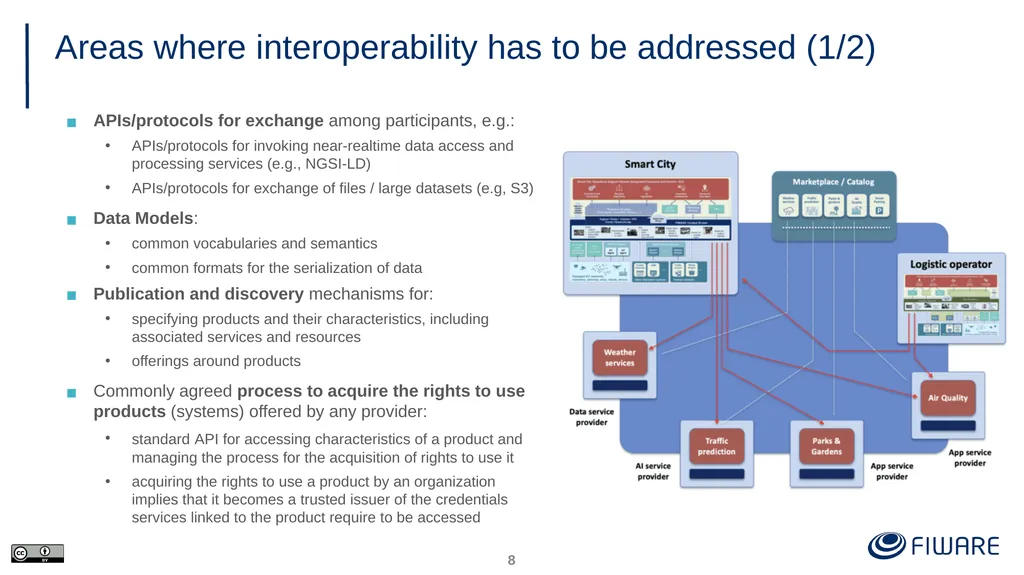
Areas where interoperability has to be addressed (1/2) APIs/protocols for exchange among participants, e.g.:
APIs/protocols for invoking near-realtime data access and processing services (e.g., NGSI-LD)
APIs/protocols for exchange of files / large datasets (e.g, S3)
Data Models:
common vocabularies and semantics
common formats for the serialization of data
Publication and discovery mechanisms for:
specifying products and their characteristics, including associated services and resources
offerings around products
Commonly agreed process to acquire the rights to use products (systems) offered by any provider:
standard API for accessing characteristics of a product and managing the process for the acquisition of rights to use it
acquiring the rights to use a product by an organization implies that it becomes a trusted issuer of the credentials services linked to the product require to be accessed 7<br>
APIs/protocols for invoking near-realtime data access and processing services (e.g., NGSI-LD)
APIs/protocols for exchange of files / large datasets (e.g, S3)
Data Models:
common vocabularies and semantics
common formats for the serialization of data
Publication and discovery mechanisms for:
specifying products and their characteristics, including associated services and resources
offerings around products
Commonly agreed process to acquire the rights to use products (systems) offered by any provider:
standard API for accessing characteristics of a product and managing the process for the acquisition of rights to use it
acquiring the rights to use a product by an organization implies that it becomes a trusted issuer of the credentials services linked to the product require to be accessed 7<br>
09
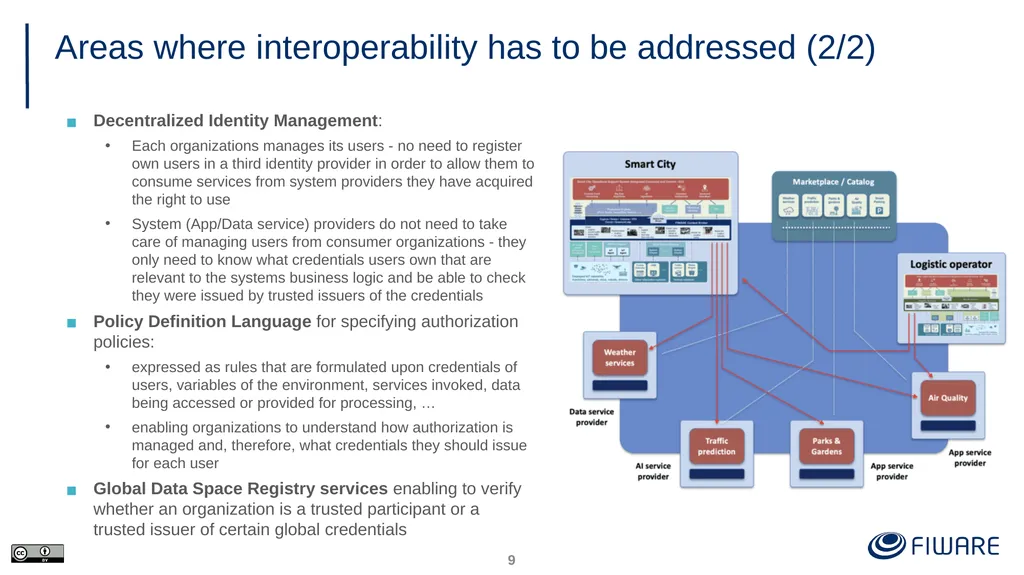
Areas where interoperability has to be addressed (2/2) Decentralized Identity Management:
Each organizations manages its users - no need to register own users in a third identity provider in order to allow them to consume services from system providers they have acquired the right to use
System (App/Data service) providers do not need to take care of managing users from consumer organizations - they only need to know what credentials users own that are relevant to the systems business logic and be able to check they were issued by trusted issuers of the credentials
Policy Definition Language for specifying authorization policies:
expressed as rules that are formulated upon credentials of users, variables of the environment, services invoked, data being accessed or provided for processing, …
enabling organizations to understand how authorization is managed and, therefore, what credentials they should issue for each user
Global Data Space Registry services enabling to verify whether an organization is a trusted participant or a trusted issuer of certain global credentials 8<br>
Each organizations manages its users - no need to register own users in a third identity provider in order to allow them to consume services from system providers they have acquired the right to use
System (App/Data service) providers do not need to take care of managing users from consumer organizations - they only need to know what credentials users own that are relevant to the systems business logic and be able to check they were issued by trusted issuers of the credentials
Policy Definition Language for specifying authorization policies:
expressed as rules that are formulated upon credentials of users, variables of the environment, services invoked, data being accessed or provided for processing, …
enabling organizations to understand how authorization is managed and, therefore, what credentials they should issue for each user
Global Data Space Registry services enabling to verify whether an organization is a trusted participant or a trusted issuer of certain global credentials 8<br>
10
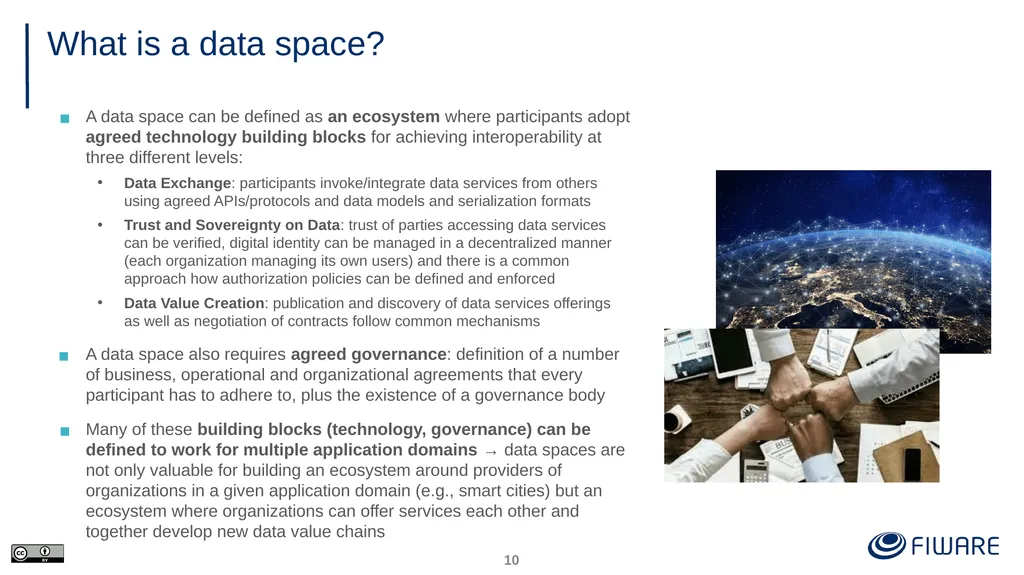
What is a data space? 9 A data space can be defined as an ecosystem where participants adopt agreed technology building blocks for achieving interoperability at three different levels:
Data Exchange: participants invoke/integrate data services from others using agreed APIs/protocols and data models and serialization formats
Trust and Sovereignty on Data: trust of parties accessing data services can be verified, digital identity can be managed in a decentralized manner (each organization managing its own users) and there is a common approach how authorization policies can be defined and enforced
Data Value Creation: publication and discovery of data services offerings as well as negotiation of contracts follow common mechanisms
A data space also requires agreed governance: definition of a number of business, operational and organizational agreements that every participant has to adhere to, plus the existence of a governance body
Many of these building blocks (technology, governance) can be defined to work for multiple application domains → data spaces are not only valuable for building an ecosystem around providers of organizations in a given application domain (e.g., smart cities) but an ecosystem where organizations can offer services each other and together develop new data value chains<br>
Data Exchange: participants invoke/integrate data services from others using agreed APIs/protocols and data models and serialization formats
Trust and Sovereignty on Data: trust of parties accessing data services can be verified, digital identity can be managed in a decentralized manner (each organization managing its own users) and there is a common approach how authorization policies can be defined and enforced
Data Value Creation: publication and discovery of data services offerings as well as negotiation of contracts follow common mechanisms
A data space also requires agreed governance: definition of a number of business, operational and organizational agreements that every participant has to adhere to, plus the existence of a governance body
Many of these building blocks (technology, governance) can be defined to work for multiple application domains → data spaces are not only valuable for building an ecosystem around providers of organizations in a given application domain (e.g., smart cities) but an ecosystem where organizations can offer services each other and together develop new data value chains<br>
11
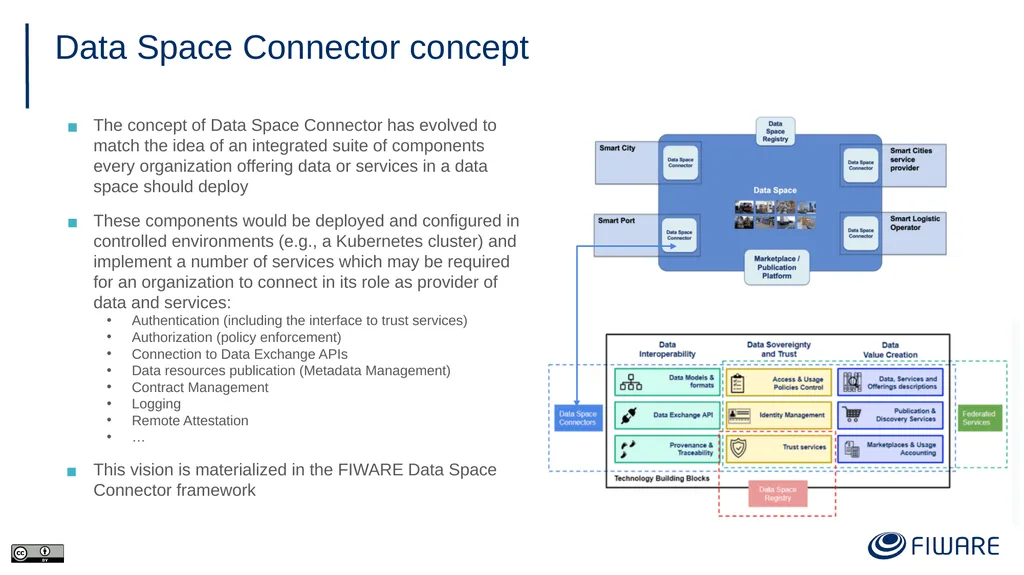
Data Space Connector concept The concept of Data Space Connector has evolved to match the idea of an integrated suite of components every organization offering data or services in a data space should deploy
These components would be deployed and configured in controlled environments (e.g., a Kubernetes cluster) and implement a number of services which may be required for an organization to connect in its role as provider of data and services:
Authentication (including the interface to trust services)
Authorization (policy enforcement)
Connection to Data Exchange APIs
Data resources publication (Metadata Management)
Contract Management
Logging
Remote Attestation
…
This vision is materialized in the FIWARE Data Space Connector framework 10<br>
These components would be deployed and configured in controlled environments (e.g., a Kubernetes cluster) and implement a number of services which may be required for an organization to connect in its role as provider of data and services:
Authentication (including the interface to trust services)
Authorization (policy enforcement)
Connection to Data Exchange APIs
Data resources publication (Metadata Management)
Contract Management
Logging
Remote Attestation
…
This vision is materialized in the FIWARE Data Space Connector framework 10<br>
12
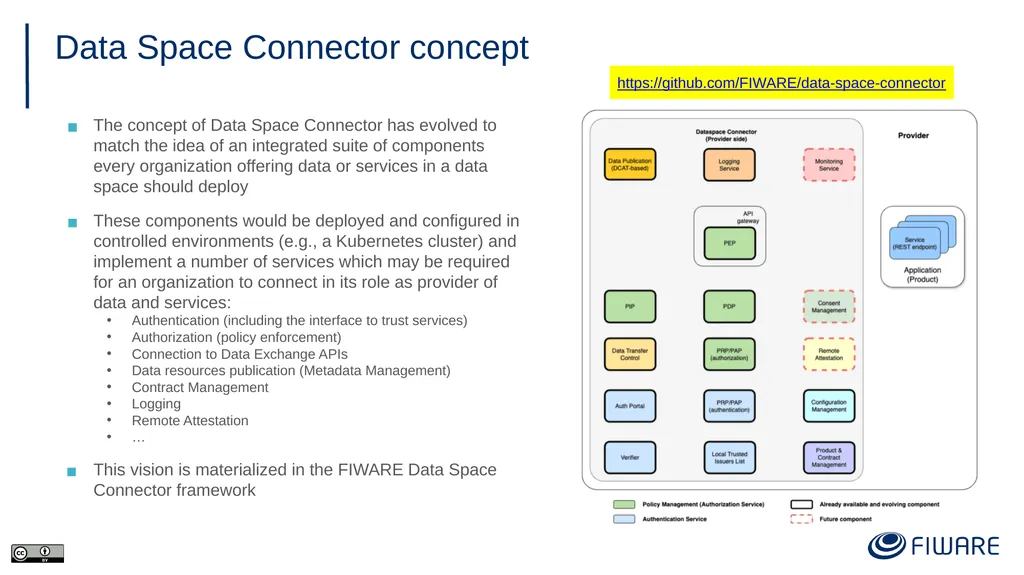
Data Space Connector concept The concept of Data Space Connector has evolved to match the idea of an integrated suite of components every organization offering data or services in a data space should deploy
These components would be deployed and configured in controlled environments (e.g., a Kubernetes cluster) and implement a number of services which may be required for an organization to connect in its role as provider of data and services:
Authentication (including the interface to trust services)
Authorization (policy enforcement)
Connection to Data Exchange APIs
Data resources publication (Metadata Management)
Contract Management
Logging
Remote Attestation
…
This vision is materialized in the FIWARE Data Space Connector framework 11 https://github.com/FIWARE/data-space-connector<br>
These components would be deployed and configured in controlled environments (e.g., a Kubernetes cluster) and implement a number of services which may be required for an organization to connect in its role as provider of data and services:
Authentication (including the interface to trust services)
Authorization (policy enforcement)
Connection to Data Exchange APIs
Data resources publication (Metadata Management)
Contract Management
Logging
Remote Attestation
…
This vision is materialized in the FIWARE Data Space Connector framework 11 https://github.com/FIWARE/data-space-connector<br>
13
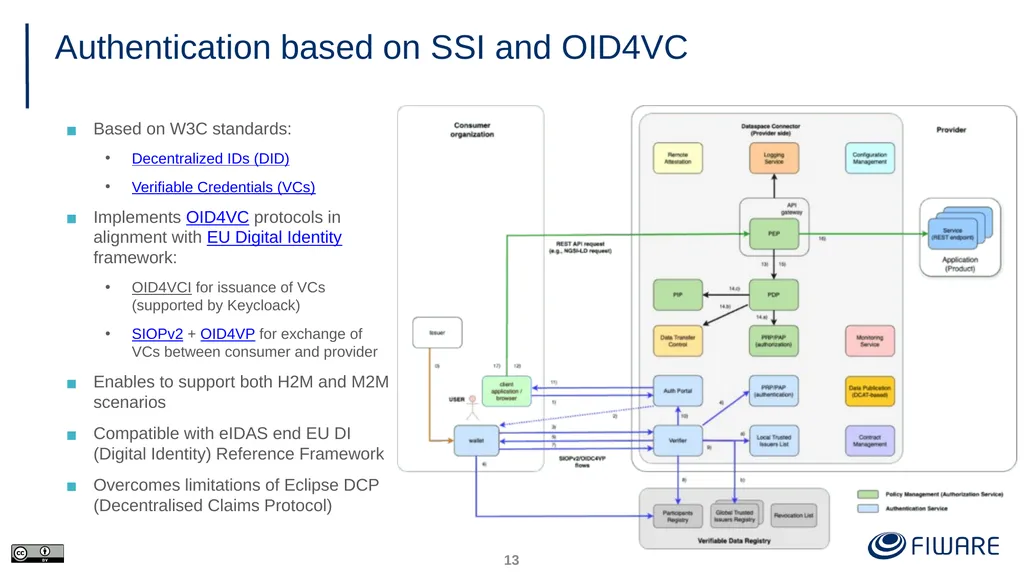
Authentication based on SSI and OID4VC Based on W3C standards:
Decentralized IDs (DID)
Verifiable Credentials (VCs)
Implements OID4VC protocols in alignment with EU Digital Identity framework:
OID4VCI for issuance of VCs (supported by Keycloack)
SIOPv2 + OID4VP for exchange of VCs between consumer and provider
Enables to support both H2M and M2M scenarios
Compatible with eIDAS end EU DI (Digital Identity) Reference Framework
Overcomes limitations of Eclipse DCP (Decentralised Claims Protocol) 12<br>
Decentralized IDs (DID)
Verifiable Credentials (VCs)
Implements OID4VC protocols in alignment with EU Digital Identity framework:
OID4VCI for issuance of VCs (supported by Keycloack)
SIOPv2 + OID4VP for exchange of VCs between consumer and provider
Enables to support both H2M and M2M scenarios
Compatible with eIDAS end EU DI (Digital Identity) Reference Framework
Overcomes limitations of Eclipse DCP (Decentralised Claims Protocol) 12<br>
14
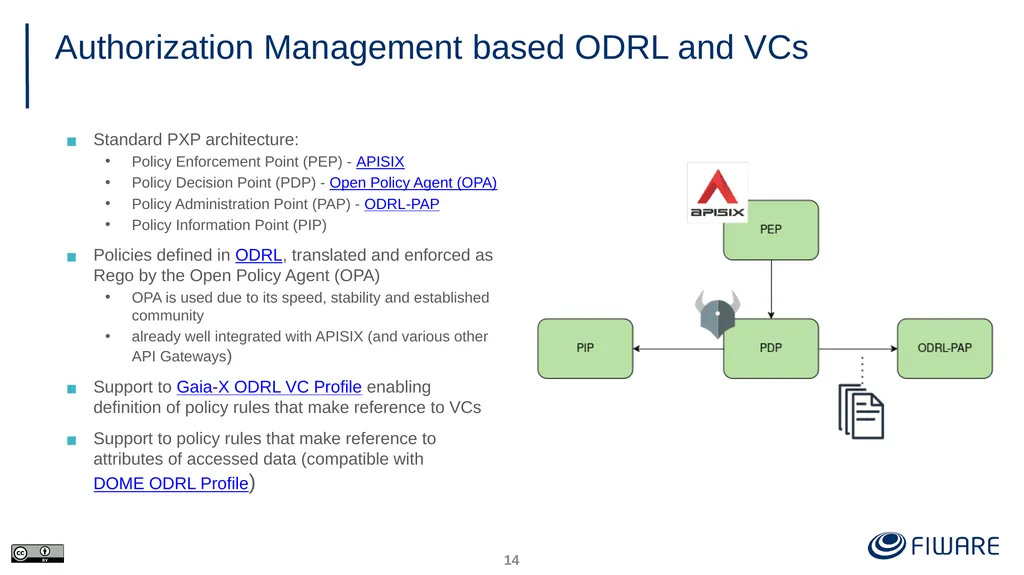
Authorization Management based ODRL and VCs Standard PXP architecture:
Policy Enforcement Point (PEP) - APISIX
Policy Decision Point (PDP) - Open Policy Agent (OPA)
Policy Administration Point (PAP) - ODRL-PAP
Policy Information Point (PIP)
Policies defined in ODRL, translated and enforced as Rego by the Open Policy Agent (OPA)
OPA is used due to its speed, stability and established community
already well integrated with APISIX (and various other API Gateways)
Support to Gaia-X ODRL VC Profile enabling definition of policy rules that make reference to VCs
Support to policy rules that make reference to attributes of accessed data (compatible with DOME ODRL Profile) 13<br>
Policy Enforcement Point (PEP) - APISIX
Policy Decision Point (PDP) - Open Policy Agent (OPA)
Policy Administration Point (PAP) - ODRL-PAP
Policy Information Point (PIP)
Policies defined in ODRL, translated and enforced as Rego by the Open Policy Agent (OPA)
OPA is used due to its speed, stability and established community
already well integrated with APISIX (and various other API Gateways)
Support to Gaia-X ODRL VC Profile enabling definition of policy rules that make reference to VCs
Support to policy rules that make reference to attributes of accessed data (compatible with DOME ODRL Profile) 13<br>
15
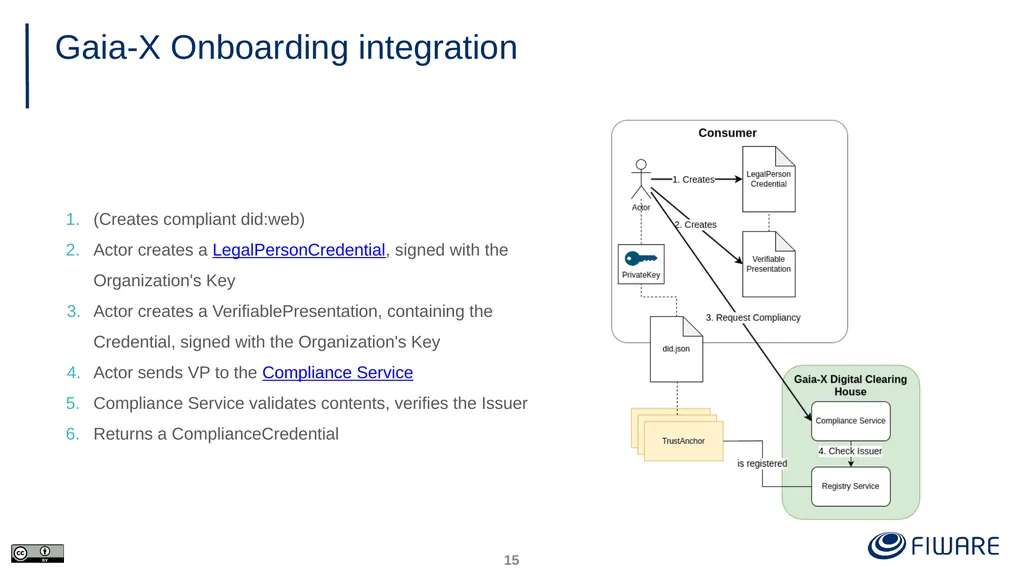
Gaia-X Onboarding integration 14 (Creates compliant did:web)
Actor creates a LegalPersonCredential, signed with the Organization's Key
Actor creates a VerifiablePresentation, containing the Credential, signed with the Organization's Key
Actor sends VP to the Compliance Service
Compliance Service validates contents, verifies the Issuer
Returns a ComplianceCredential<br>
Actor creates a LegalPersonCredential, signed with the Organization's Key
Actor creates a VerifiablePresentation, containing the Credential, signed with the Organization's Key
Actor sends VP to the Compliance Service
Compliance Service validates contents, verifies the Issuer
Returns a ComplianceCredential<br>
16
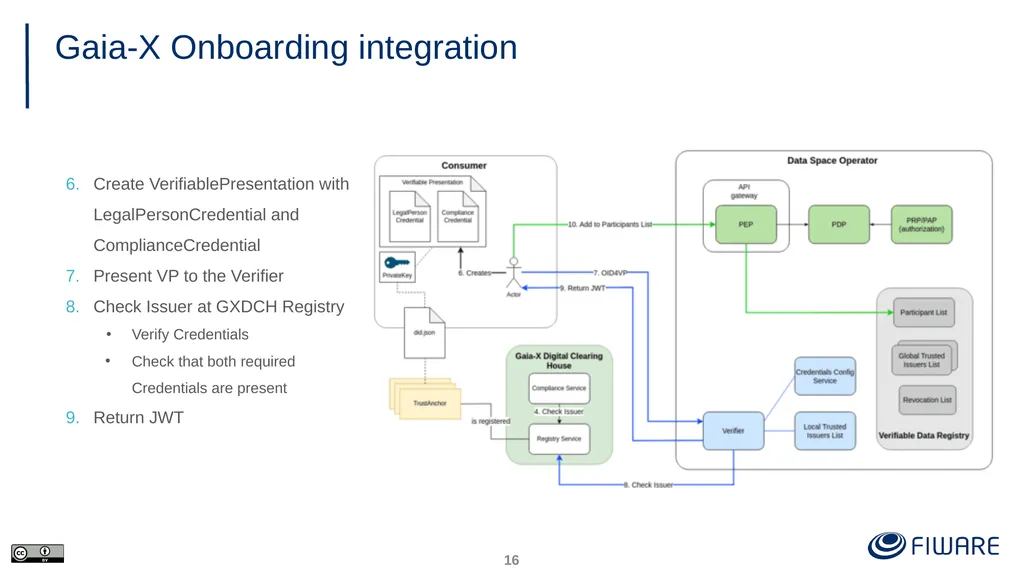
Gaia-X Onboarding integration 15 Create VerifiablePresentation with LegalPersonCredential and ComplianceCredential
Present VP to the Verifier
Check Issuer at GXDCH Registry
Verify Credentials
Check that both required Credentials are present
Return JWT<br>
Present VP to the Verifier
Check Issuer at GXDCH Registry
Verify Credentials
Check that both required Credentials are present
Return JWT<br>
17
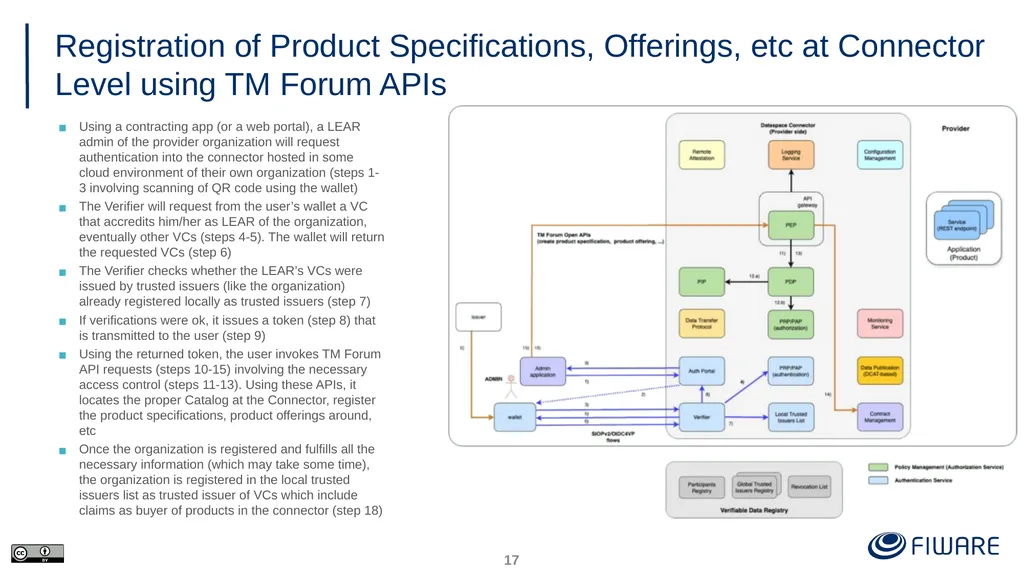
Registration of Product Specifications, Offerings, etc at Connector Level using TM Forum APIs 16 Using a contracting app (or a web portal), a LEAR admin of the provider organization will request authentication into the connector hosted in some cloud environment of their own organization (steps 1-3 involving scanning of QR code using the wallet)
The Verifier will request from the user’s wallet a VC that accredits him/her as LEAR of the organization, eventually other VCs (steps 4-5). The wallet will return the requested VCs (step 6)
The Verifier checks whether the LEAR’s VCs were issued by trusted issuers (like the organization) already registered locally as trusted issuers (step 7)
If verifications were ok, it issues a token (step 8) that is transmitted to the user (step 9)
Using the returned token, the user invokes TM Forum API requests (steps 10-15) involving the necessary access control (steps 11-13). Using these APIs, it locates the proper Catalog at the Connector, register the product specifications, product offerings around, etc
Once the organization is registered and fulfills all the necessary information (which may take some time), the organization is registered in the local trusted issuers list as trusted issuer of VCs which include claims as buyer of products in the connector (step 18)<br>
The Verifier will request from the user’s wallet a VC that accredits him/her as LEAR of the organization, eventually other VCs (steps 4-5). The wallet will return the requested VCs (step 6)
The Verifier checks whether the LEAR’s VCs were issued by trusted issuers (like the organization) already registered locally as trusted issuers (step 7)
If verifications were ok, it issues a token (step 8) that is transmitted to the user (step 9)
Using the returned token, the user invokes TM Forum API requests (steps 10-15) involving the necessary access control (steps 11-13). Using these APIs, it locates the proper Catalog at the Connector, register the product specifications, product offerings around, etc
Once the organization is registered and fulfills all the necessary information (which may take some time), the organization is registered in the local trusted issuers list as trusted issuer of VCs which include claims as buyer of products in the connector (step 18)<br>
18
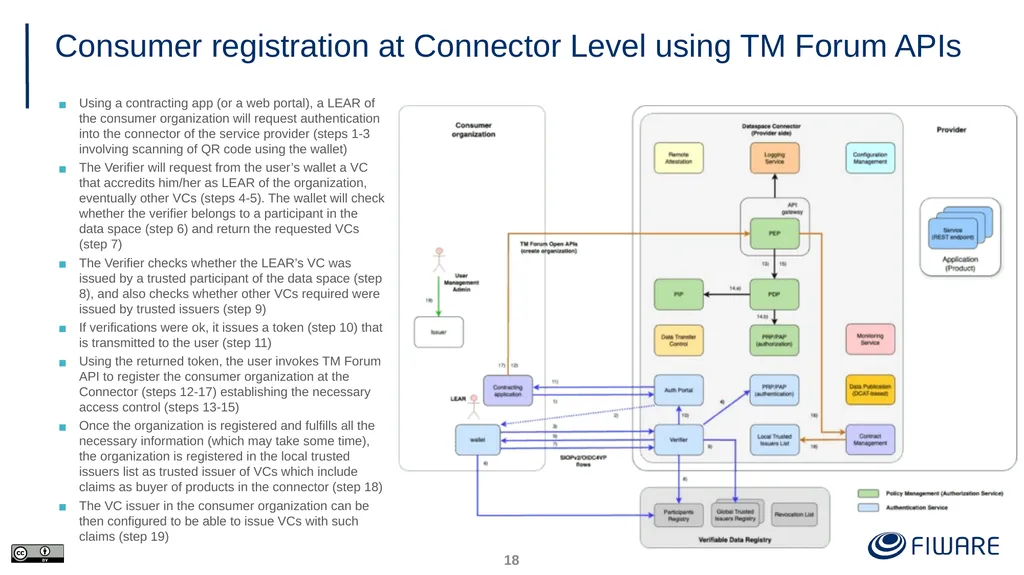
Consumer registration at Connector Level using TM Forum APIs 17 Using a contracting app (or a web portal), a LEAR of the consumer organization will request authentication into the connector of the service provider (steps 1-3 involving scanning of QR code using the wallet)
The Verifier will request from the user’s wallet a VC that accredits him/her as LEAR of the organization, eventually other VCs (steps 4-5). The wallet will check whether the verifier belongs to a participant in the data space (step 6) and return the requested VCs (step 7)
The Verifier checks whether the LEAR’s VC was issued by a trusted participant of the data space (step 8), and also checks whether other VCs required were issued by trusted issuers (step 9)
If verifications were ok, it issues a token (step 10) that is transmitted to the user (step 11)
Using the returned token, the user invokes TM Forum API to register the consumer organization at the Connector (steps 12-17) establishing the necessary access control (steps 13-15)
Once the organization is registered and fulfills all the necessary information (which may take some time), the organization is registered in the local trusted issuers list as trusted issuer of VCs which include claims as buyer of products in the connector (step 18)
The VC issuer in the consumer organization can be then configured to be able to issue VCs with such claims (step 19)<br>
The Verifier will request from the user’s wallet a VC that accredits him/her as LEAR of the organization, eventually other VCs (steps 4-5). The wallet will check whether the verifier belongs to a participant in the data space (step 6) and return the requested VCs (step 7)
The Verifier checks whether the LEAR’s VC was issued by a trusted participant of the data space (step 8), and also checks whether other VCs required were issued by trusted issuers (step 9)
If verifications were ok, it issues a token (step 10) that is transmitted to the user (step 11)
Using the returned token, the user invokes TM Forum API to register the consumer organization at the Connector (steps 12-17) establishing the necessary access control (steps 13-15)
Once the organization is registered and fulfills all the necessary information (which may take some time), the organization is registered in the local trusted issuers list as trusted issuer of VCs which include claims as buyer of products in the connector (step 18)
The VC issuer in the consumer organization can be then configured to be able to issue VCs with such claims (step 19)<br>
19
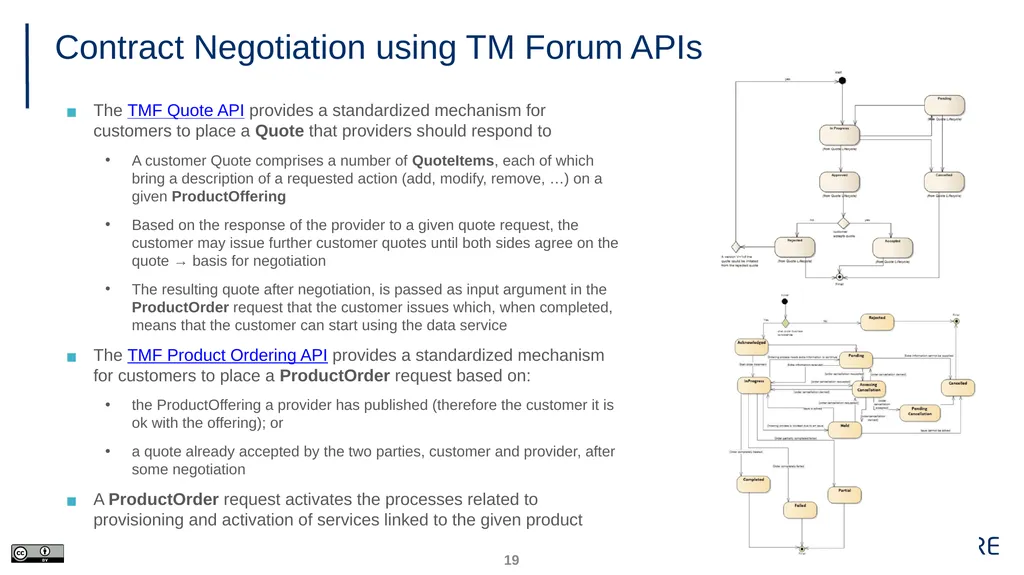
Contract Negotiation using TM Forum APIs The TMF Quote API provides a standardized mechanism for customers to place a Quote that providers should respond to
A customer Quote comprises a number of QuoteItems, each of which bring a description of a requested action (add, modify, remove, …) on a given ProductOffering
Based on the response of the provider to a given quote request, the customer may issue further customer quotes until both sides agree on the quote → basis for negotiation
The resulting quote after negotiation, is passed as input argument in the ProductOrder request that the customer issues which, when completed, means that the customer can start using the data service
The TMF Product Ordering API provides a standardized mechanism for customers to place a ProductOrder request based on:
the ProductOffering a provider has published (therefore the customer it is ok with the offering); or
a quote already accepted by the two parties, customer and provider, after some negotiation
A ProductOrder request activates the processes related to provisioning and activation of services linked to the given product 18<br>
A customer Quote comprises a number of QuoteItems, each of which bring a description of a requested action (add, modify, remove, …) on a given ProductOffering
Based on the response of the provider to a given quote request, the customer may issue further customer quotes until both sides agree on the quote → basis for negotiation
The resulting quote after negotiation, is passed as input argument in the ProductOrder request that the customer issues which, when completed, means that the customer can start using the data service
The TMF Product Ordering API provides a standardized mechanism for customers to place a ProductOrder request based on:
the ProductOffering a provider has published (therefore the customer it is ok with the offering); or
a quote already accepted by the two parties, customer and provider, after some negotiation
A ProductOrder request activates the processes related to provisioning and activation of services linked to the given product 18<br>
20
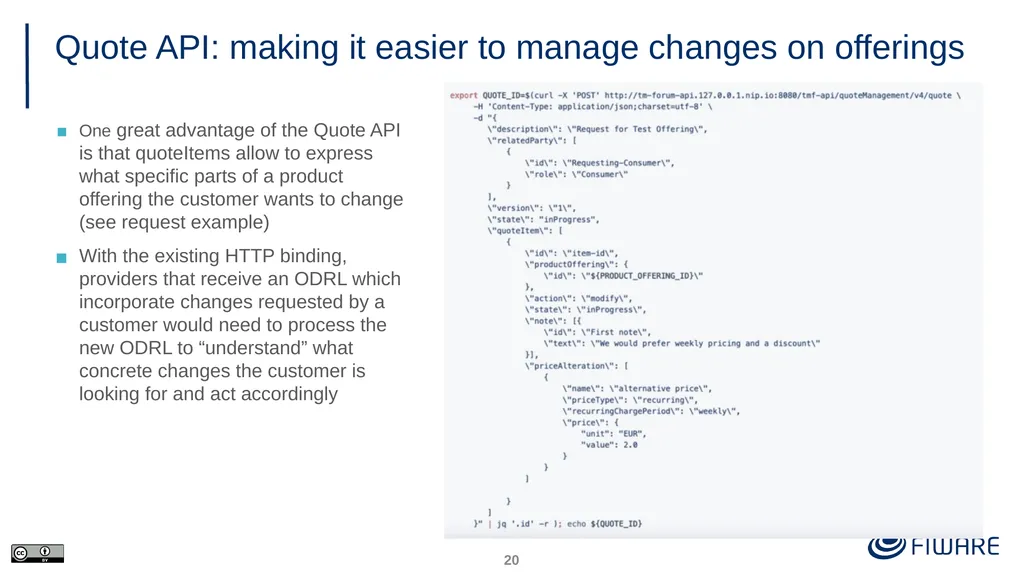
Quote API: making it easier to manage changes on offerings One great advantage of the Quote API is that quoteItems allow to express what specific parts of a product offering the customer wants to change (see request example)
With the existing HTTP binding, providers that receive an ODRL which incorporate changes requested by a customer would need to process the new ODRL to “understand” what concrete changes the customer is looking for and act accordingly 19<br>
With the existing HTTP binding, providers that receive an ODRL which incorporate changes requested by a customer would need to process the new ODRL to “understand” what concrete changes the customer is looking for and act accordingly 19<br>
21
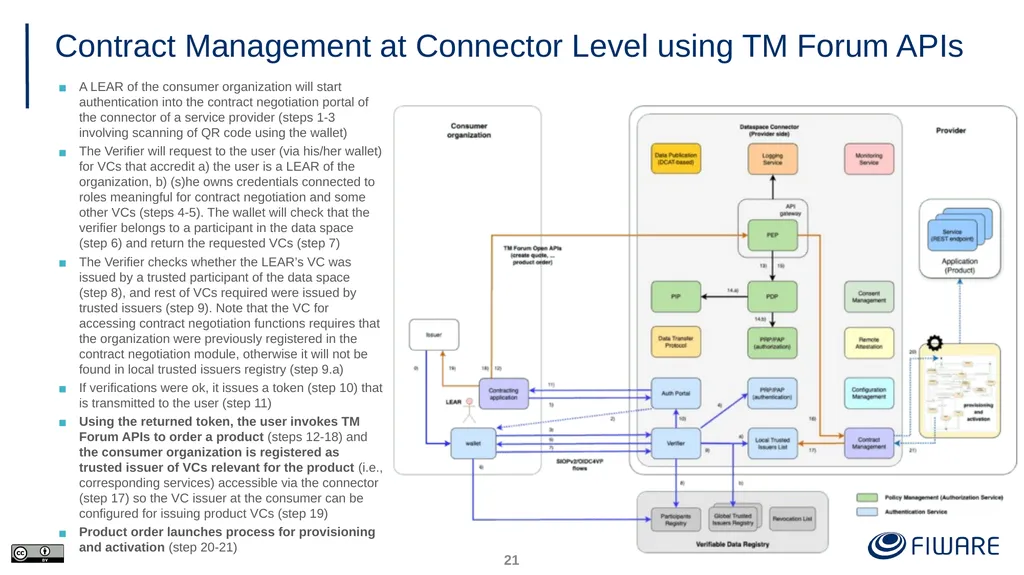
Contract Management at Connector Level using TM Forum APIs 20 A LEAR of the consumer organization will start authentication into the contract negotiation portal of the connector of a service provider (steps 1-3 involving scanning of QR code using the wallet)
The Verifier will request to the user (via his/her wallet) for VCs that accredit a) the user is a LEAR of the organization, b) (s)he owns credentials connected to roles meaningful for contract negotiation and some other VCs (steps 4-5). The wallet will check that the verifier belongs to a participant in the data space (step 6) and return the requested VCs (step 7)
The Verifier checks whether the LEAR’s VC was issued by a trusted participant of the data space (step 8), and rest of VCs required were issued by trusted issuers (step 9). Note that the VC for accessing contract negotiation functions requires that the organization were previously registered in the contract negotiation module, otherwise it will not be found in local trusted issuers registry (step 9.a)
If verifications were ok, it issues a token (step 10) that is transmitted to the user (step 11)
Using the returned token, the user invokes TM Forum APIs to order a product (steps 12-18) and the consumer organization is registered as trusted issuer of VCs relevant for the product (i.e., corresponding services) accessible via the connector (step 17) so the VC issuer at the consumer can be configured for issuing product VCs (step 19)
Product order launches process for provisioning and activation (step 20-21)<br>
The Verifier will request to the user (via his/her wallet) for VCs that accredit a) the user is a LEAR of the organization, b) (s)he owns credentials connected to roles meaningful for contract negotiation and some other VCs (steps 4-5). The wallet will check that the verifier belongs to a participant in the data space (step 6) and return the requested VCs (step 7)
The Verifier checks whether the LEAR’s VC was issued by a trusted participant of the data space (step 8), and rest of VCs required were issued by trusted issuers (step 9). Note that the VC for accessing contract negotiation functions requires that the organization were previously registered in the contract negotiation module, otherwise it will not be found in local trusted issuers registry (step 9.a)
If verifications were ok, it issues a token (step 10) that is transmitted to the user (step 11)
Using the returned token, the user invokes TM Forum APIs to order a product (steps 12-18) and the consumer organization is registered as trusted issuer of VCs relevant for the product (i.e., corresponding services) accessible via the connector (step 17) so the VC issuer at the consumer can be configured for issuing product VCs (step 19)
Product order launches process for provisioning and activation (step 20-21)<br>
22
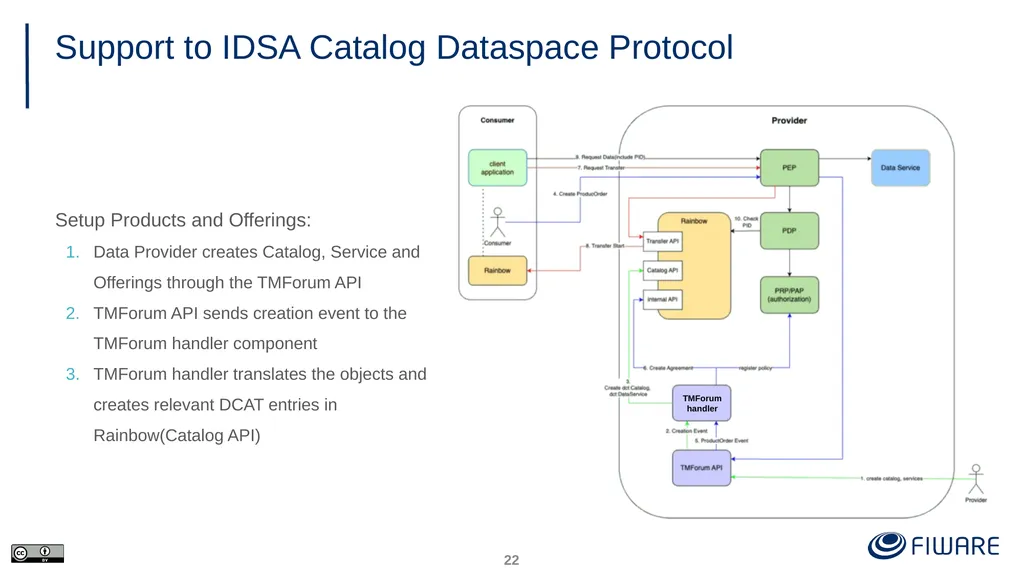
Support to IDSA Catalog Dataspace Protocol Setup Products and Offerings:
Data Provider creates Catalog, Service and Offerings through the TMForum API
TMForum API sends creation event to the TMForum handler component
TMForum handler translates the objects and creates relevant DCAT entries in Rainbow(Catalog API) 21<br>
Data Provider creates Catalog, Service and Offerings through the TMForum API
TMForum API sends creation event to the TMForum handler component
TMForum handler translates the objects and creates relevant DCAT entries in Rainbow(Catalog API) 21<br>
23
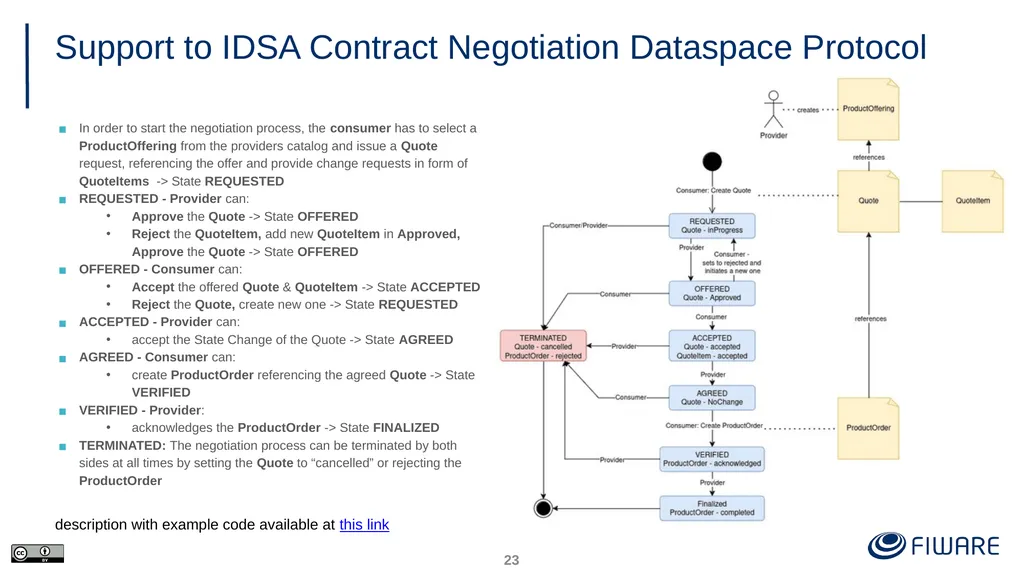
Support to IDSA Contract Negotiation Dataspace Protocol In order to start the negotiation process, the consumer has to select a ProductOffering from the providers catalog and issue a Quote request, referencing the offer and provide change requests in form of QuoteItems -> State REQUESTED
REQUESTED - Provider can:
Approve the Quote -> State OFFERED
Reject the QuoteItem, add new QuoteItem in Approved, Approve the Quote -> State OFFERED
OFFERED - Consumer can:
Accept the offered Quote & QuoteItem -> State ACCEPTED
Reject the Quote, create new one -> State REQUESTED
ACCEPTED - Provider can:
accept the State Change of the Quote -> State AGREED
AGREED - Consumer can:
create ProductOrder referencing the agreed Quote -> State VERIFIED
VERIFIED - Provider:
acknowledges the ProductOrder -> State FINALIZED
TERMINATED: The negotiation process can be terminated by both sides at all times by setting the Quote to “cancelled” or rejecting the ProductOrder 22 description with example code available at this link<br>
REQUESTED - Provider can:
Approve the Quote -> State OFFERED
Reject the QuoteItem, add new QuoteItem in Approved, Approve the Quote -> State OFFERED
OFFERED - Consumer can:
Accept the offered Quote & QuoteItem -> State ACCEPTED
Reject the Quote, create new one -> State REQUESTED
ACCEPTED - Provider can:
accept the State Change of the Quote -> State AGREED
AGREED - Consumer can:
create ProductOrder referencing the agreed Quote -> State VERIFIED
VERIFIED - Provider:
acknowledges the ProductOrder -> State FINALIZED
TERMINATED: The negotiation process can be terminated by both sides at all times by setting the Quote to “cancelled” or rejecting the ProductOrder 22 description with example code available at this link<br>
24
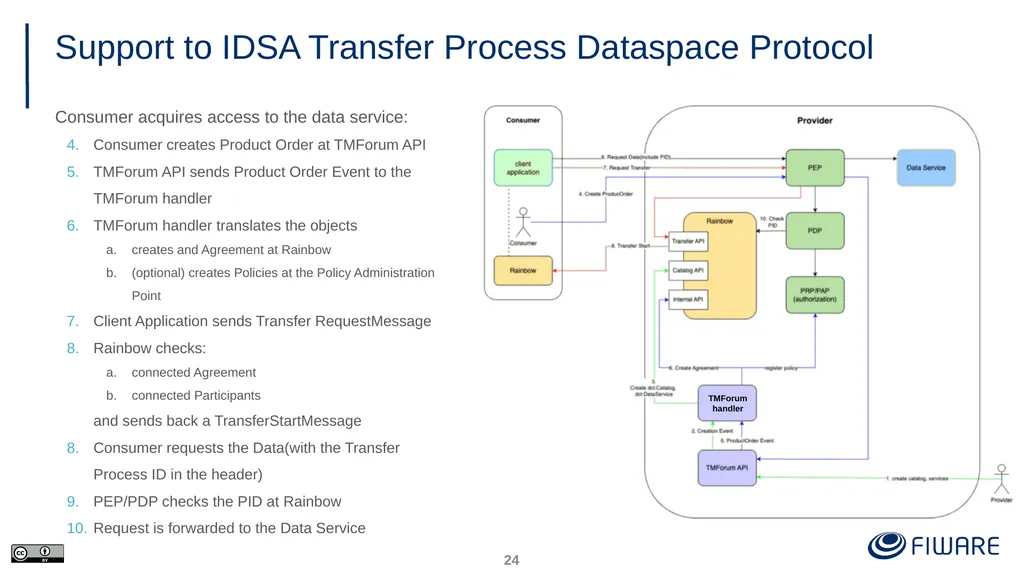
Support to IDSA Transfer Process Dataspace Protocol Consumer acquires access to the data service:
Consumer creates Product Order at TMForum API
TMForum API sends Product Order Event to the TMForum handler
TMForum handler translates the objects
creates and Agreement at Rainbow
(optional) creates Policies at the Policy Administration Point
Client Application sends Transfer RequestMessage
Rainbow checks:
connected Agreement
connected Participants
and sends back a TransferStartMessage
Consumer requests the Data(with the Transfer Process ID in the header)
PEP/PDP checks the PID at Rainbow
Request is forwarded to the Data Service 23<br>
Consumer creates Product Order at TMForum API
TMForum API sends Product Order Event to the TMForum handler
TMForum handler translates the objects
creates and Agreement at Rainbow
(optional) creates Policies at the Policy Administration Point
Client Application sends Transfer RequestMessage
Rainbow checks:
connected Agreement
connected Participants
and sends back a TransferStartMessage
Consumer requests the Data(with the Transfer Process ID in the header)
PEP/PDP checks the PID at Rainbow
Request is forwarded to the Data Service 23<br>
25
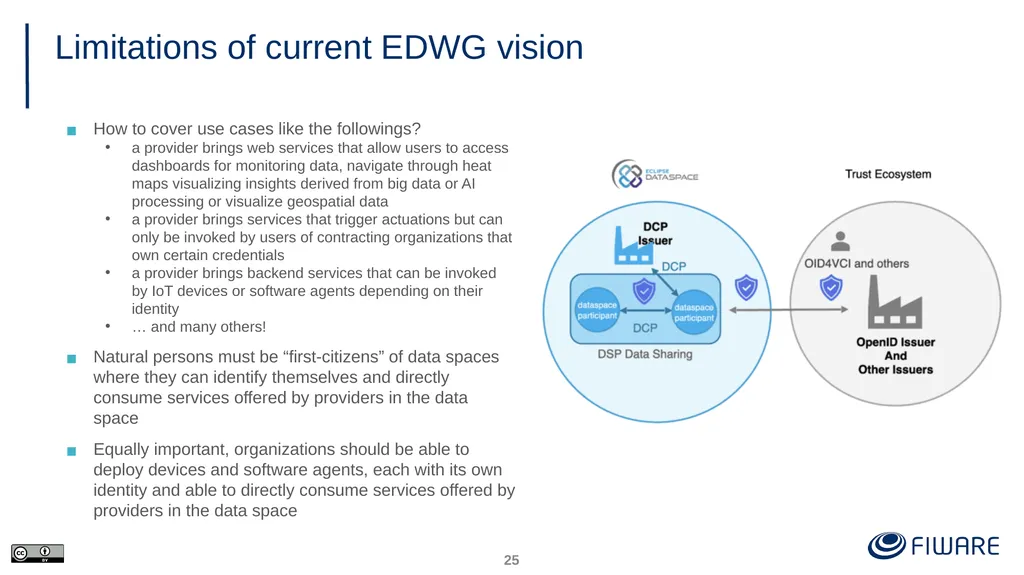
Limitations of current EDWG vision How to cover use cases like the followings?
a provider brings web services that allow users to access dashboards for monitoring data, navigate through heat maps visualizing insights derived from big data or AI processing or visualize geospatial data
a provider brings services that trigger actuations but can only be invoked by users of contracting organizations that own certain credentials
a provider brings backend services that can be invoked by IoT devices or software agents depending on their identity
… and many others!
Natural persons must be “first-citizens” of data spaces where they can identify themselves and directly consume services offered by providers in the data space
Equally important, organizations should be able to deploy devices and software agents, each with its own identity and able to directly consume services offered by providers in the data space 24<br>
a provider brings web services that allow users to access dashboards for monitoring data, navigate through heat maps visualizing insights derived from big data or AI processing or visualize geospatial data
a provider brings services that trigger actuations but can only be invoked by users of contracting organizations that own certain credentials
a provider brings backend services that can be invoked by IoT devices or software agents depending on their identity
… and many others!
Natural persons must be “first-citizens” of data spaces where they can identify themselves and directly consume services offered by providers in the data space
Equally important, organizations should be able to deploy devices and software agents, each with its own identity and able to directly consume services offered by providers in the data space 24<br>
26
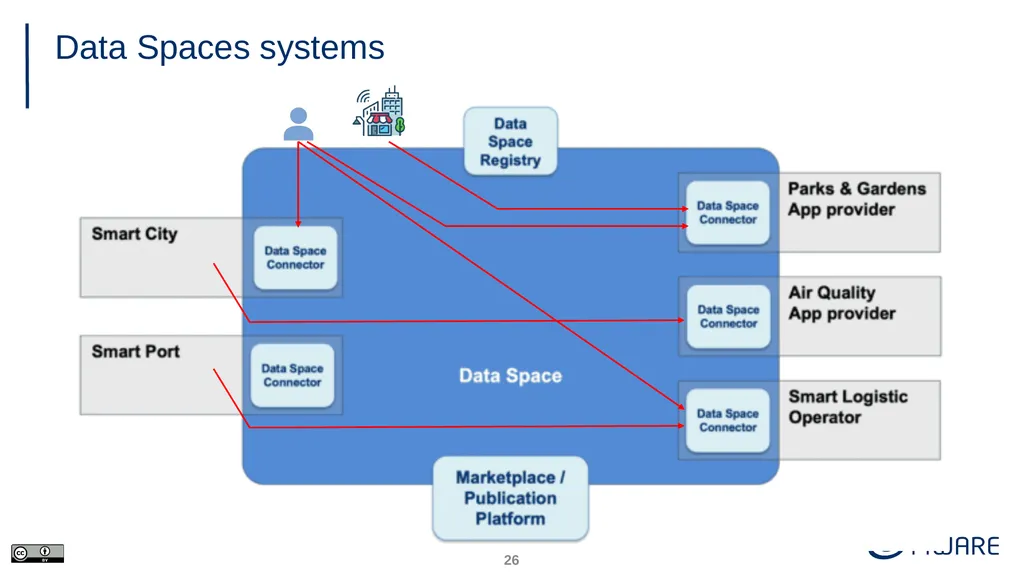
Data Spaces systems 25<br>
27
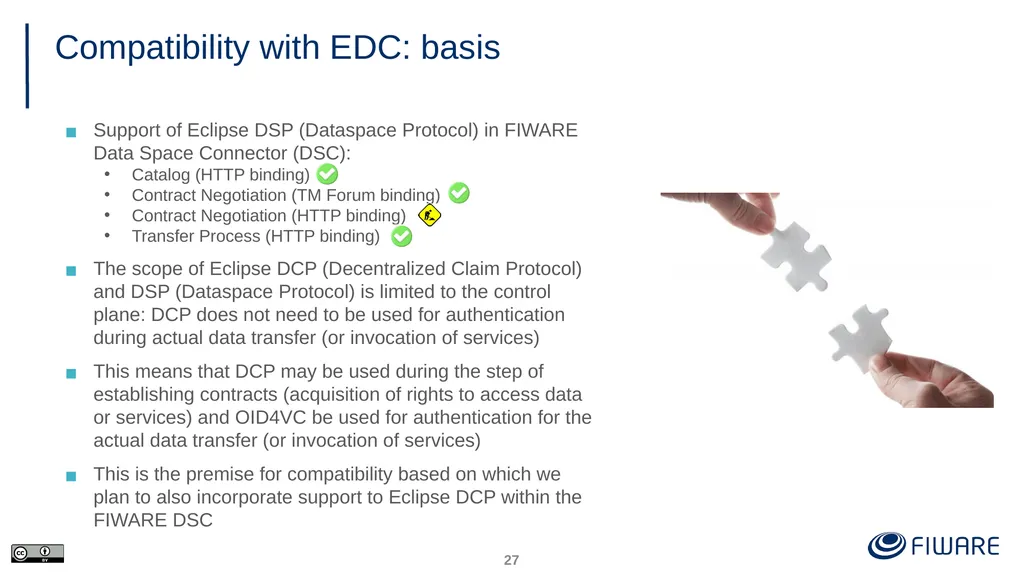
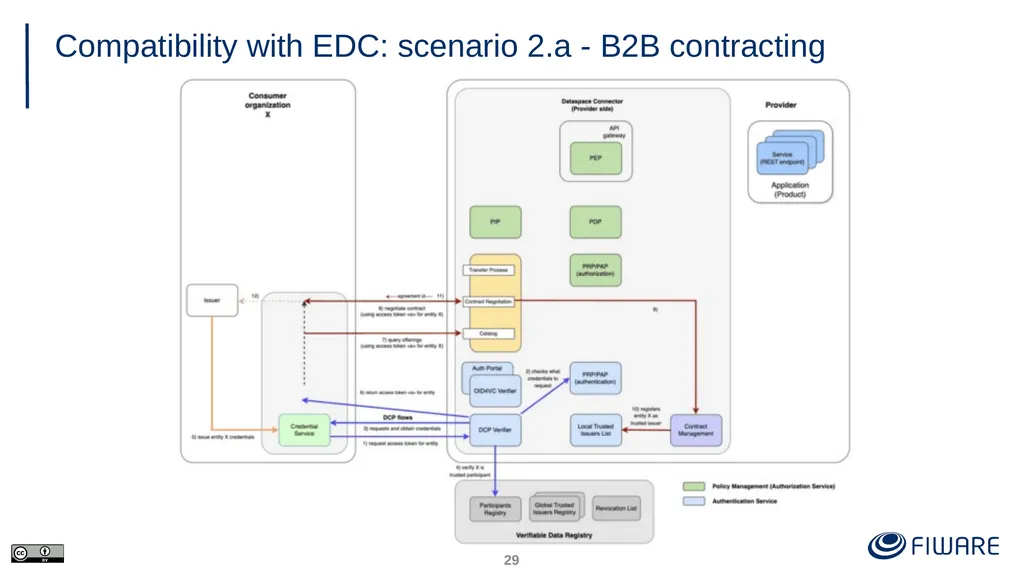
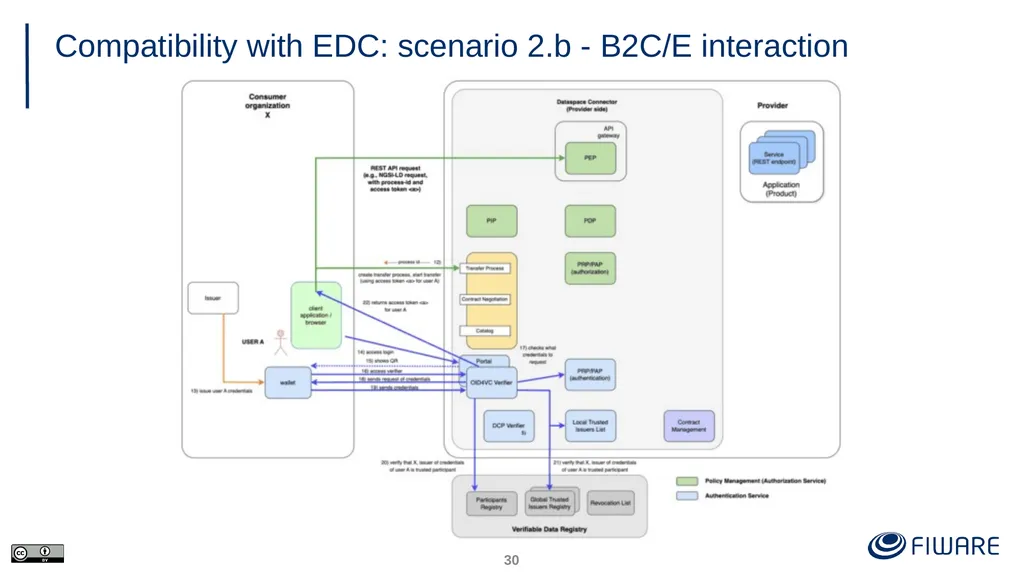
Compatibility with EDC: basis Support of Eclipse DSP (Dataspace Protocol) in FIWARE Data Space Connector (DSC):
Catalog (HTTP binding)
Contract Negotiation (TM Forum binding)
Contract Negotiation (HTTP binding)
Transfer Process (HTTP binding)
The scope of Eclipse DCP (Decentralized Claim Protocol) and DSP (Dataspace Protocol) is limited to the control plane: DCP does not need to be used for authentication during actual data transfer (or invocation of services)
This means that DCP may be used during the step of establishing contracts (acquisition of rights to access data or services) and OID4VC be used for authentication for the actual data transfer (or invocation of services)
This is the premise for compatibility based on which we plan to also incorporate support to Eclipse DCP within the FIWARE DSC 26<br>
Catalog (HTTP binding)
Contract Negotiation (TM Forum binding)
Contract Negotiation (HTTP binding)
Transfer Process (HTTP binding)
The scope of Eclipse DCP (Decentralized Claim Protocol) and DSP (Dataspace Protocol) is limited to the control plane: DCP does not need to be used for authentication during actual data transfer (or invocation of services)
This means that DCP may be used during the step of establishing contracts (acquisition of rights to access data or services) and OID4VC be used for authentication for the actual data transfer (or invocation of services)
This is the premise for compatibility based on which we plan to also incorporate support to Eclipse DCP within the FIWARE DSC 26<br>
28
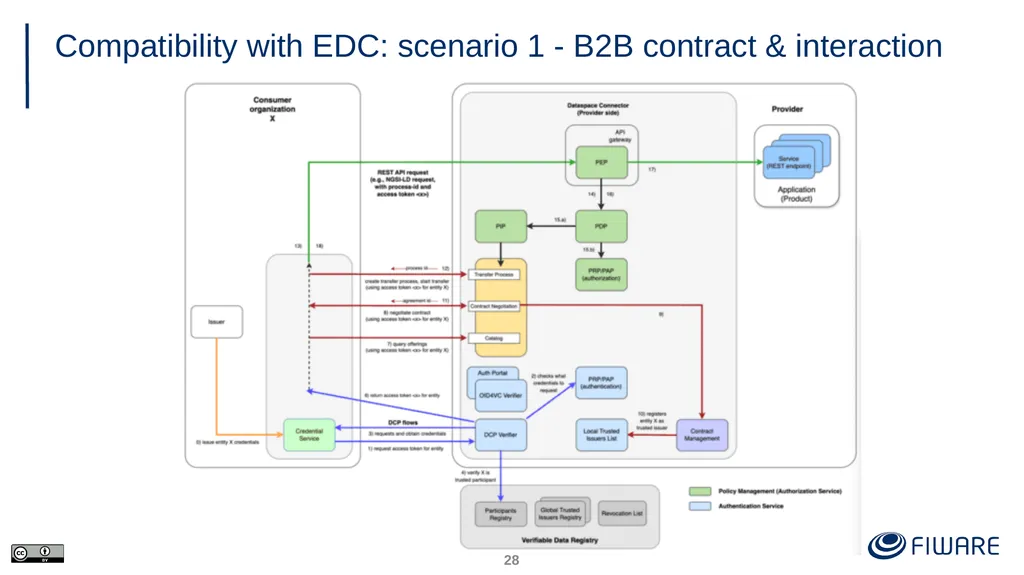
Compatibility with EDC: scenario 1 - B2B contract & interaction 27<br>
29
Compatibility with EDC: scenario 2.a - B2B contracting 28<br>
30
Compatibility with EDC: scenario 2.b - B2C/E interaction 29<br>
31
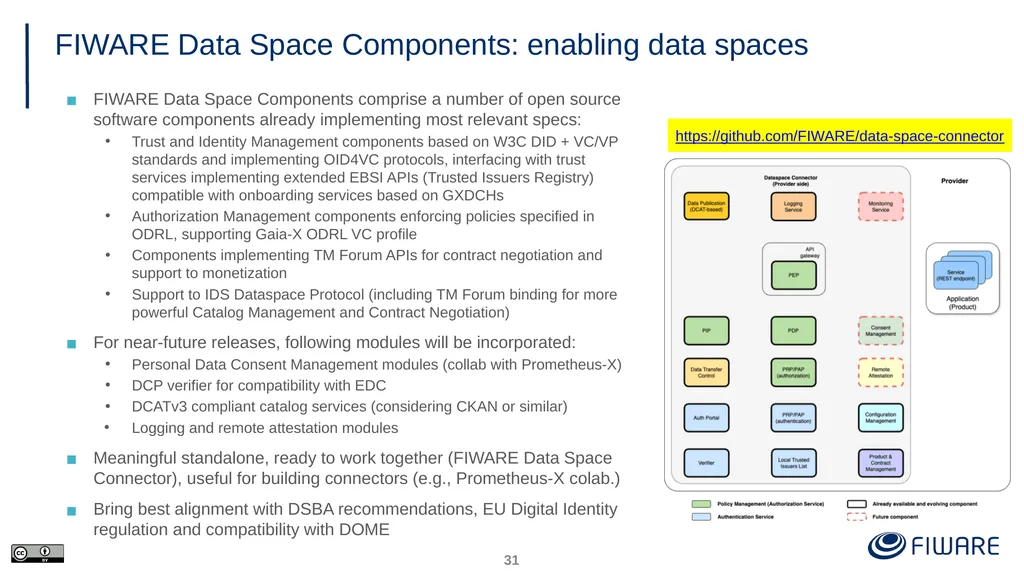
FIWARE Data Space Components: enabling data spaces FIWARE Data Space Components comprise a number of open source software components already implementing most relevant specs:
Trust and Identity Management components based on W3C DID + VC/VP standards and implementing OID4VC protocols, interfacing with trust services implementing extended EBSI APIs (Trusted Issuers Registry) compatible with onboarding services based on GXDCHs
Authorization Management components enforcing policies specified in ODRL, supporting Gaia-X ODRL VC profile
Components implementing TM Forum APIs for contract negotiation and support to monetization
Support to IDS Dataspace Protocol (including TM Forum binding for more powerful Catalog Management and Contract Negotiation)
For near-future releases, following modules will be incorporated:
Personal Data Consent Management modules (collab with Prometheus-X)
DCP verifier for compatibility with EDC
DCATv3 compliant catalog services (considering CKAN or similar)
Logging and remote attestation modules
Meaningful standalone, ready to work together (FIWARE Data Space Connector), useful for building connectors (e.g., Prometheus-X colab.)
Bring best alignment with DSBA recommendations, EU Digital Identity regulation and compatibility with DOME 30 https://github.com/FIWARE/data-space-connector<br>
Trust and Identity Management components based on W3C DID + VC/VP standards and implementing OID4VC protocols, interfacing with trust services implementing extended EBSI APIs (Trusted Issuers Registry) compatible with onboarding services based on GXDCHs
Authorization Management components enforcing policies specified in ODRL, supporting Gaia-X ODRL VC profile
Components implementing TM Forum APIs for contract negotiation and support to monetization
Support to IDS Dataspace Protocol (including TM Forum binding for more powerful Catalog Management and Contract Negotiation)
For near-future releases, following modules will be incorporated:
Personal Data Consent Management modules (collab with Prometheus-X)
DCP verifier for compatibility with EDC
DCATv3 compliant catalog services (considering CKAN or similar)
Logging and remote attestation modules
Meaningful standalone, ready to work together (FIWARE Data Space Connector), useful for building connectors (e.g., Prometheus-X colab.)
Bring best alignment with DSBA recommendations, EU Digital Identity regulation and compatibility with DOME 30 https://github.com/FIWARE/data-space-connector<br>
32
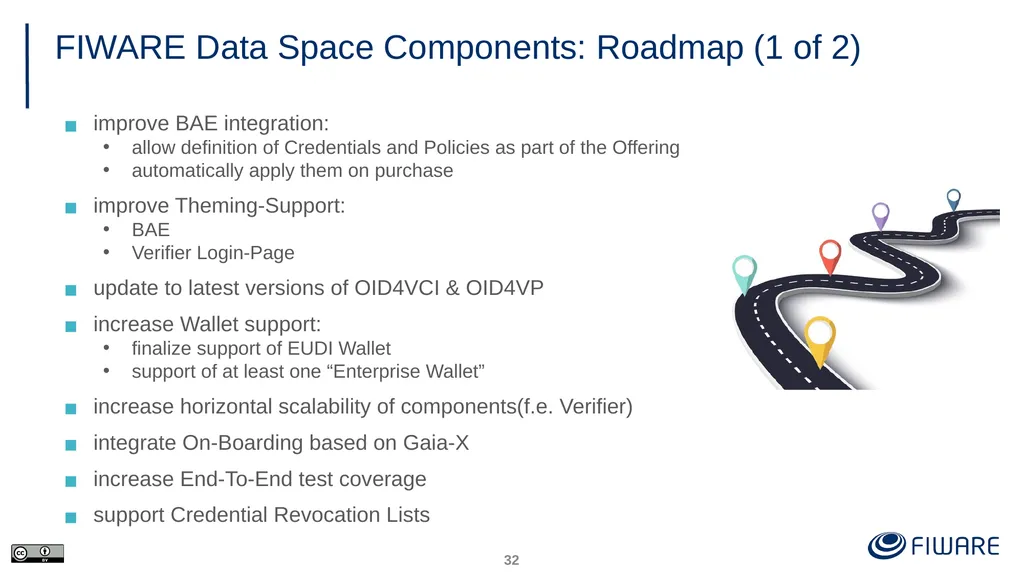
FIWARE Data Space Components: Roadmap (1 of 2) improve BAE integration:
allow definition of Credentials and Policies as part of the Offering
automatically apply them on purchase
improve Theming-Support:
BAE
Verifier Login-Page
update to latest versions of OID4VCI & OID4VP
increase Wallet support:
finalize support of EUDI Wallet
support of at least one “Enterprise Wallet”
increase horizontal scalability of components(f.e. Verifier)
integrate On-Boarding based on Gaia-X
increase End-To-End test coverage
support Credential Revocation Lists 31<br>
allow definition of Credentials and Policies as part of the Offering
automatically apply them on purchase
improve Theming-Support:
BAE
Verifier Login-Page
update to latest versions of OID4VCI & OID4VP
increase Wallet support:
finalize support of EUDI Wallet
support of at least one “Enterprise Wallet”
increase horizontal scalability of components(f.e. Verifier)
integrate On-Boarding based on Gaia-X
increase End-To-End test coverage
support Credential Revocation Lists 31<br>
33
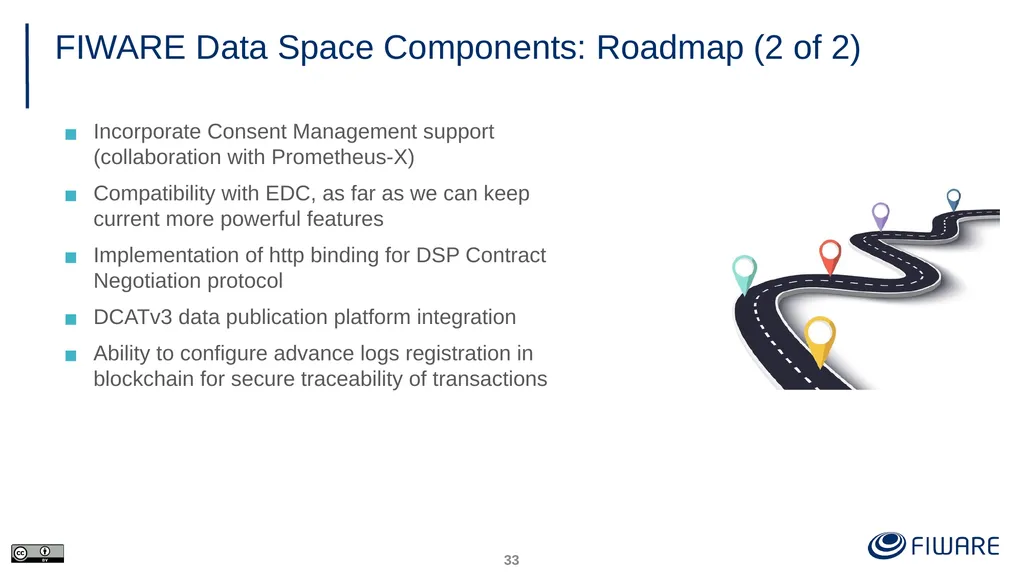
FIWARE Data Space Components: Roadmap (2 of 2) Incorporate Consent Management support (collaboration with Prometheus-X)
Compatibility with EDC, as far as we can keep current more powerful features
Implementation of http binding for DSP Contract Negotiation protocol
DCATv3 data publication platform integration
Ability to configure advance logs registration in blockchain for secure traceability of transactions 32<br>
Compatibility with EDC, as far as we can keep current more powerful features
Implementation of http binding for DSP Contract Negotiation protocol
DCATv3 data publication platform integration
Ability to configure advance logs registration in blockchain for secure traceability of transactions 32<br>
34
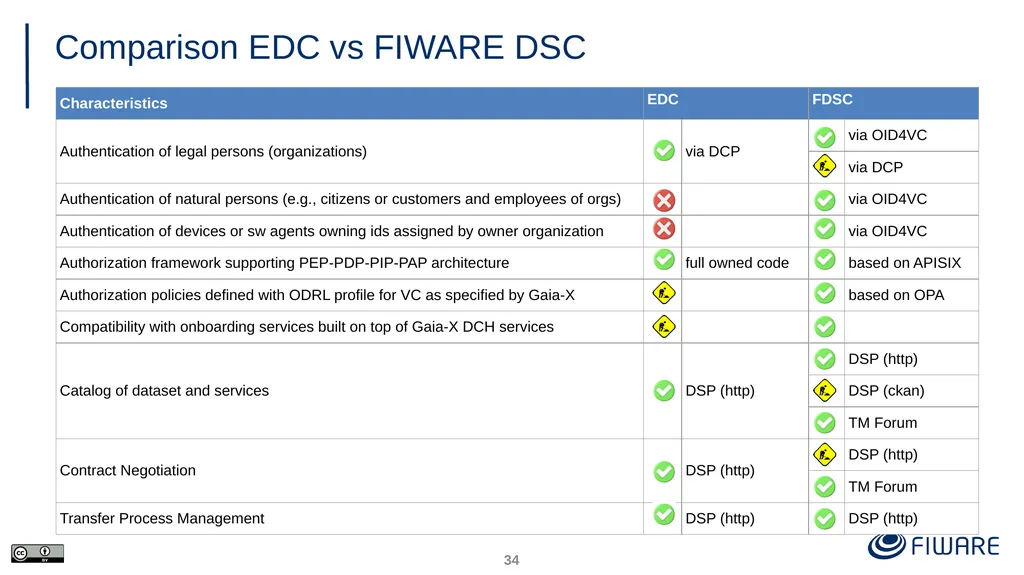
Comparison EDC vs FIWARE DSC 33<br>
35
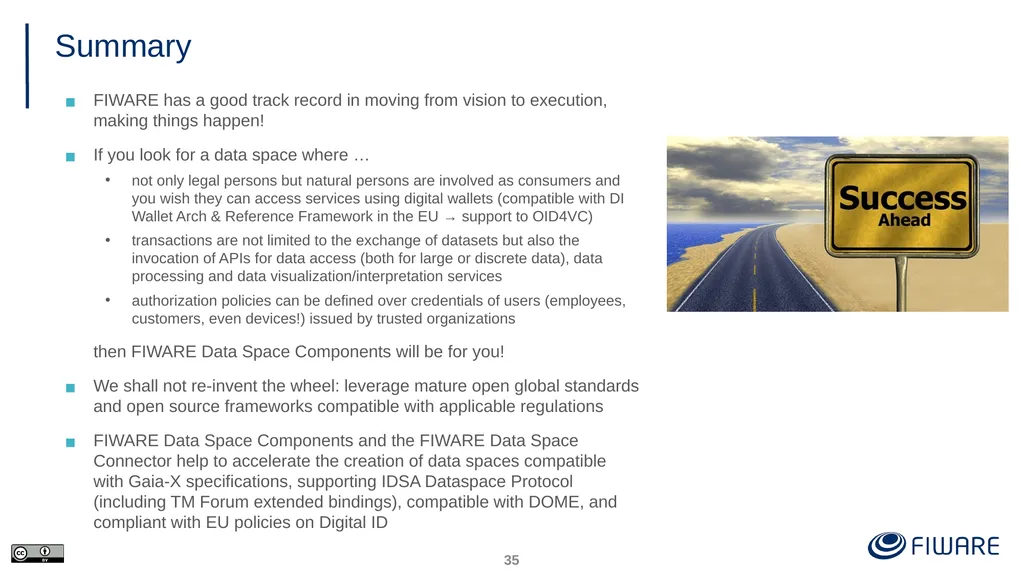
Summary FIWARE has a good track record in moving from vision to execution, making things happen!
If you look for a data space where …
not only legal persons but natural persons are involved as consumers and you wish they can access services using digital wallets (compatible with DI Wallet Arch & Reference Framework in the EU → support to OID4VC)
transactions are not limited to the exchange of datasets but also the invocation of APIs for data access (both for large or discrete data), data processing and data visualization/interpretation services
authorization policies can be defined over credentials of users (employees, customers, even devices!) issued by trusted organizations
then FIWARE Data Space Components will be for you!
We shall not re-invent the wheel: leverage mature open global standards and open source frameworks compatible with applicable regulations
FIWARE Data Space Components and the FIWARE Data Space Connector help to accelerate the creation of data spaces compatible with Gaia-X specifications, supporting IDSA Dataspace Protocol (including TM Forum extended bindings), compatible with DOME, and compliant with EU policies on Digital ID 34<br>
If you look for a data space where …
not only legal persons but natural persons are involved as consumers and you wish they can access services using digital wallets (compatible with DI Wallet Arch & Reference Framework in the EU → support to OID4VC)
transactions are not limited to the exchange of datasets but also the invocation of APIs for data access (both for large or discrete data), data processing and data visualization/interpretation services
authorization policies can be defined over credentials of users (employees, customers, even devices!) issued by trusted organizations
then FIWARE Data Space Components will be for you!
We shall not re-invent the wheel: leverage mature open global standards and open source frameworks compatible with applicable regulations
FIWARE Data Space Components and the FIWARE Data Space Connector help to accelerate the creation of data spaces compatible with Gaia-X specifications, supporting IDSA Dataspace Protocol (including TM Forum extended bindings), compatible with DOME, and compliant with EU policies on Digital ID 34<br>
36
Sounds nice? - Contact us! Juanjo Hierro
FIWARE TSC chairman
juanjose.hierro@gmail.com<br>
FIWARE TSC chairman
juanjose.hierro@gmail.com<br>