Fluid Solid Operations THEORY OPERATION DESIGN THEORY Also referred as SEDIMENTATION TANKS. Settling- process by which particulates settle to the bottom of a liquid and form a sediment. Particles experience a force, either due to gravity
"Fluid Solid Operations THEORY OPERATION DESIGN" is the property of its rightful owner. Permission is granted to
download and print the materials on this website for personal, non-commercial use only, and to display it
on your personal computer provided you do not modify the materials and that you retain all copyright
notices contained in the materials. By downloading content from our website, you accept the terms of this
agreement.
Presentation Transcript
01
Fluid Solid Operations<br>
02
THEORY
OPERATION
DESIGN<br>
03
THEORY Also referred as ‘SEDIMENTATION TANKS’.
Settling- process by which particulates settle to the bottom of a liquid and form a sediment.
Particles experience a force, either due to gravity or due to centrifugal motion; tend to move in a uniform manner in the direction exerted by that force.
Gravity settling- the particles will tend to fall to the bottom of the vessel, forming a slurry at the vessel base.
For dilute particle solutions, two main forces enacting upon particle. Primary force is an applied force, such as gravity, and a drag force that is due to the motion of the particle through the fluid. The applied force is not affected by the particle's velocity; the drag force is a function of the particle velocity.<br>
04
Settling or Sedimentation Settling- a unit operation in which solids are drawn toward a source of attraction. The particular type of settling that will be discussed in this section is gravitational settling. It should be noted that settling is different from sedimentation.
Sedimentation- The condition whereby the solids are already at the bottom and in the process of sedimenting. Settling is not yet sedimenting, but the particles are falling down the water column in response to gravity. Of course, as soon as the solids reach the bottom, they begin sedimenting. In the physical treatment of water and wastewater, settling is normally carried out in settling or sedimentation basins.<br>
05
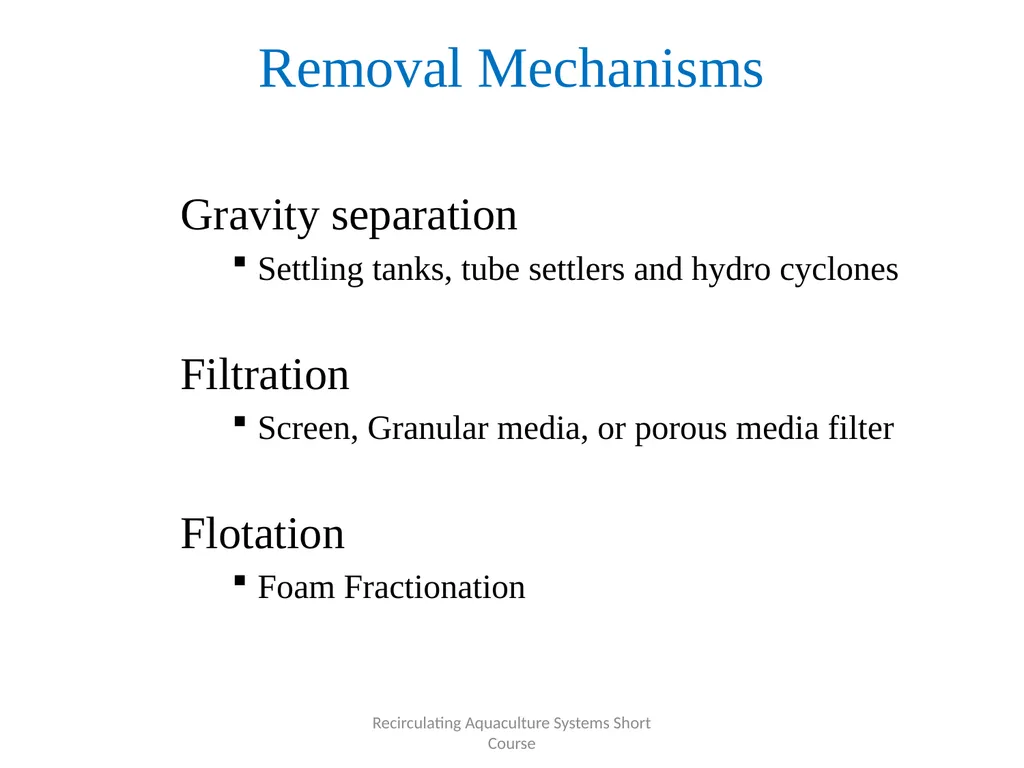
Recirculating Aquaculture Systems Short Course Removal Mechanisms Gravity separation
Settling tanks, tube settlers and hydro cyclones
Filtration
Screen, Granular media, or porous media filter
Flotation
Foam Fractionation<br>
06
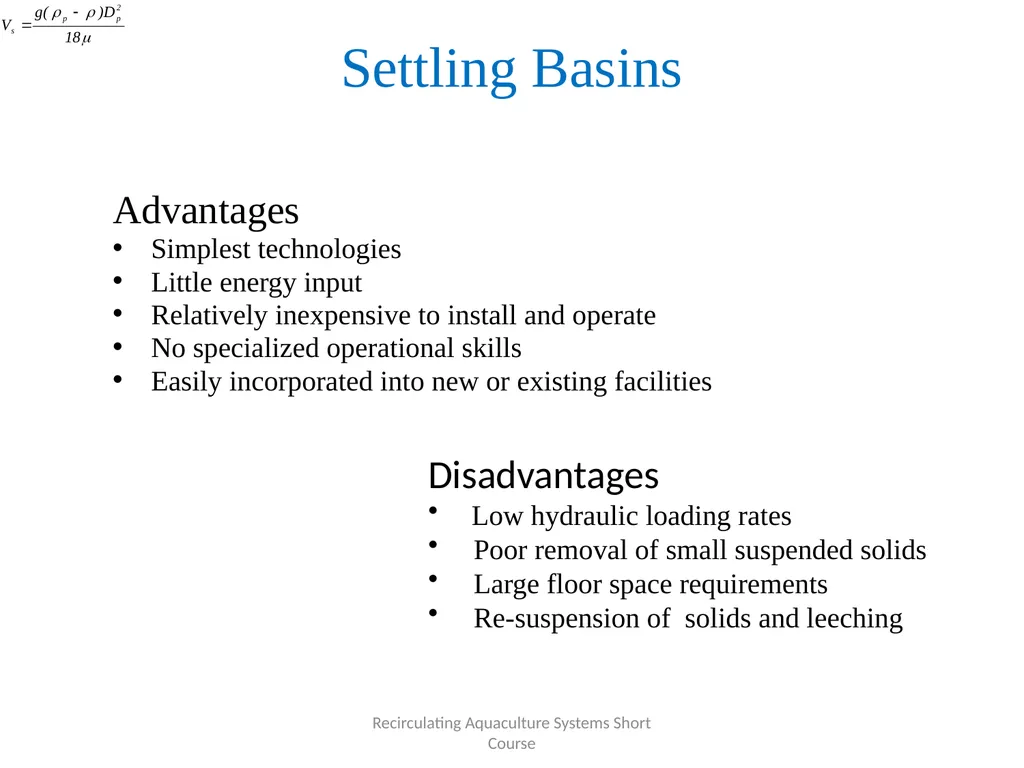
Recirculating Aquaculture Systems Short Course Settling Basins Advantages
Simplest technologies
Little energy input
Relatively inexpensive to install and operate
No specialized operational skills
Easily incorporated into new or existing facilities Disadvantages
Low hydraulic loading rates
Poor removal of small suspended solids
Large floor space requirements
Re-suspension of solids and leeching<br>
07
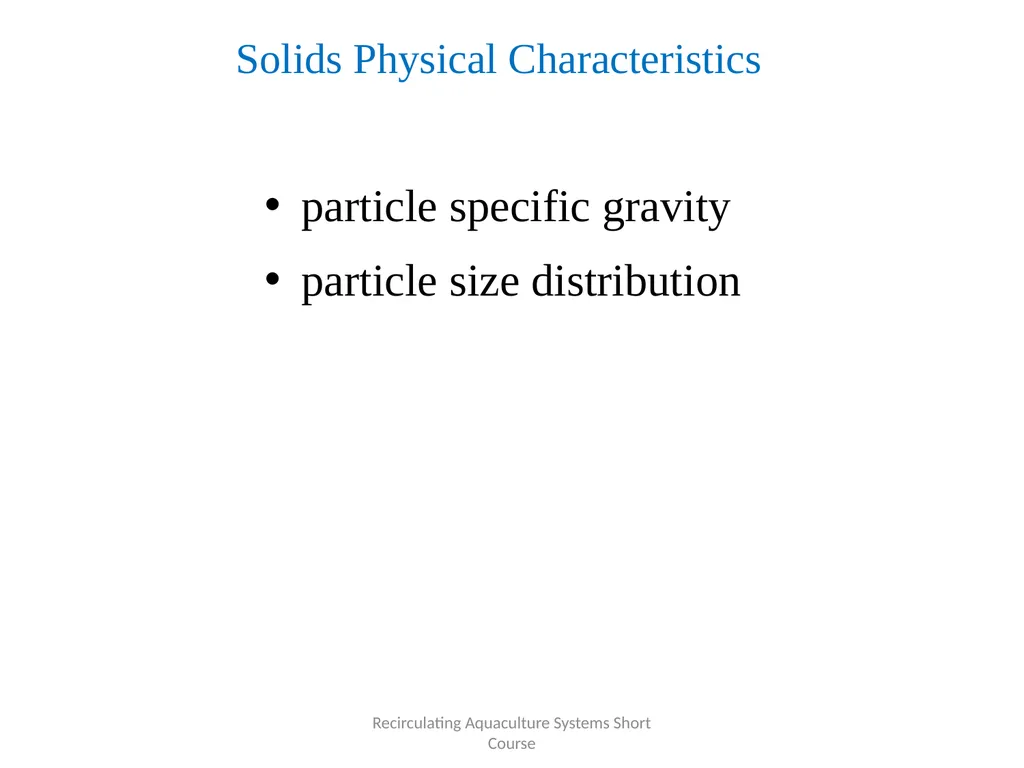
Recirculating Aquaculture Systems Short Course Solids Physical Characteristics particle specific gravity
particle size distribution Two most important physical characteristics of suspended solids:<br>
08
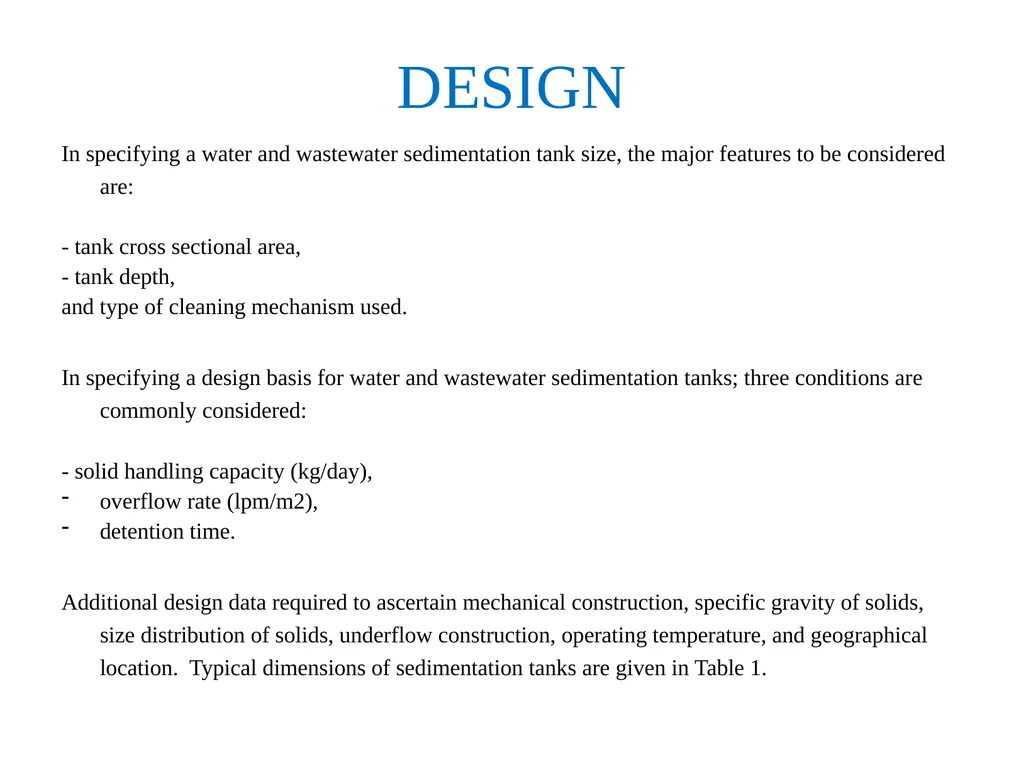
DESIGN In specifying a water and wastewater sedimentation tank size, the major features to be considered are:
- tank cross sectional area,
- tank depth,
and type of cleaning mechanism used.
In specifying a design basis for water and wastewater sedimentation tanks; three conditions are commonly considered:
Additional design data required to ascertain mechanical construction, specific gravity of solids, size distribution of solids, underflow construction, operating temperature, and geographical location. Typical dimensions of sedimentation tanks are given in Table 1.<br>
09
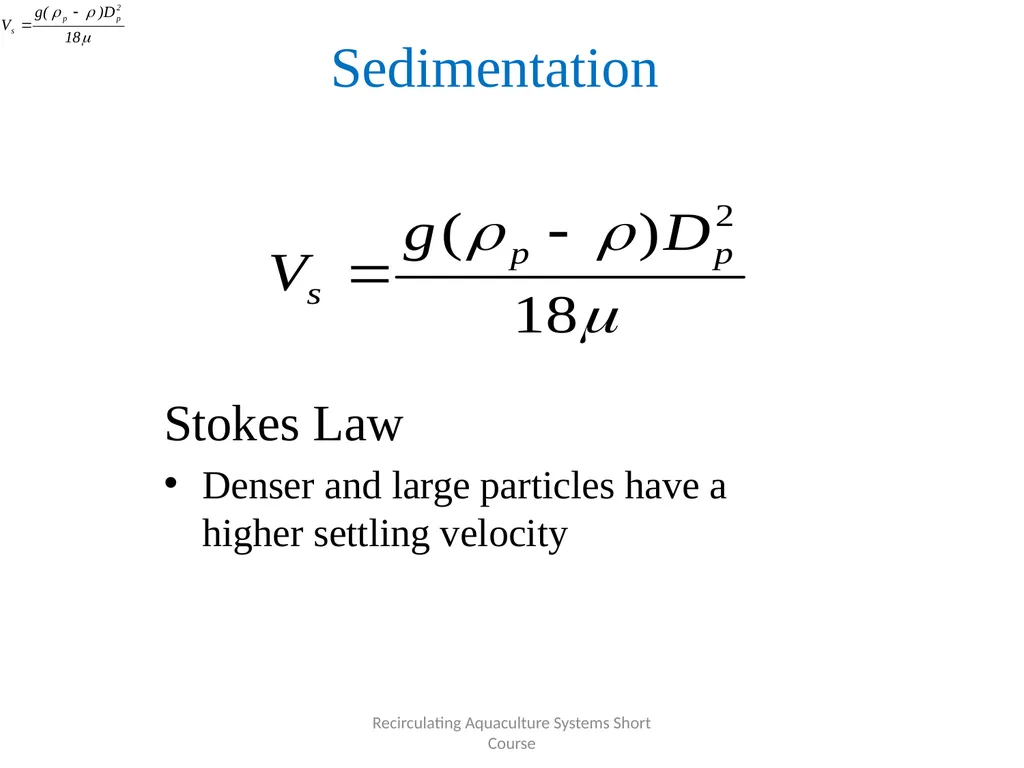
Recirculating Aquaculture Systems Short Course Sedimentation Stokes Law
Denser and large particles have a higher settling velocity<br>
10
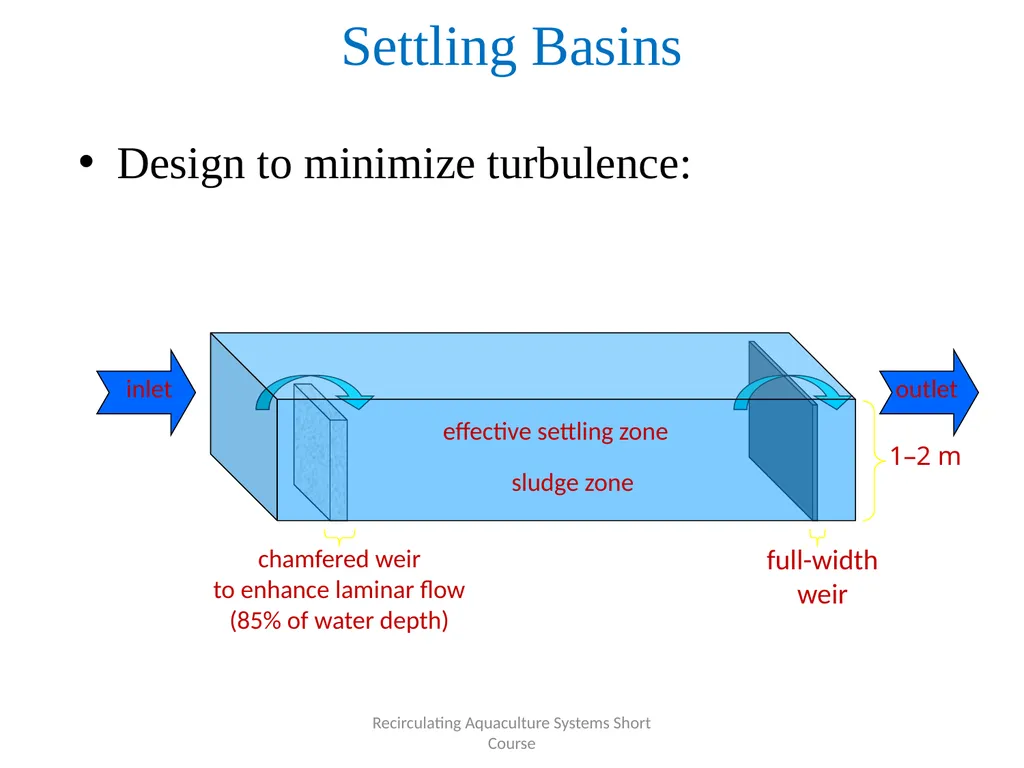
Recirculating Aquaculture Systems Short Course Settling Basins Design to minimize turbulence: chamfered weir
to enhance laminar flow
(85% of water depth) full-width
weir inlet outlet effective settling zone 1–2 m length:width = 4:1 to 8:1 sludge zone<br>
11
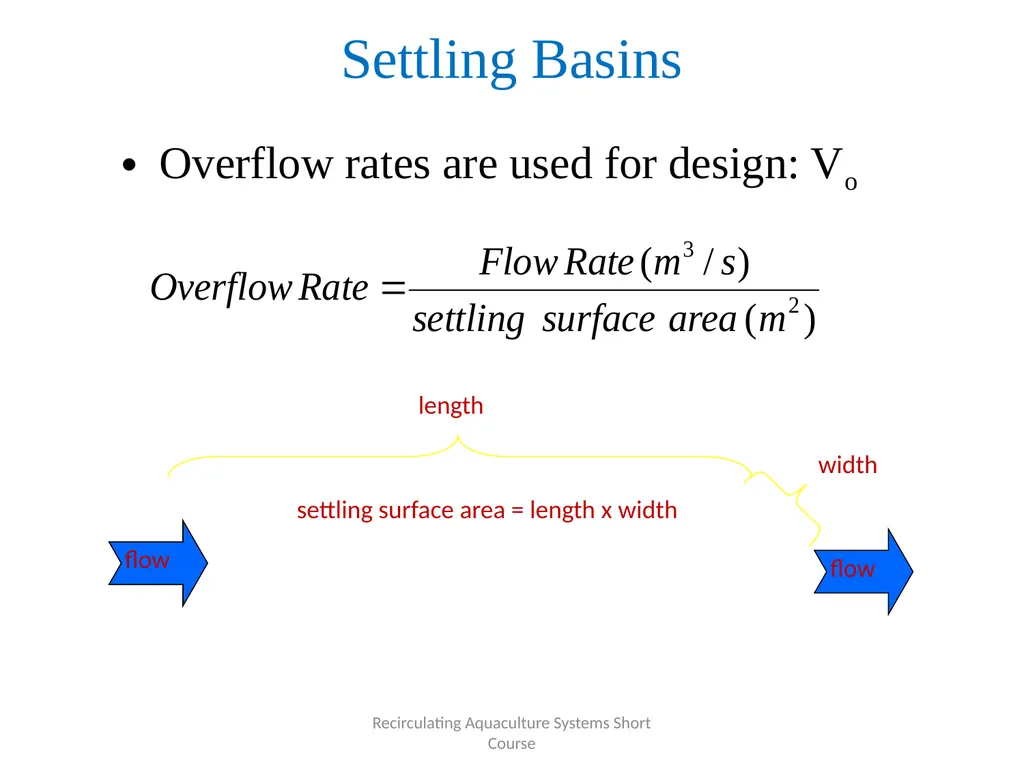
Recirculating Aquaculture Systems Short Course Settling Basins Overflow rates are used for design: Vo settling surface area = length x width width length flow flow<br>
12
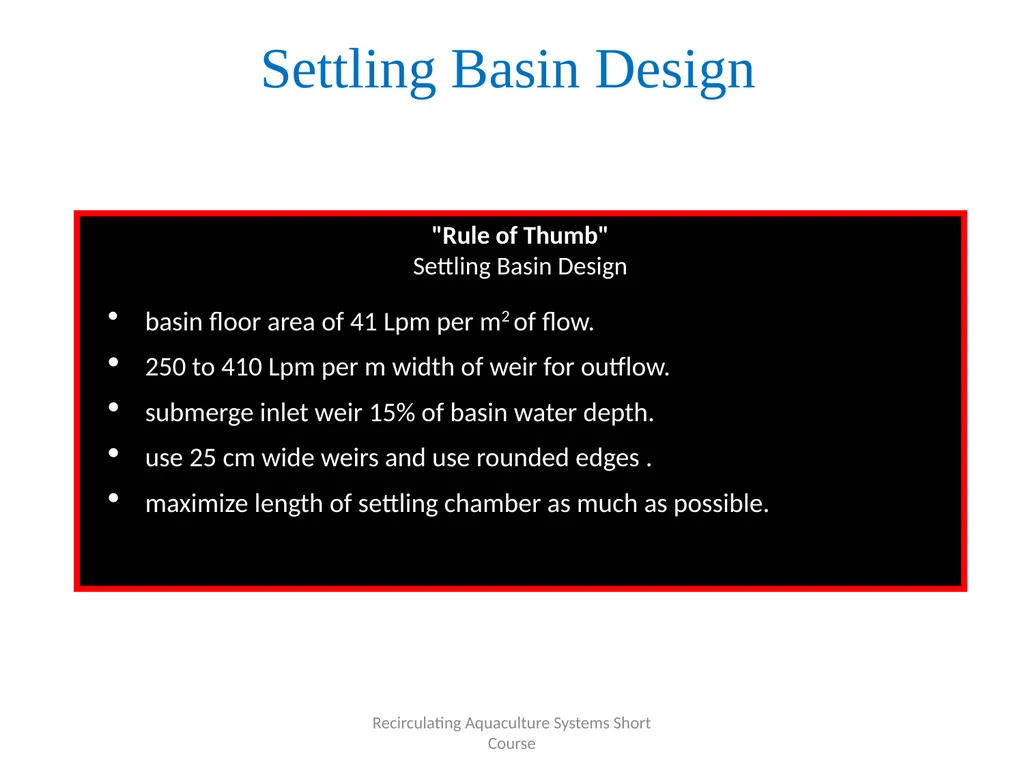
Recirculating Aquaculture Systems Short Course Settling Basin Design "Rule of Thumb"
Settling Basin Design
basin floor area of 41 Lpm per m2 of flow.
250 to 410 Lpm per m width of weir for outflow.
submerge inlet weir 15% of basin water depth.
use 25 cm wide weirs and use rounded edges .
maximize length of settling chamber as much as possible.<br>
13
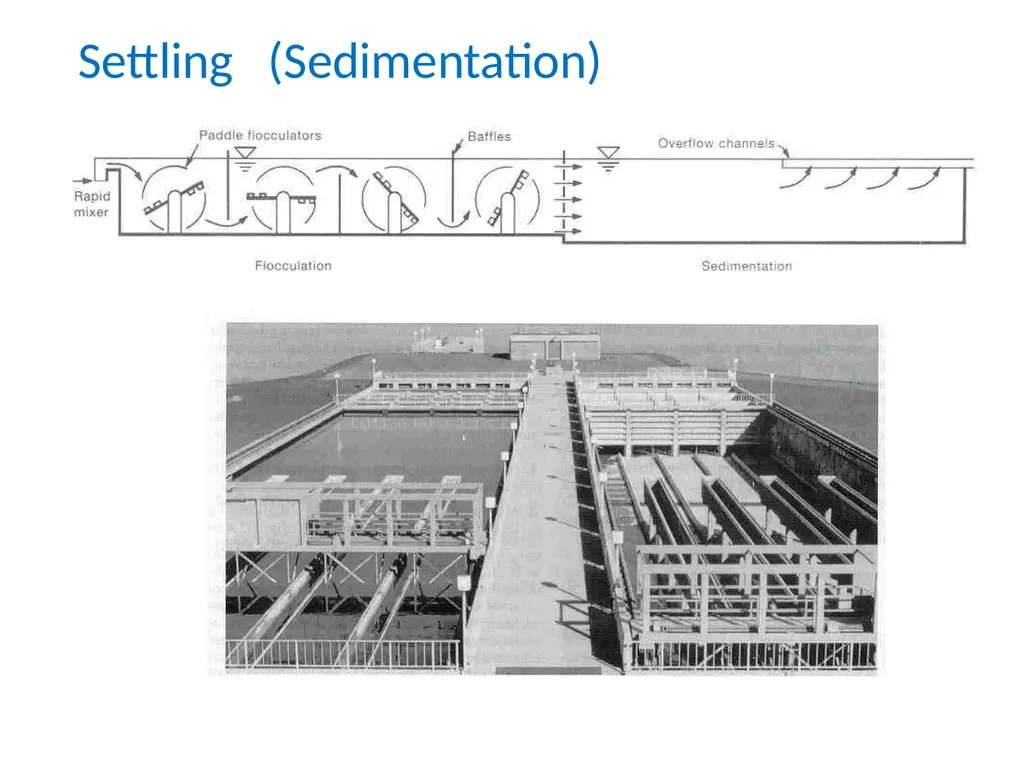
Settling (Sedimentation)<br>
14
Settling Tanks, Basins, or Clarifiers Generally, two types of sedimentation basins (also called tanks, or clarifiers) are used:
Rectangular and
Circular.
Rectangular settling, basins or clarifiers, are basins that are rectangular in plans and cross sections. In plan, the length may vary from two to four times the width.
The length may also vary from ten to 20 times the depth. The depth of the basin may vary from 2 to 6 m. The influent is introduced at one end and allowed to flow through the length of the clarifier toward the other end.<br>