Food product development presentation 2 Emerging technologies in the food industry 3D printed food What is 3D printed Food? 3D printed food is an automated way of preparing foods and meals. 3D food printing offers a range of potential
Related Topics
Share
Embed code
Download this presentation From Below
"Food product development presentation 2 Emerging" is the property of its rightful owner. Permission is granted to
download and print the materials on this website for personal, non-commercial use only, and to display it
on your personal computer provided you do not modify the materials and that you retain all copyright
notices contained in the materials. By downloading content from our website, you accept the terms of this
agreement.
Presentation Transcript
01
Food product development presentation 2 Emerging technologies in the food industry<br>
02
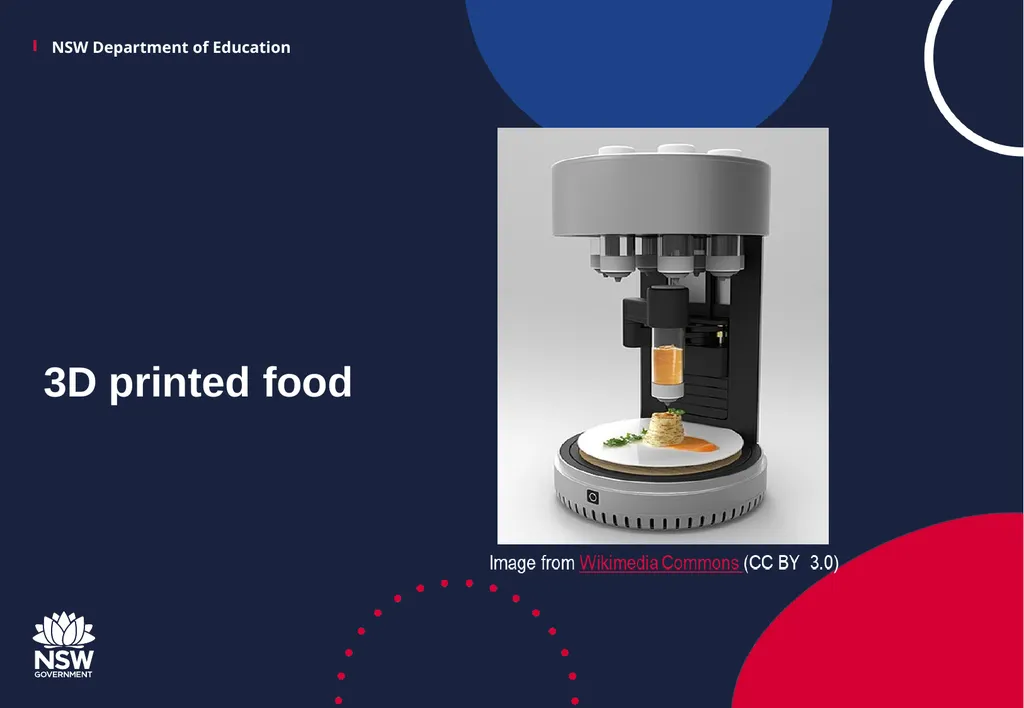
3D printed food<br>
03
What is 3D printed Food? 3D printed food is an automated way of preparing foods and meals.
3D food printing offers a range of potential benefits. It can be healthy and beneficial for the environment.
For example it can help to convert alternative ingredients such as proteins from algae or insects into recognisable food products.<br>
04
How does a 3D printer work? 3D food printers can print food, usually through one more syringes.
Three-dimensional printing of food works in a similar way to a regular 3D printer.
Using a software program, the food design is printed.
The ingredients must be puréed to have the right viscosity. The puree is then inserted into syringe-like containers.
The food product is then printed when the purees are extruded through a print nozzle onto a surface.<br>
05
Types of ingredients used in 3D printed food fruits and vegetables
doughs and batters
wheat and grains
proteins- such as proteins sourced from insects
sauces
dairy products
desserts and sweets
algae.<br>
06
3D printed foods – advantages a 3D printed food can be made more nutritious by adding nutrient rich ingredients to recipes such as protein from ground insects and algae
a great deal of stress is put on the environment by traditional food production, the use of insects and algae reduces the impact on the environment
3D printing technology is helping seniors who have difficulties eating hard vegetables
German food innovation company Biozoon are developing special recipes for seniors using 3D food printers to create food that is softer to chew.<br>
07
3D printed food - disadvantages difficulty imitating texture of foods
creating dishes that are presentable
creating great taste
food printing is slow
purchasing specialised food 3D printers is costly
although the food is safe to eat, there is a small concern with keeping the 3D printer clean and safe for food preparation.<br>
08
The food product development process<br>
09
Key to new product innovation success A company or products survival is dependent on the ability to innovate better and faster than the competition.
This includes:
reducing product development cycle time
increasing product development innovation
reusing company knowledge and assets.<br>
10
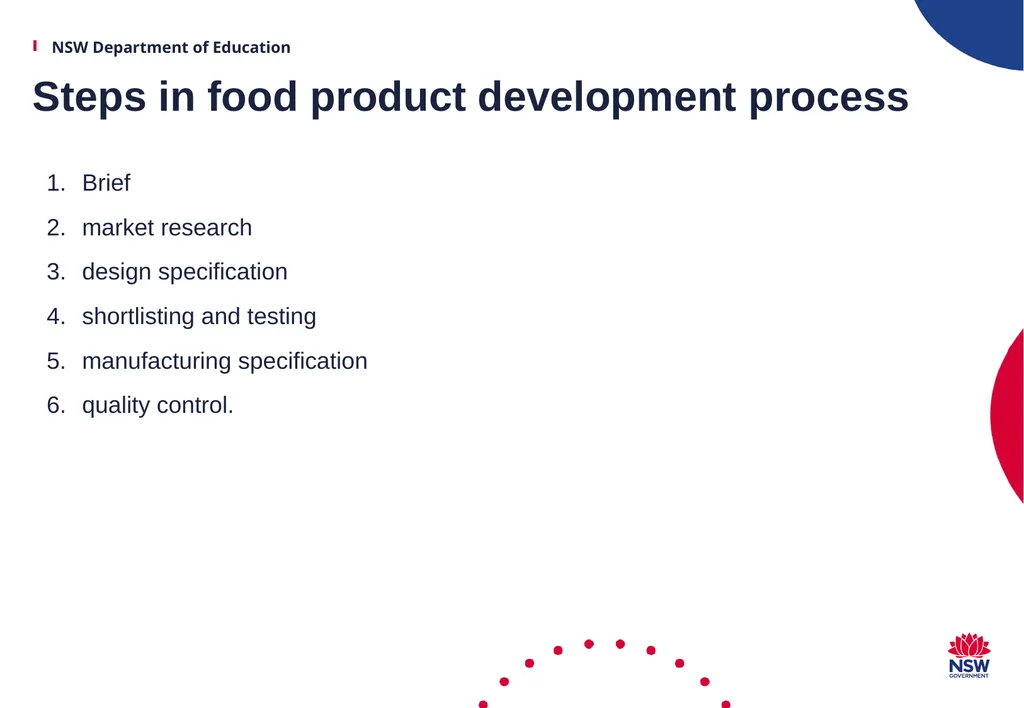
Steps in food product development process Brief
market research
design specification
shortlisting and testing
manufacturing specification
quality control.<br>
11
Brief Brief: is the problem that needs to be solved.
For example developing a gluten free lasagne for people with celiac disease.<br>
12
Market research Market research: finding out information about what people want from a product.
It includes:
researching or studying market trends and shopping habits
conducting surveys, questionnaires and interviews.
for example, would people buy a gluten free lasagne?<br>
13
Design specification The design specification is listing the needs of the product. It includes:
size
shape
shelf life
weight
sensory characteristics including texture, taste, smell, appearance
costs
ingredients (with quantities)
equipment.<br>
14
Shortlisting and testing Shortlisting
Shortlisting is where initial ideas are generated following the design specification. These ideas are then screened or chosen on which ideas best meet the design specification.
Testing
The results are analysed so that the product can be improved or changed according to taste, texture, smell, appearance. This is referred to as sensory analysis.
Similar products are tested for a specific characteristic example sweetness. Samples are given coded names and testers sort the products from the most to the least sweetest. Products are tested for a specific characteristic to find out if there is a noticeable difference between two products. For example, manufacturers can test a new gluten free version of a product to see if it is similar to the original.<br>
15
Manufacturing specification The manufacturing specification lists information a manufacturer needs to produce or make the product. The specification records the stages of the production process, with details of all the characteristics such as the shape, size, texture, colour and flavour required in the final product.<br>
16
Quality control Quality assurance (QA) guarantees that food and food products meet a clear and consistent set of standards. At key stages in production there should be quality control checks which alerts manufacturers to any problems. The results of these checks are recorded. Checks can be done by hand or by computer.
Quality control checks will include:
weight checks to make sure the product is the required weight
visual checks to ensure it looks the way it should
temperature checks to make sure it is being kept at an appropriate temperature
pH checks to ensure the food has the correct acidity/alkalinity
microbiological checks to ensure bacteria are not at harmful levels
chemical checks to safe guard against chemical contamination.<br>
17
Quality checks Other quality checks include:
microbiological checks to ensure bacteria are not at harmful levels
chemical checks to safe guard against chemical contamination
metal checks to safe guard against contamination by metals that could occur at the packing stage
organoleptic checks to check flavour, texture and aroma by sampling the food product.<br>
18
Functions of food packaging<br>
19
Functions of food packaging The three main functions of food packaging are:
to contain
types of packaging suitable (factory,retail,home level)
types of packaging (plastic or cardboard).
to preserve
shelf life
food stuff integrity
micro/chemical stability.
to inform or persuade
Logo or picture
nutritional information
instructions such as use in cooking.<br>