
Food Science Programs for Youth Mark Morgan,
TA
Published · 34 slides · 0 views
1 / 1

Description
Food Science Programs for Youth Mark Morgan, Professor and Extension Specialist Kyla Adkins, Student Engagement Coordinator and Youth Programs Leader Food Science Department 4 objectives of todays meeting 1. Explain what Food Science is
Related Topics
Share
Embed code
Download this presentation From Below
"Food Science Programs for Youth Mark Morgan," is the property of its rightful owner. Permission is granted to download and print the materials on this website for personal, non-commercial use only, and to display it on your personal computer provided you do not modify the materials and that you retain all copyright notices contained in the materials. By downloading content from our website, you accept the terms of this agreement.
Presentation Transcript
01
Food Science Programs for Youth Mark Morgan, Professor and Extension Specialist
Kyla Adkins, Student Engagement Coordinator and Youth Programs Leader
Food Science Department<br>
Kyla Adkins, Student Engagement Coordinator and Youth Programs Leader
Food Science Department<br>
02
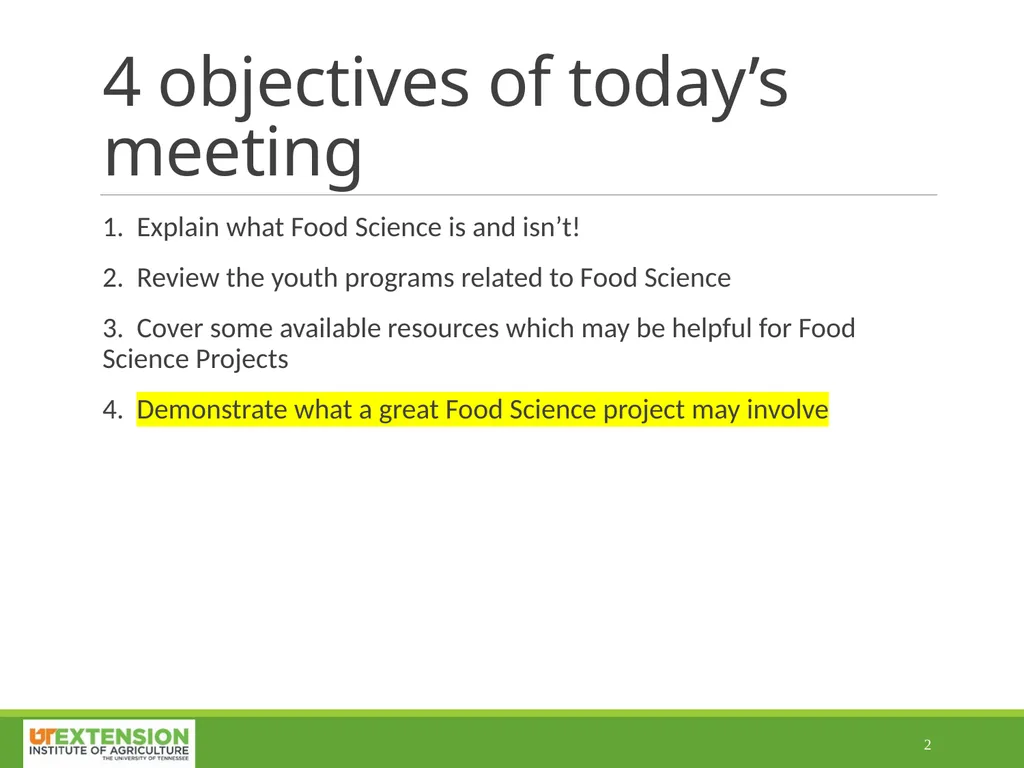
4 objectives of today’s meeting 1. Explain what Food Science is and isn’t!
2. Review the youth programs related to Food Science
3. Cover some available resources which may be helpful for Food Science Projects
4. Demonstrate what a great Food Science project may involve 2<br>
2. Review the youth programs related to Food Science
3. Cover some available resources which may be helpful for Food Science Projects
4. Demonstrate what a great Food Science project may involve 2<br>
03
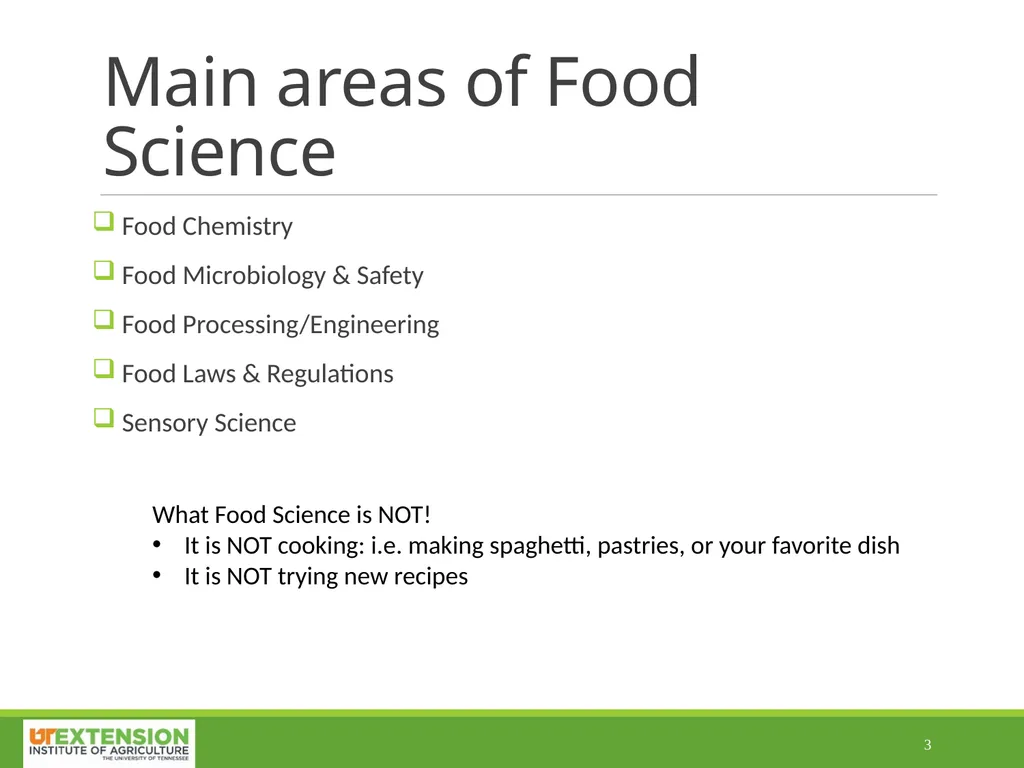
Main areas of Food Science Food Chemistry
Food Microbiology & Safety
Food Processing/Engineering
Food Laws & Regulations
Sensory Science 3 What Food Science is NOT!
It is NOT cooking: i.e. making spaghetti, pastries, or your favorite dish
It is NOT trying new recipes<br>
Food Microbiology & Safety
Food Processing/Engineering
Food Laws & Regulations
Sensory Science 3 What Food Science is NOT!
It is NOT cooking: i.e. making spaghetti, pastries, or your favorite dish
It is NOT trying new recipes<br>
04
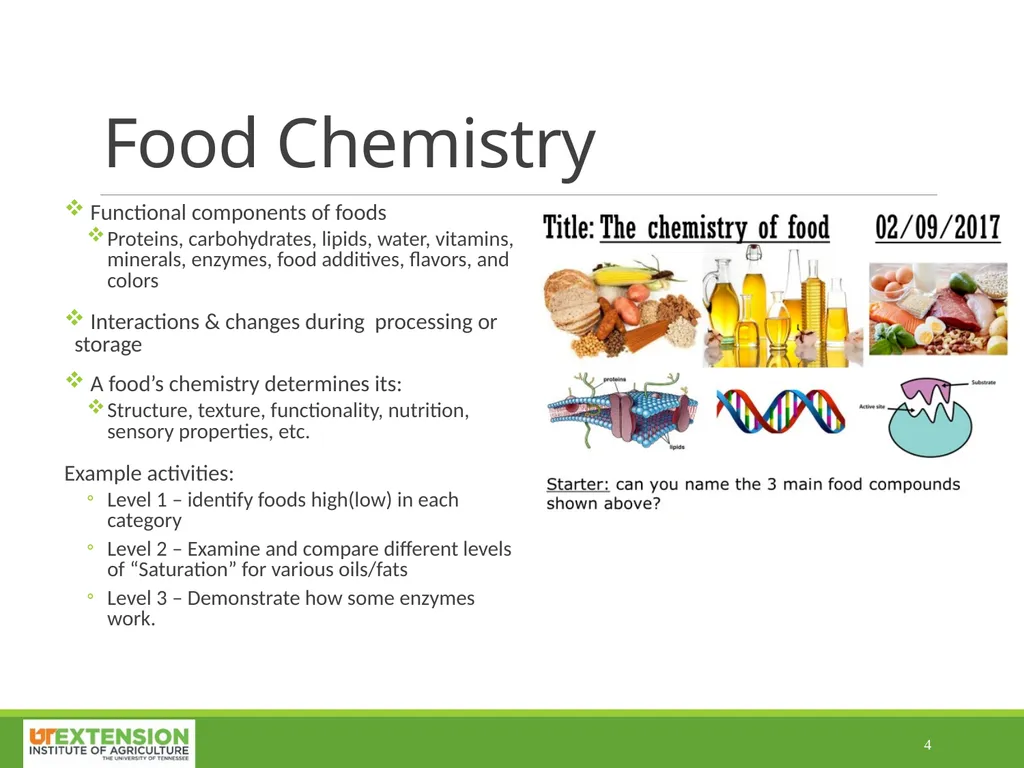
Food Chemistry Functional components of foods
Proteins, carbohydrates, lipids, water, vitamins, minerals, enzymes, food additives, flavors, and colors
Interactions & changes during processing or storage
A food’s chemistry determines its:
Structure, texture, functionality, nutrition, sensory properties, etc.
Example activities:
Level 1 – identify foods high(low) in each category
Level 2 – Examine and compare different levels of “Saturation” for various oils/fats
Level 3 – Demonstrate how some enzymes work. 4<br>
05
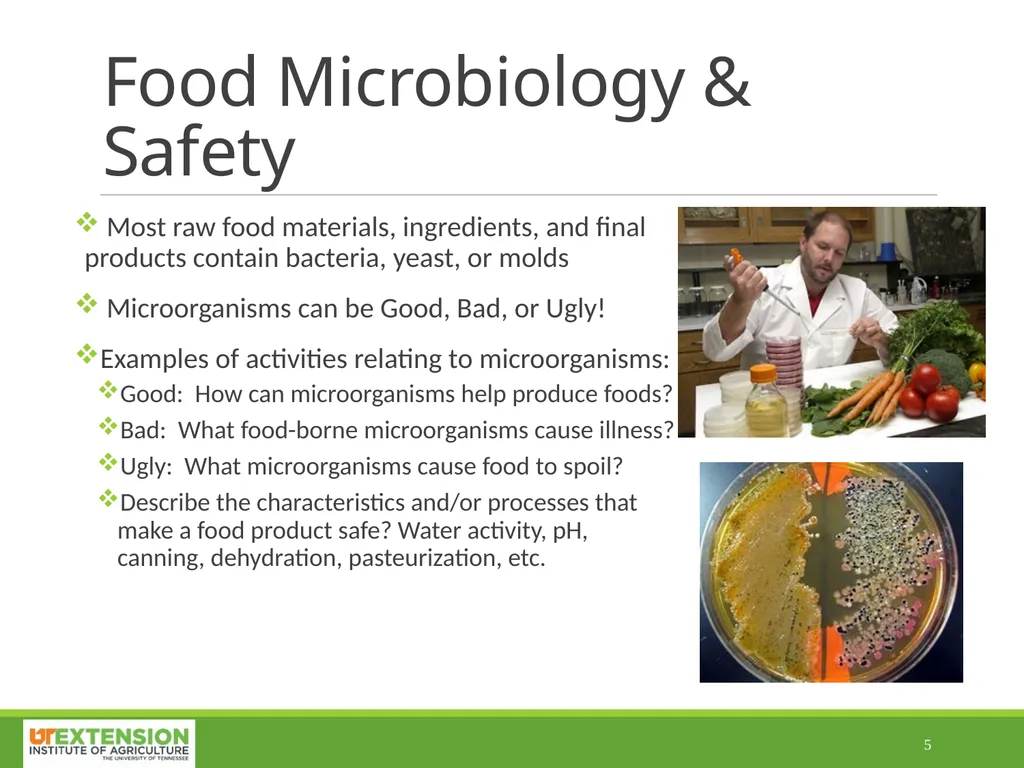
Food Microbiology & Safety Most raw food materials, ingredients, and final products contain bacteria, yeast, or molds
Microorganisms can be Good, Bad, or Ugly!
Examples of activities relating to microorganisms:
Good: How can microorganisms help produce foods?
Bad: What food-borne microorganisms cause illness?
Ugly: What microorganisms cause food to spoil?
Describe the characteristics and/or processes that make a food product safe? Water activity, pH, canning, dehydration, pasteurization, etc. 5<br>
06
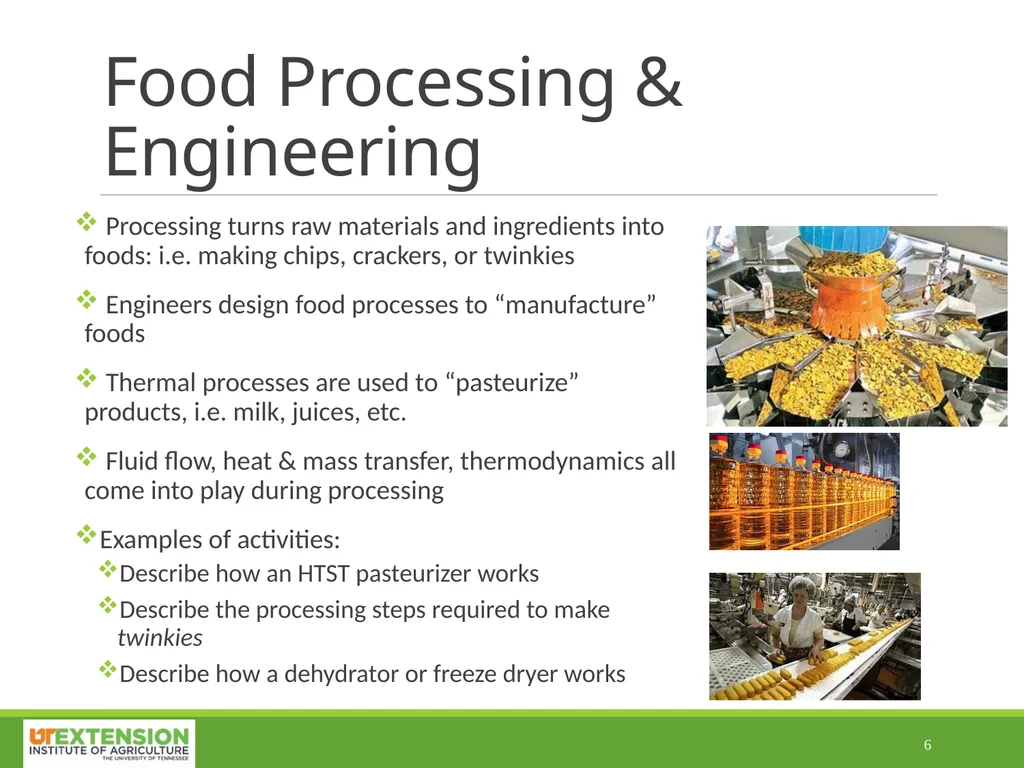
Food Processing & Engineering Processing turns raw materials and ingredients into foods: i.e. making chips, crackers, or twinkies
Engineers design food processes to “manufacture” foods
Thermal processes are used to “pasteurize” products, i.e. milk, juices, etc.
Fluid flow, heat & mass transfer, thermodynamics all come into play during processing
Examples of activities:
Describe how an HTST pasteurizer works
Describe the processing steps required to make twinkies
Describe how a dehydrator or freeze dryer works 6<br>
07
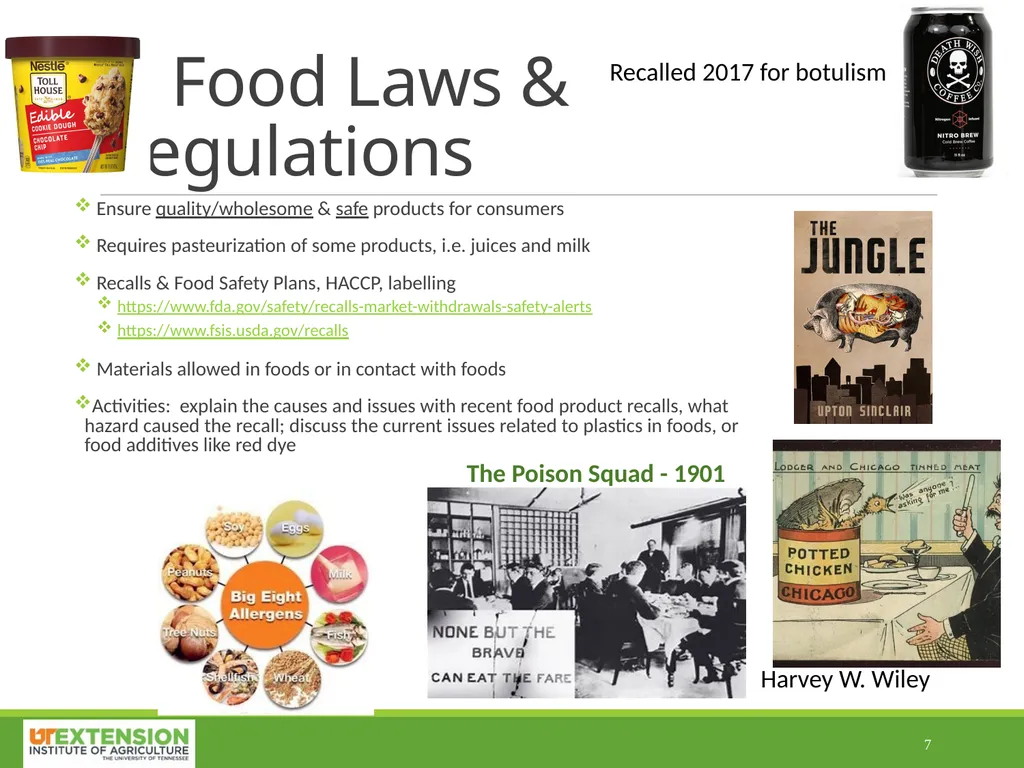
Food Laws & Regulations Ensure quality/wholesome & safe products for consumers
Requires pasteurization of some products, i.e. juices and milk
Recalls & Food Safety Plans, HACCP, labelling
https://www.fda.gov/safety/recalls-market-withdrawals-safety-alerts
https://www.fsis.usda.gov/recalls
Materials allowed in foods or in contact with foods
Activities: explain the causes and issues with recent food product recalls, what hazard caused the recall; discuss the current issues related to plastics in foods, or food additives like red dye 7 The Poison Squad - 1901 Harvey W. Wiley Recalled 2017 for botulism<br>
08
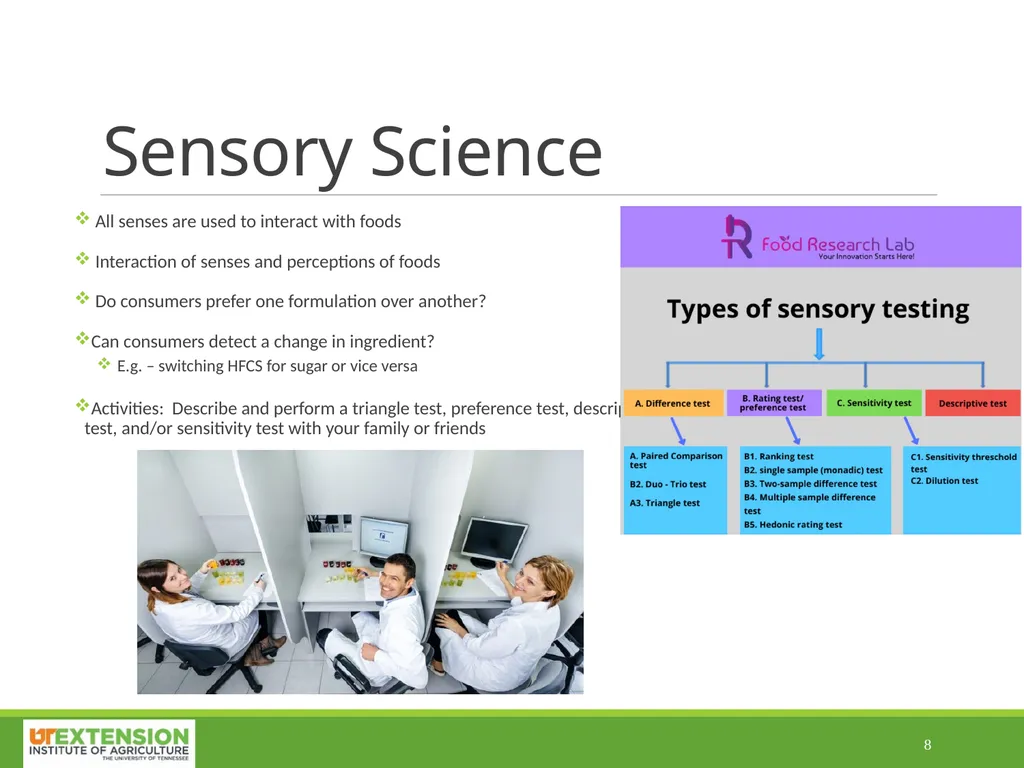
Sensory Science All senses are used to interact with foods
Interaction of senses and perceptions of foods
Do consumers prefer one formulation over another?
Can consumers detect a change in ingredient?
E.g. – switching HFCS for sugar or vice versa
Activities: Describe and perform a triangle test, preference test, descriptive test, and/or sensitivity test with your family or friends 8<br>
09
What Food Science is NOT! It is not “cooking”
Not Dietetics – diet and effects on health
Not Chef’s
Not Culinary Arts – food preparation, cooking, and presentation of foods, usually in the form of meals 9 Although all of these need knowledge of FOOD SCIENCE !<br>
Not Dietetics – diet and effects on health
Not Chef’s
Not Culinary Arts – food preparation, cooking, and presentation of foods, usually in the form of meals 9 Although all of these need knowledge of FOOD SCIENCE !<br>
10
Youth Programs in Food Science 1. Dairy Products judging – 4-H & FFA versions
2. Grill Master Challenge – Activities/Contest at 4-H Roundup
3. Product Development Team Contest – FFA only
4. Food Science Activities – 4-H Academic Conference
5. Food Science Project ePortfolios – 4-H Roundup 10<br>
2. Grill Master Challenge – Activities/Contest at 4-H Roundup
3. Product Development Team Contest – FFA only
4. Food Science Activities – 4-H Academic Conference
5. Food Science Project ePortfolios – 4-H Roundup 10<br>
11
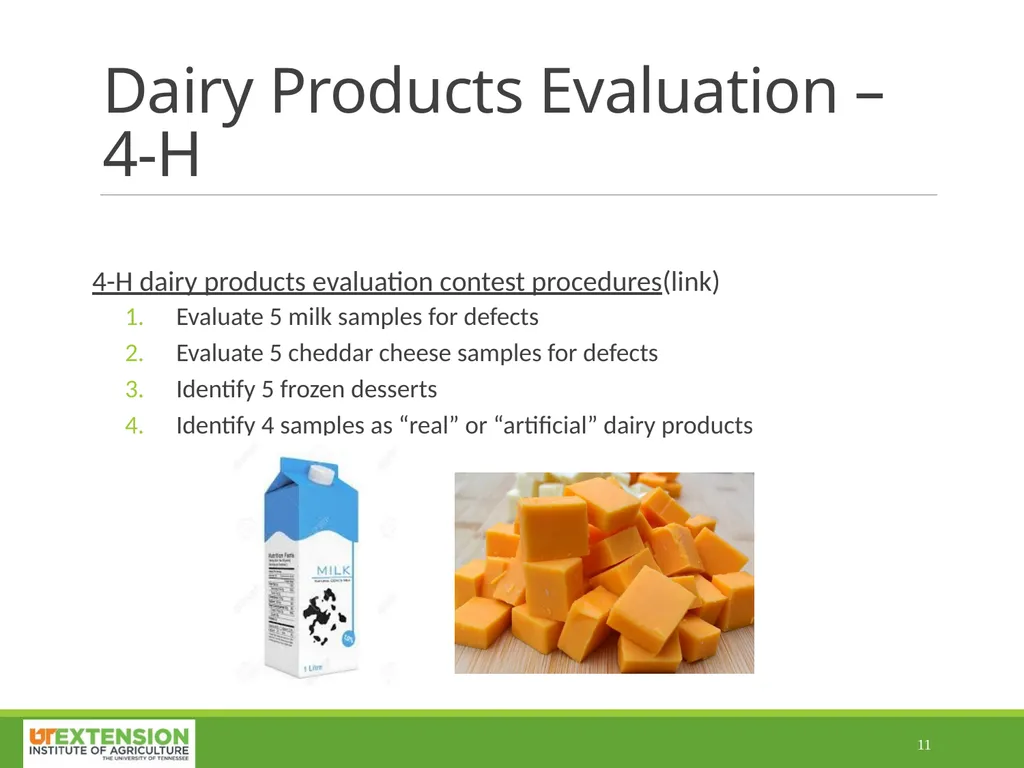
Dairy Products Evaluation – 4-H 4-H dairy products evaluation contest procedures(link)
Evaluate 5 milk samples for defects
Evaluate 5 cheddar cheese samples for defects
Identify 5 frozen desserts
Identify 4 samples as “real” or “artificial” dairy products 11<br>
Evaluate 5 milk samples for defects
Evaluate 5 cheddar cheese samples for defects
Identify 5 frozen desserts
Identify 4 samples as “real” or “artificial” dairy products 11<br>
12
Resources for Dairy Products Judging Saturday February 10th – Wilson County Fairgrounds
Dairy Products Judging Clinic - Senior High 4-H and FFA members across Tennessee are invited to participate in the clinic conducted by Dr. White.
Registration will begin at 9:00 am, with the clinic starting at 9:30 am. Lunch will be provided. Coaches and agents are welcome to participate in the clinic and learn all aspects of dairy product judging.
CONTACT: Jamie Harris jhharris@utk.edu
Know the Scorecard – from Mississipi State (for collegiate level)
http://dairyproductscontest.org/pdf/Mississippi-State-Dairy-Products-Judging.pdf
Sensory Evaluation of Milk – Penn State
http://dairyproductscontest.org/pdf/coaches_corner/Sensory-Evaluation-of-Milk-Penn-State.pdf 12 Deadline February 1st!<br>
13
Grill Master Challenge https://4h.tennessee.edu/food-science/
Lesson Plans & Guidelines available 13<br>
Lesson Plans & Guidelines available 13<br>
14
Food Science Project Resources Project Outcomes - https://4h.tennessee.edu/food-science/
Project Guide – Beginner
Activity Sheets – Beginner, Intermediate, Advanced
4-h Project Profile form
https://knox.tennessee.edu/wp-content/uploads/sites/202/2020/11/Section-A-112118-FINAL.pdf
Project e-PORTFOLIO Judging Rubric
https://4h.tennessee.edu/wp-content/uploads/sites/47/2021/01/Rubric-012920.pdf 14<br>
15
Food Science Project Resources External Resources
IFT K-12 Teaching Resources:
https://www.ift.org/community/educators/k12-teaching-resources
Search “Good Eats Videos” – with Alton Brown
Search “How it’s Made YouTube” – A lot of videos on commercial processing of food products from cheesecake to hot dogs to apple cider…
Search “Unwrapped” – more great videos on processing foods: Pringles, candies, Cheetos, mustard… 15<br>
16
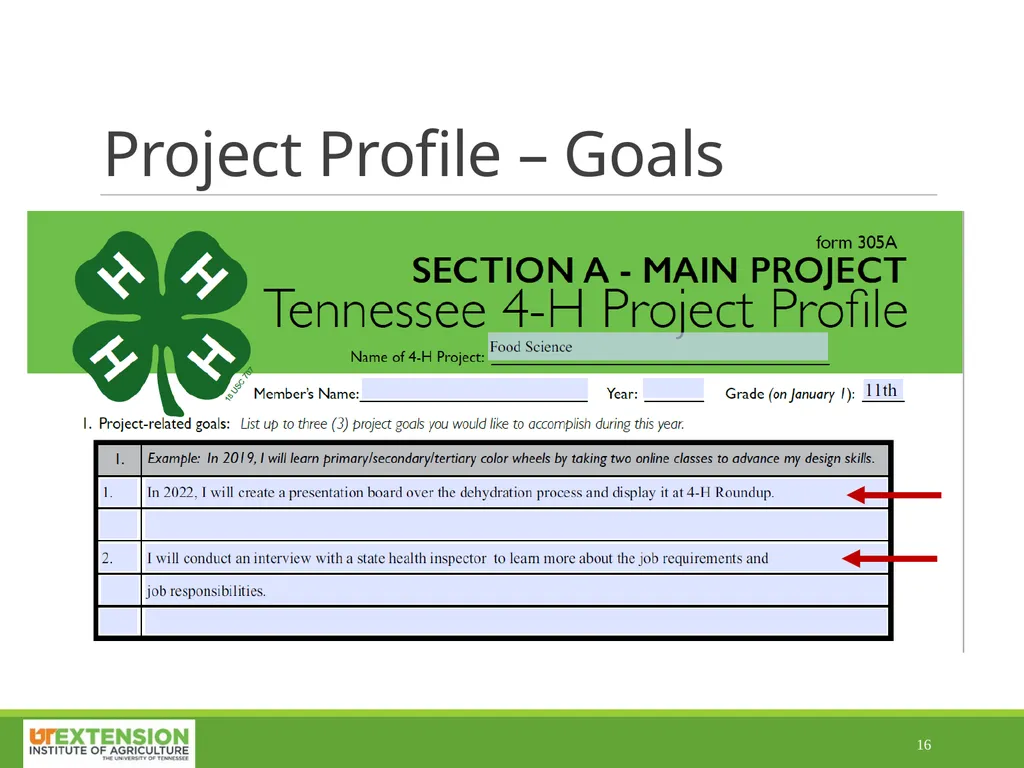
16 Project Profile – Goals<br>
17
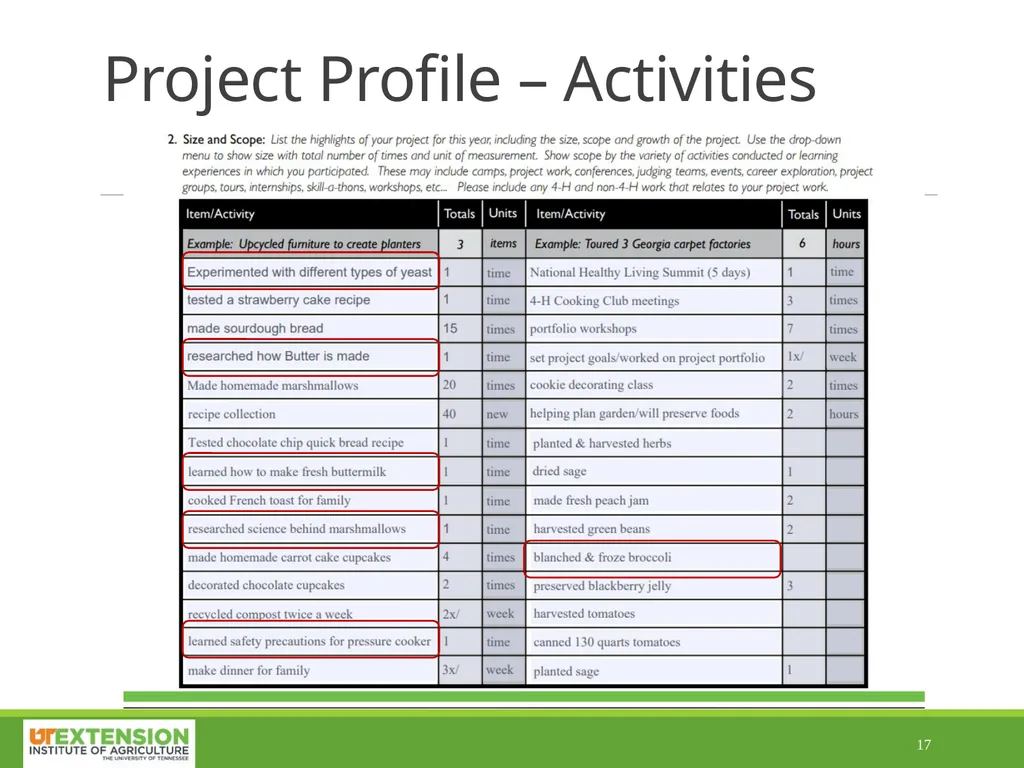
17 Project Profile – Activities<br>
18
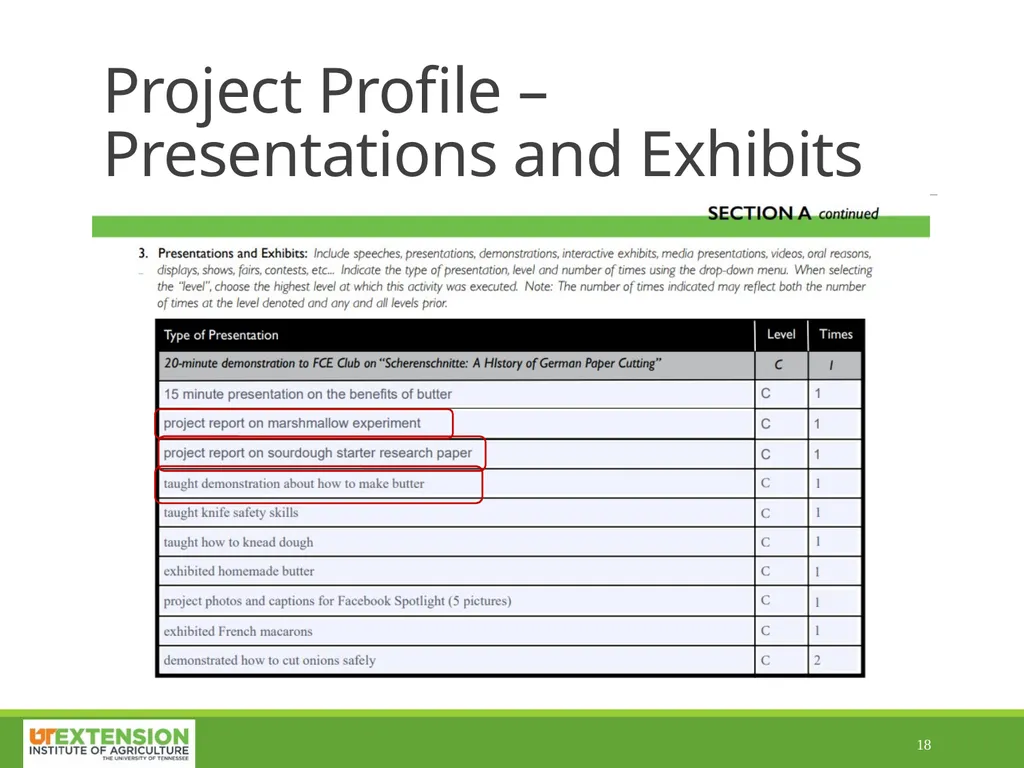
18 Project Profile – Presentations and Exhibits<br>
19
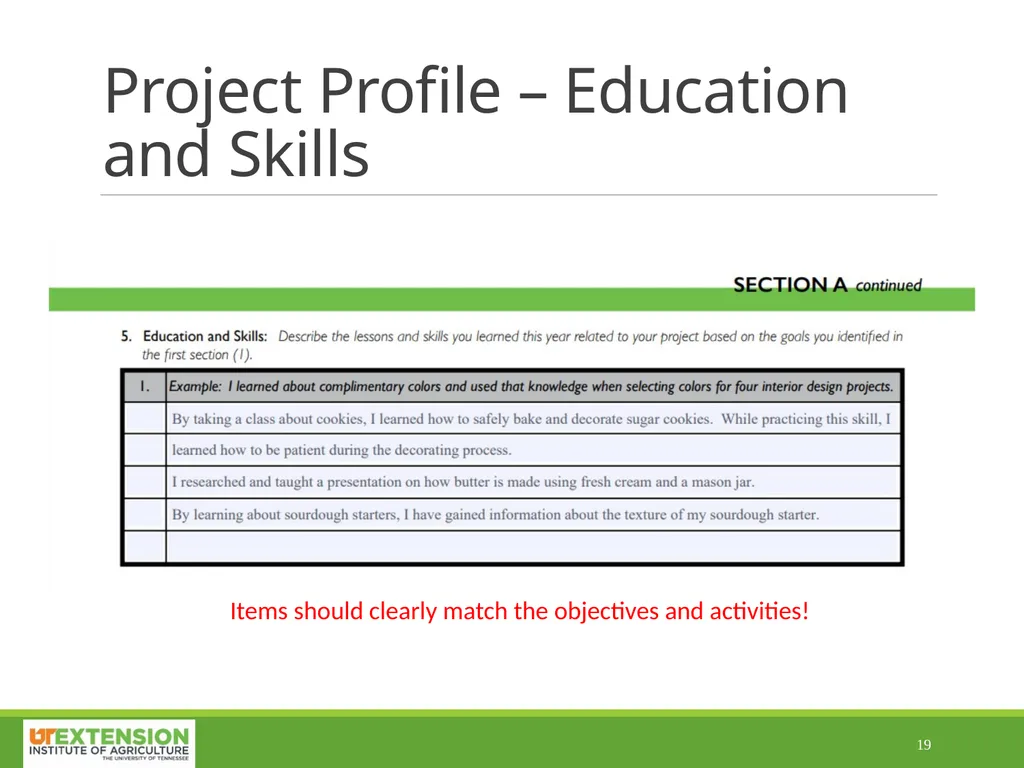
19 Project Profile – Education and Skills Items should clearly match the objectives and activities!<br>
20
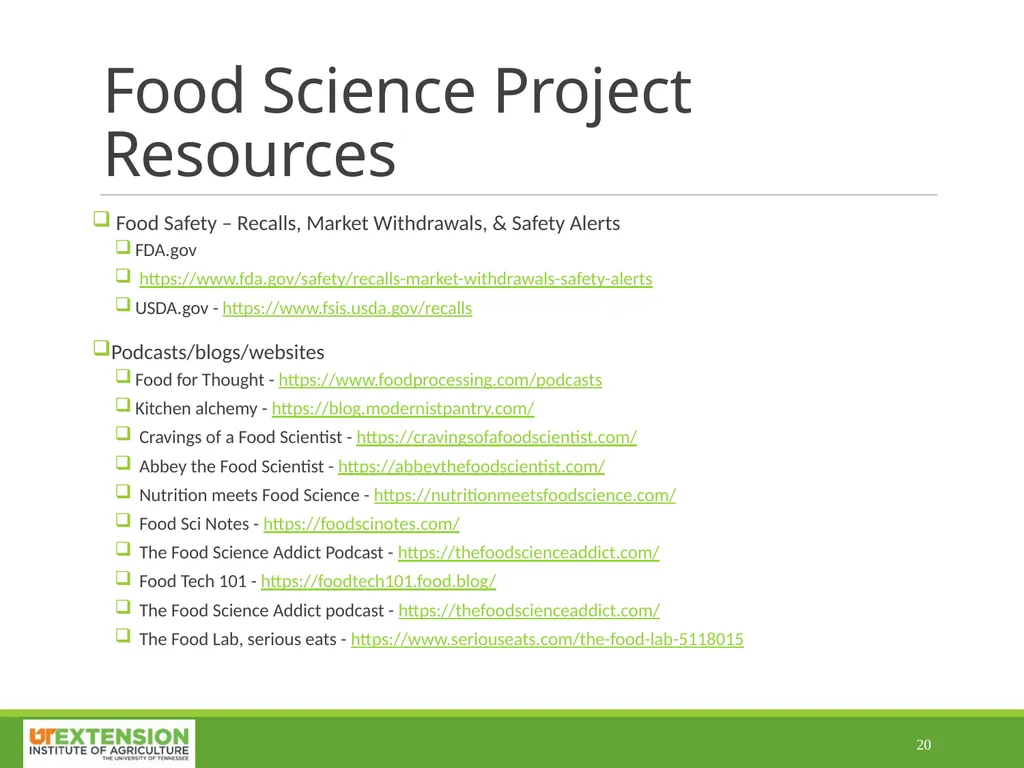
Food Science Project Resources Food Safety – Recalls, Market Withdrawals, & Safety Alerts
FDA.gov
https://www.fda.gov/safety/recalls-market-withdrawals-safety-alerts
USDA.gov - https://www.fsis.usda.gov/recalls
Podcasts/blogs/websites
Food for Thought - https://www.foodprocessing.com/podcasts
Kitchen alchemy - https://blog.modernistpantry.com/
Cravings of a Food Scientist - https://cravingsofafoodscientist.com/
Abbey the Food Scientist - https://abbeythefoodscientist.com/
Nutrition meets Food Science - https://nutritionmeetsfoodscience.com/
Food Sci Notes - https://foodscinotes.com/
The Food Science Addict Podcast - https://thefoodscienceaddict.com/
Food Tech 101 - https://foodtech101.food.blog/
The Food Science Addict podcast - https://thefoodscienceaddict.com/
The Food Lab, serious eats - https://www.seriouseats.com/the-food-lab-5118015 20<br>
21
Project Example
4-H Food Science Project Kyla Adkins<br>
22
Project Activities Should be focused on the science behind foods
NOT BAKING OR COOKING
Research basic food science principles
Case study on products that intrigue them, favorite snack, or something they make often with their family
Students do not have to make a food product if unable to due to various reasons
Research to be able to relate and articulate principle learned<br>
23
Activities Look at food in pantry or grocery stores
What are foods are high in protein?
What is considered a “good source of protein”?
What are signs you should not use a food product?
What is the difference between best buy, sell by, and use by?
Look in your pantry and see if there is a pattern for foods that use best buy, if so why would this be?
Observe your family in the kitchen. Pick out a food safety ”rule” they should practice. How did that go?<br>
24
Activities Research a favorite snack that is sold in England
Is there anything different? Why?
If a student can purchase the UK version, they can try it and compare it with the US version to see if they notice a difference.
Kitchen Alchemy
Spherification
Gummies
Research favorite restaurant health inspection scores
Did their score surprise you? What did they get marked off for? What did past scores look like?<br>
25
Case Study Students should focus on one product that intrigues them, a favorite snack, or something they make often with their family
Become an “expert” on the product
Know the food science principal areas of their product
What are the functional ingredients?
Explain how some ingredients have a specific purpose in the food
What happens if you change a functional ingredient
What are products you have in your pantry that share properties with the food product?<br>
26
Case Study – Example – Bread Food Science principle
What are microbiology concerns with white bread?
How does microbiology help with making bread?
What are some sensory attributes for white bread?
Can you describe the process steps for making bread?
Mixing ingredients, proofing, baking, cooling, packaging
What is the FDA’s standard of identity for bread?
What ingredients are required?<br>
27
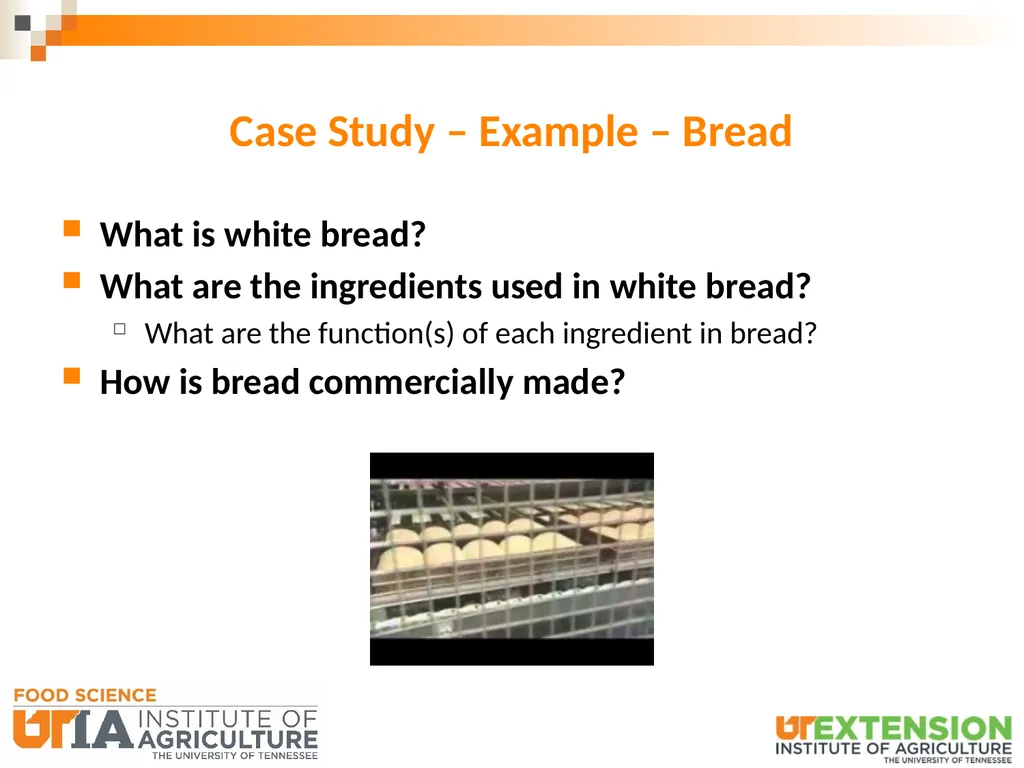
Case Study – Example – Bread What is white bread?
What are the ingredients used in white bread?
What are the function(s) of each ingredient in bread?
How is bread commercially made?<br>
What are the ingredients used in white bread?
What are the function(s) of each ingredient in bread?
How is bread commercially made?<br>
28
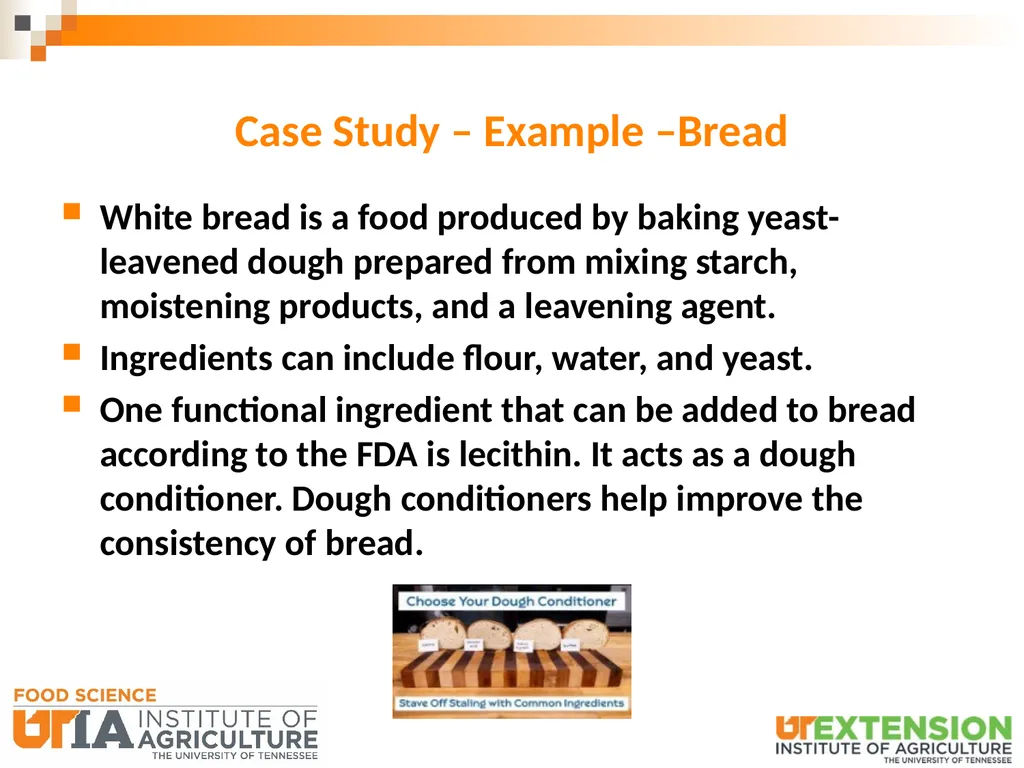
Case Study – Example –Bread White bread is a food produced by baking yeast-leavened dough prepared from mixing starch, moistening products, and a leavening agent.
Ingredients can include flour, water, and yeast.
One functional ingredient that can be added to bread according to the FDA is lecithin. It acts as a dough conditioner. Dough conditioners help improve the consistency of bread.<br>
Ingredients can include flour, water, and yeast.
One functional ingredient that can be added to bread according to the FDA is lecithin. It acts as a dough conditioner. Dough conditioners help improve the consistency of bread.<br>
29
Case Study – Example –Bread Lecithin is an emulsifier, which is considered a dough conditioner.
Can come from egg yolks and soybean
Emulsifiers help to make a balanced dough, which results in a more uniform bread and crumb consistency.
Emulsifiers also help increase shelf life because they bind water.<br>
Can come from egg yolks and soybean
Emulsifiers help to make a balanced dough, which results in a more uniform bread and crumb consistency.
Emulsifiers also help increase shelf life because they bind water.<br>
30
Case Study – Example –Bread Emulsifiers can be found in a variety of products because they help bind oil and water.
They are used in prepackaged and processed foods like mayonnaise, salad dressing, ice cream, and peanut butter.
Emulsifiers can be naturally occurring or man-made.<br>
They are used in prepackaged and processed foods like mayonnaise, salad dressing, ice cream, and peanut butter.
Emulsifiers can be naturally occurring or man-made.<br>
31
Case Study – Example –Bread What causes bread to go bad?
Mold is caused by mold spores (found naturally in the environment or on your hands) contaminating the bread. Because bread has moisture and is kept at a perfect temperature, mold can grow easily.
Stale bread is caused by the starch crystallizing and hardening over time.
What makes bread safe?
Bread is usually baked at a high temperature for a long amount of time, which kills off bacteria that would be of concern.
Bacteria cannot grow because of bread’s low water activity.<br>
32
Resources Kitchen Alchemy – WTF and Education tabs
https://blog.modernistpantry.com/
https://science.howstuffworks.com/
https://www.compoundchem.com/
https://www.fda.gov/food
Code of Federal Regulations: https://www.ecfr.gov/current/title-21
https://foodinsight.org/
https://foodcrumbles.com/<br>
https://blog.modernistpantry.com/
https://science.howstuffworks.com/
https://www.compoundchem.com/
https://www.fda.gov/food
Code of Federal Regulations: https://www.ecfr.gov/current/title-21
https://foodinsight.org/
https://foodcrumbles.com/<br>
33
Visualization of Project Student could take a photos baking bread with and without a functional ingredient.
Include result pictures
A photo of a student giving a presentation about their product.
Include presentation
Student could make a fun, informative video about their case study.
Photos of student looking at food packaging for ingredients and/or nutrition facts<br>
Include result pictures
A photo of a student giving a presentation about their product.
Include presentation
Student could make a fun, informative video about their case study.
Photos of student looking at food packaging for ingredients and/or nutrition facts<br>
34
Contact info Dr. Mark Morgan, Extension Specialist and Process Authority
Phone: 865-974-7499
Email: mark.morgan@tennessee.edu
Kyla Adkins, Student Engagement and Youth Programs
Phone: 865-974-4052
Email: kylaadkins@utk.edu
Food Science Department
2510 River Drive Knoxville, TN 37996
Phone: 865-974-7331
Email: foodsci_ext@utk.edu
Website: https://foodscience.tennessee.edu/food-science-extension/<br>