04
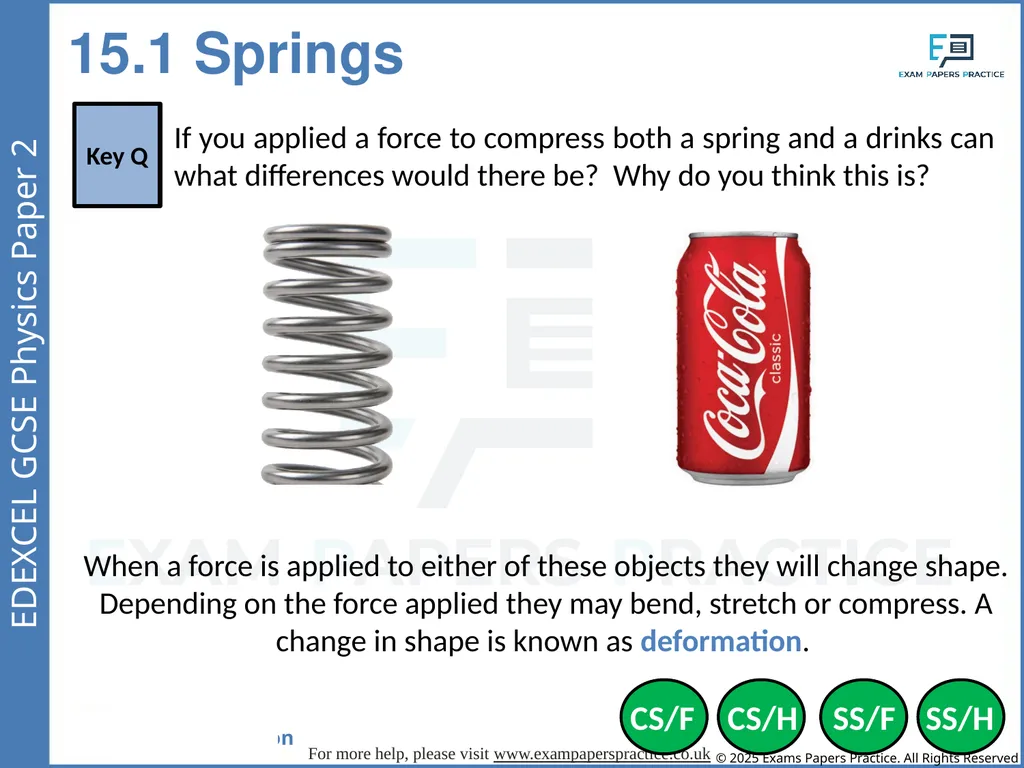
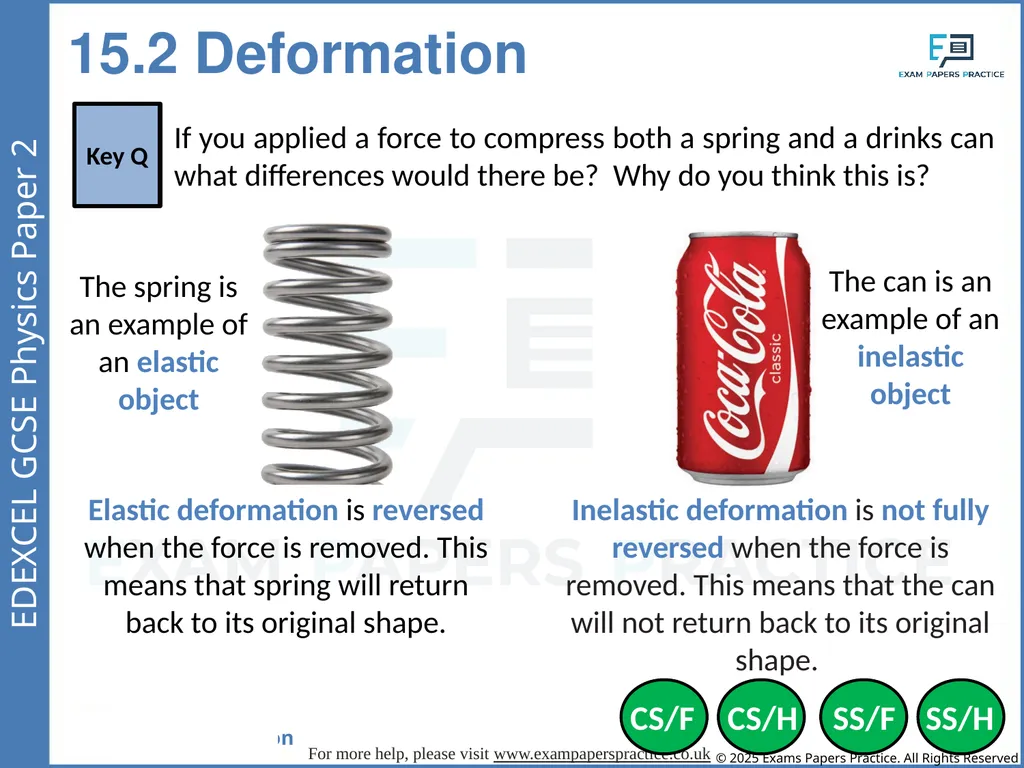
Define the following key terms: 15.2 Deformation<br>
05
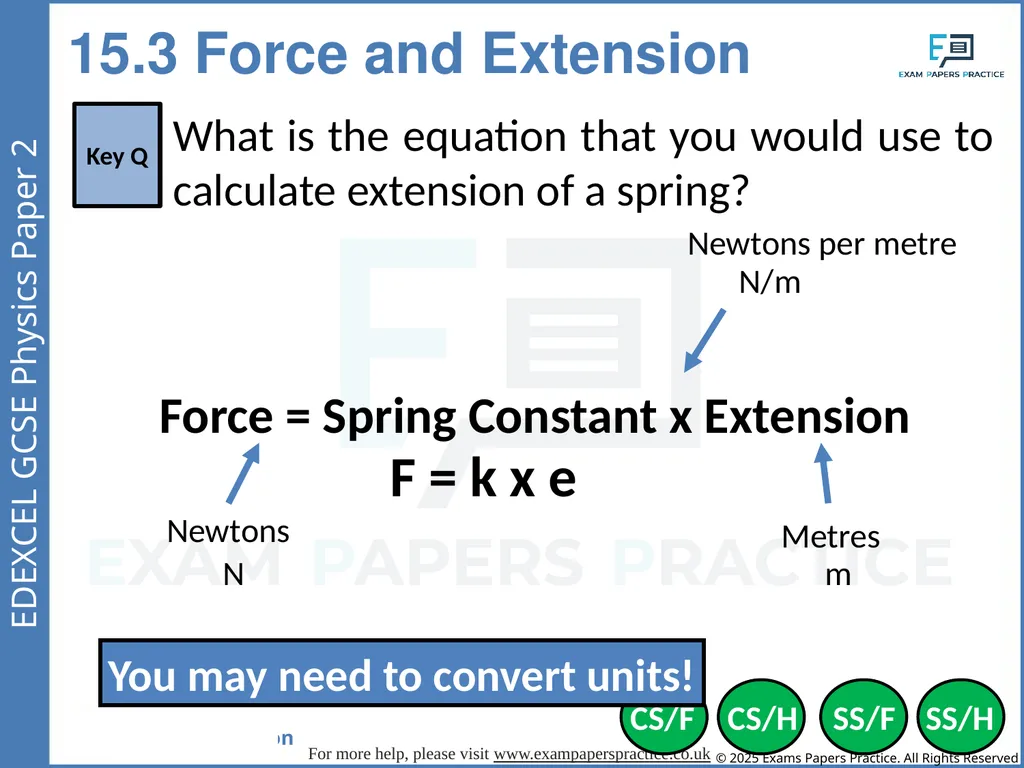
What is the equation that you would use to calculate extension of a spring? Force = Spring Constant x Extension F = k x e You may need to convert units! 15.3 Force and Extension Key Q<br>
06
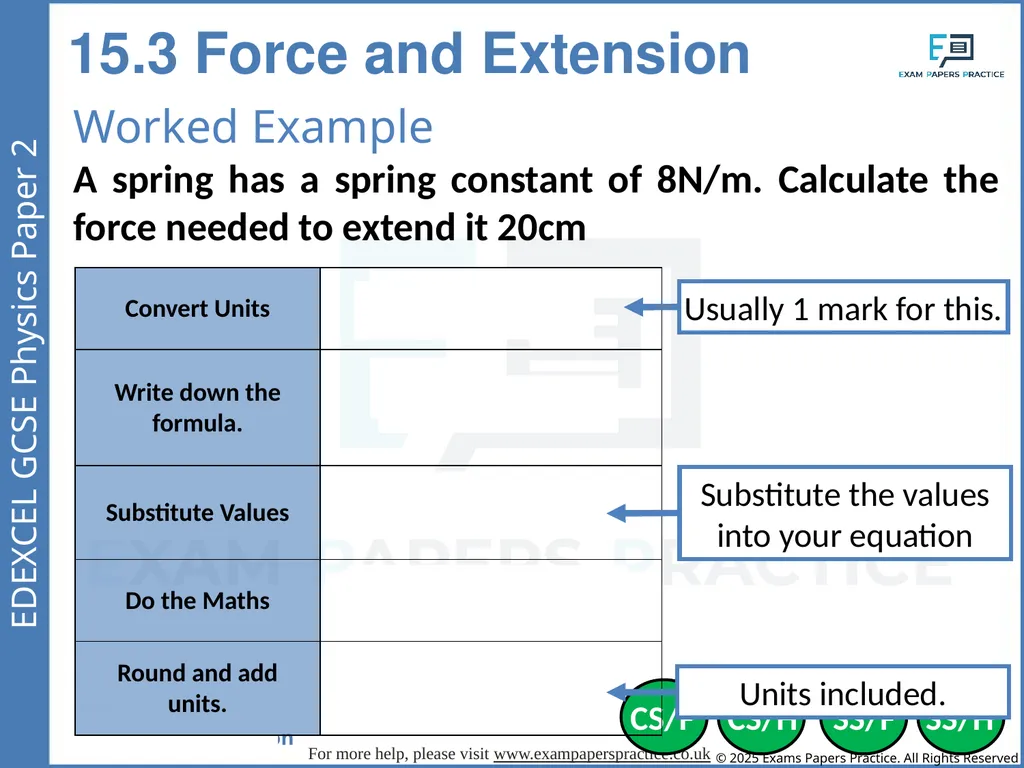
A spring has a spring constant of 8N/m. Calculate the force needed to extend it 20cm Worked Example 15.3 Force and Extension<br>
07
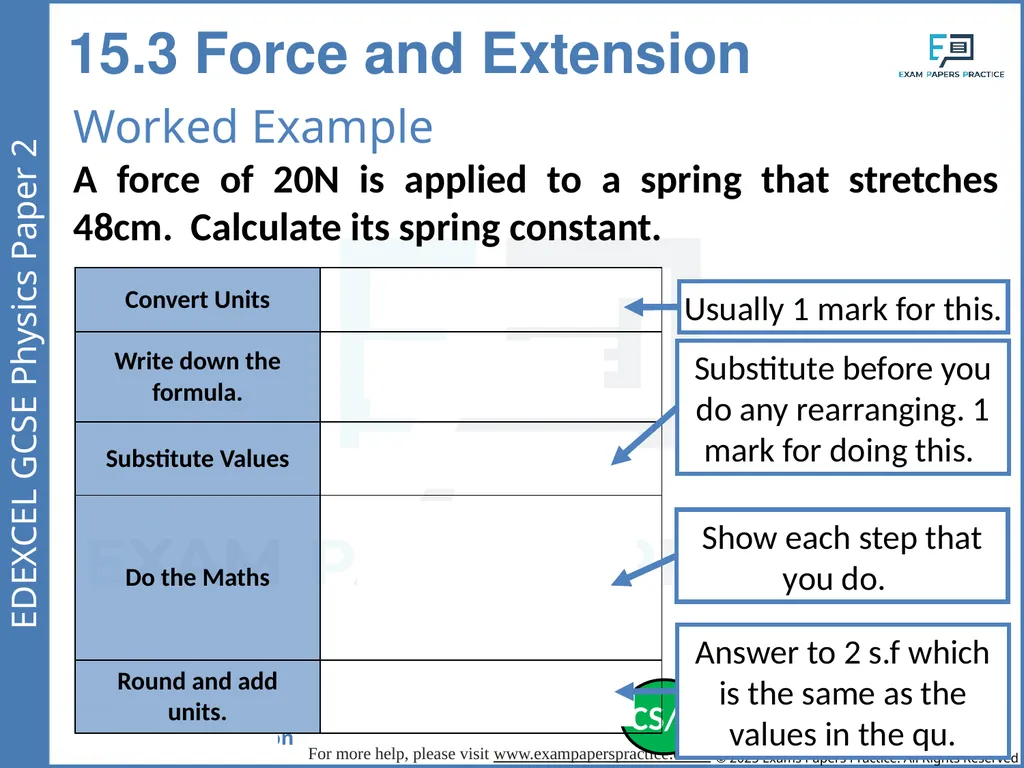
A force of 20N is applied to a spring that stretches 48cm. Calculate its spring constant. Worked Example 15.3 Force and Extension<br>
08
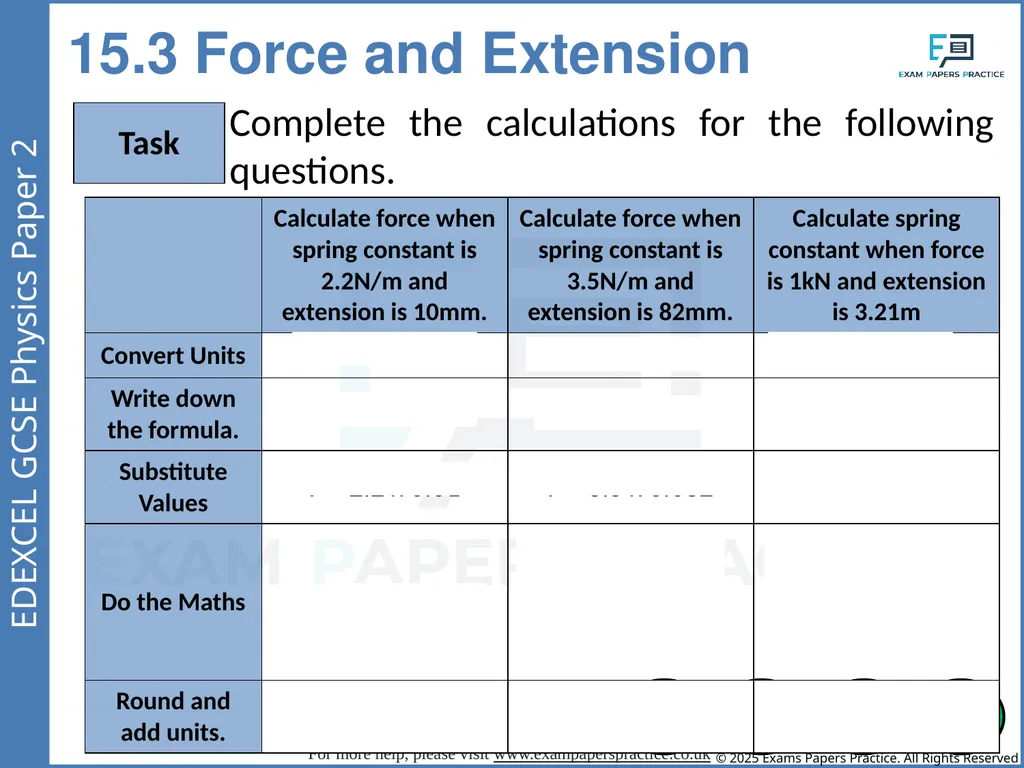
Complete the calculations for the following questions. 15.3 Force and Extension<br>
09
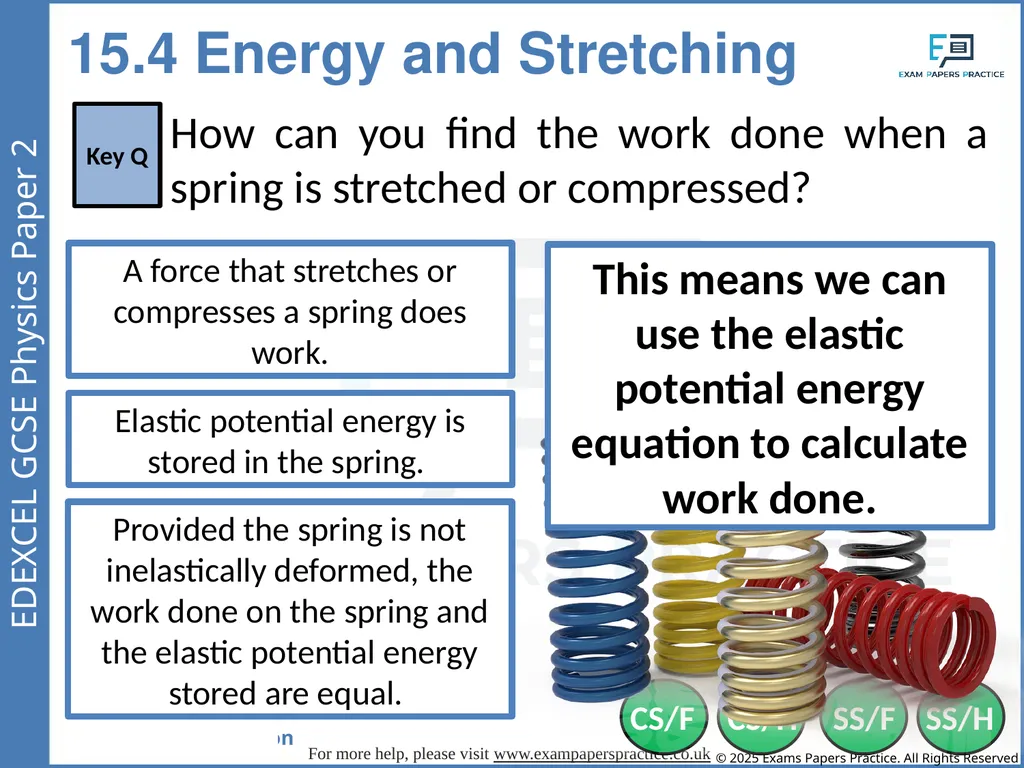
How can you find the work done when a spring is stretched or compressed? A force that stretches or compresses a spring does work. Elastic potential energy is stored in the spring. Provided the spring is not inelastically deformed, the work done on the spring and the elastic potential energy stored are equal. This means we can use the elastic potential energy equation to calculate work done. 15.4 Energy and Stretching Key Q<br>
10
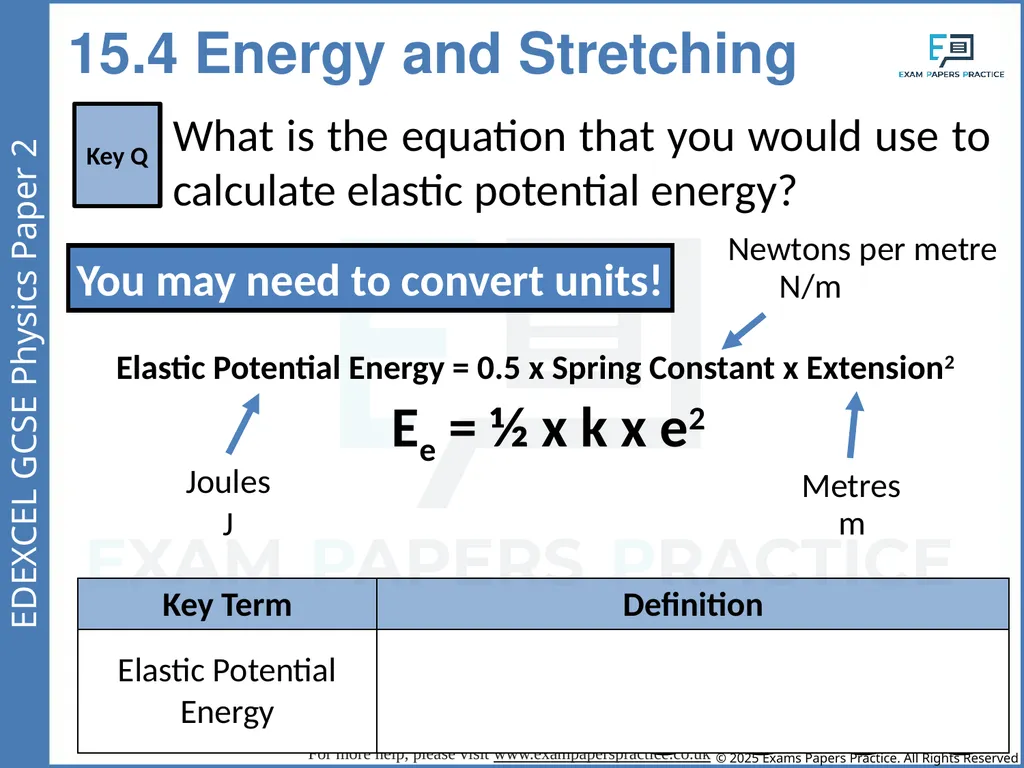
What is the equation that you would use to calculate elastic potential energy? Elastic Potential Energy = 0.5 x Spring Constant x Extension2 Ee = ½ x k x e2 You may need to convert units! 15.4 Energy and Stretching Key Q<br>
11
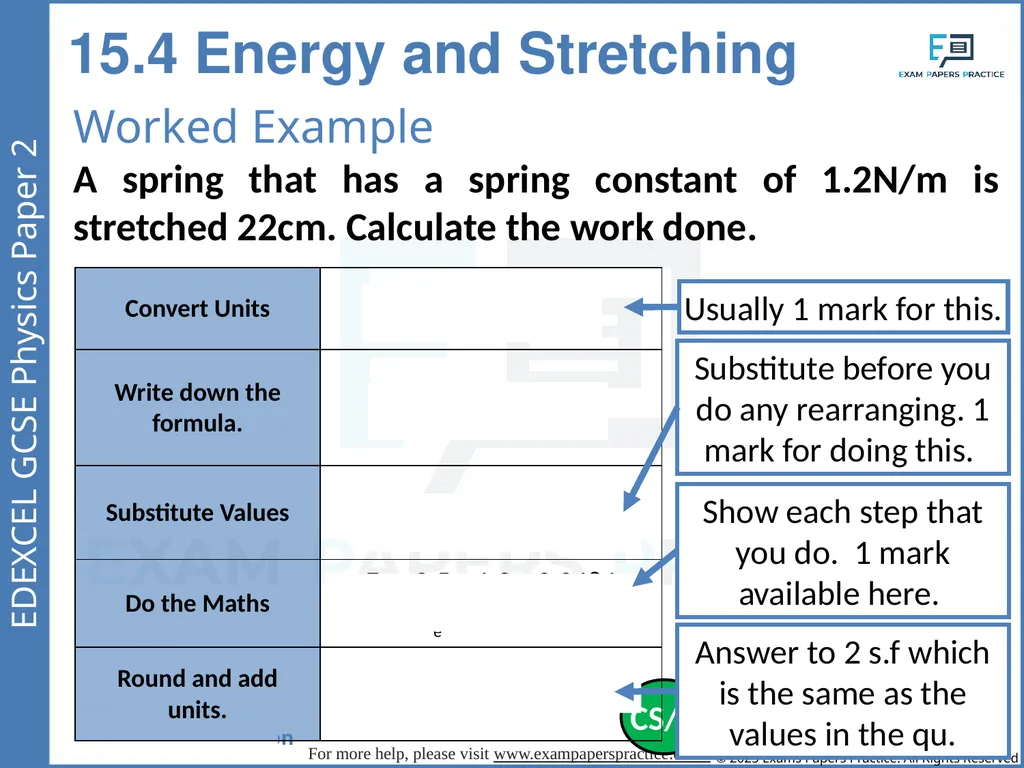
A spring that has a spring constant of 1.2N/m is stretched 22cm. Calculate the work done. Worked Example 15.4 Energy and Stretching<br>
12
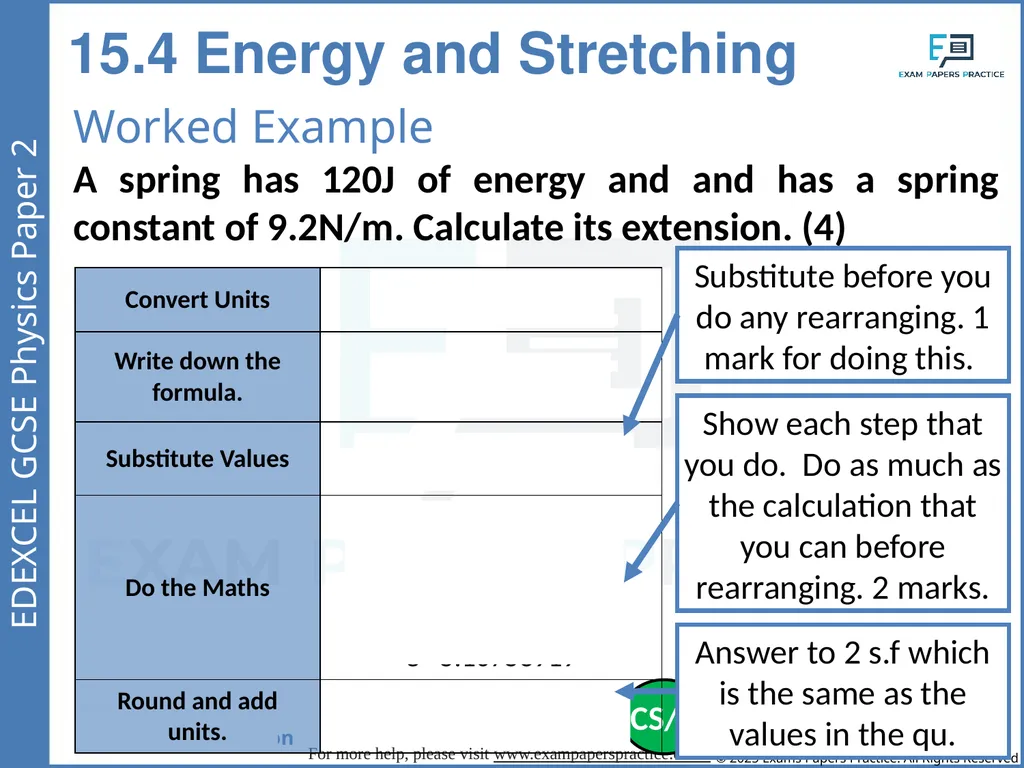
A spring has 120J of energy and and has a spring constant of 9.2N/m. Calculate its extension. (4) Worked Example 15.4 Energy and Stretching<br>
13
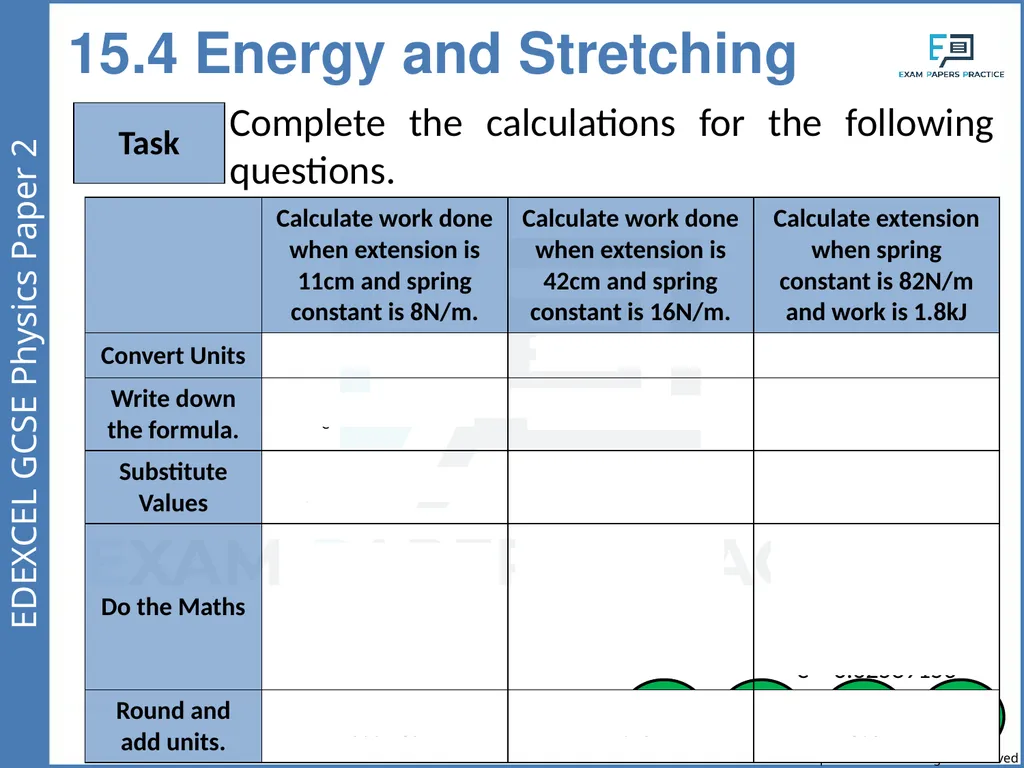
Complete the calculations for the following questions. 15.4 Energy and Stretching<br>
14
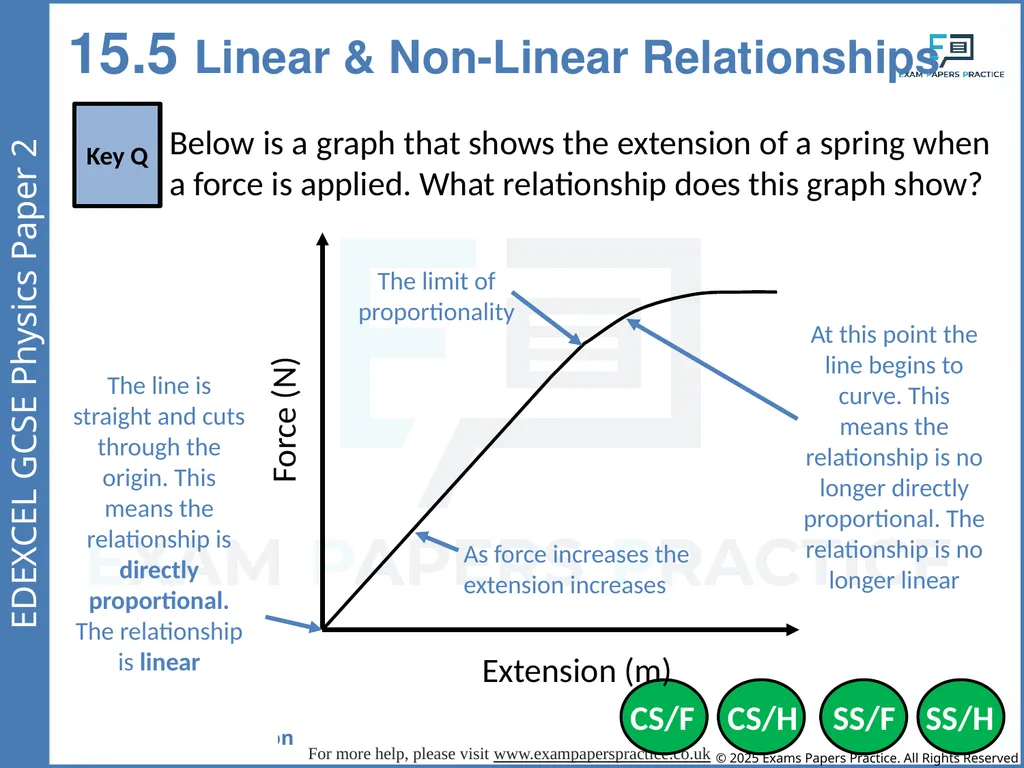
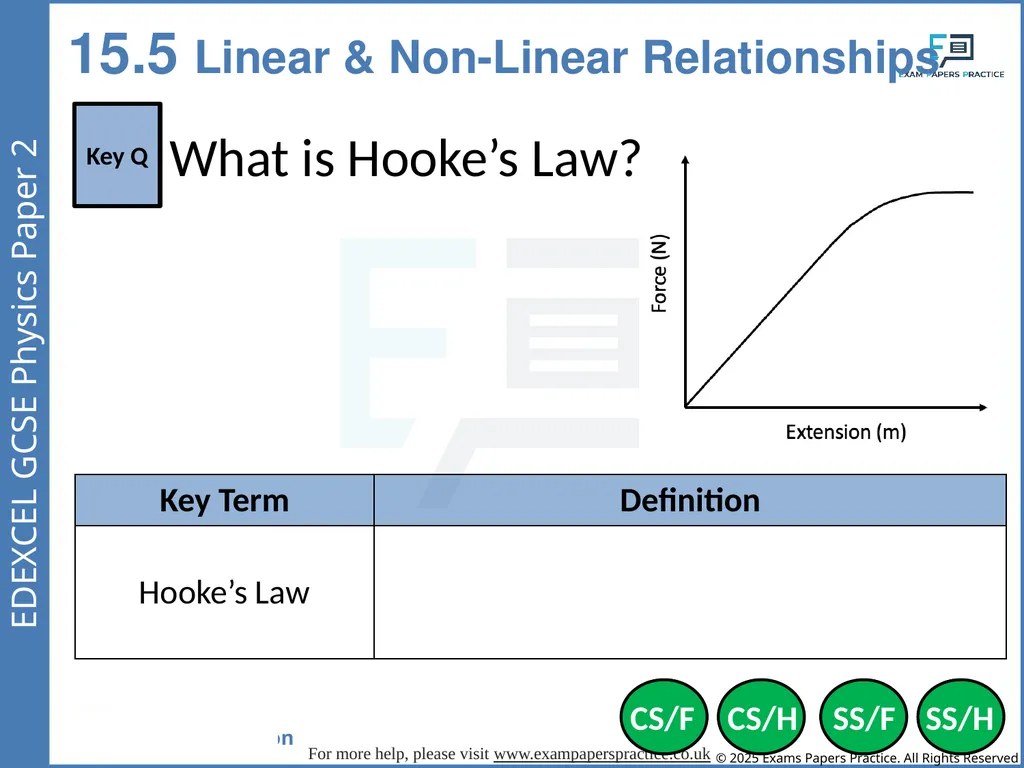
Below is a graph that shows the extension of a spring when a force is applied. What relationship does this graph show? As force increases the extension increases The line is straight and cuts through the origin. This means the relationship is directly proportional. The relationship is linear At this point the line begins to curve. This means the relationship is no longer directly proportional. The relationship is no longer linear The limit of proportionality 15.5 Linear & Non-Linear Relationships Key Q<br>
15
What is Hooke’s Law? 15.5 Linear & Non-Linear Relationships Key Q<br>
16
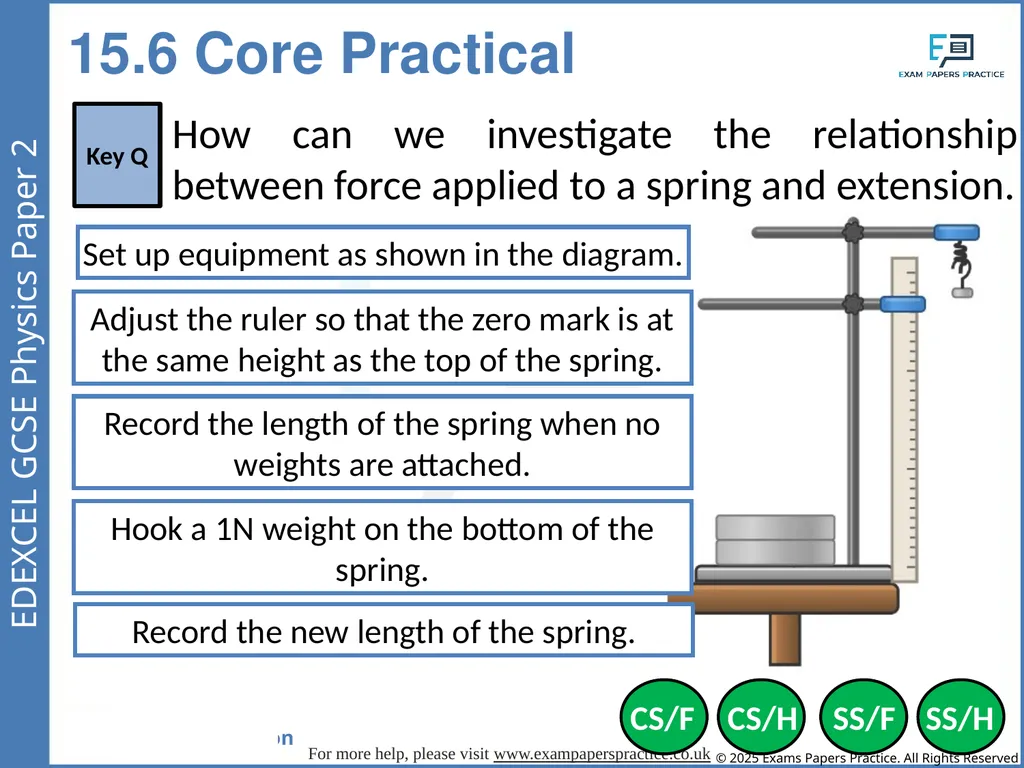
How can we investigate the relationship between force applied to a spring and extension. Set up equipment as shown in the diagram. Adjust the ruler so that the zero mark is at the same height as the top of the spring. Record the length of the spring when no weights are attached. Hook a 1N weight on the bottom of the spring. Record the new length of the spring. 15.6 Core Practical Key Q<br>
17
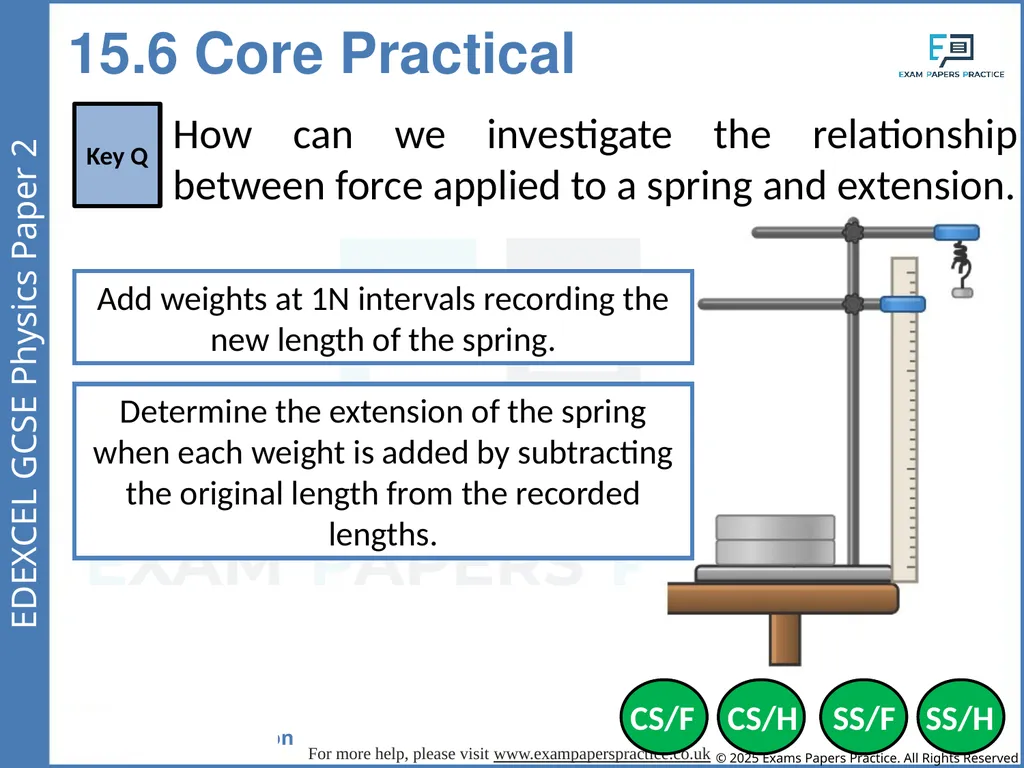
How can we investigate the relationship between force applied to a spring and extension. Add weights at 1N intervals recording the new length of the spring. Determine the extension of the spring when each weight is added by subtracting the original length from the recorded lengths. 15.6 Core Practical Key Q<br>
18
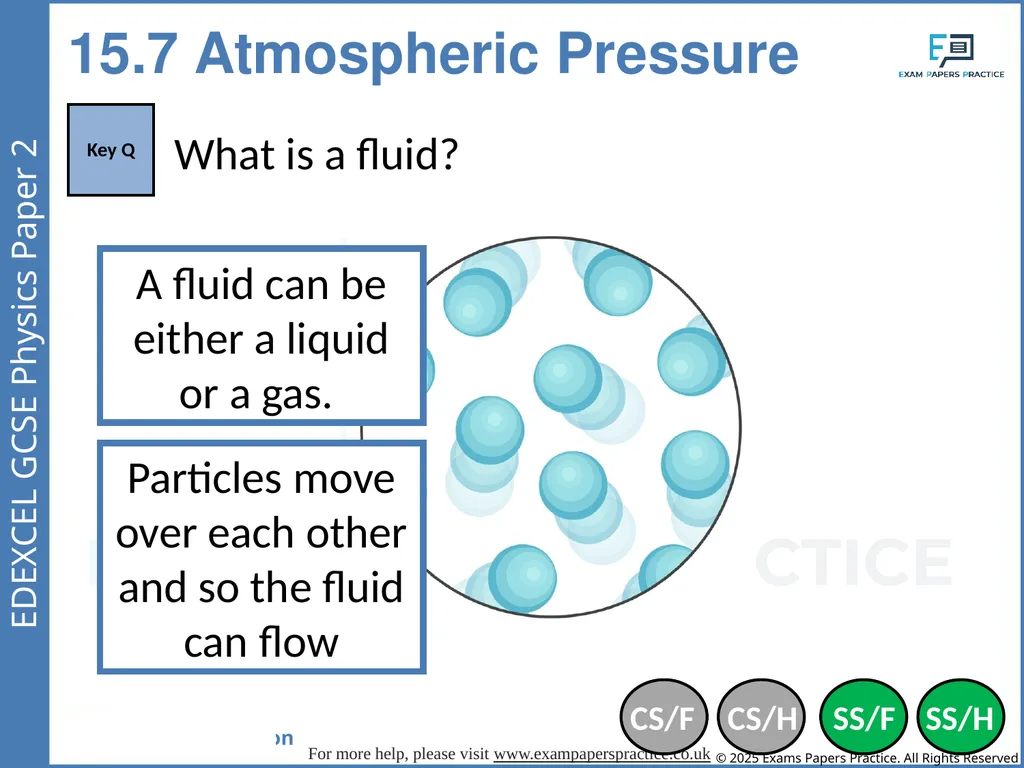
What is a fluid? A fluid can be either a liquid or a gas. Particles move over each other and so the fluid can flow 15.7 Atmospheric Pressure<br>
19
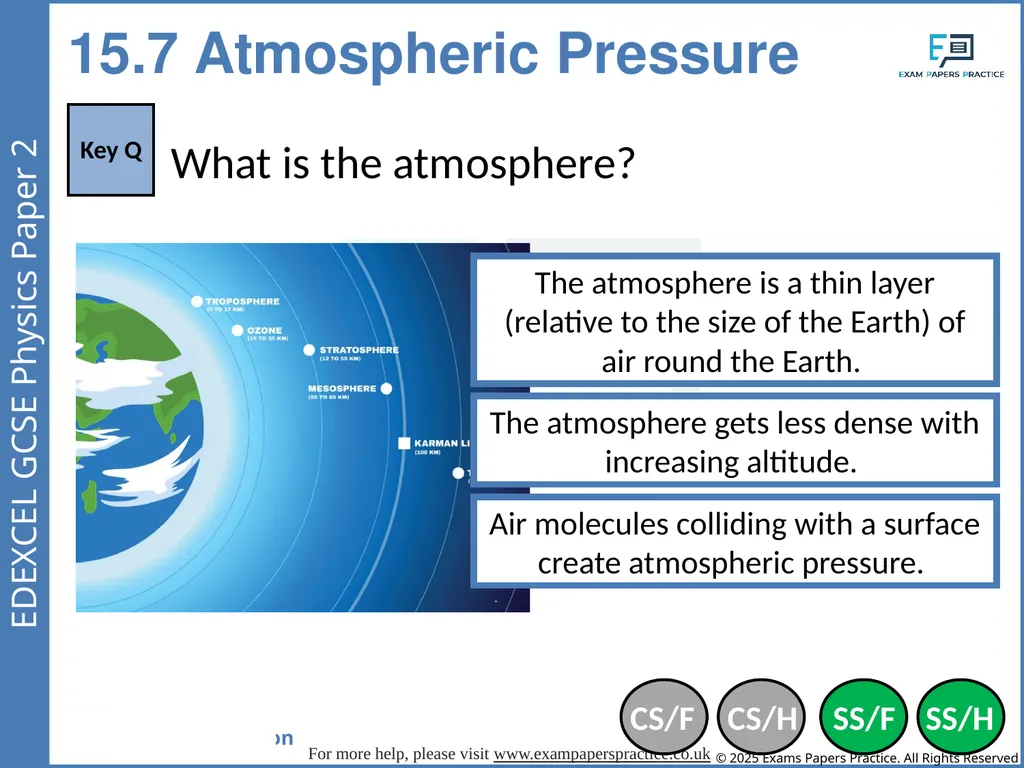
The atmosphere is a thin layer (relative to the size of the Earth) of air round the Earth. The atmosphere gets less dense with increasing altitude. What is the atmosphere? Air molecules colliding with a surface create atmospheric pressure. 15.7 Atmospheric Pressure<br>
20
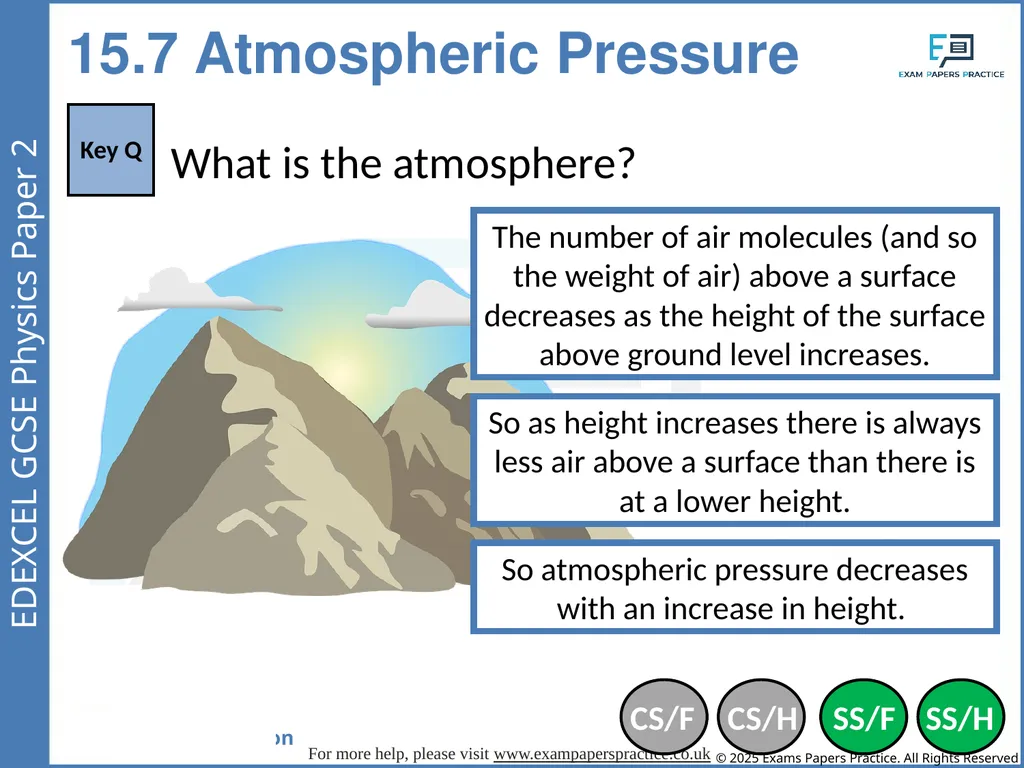
The number of air molecules (and so the weight of air) above a surface decreases as the height of the surface above ground level increases. So as height increases there is always less air above a surface than there is at a lower height. What is the atmosphere? So atmospheric pressure decreases with an increase in height. 15.7 Atmospheric Pressure<br>
21
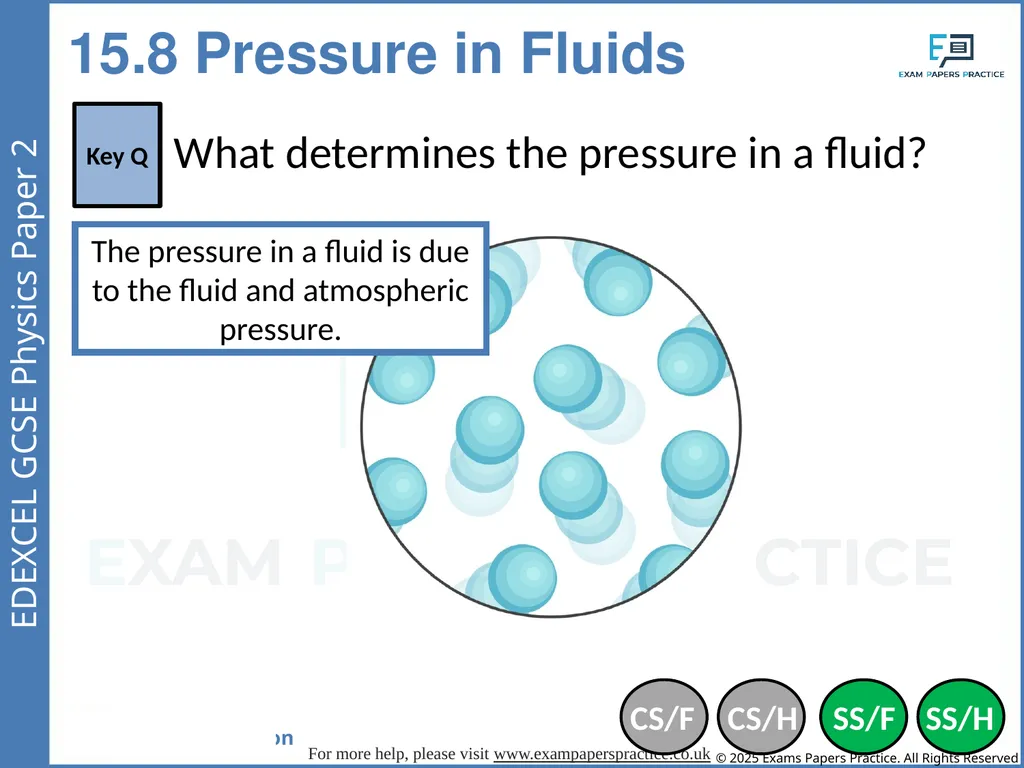
What determines the pressure in a fluid? 15.8 Pressure in Fluids Key Q The pressure in a fluid is due to the fluid and atmospheric pressure.<br>
22
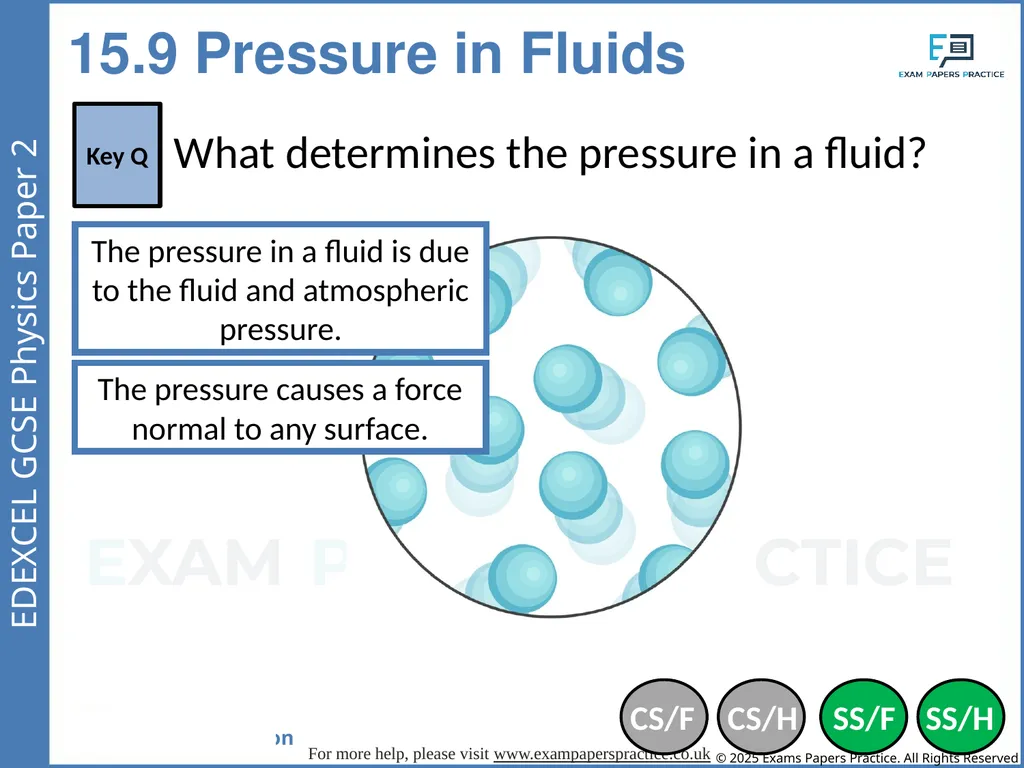
What determines the pressure in a fluid? 15.9 Pressure in Fluids Key Q The pressure in a fluid is due to the fluid and atmospheric pressure. The pressure causes a force normal to any surface.<br>
23
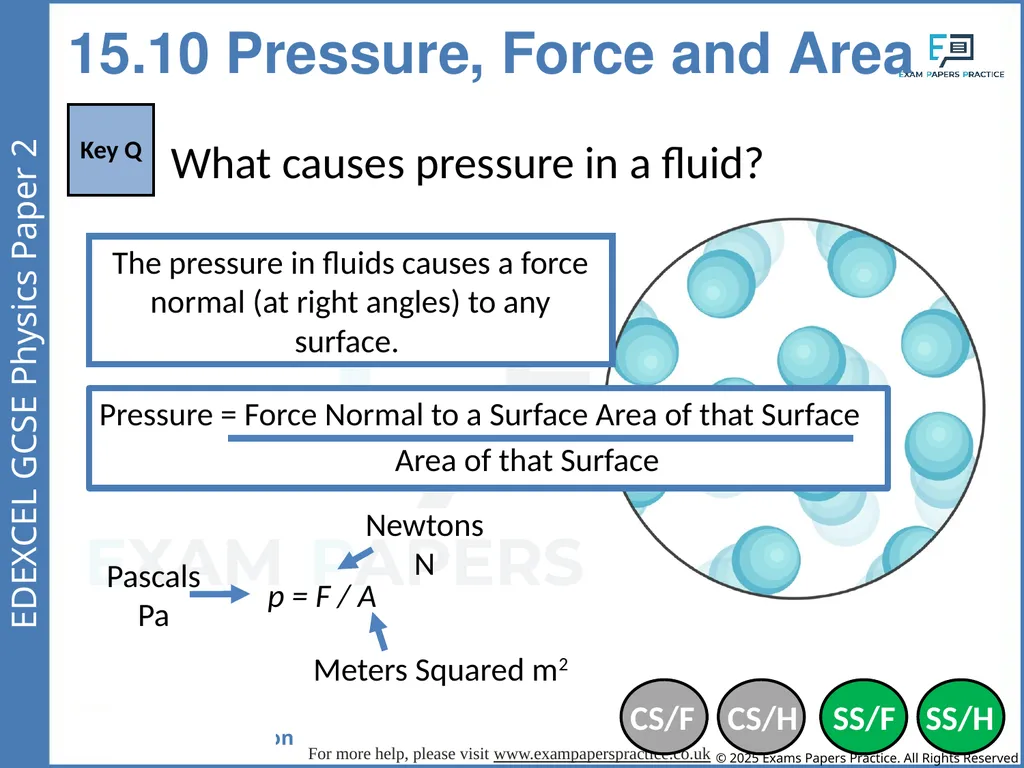
The pressure in fluids causes a force normal (at right angles) to any surface. What causes pressure in a fluid? Pressure = Force Normal to a Surface Area of that Surface Area of that Surface p = F / A Pascals
Pa Newtons
N Meters Squared m2 15.10 Pressure, Force and Area<br>
24
A toy has a mass of 150g and moves forward with a velocity of 0.08 m/s. Calculate its momentum. (3) 15.11 Calculating Pressure<br>
25
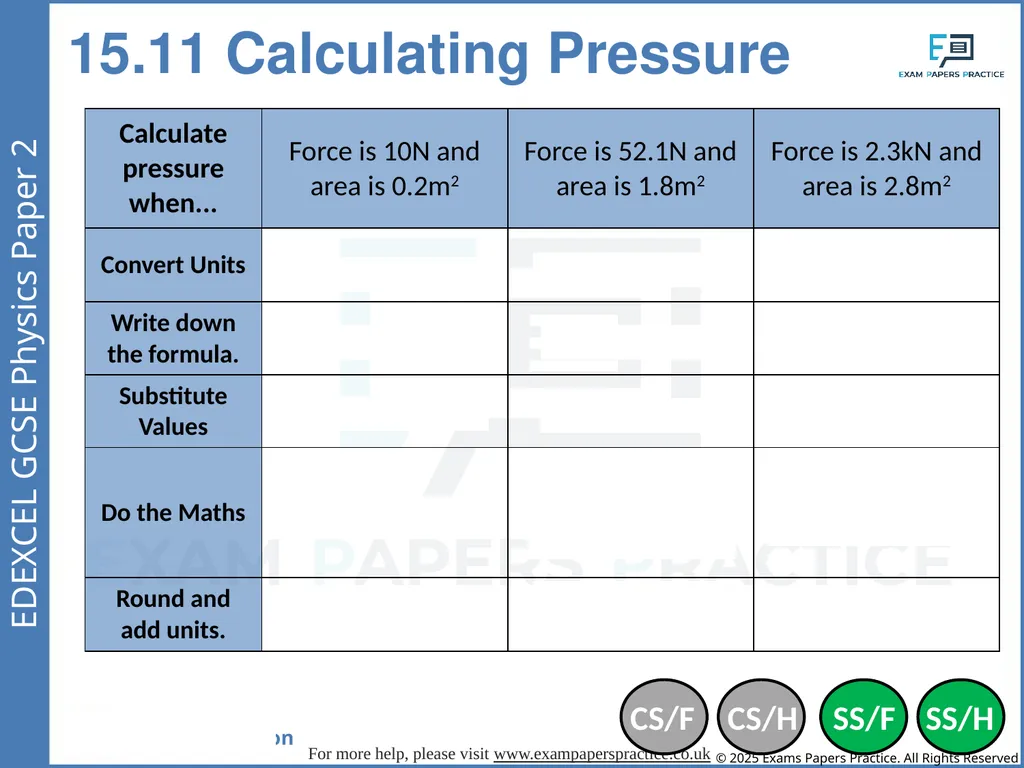
15.11 Calculating Pressure<br>
26
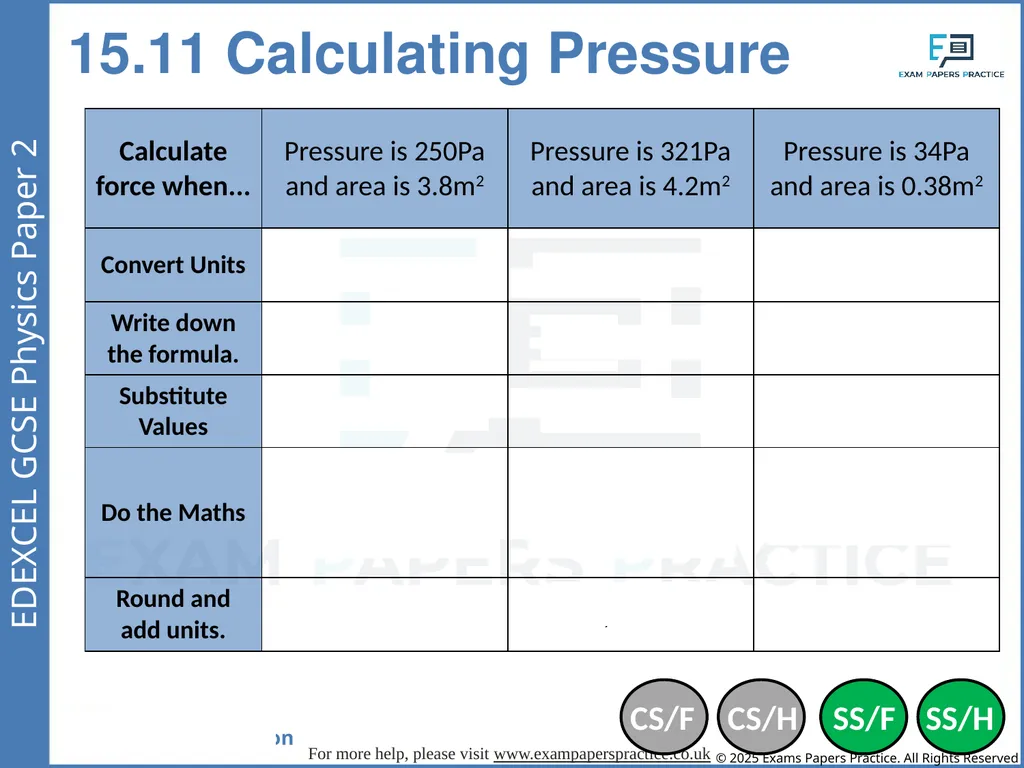
15.11 Calculating Pressure<br>
27
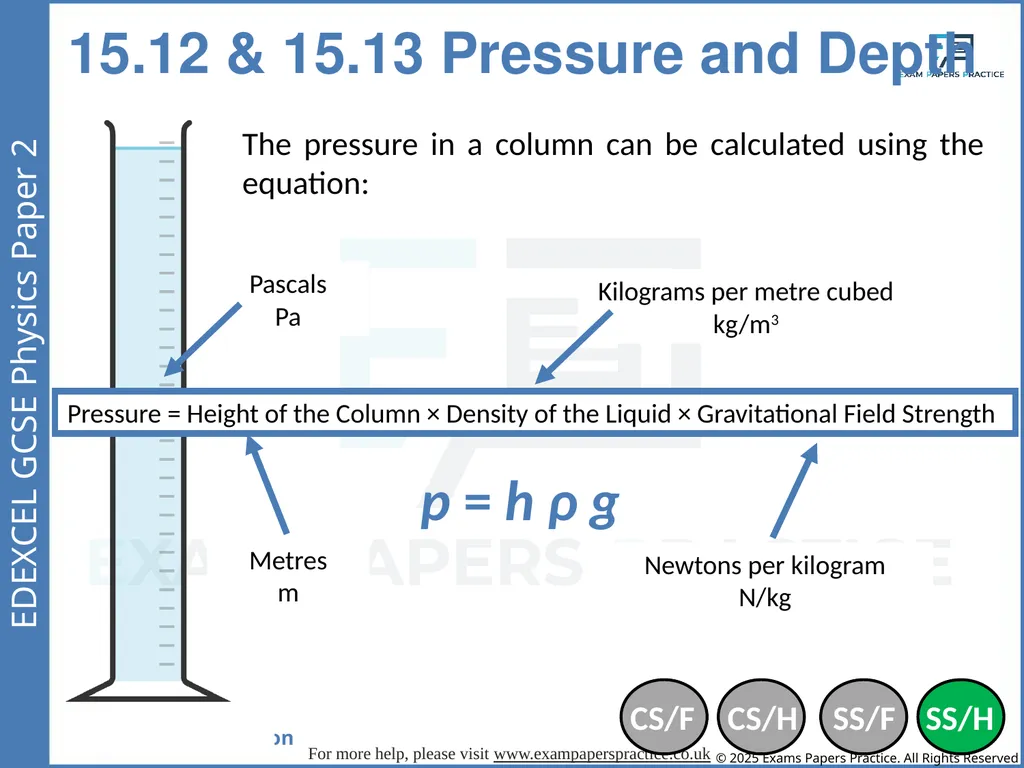
The pressure in a column can be calculated using the equation: Pressure = Height of the Column × Density of the Liquid × Gravitational Field Strength p = h ρ g Pascals
Pa Metres
m Kilograms per metre cubed
kg/m3 Newtons per kilogram
N/kg 15.12 & 15.13 Pressure and Depth<br>
28
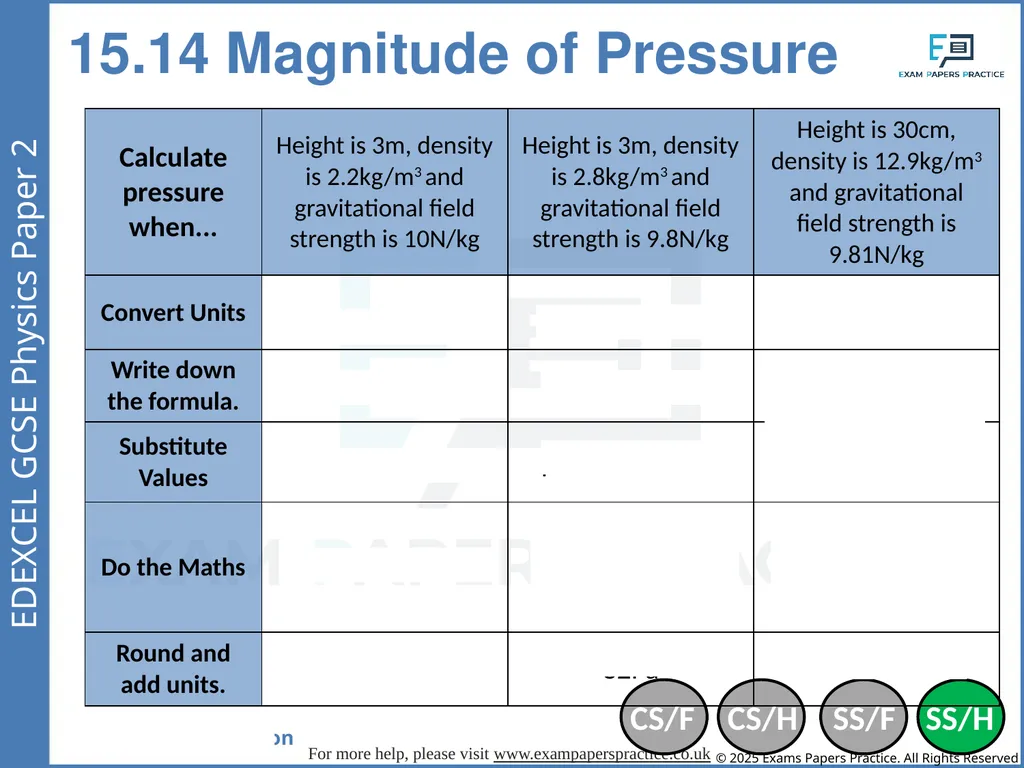
A water tank is 500 cm high. If the density of water is 1000 kg/m³ and the gravitational field strength is 9.81 N/kg, what is the pressure at the bottom of the tank? 15.14 Magnitude of Pressure<br>
29
15.14 Magnitude of Pressure<br>
30
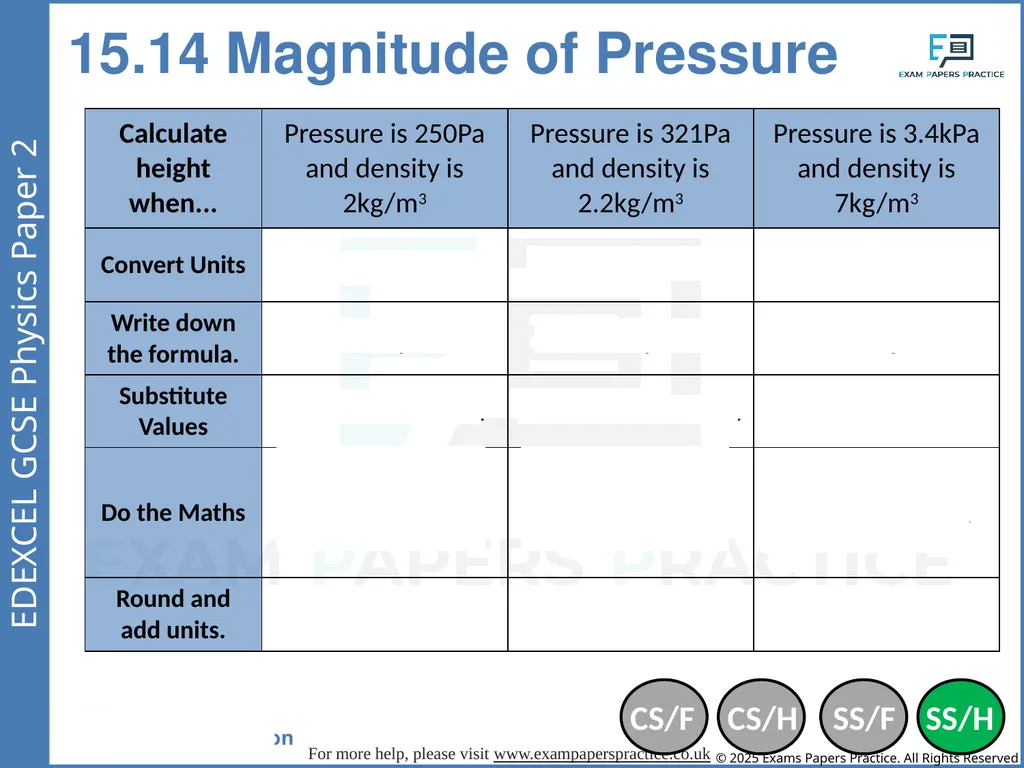
15.14 Magnitude of Pressure<br>
31
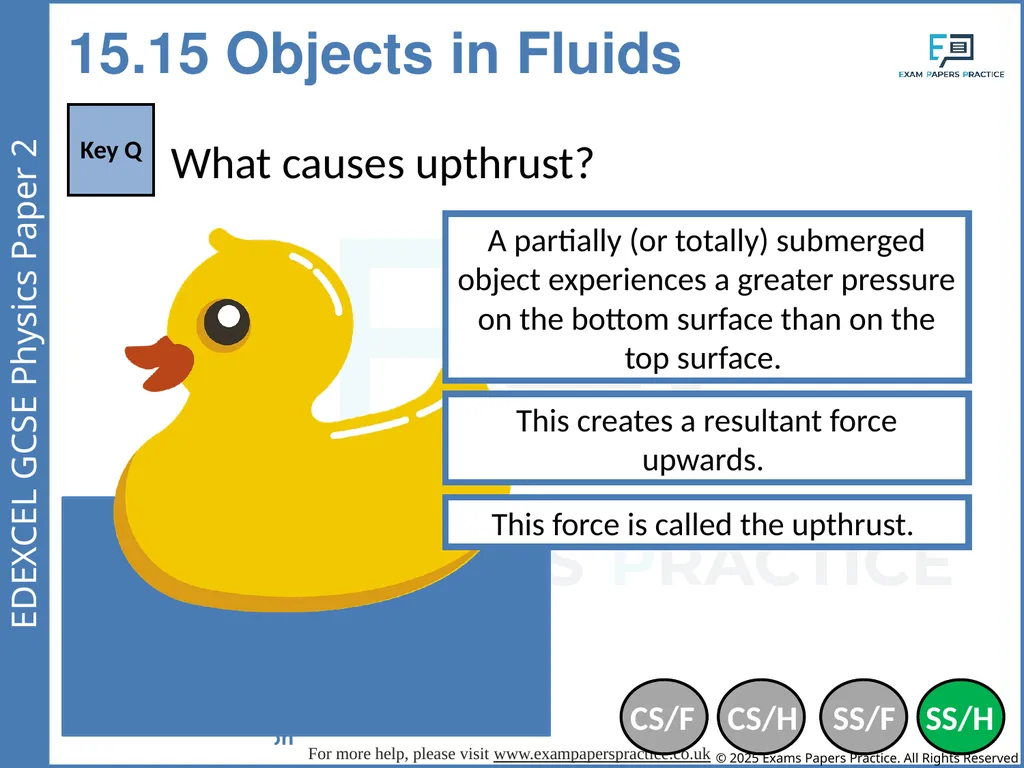
A partially (or totally) submerged object experiences a greater pressure on the bottom surface than on the top surface. This creates a resultant force upwards. This force is called the upthrust. What causes upthrust? 15.15 Objects in Fluids<br>
32
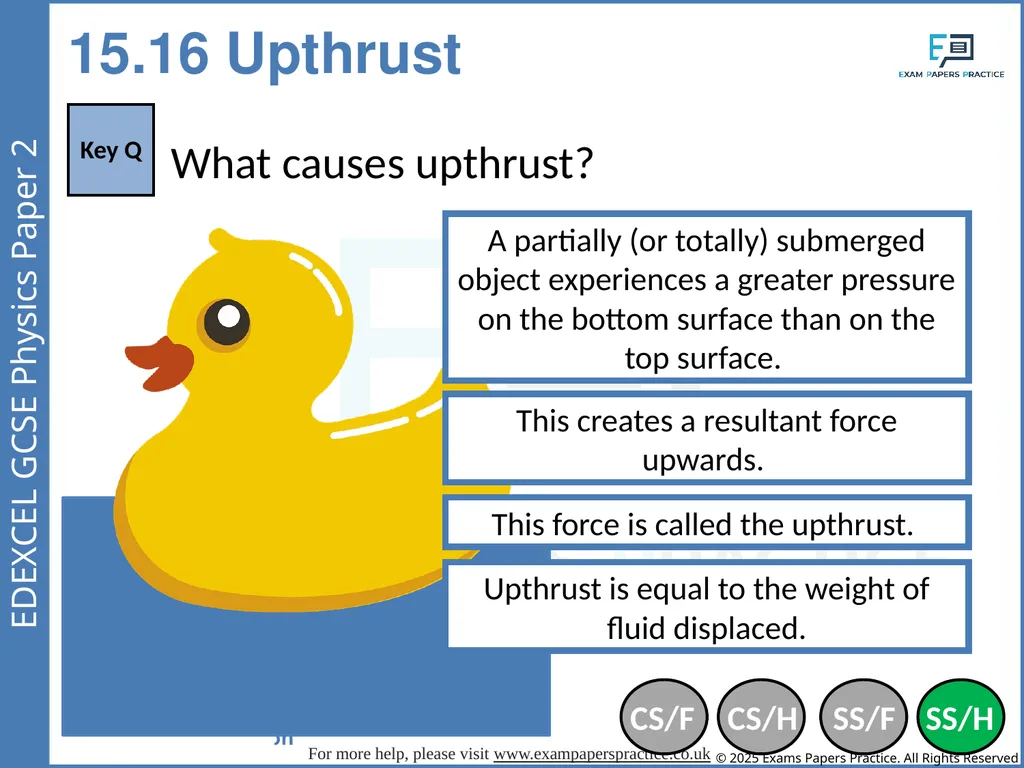
A partially (or totally) submerged object experiences a greater pressure on the bottom surface than on the top surface. This creates a resultant force upwards. This force is called the upthrust. What causes upthrust? 15.16 Upthrust Upthrust is equal to the weight of fluid displaced.<br>
33
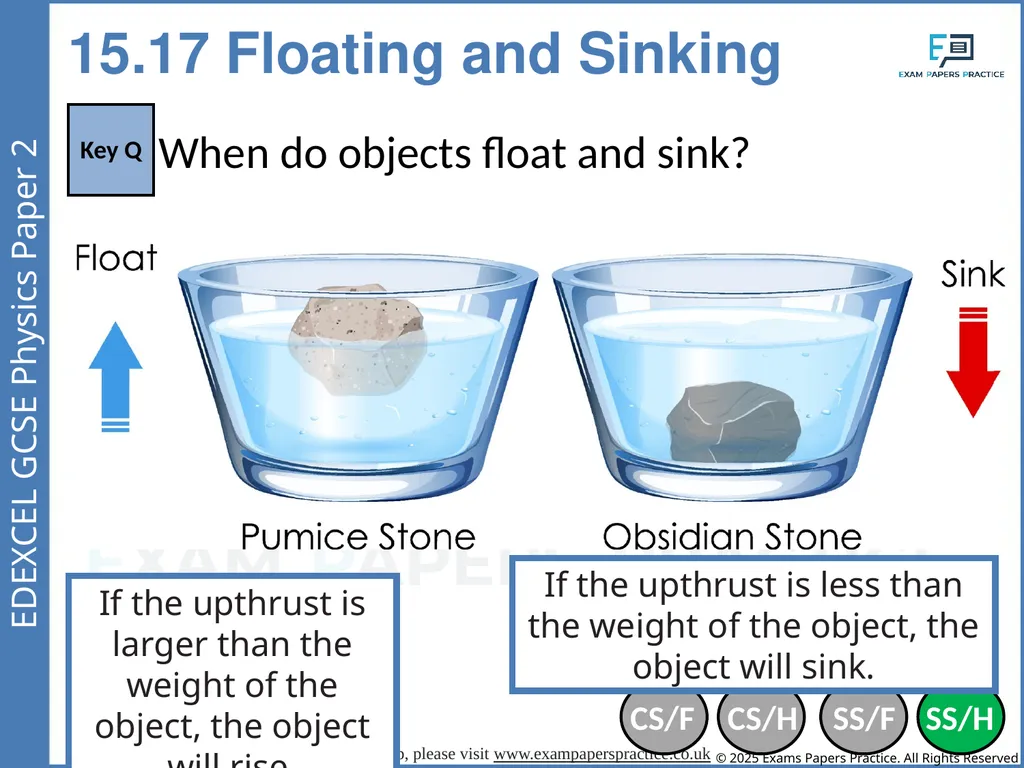
When do objects float and sink? 15.17 Floating and Sinking If the upthrust is larger than the weight of the object, the object will rise. If the upthrust is less than the weight of the object, the object will sink.<br>