
Forgery and Alteration Forgery – First Step




Description: Forgery and Alteration Forgery First Step Ascertain whose name is forged: Maker of note Payee (indorser) Drawer Different rules apply based on identitystatus of person whose name is forged. Forged Makers Signature on Note Alleged maker
Related Topics
Download Presentation
"Forgery and Alteration Forgery – First Step" is the property of its rightful owner. Permission is granted to download and print the materials on this website for personal, non-commercial use only, and to display it on your personal computer provided you do not modify the materials and that you retain all copyright notices contained in the materials. By downloading content from our website, you accept the terms of this agreement.
Presentation Transcript
slide1. Forgery and Alteration<br>
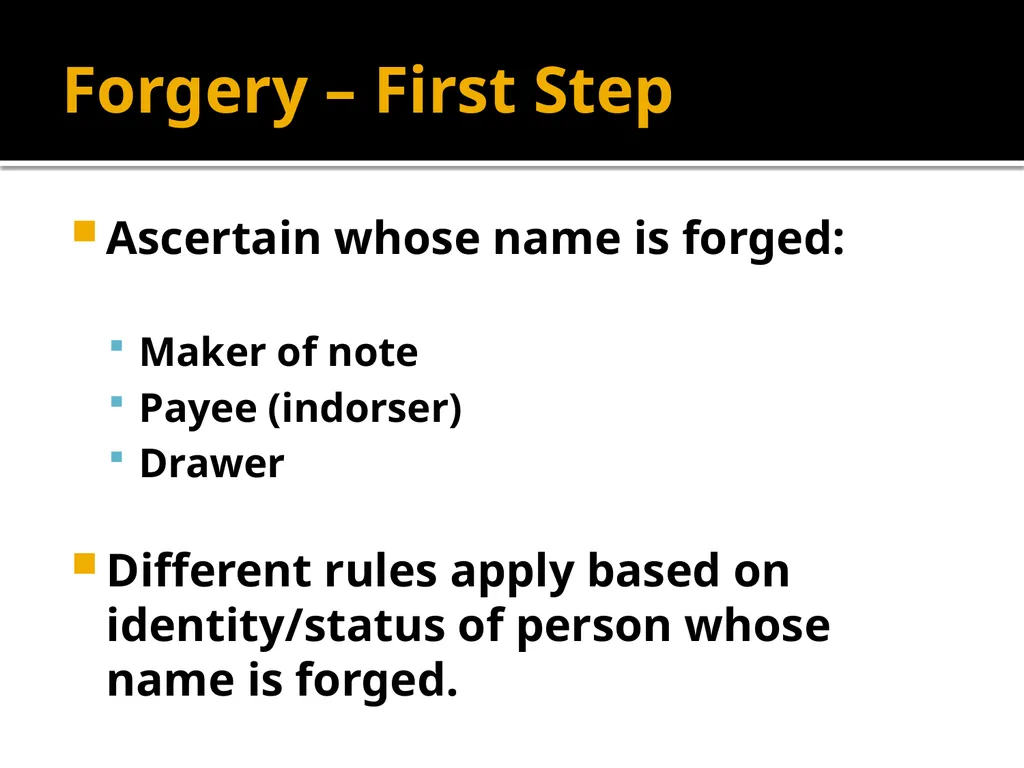
slide2. Forgery – First Step Ascertain whose name is forged:
Maker of note
Payee (indorser)
Drawer
Different rules apply based on identity/status of person whose name is forged.<br>
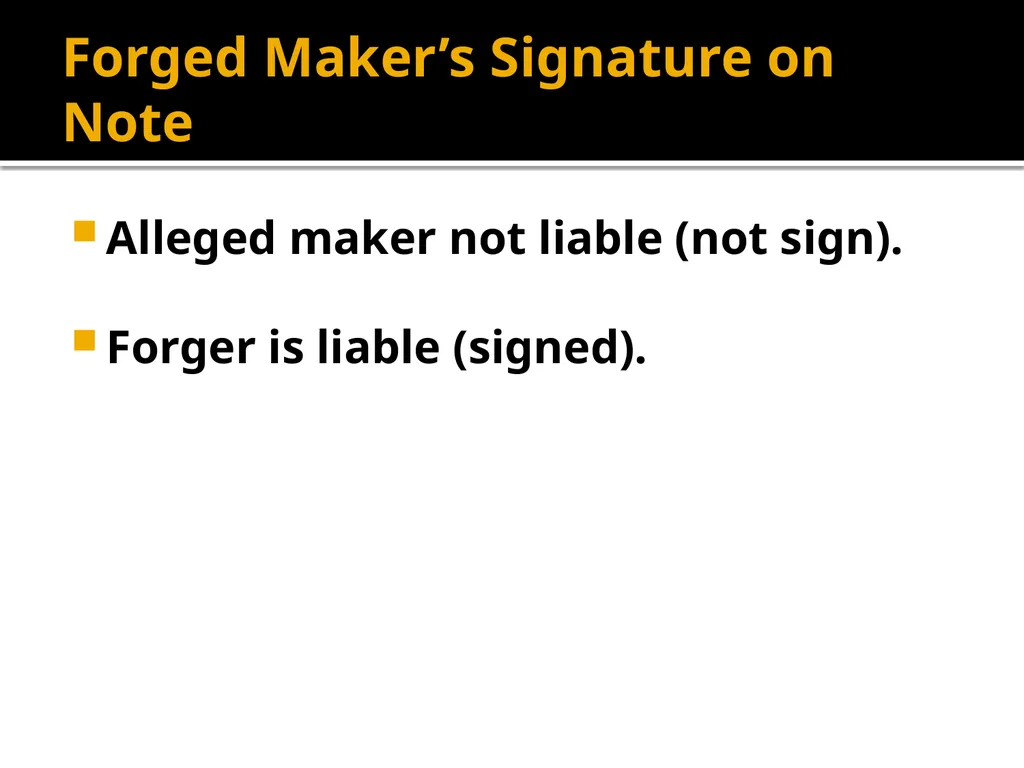
slide3. Forged Maker’s Signature on Note Alleged maker not liable (not sign).
Forger is liable (signed).<br>
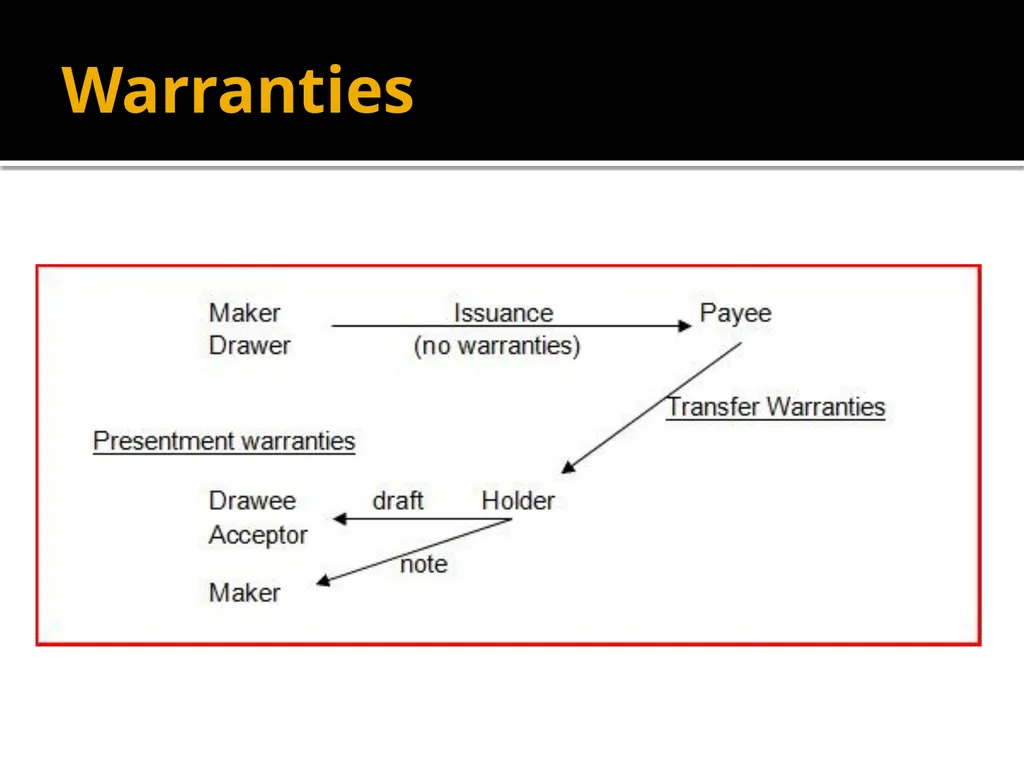
slide4. Warranties<br>
slide5. Warranties Implied – arise automatically.<br>
slide6. Warranties Implied – arise automatically.
Off-instrument liability so possession of the instrument is NOT necessary to recover.<br>
slide7. Warranties Implied – arise automatically.
Off-instrument liability so possession of the instrument is NOT necessary to recover.
Goal is to get money back that was improperly paid previously.<br>
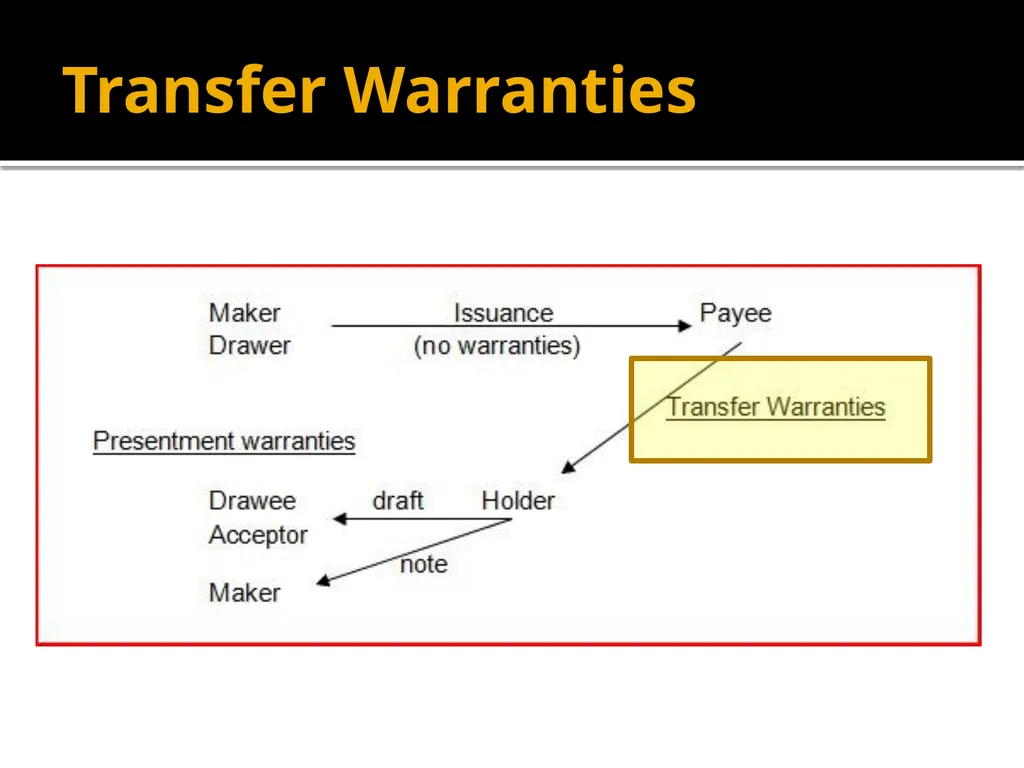
slide8. Transfer Warranties<br>
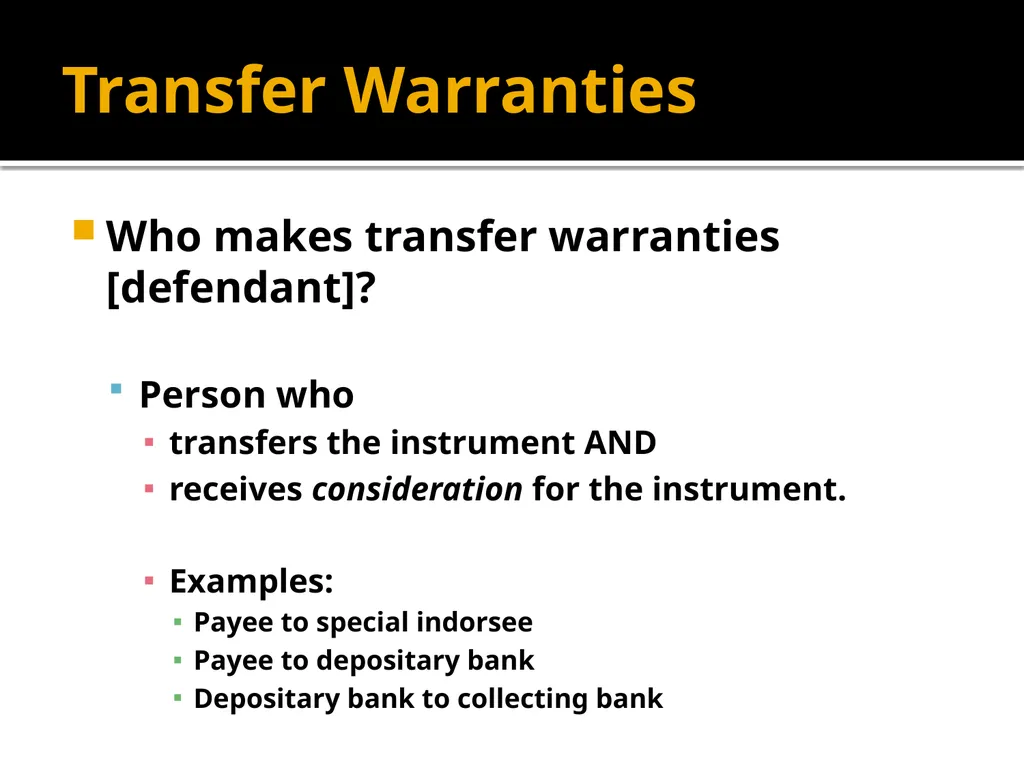
slide9. Transfer Warranties Who makes transfer warranties [defendant]?
Person who
transfers the instrument AND
receives consideration for the instrument.
Examples:
Payee to special indorsee
Payee to depositary bank
Depositary bank to collecting bank<br>
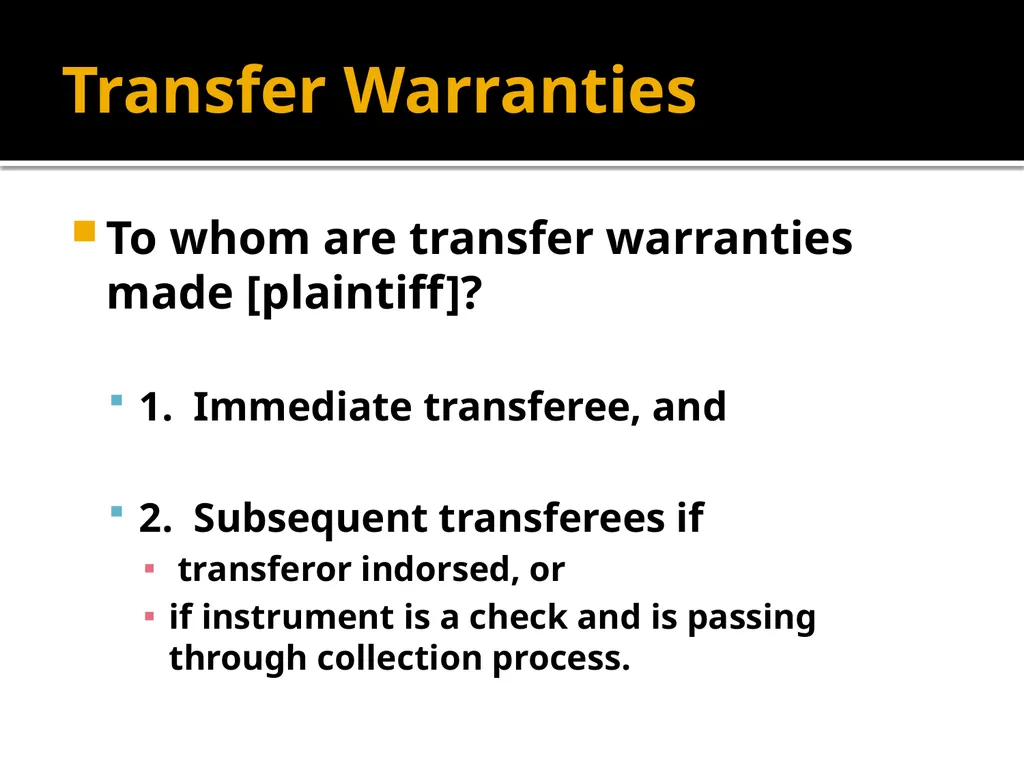
slide10. Transfer Warranties To whom are transfer warranties made [plaintiff]?
1. Immediate transferee, and
2. Subsequent transferees if
transferor indorsed, or
if instrument is a check and is passing through collection process.<br>
slide11. Transfer Warranties 1. Transferor was entitled to enforce at time of transfer.
Basically, a warranty of holder status (good title).<br>
slide12. Transfer Warranties 2. All signatures authentic and authorized.
Even if not needed for chain of title.<br>
slide13. Transfer Warranties 3. The instrument has not been altered.<br>
slide14. Transfer Warranties 4. No defense would defeat the transferor’s ability to collect the money
A “perfect plaintiff” warranty.<br>
slide15. Transfer Warranties 5. Transferor has no knowledge of bankruptcy of maker, acceptor, or drawer
Only warranty where transferor’s knowledge is relevant.<br>
slide16. Transfer Warranties 6. If remotely created item, that alleged drawer authorized the item.<br>
slide17. Transfer Warranties Disclaiming warranties:
1. Check = transferor cannot disclaim
2. Notes and non-check drafts – transferor may disclaim with indorsement including phrase such as “without warranties”<br>
slide18. Transfer Warranties Requirements to recover:
Claimant must give notice to warrantor within 30 days of when claimant has reason to know of breach.
If late notice, only discharged for loss caused by delay (if any).
Statute of limitations = 3 years<br>
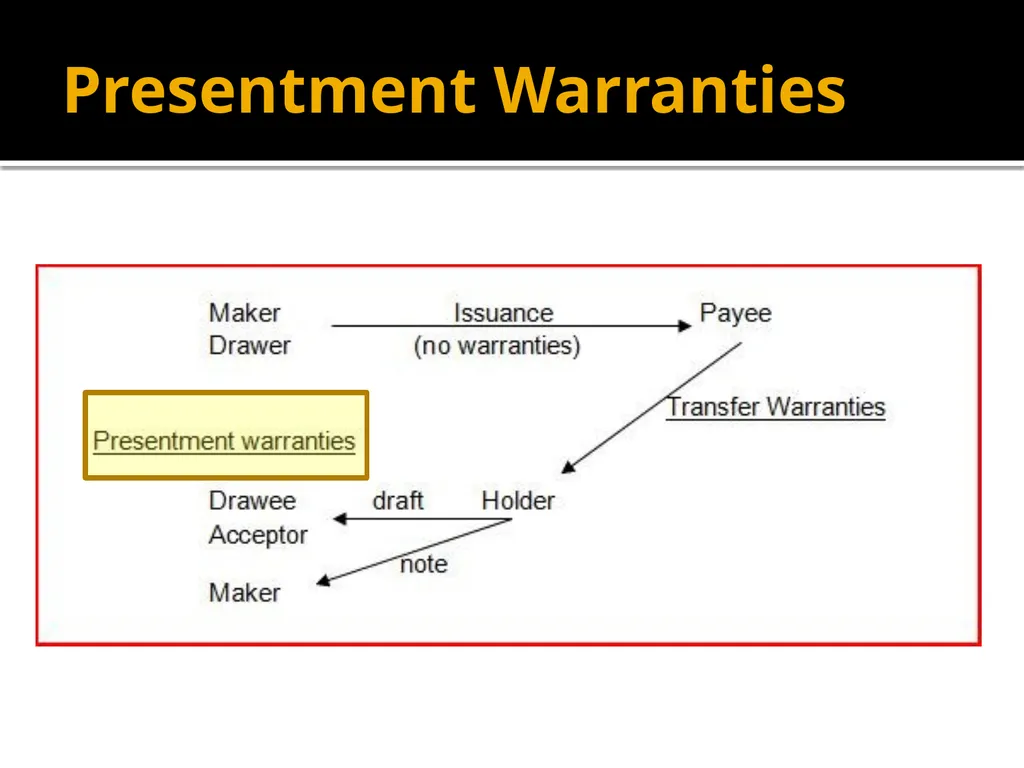
slide19. Presentment Warranties<br>
slide20. Presentment Warranties Who makes presentment warranties [the defendant]?
1. Person who presents the instrument for payment to drawee, maker, or acceptor, and
2. All previous transferors of the instrument.<br>
slide21. Presentment Warranties To whom are presentment warranties made [plaintiff]?
1. Note = Maker
2. Draft = Drawee or acceptor<br>
slide22. Presentment Warranties Transfer and Presentment warranties are mutually exclusive:
A plaintiff can sue on only one (if any) warranty.
But, a defendant could make both warranties, but to different people.<br>
slide23. Presentment Warranties – unaccepted draft (check) 1. Presenter (and prior transferors) were entitled to enforce at the time of presentment (or transfer).
A warranty of holder status (good title).<br>
slide24. Presentment Warranties – unaccepted draft (check) 2. No alteration.<br>
slide25. Presentment Warranties – unaccepted draft (check) 3. No knowledge that drawer’s signature was unauthorized.
This is NOT a warranty that the drawer’s signature is good (not forged); just a warranty of no knowledge.<br>
slide26. Presentment Warranties – unaccepted draft (check) 4. If remotely created item, that alleged drawer authorized the item.<br>
slide27. Presentment Warranties -- Note Presenter (and prior transferors) were entitled to enforce at the time of presentment (or transfer).
A warranty of holder status (good title).
A maker should know if maker’s name is a forgery or if amount altered.<br>
slide28. Presentment Warranties Disclaiming warranties:
1. Check = cannot disclaim
2. Notes and non-check drafts = may disclaim<br>
slide29. Forged Indorsement<br>
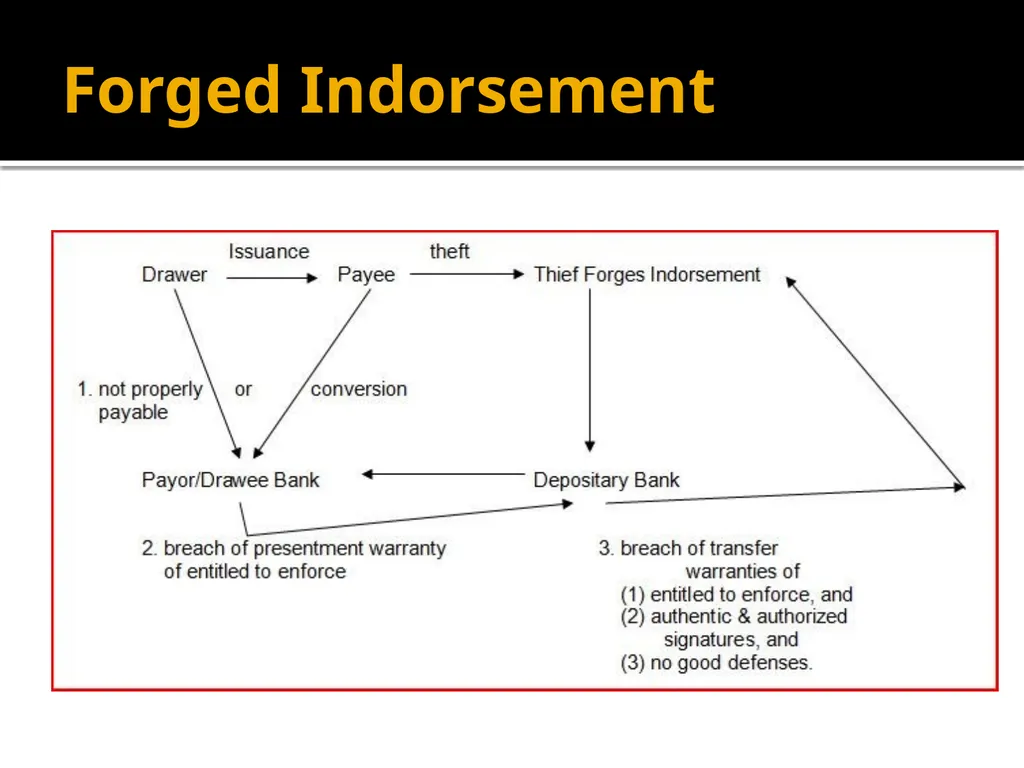
slide30. Forged Indorsement – Liability of payee (indorser) if no defenses Payee whose name was forged is not liable as did not sign.<br>
slide31. Forged Indorsement – Liability of Drawee Bank if no defenses Conversion liability to the payee,
or
Not properly payable liability to the drawer.<br>
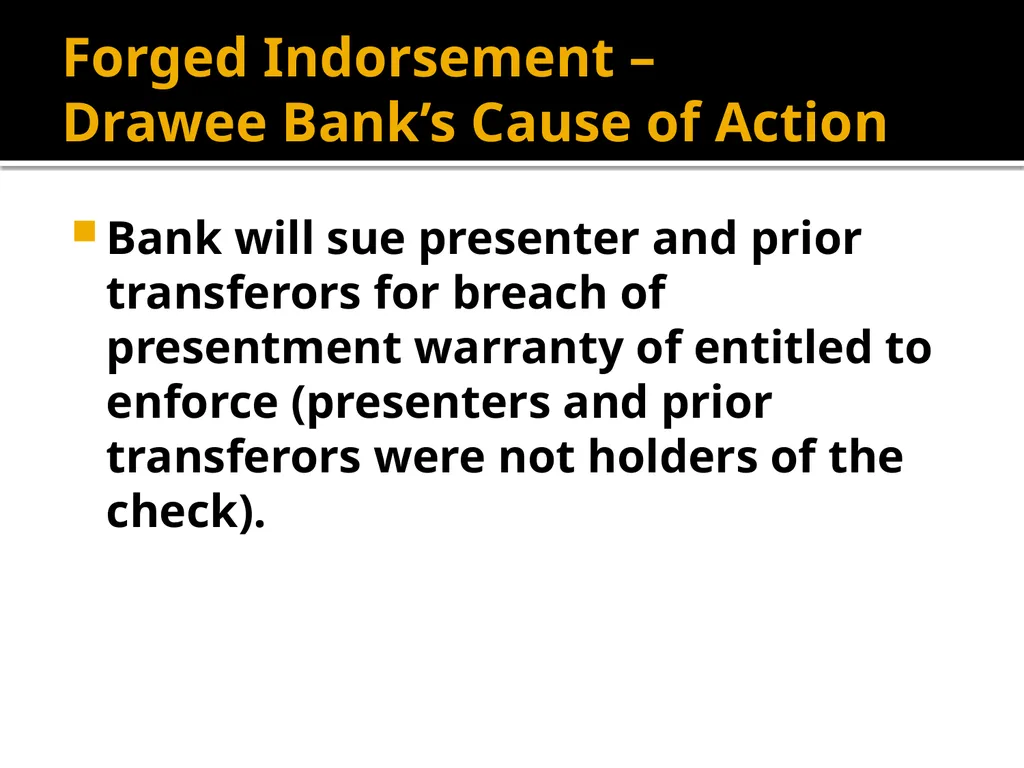
slide32. Forged Indorsement – Drawee Bank’s Cause of Action Bank will sue presenter and prior transferors for breach of presentment warranty of entitled to enforce (presenters and prior transferors were not holders of the check).<br>
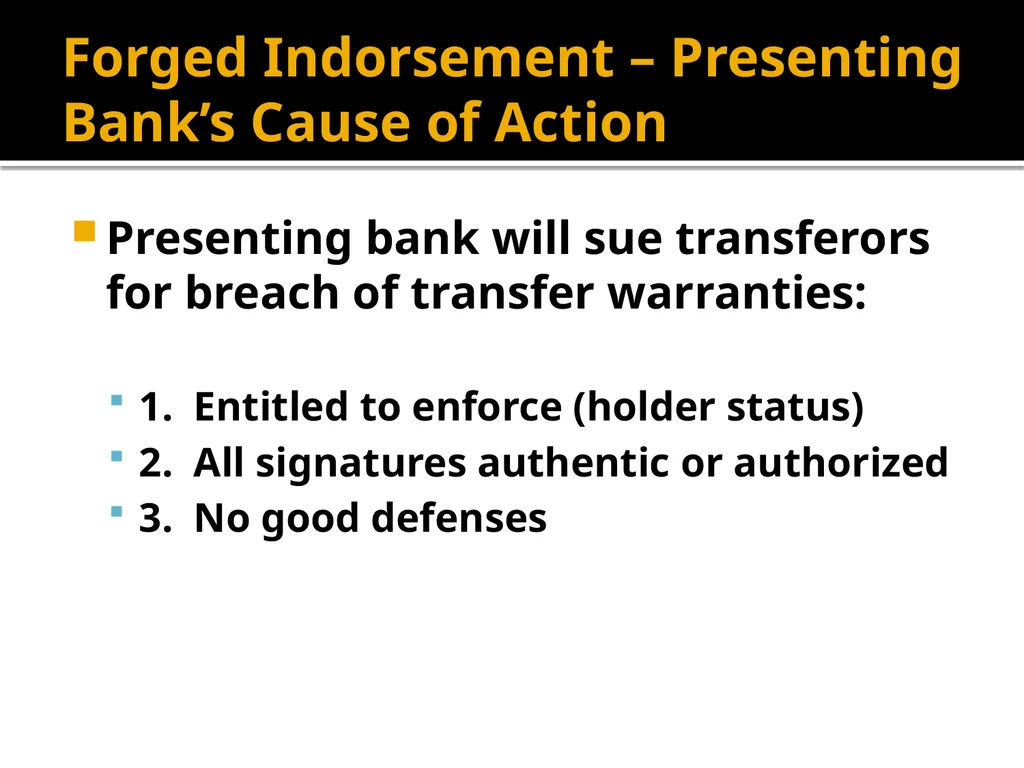
slide33. Forged Indorsement – Presenting Bank’s Cause of Action Presenting bank will sue transferors for breach of transfer warranties:
1. Entitled to enforce (holder status)
2. All signatures authentic or authorized
3. No good defenses<br>
slide34. Forged Indorsement Problems Problem 185 – p. 554
Problem 186 – p. 186<br>
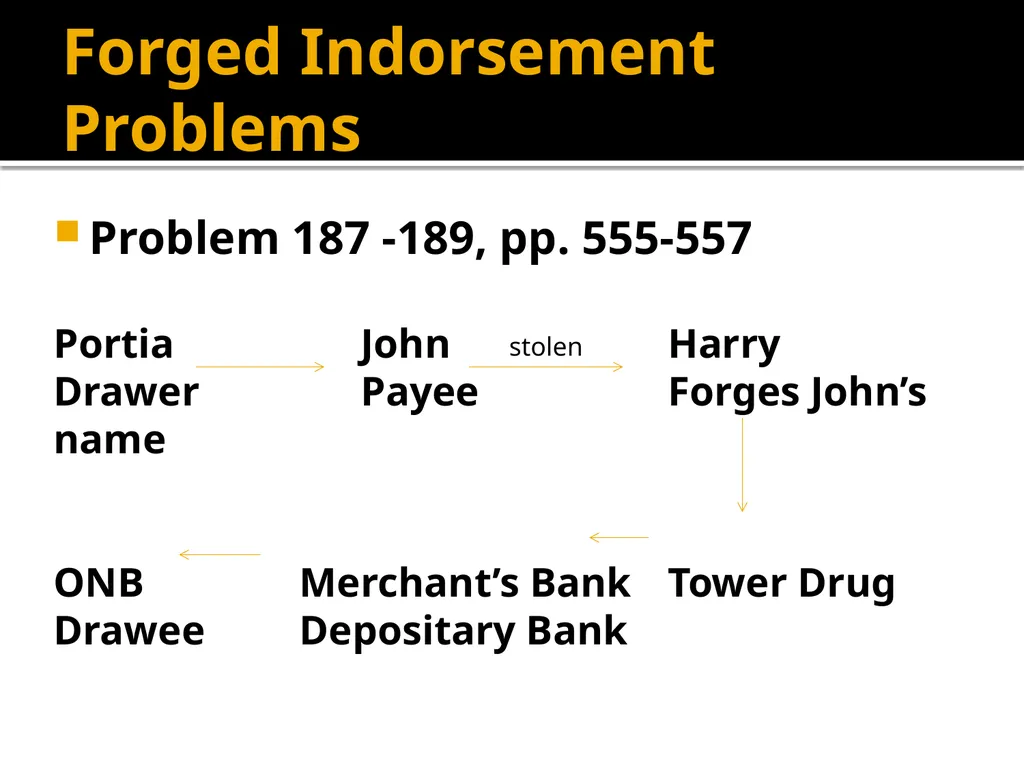
slide35. Forged Indorsement Problems Problem 187 -189, pp. 555-557
Portia John Harry
Drawer Payee Forges John’s name
ONB Merchant’s Bank Tower Drug
Drawee Depositary Bank stolen<br>
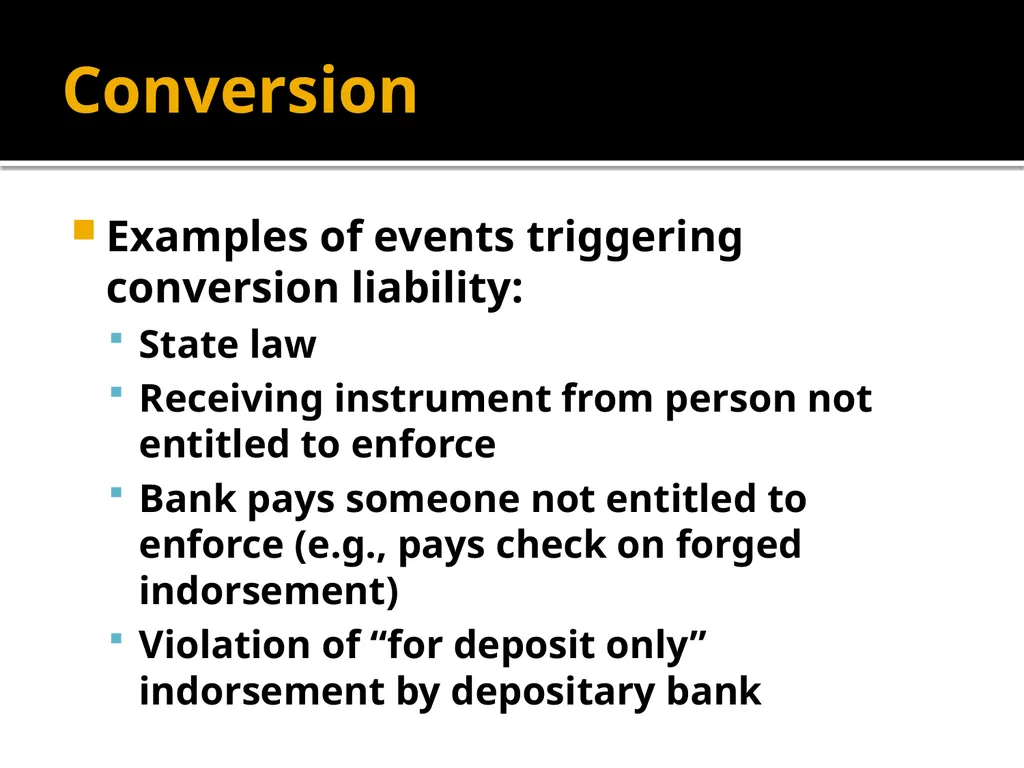
slide36. Conversion Examples of events triggering conversion liability:
State law
Receiving instrument from person not entitled to enforce
Bank pays someone not entitled to enforce (e.g., pays check on forged indorsement)
Violation of “for deposit only” indorsement by depositary bank<br>
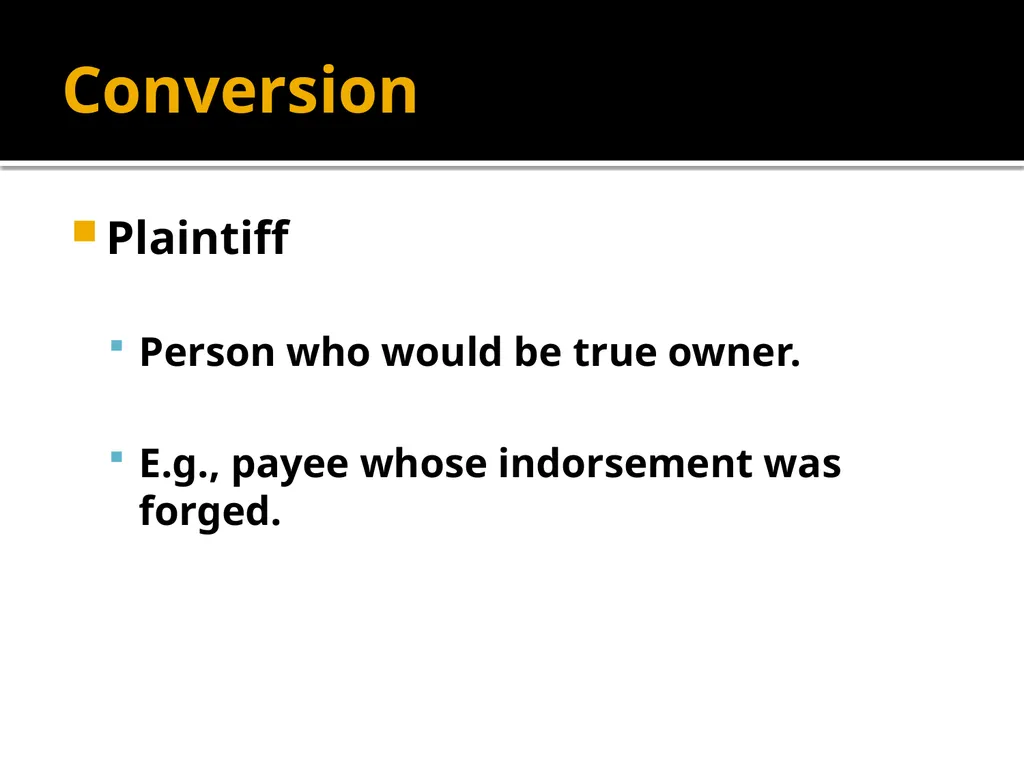
slide37. Conversion Plaintiff
Person who would be true owner.
E.g., payee whose indorsement was forged.<br>
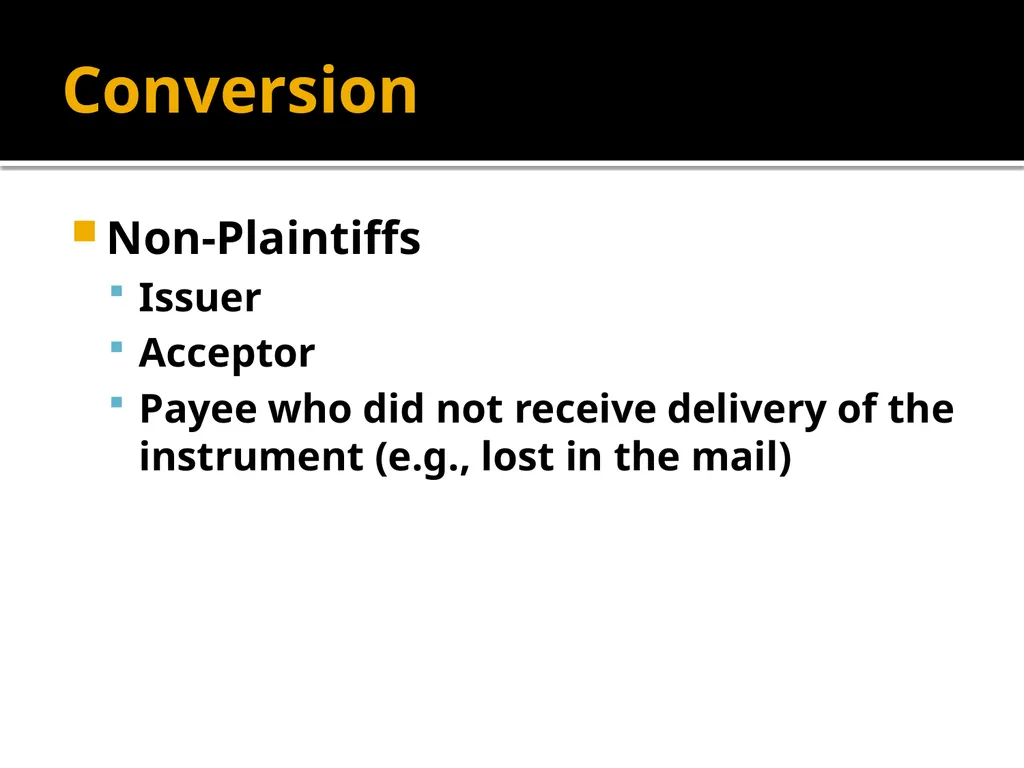
slide38. Conversion Non-Plaintiffs
Issuer
Acceptor
Payee who did not receive delivery of the instrument (e.g., lost in the mail)<br>
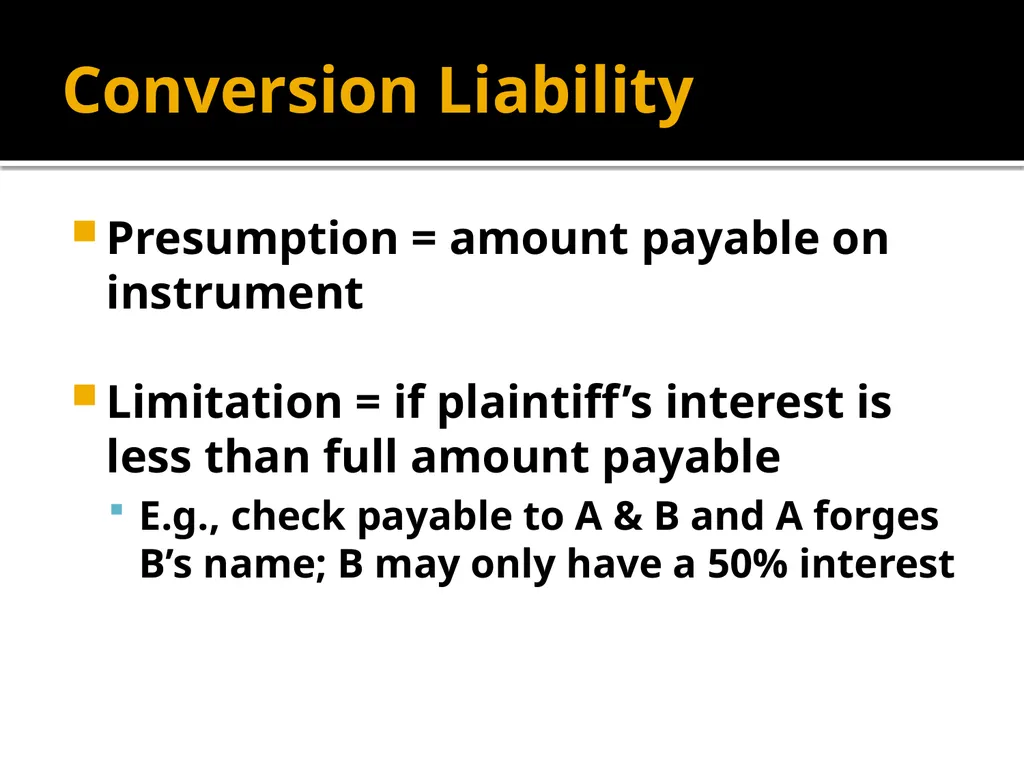
slide39. Conversion Liability Presumption = amount payable on instrument
Limitation = if plaintiff’s interest is less than full amount payable
E.g., check payable to A & B and A forges B’s name; B may only have a 50% interest<br>
slide40. Conversion Liability Problems:
Problem 190 – p. 558
Problem 191 – p. 558
Problem 192 – p. 560
Problem 193 – p. 560
Problem 194 – p. 564<br>
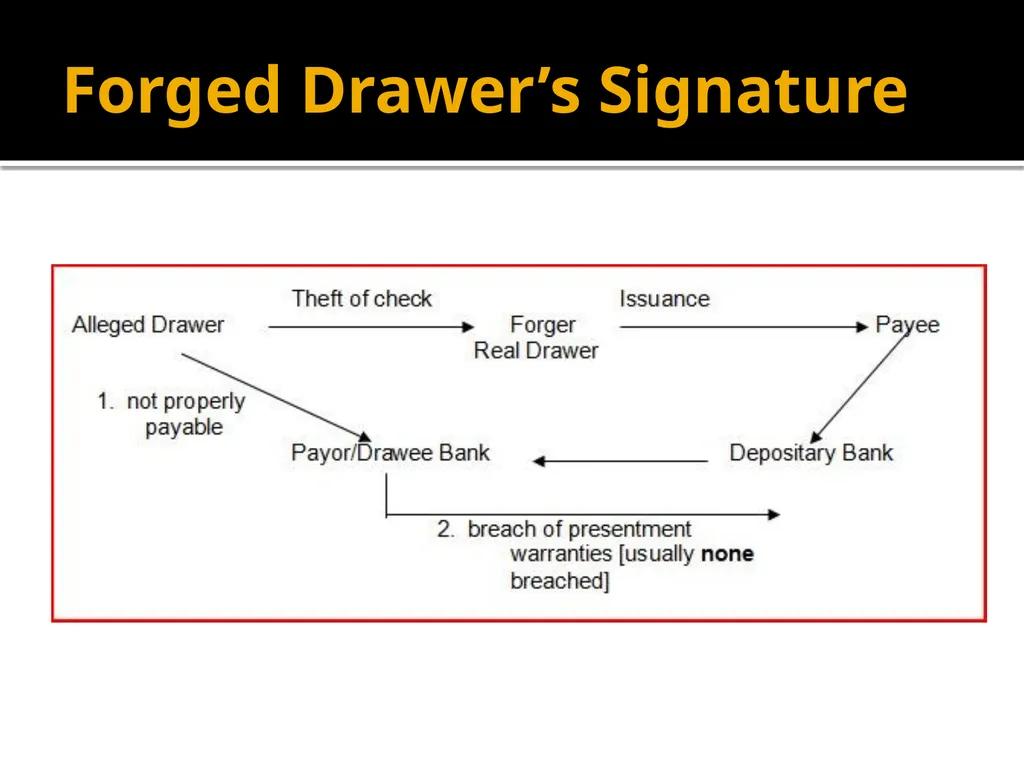
slide41. Forged Drawer’s Signature<br>
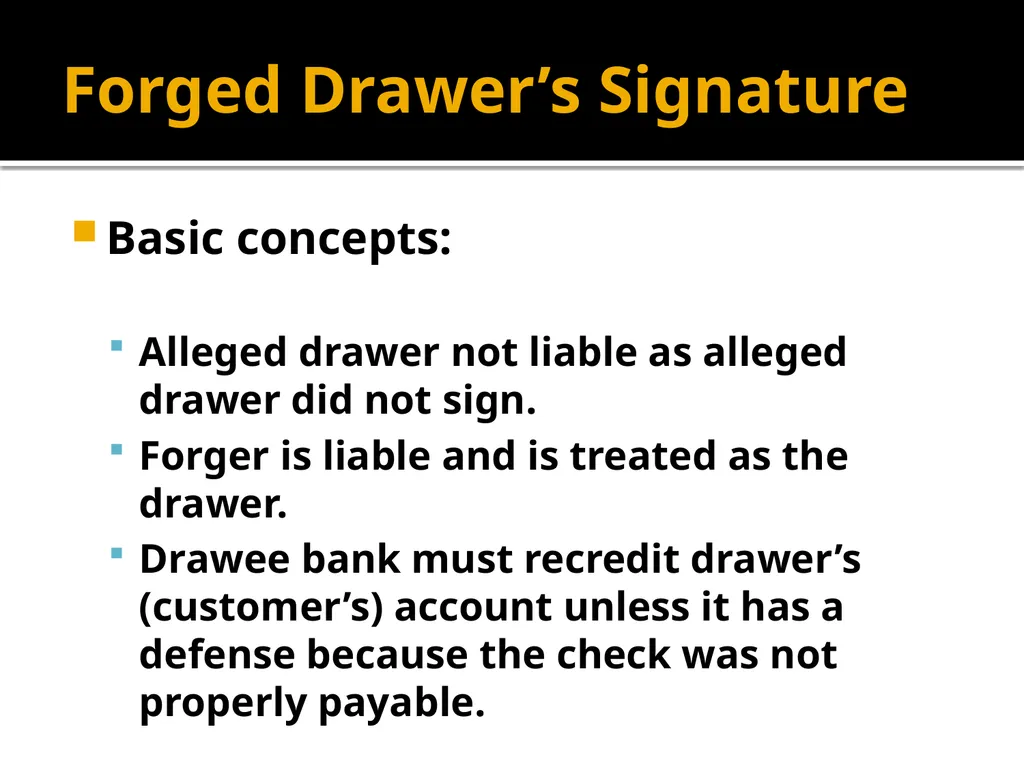
slide42. Forged Drawer’s Signature Basic concepts:
Alleged drawer not liable as alleged drawer did not sign.
Forger is liable and is treated as the drawer.
Drawee bank must recredit drawer’s (customer’s) account unless it has a defense because the check was not properly payable.<br>
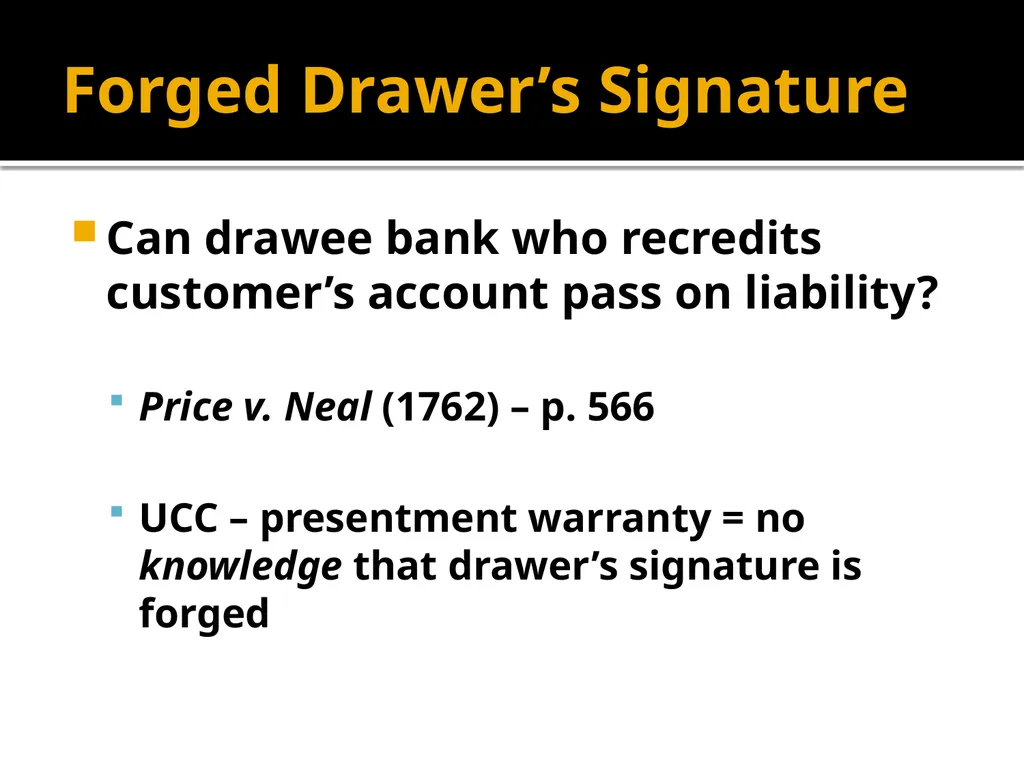
slide43. Forged Drawer’s Signature Can drawee bank who recredits customer’s account pass on liability?
Price v. Neal (1762) – p. 566
UCC – presentment warranty = no knowledge that drawer’s signature is forged<br>
slide44. Forged Drawer’s Signature Problem 195 – p. 572
Problem 196 – p. 576
Problem 197 – p. 576<br>
slide45. Forgery Validation 1. Ratification Party estopped from denying validity of a signature if:
With full knowledge of the forgery (or alteration),
Accepts the benefits thereof or actively assents to the wrongful activity.
Problem 198 – p. 579<br>
slide46. Forgery Validation 2. No Damages Problem 199 – p. 584<br>
slide47. Forgery Validation Review 1. Ratification
2. No Damages<br>
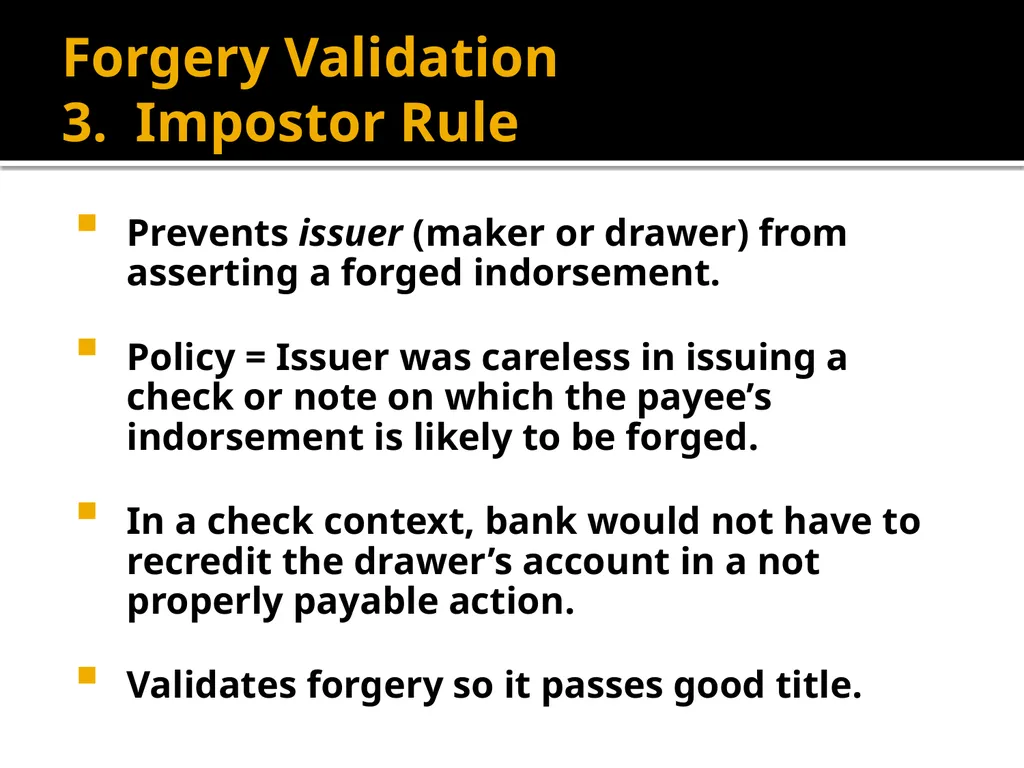
slide48. Forgery Validation 3. Impostor Rule Prevents issuer (maker or drawer) from asserting a forged indorsement.
Policy = Issuer was careless in issuing a check or note on which the payee’s indorsement is likely to be forged.
In a check context, bank would not have to recredit the drawer’s account in a not properly payable action.
Validates forgery so it passes good title.<br>
slide49. Forgery Validation 3. Impostor Rule 1. Impersonation of payee
Problem 200 – p. 585
Problem 201 – p. 586<br>
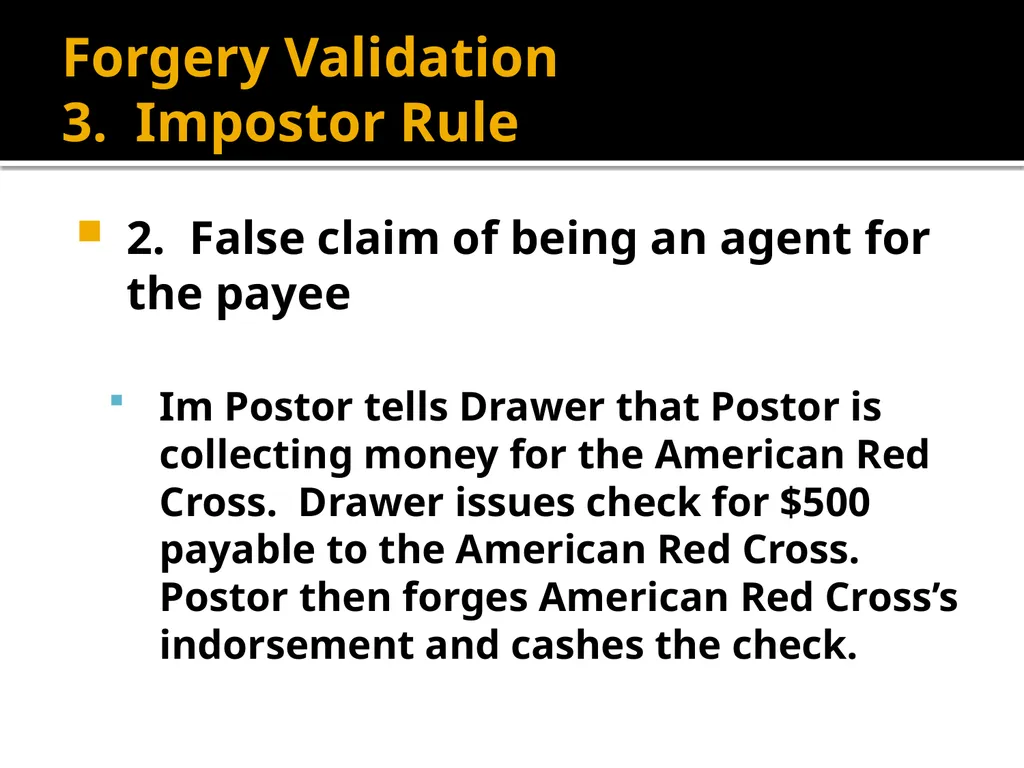
slide50. Forgery Validation 3. Impostor Rule 2. False claim of being an agent for the payee
Im Postor tells Drawer that Postor is collecting money for the American Red Cross. Drawer issues check for $500 payable to the American Red Cross. Postor then forges American Red Cross’s indorsement and cashes the check.<br>
slide51. Forgery Validation 3. Impostor Rule 3. Non-interested Payee – Evil Signer
Issuer does not intend the named payee to have an interest in the instrument.
Problem 202 – p. 586<br>
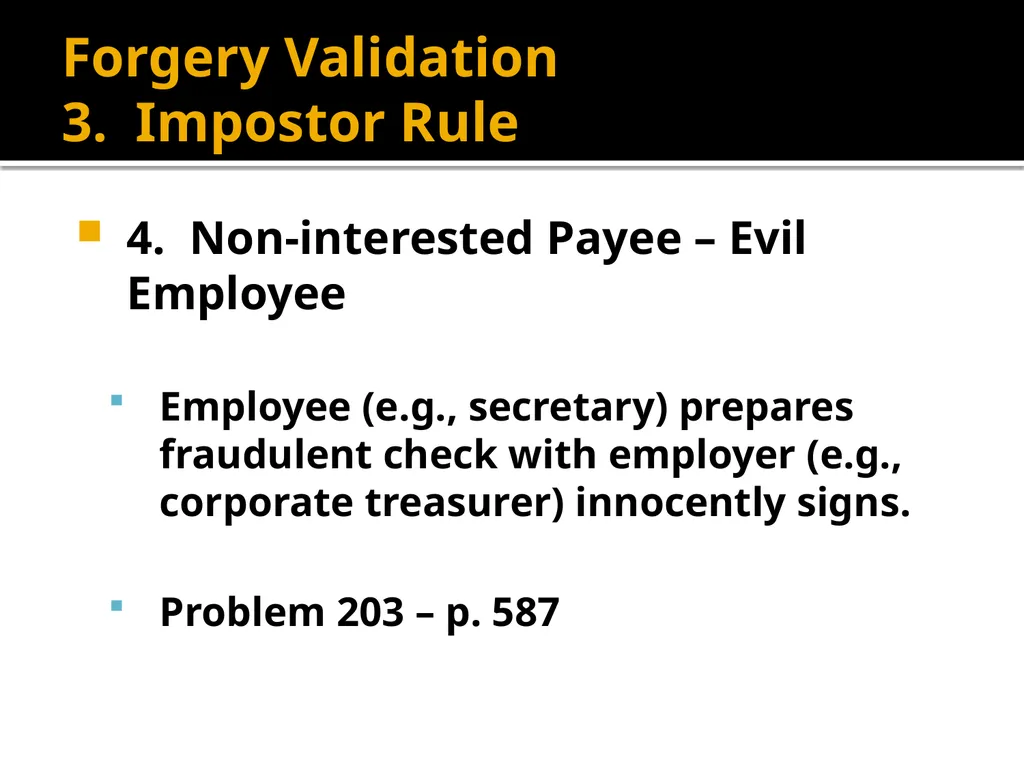
slide52. Forgery Validation 3. Impostor Rule 4. Non-interested Payee – Evil Employee
Employee (e.g., secretary) prepares fraudulent check with employer (e.g., corporate treasurer) innocently signs.
Problem 203 – p. 587<br>
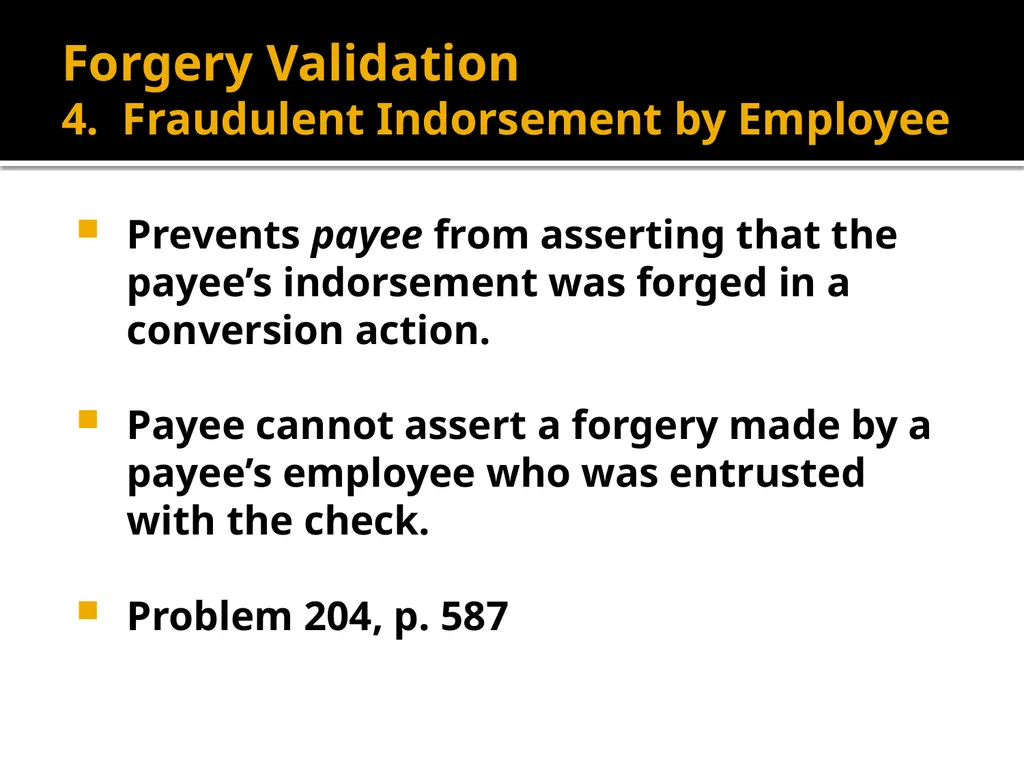
slide53. Forgery Validation 4. Fraudulent Indorsement by Employee Prevents payee from asserting that the payee’s indorsement was forged in a conversion action.
Payee cannot assert a forgery made by a payee’s employee who was entrusted with the check.
Problem 204, p. 587<br>
slide54. Forgery Validation The “double forgery” situation Problem 205 – p. 588<br>
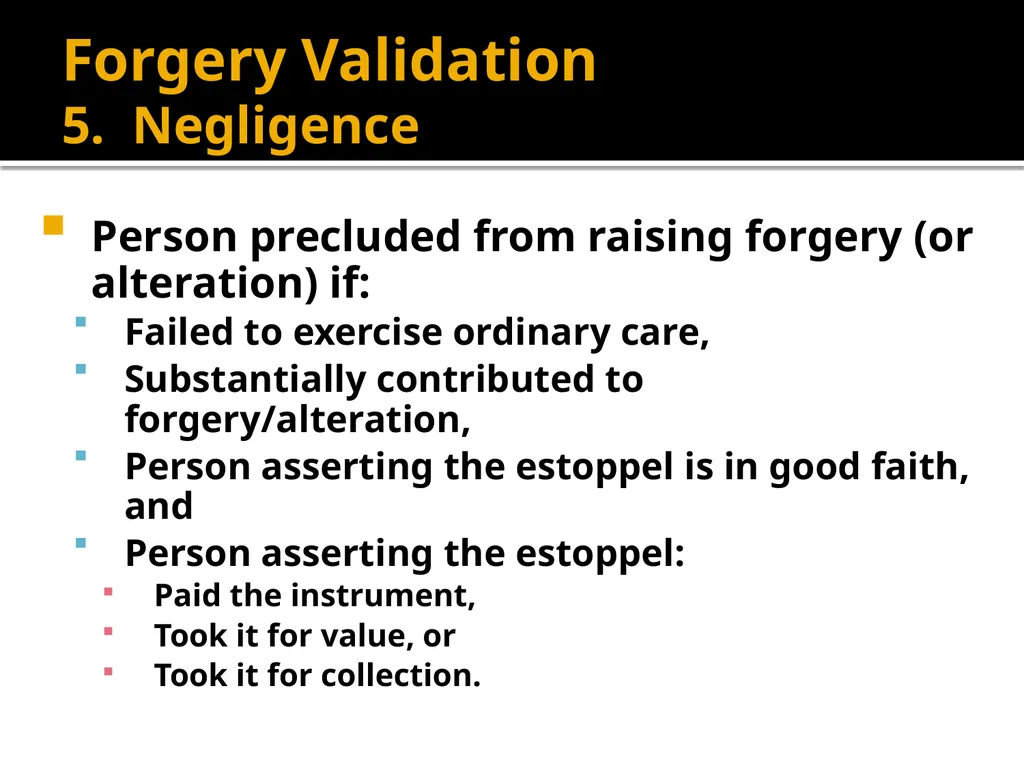
slide55. Forgery Validation 5. Negligence Person precluded from raising forgery (or alteration) if:
Failed to exercise ordinary care,
Substantially contributed to forgery/alteration,
Person asserting the estoppel is in good faith, and
Person asserting the estoppel:
Paid the instrument,
Took it for value, or
Took it for collection.<br>
slide56. Forgery Validation 5. Negligence Fact question so no bright-line rule as to what constitutes negligence.
Damages are computed on a comparative negligence basis.
Burden of proof is on the person asserting the negligence.<br>
slide57. Forgery Validation 5. Negligence Problem 206 – p. 589
Problem 207 – p. 589
Problem 208 – p. 596
Problem 209 – p. 596
Problem 210 – p. 603<br>
slide58. Forgery Validation 6. Bank Statement Rule Bank has no duty to provide a bank statement but if bank does:
Must follow Code’s specifications, and
May gain defense to customer’s not properly payable claims.<br>
slide59. Forgery Validation 6. Bank Statement Rule Duty if bank provides statement:
Return checks, or
Provide sufficient information about checks:
Check number,
Amount, and
Date of payment.<br>
slide60. Forgery Validation 6. Bank Statement Rule Duties if bank does not return checks:
Retain checks, or
Destroy checks retaining ability to furnish legible copies for seven years.
Provide customer with check or copy within reasonable time of customer’s request (two free per statement).<br>
slide61. Forgery Validation 6. Bank Statement Rule Customer’s Duties:
Inspect statement and items for:
Unauthorized customer’s signature, and
Alterations.
Report promptly to bank.<br>
slide62. Forgery Validation 6. Bank Statement Rule Ramifications of tardy reporting:
Customer is precluded from asserting the forgery or alteration in a not properly payable action.
But, Bank must prove it suffered a loss by reason of the delay to trigger the preclusion.
Problem 211 – p. 604<br>
slide63. Forgery Validation 6. Bank Statement Rule Repeat Offender Rule:
If same wrongdoer forged or altered checks, customer precluded from asserting later forgeries/alterations if not report within 30 days of bank statement.<br>
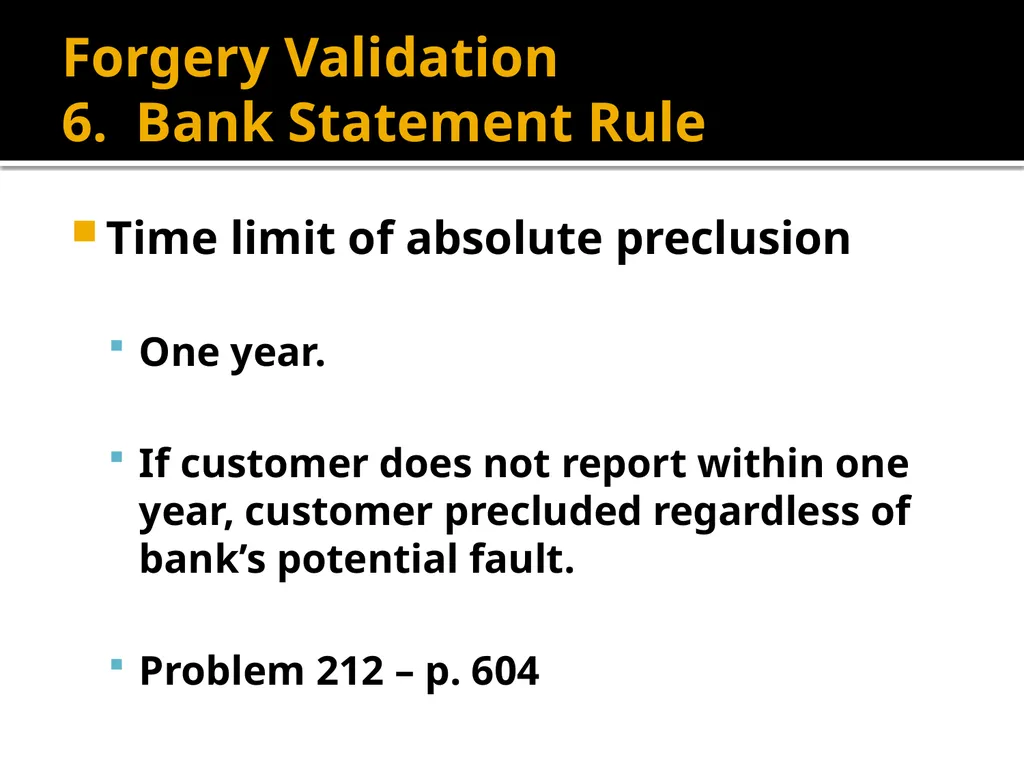
slide64. Forgery Validation 6. Bank Statement Rule Time limit of absolute preclusion
One year.
If customer does not report within one year, customer precluded regardless of bank’s potential fault.
Problem 212 – p. 604<br>
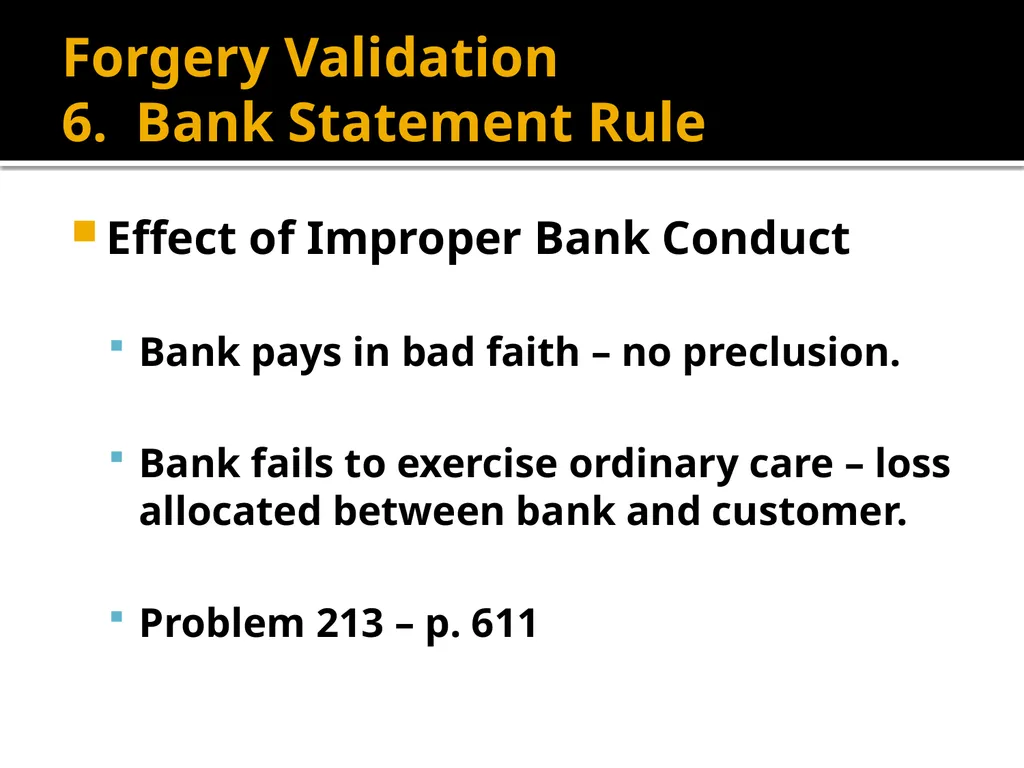
slide65. Forgery Validation 6. Bank Statement Rule Effect of Improper Bank Conduct
Bank pays in bad faith – no preclusion.
Bank fails to exercise ordinary care – loss allocated between bank and customer.
Problem 213 – p. 611<br>
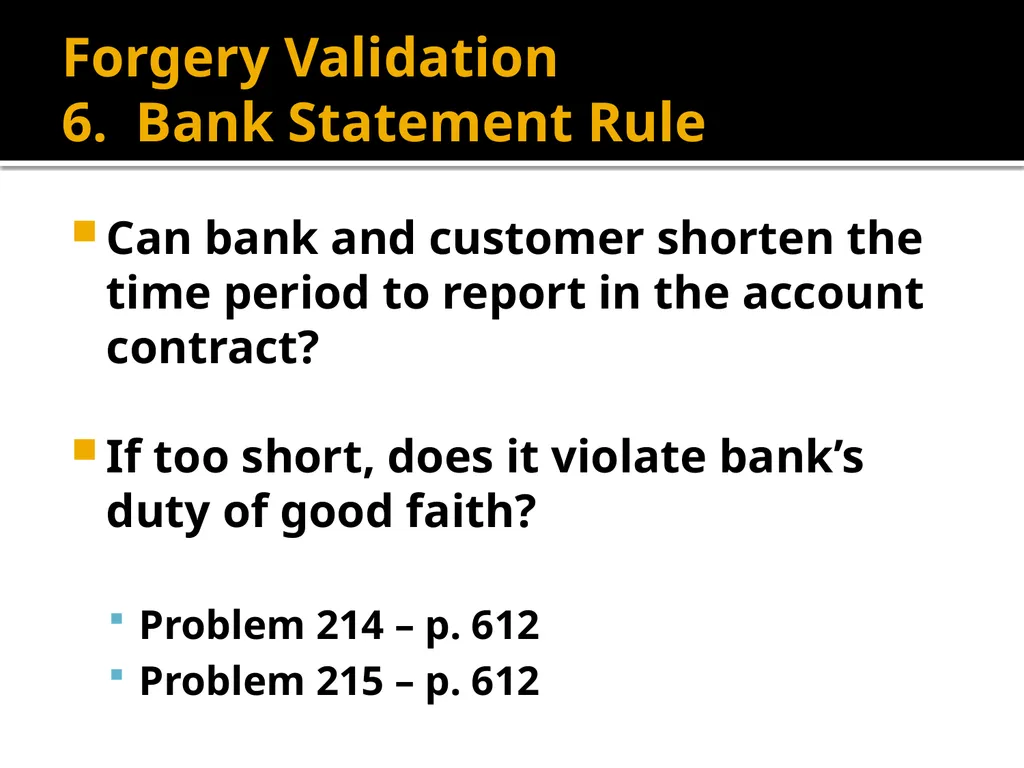
slide66. Forgery Validation 6. Bank Statement Rule Can bank and customer shorten the time period to report in the account contract?
If too short, does it violate bank’s duty of good faith?
Problem 214 – p. 612
Problem 215 – p. 612<br>
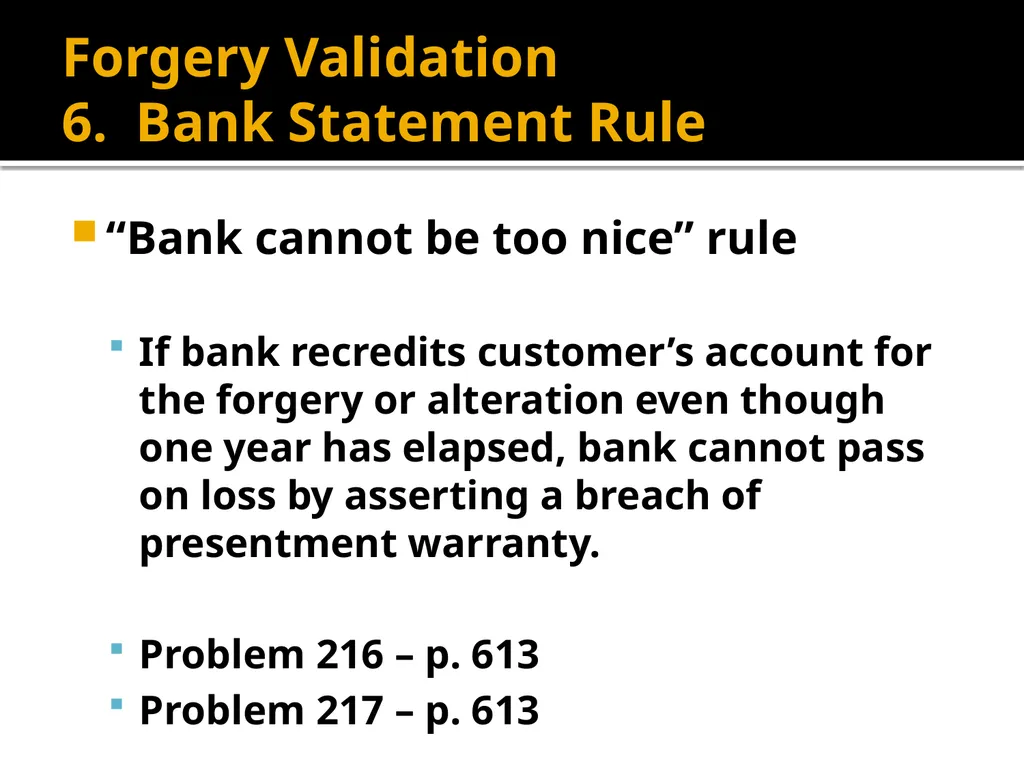
slide67. Forgery Validation 6. Bank Statement Rule “Bank cannot be too nice” rule
If bank recredits customer’s account for the forgery or alteration even though one year has elapsed, bank cannot pass on loss by asserting a breach of presentment warranty.
Problem 216 – p. 613
Problem 217 – p. 613<br>
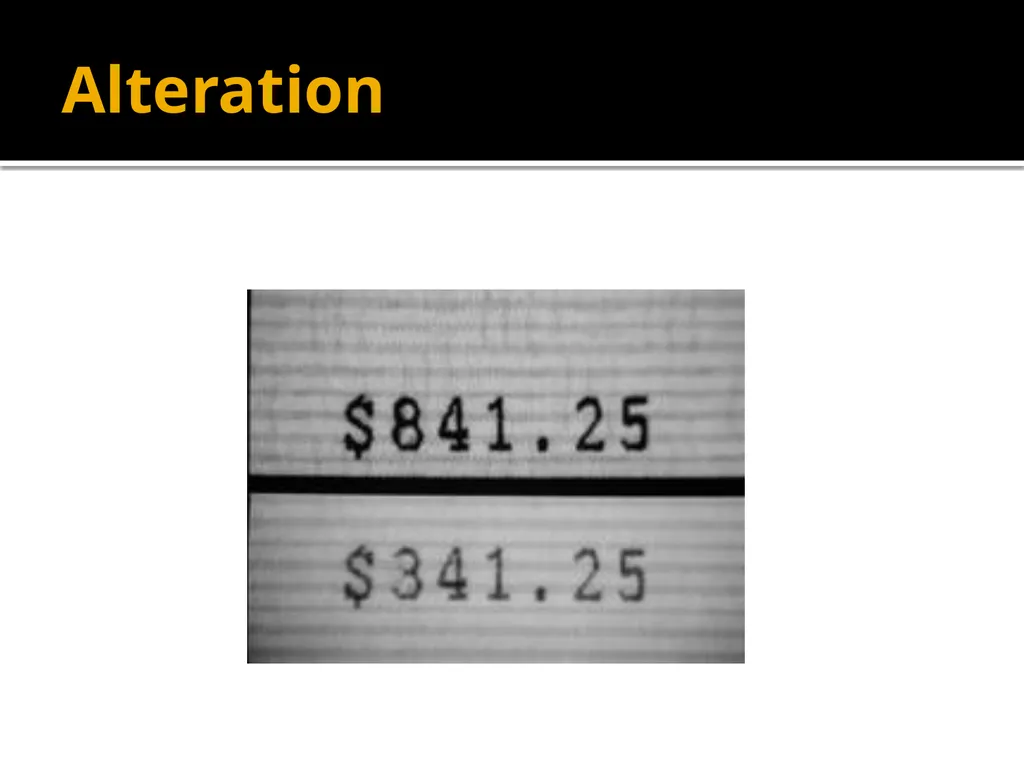
slide68. Alteration<br>
slide69. Alteration – a defense to payment Obligor (maker or drawer) does not want to pay because the instrument shows a different obligation from that which the obligor originally agreed.<br>
slide70. Alteration -- Types 1. Change in obligation
Amount changed: $10.00 to $10,000<br>
slide71. Alteration -- Types 1. Change in obligation
Date due changed: November 1, 2013 to November 1, 2011.<br>
slide72. Alteration -- Types 1. Change in obligation
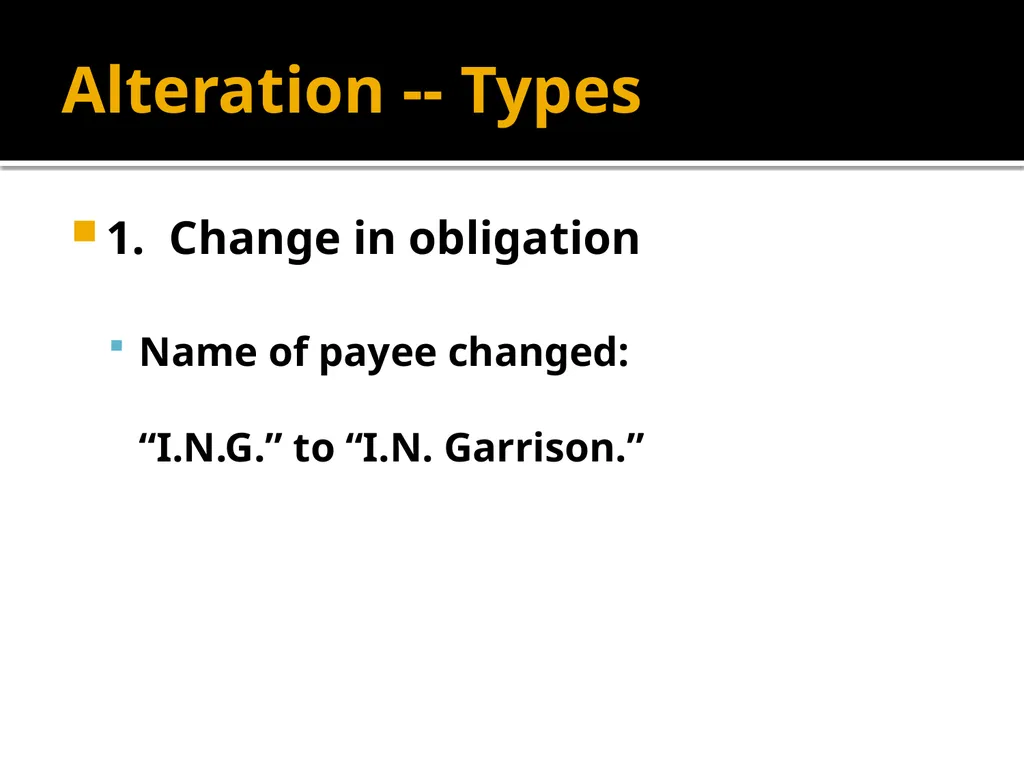
Name of payee changed: “I.N.G.” to “I.N. Garrison.”<br>
slide73. Alteration -- Types 1. Change in obligation
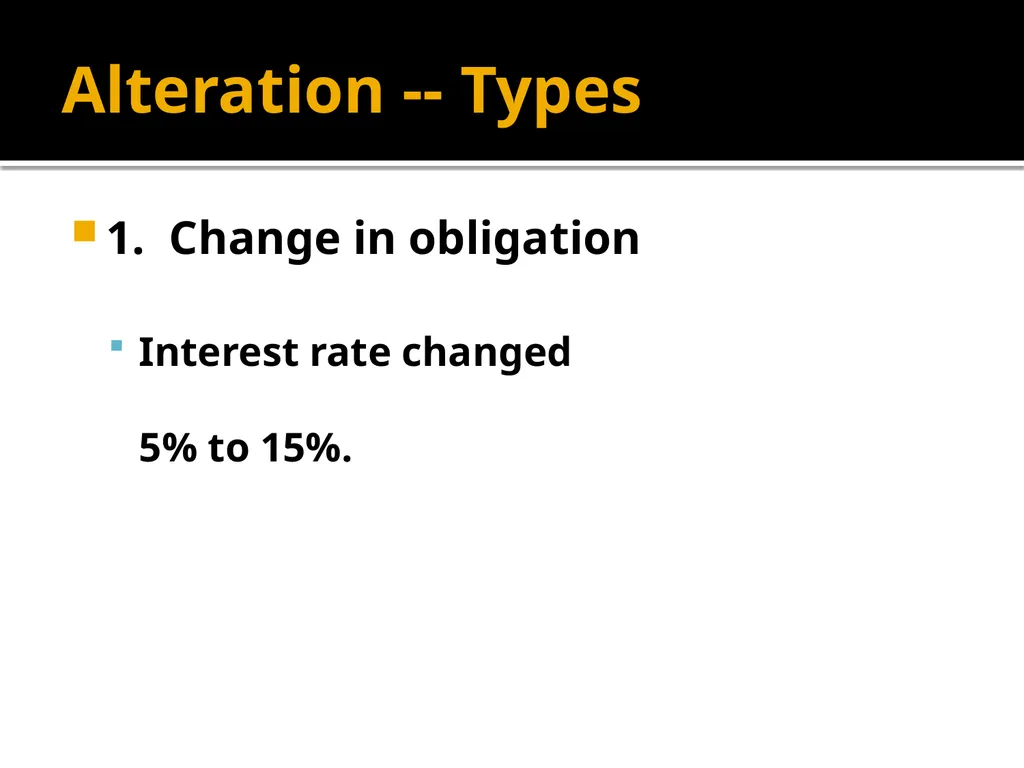
Interest rate changed 5% to 15%.<br>
slide74. Alteration -- Types 2. Unauthorized completion
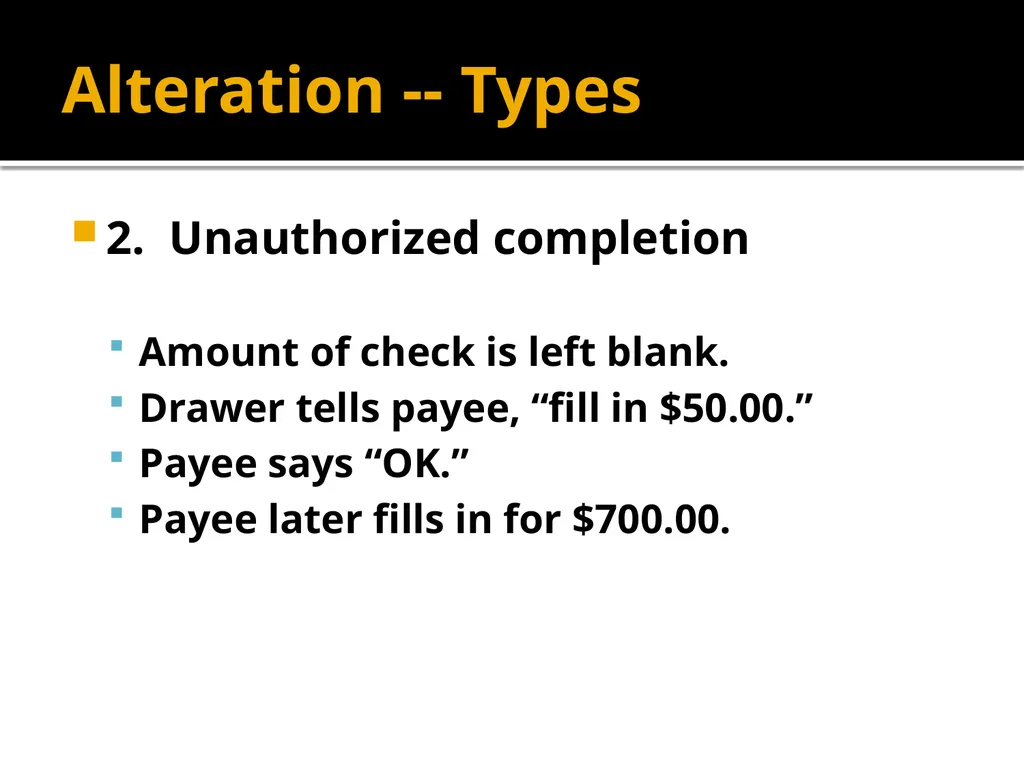
Amount of check is left blank.
Drawer tells payee, “fill in $50.00.”
Payee says “OK.”
Payee later fills in for $700.00.<br>
slide75. Alteration and Holders in Due Course 1. Change in obligation HDC can enforce for original amount.
Problem 221 – p. 615<br>
slide76. Alteration and Holders in Due Course 2. Unauthorized completion: HDC can enforce as completed –
Drawer signs check and says to Friend, “You can buy yourself a present with the check but no more than $100.”
Friend buys present from Payee (e.g., a store) costing $500 and writes check for $500.
Payee transfers check to HDC (Payee’s bank).
HDC can enforce for $500.<br>
slide77. Alteration and Non- Holders in Due Course 1. Fraudulently made by holder: Total discharge of obligor
Problem 218 – p. 614<br>
slide78. Alteration and Non- Holders in Due Course 2. Not fraudulently made by holder: no effect on obligation
On January 2, 2012, Drawer signs check for $100 payable to Payee and writes the date as “January 2, 2011.”
Payee changes the date to “January 1, 2012.”
Payee may still enforce for $100.
Problem 220, p. 615<br>
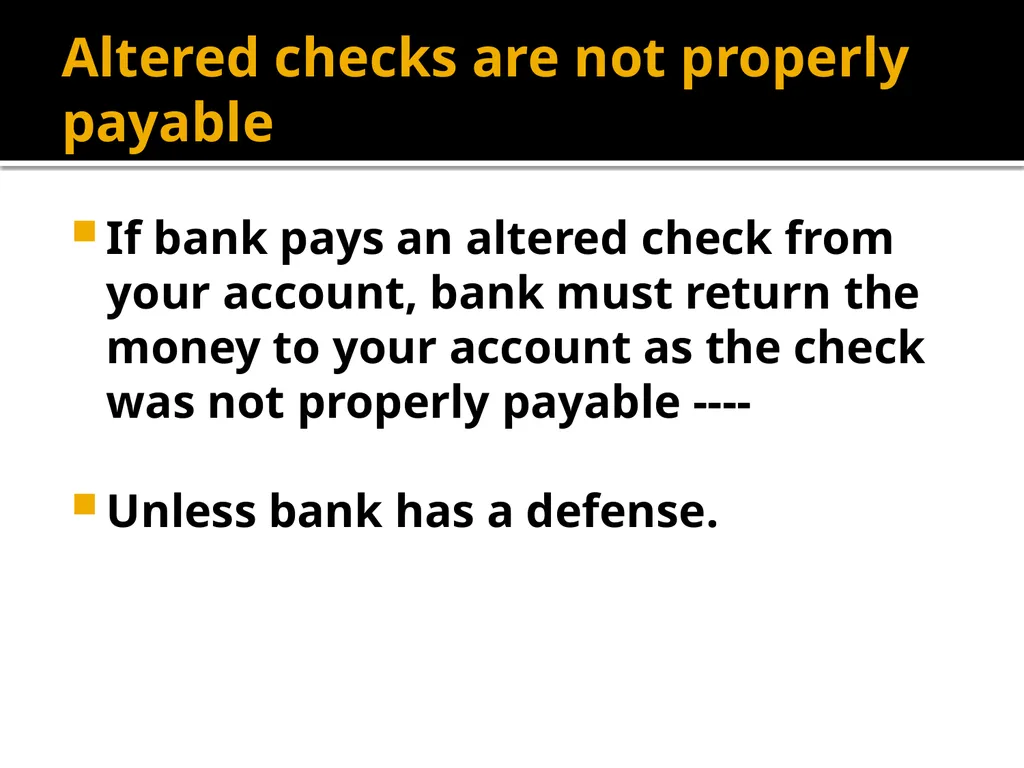
slide79. Altered checks are not properly payable If bank pays an altered check from your account, bank must return the money to your account as the check was not properly payable ----
Unless bank has a defense.<br>
slide80. Bank’s defenses to recrediting account for paying an altered check 1. Drawer was negligent.
Wrote in pencil.
Left blank spaces.
Problem 219 – p. 614<br>
slide81. Bank’s defenses to recrediting account for paying an altered check 2. Bank Statement Rule: Drawer waited more than 1 year to report the alteration (or 30 days if repeat offender scenario).<br>
slide82. If bank recredits account --- 1. Drawee bank sues presenter (or prior transferors) for breach of presentment warranty of no alteration.
2. Presenter sues prior transferors for breach of transfer warranty of no alteration.<br>
slide83. Payment in Full Checks Check (or accompanying communication) which conspicuously states that it is in full payment of an obligation that is:
1. Subject to a bona fide dispute, or
2. Unliquidated (exact amount owed not yet determined).<br>
slide84. Payment in Full Checks If payee cashes the check, the check operates as an “accord and satisfaction” of the debt unless:<br>
slide85. Payment in Full Checks If payee cashes the check, the check operates as an “accord and satisfaction” of the debt unless:
1. Payee returns the money within 90 days, or<br>
slide86. Payment in Full Checks If payee cashes the check, the check operates as an “accord and satisfaction” of the debt unless:
1. Payee returns the money within 90 days, or
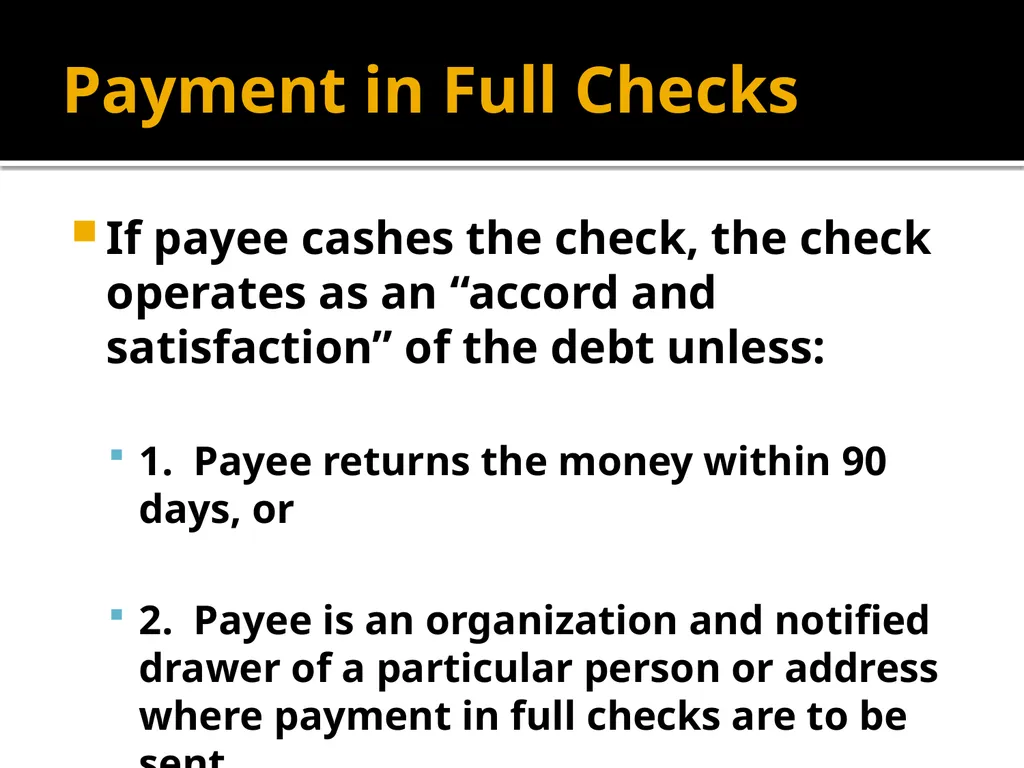
2. Payee is an organization and notified drawer of a particular person or address where payment in full checks are to be sent.<br>
slide2. Forgery – First Step Ascertain whose name is forged:
Maker of note
Payee (indorser)
Drawer
Different rules apply based on identity/status of person whose name is forged.<br>
slide3. Forged Maker’s Signature on Note Alleged maker not liable (not sign).
Forger is liable (signed).<br>
slide4. Warranties<br>
slide5. Warranties Implied – arise automatically.<br>
slide6. Warranties Implied – arise automatically.
Off-instrument liability so possession of the instrument is NOT necessary to recover.<br>
slide7. Warranties Implied – arise automatically.
Off-instrument liability so possession of the instrument is NOT necessary to recover.
Goal is to get money back that was improperly paid previously.<br>
slide8. Transfer Warranties<br>
slide9. Transfer Warranties Who makes transfer warranties [defendant]?
Person who
transfers the instrument AND
receives consideration for the instrument.
Examples:
Payee to special indorsee
Payee to depositary bank
Depositary bank to collecting bank<br>
slide10. Transfer Warranties To whom are transfer warranties made [plaintiff]?
1. Immediate transferee, and
2. Subsequent transferees if
transferor indorsed, or
if instrument is a check and is passing through collection process.<br>
slide11. Transfer Warranties 1. Transferor was entitled to enforce at time of transfer.
Basically, a warranty of holder status (good title).<br>
slide12. Transfer Warranties 2. All signatures authentic and authorized.
Even if not needed for chain of title.<br>
slide13. Transfer Warranties 3. The instrument has not been altered.<br>
slide14. Transfer Warranties 4. No defense would defeat the transferor’s ability to collect the money
A “perfect plaintiff” warranty.<br>
slide15. Transfer Warranties 5. Transferor has no knowledge of bankruptcy of maker, acceptor, or drawer
Only warranty where transferor’s knowledge is relevant.<br>
slide16. Transfer Warranties 6. If remotely created item, that alleged drawer authorized the item.<br>
slide17. Transfer Warranties Disclaiming warranties:
1. Check = transferor cannot disclaim
2. Notes and non-check drafts – transferor may disclaim with indorsement including phrase such as “without warranties”<br>
slide18. Transfer Warranties Requirements to recover:
Claimant must give notice to warrantor within 30 days of when claimant has reason to know of breach.
If late notice, only discharged for loss caused by delay (if any).
Statute of limitations = 3 years<br>
slide19. Presentment Warranties<br>
slide20. Presentment Warranties Who makes presentment warranties [the defendant]?
1. Person who presents the instrument for payment to drawee, maker, or acceptor, and
2. All previous transferors of the instrument.<br>
slide21. Presentment Warranties To whom are presentment warranties made [plaintiff]?
1. Note = Maker
2. Draft = Drawee or acceptor<br>
slide22. Presentment Warranties Transfer and Presentment warranties are mutually exclusive:
A plaintiff can sue on only one (if any) warranty.
But, a defendant could make both warranties, but to different people.<br>
slide23. Presentment Warranties – unaccepted draft (check) 1. Presenter (and prior transferors) were entitled to enforce at the time of presentment (or transfer).
A warranty of holder status (good title).<br>
slide24. Presentment Warranties – unaccepted draft (check) 2. No alteration.<br>
slide25. Presentment Warranties – unaccepted draft (check) 3. No knowledge that drawer’s signature was unauthorized.
This is NOT a warranty that the drawer’s signature is good (not forged); just a warranty of no knowledge.<br>
slide26. Presentment Warranties – unaccepted draft (check) 4. If remotely created item, that alleged drawer authorized the item.<br>
slide27. Presentment Warranties -- Note Presenter (and prior transferors) were entitled to enforce at the time of presentment (or transfer).
A warranty of holder status (good title).
A maker should know if maker’s name is a forgery or if amount altered.<br>
slide28. Presentment Warranties Disclaiming warranties:
1. Check = cannot disclaim
2. Notes and non-check drafts = may disclaim<br>
slide29. Forged Indorsement<br>
slide30. Forged Indorsement – Liability of payee (indorser) if no defenses Payee whose name was forged is not liable as did not sign.<br>
slide31. Forged Indorsement – Liability of Drawee Bank if no defenses Conversion liability to the payee,
or
Not properly payable liability to the drawer.<br>
slide32. Forged Indorsement – Drawee Bank’s Cause of Action Bank will sue presenter and prior transferors for breach of presentment warranty of entitled to enforce (presenters and prior transferors were not holders of the check).<br>
slide33. Forged Indorsement – Presenting Bank’s Cause of Action Presenting bank will sue transferors for breach of transfer warranties:
1. Entitled to enforce (holder status)
2. All signatures authentic or authorized
3. No good defenses<br>
slide34. Forged Indorsement Problems Problem 185 – p. 554
Problem 186 – p. 186<br>
slide35. Forged Indorsement Problems Problem 187 -189, pp. 555-557
Portia John Harry
Drawer Payee Forges John’s name
ONB Merchant’s Bank Tower Drug
Drawee Depositary Bank stolen<br>
slide36. Conversion Examples of events triggering conversion liability:
State law
Receiving instrument from person not entitled to enforce
Bank pays someone not entitled to enforce (e.g., pays check on forged indorsement)
Violation of “for deposit only” indorsement by depositary bank<br>
slide37. Conversion Plaintiff
Person who would be true owner.
E.g., payee whose indorsement was forged.<br>
slide38. Conversion Non-Plaintiffs
Issuer
Acceptor
Payee who did not receive delivery of the instrument (e.g., lost in the mail)<br>
slide39. Conversion Liability Presumption = amount payable on instrument
Limitation = if plaintiff’s interest is less than full amount payable
E.g., check payable to A & B and A forges B’s name; B may only have a 50% interest<br>
slide40. Conversion Liability Problems:
Problem 190 – p. 558
Problem 191 – p. 558
Problem 192 – p. 560
Problem 193 – p. 560
Problem 194 – p. 564<br>
slide41. Forged Drawer’s Signature<br>
slide42. Forged Drawer’s Signature Basic concepts:
Alleged drawer not liable as alleged drawer did not sign.
Forger is liable and is treated as the drawer.
Drawee bank must recredit drawer’s (customer’s) account unless it has a defense because the check was not properly payable.<br>
slide43. Forged Drawer’s Signature Can drawee bank who recredits customer’s account pass on liability?
Price v. Neal (1762) – p. 566
UCC – presentment warranty = no knowledge that drawer’s signature is forged<br>
slide44. Forged Drawer’s Signature Problem 195 – p. 572
Problem 196 – p. 576
Problem 197 – p. 576<br>
slide45. Forgery Validation 1. Ratification Party estopped from denying validity of a signature if:
With full knowledge of the forgery (or alteration),
Accepts the benefits thereof or actively assents to the wrongful activity.
Problem 198 – p. 579<br>
slide46. Forgery Validation 2. No Damages Problem 199 – p. 584<br>
slide47. Forgery Validation Review 1. Ratification
2. No Damages<br>
slide48. Forgery Validation 3. Impostor Rule Prevents issuer (maker or drawer) from asserting a forged indorsement.
Policy = Issuer was careless in issuing a check or note on which the payee’s indorsement is likely to be forged.
In a check context, bank would not have to recredit the drawer’s account in a not properly payable action.
Validates forgery so it passes good title.<br>
slide49. Forgery Validation 3. Impostor Rule 1. Impersonation of payee
Problem 200 – p. 585
Problem 201 – p. 586<br>
slide50. Forgery Validation 3. Impostor Rule 2. False claim of being an agent for the payee
Im Postor tells Drawer that Postor is collecting money for the American Red Cross. Drawer issues check for $500 payable to the American Red Cross. Postor then forges American Red Cross’s indorsement and cashes the check.<br>
slide51. Forgery Validation 3. Impostor Rule 3. Non-interested Payee – Evil Signer
Issuer does not intend the named payee to have an interest in the instrument.
Problem 202 – p. 586<br>
slide52. Forgery Validation 3. Impostor Rule 4. Non-interested Payee – Evil Employee
Employee (e.g., secretary) prepares fraudulent check with employer (e.g., corporate treasurer) innocently signs.
Problem 203 – p. 587<br>
slide53. Forgery Validation 4. Fraudulent Indorsement by Employee Prevents payee from asserting that the payee’s indorsement was forged in a conversion action.
Payee cannot assert a forgery made by a payee’s employee who was entrusted with the check.
Problem 204, p. 587<br>
slide54. Forgery Validation The “double forgery” situation Problem 205 – p. 588<br>
slide55. Forgery Validation 5. Negligence Person precluded from raising forgery (or alteration) if:
Failed to exercise ordinary care,
Substantially contributed to forgery/alteration,
Person asserting the estoppel is in good faith, and
Person asserting the estoppel:
Paid the instrument,
Took it for value, or
Took it for collection.<br>
slide56. Forgery Validation 5. Negligence Fact question so no bright-line rule as to what constitutes negligence.
Damages are computed on a comparative negligence basis.
Burden of proof is on the person asserting the negligence.<br>
slide57. Forgery Validation 5. Negligence Problem 206 – p. 589
Problem 207 – p. 589
Problem 208 – p. 596
Problem 209 – p. 596
Problem 210 – p. 603<br>
slide58. Forgery Validation 6. Bank Statement Rule Bank has no duty to provide a bank statement but if bank does:
Must follow Code’s specifications, and
May gain defense to customer’s not properly payable claims.<br>
slide59. Forgery Validation 6. Bank Statement Rule Duty if bank provides statement:
Return checks, or
Provide sufficient information about checks:
Check number,
Amount, and
Date of payment.<br>
slide60. Forgery Validation 6. Bank Statement Rule Duties if bank does not return checks:
Retain checks, or
Destroy checks retaining ability to furnish legible copies for seven years.
Provide customer with check or copy within reasonable time of customer’s request (two free per statement).<br>
slide61. Forgery Validation 6. Bank Statement Rule Customer’s Duties:
Inspect statement and items for:
Unauthorized customer’s signature, and
Alterations.
Report promptly to bank.<br>
slide62. Forgery Validation 6. Bank Statement Rule Ramifications of tardy reporting:
Customer is precluded from asserting the forgery or alteration in a not properly payable action.
But, Bank must prove it suffered a loss by reason of the delay to trigger the preclusion.
Problem 211 – p. 604<br>
slide63. Forgery Validation 6. Bank Statement Rule Repeat Offender Rule:
If same wrongdoer forged or altered checks, customer precluded from asserting later forgeries/alterations if not report within 30 days of bank statement.<br>
slide64. Forgery Validation 6. Bank Statement Rule Time limit of absolute preclusion
One year.
If customer does not report within one year, customer precluded regardless of bank’s potential fault.
Problem 212 – p. 604<br>
slide65. Forgery Validation 6. Bank Statement Rule Effect of Improper Bank Conduct
Bank pays in bad faith – no preclusion.
Bank fails to exercise ordinary care – loss allocated between bank and customer.
Problem 213 – p. 611<br>
slide66. Forgery Validation 6. Bank Statement Rule Can bank and customer shorten the time period to report in the account contract?
If too short, does it violate bank’s duty of good faith?
Problem 214 – p. 612
Problem 215 – p. 612<br>
slide67. Forgery Validation 6. Bank Statement Rule “Bank cannot be too nice” rule
If bank recredits customer’s account for the forgery or alteration even though one year has elapsed, bank cannot pass on loss by asserting a breach of presentment warranty.
Problem 216 – p. 613
Problem 217 – p. 613<br>
slide68. Alteration<br>
slide69. Alteration – a defense to payment Obligor (maker or drawer) does not want to pay because the instrument shows a different obligation from that which the obligor originally agreed.<br>
slide70. Alteration -- Types 1. Change in obligation
Amount changed: $10.00 to $10,000<br>
slide71. Alteration -- Types 1. Change in obligation
Date due changed: November 1, 2013 to November 1, 2011.<br>
slide72. Alteration -- Types 1. Change in obligation
Name of payee changed: “I.N.G.” to “I.N. Garrison.”<br>
slide73. Alteration -- Types 1. Change in obligation
Interest rate changed 5% to 15%.<br>
slide74. Alteration -- Types 2. Unauthorized completion
Amount of check is left blank.
Drawer tells payee, “fill in $50.00.”
Payee says “OK.”
Payee later fills in for $700.00.<br>
slide75. Alteration and Holders in Due Course 1. Change in obligation HDC can enforce for original amount.
Problem 221 – p. 615<br>
slide76. Alteration and Holders in Due Course 2. Unauthorized completion: HDC can enforce as completed –
Drawer signs check and says to Friend, “You can buy yourself a present with the check but no more than $100.”
Friend buys present from Payee (e.g., a store) costing $500 and writes check for $500.
Payee transfers check to HDC (Payee’s bank).
HDC can enforce for $500.<br>
slide77. Alteration and Non- Holders in Due Course 1. Fraudulently made by holder: Total discharge of obligor
Problem 218 – p. 614<br>
slide78. Alteration and Non- Holders in Due Course 2. Not fraudulently made by holder: no effect on obligation
On January 2, 2012, Drawer signs check for $100 payable to Payee and writes the date as “January 2, 2011.”
Payee changes the date to “January 1, 2012.”
Payee may still enforce for $100.
Problem 220, p. 615<br>
slide79. Altered checks are not properly payable If bank pays an altered check from your account, bank must return the money to your account as the check was not properly payable ----
Unless bank has a defense.<br>
slide80. Bank’s defenses to recrediting account for paying an altered check 1. Drawer was negligent.
Wrote in pencil.
Left blank spaces.
Problem 219 – p. 614<br>
slide81. Bank’s defenses to recrediting account for paying an altered check 2. Bank Statement Rule: Drawer waited more than 1 year to report the alteration (or 30 days if repeat offender scenario).<br>
slide82. If bank recredits account --- 1. Drawee bank sues presenter (or prior transferors) for breach of presentment warranty of no alteration.
2. Presenter sues prior transferors for breach of transfer warranty of no alteration.<br>
slide83. Payment in Full Checks Check (or accompanying communication) which conspicuously states that it is in full payment of an obligation that is:
1. Subject to a bona fide dispute, or
2. Unliquidated (exact amount owed not yet determined).<br>
slide84. Payment in Full Checks If payee cashes the check, the check operates as an “accord and satisfaction” of the debt unless:<br>
slide85. Payment in Full Checks If payee cashes the check, the check operates as an “accord and satisfaction” of the debt unless:
1. Payee returns the money within 90 days, or<br>
slide86. Payment in Full Checks If payee cashes the check, the check operates as an “accord and satisfaction” of the debt unless:
1. Payee returns the money within 90 days, or
2. Payee is an organization and notified drawer of a particular person or address where payment in full checks are to be sent.<br>