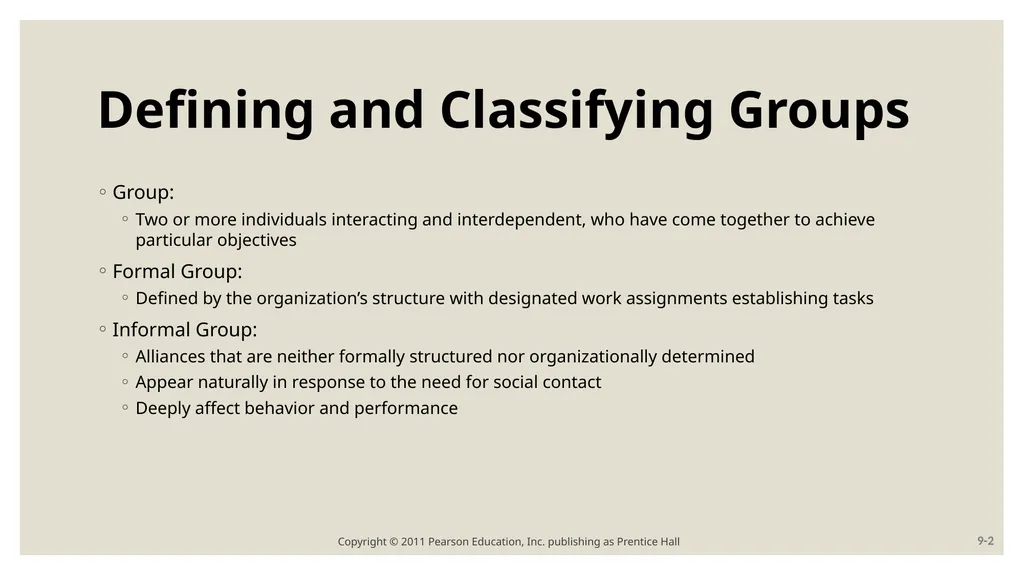
FOUNDATION OF GROUP BEHAVIOR AND Understanding Work Teams Findy Suri - Psikologi UMA Defining and Classifying Groups Group: Two or more individuals interacting and interdependent, who have come together to achieve particular objectives
"FOUNDATION OF GROUP BEHAVIOR AND Understanding" is the property of its rightful owner. Permission is granted to
download and print the materials on this website for personal, non-commercial use only, and to display it
on your personal computer provided you do not modify the materials and that you retain all copyright
notices contained in the materials. By downloading content from our website, you accept the terms of this
agreement.
Presentation Transcript
01
FOUNDATION OF GROUP BEHAVIOR AND Understanding Work Teams Findy Suri - Psikologi UMA<br>
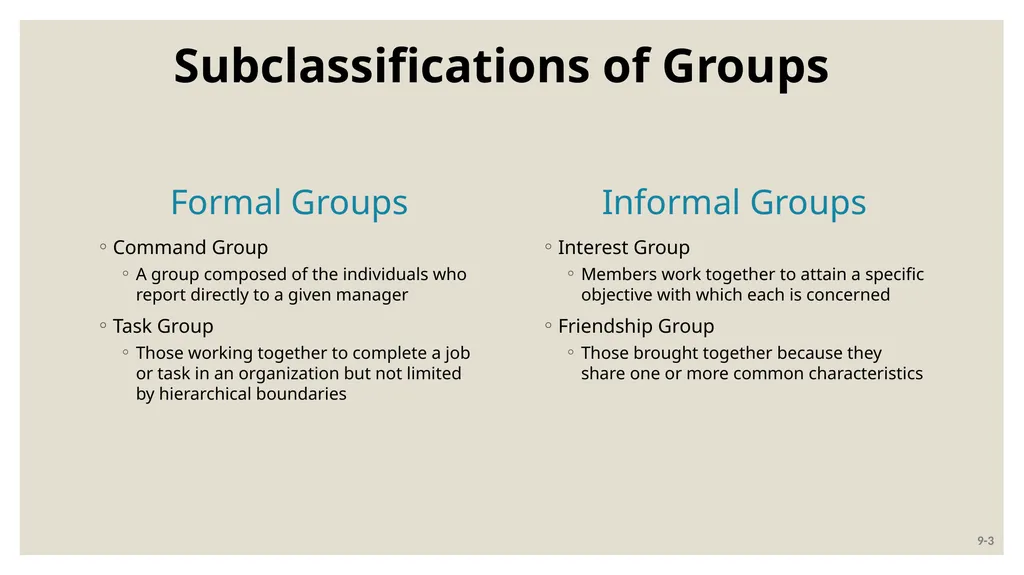
Subclassifications of Groups Formal Groups Command Group
A group composed of the individuals who report directly to a given manager
Task Group
Those working together to complete a job or task in an organization but not limited by hierarchical boundaries Informal Groups Interest Group
Members work together to attain a specific objective with which each is concerned
Friendship Group
Those brought together because they share one or more common characteristics 9-3<br>
04
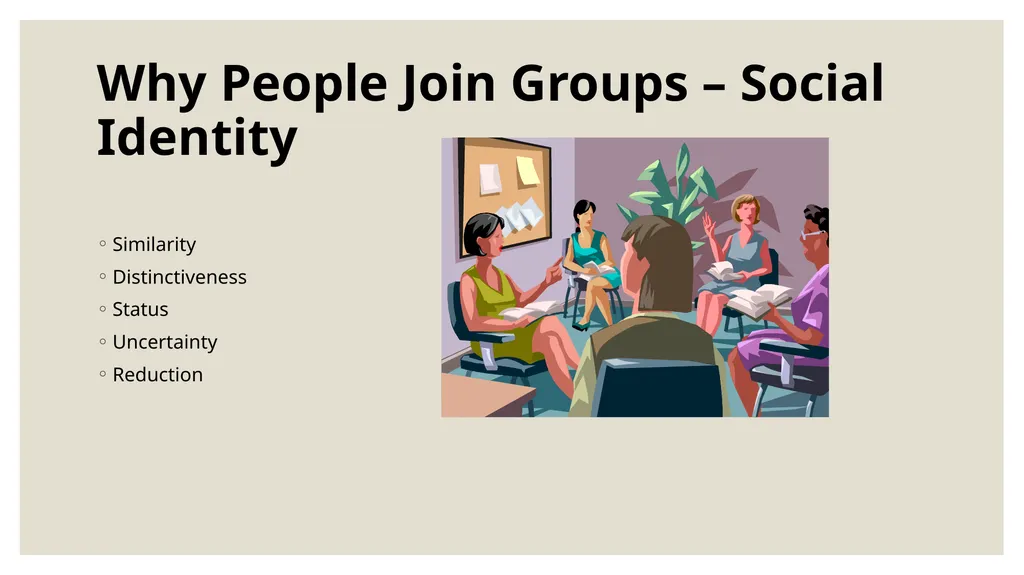
Why People Join Groups – Social Identity Similarity
Distinctiveness
Status
Uncertainty
Reduction<br>
05
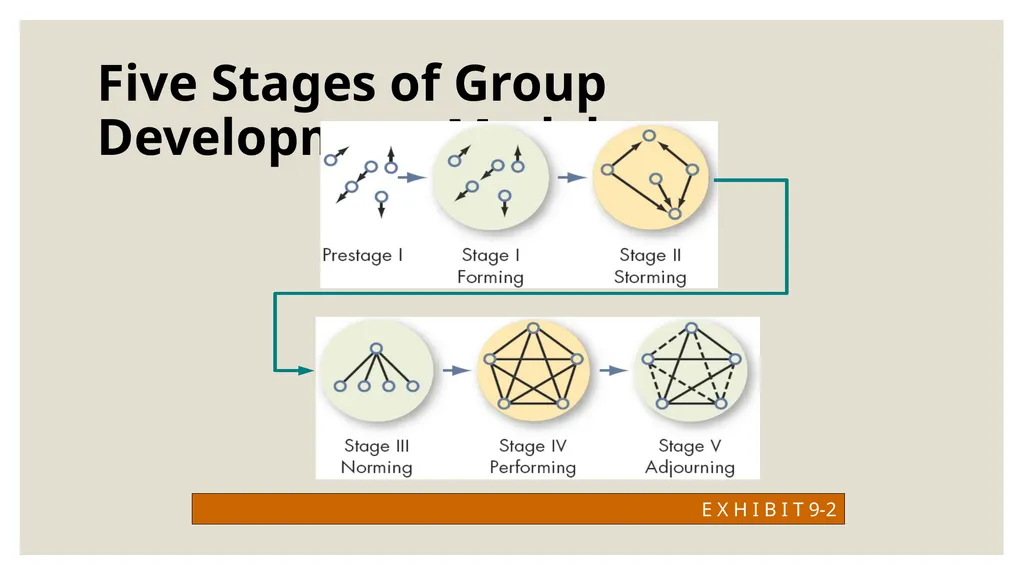
Five Stages of Group Development Model E X H I B I T 9-2<br>
06
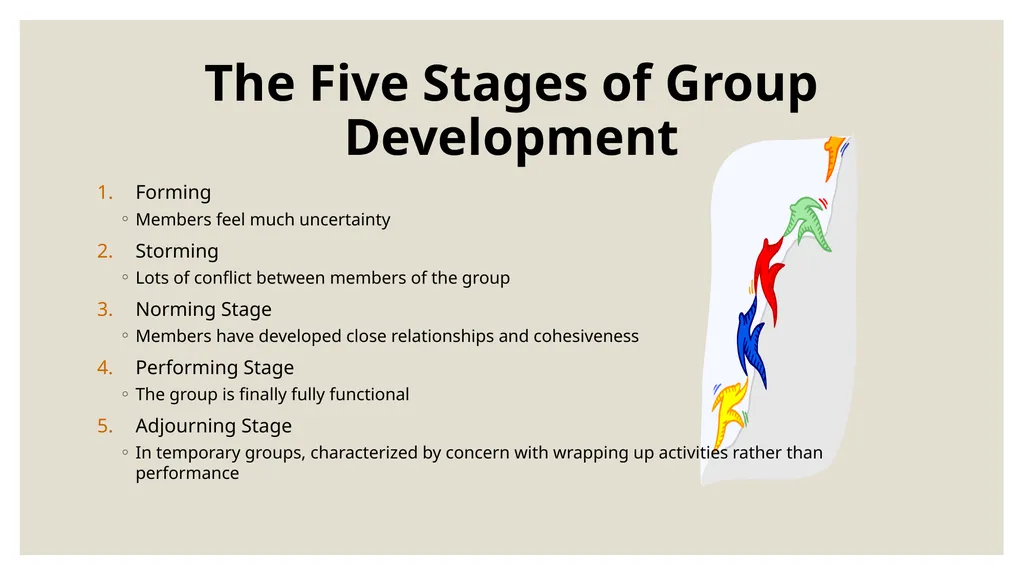
The Five Stages of Group Development Forming
Members feel much uncertainty
Storming
Lots of conflict between members of the group
Norming Stage
Members have developed close relationships and cohesiveness
Performing Stage
The group is finally fully functional
Adjourning Stage
In temporary groups, characterized by concern with wrapping up activities rather than performance<br>
07
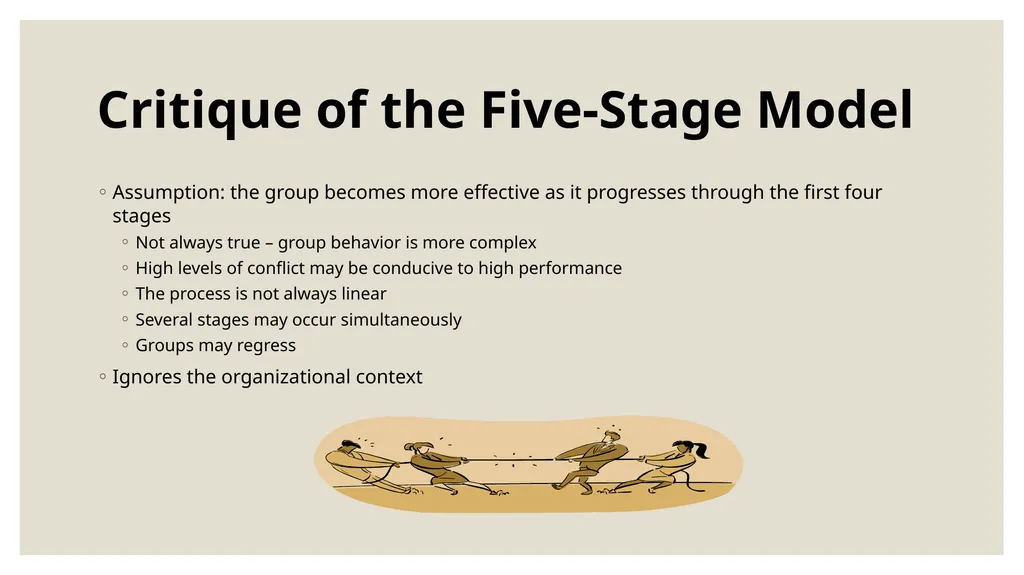
Critique of the Five-Stage Model Assumption: the group becomes more effective as it progresses through the first four stages
Not always true – group behavior is more complex
High levels of conflict may be conducive to high performance
The process is not always linear
Several stages may occur simultaneously
Groups may regress
Ignores the organizational context<br>
08
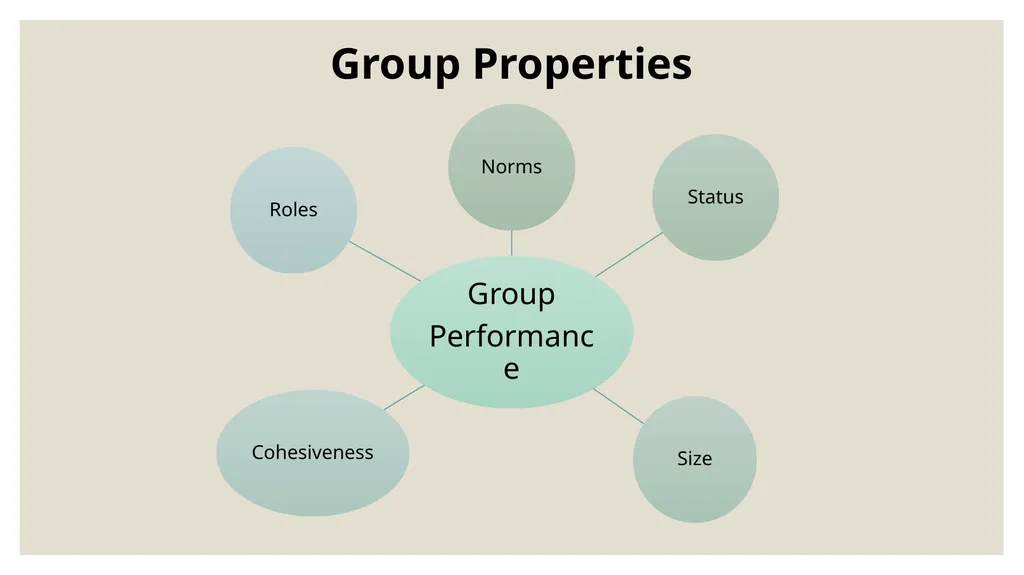
Group Properties<br>
09
Findy Suri - Psikologi UMA<br>
10
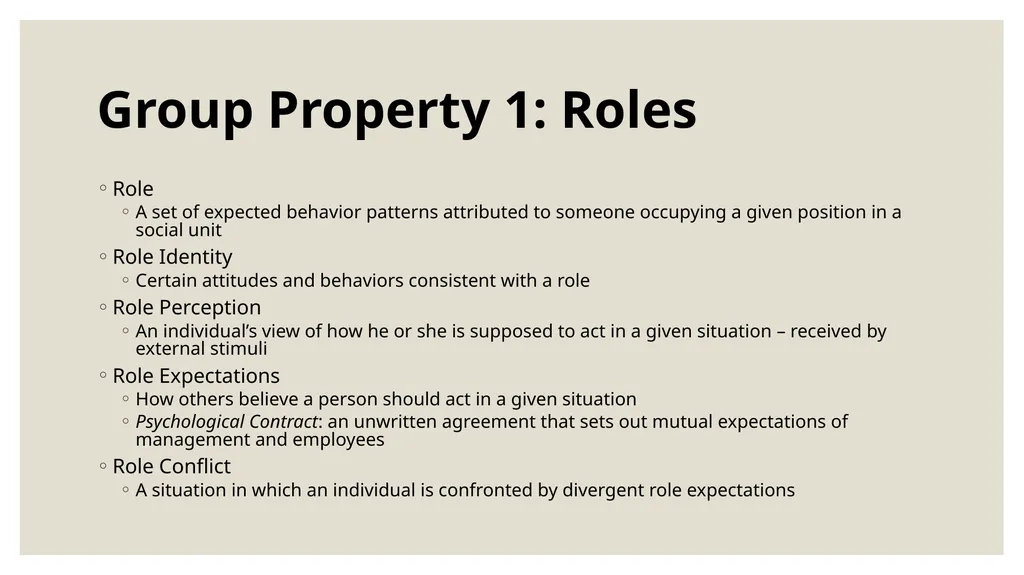
Group Property 1: Roles Role
A set of expected behavior patterns attributed to someone occupying a given position in a social unit
Role Identity
Certain attitudes and behaviors consistent with a role
Role Perception
An individual’s view of how he or she is supposed to act in a given situation – received by external stimuli
Role Expectations
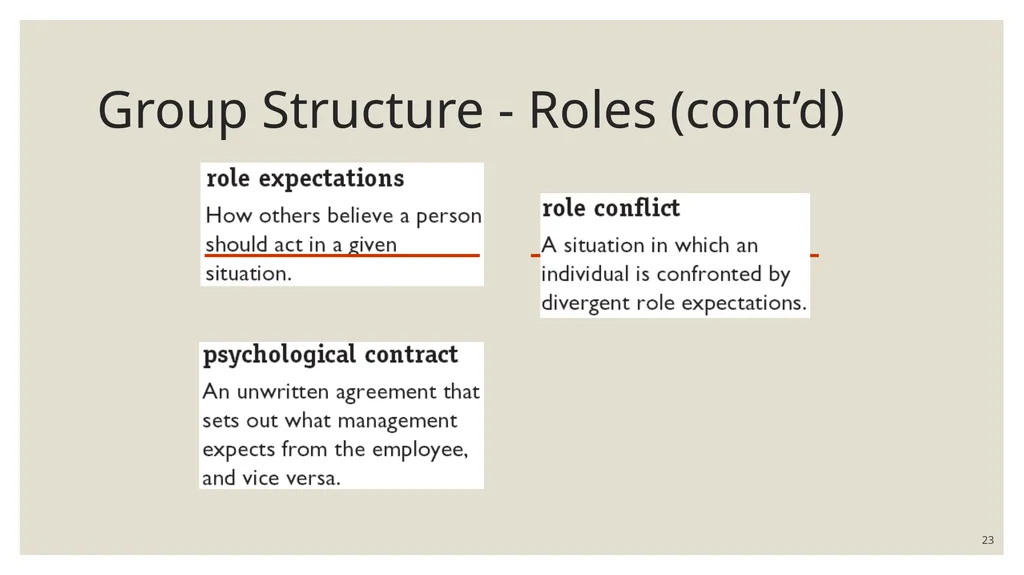
How others believe a person should act in a given situation
Psychological Contract: an unwritten agreement that sets out mutual expectations of management and employees
Role Conflict
A situation in which an individual is confronted by divergent role expectations<br>
11
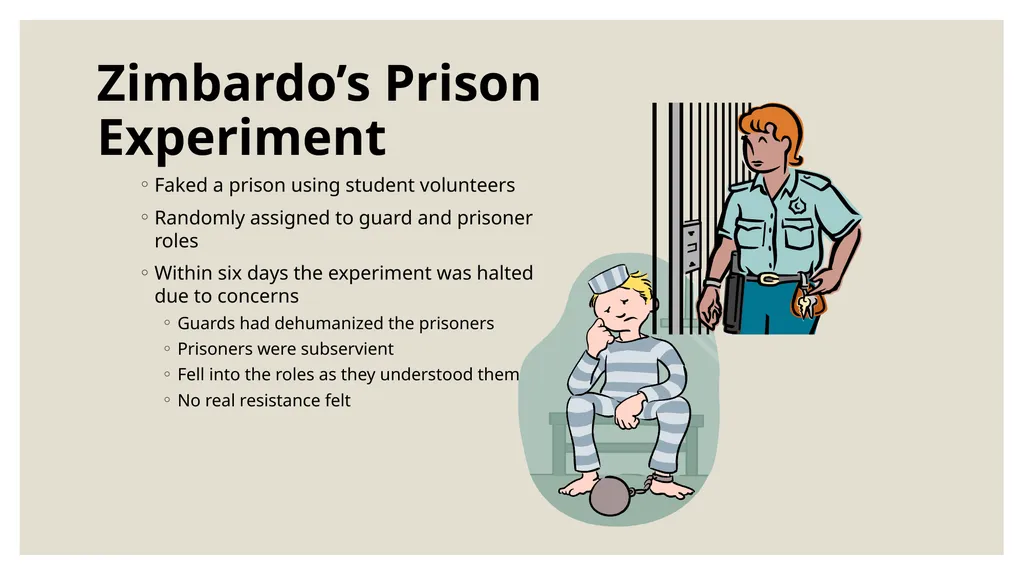
Zimbardo’s Prison Experiment Faked a prison using student volunteers
Randomly assigned to guard and prisoner roles
Within six days the experiment was halted due to concerns
Guards had dehumanized the prisoners
Prisoners were subservient
Fell into the roles as they understood them
No real resistance felt<br>
12
Group Property 2: Norms Norms
Acceptable standards of behavior within a group that are shared by the group’s members
Classes of Norms
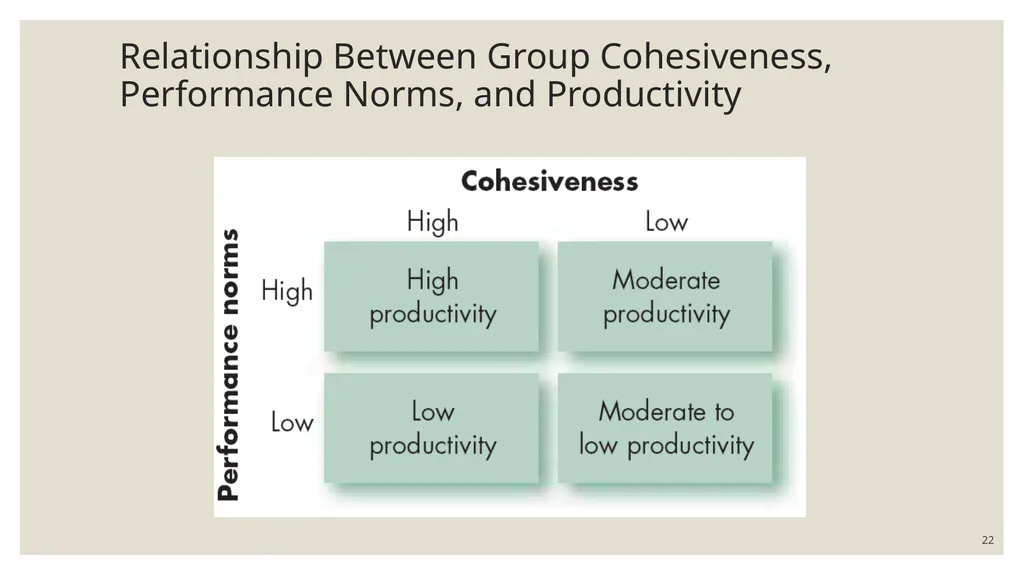
Performance norms - level of acceptable work
Appearance norms - what to wear
Social arrangement norms - friendships and the like
Allocation of resources norms - distribution and assignments of jobs and material<br>
13
Norms and Behavior Conformity
Gaining acceptance by adjusting one’s behavior to align with the norms of the group
Reference Groups
Important groups to which individuals belong or hope to belong and with whose norms individuals are likely to conform
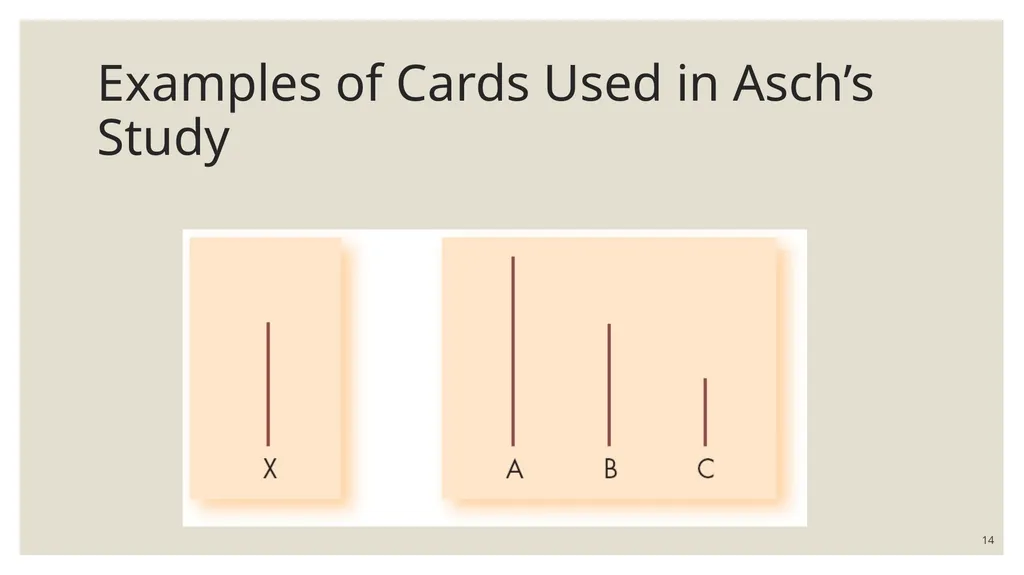
Asch Studies
Demonstrated the power of conformance
Culture-based and declining in importance E X H I B I T 9-4<br>
14
14 Examples of Cards Used in Asch’s Study<br>
15
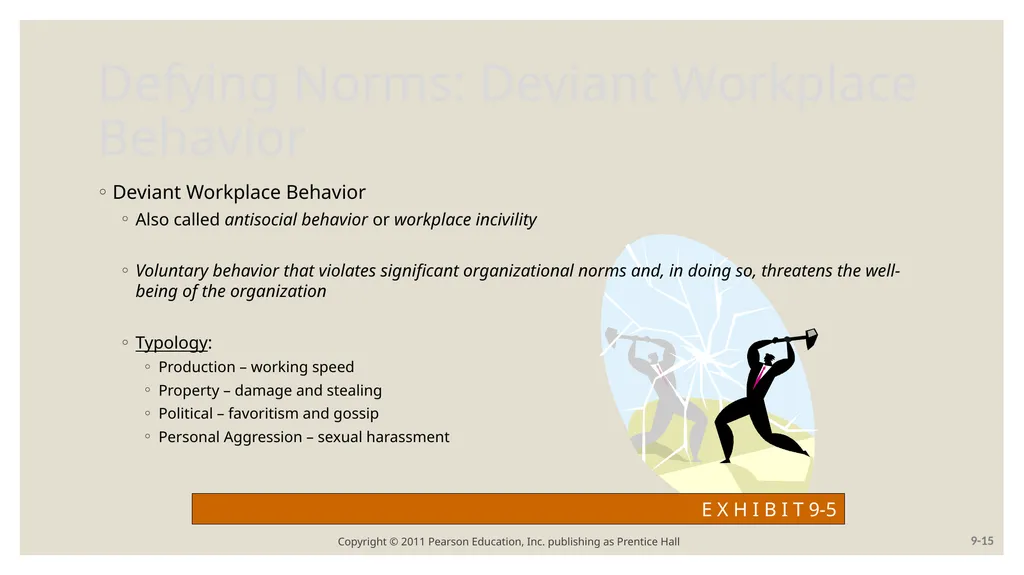
Deviant Workplace Behavior
Also called antisocial behavior or workplace incivility
Voluntary behavior that violates significant organizational norms and, in doing so, threatens the well-being of the organization
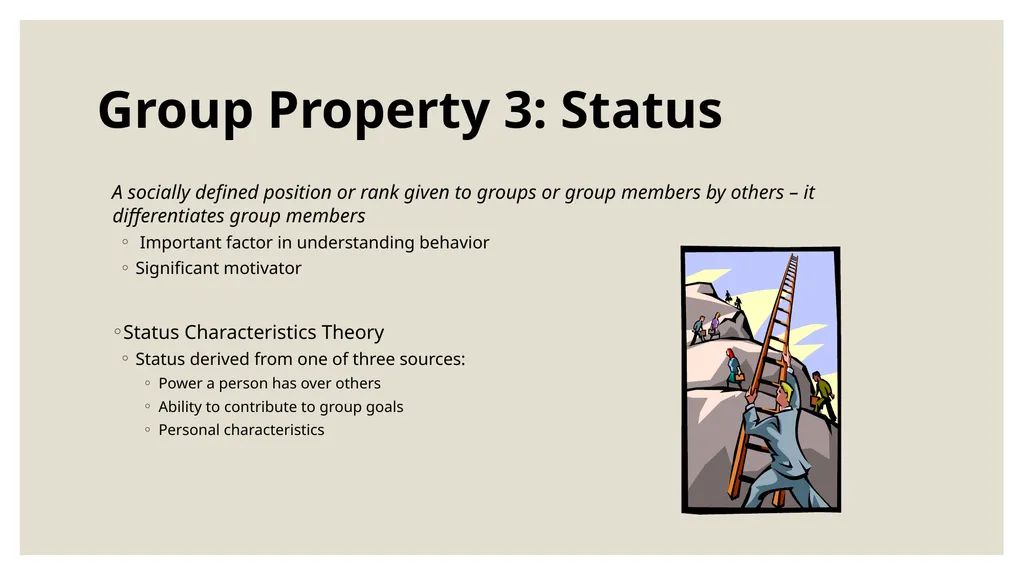
Group Property 3: Status A socially defined position or rank given to groups or group members by others – it differentiates group members
Important factor in understanding behavior
Significant motivator
Status Characteristics Theory
Status derived from one of three sources:
Power a person has over others
Ability to contribute to group goals
Personal characteristics<br>
17
Status Effects On Norms and Conformity
High-status members are less restrained by norms and pressure to conform
Some level of deviance is allowed to high-status members so long as it doesn’t affect group goal achievement
On Group Interaction
High-status members are more assertive
Large status differences limit diversity of ideas and creativity
On Equity
If status is perceived to be inequitable, it will result in various forms of corrective behavior.<br>
18
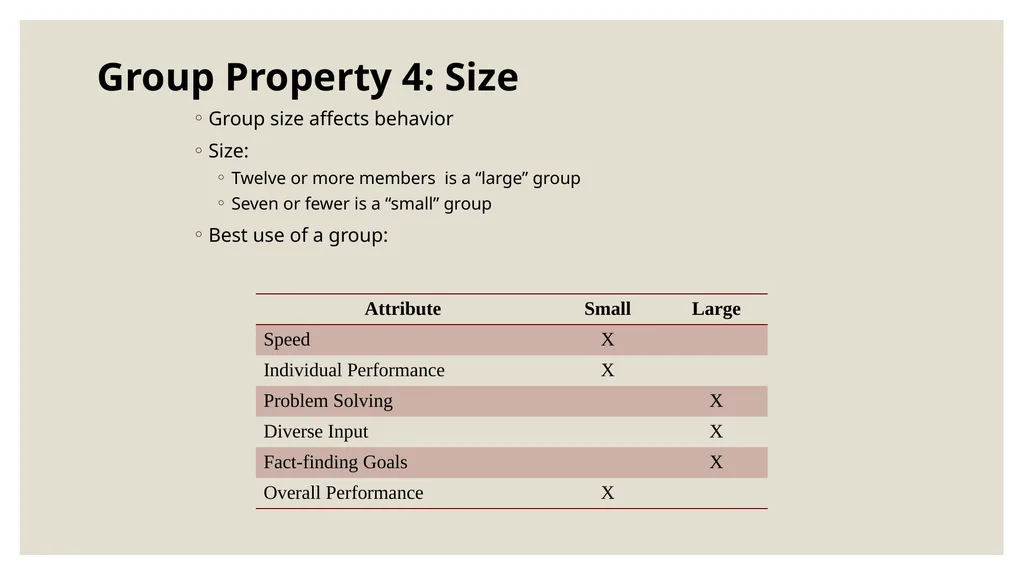
Group Property 4: Size Group size affects behavior
Size:
Twelve or more members is a “large” group
Seven or fewer is a “small” group
Best use of a group:<br>
19
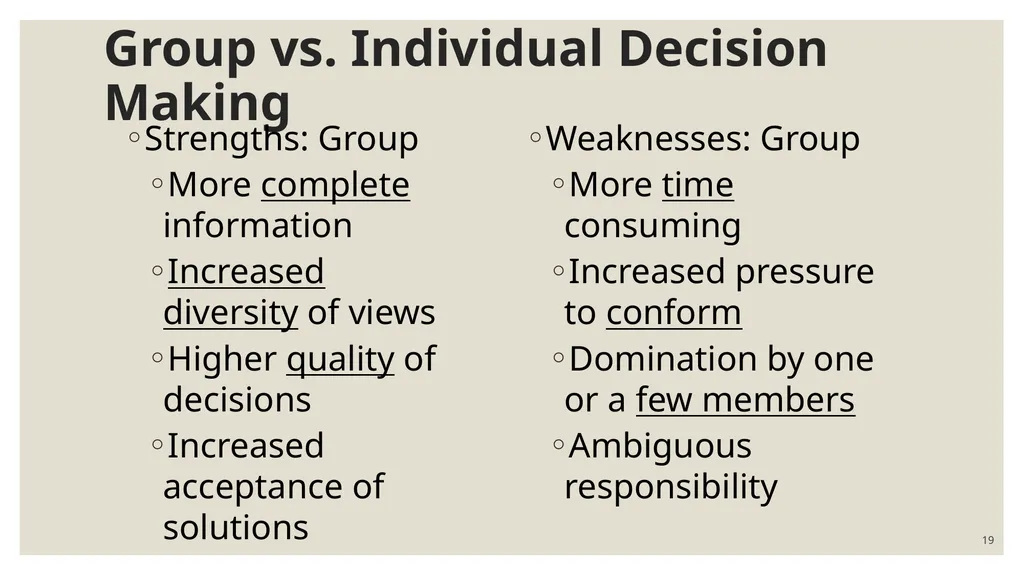
19 Group vs. Individual Decision Making Strengths: Group
More complete information
Increased diversity of views
Higher quality of decisions
Increased acceptance of solutions Weaknesses: Group
More time consuming
Increased pressure to conform
Domination by one or a few members
Ambiguous responsibility<br>
20
Issues with Group Size Social Loafing
The tendency for individuals to expend less effort when working collectively than when working individually
Ringelmann’s Rope Pull: greater levels of productivity but with diminishing returns as group size increases
Caused by either equity concerns or a diffusion of responsibility (free riders)
Managerial Implications
Build in individual accountability
Prevent social loafing by:
Setting group goals
Increasing intergroup competition
Using peer evaluation
Distributing group rewards based on individual effort<br>
21
Group Property 5: Cohesiveness Degree to which group members are attracted to each other and are motivated to stay in the group
Managerial Implication
To increase cohesiveness:
Make the group smaller.
Encourage agreement with group goals.
Increase time members spend together.
Increase group status and admission difficulty.
Stimulate competition with other groups.
Give rewards to the group, not individuals.
Physically isolate the group. E X H I B I T 9-7<br>
22
22 Relationship Between Group Cohesiveness, Performance Norms, and Productivity<br>
23
23 Group Structure - Roles (cont’d)<br>
24
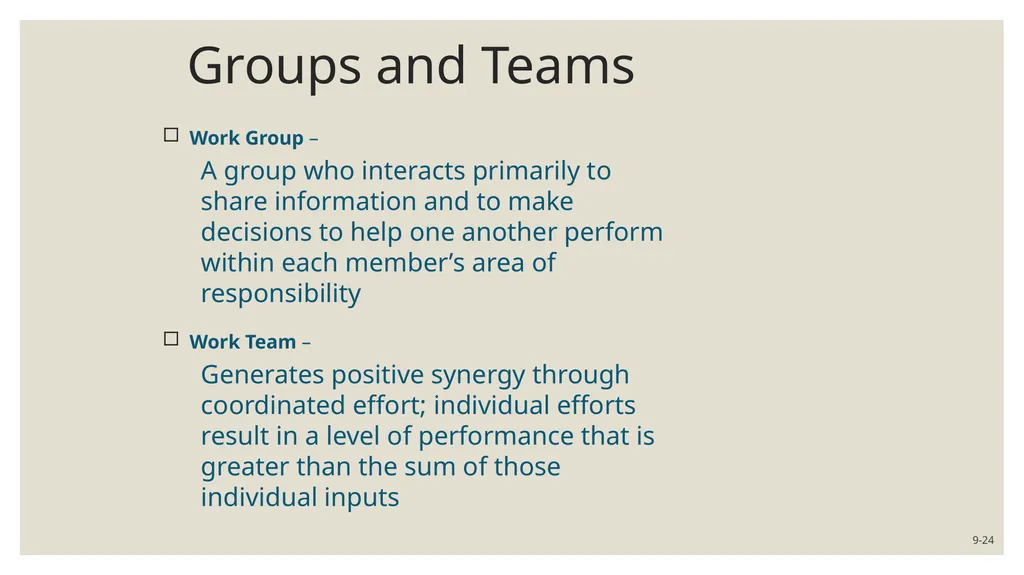
Groups and Teams 9-24 Work Group –
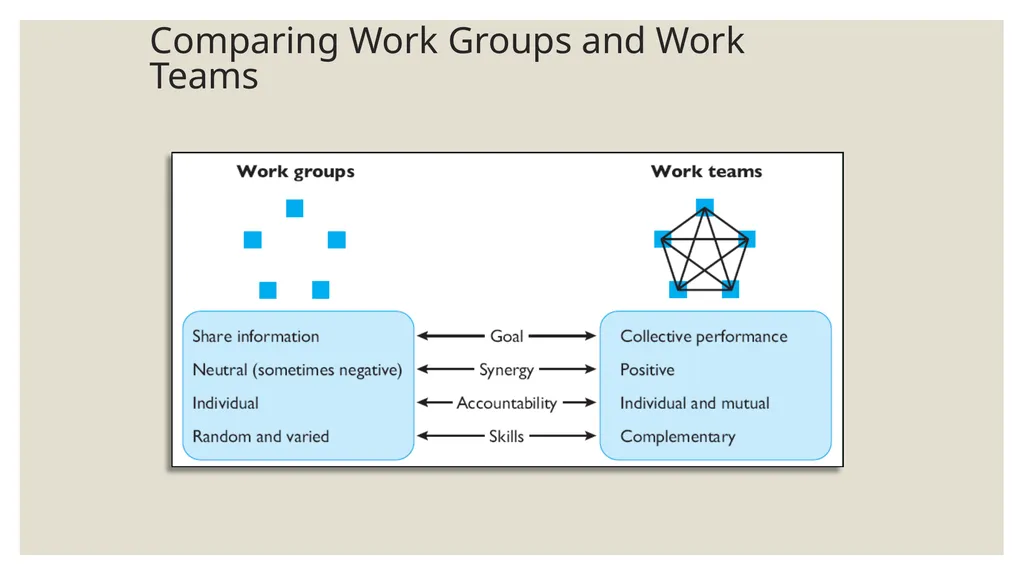
A group who interacts primarily to share information and to make decisions to help one another perform within each member’s area of responsibility
Work Team –
Generates positive synergy through coordinated effort; individual efforts result in a level of performance that is greater than the sum of those individual inputs<br>
25
Comparing Work Groups and Work Teams<br>
26
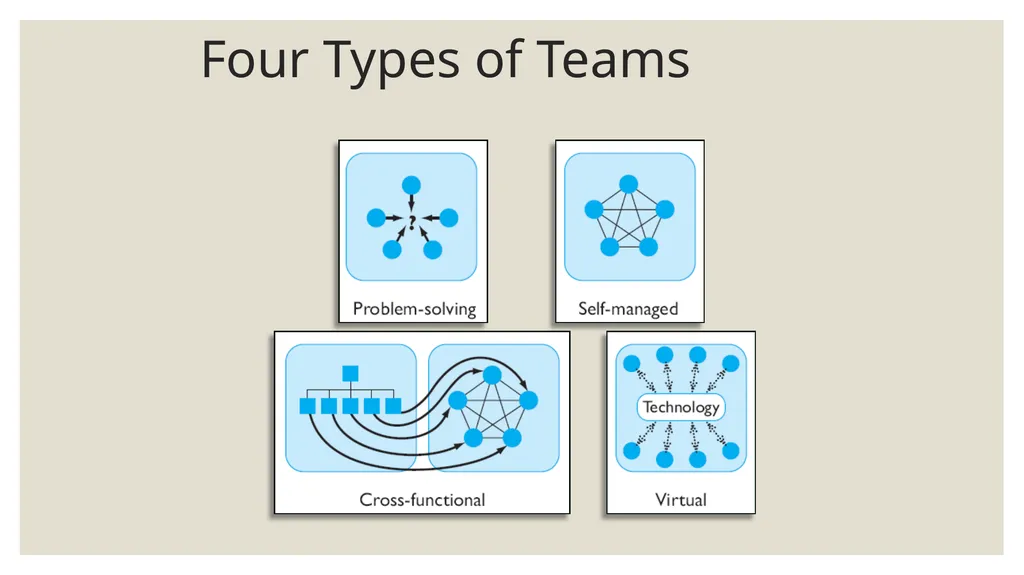
Four Types of Teams<br>
27
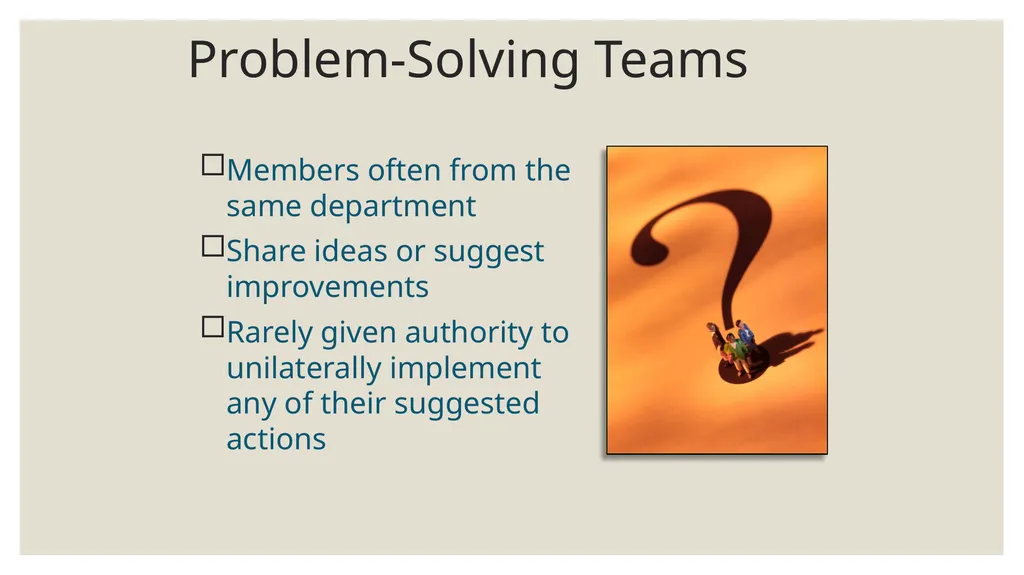
Problem-Solving Teams Members often from the same department
Share ideas or suggest improvements
Rarely given authority to unilaterally implement any of their suggested actions<br>
28
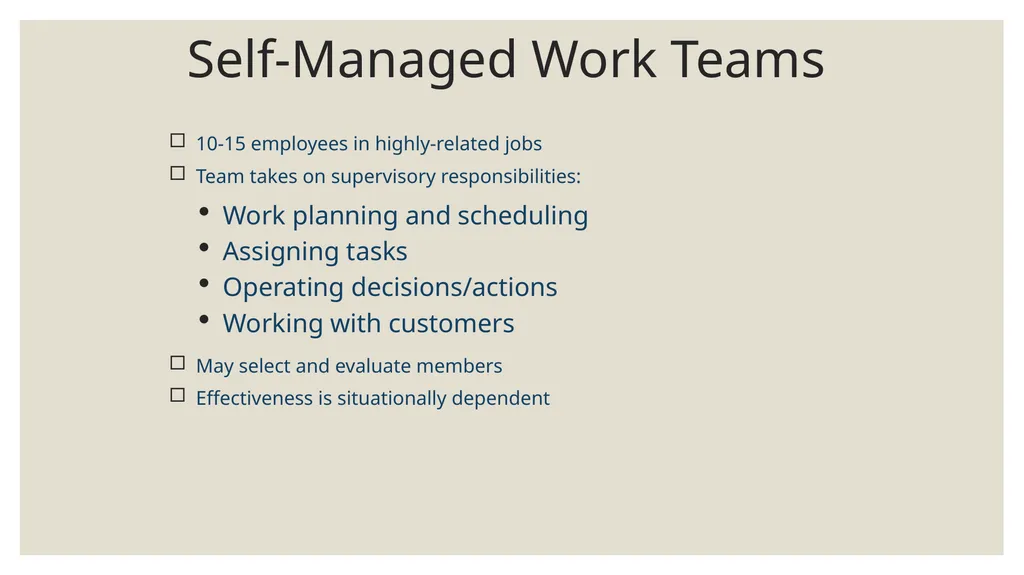
Self-Managed Work Teams 10-15 employees in highly-related jobs
Team takes on supervisory responsibilities:
Work planning and scheduling
Assigning tasks
Operating decisions/actions
Working with customers
May select and evaluate members
Effectiveness is situationally dependent<br>
29
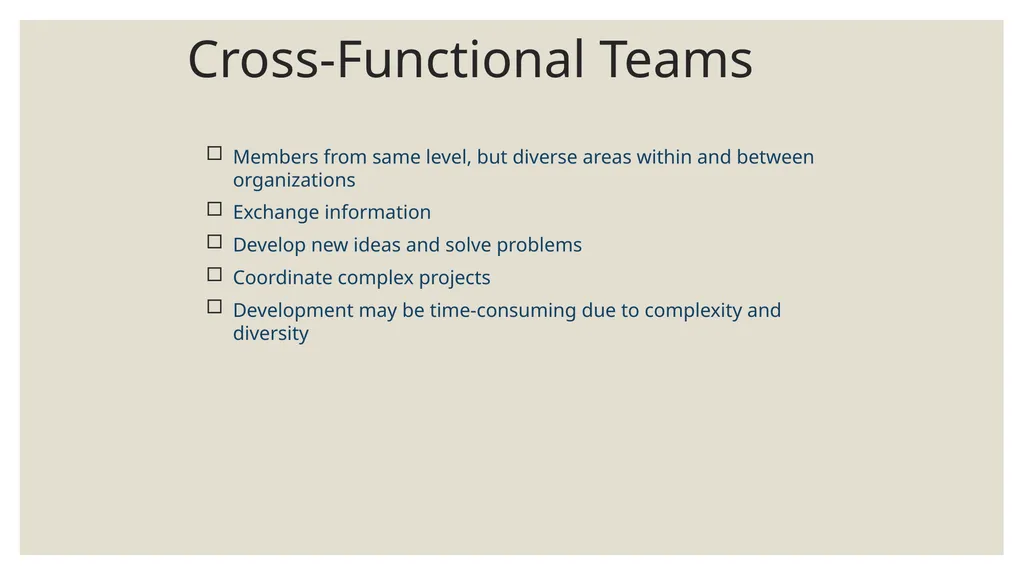
Cross-Functional Teams Members from same level, but diverse areas within and between organizations
Exchange information
Develop new ideas and solve problems
Coordinate complex projects
Development may be time-consuming due to complexity and diversity<br>
30
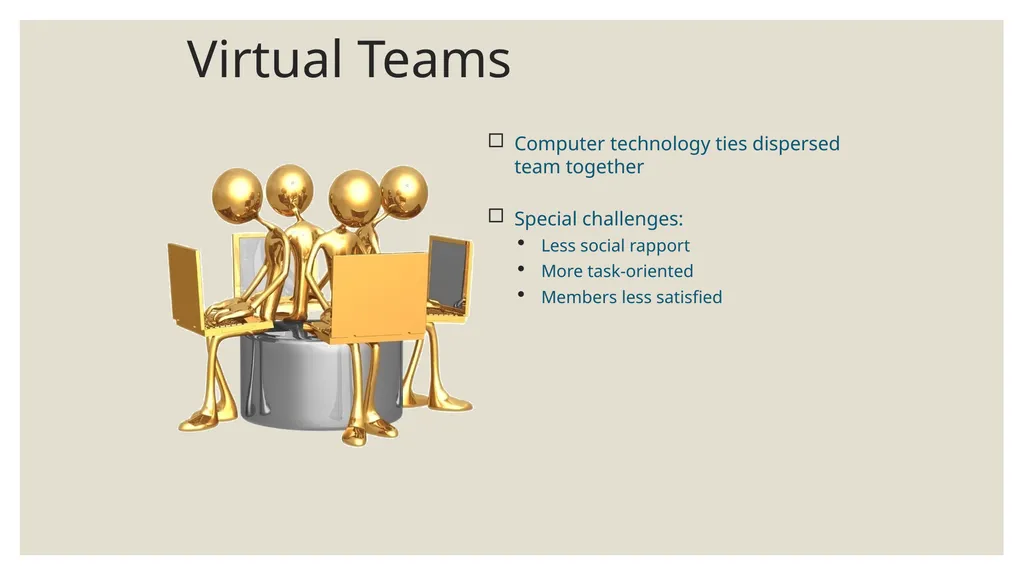
Virtual Teams Computer technology ties dispersed team together
Special challenges:
Less social rapport
More task-oriented
Members less satisfied<br>
31
Key Components of Effective Teams Context
Composition
Process<br>