Fourth TEMPO Science Team Meeting Retrieving Aerosol Absorption Properties of BL aerosols using combined VIS-UV Retrievals Omar Torres NASA-GSFC Washington, DC June 2, 2016 Use of near UV Satellite Observations for retrieving aerosol
"Fourth TEMPO Science Team Meeting Retrieving" is the property of its rightful owner. Permission is granted to
download and print the materials on this website for personal, non-commercial use only, and to display it
on your personal computer provided you do not modify the materials and that you retain all copyright
notices contained in the materials. By downloading content from our website, you accept the terms of this
agreement.
Presentation Transcript
01
Fourth TEMPO Science Team Meeting Retrieving Aerosol Absorption Properties of BL aerosols
using combined VIS-UV Retrievals Omar Torres
NASA-GSFC Washington, DC
June 2, 2016<br>
02
Use of near UV Satellite Observations for retrieving aerosol properties Observations in the 340-400 nm range can be used to derive aerosol properties
Advantages:
Low surface albedo at all terrestrial surfaces (.01 to .03 for vegetation; .08 - .12 deserts)
Weak spectral dependence of surface albedo in the 340-400 nm range.
Sensitivity to aerosol absorption.
Negligible gas absorption interference.
Disadvantages:
Ocean color interference
Aerosol absorption detection is aerosol layer height sensitive.
Historically, near UV measurements have been associated with coarse spatial resolution sensors (TOMS, OMI) primarily designed for trace gas retrieval. At these multi-kilometer resolution sub-pixel cloud contamination is the most important error source in aerosol remote sensing.<br>
03
Near-UV observations are mainly sensitive to:
-Aerosol Optical Depth (wavelength dependent, Aerosol Extinction Exponent)
-Aerosol Absorption (wavelength dependent, Aerosol Absorption Exponent)
-Aerosol Layer Height
-Surface Albedo (second order effect) Even Ignoring Surface effects (small), measured reflectances depend on at least five parameters: AOD, AEE, SSA, AAE, Zae.
If measurements at two near-UV channels are available, we may be able to retrieve two parameters. External information or assumptions on the other three are required. Satellite Retrieval Applications In the OMI Algorithm, AOD and SSA are retrieved<br>
04
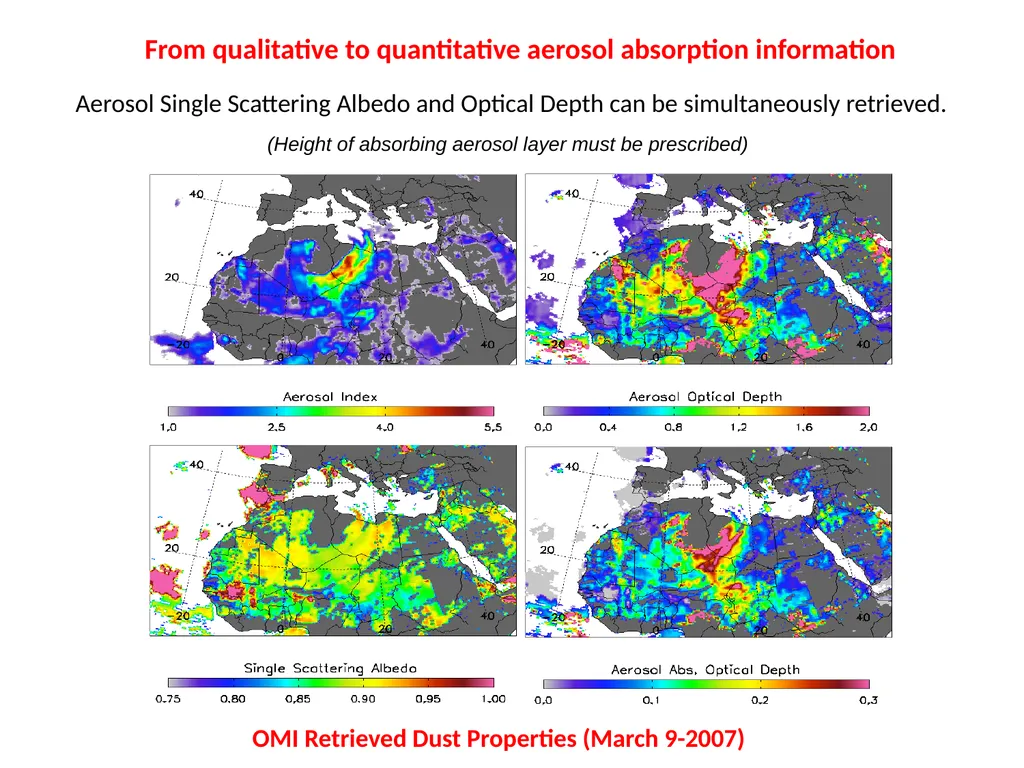
OMI Retrieved Dust Properties (March 9-2007) Aerosol Single Scattering Albedo and Optical Depth can be simultaneously retrieved. From qualitative to quantitative aerosol absorption information (Height of absorbing aerosol layer must be prescribed)<br>
05
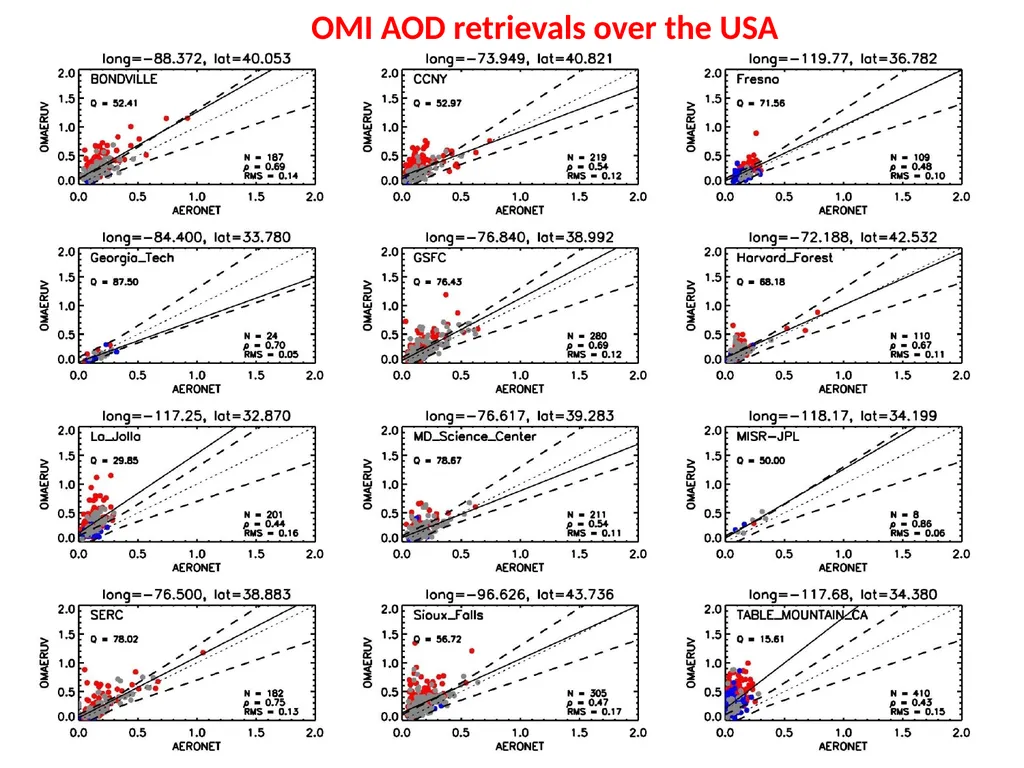
OMI AOD retrievals over the USA<br>
06
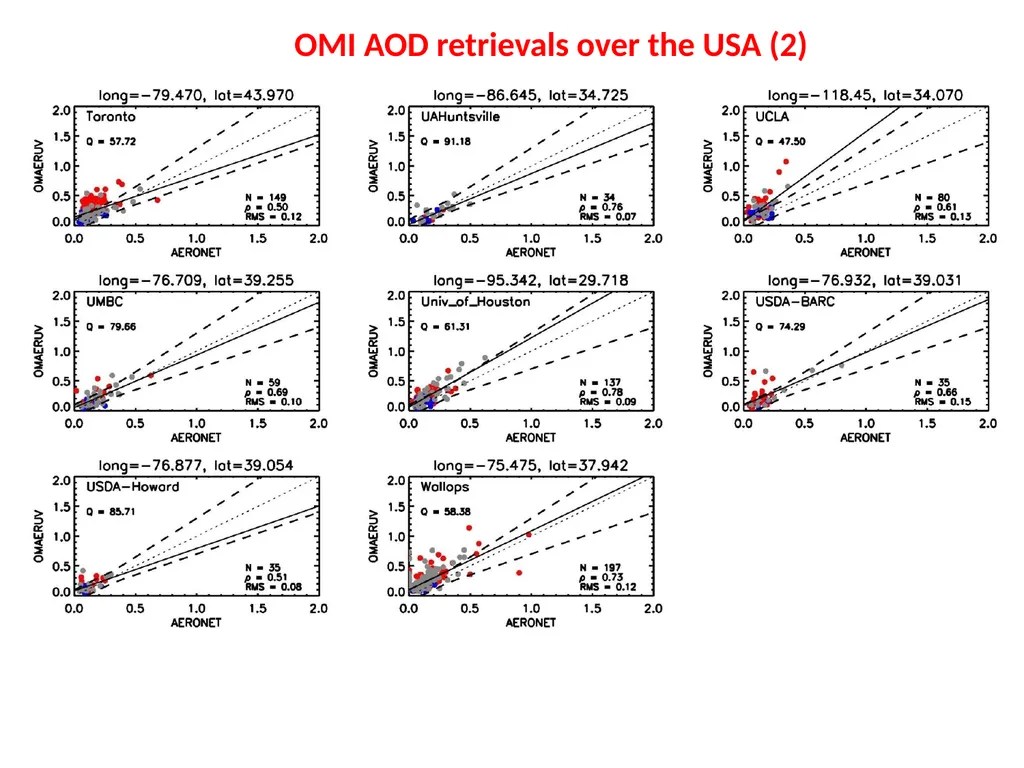
OMI AOD retrievals over the USA (2)<br>
07
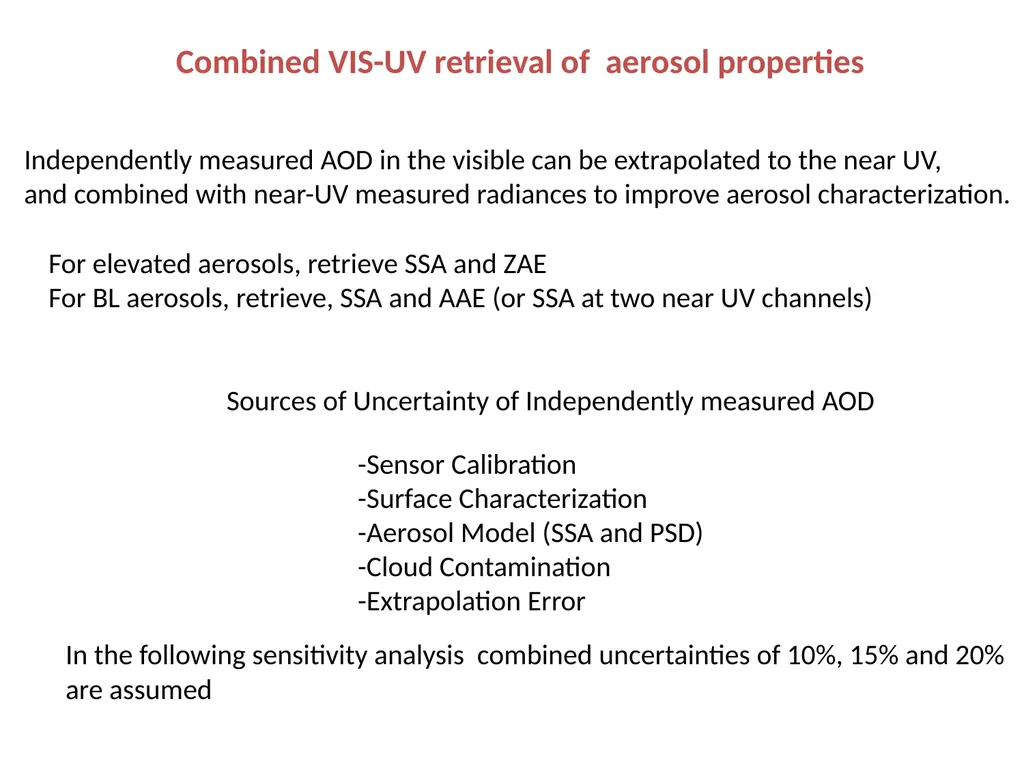
Sources of Uncertainty of Independently measured AOD -Sensor Calibration
-Surface Characterization
-Aerosol Model (SSA and PSD)
-Cloud Contamination
-Extrapolation Error Combined VIS-UV retrieval of aerosol properties Independently measured AOD in the visible can be extrapolated to the near UV,
and combined with near-UV measured radiances to improve aerosol characterization. In the following sensitivity analysis combined uncertainties of 10%, 15% and 20%
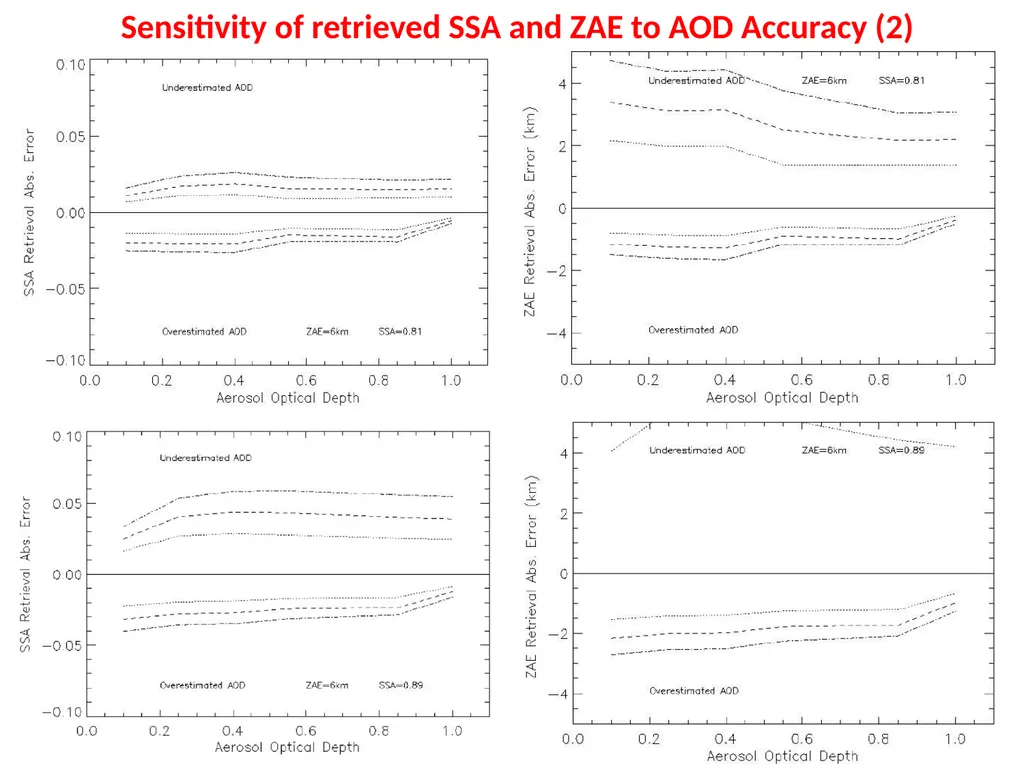
are assumed For elevated aerosols, retrieve SSA and ZAE
For BL aerosols, retrieve, SSA and AAE (or SSA at two near UV channels)<br>
08
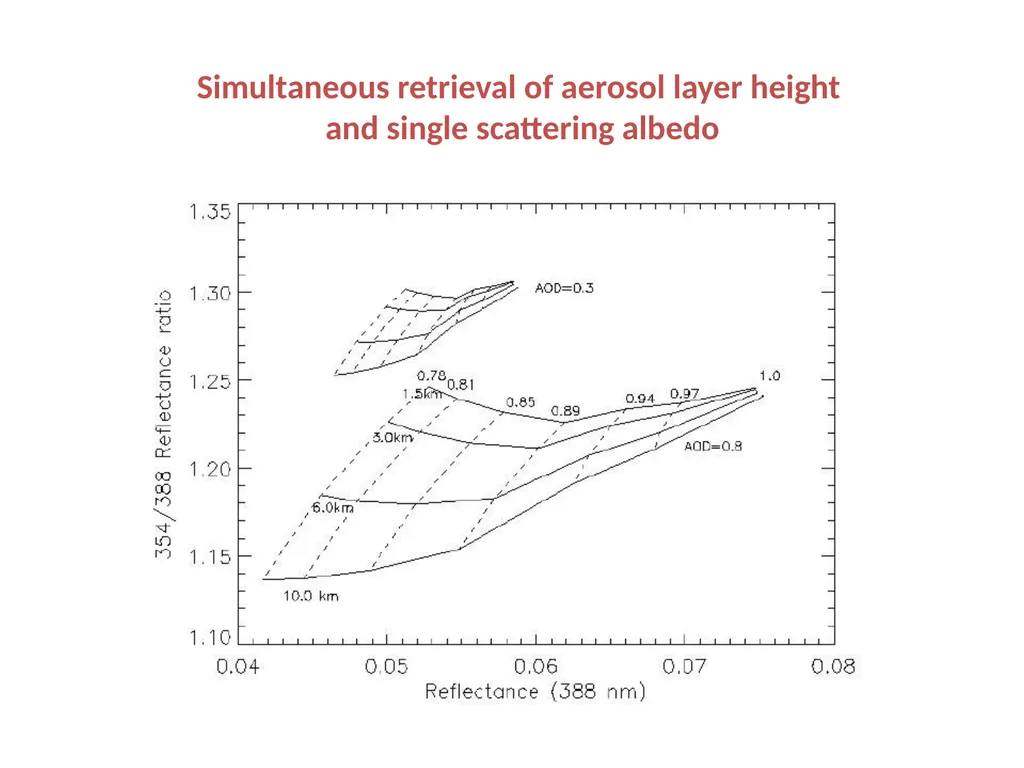
Simultaneous retrieval of aerosol layer height
and single scattering albedo<br>
09
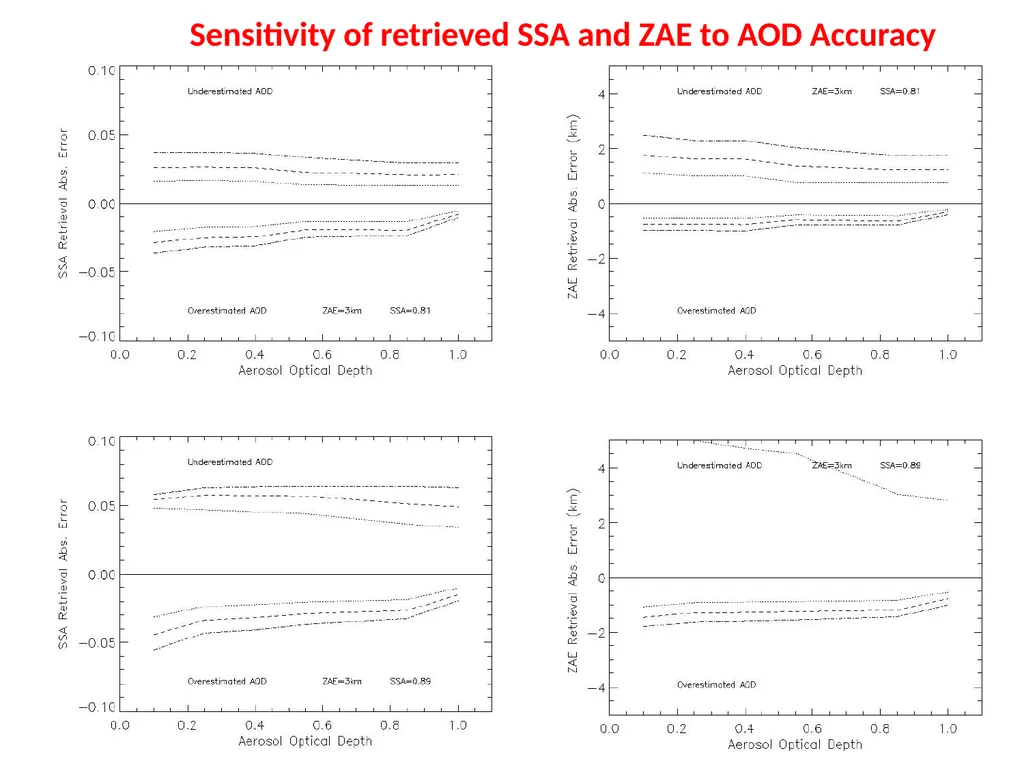
Sensitivity of retrieved SSA and ZAE to AOD Accuracy<br>
10
Sensitivity of retrieved SSA and ZAE to AOD Accuracy (2)<br>
11
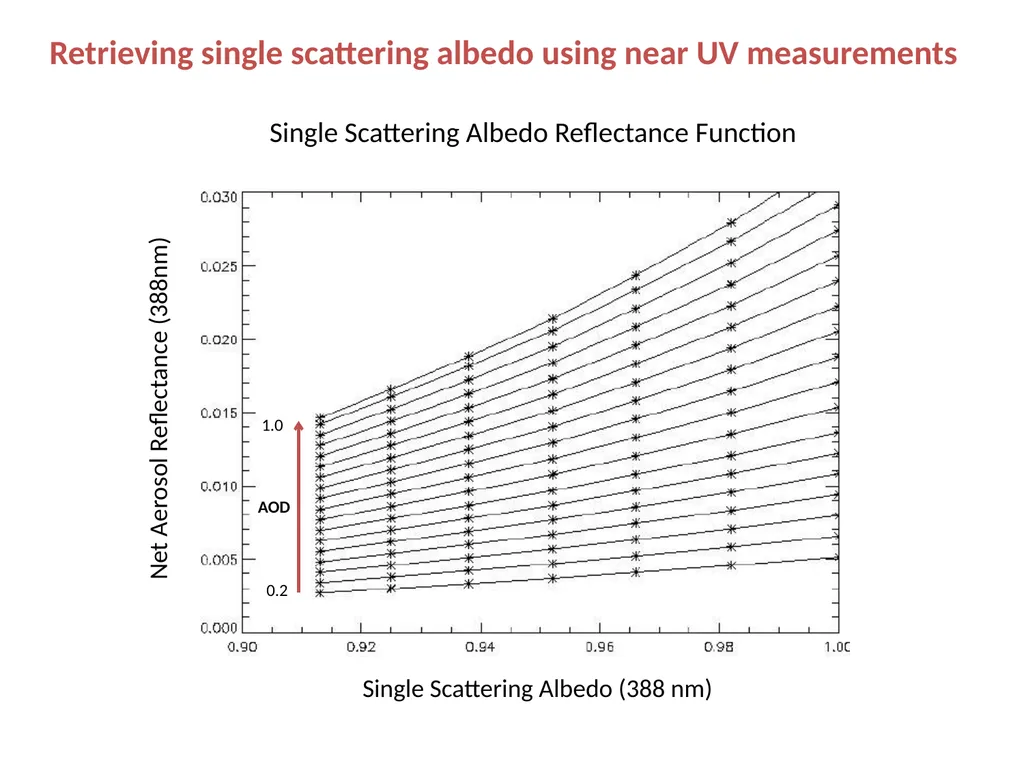
Single Scattering Albedo (388 nm) Net Aerosol Reflectance (388nm) AOD 0.2 1.0 Single Scattering Albedo Reflectance Function Retrieving single scattering albedo using near UV measurements<br>
12
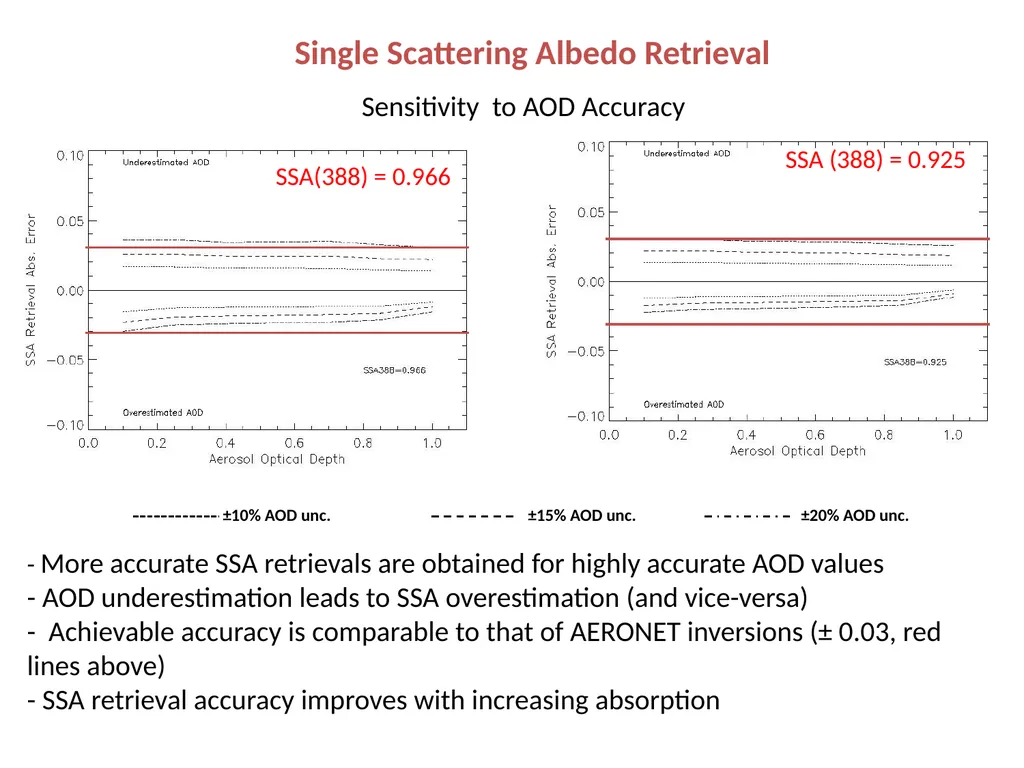
±10% AOD unc. ±15% AOD unc. ±20% AOD unc. - More accurate SSA retrievals are obtained for highly accurate AOD values
- AOD underestimation leads to SSA overestimation (and vice-versa)
- Achievable accuracy is comparable to that of AERONET inversions (± 0.03, red lines above)
- SSA retrieval accuracy improves with increasing absorption Sensitivity to AOD Accuracy Single Scattering Albedo Retrieval SSA (388) = 0.925 SSA(388) = 0.966<br>
13
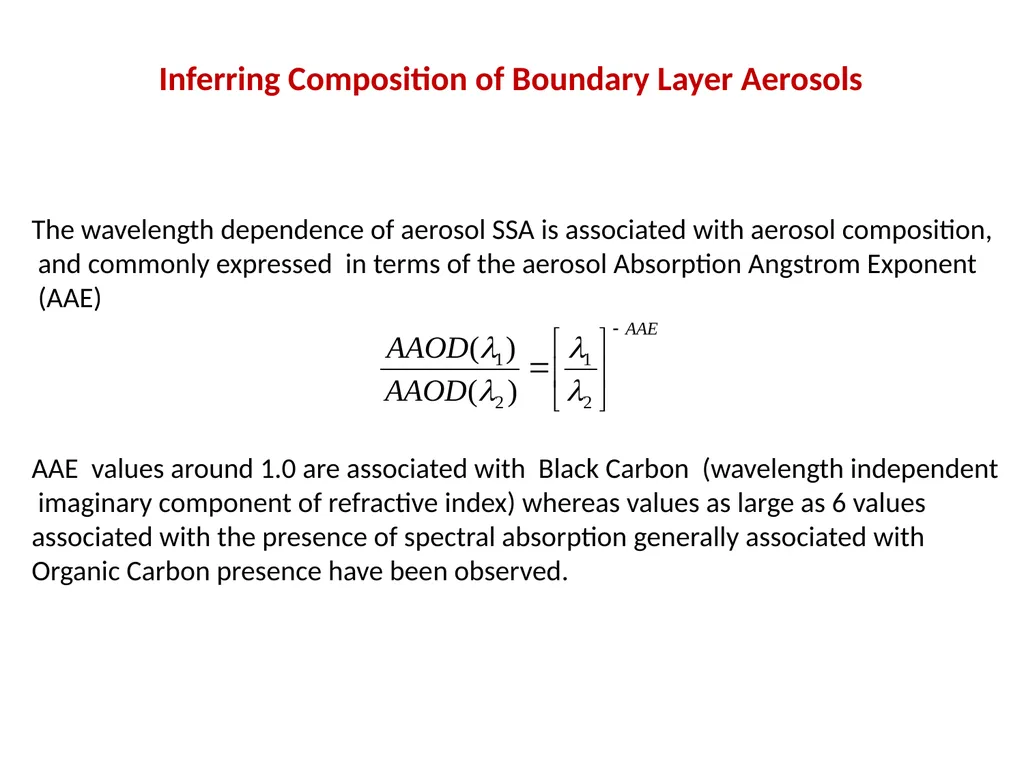
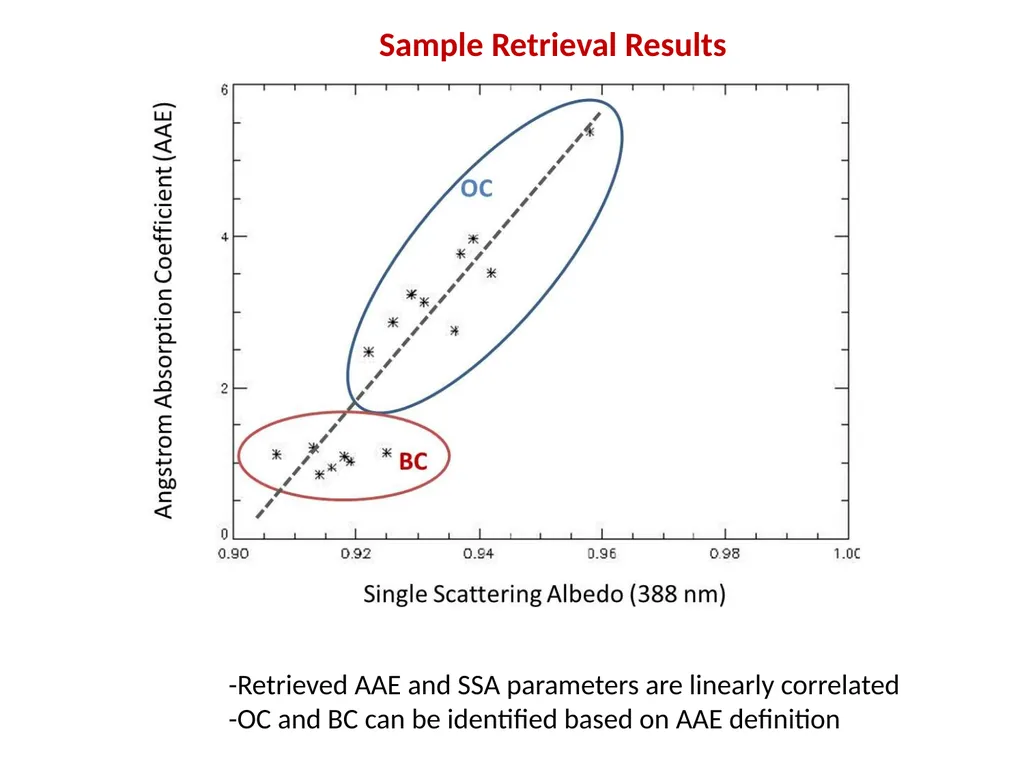
The wavelength dependence of aerosol SSA is associated with aerosol composition,
and commonly expressed in terms of the aerosol Absorption Angstrom Exponent
(AAE)
AAE values around 1.0 are associated with Black Carbon (wavelength independent
imaginary component of refractive index) whereas values as large as 6 values
associated with the presence of spectral absorption generally associated with
Organic Carbon presence have been observed. Inferring Composition of Boundary Layer Aerosols<br>
14
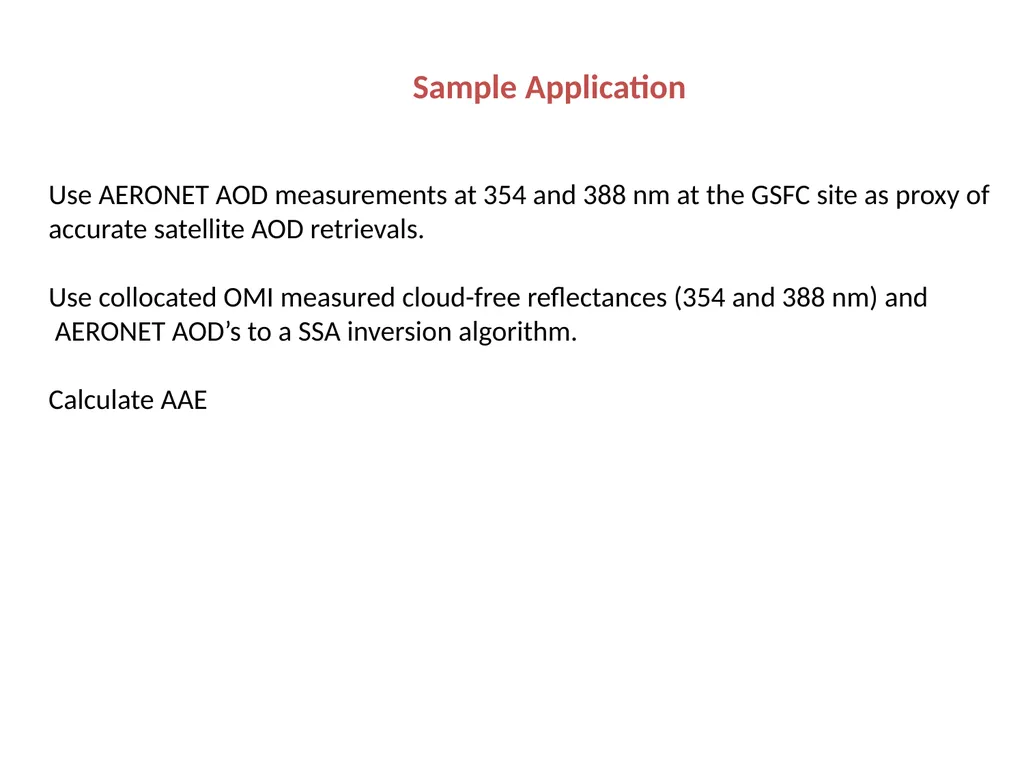
Sample Application Use AERONET AOD measurements at 354 and 388 nm at the GSFC site as proxy of
accurate satellite AOD retrievals.
Use collocated OMI measured cloud-free reflectances (354 and 388 nm) and
AERONET AOD’s to a SSA inversion algorithm.
Calculate AAE<br>
15
Sample Retrieval Results -Retrieved AAE and SSA parameters are linearly correlated
-OC and BC can be identified based on AAE definition<br>
16
Concluding Remarks Aerosol absorption information can be derived from satellite near UV-observations
The main source of uncertainty in derived products from heritage sensors (OMI) is
sub-pixel cloud contamination associated with coarse spatial resolution (13x24 km).
Although at TEMPO’s finer resolution the cloud contamination problem will be
reduced, it will still be the major source of uncertainty of retrieved aerosol products.
High resolution GOES-R ABI visible observations can provide a cloud mask to be
used by TEMPO
The combined use of GOES-R visible and TEMPO near UV measurements will
allow a better characterization of BL aerosols.<br>