
FPB AMENDMENT BILL:CRITICAL INPUTS FROM
EM
Published · 34 slides · 0 views
1 / 1
Description
FPB AMENDMENT BILL:CRITICAL INPUTS FROM PARLIAMENTARY PUBLIC HEARINGS 1 SA Communications Forum1 CommentsInputs (a) Child Sex Abuse Material is the preferred terminology to Child Pornography (b) Powers of Compliance monitors in section
Related Topics
Share
Embed code
Download this presentation From Below
"FPB AMENDMENT BILL:CRITICAL INPUTS FROM" is the property of its rightful owner. Permission is granted to download and print the materials on this website for personal, non-commercial use only, and to display it on your personal computer provided you do not modify the materials and that you retain all copyright notices contained in the materials. By downloading content from our website, you accept the terms of this agreement.
Presentation Transcript
01
FPB AMENDMENT BILL:CRITICAL INPUTS FROM PARLIAMENTARY PUBLIC HEARINGS 1<br>
02
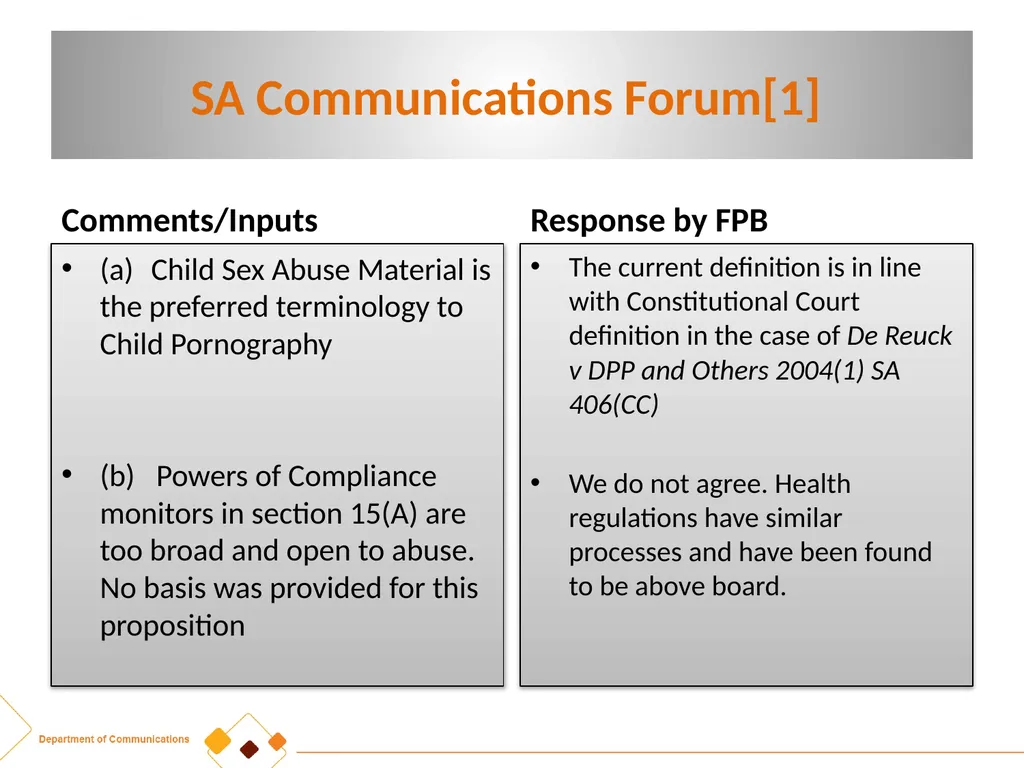
SA Communications Forum[1] Comments/Inputs (a) Child Sex Abuse Material is the preferred terminology to Child Pornography
(b) Powers of Compliance monitors in section 15(A) are too broad and open to abuse. No basis was provided for this proposition Response by FPB The current definition is in line with Constitutional Court definition in the case of De Reuck v DPP and Others 2004(1) SA 406(CC)
We do not agree. Health regulations have similar processes and have been found to be above board.<br>
(b) Powers of Compliance monitors in section 15(A) are too broad and open to abuse. No basis was provided for this proposition Response by FPB The current definition is in line with Constitutional Court definition in the case of De Reuck v DPP and Others 2004(1) SA 406(CC)
We do not agree. Health regulations have similar processes and have been found to be above board.<br>
03
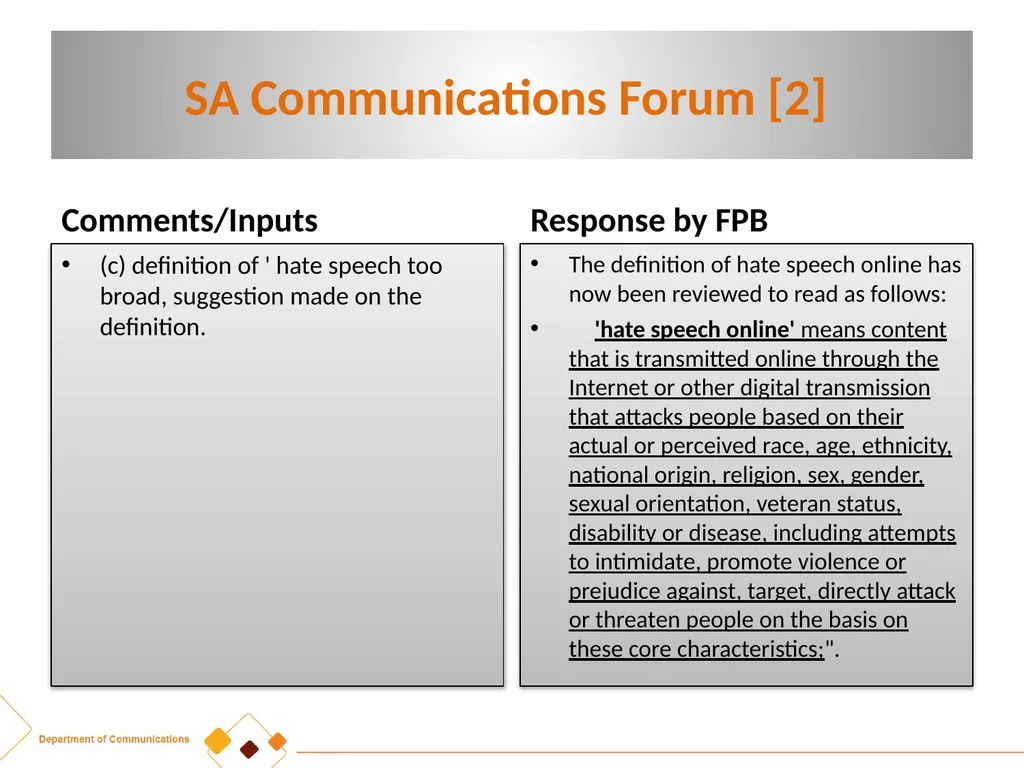
SA Communications Forum [2] Comments/Inputs (c) definition of ' hate speech too broad, suggestion made on the definition. Response by FPB The definition of hate speech online has now been reviewed to read as follows:
'hate speech online' means content that is transmitted online through the Internet or other digital transmission that attacks people based on their actual or perceived race, age, ethnicity, national origin, religion, sex, gender, sexual orientation, veteran status, disability or disease, including attempts to intimidate, promote violence or prejudice against, target, directly attack or threaten people on the basis on these core characteristics;".<br>
'hate speech online' means content that is transmitted online through the Internet or other digital transmission that attacks people based on their actual or perceived race, age, ethnicity, national origin, religion, sex, gender, sexual orientation, veteran status, disability or disease, including attempts to intimidate, promote violence or prejudice against, target, directly attack or threaten people on the basis on these core characteristics;".<br>
04
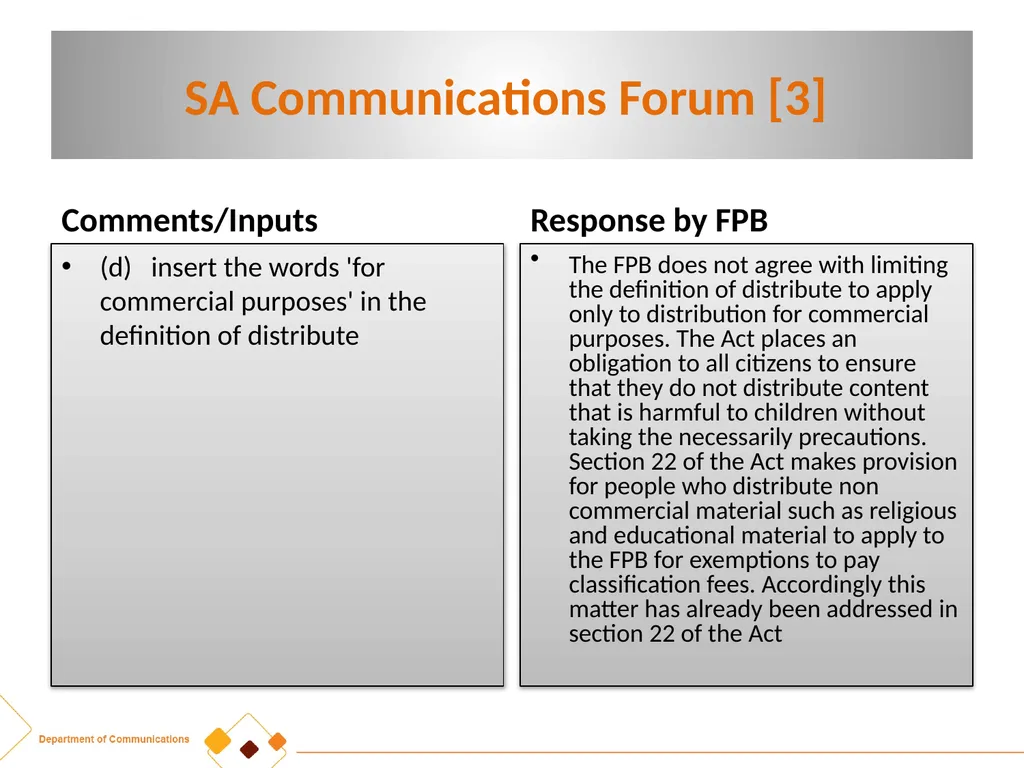
SA Communications Forum [3] Comments/Inputs (d) insert the words 'for commercial purposes' in the definition of distribute Response by FPB The FPB does not agree with limiting the definition of distribute to apply only to distribution for commercial purposes. The Act places an obligation to all citizens to ensure that they do not distribute content that is harmful to children without taking the necessarily precautions. Section 22 of the Act makes provision for people who distribute non commercial material such as religious and educational material to apply to the FPB for exemptions to pay classification fees. Accordingly this matter has already been addressed in section 22 of the Act<br>
05
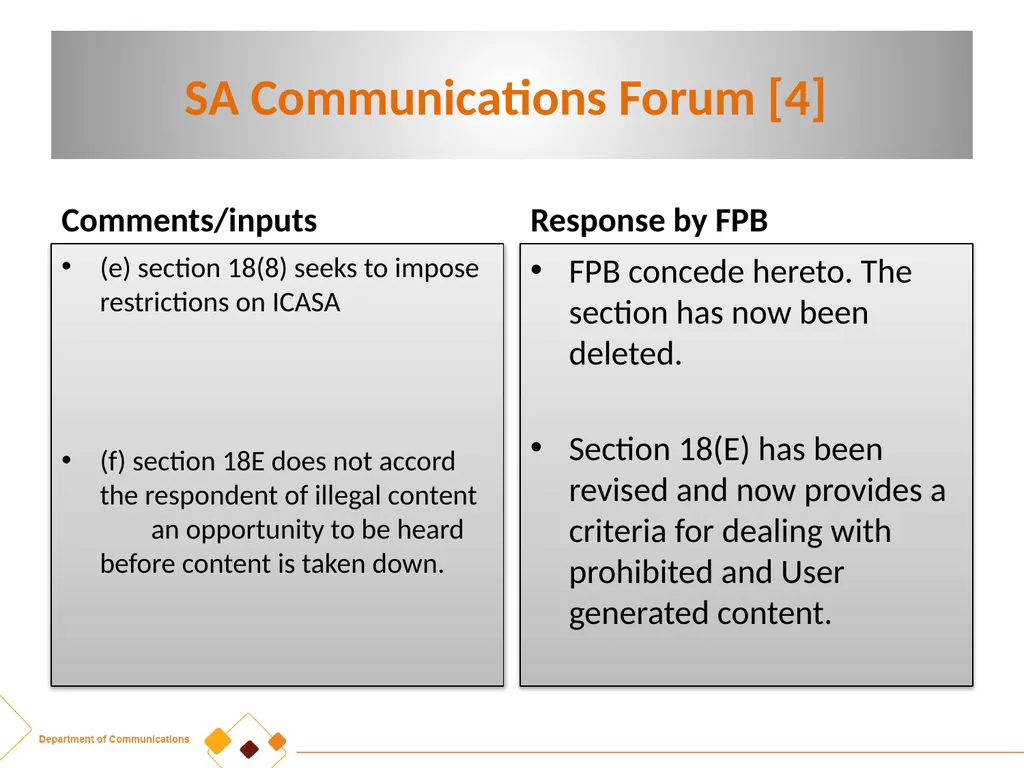
SA Communications Forum [4] Comments/inputs (e) section 18(8) seeks to impose restrictions on ICASA
(f) section 18E does not accord the respondent of illegal content an opportunity to be heard before content is taken down. Response by FPB FPB concede hereto. The section has now been deleted.
Section 18(E) has been revised and now provides a criteria for dealing with prohibited and User generated content.<br>
(f) section 18E does not accord the respondent of illegal content an opportunity to be heard before content is taken down. Response by FPB FPB concede hereto. The section has now been deleted.
Section 18(E) has been revised and now provides a criteria for dealing with prohibited and User generated content.<br>
06
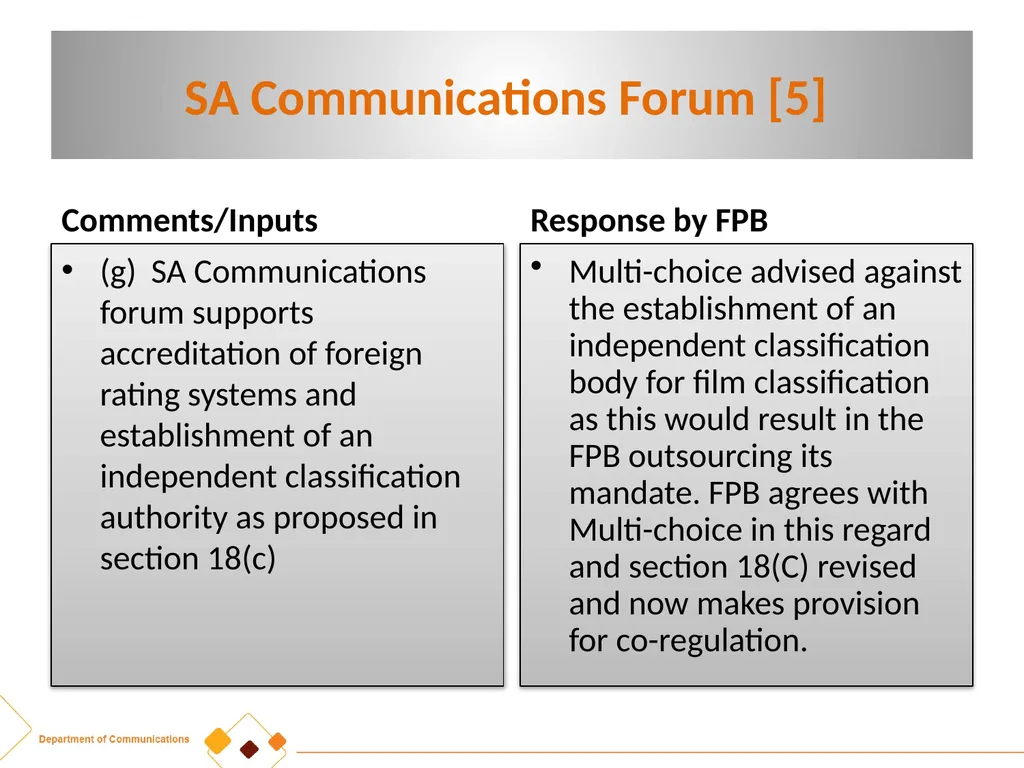
SA Communications Forum [5] Comments/Inputs (g) SA Communications forum supports accreditation of foreign rating systems and establishment of an independent classification authority as proposed in section 18(c) Response by FPB Multi-choice advised against the establishment of an independent classification body for film classification as this would result in the FPB outsourcing its mandate. FPB agrees with Multi-choice in this regard and section 18(C) revised and now makes provision for co-regulation.<br>
07
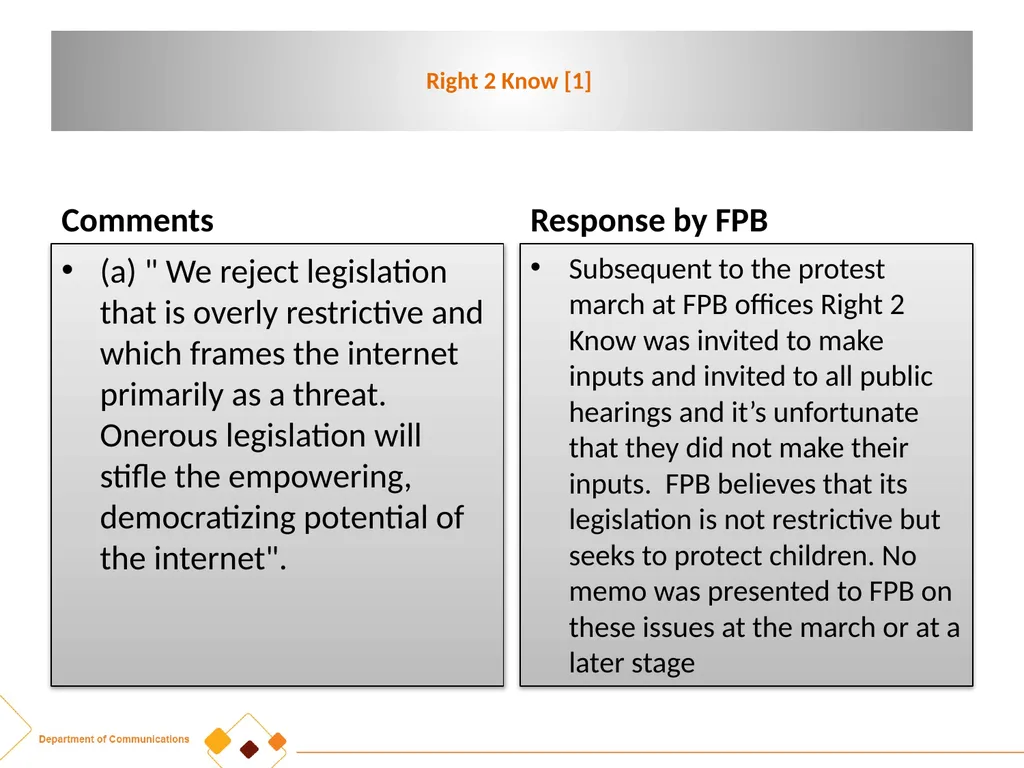
Right 2 Know [1] Comments (a) " We reject legislation that is overly restrictive and which frames the internet primarily as a threat. Onerous legislation will stifle the empowering, democratizing potential of the internet". Response by FPB Subsequent to the protest march at FPB offices Right 2 Know was invited to make inputs and invited to all public hearings and it’s unfortunate that they did not make their inputs. FPB believes that its legislation is not restrictive but seeks to protect children. No memo was presented to FPB on these issues at the march or at a later stage<br>
08
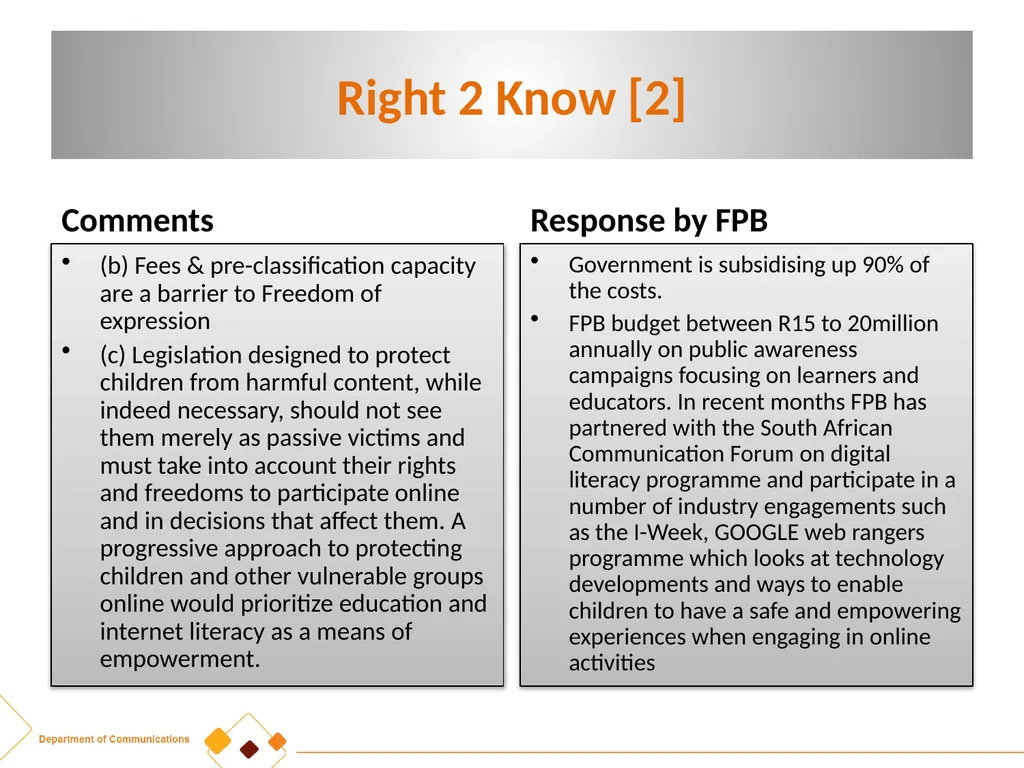
Right 2 Know [2] Comments (b) Fees & pre-classification capacity are a barrier to Freedom of expression
(c) Legislation designed to protect children from harmful content, while indeed necessary, should not see them merely as passive victims and must take into account their rights and freedoms to participate online and in decisions that affect them. A progressive approach to protecting children and other vulnerable groups online would prioritize education and internet literacy as a means of empowerment. Response by FPB Government is subsidising up 90% of the costs.
FPB budget between R15 to 20million annually on public awareness campaigns focusing on learners and educators. In recent months FPB has partnered with the South African Communication Forum on digital literacy programme and participate in a number of industry engagements such as the I-Week, GOOGLE web rangers programme which looks at technology developments and ways to enable children to have a safe and empowering experiences when engaging in online activities<br>
(c) Legislation designed to protect children from harmful content, while indeed necessary, should not see them merely as passive victims and must take into account their rights and freedoms to participate online and in decisions that affect them. A progressive approach to protecting children and other vulnerable groups online would prioritize education and internet literacy as a means of empowerment. Response by FPB Government is subsidising up 90% of the costs.
FPB budget between R15 to 20million annually on public awareness campaigns focusing on learners and educators. In recent months FPB has partnered with the South African Communication Forum on digital literacy programme and participate in a number of industry engagements such as the I-Week, GOOGLE web rangers programme which looks at technology developments and ways to enable children to have a safe and empowering experiences when engaging in online activities<br>
09
Right 2 Know [3] Comments (d) Pre-publication censorship is unconstitutional. Response by FPB Refer to response to Interactive Entertainment South Africa<br>
10
NAB, ICASA, SABC, e.tv. and
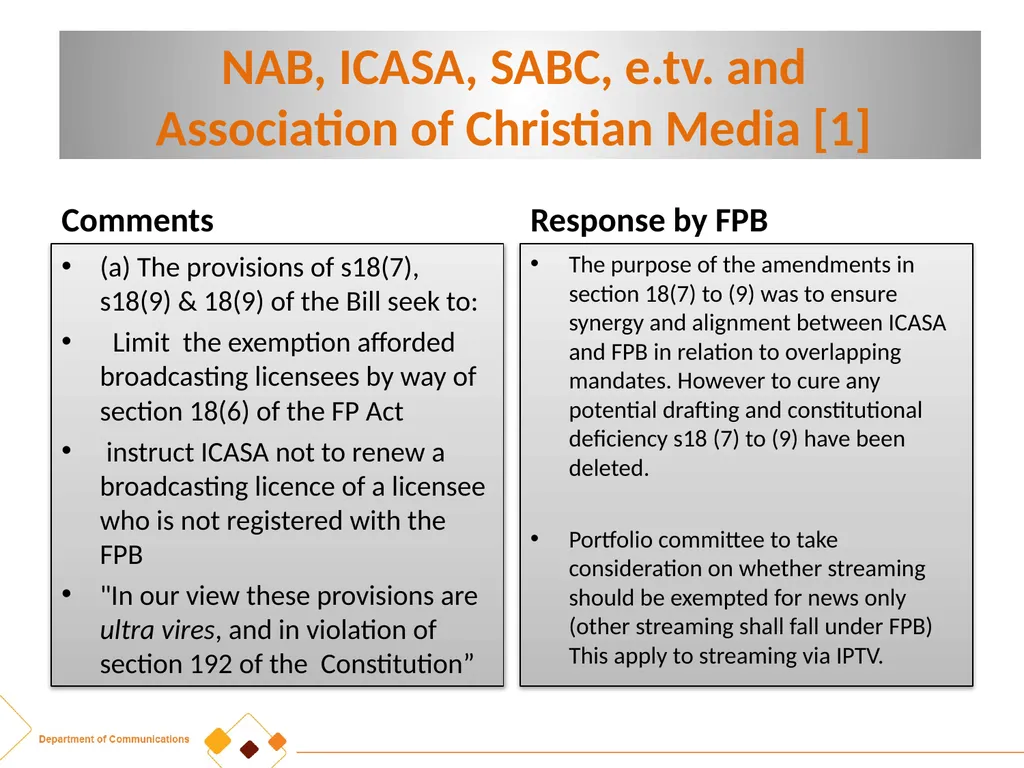
Association of Christian Media [1] Comments (a) The provisions of s18(7), s18(9) & 18(9) of the Bill seek to:
Limit the exemption afforded broadcasting licensees by way of section 18(6) of the FP Act
instruct ICASA not to renew a broadcasting licence of a licensee who is not registered with the FPB
"In our view these provisions are ultra vires, and in violation of section 192 of the Constitution” Response by FPB The purpose of the amendments in section 18(7) to (9) was to ensure synergy and alignment between ICASA and FPB in relation to overlapping mandates. However to cure any potential drafting and constitutional deficiency s18 (7) to (9) have been deleted.
Portfolio committee to take consideration on whether streaming should be exempted for news only (other streaming shall fall under FPB) This apply to streaming via IPTV.<br>
Limit the exemption afforded broadcasting licensees by way of section 18(6) of the FP Act
instruct ICASA not to renew a broadcasting licence of a licensee who is not registered with the FPB
"In our view these provisions are ultra vires, and in violation of section 192 of the Constitution” Response by FPB The purpose of the amendments in section 18(7) to (9) was to ensure synergy and alignment between ICASA and FPB in relation to overlapping mandates. However to cure any potential drafting and constitutional deficiency s18 (7) to (9) have been deleted.
Portfolio committee to take consideration on whether streaming should be exempted for news only (other streaming shall fall under FPB) This apply to streaming via IPTV.<br>
11
NAB, ICASA, SABC, e.tv. and
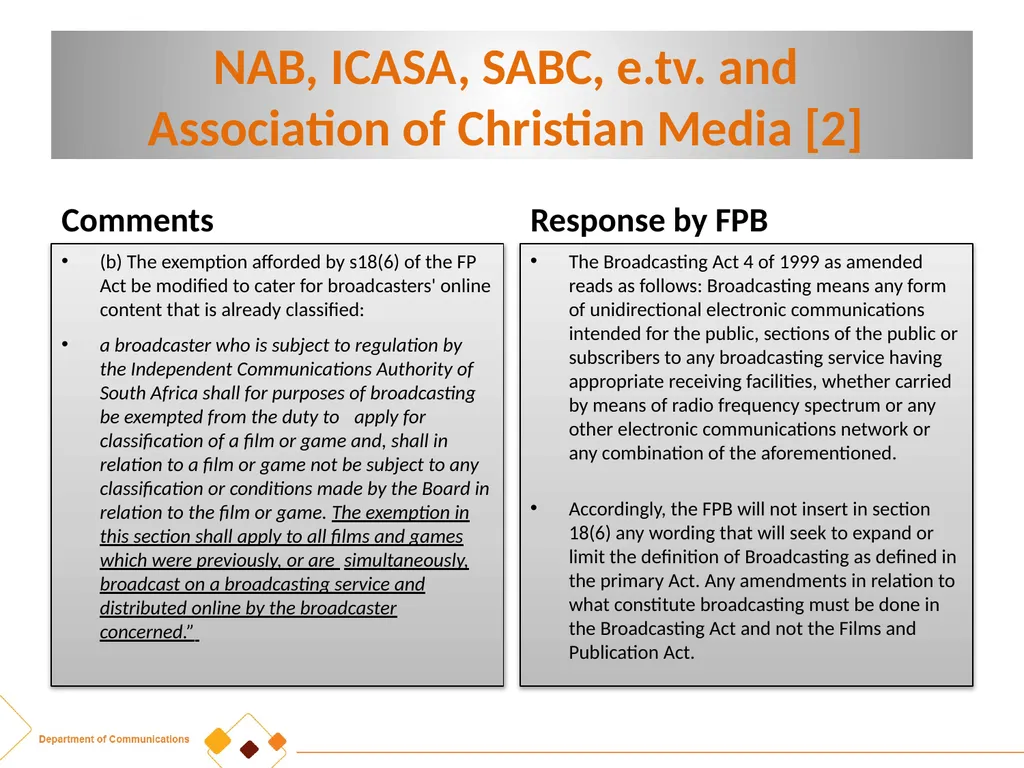
Association of Christian Media [2] Comments (b) The exemption afforded by s18(6) of the FP Act be modified to cater for broadcasters' online content that is already classified:
a broadcaster who is subject to regulation by the Independent Communications Authority of South Africa shall for purposes of broadcasting be exempted from the duty to apply for classification of a film or game and, shall in relation to a film or game not be subject to any classification or conditions made by the Board in relation to the film or game. The exemption in this section shall apply to all films and games which were previously, or are simultaneously, broadcast on a broadcasting service and distributed online by the broadcaster concerned.” Response by FPB The Broadcasting Act 4 of 1999 as amended reads as follows: Broadcasting means any form of unidirectional electronic communications intended for the public, sections of the public or subscribers to any broadcasting service having appropriate receiving facilities, whether carried by means of radio frequency spectrum or any other electronic communications network or any combination of the aforementioned.
Accordingly, the FPB will not insert in section 18(6) any wording that will seek to expand or limit the definition of Broadcasting as defined in the primary Act. Any amendments in relation to what constitute broadcasting must be done in the Broadcasting Act and not the Films and Publication Act.<br>
a broadcaster who is subject to regulation by the Independent Communications Authority of South Africa shall for purposes of broadcasting be exempted from the duty to apply for classification of a film or game and, shall in relation to a film or game not be subject to any classification or conditions made by the Board in relation to the film or game. The exemption in this section shall apply to all films and games which were previously, or are simultaneously, broadcast on a broadcasting service and distributed online by the broadcaster concerned.” Response by FPB The Broadcasting Act 4 of 1999 as amended reads as follows: Broadcasting means any form of unidirectional electronic communications intended for the public, sections of the public or subscribers to any broadcasting service having appropriate receiving facilities, whether carried by means of radio frequency spectrum or any other electronic communications network or any combination of the aforementioned.
Accordingly, the FPB will not insert in section 18(6) any wording that will seek to expand or limit the definition of Broadcasting as defined in the primary Act. Any amendments in relation to what constitute broadcasting must be done in the Broadcasting Act and not the Films and Publication Act.<br>
12
NAB, ICASA, SABC, e.tv. and
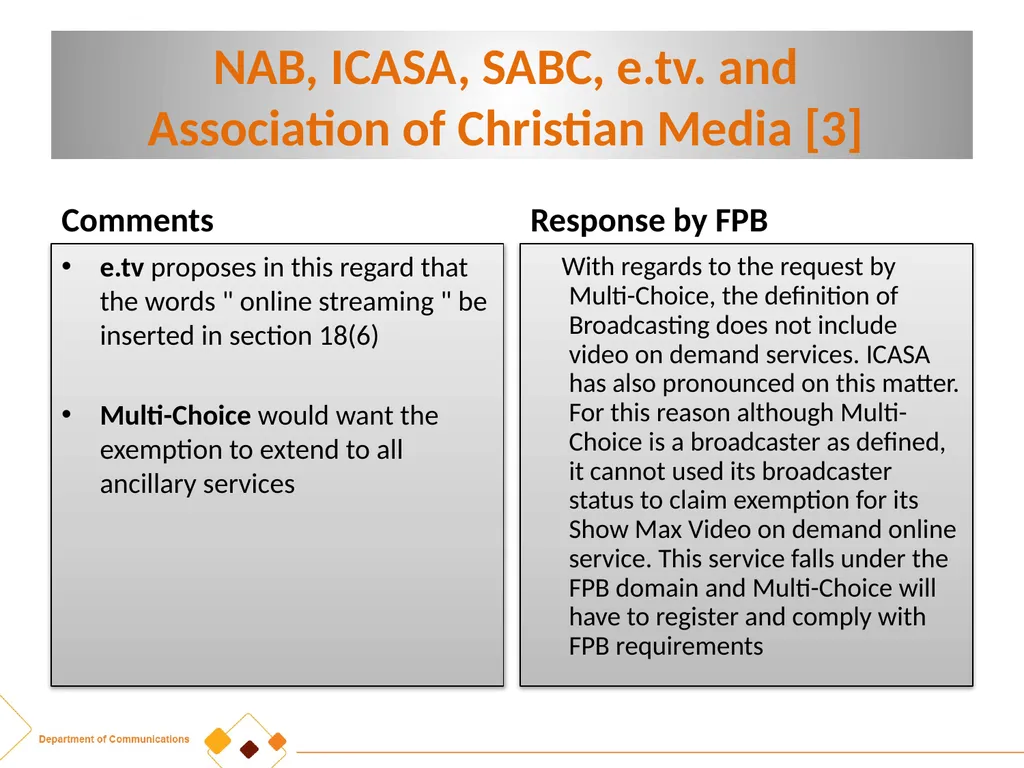
Association of Christian Media [3] Comments e.tv proposes in this regard that the words " online streaming " be inserted in section 18(6)
Multi-Choice would want the exemption to extend to all ancillary services Response by FPB With regards to the request by Multi-Choice, the definition of Broadcasting does not include video on demand services. ICASA has also pronounced on this matter. For this reason although Multi-Choice is a broadcaster as defined, it cannot used its broadcaster status to claim exemption for its Show Max Video on demand online service. This service falls under the FPB domain and Multi-Choice will have to register and comply with FPB requirements<br>
Multi-Choice would want the exemption to extend to all ancillary services Response by FPB With regards to the request by Multi-Choice, the definition of Broadcasting does not include video on demand services. ICASA has also pronounced on this matter. For this reason although Multi-Choice is a broadcaster as defined, it cannot used its broadcaster status to claim exemption for its Show Max Video on demand online service. This service falls under the FPB domain and Multi-Choice will have to register and comply with FPB requirements<br>
13
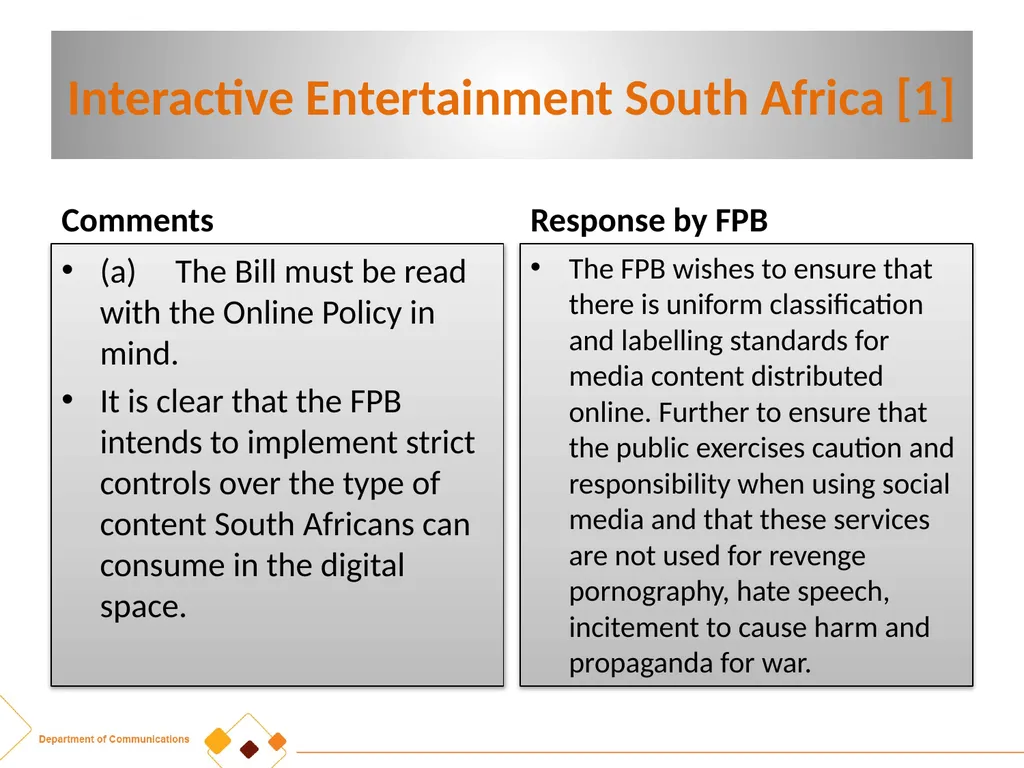
Interactive Entertainment South Africa [1] Comments (a) The Bill must be read with the Online Policy in mind.
It is clear that the FPB intends to implement strict controls over the type of content South Africans can consume in the digital space. Response by FPB The FPB wishes to ensure that there is uniform classification and labelling standards for media content distributed online. Further to ensure that the public exercises caution and responsibility when using social media and that these services are not used for revenge pornography, hate speech, incitement to cause harm and propaganda for war.<br>
It is clear that the FPB intends to implement strict controls over the type of content South Africans can consume in the digital space. Response by FPB The FPB wishes to ensure that there is uniform classification and labelling standards for media content distributed online. Further to ensure that the public exercises caution and responsibility when using social media and that these services are not used for revenge pornography, hate speech, incitement to cause harm and propaganda for war.<br>
14
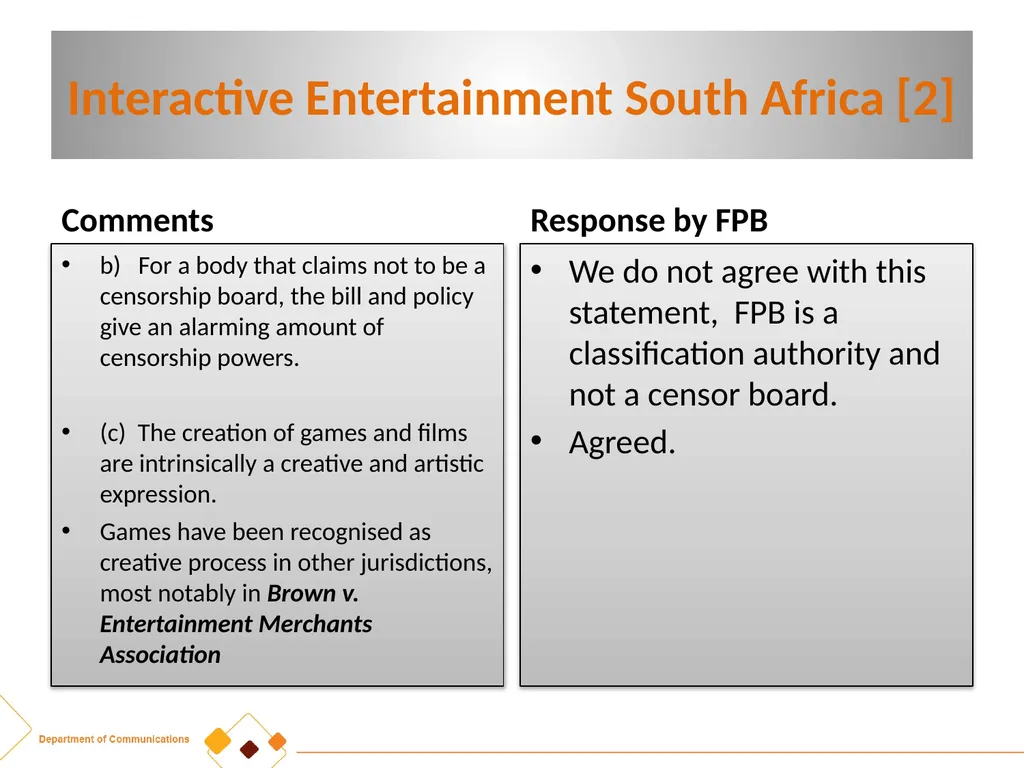
Interactive Entertainment South Africa [2] Comments b) For a body that claims not to be a censorship board, the bill and policy give an alarming amount of censorship powers.
(c) The creation of games and films are intrinsically a creative and artistic expression.
Games have been recognised as creative process in other jurisdictions, most notably in Brown v. Entertainment Merchants Association Response by FPB We do not agree with this statement, FPB is a classification authority and not a censor board.
Agreed.<br>
(c) The creation of games and films are intrinsically a creative and artistic expression.
Games have been recognised as creative process in other jurisdictions, most notably in Brown v. Entertainment Merchants Association Response by FPB We do not agree with this statement, FPB is a classification authority and not a censor board.
Agreed.<br>
15
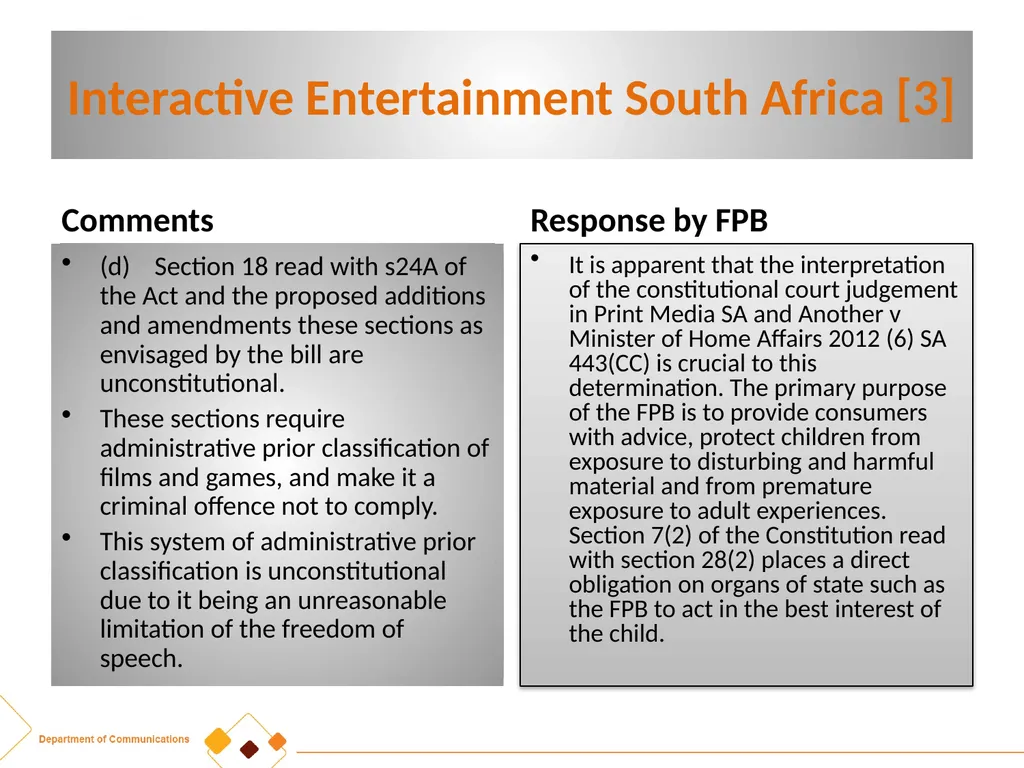
Interactive Entertainment South Africa [3] Comments (d) Section 18 read with s24A of the Act and the proposed additions and amendments these sections as envisaged by the bill are unconstitutional.
These sections require administrative prior classification of films and games, and make it a criminal offence not to comply.
This system of administrative prior classification is unconstitutional due to it being an unreasonable limitation of the freedom of speech. Response by FPB It is apparent that the interpretation of the constitutional court judgement in Print Media SA and Another v Minister of Home Affairs 2012 (6) SA 443(CC) is crucial to this determination. The primary purpose of the FPB is to provide consumers with advice, protect children from exposure to disturbing and harmful material and from premature exposure to adult experiences. Section 7(2) of the Constitution read with section 28(2) places a direct obligation on organs of state such as the FPB to act in the best interest of the child.<br>
These sections require administrative prior classification of films and games, and make it a criminal offence not to comply.
This system of administrative prior classification is unconstitutional due to it being an unreasonable limitation of the freedom of speech. Response by FPB It is apparent that the interpretation of the constitutional court judgement in Print Media SA and Another v Minister of Home Affairs 2012 (6) SA 443(CC) is crucial to this determination. The primary purpose of the FPB is to provide consumers with advice, protect children from exposure to disturbing and harmful material and from premature exposure to adult experiences. Section 7(2) of the Constitution read with section 28(2) places a direct obligation on organs of state such as the FPB to act in the best interest of the child.<br>
16
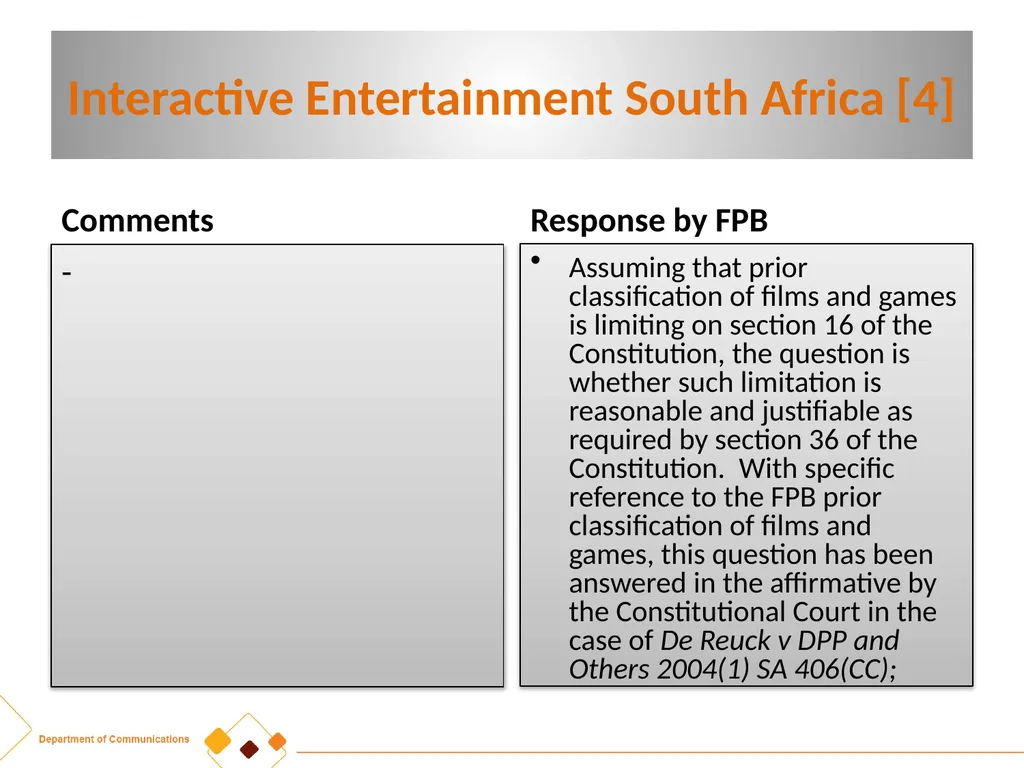
Interactive Entertainment South Africa [4] Comments - Response by FPB Assuming that prior classification of films and games is limiting on section 16 of the Constitution, the question is whether such limitation is reasonable and justifiable as required by section 36 of the Constitution. With specific reference to the FPB prior classification of films and games, this question has been answered in the affirmative by the Constitutional Court in the case of De Reuck v DPP and Others 2004(1) SA 406(CC);<br>
17
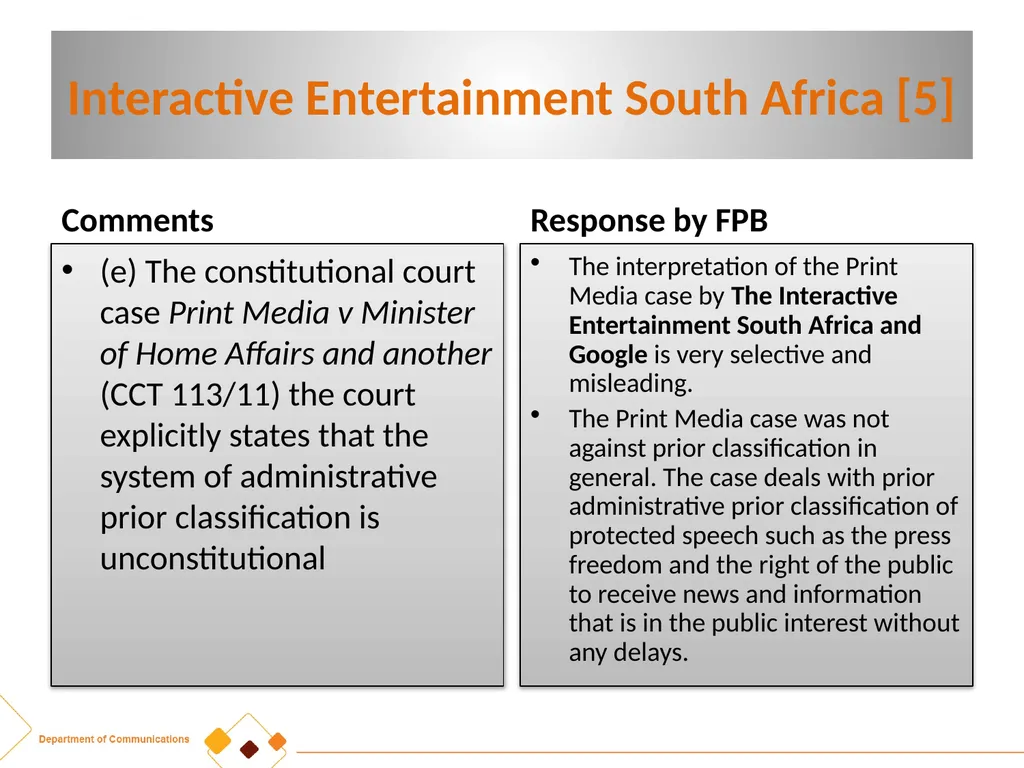
Interactive Entertainment South Africa [5] Comments (e) The constitutional court case Print Media v Minister of Home Affairs and another (CCT 113/11) the court explicitly states that the system of administrative prior classification is unconstitutional Response by FPB The interpretation of the Print Media case by The Interactive Entertainment South Africa and Google is very selective and misleading.
The Print Media case was not against prior classification in general. The case deals with prior administrative prior classification of protected speech such as the press freedom and the right of the public to receive news and information that is in the public interest without any delays.<br>
The Print Media case was not against prior classification in general. The case deals with prior administrative prior classification of protected speech such as the press freedom and the right of the public to receive news and information that is in the public interest without any delays.<br>
18
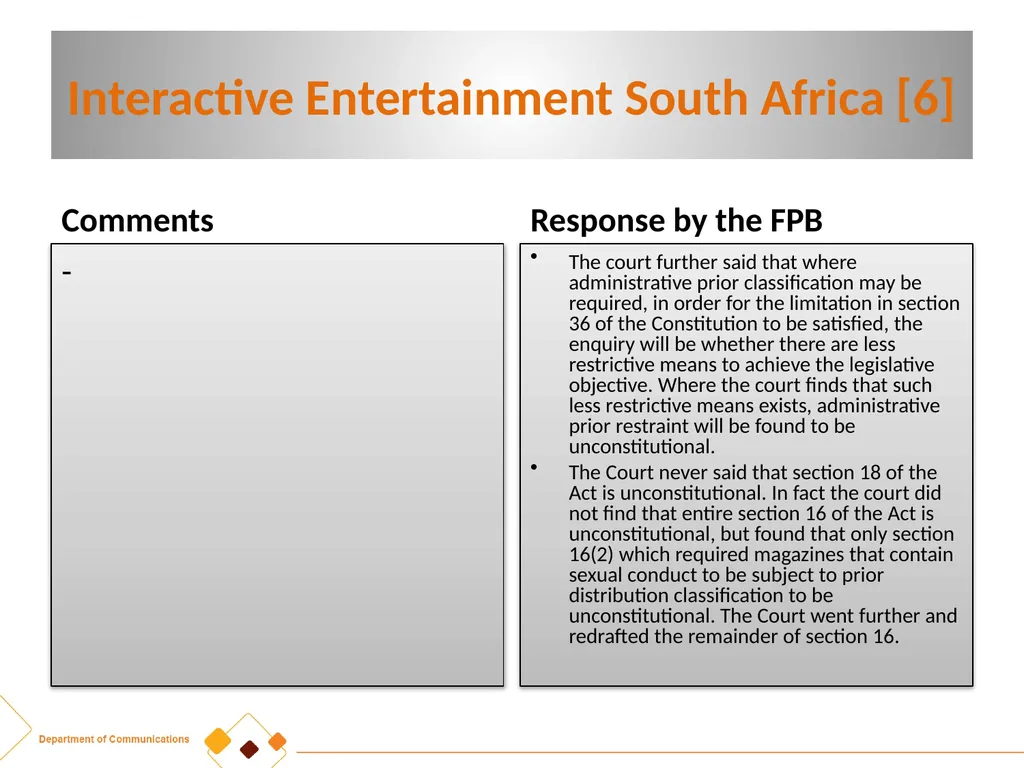
Interactive Entertainment South Africa [6] Comments - Response by the FPB The court further said that where administrative prior classification may be required, in order for the limitation in section 36 of the Constitution to be satisfied, the enquiry will be whether there are less restrictive means to achieve the legislative objective. Where the court finds that such less restrictive means exists, administrative prior restraint will be found to be unconstitutional.
The Court never said that section 18 of the Act is unconstitutional. In fact the court did not find that entire section 16 of the Act is unconstitutional, but found that only section 16(2) which required magazines that contain sexual conduct to be subject to prior distribution classification to be unconstitutional. The Court went further and redrafted the remainder of section 16.<br>
The Court never said that section 18 of the Act is unconstitutional. In fact the court did not find that entire section 16 of the Act is unconstitutional, but found that only section 16(2) which required magazines that contain sexual conduct to be subject to prior distribution classification to be unconstitutional. The Court went further and redrafted the remainder of section 16.<br>
19
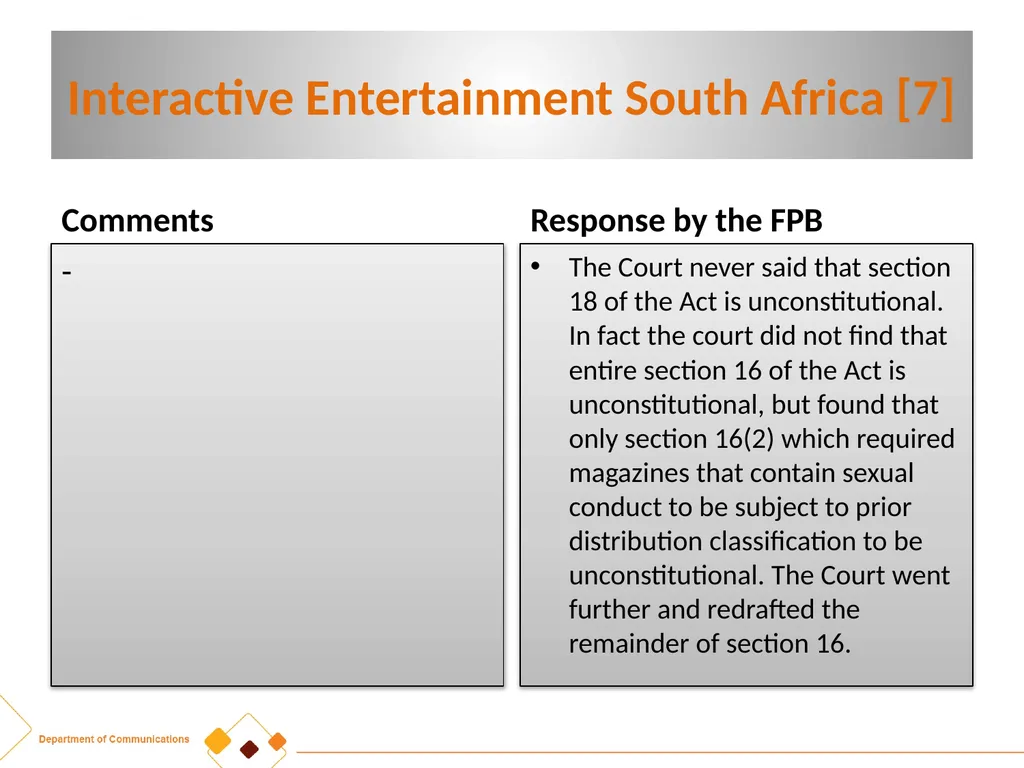
Interactive Entertainment South Africa [7] Comments - Response by the FPB The Court never said that section 18 of the Act is unconstitutional. In fact the court did not find that entire section 16 of the Act is unconstitutional, but found that only section 16(2) which required magazines that contain sexual conduct to be subject to prior distribution classification to be unconstitutional. The Court went further and redrafted the remainder of section 16.<br>
20
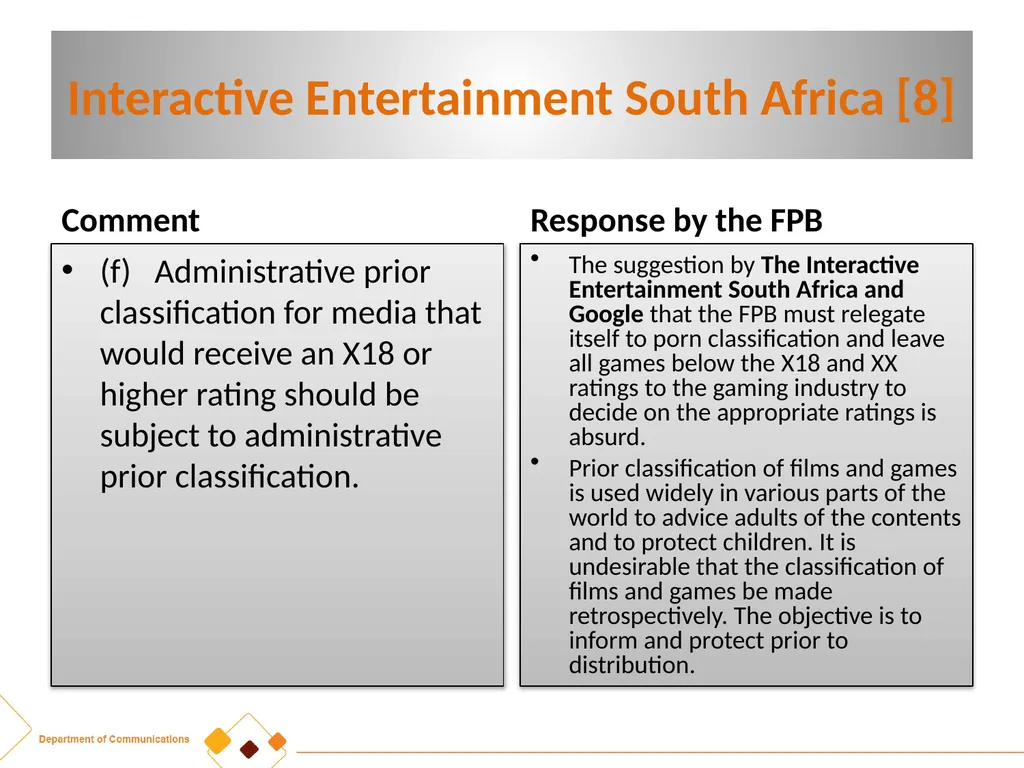
Interactive Entertainment South Africa [8] Comment (f) Administrative prior classification for media that would receive an X18 or higher rating should be subject to administrative prior classification. Response by the FPB The suggestion by The Interactive Entertainment South Africa and Google that the FPB must relegate itself to porn classification and leave all games below the X18 and XX ratings to the gaming industry to decide on the appropriate ratings is absurd.
Prior classification of films and games is used widely in various parts of the world to advice adults of the contents and to protect children. It is undesirable that the classification of films and games be made retrospectively. The objective is to inform and protect prior to distribution.<br>
Prior classification of films and games is used widely in various parts of the world to advice adults of the contents and to protect children. It is undesirable that the classification of films and games be made retrospectively. The objective is to inform and protect prior to distribution.<br>
21
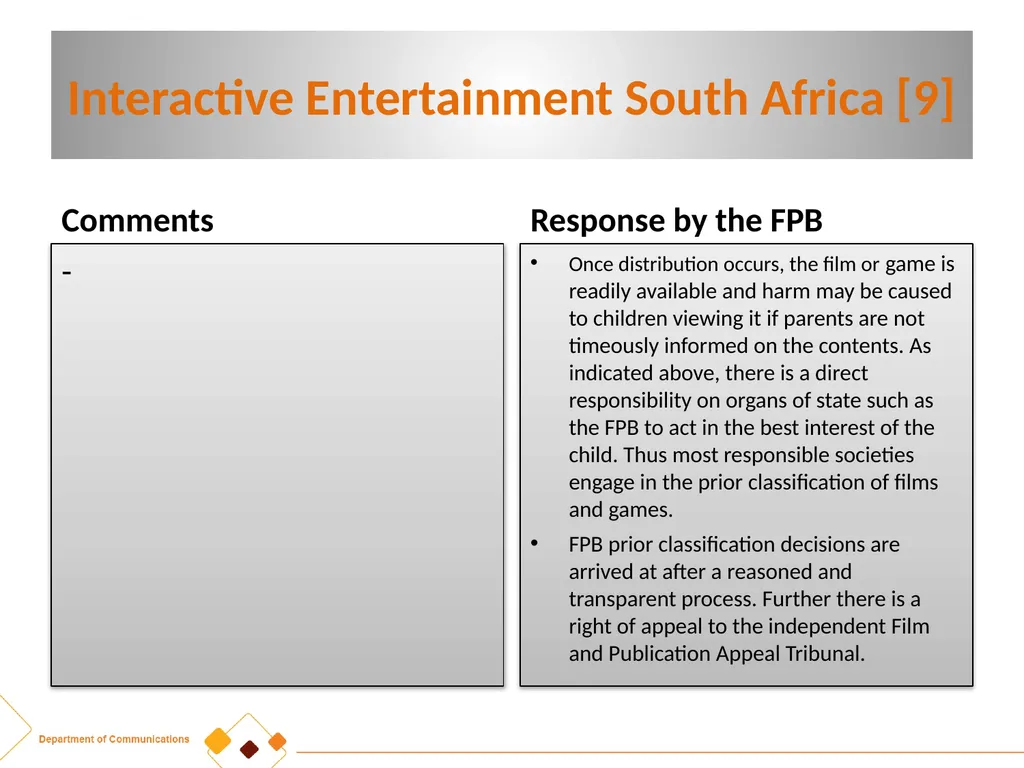
Interactive Entertainment South Africa [9] Comments - Response by the FPB Once distribution occurs, the film or game is readily available and harm may be caused to children viewing it if parents are not timeously informed on the contents. As indicated above, there is a direct responsibility on organs of state such as the FPB to act in the best interest of the child. Thus most responsible societies engage in the prior classification of films and games.
FPB prior classification decisions are arrived at after a reasoned and transparent process. Further there is a right of appeal to the independent Film and Publication Appeal Tribunal.<br>
FPB prior classification decisions are arrived at after a reasoned and transparent process. Further there is a right of appeal to the independent Film and Publication Appeal Tribunal.<br>
22
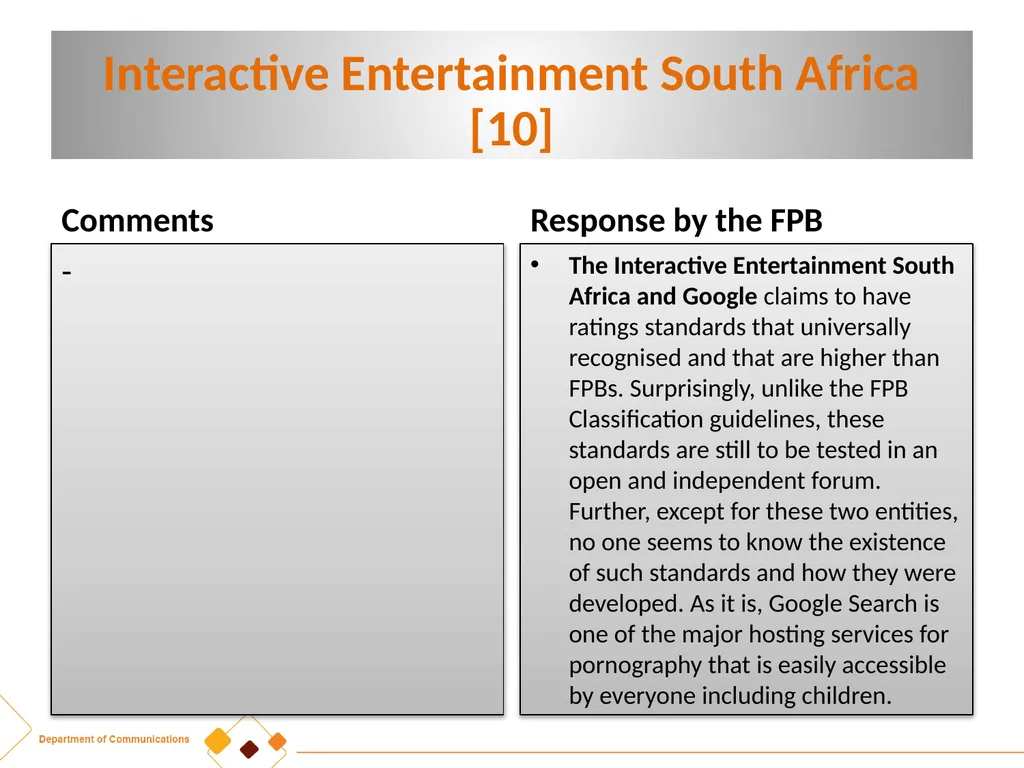
Interactive Entertainment South Africa [10] Comments - Response by the FPB The Interactive Entertainment South Africa and Google claims to have ratings standards that universally recognised and that are higher than FPBs. Surprisingly, unlike the FPB Classification guidelines, these standards are still to be tested in an open and independent forum. Further, except for these two entities, no one seems to know the existence of such standards and how they were developed. As it is, Google Search is one of the major hosting services for pornography that is easily accessible by everyone including children.<br>
23
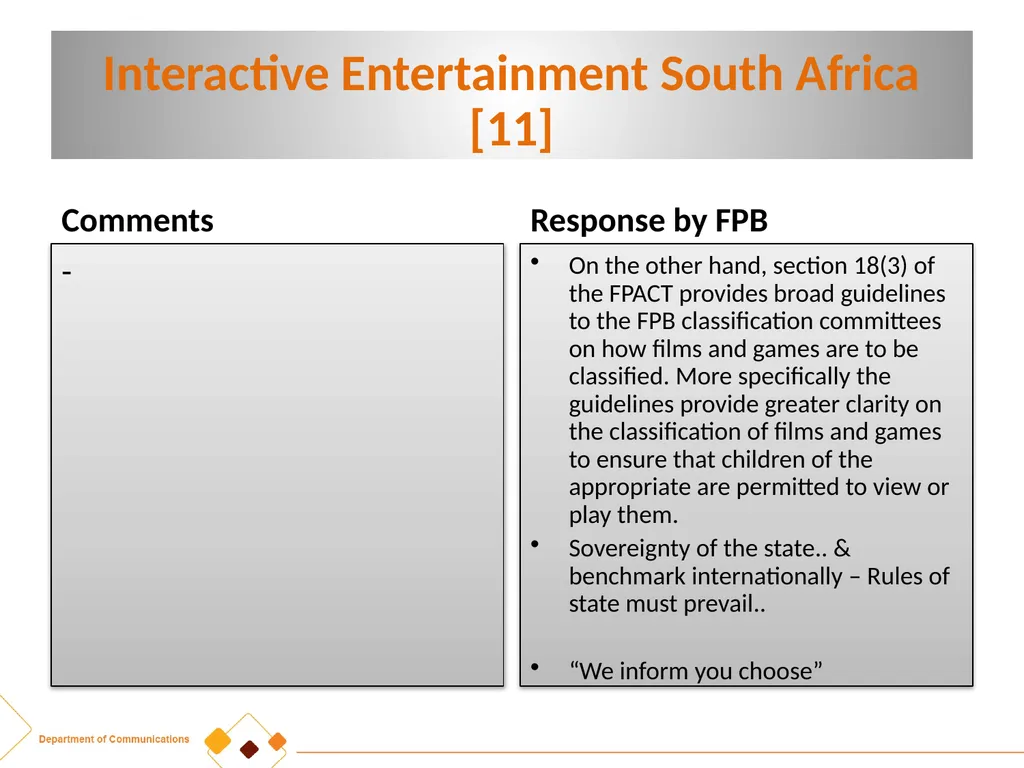
Interactive Entertainment South Africa [11] Comments - Response by FPB On the other hand, section 18(3) of the FPACT provides broad guidelines to the FPB classification committees on how films and games are to be classified. More specifically the guidelines provide greater clarity on the classification of films and games to ensure that children of the appropriate are permitted to view or play them.
Sovereignty of the state.. & benchmark internationally – Rules of state must prevail..
“We inform you choose”<br>
Sovereignty of the state.. & benchmark internationally – Rules of state must prevail..
“We inform you choose”<br>
24
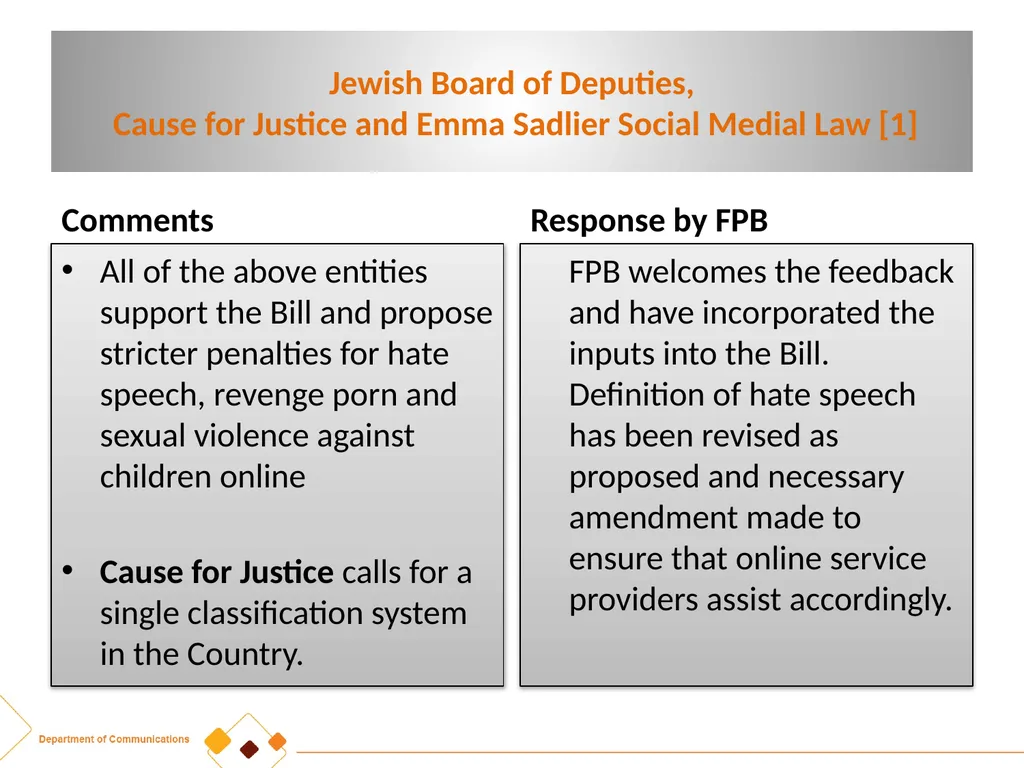
Jewish Board of Deputies,
Cause for Justice and Emma Sadlier Social Medial Law [1] Comments All of the above entities support the Bill and propose stricter penalties for hate speech, revenge porn and sexual violence against children online
Cause for Justice calls for a single classification system in the Country. Response by FPB FPB welcomes the feedback and have incorporated the inputs into the Bill. Definition of hate speech has been revised as proposed and necessary amendment made to ensure that online service providers assist accordingly.<br>
Cause for Justice calls for a single classification system in the Country. Response by FPB FPB welcomes the feedback and have incorporated the inputs into the Bill. Definition of hate speech has been revised as proposed and necessary amendment made to ensure that online service providers assist accordingly.<br>
25
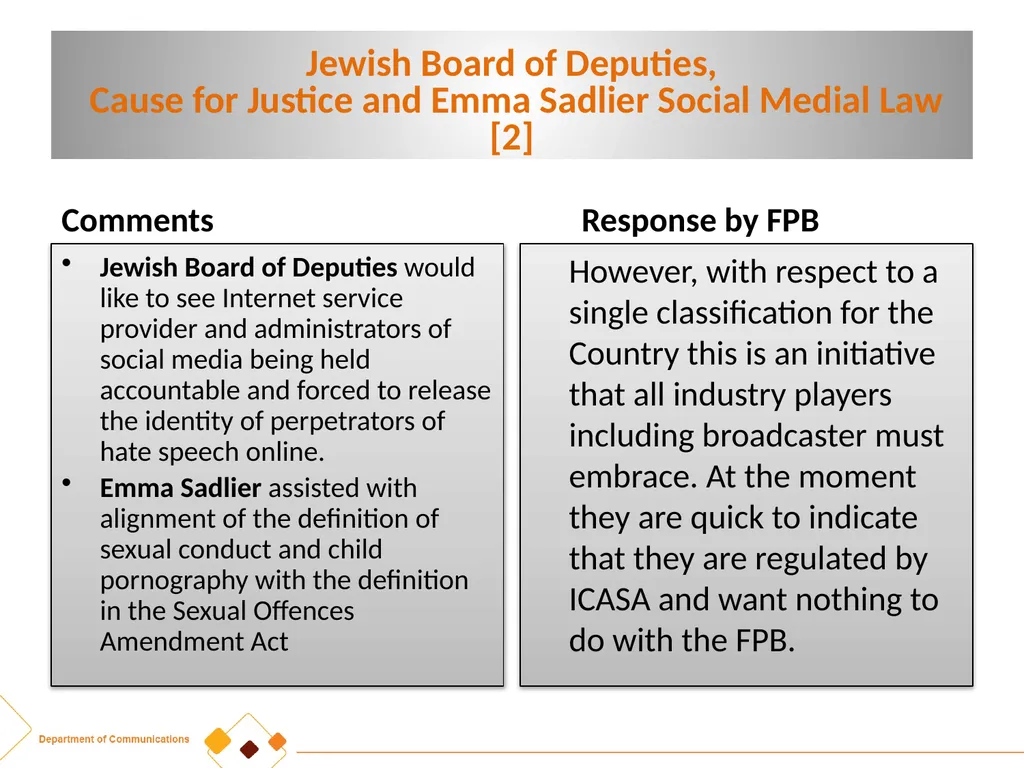
Jewish Board of Deputies,
Cause for Justice and Emma Sadlier Social Medial Law [2] Comments Jewish Board of Deputies would like to see Internet service provider and administrators of social media being held accountable and forced to release the identity of perpetrators of hate speech online.
Emma Sadlier assisted with alignment of the definition of sexual conduct and child pornography with the definition in the Sexual Offences Amendment Act Response by FPB However, with respect to a single classification for the Country this is an initiative that all industry players including broadcaster must embrace. At the moment they are quick to indicate that they are regulated by ICASA and want nothing to do with the FPB.<br>
Emma Sadlier assisted with alignment of the definition of sexual conduct and child pornography with the definition in the Sexual Offences Amendment Act Response by FPB However, with respect to a single classification for the Country this is an initiative that all industry players including broadcaster must embrace. At the moment they are quick to indicate that they are regulated by ICASA and want nothing to do with the FPB.<br>
26
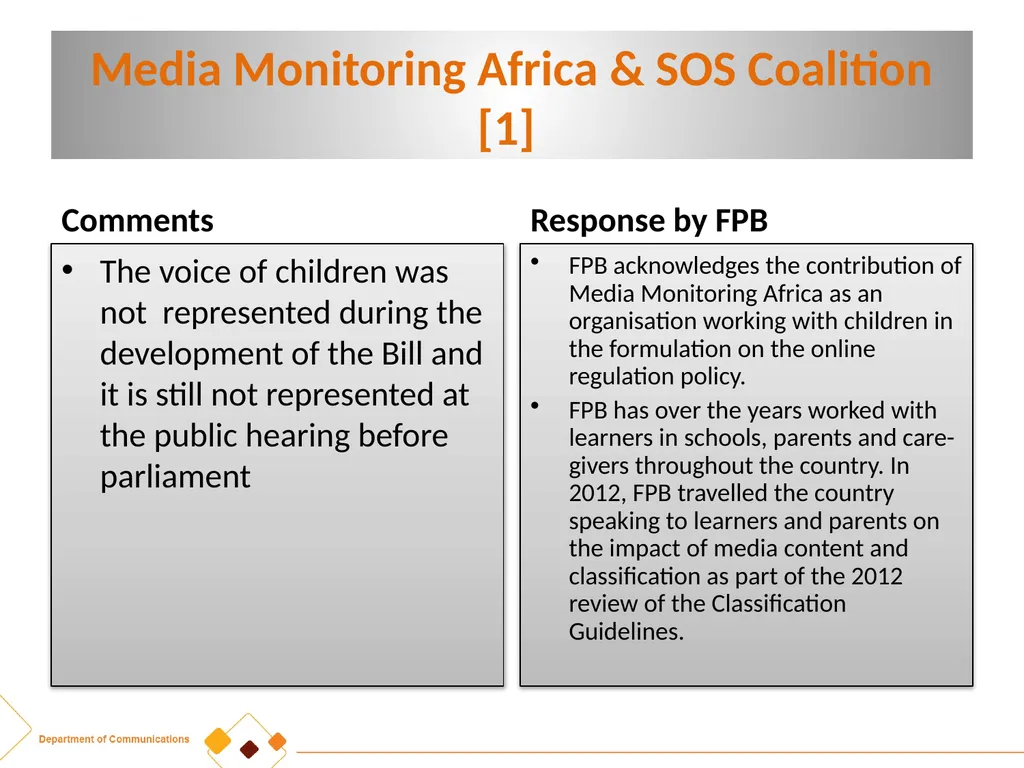
Media Monitoring Africa & SOS Coalition [1] Comments The voice of children was not represented during the development of the Bill and it is still not represented at the public hearing before parliament Response by FPB FPB acknowledges the contribution of Media Monitoring Africa as an organisation working with children in the formulation on the online regulation policy.
FPB has over the years worked with learners in schools, parents and care-givers throughout the country. In 2012, FPB travelled the country speaking to learners and parents on the impact of media content and classification as part of the 2012 review of the Classification Guidelines.<br>
FPB has over the years worked with learners in schools, parents and care-givers throughout the country. In 2012, FPB travelled the country speaking to learners and parents on the impact of media content and classification as part of the 2012 review of the Classification Guidelines.<br>
27
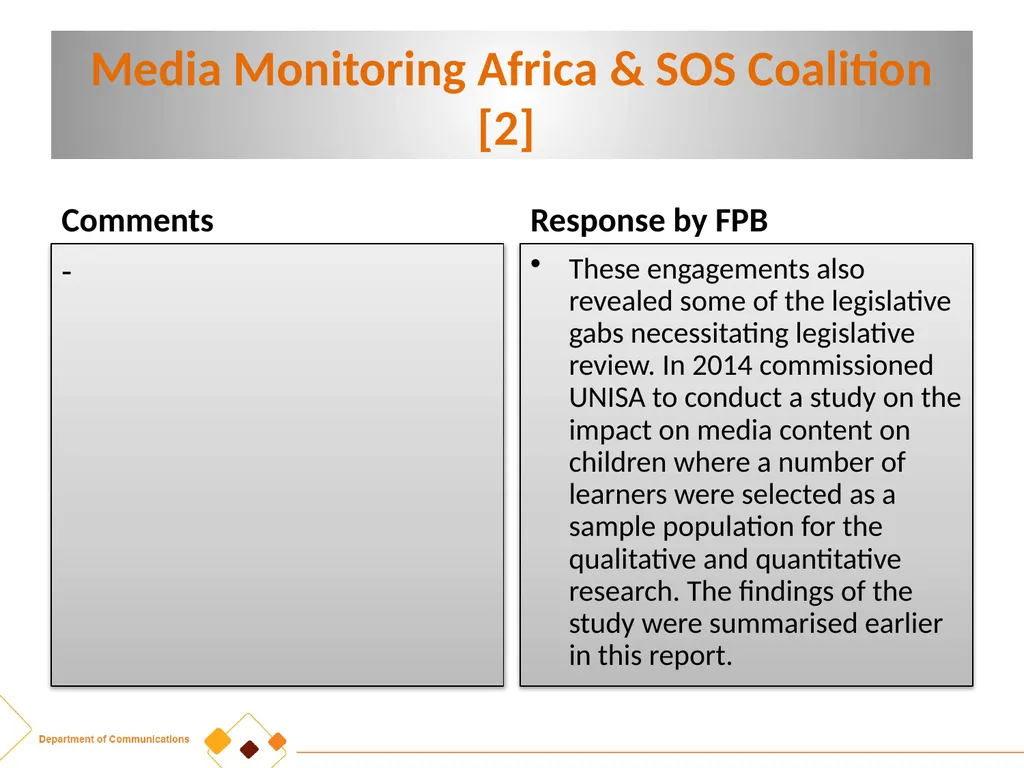
Media Monitoring Africa & SOS Coalition [2] Comments - Response by FPB These engagements also revealed some of the legislative gabs necessitating legislative review. In 2014 commissioned UNISA to conduct a study on the impact on media content on children where a number of learners were selected as a sample population for the qualitative and quantitative research. The findings of the study were summarised earlier in this report.<br>
28
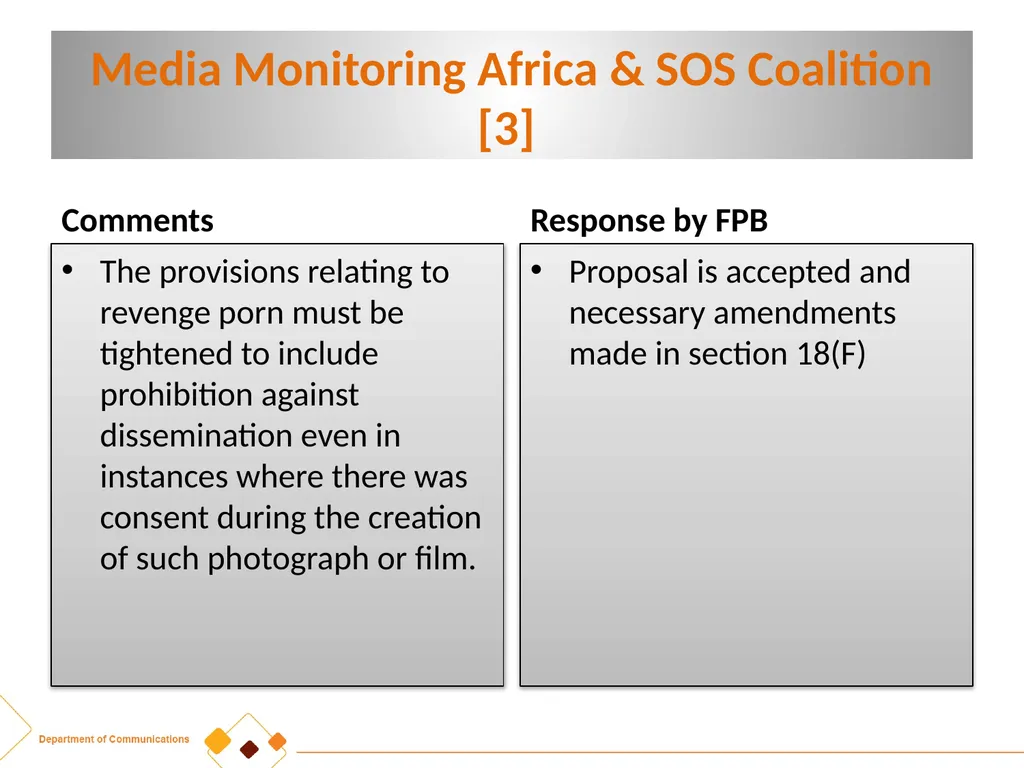
Media Monitoring Africa & SOS Coalition [3] Comments The provisions relating to revenge porn must be tightened to include prohibition against dissemination even in instances where there was consent during the creation of such photograph or film. Response by FPB Proposal is accepted and necessary amendments made in section 18(F)<br>
29
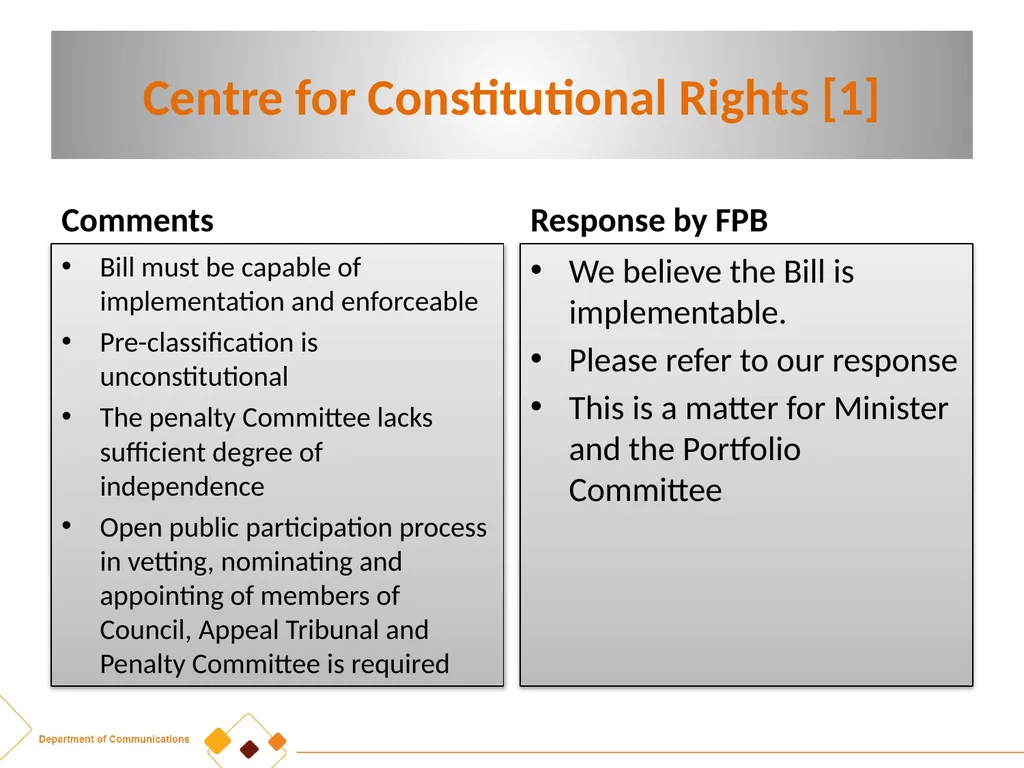
Centre for Constitutional Rights [1] Comments Bill must be capable of implementation and enforceable
Pre-classification is unconstitutional
The penalty Committee lacks sufficient degree of independence
Open public participation process in vetting, nominating and appointing of members of Council, Appeal Tribunal and Penalty Committee is required Response by FPB We believe the Bill is implementable.
Please refer to our response
This is a matter for Minister and the Portfolio Committee<br>
Pre-classification is unconstitutional
The penalty Committee lacks sufficient degree of independence
Open public participation process in vetting, nominating and appointing of members of Council, Appeal Tribunal and Penalty Committee is required Response by FPB We believe the Bill is implementable.
Please refer to our response
This is a matter for Minister and the Portfolio Committee<br>
30
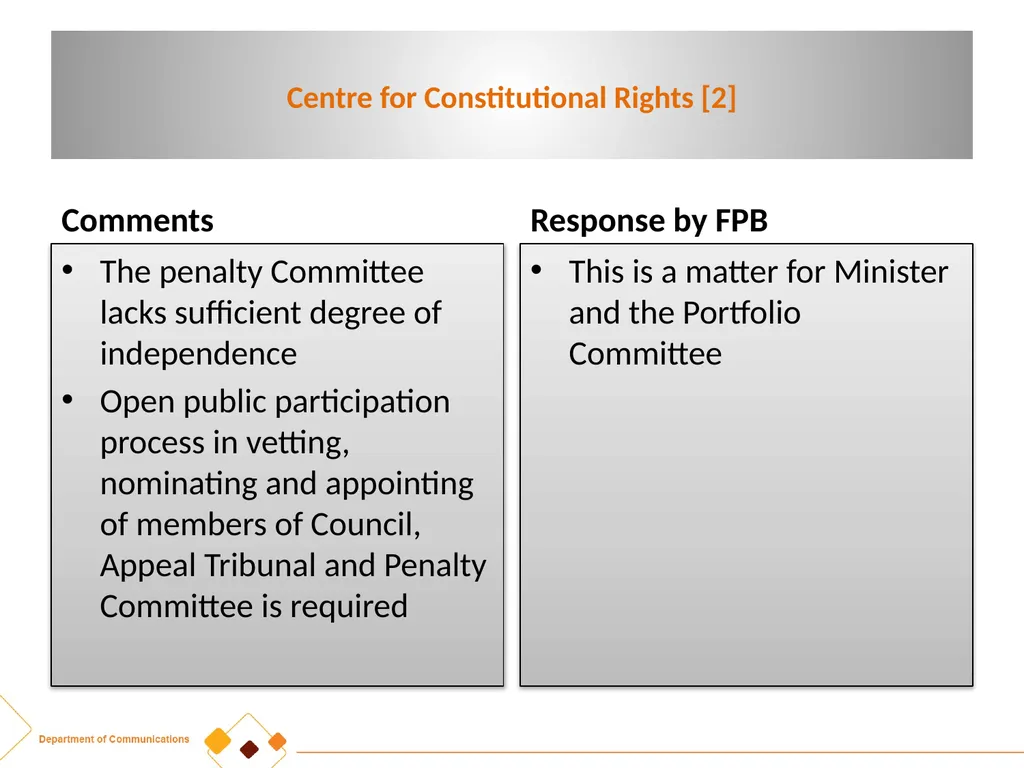
Centre for Constitutional Rights [2] Comments The penalty Committee lacks sufficient degree of independence
Open public participation process in vetting, nominating and appointing of members of Council, Appeal Tribunal and Penalty Committee is required Response by FPB This is a matter for Minister and the Portfolio Committee<br>
Open public participation process in vetting, nominating and appointing of members of Council, Appeal Tribunal and Penalty Committee is required Response by FPB This is a matter for Minister and the Portfolio Committee<br>
31
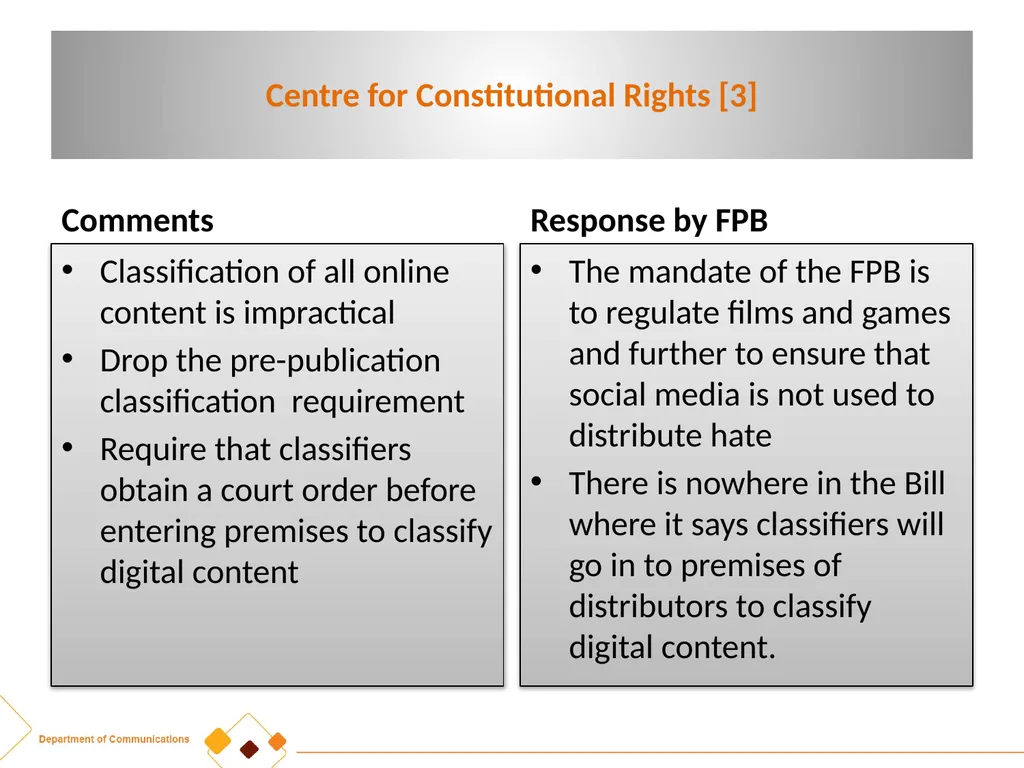
Centre for Constitutional Rights [3] Comments Classification of all online content is impractical
Drop the pre-publication classification requirement
Require that classifiers obtain a court order before entering premises to classify digital content Response by FPB The mandate of the FPB is to regulate films and games and further to ensure that social media is not used to distribute hate
There is nowhere in the Bill where it says classifiers will go in to premises of distributors to classify digital content.<br>
Drop the pre-publication classification requirement
Require that classifiers obtain a court order before entering premises to classify digital content Response by FPB The mandate of the FPB is to regulate films and games and further to ensure that social media is not used to distribute hate
There is nowhere in the Bill where it says classifiers will go in to premises of distributors to classify digital content.<br>
32
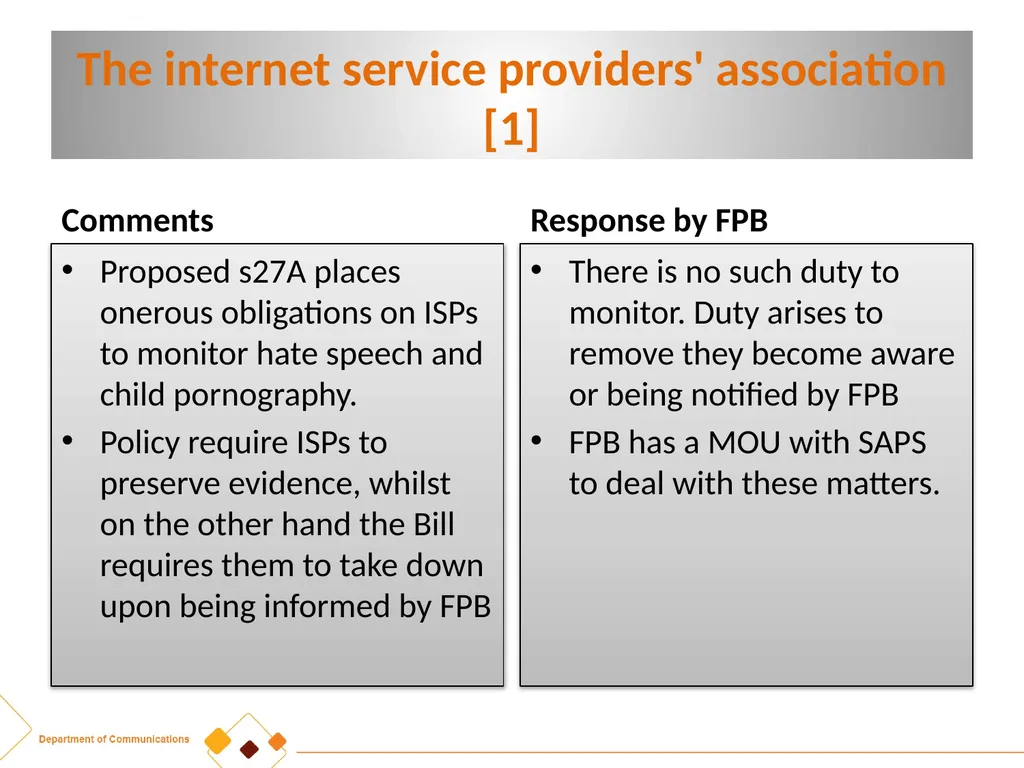
The internet service providers' association [1] Comments Proposed s27A places onerous obligations on ISPs to monitor hate speech and child pornography.
Policy require ISPs to preserve evidence, whilst on the other hand the Bill requires them to take down upon being informed by FPB Response by FPB There is no such duty to monitor. Duty arises to remove they become aware or being notified by FPB
FPB has a MOU with SAPS to deal with these matters.<br>
Policy require ISPs to preserve evidence, whilst on the other hand the Bill requires them to take down upon being informed by FPB Response by FPB There is no such duty to monitor. Duty arises to remove they become aware or being notified by FPB
FPB has a MOU with SAPS to deal with these matters.<br>
33
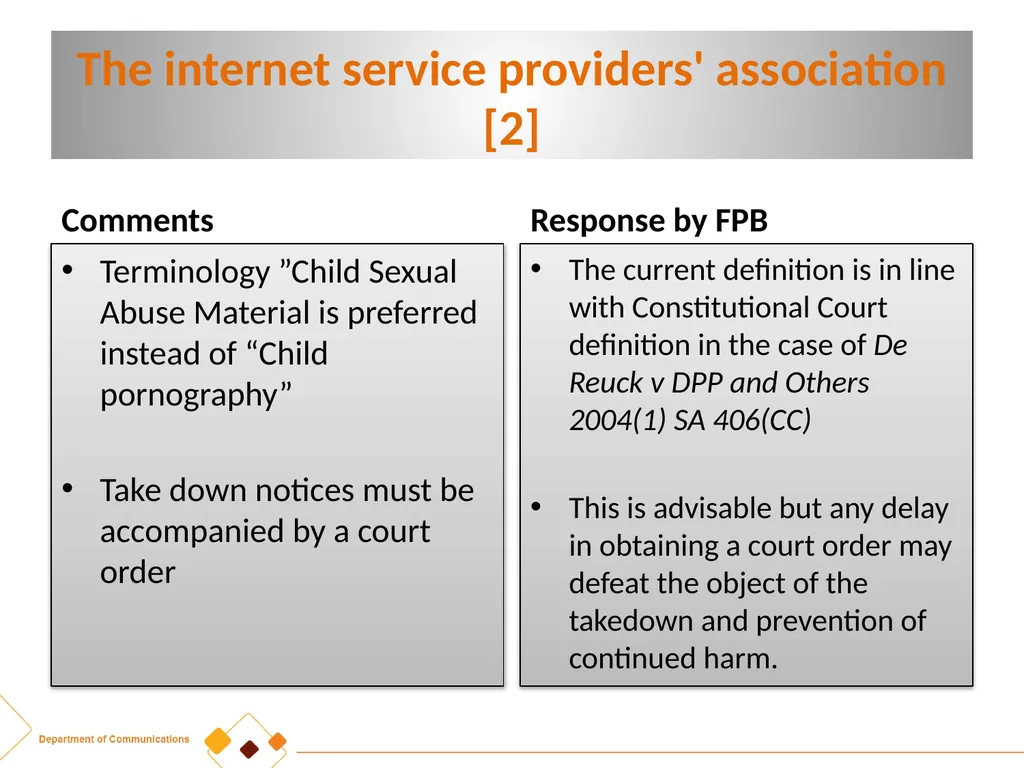
The internet service providers' association [2] Comments Terminology ”Child Sexual Abuse Material is preferred instead of “Child pornography”
Take down notices must be accompanied by a court order Response by FPB The current definition is in line with Constitutional Court definition in the case of De Reuck v DPP and Others 2004(1) SA 406(CC)
This is advisable but any delay in obtaining a court order may defeat the object of the takedown and prevention of continued harm.<br>
Take down notices must be accompanied by a court order Response by FPB The current definition is in line with Constitutional Court definition in the case of De Reuck v DPP and Others 2004(1) SA 406(CC)
This is advisable but any delay in obtaining a court order may defeat the object of the takedown and prevention of continued harm.<br>
34
Thank you.<br>