
Francisco Corella fcorella@pomcor.com Presentation
TF
Published · 42 slides · 0 views
1 / 1

Description
Francisco Corella fcorellapomcor.com Presentation at IIW XXXVII on October 10, 2023 Based in part on: ISOIEC Wallet Credentials, early draft of a chapter of a book on the Foundations of Cryptographic Authentication being coauthored with
Related Topics
Share
Embed code
Download this presentation From Below
"Francisco Corella fcorella@pomcor.com Presentation" is the property of its rightful owner. Permission is granted to download and print the materials on this website for personal, non-commercial use only, and to display it on your personal computer provided you do not modify the materials and that you retain all copyright notices contained in the materials. By downloading content from our website, you accept the terms of this agreement.
Presentation Transcript
01
Francisco Corella
fcorella@pomcor.com
Presentation at IIW XXXVII on October 10, 2023
Based in part on:
ISO/IEC Wallet Credentials,
early draft of a chapter of a book on the Foundations of Cryptographic Authentication being coauthored with
Sukhi Chuhan and Veronica Wojnas Overview of ISO/IEC 18013-5:
Innovations and Vulnerabilities
in the mDL Standard<br>
fcorella@pomcor.com
Presentation at IIW XXXVII on October 10, 2023
Based in part on:
ISO/IEC Wallet Credentials,
early draft of a chapter of a book on the Foundations of Cryptographic Authentication being coauthored with
Sukhi Chuhan and Veronica Wojnas Overview of ISO/IEC 18013-5:
Innovations and Vulnerabilities
in the mDL Standard<br>
02
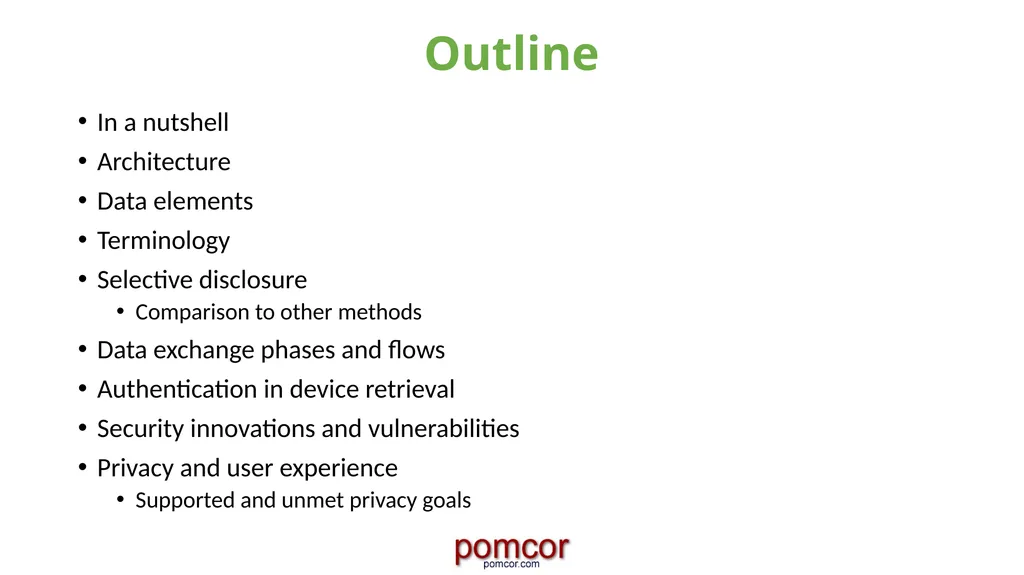
Outline In a nutshell
Architecture
Data elements
Terminology
Selective disclosure
Comparison to other methods
Data exchange phases and flows
Authentication in device retrieval
Security innovations and vulnerabilities
Privacy and user experience
Supported and unmet privacy goals<br>
Architecture
Data elements
Terminology
Selective disclosure
Comparison to other methods
Data exchange phases and flows
Authentication in device retrieval
Security innovations and vulnerabilities
Privacy and user experience
Supported and unmet privacy goals<br>
03
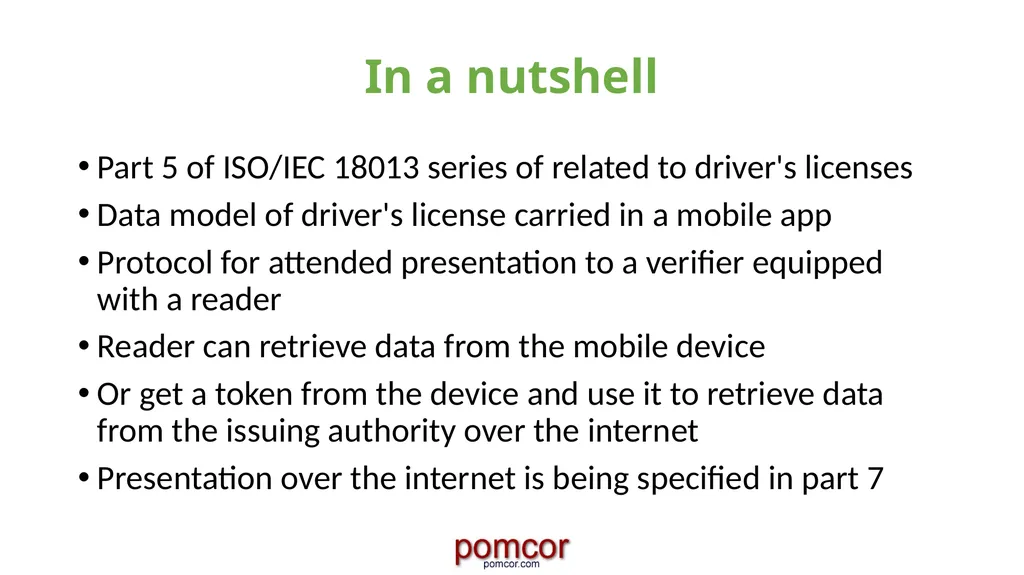
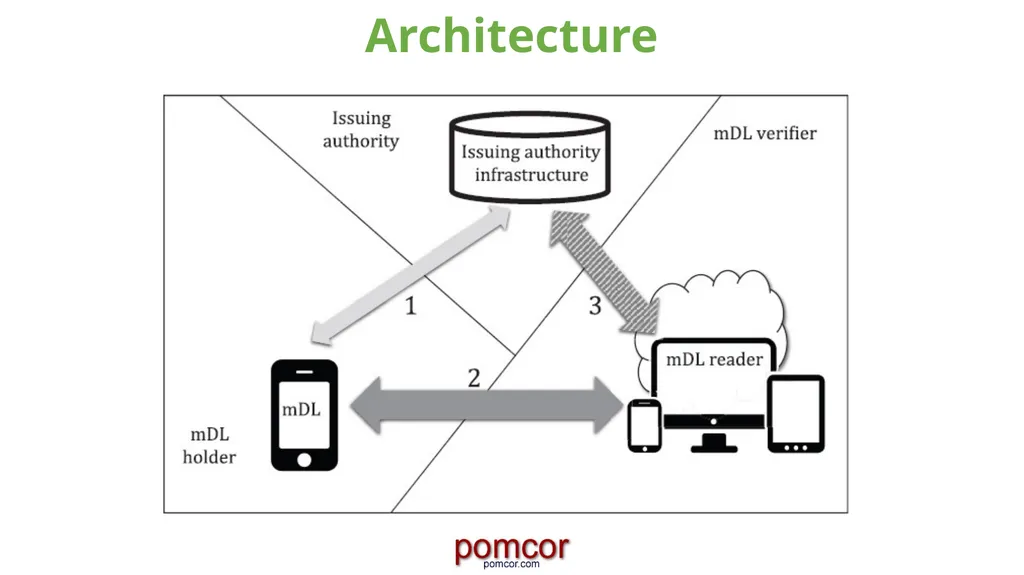
In a nutshell Part 5 of ISO/IEC 18013 series of related to driver's licenses
Data model of driver's license carried in a mobile app
Protocol for attended presentation to a verifier equipped with a reader
Reader can retrieve data from the mobile device
Or get a token from the device and use it to retrieve data from the issuing authority over the internet
Presentation over the internet is being specified in part 7<br>
Data model of driver's license carried in a mobile app
Protocol for attended presentation to a verifier equipped with a reader
Reader can retrieve data from the mobile device
Or get a token from the device and use it to retrieve data from the issuing authority over the internet
Presentation over the internet is being specified in part 7<br>
04
Architecture<br>
05
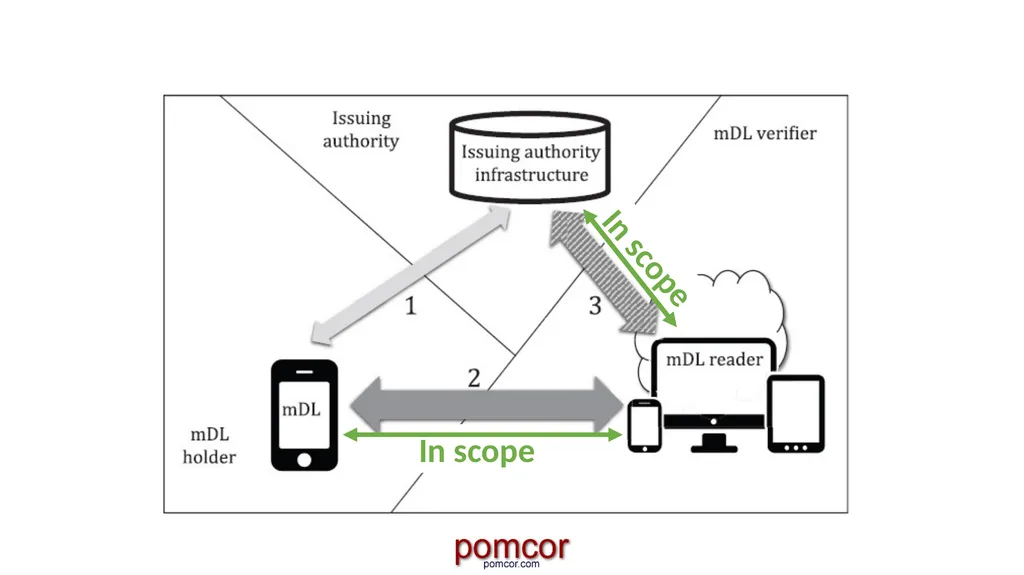
In scope In scope<br>
06
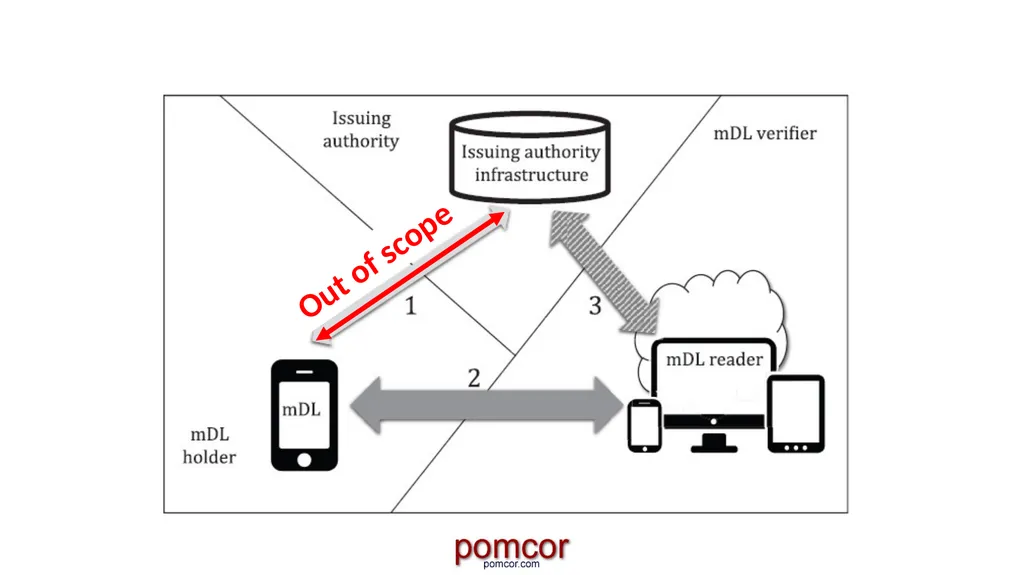
Out of scope<br>
07
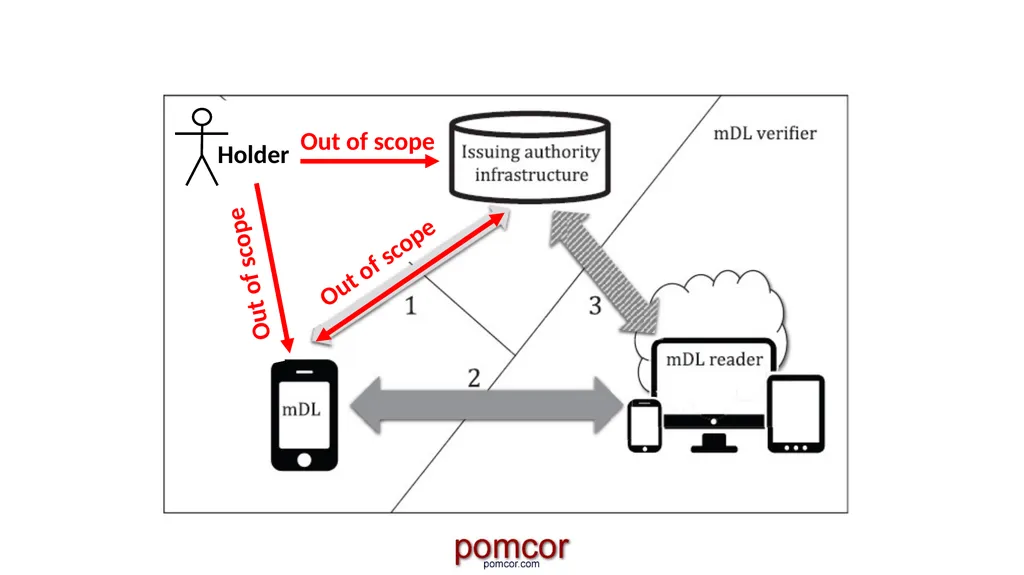
Holder Out of scope Out of scope Out of scope<br>
08
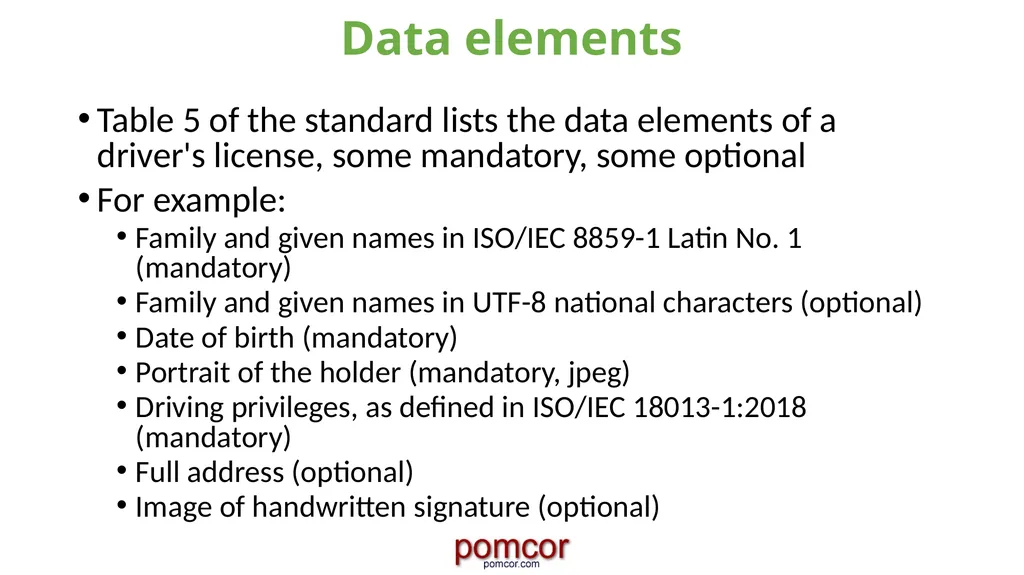
Data elements Table 5 of the standard lists the data elements of a driver's license, some mandatory, some optional
For example:
Family and given names in ISO/IEC 8859-1 Latin No. 1 (mandatory)
Family and given names in UTF-8 national characters (optional)
Date of birth (mandatory)
Portrait of the holder (mandatory, jpeg)
Driving privileges, as defined in ISO/IEC 18013-1:2018 (mandatory)
Full address (optional)
Image of handwritten signature (optional)<br>
For example:
Family and given names in ISO/IEC 8859-1 Latin No. 1 (mandatory)
Family and given names in UTF-8 national characters (optional)
Date of birth (mandatory)
Portrait of the holder (mandatory, jpeg)
Driving privileges, as defined in ISO/IEC 18013-1:2018 (mandatory)
Full address (optional)
Image of handwritten signature (optional)<br>
09
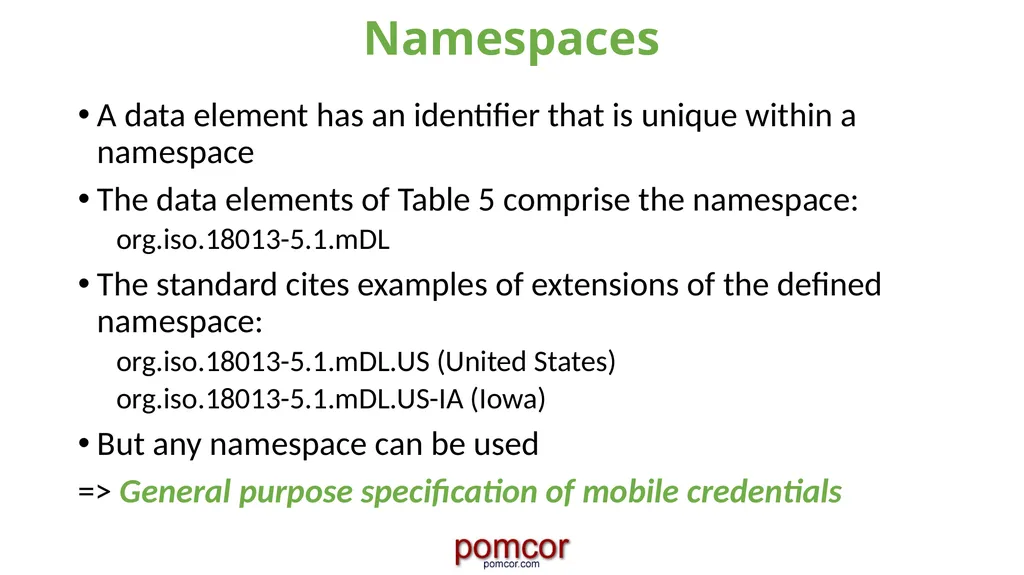
A data element has an identifier that is unique within a namespace
The data elements of Table 5 comprise the namespace:
org.iso.18013-5.1.mDL
The standard cites examples of extensions of the defined namespace:
org.iso.18013-5.1.mDL.US (United States)
org.iso.18013-5.1.mDL.US-IA (Iowa)
But any namespace can be used
=> General purpose specification of mobile credentials Namespaces<br>
The data elements of Table 5 comprise the namespace:
org.iso.18013-5.1.mDL
The standard cites examples of extensions of the defined namespace:
org.iso.18013-5.1.mDL.US (United States)
org.iso.18013-5.1.mDL.US-IA (Iowa)
But any namespace can be used
=> General purpose specification of mobile credentials Namespaces<br>
10
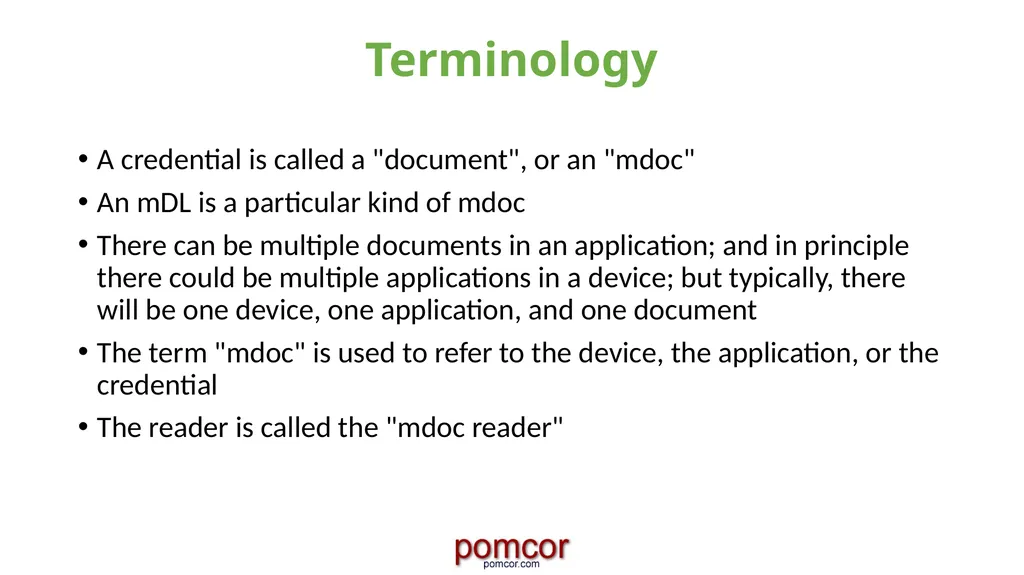
A credential is called a "document", or an "mdoc"
An mDL is a particular kind of mdoc
There can be multiple documents in an application; and in principle there could be multiple applications in a device; but typically, there will be one device, one application, and one document
The term "mdoc" is used to refer to the device, the application, or the credential
The reader is called the "mdoc reader" Terminology<br>
An mDL is a particular kind of mdoc
There can be multiple documents in an application; and in principle there could be multiple applications in a device; but typically, there will be one device, one application, and one document
The term "mdoc" is used to refer to the device, the application, or the credential
The reader is called the "mdoc reader" Terminology<br>
11
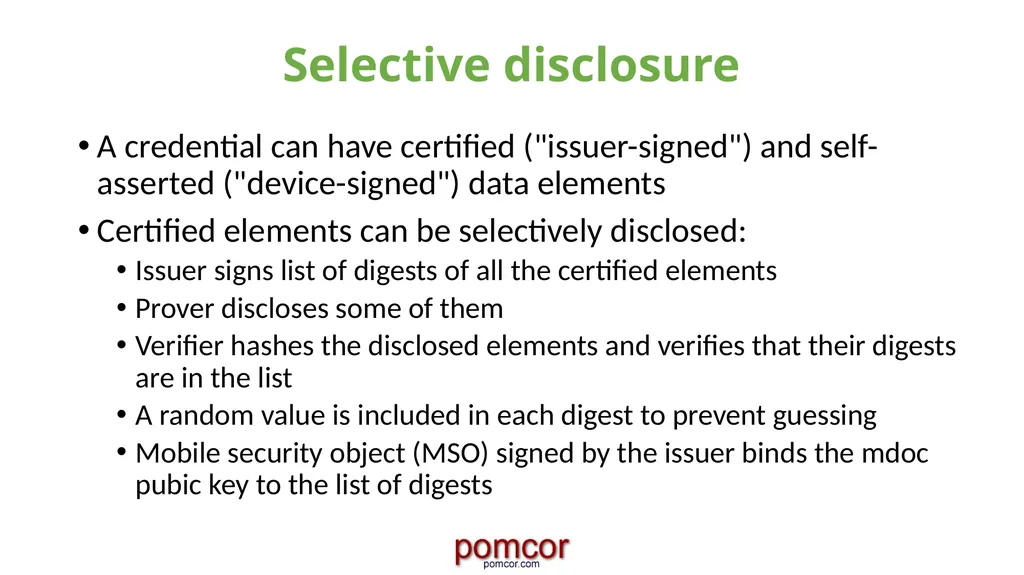
A credential can have certified ("issuer-signed") and self-asserted ("device-signed") data elements
Certified elements can be selectively disclosed:
Issuer signs list of digests of all the certified elements
Prover discloses some of them
Verifier hashes the disclosed elements and verifies that their digests are in the list
A random value is included in each digest to prevent guessing
Mobile security object (MSO) signed by the issuer binds the mdoc pubic key to the list of digests Selective disclosure<br>
Certified elements can be selectively disclosed:
Issuer signs list of digests of all the certified elements
Prover discloses some of them
Verifier hashes the disclosed elements and verifies that their digests are in the list
A random value is included in each digest to prevent guessing
Mobile security object (MSO) signed by the issuer binds the mdoc pubic key to the list of digests Selective disclosure<br>
12
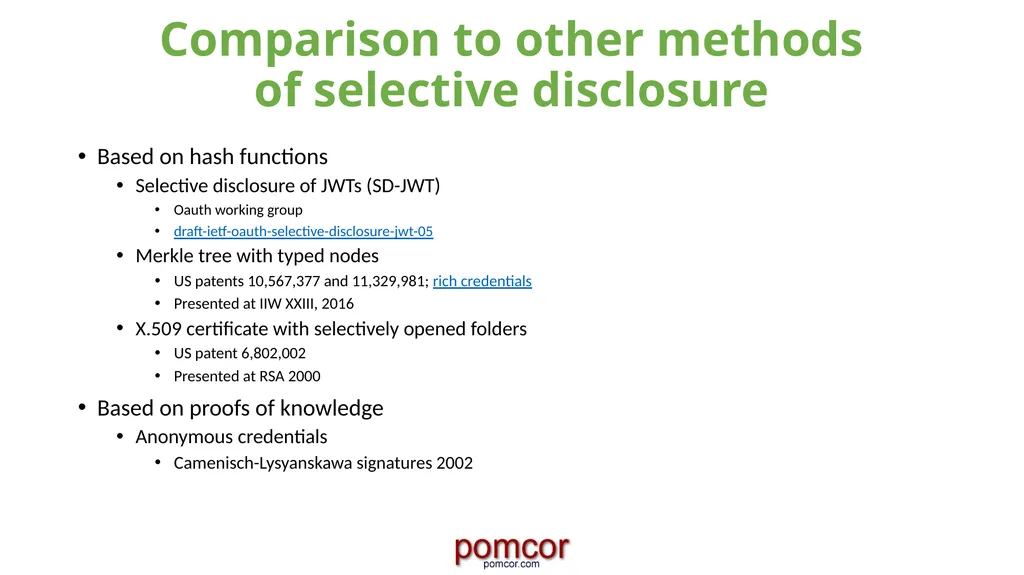
Based on hash functions
Selective disclosure of JWTs (SD-JWT)
Oauth working group
draft-ietf-oauth-selective-disclosure-jwt-05
Merkle tree with typed nodes
US patents 10,567,377 and 11,329,981; rich credentials
Presented at IIW XXIII, 2016
X.509 certificate with selectively opened folders
US patent 6,802,002
Presented at RSA 2000
Based on proofs of knowledge
Anonymous credentials
Camenisch-Lysyanskawa signatures 2002 Comparison to other methods of selective disclosure<br>
Selective disclosure of JWTs (SD-JWT)
Oauth working group
draft-ietf-oauth-selective-disclosure-jwt-05
Merkle tree with typed nodes
US patents 10,567,377 and 11,329,981; rich credentials
Presented at IIW XXIII, 2016
X.509 certificate with selectively opened folders
US patent 6,802,002
Presented at RSA 2000
Based on proofs of knowledge
Anonymous credentials
Camenisch-Lysyanskawa signatures 2002 Comparison to other methods of selective disclosure<br>
13
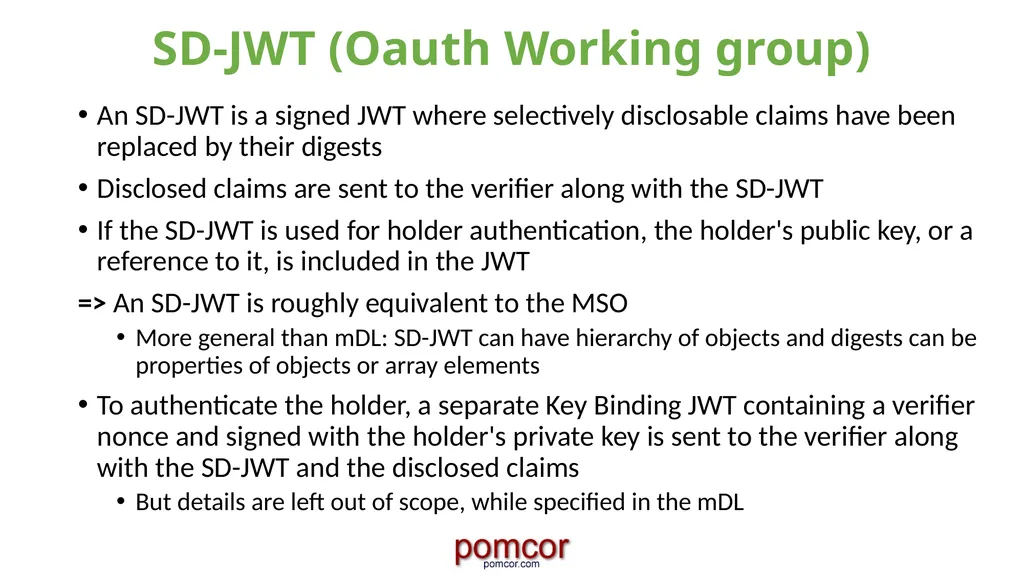
An SD-JWT is a signed JWT where selectively disclosable claims have been replaced by their digests
Disclosed claims are sent to the verifier along with the SD-JWT
If the SD-JWT is used for holder authentication, the holder's public key, or a reference to it, is included in the JWT
=> An SD-JWT is roughly equivalent to the MSO
More general than mDL: SD-JWT can have hierarchy of objects and digests can be properties of objects or array elements
To authenticate the holder, a separate Key Binding JWT containing a verifier nonce and signed with the holder's private key is sent to the verifier along with the SD-JWT and the disclosed claims
But details are left out of scope, while specified in the mDL SD-JWT (Oauth Working group)<br>
Disclosed claims are sent to the verifier along with the SD-JWT
If the SD-JWT is used for holder authentication, the holder's public key, or a reference to it, is included in the JWT
=> An SD-JWT is roughly equivalent to the MSO
More general than mDL: SD-JWT can have hierarchy of objects and digests can be properties of objects or array elements
To authenticate the holder, a separate Key Binding JWT containing a verifier nonce and signed with the holder's private key is sent to the verifier along with the SD-JWT and the disclosed claims
But details are left out of scope, while specified in the mDL SD-JWT (Oauth Working group)<br>
14
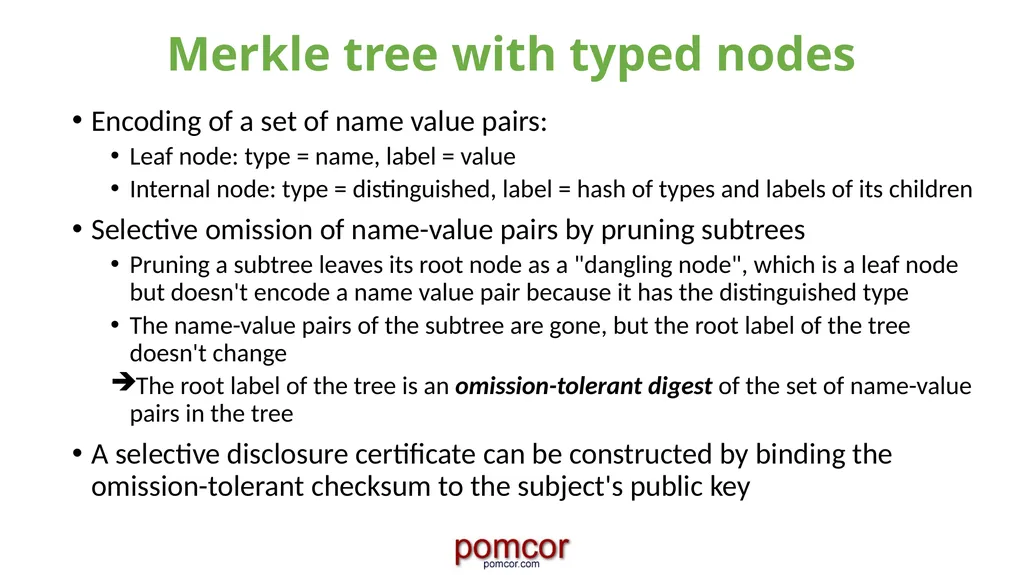
Encoding of a set of name value pairs:
Leaf node: type = name, label = value
Internal node: type = distinguished, label = hash of types and labels of its children
Selective omission of name-value pairs by pruning subtrees
Pruning a subtree leaves its root node as a "dangling node", which is a leaf node but doesn't encode a name value pair because it has the distinguished type
The name-value pairs of the subtree are gone, but the root label of the tree doesn't change
The root label of the tree is an omission-tolerant digest of the set of name-value pairs in the tree
A selective disclosure certificate can be constructed by binding the omission-tolerant checksum to the subject's public key Merkle tree with typed nodes<br>
Leaf node: type = name, label = value
Internal node: type = distinguished, label = hash of types and labels of its children
Selective omission of name-value pairs by pruning subtrees
Pruning a subtree leaves its root node as a "dangling node", which is a leaf node but doesn't encode a name value pair because it has the distinguished type
The name-value pairs of the subtree are gone, but the root label of the tree doesn't change
The root label of the tree is an omission-tolerant digest of the set of name-value pairs in the tree
A selective disclosure certificate can be constructed by binding the omission-tolerant checksum to the subject's public key Merkle tree with typed nodes<br>
15
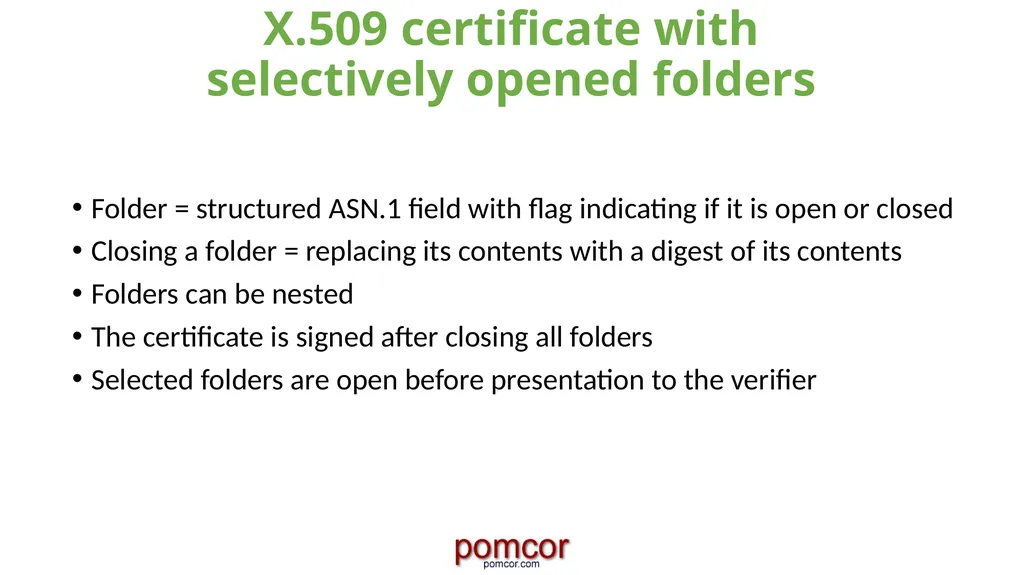
Folder = structured ASN.1 field with flag indicating if it is open or closed
Closing a folder = replacing its contents with a digest of its contents
Folders can be nested
The certificate is signed after closing all folders
Selected folders are open before presentation to the verifier X.509 certificate with selectively opened folders<br>
Closing a folder = replacing its contents with a digest of its contents
Folders can be nested
The certificate is signed after closing all folders
Selected folders are open before presentation to the verifier X.509 certificate with selectively opened folders<br>
16
Camenish-Lysyanskaya signature (many details omitted): Selective disclosure with
anonymous credentials Message: m
Signature: v, e, s
Public key of the signature scheme: a, b, c, n
Private key of the signature scheme: the factorization n = pq
Algorithm:
Choose random prime e
Compute v using 1/e mod (p-1)(q-1)
Security based on strong RSA assumption<br>
Signature: v, e, s
Public key of the signature scheme: a, b, c, n
Private key of the signature scheme: the factorization n = pq
Algorithm:
Choose random prime e
Compute v using 1/e mod (p-1)(q-1)
Security based on strong RSA assumption<br>
17
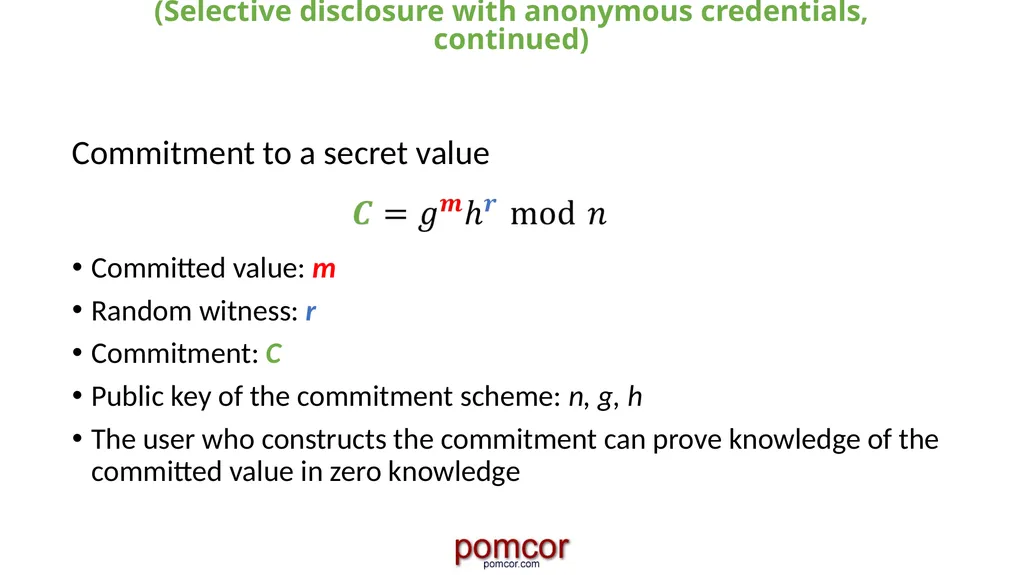
Commitment to a secret value (Selective disclosure with anonymous credentials, continued) Committed value: m
Random witness: r
Commitment: C
Public key of the commitment scheme: n, g, h
The user who constructs the commitment can prove knowledge of the committed value in zero knowledge<br>
Random witness: r
Commitment: C
Public key of the commitment scheme: n, g, h
The user who constructs the commitment can prove knowledge of the committed value in zero knowledge<br>
18
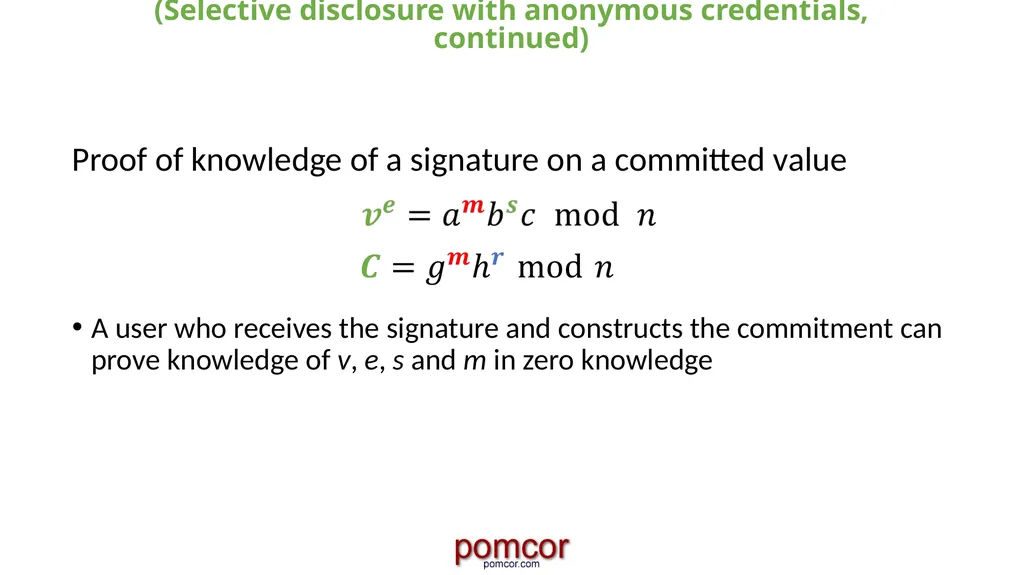
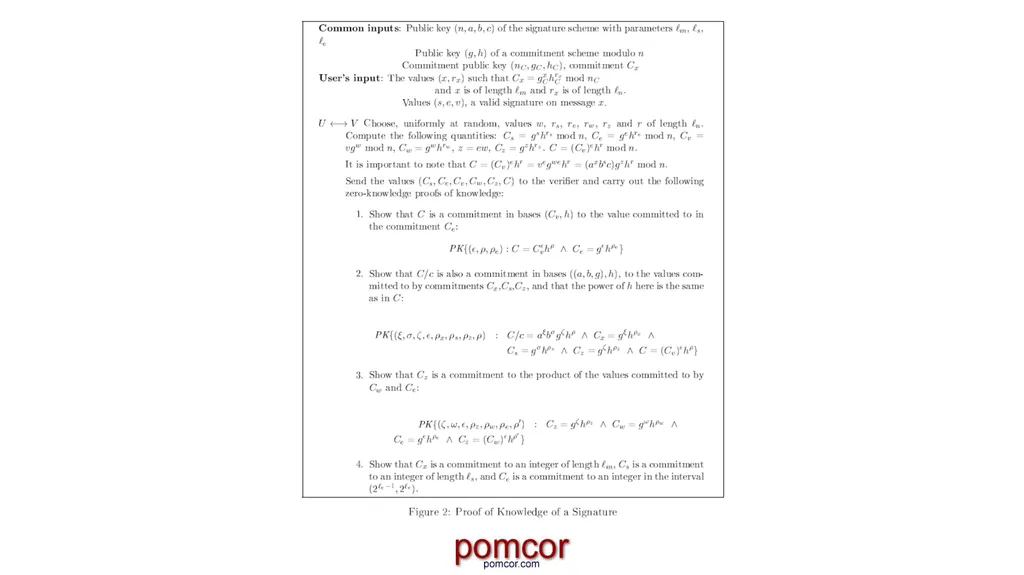
Proof of knowledge of a signature on a committed value A user who receives the signature and constructs the commitment can prove knowledge of v, e, s and m in zero knowledge (Selective disclosure with anonymous credentials, continued)<br>
19
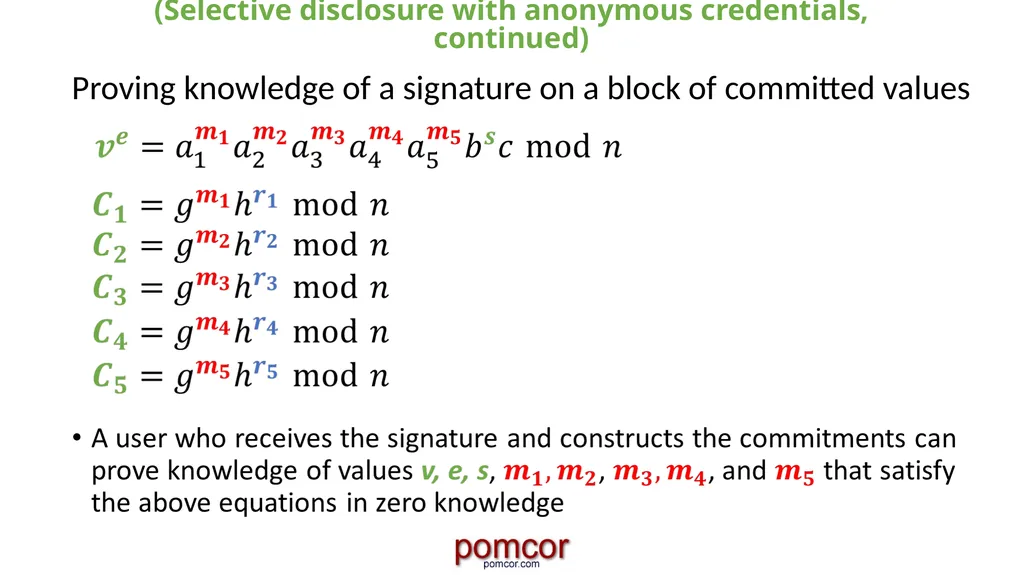
Proving knowledge of a signature on a block of committed values (Selective disclosure with anonymous credentials, continued)<br>
20
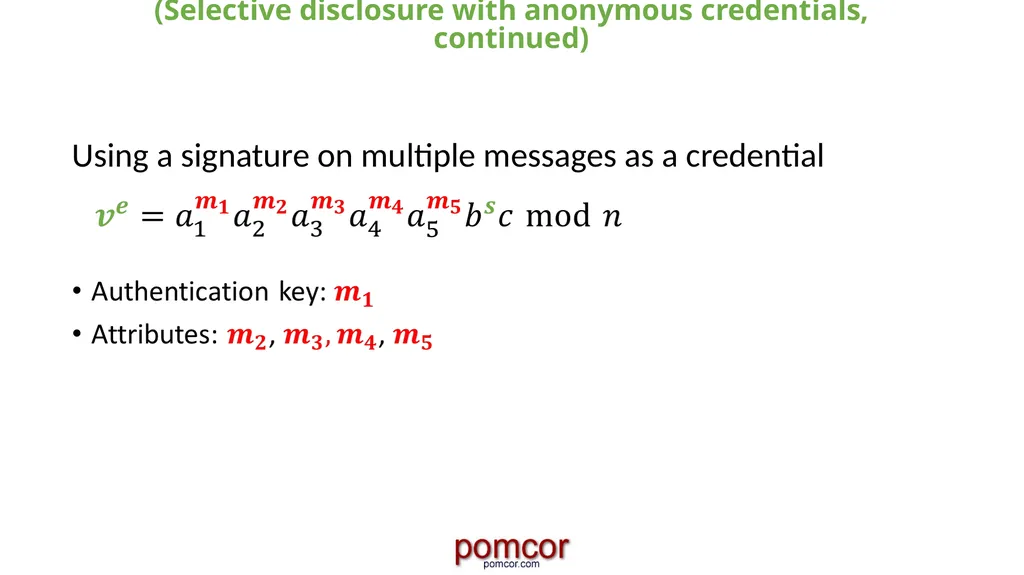
Using a signature on multiple messages as a credential (Selective disclosure with anonymous credentials, continued)<br>
21
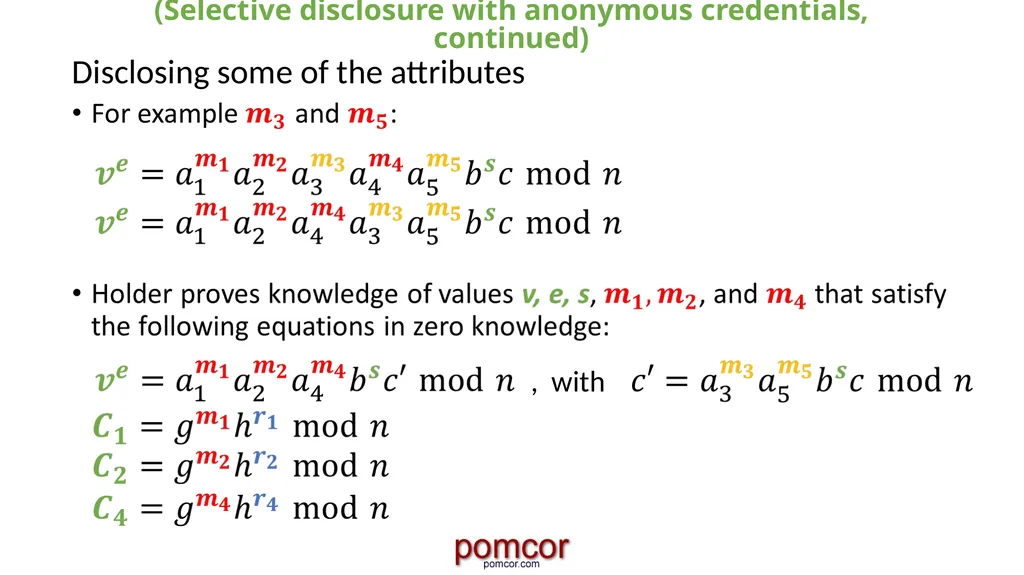
Disclosing some of the attributes (Selective disclosure with anonymous credentials, continued) , with<br>
22
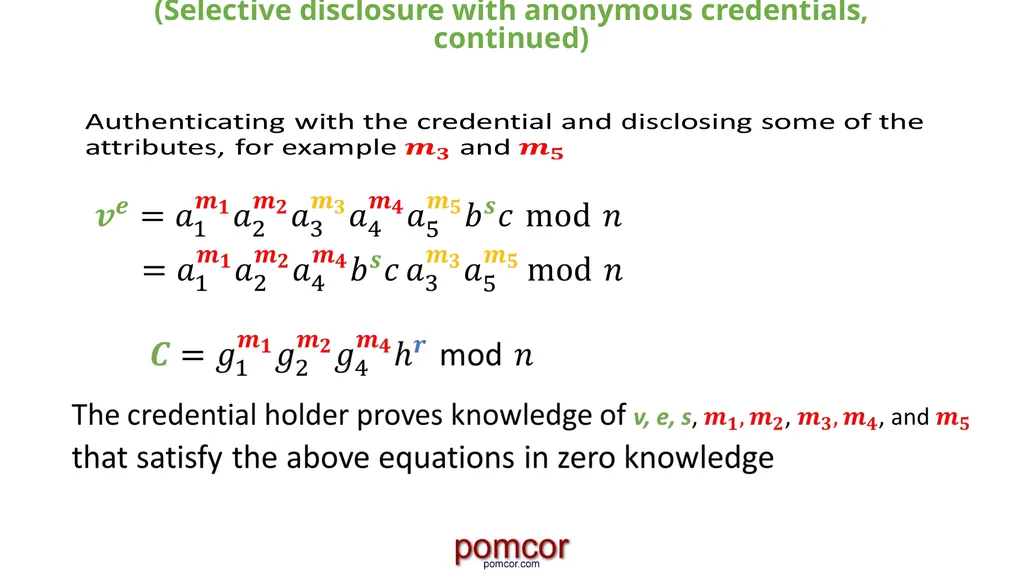
(Selective disclosure with anonymous credentials, continued)<br>
23
Device activation
By the holder, or
By the reader using NFC
Device engagement (data retrieval setup)
QR code shown on the device, or
NFC handover
Data retrieval
From the device ("device retrieval"): NFC, BLE or Wifi
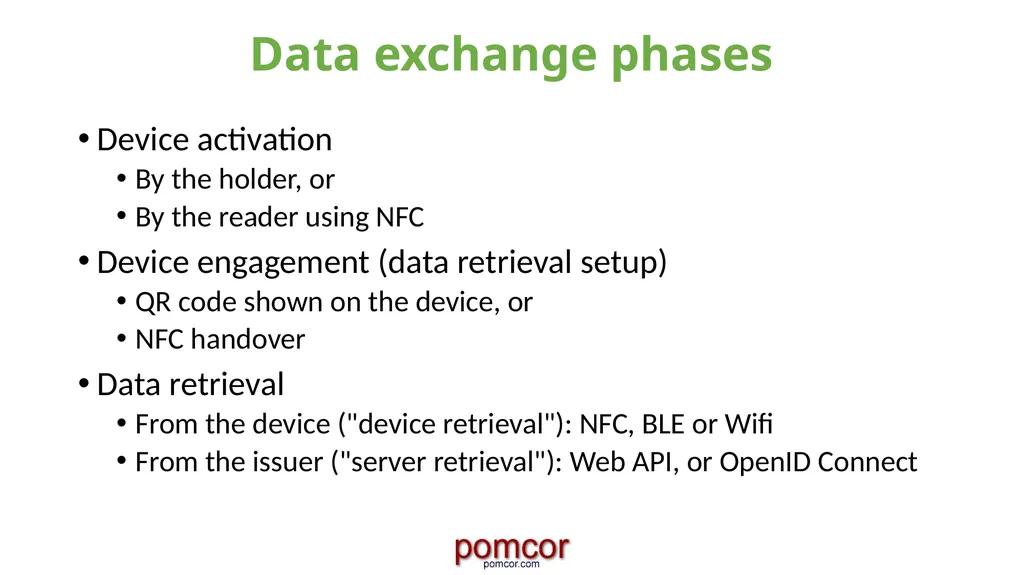
From the issuer ("server retrieval"): Web API, or OpenID Connect Data exchange phases<br>
By the holder, or
By the reader using NFC
Device engagement (data retrieval setup)
QR code shown on the device, or
NFC handover
Data retrieval
From the device ("device retrieval"): NFC, BLE or Wifi
From the issuer ("server retrieval"): Web API, or OpenID Connect Data exchange phases<br>
24
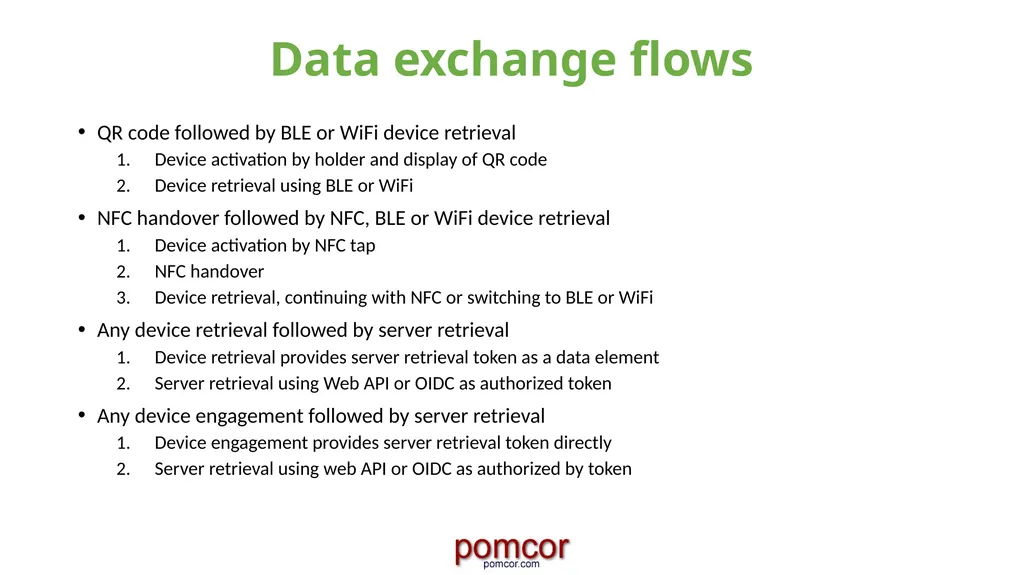
QR code followed by BLE or WiFi device retrieval
Device activation by holder and display of QR code
Device retrieval using BLE or WiFi
NFC handover followed by NFC, BLE or WiFi device retrieval
Device activation by NFC tap
NFC handover
Device retrieval, continuing with NFC or switching to BLE or WiFi
Any device retrieval followed by server retrieval
Device retrieval provides server retrieval token as a data element
Server retrieval using Web API or OIDC as authorized token
Any device engagement followed by server retrieval
Device engagement provides server retrieval token directly
Server retrieval using web API or OIDC as authorized by token Data exchange flows<br>
Device activation by holder and display of QR code
Device retrieval using BLE or WiFi
NFC handover followed by NFC, BLE or WiFi device retrieval
Device activation by NFC tap
NFC handover
Device retrieval, continuing with NFC or switching to BLE or WiFi
Any device retrieval followed by server retrieval
Device retrieval provides server retrieval token as a data element
Server retrieval using Web API or OIDC as authorized token
Any device engagement followed by server retrieval
Device engagement provides server retrieval token directly
Server retrieval using web API or OIDC as authorized by token Data exchange flows<br>
25
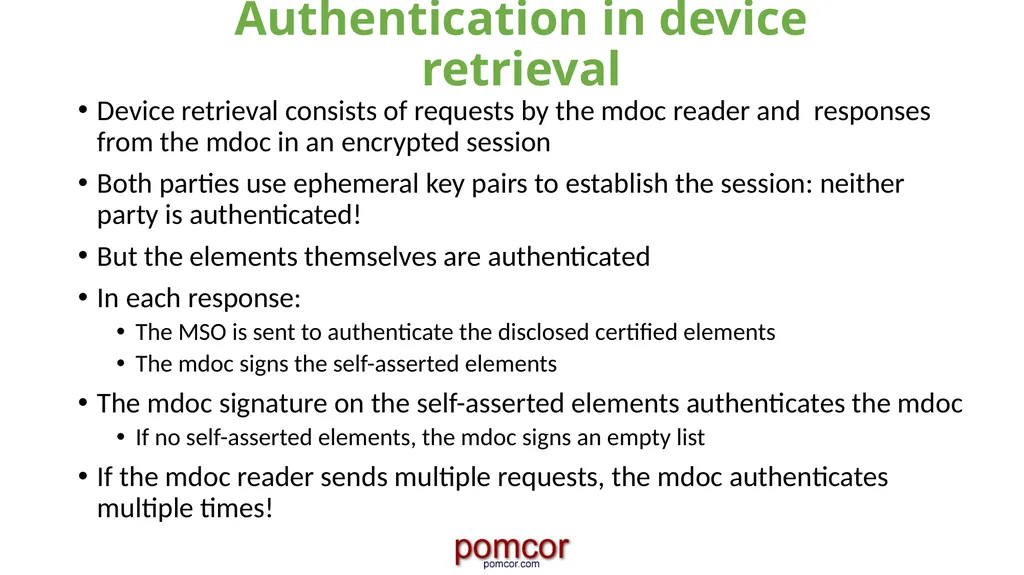
Device retrieval consists of requests by the mdoc reader and responses from the mdoc in an encrypted session
Both parties use ephemeral key pairs to establish the session: neither party is authenticated!
But the elements themselves are authenticated
In each response:
The MSO is sent to authenticate the disclosed certified elements
The mdoc signs the self-asserted elements
The mdoc signature on the self-asserted elements authenticates the mdoc
If no self-asserted elements, the mdoc signs an empty list
If the mdoc reader sends multiple requests, the mdoc authenticates multiple times! Authentication in device retrieval<br>
Both parties use ephemeral key pairs to establish the session: neither party is authenticated!
But the elements themselves are authenticated
In each response:
The MSO is sent to authenticate the disclosed certified elements
The mdoc signs the self-asserted elements
The mdoc signature on the self-asserted elements authenticates the mdoc
If no self-asserted elements, the mdoc signs an empty list
If the mdoc reader sends multiple requests, the mdoc authenticates multiple times! Authentication in device retrieval<br>
26
Retrieval of self-asserted and certified data elements from the same credential
ECDH-agreed MAC
Unconventional use of OpenID Connect Security innovations<br>
ECDH-agreed MAC
Unconventional use of OpenID Connect Security innovations<br>
27
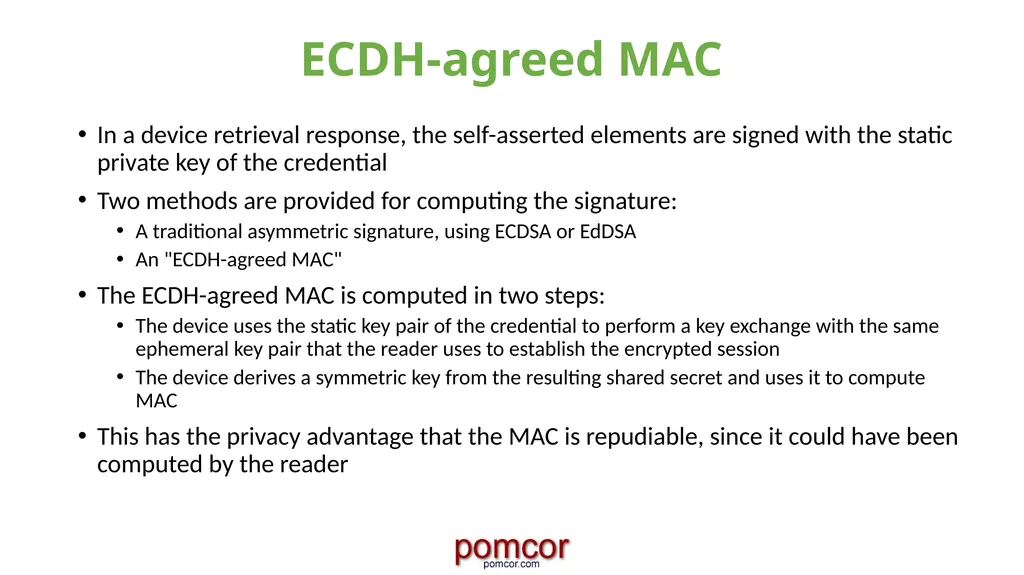
In a device retrieval response, the self-asserted elements are signed with the static private key of the credential
Two methods are provided for computing the signature:
A traditional asymmetric signature, using ECDSA or EdDSA
An "ECDH-agreed MAC"
The ECDH-agreed MAC is computed in two steps:
The device uses the static key pair of the credential to perform a key exchange with the same ephemeral key pair that the reader uses to establish the encrypted session
The device derives a symmetric key from the resulting shared secret and uses it to compute MAC
This has the privacy advantage that the MAC is repudiable, since it could have been computed by the reader ECDH-agreed MAC<br>
Two methods are provided for computing the signature:
A traditional asymmetric signature, using ECDSA or EdDSA
An "ECDH-agreed MAC"
The ECDH-agreed MAC is computed in two steps:
The device uses the static key pair of the credential to perform a key exchange with the same ephemeral key pair that the reader uses to establish the encrypted session
The device derives a symmetric key from the resulting shared secret and uses it to compute MAC
This has the privacy advantage that the MAC is repudiable, since it could have been computed by the reader ECDH-agreed MAC<br>
28
In server retrieval, the reader may use OIDC to request data elements from the issuing authority, with the reader as the relying party and the issuer as the authorization server
But the holder is not involved! The OIDC user is the traffic cop!
OIDC is used as follows:
The reader sends a request to the authorization endpoint, listing the requested data elements in the scope parameter
The server retrieval token is used as the "login_hint" parameter
The authorization server interprets the token as providing authorization, and swaps it with the authorization code without authenticating the user
The reader swaps the authorization code for the ID Token and finds the requested elements in its claim set Unconventional use of OpenID Connect (OIDC)<br>
But the holder is not involved! The OIDC user is the traffic cop!
OIDC is used as follows:
The reader sends a request to the authorization endpoint, listing the requested data elements in the scope parameter
The server retrieval token is used as the "login_hint" parameter
The authorization server interprets the token as providing authorization, and swaps it with the authorization code without authenticating the user
The reader swaps the authorization code for the ID Token and finds the requested elements in its claim set Unconventional use of OpenID Connect (OIDC)<br>
29
Vulnerabilities Vulnerability to man-in-the-middle attacks
Unauthorized access
Surreptitious activation
Eavesdropping device engagement to capture the server retrieval token<br>
Unauthorized access
Surreptitious activation
Eavesdropping device engagement to capture the server retrieval token<br>
30
Vulnerability to man-in-the-middle attacks Section 9.1.3.1
"The security objective of mdoc authentication is to prevent cloning of the mdoc and to mitigate man in the middle attacks."
Section 9.1.3.3
"The mdoc private key, which belongs to the mdoc public key stored in the MSO, is used to authenticate the mdoc. It is also used to authenticate the response data contained in the DeviceSignedItems structure"<br>
"The security objective of mdoc authentication is to prevent cloning of the mdoc and to mitigate man in the middle attacks."
Section 9.1.3.3
"The mdoc private key, which belongs to the mdoc public key stored in the MSO, is used to authenticate the mdoc. It is also used to authenticate the response data contained in the DeviceSignedItems structure"<br>
31
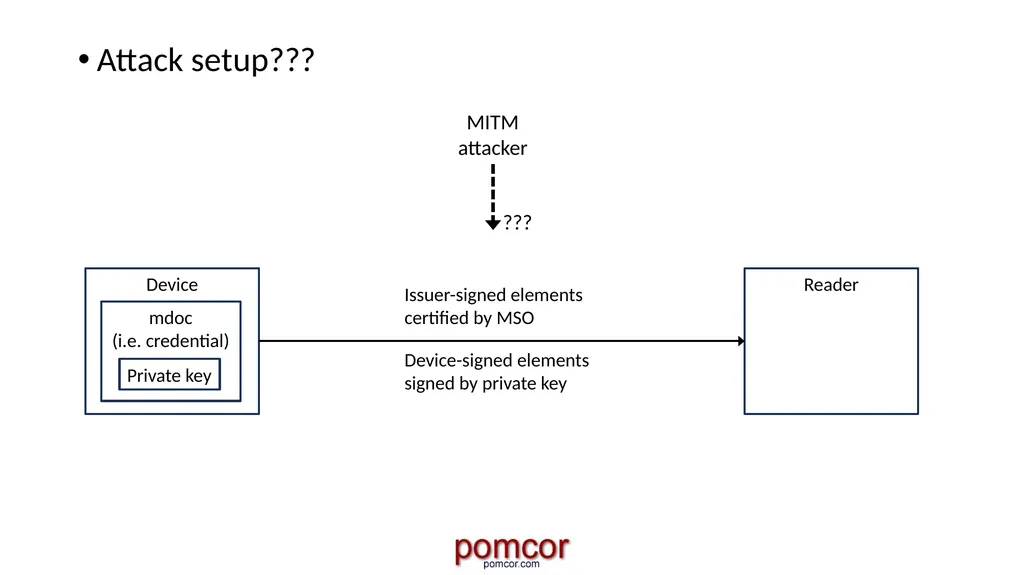
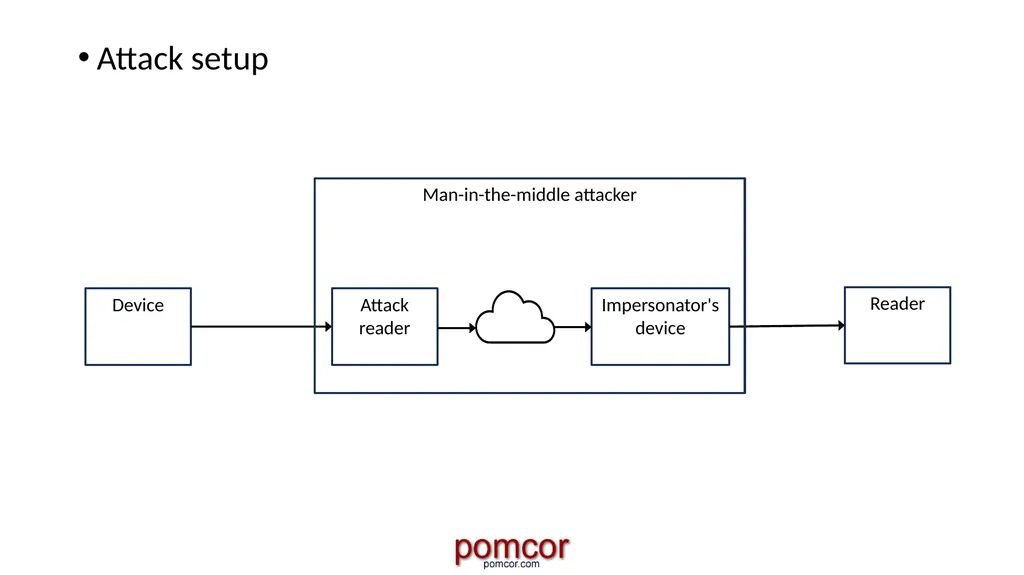
Attack setup??? Private key mdoc
(i.e. credential) Device Reader Device-signed elements signed by private key MITM attacker ??? Issuer-signed elements
certified by MSO<br>
(i.e. credential) Device Reader Device-signed elements signed by private key MITM attacker ??? Issuer-signed elements
certified by MSO<br>
32
Attack setup Device Reader Attack reader Impersonator's device Man-in-the-middle attacker<br>
33
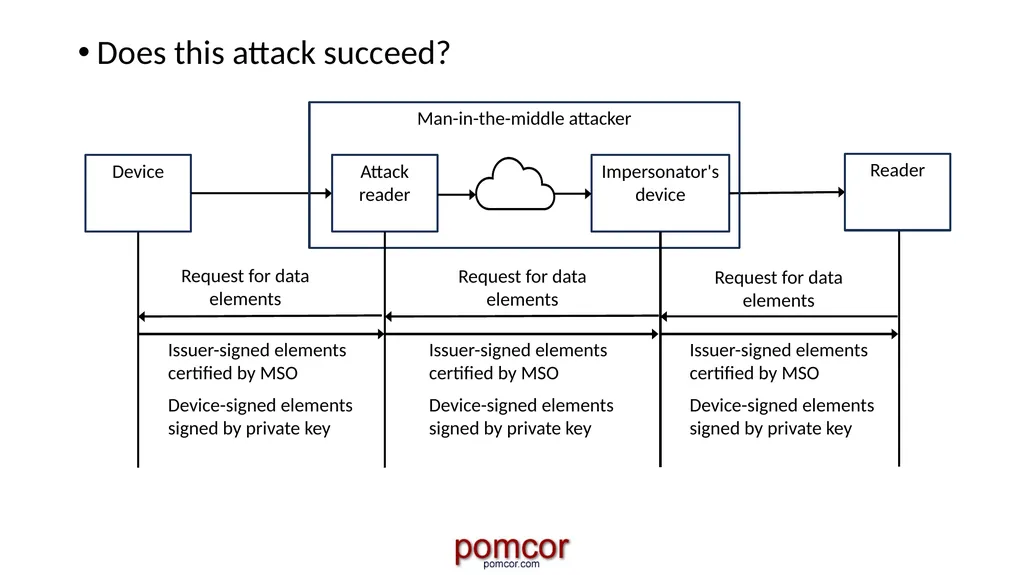
Does this attack succeed? Device Reader Attack reader Impersonator's device Man-in-the-middle attacker Device-signed elements signed by private key Issuer-signed elements
certified by MSO Request for data elements Request for data elements Request for data elements Device-signed elements signed by private key Issuer-signed elements
certified by MSO Device-signed elements signed by private key Issuer-signed elements
certified by MSO<br>
certified by MSO Request for data elements Request for data elements Request for data elements Device-signed elements signed by private key Issuer-signed elements
certified by MSO Device-signed elements signed by private key Issuer-signed elements
certified by MSO<br>
34
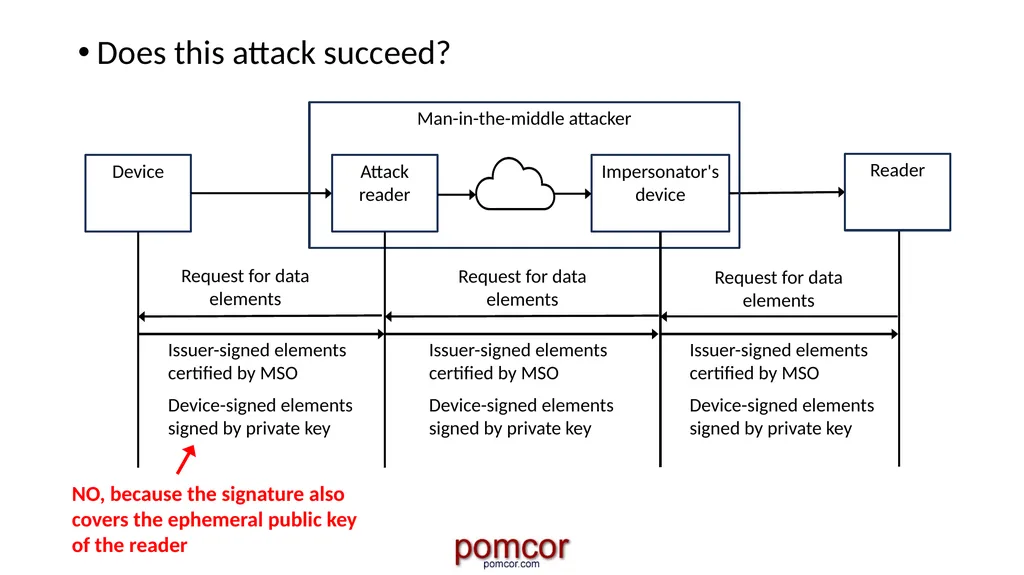
Does this attack succeed? Device Reader Attack reader Impersonator's device Man-in-the-middle attacker Device-signed elements signed by private key Issuer-signed elements
certified by MSO Request for data elements Request for data elements Request for data elements Device-signed elements signed by private key Issuer-signed elements
certified by MSO Device-signed elements signed by private key Issuer-signed elements
certified by MSO NO, because the signature also covers the ephemeral public key of the reader<br>
certified by MSO Request for data elements Request for data elements Request for data elements Device-signed elements signed by private key Issuer-signed elements
certified by MSO Device-signed elements signed by private key Issuer-signed elements
certified by MSO NO, because the signature also covers the ephemeral public key of the reader<br>
35
QR code followed by BLE or WiFi device retrieval
Device activation by holder and display of QR code
Device retrieval using BLE or WiFi
NFC handover followed by NFC, BLE or WiFi device retrieval
Device activation by NFC tap
NFC handover
Device retrieval, continuing with NFC or switching to BLE or WiFi
Any device retrieval followed by server retrieval
Device retrieval provides server retrieval token as a data element
Server retrieval using Web API or OIDC as authorized token
Any device engagement followed by server retrieval
Device engagement provides server retrieval token directly
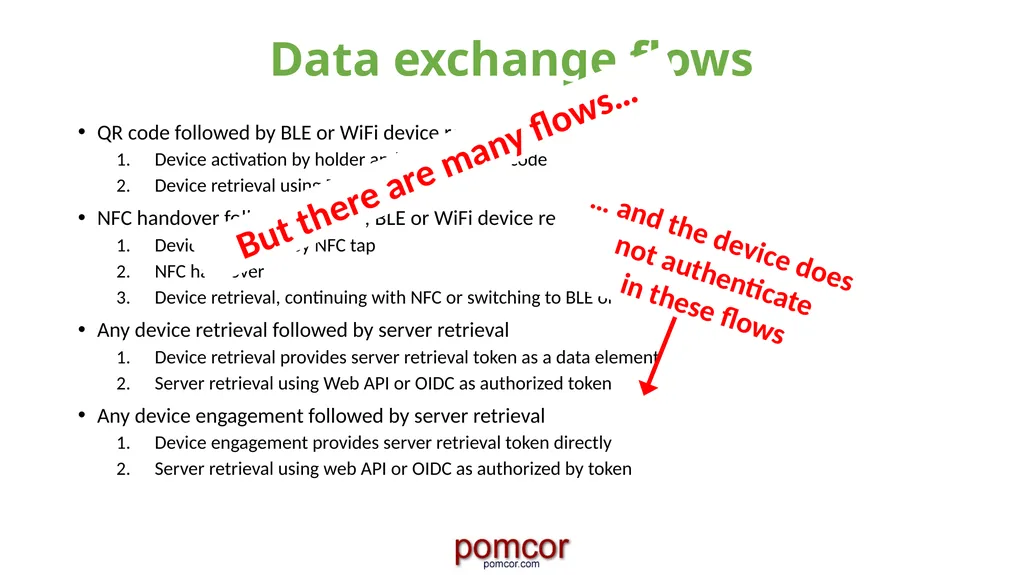
Server retrieval using web API or OIDC as authorized by token Data exchange flows … and the device does not authenticate
in these flows But there are many flows…<br>
Device activation by holder and display of QR code
Device retrieval using BLE or WiFi
NFC handover followed by NFC, BLE or WiFi device retrieval
Device activation by NFC tap
NFC handover
Device retrieval, continuing with NFC or switching to BLE or WiFi
Any device retrieval followed by server retrieval
Device retrieval provides server retrieval token as a data element
Server retrieval using Web API or OIDC as authorized token
Any device engagement followed by server retrieval
Device engagement provides server retrieval token directly
Server retrieval using web API or OIDC as authorized by token Data exchange flows … and the device does not authenticate
in these flows But there are many flows…<br>
36
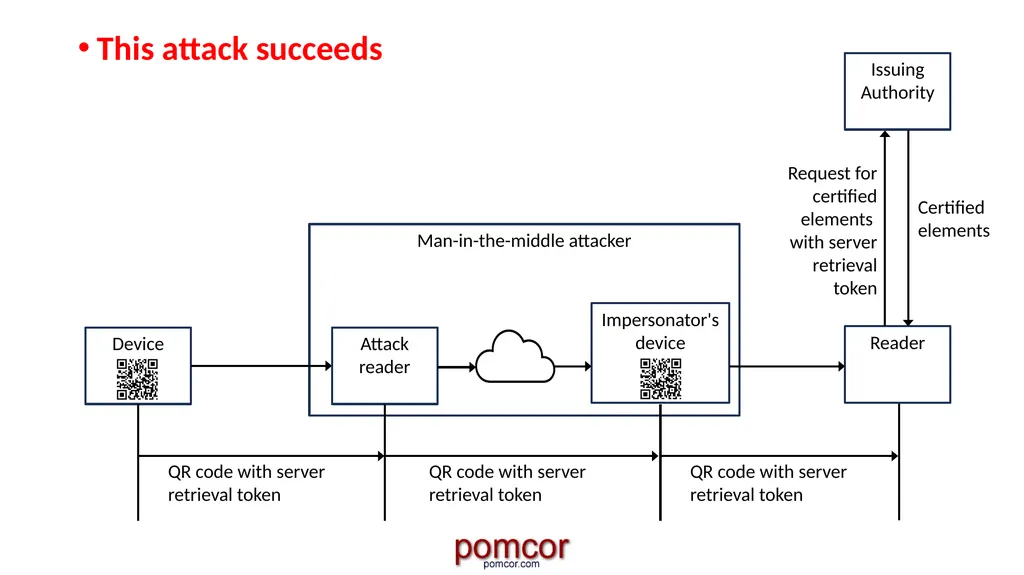
Man-in-the-middle attacker This attack succeeds Device Reader Attack reader Impersonator's device QR code with server retrieval token QR code with server retrieval token QR code with server retrieval token Issuing
Authority Request for certified elements
with server retrieval token Certified
elements<br>
Authority Request for certified elements
with server retrieval token Certified
elements<br>
37
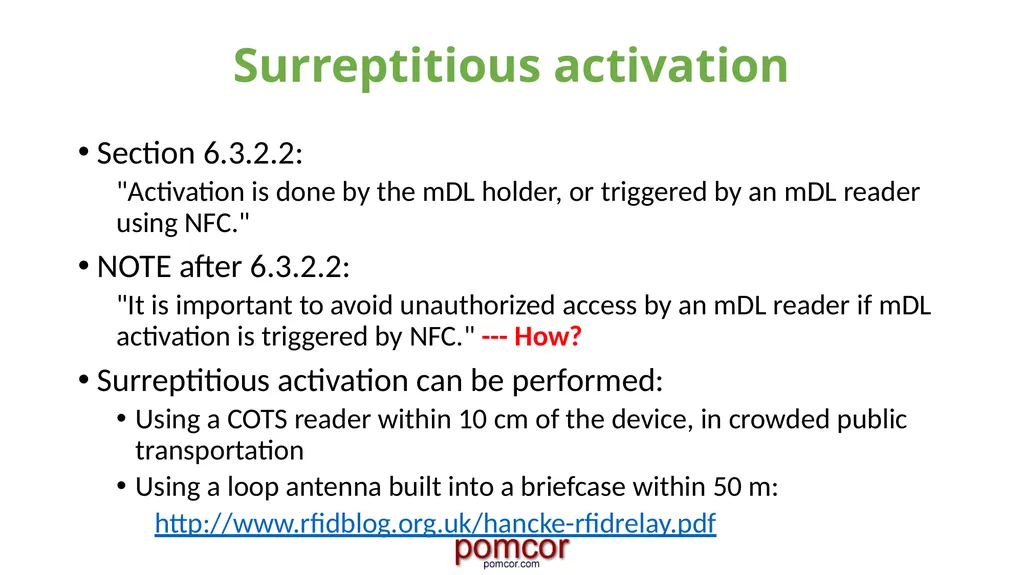
Surreptitious activation Section 6.3.2.2:
"Activation is done by the mDL holder, or triggered by an mDL reader using NFC."
NOTE after 6.3.2.2:
"It is important to avoid unauthorized access by an mDL reader if mDL activation is triggered by NFC." --- How?
Surreptitious activation can be performed:
Using a COTS reader within 10 cm of the device, in crowded public transportation
Using a loop antenna built into a briefcase within 50 m:
http://www.rfidblog.org.uk/hancke-rfidrelay.pdf<br>
"Activation is done by the mDL holder, or triggered by an mDL reader using NFC."
NOTE after 6.3.2.2:
"It is important to avoid unauthorized access by an mDL reader if mDL activation is triggered by NFC." --- How?
Surreptitious activation can be performed:
Using a COTS reader within 10 cm of the device, in crowded public transportation
Using a loop antenna built into a briefcase within 50 m:
http://www.rfidblog.org.uk/hancke-rfidrelay.pdf<br>
38
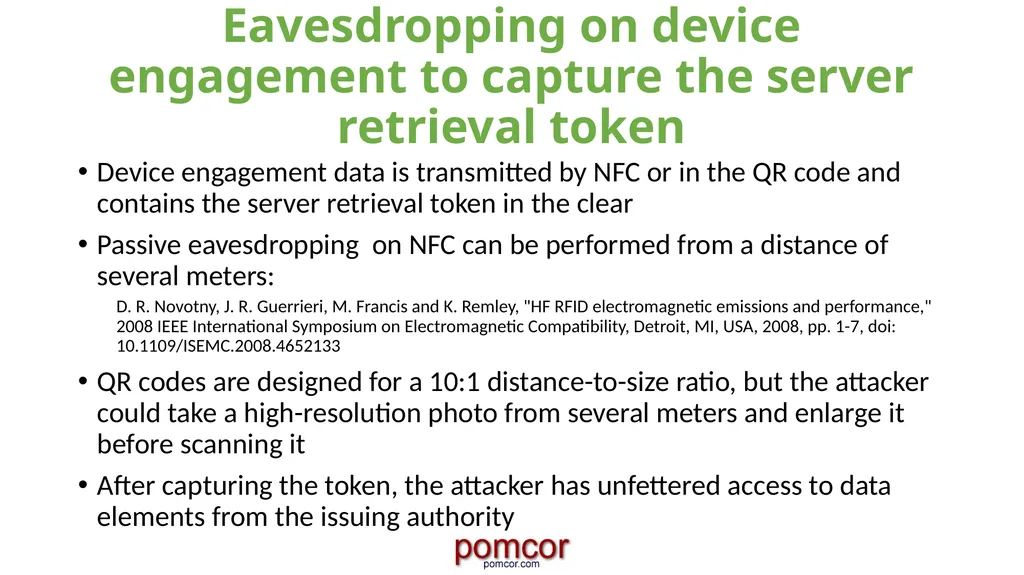
Device engagement data is transmitted by NFC or in the QR code and contains the server retrieval token in the clear
Passive eavesdropping on NFC can be performed from a distance of several meters:
D. R. Novotny, J. R. Guerrieri, M. Francis and K. Remley, "HF RFID electromagnetic emissions and performance," 2008 IEEE International Symposium on Electromagnetic Compatibility, Detroit, MI, USA, 2008, pp. 1-7, doi: 10.1109/ISEMC.2008.4652133
QR codes are designed for a 10:1 distance-to-size ratio, but the attacker could take a high-resolution photo from several meters and enlarge it before scanning it
After capturing the token, the attacker has unfettered access to data elements from the issuing authority Eavesdropping on device engagement to capture the server retrieval token<br>
Passive eavesdropping on NFC can be performed from a distance of several meters:
D. R. Novotny, J. R. Guerrieri, M. Francis and K. Remley, "HF RFID electromagnetic emissions and performance," 2008 IEEE International Symposium on Electromagnetic Compatibility, Detroit, MI, USA, 2008, pp. 1-7, doi: 10.1109/ISEMC.2008.4652133
QR codes are designed for a 10:1 distance-to-size ratio, but the attacker could take a high-resolution photo from several meters and enlarge it before scanning it
After capturing the token, the attacker has unfettered access to data elements from the issuing authority Eavesdropping on device engagement to capture the server retrieval token<br>
39
Privacy and user experience The UI between the holder and the device and between the holder and issuance authority are out of scope
==> Many aspects of privacy and UX are left to be designed by particular jurisdictions
Annex E makes privacy recommendations to be implemented by those jurisdictions
Some recommendations are supported but some are hindered by the standard<br>
==> Many aspects of privacy and UX are left to be designed by particular jurisdictions
Annex E makes privacy recommendations to be implemented by those jurisdictions
Some recommendations are supported but some are hindered by the standard<br>
40
Supported recommendations Data minimization
Supported by selective disclosure and age attestations
Declaration and authorization of intent to retain elements<br>
Supported by selective disclosure and age attestations
Declaration and authorization of intent to retain elements<br>
41
Informed consent
Hindered by the following statement in Section 7.2.1:
"An mDL shall not require mdoc reader authentication as a precondition for the release of any of the mandatory data elements"
Unlinkability
Partially supported by rotation of the mdoc key pair
Rotation fails to prevent linkability by readers in collusion with the issuer; full unlikability requires zero-knowledge technology Hindered recommendations<br>
Hindered by the following statement in Section 7.2.1:
"An mDL shall not require mdoc reader authentication as a precondition for the release of any of the mandatory data elements"
Unlinkability
Partially supported by rotation of the mdoc key pair
Rotation fails to prevent linkability by readers in collusion with the issuer; full unlikability requires zero-knowledge technology Hindered recommendations<br>