
Friday 15th March 2024 IMHARS Sharing Practice &
LS
Published · 8 slides · 0 views
1 / 1


Description
Friday 15th March 2024 IMHARS Sharing Practice Celebration Event Improving lives and outcomes for all Across all schoolscolleges, Southwarks IMHARS framework model describes the 10 components of schoolcollege life that can support and
Related Topics
Share
Embed code
Download this presentation From Below
"Friday 15th March 2024 IMHARS Sharing Practice &" is the property of its rightful owner. Permission is granted to download and print the materials on this website for personal, non-commercial use only, and to display it on your personal computer provided you do not modify the materials and that you retain all copyright notices contained in the materials. By downloading content from our website, you accept the terms of this agreement.
Presentation Transcript
01
Friday 15th March 2024 IMHARS Sharing Practice & Celebration Event Improving lives and outcomes for all<br>
02
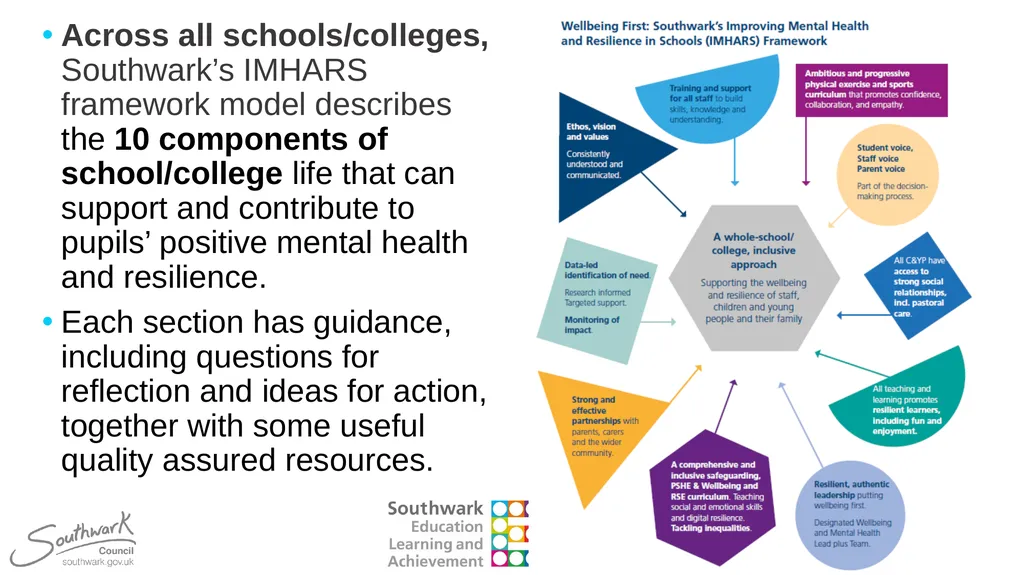
Across all schools/colleges, Southwark’s IMHARS framework model describes the 10 components of school/college life that can support and contribute to pupils’ positive mental health and resilience.
Each section has guidance, including questions for reflection and ideas for action, together with some useful quality assured resources.<br>
Each section has guidance, including questions for reflection and ideas for action, together with some useful quality assured resources.<br>
03
Tuke School - IMHARS Project Aims Emotional Wellbeing, Mental Health & Resilience Building Priority :
Enrichment and social activities appropriate to the severe, profound and complex needs
that will support them to self-regulate, manage individual stress and anxiety and
improve their sense of wellbeing and engagement with supports.
This included:
(1) Working with local creative partners to design projects suitable for the students at Tuke
(2) Intensive interaction opportunities will be embedded and consolidated to support communication.
(3) Embed wellbeing in personal development, enabling the special school staff team to develop the skills , knowledge and understanding, to provide support to each other, so that they can support the wellbeing and resilience of the student group they work with daily.
(4) Regulation/zones of regulation to assist in being able to emotionally regulate
(5) Parent/child enrichment activities to support those who are experiencing high levels of anxiety and stress<br>
Enrichment and social activities appropriate to the severe, profound and complex needs
that will support them to self-regulate, manage individual stress and anxiety and
improve their sense of wellbeing and engagement with supports.
This included:
(1) Working with local creative partners to design projects suitable for the students at Tuke
(2) Intensive interaction opportunities will be embedded and consolidated to support communication.
(3) Embed wellbeing in personal development, enabling the special school staff team to develop the skills , knowledge and understanding, to provide support to each other, so that they can support the wellbeing and resilience of the student group they work with daily.
(4) Regulation/zones of regulation to assist in being able to emotionally regulate
(5) Parent/child enrichment activities to support those who are experiencing high levels of anxiety and stress<br>
04
Ongoing Results and Impact at Tuke School (1) Creative partnerships
(a) ‘The Wheel of Creativity’ was designed by a teacher as part of his appraisal whilst working in partnership with The South London Gallery.
He produced a model of creative thinking that can be used as a reference for all teachers and SSSA’s when planning and delivering learning.
In working with teachers to complete this we discussed the framework to consider how they are planning to include elements of creative pedagogies.
(b) To support year 6-7 transition we designed a collaborative art project between Tuke and Cherry Garden school.
The partnership link with Cherry Garden school was successful with each Tuke teacher having a link teacher at Cherry Garden.
Each pair of classes worked together via virtual platforms to engage and create their individual mobiles.
Finished products were shared across the schools so that work from both schools have contributed to the final pieces in each school.
Year 7 students who arrived in September were able to recognise familiar work in their new secondary provision.
(2) Intensive interaction opportunities
(a) Virtual sessions from a music therapist were organised for students working at home.
As a result of this we introduced music therapy back into the school curriculum in partnership with Nordoff Robbins.
We have been fortunate in securing external funding for a music therapist for one year. Students in school can now benefit from face to face music therapy provision.
(b) Staff have worked with the SALT and CENMAC to consider how they facilitate opportunities and capitalize on moments when students initiate communication.
(c) Drumming project with Drumhead
(d) SPACE framework was created and introduced for students with PMLD (Sensory, partnerships, Access, Communication, Energy) which sits alongside SPELL for our students with ASD
(e) Joint training with Cherry Garden staff for SENSE football
(3) Staff wellbeing
We created a ‘wellbeing’ room within school.
This can be used by staff when they need space, feel overwhelmed or anxious.
They can use it by themselves of invite another member of staff into the space should they feel this would be supportive for them.
(b) A wellbeing programme for the whole year has been made available to staff. Attendance is optional.
These sessions are providing staff with new and interesting ways to consider their own well-being and mental health linked to the 5 ways for wellbeing. Connect
Be Active
Give
Learn
Be in the moment<br>
(a) ‘The Wheel of Creativity’ was designed by a teacher as part of his appraisal whilst working in partnership with The South London Gallery.
He produced a model of creative thinking that can be used as a reference for all teachers and SSSA’s when planning and delivering learning.
In working with teachers to complete this we discussed the framework to consider how they are planning to include elements of creative pedagogies.
(b) To support year 6-7 transition we designed a collaborative art project between Tuke and Cherry Garden school.
The partnership link with Cherry Garden school was successful with each Tuke teacher having a link teacher at Cherry Garden.
Each pair of classes worked together via virtual platforms to engage and create their individual mobiles.
Finished products were shared across the schools so that work from both schools have contributed to the final pieces in each school.
Year 7 students who arrived in September were able to recognise familiar work in their new secondary provision.
(2) Intensive interaction opportunities
(a) Virtual sessions from a music therapist were organised for students working at home.
As a result of this we introduced music therapy back into the school curriculum in partnership with Nordoff Robbins.
We have been fortunate in securing external funding for a music therapist for one year. Students in school can now benefit from face to face music therapy provision.
(b) Staff have worked with the SALT and CENMAC to consider how they facilitate opportunities and capitalize on moments when students initiate communication.
(c) Drumming project with Drumhead
(d) SPACE framework was created and introduced for students with PMLD (Sensory, partnerships, Access, Communication, Energy) which sits alongside SPELL for our students with ASD
(e) Joint training with Cherry Garden staff for SENSE football
(3) Staff wellbeing
We created a ‘wellbeing’ room within school.
This can be used by staff when they need space, feel overwhelmed or anxious.
They can use it by themselves of invite another member of staff into the space should they feel this would be supportive for them.
(b) A wellbeing programme for the whole year has been made available to staff. Attendance is optional.
These sessions are providing staff with new and interesting ways to consider their own well-being and mental health linked to the 5 ways for wellbeing. Connect
Be Active
Give
Learn
Be in the moment<br>
05
Ongoing Results and Impact at Tuke School (4) Zones of Regulation
A whole school approach has been refined and agreed with visual references
(b) Zones of regulation were adapted for our PMLD learners with a sensory tactile set of object of reference
Students are provided with a “tool box” of ideas and activities personal to them in order to emotionally regulate
(c) Areas within each key stage are set up with sensory circuits for alerting, calming, organising
(d) Staff have attended Sensory Streets training to support innovative creation of alerting zones
(5) Parent/child enrichment activities to support those who are experiencing high levels of anxiety and stress
Parent meetings and workshops
After school club provision Connect
Be Active
Give
Learn
Be in the moment<br>
A whole school approach has been refined and agreed with visual references
(b) Zones of regulation were adapted for our PMLD learners with a sensory tactile set of object of reference
Students are provided with a “tool box” of ideas and activities personal to them in order to emotionally regulate
(c) Areas within each key stage are set up with sensory circuits for alerting, calming, organising
(d) Staff have attended Sensory Streets training to support innovative creation of alerting zones
(5) Parent/child enrichment activities to support those who are experiencing high levels of anxiety and stress
Parent meetings and workshops
After school club provision Connect
Be Active
Give
Learn
Be in the moment<br>
06
Project Strengths at Tuke School Emotional Wellbeing, Mental Health & Resilience Building
Staff at Tuke are regularly using zones of regulation (ZoR) to check in with students. Activities bespoke to individuals are available to help self-regulation. SPELL and SPACE frameworks for individuals use ZoR as a positive approach and a way to emphasize with student when they are not emotionally regulated.
The curriculum offer at Tuke is rich with creative opportunities.
Innovation
Staff survey results indicate that staff feel that their well-being and mental health is important.
(a) A bespoke Mental health activity week for staff was introduced and was very popular and will continue for future years. Training and INSET opportunities have been linked to Minds ‘Five ways to wellbeing’ and this facilitates an alternative way to think about these opportunities.
(b)The school appraisal and return to work meeting have a focus on wellbeing and mental health and provide an opportunity for staff to speak confidentially
(c)#haveyoursay – monthly meetings with the Headteacher for SSSA staff to make suggestions for school improvement
(d)The MOVE program offers opportunities for students to “be active” . Case study presented at MOVE Europe for student who has made significant progress with his MOVE goals. Focus on presentation was for innovative use of equipment in the environment and community for practising skills.<br>
Staff at Tuke are regularly using zones of regulation (ZoR) to check in with students. Activities bespoke to individuals are available to help self-regulation. SPELL and SPACE frameworks for individuals use ZoR as a positive approach and a way to emphasize with student when they are not emotionally regulated.
The curriculum offer at Tuke is rich with creative opportunities.
Innovation
Staff survey results indicate that staff feel that their well-being and mental health is important.
(a) A bespoke Mental health activity week for staff was introduced and was very popular and will continue for future years. Training and INSET opportunities have been linked to Minds ‘Five ways to wellbeing’ and this facilitates an alternative way to think about these opportunities.
(b)The school appraisal and return to work meeting have a focus on wellbeing and mental health and provide an opportunity for staff to speak confidentially
(c)#haveyoursay – monthly meetings with the Headteacher for SSSA staff to make suggestions for school improvement
(d)The MOVE program offers opportunities for students to “be active” . Case study presented at MOVE Europe for student who has made significant progress with his MOVE goals. Focus on presentation was for innovative use of equipment in the environment and community for practising skills.<br>
07
Lessons Learnt and Sustainability Lessons Learnt
Emotional Wellbeing, Mental Health & Resilience Building
We received feedback from staff that it takes a while for student to be able to share their views and feelings and that as they are ready and feel confident to have a conversation staff need to make themselves available and open to listening. This is not always easy in a very busy school timetable.
Innovation
To bring in specialist professional to provide insight based on research into wellbeing and mental health for staff awareness training – as part of wellbeing day
This year out wellbeing day for staff included – singing, aqua aerobics, pilates, life drawing, box fit, gong bath, sensory dome, meditation, board games
Sustainability
Emotional Wellbeing, Mental Health & Resilience Building
Parents and student wellbeing strategy with an action plan is in consultation.
Innovation
The investment in staff wellbeing and mental health has had a positive impact on student wellbeing. It would appear that giving staff an opportunity to focus on their own wellbeing has enabled them to be more empathetic with what the students may need.
Board games briefing has now become a half termly event – following the introduction during Wellbeing Day - #haveyoursay feedback was that they would like regular opportunities to play games together<br>
Emotional Wellbeing, Mental Health & Resilience Building
We received feedback from staff that it takes a while for student to be able to share their views and feelings and that as they are ready and feel confident to have a conversation staff need to make themselves available and open to listening. This is not always easy in a very busy school timetable.
Innovation
To bring in specialist professional to provide insight based on research into wellbeing and mental health for staff awareness training – as part of wellbeing day
This year out wellbeing day for staff included – singing, aqua aerobics, pilates, life drawing, box fit, gong bath, sensory dome, meditation, board games
Sustainability
Emotional Wellbeing, Mental Health & Resilience Building
Parents and student wellbeing strategy with an action plan is in consultation.
Innovation
The investment in staff wellbeing and mental health has had a positive impact on student wellbeing. It would appear that giving staff an opportunity to focus on their own wellbeing has enabled them to be more empathetic with what the students may need.
Board games briefing has now become a half termly event – following the introduction during Wellbeing Day - #haveyoursay feedback was that they would like regular opportunities to play games together<br>
08
Next Steps and Ongoing Progress.. Sensory streets implementation
MOVE Training for all staff for practitioner and senior practitioner so that staff can support students with mobility difficulties to use sensory circuits
Roundhouse project to support Creativity in and teacher planning
Urban Health Project for reducing anxiety in students
Student and parent surveys
Parent workshops with students
Parent mornings - cenmac, play, sensory dome, MOVE at home
After school Arts Award club<br>
MOVE Training for all staff for practitioner and senior practitioner so that staff can support students with mobility difficulties to use sensory circuits
Roundhouse project to support Creativity in and teacher planning
Urban Health Project for reducing anxiety in students
Student and parent surveys
Parent workshops with students
Parent mornings - cenmac, play, sensory dome, MOVE at home
After school Arts Award club<br>