
From Theory to Practice: Treating Patients with
OM
Published · 15 slides · 0 views

1 / 1



Description
From Theory to Practice: Treating Patients with Obesity Module 12 Thank you for using the FORWARD: Focus on Obesity Education curriculum. Welcome to the FORWARD: Focus on Obesity Education curriculum. FORWARD was funded by Novo Nordisk Inc.
Related Topics
Share
Embed code
Download this presentation From Below
"From Theory to Practice: Treating Patients with" is the property of its rightful owner. Permission is granted to download and print the materials on this website for personal, non-commercial use only, and to display it on your personal computer provided you do not modify the materials and that you retain all copyright notices contained in the materials. By downloading content from our website, you accept the terms of this agreement.
Presentation Transcript
01
From Theory to Practice: Treating Patients with Obesity Module 12<br>
02
Thank you for using the FORWARD: Focus on Obesity Education curriculum.
Welcome to the FORWARD: Focus on Obesity Education curriculum. FORWARD was funded by Novo Nordisk Inc. A third-party provider developed the curriculum’s content in consultation with Novo Nordisk Inc. and leading obesity clinician experts. FORWARD relies exclusively on open-source materials available to the general public.
The goal of FORWARD is to present a complete, accurate, non-promotional and fair-balanced picture of the current state of obesity. FORWARD is intended to inspire the development of obesity education in clinical professional schools, ensuring adequate training of future healthcare providers on the diagnosis and management of obesity. By choosing to access and browse this module of FORWARD, you acknowledge that you have read, understand and agreed to the FORWARD Terms of Use. If you do not agree with the FORWARD Terms of Use, you are not permitted to further access this module and should immediately discontinue your use. Double click to view: Content current as of August 2023<br>
Welcome to the FORWARD: Focus on Obesity Education curriculum. FORWARD was funded by Novo Nordisk Inc. A third-party provider developed the curriculum’s content in consultation with Novo Nordisk Inc. and leading obesity clinician experts. FORWARD relies exclusively on open-source materials available to the general public.
The goal of FORWARD is to present a complete, accurate, non-promotional and fair-balanced picture of the current state of obesity. FORWARD is intended to inspire the development of obesity education in clinical professional schools, ensuring adequate training of future healthcare providers on the diagnosis and management of obesity. By choosing to access and browse this module of FORWARD, you acknowledge that you have read, understand and agreed to the FORWARD Terms of Use. If you do not agree with the FORWARD Terms of Use, you are not permitted to further access this module and should immediately discontinue your use. Double click to view: Content current as of August 2023<br>
03
Learning outcomes After completing this module, the learner will be able to:
Apply knowledge of behavioral modifications, pharmacological treatments, and surgical procedures to develop comprehensive and personalized care plans for adults and children living with obesity that are in accordance with clinical guidelines<br>
Apply knowledge of behavioral modifications, pharmacological treatments, and surgical procedures to develop comprehensive and personalized care plans for adults and children living with obesity that are in accordance with clinical guidelines<br>
04
All patient profiles in this module are hypothetical and are provided
for educational purposes only Note:<br>
05
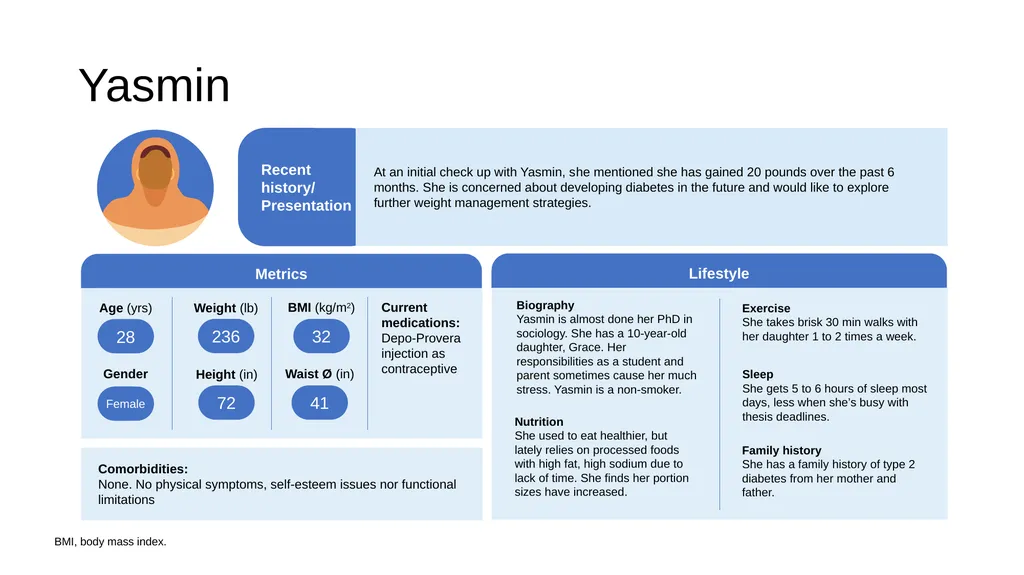
Yasmin BMI, body mass index. Metrics Recent history/
Presentation Age (yrs) Gender Weight (lb) Height (in) BMI (kg/m2) Waist Ø (in) Current medications:
Depo-Provera injection as contraceptive 28 Female 236 72 32 41 Biography
Yasmin is almost done her PhD in sociology. She has a 10-year-old daughter, Grace. Her responsibilities as a student and parent sometimes cause her much stress. Yasmin is a non-smoker. Nutrition
She used to eat healthier, but lately relies on processed foods with high fat, high sodium due to lack of time. She finds her portion sizes have increased. Exercise
She takes brisk 30 min walks with her daughter 1 to 2 times a week. Sleep
She gets 5 to 6 hours of sleep most days, less when she’s busy with thesis deadlines. Comorbidities:
None. No physical symptoms, self-esteem issues nor functional limitations At an initial check up with Yasmin, she mentioned she has gained 20 pounds over the past 6 months. She is concerned about developing diabetes in the future and would like to explore further weight management strategies. Family history
She has a family history of type 2 diabetes from her mother and father. Lifestyle<br>
Depo-Provera injection as contraceptive 28 Female 236 72 32 41 Biography
Yasmin is almost done her PhD in sociology. She has a 10-year-old daughter, Grace. Her responsibilities as a student and parent sometimes cause her much stress. Yasmin is a non-smoker. Nutrition
She used to eat healthier, but lately relies on processed foods with high fat, high sodium due to lack of time. She finds her portion sizes have increased. Exercise
She takes brisk 30 min walks with her daughter 1 to 2 times a week. Sleep
She gets 5 to 6 hours of sleep most days, less when she’s busy with thesis deadlines. Comorbidities:
None. No physical symptoms, self-esteem issues nor functional limitations At an initial check up with Yasmin, she mentioned she has gained 20 pounds over the past 6 months. She is concerned about developing diabetes in the future and would like to explore further weight management strategies. Family history
She has a family history of type 2 diabetes from her mother and father. Lifestyle<br>
06
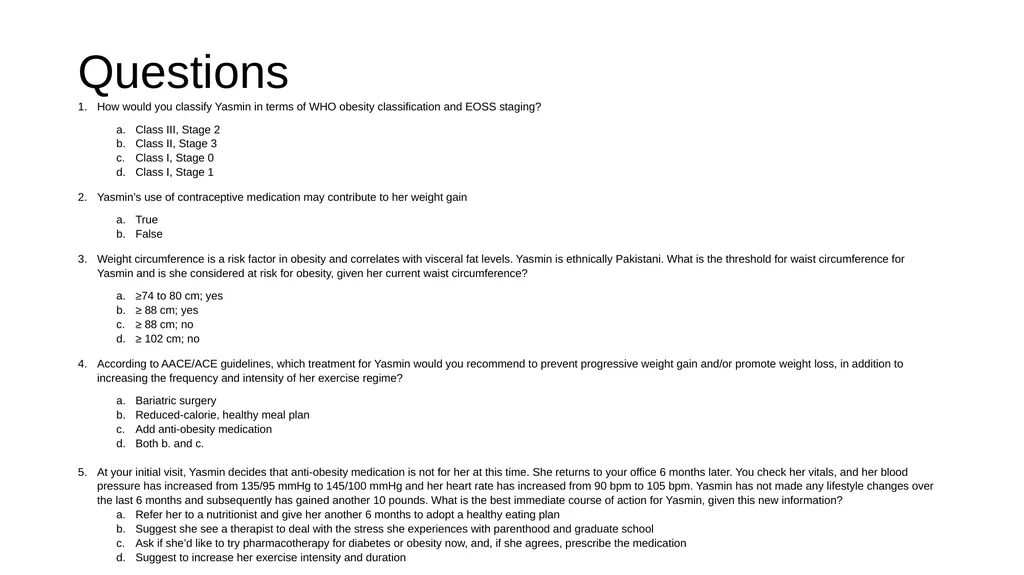
Questions How would you classify Yasmin in terms of WHO obesity classification and EOSS staging?
Class III, Stage 2
Class II, Stage 3
Class I, Stage 0
Class I, Stage 1
Yasmin’s use of contraceptive medication may contribute to her weight gain
True
False
Weight circumference is a risk factor in obesity and correlates with visceral fat levels. Yasmin is ethnically Pakistani. What is the threshold for waist circumference for Yasmin and is she considered at risk for obesity, given her current waist circumference?
≥74 to 80 cm; yes
≥ 88 cm; yes
≥ 88 cm; no
≥ 102 cm; no
According to AACE/ACE guidelines, which treatment for Yasmin would you recommend to prevent progressive weight gain and/or promote weight loss, in addition to increasing the frequency and intensity of her exercise regime?
Bariatric surgery
Reduced-calorie, healthy meal plan
Add anti-obesity medication
Both b. and c.
At your initial visit, Yasmin decides that anti-obesity medication is not for her at this time. She returns to your office 6 months later. You check her vitals, and her blood pressure has increased from 135/95 mmHg to 145/100 mmHg and her heart rate has increased from 90 bpm to 105 bpm. Yasmin has not made any lifestyle changes over the last 6 months and subsequently has gained another 10 pounds. What is the best immediate course of action for Yasmin, given this new information?
Refer her to a nutritionist and give her another 6 months to adopt a healthy eating plan
Suggest she see a therapist to deal with the stress she experiences with parenthood and graduate school
Ask if she’d like to try pharmacotherapy for diabetes or obesity now, and, if she agrees, prescribe the medication
Suggest to increase her exercise intensity and duration<br>
Class III, Stage 2
Class II, Stage 3
Class I, Stage 0
Class I, Stage 1
Yasmin’s use of contraceptive medication may contribute to her weight gain
True
False
Weight circumference is a risk factor in obesity and correlates with visceral fat levels. Yasmin is ethnically Pakistani. What is the threshold for waist circumference for Yasmin and is she considered at risk for obesity, given her current waist circumference?
≥74 to 80 cm; yes
≥ 88 cm; yes
≥ 88 cm; no
≥ 102 cm; no
According to AACE/ACE guidelines, which treatment for Yasmin would you recommend to prevent progressive weight gain and/or promote weight loss, in addition to increasing the frequency and intensity of her exercise regime?
Bariatric surgery
Reduced-calorie, healthy meal plan
Add anti-obesity medication
Both b. and c.
At your initial visit, Yasmin decides that anti-obesity medication is not for her at this time. She returns to your office 6 months later. You check her vitals, and her blood pressure has increased from 135/95 mmHg to 145/100 mmHg and her heart rate has increased from 90 bpm to 105 bpm. Yasmin has not made any lifestyle changes over the last 6 months and subsequently has gained another 10 pounds. What is the best immediate course of action for Yasmin, given this new information?
Refer her to a nutritionist and give her another 6 months to adopt a healthy eating plan
Suggest she see a therapist to deal with the stress she experiences with parenthood and graduate school
Ask if she’d like to try pharmacotherapy for diabetes or obesity now, and, if she agrees, prescribe the medication
Suggest to increase her exercise intensity and duration<br>
07
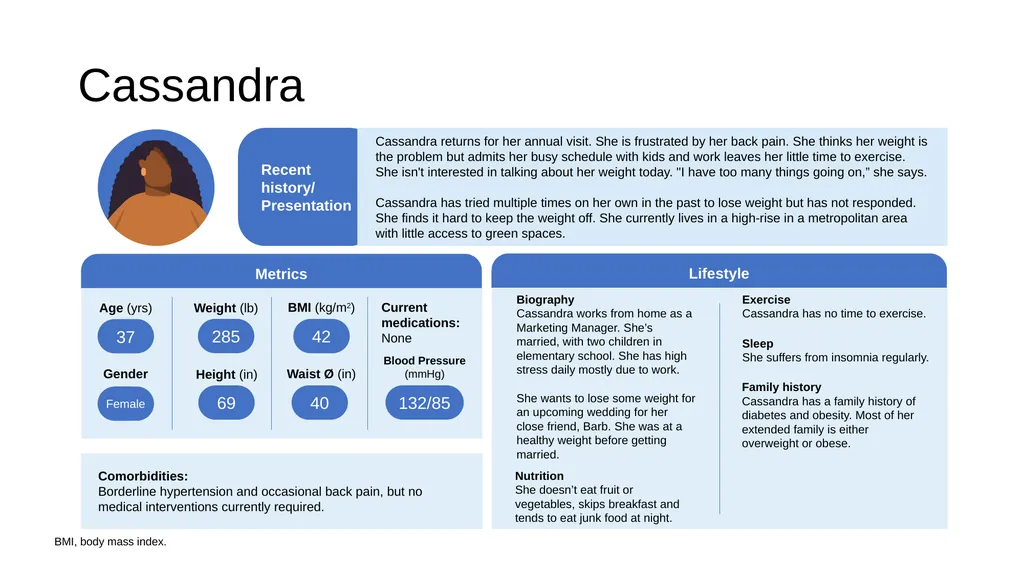
Cassandra BMI, body mass index. Metrics Recent history/
Presentation Age (yrs) Gender Weight (lb) Height (in) BMI (kg/m2) Waist Ø (in) Current medications:
None 37 Female 285 69 42 40 Biography
Cassandra works from home as a Marketing Manager. She’s married, with two children in elementary school. She has high stress daily mostly due to work.
She wants to lose some weight for an upcoming wedding for her close friend, Barb. She was at a healthy weight before getting married. Nutrition
She doesn’t eat fruit or vegetables, skips breakfast and tends to eat junk food at night. Exercise
Cassandra has no time to exercise. Sleep
She suffers from insomnia regularly. Comorbidities:
Borderline hypertension and occasional back pain, but no medical interventions currently required. Cassandra returns for her annual visit. She is frustrated by her back pain. She thinks her weight is the problem but admits her busy schedule with kids and work leaves her little time to exercise. She isn't interested in talking about her weight today. "I have too many things going on,” she says.
Cassandra has tried multiple times on her own in the past to lose weight but has not responded. She finds it hard to keep the weight off. She currently lives in a high-rise in a metropolitan area with little access to green spaces. Family history
Cassandra has a family history of diabetes and obesity. Most of her extended family is either overweight or obese. Lifestyle Blood Pressure (mmHg) 132/85<br>
None 37 Female 285 69 42 40 Biography
Cassandra works from home as a Marketing Manager. She’s married, with two children in elementary school. She has high stress daily mostly due to work.
She wants to lose some weight for an upcoming wedding for her close friend, Barb. She was at a healthy weight before getting married. Nutrition
She doesn’t eat fruit or vegetables, skips breakfast and tends to eat junk food at night. Exercise
Cassandra has no time to exercise. Sleep
She suffers from insomnia regularly. Comorbidities:
Borderline hypertension and occasional back pain, but no medical interventions currently required. Cassandra returns for her annual visit. She is frustrated by her back pain. She thinks her weight is the problem but admits her busy schedule with kids and work leaves her little time to exercise. She isn't interested in talking about her weight today. "I have too many things going on,” she says.
Cassandra has tried multiple times on her own in the past to lose weight but has not responded. She finds it hard to keep the weight off. She currently lives in a high-rise in a metropolitan area with little access to green spaces. Family history
Cassandra has a family history of diabetes and obesity. Most of her extended family is either overweight or obese. Lifestyle Blood Pressure (mmHg) 132/85<br>
08
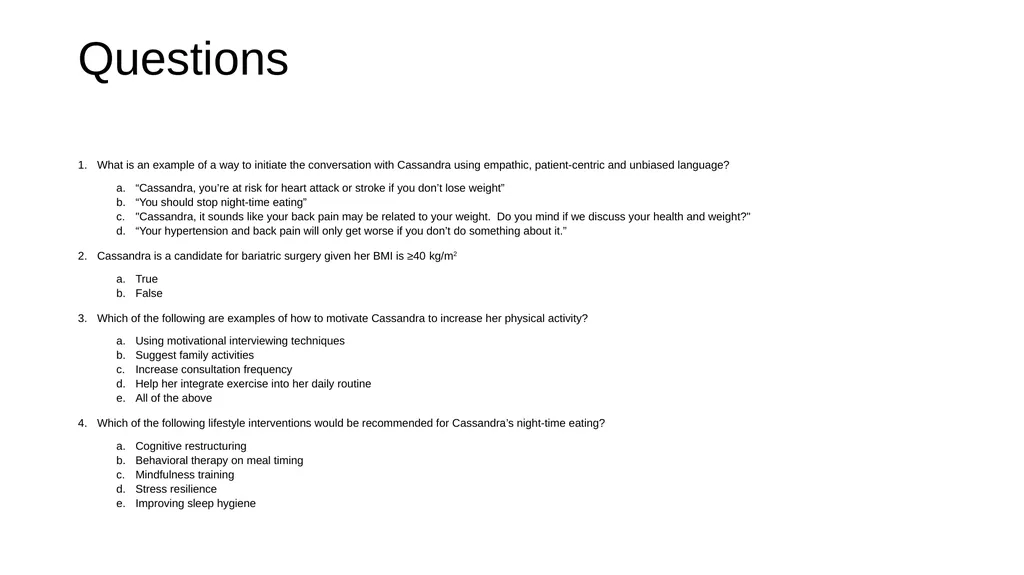
Questions What is an example of a way to initiate the conversation with Cassandra using empathic, patient-centric and unbiased language?
“Cassandra, you’re at risk for heart attack or stroke if you don’t lose weight”
“You should stop night-time eating”
"Cassandra, it sounds like your back pain may be related to your weight. Do you mind if we discuss your health and weight?"
“Your hypertension and back pain will only get worse if you don’t do something about it.”
Cassandra is a candidate for bariatric surgery given her BMI is ≥40 kg/m2
True
False
Which of the following are examples of how to motivate Cassandra to increase her physical activity?
Using motivational interviewing techniques
Suggest family activities
Increase consultation frequency
Help her integrate exercise into her daily routine
All of the above
Which of the following lifestyle interventions would be recommended for Cassandra’s night-time eating?
Cognitive restructuring
Behavioral therapy on meal timing
Mindfulness training
Stress resilience
Improving sleep hygiene<br>
“Cassandra, you’re at risk for heart attack or stroke if you don’t lose weight”
“You should stop night-time eating”
"Cassandra, it sounds like your back pain may be related to your weight. Do you mind if we discuss your health and weight?"
“Your hypertension and back pain will only get worse if you don’t do something about it.”
Cassandra is a candidate for bariatric surgery given her BMI is ≥40 kg/m2
True
False
Which of the following are examples of how to motivate Cassandra to increase her physical activity?
Using motivational interviewing techniques
Suggest family activities
Increase consultation frequency
Help her integrate exercise into her daily routine
All of the above
Which of the following lifestyle interventions would be recommended for Cassandra’s night-time eating?
Cognitive restructuring
Behavioral therapy on meal timing
Mindfulness training
Stress resilience
Improving sleep hygiene<br>
09
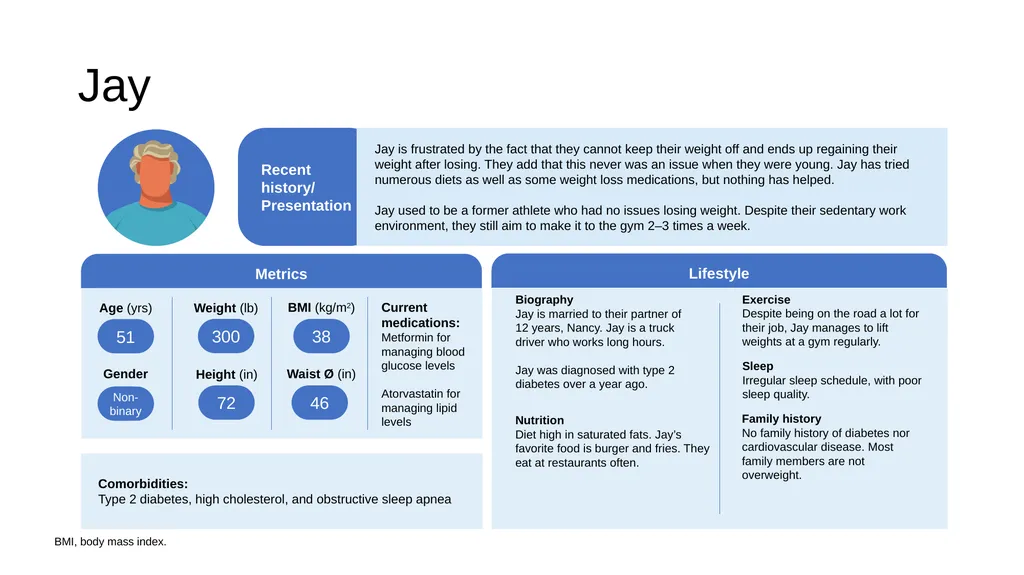
Jay BMI, body mass index. Metrics Recent history/
Presentation Age (yrs) Gender Weight (lb) Height (in) BMI (kg/m2) Waist Ø (in) Current medications:
Metformin for managing blood glucose levels
Atorvastatin for managing lipid levels 51 Non-binary 300 72 38 46 Biography
Jay is married to their partner of 12 years, Nancy. Jay is a truck driver who works long hours.
Jay was diagnosed with type 2 diabetes over a year ago. Nutrition
Diet high in saturated fats. Jay’s favorite food is burger and fries. They eat at restaurants often. Exercise
Despite being on the road a lot for their job, Jay manages to lift weights at a gym regularly. Sleep
Irregular sleep schedule, with poor sleep quality. Comorbidities:
Type 2 diabetes, high cholesterol, and obstructive sleep apnea Jay is frustrated by the fact that they cannot keep their weight off and ends up regaining their weight after losing. They add that this never was an issue when they were young. Jay has tried numerous diets as well as some weight loss medications, but nothing has helped.
Jay used to be a former athlete who had no issues losing weight. Despite their sedentary work environment, they still aim to make it to the gym 2–3 times a week. Family history
No family history of diabetes nor cardiovascular disease. Most family members are not overweight. Lifestyle<br>
Metformin for managing blood glucose levels
Atorvastatin for managing lipid levels 51 Non-binary 300 72 38 46 Biography
Jay is married to their partner of 12 years, Nancy. Jay is a truck driver who works long hours.
Jay was diagnosed with type 2 diabetes over a year ago. Nutrition
Diet high in saturated fats. Jay’s favorite food is burger and fries. They eat at restaurants often. Exercise
Despite being on the road a lot for their job, Jay manages to lift weights at a gym regularly. Sleep
Irregular sleep schedule, with poor sleep quality. Comorbidities:
Type 2 diabetes, high cholesterol, and obstructive sleep apnea Jay is frustrated by the fact that they cannot keep their weight off and ends up regaining their weight after losing. They add that this never was an issue when they were young. Jay has tried numerous diets as well as some weight loss medications, but nothing has helped.
Jay used to be a former athlete who had no issues losing weight. Despite their sedentary work environment, they still aim to make it to the gym 2–3 times a week. Family history
No family history of diabetes nor cardiovascular disease. Most family members are not overweight. Lifestyle<br>
10
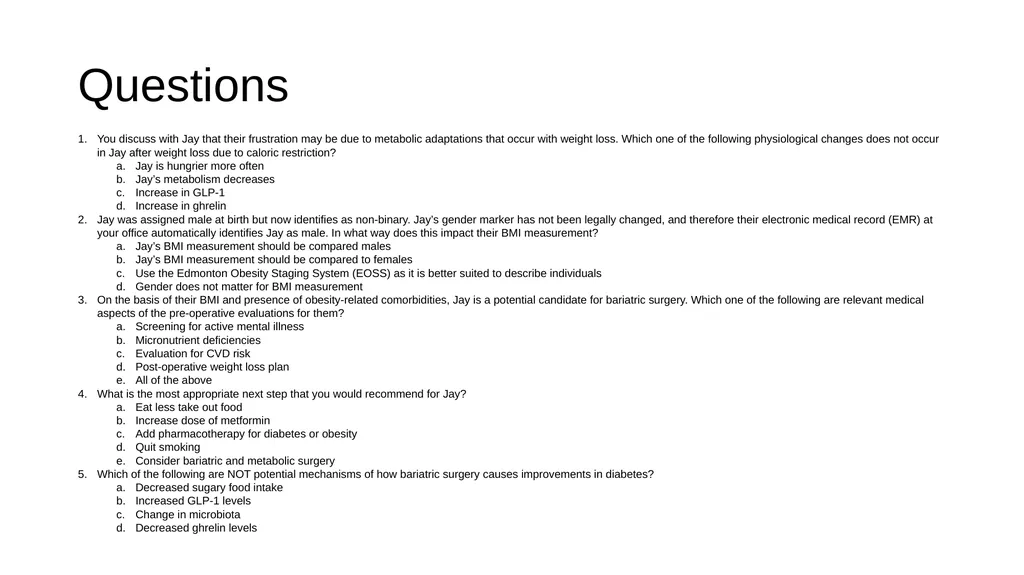
Questions You discuss with Jay that their frustration may be due to metabolic adaptations that occur with weight loss. Which one of the following physiological changes does not occur in Jay after weight loss due to caloric restriction?
Jay is hungrier more often
Jay’s metabolism decreases
Increase in GLP-1
Increase in ghrelin
Jay was assigned male at birth but now identifies as non-binary. Jay’s gender marker has not been legally changed, and therefore their electronic medical record (EMR) at your office automatically identifies Jay as male. In what way does this impact their BMI measurement?
Jay’s BMI measurement should be compared males
Jay’s BMI measurement should be compared to females
Use the Edmonton Obesity Staging System (EOSS) as it is better suited to describe individuals
Gender does not matter for BMI measurement
On the basis of their BMI and presence of obesity-related comorbidities, Jay is a potential candidate for bariatric surgery. Which one of the following are relevant medical aspects of the pre-operative evaluations for them?
Screening for active mental illness
Micronutrient deficiencies
Evaluation for CVD risk
Post-operative weight loss plan
All of the above
What is the most appropriate next step that you would recommend for Jay?
Eat less take out food
Increase dose of metformin
Add pharmacotherapy for diabetes or obesity
Quit smoking
Consider bariatric and metabolic surgery
Which of the following are NOT potential mechanisms of how bariatric surgery causes improvements in diabetes?
Decreased sugary food intake
Increased GLP-1 levels
Change in microbiota
Decreased ghrelin levels<br>
Jay is hungrier more often
Jay’s metabolism decreases
Increase in GLP-1
Increase in ghrelin
Jay was assigned male at birth but now identifies as non-binary. Jay’s gender marker has not been legally changed, and therefore their electronic medical record (EMR) at your office automatically identifies Jay as male. In what way does this impact their BMI measurement?
Jay’s BMI measurement should be compared males
Jay’s BMI measurement should be compared to females
Use the Edmonton Obesity Staging System (EOSS) as it is better suited to describe individuals
Gender does not matter for BMI measurement
On the basis of their BMI and presence of obesity-related comorbidities, Jay is a potential candidate for bariatric surgery. Which one of the following are relevant medical aspects of the pre-operative evaluations for them?
Screening for active mental illness
Micronutrient deficiencies
Evaluation for CVD risk
Post-operative weight loss plan
All of the above
What is the most appropriate next step that you would recommend for Jay?
Eat less take out food
Increase dose of metformin
Add pharmacotherapy for diabetes or obesity
Quit smoking
Consider bariatric and metabolic surgery
Which of the following are NOT potential mechanisms of how bariatric surgery causes improvements in diabetes?
Decreased sugary food intake
Increased GLP-1 levels
Change in microbiota
Decreased ghrelin levels<br>
11
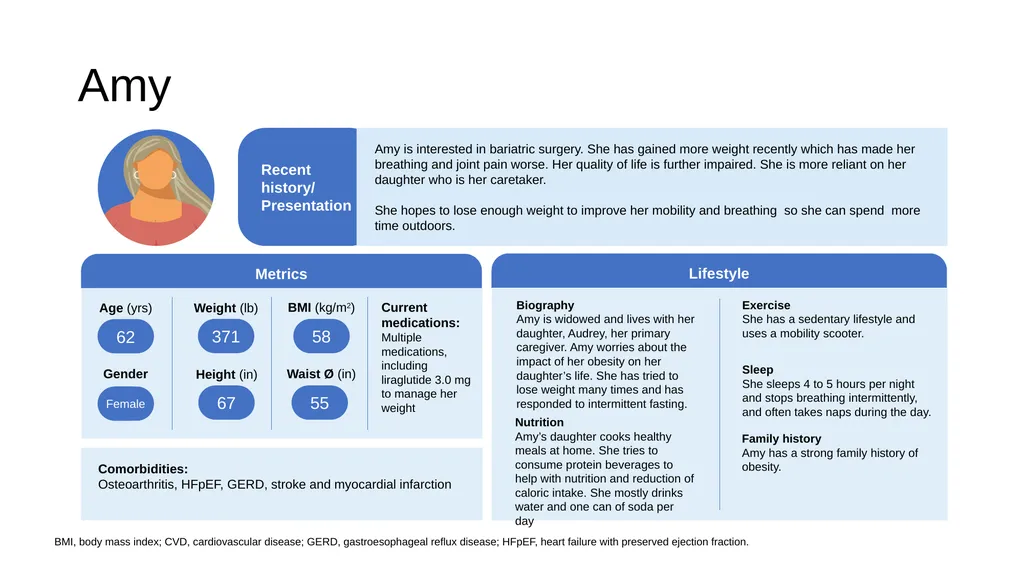
Amy Metrics Recent history/
Presentation Age (yrs) Gender Weight (lb) Height (in) BMI (kg/m2) Waist Ø (in) Current medications:
Multiple medications, including liraglutide 3.0 mg to manage her weight 62 Female 371 67 58 55 Biography
Amy is widowed and lives with her daughter, Audrey, her primary caregiver. Amy worries about the impact of her obesity on her daughter’s life. She has tried to lose weight many times and has responded to intermittent fasting. Nutrition
Amy’s daughter cooks healthy meals at home. She tries to consume protein beverages to help with nutrition and reduction of caloric intake. She mostly drinks water and one can of soda per day Exercise
She has a sedentary lifestyle and uses a mobility scooter. Sleep
She sleeps 4 to 5 hours per night and stops breathing intermittently, and often takes naps during the day. Comorbidities:
Osteoarthritis, HFpEF, GERD, stroke and myocardial infarction Amy is interested in bariatric surgery. She has gained more weight recently which has made her breathing and joint pain worse. Her quality of life is further impaired. She is more reliant on her daughter who is her caretaker.
She hopes to lose enough weight to improve her mobility and breathing so she can spend more time outdoors. Family history
Amy has a strong family history of obesity. Lifestyle BMI, body mass index; CVD, cardiovascular disease; GERD, gastroesophageal reflux disease; HFpEF, heart failure with preserved ejection fraction.<br>
Multiple medications, including liraglutide 3.0 mg to manage her weight 62 Female 371 67 58 55 Biography
Amy is widowed and lives with her daughter, Audrey, her primary caregiver. Amy worries about the impact of her obesity on her daughter’s life. She has tried to lose weight many times and has responded to intermittent fasting. Nutrition
Amy’s daughter cooks healthy meals at home. She tries to consume protein beverages to help with nutrition and reduction of caloric intake. She mostly drinks water and one can of soda per day Exercise
She has a sedentary lifestyle and uses a mobility scooter. Sleep
She sleeps 4 to 5 hours per night and stops breathing intermittently, and often takes naps during the day. Comorbidities:
Osteoarthritis, HFpEF, GERD, stroke and myocardial infarction Amy is interested in bariatric surgery. She has gained more weight recently which has made her breathing and joint pain worse. Her quality of life is further impaired. She is more reliant on her daughter who is her caretaker.
She hopes to lose enough weight to improve her mobility and breathing so she can spend more time outdoors. Family history
Amy has a strong family history of obesity. Lifestyle BMI, body mass index; CVD, cardiovascular disease; GERD, gastroesophageal reflux disease; HFpEF, heart failure with preserved ejection fraction.<br>
12
Questions How would you classify Amy in terms of WHO obesity classification and EOSS staging?
Class I, Stage 3
Class II, Stage 1
Class III, Stage 3
Class III, Stage 4
Amy has unfortunately experienced negative encounters from her previous healthcare providers. Which of the following is an example of weight stigma and discrimination?
The nurse gives Amy an appropriately sized gown before she is examined by the doctor
PCP mentions that she is “morbidly obese” and thinks she should not have surgery, but rather focus on her eating problems
A medical assistant asks permission to weigh Amy, then guides her to the scale in a secluded area
The radiology tech told her that she is too big for the MRI and will have to be rescheduled in a different radiology suite with a different MRI that holds larger weights
What cardiovascular improvements can Amy expect due to significant weight loss?
Reduced frequency of apneic events
Improvements in functional capacity and increased strength
Increase in her ejection fraction
Reduced blood pressure
All of the above
In evaluating Amy for metabolic and bariatric surgery, what recommendations would you make?
Recommend she stop drinking soda before surgery
Recommend she see a psychiatrist for evaluation of depression prior to surgery
No physical activity recommendation is needed before surgery because she is has good functional capacity
Evaluation for sleep apnea<br>
Class I, Stage 3
Class II, Stage 1
Class III, Stage 3
Class III, Stage 4
Amy has unfortunately experienced negative encounters from her previous healthcare providers. Which of the following is an example of weight stigma and discrimination?
The nurse gives Amy an appropriately sized gown before she is examined by the doctor
PCP mentions that she is “morbidly obese” and thinks she should not have surgery, but rather focus on her eating problems
A medical assistant asks permission to weigh Amy, then guides her to the scale in a secluded area
The radiology tech told her that she is too big for the MRI and will have to be rescheduled in a different radiology suite with a different MRI that holds larger weights
What cardiovascular improvements can Amy expect due to significant weight loss?
Reduced frequency of apneic events
Improvements in functional capacity and increased strength
Increase in her ejection fraction
Reduced blood pressure
All of the above
In evaluating Amy for metabolic and bariatric surgery, what recommendations would you make?
Recommend she stop drinking soda before surgery
Recommend she see a psychiatrist for evaluation of depression prior to surgery
No physical activity recommendation is needed before surgery because she is has good functional capacity
Evaluation for sleep apnea<br>
13
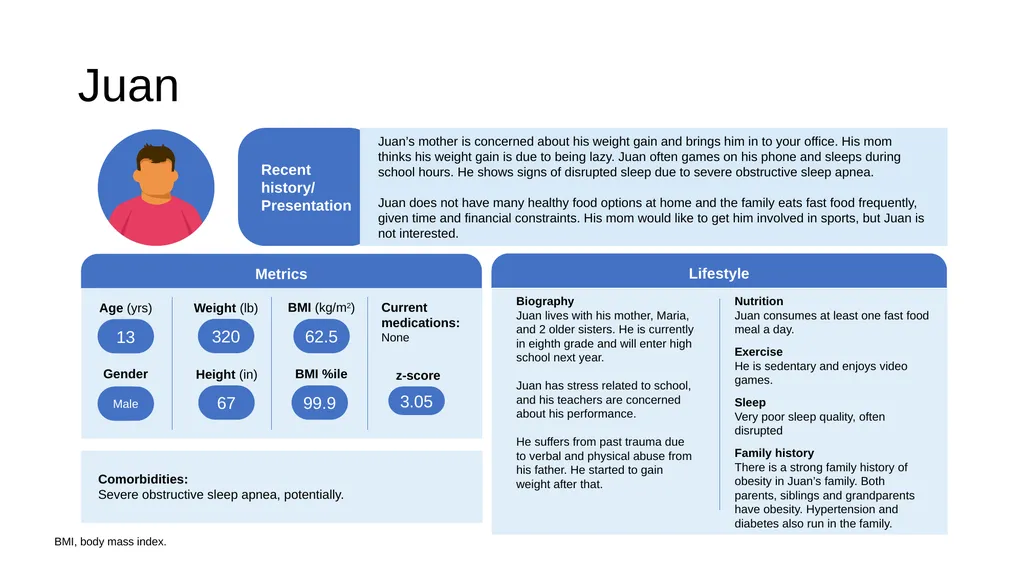
Juan Metrics Recent history/
Presentation Age (yrs) Gender Weight (lb) Height (in) BMI (kg/m2) BMI %ile Current medications:
None 13 Male 320 67 62.5 99.9 Biography
Juan lives with his mother, Maria, and 2 older sisters. He is currently in eighth grade and will enter high school next year.
Juan has stress related to school, and his teachers are concerned about his performance.
He suffers from past trauma due to verbal and physical abuse from his father. He started to gain weight after that. Nutrition
Juan consumes at least one fast food meal a day. Exercise
He is sedentary and enjoys video games. Sleep
Very poor sleep quality, often disrupted Comorbidities:
Severe obstructive sleep apnea, potentially. Juan’s mother is concerned about his weight gain and brings him in to your office. His mom thinks his weight gain is due to being lazy. Juan often games on his phone and sleeps during school hours. He shows signs of disrupted sleep due to severe obstructive sleep apnea.
Juan does not have many healthy food options at home and the family eats fast food frequently, given time and financial constraints. His mom would like to get him involved in sports, but Juan is not interested. Family history
There is a strong family history of obesity in Juan’s family. Both parents, siblings and grandparents have obesity. Hypertension and diabetes also run in the family. Lifestyle z-score 3.05 BMI, body mass index.<br>
None 13 Male 320 67 62.5 99.9 Biography
Juan lives with his mother, Maria, and 2 older sisters. He is currently in eighth grade and will enter high school next year.
Juan has stress related to school, and his teachers are concerned about his performance.
He suffers from past trauma due to verbal and physical abuse from his father. He started to gain weight after that. Nutrition
Juan consumes at least one fast food meal a day. Exercise
He is sedentary and enjoys video games. Sleep
Very poor sleep quality, often disrupted Comorbidities:
Severe obstructive sleep apnea, potentially. Juan’s mother is concerned about his weight gain and brings him in to your office. His mom thinks his weight gain is due to being lazy. Juan often games on his phone and sleeps during school hours. He shows signs of disrupted sleep due to severe obstructive sleep apnea.
Juan does not have many healthy food options at home and the family eats fast food frequently, given time and financial constraints. His mom would like to get him involved in sports, but Juan is not interested. Family history
There is a strong family history of obesity in Juan’s family. Both parents, siblings and grandparents have obesity. Hypertension and diabetes also run in the family. Lifestyle z-score 3.05 BMI, body mass index.<br>
14
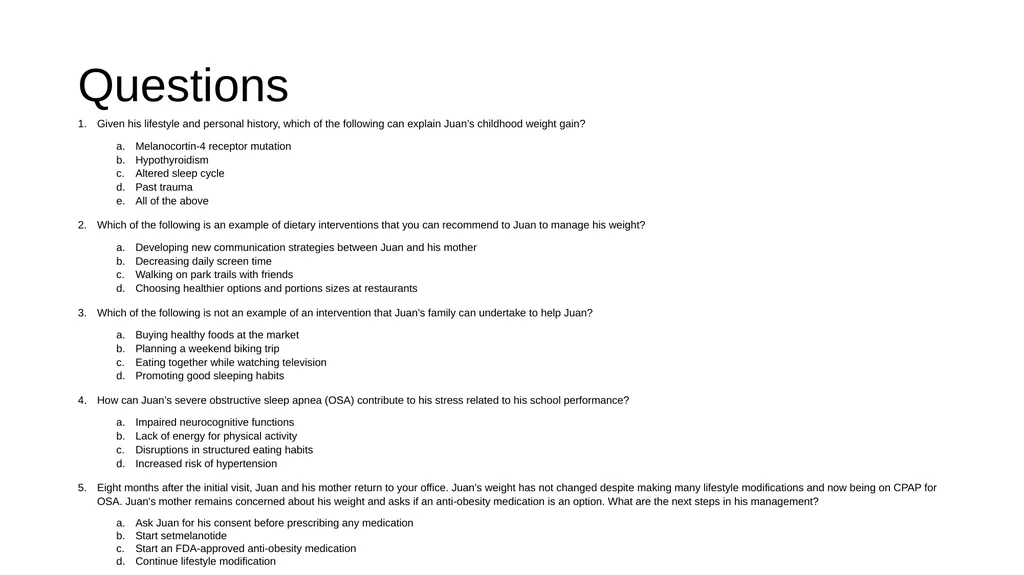
Questions Given his lifestyle and personal history, which of the following can explain Juan’s childhood weight gain?
Melanocortin-4 receptor mutation
Hypothyroidism
Altered sleep cycle
Past trauma
All of the above
Which of the following is an example of dietary interventions that you can recommend to Juan to manage his weight?
Developing new communication strategies between Juan and his mother
Decreasing daily screen time
Walking on park trails with friends
Choosing healthier options and portions sizes at restaurants
Which of the following is not an example of an intervention that Juan’s family can undertake to help Juan?
Buying healthy foods at the market
Planning a weekend biking trip
Eating together while watching television
Promoting good sleeping habits
How can Juan’s severe obstructive sleep apnea (OSA) contribute to his stress related to his school performance?
Impaired neurocognitive functions
Lack of energy for physical activity
Disruptions in structured eating habits
Increased risk of hypertension
Eight months after the initial visit, Juan and his mother return to your office. Juan's weight has not changed despite making many lifestyle modifications and now being on CPAP for OSA. Juan's mother remains concerned about his weight and asks if an anti-obesity medication is an option. What are the next steps in his management?
Ask Juan for his consent before prescribing any medication
Start setmelanotide
Start an FDA-approved anti-obesity medication
Continue lifestyle modification<br>
Melanocortin-4 receptor mutation
Hypothyroidism
Altered sleep cycle
Past trauma
All of the above
Which of the following is an example of dietary interventions that you can recommend to Juan to manage his weight?
Developing new communication strategies between Juan and his mother
Decreasing daily screen time
Walking on park trails with friends
Choosing healthier options and portions sizes at restaurants
Which of the following is not an example of an intervention that Juan’s family can undertake to help Juan?
Buying healthy foods at the market
Planning a weekend biking trip
Eating together while watching television
Promoting good sleeping habits
How can Juan’s severe obstructive sleep apnea (OSA) contribute to his stress related to his school performance?
Impaired neurocognitive functions
Lack of energy for physical activity
Disruptions in structured eating habits
Increased risk of hypertension
Eight months after the initial visit, Juan and his mother return to your office. Juan's weight has not changed despite making many lifestyle modifications and now being on CPAP for OSA. Juan's mother remains concerned about his weight and asks if an anti-obesity medication is an option. What are the next steps in his management?
Ask Juan for his consent before prescribing any medication
Start setmelanotide
Start an FDA-approved anti-obesity medication
Continue lifestyle modification<br>
15
Interactive case-based learning tool developed for, and funded by,
Novo Nordisk Inc.
Provides simulated interactions in real-time feedback, and streamlined interoperability communication. Click here or scan the QR code below, for an interactive learning experience, including the opportunity to practice hypothetical decision making and patient care<br>
Novo Nordisk Inc.
Provides simulated interactions in real-time feedback, and streamlined interoperability communication. Click here or scan the QR code below, for an interactive learning experience, including the opportunity to practice hypothetical decision making and patient care<br>